Digital Commons @ DU
Digital Commons @ DU
Library and Information Science: StudentCapstone Projects Library and Information Science: Student Scholarship
5-2015
Library and Information Science Education and eScience: The
Library and Information Science Education and eScience: The
Current State of ALA Accredited MLS/MLIS Programs in
Current State of ALA Accredited MLS/MLIS Programs in
Preparing Librarians and Information Professionals for eScience
Preparing Librarians and Information Professionals for eScience
Needs
Needs
Hanna Schmillen
University of Denver, [email protected]
Follow this and additional works at: https://digitalcommons.du.edu/lis_capstone Part of the Library and Information Science Commons
Recommended Citation Recommended Citation
Schmillen, Hanna, "Library and Information Science Education and eScience: The Current State of ALA Accredited MLS/MLIS Programs in Preparing Librarians and Information Professionals for eScience Needs" (2015). Library and Information Science: Student Capstone Projects. 1.
https://digitalcommons.du.edu/lis_capstone/1
This Capstone Project is brought to you for free and open access by the Library and Information Science: Student Scholarship at Digital Commons @ DU. It has been accepted for inclusion in Library and Information Science: Student Capstone Projects by an authorized administrator of Digital Commons @ DU. For more information, please contact [email protected],[email protected].
Library and Information Science Education and eScience: The Current State of ALA Accredited MLS/MLIS Programs in preparing Librarians and Information Professionals for eScience Needs
Hanna Schmillen
University of Denver, MLIS Candidate
Library and Information Science Program: Capstone Project May 26, 2015
Capstone Mentor: Shimelis Assefa Second Reader: Krystyna Matusiak
Abstract
The purpose of this study is multifaceted: 1) to describe eScience research in a comprehensive way; 2) to help library and information specialists understand the realm of eScience research and the information needs of the community and demonstrate the importance of LIS professionals within the eScience domain; 3) and to explore the current state of curricular content of ALA accredited MLS/MLIS programs to understand the extent to which they prepare new professionals within eScience librarianship. The literature review focuses heavily on eScientists and other data-driven researchers’ information service needs in addition to
demonstrating how and why librarians and information specialists can and should fulfill these service gaps and information needs within eScience research. By looking at the current curriculum of American Library Association (ALA) accredited MLS/MLIS programs, we can identify potential gaps in knowledge and where to improve in order to prepare and train new MLS/MLIS graduates to fulfill the needs of eScientists. This investigation is meant to be
informative and can be used as a tool for LIS programs to assess their curriculums in comparison to the needs of eScience and other data-driven and networked research. Finally, this investigation will provide awareness and insight into the services needed to support a thriving eScience and data-driven research community to the LIS profession.
Library and Information Science Education and eScience: The Current State of ALA Accredited MLS/MLIS Programs in preparing Librarians and Information Professionals for eScience Needs
Introduction
A problem facing librarians and information professionals today is properly providing relevant services to their eScience and data-driven research community. In addition, there is a lack of training for new LIS professionals in regards to eScience-related needs: data
management, database and information organization development, stable storage, and easy, long-term access. The ARL eScience Task Force and Working Group in 2010 surveyed libraries that were heavily involved within eScience initiatives. The survey revealed that 73% of the libraries that responded indicated that they were actively involved in using eScience methodology to support their community; through a variety of services (Soehner, 2010). However, one of the overlaying problems was and continues to be finding faculty and staff that have the expertise to provide eScience data preservation and management services within the library (Si, 2013). The demand for librarians and information specialists that are trained for eScience is clearly
increasing as ever-changing technology creates new science fields and massive amounts of data that needs to be collected, managed, accessible, and organized. Conversely, a quick review of the current Library and Information Science Master Programs accredited by the American Library Association (ALA) in the United States reveals that many programs do not offer deliberate specializations or tracks to train and prepare eScience librarians.
On the contrary, the generalized, primary mission of libraries is to support their
community by providing a variety of relevant, innovative services and resources that best suit the needs and wants of their specific community; and the eScience community is on the rise. To reiterate, MacColl and Jubb (2011) state, “…researchers have little interest in the support
services libraries have built for them in recent years, yet they are aware of support needs that are not being met” (p. 10). There is clearly a divide between library and information professional services and the actual needs of eScience researchers. One of the first steps to fulfilling an audience need is to first understand their essentials and how those services or products may be provided; so what services are truly needed by eScientists? What are the characteristics of
eScience research, methodology, and the community of practice? How is this field different from or similar to scientific scholarship, in general? How can we, the LIS field, train entering
librarians and information professionals to support these needs? What ALA accredited LIS programs are currently supporting and providing specializations and classes specific, if not relevant, to eScience needs? I will start the literature review with a definition of eScience to demonstrate perspective and service needs. Then I will validate the demand for eScience Librarianship within the field through other literature as well as career paths; followed by a summary of the current state of ALA Accredited programs in regards to eScience librarianship.
Literature Review What is eScience?
eScience is a term that encompasses many variations of the science fields and has been recognized as the fourth paradigm of science exploration. The scientific world is no longer separated by field of practice, but rather scientific exploration finds itself in a position where collaboration and multidisciplinary examination are the necessary commonality. As Edwards (2011, p. 670) emphasizes, “The Comtean hierarchy of physics, chemistry, and biology as driving disciplines is long gone, replaced by a massive proliferation of inter-disciplines…much of today’s most interesting and important science operates between domains.” This has come to pass due to the great accumulation of data and advancement of technology; what follows this
new access to incredible amounts of diverse, digital information is the great possibility of digital exploration within different fields and new perceptions; thus the phenomenon of eScience. eScience and data-driven research is most prevalent in the sciences, technology, engineering, and health sciences, but resides within multiple disciplines.
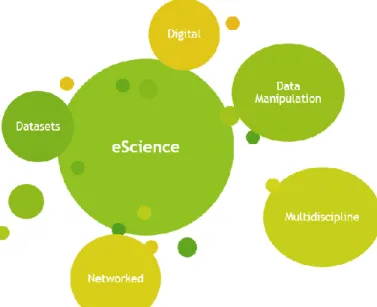
eScience refers to a digitally-enhanced, networked, data-driven science (Osswald, 2008). This accurate description of eScience by Osswald points out three of the central characteristics of eScience: digitally-enhanced, networked, and data-driven. The digitally-enhanced ration of eScience embodies how eScientists analyze, manage, and gain access to, and share the data— digitally. Without the technological advances of our time, as mentioned above, the amount of data we have access to and are able to create would significantly decrease. Almost exclusively through online databases, networks, shared digital repositories, and digital files, datasets are shared and therefore digitally accessible. Furthermore, manipulation of this data is performed through software analysis and other data mining tools; which fundamentally are digital methods. Which leads into the next portion of Osswald’s description: networked. Networked is a very important characteristic of eScience because this is what makes eScience so fascinating, the networked and multidisciplinary nature of the field that creates initially, unintended links among datasets. eScientists utilize networked data and material to formulate new information through cross-comparison and manipulation. This creates another form of scholarly communication that is networked and builds from one use to another; like how articles are connected through
citations and websites. Therefore, eScience thrives when datasets are shared and accessible. The final characteristic mentioned within Osswald’s description of eScience is data-driven. eScience exploration is achieved through data manipulation thus datasets are used as the primary form of experimentation. By manipulating and cross-comparing datasets, researchers are able to find
patterns and develop new inquiries across disciplines. The scholarship focuses on data manipulation and statistical analysis to improve upon a system or idea or to discover a new concept.
Networked, digital data analysis is an innovative way of discovery that researchers are able to more effectively utilize due to the complexity and 24/7 data access that technology has allowed to exploit. As new information technologies have been integrated, mass amounts of data has been created that needs to be controlled and easily retrievable (Joint, 2007) for manipulation and study within eScience as well as other data-driven fields. Every day new data is being collected, manipulated, created, and distributed through publications, digital repositories, networks, scholarly open access portals, among other channels. Implying that eScience has specialized needs and services to optimize its specific methodology, research, and access that all intertwine with one another.
Figure 1, listed below, is a visual representation of the definition of eScience and its components as described in the literature.
eScience essentials and skills
eScience research requires a variety of technological, data management, and customer services-related features to ensure stability, scientific integrity, and collaboration. These services can include a multitude of services and specialties: efficient and stable storage, data manipulation software for analysis, data management plans, and data preservation and curation services that ensure long-term, easy access, as well as share ability. One example of this may be access through digital repositories. And finally, professionals who can customize and maintain these services. Consequently, there are many different aspects of data management alone that are critical to researchers throughout the life cycle of data (Haendel, 2012). Furthermore, knowledge of funding agency restrictions and standards is a lifeline that determines whether the work will be funded or not. Thus grant writing expertise in addition to data analysis techniques and software that is used within the field are all needed skills.
In 2014, Weller surveyed all faculty researchers at the University of Kansas about their current and future data practices, influences, and needs. These results revealed that easy access and stability were the highest valued characteristics of data services at the time. Thus
demonstrating that one of the most foundational services are what were needed the most: storage and access in an efficient manner. This is a very common theme throughout data-driven research institutions: the need for stable, storage that is easy to maintain and access; which is a constant consideration to the library and information science (LIS) fields. Akers’ article from 2014 explored eight research universities (Cornell University, Emory University, Johns Hopkins University, Pennsylvania State University, Purdue University, University of Illinois at Urbana-Champaign, University of Michigan, and the University of Virginia) and their experiences with research data management (RDM) support. Each of these eight institutions mentioned the great
importance of supporting a solid infrastructure for their research community, a large portion being secure, stable storage that was easy for the researchers to access and maintain.
Antell further stresses the importance of librarians, science librarians in particular, to engage themselves within eScience and data management practices because:
“…many of the data management requirements involve the kind of work in which librarians already have expertise--organizing information, applying metadata standards, and providing access to information. For these reason, science librarians in particular are mobilizing to meet the needs that researchers face with the challenge of developing data management plans” (Antell, year p.3).
Not only does this stress the importance of LIS professionals, but it further demonstrates the need for information (in this case data) to be organized in a way (metadata, for example) that can be findable and thus useable and shareable.
Findability is key in order for data-driven research to survive. Not only for the purpose of finding and using data sets for exploration, but also in the realm of the scholarly communication cycle. Because eScience focuses on data exploration and the comparison and cross-analysis amongst multidisciplinary datasets, a discovery tool(s) need(s) to be put into place within data management in order for this to occur (McLean, 2015). Part of the discoverability of data would have to include metadata descriptions as well as indexing/abstracting systems to organize and create findability amongst datasets. This is a skill that LIS professionals have mastered in one way or another for decades now. However, because each dataset (historically) is created for a specific purpose within a research process, there is demand for subject-knowledge in order for metadata to be accurate. However, this type of deliberate data I described previously is not the only way to gather data. Today, large research institutions such as NASA and NOAA are gathering huge, variable datasets that cover a large spectrum of fields. This data too must be taken into account.
Sharing of data is a necessity for furthering scientific discoveries. In addition to this, open access is a requirement for many institutions and funders, but where should they put their data? Therefore, data repositories, long-term data management plans, and other services are a “vision of discoverable, open, linked, useful, and safe collections of data” (Parsons, 2011 p.555) that need to be managed and attainable accordingly. Many institutions and libraries offer data repositories for storage and sharing capability amongst researchers.
Data Management implies several things, as already mentioned, but another aspect not yet discussed is curation and preservation. This involves organization, preservation, and updating of the data sets in ways that it can then be retrieved. Data curation is described by Shreeves and Cragin as “the active and ongoing management of data through its life cycle of interest and usefulness to scholarship, science, and educations, which includes appraisal and selection, representation and organization of these data for access and use over time” (Shreeves, 2008 p.93). This quote depicts the importance of long-term maintenance and management of the data in addition to the following.
“Scientists, other scholars, and all of society are now producing, storing and
disseminating digital data that underpin the aforementioned documents in much larger volumes that the text. The survival of this data is in question since the data is not housed in long-lives institutions such as libraries. This situation threatens the underlying
principles of scientific replicability since in many cases data cannot readily be collected again. Libraries are the institutions that could best manage this intellectual output” (Heidorn, 2011, p. 663).
Data collection begun decades ago, but with the age of computers there was a definitive increase in the amount of data aggregation within more recent years. Consequently, the
formatting and software that was used to compile the data in past years, even decades, is
outdated and may not be accessible without curation. Digital media is unstable in that technology is constantly evolving thus digital information that is not updated into new, stable formats will be
unattainable; even within a person’s lifetime. In addition to the access of outdated data, the sheer amount of data being collected daily is overwhelming; not to mention the data already collected from the past. Everyday data is accumulating at high rates and researchers cannot keep up, let alone keep the data organized and stored in safe locations. Information does not organize itself or automatically come with metadata descriptions nor place itself in an accessible manner within a stable storage facility: someone knowledgeable has to make it so.
Another need eScience researchers have is in regards to sharing their data; which is directly linked to the incompatible formats of data as well as some other gaps in services. There are no set standards for data formatting so when a scientist wants to use other’s data, there can be major issues with the compatibility. To further the challenge, because data is not interoperable, researchers may be doing twice the work with data collection and manipulation. Because the collection/manipulation may have been performed already though with lack of communication and usability, that fact is unknown/unshared with other researchers. This is obviously a huge waste of time -- time that many researchers do not have in the first place.
The Mandate for eScience Librarianship
This literature review further demonstrates the need for trained eScience librarians and information professionals to enter the professional, field ready for data management, science research methods, technical skills, in addition to traditional information science training to support data-driven exploration.
“The knowledge bases in science and technology fields are expanding at unprecedented rates. Emerging new subfields and specializations, increased interdisciplinary research among these subfields, and information technological advances increase the complexity of the information environment in the science and technology fields. Science and technology (sci-tech) librarians can be considered the most important interface between today’s complex science and technology information systems and the scholars in these fields. To deal successfully with the challenges associated with this role, demand is
intensifying for recruitment of capable sci-tech librarians to the profession” (Kuruppu, 2006 p.12).
This quote from Kurupuu is a strong statement that illustrates the demand for science-technology librarians and information professionals that understand the new demands and needs within scientific research. Granted, this is a quote from 2006, but it demonstrates when science-technology (eScience) information professions began to be demanded. To follow up with a more recent quote that focuses specifically on eScience: “Large, collaboratively managed datasets have become essential to many scientific and engineering endeavors, and their management has increased the need for “eScience professionals” who extend librarianship into solving large scale information management problems for researchers and engineers” (Stanton, 2011 p.79). Thus further representing the growing rate in which eScience librarianship is becoming more necessary as the eScience field grows.
Throughout the extant literature, there is a demand for librarians and information professionals who are trained for the technical challenges within the eScience and research fields. The next step for LIS professionals is to ensure librarians and information specialists are properly trained within relevant data-management and eScience practices; discussed in the previous section. LIS professionals are already trained to manage all varieties of information so that the retrieval is efficient, sustainable, discoverable, and stable. Therefore, one can infer that the eScience fields would greatly benefit from the expertise of trained eScience librarians with technical skills and field expertise to suit the community’s needs. It is clearly implied that there is further need of data curation and information science specialties within the eScience world. This is further supported by Weber and Palmer in their literature regarding data curation research and data repositories and their need to be managed and maintained by professionals who have “a set of combined competencies from domains like information science and computer science, as
well as the natural sciences” and that “the future success of [Library and Information Science] curation programs will require new strategies for attracting promising students from across traditional campus departments” (Weber, 2012 p.311).
Because of the importance of data within science, and its management, Joint states “There is a danger that scientists (as opposed to Library and Information Science professionals) will apply the information management techniques of the new science to their own activities inappropriately…”(Joint, 2007 p.3). Implying that researchers may organize data in ways that only make sense within their field/research instead of organizing and managing data in a way that is more universal and sharable. To further the complication, due to the utter volume of data that needs to be organized, preserved, described, etc. scientists simply do not have the time, specialization, or tools to properly curate and describe data with metadata; though the importance of data within scientific discovery is so imperative.
“Scientists typically experience this frictional cost as an additional burden on top of their primary work. Research scientists’ main interest, after all, is in using the data, not in describing them for the benefit of the invisible, unknown future users, to whom they are not accountable and from whom they receive life if any benefit… therefore there is a difficulty of getting research scientists to record even the most basic metadata” (Edwards, 2011 p.673).
So for those researchers who do take the time to input metadata, often by the demand of their grant acceptance, is done minimally, at best.
“Well-codified metadata products increase the precision with which a dataset can be fitted to purpose for which is was not originally intended, or can be reused by people who did not participate in creating it. At the same time, ephemeral, incomplete ad hoc
metadata processes act as lubricants in disjointed, imprecise scientific communication” (Edwards, 2011 p.684).
Which then leads into the lack of access of the data that creates friction when attempting to communicate and share the data.
Finally, scarcely any eScience professionals are utilizing the expertise of LIS
professionals and services; even though eScience researchers would greatly benefit from the skills and services LIS professionals can and do offer. This tends to happen for a couple reasons: disconnect with the library field, misunderstanding of the services, and a distrust in the expertise of their research field. “The concept of “library service” is often reduced to the storage and provision of data for research, but library services are much more” (Osswald, 2008 p.4). LIS professionals and institutions have a lot to offer the research world in relevance to data management and storage capacity, but there is so much more potential: organization of data, preservation, etc. For example, eScience librarians and information professionals are great assets and can play a valuable role to researchers when being integrated within the research process either throughout the entire development or in preliminary stages. This is supported in Janke and Rush’s work in relation to librarians being a co-investigator in primary research team settings. The conclusion of these professionals after a case study approach is,
“Librarians (and information professionals) contribute to research teams including expertise in the entire process of knowledge development and dissemination including the ability to navigate issues related to copyright and open access policies of funding agencies…every research team needs a librarian who is a core member of the
investigative team and now a peripheral member” (Janke, 2014 p.116).
Clearly, having an information professional highly involved and embedded within a research team is beneficial to provide excellent quality research and enhance the progress of the overall research project. This is further supported by McLure, Level, Cranston, Ochlerts, and Culbertson in their study of data curation and research practices and needs. They conclude that the LIS professional can further help with the grant proposal, publication support, and targeted research assistance.
The promise for eScience for information specialists and librarians is to assist with maintaining data and support research preservation and access. In the text, The Tower and the Cloud, Marlino and Summer dedicate a section to the new future of the (e)Science librarian in regards to data, research, and their roles within a variety of research institutions. They state,
“The promises include the following: the potential for new scientific discoveries that are possible only through large-scale, computational analyses; a new era of transparency and replicability in scientific methods and results; and the potential for widespread
democratization of scientific research; given the increasing ubiquity of open access data sources and protocols” (p.192).
Therefore, the eScience field as well as other data-driven research has the need for information professionals who understand the field, the field’s jargon, its research, data and information; in addition to technical skills.
Methodology
This investigation is exploratory in nature and heavily relies on literature review and synthesis of relevant literature in the field of eScience scholarship, data management services, and LIS education. Thus the research strategy began by an intensive literature review in search of eScience needs in addition to the skills, roles, knowledge, and abilities eScience librarians and professionals need in order to be successful within the eScience domain. This included, but was not limited to: job positions and titles, skills and needs identified from researchers, librarians’ experience with eScience-related services, and relevant case studies. There have been many institutions (libraries, laboratories, and other research institutions) that have written about their own data management and eScience experiences, through: requirements and requests from faculty/community, researcher surveys, evaluation of data management services, integration of data management plans and software, etc. that have provided examples of eScience necessities and gaps. From the literature review, themes were identified from the literature in regards to the
needs of eScience in relation to the skills LIS professionals should embody in order to pursue eScience Librarianship/Professionalism. Please see Figure 1 for relevant skills, knowledge, and abilities identified.
Investigation of the ALA accreditation programs began at the ALA accreditation
directory website: http://www.ala.org/accreditedprograms/directory/ . With this complete list of accredited MLS/MLIS programs throughout North America, only the accredited programs within the United States were chosen to be explored, thus accredited programs in Canada and Puerto Rico were not included; each program’s website was identified. Each MLS/MLIS accredited program was individually probed through website-based investigation on their course catalogs, handbooks, curriculum tracks, and course descriptions in regards to the identified needs and skills of eScience professionals. I looked for A) if there was a related/appropriate, specialized track for eScience Librarianship, B) the core and elective courses offered that suited the eScience scope previously identified and C.) if class descriptions had a component of digital data. Doing so to provide an overall status of courses offered and possible intentional specializations/tracks available to students wanting to pursue eScience Librarianship.
When the initial list of eScience-related tracks was created I then performed an additional investigation to ensure that I did not miss or duplicate content to ensure inclusiveness. I then compared my list of programs and their specializations and courses with my Figure 1 to
determine if my original selection was appropriate to the identified needs of eScience. Based on the needs identified and course descriptions, I decided that general Health Sciences tracks were to not be included because there was not an inclusive nature in regards to data management, informatics, and eScience. Digital librarianship, information analysis, and technology alone were not considered a stand-alone track unless further investigation into the tracked courses
determined them appropriate. Overall, I was looking for: data management/librarianship, informatics of some concentration, eScience, or science and data librarianship focus.
Below is a list of course names, both core and elective, that I decided would to be included within my investigation and were deemed appropriate, variation of titles were
acceptable. Note that seminars, workshops, capstone projects, and practicums were not included due to the non-definitive nature of these courses in regards to the topic (course titles with * means extra study of course descriptions were required to ensure data-related relevancy):
Science/Engineering/Technology/Health/Medical Resources
Database Analysis/Design/Management/Content Management Systems
Organization of Information
Digital Libraries/Repositories
Metadata
Data Security/ Data Management
Knowledge of the Digital World/Managing Digital Environments
User-Interface Design/Information Seeking Behavior/Human-Computer Interaction/Information Architecture
Web Technology/Computer Applications/Information Technology
XML/Cyberinfrastructure Concepts/Web Usability/Web Content Management & Design
Informatics
Data Mining/Analysis/Modeling/Statistics
Information Retrieval Systems/Information Systems/Access & Retrieval/Indexing & Abstracting
Data Networking/Hybertext Systems
GIS
Grant Writing
*Actionable (Competitive) Intelligence/Big Data
*Special Libraries & Information Centers
*Text Retrieval & Web Search/Database Searching
*Controlled Vocab & Ontologies/Cataloging
*Digital Collections/e-resource Management
*Preservation & Curation
*Digitization/Digital Content Creation
*Scholarly Communication
*Management of Digital Records
My third, and final analysis of program tracks and courses was done to ensure my initial and secondary selections were seamless in my selection process. My final steps included a summary my results and display results in a comprehensible manner for summarization.
Preliminary Discussion
There are clear products and services that eScience and other data-driven researchers need in order to maintain grant funding and stipulations as discovered through the literature. Many libraries and similar information institutions have written about their data management services and how they have thrived or have been revamped according to the true needs of their data community. Thus, LIS professionals can and do provide for eScience and other data-driven research services in a variety of methods based on their individual community needs. Though different institutions have established their data management and eScience services from different points, there is a clear understanding that this field needs support. Based on the literature review, job descriptions, and grant funding agency requirements as discussed, I have summarized the overlying needs of eScience in relation to LIS potential; and they are as follows: Figure 2: Identified needs and skills for eScience research
Curation & Preservation Digitization of old data sets Life-long management Access long-term
Easy & Stable infra-structure
Long-term
Access EASY with
stable infra-structure Repository Options Flexible sharability Security Options Open vs. Secure Access Digital Repositories Metadata Database Manage-ment Conent Links & Networked Findable & share able Grant Writing Experience NSF, NIH, & other funders' standards and expectation knowledge DMPs Education & Instruction Personali-zation Analysis Knowledge Consult-ations & Outreach
Implications for LIS Training
Within the growing field of eScience, there is a lack of professionals who are capable of fulfilling the needs for data management and curation; part of the solution would be to provide eScience, data management, digital librarianship specializations/tracks within ALA accredited programs. The ALA accreditation for an MLS/MLIS program is very important and influential to students choosing a program as well as employment. Many library and information-focused employers require an ALA accredited MLS/MLIS for consideration of new employees. By looking at the current curriculum within each of the ALA accredited programs within the United States and comparing those courses to the services and needs of eScience, potential gaps can be identified for improvement and support in training and education of new MLS/MLIS graduates to fulfill eScience and data-driven research information needs. As supported by Stanton,
“…follows that educational programs designed to train eScience information professionals could provide a professional path into a powerful and valuable set of roles within a variety of research enterprises” (Stanton, 2011 p.81).
However, as noted above there is a general lack of education and training in the United States to prepare students to fully support data-driven research and pursue those career paths. A potential solution for this disconnect between eScience, its data management needs, and the LIS community is to properly train librarians and information specialists specifically in eScience and data management services while obtaining MLS/MLIS degrees. However, if one researches the current Library and Information Science Master Programs accredited by the American Library Association in the United States, they will find that many schools do not offer specific tracks to prepare science librarians. I want to provide awareness and possible suggestions for MLS/MLIS programs who would want to provide relevant classes to the actual needs and wants of the
eScience and data-driven research community. The primary audience for this study is librarians and information professionals seeking to better their MLS/MLIS programs through enhancing their data management service training to ultimately best serve the data-driven research
community. By understanding the gaps and needs within the eScience community, we can then analyze how librarians and information specialists may fill these roles and services; starting by building strong curriculums for new MLIS/MLS/MIS professionals to support eScience.
Results
After investigating every U.S. ALA accredited MLS/MLIS programs’ course descriptions, specializations and tracks, and handbooks, it was discovered that 14 of the 49 programs had deliberate, eScience-related tracks/specializations. That represents 23.7% of the ALA accredited program have a specific eScience-related track. However, several other programs offered an adequate or abundant amount of relative eScience and data management courses. The programs with specializations that are eScience-related included: data science librarianship, informatics of one dimension or another, and information analysis; which are listed below in Table 1.
Table 1: ALA Accredited Programs that have deliberate, specialized eScience-related tracks
School Specialization- Track Courses University of Arizona Special Librarianship Concentration (includes Biological informatics and Health); Data Science track;
Biodiversity/Ecologica l Informatics track;
570 Database Management and Development; 456/556 Text Retrieval and Web Search; 630 Controlled Vocabularies and Ontologies; 5xx
Introduction to Data Security; 515 Organization of Information; 519 Knowledge in a Digital World; 574 Digital libraries; 672 Introduction to Applied [Web] Technology (LAMP); 675 Advanced Digital Collections; 5xx XML and Semantic Web; 516 Human-Computer Interaction; 5xx Biodiversity Informatics; 634 Database Management in Healthcare Systems; 5xx Mining Data for Information; 673 Managing the Digital Environment; 510 Bayesian Modeling and Inference; 520 Applied Cyberinfrastructure Concepts; 575 User Interface and Website Development; 587 Information Seeking Behaviors; 624 Community Health and Medical Informatics; 646 Healthcare Informatics: Theory and Practice; 533 Medical Online Searching; GIST 601: Intro to Geographic Information Systems & Technology I;
University of California, Los Angeles
Informatics 240. Management of Digital Records; 241. Digital Preservation; 253. Medical Knowledge Representation; 246. Information-Seeking Behavior; 245. Information Access; 254. Medical Information Infrastructures and Internet Technologies; 255. Medical Decision Making; 262A. Data Management and Practice; 262B. Data Curation and Policy; 274. Database Management Systems; 276. Information Retrieval Systems: Structures and Algorithms; 277. Information Retrieval Systems: User-Centered Designs; 464. Metadata; 260 Information Structures; 289-1 Grant Writing; 272. Human/Computer Interaction; 278. Information and Visualization; 473. Information Technology and Libraries
Florida State University
Health Informatics LIS 5418 Introduction to Health Informatics; LIS 5484 Introduction to Data Networks for Information Professionals; LIS 5782 Database Management Systems; LIS 5263 Theory of Information Retrieval; LIS 5419 Consumer Health Informatics; LIS 5631 Health Information Sources; LIS 5788 Management of Health Information Technology; LIS 5736 Indexing and Abstracting; LIS 5472 Digital Libraries; LIS 5786 Introduction to Information Architecture; LIS 5787 Fundamentals of Metadata Theory and Practice; LIS 5426 Grant Writing, Evaluation, and Administration; LIS 5364 Web Site Development and Administration; LIS 5703 Information Organization;
Dominican University
Data and Knowledge Management; Informatics;
LIS 882 / Metadata for Digital Resources; LIS 889 / Digital Curation; LIS 737 / Library and Data Management Systems; LIS 750 / Information Storage and Retrieval; LIS 751 / Database Management; LIS 759 / Digital Libraries; LIS 786 / Advanced Web Design; LIS 805 / Digital Content Creation; LIS 884 / Big Data and Competitive Intelligence; LIS 780 Health Science Librarianship; LIS 781 Reference Sources in Health Sciences; LIS 703 Organization of Knowledge; LIS 732 Indexing and Abstracting University of Illinois, Urbana-Champaign MS Bioinformatics; Data Curation
Information Storage and Retrieval; Introduction to Databases; Creating Web Mashups; Information Organization and Access; Information Sources and Services in the Sciences; Health Sciences Information Services and Resources; Biological Informatics Problems and Resources; Foundations of Data Curation; Digital Libraries; Metadata in Theory & Practice; Digital Preservation; Sociotechnical Data Analytics; Data Mining; Healthcare Infrastructure ; Grant Writing; Geographic Information Systems; Implementation of Information Storage and Retrieval Systems; Information Modeling; Architectures of Knowledge; Document Modeling; FRBR as a Conceptual Model; Human-Centered Information Retrieval; Indexing and Abstracting
Indiana University
Data Science; Informatics
ILS Z511 Database Design; ILS Z513 Organizational Informatics ; ILS Z523 Science and Technology Information; ILS Z512 Information Systems Design; ILS Z556 Systems Analysis and Design ; INFO I573 Programming for Science Informatics; CSCI B669 Scientific Data Management and Preservation; STAT S670 Exploratory Data Analysis; STAT S520 Intro to Statistics; Z634 Metadata; Z652 Digital Libraries ; Z532 Information Architecture for the Web; Z517 Web Programming; INFO I501 Introduction to Informatics; INFO I507 Introduction to Health Informatics; INFO I519 Introduction to Bioinformatics; INFO I617 Informatics in Life Sciences and Chemistry; INFO I502 Human-Centered Research Methods in Informatics; INFO I500 Fundamental Computer Concepts for Informatics; ILS Z503 Representation and Organization; ILS Z520 Information Seeking and Use; ILS Z515 Information Architecture; ILS Z516 Human-Computer Interaction; ILS Z636 Data Semantics; ILS Z637 Information Visualization
University of Iowa
Informatics SLIS:5020/021:120 Computing Foundations; SLIS:6100/021:124 Database Systems; SLIS:6140/021:226 Digital Environments;
SLIS:5910/021:280 Health Informatics II ; SLIS:5900/021:275 Health Informatics I; SLIS:6160/021:242 Search and Discovery ;
SLIS:6280/021:228 Hypertext Systems; SLIS:6160/021:242 Search and Discovery; SLIS:6375/021:252 Human Computer Interaction
Emporia State University
Informatics LI 800: Introduction to Informatics; LI 819: Information Retrieval; LI 844: Database Design; LI 867: Nursing and Health Informatics; LI 897 – Nursing and Healthcare Systems Technology Integration; LI 898 – Nursing and Healthcare Informatics Applications; LI 802: Information-seeking Behavior and User-centered Services ; LI 804: Organization of Information; LI 842: Indexing and Abstracting; LI 843: Web Design and Development; LI 848: Issues in Preservation, Access, and Digitization; LI 883: Introduction to Metadata; LI 815: Information Technology; LI 869: Evidence-based Practice in Nursing and Healthcare; LI 884: Advanced Metadata Applications;
University of Michigan
Information Analysis and Retrieval
SI 554: Consumer Health Informatics; SI 551: Information-Seeking Behavior; SI 631: Content Management Systems; SI 614: Climate Change Informatics; SI 582: Introduction to Interaction Design; SI 531: Human Interaction in Information Retrieval; SI 601: Data Manipulation; SI 664: Database Application Design; SI 618: Exploratory Data Analysis; SI 671: Data Mining: Methods and Applications; SI 650: Information Retrieval; SI 640: Digital Libraries and Archives; SI 653: Evidence-Based Health Information Practice; SI 658: Information Architecture; SI 625: Digital Preservation; SI 544: Introduction to Statistics and Data Analysis; SI 608: Networks; SI 666: Organization of Information Resources
Wayne State University
Health and Scientific Data Management
7460: Database Concepts; 7430: Building Web-Based Information Services; 7491: Data Analytics; 7620: Introduction to Health Informatics and E-Science; 7470: Information Architecture; 8230: Indexing and Abstracting; 7900: Digital Libraries; 7910: Metadata in Theory and Practice; 7920: Digital Curation and Preservation; 7420: Website Design; 7490: Competitive Intelligence and Data Mining; 7492: Information Visualization; 7610: Health Sciences Information Services and Resources; 7940: Human Computer Interaction; LIS 6210 Organization of
Knowledge;
North Carolina Central University
Health Informatics LSIS 5015. Introduction to Health Informatics; LSIS 5240. Science and Technology Resources and Services; LSIS 5245. Health Sciences Resources and Services; LSIS 5440. Data-mining and Management with Statistical Analysis Applications; LSIS 5452. Advanced Data Base Systems; LSIS 5470. Computer-Based Information Networks; LSIS 5425, Organization of Information; LSIS 5420, Introduction to Digital Libraries; LSIS 5830, Metadata Applications for Digital Libraries; LSIS 5451, Database Systems; LSIS 5820, Meta-Data Analysis; LSIS 5430. Indexing and Abstracting; LSIS 5450. Information Retrieval;
University of North Texas
Health Informatics; SLIS 5200 – Information Organization; SLIS 5223 – Metadata and Networked Information Organization/Retrieval; SLIS 5740 – Introduction to Digital Libraries; SLIS 5960 – Data Analysis and Knowledge
Discovery; SLIS 5950 – Information Architecture; SLIS 5814 – Web Content Development and Maintenance; SLIS 5365 – Health Sciences Information Management; SLIS 5206 – Information Retrieval Design; SLIS 5630 – Information and Access Services in Science and Technology; SLIS 5707 – Data Modeling for Information Professionals; SLIS 5637 – Medical Informatics; SLIS 5205 – Information Indexing, Abstracting and Retrieval;
University of Texas at
Austin
Social and Health Informatics
Information and Culture: Introduction to Databases; Principles of Interaction Design; Information Resources in the Health Sciences; Introduction to Scientific Data Informatics; Information Architecture and Design; Database Management; Informatics: Consumer Health
Informatics; Special Topics in Information Science: Information Modelling; Information Organization and Access; Designing Dynamic Web Pages; Mathematical Foundations of Information Studies; Concepts of Information Retrieval; Descriptive Cataloging and Metadata; Digital Repositories; Digital Libraries; Security Informatics; Digital Archiving and Preservation; Information Technology; Internet Applications; Introduction to Programming; Human Computer Interaction;
University of Wisconsin-Madison Science Librarianship/Applied Informatics
Database Design; Digital Libraries; Information Architecture; Health Information Systems; Information Architecture; Web design for the Sciences; Document structures and metadata (XML); Organization of Information; Theories of Social Informatics; XML and Linked Data; Digital Curation; Metadata Standards and Applications; Organization of Information;
For a full list of all the investigated programs with relevant courses listed, please refer to the Appendix and see Table 2: Complete list of ALA accredited MLS/MLIS programs within the United States; noted eScience-related specializations and tracks in addition to relevant courses.
Below is a bar chart (Figure 3) that summarizes the big picture of the results. It is a visual representation of the number of relevant classes provided at each ALA accredited program investigated in this study. Each program was assigned a Program Code number that can be identified in Table 2 with the list of every program, class, specialized track identified. The average number of eScience-relevant classes among the 49 ALA accredited LIS programs investigated is 12.5.
Figure 3: Number of eScience-relevant classes per program, big picture summary and average
Conclusion
To summarize once more, the purpose of this study was 1) to describe eScience research in a practical manner. 2) Help library and information specialists understand the realm of
eScience research and the information needs of the community and demonstrate the importance of LIS professionals within the eScience domain. 3) And finally to explore the current state of curricular content of ALA accredited MLS/MLIS programs to understand the extent to which they prepare new professionals within eScience librarianship. This is done to provide as a summary and tool to LIS programs who may want to assess their curriculum in comparison to eScience and data science needs; as well as provide an awareness of these needs to LIS professionals in general.
The results did show more programs with eScience-related courses and specialized tracks than I had originally anticipated; which is a personal relief based on the literature and demand for
0 5 10 15 20 25 30 1 3 5 7 9 11 13 15 17 19 21 23 25 27 29 31 33 35 37 39 41 43 45 47 49 N UM BE R O F CL A SS ES PROGRAM CODE
Summary of ALA Accredited Programs and
Number of Relevant eScience Courses
LIS professionals within this specialization. I did anticipate that some programs would be more apt to offer a large range of eScience and technical classes than others and that is well
represented in Figure 3. There is also a lot of overlap and similarity in classes offered, such as: informatics of some kind, health and science resources, metadata, etc. though the language used to title these courses varied. Furthermore, not a single program utilized the term eScience, but focused more on words such as: data management, informatics, data science, digital knowledge, etc. Some further questions may be: Has eScience not established itself yet enough or are these words truly synonyms for this line or work? Is there a gap in language? In addition, programs offering specialized tracks related to eScience and data science may want to consider more visibility and let students know that this track is a viable option in order to boost training within this field.
There are limitations of this study, one prominent limit being the language used to describe the classes across curriculums. As LIS professionals know, not everyone utilized the same words and meaning to describe the same concepts. Therefore, organization of information may include or entail different components in one program verses another. It took careful
reading of class descriptions and handbooks to ensure relevancy, but that is still a limit. Also, the websites of these programs are not guaranteed to be updated as classes change.
To mention once more, this investigation was intended to be a current summary of the state of programs and not intended to single out specific programs. Not every LIS program should be the same and specialize in the same fields; they are individual programs serving their own community. However, with that said there are clear programs that gear more towards eScience and technology-focused curriculum where others focus on a more community/public service curriculum. The next question then becomes, are these specialized tracks truly preparing
new LIS graduates within the eScience and data-driven field? Are specialized and deliberate tracks needed or are students cherry picking through their program’s curriculum to best suit their needs and interests for their own education? How can the LIS community further emerge
themselves within the eScience (data science) field?
References
Akers, K. G., Sferdean, F. C., Nicholls, N. H., & Green, J. A. (2014). Building support for research data management: Biographies of eight research universities. International Journal of Digital Curation, 9(2), 171-191.
ALA. Directory of ALA-accredited and candidate programs in library and information studies. Retrieved from http://www.ala.org/accreditedprograms/directory/
Antell, K., Foote, J., Turner, J., & Shults, B. (2014). Dealing with data: Science librarians' participation in data management at association of research libraries institutions. COLLEGE & RESEARCH LIBRARIES, 75(4), 557-574.
Edwards, P., Mayernik, S., Batcheller, A., Bowker, G., Borgman, C. (2011). Science Friction: Data, metadata, and collaboration. Social Studies of Science, 41(5), 667-690.
Heidorn, P. B. (2011). The emerging role of libraries in data curation and e-science. Journal of Library Administration, 51(7-8), 662-672.
Janke, R., & Rush, K. L. (2014). The academic librarian as co-investigator on an
interprofessional primary research team: A case study. Health Information & Libraries Journal, 31(2), 116-122.
Joint, N. (2007). Data preservation, the new science and the practitioner librarian. Library Review, 56(6), 451-455.
Katz, Richard N. "Scholarship in a Cloudy World." The Tower and the Cloud: Higher Education in the Age of Cloud Computing. Boulder, CO: EDUCAUSE, 2008. 1-295. Web. 3 Mar. 2015. http://www.cite.hku.hk/events/doc/2008/HongKongCurrentResearch.pdf
Kuruppu, P. (2006). Recruitment of science and technology librarians. Science and Technology Librarians, 27(1-2), 11-39.
MacColl, J., & Jubb, M. (2011). Supporting research: Environments, administration and
libraries. OCLC Online Computer Library Center, Inc. Retrieved February 1, 2015, from http://files.eric.ed.gov/fulltext/ED522674.pdf
McLean, M. (2015). Technology and professional identity of librarians: The making of the cybrarian. The Australian Library Journal, 64(1), 73-74.
McLure, M., Level, A. V., Cranston, C. L., Oehlerts, B., & Culbertson, M. (2014). Data Curation: A Study of Researcher Practices and Needs. Portal: Libraries and the Academy, 14(2), 139-164.
Osswald, A. (2008). E-science and information services: a missing link in the context of digital libraries. Online Information Review, 32(4), 516-523.
Parsons, M. A., Godøy, Ø., LeDrew, E., De Bruin, T. F., Danis, B., Tomlinson, S., & Carlson, D. (2011). A conceptual framework for managing very diverse data for complex,
interdisciplinary science. Journal of Information Science, 37(6), 555-569.
Shreeves, S. L., & Cragin, M. H. (2008). Introduction: Institutional repositories: Current state and future. Library Trends, 57(2), 89-97.
Si, L., Zhuang, X., Xing, W., & Guo, W. (2013). The cultivation of scientific data specialists: Development of LIS education oriented to e-science service requirements. Library Hi Tech, 31(4), 700-724.
Soehner, C., Steeves, C., & Ward, J. (2010). E-Science and Data Support Services: A Study of ARL Member Institutions. Association of Research Libraries.
Stanton, J. M., Kim, Y., Oakleaf, M., Lankes, R. D., Gandel, P., Cogburn, D., & Liddy, E. D. (2011). Education for eScience professionals: Job analysis, curriculum guidance, and program considerations. Journal of Education for Library and Information Science, 79-94.
Weber, N. M., Palmer, C. L., & Chao, T. C. (2012). Current trends and future directions in data curation research and education. Journal of Web Librarianship, 6(4), 305-320.
Weller, T., Monroe-Gulick, A. (2014). Understanding methodologies and disciplinary
differences in the data practices of academic researchers. Library Hi Tech, 32(3), 467-482.
Other Resources
Haendel, M. A., Vasilevsky, N. A., & Wirz, J. A. (2012). Dealing with data: A case study on information and data management literacy. PLoS biology, 10(5),
Hogarth, Margaret; Furuta, Kenneth. (2012). Data Clean-Up and Management: A Practical Guide for Librarians. Retrieved from http://www.eblib.com
Martin, Victoria (2014). Demystifying eResearch : A Primer for Librarians. Retrieved from http://www.eblib.com
Mullens, J. L. (2009). Bringing librarianship to e-science. College & Research Libraries, 70(3), 212-213.
Nicholls, N. H., Samuel, S. M., Lalwani, L. N., Grochowski, P. F., & Green, J. A. (2014).
Resources to Support Faculty Writing Data Management Plans: Lessons Learned from an Engineering Pilot. International Journal of Digital Curation, 9(1), 242-252.
Pollock, L. (2012). Data management: Librarians or science informationists?. Nature, 490(7420), 343-343.
Ray, J. M. (Ed.). (2014). Research data management: Practical strategies for information professionals. Purdue University Press.
Schroeder, G. (2011). iSchool professor Zhang awarded Laura Bush 21st Century Library program grant. Retrieved from http://www.syr.edu/news/articles/2011/ischool-zhang-07-11.html
Strasser, C. A. (2014). Data Management for Libraries : A LITA Guide. New York, NY, USA: American Library Association. Retrieved from
Appendix Table 1
ALA Accredited Programs that have deliberate, specialized eScience-related tracks
School Specialization- Track Courses University of Arizona Special Librarianship Concentration (includes Biological informatics and Health); Data Science track;
Biodiversity/Ecologic al Informatics track;
570 Database Management and Development; 456/556 Text Retrieval and Web Search; 630 Controlled Vocabularies and Ontologies; 5xx
Introduction to Data Security; 515 Organization of Information; 519 Knowledge in a Digital World; 574 Digital libraries; 672 Introduction to Applied [Web] Technology (LAMP); 675 Advanced Digital Collections; 5xx XML and Semantic Web; 516 Human-Computer Interaction; 5xx Biodiversity Informatics; 634 Database Management in Healthcare Systems; 5xx Mining Data for Information; 673 Managing the Digital Environment; 510 Bayesian Modeling and Inference; 520 Applied Cyberinfrastructure Concepts; 575 User Interface and Website Development; 587 Information Seeking Behaviors; 624 Community Health and Medical Informatics; 646 Healthcare Informatics: Theory and Practice; 533 Medical Online Searching; GIST 601: Intro to Geographic Information Systems & Technology I;
University of California, Los Angeles
Informatics 240. Management of Digital Records; 241. Digital Preservation; 253. Medical Knowledge Representation; 246. Information-Seeking Behavior; 245. Information Access; 254. Medical Information Infrastructures and Internet Technologies; 255. Medical Decision Making; 262A. Data Management and Practice; 262B. Data Curation and Policy; 274. Database Management Systems; 276. Information Retrieval Systems: Structures and Algorithms; 277. Information Retrieval Systems: User-Centered Designs; 464. Metadata; 260 Information Structures; 289-1 Grant Writing; 272. Human/Computer Interaction; 278. Information and Visualization; 473. Information Technology and Libraries
Florida State University
Health Informatics LIS 5418 Introduction to Health Informatics; LIS 5484 Introduction to Data Networks for Information Professionals; LIS 5782 Database Management Systems; LIS 5263 Theory of Information Retrieval; LIS 5419 Consumer Health Informatics; LIS 5631 Health Information Sources; LIS 5788 Management of Health Information Technology; LIS 5736 Indexing and Abstracting; LIS 5472 Digital Libraries; LIS 5786 Introduction to
Information Architecture; LIS 5787 Fundamentals of Metadata Theory and Practice; LIS 5426 Grant Writing, Evaluation, and Administration; LIS 5364 Web Site Development and Administration; LIS 5703 Information Organization;
Dominican University
Data and Knowledge Management; Informatics;
LIS 882 / Metadata for Digital Resources; LIS 889 / Digital Curation; LIS 737 / Library and Data Management Systems; LIS 750 / Information Storage and Retrieval; LIS 751 / Database Management; LIS 759 / Digital Libraries; LIS 786 / Advanced Web Design; LIS 805 / Digital Content Creation; LIS 884 / Big Data and Competitive Intelligence; LIS 780 Health Science Librarianship; LIS 781 Reference Sources in Health Sciences; LIS 703 Organization of Knowledge; LIS 732 Indexing and Abstracting
University of Illinois, Urbana-Champaign MS Bioinformatics; Data Curation
Information Storage and Retrieval; Introduction to Databases; Creating Web Mashups; Information Organization and Access; Information Sources and Services in the Sciences; Health Sciences Information Services and Resources; Biological Informatics Problems and Resources; Foundations of Data Curation; Digital Libraries; Metadata in Theory & Practice; Digital
Preservation; Sociotechnical Data Analytics; Data Mining; Healthcare Infrastructure ; Grant Writing; Geographic Information Systems;
Implementation of Information Storage and Retrieval Systems; Information Modeling; Architectures of Knowledge; Document Modeling; FRBR as a Conceptual Model; Human-Centered Information Retrieval; Indexing and Abstracting
Indiana University
Data Science; Informatics
ILS Z511 Database Design; ILS Z513 Organizational Informatics ; ILS Z523 Science and Technology Information; ILS Z512 Information Systems Design; ILS Z556 Systems Analysis and Design ; INFO I573 Programming for Science Informatics; CSCI B669 Scientific Data Management and Preservation; STAT S670 Exploratory Data Analysis; STAT S520 Intro to Statistics; Z634 Metadata; Z652 Digital Libraries ; Z532 Information Architecture for the Web; Z517 Web Programming; INFO I501
Introduction to Informatics; INFO I507 Introduction to Health Informatics; INFO I519 Introduction to Bioinformatics; INFO I617 Informatics in Life Sciences and Chemistry; INFO I502 Human-Centered Research Methods in Informatics; INFO I500 Fundamental Computer Concepts for Informatics; ILS Z503 Representation and Organization; ILS Z520 Information Seeking and Use; ILS Z515 Information Architecture; ILS Z516 Human-Computer Interaction; ILS Z636 Data Semantics; ILS Z637 Information Visualization University of
Iowa
Informatics SLIS:5020/021:120 Computing Foundations; SLIS:6100/021:124 Database Systems; SLIS:6140/021:226 Digital Environments; SLIS:5910/021:280 Health Informatics II ; SLIS:5900/021:275 Health Informatics I;
SLIS:6160/021:242 Search and Discovery ; SLIS:6280/021:228 Hypertext Systems; SLIS:6160/021:242 Search and Discovery; SLIS:6375/021:252 Human Computer Interaction
Emporia State University
Informatics LI 800: Introduction to Informatics; LI 819: Information Retrieval; LI 844: Database Design; LI 867: Nursing and Health Informatics; LI 897 – Nursing and Healthcare Systems Technology Integration; LI 898 – Nursing and Healthcare Informatics Applications; LI 802: Information-seeking Behavior and User-centered Services ; LI 804: Organization of
Information; LI 842: Indexing and Abstracting; LI 843: Web Design and Development; LI 848: Issues in Preservation, Access, and Digitization; LI 883: Introduction to Metadata; LI 815: Information Technology; LI 869: Evidence-based Practice in Nursing and Healthcare; LI 884: Advanced Metadata Applications;
University of Michigan
Information Analysis and Retrieval
SI 554: Consumer Health Informatics; SI 551: Information-Seeking Behavior; SI 631: Content Management Systems; SI 614: Climate Change Informatics; SI 582: Introduction to Interaction Design; SI 531: Human Interaction in Information Retrieval; SI 601: Data Manipulation; SI 664: Database Application Design; SI 618: Exploratory Data Analysis; SI 671: Data Mining: Methods and Applications; SI 650: Information Retrieval; SI 640: Digital Libraries and Archives; SI 653: Evidence-Based Health Information Practice; SI 658: Information Architecture; SI 625: Digital Preservation; SI 544: Introduction to Statistics and Data Analysis; SI 608: Networks; SI 666: Organization of Information Resources
Wayne State University
Health and Scientific Data Management
7460: Database Concepts; 7430: Building Web-Based Information Services; 7491: Data Analytics; 7620: Introduction to Health Informatics and E-Science; 7470: Information Architecture; 8230: Indexing and Abstracting; 7900: Digital Libraries; 7910: Metadata in Theory and Practice; 7920: Digital Curation and Preservation; 7420: Website Design; 7490: Competitive Intelligence and Data Mining; 7492: Information Visualization; 7610: Health Sciences Information Services and Resources; 7940: Human Computer Interaction; LIS 6210 Organization of Knowledge;
North Carolina
Health Informatics LSIS 5015. Introduction to Health Informatics; LSIS 5240. Science and Technology Resources and Services; LSIS 5245. Health Sciences
Central University
Resources and Services; LSIS 5440. Data-mining and Management with Statistical Analysis Applications; LSIS 5452. Advanced Data Base Systems; LSIS 5470. Computer-Based Information Networks; LSIS 5425, Organization of Information; LSIS 5420, Introduction to Digital Libraries; LSIS 5830, Metadata Applications for Digital Libraries; LSIS 5451, Database Systems; LSIS 5820, Meta-Data Analysis; LSIS 5430. Indexing and Abstracting; LSIS 5450. Information Retrieval;
University of North Texas
Health Informatics; SLIS 5200 – Information Organization; SLIS 5223 – Metadata and Networked Information Organization/Retrieval; SLIS 5740 – Introduction to Digital Libraries; SLIS 5960 – Data Analysis and Knowledge Discovery; SLIS 5950 – Information Architecture; SLIS 5814 – Web Content
Development and Maintenance; SLIS 5365 – Health Sciences Information Management; SLIS 5206 – Information Retrieval Design; SLIS 5630 – Information and Access Services in Science and Technology; SLIS 5707 – Data Modeling for Information Professionals; SLIS 5637 – Medical Informatics; SLIS 5205 – Information Indexing, Abstracting and Retrieval;
University of Texas at
Austin
Social and Health Informatics
Information and Culture: Introduction to Databases; Principles of Interaction Design; Information Resources in the Health Sciences; Introduction to Scientific Data Informatics; Information Architecture and Design; Database Management; Informatics: Consumer Health Informatics; Special Topics in Information Science: Information Modelling; Information Organization and Access; Designing Dynamic Web Pages; Mathematical Foundations of Information Studies; Concepts of Information Retrieval; Descriptive Cataloging and Metadata; Digital Repositories; Digital Libraries; Security Informatics; Digital Archiving and Preservation; Information Technology; Internet Applications; Introduction to Programming; Human Computer Interaction;
University of Wisconsin-Madison Science Librarianship/ Applied Informatics
Database Design; Digital Libraries; Information Architecture; Health Information Systems; Information Architecture; Web design for the Sciences; Document structures and metadata (XML); Organization of Information; Theories of Social Informatics; XML and Linked Data; Digital Curation; Metadata Standards and Applications; Organization of Information;
Table 2:
Complete list of ALA accredited MLS/MLIS programs within the United States; noted eScience-related specializations and tracks in addition to relevant courses
Program Name State-District Code Name eScience-related Track Relevant Classes # of Classes University of Alabama
Alabama Program 1 No LS 512 Information Resources–Sciences; LS 534 Medical Librarianship; LS 533 Special Libraries and Information Centers; CIS 660 Database Analysis and Design; LS 500 Organization of Information; LS 562 Digital Libraries; LS 566 Metadata; LS 563 Indexing and Abstracting; LS 503 Systems Analysis; LS 507 User Centered Information Services; LS 569 Information Management; LS 564 Programming for Digital Libraries; LS 560 Information Technology
13
University of Arizona
Arizona Program 2 Special Librarian-ship Concentration (includes Biological informatics and Health) ; Data Science track; Bio-diversity/ Ecological Informatics track;
570 Database Management and Development; 456/556 Text Retrieval and Web Search; 630 Controlled Vocabularies and Ontologies; 5xx Introduction to Data Security; 515
Organization of Information; 519 Knowledge in a Digital World; 574 Digital libraries; 672 Introduction to Applied [Web] Technology (LAMP); 675 Advanced Digital Collections; 5xx XML and Semantic Web; 516 Human-Computer Interaction; 5xx Biodiversity Informatics; 634 Database Management in Healthcare Systems; 5xx Mining Data for Information; 673 Managing the Digital
Environment; 510 Bayesian Modeling and Inference; 520 Applied Cyberinfrastructure Concepts; 575 User Interface and Website Development; 587 Information Seeking Behaviors; 624 Community Health and Medical Informatics; 646 Healthcare Informatics: Theory and Practice; 533 Medical Online Searching; GIST 601: Intro to Geographic Information Systems & Technology I;
23
San Jose State University
California Program 3 No LIBR 202 Information Retrieval System Design; LIBR 242 Database Management; LIBR 293. Introduction to Data Networking; LIBR 246 Information Technology Tools and Applications: Advanced; LIBR 249 Advanced Cataloging and Organization of Information; LIBR 240. Information Technology Tools and Applications; LIBR 247. Vocabulary Design; LIBR 251. Web Usability;
8
University of
California, Los Angeles
California Program 4 Informatics 240. Management of Digital Records; 241. Digital
Preservation; 253. Medical Knowledge Representation; 246. Information-Seeking Behavior; 245. Information Access; 254. Medical Information Infrastructures and Internet Technologies; 255. Medical Decision Making; 262A. Data Management and Practice; 262B. Data Curation and Policy; 274. Database Management Systems; 276. Information Retrieval Systems: Structures and Algorithms; 277. Information Retrieval Systems: User-Centered Designs; 464. Metadata; 260 Information Structures; 289-1 Grant Writing; 272. Human/Computer Interaction; 278. Information and Visualization; 473. Information Technology and Libraries