The Public Schools of North Carolina
North Carolina State Board of Education
North Carolina Department of Public Instruction
The Constitutional Mandate to
Provide an Opportunity for a
Sound Basic Education
An update and recommendation
Introduction
The State Board of Education (“Board”) has in place a comprehensive system for
providing students in the public schools with the “opportunity for a sound basic education.” The Board believes that the foundation for the opportunity for a sound basic education in today’s society rests at a minimum on rigorous and relevant content standards, measured when
appropriate by valid and reliable assessments, with schools and school systems held accountable for content delivery and for success on this delivery. The Board also believes that providing the opportunity for a sound basic education means having the highest caliber of teachers and
principals, and includes training, professional development and continued evaluation. The Board believes that resources are increasingly important, especially with respect to low-wealth, at-risk, and low-performing schools. In that regard, the Board has always supported supplemental funding in various areas, including small schools and low-wealth and special education funds. In addition to these elements, the Board and the North Carolina Department of Public Instruction (“NCDPI”) employ staff who are dedicated to supplementing the core education functions of the Department with assistance in areas basic to supporting children in their efforts to obtain a sound basic education, including child nutrition and basic health programs, and professional support for school-based staff such as social workers and school resource officers (“SROs”).
This Plan is submitted pursuant to the Order of the Superior Court dated April 24, 2015. This Plan is organized into three primary sections. The first section includes a review of the key components and initiatives already in place across the State that, combined, deliver the
opportunity for a sound basic education. These components have been developed and executed by past and current Governors of North Carolina, past and present legislation enacted by the General Assembly, and past and present policies and rules of the State Board of Education. This section is referred to as Level 1.
The next section, Level 2, is focused on expanding current programs. Here, in Level 2, the priority is on expanding implementation so that programs in place today are available and accessible to more children.
The last section, Level 3, focuses on extending certain types of services to enhance access to the opportunity for a sound basic education. The Board has focused on this issue based on its understanding of the Court’s concerns. The “failure to obtain such an education may be due to any number of reasons beyond the State’s control, not the least of which may be the student’s lack of individual effort and a failure on the part of parents or other caregivers to meet their responsibilities.” Leandro v. State, 358 N.C. 605, 625 n. 11, 599 S.E.2d 365, 383 n. 11 (2004). Admittedly, this Plan cannot solve all the social or economic problems that students face outside of the school setting, nor can it cure a student’s lack of motivation or the lack of parental
involvement. The Leandro decision did not find that Article IX of the North Carolina
Constitution required the public school system to provide social or general welfare in support of a healthy family system. To the extent, however, that a model may be designed to bring
barriers or hurdles facing at-risk students, then such discussions may allow stakeholders to coordinate general resources and tools that better enable at-risk children to avail themselves of the opportunity for a sound basic education presently being provided in this State.
Table of Contents
An Opportunity for a Sound Basic Education: Level 1
Pages 5-44Level 1 outlines the initiatives and programs that the Board currently provides for students to have an opportunity for a sound basic education. This Section includes the following: I. Competent, Well-trained Teachers and Principals
A. Teacher Training and Recruitment
B. Educator Evaluation
C. Competent, Well-Trained Principals II. Curriculum
A. Standard Course of Study
B. Career & Technical Education
C. Students with Disabilities
D. Academically and Intellectually Gifted
E. Early Childhood Education III.Testing and Accountability
IV.Enhancing Student Achievement
A. Read to Achieve
B. Digital Resources, Tools and Courses
C. Career and College Promise
D. NC Advanced Placement Partnership
E. District & School Transformation V. Federal Programs
VI.Healthy Schools – Children Ready to Learn
A. Health Curriculum
B. School Support Personnel
C. Professional Development
D. Nutrition: Hunger, Health and Academics VII.School Funding in North Carolina
Program Expansion: Level 2
Pages 45-51Level 2 outlines the initiatives recommended for expansion by the State Board of Education. Each one builds on the implementation and success of programs already in place, with a focus on reaching more children. This Section includes the
following:
I. The Opportunity for Pre-Kindergarten for At-Risk Children II. School Calendar Flexibility
III. Teacher Recruitment and Retention IV. Teacher Evaluation Process
V. Professional Development
VI. Support to Schools – District and School Transformation
VII. Implement Effective Models for Improving Low Performing Schools and Districts VIII. Access to Digital Tools, Resources, and Courses
IX. Expand Healthy School Initiatives
Extension: Level 3
Pages 52-53Level 3 outlines additional initiatives intended to more fully address the non-academic needs of children who need assistance in taking advantage and better accessing the opportunity for a sound basic education provided in the public school system. Programs and
recommendations for consideration include the following: I. Family Resource and Youth Service Centers
II. Providing Birth to Kindergarten Services for at-risk children
III. Statewide Interagency Cooperation to Optimize Services to Children IV. Interagency Advisory Committee on Public Education
An Opportunity for a Sound Basic Education: Level I
I. Competent, Well-Trained Teachers and Principals
A.
Teacher Training and Recruitment
1. Traditional Teacher Education Programs
(a) The College or University (Institutions of High Education or “IHE”)
The Board has “entire control of licensing all applicants for teaching positions in all public schools of North Carolina.” G.S. 115C-296. The Board is also the lead agency in coordination with institutions of higher education (IHE) in determining standards for approval of educator preparation programs. G.S. 115C-296. The approval process requires potential educator preparation programs to submit “blueprints” of proposed programs for approval by the Board in alignment with the North Carolina Professional Teaching Standards using the Teacher Candidate Evaluation Rubric adopted by the Board. The blueprints must also specify how educator preparation programs will ensure that educator candidates will achieve the knowledge and skills necessary to teach the content standards in the North
Carolina Standard Course of Study. These blueprints are reviewed by a committee of trained college and university experts and other educators. The committee reviewers look for high quality and rigor in each program based on a set of six requirements that address content knowledge, pedagogical and professional knowledge, skills and dispositions, positive impact on student learning, and leadership and collaboration. Blueprints that lack the necessary quality components are returned with recommendations for improvement prior to Board approval.
An approved teacher education program must provide core instruction and training necessary for a teacher to meet the minimum licensing standards in North Carolina. In addition, teacher education programs must also include required courses focused on student diversity, which address children in poverty and strategies for differentiating instruction. Research on tracking in schools (based on class and race), disproportionate placement of students in poverty in special education programs and disproportionality in discipline is examined. Teacher candidates develop strategies for effectively serving children and
families living in poverty with emphasis on supporting the academic achievement of African American males.
Students seeking to complete teacher education programs are required to complete a minimum of 10 weeks of student teaching, or internships. The IHEs generally provide for students to work with at-risk and/or low-wealth schools and to gain experience working with diverse populations. Some teacher education programs provide support to new teachers in the classroom to help prevent early attrition, beginning teacher support, instructional coaching and a summer institute.
(b)The Teacher Candidate
In order to be admitted to a teacher education program at the undergraduate level, a student must satisfactorily complete Praxis I Core Academic Skills for Education.
Candidates may also satisfy admission requirements into educator preparation programs by achieving an 1100 score or higher through a combined verbal and mathematics score on the SAT. The minimum composite score for the ACT is 24 or greater.
(c) The Applicant for Teaching License
In addition to satisfying all program/course requirements, to be recommended for a Standard Professional 1 License upon program completion, prospective teachers must:
Achieve at least a 2.5 GPA
Receive a recommendation from the LEA in which student teaching was completed
Receive the recommendation of the college/university
Satisfy testing requirements
Effective for teacher candidates October 1, 2014, the State Board of Education increased the rigor in assessments required for licensure. This is now required by statute in G.S. 115C-296.
For teachers of elementary education and special education general curriculum, the new requirements ensure that teachers in these disciplines demonstrate conceptual knowledge in the teaching of reading and conceptual content knowledge in mathematics. The required tests are:
Elementary Education: K-6 candidates must pass
1) Foundations of Reading Test
2) General Curriculum Test for North Carolina (Pearson Tests, including a minimum score on the Mathematics subtest)
Special Education: General Curriculum (K-12) Licensure candidates must pass
1) Foundations of Reading Test
2) Pearson General Curriculum Test for North Carolina 3) ETS Praxis II Test 0543/5543
‐ Special Education: Core Knowledge and Mild to Moderate Applications Also effective in 2014 -2015, State statute requires all candidates for an initial
bachelor’s degree license or graduate degree license “to achieve a minimum score on a standard examination appropriate and adequate for that purpose” (G.S. 115C-296(a)). The
testing requirement had previously been suspended for some disciplines if the teachers attended preparation programs in North Carolina.
(d)Continuing Education and License Renewal
Teachers must renew their licenses every five years and, during those five years, must have completed a required number of continuing education credit hours.
(e) The IHE Report Card
The NC IHE Educator Preparation Program Report Card offers a snapshot of
information about college/university teacher and principal preparation programs. This report card includes information about teacher candidates and program data including:
Mean GPA of admitted students
Percentage of program completers licensed within one year of program completion
Percentage of formally admitted students to program completers within 3 years
Evaluation data for past three years of program graduates
Individual IHE data provided in the report cards is reported annually in the IHE Performance Reports in accordance with G.S. 115C 296(b) and are available at
http://www.ncpublicschools.org/ihe/reports/ . The actual IHE report card snapshots are located at http://apps.schools.nc.gov/pls/apex/f?p=141:1:0
2. Challenges
UNC’s fifteen teacher education programs prepare approximately 4,500 teachers. Approximately 65% are prepared through undergraduate traditional preparation programs. About one third are prepared in high-need licensure areas – mathematics, science, middle grades, and special education. Teachers from UNC’s education programs account for
approximately 38% of the new classroom teachers each year. The private teacher preparation programs in North Carolina account for close to 12% of the new teachers each year. The remaining 50% of classroom teachers come from out-of-state or some form of alternative licensing program.
Enrollment in teacher education programs is decreasing statewide. North Carolina needs approximately 11,000 new teachers each year in order to satisfy demand, but this demand is not being met through the public and private educator preparation programs, lateral entry, or the importation of teachers from other states and countries. Nearly 50% of teachers leave the classroom by year five of the teacher’s career.
3. Alternative Routes to Teacher Licensure (a) Lateral Entry
A college graduate may, in some circumstances, be eligible to enter the teaching profession without having completed a formal teacher education program at a college or university. This route requires a certain grade point average plus successful scores on a professional examination or a certain amount of relevant work experience. This route also requires the individual to complete the required teachers education curriculum while employed and within three years.
(b)Reciprocity
There are routes to licensure in North Carolina that recognize accredited teacher education programs from other states as well as valid licenses issued by other states.
(c) Teach For America
Since 1990, Teach for America (TFA) has collaborated with North Carolina school districts to recruit, train and place teachers in 14 rural eastern North Carolina counties that have shortages of highly qualified teachers. TFA-Eastern North Carolina has grown its corps due to Race to the Top funding. During the 2008-09 school year, there were 167 TFA
teachers employed in NC school districts. This yearly number has increased to 320 during the 2014-15 school year. TFA corps members have a two-year commitment to the program. TFA has expanded its statewide presence by opening a new outreach region in the Piedmont Triad area that will serve additional school districts. In addition, through NC General Assembly legislation, TFA has assumed responsibility for the continued operation of the North Carolina Teacher Corps (NCTC). Currently there are 320 TFA teachers employed in NC schools, and 2014 follow-up data indicates there are 950 TFA alumni in North Carolina, 68% of whom who are working in the education field.
(d)VIF International Education
VIF International Education builds global education programs through professional development, curriculum development, language acquisition and cultural (teacher) exchange programs that create engaging learning environments for students. VIF recruits international teachers who want to gain first-hand knowledge of the U.S. while helping to prepare students to be thoughtful global citizens. Currently, there are 705 teachers licensed to teach in North Carolina schools through the VIF program. The primary recruitment areas for VIF teachers are World Languages, English as a Second Language, Elementary Education and Dual Language (Spanish/English and Mandarin Chinese/English). The minimum teaching
commitment for VIF teachers is three years. Exchange teachers are only permitted to stay in the United States five years without returning home because their J-1 visas for cultural exchange are only good for five years.
B.
Educator Evaluation
The Board has invested in a robust evaluation system designed to identify teachers who are meeting acceptable standards of practice, those who are excelling in their impact on students, and those who may require additional support and development in order to meet proficiency. The North Carolina Educator Effectiveness System (NCEES) has two major elements designed to determine a teacher’s effectiveness – classroom observations and student growth. The NCEES online evaluation system is required for all educators and is available to teachers and school administrators through federal and state appropriations.
In order to achieve fidelity, NCDPI has worked extensively with principals across the state to establish a common understanding of how teacher practice is demonstrated at each rating category of the observational standards. The NCDPI has developed a series of regionally delivered face to-face trainings, called Principal READY, designed to help principals administer the evaluation process in a reliable, rigorous, and valid manner. These trainings also include state-level data on how well we are evaluating our teachers on the NCEES instrument. These trainings assist principals with using NCEES as a tool for increasing teacher effectiveness, rather than merely as a tool for making high-stakes employment decisions.
The NCDPI recognizes that, regardless of the amount of training principals receive, an observational evaluation process contains subjectivity and/or bias. To minimize the effects of bias on the evaluation process, the NCDPI uses student growth to provide an objective measure of a teacher’s effectiveness. The state’s student growth measure, the Educator Value-Added Assessment System (EVAAS) that is provided to all schools by state appropriation, gives teachers a measure of their impact on student learning relative to their peers in the same subject and grade (where applicable). The EVAAS measure uses sophisticated statistical methodologies to determine how much a student should grow in a given year if he or she were instructed by an “average” North Carolina teacher. Student testing performance that varies substantially from the expectation is attributed to the teacher as his or her impact on student learning. All the
individual differences in student performance on the assessment are aggregated at the teacher level. A determination is made as to whether the teacher met, exceeded, or did not meet the state’s expectation of growth with his or her students.
While teacher and principal understanding of the observational component of NCEES is solid, educators are less confident in their understanding of how EVAAS is calculated and how it can be used as a tool for promoting teacher effectiveness. The NCDPI has developed a series of trainings on how EVAAS can be used to help teachers grow and improve their practice in order to maximize student achievement. Some of these EVAAS-specific trainings have been held in conjunction with the Principal READY trainings, while others have been developed for
superintendents and other central office administrators. Consultants from the NCDPI work with these school- and district-level administrators to identify trends in the student-growth data that can reveal differences in how different student populations are being served (e.g., minority vs. non-minority students, students of low socioeconomic status vs. students of high socioeconomic status).
The NCDPI also works with educators in the field on how the student-growth data can be used to explore teacher practice more deeply to reveal problems with instructional practice that are not readily apparent from the observational process. There are cases in the State where teachers have exceptionally high ratings on the observational components of NCEES, but do not meet expected growth with their students. While these teachers may have mastered the technical aspects of teaching, there may be cases where the instructional delivery does not have a positive impact on student learning. In other words, the teaching strategies employed by the teacher may not match the instructional needs of the students being taught. Consultants from the NCDPI work with principals to look deeper into these teachers’ classrooms and help diagnose issues of instructional practice and student interaction that might be a hindrance to improved student growth. This iterative process of examining student growth, observing instructional practice, and providing substantive feedback is critical to ensuring that even our most experienced educators continue to grow and improve their instructional practice.
Although the combination of observation and student-growth data is powerful, the NCDPI works diligently to improve the evaluation process for North Carolina’s educators. The agency is currently working to incorporate student perceptions of their teachers’ practice into NCEES. Recent research (e.g., the Measures of Effective Teaching Project and The New Teacher
Project’s Irreplaceables) has demonstrated that students are accurate and reliable arbiters of teachers’ effectiveness. Students are asked to provide feedback on various aspects of their teachers’ practice such as how well they explain the content, how willing they are to provide additional assistance, and how engaging and relevant they make the content, among other things. By providing teachers anonymous student feedback on their performance, the NCDPI is better able to identify teachers’ instructional practices that may be an impediment to student
achievement.
The mission of the NCDPI is to leverage the robust evaluation system to drive better instructional practice and student achievement. This is a long-term strategy. With respect to students’ immediate needs for a highly-effective teacher, the NCDPI works with the districts’ Human Resources departments to monitor which students have access to our most highly-effective teachers. By providing districts and schools with data on their teachers’ highly-effectiveness, we can help districts pair students who have the most critical needs with those teachers who have demonstrated effectiveness in the classroom. In other words, the best way to help students who are below grade level is to expose them to teachers who provide greater than one year’s worth of academic impact.
Evaluation of our teachers and principals continues to be a critical element of maintaining and ensuring a competent educator in every classroom and a competent leader in every school. The State agency is committed to constant monitoring and improvement as more information, studies and data become available.
C.
Competent, Well-Trained Principals
Principal Preparation
The Board, NCDPI and IHE deans and faculty work closely to align educator preparation programs with the NC Professional Teaching Standards and the NC School Executive Standards. Both sets of standards (teachers and school leaders) equip new teachers and principals with the skillset to address the needs of diverse student populations, especially students from poverty.
The Board reviews, and ultimately approves, IHE teacher and principal preparation
programs using candidate's developed artifacts and electronic evidences. These evidences must demonstrate a candidate’s proficiencies in all the standards, with emphasis on successful
teaching of diverse learners including English Language Learners, Students with Disabilities, and low-achieving students prior to recommendation for licensure.
Principal standards related to supporting diverse student populations include: School Culture and Identity
School Resources and Budget Systematic Communication
Parent and Community Involvement and Outreach Federal, State and District Mandates, and
School Executive Micro-political Leadership
Principal Support for Effective Supervision
Principal READY sessions provide principals with targeted statewide support and
professional development. These sessions, facilitated by NCDPI Educator Effectiveness staff, provide principals with resources and specific examination of the NC Professional Teaching Standards and the NC Teacher Evaluation Rubric. During these interactive sessions, principals focus on instructional improvement by sharing best coaching protocols and creating evidence tools describing effective instructional practices to support their observation
practices. Principals are given time to collaborate and they create coaching questions and observation evidences for each observation standard to support the growth of teachers. A total of 44 principal sessions were offered across the state from spring 2013 – present, with 3,923
participants in attendance. These statewide sessions were held in all 8 regions of North Carolina.
II. Curriculum
A.
Standard Course of Study
The NCDPI Curriculum and Instruction Division (C&I) is the core of the academic program for the North Carolina Public Schools. The consultants in C&I are responsible for developing content standards, professional development specific to content and, if appropriate, reviewing assessment items for each of the disciplines covered by the NC Standard Course of Study.
North Carolina's Standard Course of Study defines the appropriate content standards for each grade level and each high school course to provide a uniform set of learning standards for every public school in North Carolina.
Based on a philosophy of teaching and learning that is consistent with current research, exemplary practices, and national standards, the Standard Course of Study is designed to support North Carolina educators in providing the most challenging education possible for the state’s students. The goal of these standards is to prepare all students to become career and college ready.
With these standards in mind, local school leaders make decisions about the
comprehensive curriculum that they choose to deliver to students so that they can teach the content standards for every grade and subject. In addition, local schools and districts may offer electives and coursework that are above and beyond the Standard Course of Study's content standards. Classroom instruction is a partnership between the state, which sets content standards in the Standard Course of Study, and local educators who determine which curriculum materials they will use to deliver instruction to reach the standards.
The Standard Course of Study was completely overhauled in the past few years, and the new standards were implemented for the first time in 2012-13. This initiative is part of a long-term trend to update and improve the standards as expectations change and as new research and information become available. Currently, North Carolina’s Standard Course of Study consists of the Common Core State Standards in English language arts and mathematics (under review) and the North Carolina Essential Standards in all other subjects, including social studies, the arts, healthful living, career and technical education, and world languages. Following are the standards areas:
Arts Education
Driver Education Program
English as a Second Language
English Language Arts
Guidance
Healthful Living
Information and Technology Skills
World Languages
Science
Social Studies
Career Technical Education
B.
Career and Technical Education (CTE)
The mission of CTE is to prepare all students for careers, post secondary education and citizenship. To accomplish our goal, we provide curriculum and resources for over 150 state approved courses.
The CTE courses are distributed among these program areas: agriculture; business, finance, and information technology; career development; family and consumer sciences; health science; marketing; technology; and trade and industrial education. A brief description of each course and program area can be found at the following link:
http://www.ncpublicschools.org/docs/cte/curriculum/essential-standards.pdf .
The state resources include differentiated lesson plans and resource materials. Since nearly half of our total enrollment is classified as a special population, we work to include model
strategies for special populations for all teachers. State standards for CTE courses have become better aligned with industry standards and third-party credentials in recent years. This shift is an advantage for at-risk students because it prepares them for credentials that identify them as work-ready for employers. DPI has several statewide agreements that greatly reduce or eliminate the cost of credential testing for students removing the economic barrier for students to gain access.
Major qualifiers for special populations services include academic performance, economic status, disabilities, limited English proficiency, and students of nontraditional genders in specific courses. A special populations coordinator serves these students at the school level, providing additional interventions to ensure success. If no special populations coordinator is employed at the school, CTE teachers are tasked with the additional interventions.
CTE special populations generally perform well on Perkins indicators. CTE has
graduation rates of 94% and a placement rate of over 90%. Local Education Agencies provide strategies in their local application for federal funds each year that address the needs of special populations students. Support for these students continues to be a major focus at the state and local levels.
C.
Services for Students with Disabilities
The NCDPI provides supports and funding to school districts through federal and state appropriations to serve students who are disabled. Article 9 under Public School law G.S. 115C governs programs for students with disabilities. The Exceptional Children Division uses current research to impact programming for students at risk of identification and for students once identified as exceptional.
Multi-Tiered System of Support and Exceptional Children
The following are direct programmatic strategies aimed at improving outcomes for students at risk. They combine Multi-Tiered System of Support (MTSS), which is a general education approach to school improvement, with other strategies primarily found within the Exceptional Children (EC) domain. Merging MTSS with EC programming is important. EC strategies and supports need to be generalized within the regular education context and considered viable constructs to be used within inclusion classrooms or by general education teachers. MTSS uses problem-solving frameworks, which allow schools to think about all students, and is inclusive of EC interventions and strategies as well as those used by general education teachers.
Multi-Tiered System of Support-Academics
MTSS is a framework designed to assist schools and school districts with creating a seamless system of support. This support system addresses the academic and behavior needs of all students Pre-K through 12th grade. MTSS statewide implementation is beginning in the Fall of 2015. School districts, charter schools and state-operated programs will be invited to
participate in one of four cohorts over the next four years.
The MTSS framework is built on six critical components: leadership, building capacity for infrastructure/implementation, communication and collaboration, data-based problem-solving, three-tiered instruction/intervention model, and data evaluation. MTSS focuses efforts that provide structures to analyze and define appropriate:
Core, Supplemental and Intensive instructional supports
Core: Differentiated instruction in the general classroom
Supplemental: Instruction delivered to groups of students in need of additional practice/intervention to close an identified academic and/or behavior gap
Intensive: Instruction delivered to small groups of students in need of intensive academic and behavior instruction to close an identified significant gap
Positive Behavioral Intervention and Supports
The language for Positive Behavioral Intervention and Supports (PBIS) comes directly from the 1997 reauthorization of the Individuals with Disabilities Education Act (IDEA). PBIS is based on principles of applied behavior analysis and the prevention approach and values of positive behavior support.
PBIS is a framework or approach for assisting school personnel in adopting and organizing tiered, evidence-based behavioral interventions into an integrated continuum that enhances academic and social behavior outcomes for all students.
PBIS is a prevention-oriented way for school personnel to (a) organize tiered, evidence-based practices, (b) improve their implementation of those practices, and (c) maximize academic
and social behavior outcomes for students. PBIS supports the success of ALL students.
Occupational Course of Study
The Occupational Course of Study (OCS) is for students who are identified as
Intellectually Disabled both Mild and Moderate. It is a combined program with both academic and job preparation as equally important parts of the program structure. Also under
consideration is formally expanding the OCS program to offer both a 4-year option as well as a 5-year option. The rigor of the academic components has been increased and has cut into the job preparation time. The 5-year component will build on the elements already completed and will be more like a structured internship, leading to more long-term employment opportunities.
The Occupational Preparation courses are designed to provide opportunities for students to develop self-determination skills, independent living skills and job skills, and to aid in the
transition of these skills into community settings. The objectives contained in these courses specifically target skills identified by research from the National Secondary Transition Technical Assistance Center (NSTTAC) as those associated with predictors of postsecondary success. These courses are often taught with district created lab courses to allow for additional instruction of concepts and application of skills through the related pathway work hours.
State Improvement Project (NC SIP)
The purpose of the NC SIP, a federally funded State Personnel Development Grant, is to improve the quality of instruction for students with disabilities through research supported personnel development and on-site technical assistance for the public schools and teacher preparation programs through reading and math instruction.
Goals:
1. Improve basic skills performance of students with disabilities (SWD) 2. Increase the percentage of qualified teachers of SWD
3. Increase the graduation rates and decrease dropout rates of SWD
4. Improve parent satisfaction and involvement with, and support of, school services for SWD
5. Improve the quality of teachers’ instructional competencies
Math Foundations Course
The Math Foundations professional development 30-hour course has shown to increase regular and special education teachers’ mathematical knowledge for teaching (Faulkner & Cain, 2013).
Reading Foundations
Reading Foundations is a rigorous 30-hour course that was developed to address teacher knowledge related to the instructional needs of students with persistent reading difficulties.
Targeting Adolescent Literacy
The EC Division has joined with the University of Kansas Center for Research on Learning (KUCRL), which brings a 35-year proven track record in helping adolescents attain literacy skills.
D.
Academically and/or Intellectually Gifted (AIG) Programs
Academically and/or Intellectually Gifted (AIG) programs in North Carolina are governed by Article 9B, G.S. 115C-150.5-.8, and the NC AIG Program Standards, Board policy GCS-U-000. Within both of these guiding documents, as well as practices of school districts and NCDPI, there are many aspects of AIG programming that support children at risk/of poverty, both directly and indirectly.
Article 9B provides a state definition for AIG students, which clearly indicates the strong commitment of NC to AIG students from all economic backgrounds. This statement ensures that LEAs focus efforts on all students, including those students from poverty.
Article 9B requires Local Education Agencies (LEAs) to develop their own Local AIG Plan with specific components, to be approved by local boards of education and sent to NCDPI for comments. This local AIG plan outlines how students are identified and served in local school districts. By legislating that LEAs must develop their own Local AIG Plan, versus having one statewide plan of identification and services, North Carolina supports local flexibility to develop the most effective program and services for each LEA’s student population and school context. This flexibility is a critical element in supporting children of poverty in local communities.
The NC AIG Program Standards serve as a statewide framework and guide for LEAs to develop, coordinate, and implement AIG programs. Throughout the AIG Program
Standards, there are standards that show a clear expectation to develop practices in support of children from poverty ranging from developing student identification procedures that address under-served populations to specific programming to cultivate potential in young students prior to AIG identification to support access and opportunity.
E.
Early Childhood Education
The research demonstrates the overall effects associated with a strong academic pre-kindergarten program which include:
Higher achievement test scores (reading/math)
Reduced special education identification and grade repetition
Reduced behavior problems, delinquency, and crime
Increased employment with higher earnings and reduced welfare dependency
With respect to North Carolina specifically, research into the state-funded pre-kindergarten program, More at Four (MAF, now NC Pre-K) shows:
Children at greatest risk exhibit greater growth over time in language and literacy skills, math skills, and general knowledge.
Children gain a foundational knowledge, which prepares them to develop more advanced reading and math skills in elementary school.
MAF helps to lessen the achievement gap for poor children in both math and reading performance, and such early Pre-K experiences can have a lasting effect into the elementary school years.
MAF significantly reduces the likelihood that children will be placed in special education in the third grade, academically benefiting students and resulting in considerable cost savings to school districts.
Research on the science of early childhood development has shown that children’s experiences and the conditions of their lives are pivotal to school readiness, third-grade reading proficiency, and high school graduation. Pre-kindergarten mitigates early learning disparities for children from low-income families. A robust state-funded pre-kindergarten effort continues to be a sound strategy for preparing North Carolina’s population of at-risk perspective enrollees for school success at kindergarten entry.
In order to maximize the effects from pre-kindergarten, it should not operate in isolation from K-12 education. Based on research, the following is needed to leverage the gains
associated with an effective pre-kindergarten program:
Aligned focus with clear goals across the early education continuum (P – Grade 3)
Effective, well-trained teachers and administrators
Seamless transitions
Effective professional development and support opportunities designed to improve the quality of teachers’ emotional, instructional, and organizational interactions with young children
To that end, multiple projects are underway that are designed to strengthen the connection between pre-kindergarten and K-12 in our state.
FirstSchool Collaboration
In an effort to sustain program effects in the early elementary grades, NCDPI is working collaboratively with UNC System’s Frank Porter Graham’s FirstSchool to support the
development of practices and systems for using data to promote effective instruction in Pre-K – Grade 3. Through professional development, technical assistance, and coaching, FirstSchool is
currently supporting two school districts, Bertie County Schools and Martin County Schools, to strengthen the use of data to improve instruction.
Key goals of the project are as follows:
Administrators and teachers will demonstrate an improved ability to articulate the value, purposes, and use of assessment and how it informs their instructional practices and knowledge of student learning.
Administrators and teachers will learn how to use data that support school and classroom efforts to improve the school experience of under-represented children, including broader use of data such as attendance, retention, and discipline. This includes formative, benchmark, and summative approaches that inform teaching and learning.
Administrators and teachers will explore the principles and use of collaborative inquiry to inform instructional practice and knowledge of student learning and progress, with a focus on improving learning of African American, Latino and low-income students.
Administrators and teachers will broaden their ability to view instructional practices and student engagement. Using research observation measures, Snapshot and CLASS, teachers and administrators will explore constructs of quality.
Administrators and teachers will learn to use the NC teacher evaluation system to promote the use of data, evidence-based practice, and collaborative inquiry in order to improve the school experiences of African American, Latino and low-income
children.
K-3 Formative Assessment Process
The NCDPI is designing a developmentally appropriate individualized formative assessment for K-3 children. The purpose of the K-3 Formative Assessment will be to inform instruction of students. Therefore, it will be formative in nature and used in an ongoing manner by teachers and students to guide teaching and learning. It will include multiple sources of data, such as: observations, conversations, work samples, and tasks gathered by teachers, support staff, and families. The K-3 Formative Assessment will be aligned with both North Carolina’s Early Learning and Development Standards and the Standard Course of Study. It will be constructed using principles of universal design so that it will be accessible to the greatest number of children possible. It will broaden areas currently being assessed to incorporate the five domains of
development: approaches to learning, cognitive development, emotional-social development, health and physical development, and language development and communication.
The K-3 Formative Assessment will also include a Kindergarten Entry Assessment that addresses five domains of development and will be administered within the first sixty days of enrollment. The data from this initial administration will generate a Child Profile that provides a more complete picture of the whole child and makes information available that will be used to inform teaching and learning.
NC Early Childhood Integrated Data System (NC ECIDS)
The mission of NC ECIDS is to develop and sustain a high quality integrated early childhood data system in North Carolina to inform policies and practices that ultimately support better outcomes for children and families. The goals of NC ECIDS are to:
provide state agencies, policymakers, and the general public with unduplicated counts of where children are being served;
provide information about current programs and services to better address areas of need and effective practice within systems; and
integrate with the P-20W system, allowing for the examination of longitudinal effects of early childhood programs and services.
In summary, maximizing the success of North Carolina’s most vulnerable population in its public schools will require a robust and coherent system of early education. The Board can provide a critical role in that effort by:
ensuring alignment of standards, curriculum, instructional practices, and assessments across the early learning continuum (P-3)
supporting/developing Pre-K as a critical platform for at-risk students to successfully transition into the K-12 system of education
III. Testing and Accountability
Since the early 1990s, NCDPI Accountability Services has developed and administered end-of-grade and end-of-course tests in partnership with NC State University. Those tests measure student proficiency and growth on the NC Standard Course of Study in subject areas and grades required for federal, state, and judicial reporting.
The data derived from the analyses of student performance provide information regarding which students and subgroups of students need additional supports in order to be successful. The data also provide transparency to the public about how North Carolina schools are performing and which schools are in need of additional assistance. In recent years the data from state
assessments are used in conjunction with EVAAS to provide feedback to teachers on their effect on student learning.
As this work has progressed in recent years, the accountability model and the assessment system have been modified to ensure students are college and career ready. The accountability model now includes a college admissions assessment, the ACT, and a workplace readiness assessment, ACT WorkKeys. The end-of-grade tests and the end-of-course tests, which are aligned to college and career ready content standards, have rigorous academic achievement standards that have been determined to be closely aligned with the National Assessment of Educational Progress’s (NAEP) expectations. This increased expectation for student achievement aligns with preparing all students for successful completion of K-12 education.
In October 2014, the Board convened a Summative Assessment Task Force to review assessment options. Based on the discussion thus far, the Task Force is recommending a study to determine if interim tests administered throughout the school year would be feasible. This model would allow for interim feedback for the classroom teacher on a student’s progress so that instruction could be modified to increase achievement. Pending State Board action, this model may be studied in the 2015-16 school year.
In addition to these efforts, Accountability Services is preparing new student-level reports for 2015-16 that will provide more granular information for teachers to have a sense of a
student’s strengths and weaknesses. These reports, which will also be provided to parents, will assist all students, but particularly those who are not having academic success.
IV. Enhancing Student Achievement
Over the last several administrations, programs have been initiated to enhance student learning. These programs provide additional supports to all children, particularly at risk children in order for them to graduate ready for college and careers.
A.
Read to Achieve
Third grade reading proficiency is considered a leading indicator in predicting high school graduation. Struggling readers are at a much greater risk of dropping out than proficient students, and this risk is higher among non-proficient poor students living in areas of
concentrated poverty. In 2012, the North Carolina General Assembly adopted Read to Achieve (RTA) to effect systemic change in reading instruction and student outcomes. The appropriation included resources for supports and interventions.
Current Practices with Positive Impacts
Read to Achieve legislation funds nine regionally based (eight regions plus one charter) K-3 literacy consultants who work directly with districts and schools to improve literacy instruction. To build capacity and collaboration in the field, the K-3 Literacy Division has trained over 260 Master Literacy Trainers (MLTs) to assist with the delivery of professional development, analyze district trends, and provide feedback to NCDPI. Professional
development that is sustained and ongoing is fundamental to the systemic change needed to ensure that all children have the opportunity to succeed. Professional development offered by the K-3 Literacy division and MLTs focuses on solid core literacy instruction that is adjusted according to the needs of the children in the class. The instructional trainings are based on the North Carolina Standard Course of Study (NCSCoS) using the gradual release of responsibility model. Teachers learn to model and scaffold learning for whole groups of children and to individualize and intervene for children with deficit gaps in literacy skill development. The analysis of trend data across the state helps the K-3 Literacy division identify needs and create professional development for teachers and administrators.
In the school year 2013-14, all K-3 reading teachers in NC began using the
mClass:Reading 3D formative, diagnostic assessment system provided by state appropriation. This is the first time that this grade span has used a consistent assessment system statewide. There are over 150 certified master 3D trainers inthe state. These trainers help the regional consultants with refresher trainings for new hires and offer direct support for the implementation of the assessment system in their schools and districts. When used appropriately, the Reading 3D system is another component that is fundamental to systemic change. The three benchmarks (Beginning of Year, Middle of Year, and End of Year) administered through direct interaction between the teacher and the student indicate risks for individual students in their reading development. Teachers use this information to create, adjust, plan, and target instruction that meets the needs of each child. This focused instruction is progress monitored frequently to ensure that children are receiving the interventions needed to minimize risks and advance
frequency of progress monitoring for each child. Statewide results show that children who are progress monitored make more movement toward the benchmark goals for the grade level. Overall proficiency for schools using the system for the last three years has increased by six percentage points. Also, the Reading 3D system correctly predicts whether third-grade students will pass or fail the EOG 81.7% of the time. In compliance with State statutes, representatives from Institutions of Higher Education (IHEs) were trained in the 3D assessment system two years ago. As a result, students graduating from education programs should have the
foundational training before they complete their student teaching experiences and should be prepared to use the assessments when they enter the classroom.
The K-3 Literacy division provides many key resources for the field. The
Comprehensive Reading Plan and the Literacy Strategies documents are foundational in the overall Read to Achieve implementation. Adjustments, improvements, and changes are continuously made to assist teachers and administrators. The division also currently maintains five livebinders (an online binder) for the public, including the overarching Read to Achieve binder with separate resource links to a parent, reading camp, written comprehension and big ideas in reading binder. A leadership and administrative livebinder is currently being developed. These livebinders are filled with resources that can be used by parents, teachers and
administrators across the state.
Expansion in the Future
The K-3 Literacy Division, in collaboration with other divisions in the Department of Public Instruction, will specifically focus on the 134 elementary schools on the list of 348 schools identified in the April 2015 Leandro hearing. Regional consultants are analyzing data from the schools within their regions to determine literacy needs. The consultants will work with the district and school administrators and the district MLTs to provide more targeted assistance and monitoring of these schools throughout the 2015-2016 school year. The division plans to expand collaborative work with all district MLTs to help facilitate and customize professional development in all regions across the state. A continued emphasis on progress monitoring, classroom management and adjusting instruction to meet student needs are critical areas to address.
The division continues to look for better ways to ensure that communication reaches down to the teacher and parent level. Several informational brochures have been produced, and more are needed. Online videos, webinars, and narrated online presentations will be created offering general information and resources. Plans are being developed for a chat feature that goes directly to the consultants.
Early intervention is the key for Read to Achieve to succeed and for all children to be proficient by third grade. Using a consistent formative, diagnostic assessment system with fidelity, teaching the standards, and customizing instruction for children are fundamental
practices that will lead to systemic change. When children enter school in kindergarten, teachers can immediately identify risks and provide instruction to begin to fill the missing gaps. This continuous process should remain in place through the elementary grades. Struggling students
may need extra support throughout their school careers. Instruction for students should always be focused on their needs and not be a “one size fits all” curriculum. Teaching the standards in ways that model and scaffold learning and making concrete connections benefit all levels of students. Each school would benefit from a dedicated reading/literacy coach who would work with all teachers in Professional Learning Communities (PLCs), analyze data and trends, conduct professional development, model teaching strategies, and use coaching techniques to improve literacy instruction in the school. School-level literacy coaches would help build capacity in schools and guide the systemic change process needed in every elementary school for all students to meet the demands of rigorous reading.
B.
Digital Resources, Tools and Courses
Students and districts across North Carolina have access to digital tools, resources, and courses through Home Base and the NC Virtual Public School (NCVPS). Home Base and the NCVPS together set NC apart from the rest of the nation as a model of how an intuitive, robust technology enables educators to make more meaningful teaching decisions and allows students access to a variety of courses and resources, which greatly impacts the success of North Carolina students.
Home Base
Home Base is North Carolina’s suite of digital tools, and includes a Student Information System, Instructional Improvement System (IIS) and an Educator Effectiveness System. The IIS tools are intended to provide additional opportunities for students to gain access to resources that will help them take charge of their learning. Students have quick access to assignments, grades, activities and resources for instructional purposes and the ability to use the assessment tools to take online assessments (which allow for immediate feedback).
For students, Home Base provides an opportunity to gain valuable skills that set them apart by interacting with such an advanced technology tool. Home Base also empowers students to take charge of their learning and opportunities for improvement. Not only do students have access to their schedules, class agendas, assignments, grades and test scores, but Home Base also is the hub that allows students to store work and turn in assignments. Students collaborate and share helpful insights with other classmates and have access to textbooks and other digital resources all in one place and all available statewide.
The primary use for the IIS portion of Home Base in the first two years of
implementation has been in the areas of classroom and benchmark assessments. Assessment is a key part of the cycle of instructional improvement, because it allows teachers to get an indication of how well students are learning after a particular lesson or series of lessons has been taught. The reporting options within the IIS are very valuable because the information is used to help personalize learning for students and improve instruction from the educator’s perspective. This could involve assigning specific supplemental resources to an individual student or group of students to help get them on track with a set of standards on which they could use more practice.
10,718 3,386 26,135 12,600 Course Breakdown 2013-2014 AP & Honors Credit Recovery General OCS
Or the system can challenge students who may have already mastered a standard to take their learning to the next level.
Currently, teachers have access to over 100,000 instructional materials, aligned to the NC Standard Course of Study, in Home Base (including unit plans, lesson plans, resources and assessments items) that can be used to improve instruction and directly impact student learning. In only the second year of implementation, usage of IIS has almost tripled, specifically in the use of the classroom and benchmark assessment tools. For the 2014-2015 school year, about 2.4 million classroom assessments have been successfully administered statewide (up from 800K last year) and 3.8 million benchmark assessments have been administered statewide (up from 1.3 million last year).
NC Virtual Public School
Since 2007, the North Carolina Virtual Public School (NCVPS) has served learners with high quality online courses and expanded options in education. NCVPS is the great equalizer: it provides quality learning opportunities to every North Carolina student regardless of zip code. NCVPS is nationally recognized and the second largest state-led virtual school, second only to Florida Virtual School, with over 55,000 full-credit enrollments from all 115 NC school districts, 61 charter schools, two state residential schools, four special schools, and the non-public sector. NCVPS offers over 150 different courses as a supplement to the local high school course catalog and includes Advanced Placement (AP), Occupational Course of Study (OCS), electives,
traditional, honors and credit recovery courses. All courses are taught by highly qualified, North Carolina certified teachers who provide strategies for active student engagement through a variety of technology tools.
NCVPS offers fall, spring, summer, and year-long courses. Students enroll through their school of record. NCVPS reports grades to the school of record, which will award the course credit and the final diploma. The NCVPS courses use learning management and collaborative software to maximize student interaction in each class, and NCVPS teachers use the latest technologies to engage students as well as prepare them to be career and college ready. NCVPS has served over 265,000 middle and high school students since its initial launch in the summer of 2007.
A highly qualified, North Carolina certified teacher teaches every NCVPS course, and class sizes range from 21-28 students. Teachers are required to contact students every week and to provide feedback on assignments within twenty-four hours. NCVPS staff monitors these requirements through monthly observations. Teachers are able to differentiate the courses if students need more challenge or more time to understand an objective.
C.
Career and College Promise
Career and College Promise (CCP) is a state-legislated program (S.L.2011-145) for qualified high school students in NC that allows students to have the opportunity to pursue certificates, diplomas and degrees with Institutions of Higher Education tuition-free, while they are in high school, allowing them to accelerate their preparation for work and college. There are three components of CCP: College Transfer Pathway, Career and Technical Education Pathway, and Cooperative Innovative High Schools (CIHS). All three of these programs support preparing North Carolina’s students for career and college. In particular, CIHS programs target students from the following groups: high school students who are at risk of dropping out of school before attaining a high school diploma; high school students with parents who did not continue
education beyond high school; and high school students who would benefit from accelerated academic instruction. The focus of Cooperative Innovative High Schools directly impacts students from poverty and continues to be a growing program among our LEAs across the state.
To further improve access and opportunities to dual enrollment programs for children of poverty, the Career and College Promise program must be maintained and expanded. In
addition, more technical assistance and local support needs to provide for development of rigorous programming K-12 to better prepare students for dual enrollment programs.
D.
NC Advanced Placement Partnership (NCAPP)
NC Advanced Placement Partnership and its corresponding legislation, Broaden
Successful Participation in Advanced Courses (SL2013-360), encourage North Carolina LEAs to improve access and opportunities for advanced and rigorous coursework, both AP and IB
programming. This legislation focuses on two critical components: (1) increased professional development and technical assistance in our low-performing schools and (2) state coverage for Advanced Placement (AP) and International Baccalaureate (IB) exams for all North Carolina public high school students who are enrolled in corresponding course work. Both of these components directly impact children of poverty. The technical assistance through the NCAPP directly focuses on 23 of North Carolina’s low-performing school districts, in addition to other statewide efforts, to build capacity and understanding for advanced programming. The payment of state fees for all students for AP and IB exams ensures that every student is able to access potential college-bearing course work in high school without the barrier of finances. This legislation is timely for the State’s public schools and builds on remarkable gains in 2013-14 with AP programming. For example, AP participation and performance for Black/African-American students in North Carolina’s public schools continues to outpace the participation and performance for Black/African-American students seen nationwide. The number of
from 2013 to 2014, as compared to an 8.2% increase in Black/African-American AP Exam-Takers in public schools nationwide.
E.
District and School Transformation
In 2010, North Carolina earned one of twelve Race to the Top (RttT) grants awarded by the U.S. Department of Education. In part, these funds have been made available to stimulate and strengthen the states’ efforts to turn around their lowest-achieving schools. North Carolina detailed a plan to further support the lowest-achieving schools by leveraging Race to the Top funds to significantly expand work already underway across the state by the Department of Public Instruction’s District and School Transformation Division (DST). The previous work under North Carolina Turnaround yielded remarkable success through a comprehensive program targeting low-achieving schools and responding to legislative requirements, including North Carolina’s judicial and executive direction.
The data below details the continued success with turning around low-achieving schools. Highlights from DST work include:
Of the 44 Original Low-Performing High Schools identified by Judge Manning in 2004, only 5 remain Low Performing; all of them have increased their graduation rates based on the 2013-14 accountability data.
On average, between 2009-10 and 2011-12, the schools supported by NCDPI’s Turnaround service improved by 7.9 percentage points (as compared to State average improvement of 1.1 percentage points).
Of the 118 lowest-achieving schools receiving intensive support, 88 have improved their overall performance and are no longer in the bottom 5%; 52 are no longer in the bottom 10%.
Of the 102 schools receiving service in 2013-14, 46 met and 25 exceeded student growth expectations – a healthy indicator that these schools are on the right path.
The goal of having no conventional school in NC with a graduation rate below 60% has been accomplished.
o Nine schools were identified in 2010-11 with a graduation rate below 60%. Seven remain open, and all have graduation rates exceeding 70% with two of the schools above the state graduation rate of 83.9%.
o Of all high schools identified under Race to the Top in 2009-10, graduation rates have increased an average of 17.2%. During the 2013-14 school year, approximately 50% of the RttT high schools were above the state graduation rate of 83.9%.
All 12 school districts identified in 2010 as the lowest 10% of Local Education Agencies (LEAs) in North Carolina have increased their graduation rates over the last four years. The overall average of graduation rate increase is 8.3%. Two school districts exceeded the state average of 83.9%.
70% of the 118 Race to the Top schools Met or Exceeded growth. Grade level proficiency targets are met by continuously meeting and exceeding growth.
Halifax County Schools has reduced its number of low-performing schools from 7 (64%) to 2 (18%).
All of the Halifax County middle schools and high schools Met or Exceeded growth, one elementary school Exceeded growth, and three elementary schools Met growth according to the EVAAS School Accountability Growth model for 2013-14.
Understanding the Demographics of the Schools DST Serves
Building on the framework established under the successful North Carolina Turnaround initiative, DST provides support to the lowest-achieving 5% of elementary, middle, and high schools, as well as 12 of the lowest-achieving school districts in North Carolina based on data from the 2009-10 school year using the ABC Accountability Model.
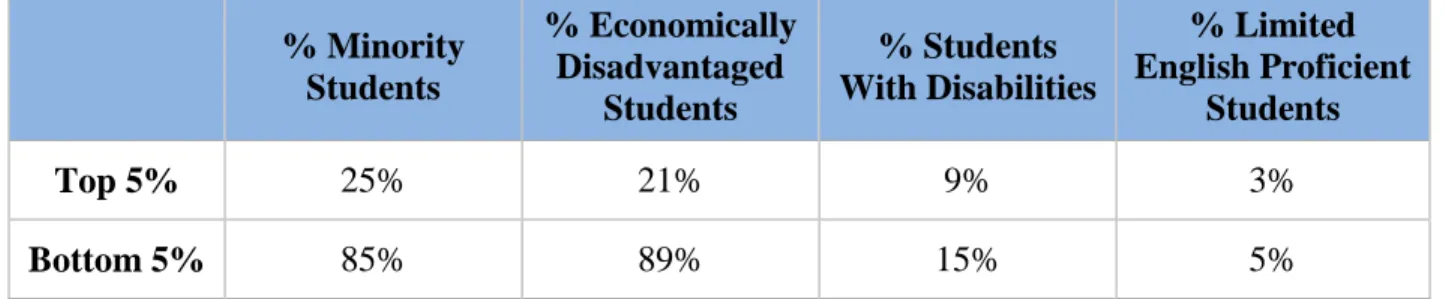
Data show that, when compared to the highest-achieving schools in North Carolina, the schools targeted by DST face unique challenges that require significant support (Table 1.1). Students in the lowest-achieving schools need to grow academically at a rate that exceeds expectations – in other words, the teachers and principals must create a learning environment that supports higher than average annual growth. Because these schools are struggling and may have a history of poor achievement, they require a great deal of customized support and
assistance to improve their performance. This dramatic change resulting in improved leadership and teaching practices is North Carolina’s definition of “turnaround.”
Table 1.1 Demographic Comparisons Between Highest- and Lowest-Achieving Schools
% Minority Students % Economically Disadvantaged Students % Students With Disabilities % Limited English Proficient Students Top 5% 25% 21% 9% 3% Bottom 5% 85% 89% 15% 5%
North Carolina Race to the Top Application; based on 2008-09 data
Services for low-performing schools in the 2015-16 school year may include:
1. A Comprehensive Needs Assessment (CNA) to identify areas to target support
2. An “Unpacking” of the report to take a deeper dive into the CNA findings and begin the process with staff to develop a school improvement plan or course of action targeting areas of need
3. Coaches assigned to schools to target specific needs working with teachers, principals, and central office staff, including school boards as appropriate; with fewer staff to serve in schools the coaching will be different and may be provided through a tiered system of intense (daily), direct (weekly), or consultative (monthly, bi-monthly), etc.
5. Professional development around specific topics that addresses needs in the school and aligns with the local and state initiatives that can be delivered in large groups with job embedded follow-up
6. Deep data analysis system to target specific areas of need by subject, grade, subgroup, student growth, teacher effectiveness, impact of professional growth, educator (teacher and school executive) standards
7. Regional support for low performing schools and NCDPI cross-division collaboration to provide resources as needed/requested.
V. Federal Programs
The Division of Federal Program Monitoring and Support provides oversight for a number of federal programs authorized under the United States Elementary and Secondary Education Act of 1965 (ESEA). The goal of the Division’s work is to ensure that all children have a fair, equal, and significant opportunity to access a high-quality education. Division staff strives to communicate that federal programs are not merely a funding source but an opportunity to think about teaching and learning in a different way.
Title I, Part A
Local education agencies target the Title I funds they receive to public schools with the highest percentages of children from low-income families. In addition to using Title I funds for comprehensive school improvement, over 50% of all LEAs use Title I funds to provide early interventions to at-risk preschool students. Well-designed preschool education programs produce long-term improvements in school success, including higher achievement test scores, lower rates of grade repetition and special education, and higher educational attainment. In a policy report published by the National Institute for Early Education Research in February 25, 2013, the return on the investment of preschool programs for at-risk children is on average $7 for every dollar invested in a well-designed program. There have been other similar studies in this space, with average return of at least $7, and often higher. In the 2014-15 school year, over $48,000,000 in Title I funds are being invested to provide preschool programs for over 7,600 students who otherwise would likely not have access to a quality preschool experience.
School Improvement Grant (SIG)
The School Improvement Grants offer supplemental federal funds to the bottom 5% of the state’s persistently lowest-achieving schools which includes charter schools, alternative and special schools. Since 2010-11, 60 schools in 32 counties have received funds to implement a rigorous turnaround model. NCDPI has supported SIG schools by providing professional development, on-site monitoring and technical assistance, and through continued coaching to front-line principals and teachers coordinated through the statewide system of support. It is estimated that more than 30,000 children have benefited from school turnaround efforts through expanded learning interventions that focus on effective building leadership and classroom instruction.
Migrant Education
The Migrant Education Program (MEP) provides supplemental educational and
supportive services to children and youth (ages 0-21) whose families are migratory farmworkers or are farmworkers themselves. Given that farmworkers earn an annual income between
$10,000 and $12,499, migratory families are among the poorest families in the United
States. According to the US Department of Education Office of Migrant Education, migratory children face challenges in seven key areas: School Disruption, Educational Continuity, School Engagement, English Language Development, Access to Services, Health Care Access, and
Family Involvement. NC MEP has developed a Service Delivery Plan that addresses all of these areas for our students. Some examples include: tutoring, mentoring, and summer programs for newly arrived children to lessen the effects of disruptive moves; enrollment services to facilitate timely transition to new schools, including collaboration with Child Nutrition programs to ensure that categorically eligible migratory children receive meals during the school year and summer; college access support and clubs to increase secondary school engagement; supplementary English for Speakers of Other Languages (ESOL) tutoring to supplement regular offerings; advocacy with local agencies; assistance with obtaining immunizations and primary health care; and family literacy and parent advisory councils (in all of our LEA sub-grantees and at