The Impact of Fiscal Decentralization on Revenue Performance in
LDCs: A Case of Uganda
Sudi Nangoli1 Isaac W., Magoola1 Yunia Musasizi2 Jaaza Mahmood2 Silvia W. Simiyu3 Grace Nalweyiso4
1.Senior Lecturer – Department of Business Administration, Makerere University Business School 2.Lecturer – Department of Business Administration, Makerere University Business School 3.Freelance researcher and Master of Business administration Student, Makerere University Kampala
4.Lecturer – Department of Business Administration, Makerere University Business School
Abstract
While it is universally envisaged that fiscal decentralization leads to improved revenue performance, a number of constraints like corruption have emerged to cause into question the above inference. This scenario crafts some doubt as to whether fiscal decentralization is still a tenable strategy for improving revenue performances. This study thus sought to examine the tenability of fiscal decentralization as a conduit for enhanced revenue performance of local Governments in Uganda. A mixed research design was adopted. Data that informed this study was purposively sourced from three districts of Uganda; one of which was urban, the other a city and the third was rural. Self administered questionnaires where used for data collection. Data were analyzed using descriptive frequencies, percentages, and correlation and regression analysis methods. Results revealed a positive significant relationship between fiscal decentralization and revenue performance (r=.553**, p<.01) and that Fiscal Decentralization still predicts Revenue Performance in local governments (Beta = .387, Sig. = .000). Recommendations were made to the effect that for improved revenue performance in local governments, Central governments should fully empower local, governments through fiscal decentralization, provide sufficient authority and autonomy to enable them efficiently manage tax collection and expenditure based on their own budgets approved by the elected local councils. Central governments and local governments should also collaboratively monitor and take action on its officials who cause revenue losses.
Keywords: Fiscal decentralization, Revenue performance, strategy, Uganda
1. INTRODUCTION
A lot of mishaps have happened since decentralization of municipalities and other local governments was initiated in Uganda. For example, Government funds have been misappropriated (Lambright, 2001), revenues have declined and service delivery is still a big challenge (Jean et al., 2010). There are low levels of accountability, inadequate resources, increased corruption, nepotism, patronage, and tendencies of central resistance to decentralization (Kyriacou, Muinelo-Gallo & Roca-Sagalés 2013; Steiner, 2006; Kolstad & Fjeldstad, 2006). Despite all these, there have been no attempts to understand the underlying processes at work and the scholarly community in Uganda is yet to fully articulate the effects of fiscal decentralization on a number of important policy goals including but not limited to revenue performance (Green, 2008). The researchers therefore sought to study the effects of fiscal decentralization on revenue performance of local Governments in Uganda. The following research question guided this study: RQ: What is the impact of fiscal decentralization on revenue performance in Ugandan Local Governments? This study covered local council three (LC III), Local Council Four (LC IV) and Local Council Five (LC V) in three districts of Uganda namely; Mbale in Eastern Uganda which is urban, Manafwa in Eastern Uganda, which is rural and Kampala district which is the capital city. This geographical scope gave a comparative outlook of urban, rural and capital city revenue performance and service delivery in a decentralized set up. It is hoped that results of this study will benefit law makers, law enforcement bodies, policy and standards bodies and politicians including the Parliament of Uganda, the Ministry of Local Government, the Ministry of Finance, The Auditor General’s Office, the donor community and Local Councils III, IV and V by way of providing guidelines for effective and efficient implementation of fiscal decentralization for better service delivery in local governments. The rest of this paper reviews literature on fiscal decentralization and revenue performance, outlines the methodology, presents and discusses findings, provides conclusions and recommendations.
2. LITERATURE REVIEW
This section presents a literature review on the conceptualization and linkage between Fiscal Decentralization and Revenue Performance.
Fiscal decentralization has been conceptualized as the fiscal empowerment of the local community through establishment of local government structures to perform tasks such as assessing and levying of taxes, tax collection, and spending of both locally generated revenues, grants and donations from central governments and other bodies (Rusten et al., 2004). This study also adopted the above conceptualization of Fiscal decentralization. In an effort to ensure full functionality of Fiscal decentralization, Oommen (2008) has stated local governments
ought to be given sufficient authority and autonomy to enable them manage tax collection and expenditure based on their own budgets approved by a duly elected local council (see also Zhang & Chen 2015; Dziobek, Mangas and Kufa, 2011). Existent research has shown that fiscal decentralization has registered some success in improving service delivery through the transfer of funds and tax raising powers from central to local governments (Akinyele, 1996; Malesky, 2005). Fiscal decentralization has also enabled local governments to exercise the authority entrusted unto them to generate adequate revenues locally and receive funds from the central government and freely spend them on local development programmes (Rusten et al., 2004). On the contrary, Rocamora (2006) advances that decentralization has not been implemented in its entirely and that inadequate fiscal decentralization is the main factor constraining revenue performance and the growth and development of “decentralized” local councils. Having wide discretion to select and set priorities is an empty power for councils with virtually no revenue. Rusten and Ojendal (2003); Rocamora (2006) further suggest that many local councils have the capacity to advance nationwide development, including making a significant contribution to poverty reduction countries but have largely failed to perform this mandate because they are allocated inappropriate and unreliable local and national financial resources among other inefficiencies. Currently, municipalities and other local governments in Uganda assess and collect fees and levies in their areas of jurisdiction for purposes of delivering services to the locals. In addition to these locally generated revenues (property rates, market dues, etc), the central government of Uganda transfers conditional and non-conditional grants as budgetary support for these units from the consolidated fund. Local governments can also pass resolutions to borrow funds from commercial and development banks to support their development programmes, in addition to donations and grants given to them by development partners. However, these funds seem to be little, are delivered late and are not always distributed fairly. Subsequently, no impact is seen on ground as many Ugandans have remained poor with deplorable health and education facilities among others the causes of which need to be investigated.
In the wake of the global financial crisis many central governments have since reduced funding to local councils. Faced with these challenges, local councils look at local sources of revenue for their survival (Olowu, 2002). These revenues include graduated tax, property tax (rates), business Licenses, Market dues and customs tax among others. We will look at these various types of revenues collected by local governments in Uganda and across the globe as we examine the revenue performance problem. Jean et al. (2010); Dziobek, Mangas and Kufa, (2011) advance that the highest level of fiscal decentralization is implemented on home land and that one of the most successful ways that local governments can increase revenues is by collecting taxes from their own citizens and commercial activities such as hotel tax, local service tax, tourist license fees, property rates and market dues. Another form of tax that greatly used to contribute to funding of local governments was graduated tax. Although there is little literature relating this form of tax, graduated tax alone contributed over 80% of local governments in Uganda and approximately 30% of total revenues collected by municipalities and other urban-based local governments (Francis & James, 2003). Unfortunately, graduated tax was abolished by the central government mainly for political reasons (Jean et al., 2010).As regards Property rates; these are charged on commercial buildings that operate within a given local government locality. Property rates are one of the most vastly recommended forms of tax in developed world where collection systems are mature (Bahl & Linn, 1992). However, this form of tax is very difficult to collect in developing countries like Uganda where many properties are not fully registered and landlords are fond evading these taxes.
3. METHODOLOGY
This section presents the research methods that were used. It considers the research design, sample design and sampling methods, data collection methods, data analysis and presentation of results.
3.1 Research Design
A mixed research design was adopted, incorporating both qualitative and quantitative research methods. Qualitative methods were used in the literature review, while quantitative methods were used in gathering, analyzing and presenting primary data.
3.2 Study Population
As earlier mentioned, this study covered 3 districts that were selected purposively to provide a combination of views from a rural district, urban district and a city. The three districts were Manafwa, Mbale and Kampala. Manafwa and Mbale are located in Eastern Uganda, while Kampala is located in Central Uganda. Further, Manafwa district is a rural district while Mbale is urban. Kampala is the capital city of Uganda. The local councils (LC) involved in this study included LC III situated at sub-county level, LC IV situated at county level and LC V situated at district level. Council members from these Local Councils were the units of measure. In addition, technical members of staff in three local government districts of were involved. The technical members of staff included Chief Administrative Officers (CAO), the Sub-County Chiefs, Town Clerks and Assistant Town Clerks, Accountants, Revenue Collection Officers, Community Development Officers, Health Officers, Education
Officers among others.
3.3 Sampling Technique and Sample Size
Both random and purposive sampling methods were used to select a total of 600 respondents to participate in the study as seen in table 1-3:
Table 1: Sample for Mbale District
Local Council Unit Number of respondents
Mbale District (Urban Local Government)
Industrial Division 50 Wanaale Division 50 Northern Division 50 Nauyo Sub-County 50 Bungokho Sub-County 50 Total 250
In Mbale (table 1), we had Bungokho Sub-County, Nauyo Sub-County, Northern Division, Wanaale Division and Industrial Division each contributing 50 participants. This is also because Mbale, being an urban district is densely populated.
Table 2: Sample for Manafwa District
Local Council Unit Number of respondents
Manafwa District (Rule Local Government)
Bupoto Sub-County 20 Buwabwala Sub-County 20 Bumbo Sub-County 20 Bubutu Sub-County 20 Bumwoni Sub-County 20 Total 100
In Manafwa (table 2), we had Bumwoni Sub-County, Bubutu Sub-County, Bumbo Sub-County, Buwabwala Sub-County, Bupoto Sub-County each contributing 20 respondents.
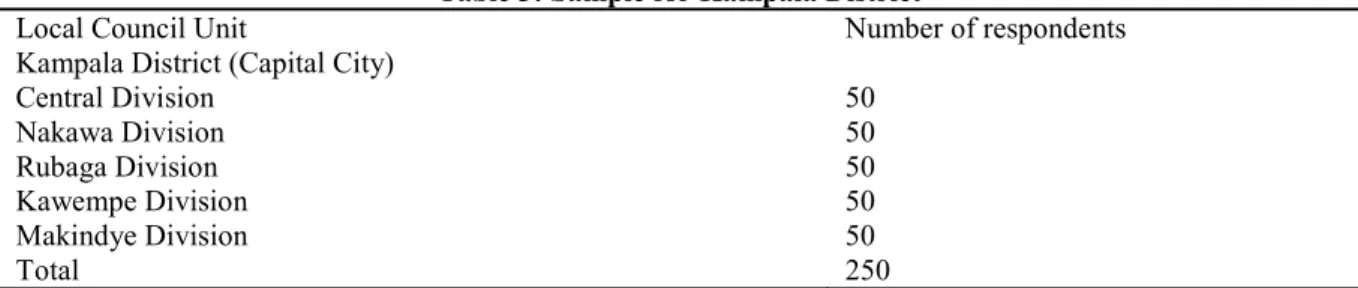
Table 3: Sample for Kampala District
Local Council Unit Number of respondents
Kampala District (Capital City)
Central Division 50 Nakawa Division 50 Rubaga Division 50 Kawempe Division 50 Makindye Division 50 Total 250
In Kampala (table 3), we had Makindye Division, Kawempe Division, Rubaga Division, Nakawa Division and Central Division each contributing 50 respondents. This is because Kampala is densely populated because it is a capital city.
3.5 Data Collection Instruments
Self administered questionnaires were used to collect primary data. The questionnaires were first tested for validity and reliability using Cronbach alpha coefficient for reliability (Cronbach alpha >0.7) and Content validity index for validity (CVI>0.6).
3.6 Data Analysis
Data were analyzed using descriptive frequencies, percentages and inferential statistics including correlations and regression analyses.
4. FINDINGS
This section presents the finding from primary data. We start with background characteristics and later dwell on examining the study variables.
4.1 Respondents’ levels of education
Table 4: Respondents’ levels of education
Frequency Percent Valid Percent Cumulative Percent
Valid below O level 37 8 8 8
O level 74 17 17 25 A level 90 20 20 45 Tertiary 139 31 31 77 University 102 23 23 100 Total 442 99 100 Missing System 3 1 Total 445 100
Source: Primary Data
Results in table 4 reveal that most respondents were at tertiary level (freq=139). This was followed by those at university level (freq=102) and A level (freq=90). Only 74 were at O level and 37 were below O level.
4.2 Experience in local unit
Descriptive statistics including frequencies and percentages were also used to determine the respondents experience in revenue planning, collection and service provision. Results were analyzed as seen in table 5 below:
Table 5: experience
Experience F % Valid Percent Cumulative Percent
Less than 1 year 155 34.8 34.8 34.8
2-5 years 188 42.2 42.2 77.1
5-10 years 70 15.7 15.7 92.8
10 years and above 32 7.2 7.2 100.0
Total 445 100.0 100.0
Source: Primary Data
Results in table 5 above show that the majority respondents had experience of 2-5 years (freq=188). A total of 155 respondents representing 34.8% had experience less than 1 year, while 70 respondents constituting 15.7% had experience of 5-10 years. Only 32 respondents representing 7.2% had experience of 10 years and above.
4.3 Fiscal Decentralization and Revenue Performance
Correlation analysis method was used to examine the relationship between fiscal decentralization and revenue performance. Table 6 presents the correlation results:
Table 6: Correlation
Fiscal Decentralization Revenue Performance Fiscal Decentralization Pearson Correlation 1 . 553**
Sig. (2-tailed) .000
N 442 442
Revenue Performance Pearson Correlation .553** 1
Sig. (2-tailed) .000
N 442 442
**. Correlation is significant at the 0.01 level (2-tailed).
Correlation results in table 6 above reveal that there is a positive significant relationship between fiscal decentralization and revenue performance (r=.553**, p<.01).
4.4 Regression Analysis
In addition to the above correlations, regression analysis was used to examine the predicting power of fiscal decentralization on revenue performance. Table 7 presents the results of regression analysis:
Table 7: Regression results Model Unstandardized Coefficients Standardized Coefficients t Sig. B Std. Error Beta 1 (Constant) 1.081 .057 8.332 .000 Fiscal Decentralization .376 .061 .387 6.492 .000
a. Dependent Variable: Revenue Performance
Regression results seen in table 7 above show that Fiscal Decentralization can predict Revenue Performance in local governments (Beta = . 387). The regression model is valid given that Sig. = .000.
5. DISCUSSION OF FINDINGS
This section presents a discussion of findings from primary data in relation to literature. Correlation results revealed that there is a positive significant relationship between fiscal decentralization and revenue performance. These findings imply that a positive change in fiscal decentralization leads to a positive change in revenue performance. In the same way, regression results indicated that fiscal decentralization is a good predictor of revenue performance. The above findings are in line with literature. For example, Jean et al. (2010) argued that fiscal decentralization eased revenue collection since the local authorities where the various businesses are located, the owners and how much income they make. This makes it easy to collect taxes such as hotel tax, local service tax, tourist license fees, property rates and market dues. Rusten et al., (2004) and Oommen (2008) argued that if well implemented, fiscal decentralization can significantly improve on revenue performance in local governments. Further, Akinyele (1996) and Malesky (2005) observe that fiscal decentralization helped in empowering local governments in planning, budgeting, collecting and allocating their own fiscal resources.
6. CONCLUSION AND RECOMMENDATIONS
As already indicated in the previous sections, there is a positive significant relationship between fiscal decentralization and revenue performance in local governments. Hence, revenue performance is significantly predicted by fiscal decentralization. Even with its envisaged challenges therefore, Fiscal Decentralization still proves a tenable strategy for improving revenue performance of local governments units; that is, in rural centers, urban centers or municipalities and city centers. It is on the basis of these findings that we make the following recommendations:
Central governments should fully empower local, governments through fiscal decentralization for better revenue performance. Such local governments should be given sufficient authority and autonomy to enable them management tax collection and expenditure based on their own budgets approved by the legally elected local councils.
Central governments should establish and enforce monitoring mechanisms for checking bad elements in local government that may lead to revenue losses through corruption, nepotism, favoritism among others. In the same light, local governments through their councils should use authority entrusted to them in a manner the benefits their electorates and desist from negative behavior that lead revenue losses such as nepotism, corruption, favoritism among others.
REFERENCES
Akinyele, R. T. (1996). States Creation in Nigeria: The Willink Report in Retrospect. African Studies Review, 39(2), 71-94.
Bahl & Lin (1992). Urban Finance in Developing Countries. Oxford University Press. The World Bank
Busemeyer R. Marius (2007). The Impact of Fiscal Decentralisation on Education and Other Types of Spending.
Max Planck Institute for the Study of Societies
Buwembo, J. (2005). What's the Fuss about New Districts? The Monitor.
Clegg Nick and Greg Clark (2010). Decentralisation and the Localism Bill: an essential guide. HM Government, ISBN: 978 1 4098 2662 0
COMFREL (2007). Assessment of the first term of decentralization. Decentralization in Cambodia. Commune Council Performance and Citizens’ Participation, 2002-2007
Crook, R. C. and J. Manor (1994). “Enhancing Participation and Institutional Performance:
Democratic Decentralization in South Asia and West Africa.” London: Overseas Development Administration.
Dziobek, C., Mangas, C. G., and Kufa, P. (2011). Measuring Fiscal Decentralization – Exploring the IMF’s Databases. © 2010 International Monetary Fund
Eriksen et al. (1999) Sited by COMFREL (2007) Assessment of the First Term of Decentralization in Cambodia, 2002-2007. COMFREL
Faguet Jean-Paul (1997). Technical Consultation on Decentralization; Decentralization and Local Government Performance. Working Group 6: Decentralization and Natural Resources Management. London School of Economics
Faguet Jean-Paul (2003). Decentralization and Local Government in Bolivia; An Overview from the Bottom Up. Conference paper presented at London School of Economics, May 2003. London School of Economics Working Paper No.29 ISSN 1740-5815
Francis Paul and Robert James (2003). Balancing Rural Poverty Reduction and Citizen Participation: The Contradictions of Uganda’s Decentralization Program. University of East Anglia, Norwich, UK; World Development Vol. 31, No. 2, pp. 325–337, 2003
Fumihiko SAITO (2008). Decentralization in Uganda: Challenges for the 21st Century. Ryukoku University, Japan.
Green Elliott (2008). District Creation and Decentralization in Uganda. Development Studies Institute, London School of Economics.
Horng, V., Pak Kimchoeun, S. Ann and N. Ngo (2005) ‘Decentralization and Deconcentration Reforms in Cambodia: an Early Review’, in K. Murshid and B. Ballard (eds) Annual Development Review, Phnom Penh. CDRI.
Jean Steven, Tiphany Lee, Katherine Malarkey and Jewells McMahon (2010). Local Government Fiscal Discretion in Uganda. NYUWagner
Kiryabwire Geoffrey (2005). Court Ruling on CIVIL SUIT NO. 267 OF 2004 between Mbale United Transporters Ltd Vs Town, Mbale Municipal Local Government Council, Richard Masaba Womalia alias Kanindo,The Chairman LC IV/MAYOR Mbale Municipal Local Government Council. High Court of Uganda at Kampala (Commercial Division).
Kolstad Ivar and Odd-Helge Fjeldstad (2006). Fiscal decentralization and corruption; A brief overview of the issues. U4 Utstein Anti-Corruption Resource Centre
Lambright M. S. Gina (2001). Decentralization in Uganda: Explaining Successes and Failures in Local Governance. FirstForumPress
Kyriacou, A., Muinelo-Gallo, L., and Roca-Sagalés, O. (2013). Fiscal decentralization and regional disparities: The importance of good governance. DOI: 10.1111/pirs.12061© 2013 The Author(s). Papers in Regional Science © 2013 RSAI
Ostrom, E., L. Schroeder and S. Wynne (1993). Institutional Incentives and Sustainable Development: Infrastructure Policies in Perspective. Boulder: Westview Press.
Malesky, E. (2005). Gerrymandering - Vietnamese Style: The Political Motivations behind the Creation of New Provinces in Vietnam. Paper presented at the Midwest Political Science Association 63rd Annual Conference.
Oguttu, W., & Opondo, O. (2007, August 11). What are the Implications of Creating More Districts? New Vision.
Olowu Dele (2002). Property Taxation and Democratic Decentralization in Developing
Countries. Paper for Seminar on ‘Taxation Perspectives: A Democratic Approach to Public Finance in Developing Countries’ Institute of Social Studies, The Hague, Netherlands
Oommen M. A. (2008). Fiscal Decentralisation to Local Governments in India. Cambridge Scholars Publishing, ISBN (10): 1-84718-488-X, ISBN (13): 9781847184887
Putnam, R. D. (1993). Making Democracy Work: Civic Traditions in Modern Italy. Princeton: Princeton University Press.
Republic of Rwanda (2000). Implementation strategy for National Decentralization Policy. Ministry of Local Government and Social Affairs, Republic of Rwanda.
Republic of Uganda (2004). Annual Assessment of Minimum Conditions and Performance Measures for Local Governments, 2003. The Republic of Uganda
Republic of Uganda (2007). Annual Assessment of Minimum Conditions and Performance Measures for Local Governments, 2006. The Republic of Uganda
Rusten, C. and J. Ojendal (2003). Poverty Reduction through Decentralization? Lessons from Elsewhere and Challenges for Cambodia. Phnom Penh, CDRI.
Rocamora Joel (2006). Opening The Democracy Door D&D in Cambodia. COMFREL
Rondinelli,(1999). A Review of Literature of Decentralization. UNDP New York
Stoop (2002) Sited by COMFREL (2007). Assessment of the First Term of Decentralization in Cambodia, 2002-2007. COMFREL
Rusten, C., Kim Sedara, Eng Netra and Pak Kimchoeun (2004) The Challenges of Decentralization Design in Cambodia. Phnom Penh, CDRI.
Samoff, J. (1990). “Decentralization: The Politics of Interventionism.” Development and Change, 21:513-30.
Smith, B.C. (1985). Decentralization: The Territorial Dimension of the State. London: George Allen & Unwin.
Steiner Susan (2006). Decentralisation in Uganda: Exploring the Constraints for Poverty Reduction. GIGA German Institute of Global and Area Studies
Tumushabe Godber, Elijah Dickens Mushemeza, Lillian Muyomba Tamale, Daniel Lukwago and Eugene Ssemakula (2010). Monitoring and Assessing the Performance of Local Government Councils in Uganda; Background, Methodology and Score Card. ACODE.
UNDP-United Nations Development Program (1993). Informe Sobre Desarrollo Humano 1993. Madrid: CIDEAL.
World Bank (1994). World Development Report: Infrastructure for Development. New York: Oxford University Press.
Yuliani Elizabeth Linda (2004). Decentralization, deconcentration and devolution: what do they mean? Interlaken Workshop on Decentralization
Zhang, S., and Chen, S. (2015). Local Governance Performance in China: A Fiscal Perspective. Emerging Markets Finance and Trade. Special Issue: Financial Supervision and Regulation With Emphasis on Korea and Emerging Market EconomiesDOI: 10.1080/1540496X.2014.1013863
Acknowledgements
We would like to acknowledge the preliminary conceptualization and mentorship provided by Kituyi Mayoka, Senior Lecturer Makerere University Business School and Prof Waswa. Balunywa, the Principle of Makerere University Business School.