1
Constraints on the applicability performance management systems framework
Olayinka Uadiale1, Pawan Adhikari2 and Pinar Guven-Uslu3
Abstract
As part of the New Public Management reforms in public-sector, private-sector style of management such as performance management systems (PMS) were adopted to ensure efficiency and accountability in the public sector of developed and developing nations. This study first explains the introduction of performance management and the level of its application in the Nigerian public sector. After that, this study attempts to identify the constraining factors (political and socio-cultural) on successful the application of PMS in Nigeria. Utilizing information obtained from interviews of management staff and employees of a state-owned hospital, it is argued that application of PMS should be cognizant of political and socio-cultural contextual characteristics of developing countries.
Keywords: Public sector, Performance management systems framework, Healthcare organizations
1 Department of Accounting, Brunel Business School, Brunel University, London, UK 2 Essex Business School, University of Essex, Colchester, UK
2 1. Introduction
Performance management (PM) is one of the key strands of New Public management (NPM) and plays a key role in processes seeking to enhance the efficiency and effectiveness of public services delivery (Hood 1991). PM has become the main channel through which public officials explain and justify their behaviour and report on outputs and outcomes (Bouckaert et al. 2010; Hyndman and Liguori 2015). PM promotes the goal of improving performance through the careful planning of performance measures, integrating them into the managerial process, and using them to enforce responsibility for actions and outcomes (Arnaboldi et al. 2015; Heinrich and Marschke 2010). This is particularly so when policy makers assume that lack of confidence in government can be addressed through performance measurement and its public reporting (Pollitt and Bouckaert 2011; Boston and Pallot 1997).
However, many studies have investigated the possible dysfunctions of performance management mechanisms, highlighting the danger of the distortion and gaming of targets, measures, and data (Bevan and Hood 2006; Moynihan 2008; Heinrich and Marschke 2010). In addition, it has been argued that traditional and sociocultural environments affect the introduction and application of PM (Ohemeng 2009; Pollitt 2005).
The introduction of the performance management systems (PMS) in Nigeria began in the early 1980s under the implementation of the Structural Adjustment Programme (SAP). SAP was a socio-economic adjustment policy designed by the IMF and the World Bank for countries that have benefitted from their loans, especially in Africa, Asia, Latin America, and former socialist countries of Europe, to tackle the effects of economic recession and globalization (Ikeanyibe 2016; Asaolu et al. 2005). The return of democratic governance in Nigeria in 1999 facilitated several reforms with focus on efficiency, economy, responsiveness and service delivery, decentralization, and performance management. In 2014, Nigerian government adopted a new performance management system in the public service as a means of promoting good governance and achieving effective service delivery. The idea of the PMS is to support the transformation of the Federal public service by developing the structures, processes and procedures for managing result-oriented performance at the sectoral, Institutional and individual levels within the Federal Public Service. However, it has been argued that performance management system has achieved limited success in enhancing efficiency in developing countries (Ohemeng 2009) and Nigeria in particular (Ikeanyibe 2016).
3
This paper makes a number of contributions to the public sector accounting and performance management literature. The study setting of Nigeria offers a distinctive extension to our understanding of the appropriateness of the western-centric private-sector management repertoire in developing countries. Specifically, the paper illustrates the limits to which PMS can be applied in countries with culture-specific structural and contextual characteristics.
The remainder of the paper is organised as follows. Section two highlights earlier studies on performance management in the public sector. This is followed by an overview of PM in healthcare organizations in Nigeria. The next section outlines the research method. Thereafter, constraints on the applicability of PMS framework in Nigeria are discussed in the light of the evaluation framework. The final section offers some concluding remarks.
2. Performance Management in the Public Sector
Over the past 20 years, some of the biggest questions of public management have revolved around performance management (Poister et al. 2013; Andrews 2014; Mesabbah and Arisha 2016). Governments across the world have promoted several initiatives to stimulate the use of performance management in public sector organizations (including central government, local governments and other public sector organizations such as hospitals, educational institutions, police forces, etc. (see e.g. Van Helden 2005; Cavalluzzo and Ittner 2004; Hood 1991, 1995; Van Thiel and Leeuw 2002; Silva and Ferreira 2010). These governments have implemented an array of instruments intended to encourage public managers, and citizens, to drive public service performance upwards, from the use of target-setting, league tables and performance information across entire policy fields to the promotion of performance planning and management techniques (Andrews 2014). Performance management has been defined as the process of defining goals, selecting strategies to achieve those goals, allocating decision rights, and measuring and rewarding performance (Heinrich 2002; Ittner and Larcker 2001; Otley 1999). According to Poister (2010) performance management in the public sector refers to engaging in strategic planning to establish a direction and major goals, setting more specific objectives and perhaps targets at multiple levels in the organization, and then using performance measurement to help focus on achieving them.
Despite the widespread use of PM in public sector organizations worldwide, there has been criticism of its efficacy in fostering performance improvement (Goh et al. 2015). Research has
4
shown that the presumed benefits remain questionable and that there are many barriers, challenges and problems in implementing PM. For example, Sanger (2008), in a study of local and state governments in the USA, suggests that there are still obstacles to the effective implementation of PM such as suppressing and manipulating negative data leading to the perception that there is a lack of transparency in the public reporting of performance. Radnor and McGuire (2004) illustrate this problem in the UK. It was reported that despite the implementation of a PM system, including balanced scorecards, there was lack of ownership and accountability for the system and most managers were “working the system” to meet externally imposed requirements for reporting on performance. Beyond the conceptual, philosophical and value interpretations of PM in the public sector, it is also important to understand the design and use of PMS frameworks/models. Hence, researchers have developed and utilized various frameworks to understand PMS in organizations.
3. PMS in healthcare organisations in Nigeria
Nigeria is the largest economy in Africa and the 26th in the world, this was established by the rebasing of Nigeria’s gross domestic product (GDP) that was estimated to be US$ 510 billion (PWC 2014; NBS 2014). Nigeria is Africa’s biggest oil exporter and has the largest natural gas reserves on the continent. Nigeria accounts for 47 percent of West Africa’s population with approximately 184 million people and has one of the largest populations of youth in the world (WB 2017). However, Nigeria is one of the emerging economies faced with the “double burden” of persisting high prevalence of communicable diseases and rising prevalence of non-communicable diseases (MSR 2015). Nigeria shoulders 10% of the global disease burden and failed to achieve the 2015 targets for the health related Millennium Development Goals (MDGs) (FMOH 2010). Nigeria’s health indicators are among the worst in the world, especially when compared to other countries with similar income per capita. Nationally, the maternal mortality ratio (MMR) is 560 per 100,000 births, infant mortality rate is 74 per 1000 live births; neonatal mortality rate is 37 per 1000 live births and child mortality rate is 117 per 1000 live births (UNICEF 2015). Nigeria is still one of the few polio endemic countries and has been a source of re-infection in neighbouring countries. Vaccine-preventable diseases coupled with infectious and parasitic diseases continue to exact a heavy toll on the health and survival of Nigerians. According to the World Bank Report the overall life expectancy in Nigeria is 55years with Nigeria being ranked 187th of 190th (WHO 2015). Nigeria’s Human
5
Development Index (HDI) value for 2015 was 0.527 which is in the low human development category thereby positioning it at 152 out of 188 countries and territories (UNDP 2016). Though the country’s HDI is above the average of 0.497 for countries in the low human development group and above the average of 0.523 for countries in Sub-Saharan Africa, when the value is discounted for inequality, the HDI falls to 0.328, a loss of 37.8 percent due to inequality in the distribution of the HDI dimension indices. Nigeria continues to depend on foreign-aid and grants and foreign investors to provide education, healthcare and infrastructure.
Despite considerable investment in the health sector over the years, health services are delivered through a weak and understaffed public sector healthcare system (GHI 2011). There is also a lack of political will and an absence of strong bureaucratic support on the part of the government for primary healthcare. In addition, health services are characterized by inequitable distribution of resources, decaying infrastructure, poor management of human resources for health, negative attitudes of healthcare providers, weak referral systems, poor coverage with high impact cost-effective interventions, unavailable or shortages of essential drugs and other health commodities, a lack of integration, poor supportive supervision, and financial barriers experienced by the population that prevent access to services (FMOH 2010). Hence, the public sector healthcare system is unable to provide basic, cost-effective services for the prevention and management of common health problems especially at Local Government Area (LGA), ward and community levels (GHI 2011). The federal budget allocation to health accounts for 5.4% of the total federal budget and 0.7% of the national gross domestic product (Uzochukwu et al. 2015). This budget allocation to health falls short of the Abuja declaration target of 15% of the national budget. Also, the per capita health expenditure of $10 is far below the $34 recommended by the macro-economic commission on health as required for provision of basic package of essential health care services (FMOH 2013).
The Nigerian healthcare system is in transition and going through significant changes in terms of priorities, policies and challenges. Its continuing economic crisis following the collapse of the world market price of oil that began in 1981 and the resultant external debts (Ikeanyibe 2016; Asaolu et al. 2005) led to the introduction of the Structural Adjustment Programme (SAP) in 1986. One of such changes is the adoption of a new performance management system in the public service as a means of promoting good governance and achieving effective service delivery in line with the government’s transformation agenda. In 2010, the Nigeria government office of the head of the civil service of the federation (OHCSF) commissioned KPMG
6
Professional Services to develop performance management system for the Federal Public Service with a focus on the balance score card. The implementation of PMS in Nigeria reinforces the focus of this article.
4. Data and methods: Qualitative case study
This paper adopts qualitative research methods to investigate and analyse the applicability of PMS framework in a public healthcare service. It is based on a case study one of the foremost teaching hospitals in West Africa in terms of the high-quality services rendered by highly skilled professionals using state-of-the-art equipment. Case study not only provide a better and holistic understanding of the context, but also allows the researcher to examine the behavioural effects of PMS in the complex and interactive environment in which PMS actually exists (Caplan 1989; Yin 2014). The evidence presented in this paper was collected using semi-structured interview and document analysis. It has been argued that the flexibility and comparability of semi-structured interviews facilitates free flowing conversation and assist the researcher to focus on the objective of the interview (Silverman 2013; Bryman and Bell 2015). Interviews were conducted on-site and off-site. Each interview lasted averagely between thirty minutes and one hour. Informants were selected from the various departments including directors, head of departments, nurses, doctors, accountants and administrative staff. Many of the interviewees were directly involved in making decisions concerning performance management in the organization.
To reinforce the interview data, the study relied on public published documents such as annual performance reports (health sector), policy documents, news clippings and other articles appearing in the mass media or newspapers. These documents provided salient insights into the evolutionary tendencies of the studied organization. Thus, the use of documents results in both obtaining new information and to corroborate and augment evidence from interviews.
7
5 Constraints on the applicability performance management systems framework
Various authors have developed frameworks to understand PMS in organizations. For example, Otley (1999) highlights five central issues which he argues need to be considered as part of the process of developing a coherent structure for performance management systems. These issues include (1) objectives (2) strategies and plans (3) targets (4) rewards system and (5) information flows. On the other hand, Ferreira and Otley (2009, p.268) highlight the following 12 questions to consider in the development of a PMS that are used effectively in the private sector: (1) vision and mission (2) key success factors (3) organization structure (4) strategies and plans (5) key performance measures (6) target setting (7) performance evaluation (8) reward systems (9) information flows, systems, and networks (10) PMSs use (11) PMSs change and (12) strength and coherence. In his revised framework of performance management (Adler 2011, p. 253) identifies industry, global economy, natural environment and national culture, strategic analysis, strategy formulation, strategy evaluation, operating systems and procedures, organizational structure, organizational culture, selection and training and development.
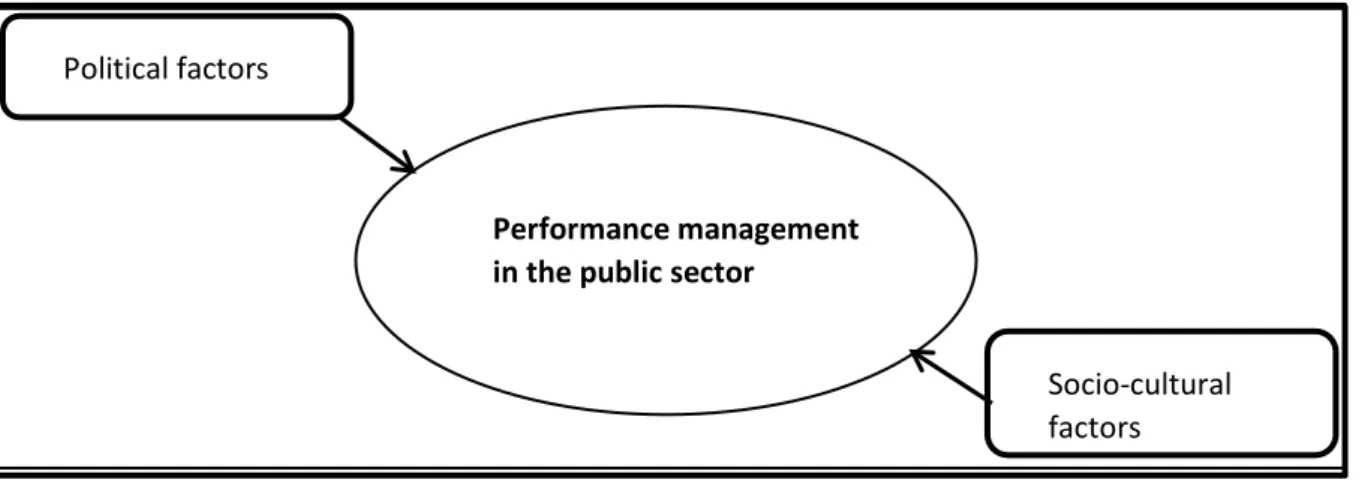
In our analysis, we identify two contextual factors, shown in Figure 1. This figure identifies factors that affect the application of PMS in the public sector in developing countries. As seen in the figure, political and socio-cultural factors affect the application of PMS in the public sector of Nigeria.
Figure 1: The evaluation framework of factors influencing the applicability of performance management system
Performance management in the public sector
Political factors
Socio-cultural factors
8
5.1 The influence of politics on the applicability of PMS framework
A major constraint on the applicability of PMS framework relates to the influence of political agenda on performance planning and measurement in the case organization. The influence of politics on NPM-driven PM has featured in many studies (Alawattage et al. 2017; van Helden and Uddin 2016; Ashraf and Uddin 2013). Several studies conducted on the African continent have discussed the impact of political interventions on PM practices, despite reforms (Ohemeng 2009, 2011; Sulle 2010). It has been argued that political constraints continue to influence the implementation of PMS. Skousen and Yang (1988) study claims that political constraints influence production and investment decisions. O’Connor et al. (2006) linked politicization with interfere in the recruitment, promotion and dismissal of employees in Chinese SOEs, despite being exposed to market forces. Similar conclusions were drawn in another study (Xu and Uddin 2008) that found that market-based reforms in Chinese SOEs resulted in powerful and wealthy state managers rather than the desired Western-centric, delegated management controls.
The study finds that the NSH’s vision and mission closely align with the ministry of health’s which reflect the state’s government health priority. Commenting on the vision and mission of the NSH, a director interviewed stated:
‘The vision and mission of the NSH aligned closely with the states’ health policies. It was noted that the health sector’s vision seeks to attain excellence in health service delivery by applying best practices at all levels of care, and the mission aims to deliver qualitative, affordable and equitable healthcare service to the citizenry applying appropriate technology by highly motivated staff’.
This statement implies that NSH’s vision and mission is driven by the political agenda of the government in relation to the health service delivery. Consequently, it can be inferred that political context in which the NSH operates influence its PMS. The implication is that employees may not be enthusiastic in achieving such politically driven objective. Similarly, in relation to recruitment of staff, one of the directors noted:
‘NSH does not recruit healthcare workers on its own. It notifies the Health Service Commission (HSC) of the areas of need. The HSC is statutorily responsible for recruitment, deployment, promotion, discipline, staff welfare and professional development matters amongst others’
This above comment suggests that the political structure of the state empowered the health commission to recruit healthcare workers which demonstrates how political factor influences
9
the design and use of PMS in the organization of study. Furthermore, the interview participants claimed that the government is involved in staff training. One of the nurses remarked:
‘Doctors, nurses and other employees received training calls from Ministry of Establishments, Training and Pension and the State Treasury Office. For example, some medical officers have benefited under the professional development partnership programme between the State Government and Otto-Von-Guericke University, Magdeburg, Germany, twenty-three (23) medical doctors and three (3) nurses in various specialties were sponsored in three batches for a six-week programme in Germany for skill acquisition/update’.
It has been argued that strategies and plans (S&Ps) are required to ensure that the effectiveness of the PMSs is achieved. According to Otley (1999) many business strategies are designed to effect ‘improvement’, often driven by competitive pressures. He argues that even in the public sector, the continual need to justify the use of resources produce similar pressures for improvement and efficiency. The study finds that strategies and plans were generated and defined centrally by the ministry of health as enunciated in the State’s Strategic Health Development Plan (SSHDP) 2010-2015. This suggests that strategic voice was absent in the NSH, as it simply followed the strategies and plans presented by the health ministry. Participants noted that the process of devising strategies and plans should follow a bottom-up approach which allows the involvement of all levels of management in the strategic process rather than the current top-down approach which imposes strategies and plans on the organization. The current strategic planning practice in the organization contradict previous literature which argues that wider involvement of lower echelons of management in the strategic process would result in greater understanding of the strategic intent and acceptance of the path to be undertaken (see e.g Ferreira and Otley 2009). In sum, it is argued that S&Ps in the NSH is politically driven. Similarly, the findings reveal that that KPIs for the health sector which the NSH is a part were determined centrally at the instance of the state government. This implies that NSH’s staff are not involved in the development of measures which defines the organization’s success.
5.2 The influence of socio-cultural factors on the applicability of PMS framework Behaviours and values prevalent in society can influence the applicability of PMS and consequently its effectiveness. It has been suggested that the adoption and implementation of PMS should be cognizant of culture-specific structural and contextual characteristics (Ohemeng 2009). Further, culture and other traditional practices have been identified as one of
10
the key fundamental problems that have hindered and continue to hinder the successful implementation of the PMS in developing countries (Mmieh et al. 2011; Caligiuri 2006; Mendonca and Kanungo 1990, 1996). One of the socio-cultural factors influencing the applicability of PMS framework in the organisation of study is attitude toward time (people’s behaviour about punctuality) and responses to deadlines. This challenge is attributed to the lack of understanding of the vision and mission and little or no involvement of staff in the formulation by senior management. Participants noted that the involvement of employees in the formulation of mission and vision statements would provide a sense of ownership and induce commitment to achieving the organizations’ overall objectives. The following comment supports this argument:
“…ownership of the mission and vision statements is of importance to employees of any organization…once the staffs are involved in their formulation; they get committed and ensure successful implementation”.
Also, it was observed some of the staff training programmes were less focused on improving staff competencies which resulted in low-performance outcomes. Participants further note that the frequency of training programmes is inadequate, and request for regular trainings and workshops to enhance career development and improve staff competencies.
Infrastructure and equipment continued to be upgraded in the NSH. This was evident with the state government’s continuous investment in projects geared towards achieving the organization’s goal of being in the forefront of contemporary and efficient healthcare delivery. However, there were evidences of delays in completing some projects. The findings have highlighted reveal that some projects were affected by people’s attitude to deadlines. One of the heads of department (HIC) explained that:
“Contactors attitudes towards project completion deadlines have been appalling. The delay in project renovation constitutes a potential threat to the organization’s accreditation exercise, particularly the postgraduate medical college. It is suggested that timely completion of projects should be prioritized to avoid dis-accreditation”.
This implies that while it is important to ensure that the structure and facilities are able to meet the demands from the public, it is a necessity to ensure that delays are avoided or minimized to the barest minimum. Such delays could have implications on service delivery and consequently on the objectives of the organization. In addition, contractors’ capacity to perform should be considered to avoid project failure.
11
Further, the evidence in the present study indicates that organization structure reflects the varying levels of administrative controls with clear lines of reporting and accountability. However, participants note that decision-making in the organization should not be limited to the management team. They argued that employees should be gainfully engaged in the decision-making process to encourage creativity. It was noted that the existence of a hierarchical and formal structure which lacks the involvement of subordinates could result in low job satisfaction and ultimately high staff turnover rate.
6. Discussion and conclusion
Performance management (PM) in the public sector continues to draw much attention from scholars, however, there is no consensus on whether it enhances organizational efficiency, effectiveness, and public accountability. In this paper, we have empirically demonstrated that to apply a PMS framework effectively, the public sector in Nigeria needs to cope with a number of constraining factors. The findings are in line with the argument of (Ohemeng 2009) who express the view that the adoption and implementation of public sector management reforms and, particularly, the performance management system (PMS) did not take into consideration the numerous institutional and capacity constraints in developing countries. We therefore argue that the application of PMS should be cognizant of culture-specific structural and contextual characteristics of developing countries. Particularly as culture is an important element that must be carefully considered in policy transfer from one environment to another.
In this respect, the study underpins the view that successful application of PMS needs to consider political factors which can necessitate the balancing of management discretion and political influence, as well as considerations of socio-cultural issues (Arnaboldi et al. 2015; Lapsley and Skærbæk 2012). It is unlikely that PMS will be implemented successfully, particularly in the context of developing countries, without overcoming the various impediments.
One contribution of the paper is that it extends the literature on public sector accounting and performance management by advancing our understanding of the appropriateness of the western-centric private-sector management repertoire in developing countries.
12
Next, this paper demonstrates how the existence of contextual characteristics impact upon the application of PMS (Ohemeng 2009, 2011; Sulle 2010). In the context of Nigeria, this study identified two contextual factors - political and socio-cultural factors as influencing the applicability of PMS.
Lastly, given that public sector organizations generally in Africa differs largely due to background, historical and cultural differences, this paper advocate the need for comparative studies between other developing countries so as to further our understanding of how PMS are being shaped in other similar contexts, and the appropriateness of western-centric private-sector management in achieving efficient and effective public organizations.
13 References
Adler, R. W. 2011. Performance management and organizational strategy: How to design systems that meet the needs of confrontation strategy firms. The British Accounting
Review 43 (4):251-263.
Alawattage, C., D. Wickramasinghe, and S. Uddin. 2017. Theorising management accounting practices in Less Developed Countries. The Routledge Companion to Performance
Management and Control:285-305.
Andrews, R. 2014. Performance Management and Public Service Improvement. In PPIW
Report. Wales: Public Policy Institute for Wales.
Arnaboldi, M., I. Lapsley, and I. Steccolini. 2015. Performance management in the public sector: The ultimate challenge. Financial Accountability & Management 31 (1):1-22. Asaolu, T., O. Oyesanmi, P. Oladele, and A. Oladoyin. 2005. Privatisation and
commercialisation in Nigeria: Implications and prospects for good governance. South
African Journal of Business Management 36 (3):65-74.
Ashraf, J., and S. Uddin. 2013. A Consulting Giant; a Disgruntled Client: A ‘Failed’Attempt to Change Management Controls in a Public Sector Organisation. Financial
Accountability and Management 29 (2):186-205.
Bevan, G., and C. Hood. 2006. What’s measured is what matters: targets and gaming in the English public health care system. Public administration 84 (3):517-538.
Boston, J., and J. Pallot. 1997. Linking strategy and performance: Developments in the New Zealand public sector. Journal of Policy Analysis and Management: The Journal of
the Association for Public Policy Analysis and Management 16 (3):382-404.
Bouckaert, G., G. Peters, and K. Verhoest. 2010. The Coordination of Public Sector
Organizations. London, UK: Palgrave Macmillan
Bryman, A., and E. Bell. 2015. Business research methods: Oxford University Press, USA. Caligiuri, P. M. 2006. Measurement Performance in a Cross-cultural Context’. In
Performance Measurement: Current Perspectives and Future Challenges., edited by
C. L. a. D. W. W. Bennett Jr. Mahwah, NJ:: Lawrence Erlbaum Associates. Caplan, E. H. 1989. Behavioral accounting- A personal view. Behavioral research in
accounting 1 (1):109-123.
Cavalluzzo, K. S., and C. D. Ittner. 2004. Implementing performance measurement
innovations: Evidence from government. Accounting, organizations and society 29 (3):243-267.
Ferreira, A., and D. Otley. 2009. The design and use of performance management systems: An extended framework for analysis. Management accounting research 20 (4):263-282.
FMOH. 2010. National Strategic Health Development Plan (NSHDP) 2010 - 2015. Abuja, Nigeria: Federal Ministry of Health.
———. 2013. Joint Annual Health Sector Reviews: A review of experience. Abuja: Federal Ministry of Health.
GHI. 2011. Nigeria Global Health Initiative Strategy 2010 – 2015.
Goh, S. C., C. Elliott, and G. Richards. 2015. Performance management in Canadian public organizations: Findings of a multi-case study. International Journal of Productivity
and Performance Management 64 (2):157-174.
Heinrich, C. J. 2002. Outcomes–based performance management in the public sector: Implications for government accountability and effectiveness. Public Administration
14
Heinrich, C. J., and G. Marschke. 2010. Incentives and their dynamics in public sector performance management systems. Journal of Policy Analysis and Management 29 (1):183-208.
Hood, C. 1991. A public management for all seasons? Public administration 69 (1):3-19. ———. 1995. The “New Public Management” in the 1980s: Variations on a theme.
Accounting, organizations and society 20 (2-3):93-109.
Hyndman, N., and M. Liguori. 2015. Central Government Accounting: Arguing for and Legitimating Change. Edinburgh: ICAS, 78.
Ikeanyibe, O. M. 2016. New public management and administrative reforms in Nigeria.
International Journal of Public Administration 39 (7):563-576.
Ittner, C. D., and D. F. Larcker. 2001. Assessing empirical research in managerial accounting: A value-based management perspective. Journal of accounting and
economics 32 (1):349-410.
Lapsley, I., and P. Skærbæk. 2012. Why the public sector matters. Financial Accountability
& Management 28 (4):355-358.
Mendonca, M., and R. N. Kanungo. 1990. Work Culture In Developing Countries: Implica tions For Performance Management. Psychology and Developing Societies 2 (2):137-164.
———. 1996. Impact of culture on performance management in developing countries.
International Journal of Manpower 17 (4/5):65-75.
Mesabbah, M., and A. Arisha. 2016. Performance management of the public healthcare services in Ireland: A review. International Journal of Healthcare Quality Assurance 29 (2):209-235.
Mmieh, F., C. Mordi, S. Singh, and F. Asiedu-Appiah. 2011. Performance management in public sector enterprises: A case analysis of employees’ perceptions in the Electricity Company of Ghana (ECG). Journal of African Business 12 (3):419-438.
Moynihan, D. P. 2008. The dynamics of performance management: Constructing information
and reform: Georgetown University Press.
MSR. 2015. Nigerian Health Sector
NBS. 2014. Nigeria’s revised and final GDP rebasing results by output approach,. Abuja, Nigeria.: National Bureau of Statistics.
O’Connor, N. G., J. Deng, and Y. Luo. 2006. Political constraints, organization design and performance measurement in China’s state-owned enterprises. Accounting,
organizations and society 31 (2):157-177.
Ohemeng, F. L. K. 2009. Constraints in the implementation of performance management systems in developing countries: The Ghanaian case. International Journal of Cross
Cultural Management 9 (1):109-132.
———. 2011. Institutionalizing the performance management system in public organizations in Ghana: Chasing a mirage? Public Performance & Management Review 34 (4):467-488.
Otley, D. 1999. Performance management: A framework for management control systems research. Management accounting research 10 (4):363-382.
Poister, T. H. 2010. The future of strategic planning in the public sector: Linking strategic management and performance. Public Administration Review 70:S246-254.
Poister, T. H., O. Q. Pasha, and L. H. Edwards. 2013. Does performance management lead to better outcomes? Evidence from the US public transit industry. Public Administration
Review 73 (4):625-636.
Pollitt, C. 2005. Performance management in practice: A comparative study of executive agencies. Journal of Public Administration Research and Theory 16 (1):25-44.
15
Pollitt, C., and G. Bouckaert. 2011. Public Management Reform: A comparative analysis-new
public management, governance, and the Neo-Weberian state: Oxford University
Press.
PWC. Economic and fiscal implications of Nigeria’s rebased GDP. Price Waterhouse Coopers 2014 [cited 28 November 2016. Available from
https://www.pwc.com/ng/en/publications/gross-domestic-product-does-size-really-matter.html.
Radnor, Z., and M. McGuire. 2004. Performance management in the public sector: Fact or fiction? International Journal of Productivity and Performance Management 53 (3):245-260.
Sanger, M. B. 2008. From measurement to management: Breaking through the barriers to state and local performance. Public Administration Review 68 (s1):S70-S85. Silva, P., and A. Ferreira. 2010. Performance management in primary healthcare services:
Evidence from a field study. Qualitative Research in Accounting and Management 7 (4):424-449.
Silverman, D. 2013. Doing qualitative research: A practical handbook: SAGE Publications Limited.
Skousen, C. R., and J.-L. Yang. 1988. Western management accounting and the economic reforms of China. Accounting, organizations and society 13 (2):201-206.
Sulle, A. 2010. The application of new public management doctrines in the developing world: An exploratory study of the autonomy and control of executive agencies in Tanzania.
Public Administration and Development 30 (5):345-354.
UNDP. 2016. Human Development Report
UNICEF. 2015. State of the World’s Children Report 2015: United Nations International Children's Emergency Fund.
Uzochukwu, B., M. Ughasoro, E. Etiaba, C. Okwuosa, E. Envuladu, and O. Onwujekwe. 2015. Healthcare financing in Nigeria: Implications for achieving universal health coverage. Nigerian journal of clinical practice 18 (4):437-444.
Van Helden, G. J. 2005. Researching public sector transformation: The role of management accounting. Financial Accountability and Management 21 (1):99-133.
van Helden, J., and S. Uddin. 2016. Public sector management accounting in emerging economies: A literature review. Critical Perspectives on Accounting 41:34-62. Van Thiel, S., and F. L. Leeuw. 2002. The performance paradox in the public sector. Public
Performance and Management Review 25 (3):267-281.
WB. 2017. Nigeria: Country overview: World Bank.
WHO. 2015. World Health Statistics: World Health Organization.
Xu, W., and S. Uddin. 2008. Public sector reforms, privatisation and regimes of control in a Chinese enterprise. Accounting Forum 32 (2):162-177.