University of Nebraska - Lincoln
DigitalCommons@University of Nebraska - Lincoln
Library Philosophy and Practice (e-journal)
Libraries at University of Nebraska-Lincoln
Winter 12-10-2018
Perceptions and Expectations of Public Library
Users in Lucknow (India): A Study
SANA ASLAM
Dr. Sharad Kumar Sonker
Department of Library and Information Science Babasaheb Bhimrao Ambedkar University Lucknow
Follow this and additional works at:
http://digitalcommons.unl.edu/libphilprac
Part of the
Library and Information Science Commons
ASLAM, SANA and Sonker, Dr. Sharad Kumar, "Perceptions and Expectations of Public Library Users in Lucknow (India): A Study" (2018).Library Philosophy and Practice (e-journal). 2034.
1 | P a g e
Perceptions and Expectations of Public Library Users in Lucknow (India): A
Study
Miss. Sana Aslam,
&
Dr. Sharad Kumar Sonkar
ABSTRACT
The main purpose of this study was to discover the perceptions and expectations of users
towards public libraries. Public libraries are meant for the public and run by the public money
and provide services to all the members of the society without any discrimination. To achieve the
objectives of the study a survey has been conducted in selected public libraries in Lucknow. For
the collection of the data well designed questionnaire was used and data were collected to 135
respondents selected from the 09 public library. The major results were as follows: the study
finds that most of the respondents were male and the common reason of respondents for visiting
a library for study and competition purpose. The study findings are as follows; the services are
good, staffs are cooperative and computer and internet facilities are very poor. The users of
public libraries have more expectations like, lack of internet and wifi facility, library websites,
photocopy facility, computer facility etc. Some people are not aware about the public library so
advertised of public library and more financial support will be required.
Keywords:
Public libraries, library users, user perceptions, user expectations, Lucknow.
Student, DLIS, Babasaheb Bhimrao Ambedkar University, Lucknow -226025,
[email protected]
Assistant professor/Supervisor, DLIS, Babasaheb Bhimrao Ambedkar University, Lucknow
-226025, Email: [email protected]
2 | P a g e
INTRODUCTION
In 19th century the term “public library” was first used in England. Books are the form of practical
communication of our thoughts put on paper. They abolish a sense of ignorance within our mind by creating store of knowledge. But as the public growth and time passed these requirements of knowledge become very huge. Thus, the concept of public library came-in. All libraries (public, academic & special) need to expand procedure according to their goals, service priorities, resource allocation etc. For these procedures to be efficiently developed and implemented regular gathering and analysis of performance data is necessary (Steward, 1997).
The public libraries were reorganized in 1960s over from the Ottoman Empire, “Public library was defined as a terms, the Library General Directorate was established under the Ministry of Foundations.” The public libraries are considered as public service institutions, working under the Ministry of culture and Tourism’s General Directorate of libraries. They are mostly recognized and funded by the central government. The city’s private offices also provide some financial support to the libraries.There are no authorized obstacles preventing the municipalities from establishing libraries, but limited administrations have been quite loose in this matter. In 21st century, the municipalities started taking more initiative on this issue and began organizing more public library services.
According to the latest draft bill (Kamu, 2003), city public libraries will remain under the administration of the Ministry of Culture and Tourism, while town public libraries will be transferred to the limited administrations. Thelimited administrations are extremely influenced by current policy in Lucknow, and if the libraries are transferred to the limited authorities without laying the required authorized base work, they may turn into supporting libraries. For different purposes the buildings and staff may be used,and according to political ideologies, the collections may be reshaped.
LITERATURE REVIEW
There are number of studies have been carried out on perception and expectation of users in different public library situations. Most of the cases, the concept of perception and expectation forms part of research papers on service quality in libraries and information centre.
(Namugera, 2014) A study on Users’ awareness, perceptions and usage of Makerere library services in the main and selected branch libraries. The study shows that the public library users having lack of knowledge of the services their public libraries provide is a growing concern in public librarianship. This has been caused by poor communication and inadequate interaction between users and the public library, coupled with the library’s failure to apply marketing strategies to promote into service.
(Nikam, 2014)
A study on Perceptions of Young adults users towards public library services. The main aim of
this paper was to young adults visit the public library, their facilities, their staff and their
services. This study adopted a survey method and the data collecting tools by the statistical
techniques. This paper was around the young adult users towards public library. The study
findings that young adults users want to improve the essential infrastructure facilities like
separate rooms for users, pure drinking water, clean toilet facility, proper seating facility etc in
the public library
(Ranganathan, 2012)
A
study on Perception and Expectation of the Users of
Bharathidasan University Library: A Study. The Bharathidasan University Library located at
Trichirappalli. The study shows that the perceptions of the library users towards the facilities and
services offered are presented in an objective way. The study findings that majority of the users
are male. They find the library ambience homely and tidy. In this library location the quality of
3 | P a g e
the book collection is very good. Google is the most preferred search engine of users of the
Bharathidasan University library for literate search.
(Kayaoglu, 2014)
The paper
Perceptions
and Expectations of Public Library Users in Istanbul, Turkey: Initial Survey Results. The main
purpose of this paper was to explore the public library users’ in Istanbul. This study adopted a
survey method and data collected tools were through the questionnaire methods a total of the 643
respondents randomly selected from 15 public libraries in the metropolitan area of Istanbul. On
the other hand, the Internet as their main source of information, and do not use public libraries
because of lack of time, convenience of the Internet, not living close to a public library, and also
being unaware of library services.
(Posey, 2009) A study on Users’ Perceptions of Library Service Quality: ALibQUAL Qualitative Study.The study findings that student perceptions were to discovered the library services accessible at Walters State Community College. A total were of 666 respondents of Walters State Community College, shows the students perception of least level of services, and preferred levels of service. To evaluate the relationship between library services and library budgets person’s involvement was conducted.(Kaunda, 2013)
A study on Assessing Service Expectation and
Perception of Public Library Users: Towards Development of User Needs and User Satisfaction
Measurement Instruments for the National Library Service of Malawi. The study shows that the
perception and expectation of the service and facility provisions of the National Library Service.
The study findings that the services and facilities act as indicators of library usefulness to the
sampled users are not clear in the literature. This paper gives suggestions on the effective use of
the developed instruments. The paper points out that the user needs assessment and user
satisfaction measurement of the National Library Service and improving the relationship
between the National Library Service and its users.
(Xia, 2003)
A study on Digital Library
Services: Perceptions and Expectations of User Communities and Librarians in a New Zealand
Academic Library. This article shows that the research conducted at Victoria University of
Wellington regarding the perceptions and expectations of user communities and librarians. It
reviews the earlier theory about this research and then presents the methodology for this study.
This research expands the area to which users' and librarians' perceptions of the usability of
digital services change. A choice of issues and recommendations for ways to develop the digital
services are discussed in this article.
(Adeniran, 2011) A study on User satisfaction with academic libraries services: Academic staff and students perspectives. The study shows that the introduction of information technology which has led to an increase in competition among information providers of Academic libraries. This paper defined the relationship between service, quality and users’ satisfaction at Redeemer’s University and it examines the earlier reviews how user surveys have been published literatures. Data was collected of the questionnaire method for the study. The study exposed that of the academic staff and students who formed the population for the study, and it also showed that how users were satisfied with the services provided by the library.(Bhattacharjee, Bhattacharjee and Sinha,
2016)
A study on User Perception and Expectation from University Libraries: A Case Study
among Student Community at Tripura. In the present age, libraries have become more
user-friendly and more interactive. The study was passed out for the purpose of knowing the
awareness and preference of Social Media particularly to the Library Users belong to different
Universities in Tripura. The study comprises of mostly graduate and post-graduate students. The
study adopted a descriptive survey design for this study. The paper highlights the important
findings in respect of the awareness and preference of Social Networking Sites. It also examines
the student usage pattern of Social Media community. The paper also described the changing
pattern or changing expectation from library services.
(Tammaro, 2008)
A study on User
perceptions of digital libraries: a case study in Italy. The purpose of this paper is to describe the
findings of users’ perceptions of digital libraries in Italy a survey promoted and financed by
4 | P a g e
Fondazione Rinascimento Digital. The study adopted a descriptive survey design was to obtain
feedback from users on their perceptions of digital library services and to give them an
opportunity to make suggestions. It also established a collaborative methodology with which to
evaluate best practice for digital libraries.
OBJECTIVES
• To explore the purpose of which users visit the public library.
• To study the perception of users towards services, resources and facilities of public library.
• To explore organizational setup of the public library.
• To study what type of information resources used by the users.
• To investigate the expectations of the users from public library.
• To study the satisfaction level of users from public library.
METHODOLOGY
The paper “Perceptions and Expectations of Public Library Users in Lucknow: A Study” demands of public libraries in Lucknow for which data should be there to survey. The study adopted a descriptive survey design for this study. Data were collected through the questionnaire method. For this appropriate research approach and method should be chosen.
SCOPE OF STUDY
The study confined in to the following libraries:-
• Amir-ud-Daula Public Library
• Ganga Prasad Verma Public Library
• Sikh Young Men’s Association Public Library
• Acharya Narendra Dev Public Library
• Sri Maa Sharada Devi Public Library
• Lala Lajpat Rai Pustakalya And Vachnalya
• State Information Center Library Hazratganj, Lucknow
• Acharya Narendra Dev International Research Institute of Buddhist Library
• Shri Chandra Bhanu Gupta Library, Lucknow.
5 | P a g e
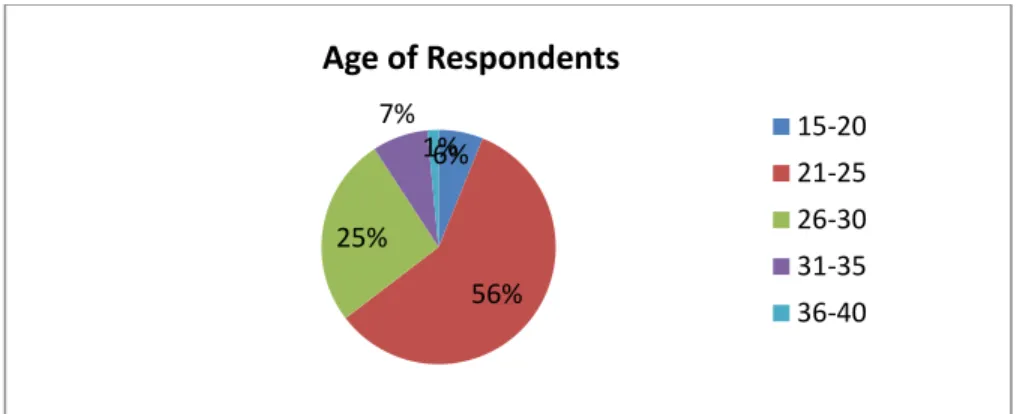
Figure 1: Age of respondents
Among the 135 respondents selected from the 09 public library who responded to the survey method, 77 percent were male and 23 percent were female. The main age group was 21–25 (56 percent) as shown in (Fig. 1). This group was followed successively by the following age percent: 25 percent, 6 percent, 7 percent, 01percent.
Figure 2: Qualification
FIGURE– 2 represents the status of the users of the public library. It may be observed from the table that majority of the respondents scoring 4 percent are intermediate, 41 percent are undergraduate, 41 percent of them are postgraduate and about 6 percent are research scholars.
Figure 3: Gender
The gender break up of respondents is shown in figure 3. It may be seen from the figure that a large number of the respondents numbering 78 percent are male and only 22 percent of them are female respondents. 6% 56% 25% 7% 1%
Age of Respondents
15-20 21-25 26-30 31-35 36-40 4% 41% 41% 6%Qualification
Intermediate UG PG Researchers 77.77 22.32 Gender Male Female6 | P a g e
Figure 4: Working Status
Current work status shows the survey discovered that 71 percent of library users were students, 13 percent were in the self employed, 9 percent were researcher, 6 percent were govt. employed, 0 percent were retired and also 0 percent were farmers (Fig. 4).
This figure shows that most of the users i.e. 38 percent were used Amir-ud-daula public library, 8 percent users were Ganga Prasad Verma library, 9 percent users were Sikh Men’s Association, 16 percent were used Acharya Narendra Dev Public Library, 8 percent users were used Sri Maa Sharada Devi Public Library, 8 percent users were used Lala Lajpat Rai Pustakalya And Vachnalya, 6 percent users were used State Information Center Library, 3 percent users were used Acharya Narendra Dev International
6% 9% 13% 0% 71% 0% working status Govt. employee Researcher Self-employeed Farmers Students Retired 37.87 7.57 9.09 16.66 0 7.57 7.57 0 6.06 0 3.03 0 4.54 0
Name of Public Libraries
Amir-ud-daula Public Library
Ganga Prasad Verma Public Library
Sikh Young Men’s Public Library
Acharya Narendra Dev Public Library
Sri Maa Sharada
Lala Lajpat Rai Pustakalya And Vachnalya
State Information Center Library Hazratganj, Lucknow
Acharya Narendra Dev International Research Institute of Buddhist Library Shri Chandra Bhanu Gupta Library, Lucknow.
7 | P a g e
Research Institute of Buddhist Library 5 percent users were used Shri Chandra Bhanu Gupta Library, Lucknow.
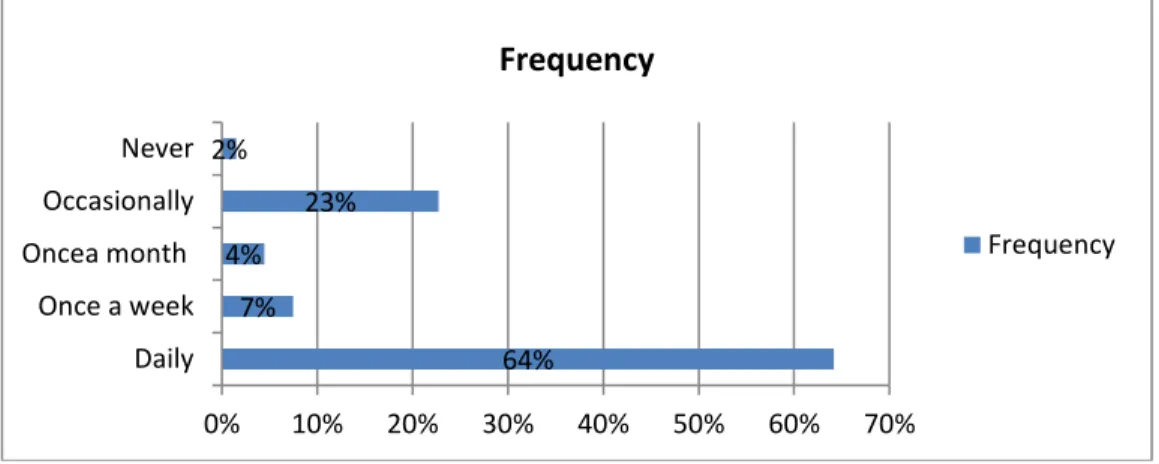
Figure 6: Frequency of Use of Public Library
The respondents were asked how frequently they had used a public library. The options were: daily, once a week, once a month, occasionally and never. The majority of respondents (64 percent) indicated that they used the library daily. The remaining 36 percent were divided among (7 percent) responses of once a week, once a month (4 percent), occasionally (23 percent), or never (2 percent).
Figure 7: Purpose for using a Public Library
The respondents were asked to mention all of the reasons why they used the library. The main reasons were students for studying and doing homework (76 percent), competition (62 percent), social & cultural (28 percent), entertainment (14 percent), use of internet (4 percent), research (8 percent) and 44 percent were read newspaper and magazines.
64% 7% 4% 23% 2% 0% 10% 20% 30% 40% 50% 60% 70% Daily Once a week Oncea month Occasionally Never
Frequency
Frequency 28% 76% 62% 14% 4% 8% 44% 0% 0% 20% 40% 60% 80%Social & Cultural Study Competition Entertainment Use of Internet Research Read newspaper & magazines
other
Purpose for using a Public Library
8 | P a g e
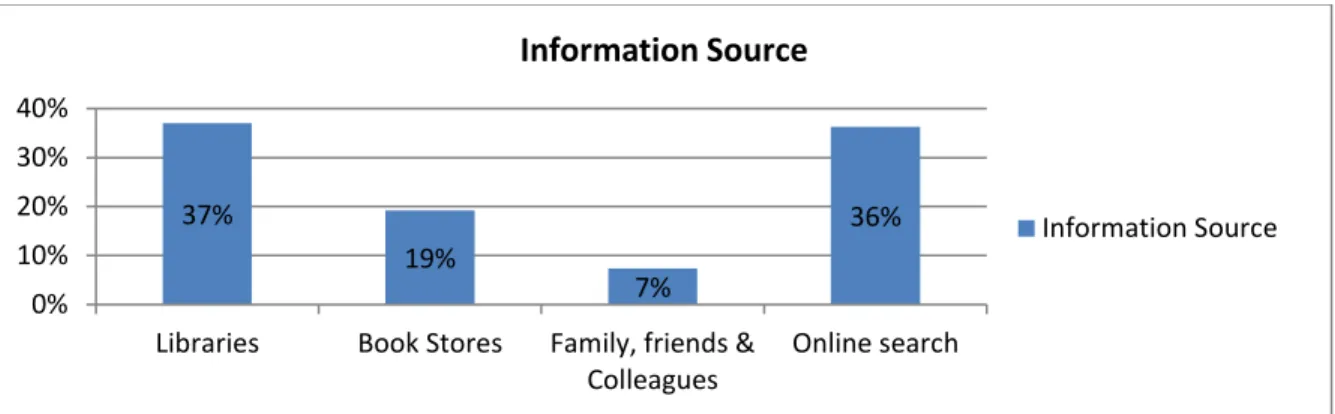
Figure 8: Types of information source do user prefer
Figure 8 shows that the user prefer what type of information source. The study findings that 37 percent respondents were libraries is the main source of information, 36 percent respondents were prefer the online search is the main source of information, 19 percent respondents were book stores is the main source of information and only 07 percent respondents were family, friends and colleagues is the main source of information.
Figure 9: Barriers in use of Library
Those who were not visiting the library regularly were lack of time 32 percent. The most commonly reasons were: the public library is too far from home, they get information via the Internet, or users were unaware of the library services and resources, time is not suitable (33 percent, 07 percent, and 21 percent, 20 percent respectively).
Figure 10: Public Library Play an Important Role
37% 19% 7% 36% 0% 10% 20% 30% 40%
Libraries Book Stores Family, friends & Colleagues Online search
Information Source
Information Source 0% 50% 32% 7% 20% 21% 33%1% Barriers in use of Library
Stongly Agree 36% Agree 57% Disagree 7% Stongly Disagree 0% Stongly Agree Agree Disagree Stongly Disagree
9 | P a g e
Figure 10 shows that the importance of public library in Lucknow. The study finding that 57 percent respondents were agreed about the public library play an important role in our society and almost all of the respondents were highly encouraging to the public library.
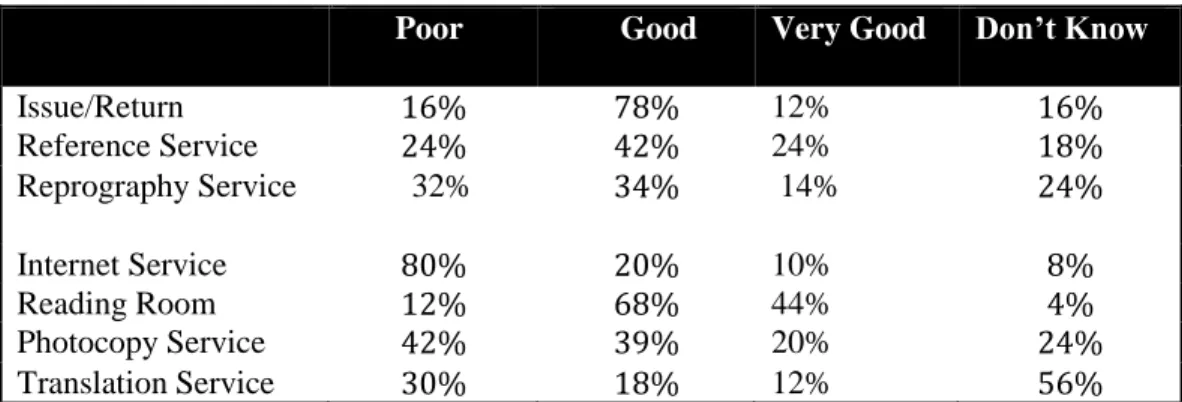
Library Services
Poor Good Very Good Don’t Know
Issue/Return 16% 78% 12% 16% Reference Service 24% 42% 24% 18% Reprography Service 32% 34% 14% 24% Internet Service 80% 20% 10% 8% Reading Room 12% 68% 44% 4% Photocopy Service 42% 39% 20% 24% Translation Service 30% 18% 12% 56%
Figure 11: Services towards public library
Figure 11 Shows that the services towards public library. The respondents were asked to respond to a series of statements about the value of library services, which used to poor, good, very good and don’t know. The survey result shows that the perceptions of public library users in Lucknow.
Figure 12: User's Perception of Staff
Figure 12: Shows various methods than public library staffs for searching information within the library premises. The data given in the figure shows that 27 percent library staff were cooperative. About 19 percent they were supportive, 19 percent staff were soft spoken, 11 percent staff were polite behavior, 22 percent staff were helpful, and 1 percent staff were preventive nature.
19% 27% 19% 11% 22% 1%
User's Perception of Staff
Supportive Co-operative soft Spoken Polite Helpful Preventive
10 | P a g e
Figure 13:
Figure 13 shown that public library deserves more financial support. 51 respondents were agreed
with this statement, 35 percent respondents were strongly agree and about 10 percent
respondents were disagree with this statement and none of the respondents were disagree.
Figure 14:
The quality of book collection in public library an indicated by the users is shown figure 14. The majority of users said that the quality of book collection is “Good” Nearly 15 percent of users find the quality of book collection is “Very Good” and 26 percent of the users say quality of book collection is “Fair”. The remaining 3 percent respondents are said that the Quality of books collection is poor and 1 percent were says that excellent library collection.
0% 20% 40% 60% Strongly Agree
Agree Disagree Strongly Disagree
35% 51%
10%
0%
Public Library Deserve More Financial Support
Public Library Deserve More Financial Support
0% 10% 20% 30% 40% 50% 60%
Poor Fair Good Very
Good Excellent 3% 26% 54% 15% 1%
User's Perception About Library Collection
11 | P a g e
Figure 15
The public library users will have certain impression about public library amenities like adequate ventilation and lighting, designed reading room, building size and quality, clean toilet room located in central place, fire extinguishers, sufficient computers, safe drinking water, sufficient seating facility. An attempt is made here to rank those amenities on the basis of responses of public library users in Lucknow.
Figure 15
Figure 15: Shows that the expectations of users towards public library. Most of the respondents were expect the internet and wi-fi facility in public library (20 percent), 11 percent users were expect more study tables, 7 percent users were expect library website and portals, 4 percent users were expect rest room facility, 5 percent users were expect library orientation programs, 10 percent users were expect photocopy facility, 7 percent users were expect training facility, 5 percent users were expect children’s material, 3 percent users were expect OPAC service, 11 percent users were expect proper cleanliness in library, 13 percent users were expect computer facility and 3 percent users were no expectation needed.
84% 62% 44% 20% 48% 18% 78% 66% 0% 20% 40% 60% 80% 100%
Sufficient Seating Facility safe Drinking water Clean Toilet Rooms Sufficient Computers Building Size and Quality Fire Extinguishers
Proper Lightning and…
Located in Central Place
Perceptions About Libraries Infrastructure
Perceptions About Libraries Infrastructure 4% 7% 20% 11% 5% 13% 11% 3% 5% 7% 10% 3% 0% 5% 10% 15% 20% 25%
Rest Room Facility Internet & Wi-fi Facility Library Orientation Program Proper Cleanliness in Library Children's Materials Photocopy Facility
Expectations
12 | P a g e
Figure 16
Figure 16: shows that most of the respondents were satisfied with the library i.e. 39 percent, 37 percent respondents were moderately satisfied with the library, 6 percent respondents were highly satisfied, 7 percent respondents were highly dissatisfied with the library and 10 percent respondents were dissatisfied with the library
.
Figure 17
Figure 17: Shows that the advertising of public library is required of most of the respondents were agree (60 percent), 27 percent were strongly agree, 10percent were disagree and 3 percent were strongly disagree.
CONCLUSION
The Public library is an important social institution.
The main purpose of this paper was to discover
the public library users’ perceptions and expectations in Lucknow.
Public libraries provide number of services to meet their needs and information requirement of all types of users. Generally, the users are satisfied with the public library services in Lucknow. The majority of users visit library to use newspapers and magazines for competitive exams, reading materials. The users have good opinion towards the library7%
10%
37% 39%
6%
User's Satisfy with Library
Highly Dissatisfied Dissatisfied Moderately Satisfied Satisfied Highly Satisfied 27% 60% 10% 3%
Advertising of Public Library is Required
Strongly Agree Agree
Disagree
13 | P a g e
staff about their ability and the way of communication with the users. However the attract more number of users.
This study adopted a descriptive survey design method. Data were collected through the questionnaire method.
The study findings are the services are good, staffs are cooperative and computer and
internet facilities are very poor.
The study findings that majority of the respondents were visit the public library for study purpose and respondents were visit the public library daily. Most of the users visit to library for study and for reading newspapers/ magazine and most of therespondents were agreed
that
public library deserves more financial support.
Users have more expectations like, lack of internet and wifi facility, library websites, photocopy facility, computer facility etc. Most of the respondents were agree of advertising of public library is required. Only few respondents were satisfied of the public library..
The suggestion offered by the users for improving the public library indicates that they want easy and quick access to information.Most of the users are not aware about the public library, so
the advertising of public library should be must there.
REFERENCES
Kayaoglu, H.D. (2014). Perceptions and Expectations of Public Library users in Istanbul,
Turkey: Initial Survey Results.
Shastri, S.(2008). Public library services, functions and organizational setup in Lucknow: a
survey. Lucknow. p.p 1-3.
Posey, J. (2009). Student Perceptions and Expectations of Library Services Quality and User
Satisfaction. Tennessee: Walters State Community College, p. 11.
Ranganathan, C. (2012) Perception and Expectation of the Users of Bharathidasan University
Library: A Study. Tamil Nadu; India: Department of Library and Information Science. p.1
Kumara, J. & Nikam, K. (2012). Perception of young adults towards public library services.
International Journal of Information Dissemination and Technology
, p.p. 1-4.
Iyer, V.K.: Public Library System in India, 1
sted., New Delhi.
Namugera, L. (2014). Users’ awareness, perceptions and usage of Makerere library services in
the main and selected branch libraries. East Africa: Makerere University Library. p.p 1-5.
Adeniran, P. (2011). User satisfaction with academic libraries services: Academic staff and
students perspectives.
International Journal of Library and Information Science
Vol. 3(10), p.1.
Kaunda, G. S. (2013). Assessing Service Expectation and Perception of Public Library Users:
Towards Development of User Needs and User Satisfaction
Measurement Instruments for the National Library Service of Malawi. Malawi: University of
Malawi. p.1.
14 | P a g e