ABSTRACT
The main objectives of this research are to (i) investigate the practice of knowledge sharing among academ-ics, and (ii) examine the relationship between knowledge sharing behaviour and its predictors based on the Theory of Planned Behaviour. Data were collected through an online survey using a questionnaire from academics in public universities. Using SPSS and PLS-SEM, data analysis process involved (i) analysis of descriptive statistics to evaluate knowledge sharing practice, (ii) assessment of the measurement model to evaluate items reliability and validity, and (iii) assessment of the structural model to evaluate its validity, path coefficients, and test the hypotheses. The results showed a great extent of knowledge sharing practice. They proved that academics’ knowledge sharing behaviour is significantly influenced by intention, which is influenced by attitude, subjective norms, and self-efficacy. Contrary to the theory, the results showed that controllability does not influence intention.
Determinants of Knowledge
Sharing Behaviour
among Academics in
United Arab Emirates
Huda Alami Skaik, International Islamic University Malaysia, Kuala Lumpur, Malaysia Roslina Othman, International Islamic University Malaysia, Kuala Lumpur, Malaysia
Keywords: Academics, Higher Education, Knowledge Sharing Behaviour, Knowledge Sharing Practice, Theory Of Planned Behaviour, UAE
INTRODUCTION
Knowledge sharing is one of the major pro-cesses of knowledge management (Nonaka & Takeuchi, 1995) and its strategies are keys to organizational and individual development (Alavi & Leidner, 2001; Earl, 2001). It is defined as the process of exchanging and transferring existing knowledge and ideas among people in
order to create new knowledge and ideas (Syed, Zaini, Noormala & Zahairah, 2009).
The benefits of knowledge sharing for organizations and individuals are numerous. On the organizational level, the benefits include facilitating knowledge creation (Akhavan, Gho-javand & Abdali, 2012), achieving continuous organizational growth, survival, and develop-ment (Durmusoglu, Jacobs, Nayir, Khilji & DOI: 10.4018/ijkss.2014070105
Wang, 2014), meeting organizational goals and objectives (Wang & Noe, 2010), solving business problems (McDermott & O’Dell, 2001), enhancing performance, maintaining competitiveness and profitability (Hsu, 2008), gaining better understanding of customer needs and identifying new business opportunities (Sandhawalia & Dalcher, 2011), enhancing pro-cess efficiency (Chugh, 2012), and improving the knowledge base for decision-making and more balanced policy decisions (Egger, 2013).
On the individual level, the benefits include getting the information easier and faster (Bada-racco, 2010), promoting individuals’ learning and innovation (Ling, Sandhu & Jain, 2009), transferring knowledge among workers in the same unit or from one unit to another (Burgess, 2005), strengthening capabilities (Egger, 2013), enhancing performance (Xiao & Jin, 2010), improving efficiency (Cummings, 2004), em-powering team effectiveness (Pangil & Chan, 2014), developing strategies to encourage organizational knowledge base (Reychav & Weisberg, 2009), reducing loss of individuals’ knowledge and expertise (Gurbuz, 2008), and transmitting knowledge and expertise to new generations (Badaracco, 2010).
Recognizing the importance of knowledge sharing is creating a demand for applying it in higher education institutions, which are seen as knowledge-intensive environments. The role of knowledge sharing is significant to achieve the maximum results for higher education in-stitutions considering the important role they play in creating, managing, and disseminating knowledge in society (Babalhavaeji & Ker-mani, 2011).
Moreover, academics are seen as expert knowledge workers engaged in teaching, writ-ing, and research from which their academic institutions generate value. Bearing in mind that higher education institutions grow and prosper from the knowledge of their academics, it is quite necessary to encourage and promote knowledge sharing among academics considering their role in enhancing education, research, and scholarly work (Babalhavaeji & Kermani, 2011).
Universities are science centers established to generate and provide knowledge, and to equip people with the best education in order to serve their societies and uplift the well-being of mankind. They grow and prosper from the knowledge of their human capital, particularly the academics (Singer & Hurley, 2005). In the knowledge-based age, universities seek to ensure success and permanence, achieve organizational goals (Sharma, 2010), and have constant performance improvements. In the academic environment, the role of knowledge sharing is becoming quite significant to achieve maximum results for academic institutions (Ba-balhaveji & Kermani, 2011) due to the important role academics play in providing education, conducting research, and publishing scholarly works. Therefore, universities should promote knowledge sharing among their academics.
Knowledge Sharing in UAE
The United Arab Emirates (UAE) has experi-enced significant local and foreign investments in various fields such as business, construction, infrastructure, financial services, telecom-munications, media, information technology, hospitality and tourism as well as education (Ahmad & Daghfous, 2010). Nonetheless, some organizations have been very conservative in terms of integrating knowledge management initiatives and knowledge sharing strategies into their operational processes (Al-Shammari, 2008). This could be attributed to the difficulty in locating the knowledge residing within people. Therefore, there is inability in some organiza-tions to locate, store, and share knowledge that could help in innovation, development and meeting planned objectives (Ahmad & Daghfous, 2010).
The government has been working consis-tently and strongly to establish a knowledge-based society with a knowledge-knowledge-based economy (Al-Nahyan, 2012a). Therefore, the government strategy has recently been focusing on human capital (Al-Nahyan, 2012a, 2012b). As a step to achieve this, it has allocated more than 1/3 of
its budget to education, research and innovation (Al-Nahyan, 2012a).
Not only that, UAE is also seeking to become a regional hub for higher education that provides high quality education in diverse programs and fields (Al-Nahyan, 2012b). As a result, the government has launched partner-ships with numerous international reputable academic institutions to establish campuses in UAE to work on raising the standards of higher education (Al-Nahyan, 2012a).
Moreover, UAE along with other partners are working collaboratively, whereby UAE can be the hub of knowledge and connectivity for the Arab region with its international partners worldwide (Abu-Ghazaleh, 2012). This will definitely enable higher education institutions, researchers, and knowledge workers in the Arab world to become part of the world research and education (Abu-Ghazaleh, 2012).
It has been noticed in the Arab world that there is an awareness of the benefits and ad-vantages of knowledge sharing to create new knowledge, increase capital assets (Al-Adaileh & Al-Atawi, 2011), develop employees’ com-petencies (Seba, Rowley & Lambert, 2012), and achieve innovation and success (Ahmad & Daghfous, 2010; Al-Alawi, Al-Marzooqi & Mohammed, 2007).
Yet there is lack of knowledge sharing strategies in the region due to economic and political complexities, organizational and national culture, lack of research and develop-ment, inadequate ICT infrastructures, and low level of willingness for knowledge revolution (Biygautane & Al-Yahya, 2011; Mohamed, O’Sullivan & Ribiere, 2008; Skok & Tahir, 2010). Such lack is viewed as the biggest impedi-ment to progress towards a knowledge-based society. Therefore, researchers have started to address the need for a knowledge sharing strategy in the region.
PROBLEM STATEMENT
Few researchers have been focusing on knowl-edge sharing in UAE particularly, concentrating
on business and management, construction, and police force service (Ahmad & Daghfous, 2010; Rowley, Seba & Delbridge, 2012; Seba et al., 2012; Skok & Tahir, 2010). These researchers have either studied the practice of knowledge sharing and its activities, or the effect of some organizational, individual, and technological factors on it.
However, not a single study has addressed knowledge sharing in the higher education sector. In light of that, this research intends to investigate knowledge sharing practice among academics and examine the factors influencing knowledge sharing behaviour in UAE universi-ties based on the theory of planned behaviour.
SIGNIFICANCE OF RESEARCH
With the scarcity of empirical studies investigat-ing knowledge sharinvestigat-ing in the Arab world, this research aims to make a major contribution in this field. The significance of this research lies in the fact that it is the first to address knowledge sharing in higher education sector in UAE with particular emphasis on academics’ knowledge sharing behaviour considering their important role in creating knowledge and the importance of knowledge sharing in achieving universities’ goals. Moreover, this research is based on a solid theoretical framework by adopting one of the well-known psychological and behavioural theories.KNOWLEDGE SHARING
PRACTICE
Knowledge sharing practice is quite significant for individuals seeking to improve their perfor-mance and career as well as for organizations aiming to achieve their success and longevity. Knowledge sharing practice is manifested in the social interaction among individuals to exchange information, knowledge, experiences, skills, concepts, thoughts, opinions, insights, ideas (Durmusoglu et al., 2014; Ramlee, 2011).
Organizations that have survived from knowledge sharing are not those who only
implemented technology, but those who de-veloped a knowledge sharing culture (Albres, 2009; Riege, 2005; Sallis & Jones, 2002). Employing technology in addition to applying knowledge sharing practices and strategies can create a knowledge sharing culture to harness organizational development (Mohamed, et al., 2008; Riege, 2005; Sveiby, 2002).
For example, in a case study in the Ameri-can healthcare sector Alajmi, McInerney, Or-zano, Tallia, Meese & Vamanu (2008) explored the practice of knowledge sharing and the use of different activities and tools in the practising process. They found that practice of knowledge sharing was manifested in different ways such as team working, exchanging of knowledge, asking and approaching each other whenever needed. Moreover, Haapalainen and Makiranta (2013) investigated the use of IT in acquiring and sharing knowledge in SMEs in Finland, and identified various channels to share tacit and explicit knowledge. They found that generally such companies regard IT as a potential tool to acquire and share knowledge.
Practising knowledge sharing involves us-ing appropriate activities and tools (Alajmi et al., 2008; Paloti, 2010) that facilitate exchanging, transferring, and utilizing knowledge. Several researchers and practitioners have identified a list of the most popular activities and tools widely employed by many organizations (Ah-mad & Daghfous, 2010; Alajmi et al., 2008; Al-Alawi et al., 2007; Chaudhry & Sivakama-sundari, 2004; Sandhu & Sidhu, 2007; Skok & Tahir, 2010; Paloti, 2010).
The activities include team meetings, dis-cussions, CoPs, training programs, apprentice-ships, workshops, conferences, brainstorming sessions, peer coaching, focus groups, and seminars, while the tools include artifacts, educational materials, manuals, boards, pro-cedures, databases, video screening sessions, decision-support systems, blogs, wikis, portals, and online communication channels like emails, internet and intranet.
Knowledge sharing is key component (Alavi & Leidner, 2001) in organizational and individual development (Nahapiet & Ghoshal,
1998; Nonaka, 1994). Therefore, in academic environments such as universities, management should create a knowledge sharing culture and support the practice of knowledge sharing by providing the necessary activities and tools. This would help and encourage academics to share their knowledge, knowing that they play a major role in disseminating knowledge and creating new one.
THEORETICAL BASE
The Theory of planned behaviour (Ajzen, 1985) states that human behaviour is guided by three kinds of salient beliefs: behavioural beliefs, normative beliefs, and control beliefs. Behavioural beliefs are about the likely conse-quences or attributes of the behaviour, normative beliefs are about the normative expectations of other people, and control beliefs are about the presence of factors that may facilitate or hinder performing the behaviour (Ajzen, 1985, 1991). In their respective aggregates, behavioural beliefs produce a favourable or unfavourable attitude toward the behaviour; normative beliefs result in perceived social pressure or subjective norms; and control beliefs give rise to perceived behavioural control, the perceived ease or difficulty of performing the behaviour (Ajzen, 1985, 1991). In combination, attitude, subjective norms, and perceived behavioural control lead to the formation of a behavioural intention. Intention is defined as the individual’s willingness to engage in behaviour (Ajzen, 1985, 1991, 2002).
However, due to the conceptual and meth-odological ambiguities concerning the concept of perceived behavioural control, Ajzen (2002) stated that perceived behavioural control should be viewed as a unitary, higher-order concept that consists of two interrelated components (Kraft, Rise, Sutton & Roysamb, 2005). In order to resolve these ambiguities, Ajzen (2002) decon-structed perceived behavioural control into two constructs: self-efficacy and controllability. Ac-cording to Ajzen (2002), self-efficacy is referred to as the individual’s confidence in the ease or
difficulty to perform certain behaviour, whereas controllability is referred to as the individual’s beliefs, based on the available resources, about the extent to which performing the behaviour is up to him/her.
According to Ajzen (1991, 2006), the more favourable the attitude and subjective norms, and the greater the self-efficacy and control-lability, the stronger would be the intention to carry out the behaviour in concern. Thus, inten-tion is considered the immediate antecedent of behaviour (Ajzen, 1991, 2002, 2006). Having a sufficient degree of actual control over the behaviour, people are expected to perform the behaviour when the opportunity arises. Each of the theory elements of intention, attitude, subjective norms, self-efficacy, and control-lability is counted as an aspect of the actual behaviour (Ajzen, 1991).
In knowledge sharing context, studies have found that intention significantly affects knowledge sharing behaviour (Alajmi, 2011; Chen, Chen & Kinshuk, 2009; Minbaeva and Pedersen, 2010; Tohidinia & Mosakhani, 2010). Moreover, studies have found that attitude, subjective norms, and self-efficacy significantly affect intention (Alajmi, 2011; Chennamaneni, 2006; Elogie & Asemota; 2013; Kuang, Davison & Yao, 2012; Lin and Lee, 2004; Minbaeva & Pedersen, 2010; Ryu, Ho & Han, 2003). Previ-ous studies on knowledge sharing behaviour
have always adopted the first or second models of the theory of planned behaviour (1985, 1991) where perceived behavioural control proved to affect intention (Elogie & Asemota; 2013; Kuang et al., 2012; Tohidinia & Mosakhani, 2010). However, only one study has adopted the latest model of the theory (2002) where controllability is measured as a separate vari-able. In that study, Alajmi (2011) found that controllability does not affect intention.
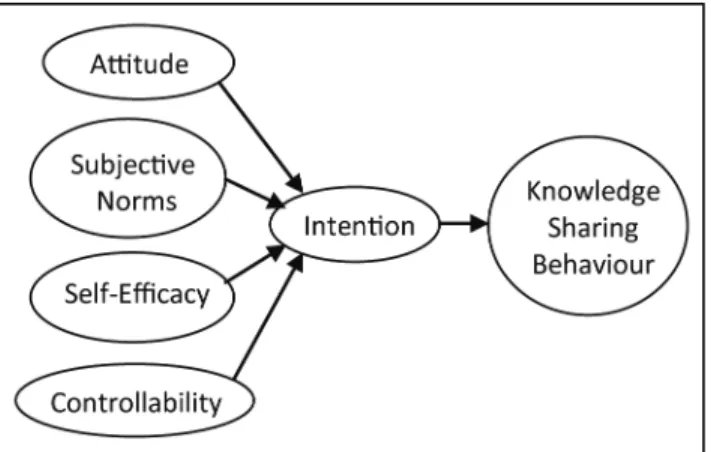
Based on the above, and in terms of the research context on knowledge sharing, it is hypothesized that academics’ knowledge shar-ing is significantly influenced by their intention, which is in turn is positively influenced by their attitude, subjective norms, self-efficacy, and controllability.
RESEARCH MODEL
AND HYPOTHESES
Based on the theoretical framework and the past researches employing the TBP as indi-cated above, the current study is examining the influence of intention on knowledge shar-ing behaviour as its main determinant, as well as the influence of attitude, subjective norms, self-efficacy, and controllability on intention as its predictors. Thus, the following research model (Figure 1) is proposed:
Based on the theoretical and empirical background on the factors influencing knowl-edge sharing behaviour, the following hypoth-eses are proposed:
H1: Intention to share knowledge has a sig-nificant positive effect on academics’ knowledge sharing behaviour
H2: Attitude has a significant positive effect on academics’ intention to share knowledge
H3: Subjective norms has a significant posi-tive effect on academics’ intention to share knowledge
H4: Self-efficacy has a significant positive effect on academics’ intention to share knowledge
H5: Controllability has a significant positive effect on academics’ intention to share knowledge
METHODOLOGY
A cross-sectional web-based survey was used as a method to collect data from the academics working in the targeted universities in UAE. The instrument employed for this purpose was a questionnaire. The web-based survey has many benefits including overcoming time and space boundaries and ease of data entry (Batinic, Reips & Bosnjak, 2002 cited in Alajmi, 2011). Moreover, it is cost-effective in developing and distributing through an internet link (Weathing-ton, Cunningham & Pittenger, 2010).
Sample and Sampling Technique
The setting of this research composed of 10 public universities in UAE, including federal, governmental, and semi-governmental uni-versities. The sample consisted of academics working in those public universities. A total of 321 academics working in different faculties participated in the study. The sampling tech-nique used for this study was the simple random sampling, which includes samples of whoever would be available at the time of conducting the research (Gay & Airasian, 2003).
Survey Instrument
A comprehensive questionnaire was created to measure the variables developed in the research model. It comprised of three sections; the first section collected demographic information about the participants. The second section col-lected data about the participants’ knowledge sharing practice. The third section collected data about the participants’ knowledge shar-ing behaviour and its predictors, which are attitude, subjective norms, self-efficacy, and controllability.
The measurement items used to measure the variables were developed and validated based upon Ajzen’s theory of planned behav-iour (1985, 1991, 2002), and other instruments validated in previous researches conducted on knowledge sharing behaviour including (Alajmi, 2011; Bock, Zmud, Kim & Lee, 2005, Chen et al., 2009; Hsu, Teresa, Yen & Chang, 2007; Ryu et al., 2003; Tohidinia & Mosakhani, 2010). The measurement items for knowledge sharing practice were developed and validated from (Alajmi et al., 2008; Al-Alawi et al., 2007; Hsu et al., 2007; Paloti, 2010; Sandhu, Jain & Umi Kalthom, 2011; Tohidinia & Mosakhani, 2010).
All items were measured using five-point Likert-scale. The scales are usually used to measure the strength degree of the respondents’ attitudes and feelings about a certain subject, and have a score in the middle that allows them to feel neutral (Simonis, 2010). The scale used for the construct of knowledge sharing behaviour ranged from ‘Never’, ‘Rarely’, ‘Sometimes’, ‘Usually’, and ‘Always’. Whereas the scale used for the rest of the constructs ranged from ‘Strongly Disagree’, ‘Disagree’, ‘Neutral’, ‘Agree’, and ‘Strongly Agree’.
Data Collection
Data was collected through a survey conducted online. One of the fastest techniques to collect data is the internet using an online survey either by sending an email or posting a web page. For this study, the survey was conducted online by
sending an email with a link of the questionnaire to the participants. The email, which was writ-ten in both English and Arabic, introduced the study to the participants inviting them to take part in the survey by answering the research questionnaire.
The questionnaire was provided in the email through a URL link that led the participants to a web page where they can answer and submit it online. Once the participants submit their answers, the data were recorded directly into a spreadsheet, which was transferred later into SPSS in order to carry out the required analysis.
In order to insure attaining the required sample size, a submission date was arranged to insure that academics would comply with it. Reminding emails were sent to the academics to answer the questionnaire. Data collection period took place from November 2012 till Mid March 2013.
Data Analysis
Using SPSS 19.0, the sample descriptive characteristics were assessed based on the demographic information. Data analysis for knowledge sharing practice was conducted using descriptive statistics of central tendency, dispersion, and frequencies. Data analysis for the research model constructs was conducted us-ing partial least square path modelus-ing technique (PLS-SEM). By using SmartPLS 2.0 software (Hansmann & Ringle, 2004), PLS-SEM was applied to assess the measurement and structural models, the mediating relationships, and to test the research hypotheses.
The assessment of the measurement model involved assessment of indicator reliability, internal consistency reliability, convergent validity, and discriminant validity at indicator and construct levels (Chin, 2010). The ment of the structural model involved assess-ment of the coefficient of determination, path coefficient, effect size, and predictive relevance (Chin, 2010). Assessment of the mediating
Table 1. Respondents’ demographics
Profile Category Percentage
Gender Male Female 68.5 31.5 Age 22-30 31-40 41-50 51& above 2.8 26.2 35.8 35.2 Level of Education Bachelor
Master Ph.D Post Doctorate 1.6 29.3 56.7 12.5 Position Professor Associate Professor Assistant Professor Instructor Lecturer Other 15.9 16.5 34.9 19.9 11.2 1.6 Years of experience 0-5 6-10 11-15 16-20 21 & above 17.4 20.9 19.6 13.7 28.3
relationship is applied using PLS algorithm test on the relationship between the dependent and independent variables with and without the presence of the mediating variable. In case both tests result in significant relationships, then the mediating variable is partial mediator, while if the tests show that after the inclusion of the mediating variable the direct relationship is no longer significant, then the mediating variable is full mediator (Guenzi, Goerges & Pardo, 2009; Ida, Roshayati & Fazli, 2012).
FINDINGS
Demographics of Respondents
Table 1 displays the demographic characteristics of the participants. As seen most of the respon-dents were males. Their age varied from 31 to more than 51. In terms of nationality, 60% of the respondents were international, 33% were Middle Eastern, and 7% were local. Moreover, the respondents were distributed among the 10 universities with majority from the federal universities. They also distributed among the different faculties. As for the position, they ranged from teachers to professors. Finally, their academic experience ranged from less than 5 years to more than 21 years.
Knowledge Sharing Practice
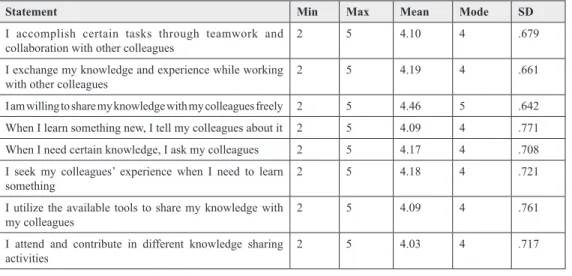
The first objective of this research is to inves-tigate academics’ knowledge sharing practice. In order to measure the practice of knowledge sharing, the respondents were asked to indicate their degree of agreement to eight statements. By using descriptive statistics of central tendency, dispersion, and frequencies, the answers were analyzed. The results showed that majority of the surveyed academics either agreed or strongly agreed to the given statements indicating a great extent of knowledge sharing practice. The minimums, maximums, means, modes, and standard deviations for these statements are shown in Table 2.
In general, the respondents indicated that they accomplish certain tasks through teamwork and collaboration with other colleagues, where almost 88% agreed and strongly agreed to the statement. Meanwhile, only 3% disagreed to the statement. Again, almost 90% of respondents agreed and strongly agreed to the second state-ment showing that they exchange knowledge and experience while working with others, and only 2% disagreed. Almost all respondents 95% agreed and strongly agreed that they are willing to share their knowledge with other colleagues freely. Only 1.2% of them disagreed to the
state-Table 2. Descriptives of respondents’ knowledge sharing practice
Statement Min Max Mean Mode SD
I accomplish certain tasks through teamwork and
collaboration with other colleagues 2 5 4.10 4 .679 I exchange my knowledge and experience while working
with other colleagues 2 5 4.19 4 .661
I am willing to share my knowledge with my colleagues freely 2 5 4.46 5 .642 When I learn something new, I tell my colleagues about it 2 5 4.09 4 .771 When I need certain knowledge, I ask my colleagues 2 5 4.17 4 .708 I seek my colleagues’ experience when I need to learn
something 2 5 4.18 4 .721
I utilize the available tools to share my knowledge with
my colleagues 2 5 4.09 4 .761
I attend and contribute in different knowledge sharing
ment. The fourth statement inspected if they would tell other colleagues the new things they learn. Based on the results, 81.3% of respondents strongly agreed and agreed that they do so, while 3.4% disagreed. Almost 88% of the respondents strongly agreed and agreed that they ask their colleagues when needing certain knowledge, and almost 3% disagreed. When asked to in-dicate their agreement to statement inspecting seeking colleagues’ experience when needing to learn something, 87.3% of the respondents strongly agreed and agreed. Meanwhile, only 3% disagreed to the statement.
Utilizing certain tools such as educational materials, manuals, boards, procedures, data-bases, blogs, wikis, portals, emails, internet, and intranet is an indication of practising knowledge sharing. When inspecting their usage of such tools, 83.2% of respondents strongly agreed and agreed that they use these tools, while 12.8% answered neutral and 4% disagreed. Finally, as an indication of practising knowledge sharing, the respondents were asked if they participate in various knowledge sharing activities such as meetings, discussions, CoPs, trainings, appren-ticeships, workshops, conferences, seminars, brainstorming, and focus groups. Total of 83% of them strongly agreed, and agreed to this statement. However, 13.7% answered neutral, while 3.4% disagreed to the statement.
Assessment of Measurement Model
The purpose of assessing the measurement model is to evaluate its validity and reliability.
It is conducted through the following tests: (a) Indicator reliability by measuring the factor loading of each of the manifest variables, which should be above 0.4 (Hair, Ringle & Sarstedt, 2013), (b) internal consistency reliability by measuring composite reliability and Cronbach’s alpha, which should be 0.7 and above (Hair, Black, Babin & Anderson, 2010), (c) convergent validity by measuring the AVE, which should be more than 0.5 (Fornell & Larcker, 1981), and (d) discriminant validity by using Fornell-Larcker’s (1981) criterion where the square root of the AVE for each construct exceeds the correlations between the construct and all other constructs (Henseler, Ringle & Sinkovics, 2009).
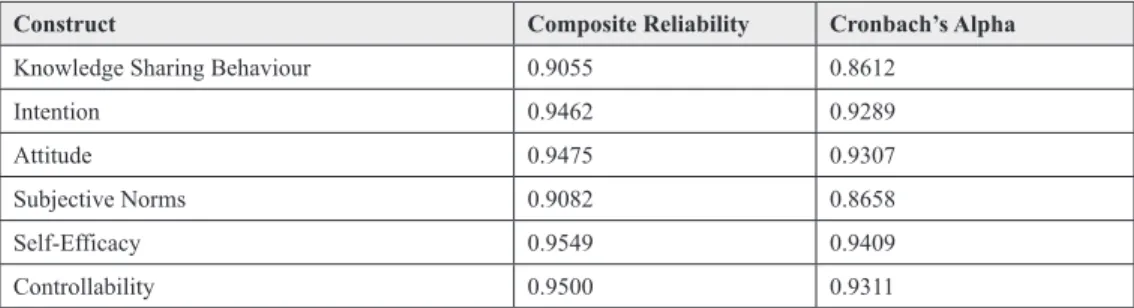
The results of analyzing the measure-ment model demonstrated reliable and valid measurement model. All factors loaded above the recommended value of 0.7 demonstrating satisfactory indicator reliability. The constructs composite reliability and Cronbach’s alpha values exceeded the recommended value of 0.7 indicating satisfactory internal consistency reliability as displayed in Table 3.
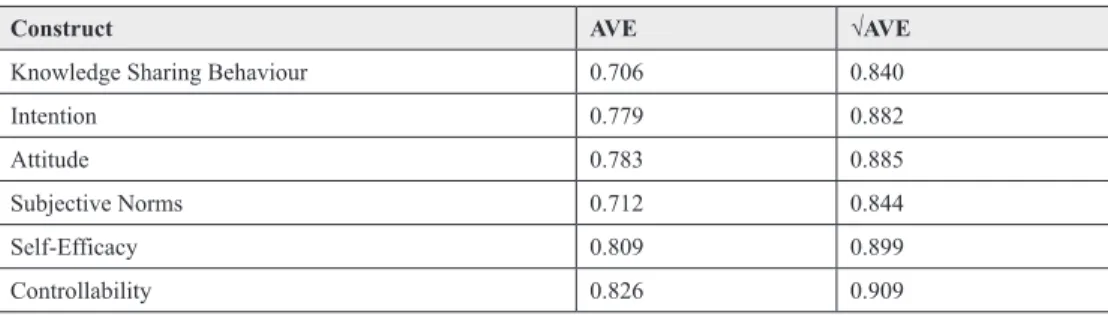
The constructs AVE exceeded the recom-mended value of 0.5 demonstrating adequate convergent validity. The square root of the constructs AVE values exceeded the correlations between the constructs and all indicators loaded higher on their own constructs indicating satis-factory discriminant validity as seen in Table 4.
Assessment of Structural Model
The purpose of assessing the structural model is to evaluate its validity and test the hypotheses.
Table 3. Internal consistency reliability
Construct Composite Reliability Cronbach’s Alpha
Knowledge Sharing Behaviour 0.9055 0.8612
Intention 0.9462 0.9289
Attitude 0.9475 0.9307
Subjective Norms 0.9082 0.8658
Self-Efficacy 0.9549 0.9409
This is achieved through the following tests: (a) the coefficient of determination (R2) by
measuring the amount of explained variance of each latent variable, which should be 0.01, 0.09, and 0.25 indicating small, medium and large exploratory power (Mitchell & Jolley, 2013); (b) path coefficient by measuring the path estimates and t-statistics, which should be 0.02, 0.15, and 0.35 indicating small, medium and large relationships (Cohen, 1988; Henseler et al., 2009); (c) effect size (f2) by measuring
the relative impact of a particular exogenous latent variable on an endogenous latent variable by means of changes in the R2 of the latent
variable, which should be 0.02, 0.15, and 0.35 indicating small, medium and large effect (Ida et al., 2012), and (d) predictive relevance (Q2)
by measuring how well observed values are reconstructed by the model and its parameter estimates, which should be higher than zero (Chin, 2010).
As seen in Tables 5 and 6 below, the results of analyzing the structural model demonstrated an adequate and valid model. The R2 values for
knowledge sharing behaviour and intention were large demonstrating strong explanatory power. Meanwhile the R2 value for attitude was
moderate demonstrating modest explanatory
power, and the R2 value for controllability was
small. The predictive relevance (Q2) values of
the dependent variables were above the rec-ommended value zero indicating an adequate predictive relevance of the model. The effect size (f2) values were within the recommended
values ranging from 0.002 to 0.219 demon-strating small and medium effect sizes of the independent variables.
Assessment of Mediating Relationship
Mediation assessment provides accurate in-formation whether a mediating variable actu-ally mediates the relation between two other variables (MacKinnon & Fairchild, 2009). The assessment is done by running the PLS algorithm test on the relationship between the independent and dependent variables without the mediator and then with the mediator. Based on the results, it can be judged whether the mediator is full or partial (Guenzi et al., 2009; Ida et al., 2012).
The research model contains only one mediator that is intention. Table 7 shows the results for the mediator intention indicating that while intention fully mediates between attitude,
Table 4. Convergent and discriminant validity
Construct AVE √AVE
Knowledge Sharing Behaviour 0.706 0.840
Intention 0.779 0.882
Attitude 0.783 0.885
Subjective Norms 0.712 0.844
Self-Efficacy 0.809 0.899
Controllability 0.826 0.909
Table 5. Coefficient of determination and predictive relevance
Construct R2 Q2
Knowledge Sharing Behaviour 0.260 0.180
subjective norms, controllability and knowledge sharing behaviour, it partially mediates between self-efficacy and knowledge sharing behaviour.
Hypotheses Testing
The research hypotheses were tested using the results of the path coefficient. Both path estimates and their t-statistics with p-values are used to support or refute the hypotheses. Path coefficient values were calculated using PLS algorithm test, while t-statistics values were calculated using bootstrapping test, and p-values were calculated using an online free calculator.
Path coefficient values of 0.02, 0.15, and 0.35 indicate small, medium and large relation-ships (Cohen, 1988). Meanwhile, significant t-values for a two-tailed test are 1.65, 1.96, and 2.59 at p-values 0.1, 0.05, and 0.01 respectively (Hair et al., 2013). Table 8 shows the results of the hypotheses testing. Four hypotheses were supported.
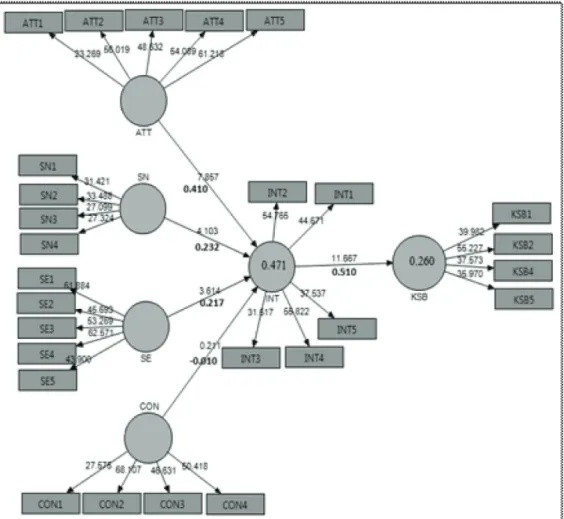
Figure 2 shows the results of the assess-ment of the measureassess-ment and structural models displaying the t-values on top of the arrows, the
path coefficients below the arrows, and the R2
values inside the circles.
DISCUSSION
The results revealed that academics’ knowledge sharing behaviour is significantly influenced by intention to share knowledge, which is consis-tent with the theory of planned behaviour and with previous studies (Alajmi, 2011; Chen et al., 2009; Minbaeva & Pedersen, 2010; Tohi-dinia & Mosakhani, 2010). Intention to share knowledge explained 26% of the variance in knowledge sharing behaviour.
Furthermore, the results showed that aca-demics’ intention is significantly influenced by attitude towards knowledge sharing, subjective norms, and self-efficacy. This result is in ac-cordance with the theory of planned behaviour as well as with previous studies (Alajmi, 2011; Chennamaneni, 2006; Elogie & Asemota; 2013; Kuang et al., 2012; Lin & Lee, 2004; Minbaeva & Pedersen, 2010; Ryu et al., 2003). Collec-tively, attitude towards knowledge sharing,
Table 6. Effect size
Path f2 Effect Size
Attitude→ Intention 0.219 Medium
Subjective Norms → Intention 0.079 Small
Self-Efficacy →Intention 0.049 Small
Controllability → Intention 0.002 Small
Table 7. Results of the mediator intention (INT)
IV DV β/t-value wzout
INT β/t-values wz INT Mediating Effect
Attitude KSB β: 0.147 t: 2.640 β: -0.002 t: 0.056 Full Subjective norms KSB β: 0.187 t: 3.057 β: 0.099 t: 1.634 Full Self efficacy KSB β: 0.211 t: 2.860 β: 0.129 t: 1.851 Partial Controll- ability KSB β: 0.088 t: 1.539 β: 0.095 t: 1.657 Full
Table 8. Hypotheses testing
Hypothesis Path Coefficients T-statistics Result
H1 Intention → Knowledge
sharing behaviour 0.510 11.667** Supported H2 Attitude → Intention 0.410 7.857** Supported H3 Subjective Norms → Intention 0.232 4.103** Supported H4 Self-efficacy → Intention 0.217 3.614** Supported H5 Controllability → Intention -0.010 0.211 Not Supported
* Significance at t value ≥1.96 with p ≤ 0.05, **Significance at t value ≥ 2.59 with p ≤ 0.01
subjective norms, and self-efficacy explained 47% of the variance in intention.
However, contrary to the theory, the results found that controllability does not have any influence on academics’ intention. It can be argued that the reason behind this result is that individuals’ intention to perform or not perform certain behaviour depends somehow on non-motivational factors as availability of requisite opportunities and resources such as time, money, skills, or cooperation (Ajzen, 1991).
Yet, the result in this research is consis-tent with that of Alajmi (2011), who found that individuals’ controllability and decision to share knowledge is not a predictor of their intention. However, in her study, she examined individuals’ intention to share knowledge in online communities and was conducted in an American context.
CONTRIBUTION
Although the results of the current study is consistent with those of previous studies, the findings of the current study contribute to the literature of knowledge sharing by addressing knowledge sharing behaviour in particular and among academics. Previous researches have either studied intention to share knowledge or knowledge sharing, and the few that have studied knowledge sharing behaviour have only targeted employees and managers and were conducted in Western or Southern-Asian contexts.
Not only that, but the current study also extends prior researches on the theory of planned behaviour by providing empirical evidence of the determinants of knowledge sharing behaviour in new context and new setting, i.e. higher education in UAE, which also provides significant practical implications for academic institutions and for the decision makers in UAE.
Moreover, the result that controllability does not affect intention, which is consistent with Alajmi’s (2011) result, calls for further researches on this particular construct in the context of knowledge sharing behaviour.
CONCLUSION
This research successes in filling the gap in literature on knowledge sharing behaviour where the findings support previous researches that have explained the complicated nature of knowledge sharing behaviour; however, the findings contribute due to being conducted a new setting, i.e. UAE with particular emphasis on a newly explored context there, which is higher education, which has not been addressed in previous researches about knowledge sharing in the Arab world.
The need to explore knowledge sharing in higher education is reinforced by the important role of universities in creating and distributing knowledge. As well as by the major role of academics as valuable resources of creating, exchanging, and disseminating knowledge, where knowledge sharing can help them in their scholarly and research works.
REFERENCES
Abu-Ghazaleh, T. (2012). Abu-Ghazaleh announces the UAE as knowledge and connectivity hub for the Arab region at e-AGE 2012.
Ahmad, N., & Daghfous, A. (2010). Knowledge sharing through inter-organizational knowledge networks: Challenges and opportunities in the United Arab Emirates. European Business Review, 22(2), 153–174. doi:10.1108/09555341011023506 Ajzen, I. (1985). From intentions to actions: A theory of planned behavior. In J. Kuhl & J. Beckman (Eds.), Action control: From cognition to behavior (pp. 11-39). Berlin, Germany: Springer-Verlag. doi:10.1007/978-3-642-69746-3_2
Ajzen, I. (1991). The theory of planned behavior.
Organizational Behavior and Human Decision Processes, 50(2), 179–211. doi:10.1016/0749-5978(91)90020-T
Ajzen, I. (2002). Perceived behavioral control, self-efficacy, locus of control, and the theory of planned behavior. Journal of Applied Social Psychology,
32(4), 665–683. doi:10.1111/j.1559-1816.2002. tb00236.x
Ajzen, I. (2006). Constructing a theory of planned behavior questionnaire. Retrieved December 1, 2012, from http://people.umass.edu/aizen/pdf/tpb. measurement.pdf
Akhavan, P., Ghojavand, S., & Abdali, R. (2012). Knowledge sharing and its impact on knowledge cre-ation. Journal of Information & Knowledge Manage-ment, 11(2), 1–12. doi:10.1142/S0219649212500128 Al-Adaileh, R., & Al-Atawi, M. (2011). Organiza-tional culture impact on knowledge: Saudi telecom context. Journal of Knowledge Management, 15(2), 212–230. doi:10.1108/13673271111119664 Al-Alawi, A. I., Al-Marzooqi, N. Y., & Moham-med, Y. F. (2007). Organizational culture and knowledge sharing: Critical success factors.
Journal of Knowledge Management, 11(2), 22–42. doi:10.1108/13673270710738898
Al-Nahyan, N. b. M. (2012a). Executive focus: Government commitment and investment in educa-tion, research initiatives, and improving the quality of education. UAE Minister of Higher Education & Scientific Research HH Sheikh Nahyan bin Mubarak Al Nahyan.
Al-Nahyan, Nahyan bin Mubarak (2012b). Education in the United Arab Emirates (UAE). The Prospect Group.
Al-Shammari, M. (2008). Toward a knowledge management strategic framework in the Arab region.
International Journal of Knowledge Management,
4(3), 44–63. doi:10.4018/jkm.2008070104 Alajmi, B. M. (2011). The intention to share: Pro-fessional’s knowledge sharing behaviors in online communities. Doctoral thesis. The State University of New Jersey.
Alajmi, B. M., McInerney, C. R., Orzano, A. J., Tallia, A. F., Meese, A., & Vamanu, I. (2008). Knowledge sharing processes and tools in U.S.A. primary health care: Analysis of four case studies.
Proceedings of the International Conference on Knowledge Management 2008, Al-Hawamdeh, S. et al. (Eds.), Hackensack, NJ: World Scientific doi:10.1142/9789812837578_0009
Alavi, M., & Leidner, D. (2001). Knowledge manage-ment and knowledge managemanage-ment systems: Concep-tual foundations and research issues. Management Information Systems Quarterly, 25(1), 107–136. doi:10.2307/3250961
Albres, J. A. (2009). A practical approach to implementing knowledge management. Journal of Knowledge Management Practice, 10(1).
Babalhavaeji, F., & Kermani, Z. J. (2011). Knowledge sharing behaviour influences: A case of library and information science faculties in Iran. Malaysian Jour-nal of Library & Information Science, 16(1), 1–14. Badaracco, J. (2010). Effective knowledge sharing and its benefits. The Point newspaper online. Batinic, B., Reips, U., & Bosnjak, M. (2002). Online social sciences. Seatle: Hogrefe & Hubber Publisher. In B. Alajmi (ed.), The intention to share: Psychologi-cal investigation of knowledge sharing behavior in online communities (pp.35-43). Doctoral dissertation. Rutgers State University of New Jersey.
Biygautane, M., & Al-Yahya, K. (2011). Knowledge management in the UAE’s public sector: The case of Dubai. Paper presented at the Gulf Research Meet-ing Conference at the University of Cambridge, UK on July 2011.
Bock, G. W., Zmud, R. W., Kim, Y. G., & Lee, J. N. (2005). Behavioral intention formation in knowledge sharing: Examining the roles of extrinsic motivators, social-psychological forces, and organizational cli-mate. Management Information Systems Quarterly,
29(1), 87–111.
Burgess, D. (2005). What motivates employees to transfer knowledge outside their work unit? Jour-nal of Business Communication, 42(4), 324–348. doi:10.1177/0021943605279485
Chaudhry, A. S., & Sivakamasundari, B. (2004). Perceptions of teachers about knowledge sharing in schools. Paper presented at the Information Resources Management Association International Conference 2004, New Orleans, USA.
Chen, I., & Chen, N.S., & Kinshuk. (2009). Examin-ing the factors influencExamin-ing participants’ knowledge sharing behavior in virtual learning communities.
Journal of Educational Technology & Society,
12(1), 134–148.
Chennamaneni, A. (2006). Determinants of knowl-edge sharing behaviors: Developing and testing an integrated theoretical model. Doctoral dissertation. The University of Texas at Arlington.
Chin, W. W. (2010). How to write up and report PLS analyses. In V. E. Vinzi, W. W. Chin, J. Henseler, & H. Wang (Eds.), Handbook of partial least squares: Concepts, methods and applications (pp. 655–690). Berlin, Germany: Springer-Verlag. doi:10.1007/978-3-540-32827-8_29
Chugh, R. (2012). Knowledge sharing with enhanced learning and development opportunities. IEEEX-plore, 100-104.
Cohen, J. (1988). Statistical power analysis for the behavioral sciences. Hillsdale, New Jersey: Law-rence Erlbaum Associates.
Cummings, J. N. (2004). Work groups, structural diversity and knowledge sharing in a global orga-nization. Management Science, 50(3), 352–364. doi:10.1287/mnsc.1030.0134
Durmusoglu, S., Jacobs, M., Nayir, D., Khilji, S., & Wang, X. (2014). The quasi-moderating role of organizational culture in the relationship between rewards and knowledge shared and gained. Journal of Knowledge Management, 18(1), 19–37. doi:10.1108/ JKM-05-2013-0183
Earl, M. (2001). Knowledge management strate-gies: Toward a taxonomy. Journal of Management Information Systems, 18(1), 215–233.
Egger, U.K. (2013). Cross Organisational Knowl-edge Sharing.
Elogie, A. A., & Asemota, A. E. (2013). Knowledge sharing behaviour of academics in the University of Ibadan, Nigeria. PNLA Quarterly, 77(4), 1–16. Fornell, C. G., & Larcker, D. F. (1981). Evaluating structural equation models with unobservable vari-ables and measurement error. JMR, Journal of Mar-keting Research, 18(1), 39–50. doi:10.2307/3151312 Gay, L., & Airasian, P. (2003). Educational research: Competencies for analysis and applications. NJ: Pearson Education.
Guenzi, P., Georges, L., & Pardo, C. (2009). The impact of strategic account managers’ behaviors on relational outcomes: An empirical study. In-dustrial Marketing Management, 38(3), 300–311. doi:10.1016/j.indmarman.2007.09.011
Gurbuz, T. (2008). Knowledge management in edu-cation and research: An elective course at METU. Paper presented at the 8th International Educational Technology Conference (IETC2008), 1313-1316.
Haapalainen, P., & Makiranta, A. (2013, March). Acquiring and sharing knowledge in SMEs: A case study in the manufacturing industry. Journal of Knowledge Management Practice, 14(1).
Hair, J. F., Black, W. C., Babin, B. J., & Anderson, R. E. (2010). Multivariate data analysis. New Jersey: Pearson education.
Hair, J. F. Jr, Ringle, C. M., & Sarstedt, M. (2013). Editorial: Partial least squares structural equation modeling: Rigorous applications, better results and higher acceptance. Long Range Planning, 46(1-2), 1–12. doi:10.1016/j.lrp.2013.01.001
Hansmann, K. W., & Ringle, C. M. (2005). Enterprise-networks and strategic success- An empirical analy-sis. In T. Theurl & E. C. Meyer (Eds.), Strategies for cooperation (pp. 133–152). Germany: Shaker Verlag. Henseler, J., Ringle, C. M., & Sinkovics, R. R. (2009). The use of partial least squares path modeling in international marketing. Advances in International Marketing, 20, 277–319.
Hsu, I. (2008). Knowledge sharing practices as facilitating factor for improving organizational performance through human capital: A preliminary study. Expert Systems with Applications, 35(3), 1316–1326. doi:10.1016/j.eswa.2007.08.012 Hsu, M. H., Ju, T. L., Yen, C. H., & Chang, C. M. (2007). Knowledge sharing behavior in virtual communities: The relationship between trust, self-efficacy, and outcome expectations. International Journal of Human-Computer Studies, 65(2), 153– 169. doi:10.1016/j.ijhcs.2006.09.003
Ida, R. I., Roshayati, H., & Fazli, I. (2012). PLS application in journal of operations management: A review. Paper presented at the Global Conference on Operations and Supply Chain Management, 12-13 March, Bandung, Indonesia.
Kraft, P., Rise, J., Sutton, S., & Roysamb, E. (2005). Perceived difficulty in the theory of planned be-haviour: Perceived behavioural control or affective attitude? The British Journal of Social Psychology,
44(3), 479–496. doi:10.1348/014466604X17533 PMID:16238850
Kuang, L. C., Davidson, E., & Yao, L. (2012). A planned behavior-based investigation of knowledge sharing in construction industry. Paper presented at the International Management and Engineering Conference.
Lin, H. F., & Lee, G. G. (2004). Perceptions of senior managers toward knowledge sharing behaviour.
Journal of Management Decision, 42(1), 108–125. doi:10.1108/00251740410510181
Ling, C. W., Sandhu, M., & Jain, K. K. (2009). Knowl-edge sharing in an American multinational company based in Malaysia. Journal of Workplace Learning,
21(2), 125–142. doi:10.1108/13665620910934825 MacKinnon, D. P., & Fairchild, A. J. (2009). Current directions in mediation analysis. Current Directions in Psychological Science, 18(1), 16–20. doi:10.1111/ j.1467-8721.2009.01598.x PMID:20157637 McDermott, R., & O’Dell, C. (2001). Over-coming cultural barriers to sharing knowledge.
Journal of Knowledge Management, 5(1), 76–85. doi:10.1108/13673270110384428
Minbaeva, D., & Pedersen, T. (2010). Governing individual knowledge-sharing behaviour. Interna-tional Journal of Strategic Change Management,
2(2/3), 200–222. doi:10.1504/IJSCM.2010.034414 Mitchell, M. L., & Jolley, M. J. (2013). Research design explained (8th ed.). CA, USA: Wadsworth Cengage Learning.
Mohamed, M., O’Sullivan, K. J., & Ribière, V. (2008). A paradigm shift in the Arab region knowl-edge evolution. Journal of Knowledge Management,
12(5), 107–120. doi:10.1108/13673270810902975 Nonaka, I. (1994). A dynamic theory of organizational knowledge creation. Organization Science, 5(1), 14–37. doi:10.1287/orsc.5.1.14
Nonaka, I., & Takeuchi, H. (1995). The knowledge-creating company: How Japanese companies create the dynamics of innovation. UK: Oxford University Press.
Paloti, R. G. (2010). Knowledge sharing. Retrieved January 17, 2011. http://eprints.rclis.org/bit-stream/10760/15179/3/KnowledgeSharinFinal.pdf Pangil, F., & Moi Chan, J. (2014). The mediating effect of knowledge sharing on the relationship be-tween trust and virtual team effectiveness. Journal of Knowledge Management, 18(1), 1–24. doi:10.1108/ JKM-09-2013-0341
Ramlee, A. R. (2011). Knowledge sharing practices among researchers and officers of the national insti-tutes of health Malaysia. Unpublished doctoral dis-sertation, International Islamic University Malaysia, Kuala Lumpur.
Reychav, I., & Weisberg, J. (2009). Good for workers, good for companies: How knowledge sharing ben-efits individual employees. Knowledge and Process Management, 16(4), 186–197. doi:10.1002/kpm.335 Riege, A. (2005). Three-dozen knowledge-sharing barriers managers should consider. Jour-nal of Knowledge Management, 9(3), 18–35. doi:10.1108/13673270510602746
Rowley, J., Seba, I., & Delbridge, R. (2012). Knowl-edge sharing in the Dubai Police Force. Journal of Knowledge Management, 16(1), 1–24.
Ryu, S., Ho, S. H., & Han, I. (2003). Knowledge sharing behavior of physicians in hospitals. Ex-pert Systems with Applications, 25(1), 113–122. doi:10.1016/S0957-4174(03)00011-3
Sallis, E., & Jones, G. (2002). Knowledge Manage-ment in Education: Enhancing learning and educa-tion. London: Kogan Page.
Sandhawalia, B. S., & Dalcher, D. (2011). Effec-tive knowledge sharing for competiEffec-tive advantage.
Journal of Knowledge Management, 15(2). Sandhu, M. S., Jain, K. K., & Umi Kalthom, A. (2011). Knowledge sharing among public sector employees: Evidence from Malaysia. International Journal of Public Sector Management, 24(3), 206–226. doi:10.1108/09513551111121347
Sharma, A. (2010). Enabling knowledge manage-ment of organizational memory for groups through shared topic maps. Master dissertation. Iowa State University, UAS.
Simonis, J. (2010). A guide to question types: An art and a science.
Singer, P., & Hurley, J. E. (2005). The Importance of Knowledge Management Today. ALA-APA Library Worklife Home, 2(6), 1–3.
Skok, W., & Tahir, Saad. (2010). Developing a knowledge management strategy for the Arab World. Electronic Journal on Information Systems in Developing Countries, 41(7), 1–11.
Sveiby, K. E. (2002). A knowledge-based theory of the firm to guide strategy formulation. Jour-nal of Intellectual Capital, 2(4), 344–358. doi:10.1108/14691930110409651
Syed, S. A., Zaini, A., Noormala, A. I., & Zahariah, M. Z. (2009). Assessing knowledge sharing behaviour among employees in SMEs: An empirical study.
Tohidinia, Z., & Mosakhani, M. (2010). Knowl-edge sharing behavior and its predictors. Industrial Management & Data Systems, 110(4), 611–631. doi:10.1108/02635571011039052
Wang, S., & Noe, R. A. (2010). Knowledge sharing: A review and directions for future research. Human Resource Management Review, 20(2), 115–131. doi:10.1016/j.hrmr.2009.10.001
Weathington, B. L., Cunningham, C. J., & Pittenger, D. J. (2010). Research methods for the behavioral and social sciences. Hoboken, NJ: John Wiley & Sons, Inc.
Xiao, Y. C., & Jin, Y. H. (2010). The hierarchical linear modeling of shared mental model on virtual team effectiveness. Kybernetes, 39(8), 1322–1329. doi:10.1108/03684921011063619