Contribution
of
Fc
γ
receptor
IIIA
gene
158V/F
polymorphism
and
copy
number
variation
to
the
risk
of
ACPA
‐
positive
rheumatoid
arthritis
M.M.
Thabet
T.W.J.
Huizinga
R.B.
Marques
G.
Stoeken
‐
Rijsbergen
A.M.
Bakker
F.A.
Kurreeman
S.J.
White
R.E.M.
Toes
A.H.M.
van
der
Helm
‐
van
Mil
64
ABSTRACT
Objectives: Fcγ receptors (FcγRs) are potent immune-modulators. FcγRs-genes encompass a complex region, polymorphic by both single nucleotide polymorphisms (SNPs) and copy number variation (CNV). The genetic complexity of FcγRs-genes, combined with the heterogeneity of rheumatoid arthritis (RA) may have caused inconsistent findings in previous studies on FcγR-SNPs in RA. Since there is increasing evidence that anti-citrullinated peptide autoantibodies (ACPA) positive RA and ACPA-negative RA have different genetic background, we investigated whether FcγRIIIA158V/F SNP differently associates with ACPA-positive and ACPA-negative RA. Moreover, this study is also the first to assess whether CNV of FcγRIIIA-gene affects the FcγRIIIA158V/F SNP genotyping and if CNV of FcγRIIIA-gene confers risk to RA.
Methods: This study comprises 945 RA patients and 388 healthy controls, all Dutch Caucasians. FcγRIIIA158V/F SNP was genotyped using Sequenom. The CNV of Fcγ RIIIA-gene was determined in 369 RA patients and 240 controls using Multiplex Ligation-dependent Probe Amplification (MLPA). Associations between the genotypes and RA were analysed stratifying for the presence/absence of ACPA and the presence/absence of CNV of the FcγRIIIA-gene.
Results: The FcγRIIIA-158V variant was associated with susceptibility to ACPA-positive RA (OR=1.3, 95%CI 1.01-1.6, p=0.034). In patients without CNV this association was also present (OR=1.6, 95%CI 1.2-2.4, p=0.005). FcγRIIIA-gene showed CNV that was not significantly different between patients and controls.
Conclusion: The FcγRIIIA-158V allele confers risk to ACPA-positive RA, before and after correcting for the presence of CNV. Although the FcγRIIIA-gene shows CNV, this was not associated with higher risk of RA.
65
5
INTRODUCTION
Rheumatoid arthritis (RA) is a systemic autoimmune disease for which the aetiology and pathogenesis remain largely unclear. One of the characteristic features of part of the RA patients is the expression of auto-antibodies such as rheumatoid factors (RF) and ACPA [1]. Multiple genetic risk factors have been unequivocally shown to predispose for ACPA-positive RA but not for ACPA-negative RA, like HLA shared epitope (SE) [2], PTPN22 [3], and recently TRAF-C5 [4]. Also the results of HLA-association studies and genome wide SNP scans revealed that positive RA has a different genetic background than ACPA-negative disease [5-7]. This emphasizes the need to systemically study genetic risk factors in ACPA-positive and in ACPA-negative RA separately.
The Fcγ receptors (FcγRs) play a crucial role in immunity by linking the IgG antibody mediated responses with cellular effector and regulatory functions [8]. FcγRIIIA is expressed by natural killer (NK) cells, macrophages [9] and a subset of T lymphocytes [10]. Additionally, this intermediate-affinity FcγR is believed to play a pivotal role in the clearance of immune complexes [11].
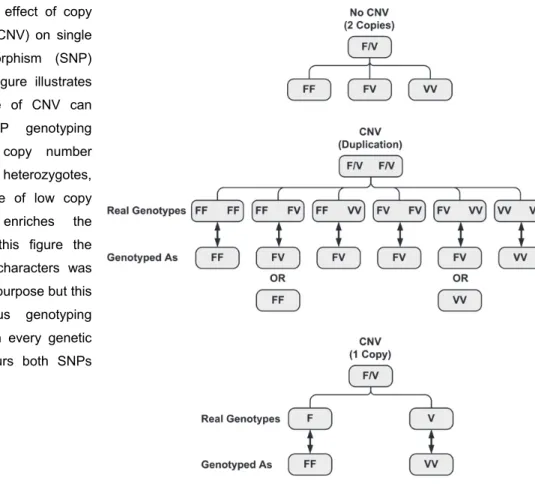
These receptors are encoded by genes clustered on the long arm of chromosome 1 (1q21- q24) in a complex region showing extensive nucleotide sequence homology that resulted from duplication and recombination events which occurred in this cluster during the evolution [12]. In addition, copy number variation (CNV) has been shown to be present in this region in several large scale whole genome studies and focused studies [13-16]. The presence of common CNVs can cause false SNP genotyping results. Figure 1 summarizes the possible effects of CNV on SNP genotyping. A higher copy number (CN) may falsely enrich the heterozygotes, while the presence of a lower CN (a single copy) may falsely enrich the homozygotes (hemizygosity as one allele is absent). The subsequent skewing of genotypes may lead them to fail Hardy-Weinberg equation (HWE) and may blur the association of the studied SNPs with disease susceptibility. It may also limit the ability of the genome-wide SNP association studies to detect disease associated SNPs in regions with CNV [17]. Such genetic complexity renders successful genotyping of different SNPs in that region using classical methods notoriously difficult.
66
The presence of such a genetic complexity in the FcγR region, combined with the heterogeneity of RA, might be the cause of inconsistent findings in previous studies on FcγR SNPs in relation to RA. In particular, the functionally relevant, FcγRIIIA 158V/F polymorphism (rs396991) had been extensively studied in RA case-control studies, revealing remarkably contradicting results. The 158V allele was found to be associated with RA susceptibility in many studies [18-21], in another study the 158F allele was associated with RA [22], whereas in other studies no association with RA was observed [23-28]. These contradicting results can in part be caused by methodological difficulties due to the extreme homology to FcγRIIIB [29] but difficulties in genotyping due to the presence of CNV as well as the heterogeneity of RA regarding the ACPA status are likely causes that have never been addressed.
Given the important role of FcγRIIIA in auto-immunity, we specifically wanted to study the association of FcγRIIIA 158V/F polymorphism with positive RA. The
ACPA-Figure 1: Possible effect of copy number variation (CNV) on single nucleotide polymorphism (SNP) genotyping. This figure illustrates how the presence of CNV can cause false SNP genotyping results. A high copy number falsely enriches the heterozygotes, while the presence of low copy number falsely enriches the homozygotes. In this figure the use of F and V characters was only for illustration purpose but this kind of erroneous genotyping result can occur in every genetic region that harbours both SNPs and CNV.
67
5
negative RA group was studied as well. Additionally, we investigated whether the presence of CNV of FcγRIIIA gene has any effect on the association between the FcγRIIIA 158V/F SNP and RA and also if the presence of CNV of the FcγRIIIA gene itself associates with susceptibility to RA.
PATIENTS AND METHODS Subjects
Nine hundred and foirty-five Dutch Caucasian individuals with RA, all of whom fulfilled the American College of Rheumatology (ACR) classification criteria for RA were studied and described elsewhere [30-32]. Controls were 388 unrelated Dutch Caucasians with no history of RA [33]. For both patients and controls an informed written consent according to the Declaration of Helsinki was obtained. The Commissie Medische Ethiek, the Leiden institutional review board, approved all protocols.
ACPA status was available for 619 patients, and was positive in 58.8% (N=364) of cases. Rheumatoid factor (RF) status was available for 899 patients, and was positive in 64.9% (N=583) of cases. Shared epitope (SE) status was available for 610 patients and was positive in 70.2% (N=428) of cases. Serum ACPA was determined by ELISA (CCP2, Immunoscan RA Mark 2, Euro-diagnostica, Arnhem, the Netherlands and Axis-Shield, Dundee, UK) and the cut-off level for ACPA positivity was set at 25 arbitrary units (AU), according to the manufacturer's instructions.
Genotyping
FcγRIIIA 158V/F (rs396991) was genotyped using the MassArray matrix-assisted laser desorption ionisation-time-of-flight mass spectrometry, according to the protocols recommended by the manufacturer (Sequenom, San Diego, California, USA). The sequences of PCR primers used in the assay were (ACGTTGGATGTTCACAGTCTCTGAAGACAC) and (ACGTTGGATGAAGCCACACTCAAAGACAGC) and the sequence of the extension primer was (ggagACTTCTGCAGGGGGCTT). SpectroCaller software supplied by the manufacturer was used to automatically call the genotypes. All doubtful calls were rechecked, and after manually evaluating their spectra, they were either accepted or recalled, and if still
68
doubtful the calls were rejected. Ten per cent of samples were genotyped in duplo. The error rate of genotyping was 0%.
CNV
The CNV status of FcγRIIIA gene was assessed using Multiplex Ligation-dependent Probe Amplification (MLPA); which is a sensitive method for copy number quantification [34]. MLPA probe design and assay were performed as described by White et al. [35]. The MLPA probe sequences used were (GACTCCCACCTTGAATCTCATCCCCAGGGTCTCA) and (CTGTCCCATTCTTGGTGCTGGGTGGATCTAAATCCAGG). Because a relatively large amount of DNA is needed for MLPA (in our experiment 125 ng DNA per sample to get accurate and reliable results), enough DNA was not available from all the RA patients and controls genotyped for the FcγRIIIA 158V/F SNP. Additionally not all the DNA samples used for SNP genotyping were extracted using the same method. According to the manufacturer protocols, the usage of DNA samples extracted using different methods may influence the MLPA results. The presence of remnants of phenol in phenol-extracted DNA can inhibit MLPA-PCR and impede ligase enzyme activity and the use of old magnetic particles in automated DNA extraction devices may result in incomplete sample denaturation, subsequently influencing MLPA results and rendering them incomparable. Therefore DNA samples that were extracted using phenol were not used for MLPA. Consequently, the MLPA was performed on 456 RA patients and 285 controls for whom we had enough DNA that was extracted using the same method.
Statistical analysis
The χ2 test with 2 degrees of freedom (Epi Info v6, CDC, Atlanta, Georgia, USA) was used to compare the relation between genotypes and ACPA+ve and ACPA-ve RA. The MLPA results were analysed as described by White et al. [36]. The height of each probe-specific peak was divided by the sum of three control peaks to give a ratio. The median ratio for FcγRIIIA
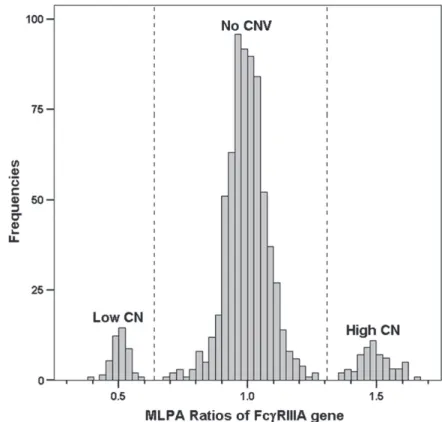
across all samples within an assay was calculated and used to normalize the ratios around a value of 1. The normalized ratio for each individual was calculated and plotted in a scatter plot (Figure 2). Subgroups corresponding to different FcγRIIIA gene copy numbers were defined by eye and confirmed by cluster analysis (using R statistical software version 2.5.0),
69
5
and are delineated by vertical dotted lines. To minimize the possibility of mis-genotyping of FcγRIIIA158V/F polymorphism that can be caused by CNV (Figure 1), we performed the analysis on the subgroup of individuals with no CNV (The middle cluster in Figure 2), thus excluding genotypes from samples with either high or low copy number (the first and the third clusters in Figure 2). P-values were considered statistically significant if < 0.05.
RESULTS
This study included 945 RA patients and 388 healthy controls. The genotype frequencies of the FcγRIIIA 158V/F SNP in RA patients and controls are shown in Table 1. The genotype frequencies of FcγRIIIA-158V/F polymorphism (rs396991) were in accordance with HWE (P-value is 0.6 in cases and 0.4 in controls). No statistically significant differences in the genotype or allele frequencies between RA patients and controls were observed. However after stratifying for ACPA status, the 158VV genotype was more frequent in ACPA positive RA patients compared to controls (P=0.05, OR=1.5, 95%CI 0.99-2.27). Similarly, the frequency of the 158V allele in the ACPA positive RA group (N=358) was higher compared
Figure 2: Copy number
variation (CNV) of the FcγRIIIA gene. Cluster 1 represent samples with a low copy number and cluster 3 represents samples with a high copy number of FcγRIIIA compared with cluster 2 that represents samples without CNV of the FcγRIIIA gene. MLPA, multiplex ligation-dependent probe amplification.
70
to controls (P=0.034, OR=1.3, 95%CI 1.01-1.55). No differences were found in the ACPA negative group (N=252) (Table 1).
Table 1: Comparison of the FcγRIIIA 158V/F genotype and allele frequencies in patients with rheumatoid arthritis (RA) and controls
OR and p for each row represent comparison with the control group as reference ACPA, anti-citrullinated peptide antibodies; MAF, minor allele frequency.
Table 2: Copy Number Variation of the FcγRIIIA gene
p Value compared with controls.
ACPA, anti-citrullinated peptide antibodies; CNV, copy number variation; RA, rheumatoid arthritis.
The FcγRIIIA gene shows CNV in 6.6% of RA patients and in 9.5% of controls (Table 2). Since the presence of CNV might lead to skewing of the genotype frequencies by causing genotyping errors (Figure 1), we assessed whether CNV of the FcγRIIIA gene has an influence on the association of FcγRIIIA-158V/F polymorphism and RA. Therefore, we determined the association between FcγRIIIA 158V/F and ACPA+ve and ACPA-ve RA in subjects with no CNV of FcγRIIIA gene. Genotypes from individuals with no CNV were selected (cluster 2 in Figure 2), thus excluding samples that showed either low or high CN of
FcγRIIIA gene (cluster 1 & 3 respectively in Figure 2). Without stratifying for ACPA, the 158VV genotype was significantly more frequent in RA patients compared to controls (17.2 vs 11.7 respectively, P=0.05, OR=1.6, 95%CI 0.97-2.6), but the frequency of the 158V allele was not significantly higher in RA patients compared to controls. Subsequently, stratifying for ACPA status showed an increased risk of RA as the 158VV genotype was more frequent in
71
5
the ACPA positive RA patients compared to controls (21.5 vs 11.7 respectively, P=0.009, OR= 2.1, 95%CI 1.2-3.8) also the presence of the 158V allele is associated with ACPA positive RA (P=0.039, OR=1.4, 95% CI 1-1.9). No association was found in the ACPA negative group (Table 3). Comparing the data without and with stratification for CNV (Table 1 and 3 respectively) reveals that almost similar results were observed for the effect of the 158V allele on the risk of ACPA positive RA. In contrast the odds ratio for the effect of the 158VV genotype on the risk of RA became higher after correcting for the presence of CNV, although the confidence intervals were overlapping.
Table 3: Comparison of the FcγRIIIA 158V/F genotype and allele frequencies in patients with rheumatoid arthritis (RA) and controls with no copy number variation
OR and p for each row represent comparison with the control group as reference.
The patients with RA and controls chosen for analysis in this table showed no evidence of CNV based on MLPA results (cluster 2)
ACPA, anti-citrullinated peptide antibodies; CNV, copy number variation; MAF, minor allele frequency; MLPA, multiplex ligation-dependent probe amplification
All the subjects identified as having low copy number (a single copy) were genotyped as homozygous for either the 158V or the 158F alleles (as suggested by Figure 1).
The third aim of this study was to investigate whether the difference in FcγRIIIA gene copy number confers risk to RA. The distribution of CNV was not significantly different between patients and controls with and without stratifying for ACPA status (Table 2).
DISCUSSION
In the current study we investigated the association between the FcγRIIIA 158V/F SNP and ACPA-positive as well as ACPA-negative RA and explored the effect of CNV of FcγRIIIA
72
between the FcγRIIIA-158V allele and RA is refined to the ACPA-positive group. In addition, after correction for the effect of the presence of CNV on genotypes, the strength of the association was slightly increased. To our knowledge this is the first study to consider the effect of disease heterogeneity (presence/absence of ACPA) and genetic heterogeneity (effect of CNV on SNP genotyping) on the association between FcγRIIIA-158V/F polymorphism and RA.
The FcγRIIIA is expressed on NK cells and on macrophages, the expression by macrophages is limited to only a few tissues which correlate with the sites of pathology seen in patients with rheumatoid arthritis (synovium, dermis under stress, lungs, pericardium and liver) [37]. The FcγRIIIA expression on NK cells and the number of FcγRIIIA-IgG binding sites per NK cell correlates with the antibody-dependent cell-mediated cytotoxicity (ADCC) function of these cells [38]. The presence of the FcγRIIIA 158V/F SNP, which is a T to G substitution at nucleotide 559 in FcγRIIIA gene that results in a switch from phenylalanine to valine at amino acid position 158 in the immunoglobulin binding domain, has functional consequences. It was shown that this 158V/F SNP affects the binding affinity of FcγRs to IgG: the 158V allele is associated with higher NK cells IgG binding affinity compared to the 158F allele, with a gene dosage effect [39]. In addition IgG stimulation of NK cells from 158VV individuals resulted in higher Ca2+ influx, higher concentrations of interleukin-2 (IL2) receptor (CD25) expression and reduced survival of NK cells after activation induced cell death when compared with 158FV or 158FF individuals [40].
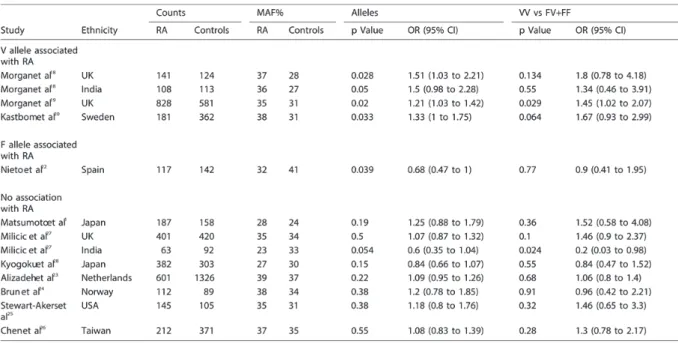
So far, the results of the published studies concerning the FcγRIIIA-158V/F SNP in RA vary markedly. They differ in the presence or absence of its association with RA as well as in the allele frequencies within similar ethnic populations. The results of these studies are summarised in Table 4. In our study, the genotype and minor allele frequency (MAF) in controls and RA patients were almost identical to those previously reported in Dutch Caucasians [23].
73
5
Table 4: The FcγRIIIA 158V/F polymorphism association with rheumatoid arthritis (RA) in different studies
MAF, minor allele frequency.
It was suggested that these contradicting results originated from methodological difficulties, due to the extreme homology of FcγRIIIA to FcγRIIIB gene that might lead to falsely detecting an FcγRIIIB sequence as the FcγRIIIA-158V variant leading to false over-presentation of the 158V allele [29]. As indicated, there are two additional explanations that may have been overlooked. First, we now provide evidence that the FcγRIIIA-158VV genotype associates with ACPA positive subset of RA. A previous meta-analysis [23] showed an odds ratio of 1.3 for the FcγRIIIA-158VV genotype to increase the risk of RA; the percentage of ACPA positive RA patients in those studies is unknown. Our data suggest the need for an additional meta-analysis in ACPA positive RA specifically. Second, the presence of CNV in this gene cluster may previously have led to skewing of the genotype frequencies, subsequently affecting disease associations. Since the frequency of CNV was reported to vary significantly in different ethnic populations [36], CNV may be another cause of the different allele frequencies of FcγRIIIA-158V/F polymorphism and different associations with RA observed in different populations.
74
In our study, after controlling for the FcγRIIIA gene copy number, the association between RA patients in general (without considering the ACPA status) and presence of the 158VV genotype became borderline significant (P=0.05, OR=1.6 95% CI 0.97-2.6 vs P=0.2, OR=1.3 95% CI 0.87-1.78 without controlling for the CNV). Similarly in the ACPA positive group before correcting for the presence of CNV, presence of the 158VV genotype was associated with RA susceptibility with a borderline significant P-value (0.05) and an odds ratio of 1.5 (95% CI 0.99-2.27). In the ACPA positive group without CNV this association had an odds ratio of 2.1 (95% CI 1.2-3.8). Although these confidence intervals are overlapping and although the presence of CNV of FcγRIIIA didn’t significantly change the genotype frequencies (probably because the frequency of CNV was relatively low in comparison to the 158V allele), correction for the presence of CNV affected the association between the 158VV genotype and RA. To our opinion, these data underline the need to take the CNV into consideration while performing analysis on SNPs.
The CNV of other FcγRs genes has been shown to associate with susceptibility to several auto-immune diseases such as lupus nephritis [16] and idiopathic thrombocytopenic purpura (ITP) [41]. The present study evaluated CNV in the FcγRIIIA gene. We confirmed the presence of CNV in the FcγRIIIA gene with a frequency of 9.5% in healthy controls and 6.6% in RA patients. A comparable frequency of CNV was recently reported in another study with a smaller sample size (116 ITP patients and 100 healthy controls) [41]. We did not find an association between CNV of FcγRIIIA gene and susceptibility to RA. Though, because of the low frequency of CNV in this gene, we were underpowered to formally conclude that CNV of
FcγRIIIA gene is not associated with RA susceptibility.
In conclusion, the FcγRIIIA-gene shows CNV which was not differently distributed between RA patients and healthy controls. The analysis of association between the Fcγ RIIIA-158V/F polymorphism with RA, stratified for ACPA status and CNV of the FcγRIIIA-gene, revealed that the FcγRIIIA-158VV genotype confers risk to ACPA positive RA. The fact that a SNP in the FcγRs genes associates with ACPA positive RA points to the relevance of antibodies in the pathophysiology of ACPA+ve RA.
75
5
REFERENCES
1. Matsumoto I, Zhang H, Muraki Y, Hayashi T, Yasukochi T, Kori Y, etal.Afunctional variant of Fcgamma receptor IIIA is associated with rheumatoid arthritis in individuals who are positive for anti‐glucose‐6‐phosphate isomerase antibodies.
Arthritis Res Ther 2005;7(6):R1183‐R1188.
2. Gregersen PK, Silver J, Winchester RJ. Thesharedepitopehypothesis.Anapproach to understanding the molecular genetics of susceptibility to rheumatoid arthritis.
Arthritis Rheum 1987;30(11):1205‐13.
3. Gregersen PK, Lee HS, Batliwalla F, Begovich AB. PTPN22:settingthresholdsfor autoimmunity. Semin Immunol 2006;18(4):214‐23.
4. Kurreeman FA, Padyukov L, Marques RB, Schrodi SJ, Seddighzadeh M, Stoeken‐ Rijsbergen G, etal.Acandidategene approachidentifiestheTRAF1/C5regionasa riskfactorforrheumatoidarthritis. PLoS Med 2007;4(9):e278.
5. Plenge RM, Padyukov L, Remmers EF, Purcell S, Lee AT, Karlson EW, et al. Replication of putative candidate‐gene associations with rheumatoid arthritis in >4,000 samplesfromNorthAmericaandSweden: associationofsusceptibility with PTPN22,CTLA4,andPADI4.Am J Hum Genet 2005;77(6):1044‐60.
6. Verpoort KN, van Gaalen FA, van der Helm‐van Mil AH, Schreuder GM, Breedveld FC, Huizinga TW, et al. Association of HLA‐DR3 with anti‐cyclic citrullinated peptideantibody‐negative rheumatoid arthritis. Arthritis Rheum 2005;52(10):3058‐62.
7. Huizinga TW, Amos CI, van der Helm‐van Mil AH, Chen W, van Gaalen FA, Jawaheer D, et al. Refining the complex rheumatoid arthritis phenotype based on specificityof theHLA‐DRB1 sharedepitopeforantibodiesto citrullinatedproteins.
Arthritis Rheum 2005;52(11):3433‐8.
8. Ravetch JV, Bolland S. IgGFcreceptors. Annu Rev Immunol 2001;19:275‐90. 9. Masuda M, Morimoto T, De HM, Nishimura N, Nakamoto K, Okuda K, et al.
Increase of soluble FcgRIIIa derived from naturalkiller cells and macrophages in plasmafrompatientswithrheumatoidarthritis. J Rheumatol 2003;30(9):1911‐7. 10. Ravetch JV, Perussia B. Alternative membrane forms of Fc gamma RIII(CD16) on
human natural killer cells and neutrophils. Cell type‐specific expression of two genesthatdifferinsinglenucleotidesubstitutions. J Exp Med 1989;170(2):481‐97. 11. Edberg JC, Kimberly RP. Cell type‐specific glycoforms of Fc gamma RIIIa (CD16):
differentialligandbinding.J Immunol 1997 Oct 15;159(8):3849‐57.
12. Qiu WQ, de BD, Brownstein BH, Pearse R, Ravetch JV. Organizationof thehuman andmouselow‐affinityFcgammaRgenes:duplicationandrecombination. Science 1990 ;248(4956):732‐5.
13. Sebat J, Lakshmi B, Troge J, Alexander J, Young J, Lundin P, etal.Large‐scalecopy numberpolymorphisminthehumangenome.Science 2004;305(5683):525‐8.
76
14. Redon R, Ishikawa S, Fitch KR, Feuk L, Perry GH, Andrews TD, et al. Global variationincopynumberinthehumangenome. Nature 2006;444(7118):444‐54. 15. Wong KK, deLeeuw RJ, Dosanjh NS, Kimm LR, Cheng Z, Horsman DE, et al. A
comprehensiveanalysis ofcommon copy‐numbervariations inthehumangenome.
Am J Hum Genet 2007;80(1):91‐104.
16. Aitman TJ, Dong R, Vyse TJ, Norsworthy PJ, Johnson MD, Smith J, et al. Copy number polymorphism in Fcgr3 predisposes to glomerulonephritis in rats and humans. Nature 2006;439(7078):851‐5.
17. McCarroll SA, Altshuler DM. Copy‐number variation and association studies of humandisease. Nat Genet 2007;39(7 Suppl):S37‐S42.
18. Morgan AW, Griffiths B, Ponchel F, Montague BM, Ali M, Gardner PP, et al. Fcgamma receptortype IIIAisassociatedwithrheumatoidarthritisintwo distinct ethnicgroups. Arthritis Rheum 2000;43(10):2328‐34.
19. Morgan AW, Keyte VH, Babbage SJ, Robinson JI, Ponchel F, Barrett JH, et al. FcgammaRIIIA‐158V and rheumatoid arthritis: a confirmation study.
Rheumatology (Oxford) 2003;42(4):528‐33.
20. Kastbom A, Ahmadi A, Soderkvist P, Skogh T. The 158V polymorphism of Fc gamma receptor type IIIA in early rheumatoid arthritis: increased susceptibility and severity in malepatients (theSwedish TIRA project). Rheumatology (Oxford) 2005;44(10):1294‐8.
21. Radstake TR, Petit E, Pierlot C, van de Putte LB, Cornelis F, Barrera P. Role of Fcgamma receptors IIA, IIIA, and IIIB in susceptibility to rheumatoid arthritis. J Rheumatol 2003;30(5):926‐33.
22. Nieto A, Caliz R, Pascual M, Mataran L, Garcia S, Martin J. InvolvementofFcgamma receptor IIIA genotypes in susceptibility to rheumatoid arthritis. Arthritis Rheum 2000;43(4):735‐9.
23. Alizadeh BZ, Valdigem G, Coenen MJ, Zhernakova A, Franke B, Monsuur A, et al. Association analysis of functional variants of the FcgRIIa andFcgRIIIa genes with type 1 diabetes, celiac disease and rheumatoid arthritis. Hum Mol Genet 2007;16(21):2552‐9.
24. Brun JG, Madland TM, Vedeler CA. ImmunoglobulinGfc‐receptor(FcgammaR)IIA, IIIA, and IIIB polymorphisms related to disease severity inrheumatoid arthritis. J Rheumatol 2002;29(6):1135‐40.
25. Stewart‐Akers AM, Cunningham A, Wasko MC, Morel PA. Fc gammaRexpression on NK cells influences disease severity in rheumatoid arthritis. Genes Immun 2004;5(7):521‐9.
26. Chen JY, Wang CM, Wu JM, Ho HH, Luo SF. Association of rheumatoid factor production with FcgammaRIIIapolymorphism in Taiwanese rheumatoid arthritis.
77
5
27. Milicic A, Misra R, Agrawal S, Aggarwal A, Brown MA, Wordsworth BP. TheF158V polymorphism in FcgammaRIIIA shows disparate associations with rheumatoid arthritis in two genetically distinct populations. Ann Rheum Dis 2002;61(11):1021‐3.
28. Kyogoku C, Tsuchiya N, Matsuta K, Tokunaga K. Studies onthe association of Fc gammareceptorIIA,IIB,IIIAandIIIB polymorphismswithrheumatoidarthritisin the Japanese: evidence for a genetic interaction between HLA‐DRB1 and FCGR3A.
Genes Immun 2002;3(8):488‐93.
29. Morgan AW, Griffiths B, Barrett JH, Markham AF, Emery P, Isaacs JD. Fcγ receptor type IIIA is associated with rheumatoid arthritis in two distinct ethnic groups. Reply.Arthritis Rheum 2002;46(2):557‐9.
30. Brinkman BM, Huizinga TW, Kurban SS, van d, V, Schreuder GM, Hazes JM, et al. Tumour necrosis factor alpha gene polymorphisms in rheumatoid arthritis: association with susceptibility to, or severity of, disease? Br J Rheumatol 1997;36(5):516‐21.
31. van Aken J, van Bilsen JH, Allaart CF, Huizinga TW, Breedveld FC. TheLeidenEarly ArthritisClinic. Clin Exp Rheumatol 2003;21(5 Suppl 31):S100‐S105.
32. Goekoop‐Ruiterman YP, de Vries‐Bouwstra JK, Allaart CF, van ZD, Kerstens PJ, Hazes JM, et al. Clinical and radiographic outcomes of four different treatment strategies in patients with early rheumatoid arthritis (the BeSt study): a randomized,controlledtrial. Arthritis Rheum 2005;52(11):3381‐90.
33. de Jong BA, Westendorp RG, Eskdale J, Uitdehaag BM, Huizinga TW. Frequencyof functional interleukin‐10 promoter polymorphism is different between relapse‐
onset andprimary progressivemultiplesclerosis. Hum Immunol 2002;63(4):281‐ 5.
34. Schouten JP, McElgunn CJ, Waaijer R, Zwijnenburg D, Diepvens F, Pals G. Relative quantification of 40 nucleicacid sequences bymultiplex ligation‐dependentprobe amplification.Nucleic Acids Res 2002;30(12):e57.
35. White SJ, Vink GR, Kriek M, Wuyts W, Schouten J, Bakker B, et al. Two‐color multiplex ligation‐dependent probe amplification: detecting genomic rearrangementsinhereditarymultipleexostoses.Hum Mutat 2004;24(1):86‐92. 36. White SJ, Vissers LE, Geurts van KA, de Menezes RX, Kalay E, Lehesjoki AE, et al.
Variation of CNV distribution in five different ethnic populations. Cytogenet Genome Res 2007;118(1):19‐30.
37. Bhatia A, Blades S, Cambridge G, Edwards JC. DifferentialdistributionofFcgamma RIIIa in normal human tissues and co‐localization with DAF and fibrillin‐1: implications for immunological microenvironments. Immunology 1998;94(1):56‐ 63.
78
38. Vance BA, Huizinga TW, Wardwell K, Guyre PM. BindingofmonomerichumanIgG defines an expression polymorphism of Fc gamma RIII on large granular lymphocyte/naturalkillercells. J Immunol 1993;151(11):6429‐39.
39. Koene HR, Kleijer M, Algra J, Roos D, von dem Borne AE, de HM. FcgammaRIIIa‐
158V/F polymorphism influences the binding of IgG by natural killer cell Fc gammaRIIIa, independently of the Fc gammaRIIIa‐48L/R/H phenotype. Blood 1997;90(3):1109‐14.
40. Wu J, Edberg JC, Redecha PB, Bansal V, Guyre PM, Coleman K, et al. A novel polymorphismofFcgammaRIIIa(CD16)altersreceptorfunctionandpredisposesto autoimmunedisease. J Clin Invest 1997;100(5):1059‐70.
41. Breunis WB, van ME, Bruin M, Geissler J, de BM, Peters M, et al. Copy number variation of the activating FCGR2C gene predisposes to idiopathic thrombocytopenicpurpura. Blood 2008;111(3):1029‐38.