CTC: an End-To-End Flow Control Protocol for Multi-Core Systems-on-Chip
Nicola Concer, Luciano Bononi
Dipartimento di Scienze dell’Informazione
Universit`a di Bologna
{
concer,bononi
}
@cs.unibo.it
Michael Souli´e, Riccardo Locatelli
ST Microelectronics
Grenoble, France
{
michael.soulie,riccardo.locatelli
}
@st.com
Luca P. Carloni
Computer Science Department
Columbia University in the City of New York
[email protected]
Abstract
We propose Connection then Credits (CTC) as a new end-to-end flow control protocol to handle message-dependent deadlocks in networks-on-chip (NoC) for multi-core systems-on-chip. CTC is based on the classic end-to-end credit-based flow control protocol but differs from it be-cause it uses a network interface micro-architecture where a single credit counter and a single input data queue are shared among all possible communications. This architec-tural simplification reduces the area occupation of the net-work interfaces and increases their design reuse: for in-stance, the same network interface can be used to connect a core independently of the number of incoming and outgo-ing communications. CTC, however, requires a handshake preamble to initialize the credit counter in the sender net-work interface based on the buffering capacity of the re-ceiver network interface. While this necessarily introduces a latency overhead in the transfer of a message, simulation-based experimental results show that the penalty in perfor-mance is limited when large messages need to be trans-ferred, thus making CTC a valid solution for particular classes of applications such as video stream processing.
1
Introduction
Future generations of systems-on-chip (SoCs) will con-sist of heterogeneous multi-core architectures with a main general-purpose processor, possibly itself consisting of multiple processing cores, and many task-specific subsys-tems that are programmable and/or configurable. These sub-systems, which are also composed of several cores, will provide higher efficiency in supporting important classes of applications across multiple use-case scenarios [14, 19].
Network On Chip Media Accelerators Embedded Memory Peripherals External Memory Control Video Video Audio Imaging Graphics Graphics CPUs & DMAs
Figure 1. NoC-based System on Chip and the media-accelerator sub-system [6].
Heterogeneity is the combined result of hardware special-ization, reuse of Intellectual Property (IP) modules, and the application of derivative design methodologies [7]. Pro-grammability makes it possible to upgrade dedicated soft-ware and add the support of new applications and features that were not included at the chip design time.
Some current SoCs already offer task-specific subsys-tems such as media accelerator subsyssubsys-tems including het-erogeneous and specialized cores (e.g. video and audio de-coders) that are connected to a shared bus and communi-cate through the global memory [7]. This approach, how-ever, offers limited programmability and reuse and does not optimize the utilization of the resources (e.g., the buffer-ing queues in the core interfaces are typically sized for the worst-case scenario). Instead, communication among these cores in future SoCs will likely be based on the
req rep
NI
Processor
req repNI
Memory
NOC
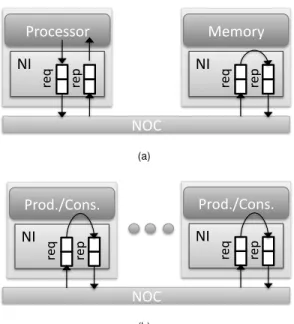
(a) NOC req rep NI Prod./Cons. req rep NI Prod./Cons. (b)Figure 2. NIs connecting cores to the NoC and the possible message dependencies in the (a) shared memory and (b) message passing communication paradigms.
on-chip (NoC) paradigm [2, 8, 16]. These NoCs will be also heterogeneous as illustrated in Fig. 1, where a top-level net-work connects the main components of the chip, while other sub-networks support auxiliary subsystems such as the me-dia accelerator. In some of these task-specific subsystems the communication will be based on theMessage Passing
paradigm, which improves the performance of many impor-tant applications such as video stream processing and other multimedia applications [15].
In this paper we focus on the design of the sub-network interconnecting the cores of a message-passing sub-system and we propose an end-to-end flow control that optimizes the flexibility and reusability of the cores through the defi-nition of a unified network interface (NI) design.
Network interfaces are a crucial component for design and reusability in the NoC domain because they decouple the design of the cores from the design of the network. NIs implement the NoC communication protocols and im-prove performance by providing elasticity between inter-core communication tasks and intra-inter-core computation tasks thanks to their storage capabilities. As shown in Fig. 2 put and output queues are used to temporarily store the in-coming and outgoing messages. While messages are the units of transfer between the network clients (processors and memories), in the network interface a single message is typically broken down into a sequence of smaller pack-ets for routing purposes; packpack-ets may be further segmented in flow control digits (flit) for more efficient allocation of
network resources such as link bandwidths and queue ca-pacities [9, 11].
The correct operations of a network requires to effi-ciently handle deadlock situations which may arise due to the circular dependencies on the network resources that are generated by in-flight messages. A variety of methods has been proposed in the literature to either avoid or recover from deadlock [1, 9]. Most of these protocols assume the
consumption assumption where the packets of a message traversing the network are always consumed by the desti-nation core once they reach its corresponding network in-terface [22]. However, as depicted in Fig. 2 and discussed in detail in Section 2, deadlock may be caused also by de-pendencies that areexternalto the network, i.e. dependen-cies that areinternalto a core. In fact, in real SoC systems and multiprocessor systems a core typically generates new messages in response to the reception of a previous mes-sage. These dependencies between messages can gener-ate a different type of deadlock that is commonly referred as message-dependent(or protocol) deadlock [15, 18, 22]. Message-dependent deadlock occurs at a level of abstrac-tion that is higher than the routing-level deadlock, which can be addressed by deadlock-free routing algorithms such as dimension-order routing [9, 11].1
Related Work. Various solutions for message-dependent deadlock have been proposed in the literature. Dielissenet al. solve this problem by guaranteeing suffi-cient storage space for each possible pair of communicat-ing elements [10]. Anjan et al., instead, add timers into the router’s output ports to detect deadlock occurrences and move the blocked packets into specialized queues to guarantee progress [1]. Song et al. propose a deadlock-recovery protocol motivated by the observation that in prac-tice message-dependent deadlocks occur very infrequently even when network resources are scarce [22]. These three approaches, however, are meant for parallel computing sys-tems and are not expected to scale well to SoC design.
The message-dependent deadlock problem in NoC for shared-memory architectures has been addressed by intro-ducing two physically-separated networks for the two mes-sage types (load and store requests) [20] or two logically-separated network (virtual networks) [7]. These solutions may be difficult to scale to future multicore SoCs where the increasing number of heterogeneous cores and message types is likely to grow, thus leading to more complex de-pendencies among packets.
TheÆTHEREAL[13] and FAUST[12] NoCs use credit-based (CB) end-to-end flow control protocols. Similar to the credit-based flow control mechanisms that operate at the
1We focus on addressing message-dependent deadlock while
assum-ing the use of a deadlock-free routassum-ing algorithm. Notice that message-dependent deadlock is different fromapplication-level deadlockwhich is out of the scope of this paper.
link level between a pair of interconnected routers [9, 11], a CB end-to-end flow control protocol uses credits to in-form a sender NI about the current storage capacity of the queue in the receiving NI. As discussed in more detail in Section 3, the sender NI keeps track of this capacity with a credit counter that is initialized with a value equal to the size of the corresponding queue and is dynamically updated to track the number of available packet slots in the queue. Hence, the sender continuously transmits only a subset of the message packets that is guaranteed to eventually arrive inside the NI, thus avoiding a message-dependent deadlock. Notice that for a given SoC a core that may send messages toNdifferent cores needsNcredit counters while if it can receive messages fromMdifferent cores it needsM differ-ent queues.
Contributions.We build on the CB approach to develop
Connection then Credits (CTC), an end-to-end flow con-trol protocol that allow us to handle the message-dependent deadlock while simplifying the design of the network in-terface, which is based on the same micro-architecture re-gardless of the number of communications that its core may require. This micro-architecture uses a single credit counter together with an output queue for sending all the possible outgoing messages and a single pair of data-request queues that is shared across all possible incoming messages. On the other hand, as explained in Section 4, CTC requires the completion of a handshake procedure between any pair of cores that want to communicate before the actual message transfer starts. This procedure is used to initialize the credit counter in the sender NI based on the current available space in the data queue of the receiver NI. While this necessarily adds a latency overhead to the transfer of the message, the penalty in performance is limited when large messages need to be transferred as it is shown by the simulation results that we report in Section 5.
2
Message-Dependent Deadlock
There are two main communication paradigms for ex-changing data among the processing cores of a system-on-chip and they are associated to two corresponding program-ming models:shared memoryandmessage passing.
In a shared-memory paradigm the processing cores com-municate via data variables that are defined in the same log-ical memory space and are physlog-ically stored in one or more memory cores. As shown in Fig. 2(a), a processor accesses a memory through either a load or a store request by speci-fying the memory address and the size of the data block to be transferred. In the case of a load request the addressed memory replies by sending the values of the requested block of data (typically a cache line) to the processor, which saves them in its local cache memory. In the case of a store re-quest the memory receives new values for a block of
ad-dresses, which typically correspond to a line in the proces-sor’s local cache, and it replies by generating a short ACK
message to confirm their correct delivery. Shared memory is the most used paradigm in current multi-core SoCs.
In the message passing paradigm, which is illustrated in Fig. 2(b), the processing cores communicate by send-ing/receiving data that are pushed directly from a core to another (peer-to-peercommunication): the sending and re-ceiving cores are commonly referred as theproducer and
consumer, respectively. By having dedicated logical ad-dressing space for each processing core and providing direct communication among their physical local memories, mes-sage passing avoids the issues of shared-memory coherency and consistency [17], thus potentially reducing the commu-nication latency of each data transfer. This paradigm is par-ticularly suited for data-flow and stream processing applica-tions that consist of chains of processing cores such as the video processing pipeline [15].
The correct implementation of shared memory and mes-sage passing paradigms in a system-on-chip requires an un-derlying NoC with communication protocols that guaran-tee the correct transfer of each message and, particularly, the absence of deadlocks. As discussed in the Introduc-tion, even if the NoC relies on deadlock-free routing al-gorithms, message-dependent deadlock may arise due the dependencies among the messages “inside a core”, which are shown in Fig. 2: e.g. the dependence between a load request and response in a memory for the shared memory paradigm and the causality dependency between the con-sumption and production of data in a core for the message passing paradigm. For both paradigms, the dependencies between pairs of messages may get combined, thus leading tomessage dependency chains[21]. Indeed, the causality relations among pairs of messages can be modeled as a par-tial order relation≺over the set of all possible messages that are transferred in the network. Message dependency chains depend on the chosen communication paradigm and the characteristic of the given application [15].
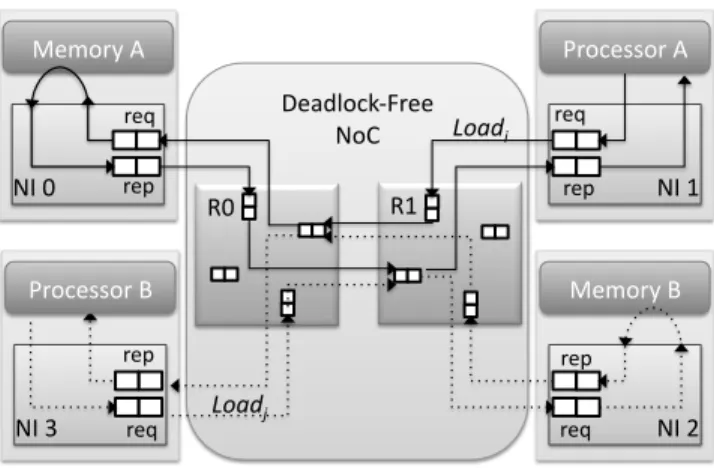
Example. Fig. 3 shows a simple example of a message-dependent deadlock that may occur due to the dependence between the messages that are received by (sent from) a memory core in a shared memory environment. The net-work interfaceN I0receives packets for a memory load (or
store) request message addressed toM emoryAand in
re-ply sends packets with a response message that includes the requested data (or the acknowledgment of a store op-eration). Since the input and output queues of N I0 have
necessarily limited storage capacity, a long sequence of re-quests may cause a back-pressure effect into the NoC. For instance, the packets of a series of load request messages Loadi from P rocessorA may not be fully stored within N I0 and, instead, may have to wait for several clock
Deadlock‐Free NoC R1 R0 req rep NI 1 Loadi Processor A req rep NI 2 Memory B req rep NI 0 Memory A req rep NI 3 Loadj Processor B
Figure 3. Message-dependent deadlock in a shared-memory request-response paradigm.
that P rocessorB sends a series of load request messages Loadj to M emoryB. Even if M emoryB can
immedi-ately serve a first subset of these requests, the packets of the corresponding response messages will not be able to reachP rocessorBbecause they will be blocked as they
at-tempt to access the East Queue ofRouter0. On the other
hand, whenM emoryAwill be finally able to serve the
re-quest messagesLoadi, the packets of its response messages
will not be able to reach P rocessorA because they will
be blocked as they attempt to access the West Queue of Router1, which are occupied by some of the packets of the
load request messagesLoadj. In summary, even if the NoC
uses a deadlock-free routing algorithm, the dependencies across the messages inside the memory cores cause a cir-cular dependency involving N I0,Router0,Router1, and N I1which leads to a deadlock.
Similarly to routing-dependent deadlock, the message-dependent deadlock problem can be addressed with either avoidance or recovery strategies. The relative advantages of the various techniques based on these two approaches depend on how frequently deadlocks occur and how effi-ciently (in terms of resource cost and utilization) messages can be routed while guarding against deadlocks [22].
The introduction of aVirtual Network(VN) for each type of message transfer guarantees the solution of the message-dependent deadlock by satisfying the consumption assump-tion [7, 22]: the input and output queue of each router and each NI in the network is replicated and assigned to a single specific message class (e.g. two classes in case of memory request and response messages). This solution “cuts” the causality dependency between messages in the network at the cost of a higher buffer requirement and more complex router and NI design.
Stream processing applications implemented with a pipeline of processing cores, where each core produces data for the next consumer core, lead to a dependency chain of
message requests request1 ≺ · · · ≺ requestn wheren
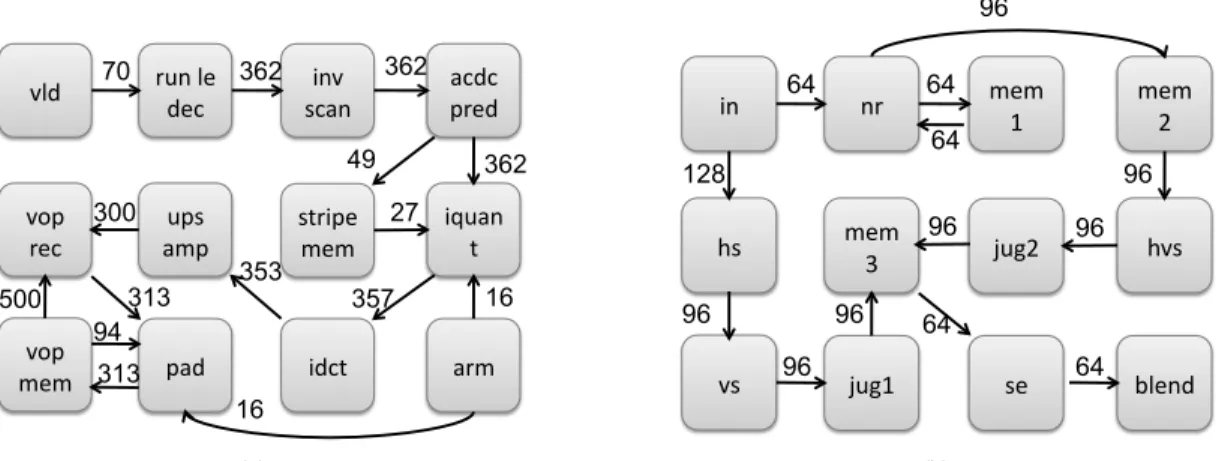
is the number of cores in the pipeline. For example, Fig. 4 shows the task graphs of the Video Object Plane Decoder (VOPD) and Multi-Window Display (MWD) applications where the nodes represent the tasks while the arcs repre-sent the communications between the tasks and the rela-tive bandwidth requirements [3]. The task graphs of these applications, which are examples of stream processing ap-plications, are similar and present a fairly-linear pipeline structure with a sequence of twelve stages, each stage cor-responding to a task. Hence, an optimally-concurrent SoC implementation where each task is mapped to a distinct pro-cessing core and where each inter-task communication is implemented by end-to-end message passing would lead to as many message types as the number of arcs. Multi-core SoCs for embedded products simultaneously support an in-creasing number of such streaming applications. This trans-lates into the presence of complex communication patterns among the cores, which simultaneously run multiple threads of computation to implement the multiple tasks of the var-ious applications. The implementation of the communica-tion requirements among these cores with a NoC requires new solutions for the message-dependent protocol. In fact, a solution based on virtual networks does not scale as the number of distinct message types that travel on the network continues to grow. Furthermore, the length of the depen-dency chains is difficult to predict because it depends on the given application.
3
Credit Based (CB) Protocol
A different approach to the solution of the message-dependent deadlock is based on the use of an end-to-end
flow control protocol that guarantees that a sender NI does not ever inject more flits in the network than the correspond-ing receiver NI can eject. The Credit Based (CB) end-to-end flow control protocol is a simple implementation of this idea that has been used in previous works [12, 13].
With a CB protocol, the sender NI maintains a detailed knowledge of the number of queue slots that the receiver NI has still available through the exchange of end-to-end trans-mission credits. A credit can be associated to either a packet or to a packet flit depending on the desired level of granu-larity2. What is important is the guarantee that no
frag-ment of a message can remain blocked in the network due to the lack of space in the NI input queue, with the potential risk of causing a deadlock situation. Hence, the sender NI can continue to inject flits in the network only if it has still enough credits as proofs that the receiver NI will eject these flits. Dually, the receiver NI must send a credit back to the
2In this paper we use the granularity of the flit and we refer to them as flit-credits.
stripe mem
vld run le dec scan inv acdc pred
iquan t idct ups amp arm vop rec pad vop mem 70 362 362 362 49 16 357 27 353 300 500 313 313 94 16 (a) jug2 in nr mem 1 mem2 hvs se mem 3 blend hs jug1 vs 64 64 96 64 96 128 96 96 64 64 96 96 96 (b)
Figure 4. The MP (a) Video Object Plane Decoder (VOPD) and (b) Multi-Window Display (MWD) task
graphs.
sender NI for each flit that its core has consumed, thereby generating an empty slot in its input queue.
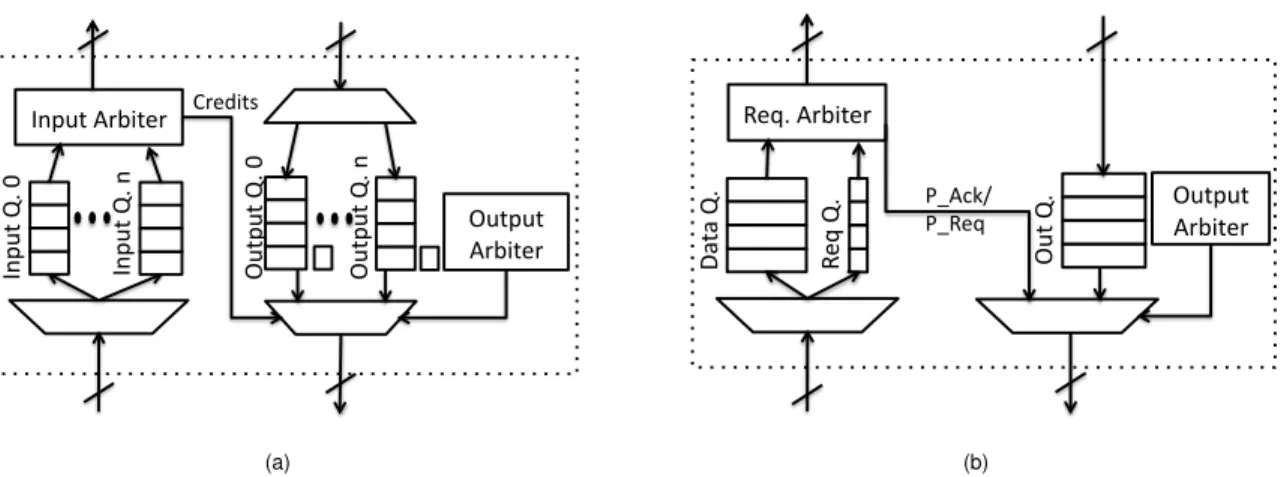
Generally a single consumer core can be addressed by multiple producers. Also a producer can address multiple consumers and for each of these the producer needs a sep-arated credit counter. Differently from credit-based flow control mechanisms that operate at the link level between a pair of interconnected routers [9, 11], here a pair of com-municating cores may be separated by multiple hops in the network. Also all packets generated by the peer cores arrive at the same NI’s input port. Fig. 5(a) shows the simplest way to address this issue. Each NI is provided with mul-tiple and independent input and output queues and credit counters: one input queue for each possible sender NI and one output queue and credit counter for each addressed NI. A genericN Id, upon the reception of a flit fromN Is,
saves the incoming data intoQs, the input queue associated
to the sourceN Is. WhenN Idreads a flit fromQs, it
gen-erates an end-to-end flit-credit to send back toN Is. In turn, N Isupdates the credit counterCdassociated to the
destina-tionN Id. Multiple credits can be combined into one single
end-to-end credit message for better efficiency. The amount of flit-credits K associated to a single credit-message is a fixed parameter of the system. The sizeQ of each input queue depends on the value ofK because the NI must be capable of storingKincoming flits for each flit-credit that it has generated. In particular considering the set of peers Pc = {ni. . . nj} that can possibly communicate with the
consumernc,nc’s input queues should be sized as: Qnc =K+M ax
RT T(ni, nc)|ni∈Pc (1)
whereRTTis the zero-load round-trip time function that depends on the given NoC implementation: specifically it depends on the distance in hops between the NIs, the latency
of the routers, and, in case of channel pipelining [5], on the number of stages of each pipelined channel.
On the input side, theInput Arbiterselects the incoming data to process while on the output side, theOutput Arbiter
selects the queue that is used to forward the flit or to send a credit. The selection of the input and output queues is made on a packet basis to avoid the delivering/reception of flits of different packets, e.g. according to a round-robin policy.
The CB end-to-end flow control protocol differs from the virtual network approach for two main of reasons. First, in VN all the queues, including those in the routers, must be replicated while in the CB protocol only the queues of the NI must be replicated. Second, in VN the number of queues per channel depends on the length of the application message-dependency chain while in the CB protocol this number varies for each given consumer core depending on the number of producer cores that may address it.
4
Connection Then Credits (CTC) Protocol
Adding a dedicated input and output queue for each pos-sible source/destination of messages, as required by the CB flow control protocol, forces engineers to design a specific network interface for each node of the network. This is the case particularly for multi-use-case SoCs where the inter-action between cores is driven by the application run by the user [14,19]. As an alternative to CB, we present the “Con-nection Then Credits” (CTC) flow control protocol. CTC rationalizes and simplifies the design of NIs while guaran-teeing the absence of message-dependent deadlock.CTC regulates the exchange of messages between two peer NIs by introducing a handshake procedure called Con-nection. A CTC-message is a fixed amount of data to be exchanged between the two NIs. As shown in Fig. 5(b) a
Input Arbiter Output Q. n Input Q. 0 Input Q. n Output Arbiter Output Q. 0 Credits (a) Da ta Q. Req Q. Req. Arbiter Out Q. P_Ack/
P_Req Output Arbiter
(b)
Figure 5. Network Interface implementations: (a) credit based and (b) CTC.
CTC NI is composed of onlytwoinput queues andone sin-gle output queue independently from the number cores that can require a connection with this NI. The data-queue is used for storing incoming data flits while therequest-queue
instead is used for the incoming transactions requests. When a producerN Isneeds to initiate a connection
to-wards a consumer peerN Id, it first sends a request packet3
called P REQ(packet-request) toN Id to signal its request
to communicate. The P REQpacket also indicates the to-tal size of the message to be delivered and some additional information that can be used by the NI (i.e. for priority decisions). Upon the reception of a P REQ,N Idstores the
request in the request-queue together with the other requests previously received and not yet processed. When the core associated toN Idis available for processing a new request
(i.e., the data queue has enough free space to accept a new message) it generates an acknowledge packet called P ACK
that is forwarded to the source of the given request. The P ACKpacket is similar to the end-to-end credit packet in the CB flow control. The difference is that the first P ACK
sent byN Idactuallyinitializesthe output credit counter of N Is so that it can generate and send a specific amount of
data. Upon the reception of credits the producer first gener-ates aheaderflit used to open a path along the routers of the NoC, then it forwards the data flits and decreases the CTC-counter by one unit for each data-flit that has been sent.
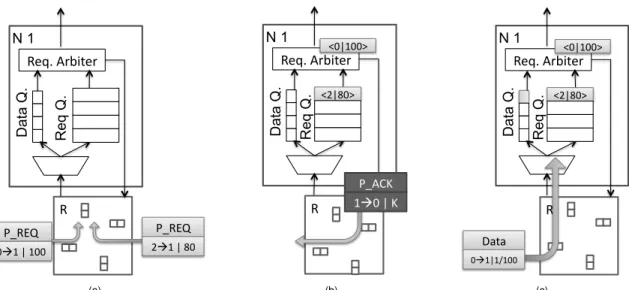
Fig. 6 shows an example of the CTC protocol operations: at firstN I0 andN I2, addressN I1with two P REQ
mes-sages indicating the size of the transaction they want to ini-tiate (respectively 100 and 80 flits). In Fig. 6(b)N I1selects N I0to initiate the connections while it stores the other
re-quest in the rere-quest-queue. Then N I1 generates a chain
of consecutive P ACKpackets so thatN I0’s credit counter 3Note that P REQand P ACKare actuallymessagescomposed by one
single packet. When referring to these two messages we use the two words without distinction.
is initialized with the maximum amount of flit-credits that N I1can offer.
As for the CB case, a single P ACKconveysKflit-credits per single message but in the former counters are initialized at start up time whereas in CTC the consumer NI initial-izes the counter of the selected producer peer. Consider-ing the example in Fig.6 if the size of the data input queue were Q=10andK=3,N I1 would generate 3 consecutive
P ACK messages to initialize N I0’s credit counter to the
maximum storage it can offer. AsQis not a multiple ofK
one slot is not assigned at the connection start-up time but it will be assigned as soon asN I1starts receiving flits and
forwarding them to the connected core. Finally, Fig. 6 (c) shows the data-packet generated byN I0reaching the
data-queue ofN I1.
Independently from the consumption rate of the core, in both considered end-to-end flow controls each time a con-sumer frees Kslots in the data input-queue, it generates a new P ACKmessage until the sent credits are sufficient to transfer all the flits of the requested transition (whose size was specified in the P REQmessage). Considering the ex-ample in Fig. 6 withK = 3,N I1generates a new P ACK
for eachK flits that are consumed. Hence the 100 flits of messageM require a total ofdM/Ke = 34P ACK mes-sages. As the message’s length M is not a multiple ofK, the consumer NI assigns to the connection a bigger amount of memory slots thanM. Nevertheless at mostK-1slots of
Qcan be reserved but not actually used. These additional slots are marked asdirtyand freed when the connection is terminated.
Finally upon the sending/reception of the last flit ofM, the producer and the consumer terminate the connection. Note that there is no need of specific flags or instructions as both producer and consumer nodes know the exact size of the transfer to process.
R Data Q. Req. Arbiter N 1 Req Q. P_REQ 01 | 100 P_REQ 21 | 80 (a) Data Q. Req. Arbiter <2|80> N 1 Req Q. R P_ACK 10 | K <0|100> (b) R Data Q. Req. Arbiter <2|80> N 1 Req Q. Data 01|1/100 <0|100> (c)
Figure 6. The CTC transaction-definition procedure: (a) the core interfaceN I1 receives two P REQ
requests fromN I0 andN I2; (b)N I1selects the request fromN I0generating the relative P ACKand
stores the one fromN I2in the request-queue; (c)N I1receives the data-packets fromN I0.
To avoid throughput degradation, the data-input queue should be sized accordingly to Equation 1 as function of the number of credits per P ACKand the maximum round trip time between the consumer NI and the producer address-ing it. Usaddress-ing a fixed value ofKrather than a dynamic one, reduces the number of control packets traveling on the net-work. Moreover the parameterKinfluences both the num-ber of CTC-control messages traveling along the network and the size of the data input queue on the NIs. Hence it has a clear impact on the design and performance of the network. According to Equation 1 a small values ofK al-lows to reduce the size of the input queue saving area and power consumption. On the other hand, it implies a higher number of P ACK packets flowing through the network to update the credits on the producer side. To avoid loss of per-formance and reduce contentions, a producer node that runs out of credits terminates the injection of the packet by tag-ging the flit using the last credit aspacket tail. In this way the path along the network is made available to other pos-sibly blocked packets. Note that the CTC connection is not terminated until the delivery of all the flits of the message is completed.
To guarantee the consumption assumption of the P REQ
messages, the request-queue must be sized accordingly to the maximum number of requests that a NI can receive. By limiting each CTC producer to have one single outstanding P REQat time the request queue can be sized according to the number of possible sources of data so that all incoming P REQcan be stored in the NI and removed from the NoC. CTC defines three message dependencies that are ad-dressed in the following way:
P REQ→P ACK: the request-queue is sized accordingly to the number of possible producer-peers addressing the given NI. CTC limits each node to have at most one outstanding P REQat time. Hence the consumption of all injected P REQis guaranteed.
P ACK→data: P ACKpackets are always consumed by a network interface that updates the output credit counter and then deletes them.
data→ P ACK: the credit mechanism ensures that no more data-flits than those allowed by the output credit counter can ever been injected. Hence all data flits in-jected in the NoC are eventually consumed by their ad-dressed NI.
Thanks to the CTC protocol design, these three depen-dencies are independent from the applications that is run by the cores and hence the system can be considered protocol-deadlock free.
5
Analysis and Simulation
To analyze the characteristics of the CTC protocol and compare the performance of a CTC-based NoC versus a CB-based NoC we developed aC++system-level simula-tor that allows us to model various NoC topologies, routing and flow-control protocols as well as the traffic scenarios injected by various types of cores. We used the simula-tor to compare the two end-to-end protocols on the Spi-dergon NoC [7] for the case of the VOPD and MWD ap-plications whose task graphs are shown in Fig. 4. We
60 80 100 120 140 160 180 200 220 240 0.1 0.2 0.3 0.4 0.5 0.6
Message Latency (cycles)
Offered Load (flit/cycle) CB CTC (a) 60 80 100 120 140 160 180 200 220 240 0.1 0.2 0.3 0.4 0.5 0.6 0.7 0.8 0.9 1
Message Latency (cycles)
Offered Load (flit/cycle) CB CTC (b) 100 150 200 250 300 350 400 450 500 0.1 0.15 0.2 0.25 0.3 0.35 0.4
Message Latency (cycles)
Offered Load (flit/cycle) CB
CTC
(c)
Figure 7. Message latency as function of the injection rate for (a) VOPD, (b) MWDand (c) Uniform
traffic patters. 40 50 60 70 80 90 100 110 120 0 5 10 15 20 25 30 35
Message Latency (cycles)
Credits per P_Ack CB CTC
Figure 8. Message latency as function of the number of credits associated to aP ACK for
the case of theVOPDtraffic pattern.
signed each task to a different core following the heuristic presented in [4]. We also considered therandom uniform traffic patternwhere each node may communicate with any other node in the network [9]
In the CB-based NoC the NI of each core has a number of input queues equal to the number of incoming streams (see Fig. 4). For both the CTC-based and the CB-based NoC, the size of each data input queue is set uniformly based on Equation 1 and no virtual channels are used.
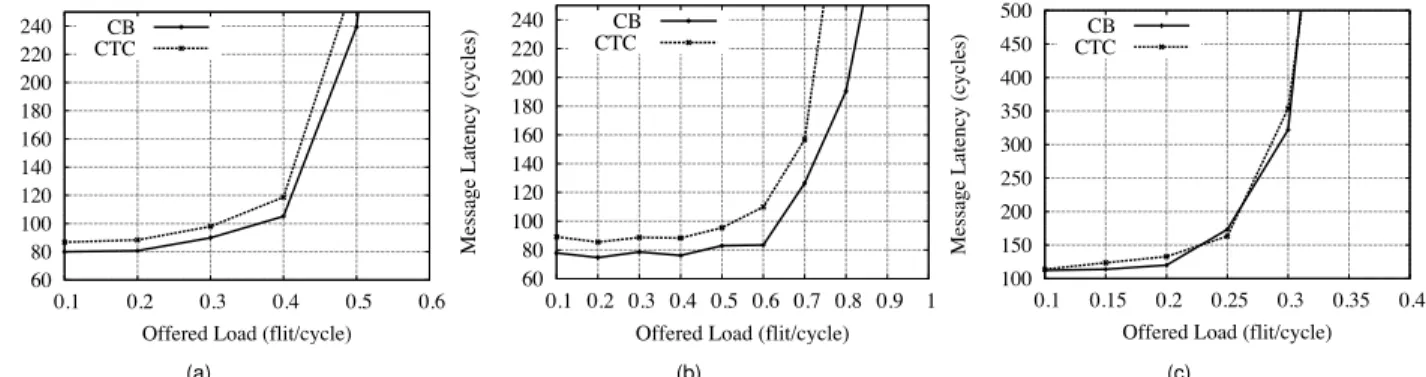
Fig. 7 shows the average end-to-end message latency as function of the average offered load whenK is fixed to 32 flit-credits (results are similar for the other credits values) and the messages are 64 flits. As expected, the CTC proto-col gives a higher latency due to the handshake procedure. Nevertheless, for the VOPD application the difference be-tween the two protocols remains under10%up to the satu-ration point, which is around 0.4.
Fig. 8 shows the average peer-to-peer latency as function of the number of creditsKper P ACKpacket when the of-fered load is lower than the saturation threshold for the case
of the VOPD application. Clearly, by increasing the value ofKthe performance of the system also improves: PEs can inject more flits per P ACK thus reducing the number of control packets (credits and headers). Conversely, increas-ingK also requires bigger input queues that must support the additional number of flits received per P ACKsent.
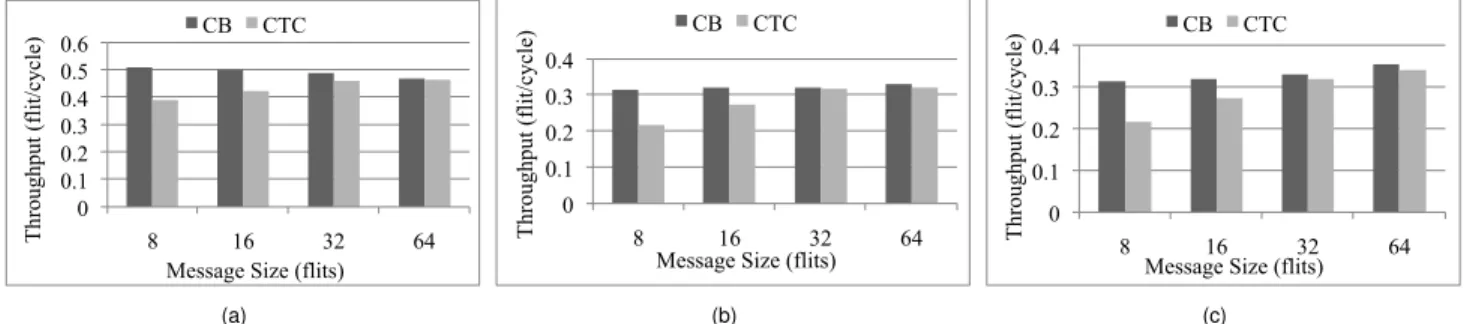
Fig. 9 reports the throughput comparison as function of the message size M. As expected, in all these scenar-ios, the performance of the CTC-based NoC increases with the message size for the same offered load because the rate of connections-per-flits that must be set up is reduced. Therefore, CTC represents a valid proposition for message-passing applications such as video stream processing that present large inter-core message transfers.
Finally, we analyze the amount of storage used by the two alternative flow control protocols. As discussed in Sec-tion 3, for both CB-based and CTC-based NoCs the input queues of the network interfaces must be properly sized to avoid throughput degradation. For a CB-based NoC each input queue must be sized accordingly to Equation 1. For a CTC-based NoC, instead, only the data-queue must have this size while the request-queue of a given interface must be as large as the number of distinct producer cores that can send message to its core. Notice that in order to pro-vide a single interface design for each possible core, this number can be over-estimated without a major loss of area because the request-queue has a negligible size compared to the data-queue. Fig. 10 shows the breakdown of the aggre-gate number of data-queues used in the network interfaces for the two approaches to support the given applications. In VOPDand MWDonly the interfaces associated to nodes with incident (outgoing) arrows actually require input (out-put) queues. Considering VOPD the CTC-based NoC uses a total of 22 data queues, including both input and output, while the CB-based NoC needs 30 data queues. Assuming that the length of each data queue is the same in the two NoCs, CTC allows to save up to 35% of storage space for this particular case study. In the MWDcase, since most of
0 0.1 0.2 0.3 0.4 0.5 0.6 8 16 32 64 Throughput (flit/cycle)
Message Size (flits) CB CTC (a) 0 0.1 0.2 0.3 0.4 8 16 32 64 Throughput (flit/cycle)
Message Size (flits) CB CTC (b) 0 0.1 0.2 0.3 0.4 8 16 32 64 Throughput (flit/cycle)
Message Size (flits) CB CTC
(c)
Figure 9. NoC Throughput as function of the message size whenK= 4flit-credits.
0 20 40 CB CTC Num. of Queues Input Output (a) 0 20 40 CB CTC Num. of Queues Input Output (b) 0 100 200 300 CB CTC Num. of Queues Input Output (c)
Figure 10. Breakdown of the aggregate number of input and output queues in the NoC NIs for the
VOPDapplication.
the cores communicate only with one other core the two NoCs have many interface with similar structures. Still, even in this case CTC allows to save up to 24% of storage as reported in Fig. 10.
Finally, the Uniform traffic pattern represent the special case where each node may communicate with any other node of the NoC. In this case clearly CB is an expensive solution as it requiresN −1queues whereN is the num-ber of nodes in the network. In fact, in absence of a nego-tiation protocol, replicating the queues is the only way to guarantee that flits of different messages are not mixed in a single queue and that all injected flits are also ejected from the NoC. In comparison, the storage reduction achieved by CTC can be very high because allN −1input and output queues of each node are replaced by the single input data-queue and the output data-queue.
In summary, the reduction of the size of the queues that must be installed in each network interface translates di-rectly in a reduction in the area occupation and is expected to lead also to a reduction in overall NoC power dissipation.
6
Conclusions
Message-dependent deadlock is a destructive event that, even if rare [22], must be properly addressed to guaran-tee the correct behavior of a network. The credit based (CB) end-to-end flow control protocol solves this problem by using multiple dedicated input queues and output
reg-isters in the network interfaces. This increases the com-plexity of the network interface design. Further, since the number of these queues depends on the number of distinct communications that its particular core may have, the same network may present interfaces that have different micro-architectural structures.
We proposed the Connection Then Credits (CTC) end-to-end flow control protocol as an area-efficient solution to the message-dependent problem that is characterized by a simpler and more modular network interface architecture. CTC-supporting network interfaces use one single input data queue and one output credit counter. Hence, the over-all number of queues per network interface remains equal to two, the total amount of storage is reduced and the over-all network-interface design becomes independent from the communication requirement of the particular core, thus in-creasing its reusability. On the other hand, any new commu-nication between a pair of peer nodes requires the prelimi-nary completion of a handshake procedure to initialize the output credit counter on the producer side (after the connec-tion has been established CTC works in a way similar to the original Credit Based flow protocol). This procedure neces-sarily increases the latency of a message transfer and it also reduces the network throughput for small messages.
In summary, the choice between CB versus CTC may be seen as a case of typical “performance versus area” tradeoff. From this perspective, experimental results show that for a video processing application the latency penalty remains
under 10% while the savings in terms of the overall area occupation of the network interfaces reaches 35%. There-fore CTC is an effective solution of the message-dependent deadlock problem for throughput-driven stream processing applications.
Acknowledgments
This work is partially supported by the University of Bologna and ST Microelectronics project funds for the project ”Modeling and Analysis of Network Protocols for Spidergon-Based Networks on Chip”, the National Science Foundation (Award #: 0541278) and by the GSRC focus center, one of the five research centers funded under the Fo-cus Center Research Program, a Semiconductor Research Corporation program.
References
[1] K. V. Anjan and T. M. Pinkston. DISHA: a deadlock recov-ery scheme for fully adaptive routing. InIPPS ’95: Proceed-ings of the 9th International Symposium on Parallel Process-ing, pages 537–543, Apr. 1995.
[2] L. Benini and G. D. Micheli. Networks on chip: A new SoC paradigm.IEEE Computer, 49(2/3):70–71, Jan. 2002. [3] D. Bertozzi et al. NoC synthesis flow for customized
do-main specific multiprocessor systems-on-chip.IEEE Trans. on Parallel and Distributed Systems, 16(2):113–129, Feb. 2005.
[4] L. Bononi, N. Concer, M. Grammatikakis, M. Coppola, and R. Locatelli. NoC topologies exploration based on mapping and simulation models. InDSD ’07: Proceedings of the 10th Euromicro Conference on Digital System Design Ar-chitectures, Methods and Tools, pages 543–546, Aug. 2007. [5] N. Concer, M. Petracca, and L. P. Carloni. Dis-tributed flit-buffer flow control for networks-on-chip. In The Proceedings of the Sixth International Confer-ence on Hardware/Software Codesign & System Synthesis (CODES+ISSS), pages 215–220, Oct. 2008.
[6] M. Coppola. Keynote lecture: Spidergon STNoC: the communication infrastructure for multiprocessor architec-tures. InInternational Forum on Application-Specific Multi-Processor SoC, Jun. 2008.
[7] M. Coppola, M. D. Grammatikakis, R. Locatelli, G. Maruc-cia, and L. Pieralisi. Design of Cost-Efficient Interconnect Processing Units: Spidergon STNoC. CRC Press, Inc., Boca Raton, FL, USA, 2008.
[8] W. J. Dally and B. Towles. Route packets, not wires: On-chip interconnection networks. InProceedings of the Design Automation Conference, pages 684–689, Jun. 2001. [9] W. J. Dally and B. Towles. Principles and Practices of
In-terconnection Networks. Morgan Kaufmann Publishers, San Mateo, CA, 2004.
[10] J. Dielissen, A. R˘adulescu, K. Goossens, and E. Rijpkema. Concepts and implementation of the Philips network-on-chip. InIP-Based SoC Design, Nov. 2003.
[11] J. Duato, S. Yalamanchili, and L. Ni. Interconnection Net-works. An Engineering Approach. Morgan Kaufmann Pub-lishers, San Mateo, CA, 2003.
[12] Y. Durand, C. Bernard, and D. Lattard. FAUST : On-chip distributed architecture for a 4G baseband modem SoC, in. InProceedings of Design and Reuse IP-SOC, pages 51–55, Nov. 2005.
[13] O. P. Gangwal, A. R˘adulescu, K.Goossens, S. G. Pestana, and E. Rijpkema. Building predictable systems on chip: An analysis of guaranteed communication in the Æthereal network on chip. In P. van der Stok, editor,Dynamic and Robust Streaming In And Between Connected Consumer-Electronics Devices, volume 3 ofPhilips Research Book Se-ries, chapter 1, pages 1–36. Springer, 2005.
[14] A. Hansson, M. Coenen, and K. Goossens. Undisrupted quality-of-service during reconfiguration of multiple appli-cations in networks on chip.Proceedings of the conference on Design, automation and test in Europe, pages 954–959, Apr. 2007.
[15] A. Hansson, K. Goossens, and A. R˘adulescu. Avoiding message-dependent deadlock in network-based systems on chip. VLSI Design, 2007:Article ID 95859, 10 pages, May 2007.
[16] A. Hemani et al. Network on chip: An architecture for bil-lion transistor era. In18th IEEE NorChip Conference, page 117, Nov. 2000.
[17] J. L. Hennessy and D. A. Patterson.Computer Architecture: A Quantitative Approach. Morgan Kaufmann, 2006. [18] H. D. Kubiatowicz. Integrated Shared-Memory and
Message-Passing Communication in the Alewife Multipro-cessor. PhD thesis, Massachusetts Institute of Technology. Boston, 1997.
[19] S. Murali, M. Coenen, A. Radulescu, K. Goossens, and G. D. Micheli. Mapping and configuration methods for multi-use-case networks on chips. Proceedings of the 2006 conference on Asia South Pacific design automation, pages 146–151, 2006.
[20] S. Murali and G. D. Micheli. An application-specific design methodology for STbus crossbar generation. InDATE ’05: Proceedings of the conference on Design, Automation and Test in Europe, pages 1176–1181, Apr. 2005.
[21] T. M. Pinkston and J. Shin. Trends toward on-chip net-worked microsystems.Intl. J. High Performance Computing and Networking, 3(1):3–18, 2001.
[22] Y. H. Song and T. M. Pinkston. A progressive approach to handling message-dependent deadlock in parallel computer systems. IEEE Trans. on Parallel and Distributed Systems, 14(3):259–275, 2003.
![Figure 1. NoC-based System on Chip and the media-accelerator sub-system [6].](https://thumb-us.123doks.com/thumbv2/123dok_us/1116242.2648565/1.918.469.822.436.696/figure-noc-based-chip-media-accelerator-sub.webp)