Association for Information Systems
AIS Electronic Library (AISeL)
2014 International Conference on Mobile Business
International Conference on Mobile Business
(ICMB)
2014
A Model of Digital Payment Infrastructure
Formation and Development: The EU Regulator´s
Perspective
Kalina Staykova
Copenhagen Business School, [email protected]
Jan Damsgaard
Copenhagen Business School, [email protected]
Follow this and additional works at:
http://aisel.aisnet.org/icmb2014
This material is brought to you by the International Conference on Mobile Business (ICMB) at AIS Electronic Library (AISeL). It has been accepted for inclusion in 2014 International Conference on Mobile Business by an authorized administrator of AIS Electronic Library (AISeL). For more information, please [email protected].
Recommended Citation
Staykova, Kalina and Damsgaard, Jan, "A Model of Digital Payment Infrastructure Formation and Development: The EU Regulator´s Perspective" (2014).2014 International Conference on Mobile Business. 14.
A MODEL OF DIGITAL PAYMENT INFRASTRUCTURE
FORMATION AND DEVELOPMENT: THE EU
REGULATOR´S PERSPECTIVE
Staykova, Kalina, Copenhagen Business School, Howitzvej 60, 2000 Frederiksberg,
Denmark, [email protected]
Damsgaard, Jan, Copenhagen Business School, Howitzvej 60, 2000 Frederiksberg, Denmark,
[email protected]
Abstract
The payment field is being rapidly transformed. New players have emerged and are threatening the well-established positions of the incumbents. This process is driven by technology change and market forces, and it is shaped by the increasing role of the regulator. When considering the change in the regulatory environment and combining it with the disruptive and innovative nature of the mobile phone, the result is a market that is rapidly transforming from well-established structure into a state of flux. We build a model to understand and explain this transformation of the digital payment infrastructure. The model captures the formation and development of the digital payment infrastructure with a particular emphasis on the regulator´s and innovator’s perspective. It consists of four stages characterized by slow incremental change which are followed by short and rapid bursts of discontinuity. Each stage is portrayed by its evolutionary dynamics, the nature of the payment platform, the legal implications, the level of competition, and what drives the discontinuity.
1
Introduction
There is little doubt that the payment field is being transformed. A significant role in this process is played by the mobile phone which is going to upset the current equilibrium by demolishing well-established business models and associated institutions while paving the way for new. Due to its disruptive nature, the device is gradually eroding hard earned concessions and absorbing services that previously were profitable. For example, consider that the mobile phone is in the midst of absorbing navigation devices (GPS), mp3 players, and cameras as separate physical objects. The annexation quest of the mobile phone propels forward and it has already set its target on digital payments (e.g. Google Wallet, iZettle etc.).
Currently, domestic payment arenas are well-established, with predefined roles and profitable business models. Payment fees, however, are about to become less profitable in the near future (European Commission, 2013). At the same time novices in the payment landscape are challenging the status quo of the payment market. The observed transformation, however, is not attributed only to the disruptive nature of technology. It is also influenced and shaped by market forces and the growing intervention of the regulators. The changes in the regulatory environment, combined with the disruptive nature of the mobile phone, are transforming the well-established digital payment market. In this paper, we seek to provide an answer to the following eminent research question which the payment industry faces today:
How does digital payment infrastructure form and develop from innovator’s and regulator’s perspective?
We present our answer as a framework that captures and portrays the formation and evolution of digital payment infrastructures. This paper proceeds as follows. In section 2, we present our theoretical basis. In section 3, we conceptualize our model. In section 4, we discuss the model and its limitations and make some conclusions.
2
Theoretical foundations
We aim to build a framework which identifies the different stages of the digital payment infrastructure evolution, while at the same time analyzing the evolutionary dynamics from different perspectives. As we recognize the complexity of the digital infrastructures, we adopt an interdisciplinary approach in order to gain an in-depth understanding of the evolution in the digital payment market.
2.1
Infrastructure
There is an urgent need to theorize the evolution of digital infrastructures (Tilson et al., 2010). As Henningsson and Hedman (2012) point out there are still many things about digital infrastructures and how they can be developed towards specific ends that remain unknown. In particular, the area of the digital payment infrastructure is understudied. The problem is investigated by Henningsson and Hedman (2012) from organizational capabilities perspective. They, however, do not propose an evolutionary model through which the infrastructure is established.
There is not enough research dedicated to the concrete evolutionary path through which digital infrastructures grow. Some of the existing literature on digital infrastructure investigates the causal structures of the evolution. Henfridsson and Bygstad (2013) highlight the existence of three self-reinforcing mechanisms (innovation (new services and products are created), adoption (more services are offered and more users are attracted) and scaling (attracting partners to increase the reach of the infrastructure)) that serve as causal powers in digital infrastructure evolution. Bygstad (2010) identifies two self-reinforcing mechanisms (innovation and service) in information infrastructures
which feed on each other. Although these models recognize the complexity of the infrastructure evolution, they exclude from their scope of analysis external factors which influence the development such as the role of the regulator. Infrastructure is both relational and ecological (Star, 1999). Thus, digital infrastructures are also investigated as relational models which are established and operated by a heterogeneous collection of stakeholders drawn from both private and public organisations who engage in various issues of collaboration, conflict and control (Elaluf-Calderwood, Herzhoff, Sorensen and Eaton, 2011). The relationship between different stakeholders such as system builders, entrepreneurs, regulators as a driver of the evolution of the wireless infrastructure is analyzed by Lyytinen and Fomin (2002). They observe specific arrangements between the regulatory regime, technological innovation and market forces. The analysis, however, does not reveal clearly the interdependency between the three units of analysis, and it does not map the different stages of the evolutionary path.
2.2
Platforms
It is acknowledged that the evolutionary complexity links digital infrastructure and digital platforms in many ways (Sorensen, fortcoming). The interdependency between platforms and infrastructures, however, is understudied. Digital infrastructures are usually being subjected to much more nebulous control arrangements than digital platforms (Sorensen, forthcoming). Thus, infrastructures are much more complex than platforms. For the purposes of this paper, we define digital infrastructures as enablers of digital platforms. Thus, we investigate the digital payment solutions as digital payment platforms which, as they grow and mature, slowly become integral part of the payment infrastructure. At the same time, due to their disruptive nature, the digital platforms transform significantly the existing payment infrastructure. In our view, a payment infrastructure encompasses physical payment artifacts and the institutions that use and manufacture them as well as acquirers, banks, merchants and citizens. It also encompasses relevant legislative and regulative bodies and trade and industry associations that engage in the alignment of multiple interests including standards, fees and the legitimization of the acceptable uses of the infrastructure.
In the existing literature it is recognized that a payments system functions as two-sided markets that enable the interaction between both merchants and consumers (Rochet and Tirole, 2002; Evans and Schmalensee, 2008). There is often confusion between the exact difference between one-sided, two-sided, and multi-sided platforms. Part of the problem stems from the lack of a clear definition (Hagiu and Wright, 2011). There is an overlapping in the way two-sided and multi-sided platforms are defined (Evans and Schmalensee, 2008; Hagiu and Wright, 2011). In this paper, we propose a clear distinction between one-sided platform, two-sided platform and multi-sided platform and demonstrate how platforms develop and grow over time by adding new sides and functions to their initial value preposition. Thus, we trace the evolution of the platform from one-sided and two-sided to multi-sided (attracting more than two sides). In our model one-sided platforms differ from one-sided markets which function predominantly as resellers (Hagiu and Wright, 2011). One-sided platforms facilitate the communication between the users of the platform who form one distinctive group of consumers which exhibit same-side network effects and have interchangeable roles. Thus, they differ from the two-sided platforms which link two distinctive groups of users (consumers and merchants) with strong cross-side network externalities.
The growth of the platforms is conditional upon several factors. The success of the platform depends on the critical mass i.e. the number of the users on both sides has to reach a certain point (Evans, 2009). The critical mass influences market dynamics radically. Markets may grow slowly until reaching a critical mass, then, suddenly, they can begin expanding rapidly (Osterberg and Thomson, 1998). Multi-sided platforms create value for their participants and profit for themselves by managing network externalities (Evans, 2013). The establishment of strong same-side or cross-side network effects increases the initial value preposition of the platform and allows for the development of pricing models which enlarge the initial user base (Rochet and Tirole, 2002; Eisenmann et al., (2006)). After
bringing enough users on board, a platform owner should ensure the retaliation of the users by managing the homing costs and the switching costs of the platform (Shapiro and Varian, 1999).
2.3
Evolutionary Economics theory
In our framework we assume that the process of evolution is triggered by technology disruption which changes the number of actors and triggers new modes of interaction between them by transforming the competitive dynamics of the environment. To capture the dynamics of the technology change and to better explain its impact on the evolution, we rely on the evolutionary theory.
The concept of punctuated equilibrium stems from the evolutionary theory (Van Den Bergh and Gwody, 2000). The evolution of species can occur either as gradualism or as punctuated equilibrium. Change in gradualism is slow-paced, whereas in punctuated equilibrium, change comes in spurts, often unexpectedly. Periods of very little change (or incremental change) are followed by few huge changes. The concept of punctuated equilibrium is found to be particularly useful for explaining the dynamics of technological change (Tushman and Rosenkopf, 1992; Tushman and Anderson, 1986). Technology development is presented as an evolutionary process punctuated by rapid discontinuous change. In the case of digital payments, we clearly observe the phenomenon of existing technologies being applied in new application domain. To explain this, we adopt the biological notion of speciation which states that new species evolve when they are isolated from their antecedent population. The analogue of speciation in technological development is the use of existing technologies in a new domain of application (Adner and Levinthal, 2002). The speciation triggers the evolution process. Thus, we attribute the technological discontinuities (or the short periods of rapid discontinuous change) to re-application of existing technologies in new re-application domain.
In this paper we also rely on the evolutionary perspective on dominant designs which focuses on rivalry among alternatives. We adopt the concept of the dominant design as a product’s design specifications (consisting of a single or a complement of design features) which define the product category’s architecture (Christensen et al., 1998). The introduction of new technologies leads to a rapid spread of different new designs which co-exist and enter into direct rivalry with old designs. Over the time a dominant design emerges.
Lyytinen and Fomin (2002) point out the interdependency between technological artifacts, actors, ideas and sites. Thus, the technology change has a clear impact on the relationship dynamics among different actors. Of particular importance is the understanding that technology disruptions leads to the emergence of new actors (companies) which change the competitive dynamics of the ecosystem. To better investigate this claim and to guarantee consistency in the adopted theories, we rely on the evolutionary economics which is based on the variation, selection and retention mode of evolution (Aldrich and Ruef, 2006; Metcalfe, 1998). The principle of evolution states that some entities (or in our case companies), due to their specific characteristic, are better adapted to evolutionary pressure than others. Variety is generated, and then the number of entities in the variety is decreased by a selection process (Mayr, 1982). Relation between variation and selection is two-way; variety drives selection and the development of variety is shaped by the process of selection.
2.4
Regulation
Lyytinen and King (2002) recognize that the reorganization of the regulatory regime and the disruption of technologies are interlinked in multiple ways. In particular, most of the existing frameworks for analyzing mobile payments (a field which is characterized by a high level of technology disruption) also point out the importance of regulation (Au and Kauffman, 2008; Dahlberg et al., 2008; Ondrus et al., 2009). Although most of these models recognize the role of the regulators for shaping the environment, they view the impact of the regulation as static. We argue that regulation has a dynamic nature and changes throughout the whole evolutionary process. Furthermore, regulation
not only follows the technology and market development, but also shapes the evolutionary process whenever this is necessary. This complexity is not captured by the existing frameworks. Thus, our paper aims at addressing this research gap. To this end, we try to map the development of the EU payment legislation which shapes the Single Payment Market, and in particular SEPA as the initiative is perceived as a cornerstone for the achievement of full payment market integration. SEPA is a form of European hybrid governance where traditional hard law, soft law and privately constructed rules interact (Janczuk-Gorywoda, 2012). In this term, we view SEPA as a legislation effort and not as a final result, namely the establishment of SEPA infrastructure. We then try to test whether our model can serve as a predictive tool for estimation of the possibility (regulation or not) and the degree (more or less regulation) of future legislative efforts on EU level.
3
Crafting the Digital Payment Infrastructure Evolution (DPIE)
model
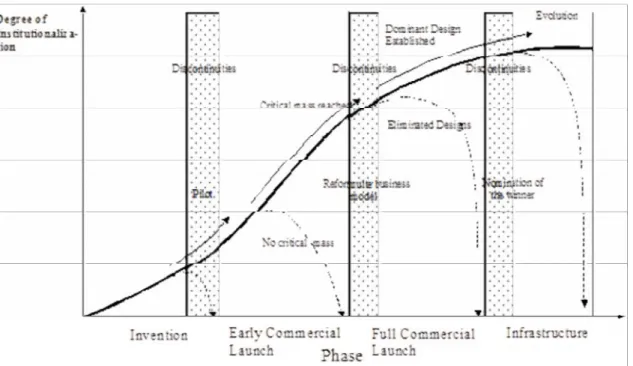
As indicated above we try to build a framework which identifies the different stages of digital payment infrastructure evolution by analysing the evolution from several perspectives, namely multi-sided platforms, evolutionary theory and regulation. We build on the notion adopted by Tilson et al. (2010) who claim that digital infrastructures can be characterised in terms of paradoxical relations between both stability and change, and generativity and control. To further explain this, we incorporate the notions of technological discontinuities and incremental change as stated in the Tushman – Rosenkopf cyclical model of technological change (Tushman and Rosenkopf, 1992). Thus, our model states that the evolution of the digital payment infrastructures is not stable and slow-paced but rather a dynamic process which combines periods of incremental change and stability with rapid, short-term disruptions. Our model defines 4 phases of evolution (invention, early commercial launch, full commercial launch and establishment of new infrastructure) which are intercepted by several discontinuities (technology disruption (speciation), formulation of a successful business model and emergence of a dominant design) (fig.1). Thus, our model recognizes the presence of several discontinuities which accelerate the development and are the source of major change in the evolution process. The discontinuities are not self-driven. They are a result (or natural continuation) of the specific development dynamics which characterize each stage of the evolution. This development dynamic within each stage is influenced and shaped by the growth of the payment platforms (multi-sided platform), the change in the configuration of the actors (evolutionary economics), and the role of the regulation.
3.1
Phase 1 Invention
The invention stage is a period of inventing new technologies or processes. Sometimes this is done without a specific application in mind or the invention turns out not to be useful for what it was first intended. Many technologies, therefore, can be characterized as dormant. They have disruptive potential but first they need to be unlocked. A good example of this is the ATM which was created in 1939 by Luther Simijan. After six months of trails the bank reported that there was no need or demand for such a product (Barwise and Meehan, 2011). It was not until almost thirty years later, a second attempt to popularize the ATM was made and this time the invention became widespread. The genesis of the ATM shows common characteristics of inventions as many are invented long before they became widespread.
In the area of digital payments the technologies which allow the execution of digital payments (e.g. NFC, QR codes, etc.) were first developed and applied to markets other than the payment market. Later, they were introduced to the digital payment field. Even though they were subjected to some adaptations, we do not witness a significant, radical modification of these technologies. Thus, the technologies, which enable the digital payments today, are borrowed from other fields.
In this paper, we argue that this happens during the first discontinuity which is triggered by a shift in the application domain of a particular technology (speciation). We argue that the shift is caused when a specific technology manages to get the attention of a given actor.
Figure 1. The Digital Payment Infrastructure Evolution Source: Authors’ creation
This speciation usually results when a technology is taken from one niche and put into another market niche. The new technology then has an evolutionary path of its own and can soon penetrate an existing mass market. This, however, happens at a later stage. First the technology has to exit the originating niche (or exit the first discontinuity). Niches are seen as incubator rooms where innovation can evolve protected from the mainstream market selections (Hjelholt and Damsgaard, 2013). Actors select the particular invention due to the belief that it can support or enhance their position and increase their power. To exit the niche an institutional actor or a company has to test the market potential of the selected technology. Thus, the niche innovation is offered as a service in the market, often on a trial basis. After a pilot is completed, the actor evaluates the results and decided whether to launch the innovation or not in the next stage – early commercial launch. Thus, the exit of the niche depends on the results from the pilot.
Most of the existing solutions in this stage are offered as one-sided platforms (Barclays’ Pingit, Danske Bank’s MobilePay) which combine one or few features and target one distinct group of users who exhibit strong same-side network effects. As the pilot period is associated with many uncertainties, companies usually try to test a service or a product with limited functionalities which will allow them to attract the attention of various consumers. Combining too many functions at this stage will increase the investment costs of the company. At the same time as the market is not fully understood, it is hard to predict the exact demand for particular functionalities.
As claimed above technology innovation can disrupt the existing ecosystem by bringing new players, and thus it complicates the relational dynamics. In this first phase, we identify two main players -incumbents and new entrants (e.g. start-ups using new technologies). There are established payment solutions offered by regulated financial institutions (banks, credit card companies). Most of the customers are locked-in the old payment systems. The new entrants offer either better alternative solutions or completely new payment solutions. The customers, however, are still not locked-in. As a result regulators have no clear mandate to legislate because the new technology may not lift–up. We define this phase as a regulatory gap which is characterized by high level of regulatory asymmetry (some entities are covered by specific legal requirements, while others are not). The asymmetry is
further enhanced by the different levels of competitive advantages between incumbents and new entrants. Since the contenders do not have to comply with the same regulatory requirements which banks, for example, face, they have more freedom to operate. However, they also face high level of regulatory uncertainty as they do not know what approach the regulator might take it the future. Therefore, there is a high risk that the gained competitive advantage may be neutralized by too rigorous regulation introduced at a later stage. In this first stage, we argue that the role of the regulator is to find the right balance between ensuring innovation and guaranteeing fair competition. Furthermore, regulation at this stage can be seen as a barrier to entry if the compliance is too high and costly. This partly explains the wait-and-see approach adopted by the regulators.
3.2
Phase 2 Early Commercial Launch
The second stage is characterized by the early commercial launch of the payment solution. The main aim of this stage is to guarantee the growth of the product/service by increasing the user base i.e. reaching a critical mass. A popular way to attract first-time visitors is to offer gifts, subsidies or discounts (Damsgaard, 2002). Being able to achieve a critical mass is the threshold for the adoption of a new technology or a payment service. If a critical mass is not reached, the specific payment solution just dies out. There are many examples of launched mobile payment solutions which were discarded after they failed to attract the necessary user base, f.e. Bart in Sweden, O2 Wallet in UK etc. The critical mass indicates the presence of a stable user base which is entrenched in the service/product. The entrenchment is further enhanced by adding new functionalities to the already existing payment solution. The large user base attracts a second distinct group of users (i.e. merchants) who are ready to pay to get an access to the consumers. Thus, a payment solution is transformed from one-sided platform to two-sided platform. This development changes the evolutionary dynamics and leads to the second discontinuity where, now as the solution has proven its value, a company has to decide on its viable business model.
The critical mass concept has very important implications for the competition in the digital payment markets. The speciation of various technologies during the previous stage leads to variation in the offerings (Tushman and Rosenkopf, 1992). We claim that variation begins after a company decides to shift a specific technology or innovation to a new domain of application and offers it commercially. This act spurs variation in the new niche. These innovations lead to the emergence of many new entities, which enter into an environment previously inhabited only by incumbents, and thus giving rise to specific variation. It is important to note here that in the digital payment area the variation comes from the various existing technologies re-applied to this market from other domains ( NFC, QR codes), as well as from the institutional actor or companies who choose them (e.g. many new entrants offer NFC-based payment solutions in various forms). The number of the new entrants is usually growing faster and the interaction with the other actors in the environment (new entrants and incumbents alike) is chaotic.
Since the regulator does not have a clear mandate to legislate after the introduction of new technologies, new entrants are left operating in a legal void without clear guidance to adhere to. As a response to this, many industry players form self-regulatory bodies which develop a common set of standards and business rules applicable to all of its members. The main goal is to gain a cohesive voice in the industry and to seek membership with influential bodies which can shape policy-making decisions.
The Single Euro Payments Area (SEPA) is probably the most ambitious self-regulatory project aimed at creating an integrated European digital payments market since the introduction of the Euro (Allix et al., 2009). The starting point for the SEPA project can be traced back to the adoption of Regulation 2560/2001 on cross-border payments in Euro which introduced the principle of equal charges for cross-border and domestic payments. But the Regulation itself was not sufficient to accomplish EU payment market integration. Instead, the Regulation was a clear signal to the banking industry to fill this apparent void by introducing technical standards (Janczuk-Gorywoda, 2012). In 2002, banks and
banking associations established the European Payment Council (EPC) as a decision-making body of the European banking industry with the main purpose to support and promote SEPA. We argue that at this stage SEPA has all the characteristics of a typical self-regulation initiative. Thus, during the phase of the early commercial launch the regulator prefers to encourage self-regulatory initiatives instead of introducing hard law. Although self-regulation can be seen as a step towards regulatory symmetry as it tries to fill the regulatory void, the levels of asymmetry still remain high. We attribute this to the voluntarily nature of the self-regulation which, in contrast to regulation, does not have binding force. Therefore, the decision to join or not a particular regulatory initiative is left to the discretions of the companies. The asymmetry is also attributed to the uncertain future of the new payment technologies and payment services. Until new technology reaches a critical mass, the levels of competition remain low and there is no particular need to regulate it. Before passing the critical mass test, the future of the new payment services seems unstable and insecure.
3.3
Phase 3: Full Commercial Launch
In the full commercial launch phase digital payment solutions converge and transform from two-sided into multi-sided platforms by attracting more sides and adding more functions to their initial value preposition. The full commercial launch phase is characterized by intensive competition between incumbents and new entrants as well as between new entrants themselves. Thus, as a preparation for the severe competition, a payment solution has to increase its value preposition, and thus indirectly to increase its switching and homing costs. During this stage different payment solutions fight to become the dominant actor in the market. Often solutions will be in direct competition over the same users (Hjelholt and Damsgaard, 2013). According to the model proposed by Tushman and Rosenkoph the period of intense competition ends with the selection of a dominant design which we understand as the specification (consisting of a single design feature or configuration of design features) that defines the product category’s architecture (Christensen et al., 1998). The end of the battle comes with the establishment of one or several dominant designs. Therefore, we witness a significant decrease in the number of solutions. The establishment of a new dominant design constitutes the third discontinuity in our model.
From evolutionary economics perspective, while innovation is about creating new variations, selection puts them to test. Selection reduces the variety by giving preference to some forms of variation rather than to others (Aldrich and Ruef, 2006). Competition is selection undertaken in a market environment the outcome of which is economic change (Metcalfe, 1998). Selection is tight to the concept of Darwinian “fitness” which states that the fittest variations will survive, while the unfit ones will perish. In economic terms “fitness” is equalized with economic efficiency. The variations which generate profit and can capture a significant market share are deemed fit to be the true winners.
If, in this stage, the regulatory asymmetry is still present, the legal incoherence can turn out to be a very important tool in this battle. The longer a new entrant stayed unregulated after it has reached critical mass, the more competitive advantage it will enjoy over its regulated competitors because it is not subject to regulatory burdens. Although the early commercial stage was primarily dominated by self -regulation, this mechanism seems not to be very useful in the later full commercial launch phase. The main reason for this is the fact that self-regulation is not suitable for stages with high level of competition because of its voluntary nature. In this stage, characterized by heated battle for dominance, the regulatory void, due to the lack of any particular regulation, can pose significant threats to the proper functioning of the market. The role of the regulators here is to ensure consumer protection and fair competition (or level playing field for all the actors). This cannot be achieved by the EPC alone or by any other self-regulatory association. Therefore, the European Commission decided to adopt the Payment Service Directive (PSD) in 2007 which serves as a legal framework for SEPA. Thus, the PSD changes the self-regulatory nature of SEPA to a hybrid form where soft law and hard law interact to address different issues. This presents an interesting development in the EU regulator’s approach in regulating the payment area as it indicates for increased regulatory
intervention. At the same time the PSD introduces a new licensing regime for payment service providers (PSPs) who offer limited amount of payment services (Payment Institutions). Thus, new entities are brought into the regulatory scope. The asymmetry, however, is still present as the different PSPs continue to be governed by different rules (different licensing regimes for Payment institutions, E-money Institutions, Credit institutions).
3.4
Phase 4: Infrastructure
In the final stage, the development slows down as a well-defined and mature payment infrastructure is established. The digital platform, which is selected after the severe competition, becomes integral part of the infrastructure, and thus of a well-established, stable regime. At the same time the existing infrastructure is transformed as it is now dominated by a new player. The ability of the winner to innovate is seriously restrained as it cannot fully absorb new inventions on constant basis. The winner has established user base, successful business model and high lock-in effects. Therefore, there is little incentive to innovate as the main efforts are focusing on preserving the leadership position by retaining the already gained market share. As a result of its victory, the winner is granted a concession to establish its own infrastructure (either as part of the existing one, or a completely new one). This usually allows the winner to exclude other competitors and new entrants from accessing the newly established infrastructure and to raise the barriers to entry.
The establishment of a stable infrastructure is also connected to a change in the regulatory approach. Soft law and self-regulation both work as preliminary or complimentary stages of hard law (Gonçalves and Gameiro, 2008). There are still some doubts about their effectiveness as regulatory instruments. They are often designed to promote more participation and dialogue, but sometimes they are also perceived as lacking transparency and accountability. This discussion can be seen in the evolution of SEPA. In 2013, the European Commission adopted Regulation (EU) No 260/2012 of the European Parliament and of the Council establishing technical and business requirements for credit transfers and direct debits in euro (SEPA Regulation). The reason for this is that the self-regulatory efforts of the European banking sector through the SEPA initiative have not proven sufficient to drive forward concerted migration to Union-wide schemes for credit transfers and direct debits on both the supply and the demand side (para 5 of the SEPA Regulation).
We argue that, with the adoption of the SEPA Regulation, the hybrid governance mode of SEPA has changed towards hard law. SEPA is no longer a voluntarily initiative, but a regulatory requirement (Deutsche Bank, 2012). Due to the inability of the EPC to ensure fast adoption of the SEPA Rulebooks in the countries of the SEPA area, a stricter, more hierarchic approach is needed. This development in the EU payment legislation signals that as the platforms mature and established infrastructures emerge, the regulator has more incentives to intervene and regulate the development of the area. The evolution of SEPA indicates a general trend towards more regulation in the EU payment area. For the past decade there has been a growing discussion around the changing character of the EU legislative approach. The regulatory reform has aimed at establishing a “new mode of governance” by combining traditional hard law with more alternative legislative forms such as in the soft law and co-regulation. However, we argue that, at least in the digital payment area, although we have observed a variety of self-regulatory initiatives, we are about to see the introduction of more regulation. The newly proposed “Payments Legislative Package” is a clear indicator of this development (European Commission, 2013).
As our model has a cyclical nature, this phase of slow incremental growth coincides with the first stage. The winner of the selection process has established itself as a dominant market player, but, as noted above, this has restricted its ability to innovate. This creates opportunities for new players to come up with new innovations which has the potential to disrupt the market. Thus, this last stage of the evolution ends when a new speciation process is triggered.
4
Conclusions and Discussions
In this paper we have built a model that describes and explains the formation and development of digital payment infrastructure. To that end, we rely on the combination of number of theories and regulatory frameworks, namely regulation, multi-sided platforms, evolutionary economics. The key characteristics of our model are summarized in Table 1.
We identify 4 different stages of digital payment infrastructure evolution. The invention phase triggers a process of speciation where a new product or a service is applied in another domain. This disrupts the old domain and leads to an invasion of new entities. The variation of companies, which characterizes the early commercial launch, is put down to selection during the next stage. In the final phase (the establishment of infrastructure), the selected winner tries to retain its position and to raise the barrier to entry for new players.
Phase Invention Early Commercial Launch Full Commercial Launch Infrastructure Evolutionary
Economics Speciation Variation Selection Retention Payment
Platform One-sided Two-sided Multi-sided Integrated Legal
Implications Regulatory Gap Self-regulation GovernanceHybrid Hard Law
Competition Low Moderate High Low
Discontinuity Pilot Viable Business
Model DominantDesign Speciation Table 1. Overview of the key characteristics of the DPIE model
The level of competition also varies during the different stages of the model. The invention stage is characterized by low level of competition as the new entrants are yet to test the market potential of their inventions. Therefore, we define the platform as one-sided since the new product or service is still developing. As the platform becomes two-sided during the next stage, the level of competition slowly rises, but the preference is given to cooperation. The competition intensifies as the platform matures and becomes multi-sided. After the selection the established winner faces low level of competition and tries to retain its dominant position by integrating more products or services to the already existing payment solutions (bundling).
In this paper we claim that the regulator’s role changes over time as the digital payment infrastructure develops. At the beginning the regulator tends to adopt a wait-and-see approach in order to estimate the development of the market. But as the market evolves and matures, the regulator tends to increase its intervention in order to guarantee adequate consumer protection and fair competition. The main impact of the EU regulation is to open up the EU payment market for new players which will bring more competition and foster banks to innovate their services and products. Innovation will bring more choice and lower prices for the end consumer. At the same time regulation has a negative impact on the incumbents as they have to unbundle their infrastructure. A good example of this is the Payment Initiation Service and the Account Information Service in the context of the Proposal for Amendment of the PSD (PSD2, 2013). By ensuring the entrance of new players and by reducing the dominant power of banks, the EU regulator aims at creating a level playing field for the EU payment market. This, undoubtedly, leads to the introduction of more regulation in the payment sector.
Our contributions to the existing literature are several. We recognize that the source of innovation in the digital payment market comes mainly from re-application of already existing technologies to the payment field. We provide a theoretical explanation of this phenomenon and its impact on the further evolution of the payment market by linking it to the concept of speciation. Our model also tries to provide a clear distinction between one-sided, two-sided and multi-sided platforms and to trace the growth of the platform as part of the digital payment infrastructure. Lastly, we see regulation as a dynamic concept which develops over time. The change in the regulatory approach has a clear impact on the digital payment infrastructure.
The DPIE model is designed as an idealized model. In reality, there are many solutions at different stages of the model. This also indicates that timing the launch of a solution with appropriate type of regulations can decide its faith. If it is too late, the regulatory window of opportunity may have shut. If it is too early, the incumbents will have the regulatory upper hand in the form of a (de-facto) concession. Validation of the model can be achieved by testing its explanatory power in describing historical accounts of attempts to establish payment infrastructures. In a more prescriptive mode, the model could be tested by its ability to offer guidelines to companies as what to expect and do next when they are jockeying for a position for their solution in the digital payment market.
References
Adner, R. and Levinthal, D. A. (2002). The emergence of emerging technologies, California Management Review, 45(1), 50–66.
Allix, J., Forest, D. and Vaigauskaite, D. (2009). Single Euro Payments Area (SEPA): Self-regulation under competition scrutiny. Competition Policy Newsletter (1), 37-38.
Aldrich, H. and Ruef, M. (2006). Evolutionary Approach, Organizations Evolving, (2d. ed), SAGE Publications Ltd.
Anderson, P. and Tushman, M. (1990). Technological discontinuities and Dominant Designs: A Cyclical Model of Technological Change. Administrative Science Quarterly, 35, 604-633. Au, Y. and Kauffman, R. (2008). The economics of mobile payments: Understanding stakeholder
issues for an emerging financial technology application. Electronic Commerce Research and Applications, 7, 141–164.
Barwise, P. and Meehan, S. (2011). Beyond the Familiar Long Term Growth Through Customer Focus and Innovation. John Wiley & Sons
Bygstad, B. (2010). "Generative Mechanisms for Innovation in Information Infrastructures," Information and Organization, 20 (3-4), 156-168.
Christensen, C., Suaréz,F. F. and Utterback, J.M. (1998). Strategies for Survival in Fast-Changing Industries, Management Science, 44, 207–220.
Dahlberg,T., Huurros,M. and Ainamo, A. (2008). Lost Opportunity – Why Has Dominant Design Failed to Emerge for the Mobile Payment Services Market in Finland?, Proceedings of the 41st Hawaii International Conference on System Sciences – 2008.
Damsgaard, J. (2002). Managing an internet portal, Communications of the Association for Information Systems, 9, 408-420.
Deutsche Bank. (2012). The Ultimate Guide to SEPA Migration, Report. Can be retrieved at:
https://www.deutschebank.nl/nl/docs/GTB_Ultimate_Guide_to_SEPA_Migration_by_Deutsche_B ank__2013.pdf
Eisenmann, T. R., Parker, G. and van Alstyne, M. (2006). Strategies for Two-Sided Markets. Harvard Business Review 84 (10).
Elaluf-Calderwood, S., Herzhoff, J., Sørensen, C. and Eaton, B. (2011). Mobile digital infrastructure innovation towards a tussle and control framework. In: 19th European Conference on Information Systems (ECIS 2011), 9-11 June 2012, Helsinki, Finland.
European Commission (2013). Proposal for a Directive of the European Parliament and the Council on payment services in the internal market and amending Directives 2002/65/EC, 2013/36/EU and
2009/110/EC and repealing Directive 2007/64/E, COM
European Commission (2012). Regulation (EU) No 260/2012 of the European parliament and of the Council establishing technical and business requirements for credit transfers and direct debits in euro and amending Regulation (EC) No 924/2009
Evans, D. S. (2009). How Catalysts Ignite: The Economics of Platform-Based Start-Ups. In: Gawer, A. (ed.). Platform, markets and innovation. Cheltenham, UK and Northampton, MA, US: Edward Elgar.
Evans, D. S. (2013). Economics of Vertical Restraints for Multi-Sided Platforms. University ofChicago Institute for Law & Economics Olin Research Paper No. 626.
Evans, D. S. and Schmalensee, R. (2008). Markets with Two-Sided Platforms. Issues in Competition Law and Policy (ABA Section of Antitrust Law), Vol. 1, Chapter 28.
Gonçalves, M.E. and Gameiro, M. ( 2008). Hard Law, Soft Law and Self-regulation: Seeking better governance for science and technology, Working paper 2011/18
Hagiu, A. and Wright, J. (2011). Multi-sided platforms. Working paper, Harvard Business School Henfridsson, O. and Bygstad, B. (2013) The Generative Mechanisms of Digital Infrastructure
Evolution, MIS Quarterly, 37 (3), 896-931.
Henningsson, S.and Hedman, J. (2012). Digital Payments Infrastructure Evolution: Requirements on Organizational Capabilities. In: Innovation in Information Infrastructures (III 2012) October 9-11, Edinburgh, UK.
Hjelholt, M. and Damsgaard, J.(2012). Genesis and Evolution of Digital Payment Platforms, In: ECIS 2012 Proceedings. ed. /Jan Pries-Heje; Mike Chiasson; Jonathan Wareham; Xavier Busquets; Josep Valor; Sandra Seiber. Atlanta, GA : Association for Information Systems. AIS Electronic Library (AISeL).
Janczuk-Gorywoda, A. (2012). Public-Private Hybrid Governance for Electronic Payments in the European Union, German Law Journal, 13 (12), 1435-1455.
Lyytinen, K. and Fomin, W. (2002). Achieving High Momentum in the Evolution of Wireless Infrastructures: The battle over the 1G solutions, Telecommunications Policy, 26, 149–190. Lyytinen, K. & King, J. (2002): Around The Cradle of the Wireless Revolution: The Emergence and
Evolution of Cellular Telephony. Telecommunications Policy, 26 (3-4), 97-100.
Mayr, E. (1982). The Growth of Biological Thought. Diversity, Evolution, and Inheritance. Cambridge, Mass.: Belknap.
Metcalfe, J.S ( 1998). Evolutionary Concepts in relation to Evolutionary Economics, CRIC Working Paper No 4
Ondrus, J., Lyytinen, K. and Pigneur, Y. (2009). Why Mobile Payments Fail? Towards a Dynamic and Multi-perspective Explanation, 42th Annual Hawaii International Conference on System Sciences (HICSS’09), IEEE Computer Society, 5-8 Jan 2009, Hawaii, USA
Osterberg, W.P and Thomson, J. B. (1998). Network Externalities: The Catch-22 of Retail Payments Innovations, Federal Reserve Bank of Cleveland, Research Department
Rochet, J.-C. and Tirole, J., (2002). Cooperation Among Competitors: Some Economics Of Payment Card Associations. RAND Journal of Economics, 33 (4).
Shapiro, C. and Varian, H. (1999). Information Rules, Boston: Harvard Business School Press Star, S. (1999). The Ethnography of Infrastructure. American Behavioral Scientist, 43 (3), 377-39. Sørensen, C. (Forthcoming): Digital Platform and -Infrastructure Innovation. In Mobile
Strategy Challenges (In Japanese), ed. H. Higashikuni. Tokyo: Nikkan Kogyo Shimbun Ltd. Tilson, D., Lyytinen, K., and Sorensen, C. (2010). Digital Infrastructures: The Missing IS Research
Agenda. Information Systems Research, 20(4): 748-759.
Tushman, M.L and Anderson, P. (1986). Technological discontinuties and organizational environments, Administrative Science Quarterly, 31, 439-65.
Tushman, M.L. and Rosenkopf, L. ( 1992). Organizational determinants of technological change: Towards a sociology of technological evolution, Research in Organizational Behavior (14), 311-347.
Van Den Bergh, J. and Gwody, J. M. (2000). Evolutionary Theories in Environmental and Resource Economics: Approaches and Applications. Environmental and Resource Economics, 17, 37–57.