D15.1
Methodologies and Tools for SLM components
development
M9 issue
Document Owner: H. Boyé (HARDIS)
Contributors: M. Hirsch (DITF), M. Maggio (ENG), D. Storelli (ENG) Dissemination: Public
Contributing to: WP 1.5 Date: 02.11.2012 Revision: Version 1.0
VERSION HISTORY
VERSION DATE NOTES AND COMMENTS
0.1 27.04.2012 INITIAL VERSION
0.2 11.07.2012 CONTRIBUTION FROM HARDIS
0.5 03.09.2012 CONTRIBUTION FROM HARDIS
0.9 02.11.2012 VERSION 1.0 FOR PEER REVIEW
1.0 6.11.2012 PEER REVIEW COMMENTS ADDRESSED BY HARDIS
DELIVERABLE PEER REVIEW SUMMARY
ID Comments Addressed ()
Answered (A)
1
Apart from minor comments, it is recommended to better explain the interaction of this WP with the others within MSEE, e.g. WP2.6, and the final integration at WP4.5.
See last paragraph of section “2.2.2. Integration with other MSEE IT System” :
“[…] WP1.5 will focus on the release of the SLMToolBox as a unique and coherent software component, to be integrated in WP4.5.”
2
A comparison among the selected ICT platform and other tools could be useful to highlight advantages and
disadvantages of decisions taken within MSEE.
See new section : “5.2.4.1 Overview and comparison of free IDEs”
TABLE OF CONTENTS
EXECUTIVE SUMMARY ... 6
1. INTRODUCTION ... 7
1.1. Objective of the deliverable 7 1.2. Structure of the deliverable 7 2. REQUIREMENTS EVALUATION ... 8
2.1. Context analysis 8 2.2. Requirements 8 2.2.1. Response to change ... 10
2.2.2. Integration with other MSEE IT System ... 10
2.2.3. Distributed and collaborative development ... 10
2.2.4. Quality assessment ... 11
2.3. Recommendations 11 3. EXISTING SOFTWARE DEVELOPMENT METHODOLOGIES ... 13
3.1. Software development models 13 3.2. Agile development 18 3.2.1. “Values” of agility ... 18
3.2.2. Agile development methods ... 19
3.2.3. Characteristics of agile methodologies ... 21
3.2.4. Scrum framework ... 22
3.2.5. Extreme Programming practices... 26
4. SLMTOOLBOX DEVELOPMENT PROCESS ... 29
4.1. Methodological foundations 29 4.2. Project phases 29 4.2.1. Inception ... 29 4.2.2. Elaboration ... 29 4.2.3. Construction ... 29 4.2.4. Transition ... 30
4.3. 1st iteration project plan 30 4.3.1. Overview ... 30
4.3.2. Relevant inputs for SLMToolBox ... 31
4.3.3. Release V0.1.0 ... 31
4.3.4. Release V1.0.0 ... 32
4.4. 2nd iteration project plan 33 4.4.1. Overview ... 33
4.4.2. Relevant inputs for SLMToolBox ... 33
4.4.3. Release V2.0.0 ... 34
5. SUPPORTING TOOLS FOR DEVELOPMENT PROCESS ... 35
5.1. Requirements for software development tools 35 5.1.1. Process development support ... 35
5.1.2. Technical requirements ... 36 5.2. Tooling support 36 5.2.1. Software forges... 36 5.2.2. Overview ... 37 5.2.3. Documentation management ... 39 5.2.4. Development environment ... 39 5.2.5. Code repository ... 41
5.2.6. Continuous integration platform ... 42
5.2.7. Bug tracking ... 43
6. CONCLUSION ... 45
LIST OF FIGURES
Figure 1 - Structure of D15.1 ... 7
Figure 2 - Overall integration and implementation process ... 8
Figure 4 - V-Shaped model [4] ... 14
Figure 5 - Spiral model [5] ... 15
Figure 6 - Unified Process Lifecycle [6] ... 17
Figure 12 - Trac Wiki ... 39
Figure 13 - Eclipse IDE ... 41
Figure 14 - Cruise Control build status ... 43
LIST OF TABLES
Table 1 - Methodological requirements... 10
Table 2 - Recommendations (Methods & Tools) ... 12
Table 3 - Software development models ... 17
Table 4 - Agile development methods ... 21
Table 5 - Principles of agile methodologies ... 22
Table 6 - eXtreme Programming Practices... 26
Table 7 - MSEE inputs for SLMToolBox 1st prototype ... 31
Table 8 - SLMToolBox V0.1.0 - Release Planning ... 32
Table 9- SLMToolBox V1.0.0 - Release Planning ... 33
Table 10- MSEE inputs for SLMToolBox 2nd prototype ... 34
Table 11- SLMToolBox V1.0.0 - Release Planning ... 34
Table 12 - Requirements for software development tools ... 35
Table 13 - Comparison of free IDEs ... 40 ACRONYMS
ASD: Adaptive Software Development CMMI: Capability Maturity Model Integration CV: Concurrent Versions System
DOW: Documentation of Work
DSDM: Dynamic System Development Method IDE: Integrated Development Environment
IEEE: Institute of Electrical and Electronics Engineers MDD: Model Driven Development
OOPSLA: Object-Oriented Programming, Systems, Languages & Applications PERT: Project Evaluation and Review Technique
QA: Quality Assurance
RAD: Rapid Application Development SLM: Service Lifecycle Management UML: Unified Modeling Language UP: Unified Process
Executive Summary
The Work Package 1.5 of the MSEE project aims at designing and developing a set of software tools, which will support the service engineering activities in the frame of the service lifecycle. As these tools will provide support for interrelated activities, in particular: service modeling, service engineering and service governance, they have to be presented and designed in the form of a coherent module, namely the “Service Lifecycle Management Tool Box” (“SLMToolBox”).
This deliverable reports on the methodology that will be used to support the design and development of the “Service Lifecycle Management Toolbox”. The ambition of this report is to define a coherent end to end process, which will orchestrate the activities related to software development, from the collection of the requirements, to the release of the final result. The second objective of this deliverable is to identify a set of tools which will support the whole development process of the SLMToolBox. This development method will be instantiated in the frame of the two cycles of the MSEE project (cf. “Description Of Work” – “B 1.3.3 WPs Interdependencies (PERT Diagram)”), knowing that the 1st
version of the SLMToolBox will be released at M12, and the second one at M24.
The second chapter reflects the requirements which have to be taken in account for the definition of the overall development process. These requirements are introduced with a brief analysis of the specific context of the MSEE project. Some constraints concerning the integration of the SLMToolBox with the MSEE IT system are identified. Finally, this chapter provides recommendations for change management, portability and quality insurance.
The third chapter proceeds to a review of existing software development methods and approaches. An analysis of influent methods is provided, and evaluated accordingly to the recommendations identified in chapter 2. In the continuity of this chapter, chapter four defines an appropriate project plan for the development of the SLMToolBox, based on “UP” and “Scrum” methodologies.
Finally, the fifth chapter provides the definition of a “tool chain”, built upon open source software modules integrated together. The role of each module, its interfaces and appropriate open source software is described.
As a result, this report defines the overall methodology (process and tools) which will guide the development of the two prototypes releases of the SLMToolBox, in the frame of work package 15 of the MSEE Project.
1. Introduction
1.1. Objective of the deliverable
The main objective of WP15 is to design and develop a software toolset called the “Service Lifecycle Management Toolbox” [1].
D15.1 will provide the definition of the development process which will sustain the whole activities that will take place, in order to deliver a software result aligned with functional requirements for service lifecycle management, meeting quality and integration needs of the MSEE project.
Therefore, the following objectives have been determined for the deliverable:
To define a lightweight “end to end” development process for Service Lifecycle Management software tools (i.e. : SLMToolBox)
To propose a coherent set of tools, supporting the development activities in WP1.5 1.2. Structure of the deliverable
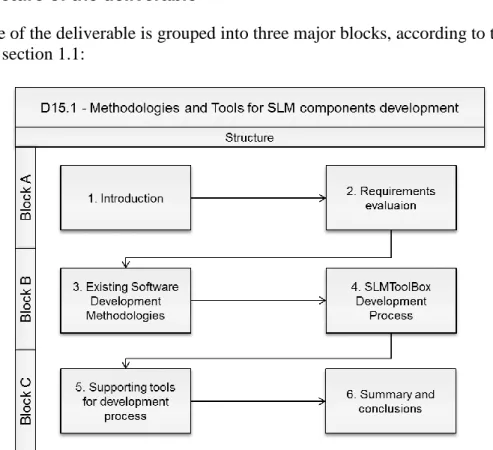
The structure of the deliverable is grouped into three major blocks, according to the objectives described in section 1.1:
Figure 1 - Structure of D15.1
Block A has the role to summarize the context of the development activities in the frame of WP1.5 and to detail the main requirements regarding the development process and the expected results for this work package, which may influence the definition of the related development methodology.
Block B is focusing on the definition of a development process, adapted to the context of WP1.5, starting from a review of “state of the art” development methodologies and good practices.
Block C lays out the definition of a coherent and integrated set of tools (based on open source software tools and document templates) in the objective to support the development related activities, derived from the process defined in the previous part of the document.
2. Requirements evaluation
The role of WP1.5 is to provide a set of software tools in order to support the service engineering activities in the frame of service lifecycle management. Due to the specificities of this domain, it has been recognised that the resulting SLMToolBox should integrate existing components (development frameworks, code libraries) and be developed thanks to specific software code, which would be produced in the frame of the MSSE project. In order to accomplish this work, it is necessary to define a precise process which can be adapted to the specific context of the project and that would enable to achieve an acceptable level of quality. In order to define and to adapt such a process based on best of breed methodologies; this section intends to characterize the main requirements issued from the context of WP1.5 work and common expectation related to software quality.
2.1. Context analysis
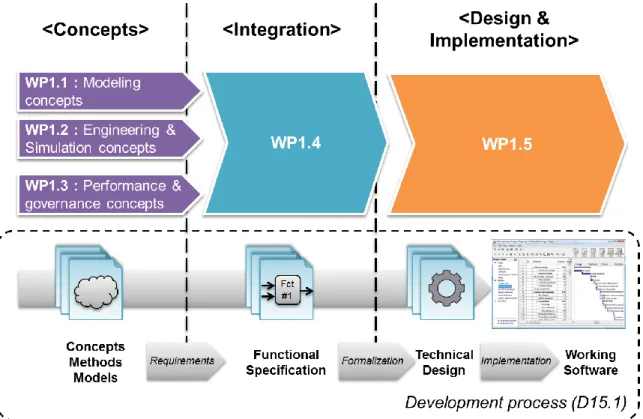
The following figure depicts the role of each work package in SP1. It show that WP1.1, WP1.2 and WP1.3 will deliver scientific concepts on service lifecycle management and service engineering; WP1.4 will integrate these concepts under the form of a functional specification. Finally, WP1.5 is dedicated to the design and implementation of the expected software for SLM.
Figure 2 - Overall integration and implementation process
This deliverable aims at defining the relevant process which will drive the development of usable software tools, starting on the concepts developed by WP1.1, WP1.2 and WP1.3. 2.2. Requirements
The main requirements identified for this development process can be summarized as the following:
Requirement Description
Respond to change The MSEE project will run two iterations which will result in the development of two versions of the SLMToolBox. During
both iterations, the development activities in WP1.5 will be run in parallel of the research activities of other SP1 workpackages. Therefore, the development process used by WP1.5 must be ready to adapt the design and the implementation to new requirements of SP1, which will be refined and validated over time.
As a consequence, a strong collaboration with SP1 partners all along the development process is mandatory to keep the necessary alignment between the concepts and the implementation.
Enable the integration of the software with the overall MSEE IT System
The expected result for both versions of SLMToolBox, developed in the frame of MSEE, is envisioned as a working prototype which :
- Must be able to integrate with the overall MSEE IT system architecture (in particular : to provide and share models with other MSEE platforms)
- Must be able to be reused independently, outside of the frame of the MSEE project
As a consequence, the development process of the SLMToolBox must collaborate with the design activities performed by other development work packages of MSEE (in particular : SP4 and WP2.6)
Allow distributed and collaborative development activities
The four partners of WP1.5 will have to work collaboratively in order to provide their contribution to the development of the SLMToolBox. Therefore, it is needed that the development process encompass this collaborative aspects and provides the relevant means for orchestrating each partners activities, both on methodological and technical support aspects.
As a consequence, the development methodology should provide the necessary support (tools and organization) to allow multiple contributors to develop code in parallel and to integrate the resulting software components.
To leverage opportunities for further development and exploitation of the resulting software, it is foreseen to release both prototypes under an open source license. This requirement will influence the choice of open source and redistributable frameworks and components, which will be selected at the design stage of the SLMToolBox (cf. deliverable D15.2 - Specifications and Design of Service Lifecycle Management ToolBox [2])
Enable the achievement of a satisfying level of quality
The two prototypes of the SLMToolBox developed in WP1.5 are expected to deliver a convincing implementation of the service related concepts developed in SP1. It is necessary that the resulting software provides the relevant functionalities for its target users and be stable enough to be used in the frame of concrete case of service development.
As a consequence, the development process must provide the necessary support to continuously assess the quality of the
software, both on technical and functional aspects.
Table 1 - Methodological requirements
2.2.1. Response to change
As the development of the SLMToolBox takes place in the context of a research project, its main goal is to sustain the verification of the concepts which are developed in the field of service science via the means of useable software tools. The achievement of this goal is envisioned as providing a software prototype, providing a sufficient set of features which are well aligned with the theoretical concepts explored in other work packages (WP1.1, 1.2, 1.3 and 1.4). Thus, as the research work in these WPs will refine service lifecycle management concepts along time, it is mandatory that the result, produced in WP1.5 is able to evolve, in order to adapt with conceptual changes.
Furthermore, it is also recognized as a strong requirement that the prototype software development in WP1.5 has to stand upon solid technical foundations, in order to enable future modifications, outside of the frame of the MSEE project.
Considering these both aspects, the development method should strongly facilitate the evolution of the SLMToolBox along its lifecycle. In particular, sustaining a feedback loop between service engineering researchers, enterprise end users and developers is identified as an efficient mean for change management. Therefore, an iterative development methodology is strongly preconized as a methodological foundation for the development process of WP1.5 tools.
2.2.2. Integration with other MSEE IT System
According to deliverable D41.1 - MSEE Service-System Functional and Modular Architecture [3], the SLMToolBox will interact with some others of the MSEE IT systems (i.e.: the Generic Service Development Platform WP4.2; the Innovation Ecosystem Platform WP2.6). It is also envisioned that some of the components of the SLMToolBox, in particular the modeling environments, could be reused in other contexts, outside of the frame of the MSEE project.
This versatility strongly influences the design of WP1.5 tools, which will rely on a modular approach for their interfaces and internal architecture. This aspect also has an influence on the supporting development process and tools, as both should enable to maintain modularity and structure of the development of corresponding software assets around a loosely coupled components architecture.
The integration of the SLMToolBox with other MSEE platforms will be specifically addressed in the frame of WP4.5 “MSEE Service-System integration & testing”. In particular, this work will cover the technical integration between the SLM ToolBox and the Innovation Ecosystem Platform for the 1st cycle. The integration of the SLMToolBox with the Generic Service Development Platform will be covered in the second cycle of MSEE. Therefore, WP1.5 will focus on the release of the SLMToolBox as a unique and coherent software component, to be integrated in WP4.5.
2.2.3. Distributed and collaborative development
WP1.5 involves the collaboration of several partners in the development activities. These entities will have to collaborate in a distributed manner in order to synchronize their efforts, achieving a consistent result. As a consequence, the development process and the tools
supporting the underlying activities must be adapted to distributed work and should leverage collaboration with appropriate and efficient communication means.
2.2.4. Quality assessment
As a complement to the aspects which are specific to the context of the development of the SLMToolBox in the frame of MSEE, it is important to enlighten some aspects related to software quality.
Most software-related tools and methods including those described in IEEE Software claim to assess or improve software quality in some ways. Thus, before defining an appropriate process for software development and corresponding tools, we must bring some definition around the concept of software quality and to define how it will be measured.
IEEE Standard Glossary of Software Engineering Terminology defines the discipline of software quality as a “planned and systematic set of activities to ensure quality is built into the software” [4]. It consists of software quality assurance, software quality control, and software quality engineering. As an attribute, software quality is (1) the degree to which a system, component, or process meets specified requirements. (2) The degree to which a system, component, or process meets customer or user needs or expectations.
Software systems are large, complex beset with maintenance problems, whilst users expect high quality. However, it is hard to assess and assure quality. The ISO/IEC 9126 [5] standard has been developed to address software quality issues. It specifies software product quality characteristics and sub-characteristics and proposes metrics for their evaluation (Functionality, Reliability, Usability, Efficiency, Maintainability, and Portability).
Considering the elements developed in this section, the assessment of software quality during its development process can be considered as a transversal topic which has an impact of each stage of the software lifecycle. Thus, every phase of the development process should take it into account and provide relevant means, either methodological (practices) or technical (tools) to achieve the expected result.
2.3. Recommendations
As a response to the requirements defined in the previous section, we derive the following recommendations in order to provide the relevant methodological and technical support to fulfil them:
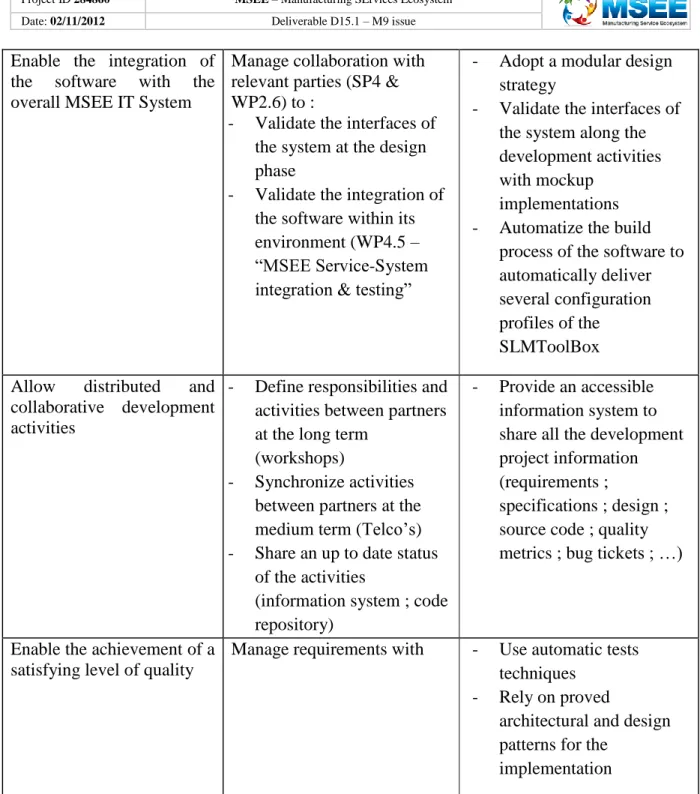
Requirement Methodological support Technical support
Respond to change Enhance collaboration between SP1 partners : - Collect and validate requirements during workshops
- Provide intermediate software releases to collect feedback
- Run short development iterations, based on prioritized subsets of requirements
Share up to date information on the development status :
- Provide a centralized access to requirements lists and specifications
Enable the integration of the software with the overall MSEE IT System
Manage collaboration with relevant parties (SP4 & WP2.6) to :
- Validate the interfaces of the system at the design phase
- Validate the integration of the software within its environment (WP4.5 – “MSEE Service-System integration & testing”
- Adopt a modular design strategy
- Validate the interfaces of the system along the development activities with mockup
implementations - Automatize the build
process of the software to automatically deliver several configuration profiles of the
SLMToolBox Allow distributed and
collaborative development activities
- Define responsibilities and activities between partners at the long term
(workshops)
- Synchronize activities between partners at the medium term (Telco’s) - Share an up to date status
of the activities
(information system ; code repository)
- Provide an accessible information system to share all the development project information (requirements ;
specifications ; design ; source code ; quality metrics ; bug tickets ; …)
Enable the achievement of a satisfying level of quality
Manage requirements with - Use automatic tests techniques
- Rely on proved
architectural and design patterns for the
implementation
Table 2 - Recommendations (Methods & Tools)
As an intermediary conclusion, we can formulate the following statements as the basis of the development process to be implemented:
To rely on proven existing software design and development practices To be articulated on a lightweight and iterative methodology
To be sustained by an integrated tool chain, covering the whole development lifecycle, offering support for project management ; communication ; traceability and quality control
3. Existing Software Development Methodologies
3.1. Software development models
During the previous four decades, software has been developed from a tool used for analyzing information or solving a problem to a product in itself. However, the early programming stages have created a number of problems turning software an obstacle to software development particularly those relying on computers. Software consists of documents and programs that contain a collection that has been established to be a part of software engineering procedures. Moreover, the aim of software engineering is to create a suitable work that constructs programs of high quality.
Since the early days of software development, several conceptual models have emerged for software development approaches, giving an abstract representation of different specific processes used across software and facilitating the implementation of appropriate methodologies.
A software process model is an abstract representation of a process. It presents a description of a process from some particular perspective as: specification, design, validation, evolution... There are numbers of general models for software processes, like: Waterfall model, Evolutionary development, Formal systems development and Reuse based development, etc. The following table gives an overview of five well known models, which are largely used across the software industry. These models are chosen because their characteristics correspond to most software development programs. There are many variants of these models, for instance “formal development” where a waterfall-like process is used, but the specification is formal that is refined through several stages to an implementable design.
Software
development model Characteristics
Waterfall model
It is the most classic model for software engineering. As this model emphasizes planning in early stages, it tends to sequentially address each phases of the development process, one by one. The model begins with establishing system requirements and software requirements and continues with architectural design, detailed design, coding, testing, and maintenance. As the waterfall model is a “conceptual” model, it serves as a baseline for many other lifecycle models.
Figure 3 - Waterfall model [6]
Advantages :
Widely used and known as a reference for software development projects
Reinforce good practices for the work flow of software development (sequentially specify, design, implement, test, …)
Identifies deliverables and miles stones Disadvantages :
Based on the assumption that all the requirements are accurate early in the project and they will remain invariant during the whole process.
Difficult to integrate risks management and change management
Has a significant administrative overhead, which generates costs for small teams and projects [7]
V-Shaped model
Just like the waterfall model, the V-Shaped life cycle is a sequential path of execution of processes. Each phase must be completed before the next phase begins. Testing is emphasized in this model more than the waterfall model. The testing procedures are developed early in the life cycle before any coding is done, during each of the phases preceding implementation. Requirements begin the life cycle model just like the waterfall model. Before development is started, a system test plan is created. The test plan focuses on meeting the functionality specified in requirements gathering.
Figure 4 - V-Shaped model [8]
Advantages :
Higher chance of success over the waterfall model due to the early development of test plans during the life cycle
Works well for small projects where requirements are easily understood by the project team
Disadvantages :
Software is developed during the implementation phase, so no early prototypes of the software are produced
Spiral model
The spiral model is similar to the incremental model, with more emphases on risk analysis.
The spiral model has four phases: Planning, Risk Analysis, Engineering and Evaluation.
A software project repeatedly passes through these phases in iterations (called Spirals in this model). The baseline spiral, starting in the planning phase, requirements is gathered and risk is assessed. Each subsequent spiral builds on the baseline spiral. Requirements are gathered during the planning phase. In the risk analysis phase, a process is undertaken to identify risk and alternate solutions.
A prototype is produced at the end of the risk analysis phase. Software is produced in the engineering phase, along with testing at the end of the phase. The evaluation phase allows the customer to evaluate the output of the project to date before the project continues to the next spiral. In the spiral model, the angular component represents progress, and the radius of the spiral represents cost.
Figure 5 - Spiral model [9]
Advantages :
High amount of risk analysis, which makes this model adapted for large and mission critical projects
Executable software is produced early in the project lifecycle Disadvantages :
Relevant risk analysis requires highly specific expertise. The success of the project is highly dependent on the quality of this risk analysis phase
project costs
Iterative development
The experience drawbacks of the Waterfall Model generated a demand for a new method of developing systems which could provide faster results, require less up-front information, and offer greater flexibility. With Iterative Development approach, the project is divided into small cycles. This allows the development team to demonstrate results earlier on in the process and obtain valuable feedback from system users.
Each iteration is actually a mini-Waterfall process, with the feedback from one phase providing vital information for the design of the next phase. In a variation of this model, the software products, which are produced at the end of each step (or series of steps), can go into production immediately as incremental releases.
Such iterative model serves as a baseline for the so called “agile” methodologies.
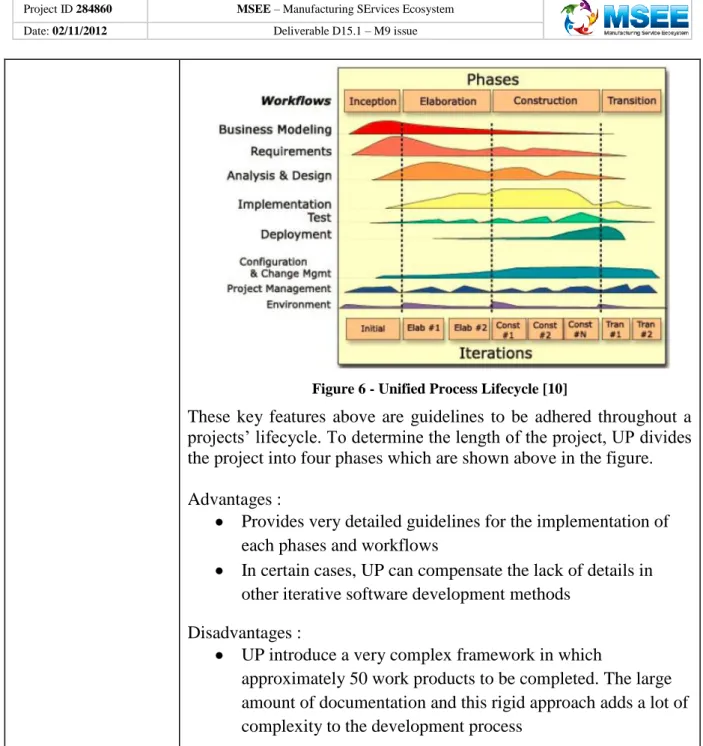
Unified Process
All efforts, including modelling, is organized into workflows in the Unified Process (UP) and is performed in an iterative and incremental manner.
Some of the key characteristics of the UP are as follows [10] : Uses a component based architecture which creates a system that is easily extensible, promotes software reuse and
intuitively understandable
Largely relies on modeling with UML – which represent its code as a diagrammatic notation to allow non-technical parties to collaborate and validate the design. Besides, UML models could be reused for code generation purpose, thanks to MDD techniques.
Managing requirements using use-cases and scenarios have been found to be very effective at both capturing functional requirements and help in keeping sight of the anticipated behavior of the system.
Design is iterative and incremental – helps reduce project risk profile, allows greater customer feedback and help developers stay focused.
UP assists in planning quality control and assessment built into the entire process involving all member of the team.
Figure 6 - Unified Process Lifecycle [10]
These key features above are guidelines to be adhered throughout a projects’ lifecycle. To determine the length of the project, UP divides the project into four phases which are shown above in the figure. Advantages :
Provides very detailed guidelines for the implementation of each phases and workflows
In certain cases, UP can compensate the lack of details in other iterative software development methods
Disadvantages :
UP introduce a very complex framework in which
approximately 50 work products to be completed. The large amount of documentation and this rigid approach adds a lot of complexity to the development process
Table 3 - Software development models
Methodologies impose a disciplined process upon software development with the aim of making software development more predictable and more efficient, in order to achieve greater quality. Sequential models are considered to be the traditional way of developing software. Such methods require defining and documenting a stable set of requirements at the beginning of a project. The trends of the last decade went to promote the so called “agile methodologies” as an attempt to satisfy eager business community asking for lighter weight along with faster and nimbler software development processes. Several methodologies tended to spread across software industry, acknowledging that high quality software and more importantly customer satisfaction could only be achieved by bringing “lightness” to their processes.
3.2. Agile development
With a traditional process (derived from Waterfall or V-Shaped models), activities are scheduled one after another until the project end date. The project plan shows a sequential list of activities, where for instance, design always starts when analysis is finished; coding starts when the design is done, etc. At the end of the schedule the software is demonstrated and finally, the team discovers if the stakeholders are satisfied with the end result.
Agile processes accept that requirements will change [11] and create opportunities for improvement and competitive advantage. In this context, it is assume that requirements are not a constant. Each requirement is described under the form of software features. The process of analysis, design, implementation, testing is then applied to each feature in sequence. This means that for the implementation of each functionality, the whole development process will be instantiated, from analysis to end testing and delivery. From the overall perspective, the software will evolve incrementally and iteratively. Schematically, such agile process consist in repeating the process of running short instances of waterfall development, but many times until the product is satisfying enough to be released. The principle advantages of this paradigm is that 1) the customer can change priorities and content during the whole development process 2) the effort and the cost are invested features per features, not on “phases”. On the other side, one of the costs of managing this way is to always be ready for new features. This implies keeping code and design quality through the entire project.
Agile methods gather methodological practices applicable to any kind of project, but currently mostly applied to the domain of software development. According to the agile process described previously, such methods aim at focusing on the added value of the software and tend to be more pragmatic, by alleviating the practices induced by more traditional software development methods. As a counterpart, they require a greater implication of the stakeholders (e.g. customer) into the development process, but promote a better reactivity to new or changing demands and requirements. Agile methods prioritize the satisfaction of the customer needs, through collaboration over contracting.
These light weight development methods mainly differ the from the traditional “V” cycle model by opposing an iterative approach to a sequential approach. Such methods intend to empower the role of the end user and to orientate the whole development process toward the satisfaction of its demands. By splitting the development process into time boxed development cycles (i.e. 3 to 4 weeks), it offers the possibility to frequently and periodically deliver a working software, allowing to collect continuous feedback from the end user and to readjust priorities of requirements.
In the perspective of providing a better adequacy to the requirements, a better reactivity for facing changes and thus an improvement of the added value, agile methodologies are identified as a relevant mean for supporting the development of complex software in distributed environments and evolving domains. The implementation of such methodology requires a strong involvement of user representatives, being able to collaborate with the development team. This collaboration is the basis for delivering high quality software, both on functional and technical aspects in a fixed period of time.
3.2.1. “Values” of agility
According to the “Agile Manifesto” [12], agility promotes four pillar values:
“Individuals and interactions”: in the agile perspective, the team is more important than tools or procedures. For delivering value to the customer, it is considered that a
cohesive team of uneven skilled members communicating between each other is preferable over expert individuals with no interactions and communication.
“Working software”: agility stands on the fact that working software is preferable over technical documentation. Documentation is still recognized as helpful as a communication mean, but not as an end goal. Besides, well-structured and commented code can sometimes be more efficient than large sets of documentation.
“Customer collaboration”: as mentioned previously, agile approaches tend to include customers as an essential actor of the development process. Interactions between the project members and the customer are recognized as an essential factor of success. In this perspective, collaboration is considered as more important than contracting for the project success.
“Respond to change”: from the agile perspective, “change” is considered as “normal” events in the project lifecycle. Therefore, the manifesto highlights that in an agile context, it is essential to be able to manage change when it occurs and to keep customer satisfaction achieved, rather than suffering from changes and enforcing to follow the initial plan.
3.2.2. Agile development methods
The following table gives an overview of popular agile development methods and a brief description of their history and characteristics:
Method Characteristics
Rapid Application Development (RAD)
RAD takes its origins in the publications of Barry Boehm (spiral model), Tom Gilb (evolutive lifecycle), Scott Shultz (rapid iterations production) as well as Brian Gallagher and Alex Balchin. James Martin formalized the methodology in 1991 in the book “Rapid Application Development” [13].
It is the first methodology to propose a development cycle which differentiates radically from the “waterfall” model. RAD proposes a new kind of development cycle, qualified as “iterative, incremental and adaptive” which will be reused by every other agile methodology. The main outcome of RAD was a formalization of the first “agile” postulate, stating that to make a predictive project planning; some of the piloting aspect must be invariant as some other should be variant.
Dynamic System Development Method (DSDM)
DSDM [14] is a more generic project management method, in the category of agile methodologies. First released in 1994, DSDM emanated from a consortium of software vendors and experts. It was designed to provide some discipline to RAD; but became a generic approach for project management.
DSDM fixes cost, quality and time as invariant; and uses the MoSCoW [15] prioritisation of scope (musts, shoulds, coulds and won't haves) to adjust the project deliverable to meet the stated time constraint. Since it version 4.2 the DSDM provides
some guidelines for integrating practices from RUP [16], XP and PRINCE2.
Scrum
The scrum framework was introduced in 1995 when Jeff Sutherland and Ken Schwaber jointly presented a paper describing the Scrum methodology at the OOPSLA conference [17]. And was the formalized in the book “Agile Software Development with Scrum” [18]
The term “Scrum” was borrowed from the Rugby language, where the “scrum” refers to the manner of restarting the game after a minor infraction.
The Scrum methodology mainly finds its roots in the “rugby approach” described by Hirotaka Takeuchi and Ikujiro Nonak in 1986 [19], where the whole product development process is performed by one cross functional team, across multiple overlapping phases.
Crystal Methodologies
Crystal Clear [20] is a member of the Crystal family of methodologies as described by Alistair Cockburn. It is considered as an example of an agile or lightweight methodology. The Crystal family of methodologies focuses on efficiency and habitability as components of project safety. Crystal Clear focuses on people, not processes or tools.
According to Jens Coldewey: “The Crystal methodologies are about frequent de-livery, close communication, and reflective im-provement.” [21]
Adaptive software development
ASD, developed by James A. Highsmith, offers an agile and adaptive approach to high-speed and high-change software projects [22]. In ASD, the static plan-design life cycle is replaced by a dynamic speculate-collaborate-learn life cycle.
Figure 7 - ASD Lifecycle [23]
ASD focal point is on three non-linear and overlapping phases : Speculate - To define the project mission, make clear the realization about what is unclear.
Collaborate – Highlights the importance of teamwork for developing high-change systems
Learn – This phase stresses the need to admit and react to mistakes, and that requirements may well change during development
ASD focuses more on results and their quality than the tasks or the process used for producing the results. “In an adaptive environment, learning challenges all stakeholders - developers and their customers - to examine their assumptions and to use the results of each development cycle to adapt the next” [23]. As such learning is a continuous and important feature, one that assumes that plans and designs must change as development proceeds.
Extreme Programming
Extreme programming (XP) has evolved from the problems caused by the long development cycles of traditional development models [24]. The XP process can be characterized by short development cycles, incremental planning, continuous feedback, reliance on communication, and evolutionary design [25].
While individual practices defined in XP are suitable for many situations, overall view & management practices are given less attention in the methodology.
Table 4 - Agile development methods
As one of the most popular agile methodology for software development, Scrum defines a methodological framework and a set of practices for the management of software development projects. Besides, eXtreme Programming proposes as set of best practices focused on the development activities. Overall, the combination of Scrum methodology plus some practices derived from eXtreme Programming has shown satisfying results in the software industry.
3.2.3. Characteristics of agile methodologies
According to Highsmith and Cockburn, “what is new about agile methods is not the practices they use, but their recognition of people as the primary drivers of project success, coupled with an intense focus on effectiveness and maneuverability. This yields a new combination of values and principles that define an agile world view.” [26] Highsmith further transcribes from the book Agile Competitors and Virtual Organizations the definition of agility: “Agility... is a comprehensive response to the business challenges of profiting from rapidly changing, continually fragmenting, global markets for high-quality, high-performance, customer-configured goods and services.”
The following principles of agile methodologies are seen as the main differences between agile and traditional methods:
Agile principle Description
People oriented
Agile methodologies consider people – customers, developers, stakeholders, and end users – as the most important factor of software methodologies. “The most important implication to managers working in the agile manner is that it places more emphasis on people factors in the project: amicability, talent, skill, and communication” [27]
Adaptive
Agile methods welcome changes at all stages of the project. Changes to the requirements is perceived as good things, because they mean that the team learned more about what it will take to satisfy the market [28]. Nowadays, the challenge is not stopping change but rather determining how to better handle changes that occur throughout a project.
Conformance to actual
Agile methodologies value conformance to the actual results as opposed to conformance to the detailed plan. Each iteration or development cycle adds business value to the on-going product, which is assessed by end users and customers.
Balancing flexibility & planning
Plans are important, but most of software development projects cannot be accurately predicted far into the future, because there are so many variables to take into account. A better planning strategy is to make detailed plans for the next few weeks, very rough plans for the next few months, and extremely crude plans beyond that. [29]
Empirical process
Agile methods develop software as an empirical (or nonlinear) process. In engineering, processes are either defined or empirical. In other words, defined process is one that can be started and allowed to run to completion producing the same results every time. In software development it cannot be considered a defined process because too much change occurs during the time that the team is developing the product.
Decentralized approach
Agile software development spreads out the decision making to the developers. This does not mean that the developers take on the role of management. Management is still needed to remove roadblocks standing in the way of progress.
Simplicity
Agile teams always take the simplest path that is consistent with their goals. Fowler states, “They (agile teams) don’t anticipate tomorrow’s problems and try to defend against them today” [28]. The reason for simplicity is so that it will be easy to change the design if needed on a later date.
Collaboration
Agile methods involve customer feedback on a regular and frequent basis. The customer of the software works closely with the development team, providing frequent feedback on their efforts. As well, constant collaboration between agile team members is essential.
Small self-organization team
An agile team is a self-organizing team. Responsibilities are communicated to the team as a whole, and the team determines the best way to fulfill them. Agile teams discuss and communicate together on all aspects of the project. That is why agility works well in small teams.
Table 5 - Principles of agile methodologies
3.2.4. Scrum framework
3.2.4.1 Overall process
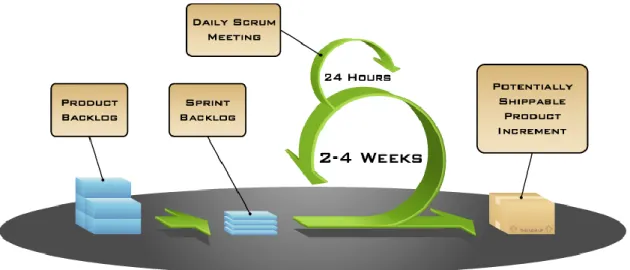
Figure 8 - Scrum overall process
In the previous figure, we can observe two important cycles which respectively are:
Sprint: this corresponds to an intermediate development cycle which aims at producing an exploitable, but intermediate version of the software. Although the end result of a sprint might contain a reduced set of new functionalities and improvement, it is important to underline that this result must meet a high quality level, which should be equivalent to the one imposed by the release cycle. The duration of the sprint is constant, and generally equivalent to a period of 2 to 4 weeks long.
Daily scrum: this corresponds to the shortest work cycle in the scrum framework. Each day of work, is held a short and informal stand up meeting between the team members, aiming at synchronizing the work at the operational level inside the team and eventually to share issues and to define short term action plans.
Finally, the “sprint” cycle is often encompassed itself in a higher level “release cycle”:
Release: the release cycle corresponds to the issue of a major and significant version of the software product, at the end of which the software result must contain relevant functionalities and improvements to justify its release into the market or to its customer. Typically, the release cycle corresponds to a period of several month of work. Its duration can vary, depending on the vision which is associated to this release. One release cycle often include several sprints cycles, each one delivering some progress toward the goal of the release.
The SCRUM framework is structured around three main concepts: Roles; Artefacts; Events.
3.2.4.2 Scrum Roles
The project team is composed of the three roles defined by the methodology:
Product Owner: is responsible to define the “what”. He represents the voice of the customer and is in charge to clearly express the requirements, their priorities and to ensure the development team has the sufficient level of understanding of the functionalities described. In practice, it could be difficult to dedicate one product owner to the development project – in such cases, scrum teams can rely on one member, assuming the role of “proxy product owner”, who is not one of the stakeholders but has the responsibility to represent them inside the project team.
Development team: is composed of professionals who are in charge to produce and deliver a satisfying implementation of the requirements detailed by the product owner. Such teams are composed of members with appropriate but different skills. They are responsible to manage and to organize their own work. The resulting synergy optimizes the team’s overall efficiency and effectiveness.
Scrum master: this member is responsible to insure the respect of the practices defined by Scrum and to help the team to improve their work process. Globally, the role of the scrum master is to help the team to maximize the value create by the development activities. In reduced configurations, the role of the scrum master can be assumed by one member of the development team. Overall, the role of the scrum master is to act as a “facilitator” and to be the “guardian” of the continuous improvement approach of scrum.
The team model in Scrum is designed to optimize flexibility, creativity, and productivity. It relies on self-organisation and cross functional skills.
3.2.4.3 Scrum Events
Scrum defines several types of events, which occurs regularly but at different periods of time. Other than the Sprint itself, which is a container for all other events, each event in Scrum is a formal opportunity to inspect and adapt something in the development process.
Sprint: this is the core event in Scrum. A sprint is a fixed period of time (generally between 2 and 5 weeks) during which the development team will concentrate on the development of a fixed subset of the requirements. Each sprint can be considered as a small development project, within the development project. At the end of one sprint, the result is a working piece of software delivered on time, which meets the level of quality imposed by the project, and which might cover the functional scope defined by the requirements taken as the input.
Sprint planning meeting: during this event, the work to be accomplished during the sprint is planned by the team. This event has to cover two topics: 1) what will be delivered at the end of the next sprint? 2) How will the needed work will be achieved? To answer the first question, the product owner presents the items of the product backlog ordered by priority to the development team and reach an agreement on the goal for the next sprint, as well as which product backlog items should be covered. Finally, the development team discusses each item in details to define “how” the work will be done. As a result, the spring backlog is constituted of the product backlog items selected for the sprint, plus the subsequent tasks for delivering these items. Daily scrum: this is the daily event where the team members get the opportunity to synchronize its work and to create a detailed work plan for the next 24 hours. Each team member explains 1) what has been accomplished since the last meeting 2) what will be done before the next meeting 3) what are the obstacles in the way. The Development Team assesses progress toward the Sprint Goal and to assess how progress is trending toward completing the work in the Sprint Backlog. This meeting has the role to improve communication inside the team and to identify and remove obstacles to reach the spring goal.
Sprint Review: this event occurs at the end of a sprint, in order to inspect the resulting work and eventually to adapt the product backlog. The work achieve is demonstrated to any interested third party in an informal matter. Such event intends to increase collaboration and to collect feedback.
Sprint Retrospective: this meeting is an opportunity for the scrum team to inspect “what went well” and “what went wrong” in the previous sprint, and to create a plan for improvement.Although improvements may be implemented at any time, the Sprint Retrospective provides a formal opportunity to focus on inspection and adaptation. 3.2.4.4 Scrum Artifacts
Finally, Scrum defines artefacts, to represent the work, in ways that are useful for the team, to reach the objectives of the project.
Product Backlog: is an ordered list of every requirement (idea, functionality, enhancement, fix…) that might be needed in the product. The product owner is responsible for maintaining the items of the product backlog as well as their priorities and to make their description available to any interested project member. This product backlog is dynamic and constantly changes to identify what is needed in the product, to make it appropriate, useful and competitive. Each item in the product backlog is characterized by its “value” (from a business point of view) and its “priority”. The product owner relies on these attributes to order the product backlog content. Top-ordered Product Backlog items drive immediate development activities for the next sprints. Besides, the development team is responsible for assessing the level of detail of each item and to estimate the necessary effort to implement each item, during the sprint planning meeting. In practice, some specific conventions can be used to describe the items of the product backlog in a detailed and coherent manner. For example, such items can be described into the form of “user stories” with the following syntax “as a [type of user], I can [actions], so that [goal]”. For example, an item concerning the “login” functionality of a web application can be described as the following: “As an administrator, I can log into the application by typing my user name and my password on the login screen, so that I can securely access the administration functionalities of the application”
Sprint Backlog: is the set of product backlog items selected for one particular sprint. This backlog is generated during the sprint planning meeting and represent the commitment of the development team, to deliver the implementation of these items at the end of the corresponding sprint. The sprint backlog represents the detailed description of the necessary work to meet the sprint goal. In practices, the items of the backlog are refined in smaller unit of works defining the “tasks” to be accomplished by the team (e.g. : “to implement the login form screen” ; “to implement the password validation algorithm” ; “to implement the database access for retrieving user profiles data”; …). During the sprint, the development team is responsible for modifying the sprint backlog with the new tasks which emerge during the development.
Definition of “done”: When an item of the product backlog or of the sprint backlog is declared as “done”, everyone must understand what “done” means. For this, scrum gives no specific guidelines on how “done” should be defined, but recommend that the team should establish a formal definition which should be shared among every members. As the scrum team matures, it is expected that the definition of “done” should evolve, to include more criteria for higher quality. As an example, for a product backlog item, “done” could be defined as the following checklist:
The code is reviewed and meet quality standards The code is committed into the repository
All Acceptance Criteria of the User Story are met
3.2.5. Extreme Programming practices
Extreme Programming (XP) gathers a set of practices oriented toward the production of a software application. XP is mostly adapted for reduced development teams (2 to 5 persons) in the context of changing requirements. “Extreme” means these practices get turned up to a much higher volume than on traditional projects. Extreme Programming was best described by Kent Beck in his landmark book “Extreme Programming Explained - Embrace Change” [30].
The twelve practices formulated by XP are grouped under the following areas:
Area Practices Purpose
Fine scale feedback
Pair programming Planning game
Test driven development Whole team
To continuously align the development of the system on the demand in order to meet requirements and to manage evolution of the requirements
Continuous process
Continuous integration Design improvement Small releases
XP encourage to develop a system through a path of small increments, continuously assessed in term of technical quality and user feedback
Shared understanding
Coding standard
Collective code ownership Simple design
System metaphor
Promote that the whole team should share the same level of knowledge about the design and the implementation of the system
Programmer welfare Sustainable pace
XP promote that a sustainable environment for the team has positive benefits on the project
Table 6 - eXtreme Programming Practices
Due to its total focus on “programming”, XP has known several controversies as a “whole methodology”. In particular, it is criticized regarding its lack of requirement management guidelines; potentially limited scalability and lack of specification traceability.
In this report, we do not introduce XP as a methodology to be implemented “By the book”, but more as a referential of best practices, which can be reused in the frame of an upper methodological framework (for instance: Scrum or CMMI), to guide the organization of the team at the operational level. The following subsections summarize the main practices defined by XP, and give more explanation for the one considered eligible for the development process of the SLMToolBox in the frame of WP1.5.
3.2.5.1 Pair programming
Pair Programming is a situation where two developers work side by side, designing and coding, while working on the piece of software. According to Cockburn and Williams [31], who observed the method in academic environments, Pair Programming improves the quality of the software design, reduces deficiencies in the code, enhances technical skills, improves team communication, and it is considered to be more enjoyable for the participants. Moreover, other studies [32] that compared the performance of Pair Programming students and solo students showed that the former were more likely to hand in solutions for their assignments. However, literature has shown that similar to other collaborative learning
situations, it is not always successful. Tessem [33], for example, showed that some students found the experience irritating, extremely inefficient and very exhausting.
In the context of the development of SLMToolBox in MSEE, such configuration is considered useful mostly for solving technical problems or design issues. In this perspective, we plan to rely very occasionally on pair programming and for short period of times.
3.2.5.2 Whole team
In the “Extreme Programming” paradigm, the customer is considered as the most interested party into the system. It is assumed that the “customer” is the one who really uses the system. As a consequence, XP recommends that the customer, or at least one of its representatives, is dedicated to the project and should be available for any questions of the development team, regarding the expected behavior of the system. For example, from the XP point of view, the team who develops a financial administration system should include a financial administration with enough expertise on the domain.
In the context of MSEE, this is certainly the most challenging practice to implement for the development of the SLMToolBox. The first reason in that the system should implement high level requirements (research concepts) coming from distant and distributed teams, working in several distinct domain of expertise (enterprise modeling; service engineering; enterprise governance; …). The second reason is that the tool developed in WP1.5 should propose an implementation which makes sense from a “user” point of view, which doesn’t derives trivially from the scientific results of the research.
So, giving this context, the main challenge is to be able to fill the gap between the research results coming from other work packages and the sufficient level of detail that one software development team is expecting to receive as an input. Considering the situation and some lessons learned from previous implementation of the Scrum framework, the main development team at HARDIS will include a dedicated member to be the referent person about requirements to be eligible to the development of specific functionalities in the SLMToolBox. From the Scrum point of view, this member will handle the role of “Proxy Product Owner”. He will have the following responsibilities:
- Analyze all the research inputs (deliverable) coming from MSEE
- Design relevant requirements in term of software functionalities, aligned with the research results of MSEE
- Validate the relevance of these requirements with the scientific partners of MSEE - Providing a detailed description of requirements to the development teams and give
them all the information needed for their implementation
Overall, this person will be the representative of the scientific side of the project, within the development team.
3.2.5.3 Continuous integration
This practice promote the idea that the members of the team should share one unique up to date code base for the development, which would be the latest version of the software. Since different team members may have versions saved locally with various changes and improvements, they should try to upload their current version to the code repository every few hours, or when a significant break presents itself. Continuous integration will contribute to greatly improve the level of quality and to avoid delays later on in the project cycle, caused by integration problems.
It is recognized that the implementation of such practice for the development of the SLMToolBox clearly has multiple advantages, considering the distributed nature of the
contributors and the multiples modules to be implemented and integrated within the final software. We propose to implement continuous integration for the development of the SLMToolBox as the following:
- Providing a unique and centralized code repository, providing complex version management capabilities
- Implement automatized and recurrent (nightly) tasks for : compilation, code analysis, automatic tests, integration tests
- Promote common development practices: commit changes to the code base after each modification; regularly actualize the local configuration with the actual code base; review code quality reports …
3.2.5.4 Small releases
The delivery of the software is done via frequent releases of live functionality creating concrete value. The small releases help the customer to gain confidence in the progress of the project. This helps maintain the concept of the whole team as the customer can now come up with his suggestions on the project based on real experience.
As for the “whole team” practice, the fact to produce regular and small releases of software with concrete value is challenging, mainly because of the “research” orientation of this development project. This process requires a group of user is clearly identified and is involved enough in the project to provide its feedback to the development team, regarding the added value of the software. As soon as one major release of the SLMToolBox is produced, we can expect this incremental loop should to be easier to sustain, as we can expect this first major version will generate feedback from interested third parties in the MSEE project members.
3.2.5.5 Coding standard
Coding standard is an agreed upon set of rules that the entire development team agree to adhere to throughout the project. The standard specifies a consistent style and format for source code, within the chosen programming language, as well as various programming constructs and patterns that should be avoided in order to reduce the probability of defects. For the development of the SLMToolBox, the assessment of coding standards can be partially achieved through periodic code and architecture review of the software. On another aspect, the verification of the conformance of the source code to the coding standards defined in the team can be automatized, thanks to the continuous integration tooling platform which supports the whole “continuous integration” process.
3.2.5.6 Simple design
This extreme programming practice promotes the choice of the most simple design implementation over complex ones. From the XP perspective, design choices can be evaluated subjectively by the development team regarding four qualities: Testable, Understandable, Browsable and Explainable. As for the other phases of the lifecycle of the software (analysis, specification, development, testing …) the design activities occur continuously along the development of the product. Therefore, XP recommends proceeding to periodic reviews of the overall design of the software, in order to maintain coherence and to align older design choices with newer ones. Such alignment necessitates restructuring older code through refactoring activities. As for the continuous integration practice, refactoring activities largely contribute to maintain sustainable quality of the overall software and to guarantee its maintainability.
4. SLMToolBox Development Process
4.1. Methodological foundations
Considering the three following aspects: 1) whole project plan of the MSEE Project ; 2) methodological recommendations for the development of the SLMToolBox (see chapter 2) ; 3) the relevance of agile methodologies in the case of SLMToolBox development ; we propose a project plan derived from both Unified Process methodology and Scrum framework.
4.2. Project phases
According to the MSEE project plan defined in the DOW, the overall project will follow two cycles. As a consequence, we propose to structure our project plan round these two cycles, considering them as two consecutive iterations. For each cycle, we propose to follow a development process derived from the “Unified Process” methodology. Therefore, both cycles of the SLMToolBox will go through the following phases: Inception / Elaboration / Construction / Transition. These phases allow the process to be presented at a high level in a similar way to how a 'waterfall'-styled project might be presented, although in essence the key to the process lies in the iterations of development that lie within all of the phases, which will be sustained by the scrum framework.
The work will be structured across these four phases, in order to converge from an initial set of very high levels of requirements, derived from research concepts on the topic of Service Engineering toward a working implementation of a software tool set to support the management of the Service Lifecycle.
4.2.1. Inception
The main goal of the “inception” phase is to scope the system as a basis for validating the initial strategy of the development project. Unified Process methodology proposes to validate the project from a business perspective, relying on financial and economic indicators. In our case, we will utilize this “inception” phase as the opportunity to validate what makes sense to be developed in MSEE, considering the innovation expected from the research project and the existing offer of potentially equivalent tools on the market or in open source communities. At the end of this phase, the key features of the system will be described, as well as the major constraints for its development.
4.2.2. Elaboration
The primary objective of this phase is to mitigate the key risks items identified by the analysis, up to the end of this phase. The “elaboration” phase is where the project starts to take a more precise shape. In this phase the problem domain analysis is made and the architecture of the project gets its basic form. One of the major outcomes of the elaboration is an executable architecture which realizes the significant use cases, from a technical point of view. To pass this phase successfully, it is important to insure that all stake holders (in our case, MSEE partners involved in SP1) agree on the current vision of the system. The key domain analysis for the elaboration is the system architecture.
4.2.3. Construction
The goal of construction phase is to build the software system. In this phase, the main focus in on the development of the components and the other features of the system. In our case, this is
![Figure 3 - Waterfall model [6]](https://thumb-us.123doks.com/thumbv2/123dok_us/1041035.2637841/14.885.117.812.40.1198/figure-waterfall-model.webp)
![Figure 5 - Spiral model [9]](https://thumb-us.123doks.com/thumbv2/123dok_us/1041035.2637841/15.885.120.817.24.1179/figure-spiral-model.webp)
![Figure 7 - ASD Lifecycle [23]](https://thumb-us.123doks.com/thumbv2/123dok_us/1041035.2637841/20.885.117.816.47.1231/figure-asd-lifecycle.webp)