for Deep Learning Systems
Gingfung Yeung1, Damian Borowiec1, Renyu Yang2∗, Adrian Friday1, Richard Harper1, and Peter Garraghan1
1 School of Computing & Communications, Lancaster University, Lancaster, UK
{g.yeung1, d.borowiec, a.friday, r.harper, p.garraghan}@lancaster.ac.uk 2
School of Computing, University of Leeds, Leeds, UK [email protected]
Abstract. Deep Learning (DL) models are deployed as jobs within ma-chines containing GPUs. These DL systems - ranging from a singular GPU device to machine clusters - require state-of-the-art resource man-agement to increase resource utilization and job throughput. While it has been identified that co-location - multiple jobs co-located within the same GPU - is an effective means to achieve this, such co-location incurs performance interference that directly debilitates DL training and infer-ence performance. Existing approaches to mitigate interferinfer-ence require resource intensive and time consuming kernel profiling ill-suited for run-time scheduling decisions. Current DL system resource management are not designed to deal with these problems. This paper proposes Horus, an interference-aware resource manager for DL systems. Instead of leverag-ing expensive kernel-profilleverag-ing, our approach estimates job resource uti-lization and co-location patterns to determine effective DL job placement to minimize likelihood of interference, as well as improve system resource utilization and makespan. Our analysis shows that interference cause up to 3.2x DL job slowdown. We integrated our approach within the Ku-bernetes resource manager, and conduct experiments in a DL cluster by training 2,500 DL jobs using 13 different models types. Results demon-strate that Horus is able to outperform other DL resource managers by up to 61.5% for resource utilization and 33.6% for makespan.
Keywords: Machine Learning Systems, Performance Interference, Deep Learning, GPU Scheduling, Cluster Resource Management
1
Introduction
Deep Learning (DL) is an increasingly important type of machine learning algo-rithm with significant potential for touching many aspects of society [12]. The rapid growth in the number of DL practitioners and the data they require in their computations has created a necessity for both individually powerful, as well as large-scale clusters of machines equipped with GPUs - specialized hardware ac-celerators - to facilitate the vast amounts of computation DL entails at reduced
training time. These systems, which we refer to asDL systems, use resource man-agement frameworks to perform DL scheduling and job placement (i.e allocation of DL jobs onto GPUs). An important goal for DL systems is to maximize the effective utilization of these expensive resources through minimizingmakespan,
job waiting, andjob completion time (JCT).
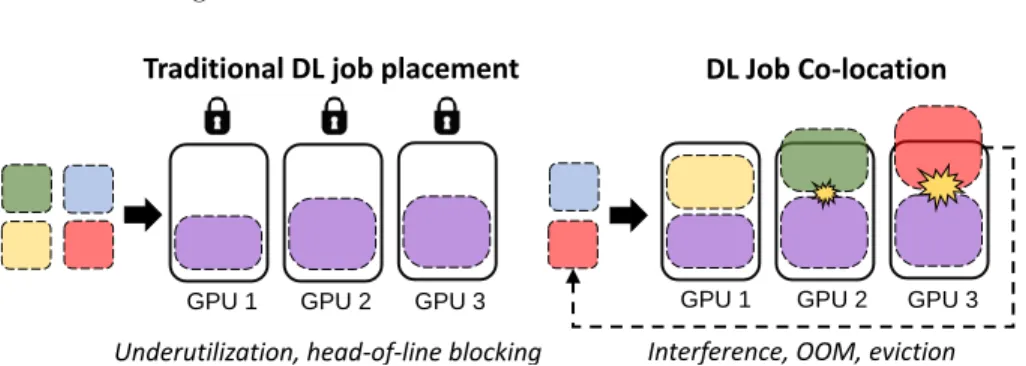
DL systems, particularly clusters, experience issues associated with GPU un-derutilization and long queuing times [19]. One cause of such unun-derutilization is that DL resource managers disallow co-location of multiple DL jobs within the same GPU [25,13]; a characteristic shared within other resource managers such as Kubernetes and Yarn that were originally designed for CPU-based work-loads [16,35]. Instead, the majority of DL resource managers focus on reducing network latency and locality [3,25,13]. This inability to co-locate DL jobs within the same GPU results in reduced resource utilization, longer queuing times and reduced cost efficiency within DL systems.
Recent DL resource managers have been proposed that make placement de-cisions by consolidating DL jobs onto fewer machines to minimize workload and JCT [3,37,13]. However, while DL resource managers now exist that allow for co-location [37,29], there has been little attention drawn to the performance interference which arises between multiple DL jobs training within the same GPU. Performance interference (which we refer to as interference), results in slower training step time and overall epoch time. Previous work has demon-strated the existence of interference within DL systems, resulting in an 18% JCT slowdown [37]. Furthermore, as no existing DL resource manager considers the impact of interference in DL job co-location decisions, this can lead to poor placement of unsuitable jobs resulting in a higher makespan, increase in JCT, job eviction and job failures from GPU out-of-memory (OOM) errors [19].
We propose Horus, a DL system resource manager that maximises resource utilization and minimizes makespan whilst attempting to reduce JCT perfor-mance degradation by anticipating interference due to co-location. By leveraging DL model application features ascertained from [40], Horus is able to estimate the GPU utilization of DL jobsprior to execution, and make better placement deci-sions to determine suitable co-location combinations with the lowest interference. Our approach avoids the need to profile kernel patterns [26,6], modification of the GPU thread-block scheduler (commonly proprietary to GPU hardware man-ufacturers), and extensive online profiling of job execution in an isolated GPU at scheduler runtime; all of which are expensive and time consuming processes in terms of system development and job placement. Our core contributions are: (1) Analysis of DL job co-location patterns. We empirically measured 276 unique combinations of interference patterns from co-locating 13 prominent types of DL jobs comprising both vision and language models (§5.2). Our results demonstrate that co-locating DL jobs with high GPU utilization requirements leads to a 1.5X-3.2X JCT increase stemming from interference. Moreover, we observe that interference patterns significantly vary between different DL job combinations, and that equivalent GPU utilization can exhibit dissimilar JCT degradation patterns.
(2) Co-location DL resource manager.Via leveraging GPU utilization estimation, we construct a cost-based best-fit-decreasing model that determines suitable placement for DL job co-location (§4). Horus was integrated into Ku-berentes [16] - an open source cluster manager, and was evaluated by submitting 2,500 DL jobs from different application domains into a GPU cluster under dif-ferent workload patterns (§5). Results demonstrate that Horus achieves high resource utilization and scheduler performance, and outperforms various clus-ter resource managers - including other co-location approaches [35,37]) - with improvements up to 61.5% and 33.6% for resource utilization and makespan.
2
Background
2.1 Deep Learning
Deep Learning is a type of machine learning algorithm based on neural net-works. DL models are formed by deep neural networks (DNNs), consisting of input, hidden, and output layers [12] and have two phases: training and infer-ence. DL model training requires significant volumes of data [15] to iteratively minimize an error objective. Larger numbers of layers and units per layer re-sults in higher number of floating point operations (FLOPs) to execute [32]. GPUs are frequently used to accelerate DL model training due to their ability to rapidly perform FLOPs execution using thousands of processing cores. For example, Nvidia GPUs define abstraction over a group of cores as streaming multiprocessors (SMs), which are used to execute GPU kernels. A complex DL model (i.e expressed by model depth and width) will result in greater number of FLOPs, and thus a higher GPU utilization in comparison to simpler DL models that leverage the same batch size and GPU architecture [1].
2.2 Deep Learning Resource Managers
Due to the growing number and scale of DL jobs that require training on TB-scale data, researchers and businesses leverage DL systems: powerful machines or clusters of machines to accelerate training. Users submit jobs to a DL system via a web portal or command line interface with specified job configurations (e.g. batch size, model, dataset) comprising one or more tasks that execute within a container. DL jobs are assigned resources and allocated onto machines through use of a resource manager to increase system resource efficiency to satisfy a specified Service Level Agreement (SLA). Existing DL system resource managers 3have focused on a specific sub-set of objectives including minimizing makespan, JCT, as well as maximizing system resource utilization and energy-efficiency [4]. Recent studies of production DL systems have identified several challenges: low utilization of system resources reflected by an average GPU utilization of 52% [19], and long queuing time for DL jobs between 4000s - 8000s due to head-of-line blocking [13]. These challenges are exacerbated by DL systems leveraging
3
GPU 1 GPU 2 GPU 3
Traditional DL job placement
GPU 1 GPU 2 GPU 3
Interference, OOM, eviction
DL Job Co-location
Underutilization, head-of-line blocking
Fig. 1: Difference between traditional vs. DL resource managers: DL job co-location manifesting interference.
non-preemptive traditional schedulers [16,35] that require DL jobs to hold ex-clusive access to a given GPU. This is particularly problematic in the context of schedulers due to its negative impact upon job throughput and makespan, system availability, and cost efficiency.
Improving upon established approaches, recent DL resource managers have been designed to address challenges of under-utilization and long queue times via improvements to network locality and bandwidth [3,25,13]. Another approach demonstrated to be effective for DL resource managers is enabling theco-location
of DL jobs within the same GPU to execute simultaneously, improving overall system resource utilization [37,29]. However, few DL resource managers consider or capture the drawbacks of co-location when performing DL job placement decisions, including the manifestation of interference that might result.
2.3 Deep Learning Interference
Interference occurs when multiple processes compete for limited resources within the same machine [23,8]. Interference of DL jobs co-located within the same GPU has been shown to result in 18% JCT degradation [37]. This is problematic when considering that DL jobs may train in the region of hours to days. Hence, in order for DL systems to fully exploit co-location, DL resource managers should consider the effects of interference when performing DL job placement.
Profiling DL job resource usage (notably GPU utilization) allows DL resource managers to minimize interference resultant from co-location. GPU interference differs from that of CPU interference because of their processor architectures. GPUs use a thread-block scheduler to schedule compute or memory intensive kernels to streaming multiprocessors, and leverage single instruction multiple data parallelism on many cores, whereas CPU usesmultiple instruction multiple dataparallelism on fewer cores. Precisely calculating interference for different co-located DL job combinations is challenging due to the diversity in model types and kernels that are implemented in different DL libraries [2].
While there exist several GPU resource managers that minimize interfer-ence [26,6], such approaches require extensive online profiling of job kernel access patterns at scheduling runtime. This is challenging as profiling DL job resource
Table 1: Studied DL models in Vision (Cifar10 [21]) and NLP (WikiText-2 [24], News-Commentary v14-en-zh [36]
Model Type Batch Size
MobileNetV2 [27], GoogLeNet [31], ResNet [15], VGGNet [30], DenseNet [17], SqueezeNetV1 [18], ShuffleNetV2 [22], ResNeXt [38], MNASNet [33], PyramidNet [14], DualPathNetwork [7]
CNN 64, 128, 256
LSTM [11], Transformer [34] RNN 16, 32, 64
usage (e.g. instruction per cycle, DRAM throughput, compute efficiency) to in-fer interin-ference by creating suitable performance profiles may extend DL job training within the regions of minutes to hours. Additionally it must be per-formed for every new DL model type submitted into the system. This results in considerable resource overhead when using profiling tools such as nvprof and nv-nsight-cu-cli, as well as increased DL system makespan. We believe an alternative approach is to understand how DL model types and model con-figurations result in varying DL job resource usage patterns, in order to infer interference for different co-location combinations. This would allow for DL re-source managers to co-locate DL jobs more effectively through considering the impact of interference in placement decisions.
3
Deep Learning Interference Study
This section presents our analysis of different interference profiles for co-located DL jobs. While there have been prior studies into GPU interference [6,39], the majority of works use few or relatively simple DL models types and con-figurations (i.e. LeNet, Multilayer perceptron, MNIST). We conduct a micro-benchmark of different co-location combinations with heterogeneous configura-tions of prominent DL model types, and study their influence upon resource utilization and interference profiles.
3.1 Setup
A wide variety of DL jobs were deployed within a DL system (4 x Nvidia Geforce 1080, Intel i7-6850k, Nvidia Docker 2, CUDA Toolkit 10.0), and using the DL library frameworks AllenNLP [10] and Pytorch 1.1. Leveraging methods estab-lished within prior studies of GPU interference [6,39], micro-benchmarking was conducted by co-locating paired combinations of DL jobs within the same GPU device, and then measuring the corresponding JCT performance degradation
Tdeg from interference during DL job training. Performance degradation is cal-culated as
Tdeg=
|Tcolo−Tsolo| Tsolo
(1) whereTcolois the time taken for a co-located DL job to reach a fixed time epoch, andTsolo is the time taken for the same DL job training in isolation.
0 50 100 150 200 250 0 10 20 30 40 50 60 70 80 90 100 FL OP s SM Utilization % 1 1.5 2 2.5 3 3.5 25 50 75 100 125 150 175 200 N or maliz ed JCT in cr ea se
Cumulative GPU utilization (%) (a) Interference profiles from different DL job co-location combinations Time (ms) V GG mn as ls tm V GG 1 4 2 .2% GP U U ti l 1 4 7 .1% G P U U til
(b) Kernel co-located jobs patterns with equiv. GPU utilization
Fig. 2: GPU utilization interference patterns
The DL job micro-benchmark comprises 13 unique DL model architectures including both convolution neural networks (CNNs) and recurrent neural net-works (RNNs) from computer vision domains and natural language processing as shown in Table 1. Each model is then further modified with different model configurations such as residual blocks, projection dimensions, and scale param-eters. DL models were selected due to their usage within previous DL resource managers [25,13,37] and prominence in the machine learning community. This provided a total of 24 unique DL model configurations, and 276 unique co-location combinations (300 when including DL jobs in isolation) for profiling. Each DL job is trained for a fixed set of five epochs to capture a stable perfor-mance profile. Analysis metrics were collected from monitoring the DL system, usingnvidia-smito collect statistics for GPU utilization, PCIe bandwidth and GPU memory usage.
3.2 Analysis
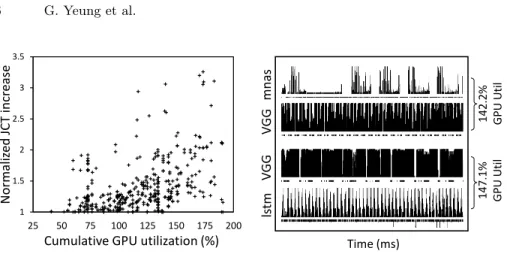
We found that co-located DL jobs that require high GPU utilization results in greater JCT slowdown from higher interference. For example, co-locating two VGG19 models (each requiring 90%+ utilization in isolation) results in over a 3.2X JCT increase. Figure 2a shows that for all co-located job combinations,
GPU overcommitment (i.e. the cumulative GPU utilization requirement greater than 100% of a GPU device) results in an average JCT increase of 42%. In contrast, pairs of co-located DL jobs that individually require less than 50% utilization are less likely to experience overcommitment, and, as a result, can be colocated with similar sized jobs with minimal interference JCT increases of 1 -10%. Moreover, we observed that the degree of JCT increase stemming from in-terference varies quite substantially, even for jobs with similar DL job utilization levels in isolation. This phenomena can be seen in kernel access patterns shown
Resource manager
Profiler Estimator
DL Job Queue
Submission
Horus Framework
Scheduler28% GPU util Resource Pool ✔ ✔ x x No de 1 Node 2 No de n Profiler
GPU 1 GPU 2 GPU 3
GPU 1 GPU 2 GPU 3 Co-location score
GPU Utilization, memory, DL job & node events Global State Store Policy config Event Logger Container Manager NFS
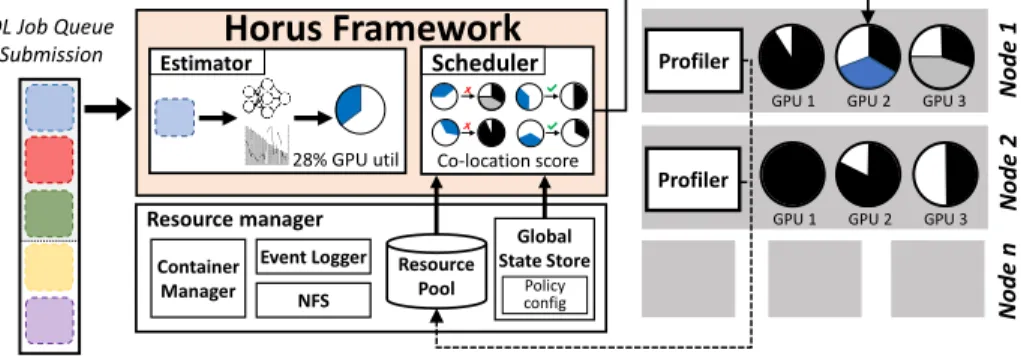
Fig. 3: Horus scheduler framework overview
in Figure 2b, whereby co-locating VGG with either LSTM (1 layer, hidden di-mensions 128) or MNASNet (Depth 1.3) results in an equivalent GPU utilization of approximately 147%, however results in a 1.3X and 3.03X JCT increase. The reason for this behaviour is due to convolution kernels being intrinsically more compute intensive in contrast to GEMM kernels, as well as different memory transfer and compute patterns when contending for resources [6].
4
The Horus Framework
4.1 Overview
Horus is designed to operate within DL resource managers that leverage GPUs, and comprises two main components as shown in Fig. 3: theResource Estima-tor, and Resource Scheduler. At submission time, the estimator calculates the GPU utilization of an executing, or incoming DL job, ascertained via online metric collection or prediction [40] (detailed in§4.2). The scheduler assigns DL jobs to GPUs by ranking their suitability to support co-location. Our approach attempts to greedily maximize GPU utilization to minimize makespan whilst attempting to avoid placement decisions that lead to severe interference causing JCT slowdown (detailed in§4.3).
Our resource manager can be deployed within a single DL system, or within a cluster integrated within existing resource managers such as Kubernetes [16]. In the context of clusters, Horus uses a shared-state, centralized architecture due to its suitability to handle long jobs (an common characteristic of DL job training), as well as providing a view of overall global cluster for high quality scheduling decisions [28,9]. A centralized cluster view is maintained through a shared centralised repository, with monitoring agents deployed in each machine reporting application and system utilization metrics for placement decisions.
4.2 Resource Estimator
Estimation of expected GPU Utilization: While our framework does not modify any underlying DL libraries to function, it does require DL model uti-lization to be provided. Such utiuti-lization patterns can be provided via execution, or prediction. For Horus we have leveraged the prediction technique from Yeung et al. [40] to avoid executing each and individual incoming jobj, which operates by traversing the computation graph, extracting model features and eventually estimating its GPU utilization, i.e.E(GU tilj). Such features are well known and frequently modified by Machine Learning researchers and developers [27,33,32], hence it is relatively straight forward for practitioners to manually extract, or automatically collect such metrics via graph analysis tools such as TensorFlow profiler4and TorchScript5.
Estimation of expected GPU Memory: The only exception for straight forward metric collection the total job memory size (MiB) due to initialization and optimization of individual DL libraries. However, it is possible to estimate the minimum expected memory usage in bytes by considering the following four factors involved in both forwardMf and backward passesMb [12]: (i) the batch size of dataB, (ii) the number of activationsA, (iii) number of gradientsGand (iv) the number of parametersP. In addition to an initialization overheadδ, the overall estimated memory requirement for a given DL jobjcan be expressed as:
E(GM emj) =E(Mjf) +E(M b
j) +δ= (B∗A+P) +B∗G+δ (2)
The expectation of both GPU utilization and GPU memory will be used for node capacity check in the scheduler in case of tackling an incoming job.
4.3 Resource Scheduler
This section describes our scheduling approach to effectively co-locate DL jobs and handle potential placement issues from interference. We observe that in order to maximize GPU utilization, it is necessary to allow co-location of DL jobs onto the same GPU. Gandiva [37] employs a random trial-and-error strategy to co-locate DL jobs. In their approach, by monitoring the job in isolation and application throughput, a job is killed or migrated to another node randomly using an undefined threshold value and time period. In such an approach, it is possible for random job migration to be allocated with another incompatible job leading to equal or greater performance slowdown.
To alleviate the performance degradation stemming from co-location inter-ference, the core of resource scheduling is to understand the compute resource requirementprior to job execution and incur as less overhead (cost) as possible. We design the cost to reflect the selection preference of a node mainly consid-ering GPU memory usage and GPU utilization, respectively. We can therefore determine the most suitable placement based on per-node cost inference.
4
https://github.com/tensorflow/tensorflow/tree/master/tensorflow/core/profiler 5
Cost Inference:We break down the cost of scheduling jobjonto an individual GPUk(denoted byj →k): Costj→k=CjGM em→k +C GU til j→k + jobT ype j (3)
We add up the incurred cost of running jobj regarding GPU memory usage and GPU utilization increase, followed by a calibrationdue to DL jobs type.
In particular, the cost of GPU memoryCjGM em→k is referred to as a weighted proportion of GPU memory usage (Eq. 4), in light of the key implication – higher current GPU memory usage causes a higher chance of OOM and JCT slowdown.
CjGM em→k =ω∗
GM emusedk
GM emtotal k
(4) where GM emtotal is the total GPU memory of the device and ω is used to customize and indicate the performance impact.
As there exists a relationship between increased GPU utilization of co-located DL jobs and JCT slowdown (§3.2), we penalize the combinations of co-located DL jobs when over-commitment manifests – the total forthcoming GPU uti-lization (i.e., current GPU utiuti-lization GU tilcurr
k and the estimated increment
E(GU tilj)) exceeds 100%. Likewise, we add a penalty hyperparameterφ∈[1,2] to tweak the slowdown impact due to GPU over-commitment:
GU tilj→k=GU tilcurrk +E(GU tilj)
CjGU til→k =
(
φ∗ |GU tilj→k−100|, ifGU tilj→k>100
100−GU tilj→k, ifGU tilj→k≤100
(5)
The implication behind thispiecewisecost setup is to pack a job so that the host node can approach to 100% GPU utilization without resource over-commitment. For instance, higher remaining GPU capacity results in a higher cost. On the other hand, once over-commitment occurs, the cost will be increasingly aug-mented, which indicates a reduced scheduling probability of the node, consider-ing job’s performance.
Similarly, as observed in Fig. 2b, different DL model architectures exhibit var-ious degrees of JCT slowdown from interference, thus anicenesshyperparameter
ν is added to accommodate this behaviour (Eq. 6. Our scheduling approach will favour a particular DL job types based onν selection.
jobT ypej = (
ν, ifCjobtypeis CNN
0, otherwise (6)
Cost-based Best-Fit-Decreasing Job Scheduling:Alg. 1 outlines our schedul-ing solution. At each schedulschedul-ing time, the scheduler will collect the current DL system state, and fetch job collection J from the queue. We adopt a best-fit-decrease like algorithm to prioritize jobs with larger GPU requests, avoiding their long-time starvation. To do so, we firstly sort the job collectionJ accord-ing to the pertainaccord-ing GPU utilization (Line 1). We then iteratively attempt to find and bind resources for each job. Specifically, we firstly check the resource
Algorithm 1 Best Fit Decreasing Job Scheduling Algorithm
Input: (J,S) // k jobs in the queue and current cluster state
Output: (scheduleStatus, NodeBindingResultres)
1: J ←DescendSort(J) // a job collection via descend sort by jobs’ GPU util 2: res←dict()
3: forjinJ do
4: if hasAllocatableResources(j,S)then
5: N ←getFeasibleNodes(j,S) //capacity check(CPUs, Mems, GPU Mems) 6: G ←getAllGP U s(N)
7: λ←j.requestedGP U;σ←GetMinRequiredNodeNum(j), 8: if len(N)< σthen
9: continue
10: CG→j←GetCosts(G, j) // use Eq. 3 to calculate cost for each GPU
11: G+←AscendSort(C
G→j).topK(λ)
12: res←Put(j,G+ ) 13: if Len(res)>0then
14: BindNodes(res,j)
15: returnScheduleResults.SCHEDULED,res
16: else
17: returnScheduleResults.EMPTY,Nil
capacity and filter out available candidate nodesN that can satisfy all require-ments of job j in terms of CPU, memory and GPU memory (Lines 4-9). GPU collection G is obtained from the pertaining candidate nodes. For instance, the GPU memory requirement is inferred by using Eq. 2 discussed in§4.2. We can further assess the incurred cost stemming from running the jobj on each GPU of G, separately, via the cost estimation in Eq. 3 (Line 10). To reduce possible interference, the best fit is to select the nodes with minimized impact in case of placingj. Hence the scheduler prefers nodes that host the selected GPUs (G+) with λ least costs (Lines 11-12), and finalizes placement decisions by sending binding requests to the scheduler (Lines 13-17).
Job Failover and Rescheduling: In some scenarios, it is possible for our approach (as well as other DL resource managers) to encounter issues associated with OOM errors due to co-located DL jobs exceeding the total GPU memory capacity resulting from incorrect estimation. We address this issue by using a separate thread to monitor job progress, and in the event of failure, jobs are resubmitted onto the scheduling queue. The scheduler will then update the DL job request with necessary GPU memory requirements, where GPU memory must be equal or greater than the job to be included in consideration.
In a worst case scenario whereby each DL job already fully utilizes GPU resources (i.e. no memory available for packing), our algorithm will pend waiting jobs until existing jobs terminate and release resources and so act similarly to traditional DL resource managers. However, we can leverage other priority or time-sharing primitives to reduce the waiting time.
Complexity Analysis: It is worth noting that at each scheduling cycle, the scheduler re-considers all available GPUs and nodes, given resource requirements are satisfied, including the number of GPUs, and the available GPU memory against the least expected memory calculated in Eq. 4. The time complexity of the capicity check procedure (Lines 4-5) isO(kN G) wherekdenotes the size of pending jobs, while N and Grepresent the number of nodes and GPUs in the DL system, respectively. In addition toO(N logN) used for sorting and asymp-toticallyO(N) in top-K selection, the overall complexity remainsO(kN G). The scheduling can therefore scale well with the increment of either node or GPU scaling-out. Since our scheduler uses a placement algorithm for co-location is greedy, we do not guarantee algorithm optimality. Nevertheless, we find it is less invasive and less time consuming in improving scheduling effectiveness.
5
Evaluation
5.1 Experiment Setup
System:Horus was deployed onto a 12-GPU cluster with each node containing 4 x Nvidia RTX 2080 Ti GPUs, an AMD Ryzen 1920X 12 Core Processor (2 threads per core) with 10Gb Ethernet network, and 128GB DDR4 memory. Each node was installed with Ubuntu Disco 19.04 and Nvidia driver 430.50. In our experiments, the DL libraries (AllenNLP [10], Pytorch 1.1) and CUDA toolkits responsible for DL job instantiation and execution were stored in a Docker con-tainer. Our cluster uses the Kubernetes 1.15.2 resource management framework due to its prominence within the resource management community. cAdvisor and DCGM were configured to extract data at 1s and 250ms intervals, respec-tively, as initial trial runs indicated that these parameters resulted in effective job throughput given our cluster configuration.
Comparative algorithms: To evaluate the Horus scheduling co-location al-gorithm described in §4.3, we have designed and implemented two additional scheduling algorithms for comparison:
B First in First Out (FIFO): Emulating slot-based approaches established in big data cluster schedulers such as Kubernetes [16] and YARN [35], FIFO assigns the next incoming DL job onto an idle GPU without job co-location. As threshold values are not defined in prior work, the timing period was set at 0-60s so that all DL jobs achieve stable performance patterns, and we configure the performance threshold to 50% informed by interference patterns (Figure 2a).
B Opportunistic Bin Packing (OBP): Assigns DL jobs based on GPU memory availability. The algorithm assigns and co-locates DL jobs based on estimated memory requirements prior to submission via exploiting our memory estimation model described in Eq. 4. During job submission time, if a GPU with higher memory is available than estimated memory, then the scheduler will opportunistically allocate a schedule for that job to that GPU.
With the exception of FIFO, preemption was enabled for all algorithms. Our preemption strategy is triggered when a GPU is overcommitted (threshold de-fined by operator) or an idle GPU. This preemption allows previously co-located DL jobs experiencing interference to be rescheduled to another GPU. Horus have configured to operate job collection sizeJ = 15 based on initial experiment runs to provide a sufficient number of candidate DL jobs for placement.
Workload:Experiments were conducted using a mixture of DL job types gen-erated from Table 1, as well as new DL model configurations and model types (LSTM, Transformer), resulting in Horus being exposed to approximately 50% new DL jobs not used in predictor training. Selected models and datasets lever-aged in our experiments are well established in micro-benchmarking DL resource managers [37,25,13]. Submitted DL jobs use a distribution between 3 minutes to 2 hours following DL job sizes derived from JCT of production systems [13]. Jobs are characterized as short/long (<800s or >=800s) and light/heavy (<60% or
>=60% GPU utilization). JCT was controlled by terminating jobs at specified epoch numbers to emulate JCT patterns of production systems, as well as train sufficient DL jobs in a reasonable time frame. For our experiments we focused on DL jobs requiring a single GPU for training, following established practice from other co-location DL schedulers [29]. This is because between 50%-86% of total production DL jobs have been shown to require a single GPU [13,19,5] and hence we have attempted to capture a broad spectrum of different job and model types. Our objective is to study changes in workload makespan and JCT due to interference from DL job co-location. Furthermore, locality—a key focus within prior DL cluster schedulers [37,25,13]—introduces a non-intuitive dimen-sion of JCT heterogeneity even for jobs running in isolation, making it difficult to fairly measure potential trade-off gains between resource utilization against JCT increase when co-locating DL jobs.
Metrics: Algorithm effectiveness was measured using the following metrics:
Cluster GPU Resource Utilization: GPU utilization of all devices, Job Comple-tion Time (JCT): End-to-end completion time for a DL job, commencing from the start of job execution and finishing at job completion.Workload Makespan: The total span-time to complete all DL jobs from en-queuing through to comple-tion. Moreover, we have also measured parameters for general cluster resource utilization (CPU, memory, disk).
Experiment runs: Each algorithm scheduled 100 DL jobs for each workload pattern five times each, successfully training a total of 1,500 DL jobs; equivalent to approximately 66 days of DL system GPU computation.
5.2 Results
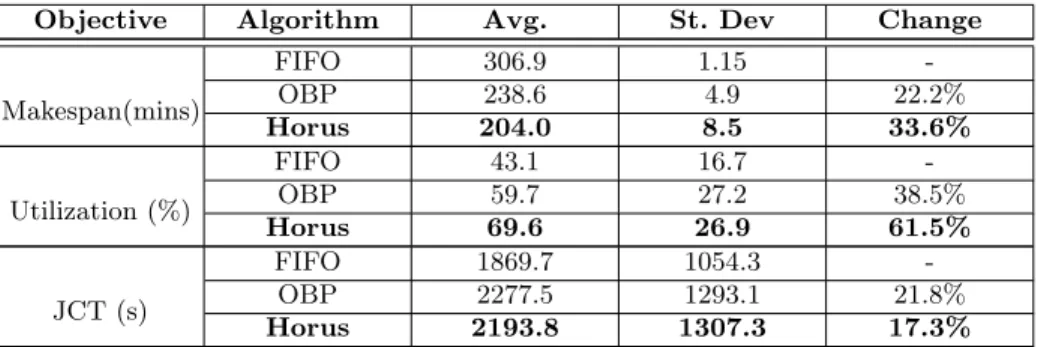
Makespan:In all experiment runs, Horus was able to successfully schedule all DL jobs with the lowest makespan as shown in Fig. 4a. This is demonstrated by a makespan of 204 minutes, and is equivalent to a 33.6% improvement against FIFO, and a 22.2% improvement over OBP as shown in Table 2. The reason for a lower makespan is due to Horus being able to perform better placement decisions for co-locating DL jobs, by leveraging our GPU utilization estimator to
0 50 100 150 200 250 300 350
FIFO OBP Horus
Mak esp an ( m ) (a) Makespan 0 10 20 30 40 50 60 70 80 90 100 0 100 200 300 C lu st er GPU Ut iliz at ion (% ) Time (m) FIFO OBP Horus (b) GPU Utilization 0.0 0.1 0.2 0.3 0.4 0.5 0.6 0.7 0.8 0.9 1.0 0 1000 2000 3000 4000 5000 C DF JCT (s) FIFO OBP Horus (c) JCT Fig. 4: Experiment results for comparing DL resource manager operation.
Table 2: Workload makespan, GPU utilization and JCT statistics.
Objective Algorithm Avg. St. Dev Change
Makespan(mins) FIFO 306.9 1.15 -OBP 238.6 4.9 22.2% Horus 204.0 8.5 33.6% Utilization (%) FIFO 43.1 16.7 -OBP 59.7 27.2 38.5% Horus 69.6 26.9 61.5% JCT (s) FIFO 1869.7 1054.3 -OBP 2277.5 1293.1 21.8% Horus 2193.8 1307.3 17.3%
avoid underutilization and OOM errors from overcommitment. We observe that OBP has the second lowest makespan for all experiments. FIFO has the highest makespan at 306.9 minutes due to longer queueing times for DL jobs waiting to acquire exclusive access to an idle GPU for training.
Utilization:Horus is able to achieve high overall cluster resource utilization in all experiment runs as shown in Table 2 and Fig. 4b, reflected by an average 69% utilization in comparison to FIFO (43%) and OBP (60%). This is resultant of the Horus algorithm determining better co-location combinations for DL job placement to maximize GPU utilization from predicted memory and utilization requirements of DL jobs described in §4.3. While OBP achieve relatively high utilization compared to FIFO due their ability to perform co-location, OBP is able to achieve higher utilization as a result of its rapid scheduling cycle. JCT:Fig. 4c and Table 2 (JCT) shows the average JCT for DL jobs. We observe that FIFO achieves the fastest JCT at 1869.7s, due to DL jobs acquiring exclusive GPU access disallowing co-location and thusly no interference. In contrast, we observe that all co-location algorithms experience JCT slowdown between 17.3% - 21.8%. A note of particularly interest is Horus’s ability to effectively co-locate and reduce makespan to achieve higher DL job throughput will paradoxically expose the DL cluster to greater interference and consequent JCT slowdown. Horus does however still achieve a lower JCT in comparison to OBP, and when
considering our gains to resource utilization and makespan, we view this as an acceptable trade-off.
Scalability:Horus has been evaluated through empirical means in a DL cluster of comparable scale found in recent works [25,29]. As discussed in §4.2, our algorithm complexity is a linear combination between the nodes and GPUs. Moreover, Horus was evaluated using established communication mechanisms in the Kubernetes framework for orchestrating job deployments and file system mounting, which has been demonstrated to scale to thousands of machines [16].
6
Related Work
DL Resource Managers: Gandiva [37] focuses primarily on improving the time-sharing, by enabling DL jobcontext-switching, and extracting job through-put (e.g. minibatch per second) thus allowing ‘random-and-trial’ job co-location placement and eviction upon performance slowdown. Tiresias [13], focuses on improving average JCT and job starvation time. It does so by profiling network latency, consolidating distributed DL jobs and implementing a multi-level feed-back queue, which adjusts job priorities. Optimus [25] implements a performance predictor model, which at runtime, adjusts the number of required parameter servers or workers. It assumes job convergence is predictable, which in many cases is difficult to ascertain [13]. All of the above DL cluster schedulers are complimentary to our work as they focus on addressing various challenges and scheduling objectives, related to locality, time-sharing and average JCT. Ho-rus focuses on DL workload makespan and GPU utilization, as well as making placement decisions based on interference between co-located DL jobs in GPUs. Interference-Aware Resource Managers: The study of GPU interference is an established area [26,6], whereby approaches leverage heavy static profiling of GPU kernel access patterns within isolated machines to classify the workload types at the job submission time, identifying suitable placements. There also exist various cluster schedulers which reduce performance interference of hetero-geneous CPU workloads [8,9,20]. As discussed in§2, these cluster schedulers are not designed to effectively handle GPU scheduling, particularly DL clusters due to differences in hardware, workload, and long queuing times [19]. Horus builds upon these ideas, proposing a prediction discussed in §4.2 which complements other GPU interference-aware resource managers [39,29], by using lightweight profiling to characterize DL job utilization patterns.
GPU Interference Analysis:Interference analysis and fine-grained GPU ker-nel scheduling is an established field of research within the hardware architecture community. Researchers have proposed various solutions to mitigate kernel in-terference in GPU kernel scheduling [6]. All established DL cluster schedulers do not incorporate GPU kernel scheduling characteristics during job scheduling due to heterogeneous DL system hardware and DL frameworks. As an alternative to threadblock scheduling and kernel prediction, Horus uses application features to ascertain job utilization to alleviate GPU interference in DL systems, and provides a study focused on DL job interference due to co-location.
7
Conclusions
In this paper we have presented Horus, a resource management framework for Deep Learning systems that achieves high job throughput and resource efficiency via effective DL job location. Horus performs intelligent placement and co-location of DL jobs in GPUs by estimating job utilization patterns using model features without requiring DL library modification or heavy kernel profiling at scheduler runtime. From our analysis, we have empirically shown the diversity of interference profiles manifesting between co-located DL jobs, and can result in up to 3.2X increase within their completion time. We have created a resource estimator and scheduler integrated into existing DL cluster resource managers. Through experiments we have shown that Horus is capable of reducing makespan by up to 33.6% and improving cluster GPU utilization by 61.5%.
References
1. Nvidia deep learning performance guide, https://docs.nvidia.com/ deeplearning/sdk/dl-performance-guide/index.html
2. Pytorch,https://pytorch.org/
3. Amaral, M., Polo, J., Carrera, D., Seelam, S., Steinder, M.: Topology-aware gpu scheduling for learning workloads in cloud environments. In: ACM SC (2017) 4. Bhuiyan, A., Guo, Z., Saifullah, A., Guan, N., Xiong, H.: Energy-efficient real-time
scheduling of dag tasks. ACM TECS (2018)
5. Chaudhary, S., et al.: Balancing efficiency and fairness in heterogeneous gpu clus-ters for deep learning. ACM EuroSys ’20 (2020)
6. Chen, Q., Yang, H., et al.: Prophet: Precise qos prediction on non-preemptive accelerators to improve utilization in warehouse-scale computers. ACM SIGOPS Operating Systems Review (2017)
7. Chen, Y., Li, J., Xiao, H., Jin, X., Yan, S., Feng, J.: Dual path networks. In: Advances in Neural Information Processing Systems. pp. 4467–4475 (2017) 8. Delimitrou, C., Kozyrakis, C.: Paragon: Qos-aware scheduling for heterogeneous
datacenters. In: ACM SIGPLAN Notices. ACM (2013)
9. Delimitrou, C., Kozyrakis, C.: Quasar: resource-efficient and qos-aware cluster management. In: ACM ASPLOS (2014)
10. Gardner, M., Grus, J., Neumann, M., Tafjord, O., et al.: Allennlp: A deep semantic natural language processing platform (2017)
11. Gers, F.A., Schmidhuber, J., Cummins, F.: Learning to forget: Continual prediction with lstm (1999)
12. Goodfellow, I., Bengio, Y., Courville, A.: Deep learning. MIT press (2016) 13. Gu, J., Chowdhury, M., Shin, K.G., Zhu, Y., et al.: Tiresias: A {GPU} cluster
manager for distributed deep learning. In: USENIX NSDI (2019)
14. Han, D., Kim, J., Kim, J.: Deep pyramidal residual networks. In: IEEE CVPR. pp. 5927–5935 (2017)
15. He, K., Zhang, X., Ren, S., Sun, J.: Deep residual learning for image recognition. In: IEEE CVPR (2016)
16. Hightower, K., Burns, B., Beda, J.: Kubernetes: up and running: dive into the future of infrastructure. ”OReilly Media, Inc.” (2017)
17. Huang, G., Liu, Z., Van Der Maaten, L., Weinberger, K.Q.: Densely connected convolutional networks. In: IEEE CVPR. pp. 4700–4708 (2017)
18. Iandola, F.N., Han, S., et al.: Squeezenet: Alexnet-level accuracy with 50x fewer parameters and¡ 0.5 mb model size. arXiv preprint arXiv:1602.07360 (2016) 19. Jeon, M., et al.: Analysis of large-scale multi-tenant gpu clusters for dnn training
workloads. arXiv preprint arXiv:1901.05758 (2019)
20. Kambatla, K., Yarlagadda, V., Goiri, ´I., Grama, A.: Ubis: Utilization-aware cluster scheduling. In: IEEE IPDPS (2018)
21. Krizhevsky, A., Hinton, G., et al.: Learning multiple layers of features from tiny images. Tech. rep., Citeseer (2009)
22. Ma, N., Zhang, X., Zheng, H.T., Sun, J.: Shufflenet v2: Practical guidelines for efficient cnn architecture design. In: ECCV (2018)
23. Mars, J., Tang, L., et al.: Bubble-up: Increasing utilization in modern warehouse scale computers via sensible co-locations. In: IEEE/ACM MICRO (2011)
24. Merity, S., Xiong, C., Bradbury, J., Socher, R.: Pointer sentinel mixture models. arXiv preprint arXiv:1609.07843 (2016)
25. Peng, Y., Bao, Y., Chen, Y., Wu, C., Guo, C.: Optimus: an efficient dynamic resource scheduler for deep learning clusters. In: ACM EuroSys (2018)
26. Phull, R., et al.: Interference-driven resource management for gpu-based heteroge-neous clusters. In: Proceedings of HDPC. ACM (2012)
27. Sandler, M., Howard, A., Zhu, M., Zhmoginov, A., Chen, L.C.: Mobilenetv2: In-verted residuals and linear bottlenecks. In: IEEE CVPR. pp. 4510–4520 (2018) 28. Schwarzkopf, M., Konwinski, A., Abd-El-Malek, M., Wilkes, J.: Omega: flexible,
scalable schedulers for large compute clusters. In: ACM EuroSys (2013)
29. Shen, H., et al.: Nexus: A gpu cluster engine for accelerating dnn-based video analysis. In: ACM SOSP (2019)
30. Simonyan, K., Zisserman, A.: Very deep convolutional networks for large-scale image recognition. CoRRabs/1409.1556(2014)
31. Szegedy, C., et al.: Going deeper with convolutions. In: Computer Vision and Pat-tern Recognition (CVPR) (2015)
32. Tan, M., Le, Q.V.: Efficientnet: Rethinking model scaling for convolutional neural networks. arXiv preprint arXiv:1905.11946 (2019)
33. Tan, M., et al.: Mnasnet: Platform-aware neural architecture search for mobile. In: IEEE CVPR. pp. 2820–2828 (2019)
34. Vaswani, A., Shazeer, N., Parmar, N., et al.: Attention is all you need. In: NIPS (2017)
35. Vavilapalli, V.K., et al.: Apache hadoop yarn: Yet another resource negotiator. In: ACM SoCC (2013)
36. (WMT19), A.M.T.: Shared task: Machine translation of news, http://www. statmt.org/wmt19/translation-task.html
37. Xiao, W., et al.: Gandiva: Introspective cluster scheduling for deep learning. In: USENIX OSDI (2018)
38. Xie, S., Girshick, R., Doll´ar, P., Tu, Z., He, K.: Aggregated residual transformations for deep neural networks. In: IEEE CVPR (2017)
39. Xu, X., et al.: Characterization and prediction of performance interference on me-diated passthrough gpus for interference-aware scheduler. In: HotCloud (2019) 40. Yeung, G.F., Borowiec, D., Friday, A., Harper, R., Garraghan, P.: Towards gpu