On the secure software development process:
CLASP, SDL and Touchpoints compared
Bart De Win
*, Riccardo Scandariato, Koen Buyens, Johan Gre´goire, Wouter Joosen
Department of Computer Science, DistriNet, K.U. Leuven, Celestijnenlaan 200A, 3001 Heverlee, Belgium
Available online 15 February 2008
Abstract
Development processes for software construction are common knowledge and mainstream practice in most development organiza-tions. Unfortunately, these processes offer little support in order to meet security requirements. Over the years, research efforts have been invested in specific methodologies and techniques for secure software engineering, yet dedicated processes have been proposed only recently.
In this paper, three high-profile processes for the development of secure software, namely OWASP’s CLASP, Microsoft’s SDL and McGraw’s Touchpoints, are evaluated and compared in detail. The paper identifies the commonalities, discusses the specificity of each approach, and proposes suggestions for improvement.
Ó2008 Elsevier B.V. All rights reserved.
Keywords: Secure software; Software process; SDL; CLASP; Touchpoints
1. Introduction
The construction of secure software is still largely a mat-ter of guidelines, best practices and undocumented expert knowledge. Current practices provide guidance for particu-lar areas such as threat modeling, risk management, or secure coding. It is crucial for these to be combined into an integrated and more comprehensive construction method. Several advances have recently been made in the definition of processes for secure software development. However, there has been no objective comparison of these methodologies so far. Therefore, it is difficult for managers and developers to understand their strengths and weak-nesses and, hence, it is hard to make an ‘informed’ decision about which one is more appropriate for the job.
The goal of this paper is to evaluate and compare pro-cesses for secure software development. The focus is put on three forefront representatives, namely Microsoft’s
Security Development Life cycle(SDL)[1], OWASP’s Com-prehensive, Lightweight Application Security Process
(CLASP)[2]and McGraw’Touchpoints[3], as they are rec-ognized as the major players in the field. Their leading role is, among others, due to a number of characteristics that are of particular interest in the context of this study. As far as completeness is concerned, they all provide an exten-sive set of activities covering a broad spectrum of the devel-opment life-cycle. The processes have also undergone extensive validation. For instance, Microsoft is using SDL internally (e.g., for the Vista project). CLASP was contributed to and reviewed by several leading security companies of the OWASP consortium. The Touchpoints work has been validated over time as it has been based on experience gained from several industrial projects. Fur-thermore, the selected processes represent a healthy mix for comparison. SDL is considered to be more heavyweight and rigorous, making it more suitable for large organiza-tions. CLASP, on the other hand, is lightweight and more affordable for small organizations with less strict security demands. Touchpoints is based on industrial experience
0950-5849/$ - see front matterÓ2008 Elsevier B.V. All rights reserved. doi:10.1016/j.infsof.2008.01.010
*
Corresponding author. Tel.: +32 16 327855; fax: +32 16 327996. E-mail address:fi[email protected](B. De Win).
www.elsevier.com/locate/infsof Information and Software Technology 51 (2009) 1152–1171
gathered over several years which was subsequently dis-tilled into an approach, making sure that the proposed activities are both executable and feasible. Finally, the selection of the processes was also influenced by the avail-ability of thorough documentation.
This paper compares CLASP, SDL and Touchpoints, mainly from a theoretical perspective. A first contribution is theactivity-matrix, which lists and relates all activities of the different processes in a comprehensive model. The matrix facilitates the identification of similarities between the pro-cesses and it introduces grouping of activities into regular development phases. A second contribution is the actual comparison of the processes from different perspectives: (i) generic characteristics of the processes are discussed in order to outline the philosophy underlying a particular method; (ii) activity-wise, the commonalities and the differences between the methods are identified and discussed in order to articu-late the strong and weak points of these methods and (iii) process-wise, a number of improvements are outlined that the processes could benefit from, in terms of both coverage and quality. In order to complement the theoretical discus-sion, the results of applying the three processes on a small-scale case study are presented and they confirm the findings of the theoretical study.
The structure of this paper is as follows. Section 2
describes the methodological approach that was adopted for the comparison. Section3contains a bird’s eye presen-tation of the processes, with a particular focus on their characterizing philosophy. Section 4 zooms into both the commonalities and the differences of the processes, on a phase-by-phase basis. Section5 summarizes the results of the application of the different processes on a small-scale case study. Section 6 presents a number of challenges for the presented processes and highlights the room for improvement. Section 7 discusses related work. Finally, Section 8 presents the conclusions as well as directions for future work.
2. Methodology
This section briefly sketches the methodology that was used for the comparison of the selected processes. To begin, the team agreed on the sources to be used, since pos-sible differences and inconsistencies may exist in different versions. For CLASP it was decided to use the documenta-tion of version 1.2 available at the OWASP website.1For SDL the book by Howard and Lipner [1] was used and for Touchpoints the book by McGraw[3].
Based on the available sources, three by-the-book initial lists of activities were articulated. For some activities this required some interpretation of text to elicit implicit activ-ities. Furthermore, some clean-up was necessary on these lists. This meant optimizing the hierarchical structure of
activities and similar transformations. Once the lists of activities were agreed upon, they were merged by linking activities that are conceptually similar. This was not always straightforward, as the granularity and order of activities is not always identical and as particular activities (such as threat modeling) can have many different interpretations. Of all steps taken, this was probably the most challenging one, and the goal was to be as precise as possible.
To increase the structure and the organization of activ-ities, the activities were subsequently organized into the dif-ferent phases of a typical software development process (‘Education and Awareness’, ‘Project Inception’, ‘Analysis and Requirements’, ‘Architectural Design’, ‘Detailed Design, ‘Implementation’, ‘Testing’, ‘Release and Deploy-ment’ and ‘Support’). Since SDL activities are already organized into stages, the activities were mapped onto the above-mentioned phases using extra information provided by MSDN [4]. As far as CLASP is concerned, activities have been assigned to phases by looking at the role that is responsible for the activity itself. Finally, Touchpoints provides a mapping of the touch points to typical software development phases, which was used accordingly.
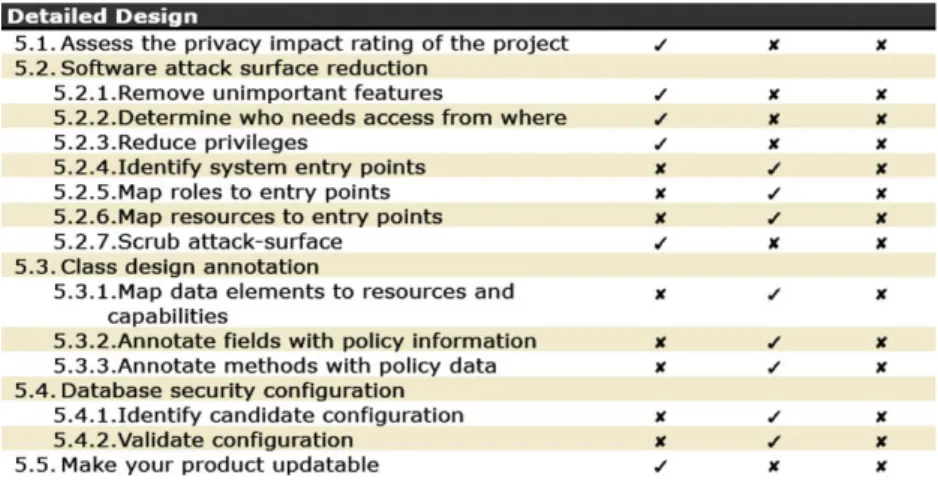
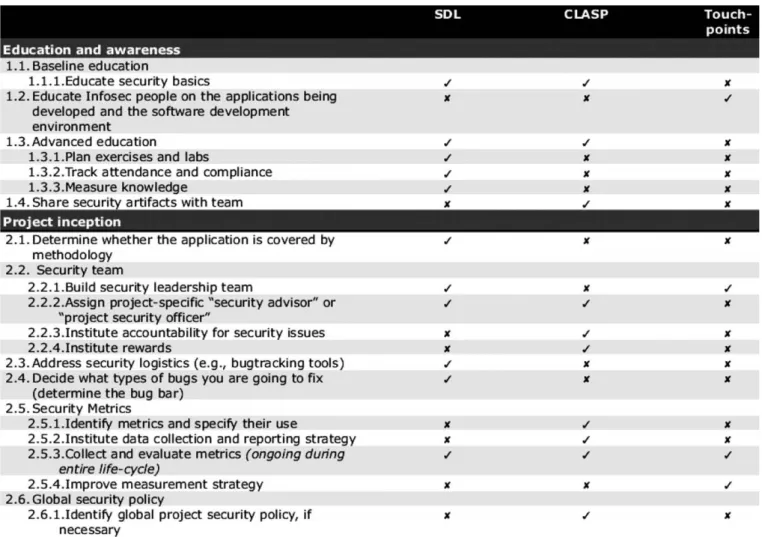
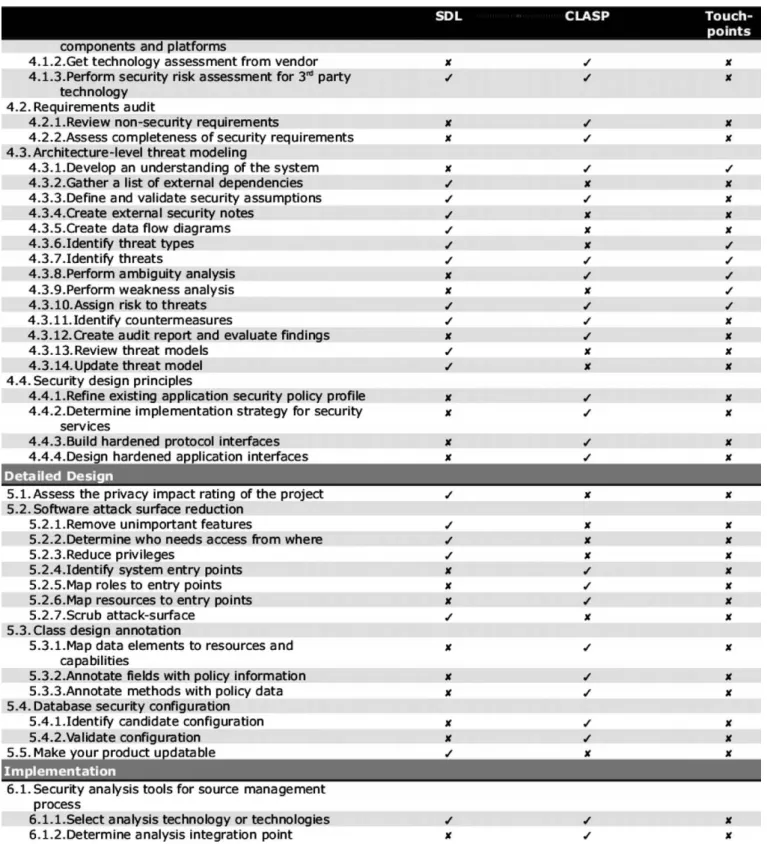
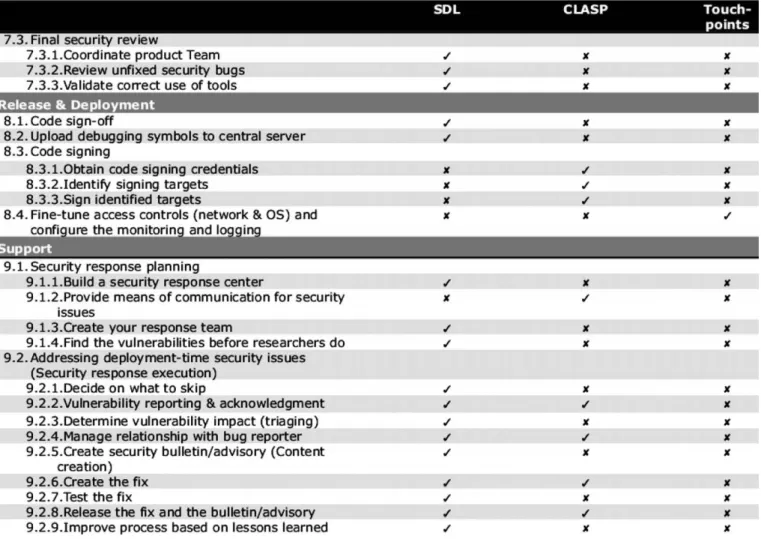
The result of this analysis was structured as a matrix, which contains a section for each of the aforementioned phases, with each row representing a certain activity and each column representing one of the approaches. Fig. 1
shows a fragment of the matrix, focusing on the ‘Detailed Design’ phase. The complete matrix has been included in
Appendix A. The matrix has been the foundation for the further analysis and comparison of the candidate pro-cesses, in particular (i) to identify the intersection and the differences between them and (ii) to apply them to the case study.
3. Background and general characteristics
In this section, the processes are further introduced and a number of characteristics are discussed to give a flavor of their overall philosophy.
3.1. CLASP
Originally defined by Secure Software and later donated to OWASP, CLASP is a lightweight process for building secure software [2]. It includes a set of 24 top-level activi-ties, which can be tailored to the development process in use. Key characteristics include:
Security at the center stage:The primary goal of CLASP is to support the construction of software in which security takes a central role. Furthermore, the activities of CLASP are defined and conceived primarily from a security-theo-retical perspective and, hence, the coverage of the set of activities is fairly broad.
Limited structure:CLASP is defined as a set of indepen-dent activities that have to be integrated in the development process and its operating environment. The choice of the activities to be executed and the order of execution is left
1 CLASP 2 has been announced for some time now, but no new material
open for the sake of flexibility. Moreover, the execution fre-quency of activities is specified per individual activity and, hence, the coordination and synchronization of activities is not straightforward. Two road maps (‘legacy’ and ‘green-field’) have been defined to give some guidance on how to combine the activities into a coherent and ordered set.
Role-based: CLASP defines the roles that can have an impact on the security posture of the software product and assigns activities to these roles. Roles are responsible for the finalization and the quality of the results of an activ-ity. As such, roles are used as an additional perspective to structure the set of activities.
Rich in resources: CLASP provides an extensive set of security resources that facilitate and support the implemen-tation of the activities. For instance, one of these resources is a list of 104 known security vulnerabilities in application source code (e.g., to be used as a checklist during code reviews).
3.2. SDL
As a result of its commitment to trustworthy computing proclaimed in 2002, Microsoft defined the SDL to address the security issues they frequently faced in their products. SDL comprises a set of activities, which complement Microsoft’s development process and which are particu-larly aimed at addressing security issues. SDL can be char-acterized as follows:
Security as a supporting quality:The primary goal of SDL is to increase the quality of functionality-driven software by improving its security posture. Security activities are most often related to functionality-based construction activities. For instance, threat modeling starts from architectural dependencies with external systems, while an architecture could in fact reduce such threats in the first place. SDL is designed as an add-on to the software construction process.
Well-defined process:The SDL process is well organized and related activities are grouped in stages. Although these stages are security specific, it is straightforward to map them to standard software development phases.
Further-more, several activities have a continuous characteristic in the SDL process, including threat modeling and educa-tion. As such, the SDL process incorporates support for revising and improving intermediate results.
Good guidance: SDL does a good job at specifying the method that must be used to execute activities, which, on average, are concrete and often somewhat pragmatic. For instance, attack surface reduction is guided by a flow chart and threat modeling is described as a set of sub-processes. As a result, the execution of an activity is quite achievable, even for less experienced people.
Management perspective:SDL takes a management per-spective for the elicitation and description of many activi-ties. This is nice, given the inherent complexity of security, and it shows that security as a quality has to be managed in order to be realized in practice.
3.3. Touchpoints
Touchpoints provides a set of best practices that have been distilled over the years out of the extensive industrial experience of its proposer. Most of the best practices, named activities from here on, are grouped together in seven so-called touch points. Touchpoints can be charac-terized as follows:
Risk Management: Touchpoints acknowledges the importance of risk management when it comes to software security. It tries to bridge the gap by elaborating a Risk Management Framework (RMF) that supports the Touch-points activities.
Black vs. White: The touch points provide a mix of black-hat and white-hat activities, both of which are neces-sary to come to effective results. Black-hat activities are about attacks, exploits and breaking software (e.g., pene-tration testing). White-hat activities are more constructive in nature and cover design, controls and functionality (e.g., code review).
Flexibility:The touch points can be tailored to the soft-ware development process already in use. To facilitate this, the documentation provides a prioritization of the different
touch points. This allows companies to gradually introduce the touch points, starting from the most important ones.
Examples: Touchpoints is rich on examples. For instance, when describing abuse cases, there is an example giving the reader a good feel about what they might look like in a particular situation.
Resources: To further aid the execution of activities, Touchpoints provides links to resources and also explains how to use them. To this aim, a part of the book is dedi-cated to security knowledge (which the resources are part of). For instance, attack patterns are provided in order to be used in the elicitation of abuse cases.
4. Phase-by-phase comparison
In this section, a comparison of the three processes on the level of activities is presented. The activities have been classified according to software development phases, as dis-cussed in Section2. Some phases have been merged in this section, however, for reasons of readability. For each phase the processes are discussed, pointing out commonalities and differences. The goal of the comparison in this section is to discuss the important differences, not to be exhaustive. The reader is referred to the complete matrix inAppendix Athat may serve as a source for an exhaustive comparison.
4.1. Education and awareness
SDL: Education is a fundamental part of SDL. Every team member of the project should be givenbaseline educa-tionin software security (Activity 1.1) in order to increase (i) the awareness of the importance of the problem and its broad scope and (ii) the knowledge of security engineer-ing basics, includengineer-ing core concepts, types of security breaches, possible solutions, and so on.
More focused and targetedadvanced education(Activity 1.3) is scheduled as well for particular groups of engineers. As security is a rapidly evolving field, with new threats emerging frequently, such courses are scheduled annually. Some examples of courses in this area include fuzz testing, threat modeling and reviewing code. An infrastructure for
tracking the attendance (Activity 1.3.2) and for measuring
the effectiveness of courses (Activity 1.3.3) is suggested.
CLASP:Similar to SDL, CLASP emphasizes the impor-tance of education (base-level as well as advanced). How-ever, CLASP has a somewhat different focus in that it addresses all project roles (e.g., including the project man-ager). Moreover, accountability is a key driver to organize courses, since engineers can only be held responsible for security problems when they are sufficiently trained. CLASP also improves security awareness by proactively
sharing all security artifactswithin the development team (Activity 1.4).
Touchpoints:Since education is not one of the seven core touch points, little attention is given to the topic. It is rec-ognized that people should be sufficiently trained, espe-cially about the particularities of the development
environment as software engineers are considered to be more in line with the Touchpoints philosophy. The infor-mation security people are the main target for training. Besides the touch points, a knowledge management frame-work is described to structure and share software security knowledge. Such frameworks clearly facilitate the spread-ing of knowledge and, hence, they are fundamental to edu-cation. Unfortunately, the book only hints at where and how this knowledge can be used throughout the different touch points.
Discussion: The common base-line for education is the training of project engineers in general and specific con-cepts related to software security. The training program of SDL is impressive in this respect, and some of these courses are even freely available. CLASP takes a somewhat different approach in that it broadens the target audience of training to all roles involved in the project. Touchpoints is more vague about the goal and the specifics of training. It is somewhat surprising, for instance, that given the risk-ori-ented approach of Touchpoints, no risk management train-ing is suggested whatsoever. Finally, it is important to support and monitor the education program closely in order to optimize the net effect of training. In that respect, SDL suggests to institute a tracking program to keep track of who is required to follow which courses, as well as a measurement program to assess the effectiveness of knowl-edge transfer via training programs. In that sense, SDL puts more focus on the management perspective of education.
Awareness is a broad concept that can be interpreted in different ways. For SDL and Touchpoints, awareness relates to knowledge about the problem of software secu-rity, mostly by means of training and by clear commitment of the company’s general management. In addition, CLASP also stresses the logistic side of awareness, for instance the sharing of project-specific security information to increase the awareness of engineers to the specific prob-lems in the project at hand.
4.2. Project inception
SDL: At the beginning of this phase, SDL suggests to make a go/no go decision about the applicability of the methodology to the project at hand (Activity 2.1). If the gauge is passed, SDL describes in detail how to organize the personnel involved in a secure software project (Activ-ities 2.2.1 and 2.2.2). Foremost, a security adviser is assigned to the project itself. This adviser helps the devel-opers with security related issues and possibly serves as a gateway between developers and a dedicated security team (if available). Other important roles include the develop-ment team security contact, the company-wide security team and the security leadership team. While all the former are technical-oriented profiles, the responsibilities of the latter are more managerial and include (i) regular commu-nication to the development team about security and
pri-vacy bug counts and (ii) communication of security and privacy policy updates.
Furthermore, SDL includes specific activities to address the logistics aspects, e.g., to make sure that the necessary tools are available (Activity 2.3), and to determine the type of security bugs that will (or will not) be addressed (Activ-ity 2.4).
CLASP: For CLASP, the construction of the security team is also important. In this respect, CLASP suggests to assign a security officer to the project (Activity 2.2.2), which is a security expert that shares knowledge and acts as a security soundboard and reviewer throughout the development life-cycle. However, the influence of software security on other typical development roles (e.g., project manager, requirements specifier or architect) is discussed as well. CLASP also acknowledges the role played by indi-vidual commitment. To this aim, it suggests the use of both positive and negative incentives for motivating project engineers, by institutionalizing accountability (Activity 2.2.3) and by means ofrewards(Activity 2.2.4).
An important difference in CLASP is represented by the attention that is put on security metrics (Activity 2.5), which aid in assessing the security posture of the product as well as enforcing accountability of security issues. Care must be taken to identify the metrics to collect (Activity 2.5.1), toinstitute the strategy for data collection and report-ing(Activity 2.5.2), and toperiodically collect and evaluate the identified metrics (Activity 2.5.3). Note that this last activity is actually ongoing during the different phases of the software development process.
Furthermore, CLASP emphasizes the importance of the
organizational policy (Activity 2.6). It is suggested to develop such a document (if not already available), since it should be used as a baseline for security requirements of all software projects. CLASP provides a list of global security requirements to be used as a template for the glo-bal policy. During inception, the relevance of each gloglo-bal requirement must be evaluated for the project at hand. In case of conflicts between the global policy and project-spe-cific requirements, proper action should be taken to resolve them.
Touchpoints:Touchpoints stresses the creation, and con-tinuous execution, of an improvement program. This pro-gram aims at developing a clear understanding of the specific actions required to improve the state-of-practice within an organization regarding software security. The
improvement program should cover both the measurement strategy(Activity 2.5.4) and theprocessitself (Activity 2.7).
Discussion: The processes cover a number of to-be-expected activities, which are also relevant for regular software development practices. For instance, one has to identify and assign responsibilities and, closely linked to that, to establish the positive and negative consequences for (not) meeting particular goals. Also, care must be taken to install program-wide, security-relevant logistic support such as tools for bug-tracking and team communication.
The support for security metrics is particularly impor-tant in making secure software construction a true engi-neering activity in which progress can be measured. Metrics are instrumental to assessing the quality of a pro-ject as well as the improvement over different propro-jects. Examples of security-specific metrics include measuring the attack surface, the reported default rates and the cover-age of security tests. In general, they can relate to different scopes: the project, the process, the product and the orga-nization. Both CLASP and SDL thoroughly address the metrics-challenge and suggest a number of metrics that are related to particular activities. CLASP gives more guid-ance on which metrics to use and how to integrate them into the project life-cycle. For SDL on the other hand, given the elaborate and detailed description of many of the stages, it is not that hard to deduce extra, useful metrics (such as the number of threats covered, the number of bugs reported, or the test coverage). Touchpoints touches upon the use of metrics to drive the improvement program of an organization, but is more vague about how to realize this in practice. Unfortunately, none of the processes succeed in providing a complete and systematic integration of metrics within all process activities.
The project manager is the main stakeholder for most activities in this phase. He must make sure that all teams and all supporting infrastructure is in place and that basic agreements have been made. In this respect, one of the agreements that might deserve more attention in all pro-cesses is the overall security objectives that the project will target. For SDL, this is partially covered by the bug bar, but it would be useful to extend this idea to a broader num-ber of indicators. Good agreements about this in the pro-ject inception phase renders the obpro-jectives more clear for all team members. Clearly, a prerequisite for this is the availability of a good set of indicators.
4.3. Analysis and requirements
SDL:This might be a striking observation, but SDL has very few activities in this phase. The definition ofuse sce-narios(Activity 3.7) is part of the analysis of the system, and it is the first step in the (architecture-level) threat mod-eling process.
CLASP:In order to prepare for requirements specifica-tion, CLASP suggests to identify (i)resources(from a net-work as well as from a data perspective) and trust boundaries (Activities 3.1.1 and 3.1.2), (ii) capabilities for resources and link them to roles (Activities 3.2.2 and 3.2.1) and (iii) attacker profiles (Activity 3.3.1.1).
Requirements elicitation in CLASP is performed using both a black-hat and a white-hat perspective, i.e., by means of threat modeling and requirements specification respec-tively. Threat modeling uses different approaches: (i) use case driven threat modeling, during which attacks to all functional use cases of the system are performed (Activity 3.3.2.3), (ii) resource driven threat modeling that focuses on (il)legal use of resources (Activity 3.3.3) and (iii)
knowl-edge driventhreat modeling, i.e., assessing whether known attacks can be valid and useful for the system at hand (Activity 3.3.4.3). For each misuse case, appropriate
defense mechanismsare to be identified (Activity 3.3.7). Requirements specification is based on two pillars: busi-ness requirements and functional security requirements
(Activities 3.4.4 and 3.4.5). The former covers all require-ments that originate from the customer or the organiza-tion, possibly driven by the global security policy (see Section 4.2). The latter focuses on security services for the resources that were identified. A conflict resolution
activity is suggested to solve mismatches between different (sets of) requirements (Activity 3.4.7). Finally,risk mitiga-tionsmust be determined for each resource, similar to the defense mechanisms for misuse cases. In parallel, require-ments for theoperational environmentare specified in order to improve the understanding of the system’s context (Activity 3.6).
Touchpoints: One of the touch points is entirely dedi-cated to threat modeling based on abuse cases (Activity 3.3). The elicitation of abuse cases is achieved by identify-ingthreat agents, elicitinganti-requirements(i.e., things the software should not do, often based on security functional-ity failure) and identifying the attack model (attack pat-terns relevant to the system at hand). Anti-requirements states what can go wrong (i.e., the goal of a possible break-in), while the attack model relates to the means to achieve this (the how). Abuse cases are then specified as the combination of a threat agent, an anti-requirement and an attack pattern, together with a mitigating scenario (Activity 3.3.5).
Apart from the aforementioned abuse cases, extra secu-rity requirements can be identified based on three different sources: laws and regulations, commercial considerations and contractual obligations (Activities 3.4.1, 3.4.2, and 3.4.3). All security requirements are ordered according to
the severity of the obligation, which is among others related to the source of the requirement (e.g., not adhering to national laws may lead to severe business loss) (Activity 3.3.6).
Discussion: Threat modeling is one of the most funda-mental activities in any security engineering effort. The spectrum of threat modeling activities that can be per-formed is considerable: conceptual versus technical, func-tionality- versus attack-driven, systematic versus pragmatic and so forth. Each process has its own accents in this spectrum and it is far from straightforward to understand the specifics of each activity and their relation-ship. Fig. 2 depicts our interpretation of this matter. For every process (represented in columns), the different activ-ities are listed and lines denote a relationship between activities (a full line connects identical activities, while a dashed line represents a more loosely coupled relationship). Every activity is annotated to indicate whether it has to be executed during requirements analysis (Req) or software design (Des). Finally, activity groups are marked with a ‘+’ for white-hat activities and a ‘-’ for black-hat activities. In general, it is fair to say that Touchpoints covers the broadest spectrum of activities, SDL is restricted to archi-tectural threat modeling (see Section 4.4) and CLASP is positioned in between. In addition, it is also remarkable in this context that for all processes, resource-driven threat modeling is based on technical resources.2In the authors’ opinion, it would make sense to identify business level resources (orassets) and use these to drive the threat mod-eling activities during the analysis phase. Indeed, assets do not necessarily align perfectly with technical ones, as is for instance the case for values that are typically not
repre-Fig. 2. Security requirements and threat modeling demystified.
2 While CLASP does not exclude the use of non-technical resources, the
methodology is strongly biased and almost all the examples given in the text are system- or technology-oriented.
sented as first class concepts, but which are deduced by means of a query or some other computation (e.g., the glo-bal glo-balance of a set of bank accounts). Consequently, the focus on business-level threat modeling would increase and business-level threats would be identified less acciden-tally. Touchpoints’ risk management framework covers this to some extent, but its adoption is disconnected and not very visible in the touch points.
Another important goal of the analysis phase is the spec-ification of security requirements. In this context, two observations are important. First, the sources used for the elicitation of threats or requirements are somewhat dif-ferent. For SDL, this is primarily based on threats to the system. For CLASP, additional requirements originate from the global company policy, and functional security requirements are elicited explicitly. In Touchpoints addi-tional requirements are based on obligations in the context of regulations or towards customers. This suggests that CLASP and Touchpoints use a broader set of sources to drive requirements elicitation. Second, it is noteworthy that abuse cases (or misuse cases) are a common format for the specification of security requirements. In the authors’ opin-ion, this could be extended by explicitly transforming the misuses into more affirmative, solution-oriented require-ments, which would align better with prevailing standards such as the Common Criteria ([5]).
As a final remark, the initial identification of mitigation strategies for threats can be useful, since this can lead to the elicitation of additional security requirements (in particular requirements on security functions). In the authors’ opin-ion, the approaches for analysis-level mitigation described by the respective processes are weak. In CLASP, mitigation is based on genericknowledge of threats and, hence, only generic mitigation strategies can be suggested. In Touch-points, mitigations should be specified in abuse cases but no guidance on how to achieve this is given whatsoever.
4.4. Architectural and detailed design
SDL:During the architectural phase, performing rigor-ous and thoroughthreat modeling(Activity 4.3) is possible as one has a clear understanding of the system decomposi-tion and of the informadecomposi-tion flows within the architecture. SDL covers this by means of an extended set of sub-activ-ities. Additionally, an interesting feature is represented by an activity focusing on the specification of theoperational environment (Activity 4.3.3, also present in CLASP). This activity details the architectural assumptions about com-puting hosts and data networks.
At detailed design level, SDL focuses on assessing the impact of the project on user privacy (Activity 5.1) and the reduction of the attack surface (Activity 5.2). For instance, techniques are suggested to reduce the attack sur-face by discarding unnecessary features and by limiting privileges.
CLASP: Just like SDL, CLASP also supports threat modeling at architectural level, although in a less thorough
way. However, CLASP adds two preparatory steps at the beginning of the architectural phase. First, CLASP consid-ers the fact that most projects will be using third-party components. In order to prepare mitigating the security risks involved herein, CLASP includes activities to research andassess off-the-shelf technology, like third party compo-nents the project will depend upon (Activity 4.1). This activity is present in SDL as well, but in a limited form, i.e., the focus is on the interaction with the OS and the ActiveX controls. Second, CLASP is unique in suggesting a review step (Activity 4.2) where both the security and the non-securityrequirements are auditedin order to assess their completeness.
At detailed design level, CLASP complements SDL in terms of activities devoted to the reduction of the attack surface (Activities 5.2.4–5.2.6). Indeed, SDL focuses more on reduction of privileges, while CLASP focuses on the
reduction of access points.
Furthermore, CLASP is unique in providing guidance about injecting security annotations in the design models
(Activity 5.3) and securing theconfiguration of data bases
(Activity 5.4).
Touchpoints:The main focus of Touchpoints during the design phase is on threat modeling. For instance, Touch-points includes threat identification and risk assessment
(as described in the risk management framework), where risks in the system (including any frameworks that it might use) are identified and mitigated (Activity 4.3.8). Further, Touchpoints is unique in that it also aims at removing any ambiguity there might be, as ambiguity is often a cause of problems (Activity 4.3.9).
Discussion: As mentioned in the above description of this phase, all processes have a common trait regarding the analysis of threats at architectural level. By threat it is usually meant a danger for an architectural or infrastruc-tural resource (playing the role of asset) like spoofing a ser-ver or intercepting a network connection. This type of threats take place ‘‘one level below” the application logic and are enabled by the inadvertent use of mechanisms like DNS for server spoofing or encryption for connection interception. It is interesting to note that all processes sug-gest the adoption of misuse cases (often referred to as threat scenarios) to document the possible threats to archi-tectural elements. However, there are significant differences in the methodologies that the three processes suggest to use in order to unearth these threats. SDL is with no doubt the most precise and thorough. Indeed, the process suggests to use STRIDE, which is a systematic and effective way of eliciting threats (sometimes too effective, as the number of discovered threats can easily explode). Further, the tech-nique is well documented and all the necessary resources to carry it out are provided, including a tool. Touchpoints is a bit less complete. It refers to STRIDE and proposes further activities related to threats. Examples are the analysis of weaknesses that arise by using third party software such as off-the-shelf components, and the analysis of flaws due to ambiguity in the design, for instance, problems related
to type safety and type confusion. CLASP is deficient in this area, as it does not provide any guidance about how to carry out the threat analysis activity.
If we now look at the stakeholders involved in this phase, we notice some differences among the three pro-cesses. Both SDL and Touchpoints focus on the security expert that has to scrutinize the architecture. They also put significant emphasis on risk-driven prioritization of threats in order to allot development effort wisely. This allows the customers (who know the value of assets) and the project managers (who know the costs of devel-opment) to be involved in this process phase and to con-tribute with business-informed decisions. CLASP has a more holistic view and considers several stakeholders. During this phase, indeed, some activities link back to the requirements phase (review non-security require-ments, assess completeness of security requirements) which is in line with modern software engineering approaches, where software architecture design and requirements definition are intertwined [6]. Therefore, requirements specifiers are involved in this phase too. Moreover, CLASP (as SDL) takes the deployment view into consideration, e.g., by validating the architecture and the design against both the network assumptions (e.g., existence of a firewall, of a centralized authentica-tion server, and so on) and the host assumpauthentica-tions (e.g., expecting an important system component to be bundled with the OS). Clearly, this requires the involvement of field engineers. Finally, very detailed guidance is pro-vided by CLASP to both the architect and the designer, e.g., with activities like design hardened interfaces and
annotate class design with security properties.
4.5. Implementation and testing
SDL:It is interesting to observe that, apart fromsecure coding guidelines(Activity 6.5.1), SDL lacks real implemen-tation activities. This is probably due to the fact that SDL focuses on security as a supporting quality. The use of
automated tools for verification purposes is encouraged (Activity 6.3), as well asmanual code inspection (Activity 6.4), e.g., to assess the adherence to coding guidelines. Fur-thermore, apart from the editing ofdocumentation(Activity 6.7) that prescribe security best practices, the creation of
tools (Activity 6.6) that can facilitate configuration and audit of systems is encouraged.
SDL puts a lot of focus on security testing. However, SDL focuses mainly on black box testing (Activities 7.1.10 and 7.1.11). A typical black box test is to feed the application with random input in order to observe the sys-tem’s reaction for unexpected failures (which are hints of possible security bugs). SDL includes two additional test-ing activities: (i) the security push (Activity 7.2) and (ii) thefinal security review(Activity 7.3). Both perform extra testing but have a different focus. During the security push, the project team tests the entire system with specific focus on legacy code, while during the final security review the
entire system is tested by the central security team. Both target the entire system with a focus on highest-risk compo-nents, in contrast to security testing which focuses on indi-vidual components. It is worth noting that, for the security push, SDL does cover white box verification in the form of code review.
CLASP: Just like SDL, CLASP emphasizes the impor-tance of security testing. However, contrary to SDL, CLASP focuses more on white box testing (Activities 7.1.2 and 7.1.3). CLASP also suggests the integration of security analysis into source management (Activity 6.1), in order to automate the implementation-level security analysis and metrics collection through the use of dynamic and/or static analysis tools.
Other than these commonalities, CLASP includes more implementation activities, including the implementation of interface contracts (Activity 6.5.3). Moreover, CLASP acknowledges the importance of reviewing the specification from the developer perspective (Activity 6.2) in order to spot ambiguities that could lead to security flaws during implementation.
Finally, CLASP deals with the creation of the necessar-ily documentation to install and operate the application securely (Activity 6.8).
Touchpoints:Similar to SDL and CLASP, Touchpoints emphasizes the importance of security testing – actually, three out of seven touch points covered in the book deal with security testing. A difference in focus does exist, as Touchpoints stresses the importance of risk based security testing (Activity 7.1.1). The main characteristic of Touch-points is the emphasis on code reviews. In particular, the use of automated tools is suggested (and examples provided).
Discussion: Not surprisingly, all analyzed processes stress the importance of security testing. A closer look to the documentation reveals that they all provide thorough, good-quality guidance in describing the testing-related activities. However, different flavors can be identified. SDL has a predominant black-hat approach to testing, i.e., activities focus on fuzz testing and penetration testing. CLASP is mostly white-hat, as illustrated by activities like resource driven testing, testing of security attributes (e.g., privileges), integration and automation of security testing with the commit procedure of the software repository and with the build process. Touchpoints is in between: some activities are mainly white-hat oriented, e.g., security functionality testing, while the black-hat component is still very present, for instance, pen testing is a touch point in its own.
Concerning the stakeholders that are involved in this phase, the implementers and the testers are center stage in all processes. However, we observe that SDL goes a bit further. Significant attention is devoted to provide the project managers with test results in order to track the pro-ject status (security-wise).
As a final consideration, we noticed that the use of both formal notations and the code generation techniques (e.g.,
MDA) do not find the proper space in any of the processes under study.
4.6. Release, deployment and support
SDL:SDL focuses on theresponse plandefining what to do when a new vulnerability is discovered (Activities 9.1 and 9.2). It is stressed that normal response planning can deviate considerably from the situation where a security emergency has to be dealt with. SDL also acknowledges that communication with customers is very important. One has to make sure that, amongst other things, security advisories can be released and customers have access to software updates.
CLASP: Even though organized quite differently from SDL, CLASP covers about the same activities, ending up with the same result. There is a difference though, and that is that CLASP puts extra emphasis on signing the code, in order to provide stakeholders with a way to validate the origin and integrity of the software (Activity 8.3).
Touchpoints: Touchpoints has very limited support in this phase. The only aspect that Touchpoints covers here is that the InfoSec people should contribute to the secure development by fine tuning access controls and configuring the monitoring and logging (Activity 8.4).
Discussion:As a general observation, we notice that the activities in this phase focus largely on support rather than deployment. As far as deployment is concerned, activities relate to the release of the software (e.g., code signing) rather than its fielding. Touchpoints is an exception in this respect, as it contains an activity dealing with the configu-ration of access control, logging, and monitoring. Concern-ing software support, two types of activities are very much elaborated in CLASP and SDL: (1) producing the docu-mentation (for SDL triggered during the impledocu-mentation phase) and (2) dealing with patching. However, some dif-ferences exist in the level of quality those activities are pre-sented. Overall, CLASP does a good job in detailing the type of documentation to be produced. Quite interestingly, however, SDL acknowledges the importance of producing documentation also during the implementation and, there-fore, has some activities in that phase too. With no doubt, SDL has a better coverage of the management of both security reports and patches. For instance, SDL prepares the patch management starting from the implementation phase (e.g., by easing up the bug fixing after release by uploading debug symbols) and follows up during the sup-port phase with a well documented and structured set of activities.
5. Experimental assessment – the ATM case study
In this section, the application of the three processes on a small case study is discussed. The main purpose of this experiment is illustrative, i.e., to verify whether the results of the theoretical comparison hold in practice, rather than evaluative, i.e., to do a thorough and systematic analysis
and comparison of the respective processes on the field. We first introduce the case study and then present the results of executing each process on the described case in Section 5.1 through Section 5.3. Each section concludes with a discussion part.
The case study is an ATM system, an internal project that is reused across several research works. The ATM software to be designed controls a simulated automated teller machine (ATM) having a magnetic stripe reader, a customer console, a slot for depositing envelopes, a dis-penser for cash, a printer for printing customer receipts and a key-operated switch to start or stop the machine.
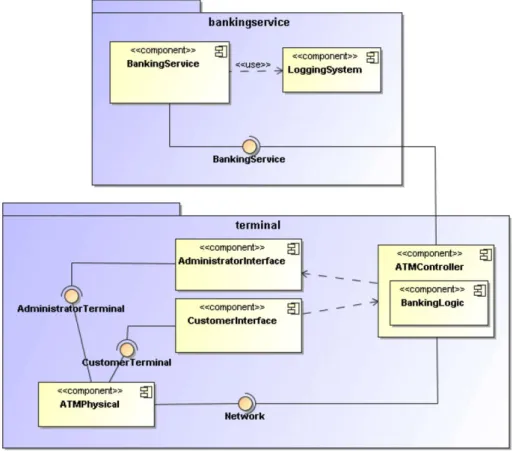
The main use cases of the system are to start or stop the system, and to perform a transaction (withdrawal, deposit, transfer or inquiry). The component diagram of the soft-ware architecture is shown in Fig. 3 (the process and deployment diagrams are very similar). The responsibility of most components is straightforward: at the terminal side, the ATMPhysical component abstracts the hardware of the machine, the Administrator- and CustomerInterface components represent the basic GUI for two different types of users, the ATMController contains the generic logic for the terminal, while the BankingLogic subcomponent focuses on the banking specific logic. At the BankingSer-vice side, the BankingSerBankingSer-vice component contains the logic for the bank, while the LoggingSystem is responsible for logging relevant events.
During the experiment, the three processes were applied to this case study based on the available material. From a methodological perspective, each process was applied in a project-oriented way by building a team of two persons selected from the authors. Each team was composed of a junior researcher and a senior researcher acting as a sound-board. At the end of the experiments, the results were reviewed during a workshop in order to ensure completeness.
The case study is developed to the level of architectural design. Therefore, only a subset of the process phases can be applied. As motivated by the above description, the ‘‘Education and awareness” and the ‘‘Project Inception”
phases were bypassed. Indeed, the creation of the teams was straightforward due to the resource constraints, and the training of team members in the security area was suf-ficient. Furthermore, these phases are of less use for one-shot projects. Since no implementation of the case is avail-able, the core set of activities executed reside in the ‘‘Anal-ysis and Requirements” and ‘‘Architectural Design”
phases. This implies that some important activities, like testing, were not executed.
5.1. CLASP 5.1.1. Analysis
In the context of analysis, the first activity is to deter-mine resources and trust boundaries (Activity 3.1). In the case study, the network design (Activity 3.1.1) was based on the architectural deployment diagram, except that the
components of the banking service were distributed over different machines (this enabled more flexible deployment scenarios and increases as such the depth of the security analysis). To identify data resources (Activity 3.1.2), CLASP suggests to look for several items, like: service level access points and information assets, low level resources (such as memory), and system related resources (such as ACLs and configuration files). At this point of the develop-ment life-cycle only the identification of the first type was considered really feasible (and useful). Since many activi-ties of CLASP are driven by resources, extra consideration was put into these results, but no satisfying improvements could be achieved.
Resources are then used in two ways by CLASP: white-hat and black-white-hat analysis. During the white-white-hat part, secu-rity requirements are elicited for the resources. In the black-hat part, attacks are matched to the identified resources.
For the white-hat track, the capabilities of the resources have been identified (Activity 3.2.1), and system roles have been mapped to these capabilities (Activity 3.2.2). This is instrumental to the following step, i.e., the elicitation of security-relevant requirements (Activity 3.4.5). During this activity, the resources have been first grouped into five broad classes: user-confidential data, ATM processes, bank system processes, network and memory. The choice of the classes is arbitrary, however, the rationale is to minimize the number of requirements that have to be specified by
bracketing resources that have similar demands. In our experiment, 12 general requirements have been specified for the 5 classes. In a next step of the activity, the coverage of the requirements has been verified by mapping them onto individual resource capabilities and assessing whether extra, specific requirements would be necessary (gap analy-sis). In a final step, these extra requirements have been articulated for the individual resource capabilities. An overview of this process and an excerpt of the results are shown inFig. 4.
For the black-hat track, the next step is the identifica-tion of the threat agents (Activity 3.3.1.1). As a result of this activity, 5 profiles have been described: insider (e.g., an administrator or a bank employee in charge of the ATM), script kiddie (e.g., to get easy money), competitor (e.g., to gain customers information), government (e.g., to track banking transactions), and organized crime (e.g., to cover transactions). An additional profile (activist) has been considered and discarded. The resources and the profiles are the input to the subsequent threat modeling activities. The identification of misuse cases is performed in three ways: based on known attack patterns, on func-tionality (i.e., use cases), and on identified resources. For each of these, a number of misuse cases have been identified. One of the problems that we have encountered in this context is the generation of overlapping misuse cases over the three approaches: the lists had to be sani-tized considerably.
5.1.2. Design
At architectural level, there is one main activity that has been applied to the case study: identification of architec-tural level misuse cases (Activity 4.3.8). The method is comparable to Microsoft STRIDE/DREAD. However it is less structured: SDL provides threat tree patterns that one can use in practice, while the CLASP resources about vulnerability causes is more limited.
Other activities like assessment of third party compo-nents (Activity 4.1) and the review of requirements (Activ-ity 4.2) have been omitted because they are not fundamental in the specific context of this case study.
5.1.3. Discussion
Overall, CLASP was perceived as a systematic method, although a number of activities can be improved in this respect (e.g., the identification of resources, or architec-tural-level misuse cases). The execution of the process took more time than expected: over 40 h, with the identification of requirements as the most demanding activity in this respect. The identification of requirements was perceived as the most difficult activity, probably due to the fact that it is hard to come up with requirements without proper (guidance for) motivation.
5.2. SDL 5.2.1. Analysis
As discussed in Section4.3, SDL has very few activities in the analysis phase. The definition of use scenarios is related to threat modeling, which will be discussed in the next section.
5.2.2. Design
Product risk assessment (Activity 4.1) is concerned with identifying the risk involved in the application. The ques-tionnaire used for security risk assessment did not reveal any additional information, especially since at the time of execution many of the questions were not applicable to the initial architecture of the system yet. It would be more useful if the architecture and the design of the case would have been more worked out.
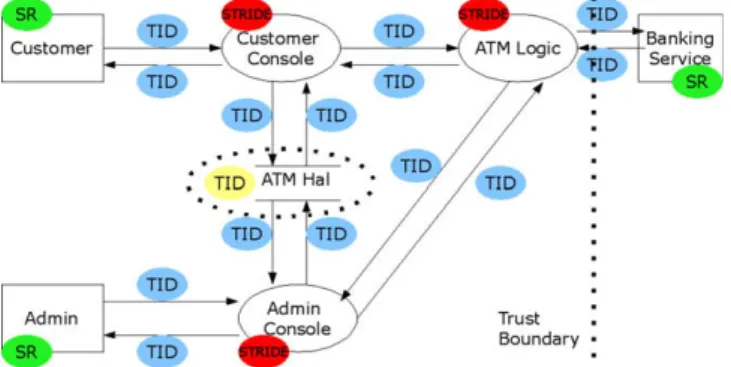
For threat modeling (Activity 4.3), the first step was to create data flow diagrams (DFD) for the system (Fig. 5
shows one of these – the colored ovals indicate which STRIDE threats are applicable to a particular entity). Thereafter, threats were to be identified by applying STRIDE on all entities in the DFD. Microsoft provides a nice threat modeling and analysis tool [7] to aid in this effort. While the book and the tool do not fully correspond (a.o. for threat elicitation and risk assignment), the tool
Fig. 4. Defining requirements in CLASP.
provides a good help in identifying, automating and ana-lyzing the threats to a system. For this case, 118 threats were identified. In terms of risk analysis, the book suggests a new approach by assigning risk levels depending on the characteristics of threats (e.g., in the context of data tam-pering, is the effect temporary or permanent), rather than assigning values for a threat’s likelihood and impact, since this is typically perceived as a difficult task. For the exper-iment, most of the threats were identified as level 2, while the other levels (1, 3 and 4) were assigned only sporadically.
5.2.3. Discussion
Overall, the majority of time was spent on the threat modeling (approx. 30 h). Threat modeling was perceived as a feasible activity, except for the rating of risks, which is rather arbitrary.
One of the clear benefits of SDL is the systematic approach to the architectural threat modeling. By assigning STRIDE threats to all elements in the data flow diagrams, no obvious threats are missed. The other processes by far do not perform equally well for basic threat modeling. However, there are some downsides linked to the STRIDE threat modeling as well: the systematic analysis results in an explosion of elicited threats, which then requires a good risk analysis method to be managed. Unfortunately, the risk assessment technique does not seem to perform very well for our case. Most threats were assigned risk level 2. This can be explained by the fact that the characteristics are not always fully clear when applied to practical situa-tions, or the fact that the risks to be assigned are not very well spread over the risk spectrum (more than half of the leaves in the threat tree patterns assign risk level 2). Another downside to the process is that it focuses on ele-ments in isolation, rather than identifying threats to a par-ticular combination of elements. The latter might reduce the explosion of threats, since many threats are actually linked to a few higher-level threats (analogous to the idea of threat trees).
5.3. Touchpoints 5.3.1. Analysis
According to the McGraw’s theoretical model, three touch points are of interest in this phase: Security Require-ments, Risk Analysis, and Abuse Cases.
In particular, thesecurity requirements touch point sug-gests to elicit financial or commercial considerations, con-tractual obligations, and legal/regulatory risks (see Activities 3.4.1–3.4.3). We applied this activity to the bank-ing domain with the followbank-ing results:
Financial and commercial considerations. Commercial assets such as reputation are important in this domain. Part of keeping up a good reputation is making sure the system is ‘‘always” available as well as limiting the number of incorrectly executed transactions (availability requirement). Financial considerations are also
impor-tant. For example, it was recognized that system has to assure that the transactions are executed using the correct amount of money involved, i.e., no rounding errors and such are introduced (accuracy requirement).
Contractual obligations. As the client stakeholder is not available in our case, we have no results out of this activity.
Legal and regulatory risks. The system deals with per-sonal information, hence privacy laws must be taken into account. Other legal implications concern the obli-gation of keeping track of dodgy/fraudulent behavior for judiciary purposes (auditing requirement). Further, since transactions might constitute as evidence used in court, repudiation of such transactions should not be possible (non-repudiation requirement). In particular, supposing that the system is to be deployed in Europe, four Council Directives apply.
Theabuse cases touch pointproved to be very powerful. In this area, three main activities were performed:
Identify and Revise Threat agents (Activity 3.3.1). Five types of attacker profiles were identified: organized crime, small criminals, insiders, legitimate users, script kiddies.
Use Case Driven Analysis (Activity 3.3.2). A list of 20 scenarios that the system should prevent were identified, such as retrieving more money than is available in the account, depositing money to an account without iden-tification, or shutting down the ATM system without authorization.
Attack Driven Analysis (Activity 3.3.4). From a list of attack patterns provided by the process as a resource, 21 attacks were selected as relevant for the case study. It is interesting to note that each activity must be per-formed iteratively. Each activity is followed by a review step until the quality is satisfactory and the results are approved.
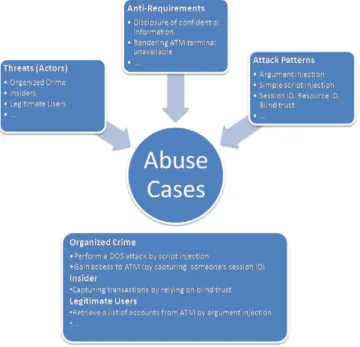
In Activity 3.3.4, the abuse case are finally produced as a cross-product of threat agents, anti-requirements, and attacks. Of course, not all attacks can be performed by each attacker profile. For instance, complex attacks are not considered for script kiddies. Nevertheless, we observed an explosion in the number of abuse cases. The output is schematized in Fig. 6, which, due to space con-straints, does not include the complete results.
In the final step, the abuse cases were ranked according to risk (Activity 3.3.6). We applied a three-level categoriza-tion: must-have, important to have, nice but unnecessary to have. This classification is suggested by the risk analysis touch pointwhen it comes to ranking the security require-ments (described above). For the sake of homogeneity, we used the same ranking criteria for abuse cases as well. As a result of this activity, out of the 35 identified abuse cases, 74% were ranked as must-haves, 23% as important, and only 3% as unnecessary.
5.3.2. Design
The design phase is covered by the architectural risk analysis touch point. This phase is less rich of distinguishing results. Indeed, architectural risk analysis is largely based on the STRIDE technique, which has been already illus-trated in Section5.2.
As far as Activity 4.1.1 is concerned, it was skipped as no third party component is used in this simple application.
5.3.3. Discussion
Overall, the time needed to carry out the experiment was equally distributed among the analysis phase (14 h) and the design phase (14 h). The creation of the abuse cases was perceived as a low-to-medium complexity task; the archi-tectural risk analysis as hard, especially the ambiguity and weakness analysis.
In conclusion, some general observations have been gathered during the execution of this experiment. On the positive side, the team was particularly pleased by the thor-oughness of the analysis phase. First, there is some focus on laws and regulations. In several sectors, like health, avi-ation and finance, the existing regulavi-ations and laws are indeed primary sources of (security) requirements. Second, the methodological way of building high-level anti-require-ments (via abuse cases) is particularly interesting. McGraw’s methodology acknowledges the importance of having two levels of misuse analysis, i.e., both at the requirements and the architectural level.
On the negative side, applying the touch points is not always straightforward. Both the Abuse Cases and the Architectural Risk Analysis are described via a detailed flow chart of activities. This has been appreciated by the team, however, a limited amount of information about
howto perform each step in the chart is provided. In other
words, the team found that too often there is room for interpretation and uncertainty about what to do in practi-cal terms. Second, the process tends to get too technipracti-cal too soon. An example is the list of attacks provided during analysis in order to elicit the abuse case. For instance, dur-ing the requirements phase, it is hard to decide whether a ‘‘buffer overflow with environment variables” is a viable attack, as the detailed design description of the system is yet to come.
6. Discussion and improvements
In this section we discuss a number of fundamental improvements, which the processes could benefit from.
6.1. Quality and coverage
During the analysis of activities, it was observed that some of them do not correspond to the state-of-the-prac-tice definition for process activities. From a general per-spective, a process involves a temporally ordered series of activities that, starting from an input state, leads to an out-come by using a set of resources like time, and expertise.
Activities must produce added value in the form of an output, which must be clearly identified in an artifact. As a counter-example, only two activities in CLASP clearly specify the artifacts that should be produced. Touchpoints scores better here as for some touch points they provide a process diagram stating the outputs of the different activi-ties. It is also important that the delta between input and output, the ‘visible impact’, is large enough to make an activity worthwhile. If this criterion is applied to the pro-cesses, it can be observed that some of the construction steps are guidelines rather than real activities. For instance, SDL suggests to use the latest compilers and to avoid using deprecated functions from libraries. According to the above discussion, this is more of a coding guideline than a process activity. A similar but reverse example comes from the Touchpoints. An initial step of the static code analysis activities is the selection of the tools to be used for the automated analysis itself. In that case, the impact is more visible, as the activity starts from a list of candi-dates and ends up with a set of selected tools and their associated configuration (to be used later on in the pro-cess). As another positive example, CLASP addresses the impact of each of the 24 top-level activities in the Activ-ity-Assessment View.
According to Davenport[8], the characteristic of a busi-ness process is to focus on the procedural aspects of the activities, i.e., how work is done and not only what work has to be done. That is, activities should provide a ‘system-atic method’ to put in practice what they suggest. It is observed that SDL and CLASP both fall short in support-ing the aforementioned property. For instance, the CLASP activityapply security principles to design(Activity 4.4) has no clear methodological indication on how to realize the activity. McGraw’s process provides a (basic) method for
some of the touch points, but unfortunately not for all of them. This method is shown in the form of a process dia-gram and some related information. A good example is the diagram explaining the steps to perform the weaknesses analysis of off-the-shelf components during the architec-tural risk analysis touch point (see Activity 4.4.13).
Besides these quality issues, a few coverage gaps were observed, i.e., phases that have little or no support. First, activities at the design stage are mostly oriented towards detailed design. For instance, at architectural level, there is room for specific activities in the area of trade-off analy-sis, e.g., security vs. usability. Second, in both SDL and Touchpoints there is very limited support during the deployment phase. In SDL it is limited to user documenta-tion, while Touchpoints only talks about the contribution that InfoSec people can bring into the project at that phase (Activity 8.4). Further support for deployment could include the management of the security solution by enforc-ing operational procedures, as well as the monitorenforc-ing of the security solution in order to proactively discover weaknesses.
6.2. Security in context
Two main constraints must be considered when it comes to security-specific activities: the integration with an exist-ing process and the cost of augmentexist-ing a process with security.
Concerning integration, many medium-to-large organi-zations already have a heavyweight and rigorous develop-ment process in place, e.g., according to the Unified Process [9]. Furthermore, many of them have achieved a significant level of process maturity and have received a certification for their accomplishment. For these organiza-tions, it is key to have a set of clear guidelines to ease up the difficult task of integrating new security-centric activities in a well-established, preexisting instance of a standard process.
For smaller organizations with a more lightweight and less rigorous process, merging the security process with the existing informal software development process is less of a problem. However, these organizations may have a non-tra-ditional process in place, e.g., they may be using agile tech-niques such as Extreme Programming [10]. There is a knowledge gap with respect to the problem of integrating CLASP in agile methods. Conversely, SDL’s and Touch-points’s support in this direction is far more extensive.
It is impossible to build a 100% secure system, especially in day-to-day system construction with a constant trade-off between security and other constraints such as the cost. This will have an impact on the accuracy with which cer-tain activities are being executed and on the set of activities that will be executed in the first place. Therefore, it would be useful to provide guidelines for selecting the set of rele-vant activities. At a minimum, a distinction could be made between a core set of mandatory activities and its accessory extensions. Also, an indication of the risk associated with
the omission of accessory activities is useful. For instance, CLASP provides such information to some extent (in the Activity-Assessment View) and Touchpoints has a prioriti-zation of the touch points that can be used as a guide. It would seem useful to extend this into a maturity-like approach (e.g., based on SSE-CMM[11]) in order to indi-cate the desired rigor to be put in the execution of certain activities more precisely. Based on this, a number of pro-files could be defined for different types of environments and applications domains. Additionally, these indications could be used to drive the assurance process of the software afterwards.
6.3. Verification
Application functionality is a positively spaced problem: functional requirements are specified in an affirmative man-ner (what behavior should occur) and verifying the correct-ness of a functional requirement focuses on the (limited) set of executions of the particular function. In clear contrast, security is to a large extent negatively spaced. Security requirements typically state which behavior should not occur. Since the set of executions of a software artifact is infinite, it is much harder to cover this set in order to guar-antee the correct realization of a security requirement in software. Therefore, it is crucial to institute verification as an important fill rouge throughout the process, comple-mentary to construction activities.
Verification is in practice often closely linked to a partic-ular construction activity, i.e. to ensure that the activity has been done right. For instance, when building a threat tree one could verify that all types of threats are covered sys-tematically for every asset in the system. While the impor-tance of this type of verification is clear, it is equally important to include dedicated verification efforts that focus on relations between activities as well as on spanning significant sets of activities. For instance, one could cross-check the security requirements set with the operational policy.
The experiment with the ATM system has shown that the verification of results of activities is difficult in practice since (i) it is often not clear what it means to be correct (i.e., no precise criteria have been defined) and (ii) the method to be used for verification is not defined. Consequently, most verification has been performed manually and in an ad-hoc manner. There is a lot of room for improvement in this area. Clearly, the availability of good metrics (see next sec-tion) can be a catalyst for improving verification.
6.4. Metrics
The software engineering practice assigns a significant role to metrics. They are a quantitative means to measure the progress of quality for the process itself and the pro-duced artifacts. CLASP, Touchpoints and (particularly) SDL all have only limited focus on metrics. Two directions of improvement can be foreseen.
First, a program to evaluate the effectiveness of the secu-rity process itself must be instituted. The program should be responsible for continuously assessing both the real impact of security activities on product quality and the optimal usage of resources (e.g., time and personnel). The importance of measuring the impact of security is some-what mentioned by examples in Touchpoints, but the met-rics program devised by McGraw is primarily intended to measure the level of adoption of the touch points, i.e., it is a CMM-like measurement program. To assess the opti-mal usage of the security budget, the process should pro-vide baseline figures about time and personnel required by the activities. For instance, CLASP provides informa-tion about the time that is required to carry out activities. Second, specific measuring activities should be included in all development phases to assess the quality of artifacts from a security perspective and at different levels of abstraction. Such measures could play a leading role in defining acceptance criteria for software artifacts during all stages of the development process. More importantly, metrics should constitute an analysis tool to identify criti-calities early on, with remarkable impact on cost. To some extent, CLASP tries to pursue this direction, as a whole top-level activity is dedicated to metrics. However, the implementation of this type of measuring program is diffi-cult. Indeed, there is not a clear understanding of which properties should be observed in order to asses security qualities. Some work exists concerning the implementation and the deployment phase[12], but significant gaps have to be filled by the research community.
6.5. Principled process
Several security principles have been enumerated in the literature [13–15]. Examples include ‘minimize attack sur-face’ and ‘run with least privilege’. The value of such prin-ciples is so widely recognized that their enforcement should be explicitly assisted by the process.
Activities could be annotated in order to highlight their contribution to the realization of a specific principle. For instance, CLASP activity map roles and resources to entry point (Activities 5.2.5 and 5.2.6) relates to the ‘minimize attack surface’ principle. In CLASP, principles are seldom addressed a few times, but the relationship between activi-ties and principles is not worked out systematically. In SDL, principles are explicitly mentioned only twice. In Touchpoints they are explicitly mentioned as part of the knowledge pillar of the process, i.e., the part of the method that covers the sources of information to be used during the activities. However, there is no explicit mention about how to use them practically in the touch points. Further-more, new constructive activities could be introduced to better support principles. Finally, some verification activi-ties can be put in place to assess the compliance of process artifacts with principles. For instance, the SDL activity
Scrub the attack surface(Activity 5.2.7) contributes to the
verification of the above-mentioned ‘minimize attack sur-face’ principle.
6.6. Process support for moving targets
It is common knowledge that security is a moving target: applications change, execution environments change, attackers change, and new (types of) bugs are found. This influences the security posture of a software application and, consequently, it also affects the construction process of secure software in different ways. First, under the hypothesis that the previously articulated security assump-tions remain valid, the process must include continuous support to address new security vulnerabilities after the software has been released. This is supported in CLASP and SDL by including activities that focus on software updates and security advisories. Touchpoints does not seem to cover this. Second, and more challenging, when intermediate results turn out to be incorrect (such as an incomplete threat model), or when security assumptions change after deployment, the process must be backtracked in order to correct the no-longer valid decisions and assumptions. In a process, backtracking can be supported by introducing iterative cycles, or by inserting dedicated checkpoints and feedback loops. This kind of support is limited in the covered processes.
In the same way, it is challenging to enforce security requirements on a moving target, functionality-wise. For instance, if the use cases of a system change frequently, threat modeling must be repeated every time and since many activities are based on the outcome of threat model-ing, this will have several ripple effects. These effects could be limited by choosing a limited set of locations in the pro-cess to which security activities are added.
Traceability of decisions and relations between interme-diate results constitute a way to improve the support for change management. As such, one can more clearly ana-lyze and estimate the impact of modification on the devel-oped system.
7. Related work
To the authors’ knowledge, no evaluative studies have been performed on secure software development processes. Therefore, the discussion on related work focuses on (i) related processes covering the entire secure development life-cycle, and (ii) methodologies focusing specifically on particular construction or assurance activities.
There are a number of resources that cover the entire secure development life-cycle. Build Security In [16] is a website maintained by the Software Engineering Institute (SEI) and sponsored by the DHS National Cyber Security Division. Part of the available material and their contribu-tors are closely related to Touchpoints. The website pro-vides an overview of existing processes and methods for each development phase. These methods are not secure software methodologies, but rather tools that can be used