Introduction to the Security Engineering
Risk Analysis (SERA) Framework
Christopher Alberts Carol Woody Audrey Dorofee November 2014 TECHNICAL NOTE CMU/SEI-2014-TN-025 CERT Division http://www.sei.cmu.edu
Copyright 2014 Carnegie Mellon University
This material is based upon work funded and supported by the Department of Defense under Contract No. FA8721-05-C-0003 with Carnegie Mellon University for the operation of the Software Engineer-ing Institute, a federally funded research and development center.
Any opinions, findings and conclusions or recommendations expressed in this material are those of the author(s) and do not necessarily reflect the views of the United States Department of Defense.
This report was prepared for the SEI Administrative Agent AFLCMC/PZM
20 Schilling Circle, Bldg. 1305, 3rd floor Hanscom AFB, MA 01731-2125
NO WARRANTY. THIS CARNEGIE MELLON UNIVERSITY AND SOFTWARE ENGINEERING INSTITUTE MATERIAL IS FURNISHED ON AN “AS-IS” BASIS. CARNEGIE MELLON
UNIVERSITY MAKES NO WARRANTIES OF ANY KIND, EITHER EXPRESSED OR IMPLIED, AS TO ANY MATTER INCLUDING, BUT NOT LIMITED TO, WARRANTY OF FITNESS FOR PURPOSE OR MERCHANTABILITY, EXCLUSIVITY, OR RESULTS OBTAINED FROM USE OF THE MATERIAL. CARNEGIE MELLON UNIVERSITY DOES NOT MAKE ANY
WARRANTY OF ANY KIND WITH RESPECT TO FREEDOM FROM PATENT, TRADEMARK, OR COPYRIGHT INFRINGEMENT.
This material has been approved for public release and unlimited distribution except as restricted be-low.
Internal use:* Permission to reproduce this material and to prepare derivative works from this material for internal use is granted, provided the copyright and “No Warranty” statements are included with all reproductions and derivative works.
External use:* This material may be reproduced in its entirety, without modification, and freely distrib-uted in written or electronic form without requesting formal permission. Permission is required for any other external and/or commercial use. Requests for permission should be directed to the Software En-gineering Institute at [email protected].
* These restrictions do not apply to U.S. government entities.
Carnegie Mellon® and CERT® are registered marks of Carnegie Mellon University. DM-0001881
Table of Contents
Acknowledgments vii
Abstract ix
1 Introduction 1
1.1 Importance of Software Security 1
1.2 Focus of the SERA Framework 3
1.3 About This Report 4
2 Problem Space 6
3 Security Risk Concepts 9
3.1 Security Risk 9
3.2 Risk Measures 11
3.3 Risk Management 11
3.4 Controlling Security Risks 11
3.5 Complexity of Security Risk 12
4 SERA Approach 14
4.1 Security Risk Environment 14
4.2 SERA Differentiators 16
5 Operational Models 17
5.1 Multiple Models 17
5.2 Example: Operational Models 18
5.2.1 Top-Level Workflow Model 18
5.2.2 Top-Level Network Model 20
5.2.3 Data Model 23
6 Scenario-Based Risk Analysis 24
6.1 Security Risk Scenario 24
6.2 Risk Statement 26
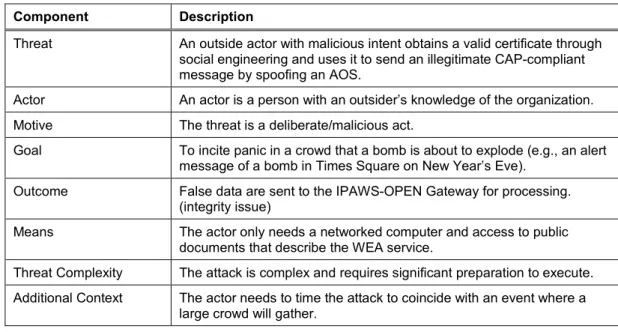
6.3 Threat Components 26
6.4 Threat Sequence 27
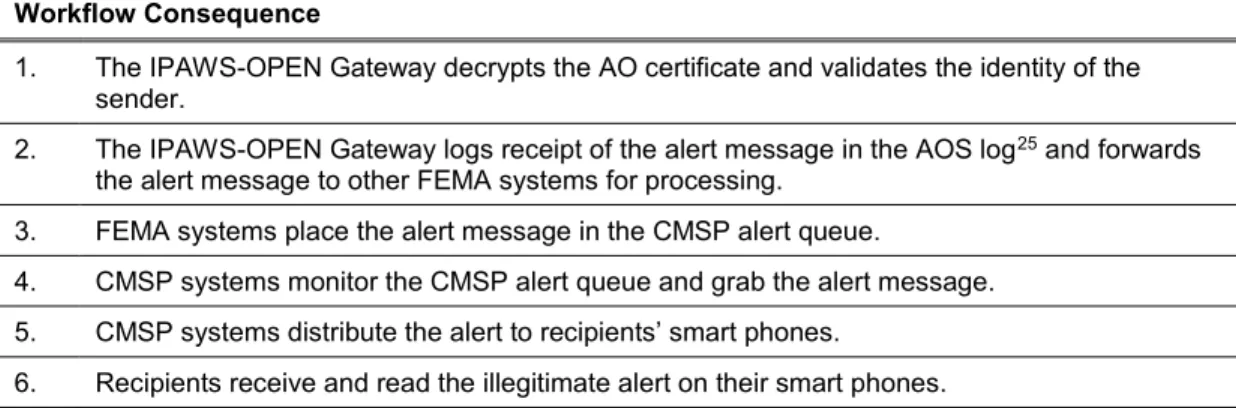
6.5 Workflow/Mission Thread Consequences 28
6.6 Stakeholder Consequences 28
6.7 Enablers 29
7 SERA Framework Overview 31
7.1 Establish Operational Context (Task 1) 31
7.2 Identify Risk (Task 2) 32
7.3 Analyze Risk (Task 3) 33
7.4 Develop Control Plan (Task 4) 34
8 Summary and Next Steps 37
8.1 Early Piloting of SERA 37
8.2 Future SERA Development 37
8.3 Aligning with Standards, Laws, and Regulations 38
8.4 Final Thoughts 39
List of Figures
Figure 1: SERA Framework: Technical Perspectives 3
Figure 2: Components of Security Risk 10
Figure 3: Risk Management Activities 11
Figure 4: Security Risk Environment 14
Figure 5: Top-Level Workflow Model 19
List of Tables
Table 1: Operational View 17
Table 2: WEA Data Model 23
Table 3: Threat Components 27
Table 4: Threat Sequence 27
Table 5: Workflow Consequences 28
Table 6: Stakeholder Consequences 29
Table 7: Enablers 30
Table 8: Task 1: Steps Performed 32
Table 9: Task 2: Steps Performed 33
Table 10: Task 3: Steps Performed 34
Table 11: Task 4: Steps Performed 35
Table 12: Risk Probability Criteria 40
Table 13: Risk Impact Criteria 41
Table 14: Risk Exposure Matrix 42
Table 15: Risk Measures 43
Table 16: Prioritized Risk Spreadsheet 44
Acknowledgments
This report describes our initial phase of research into early lifecycle risk analysis. We would like to thank Kevin Fall, Chief Technical Officer of the Software Engineering Institute, for providing the initial research funding for this work. We would like to thank those members of the software acquisition-and-development community who reviewed our early conceptual designs and pro-vided our initial pilot opportunities. We were fortunate to have support from both the Department of Defense (DoD) and Federal Civilian Agencies. We would also like to thank the participants at our challenge problem workshop in August 2014. Their thoughtful feedback helped us to improve our approach and enabled us to chart a course for future research and development related to this work. Finally, we would like to thank Rita Creel and Stephen Blanchette for reviewing this report.
Abstract
Software is a growing component of modern business- and mission-critical systems. As organiza-tions become more dependent on software, security-related risks to their organizational missions are also increasing. Traditional security-engineering approaches rely on addressing security risks during the operation and maintenance of software-reliant systems. However, the costs required to control security risks increase significantly when organizations wait until systems are deployed to address those risks. It is more cost effective to address software security risks as early in the lifecycle as possible. As a result, researchers from the CERT Division of the Software
Engineer-ing Institute (SEI) have started investigatEngineer-ing early lifecycle security risk analysis (i.e., durEngineer-ing re-quirements, architecture, and design). This report introduces the Security Engineering Risk Anal-ysis (SERA) Framework, a model-based approach for analyzing complex security risks in software-reliant systems and systems of systems early in the lifecycle. The framework integrates system and software engineering with operational security by requiring engineers to analyze oper-ational security risks as software-reliant systems are acquired and developed. Initial research ac-tivities have focused on specifying security requirements for these systems. This report describes the SERA Framework and provides examples of pilot results.
1 Introduction
Software is a growing component of modern business- and mission-critical systems. As organiza-tions become more dependent on software, security-related risks to their organizational missions are also increasing. Traditional security-engineering approaches rely on addressing security risks during the operation and maintenance of software-reliant systems. However, the costs required to control security risks increase significantly when organizations wait until systems are deployed to address those risks. It is more cost effective to address software security risks as early in the lifecycle as possible.
In October 2013, researchers from the CERT Division at Carnegie Mellon University’s
Soft-ware Engineering Institute (SEI) started investigating early lifecycle security risk analysis. Our initial research suggests that applying traditional security risk-analysis methods earlier in the lifecycle will not solve the problem because those methods cannot handle the inherent complexity of modern cybersecurity attacks. New approaches are needed.
As a result, we developed the Security Engineering Risk Analysis (SERA) Framework, a security risk-analysis approach that advances the existing state-of-the-practice. The SERA Framework in-corporates a variety of models that can be analyzed at any point in the lifecycle to (1) identify se-curity threats and vulnerabilities and (2) construct sese-curity risk scenarios. Those scenarios are then used to focus an organization’s limited resources on controlling the most significant security risks.
This report discusses the contribution of the SERA Framework, given today’s increasingly com-plex threat environment; reviews the framework’s basis in existing research and practice; intro-duces the framework key differentiators; highlights piloting of the framework to elicit better secu-rity requirements; and proposes future work to build a SERA method description and additional model types and archetypes to support use of the framework.
1.1 Importance of Software Security
Software assurance is defined as a level of confidence that software functions as intended and is free of vulnerabilities, either intentionally or unintentionally designed or inserted as part of the software, throughout the lifecycle [NIA 2010]. Software assurance has been legislatively man-dated for the Department of Defense (DoD) in the National Defense Authorization Act for Fiscal Year 2013 [NDAA 2013]. The pursuit of software assurance is a worthy goal that must be trans-lated into practical methods that acquirers, designers, and developers can apply throughout the ac-quisition-and-development lifecycle.
Software assurance is becoming increasingly important to organizations across all sectors because of software’s increasing influence in business- and mission-critical systems. For example, con-sider how the size of flight software1 has increased over the years. Between 1960 and 2000, the
degree of functionality provided by software to the pilots of military aircraft has increased from 8% to 80%. At the same time, the size of software in military aircraft has grown from 1,000 lines of code in the F-4A to 1.7 million lines of code in the F-22. This growth trend is expected to con-tinue over time [NASA 2009]. As software exerts more control of complex systems, like military aircraft, the potential risk posed by cybersecurity2 vulnerabilities will increase in kind.
Cost is another dimension of cybersecurity vulnerabilities that must be taken into account. Many cybersecurity vulnerabilities are considered to be software faults because their root causes can be traced to the software’s requirements, architecture, design, or code. Studies have shown that the cost of addressing a software fault increases significantly (up to 200 times) if it is corrected during operations as opposed to design [Mainstay 2010, Microsoft 2014, Soo Hoo 2001]. In addition, re-work related to defects consumes more than 50% of the effort associated with a software project. It is thus more cost effective to address software faults early in the lifecycle rather than wait until operations. This principle applies to many operational security vulnerabilities as well.
Operational security vulnerabilities generally have three main causes: (1) design weaknesses,3 (2)
implementation/coding errors, and (3) system configuration errors. Addressing design weaknesses as soon as possible is especially important because these weaknesses are not corrected easily after a system has been deployed. For example, software maintenance organizations normally cannot issue a patch to correct a fundamental security issue related to the software’s requirements, archi-tecture, or design. Remediation of design weaknesses normally requires extensive changes to the system, which is costly and often proves to be impractical. As a result, software-reliant systems with design weaknesses often are allowed to operate under a high degree of residual security risk, putting their associated operational missions in jeopardy.
Secure coding and operational security practices help address implementation/coding vulnerabili-ties and system configuration errors respectively. However, design weaknesses represent 19 of the top 25 weaknesses documented in the Common Weakness Enumeration4 (CWE) [MITRE 2011].
The importance of design weaknesses in managing cybersecurity risk cannot be overstated. Our experience indicates that many acquisition and development programs implement compli-ance-based approaches to address design weaknesses. Engineers typically select security controls based on mandated requirements. However, these compliance-based controls do not necessarily consider the unique characteristics of the operational environment in which a system will be de-ployed. In addition, attackers are not limited by mandated security controls. They tend to study a
1 Flight software is a type of embedded real-time software used in avionics. 2 We use the terms cybersecurity and security interchangeably in this document.
3 In this report, we define a design weakness to be a security-related defect in software’s requirements,
architec-ture, or design.
4 The Common Weakness Enumeration (CWE) is an online dictionary of weaknesses that have been found in
computer software. The dictionary is maintained by the MITRE Corporation. The purpose of CWE is to facilitate the effective use of tools that identify, find, and resolve bugs, vulnerabilities, and exposures in computer soft-ware before the programs are publicly distributed or sold.
system of interest in its operational environment, looking for specific vulnerabilities to exploit. While compliance with mandated security controls is necessary, it might not be sufficient to re-duce the residual operational security risk of deployed software-reliant systems. Engineers need to look beyond compliance when designing and developing software-reliant systems.
While software and system engineers normally perform extensive analysis to check safety and performance issues, they often do not check for potential problems related to security. By evaluat-ing software-and-system design weaknesses, these engineers can validate that a software-reliant system—as conceived, designed, and built—will perform its functions within an acceptable de-gree of security risk. Analyzing software security risk early in the acquisition-and-development lifecycle helps build confidence that the system will function as intended during operations even in the event of a cybersecurity attack.
1.2 Focus of the SERA Framework
Prior to developing the SERA Framework, we reviewed relevant research literature to understand the current state of the practice for early lifecycle security risk analysis. Our review indicated that most security risk-analysis methods cannot handle the inherent complexity of modern cybersecu-rity attacks. Current methods are normally based on a simple, linear view of risk that assumes that a single threat actor exploits a single vulnerability in a single system to cause an adverse conse-quence. In reality, multiple actors often exploit multiple vulnerabilities in multiple systems as part of a complex chain of events. As a result, we have focused our efforts on developing a risk-analy-sis approach capable of handling the complexity of today’s cybersecurity attacks.
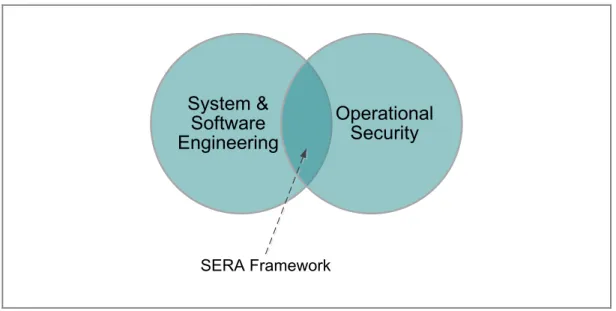
As shown in Figure 1, the SERA Framework incorporates two important technical perspectives: (1) system and software engineering and (2) operational security. The framework requires engi-neers to consider operational security risks early in the lifecycle. This approach blends multiple technical disciplines and defines a complex analysis activity.
System &
Software
Engineering
Operational
Security
SERA Framework Figure 1: SERA Framework: Technical PerspectivesThe SERA Framework is not a quick check-the-box analysis activity. Rather, it defines an engi-neering practice for analyzing risk in software-reliant systems that are being acquired and devel-oped, with the ultimate goal of building security into those systems. The tasks specified in the framework are designed to be integrated with a program’s ongoing system engineering, software engineering, and risk management activities. In fact, our field experience indicates that most pro-grams are already performing many aspects of the framework. By applying the SERA Frame-work, engineers can assemble and augment existing program information in ways that enable bet-ter decisions regarding software security.
1.3 About This Report
This report presents our initial research results, not a final product. The primary audience for this report is anyone interested in learning about new approaches for analyzing security risks during requirements development. In addition, people who are interested in learning about advanced con-cepts in security risk analysis will also find this document useful. A secondary audience is practi-tioners, such as systems engineers, software engineers, operational-security risk analysts, and sys-tem/software engineering managers. As we mature the SERA Framework, we will develop publications and other products that are oriented toward practitioners. In general, anyone who is interested in the following topics will find this report worthwhile:
• performing early lifecycle security risk analysis • analyzing security risk in complex environments • building security into software-reliant systems • specifying risk-based security requirements
This report provides a conceptual framework for conducting security risk analysis early in the ac-quisition-and-development lifecycle and presents detailed examples from our early piloting of the framework. This document includes the following sections:
• Section 1: Introduction—presents a brief introduction to the SERA Framework and provides some of the motivation for its development
• Section 2: Problem Space—defines the six key perspectives of the operational environment in which the SERA Framework is applied
• Section 3: Security Risk Concepts—highlights key foundational concepts of cybersecurity risk management
• Section 4: SERA Approach—describes the key elements of the security risk environment and highlights the main differentiators of the SERA Framework
• Section 5: Operational Models—presents examples of the types of models developed when applying the SERA Framework
• Section 6: Scenario-Based Risk Analysis—presents examples of the security risk scenarios produced when applying the SERA Framework
• Section 7: SERA Framework Overview—outlines the tasks and steps of the SERA Framework • Section 8: Summary and Next Steps—presents next steps in the development and transition of
the SERA Framework
• Appendix: Example Results for Risk Analysis and Control—provides examples of analyzed risks and control plans produced when applying the SERA Framework
The main purpose of this report is to present an overview of the SERA Framework. However, be-fore we dive into the details of the framework, we first provide the conceptual basis of our re-search. The next section of this report begins exploring the fundamental concepts of our research by describing the problem space for our work.
2 Problem Space
Our research-and-development goal for the SERA project is to develop an approach capable of analyzing the complexity of modern cybersecurity risks. Based on this goal, a key question to an-swer is “What is driving the complexity of security risks?” To anan-swer that question, we begin with the operational environment in which security risk analysis must be performed. Many sources of complexity originate in the network of people, processes, and technologies that form the foundation of an organization and its operational environment. We use the following perspec-tives to describe the complexity of today’s operational environments:
• software • socio-technical • cyber-physical • mission • system of systems • compliance
These perspectives are important because they influence how security risk analysis must be per-formed in practice. As a result, the six perspectives define the problem space for our research-and-development activities. Each perspective is described in the remainder of this section, beginning with the software perspective.
Software Perspective: A software-reliant system is a system whose behavior (e.g., functionality,
performance, safety, security, interoperability) is dependent on software in some significant way [Bergey 2009]. The software perspective is focused on building security controls into a software-reliant system, not treating security as an add-on feature that will be addressed during software sustainment activities. This perspective requires addressing security concerns from the earliest phases of the system and software lifecycles through the sustainment and evolution of deployed software-reliant systems.
Socio-Technical Perspective: A socio-technical system is defined as interrelated technical and
so-cial elements that are engaged in goal-oriented behavior. Elements of a socio-technical system in-clude the people who are organized in teams or departments to do their work tasks and the tech-nologies on which people rely when performing work tasks. This perspective stresses the prominent role of people in creating, using, and maintaining technologies. It also highlights the role of people in causing and preventing security attacks.
Cyber-Physical Perspective: A cyber-physical system is an engineered system that is built from,
and depends upon, the seamless integration of computational algorithms and physical compo-nents. Cyber-physical systems merge the physical and virtual worlds, integrating objects, data, and services. Cyber processes monitor and collect data from physical processes, such as the steer-ing of an automobile or the observation of vital signs of a hospital patient. Cyber-physical systems are networked, making their data globally available to other processes. These systems thus make it possible for software to directly interact with events in the physical world. The cyber-physical
perspective emphasizes the notion that cybersecurity attacks can produce consequences in the physical world.
Mission Perspective: A mission is a fundamental objective or purpose being pursued by an
indi-vidual, group, or organization. People, processes, and technologies are then organized in a manner to achieve the mission. This perspective highlights the effect of cybersecurity attacks on the mis-sion that an individual, group, or organization is pursuing. As a result, a security risk analysis must extend beyond the boundary of a technical system and consider the impact on the mission.
System-of-Systems Perspective: A system of systems is defined as a set or arrangement of
interde-pendent systems that are related or connected (i.e., networked) to provide a given capability [Lev-ine 2003]. The following characteristics are used to differentiate a system of systems from a very large, complex monolithic system [Maier 1996]:
• managerial independence—The management of each system within a system of systems is independent from the management of the other systems.
• operational independence—Each system within a system of systems provides useful func-tionality apart from other systems.
• evolutionary character—Each system within a system of systems grows and changes inde-pendently of other systems over time.
• emergent behavior—Certain behaviors of a system of systems arise from the interactions among the individual systems and are not embodied in any of the individual systems. • geographic distribution—Individual systems within a system of systems are dispersed over
large geographic areas.
The system-of-systems perspective describes how a software-reliant system must function as part of a multi-system environment to achieve stakeholders’ objectives. This complex, multi-system environment has implications for how security is analyzed and managed. This perspective also il-lustrates the complex nature of security attacks and how they typically include many systems that are managed by multiple, independent organizational entities.
Compliance Perspective: Compliance is defined as the state of being in accordance with
estab-lished guidelines, specifications, or legislation or the process of becoming so. The compliance perspective describes the range of security guidelines, specifications, and laws to which an organi-zation must adhere. Examples include
• DoD Instruction 8510.01: Risk Management Framework (RMF) for DoD Information
Tech-nology (IT) [DoD 2014]
• NIST Special Publication 800-37 Revision 1: Guide for Applying the Risk Management
Framework to Federal Information Systems: A Security Life Cycle Approach [NIST 2010] • NIST Special Publication 800-30 Revision 1: Guide for Conducting Risk Assessments [NIST
2012]
• NIST Special Publication 800-160: Systems Security Engineering: An Integrated Approach to
Building Trustworthy Resilient Systems [NIST 2014a]
As a result, a security risk analysis must consider and, when appropriate, incorporate the practices and controls specified in relevant guidelines, specifications, and laws. Each sector may be re-quired to comply with specific and unique set of mandated requirements. However, most man-dated cybersecurity requirements share a common set of principles and characteristics.
Traditional security-risk analysis methods generally address one or two of the above perspectives.
An overarching goal of our research is to define a solution that considers all six perspectives. In the next section, we begin to transition from the problem space to the solution space as we high-light the fundamental concepts of security risk analysis.
3 Security Risk Concepts
The term risk is used universally, but different audiences attach different meanings to it [Kloman 1990]. In fact, the details about risk and how it supports decision making depend on the context in which it is applied [Charette 1990]. For example, safety professionals view risk management in terms of reducing the number of accidents and injuries. A hospital administrator views risk man-agement as part of the organization’s quality assurance program, while the insurance industry re-lies on risk management techniques when setting insurance rates. Each industry thus uses a defini-tion that is tailored to its context. No universally accepted definidefini-tion of risk exists.
Whereas specific definitions of risk might vary, a few characteristics are common to all defini-tions. For risk to exist in any circumstance, the following three conditions must be satisfied [Cha-rette 1990]:
1. The potential for loss must exist.
2. Uncertainty with respect to the eventual outcome must be present.5
3. Some choice or decision is required to deal with the uncertainty and potential for loss. The three characteristics can be used to forge a basic definition of risk. Most definitions focus on the first two conditions—loss and uncertainty—because they are the two measurable aspects of risk. Thus, the essence of risk, no matter what the domain, can be succinctly captured by the fol-lowing definition: Risk is the probability of suffering harm or loss.6
3.1 Security Risk
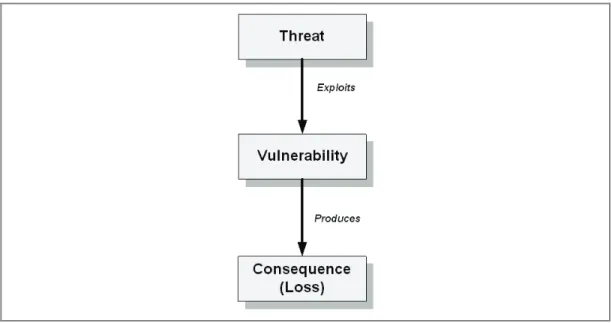
Security risk is a measure of (1) the likelihood that a threat will exploit a vulnerability to produce an adverse consequence, or loss, and (2) the magnitude of the loss. Figure 2 illustrates the three core components of security risk:
• Threat—a cyber-based act, occurrence, or event that exploits one or more vulnerabilities and leads to an adverse consequence or loss
• Vulnerability—a weakness in an information system, system security procedures, internal controls, or implementation that a threat could exploit to produce an adverse consequence or loss; a current condition that leads to or enables security risk
• Consequence—the loss that results when a threat exploits one or more vulnerabilities; the loss is measured in relation to the status quo (i.e., current state)
From the security perspective, a vulnerability is the passive element of risk. It exposes cyber tech-nologies (e.g., software application, software-reliant system) to threats and the losses that those threats can produce. However, by itself, a vulnerability will not cause an entity to suffer a loss or
5 Some researchers separate the concepts of certainty (the absence of doubt), risk (where the probabilities of
alternative outcomes are known), and uncertainty (where the probabilities of possible outcomes are unknown). However, because uncertainty is a fundamental attribute of risk, this report does not differentiate between deci-sion making under risk and decideci-sion making under uncertainty.
experience an adverse consequence; rather, the vulnerability makes the entity susceptible to the effects of a threat (adapted from the book titled Managing Information Security Risks: The OCTAVESM Approach [Alberts 2006]).
Figure 2: Components of Security Risk
Consider the following example of a security risk. An organization does not encrypt customer data as they are transmitted between systems on the internal network (to ensure quick processing of the data). Malware (i.e., a sniffer), which has been installed in an organization’s infrastructure, collects unencrypted customer data (i.e., personally identifiable information) and sends the data to designate staging points across the globe. As a result of this breach in data confidentiality, the or-ganization could suffer significant financial, legal, and reputation consequences.
The components of this security risk are
• Threat—Malware collects unencrypted customer data (i.e., personally identifiable infor-mation) and sends the data to designate staging points across the globe.
• Vulnerability—The organization does not encrypt customer data as they are transmitted be-tween systems on the internal network.
• Consequence—The organization could suffer significant financial loss, legal fees, and reputa-tion loss.
In this example, malware exploits a single vulnerability, the unencrypted transmission of data be-tween systems. However, if no threat actor (i.e., malware in the above example) attempts to ex-ploit the vulnerability and carry out the attack, then no adverse consequences will occur. The se-curity vulnerability (e.g., unencrypted data) lies dormant until a threat actor (e.g., malware) attempts to exploit it to produce an adverse consequence or loss.
3.2 Risk Measures
In general, three measures are associated with any risk: (1) probability, (2) impact, and (3) risk ex-posure.7Probability is a measure of the likelihood that the risk will occur, and impact is a
meas-ure of the loss that occurs when a risk is realized. Risk exposure provides a measure of the magni-tude of a risk based on current values of probability and impact.
3.3 Risk Management
Risk management is a systematic approach for minimizing exposure to potential losses. It pro-vides a disciplined environment for
• continuously assessing what could go wrong (i.e., assessing risks) • determining which risks to address (i.e., setting mitigation priorities)
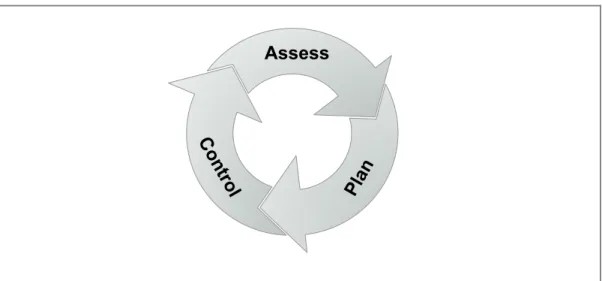
• implementing actions to address high-priority risks and bring those risks within tolerance Figure 3 illustrates the three core risk management activities:
• Assess risk—Transform the concerns people have into distinct, tangible security risks that are explicitly documented and analyzed.
• Plan for controlling risk—Determine an approach for addressing each security risk; produce a plan for implementing the approach.
• Control risk—Deal with each security risk by implementing its defined control plan and tracking the plan to completion.
Figure 3: Risk Management Activities
3.4 Controlling Security Risks
The strategy for controlling a risk is based on the measures for the risk (i.e., probability, impact, and risk exposure), which are established during the risk assessment. Decision-making criteria (e.g., for prioritizing risks or deciding when to escalate risks within an organization) may also be
Assess
Plan
used to help determine the appropriate strategy for controlling a risk. Common control approaches include
• Accept—If a risk occurs, its consequences will be tolerated; no proactive action to address the risk will be taken. When a risk is accepted, the rationale for doing so is documented.
• Transfer—A risk is shifted to another party (e.g., through insurance or outsourcing). • Avoid—Activities are restructured to eliminate the possibility of a risk occurring. • Mitigate—Actions are implemented in an attempt to reduce or contain a risk.
For any security risk that is not accepted, the security analyst should develop and document a con-trol plan for that risk. A concon-trol plan defines a set of actions for implementing the selected concon-trol approach. For risks that are being mitigated, their plans can include actions from the following categories:
• Recognize and respond – Monitor the threat and take action when it is detected.
• Resist – Implement protection measures to reduce vulnerability to the threat and minimize any consequences that might occur.
• Recover – Recover from the risk if the consequences or losses are realized.
Thus far in this section, we provide a simplified view of security risk, where a single threat actor exploits a single vulnerability in a single system to cause an adverse consequence. Most tradi-tional security risk analysis methods are based on this simplified view of risk. However, in reality, multiple actors exploit multiple vulnerabilities in multiple systems as part of a complex chain of events. In the next section, we look at the inherent complexity of security risk.
3.5 Complexity of Security Risk
Consider the following example of a complex risk scenario. In this scenario, an individual (i.e., the perpetrator) intends to steal personally identifiable information about an organization’s cus-tomer base. The individual’s goal is to steal the identities of cuscus-tomers for financial gain. To carry out this risk scenario successfully, the individual performs the following actions:
• The individual performs reconnaissance on the organization’s systems and networks. • The individual also performs reconnaissance on partners and collaborators that work with the
organization and have trusted access to the organization’s systems and networks.
• Reconnaissance indicates that the organization has strong perimeter security controls in place. As a result, the individual targets a third-party collaborator that (1) has legitimate, trusted ac-cess to the organization’s internal network and (2) has relatively weak perimeter security con-trols in place.
• The individual gains access to the third-party collaborator’s internal network by exploiting several common vulnerabilities.
• The individual uses the collaborator’s trusted access to the organization’s internal network to bypass the organization’s perimeter security controls and gain access to its network.
• Additional reconnaissance indicates that the organization does not encrypt customer data as they are transmitted between an order entry system and an inventory system (to ensure quick processing of the data). In addition, the organization does not employ rigorous monitoring in its systems and networks. The organization’s strategy is to focus primarily on its perimeter
security. The individual decides to exploit these vulnerabilities and installs malware (i.e., a sniffer) that is designed to
− steal unencrypted customer data as it is being transmitted between systems on the inter-nal network
− send the stolen data to staging points at multiple external locations
• Once installed, the malware collects unencrypted data and sends the data to the staging points. This data exchange is timed to occur during peak business hours to mask the attack.
As a result of this scenario, the organization could suffer significant financial, legal, and reputa-tion consequences. The crux of this scenario is identical to the risk that we highlighted in Secreputa-tion 3.1; however, the risk scenario presented in this section is considerably more complex. This risk scenario better represents the inherent complexity of modern security attacks, where multiple ac-tors8 exploit multiple vulnerabilities9 in multiple systems10 as part of a complex chain of events.
Traditional methods are often unable to analyze complex security attacks effectively. Our research is intended to address this deficiency in traditional security risk-analysis methods.
8 In the scenario, both the individual that initiates the attack and the malicious code are considered to be threat
actors.
9 Vulnerabilities in the scenario include lack of monitoring to detect the actor’s reconnaissance activities; allowing
trusted access to the organization’s internal network by an third-party collaborator that employs poor security practices; the organization’s lack of rigorous monitoring of its systems and networks; and lack of data encryption between the order entry and inventory systems.
4 SERA Approach
The example from Section 3.5 illustrates the notion that modern security risks are highly complex. In our current research, we are developing the SERA Framework to analyze complex security risks. We begin this section by describing the key elements of the security risk environment in which our analysis approach is applied. We then close out this section by highlighting two key differentiators of the SERA Framework.
4.1 Security Risk Environment
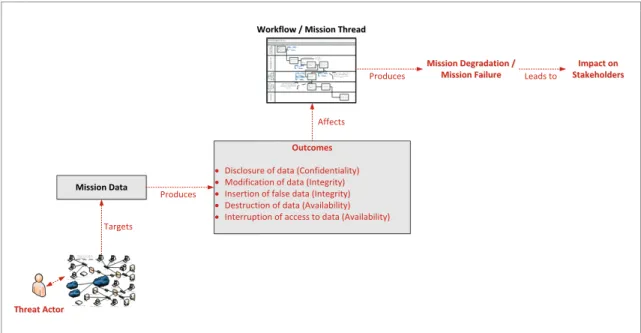
In Section 2, we describe the problem space for our research-and-development activities. Within that context, we take a closer look at the security risk environment and its characteristics. Figure 4 depicts our conceptual view of the security risk environment.
Mission Data
Outcomes
• Disclosure of data (Confidentiality)
• Modification of data (Integrity)
• Insertion of false data (Integrity)
• Destruction of data (Availability)
• Interruption of access to data (Availability)
Mission Degradation / Mission Failure
Mission Degradation / Mission Failure
Workflow / Mission Thread
Workflow / Mission Thread
Threat Actor
Threat Actor
Targets
Produces
Affects
Produces StakeholdersImpact on
Impact on Stakeholders
Leads to
Figure 4: Security Risk Environment
The focal point of the environment is the threat actor. A common goal of many threat actors is to inflict harm or loss on a mission’s stakeholders. To accomplish that goal, a threat actor first tar-gets data that are used to support a workflow or mission thread.11 To access targeted mission data,
a threat actor must navigate through the complex network of people, processes, and technologies, looking for weaknesses in organizational security practices (socio-technical perspective) and vul-nerabilities in software-reliant systems to exploit (software perspective). Getting to the mission
11 A workflow is a collection of interrelated work tasks that achieves a specific result [Sharp 2001]. A workflow
in-cludes all tasks, procedures, organizations, people, technologies, tools, data, inputs, and outputs required to achieve the desired objectives. The business literature uses several terms synonymously with workflow, includ-ing work process, business process, and process. Mission thread is essentially the term the military uses in place of workflow. A mission thread is a sequence of end-to-end activities and events that takes place to ac-complish the execution of a military operation. In this document, we use the terms workflow and mission thread
data can be difficult. A threat actor may need to jump from one targeted computer to another when attempting to realize the goal of the attack. In many cases, an actor may target computers that are owned and maintained by trusted partners and third-party collaborators when conducting a cyber-attack (system-of-systems perspective).
The threat actor is ultimately looking to violate the security attributes of mission data, with the hope of causing a range of indirect, negative consequences for mission stakeholders. Data have three basic security attributes: confidentiality, integrity, and availability.12 For a given risk, a
threat actor generally is trying to produce one or more of the following outcomes: • disclosure of data (violation of the confidentiality attribute)
• modification of data (violation of the integrity attribute) • insertion of false data (violation of the integrity attribute) • destruction of data (violation of the availability attribute)
• interruption of access to data (violation of the availability attribute)
Each outcome maps to a security attribute of the data. The example from Section 3.5 illustrates a scenario in which a threat actor steals unencrypted customer data as they are being transmitted be-tween systems on an internal network. The customer data should only be viewed by people within the company who have been authorized to view it. As a result, the confidentiality attribute of the customer data is violated because the threat actor is not authorized to view that data.
In that example, the threat actor is targeting an organization’s order entry and inventory work-flow. A key part of the organization’s mission is to protect personally identifiable information from being viewed (and stolen) by unauthorized parties (mission perspective). Protecting cus-tomer information is part of an effective organizational security program; however, in many cases, the protection of personally identifiable information is also mandated by laws and regulations (compliance perspective). As indicated in Figure 2, the violation of a security attribute has an im-pact on the workflow/mission thread and its ability to achieve its mission successfully.
The final basic element of the security risk environment is the impact on mission stakeholders.13
When a threat actor produces mission degradation or mission failure, the consequence can have a negative impact on various stakeholder groups. The example from Section 3.5 could lead to many adverse consequences. The identities of customers could be stolen, leading to considerable per-sonal financial losses. Those consumers could sue the company for not protecting their perper-sonal data properly, resulting in legal fees and resulting financial penalties for the company. Also, the company could suffer a loss in reputation, which could adversely affect its profits. This example illustrates one type of attack that could be directed at an organization’s order entry and inventory management processes. Other types of cyber-attacks could produce very different consequences,
12 Confidentiality is defined as keeping proprietary, sensitive, or personal information private and inaccessible to
anyone who is not authorized to see it. Integrity is defined as the authenticity, accuracy, and completeness of data. Availability is defined as the extent to which, or frequency with which, data mist be present or ready for use. These definitions are adapted from the book titled Managing Information Security Risks: The OCTAVESM
such as sending the wrong merchandise to customers (cyber-physical perspective). Organizations must be prepared to guard against a range of cyber-attacks.
The conceptual view of the security risk environment highlights the complex nature of security risks. The ultimate focus of our SERA research-and-development project is to develop a system-atic means for sorting through this complexity and enabling effective decision making. This focus has led to a unique approach for analyzing security risk in complex environments.
4.2 SERA Differentiators
The SERA Framework incorporates two key design features that differentiate it from other secu-rity risk assessments. The first is the use of operational models. Participants applying traditional security-risk assessments typically rely on their tacit understanding of the operational context in which a software-reliant system must operate. Our experience indicates that tacit assumptions are often incorrect or incomplete, which adversely affects the results of a security risk analysis. We propose using operational models to describe a system’s operational context explicitly. This topic is the focus of Section 5 of this report.
The second feature is the semantics that we have defined to document security risks. Most tradi-tional assessments rely on linear, simplistic structures for recording risks. These methods are based on the premise that a single threat actor exploits a single vulnerability in a single system to cause an adverse consequence. For example, many of these methods commonly employ an if-then statement to capture a risk. The if part of the statement coveys how the threat exploits a vulnera-bility, while the then portion expresses the resulting consequence. However, basic formats, such as the if-then statement, are too simplistic to capture that complexity of modern cybersecurity at-tacks. Here, we propose using scenarios to document the inherent complexities and nuances of se-curity risk. We describe the structure of sese-curity risk scenarios in Section 6 of this report.
5 Operational Models
Many risk-identification methods are based on brainstorming techniques. Participants describe risks based on their tacit understanding of the operational environment. For security risk-identifi-cation methods, people tend to identify threats with which they have some familiarity. They also tend to describe consequences based on their personal knowledge of organizational workflows and associated stakeholders. In lieu of brainstorming, we propose that people conduct a detailed analysis that employs a multi-model approach for establishing operational content.
5.1 Multiple Models
Most traditional risk-identification methods do not explicitly describe the operational environ-ment. As a result, each participant in the brainstorming session relies on his or her mental model of the environment. Each person is relying on his or her assumptions that are likely to be incor-rect, incomplete, or in conflict with the assumptions of other participants. These participants do not have a common view of the operational environment. This is especially problematic when se-curity risks are being identified early in the lifecycle. The environment might not be well de-scribed or documented, which makes people’s perspectives vary widely.
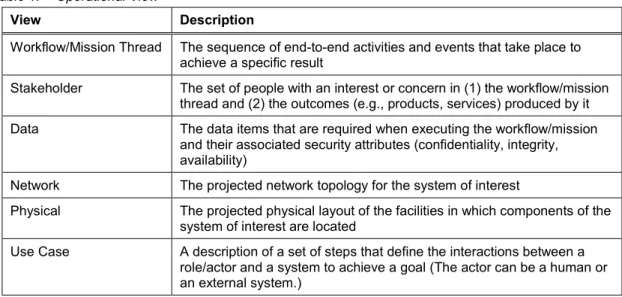
To counteract this lack of a common perspective, we propose developing models that describe the operational environment in which the system will be deployed. Table 1 provides a description of the operational views that we have been using in our pilot activities of the SERA Framework. Each view is characterized using one or more models.
Table 1: Operational View
View Description
Workflow/Mission Thread The sequence of end-to-end activities and events that take place to achieve a specific result
Stakeholder The set of people with an interest or concern in (1) the workflow/mission thread and (2) the outcomes (e.g., products, services) produced by it Data The data items that are required when executing the workflow/mission
and their associated security attributes (confidentiality, integrity, availability)
Network The projected network topology for the system of interest
Physical The projected physical layout of the facilities in which components of the system of interest are located
Use Case A description of a set of steps that define the interactions between a role/actor and a system to achieve a goal (The actor can be a human or an external system.)
Developing and documenting operational models enables analysts to address aspects of complex-ity that are inherent in the securcomplex-ity risk environment. (See Section 4.1 for a description of the se-curity risk environment.) Models representing the views from Table 1 can be analyzed to establish the following key aspects of a threat:
• critical data—important information highlighted in workflow/mission thread, use case, and network diagrams. By examining these models, analysts can identify which data elements are most critical to the workflow/mission thread and its associated mission.
• access path—how a threat actor can gain access to data and violate its security attributes (i.e., create breaches of data confidentiality, integrity, and availability). The network and physical models provide insights into potential cyber and physical access paths for an attack.
• threat outcome—the direct consequence caused by the threat. A direct consequence describes which security attributes of critical data have been breached. Examples of outcomes include data disclosure, data modification, insertion of false data, destruction of data, and interruption of access to data. The data model is used to identify the immediate consequence of a threat. A threat ends with a description of its direct consequence or outcome. However, a security risk analysis must also take into account any indirect consequences triggered by the occurrence of a threat. For example, if false data are inserted into a workflow or mission thread, then the follow-ing questions related to indirect consequences must be answered:
• How is the workflow/mission thread affected? • How are the mission’s objectives affected? • How are mission’s stakeholders affected?
The indirect consequences are used to (1) measure the impact of a security risk and (2) establish a risk’s priority for decision makers. Analysts determine indirect consequences using models that represent the workflow/mission thread and stakeholder views. In the remainder of this section, we provide examples of three operational models that we developed for our initial pilot of the SERA Framework: (1) top-level workflow model, (2) top-level network model, and (3) data model.
5.2 Example: Operational Models
For our pilot application of the SERA Framework, we analyzed security risk in the Wireless Emergency Alerts (WEA) service, which is a collaborative partnership that includes the cellular industry, Federal Communications Commission, Federal Emergency Management Agency (FEMA), and U.S. Department of Homeland Security (DHS) Science and Technology Directorate (S&T) [WEA 2014]. The WEA service enables local, tribal, state, territorial, and federal public safety officials to send geographically targeted text alerts to the public to warn it about emergency situations. The best place to start when describing the WEA service is with its workflow.
5.2.1 Top-Level Workflow Model
An emergency alert is a message sent by an authorized organization that provides details of an oc-curring or pending emergency situation to one or many designated groups of people. Emergency alerts are initiated by many diverse organizations. For example, law enforcement organizations issue amber alerts, and the National Weather Service (NWS) issues weather alerts. Both amber alerts and weather alerts are examples of emergency alerts. A wireless alert is an emergency alert
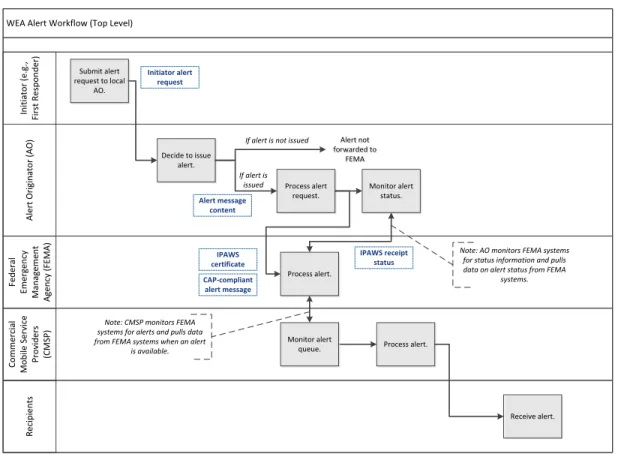
that is sent to mobile devices, such as cell phones and pagers. Figure 5 shows the top-level work-flow model that we developed for the WEA service.14
WEA Alert Workflow (Top Level)
Alert Origi nator (AO ) Initiator (e .g ., First Responder ) Fe deral Emergency Manage me nt Agency (FEMA )
Commercial Mobile Service Providers (CMSP
) Re cipie nts Submit alert request to local AO. Decide to issue alert. Process alert. Process alert. Receive alert. Alert not forwarded to FEMA Alert not forwarded to FEMA If alert is issued If alert is not issued
Process alert
request. Monitor alert status.
Monitor alert queue.
Note: AO monitors FEMA systems for status information and pulls data on alert status from FEMA
systems.
Note: CMSP monitors FEMA systems for alerts and pulls data from FEMA systems when an alert
is available. Initiator alert request Alert message content CAP-compliant alert message IPAWS certificate IPAWS receipt status
Figure 5: Top-Level Workflow Model
The figure shows the sequence of activities required to issue a wireless alert. We used a swimlane diagram15 to document the workflow. The activities in a swimlane diagram are grouped visually
by placing them in lanes. Parallel lines divide the diagram into multiple lanes, with one lane for each workflow actor (i.e., person, group, or sub-process). Each lane is labelled to show who is re-sponsible for performing the activities assigned to that lane. In Figure 5, the gray boxes with solid borders represent the activities that are performed by each workflow actor. Lines between the ac-tivities establish the relationships among and sequencing of the acac-tivities. Finally, the blue, dashed boxes are data items that flow between the activities.
The workflow begins with a request from an initiator (e.g., law enforcement, NWS) to submit an alert (initiator alert request). A team from the Alert Originator (AO) organization receives the
ini-14 We also developed a second-level workflow that contained more details about the WEA service as part of our
analysis. Because of the limited scope of this document, we are only showing the top-level workflow in this re-port.
15 A swimlane diagram provides a visual representation of a workflow or mission thread. It defines the sequence of
end-to-end activities that take place to achieve a specific result as well as who performs each activity. Swimlane diagrams are especially useful for describing workflows or mission threads that cross organizational boundaries,
tiator alert request and decides (1) whether or not to issue the alert and (2) the distribution chan-nels for the alert (e.g., television, radio, roadside signs, wireless technologies, others). The work-flow in Figure 5 assumes a wireless alert will be issued.
An operator from the AO enters the alert message content into an Alert Originating System (AOS), which then processes the content. The AOS converts the alert message to a CAP-compliant format,16 which is the data format required by FEMA systems. The CAP-compliant
alert message and IPAWS certificate are then sent from the AOS to a FEMA system named IPAWS-OPEN Gateway.17 The IPAWScertificate is used to establish that the CAP-compliant
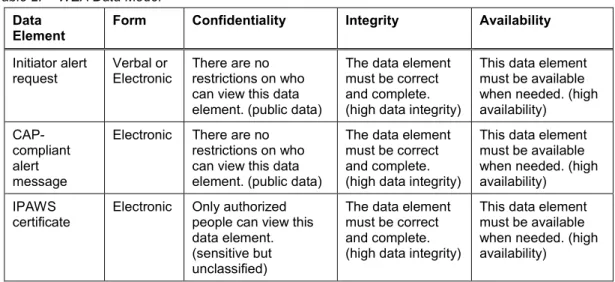
alert message is being sent from a legitimate AO. The certificate is encrypted during transmission to IPAWS-OPEN Gateway while the compliant alert message is not encrypted. (The CAP-compliant alert message is considered to be public information and thus does not need to be en-crypted. Table 2 highlights the security attributes of theCAP-compliant alert message and IPAWS certificate.)
The IPAWS-OPEN Gateway decrypts the IPAWS certificate and validates the identity of the sender. If the certificate is determined to be valid, the IPAWS-OPEN Gateway
• logs receipt of the alert message (IPAWS receipt status) in the IPAWS-OPEN log • immediately forwards the alert message to other FEMA systems for processing
The AO can monitor the IPAWS-OPEN log to make sure that the IPAWS-OPEN gateway re-ceived the CAP-compliant alert message.
FEMA systems then process the wireless alert and forward it to the commercial mobile service providers (CMSPs). AT&T, Verizon, and other wireless carriers are examples of CMSPs. The CMSP systems process and format the alert message and then distribute it to recipients’ smart phones. Finally, recipients receive and read the wireless alert on their smart phones.
5.2.2 Top-Level Network Model
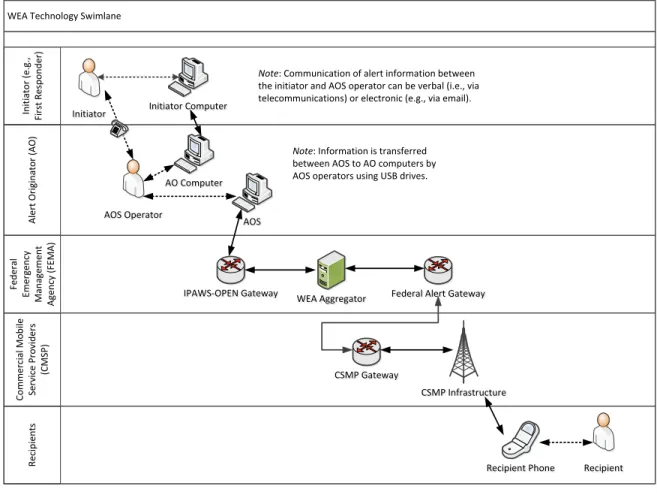
Figure 5 features a top-level workflow that describes the core activities needed to distribute an emergency alert using the WEA service. The workflow provides the anchor for the subsequent se-curity risk analysis. After we develop a workflow model, we then determine which technologies support that workflow.
The systems that support the WEA workflow are shown in Figure 6. In essence, the collection of systems in Figure 6 depicts the WEA system of systems. These systems support the end-to end WEA workflow and are the starting point for a deep dive into an analysis of WEA support tech-nologies.18
The following are the highlights of the WEA system of systems depicted in Figure 6:
16 Common Alerting Protocol (CAP)
17 Integrated Public Alert and Warning System Open Platform for Emergency Networks (IPAWS-OPEN)
18 We developed additional, more detailed network diagrams as part of our analysis. Because of the limited scope
• Initiator systems—Communication of alert information between the initiator and AO can use the following technologies: telecommunications (for verbally communicating requests) and unencrypted email from the initiator’s desktop computers.
• AO systems—The AO uses three systems: telecommunications, AO desktop computers, and the AOS. The AO relies on the following technologies to receive requests to issue an alert: telecommunications (for verbally receiving requests) and unencrypted email sent from an ini-tiator’s desktop computer to AO desktop computers.19 After AO management decides to issue
a wireless alert, an AO operator enters the alert into the AOS, which then forwards the CAP-complaint alert message to the IPAWS-OPEN Gateway (i.e., a FEMA system).
• FEMA systems—The IPAWS-OPEN Gateway receives the alert message, validates the sender using the certificate, and forwards the alert to the WEA Aggregator for processing. The WEA Aggregator processes the wireless alert and transmits it to the Federal Alert Gateway, which then sends the alert message to CMSP Gateway.
• CMSP systems—The CMSP Gateway receives the alert message and then forwards it to CMSP Infrastructure (e.g., cell towers). The alert message is transmitted by the CMSP Infra-structure to capable wireless devices in the designated area(s).
• Recipient systems—People in the designated area(s) that have devices capable of receiving wireless alerts receive the message on their wireless devices.
WEA Technology Swimlane Alert Origi nator (AO ) Initiator (e .g ., First Responder ) Fe deral Emergency Manage me nt Agency (FEMA ) Commercial Mobile Se rvice Providers (CMSP ) Re cipie nts AOS AOS Initiator Initiator AOS Operator AOS Operator Initiator Computer Initiator Computer AO Computer AO Computer WEA Aggregator WEA Aggregator Recipient Phone
Recipient Phone RecipientRecipient CSMP Infrastructure
CSMP Infrastructure IPAWS-OPEN Gateway
IPAWS-OPEN Gateway Federal Alert GatewayFederal Alert Gateway
CSMP Gateway CSMP Gateway
Note: Information is transferred between AOS to AO computers by AOS operators using USB drives.
Note: Communication of alert information between the initiator and AOS operator can be verbal (i.e., via telecommunications) or electronic (e.g., via email).
Figure 6: Top-Level Network Model
For our pilot application of the SERA Framework, the pilot’s stakeholders identified the AOS as the system of interest for the analysis. Here, we define the system of interest as the software appli-cation or system that is the focus of the security risk analysis.20 The operational environment for
the system of interest is then characterized to establish a baseline of operational performance. Se-curity risks are analyzed in relation to this baseline. We developed several models related to the AOS, including
• detailed workflows • detailed network diagrams
• projected facility layout of AOS computers • data security attributes for AOS data • AOS use cases
We did not include all of the above models in this report because they are beyond the scope of the introductory nature of this document. We plan to provide a more detailed treatment of the AOS models in subsequent publications. We conclude this section with a look at a model that describes the security attributes of critical AOS data.
5.2.3 Data Model
From the system-of-systems perspective, we identified three critical data items (i.e., critical as-sets) for the AOS:21
1. initiator alert request—a request to submit an alert sent from an initiator computer to the AOS
2. CAP-compliant alert message—the alert message in CAP-compliant format sent from the AOS to the IPAWS-OPEN Gateway
3. IPAWS certificate—sent from the AOS to the IPAWS-OPEN Gateway along with the
CAP-compliant alert message and used to establish that the alert message was sent from a legiti-mate AO
Each of the three data items appears on the top-level workflow and is stored, transmitted, or pro-cessed by the system of interest (i.e., the AOS). Table 2 presents the security attributes (i.e., confi-dentiality, integrity, and availability) for the three critical data items. The security attributes are essential input when identifying threats to the AOS.
Table 2: WEA Data Model
Data
Element Form Confidentiality Integrity Availability
Initiator alert
request Verbal or Electronic There are no restrictions on who can view this data element. (public data)
The data element must be correct and complete. (high data integrity)
This data element must be available when needed. (high availability)
CAP-compliant alert message
Electronic There are no restrictions on who can view this data element. (public data)
The data element must be correct and complete. (high data integrity)
This data element must be available when needed. (high availability)
IPAWS
certificate Electronic Only authorized people can view this data element. (sensitive but unclassified)
The data element must be correct and complete. (high data integrity)
This data element must be available when needed. (high availability)
Our intent for this section is to provide an overview of the types of operational models that help enable effective risk identification. Our field experience indicates most risk-identification meth-ods rely on participants’ tacit understanding of the operational environment, which is often incor-rect, incomplete, or in conflict. Our goal is to use operational modeling to construct a common view of the projected operational environment. From this common, or baseline, view of the opera-tional environment, analysts can then develop a set of relevant security risk scenarios. In the next section, we present our prototype structure for describing security risk scenarios.
21 The three data items were identified by analyzing the top-level workflow from Figure 5 and the top-level network
devel-6 Scenario-Based Risk Analysis
The second key differentiator of the SERA approach is the use of scenarios to describe security risks. Our early piloting of the SERA Framework indicates that scenarios capture the complexities and nuances of a security risk. We define a security risk scenario as a narrative description of a complex security risk. A security risk scenario tells a story of how one or more threat actors can cause adverse consequences for stakeholders by exploiting vulnerabilities in one or more soft-ware-reliant systems.
We develop a scenario after performing a detailed analysis of a threat, its enablers, and the conse-quences it can produce. The development of a security risk scenario is thus the culmination of an extensive analysis activity. The SERA Framework requires that the following data are recorded for each security risk:
• security risk scenario • risk statement • threat components • threat sequence • workflow consequences • stakeholder consequences • enablers
In this section, we present examples of the above data in the context of a security risk to the WEA service.
6.1 Security Risk Scenario
The following scenario describes a spoofing attack22 that targets an AOS:
An outside actor with malicious intent plans to obtain a valid IPAWS certificate through so-cial engineering23 and then use it to send an illegitimate CAP-compliant alert message to the
IPAWS-OPEN Gateway. In carrying out this attack, the actor plans to spoof an AOS. First, the threat actor performs reconnaissance to gather the information needed to
• conduct social engineering to get a valid IPAWS certificate and the associated encryp-tion key from an AO
• construct an illegitimate CAP-compliant alert message that will be accepted by the IPAWS-OPEN Gateway
The threat actor identifies several social engineering targets based on the results of reconnais-sance. The actor performs social engineering on people at the AO that have access to the
22 A spoofing attack is a circumstance in which a person or program successfully impersonates another person or
program by falsifying data. The person or program perpetrating the attack is free to take action that will be at-tributed to the victim of the spoofing attack.
23 Social engineering refers to the intentional manipulation of people to get them to perform certain actions or
AO’s IPAWS certificate and encryption key. After several attempts, the actor obtains an AO’s valid IPAWS certificate and encryption key from an unsuspecting employee at the AO. The actor gains access to data specifications for constructing CAP-compliant alert messages from public documents.
Now that the actor has a valid IPAWS certificate and knows how to format data for the IPAWS-OPEN Gateway, he or she can execute the attack. The actor’s goal is to incite panic in a crowd that a bomb is about to explode (e.g., an alert message of a bomb about to explode in Times Square on New Year’s Eve or at a major sporting event). The actor will send an ille-gitimate alert message to the wireless devices of people in the crowd. To maximize the impact of the attack, the actor must send the false alert when a large crowd has gathered for an event. To send an illegitimate alert message, the threat actor
• constructs an illegitimate CAP-compliant alert message • links it to the IPAWS certificate
• encrypts the IPAWS certificate
• sends the illegitimate, unencrypted CAP-compliant alert message and encrypted IPAWS certificate to the IPAWS-OPEN Gateway
The IPAWS-OPEN Gateway decrypts the IPAWS certificate and validates the identity of the sender. The certificate is determined to belong to a valid AO, and the IPAWS-OPEN Gate-way
• logs receipt of the alert message in the IPAWS-OPEN log
• immediately forwards the alert message to other FEMA systems for processing
Staff members from the AO are not monitoring the IPAWS-OPEN log because they have not sent an alert message. The FEMA systems process the illegitimate alert message and place it in the CMSP alert queue. CMSP systems are monitoring the CMSP alert queue and grab the alert message. Next, CMSP systems distribute the alert to recipients’ wireless devices. Recipi-ents receive and read the illegitimate alert on their wireless devices. At this point, staff mem-bers from the AO are still unaware that a threat actor has spoofed their AOS and delivered an illegitimate wireless alert to a group of people.
This scenario could have considerable impact on stakeholders, depending on the severity of the event with which the attack is linked. Health and safety damages could be significant, leading to potentially large legal liabilities. Such an attack could damage the reputation of the WEA service beyond repair.
The above example illustrates how a threat actor can execute an AOS spoofing attack that targets the WEA service. The purpose of the scenario is to convey the most important aspects of a secu-rity risk; it does not include all of the details needed to analyze the risk. As a result, we record ditional data for each scenario. In the remainder of this section, we present examples of these ad-ditional data for the AOS spoofing risk.