Spaces and
Pedagogies
ISBN 978-1-927214-24-4
NEW ZEALAND TERTIARY LEARNING AND
Spaces and Pedagogies: New Zealand Tertiary Learning and Teaching Conference 2017 Proceedings
The New Zealand Tertiary Learning and Teaching Conference 2017 was held at Unitec Institute of Technology, Auckland, New Zealand, 2-3 October, 2017. All papers published in these proceedings have been blind peer reviewed by a minimum of two referees.
The papers in this publication comprise the proceedings of the 2017 NTLT conference. They reflect the authors’ opinions and, their inclusion in this publication does not necessarily constitute endorsement by the editors, ePress or Unitec Institute of Technology.
EDITORS Lucy Patston and Simon Nash ACADEMIC ADVISOR Laura Stephenson PROOFREADER Marie Shannon
REVIEW COMMITTEE Sylvia Hach, Kay Hammond, Margaret Henley, Simon Nash, Lucy Patston (chair), Bettina Schwenger
CONFERENCE PROJECT TEAM Lucy Patston, Simon Nash, Laura Ewens-Volynkina, Kelly Handley, Ken Liu, James Oldfield, JJ Purton Jones, Bettina Schwenger This publication may be cited as: Patston, L.L.M., & Nash, S. (2017). Spaces and Pedagogies: New Zealand Tertiary Learning and Teaching Conference 2017 Proceedings. Auckland, New Zealand: ePress, Unitec Institute of Technology.
ACKNOWLEDGMENTS
The conference sponsor was Ako Aotearoa, National Centre for Tertiary Teaching Excellence, Wellington, New Zealand.
Spaces and Pedagogies: New Zealand Tertiary Learning and Teaching Conference 2017 Proceedings is licensed under a Creative Commons Attribution-NonCommercial 4.0 International License.
ISBN 978-1-927214-24-4
An ePress publication [email protected] www.unitec.ac.nz/epress/
Unitec Institute of Technology, Private Bag 92025, Victoria Street West, Auckland 1010, Aotearoa New Zealand
A PILOT STUDY INTO USE
OF REGULAR SHORT
QUIZZES IN A FLIPPED
LEARNING CLASS
HUGH WILSON
DAVID PHILLIPS
A pilot study into use of regular short quizzes in a flipped learning class by Hugh Wilson and David Phillips is licensed under a Creative Commons Attribution-NonCommercial 4.0 International License.
This publication may be cited as: Wilson, H., & Phillips, D. (2017). A pilot study into use of regular short quizzes in a flipped learning class. In S. Nash and L.L.M. Patston (Eds.), Spaces and Pedagogies: New Zealand Tertiary Learning and Teaching Conference 2017 Proceedings (pp. 121–130). Auckland, New Zealand: ePress, Unitec Institute of Technology.
Contact:
[email protected] www.unitec.ac.nz/epress/ Unitec Institute of Technology Private Bag 92025, Victoria Street West Auckland 1142
New Zealand
ABSTRACT
Flipped learning is an approach that has students develop a basic knowledge of a topic before it is studied. It allows class time to be spent on activities designed to build on that basic knowledge, enabling a better understanding of the topic. However, flipped learning does not work if the students do not complete the pre-class study provided by the tutor, as this results in the student not having the knowledge to benefit from the class sessions.
This pilot study looked at the use of short online quizzes at the start of each class session to address the issue of students not doing the assigned pre-class study, with the marks counting towards the final overall course grade. This approach was trialled on a Level 6 course in a civil engineering programme at a technical institute.
The research indicated that the approach resulted in more students accessing the pre-class resources, but many only did so within a day of the quiz, which did not allow time for deeper learning processes to be undertaken. This was reflected in these students having no visible improvement in exam marks.
The research has provided suitable data for a successful pilot study, with further work to be undertaken to more deeply understand and quantify outcomes. This work will also allow further student surveys to be undertaken that build on the data collected to date to improve the linkages between online resources and in-class learning.
INTRODUCTION
Flipped learning involves students studying course content on a topic before they attend the class session (Roach, 2014). This results in the students arriving in class with a basic knowledge of the topic, which allows class time to conduct activities which foster a better understanding of the topic. This ‘flips’ the traditional approach, where content is presented in class and students are expected to develop better understandings of the topic through self-directed learning carried out after the class. The ‘flipped classroom’ has begun to revolutionise the way that students receive information from their teachers and is ushering in a new era of active and creative thinkers (Roach, 2014).
Students who do not come to class with a basic knowledge of the topic are unlikely to benefit from the class and will, most likely, spend all of the session trying to determine basic knowledge, rather than developing a deeper understanding of the topic (Gilboy et al., 2014). Therefore, one of the issues that needs to be addressed, in developing a flipped learning course, is how to encourage all students to do the pre-class study required.
One approach to encouraging students to do the pre-class work is to have short quizzes, based on this work, at the start of each class session. This research investigated whether using short, low-stakes (i.e. only a small number of marks allocated toward the final course grade), multi-choice quizzes at the start of each class session, in a Level 6 Construction Practices course, resulted in improvements in student pre-class preparation and exam performance. The research also looked at student views on the learning style so that an inclusive approach was utilised, which engaged the students in the research and outcomes, and provides conclusions and recommendations to enhance future learning outcomes.
LITERATURE REVIEW
Flipped learning, with or without quizzes, has been identified as a popular approach with students. Many studies indicate that students often prefer to learn content online, rather than have it presented in a traditional lecture
123
Spaces and Pedagogies: New Zealand Tertiary Learning and Teaching Conference 2017 Proceedings
(Angus & Watson, 2009; Dabbour, 2016; Gilboy et al., 2015; Lucke, 2014). This can be due to the ability of students to work at their own pace, to repeat some or all of the content presentation, and to study the content when they wanted. Roach (2014) found that students respond positively to flipped learning, and that it is an instructional design that is beneficial across student groups.
An important aspect of flipped learning is that in the class session they are able to fully participate in group or individual work using real-life scenarios and discipline-specific problems. Having peers all ‘on the same page’ is been identified as critical to peer support, networking, problem-solving and effective career-long learning and project delivery (Scott & Yates, 2002).
One advantage of regular quizzes is that they encourage students to keep up with the course content as it is presented, as opposed to binge-studying once or twice a semester when tests are due (Sales-Morera, Arauzo-Azofra, & García-Hernández, 2012; Angus & Watson, 2009) or falling so far behind that they cannot catch up through ‘cramming’. Additionally, online quizzes provide immediate feedback to students about their level of learning, and help the tutor identify parts of the course content that students are struggling with and that require further explanation in class (Angus & Watson, 2009; Dabbour, 2016; Hagerty & Rockaway, 2012; Sales-Morera et al., 2012).
The effectiveness of quizzes in improving student performance is varied. Angus and Watson (2009) found that regular, low-stakes, online quizzes improved student learning, as evidenced in the final exam. However, other studies (Lucke, 2014; Dabour, 2016) show no correlation between the use of regular quizzes and student performance in exams and final grades. One likely reason among many possibilities (such as personal motivation, time, workloads, staffing, peer mentoring and extra-curricular commitments) for the lack of effectiveness could be the quality of the online study – students simply accessing the online material does not necessarily mean they are learning it. Lucke (2014) observed that most students in his study viewed the online material the day before the quizzes closed. He concluded that providing students with online content to be viewed before class results in many students learning only superficially, viewing the material just in time, rather than absorbing and processing the content properly.
METHODOLOGY
Background
The approach of using quizzes to encourage students to do the pre-class study was trialled with a Level 6 Construction Practices class in a civil engineering programme at a New Zealand technical institute in Semester 1 of 2017. Construction Practices teaches students how to plan and implement the construction of civil engineering projects, as well as related safety, quality and environmental-protection measures that need to be incorporated into the construction process. The course required students to learn a multitude of relatively simple facts and ideas and then be able to apply them to real-world scenarios.
The class consisted of 50 students, although two dropped out midway through the course leaving 48 participants in the study. The course is compulsory for both the New Zealand Diploma in Engineering (NZDE) and the Bachelor of Engineering Technology (BEngTech), and the class consists of students enrolled in both qualifications. About half the students had English as a second language.
Procedure
The course was taught using a flipped learning approach, with students being required to spend at least three hours studying online videos and readings that were presented on the course’s Moodle site a week before each class. Moodle is the online platform that the technical institute utilises for connecting with students to share course notes, slides, feedback and assessment submission. The classes consisted of one three-hour session held every week over a period of 15 weeks, with a two-week mid-semester break in the middle. Two of the class sessions were site visits with
no quizzes or formal class activities, but the remaining 11 weeks started with a 10 question, 10-minute online quiz that was accessed through Moodle.
Quiz marks and correct answers were released when the quiz closed. While the quiz was open book, it was designed so that students had to know where the relevant information was, if they were to successfully complete the quiz in the time available. Most students opted to do the quiz on their mobile phones although about 10% brought laptops into the class for the quiz. Paper copies of the quiz were also available for students who did not have internet-capable devices or who preferred to do the quiz on paper, an option which approximately 10% of the class chose. However, the paper quizzes were marked manually so students who chose this option did not get immediate feedback. The class sessions that followed had activities that usually required the students to plan construction works related to the type of civil engineering works that were being studied in that session.
The effectiveness of the flipped learning approach incorporating regular quizzes was assessed by a survey to determine students’ reactions to this approach, how much pre-class work they did, and whether they considered the approach as beneficial to their studies. In addition, an analysis of the YouTube and Moodle records of the online content to determine the level of engagement of the students with the content before the class sessions and a comparison of the exam results with previous classes (Semester 1, 2016 and Semester 2, 2016) determined if there were any improvements in exam performance.
RESULTS AND DISCUSSION
Student survey
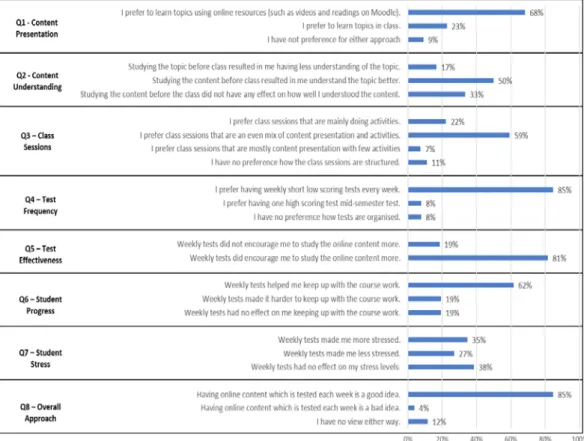
A paper survey was distributed to students in class in the last session of the semester, consisting of eight themed groups of statements relating to student views on flipped learning and regular online quizzes. The student survey was filled in by 26 students, which represented about half of the class. The results of the student survey are shown in Figure 1.
Of those surveyed, 68% showed a preference for the flipped learning approach using online resources (Question 1). Fifty percent said that studying the topic before class helped them understand the topic better, and a further 33% had no preference (Question 2). The opportunity to do more activities in class was preferred by 79%, with only 7% wanting the class session to consist mainly of content presentation (Question 3). The approach of having online content, which is tested each week, was considered to be a good idea by 85% (Question 8), showing a general appreciation of flipped learning with regular testing.
One concern was that regular quizzes would be more stressful for students compared with the previous practice of having a high-stakes (significant marks allocated to the assessment) mid-semester test. Students were divided on this issue, with 27% stating it was less stressful and 35% saying it was more stressful (Question 7). However, 85% of the students preferred regular quizzes rather than one mid-semester test (Question 4). This difference may be due to a lack of clarity around Question 7 of the survey in that it was not clear that it referred to the stress related to regular quizzes, as compared to one mid-semester test. However, some of the comments made in relation to this question expressed significant stress related to the high-stakes, mid-semester test.
The quizzes seemed to have some effect on students keeping up with the course, with 81% saying that having regular quizzes encouraged them to study the online content more than they would have if there had been no quiz (Question 5). Sixty-two percent also said that regular quizzes helped them keep up with the course work (Question 6).
125
Spaces and Pedagogies: New Zealand Tertiary Learning and Teaching Conference 2017 Proceedings
Moodle and YouTube analysis
The Moodle analysis consisted of downloading activity logs for readings and videos that presented the content that students needed to learn before class sessions. The logs extended back three semesters and so the activity in previous courses (Semester 1 and Semester 2, 2016) could be compared with the activity in the current course (Semester 1, 2017). The Moodle logs were analysed to provide an indication of how many individual students accessed the resource, and the number of times the resource was accessed each day.
The YouTube analysis involved accessing the YouTube analytics for each of the videos that had been viewed by students in Moodle. This provided information on how much of the video the students watched, at what point those who did not watch the whole video stopped watching, and what technological devices they used to view the videos. The analytics also provided a comparison of the results from the analysis of videos on Moodle.
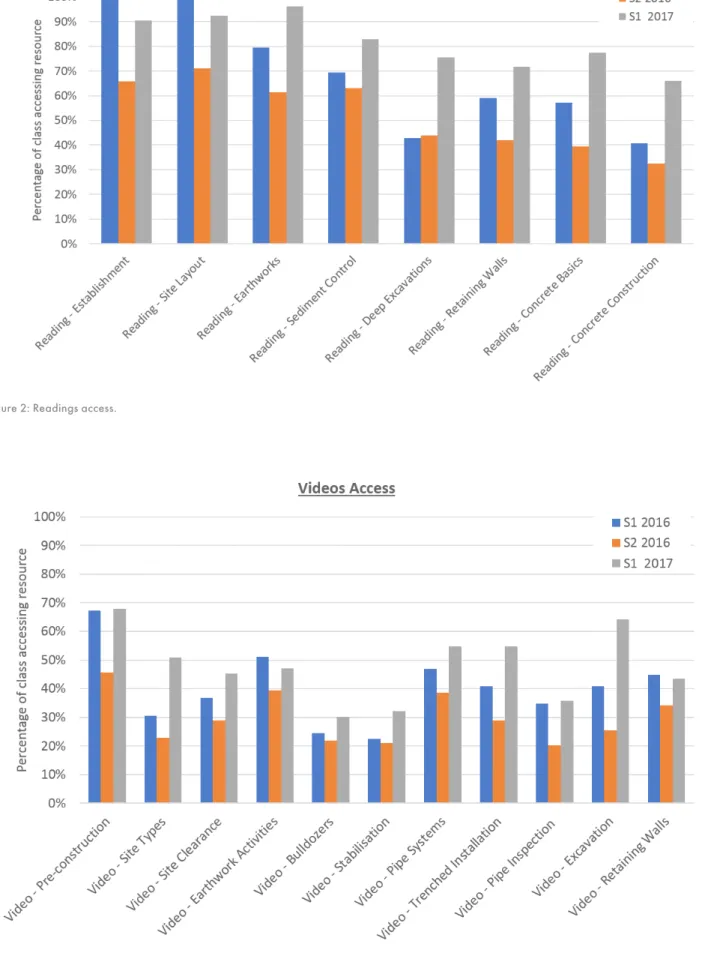
Figures 2 and 3 show the percentage of the class from each of the three cohorts (Semester 1, 2016, Semester 2, 2016 and Semester 1, 2017) that accessed some of the online readings and video resources respectively. It is noted that readings were used more than videos, with students viewing readings averaging 82%, and students viewing videos only averaging 51%. In other words, on average, only half of the class viewed the videos (in all cohorts). Another observation is that a decrease in online accessing of the readings and videos occurred over all three semesters in the study. Potentially, students became busier with workload and other assessments, although further research is required to determine the specific reasons. Lastly the percentage of the class accessing both readings and videos increased in Semester 1, 2017 compared with previous semesters. This indicates that the quizzes were having some effect on getting students to view the online resources.
Figure 2: Readings access.
127
Spaces and Pedagogies: New Zealand Tertiary Learning and Teaching Conference 2017 Proceedings
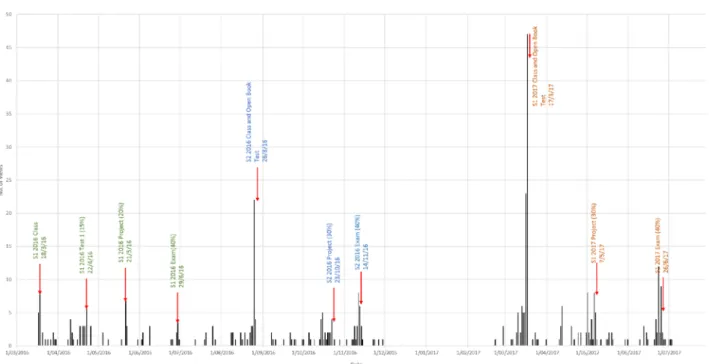
One output from the Moodle analysis was a graph for each resource, showing the number of times it was accessed each day. A number of students did access each individual resource many times, but this duplication was removed from the data. The graphs all showed a similar pattern in the number of daily accesses climbing steeply one to two days before the class session and quiz. Accesses also climbed in the days before projects were due and before the exam. Figure 4 shows a typical time-versus-access graph, with the relevant assessment events highlighted, and demonstrated a significant increase in the number of views between earlier semesters (Semesters 1 and 2, 2016) and Semester 1, 2017.
While the findings suggest that the quizzes did increase the number of views, it is questionable whether or not they improved the quality of learning. Figure 4 shows a high number of accesses on the day of the quiz. This was partially due to students having the resource open when doing the quiz, but also reflects students who started viewing the resource early on the morning of the quiz. A review of several of the logs indicates that approximately 25% of the students who viewed the resource only did so on the day of the quiz, which provides some evidence to support Lucke’s (2014) observations that many students only view the material just before the deadline.
Figure 4: Sample of daily views graph.
Quiz and exam marks
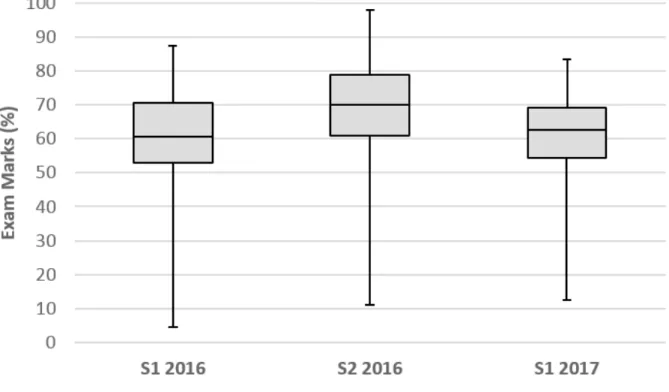
One measure of students’ performance are the quiz marks. The average quiz mark for the Semester 1, 2017 class was 63%, which was lower than expected considering that the quizzes consisted of relatively simple questions directly related to the online content, and was open book. Another measure of performance are the exam marks. Figure 5 shows the exam results for all three cohorts. The Semester 1, 2016 and Semester 1, 2017 marks are similar, while the Semester 2, 2016 results are slightly better. Semester 2 results are usually better because that semester normally has a higher proportion of BEngTech students, who are generally more academically capable than the NZDE students. Overall the comparison of quiz marks and exam results in this pilot study (which did not consider wider variables such as workload and timetabling) indicates that the use of quizzes has not improved student performance.
Limitations
There are several limitations to this research. Firstly, the student cohorts vary considerably between years and some cohorts are noticeably more studious and some more academically able than others. For example, it was noted that the Semester 2, 2016 cohort was a high-achieving group. Another limitation is that the Moodle records used to measure students’ engagement with the online resources only indicate whether a student accessed the resource, not how long or how productively they studied it. The YouTube analytics provide some information on the average time the videos were viewed for, but the quality of this viewing-study cannot be determined. Also, the research did not give consideration to student timetables and workload that may have affected how much time students were able to dedicate to the course.
Another factor that influenced the results was that the course started with one tutor who did not implement these activities very well, so the activities were not as effective as they could have been in helping students develop their understanding. The class was also too large for one tutor to properly engage with student groups. Another tutor was added late in the course and this enabled the class sessions to be more engaging.
CONCLUSIONS
The main aim of this pilot study was to determine whether weekly, low-stakes quizzes would result in students studying the pre-class content before classes in a flipped learning classroom. The effects of these regular quizzes, the student view of the approach, and flipped learning in general were also of interest and will determine the direction of further research.
The benefits to student learning methods and outcomes from flipped learning has been extensively researched internationally, with a general consensus that students are more fully engaged and enjoy the learning process (Bristol, 2014; Wolf et al., 2015). Studies have also used analytics to measure the engagement (Salas-Morera et al., 2012; Lucke,
129
Spaces and Pedagogies: New Zealand Tertiary Learning and Teaching Conference 2017 Proceedings
2014), and this method has been utilised in this pilot study to get a clear understanding of how the students made use of the online course materials.
The Moodle logs showed an increase in both the number of times each resource was accessed and the proportion of the class that accessed the resource as time went on. However, there was no corresponding performance improvement in exams. One reason for this may be that many students only looked at the online materials immediately before class, rather than reviewing and processing them throughout the week. This shallow learning approach did not equip them sufficiently to improve their performance.
Another reason for the lack of performance in the exam could have been the quality of the class sessions. The tutor was in the process of learning how to implement an active-learning approach, and the early semester sessions were therefore not as active as they could have been for enhancing the learning experience. Improvements in the implementation of the class activities may encourage students to be more interested in the subject, and perhaps be motivated to engage more deeply with the online resources.
Most students expressed a preference for the flipped learning approach, a result that has been concluded from other research into student preference for flipped learning (Gilboy et al., 2015; Roach, 2014) and preferred having regular low-stake quizzes rather than one high-stake, mid-semester test. This is an important finding as student preference is highly relevant to how well they learn – and this needs to be taken into account in future research and course design. Therefore, it is considered that this approach is worth pursuing in the future as it is easy to implement for the lecturer, is simple for the students to undertake, and provides motivation for students to maintain constant learning progress through the semester and be prepared for the in-class learning. However, additional methods, such as improved on-line engagement (for example, games, reflection points during videos and spot-questions), need to be developed to encourage students to adopt a deeper learning process.
REFERENCES
Angus, S. D., & Watson, J. (2009). Does regular online testing enhance student learning in the numerical sciences? Robust evidence from a large data set. British Journal of Educational Technology, 40(2), 255-272. Retrieved from: http://dx.doi.org/10.1111/j.1467-8535.2008.00916.
Bristol, T. (2014). Flipping the Classroom. Teaching and Learning in Nursing, 9(1), 43-46.
Dabbour, E. (2016). Quantifying the effects of using online student response systems in an engineering ethics course. Journal of Professional Issues in Engineering Education and Practice, 142(2), 04015010.
Gilboy, M. B., Heinerrichs, S., & Pazzaglia, G. (2015). Enhancing student engagement using the flipped classroom. Journal of Nutrition Education and Behaviour, 47(1), 109-114.
Hagerty, D. J., & Rockaway, T. D. (2012). Adapting entry-level engineering courses to emphasize critical thinking. Journal of STEM Education: Innovations & Research, 13(2), 25-34.
Kim, M. K., Kim, S. M., Khera, O., & Getman, J. (2014). The experience of three flipped classrooms in an urban university: An exploration of design principles. The Internet and Higher Education, 22, 37-50.
Lucke, T. (2014). Using learning analytics to evaluate the effectiveness of the flipped classroom approach. In A. Bainbridge-Smith, Z. Qi, & G. Gupta (Eds.). 25th Annual Conference of the Australasian Association for Engineering Education: Engineering the Knowledge Economy: Collaboration, Engagement & Employability (pp. 1156-1164). Wellington, New Zealand: School of Engineering & Advanced Technology, Massey University. Retrieved from https://www.researchgate.net/profile/Terry_Lucke/publication/270162113_ Using_Learning_Analytics_to_Evaluate_the_Effectiveness_of_the_Flipped_Classroom_Approach/ links/54a1e9760cf256bf8baf7b15.pdf
Roach, T. (2014). Student perceptions toward flipped learning: New methods to increase interaction and active learning in economics. International Review of Economics Education, 17, 74-84.
Salas-Morera, L., Arauzo-Azofra, A., & García-Hernández, L. (2012). Analysis of online quizzes as a teaching and assessment tool. Journal of Technology and Science Education, 2(1), 39-45. Retrieved from http://dx.doi. org/10.3926/jotse.30.
Scott, G., & Yates, K. W. (2002). Using successful graduates to improve the quality of undergraduate engineering programmes. European Journal of Engineering Education, 27(4), 363-378.
Wolf, M., Wagner, M., Poznanski, S., Schiller, J., & S. Santeen. (2015). Not another boring lecture: Engaging learners with active learning techniques. The Journal of Emergency Medicine, 48(1), 85-93.
THE AUTHORS
Hugh Wilson teaches civil engineering management and construction at Unitec Institute of Technology, Auckland, New Zealand. Before joining Unitec in 2011, he spent 25 years practising as a civil engineer.
Dr Dave Phillips is Associate Professor in Engineering at Unitec Institute of Technology, and is a Chartered Professional Engineer and Fellow of Engineering NZ (formerly IPENZ).