SOCI 4096/97
Honours Thesis
Guidelines
Department of Sociology
Nipissing University
2013
Revised January 2013
2
Table of Contents
CHAPTER 1: INTRODUCTION ... 3
1.1 Suggested Timetable and Deadlines for SOCI 4096 and SOCI 4097 Completion... 3
CHAPTER 2: GENERAL REGULATIONS ... 4
2.1 Prerequisites and Application Deadline ... 4
2.2 Requirements for Credit, Learning Expectations and Outcomes ... 4
2.3 Advisor Selection... 5
2.4 Registration ... 5
2.5 Submission Deadline, Grading and Late Penalties ... 6
2.6 Revisions and Final Submission... 6
2.7 Plagiarism and University Policies on Academic Conduct ... 6
2.8 Ethics Approval for Research with Human Subjects ... 6
CHAPTER 3: STRUCTURE AND ORGANIZATION OF THE THESIS PROPOSAL ... 7
3.1 Writing the Thesis Proposal ... 7
3.2 Sample Thesis Proposal Structure ... 7
CHAPTER 4: STRUCTURE AND ORGANIZATION OF THE THESIS ... 7
4.1 Writing the Thesis ... 7
4.2 Sample Thesis Structure... 7
CHAPTER 5: THESIS FORMAT ... 7
5.1 General Formatting and Length ... 7
5.2.1 Title Page ... 7 5.2.2 Abstract ... 7 5.2.3 Acknowledgements ... 7 5.2.4 Dedication ... 7 5.2.5 Table of Contents ... 8 5.2.6 List of Tables ... 8 5.2.7 List of Figures ... 8 5.2.8 List of Appendices ... 8 5.2.9 References ... 8
5.2.10 ASA (American Sociological Association) Style Guide ... 8
APPENDICES ... 9
3
CHAPTER 1: INTRODUCTION
The undergraduate thesis is a unique opportunity for honours students to design and conduct independent research in an area of their own Sociological interests. Completing a thesis greatly enhances and solidifies the methodological skills and theoretical knowledge students acquire in their course work. Completing a thesis is excellent preparation for the pursuit of graduate studies, and is valuable experience for employment in applied research and policy settings. This document provides a guide on suggested timelines and deadlines (Chapter 1); the course regulations and procedures (Chapter 2); organization and structure (Chapters 3 and 4); formatting (Chapter 5); and references on writing for Sociology students.
1.1 Suggested Timetable and Deadlines for SOCI 4096 and SOCI 4097 Completion
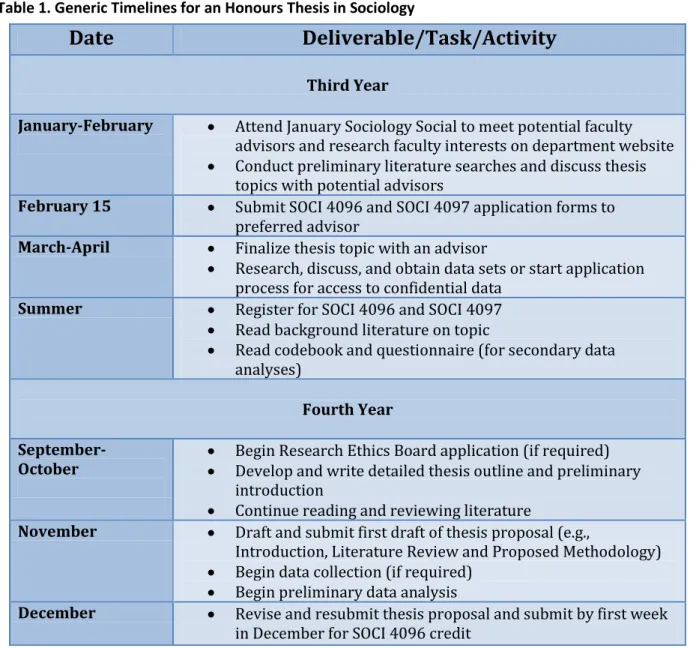
Students are advised to consult their advisor and develop a tentative schedule for thesis completion. The exact deadlines will vary depending on the nature of your research. The table below provides a general guideline, but students are encouraged to develop their own detailed timeline in close consultation with their thesis advisor.
Table 1. Generic Timelines for an Honours Thesis in Sociology
Date
Deliverable/Task/Activity
Third Year
January-February • Attend January Sociology Social to meet potential faculty
advisors and research faculty interests on department website
• Conduct preliminary literature searches and discuss thesis
topics with potential advisors
February 15 • Submit SOCI 4096 and SOCI 4097 application forms to
preferred advisor
March-April • Finalize thesis topic with an advisor
• Research, discuss, and obtain data sets or start application
process for access to confidential data
Summer • Register for SOCI 4096 and SOCI 4097 • Read background literature on topic
• Read codebook and questionnaire (for secondary data
analyses)
Fourth Year
September-October •• Begin Research Ethics Board application (if required) Develop and write detailed thesis outline and preliminary
introduction
• Continue reading and reviewing literature
November • Draft and submit first draft of thesis proposal (e.g.,
Introduction, Literature Review and Proposed Methodology)
• Begin data collection (if required) • Begin preliminary data analysis
December • Revise and resubmit thesis proposal and submit by first week
4
CHAPTER 2: GENERAL REGULATIONS 2.1 Prerequisites and Application Deadline
Prerequisites:
SOCI 4096 HONOURS THESIS I is restricted to students in the fourth year of the Honours Sociology or Honours Criminal Justice programs and who have completed 24 credits in Sociology and/or Criminal Justice.
Antirequisite: SOCI 4095 Hours: Individually supervised. Credits: 3
SOCI 4097 HONOURS THESIS II is restricted to students in the fourth year of the Honours Sociology or Honours Criminal Justice programs and who have completed 24 credits in Sociology and/or Criminal Justice and have achieved a minimum grade of 75% in SOCI 4096 HONOURS THESIS I.
Antirequisite: SOCI 4095 Hours: Individually supervised. Credits: 3
Application Deadline:
Honours students wishing to take this course in their fourth year of study must apply no later than
February 15 of their third year in the programme. The application form is available online at
faculty advisor (see Section 2.3 below).
2.2 Requirements for Credit, Learning Expectations and Outcomes SOCI 4096 HONOURS THESIS I
Requirements for Credit:
To fulfill the requirements of SOCI 4096 HONOURS THESIS I, the student must design and submit a completed research proposal, including the thesis problem statement, literature review and proposed methodology. The research proposed in SOCI 4096 will be completed in SOCI 4097. Various forms of research may be proposed. The work is carried out under the supervision of a full-time member of the
January-February • Data analysis
• Draft results, discussion and conclusion chapters • Revise introduction, literature review and finalize
methodology chapters
March • Final revisions, editing, proofreading and formatting of text,
tables and figures
• Present thesis findings at Nipissing Undergraduate Research
Conference
March 15 Submit final evaluation version of thesis to advisor April Corrections and submission of final version of thesis
5
Department. To fulfill the requirements of this course, the student must design and submit a completed research proposal to pursue in SOCI 4097.
Learning Expectations (which students will do in the course and the supervisor will measure): 1. Identify and develop a researchable sociological research question on a topic of the
student’s choosing, in consultation with the supervising faculty member
2. Recognize and choose appropriate theoretical and methodological frameworks to undertake to research the chosen sociological question
3. Understand and employ advanced academic writing skills in completing Introduction, Literature Review and Methodology components of honours thesis project
Course Outcomes (what will result from successful completion of the course):
1. Demonstrate independence in researching a sociological question, including identifying research information sources and data, bibliographic references and other academic materials and resources
2. Ability to employ advanced academic research and writing skills in developing, researching and reporting on the results of original sociological research
SOCI 4097 HONOURS THESIS II
Requirements for Credit:
To fulfill the requirements of SOCI 4097 HONOURS THESIS II, students must submit a completed honours thesis based on significant research completed as a continuation of the honours thesis research
proposal completed in SOCI 4096. The work is to be carried out under the supervision of a member of the Department.
Learning Expectations (which students will do in the course and the supervisor will measure): 1. Address requests for revisions to completing Introduction, Literature Review and
Methodology
2. Implement appropriate techniques based on selected research methodology to analyze information and data
3. Prepare and submit an academic report, in journal submission format, of the findings from the research
Course Outcomes (what will result from successful completion of the course):
1. Demonstrate independence in researching, analyzing and reporting on a sociological question, including identifying appropriate research methodologies and analytic techniques, identifying research information sources and data, and researching bibliographic references and other academic materials and resources
2. Demonstrated superior ability to employ advanced academic research and writing skills in developing, researching and reporting on the results of original sociological research
2.3 Advisor Selection
Students should discuss their preliminary topic with potential advisors in the Department in their third year of study. In January of the third year of the programme, students are encouraged to attend the Sociology Social to meet potential faculty advisors with similar research interests. Students should also consult the Department website to review faculty research interests
6
member is required to supervise any particular topic or thesis, so it is up to students to find a willing and available advisor for their thesis.
The thesis is an opportunity for students to work independently on a research topic of their choice. The general role of the advisor is to assist you in learning how to set timelines, carry out, complete and present your independent research. This may involve commenting on proposal and thesis chapter drafts or analyses. It is your responsibility to meet with your thesis advisor and discuss the progress of your work. Students are also responsible for finding and/or collecting the data for their topic. In certain circumstances, advisors may work with students to develop a thesis topic that is part of their larger research agenda. Funding the thesis work is the responsibility of the student, but in some cases, faculty may have available funds for students to complete their thesis as part of research assistant
employment.
2.4 Registration
Students must have an approved advisor in order to register in SOCI 4096 and SOCI 4097. Registration follows the normal course registration, procedures and add/drop deadlines set by the Registrar for 3-credit courses.
2.5 Submission Deadline, Grading and Late Penalties
The thesis must be submitted to your advisor no later than 4pm on March 15. Submit the thesis as a single PDF file attached to an email sent to your advisor. The penalty for late thesis submissions is up to the discretion of your advisor, but typically 2% is deducted for the first late day and 1% is deducted for each subsequent day (including weekends).
Extensions without penalty will only be granted for exceptional circumstances (e.g., medical, family emergencies). In these situations, students are required to inform their advisors, and submit a request for extension.
Your thesis will be graded by your advisor as well as one other faculty member of the Sociology Department. The two grades will be compared, and the average of the two grades will be given if the grades are within 10 percent. If the difference exceeds 10 percent, a third member of the faculty will grade the thesis, and all three grades will be averaged to constitute the final grade.
2.6 Revisions and Final Submission
Your advisor will grade your thesis, and will return the marked thesis typically within 2 to 3 weeks of submission. Advisors may wish to include written comments and corrections on a hard copy or may include comments electronically in the PDF file. You are required to make the corrections and resubmit a corrected final version of your thesis as a single PDF file.
2.7 Plagiarism and University Policies on Academic Conduct
The thesis must be written in the students own words. It is a serious academic offence to plagiarize all or part of the thesis. Direct quotes or ideas from previous research must be cited appropriately in text and in the bibliographical references. At their discretion, advisors may opt to submit your thesis to the standard plagiarism detection software (e.g., SafeAssign) under license at Nipissing University. For further information on academic offences, student policies, and procedures, students should consult Nipissing University’s Academic Calendar
7
2.8 Ethics Approval and Conduct for Research Involving Humans
If you are planning on collecting your own data for your thesis (e.g., interviews, administering surveys, participant observation, focus groups), you need to apply for ethics approval from Nipissing University’s Research Ethics Board. Students are strongly encouraged to start working on their ethics approval as early as possible in their fourth year of study. Ethics approval can be a lengthy process, and often entails multiple reviews and revisions of your initial application. Additional procedures apply if you are intending on conducting research with Aboriginals as participants. For details on how to obtain ethics approval, please see the guidelines outlined by the Research Ethics Board at
CHAPTER 3: STRUCTURE AND ORGANIZATION OF THE THESIS PROPOSAL 3.1 Writing the Thesis Proposal
Further details on the content and questions addressed in each section of a typical proposal are available in the print and online writing references at the end of this document.
3.2 Sample Thesis Proposal Structure (10-15 pages)
1. Introduction ... 1-2 pages 2. Literature Review ... 3-5 pages 3. Research Questions and Hypotheses ... 1 page 4. Methodology ... 2-5 pages 5. Anticipated Outcomes ... 1-2 pages 6. References
CHAPTER 4: STRUCTURE AND ORGANIZATION OF THE THESIS 4.1 Writing the Thesis
As with the research proposal, students are encouraged to make use of online and in-print references on how to structure, set up and write the honours thesis. A brief list of references is attached at the end of this document.
4.2 Sample Thesis Structure (30-40 pages)
1. Introduction ... 3-5 pages 2. Literature Review ... 8-10 pages 3. Methods ... 4-5 pages
3.1 Data
3.2 Analysis/Analytic Strategy
4. Results ... 10 pages 5. Discussion and Conclusion (possibly two chapters) ... 5-10 pages 6. References
CHAPTER 5: THESIS FORMAT 5.1 General Formatting and Length
The thesis must be double-spaced and written in a 12 point (Times New Roman preferable). Smaller font sizes may be used for graphical displays or tables but should not be smaller than 9 point. The left margin should be set to 1.5 inches (38mm) and the right, top and bottom margins set to 1 inch (25mm). The thesis is typically between 30 and 40 pages in length not including tables, figures and appendices. Students may use footnotes and endnotes but not excessively.
8
All pages of the thesis except the title page must be numbered. Preliminary pages (e.g., table of contents, acknowledgements) should be numbered using small Roman numerals (e.g., i, ii, iii) while the remainder of the thesis should be numbered with Arabic numerals (e.g., 1, 2, 3) centred in the footer. The thesis should include a right-justified header (e.g., Honours Thesis in Sociology: L. Smith).
The front end of the thesis should include the following components in order: 1) Title Page; 2) Abstract; 3) Acknowledgements; 4) Dedication (optional); 5) Table of Contents; 6) List of Tables; 7) List of Figures; and 8) List of Appendices.
5.2.1 Title Page
All theses must include a title page that includes the title, student’s name, year and department. Please refer to the example listed in the appendix.
5.2.2 Abstract
The thesis must include an abstract of 200 words or less. The abstract should convey the context of your research, the methodology employed, the major findings and the implications of those results. The abstract should be included right after the title page. For examples on abstracts, students are
encouraged to browse articles in leading journals in Sociology (e.g., American Sociological Review, American Journal of Sociology, Social Forces).
5.2.3 Acknowledgements
Your acknowledgements section should include a list of people you wish to thank (e.g., faculty advisor, second reader, colleagues, friends and family). You should also acknowledge any financial support that you received (e.g., hired to work under a SSHRC grant by your advisor, hold a university scholarship)
5.2.4 Dedication
You may also wish to include a dedication page. While completely optional, some students chose to dedicate their thesis to someone who was particularly influential in their life.
5.2.5 Table of Contents
See sample in appendix below.
5.2.6 List of Tables
See sample in appendix below.
5.2.7 List of Figures
See sample in appendix below.
5.2.8 List of Appendices
See sample in appendix below.
5.2.9 References
All references of sources that are cited in text are to be listed and included immediately after the conclusion section of the thesis.
9
American Sociological Association (ASA) style is recommended for in-text citations and bibliographic references. A free version of ASA style guide is available at
10
References
Department of Sociology, Harvard University. 2012.
A Guide to Writing a Senior Thesis in
Sociology
. http://www.wjh.harvard.edu/soc/pdfs/Guide_to_Thesis.pdf Accessed November 14,
2012.
Department of Sociology and Anthropology, Swarthmore College. 2012.
Sociology and
Anthropology Thesis Guide 2012-2013
.
http://www.swarthmore.edu/Documents/academics/soan/ThesisGuide12-13.pdf Accessed
November 14, 2012.
Department of Geography, Western University. 2012.
Geography 4900/01E Thesis Guide for
Students
. http://geography.uwo.ca/undergrad/courses/4900-student-manual-2012.pdf
Accessed October 24, 2012.
Massengill, R. 2012.
The Soc 300 Companion: A Guide to Writing Your Sociology JP Research
Proposal at Princeton
. Department of Sociology, Princeton University.
http://www.princeton.edu/~rmasseng/The%20Soc%20300%20Companion.pdf Accessed
November 12, 2012.
11
APPENDICES
Examples of Formats
12
TITLE IN UPPER CASE LETTERS: THE UNDERGRADUATE THESIS
By
JANE SOCIOLOGY
A Thesis Submitted to the Department of Sociology
In Partial Fulfillment of the Requirements
for the Degree
Bachelor of Arts
Nipissing University
13
Table of Contents
Page Abstract ... ii Acknowledgements... iii Table of Contents ... iv List of Tables ... v List of Figures ... viList of Appendices ... viii
CHAPTER 1: INTRODUCTION ... 1
1.1 The Emerging Social Network at Work ... 2
CHAPTER 2: LITERATURE REVIEW ... 6
2.1 Facebook in the Office ... 6
2.2 “Tweeting” the Day Away ... 8
CHAPTER 3: METHODS ... 12 3.1 Data ... 12 3.2 Analysis ... 14 3.2 Independent Variables ... 14 3.2 Dependent Variables ... 16 CHAPTER 4: RESULTS ... 19 4.1 Descriptives ... 19
4.2 Ordinary Least Squares (OLS) Regressions... 26
CHAPTER 5: DISCUSSION AND CONCLUSIONS ... 31
5.1 Underpaid and Over (net)Worked ... 31
REFERENCES ... 38
APPENDICES ... 44
A.1 Additional Regressions Predicting Network Activity ... 44
14
List of Tables
Table Page 1.1 Table Title ... 3 2.1 Table Title ... 12 3.1 Table Title ... 16 3.2 Table Title ... 17 4.1 Table Title ... 25 5.1 Table Title ... 3315
List of Figures
Figure Page 1.1 Figure Title ... 3 2.1 Figure Title ... 12 3.1 Figure Title ... 16 3.2 Figure Title ... 17 4.1 Figure Title ... 25 5.1 Figure Title ... 3316
List of Appendices
Appendix Page
A.1 Appendix Title ... 37 A.2 Appendix Title ... 39
17
References on Writing and Methodology in Sociology
Writing Guides:
•
Edwards, M. 2012.
Writing in Sociology
. London: Sage
•
Northey, M., Tepperman, L., and P. Albanese. 2012.
Making Sense: A Student’s Guide to
Research and Writing.
Don Mills, Ontario: University Press
•
Symbaluk, D. 2006.
Guide to Success in Social Science: Writing Papers and Exams.
Toronto: Nelson
•
Winkler, A. and J. Metherell. 2012.
Writing the Research Paper: A Handbook.
Boston:
Allyn and Bacon
Links to Academic Writing Resources:
•
•
•
•
•
•
Quantitative Methods and Statistics:
•
Agresti, A. and B. Finlay. 2009.
Statistical Methods for the Social Sciences, 4/E
. Pearson.
•
Agresti, A. and C. Franklin. 2012.
Statistics: The Art and Science of Learning from Data,
2/E.
Pearson.
•
De Vaus, D. 2007.
Surveys in Social Research
.
Fifth Edition
. Taylor & Francis.
•
Fox, J. 2008.
Applied Regression and Generalized Linear Models. Second Edition.
Thousand Oaks, CA: Sage Publications.
•
Guppy Neil and George Gray. 2008.
Successful Surveys: Research Methods and Practice.
Fourth Edition.
Nelson Publications.
18
•
Healy, J.F. and S. Prus. 2009.
Statistics: A Tool for Social Research
. Nelson.
•
Hogan, Thomas P. 2010.
Bare Bones R: A Brief Introductory Guide
. Thousand Oaks, CA:
Sage Publications.
•
Longest, Kyle. C. 2012.
Using Stata for Quantitative Analysis
. Thousand Oaks, CA: Sage
Publications.
•
Miller, Jane E. 2005.
The Chicago Guide to Writing about Multivariate Analysis
. Chicago:
University of Chicago Press.
•
Tabachnick, B and L. Fidell. 2012.
Using Multivariate Statistics. 6
thEdition
. Pearson.
•
Vogt, W. Paul. 2005.
Dictionary of Statistics and Methodology: A Non-technical Guide for
the Social Sciences
, 3rd edition. Newbury Park, CA: Sage Publications.
•
Wagner, William E. 2010.
Using SPSS for Social Statistics and Research Methods
.
Thousand Oaks, CA: Sage Publications.
Qualitative Methods:
•
Becker, H. 1998.
Tricks of the Trade: How to Think About Your Research While Doing It.
Chicago: University of Chicago Press
•
Berg, B. 1995.
Qualitative Research Methods for the Social Sciences
. Boston: Allyn and
Bacon
•
Charmaz, K. 2006.
Constructing Grounded Theory: A Practical Guide Through Qualitative
Analysis.
London : Sage
•
Glaser, B. and A. Strauss. 1967.
The Discovery of Grounded Theory: Strategies for
Qualitative Research.
New York : Aldine De Gruyter
•
Hammersley, M. 1998.
Reading Ethnographic Research.
New York: Routledge
•
Jorgensen, D. 1989.
Participant Observation: A Methodology for Human Studies
.
London: Sage
•
Packer, M. 2011.
The Science of Qualitative Research.
Cambridge: Cambridge University
Press.
19