
IEEE
Proof
Sentiment Analysis: From Opinion Mining to
Human-Agent Interaction
Chlo
e Clavel and Zoraida Callejas
Abstract—The opinion mining and human-agent interaction communities are currently addressing sentiment analysis from different perspectives that comprise, on the one hand, disparate sentiment-related phenomena and computational representations, and on the other hand, different detection and dialog management methods. In this paper we identify and discuss the growing opportunities for cross-disciplinary work that may increase individual advances. Sentiment/opinion detection methods used in human-agent interaction are indeed rare and, when they are employed, they are not different from the ones used in opinion mining and consequently not designed for socio-affective interactions (timing constraint of the interaction, sentiment analysis as an input and an output of interaction strategies). To support our claims, we present a comparative state of the art which analyzes the sentiment-related phenomena and the sentiment detection methods used in both communities and makes an overview of the goals of socio-affective human-agent strategies. We propose then different possibilities for mutual benefit, specifying several research tracks and discussing the open questions and prospects. To show the feasibility of the general guidelines proposed we also approach them from a specific perspective by applying them to the case of the Greta embodied conversational agents platform and discuss the way they can be used to make a more significative sentiment analysis for human-agent interactions in two different use cases: job interviews and dialogs with museum visitors.
Index Terms—Sentiment analysis, opinion mining, embodied conversational agents (ECAs), human-agent interaction, affect, emotion, socio-affective interaction
Ç
1
I
NTRODUCTIONT
HEdomain of sentiment analysis has seen an upsurge of interest with the rapid increase of available text data containing opinions, critics and recommendations on the web (movie reviews, forum debates, tweets and other entries in social networks) [1]. The diversity of the data and of the industrial applications using sentiment analysis raises various scientific issues that have yet to be fully addressed by the existing systems. A challenging area is the develop-ment of opinion detection methods relying on these new sources. Opinion detection systems using sentiment analy-sis have been developed to target customers and evaluate the success of marketing campaigns [2], to know the user experience with certain products or their image of brands [3][4], or to predict stock price fluctuations [5].Another growing research field is the development of embodied conversational agents (ECAs), virtual characters able to interact with humans. ECAs are involved in various applications. For example, they can play the role of an assis-tant such as the characters present on sales sites [6], of a tutor in Serious Games [7], or of a companion such as a health coach [8]. One of the scientific challenges of this research field is to integrate the affective component of the
interaction. First, the ECA has to take into account the human emotional behaviors and social attitudes. Sentiment analysis of the user’s verbal content is crucial for ECAs in order to determine the user’s emotions and attitudes and to adapt its behavior accordingly. Second, they must be able to convey them appropriately.
The goal of this paper is to provide a state of the art on sentiment analysis from the perspective of the opinion min-ing and conversational agents communities, identifymin-ing the most relevant advances of both communities and discussing the open research questions and prospects. We have contex-tualized the discussion in the development of a sentiment analysis module and its integration in an ECA platform dealing with multimodal socio-emotional interactions. The final goal is to determine which reaction an ECA should have according to the user’s detected socio-emotional behaviors and sentiments.
The communities analyzed in this paper have provided different state of the art studies and surveys following their particular vision of the topic. A variety of work addressing the aspects of emotion modeling can be found. Particularly paradigmatic and prolific are the studies by Scherer and colleagues presenting surveys on different aspects of defin-ing, producing and modeling emotion [9], [10], [11], [12], [13]. Although there are currently many state of the art papers that address the concept of emotion and its various uses for different applications [14], the link between emo-tions, sentiments and opinions is not always clear [15]. With respect to the sentiment analysis community, [16] and [17] provide a state of the art of sentiment analysis in the context of data mining focusing on machine learning methods. These states of the art were recently updated by [18] and [19].
C. Clavel is with the Institut Mines-Telecom, Telecom ParisTech, CNRS LTCI75014, Paris, France. E-mail: [email protected]. Z. Callejas is with the Depertment Languages and Computer Systems,
University of Granada, CITIC-UGR18071, Granada, Spain. E-mail: [email protected].
Manuscript received 4 Sept. 2014; revised 22 May 2015; accepted 8 June 2015. Date of publication 0 . 0000; date of current version 0 . 0000.
Recommended for acceptance by R. Mihalcea.
For information on obtaining reprints of this article, please send e-mail to: [email protected], and reference the Digital Object Identifier below.
Digital Object Identifier no. 10.1109/TAFFC.2015.2444846
1949-3045ß2015 IEEE. Personal use is permitted, but republication/redistribution requires IEEE permission. See http://www.ieee.org/publications_standards/publications/rights/index.html for more information.
IEEE
Proof
With respect to the ECA community, special interest has been paid to emotion recognition. Notably, the work by Schuller and Batliner, who have organized special issues, challenges and a book in the topics of paralinguistics in speech and language [20], [21] and emotion in interaction [22].
Several authors have also presented specific proposals for affective interaction management. For example Pitter-man et al. [23] proposed a dialog model including the dependencies between combined dialog and emotional states. Bui et al. [24] used statistical approaches that adapt the dialog strategy to the user’s actions and emotional states, which are the output of an emotion recognition module. In our previous work we have also proposed statis-tical strategies to model the user’s state considering their intentions and emotions [25]. Besides these general approaches, certain authors have focused on particular domains, for example D’Mello and Graesser [26] propose an intelligent tutoring system that automatically adapts its dialogs based on whether the learner is bored, confused, or frustrated, and tracks specific learners’ behaviors such as disengagement. However, to our knowledge, there are no surveys presenting a comprehensive state-of-the-art of such approaches, focusing specifically on how to deal with affec-tive interaction goals and manage the system responses according to the user’s emotions.
The present paper aims at gathering all these aspects and at enriching the existing studies by providing a comparison of the underlying theoretical frameworks ofsentiment-related phenomena1 and the computational methods for sentiment analysis by addressing the following four key aspects:
Which sentiment-related phenomena are relevant in order to determine ECA reactions?
How relevant are the existing sentiment computa-tional methods to be integrated in an ECA platform?
How can sentiment analysis be considered by the affective interaction management system?
Which interaction strategies can be used based on the user’s perceived sentiment in order to conduct the interaction and decide the most appropriate ECA’s behavior?
Our contribution is thus to confront the existing states of the art provided independently by each community and combine all these aspects together to integrate sentiment analysis in a human-agent interaction system. We focus on confronting the phenomena that are modelled in the exist-ing computational methods and on the relevance of existexist-ing sentiment analysis algorithms for modeling the phenomena of interest for human-agent interaction.
Fig. 1 sums up the various scientific issues that are implied in the integration of sentiment analysis in human-agent interaction and presents how these issues are orga-nized in this paper. Section 2 presents the various terminol-ogies and underlying theoretical frameworks of sentiment-related phenomena. As the ECA-specific issues offer so far a scarce literature compared to the bank of literature offered by sentiment analysis for data mining, we choose to outline
the existing sentiment analysis approaches concurrently with the existing socio-affective interaction and dialog man-agement systems (Section 3) and debate some open ques-tions and related works concerning the integration of user sentiment analysis in an interaction with an ECA (Section 4). Then, we show how to follow the guidelines proposed in the case of a particular ECA platform in two different scenarios (Section 5). Finally, Section 6 sums up the core avenues that have to be addressed for future ECAs to take advantage of the sentiment-related phenomena in their socio-affective interactions with the user.
2
T
ERMINOLOGIES ANDT
HEORETICALF
RAMEWORKS ACROSSS
CIENTIFICC
OMMUNITIES2.1 Terminologies
Sentiments, opinions, emotions, moods, appreciations, social stances. . . Each of these terms refers to phenomena that present both specific features and overlaps. According to the scientific community involved and the targeted appli-cation, various terminologies are used. Scherer [14] defines the termemotionand its specificity according to other phe-nomena: preferences, attitudes, affective dispositions, and interpersonal stances. These definitions are references in the affective computing community. The natural language processing (NLP) community tends to use more frequently
opinionandsentiment, whereas the ECA community tends to use emotions, but the actual studied phenomena overlap. Next sections discuss the subtle differences between the terms reported in the literature across scientific communi-ties from computational linguistics to psychology.
2.1.1 Opinion Mining Perspective
Affects, emotions, sentiments, opinions: Krcadinac et al. [27] distinguish affect (or emotion) and sentiment analysis as two different research areas closely related to recognition. The authors state that sentiment analysis is focused on the classification of positive/negative valence, and affect analysis or emotion recognition in recognizing more fine-grained emotions. Many authors are consistent with this classification, even though they sometimes concede that the distinction between affect and sentiment is not clear in the community [28]. For instance, [29] denote as senti-ment analysis their automatic analysis of written reviews of youtube videos in terms of positive or negative valence. Other authors attempt to recognize more fine-grained categories. They use two different appellations for their work: emotion recognition [30] and affect analysis
[31], [28]. The Semeval evaluation campaign of 2007 [32] devotes a task to emotion detection in texts (headlines news) that relies on both emotional labels (the big-six) and the valence axis.
Despite this categorization, sentiment analysis has also been considered in a broader sense, as the computational study of sentiments, emotions and even opinions [33][34], and when it is focused on a positive versus negative distinc-tion, they call it sentiment polarity. For example, [33] talk about “polarity sentiment analysis” but they present their study as a “sentiment analysis of microblog data”. Similarly,
1. A term which we will use here to regroup all the phenomena related to sentiment in the literature, from opinion to affect and emotion.
IEEE
Proof
[34] present an approach to the detection of users sentiment polarity (positive, neutral or positive) in Facebook, which is presented as a “sentiment analysis tool”. In [35], sentiment is considered as the affective part of opinion.
The use ofaffect,emotion,sentimentandopinionin the pre-vious works is more dependant on the implied scientific communities than on a difference between these terms. Munezero et al. [15] offers an in-depth analysis of these dif-ferences from a NLP point of view. According to them, affects exist before self-personal awareness and are a prede-cessor to emotions. Affects have therefore no expression in language. Emotions differ from sentiments by their duration (emotions are briefer) and by the presence of a target (emo-tions are not always targeted towards an object). According to [15], opinions are not the same as sentiments: they are personal interpretations of information and are not neces-sarily emotionally charged.
Attitudes, feelings and mental states: Other authors have also tried to define the sentiment-related phenomena in lan-guage. Kerbrat-Orecchioni [36] do not use the words senti-ment or opinion but instead the termsattitudesandfeelings. They define attitudes as “concerned with our feelings, including emotional reactions, judgements of behavior and evaluation of things” (p. 35) and distinguish three kinds of
attitudes: affect (personal reaction referring to an emotional state), judgment (assigning qualities—e.g., tenacity—to individuals according to normative principles) and appreci-ation (evaluappreci-ation of an object—e.g., a product or a process).
Linguists such as [37] or [38] make a similar distinction. Charaudeau [38] relies on discourse theory in the line of [39] to define discourse modalities to spot evaluative fea-tures, distinguishing opinion, appreciation, agreement, acceptation and judgment. Kerbrat-Orecchioni [37] dis-cusses that evaluation can be expressed emotionally: speak-ers may or may not be emotionally involved in the content of their utterance.
Other approaches, as [40] or [41], refer to the Private State Theory, which defines mental states as involving opinions, beliefs, judgements, appraisals and affects.
2.1.2 ECAs Perspective
Emotions, feelings and mental states: The ECA community has strong roots in psychology and the computational models that are most frequently used are based on psycho-logical theories ofemotion. The Emotion Markup Language (EmotionML) from the W3C2 specifies the various termi-nologies and theoretical models that have to be used for both the automatic recognition of emotion-related states from user behavior and the generation of emotion-related system behavior.
The literature in psychology concerning theories of emo-tionsis plentiful [42] and different theories have led to vary-ing definitions that use different words to describe emotion. More recently, different authors have centered on the dis-tinction of emotions as perceptions of bodily states versus cognitive approaches [43]. The first vision identifies with Jame’s theory [44], in which emotions are considered to be
feelings. In the second approach every emotion is deter-mined by an evaluative judgment [43], and therefore an emotion can be considered to be acognitive state.
Some authors argue that the human mind consists of a variety ofmental states[45] that, although usually denoted with different terms such as emotions, cognitions or per-ceptions, cannot be distinguished in practice by neuroim-aging, which shows that there is no specific brain activity for each of them and they are merged and processed in the same networks.
Emotions, and affects versus moods, a question of duration: When definingemotion, the question of intensity and dura-tion is a key issue tackled by the introducdura-tion of a new term:
Fig. 1. Merging two communities—outline of the paper.
IEEE
Proof
mood. Oatley and Johnson-Laird [46] elaborate onemotion-based states over different time durations, from a few sec-onds for facial expressions to minutes and hours for experi-ences of emotion, hours to weeks for mood, months for psychological illnesses, and lifetimes for emotion-based traits of personality. Beedie et al. [47] go a step further in the distinction between emotion and mood and use 16 criteria that differentiate emotions and moods, including not only duration but also cause and intensity. Apart from duration and intensity, [14] also discusses the fact that appraisal is not linked in the same way to emotions as to moods, as moods often appear without apparent cause (e.g., being gloomy or cheerful). Sometimes certain terms are considered patholo-gies or disorders. For example, [48] address loneliness and isolation in older adults by considering mood to investigate the longitudinal interventions of an ECA.
Some authors describe affect as comprised of emotions (specific, intense, and short responses to stimuli) and moods (longer, more ambiguous, non-attributable, and lower intensity) [49]. However, it has also been described as a tem-peramental response to emotions. For example, [50] present a study on the relationship between affect intensity, regula-tion of emoregula-tion and drinking to cope. When the authors talk about affect they use it to describe the intensity of emotions. Thompson et al. [51] also describe affect as intensity and attention to emotion.
Social stances, interpersonal stances: Social interaction stud-ies have a different perspective on emotion and introduce a new concept that is widespread within the ECA commu-nity: social/interpersonal stances. Social interactions were modelled by Scherer [14] in his definition of interpersonal stances: “an affective style that spontaneously develops or is strategically employed in the interaction with a person or a group of persons (e.g., being polite, distant, cold, warm, supportive, contemptuous).” Ochs et al. [52] make the same distinction between interpersonal stances such as warm and polite and emotions to analyze the expressions of a smile in an ECA. Another reference work in social interaction is Vinciarelli’s concept of social signal processing [53] which distinguishes social signals (short-time phenomena) from social behaviors (longer duration, temporal patterns of non-verbal cues including facial expressions, body postures and gestures, and vocal outbursts like laughter).
2.2
T
HEORETICALF
RAMEWORKS OFS
ENTIMENT-R
ELATEDP
HENOMENABehind the various terminologies described, there are differ-ent frameworks used in a variety of ways by the two commu-nities under study in this paper, and by the ECA community in particular. We propose here a common categorization of these frameworks that arise from both communities: dimen-sional (representation of sentiment-related phenomena on different axes, such as valence and arousal [54], [55]), discrete (representation of sentiment-related phenomena into dis-tinct categories, such as fear or joy [56], [57], [58]) and appraisal (sentiment-related phenomena are linked to the process of evaluation of events, objects or persons [59][12] [36]). Such categorization has been already used in the affective computing community with EmotionML (see Section 2.1.2) and suits an opinion mining perspective.
2.2.1 Opinion Mining Perspective
Although the underlying theoretical frameworks of the opinion mining and sentiment analysis are not always clear, there exists some background literature in this domain which comes from three main research communities: psychology, sociology and linguistics.
The dimensional approach, from psychology, is the most frequently used, even though it is barely mentioned explic-itly. Most detection systems focus on the valence axis and propose, as mentioned in Section 2.1.1, a polarity analysis consisting of a positive versus negative classification. This is the case of [60], [61] or [62], [29] in movie reviews, [63] in various products reviews (recommended or not recom-mended), [33] in micro-blog data, and [34] in facebook data. Other authors also employ the arousal axis, e.g., [64]. Usually the arousal dimension represents the strength of a certain emotion encountered in a text [65].
In sentiment analysis, the studies that focus on emotions rather than on polarity, usually employ thediscrete approach, in which a number of categories are considered and each unit (expression, sentence, paragraph, or document) is classified into these categories. In this case the first chal-lenge is to determine the categories or labels to consider, which is a core aspect of the domain, given the complexity of sentiment-related phenomena. In contrast to polarity detection, the aim is to detect more categories of emotion or subjectivity in texts, such as in blogs and social networks.
For example, [66] presents a model that distinguishes between nine categories (anger, disgust, fear, guilt, interest, joy, sadness, shame, surprise), [30] recognizes six (anger, disgust, fear, happiness, sadness and surprise), while [28] distinguishes between 22 categories defined in the Ortony Clore and Collins (OCC) model (described in the next paragraph). Other authors focus on specific components of sentiment-related phenomena through categories such as agreement versus disagreement [67], or flame detection in private messages sent to controversial pages [68]. Some authors also employ hybrid approaches. For example, [69] proposes an automated emotional markup in text using both categories and emotion dimensions.
Two types of appraisal theories are considered in senti-ment analysis and opinion mining communities. The first one is the OCC model which focuses on the cognitive struc-ture of emotions [59], [70] and the second one [36] is based on the social constructionism theory [71] and considers not only emotions and affects but also judgment and apprecia-tion (see Secapprecia-tion 2.1.1). The use of appraisal theories for opinion mining is especially interesting where it is neces-sary to reliably determine the target of the opinion, such as for the automatic analysis of reviews (e.g., movies, hotels, products) and opinions about brands and services (e.g., in social media). As discussed by [72], in some cases, it is not only necessary to consider the affect or attitude (evaluative stance about an object), but also to find the targets (the object of the stance) and sources (the person taking the stance) that may be implied.
The appraisal theory has been used in this way for the automatic analysis of textual opinions. [73] refers to this definition of appraisal expression and its relation to the tar-get and the source for the analysis of customer opinion in call-center transcripts. [66] proposes an @AM (ATtitude
IEEE
Proof
Analysis Model) modeling the previously described appraisal model and distinguishing affect, judgment and appreciation (see Section 2.1.1) on sentences extracted from personal stories. An alternative but similar model to the appraisal theory has been proposed in [74] in order to model the source and the target of the opinions and emo-tions. It proposes a specific approach in order to model direct versus indirect expressions of opinions and emotions that are not distinguished in the appraisal framework.
2.2.2 ECAs Perspective
The ECA community essentially relies on the field of psy-chology to build its model for expressing emotional behav-iors and interacting with humans, with a focus on the detection ofemotionfrom speech or from visual cues (facial expressions, gesture, posture).
In thedimensional approach, most studies focus on detect-ing negative emotional states, as they are detrimental to the performance of the system, either because they can cause the user to give up interacting with the system [75], or because they make it more difficult for the system to under-stand the input distorted by a deep negative emotion, such as the study of recognition of speech under stress [76]. In other domains of application, avoiding user frustration is not only important for the system, but also for user security (for example [77] detects drivers’ frustration and cognitive load in their speech), or for their learning (as in the case of tutoring systems [78]).
Other studies propose a more sophisticated use of the valence-arousal dimensions for artificial agents. For exam-ple, [79] proposes the use of several layers that coordinate to obtain a more expressive behavior.
With respect to the discrete approach, on the one hand there are studies that employ basic emotional categories, such as Ekman’s Big-Six [56], the main four proposed by Picard [80], or the eight basic emotions described by Plut-chik [44]. On the other hand, other authors expand the notion of emotion by using a list of emotional terms depending on the applicative contexts [25], [81]. Work inte-grating user sentiment detection based on linguistic cues for ECAs focuses on selected emotional categories, (e.g., the Big-Six of Ekman) and complex affect labels (such as approving), e.g., the OCC model in EMMA [82], the nine emotions including the Big-Six in Emoheart [31], or other different user emotional states [83] (that are actually a dis-tinction between neutral, polite and frustrated). Also [84] proposes a classification between positive versus negative user sentiment as an input of human-agent interaction. Posi-tive versus negaPosi-tive classifications overlap with the repre-sentation of sentiment in the valence axis, as previously explained in Section 2.2.1
The main appraisal model used is the OCC model (see Section 2.2.1). As shown in [85], it has been very popular within the ECA community, especially for synthesizing the emotional behaviors of the agents, classifying events, objects and actions and quantifying the emotions generated and how they interact with other emotions to define and express the agent’s state. The use of appraisal theories in ECAs makes it possible to compute more complex models on how emotions should drive the ECAs behavior and decision-making processes. For example [86] discuss how emotion
drives judgment in these agents, while [87] presents a model based on the OCC theory in which the agent analyzes the context of the interaction and sets its goals and behaviors accordingly. These selection mechanisms has also been smoothed using fuzzy logic [88], [89].
However, according to [90], the focus of OCC on cog-nitive components results on very narrow computational models, so they describe some alternatives that include other emotional elements such as Scherer’s appraisal model based on sequential checking theory3 [91] and
dynamic aspects [92]. Several authors are investigating these approaches within general agent architectures [93], for example with the belief-desire-intention (BDI) and biologically inspired cognitive architectures (BICA) mod-els [94], [95].
2.3
S
UMMARY—O
VERLAPPINGT
ERMINOLOGIES,
T
HREEM
ODELS ANDT
WOC
OMMUNITIESThe ECA community essentially tends to rely on psycho-logical theories in order to model phenomena focused on
emotion, affect and mood. The recent tendency of ECA community is also to integrate the point of view of social interactions. Opinion mining community prefers the terms opinion, sentiment or affect but the major part of existing works does not provide in-depth definitions of the phenomena associated with these three terms. It is interesting to notice that the term affect can take very different meanings according to the studies. However, some existing linguistic studies using the term attitude
go further in the definition of sentiment-related phenom-ena for NLP.
Table 1 presents a summary of the three theoretical frameworks used by both communities. It shows that polar-ity recognition—that can be viewed both as a dimensional and discrete approach—is very frequent in the community of opinion mining (positive versus negative classification) and is also used by ECAs to detect user’s negative emotions for interaction management. The appraisal OCC model is used by both communities but each community has also their own appraisal model (Martin and White [36] for opin-ion mining and dynamic appraisal [92] for ECAs).
It is also important to note that the very unfrequent stud-ies integrating the detection of user sentiment in ECAs based on linguistic cues, concern more visualisation than interaction issues [31], [82]. We identify only two studies that integrate a sentiment detection module for human-agent interaction [83], [84].
With the aim to integrate the detection of sentiment-related phenomena in human-agent interaction, the two communities have to be connected. First, the ECA commu-nity has to go beyond the model ofemotionsand to consider other sentiment-related phenomena such as attitudes and social stances. Second, the opinion mining community has to improve its definition and its models of the targeted sen-timent-related phenomena. Section 4.2 presents guidelines in this sense.
3. According to the sequential checking theory, emotional states are determined according to a sequence of appraisal checks (e.g., novelty and coping potential checks).
IEEE
Proof
3
C
OMPUTATIONALM
ODELS: T
RANSVERSEO
VERVIEWSentiment/opinion detection methods used in human-agent interaction are rare and, when they are employed, they are not different from the ones used in opinion mining and not designed for socio-affective interactions. Besides, many works that address affective components in human-com-puter interaction deal mainly with conceptualizing and detecting emotional states. However, it is also necessary to investigate how they can be used by dialog management systems to build socio-affective interactions. The following sections discuss the existing approaches to address this challenge, starting with an overview of sentiment detection methods, followed by a description of the main approaches to affective dialog management. The challenges for using such methods in human-agent interactions including multi-modal sentiment analysis will be developed in Section 4.
3.1 Sentiment Detection Methods
One of the key particular aspects to opinion mining is to process negation and intensifiers to correctly discern the polarity and intensity of the judgment. Anaphora resolu-tion [98] and relaresolu-tion extracresolu-tion are also crucial in order to identify the target of the evaluation (see appraisal approaches in Table 1), e.g., when the target is indicated by a personal pronoun. Disambiguation of the opinion sense also depends on various contexts such as the per-sons expressing the opinion and their personality, and their social or political affiliations. Ironic expressions are also very frequent and difficult to detect [99]. Moreover, the ability of the system to analyze metaphors [100] can be useful for opinion analysis (i.e., the use of global warming versus climate change). In order to tackle these aspects, the literature in sentiment analysis presents two types of methods (and hybrid versions of them): methods based on semantic rules and statistical methods.
TABLE 1
Illustrations of Most Frequent Models of Sentiment-Related Phenomena by the Two Communities
Opinion mining applications ECAs applications Dimensional approaches
Sentiment can be characterized as a point in a n-dimensional space. The most widespread dimensions are valence (pleasantness or hedonic value) and arousal (bodily activa-tion) [54], [55].
Polarity detection (positive versus negative): opinions and reviews, attitude towards brands, preferences and comparatives, agreements [60], [61], [62], [63], [29], [34], [33], [96].
Computation of the strength of emotions expressed in texts: analysis of blogs, social networks, movie reviews [64].
Detection of negative emotions in order to optimize ASR [76].
Detection of negative emotions for interaction management [75], [84].
Model agent expressive behavior using valence-arousal [79].
Discrete approaches
Sentiments are considered separately from one another and assumed to be unique experiential states [56], [57], [58], [80], [44].
Analysis of positive vs. nega-tive categories (see references of dimensional approaches).
Emotion/affect detection in texts [30], [69] (discrete approach mixed with dimen-sional approach), [66], [28] (22 OCC categories).
Analysis of other sentiment-related categories: [67] (agree-ment versus disagree(agree-ment), [68] (flame detection).
Subjectivity detection in texts [17].
Recognition of negative emotion categories (see references of dimensional approaches).
Detection and avoidance of user frustration in driving situations [77] or for tutoring systems [78] or for a child conversational computer game [83].
Detection of various emotions according to the application for dialog systems [25], [81], [83].
Textual affect visualization in avatars [82], [31].
Appraisal approaches
The focus is put on the modeling of the process of evaluation of events, object, or persons [59], [12], [36].
Detection of the target of the user sentiment in: reviews [72], call-centers [73], personal stories [66], using for example Martin and White’s appraisal model [36].
Textual affect sensing [28], [70] and representation of affective knowledge in lexical resources [97], for example with the OCC appraisal model.
modeling the system and user decision making and behavioral models as well as the context of the interaction, using different models (e.g., OCC [86], [87], [88], [89], Scherer’s Sequential Checking Theory [91], or the dynamic appraisal EMA model [92]) and architectures (e.g., BDI [94] or BICA [95]).
IEEE
Proof
The first ones concern the design of rules for the extrac-tion and automatic labeling of sentiment-related expres-sions contained in texts. They rely not only on the occurrence of words belonging to sentiment lexicons [101] but also on linguistic extraction patterns combining differ-ent features obtained from morpho-syntactic analysis (word form, lemma, part of speech tags) or from the outputs of other rules [64], [102]. There are a variety of open source sentiment lexicons in English used by sentiment detection systems: SentiWordNet [96], EmotiWord[103], the LIWC dictionary [101], WordNet Affect [97], and Sentiful [104] are some of the most widespread.
The second type of methods is based not only on simple statistic methods but also on supervised machine learning methods. As an example of a simple statistical method, we can cite [63], which uses unsupervised learning techniques based on the mutual information between document phrases and the words “excellent” and “poor”, where the mutual information is computed using statistics gathered by a search engine. Supervised machine learning methods such as support vector machines and naive Bayes classifiers are frequently used for this task [60].
Rule-based methods handle the previously listed chal-lenges better as it is possible to build dedicated rules for anaphora resolution, processing negations and intensifiers, target identification [72], source identification, and meta-phor disambiguation [105]. However, in order to attain acceptable success rates it is necessary to restrict the domain of application as much as possible. Thus, their main disad-vantage is the difficulty of building generic extraction patterns and lexicons to extract all sentiment-related expres-sions contained in the data and to assign them a relevant label in varying contexts. Some authors have proposed dif-ferent solutions, such as expanding the affective lexicon with new entries based on semantic similarity [103] or linear programming [106].
Supervised machine learning methods make it possible to generate more interoperable models, but they require the availability of labelled data for training. The quality of the models learned strongly depends on the reliability of sentiment annotation, which is affected by raters’ subjectiv-ity as existing annotation guides are rare. Besides, this type of methods allows building models that are sometimes dif-ficult to interpret and control, which is why hybrid (statis-tical and rule-based methods) are sometimes used [107] [108]. Also some authors propose methods that provide more control, e.g., [109] uses conditional random fields (CRF) tackling opinion source identification as a sequential tagging task, whereas [110] identifies the target of the opin-ion with CRF. In [67] a Bayesian network is also used to model pragmatic dependencies to improve agreement analysis in meetings.
The tendency is now to handle the drawbacks of each type of method using hybrid methods, which bring both the generalizable nature of machine-learning approaches and the in-depth modeling offered by semantic rules. For instance, [72] uses probabilistic models for disambiguation, and tools like AutoSlog provide supervised pattern trainers that have been used for opinion source identification [109], while [62] proposes merging unsupervised machine learn-ing algorithms with supervised ones.
Different contexts and domains of application may intro-duce other specific challenges. It is thus important to keep in mind that the performance of such systems is strongly dependent on:
the type of data to be analyzed: the style and the language register of the writer/speaker, the quality of the syntactic structure of the data (tweets and oral transcription versus newpaper). For example, senti-ment detection in social networks or transcriptions of speech must be able to cope with ill-formed linguistic structures [111] and other phenomena such as orthographic mistakes, emoticons and other symbols [112].
the classes of sentiment that are considered: classi-fication according to ten classes is indeed more difficult than for two classes. Performance also depends on the choice of classes being studied, e.g., discriminating between appreciation and judgment is generally more difficult than between positive and negative.
the quality of the ground-truth annotations: evalu-ating performance consists of analyzing differences between ground truth annotations and system decisions. In the field of sentiment, we cannot speak about actual human error, since the situation is more complex (subjectivity of the annotations, and imbalanced proportion of emotional and neu-tral contents [113]).
3.2 Socio-Affective Dialog Management
Usually, interactive agents follow an “affective loop” [114], a cycle comprised of three steps: recognizing the user’s emo-tion, selecting the most suitable action according to what has been recognized, and synthesizing an appropriate affec-tive response.
These phases can be further divided. For example, [95] decomposes affective modeling into five core generic compu-tational tasks: i) defining a mapping between the elicitor and an emotion, ii) computing the intensity of the resulting emotion, iii) computing the decay of the emotion over time, iv) integrating multiple emotions if necessary, and v) inte-grating the new emotion with existing emotions or moods.
In traditional conversational systems, the dialog man-ager receives a semantic representation of the user’s pre-vious input, and uses dialog history and different user or interaction models and/or external information sources to decide on the next system response [115]. Affective dia-log management implies processing affective information as another input to the dialog manager or the user model used by the manager.
According to [116], emotion can be considered the manipulation of the range of interaction affordances avail-able to the agent (the agent has a set of dialog actions or behaviors from where to choose how to behave, and emotion is part of the function that selects the best one). As the emotional state of the counterparts is affected by their interlocutors, the authors indicate that “emotion becomes a strategy for goal fulfillment” that allows the dialog manager to select the most appropriate action over a more meaning-ful space of possible utterances.
IEEE
Proof
[117] presents a statistical dialog manager based on par-tially observable Markov decision processes (POMDPs) that considers an extra input that includes information about the user state (positive or negative). Similarly, [118] suggests the use of Affective Profiles for the users and the system and dis-cuss how to use them to build script-based affective dialogs using the AIML markup language adapted to the emotions recognized in the user’s textual input. In [25] a mental-state model is presented that is comprised of the user’s recognized emotion and predicted intention, which is used by the dialog manager to select the most suitable system response. An affective dialog manager can be used to modulate the ECA’s responses according to the user’s affect [25].
3.3 Summary—Affective Interaction Based on Sentiment Detection
A major part of existing sentiment analysis methods focus on the distinction of positive versus negative affect, even though both advanced machine learning and rule-based methods offer a great potential to go further, as they make it possible to distinguish more fine-grained categories and to identify the target and the source of sentiment-related phenomena.
Socio-affective interactions aim to tackle user’s socio-emotional behavior in different ways. In order to achieve such complex behaviors, the systems must detect specific aspects of user’s behavior not only as an input of interaction strategies but also as an output (both to check the efficiency of interaction strategies and to help the detection). The two following sections present tracks to handle these issues.
4
M
ERGING THET
WOC
OMMUNITIES: O
PENQ
UESTIONS ANDP
ROSPECTSThere are many opportunities for the communities under study to benefit from each other. In the following sections we will discuss the issues that should be addressed and provide some guidelines on how they could be integrated, especially from the perspective of integrating sentiment analysis in ECA.
4.1 Emphasizing Socio-Affective Interaction Strategies and Goals
The type of sentiment-related phenomena that are relevant to human-agent interaction varies with the application and thus with the socio-affective interaction goals. Although interaction goals may be domain specific, there also exist common goals, such as the acceptability, social competence and believability of the ECA, or the user engagement in the interaction. To fulfil such goals, socio-affective interaction strategies are set up focusing on phenomena that are rather related toemotions. The following sections describe the main interaction goals and strategies pointing out possibilities for enhanced human-agent interaction by integrating relevant sentiment-related phenomena.
4.1.1 Dealing with Users’ Emotions: From Awareness to Self-Awareness
In most approaches found in the literature, agents have been designed for the sake of avoiding user frustration. A clear example are tutoring systems in which affective
information can be used to choose the best pedagogic strat-egy to avoid frustration during learning.
However, there are also applications in which it is inter-esting to provoke negative emotional responses in the users in order to improve the believability of agents. Several authors have attempted to frustrate users and then assess how they respond to agents with different degrees of empathetic responses [119]. Also [120] generated a model of impoliteness for believable non-player characters in video games. Uncomfortable user experiences in human-computer interaction may also have benefits [121]. For example, FearNot! [122] developed during the EU projects Victec and eCircus explored the use of negative ECAs for different purposes including the treatment of phobias. Simi-larly, Campos et al. [123] developed a serious game for help-ing children to learn conflict resolution strategies.
We believe that additional efforts should be made to analyze the impact of socio-affective strategies on users’ negative emotions, not only at particular moments of the interaction, but also on how they develop over time and how they can be tackled using different dialog management strategies. To achieve this goal, sentiment analysis can play a relevant role helping to understand the progress of the user emotional states. First, it can provide additional infor-mation sources that intricate with emotions but also have different time spans and thus offer complementary knowl-edge, such as opinions and attitudes. Second, it can provide accurate information about the source and target of senti-ment-related phenomena that can help to discern whether the changes in the users’ states are due to the interaction policies or to other issues related to the agent or the context of the interaction.
Boehner et al. suggest a different perspective of affective interaction in which the aim “is not making systems more aware of emotions, but making people more aware of emo-tions through system use and design” [124]. Different stud-ies indicate that sustained affective interactions can help users examine their emotional experiences over time, which has been proven to be helpful for emotion regulation [51]. Thus, the emotion management and synthesis in affective agents can be fine-tuned to provide a more satisfying user experience [125]. However, this field has still not been suffi-ciently addressed. The deeper understanding of the user through sentiment analysis described earlier, can help to further advance this area offering improved possibilities for emotional feedback.
4.1.2 Building Long-Term Relations Based on Empathy and Trust
In application domains that require long-term relations between the agents and the users [126]—this is the case of relational agents such as coaches, tutors [127], healthcare assistants and social companions [128]—, it is crucial to be able to detect and manage phenomena that are more permanent than emotions. Thus, sentiment analysis meth-ods can contribute to consider the elements that have a longer duration, such asmood, trust, or different types of
empathy(see Section 2.1.2).
As a matter of fact, one of the main socio-affective inter-action goals in these contexts is to emphatically engage with
IEEE
Proof
human users over long periods of time [129], for which some affect-related constructs such as empathy, trust, per-suasion or comfort are particularly relevant.4Empathy has been characterized attending to different dimensions. Looije et al. [131] build on the concepts of empathy and trust, and divide empathy into three dimensions: complimentary, attentive and compassionate. [132] studied the implications of parallel and reactive empathy in tutoring agents. Parallel empathy describes a person displaying an emotional state similar to that of another individual, which expresses the ability to identify with the emotions of others. Reactive empathy provides insight about recovering from that emo-tional state. The authors showed that combining both types of empathy by displaying adequate emotional expressions changed the emotional states of student from fear to neutral states. Similarly, [133] presents the CARE system, which supports empathetic assessment and interpretation. With respect to trust, different aspects have been studied, such as the importance of the ability of the system to provide effec-tive explanations of its own behavior [134], [135].
4.1.3 Increasing the Agent Likeability and the Engagement of the User
The modulation of the ECA’s responses according to the user’s affect helps the agent to be more effective and to establish richer relations, fostering likeability [25]. Senti-ment analysis can help to build enhanced interactions to make ECAs more likable or to improve the user’s opinion about their agency.
Currently, when authors address these challenges, they use opinion surveys with users in order to find out whether they were successful to produce adequate strategies. This way, they can optimize the interaction policies to create a new version of the ECAs, which are iteratively enhanced through these perceptive studies [136]. However, this is an offline process in which the ECA is not learning from the interactions, and the reason why it is prevalent is because it is complex to find out whether the user likes the agent on the fly. Sentiment analysis can help to solve this challenge by incorporating affective cues coupled with the target of the affect, which can be used to track the perceived likeabil-ity of the ECA and the user engagement levels during the interaction. Furthermore, it can contribute to provide new inputs to particular socio-affective strategies specifically envisaged to improve agents likeability and foster user engagement. This is the case of mirroring strategies.
As discussed in [137], people tend to align their way of speaking when they talk to each other and to machines so a basic strategy is to use mirroring. Mirroring has been proved as a sign of human empathy and interpersonal com-petence [138], and can therefore be considered an appropri-ate behavior for an agent that should be perceived as socially competent. Different studies have addressed emo-tional mirroring in ECAs, for example [139] mimicked user emotions through the agent’s facial expressions, and [140]
used facial expressions, gestures and head positions. Other studies address more complex mirroring strategies includ-ing more subtle mechanisms, as it is the case of the social dynamics of laughter [141], in which the user state is not copied, but interpreted in different ways that affect the sys-tem behavior at several levels. Agents which adequately employ mirroring strategies are perceived as more empa-thetic, and one of the consequences is an increased rapport [142], [143].
However, [144] found that the likeability of their ECA depended mainly on the agent’s ability to answer the users requests appropriately, which shows the importance of building appropriate interaction strategies integrating deep analysis of user sentiment-related phenomena for which mirroring may not be sufficiently complex. Besides, engage-ment policies that are coupled with user models [79], [145] are required to vary their behavior in a more subtle way. Indeed, a sustained interaction with an agent that always behaves in the same way would drastically decrease user sat-isfaction over time [115], but they are also useful in short-term relations to maintain the interaction with the user [146].
4.2 Putting Theoretical Models into Practice
The large variety of terminologies (Section 2.1) and theoreti-cal frameworks (Section 2.2) shows the complexity of senti-ment analysis. As explained in Section 2.2, the majority of computational methods of sentiment analysis focus on the positive/negative distinction although they also consider arousal sometimes [64]. This model is well suited to simplify the opinion classification problem for machine-learning approaches and can be satisfactory for ECAs in some cases.
However, these two dimensions are not sufficient to indi-viduate the existing sentiment-related phenomena in lan-guage [97]. One of the key challenges for sentiment analysis is to go beyond the positive versus negative classes. Regarding human-agent interaction, this breakthrough is crucial to fulfil the socio-affective goals presented in Section 4.1. With this in mind, works such as [72], distinguishing affect from judgment and linking sentiment to its target, are promising and make this challenge reachable for human-agent interaction.
We believe that merging the perspectives of opinion mining and ECA communities can be of reciprocal help. On the one hand, the appraisal models used by the ECA community can be used for opinion mining to define the cognitive effects of a past emotion in the expression of the user’s current subjectivity. For instance, [147] use the OCC model to link words such as “victory” to later expressions of pride, hope or disappointment expressed by winners and losers [148]. On the other hand, clearly identifying the targets and the sources of sentiment-related phenomena is a highly useful input for the agent’s socio-affective interaction strategies described in Section 4.1. Opinion mining is based to a great extent on spotting entities, objects and aspects for which the user expresses an opinion [149]. It would allow ECAs to perform a deeper analysis of the target of the users’ senti-ment-related phenomenon. For example, in the OCC the-ory, each user judges the desirability of an event, the approbation of an action, and the attraction of an object [59]. The attraction of an object denotes the correspon-dence of its characteristics with the user’s appreciations.
4. Prolonged interaction with agents may influence user’s affect and behavior in many different ways. The scientific community is involved in establishing ethical guidelines for such agents. For example, [130] discusses the ETICA (Ethical Issues of Emerging ICT Applications) project and its implications for empathetic care robots.
IEEE
Proof
Thus, being able to identify those characteristics and eval-uate how they relate to user’s affect is of great importance for managing appraisal.
More generally, the target and the source of sentiment-related phenomena are information that could enable an ECA both to adapt its behavior and to try to lead the user to an optimal state for interaction. For instance, if the ECA detects that the user does not like another agent or object, it can decide to no longer speak about this object [150]. The detection of user interest and preferences in the interaction and in the topic of the conversation is of great value to human-agent interactions. Such aspect is also crucial if the socio-affective interaction goal is to increase the user liking towards the agent (see Section 4.1).
Another benefit concerns the type of distinction intro-duced in Section 2.1.1 considering affect, judgment and appreciation, which will enable the ECA community to con-sider other phenomena than the user’s emotions. It allows the ECA to determine the stances of the user with regard to the content of its utterance and to the ECA. The ECA can also lead the user to feel/express other stances thanks to its dialog strategy. For instance, if the user expresses a negative appreciation towards the ECA, it can try to improve its rela-tionship with the user.
The appraisal approach of [36] used by the opinion min-ing community could be very interestmin-ing to answer the pre-viously described issues as it provides the possibility to:
Model the sentiment-related phenomena with its source and target.
Distinguish the various types of sentiment-related phenomena, e.g., judgement and affect.
Another interesting issue for modeling users’ sentiment-related behavior is to be able to recognize and synthesize transitory emotional states. ECAs work with constant and transient affective aspects. For example, [151] conceptual-izes events and actions as user acts that create transient affective meaning. In some cases, this information is com-plemented with constant or less ephemeral aspects such as moods (see Section 2.1.2) or personality traits [25], that influ-ence the transient expression of emotion. Detecting such aspects from user utterances would therefore be a great issue for NLP methods described in Section 3.1.
4.3 Adapting Computational Methods to Conversational Speech
The integration of the previously described opinion mining methods into the domain of ECAs is not direct, as the con-versational nature of human-agent interactions imposes cer-tain restrictions that are not present in textual NLP. In the following sections we describe some of the most relevant issues that must be considered.
4.3.1 Integration of the Multimodal Context
The targeted human-agent interaction is face-to-face, which means that verbal content takes place in a context of multi-modal speech [152]. The non-verbal signal provides comple-mentary information to the linguistic content for sentiment analysis [29] through features which are dedicated to char-acterizing more the affective component of sentiment than
the component related to judgment and appreciation (see Section 2.2). There are a large number of studies focusing on the acoustic features such as prosody, voice quality or spec-tral features for emotion detection [76], [153], [25] and more generally on non-verbal features (posture, gesture, gaze, or facial expressions [154]). The field of social signal processing contains a bank of literature on this issue [53]. The direct integration of non-verbal emotional content is widespread in human-agent interaction [84], [105], [155], [156].
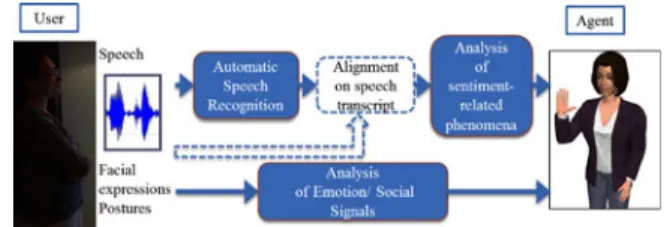
Fig. 2 illustrates the two ways of integrating a sentiment analysis module with the analysis of non-verbal content of speech. A first step towards multimodality is therefore to consider sentiment analysis from the point of view of the speech signal and to rely on the combination of linguistic and prosodic features. The first approach is to carry out emotion/sentiment detection using each modality (i.e., pro-sodic features and linguistic features) independently. The second (and less common) approach is to combine linguistic and acoustic features by aligning the transcript with the extracted prosodic features for the analysis of sentiment, as suggested by [157]. In particular, such approaches can be useful to characterize paralinguistic events such as laughs [158] or sighs [159], which are key cues of sentiment-related phenomena [160] or to disambiguate ironic expressions that are not detectable through the linguistic content.
4.3.2 Automatic Speech Recognition (ASR) Outputs and Spontaneous Speech Features
The linguistic-based sentiment analysis carried out on auto-matic speech transcripts has to deal with speech variability: inter-speaker and intra-speaker variability (emotion, speech style, linguistic variation, grammatical construction, badly pronounced words etc.). This variability causes two issues for oral data analysis, rarely addressed in the context of sentiment analysis.
Firstly, the performance of the ASR systems strongly depends on the background noise and quality of the record-ing systems. Thus, the confidence score and the various hypotheses of the ASR outputs have to be taken into account. This issue is scarcely handled in the sentiment analysis/opinion mining community [18], [73], [161] but is already handled by other communities: for example, [162] investigated the effectiveness of using more ASR hypothe-ses (n-best lists) to extract lexical features for the automatic analysis of the level of interest in spoken dialogs.
Secondly, even correctly transcribed, spontaneous speech features contained in the user utterance such as dis-fluencies, backchannels and interruptions introduce some noise into the text from the point of view of a text-based detection system. However, it should be noted that the
Fig. 2. Integrating sentiment analysis in a multimodal context in a human-agent interaction.
IEEE
Proof
disfluency rate in user utterances depends on contextual factors, such as the role of the speaker in the conversation [163] or the interaction context (users tend to simplify utter-ances and use less disfluencies in human-machine dialogs than in human-human dialogs [164]). Nevertheless, the presence of disfluency phenomena (e.g., repetitions, hesita-tions, etc.) disrupts the syntactical structure of the message [165] and should be taken into account in sentiment analysis methods, without ignoring the fact that disfluencies can have a strategic function in the conversation [166], [167]. In particular, [29] uses disfluencies (filled pauses, fillers, stut-tering, laughter, breathing and sigh) to improve multimodal emotion recognition. The automatic detection of cies can be difficult in particular in the case of edit disfluen-cies where the speaker corrects or alters the utterance, or abandons it entirely and starts over [168]. Existing disflu-ency detection systems make use of acoustic and/or lexical cues using sequence detection methods [169], such as the work we carried out on call-center data [170].
4.3.3 Turn-Taking Behavior
The interaction between a human and an ECA also corre-sponds to conversational speech and the user’s turn-taking behavior can be a powerful indicator of affect and can be integrated as an additional cue for sentiment detection (e.g., what is the user’s dynamic in terms of turn-taking? does the user employ short turns? does the user try to frequently interrupt the agent?). [171] provides a state of the art of social signals in turn-taking and presents some studies ana-lyzing the role of turn-taking as an indicator of speaker’s attitude: “a clash of opinions also means a clash of turn-taking” [172]. In [113], we demonstrated that dialog length and width, understood as the total number of turns and the number of turns required to provide a single information item (e.g., repetitions, asking for help, etc.), improves emo-tion recogniemo-tion accuracy. [173] also demonstrate that con-versational features can be used as a single source to reliably model user affect by predicting satisfaction ratings.
Detecting the users’ turn-taking behavior can be done locally with the detection of interruptions such as in [84], which describes an acoustic turn-taking module, which can use features (speech rate or speaker turn duration) and structural features [67] (used as cues for agreement analysis in meetings). For the analysis of human-human interactions, [174] uses turn-taking features (steady conversational period) and [175] calls on an echo state network to predict timing activity.
4.4 Integrating the Temporal Constraints
Timing plays a major role in the relevance of ECA’s emotional reaction to users’ expression of sentiment, rais-ing the issue of the processrais-ing time for sentiment detec-tion methods; a relevant answer to user sentiment that occurs too late because of too long processing time in the interaction is not conceivable.
The processing time of sentiment analysis is addressed in a quite different manner in the context of opinion mining. The community—joining forces with Big Data movement–puts a slant on the development of scalable methods, that is, on methods that are able to deal with
large databases and that can incrementally adapt to new incoming data [17]. From the perspective of human-agent interaction, the question is not how to deal with a large amount of data, but how to provide a quick reaction to users’ sentiment through affective dialog strategies (see Section 3.2). In human-agent interaction the sentiment detection method takes as input an incoming audio stream and the unit of analysis or decision frame has to be deter-mined according to the temporal constraints.
4.4.1 Methods with Various Levels of Complexity
Affective dialog strategies can be designed with full knowl-edge of the sentiment detection time, such as in [84]. In this paper, the complex rule-based approach for sentiment anal-ysis of [102] (compositional approach) is used as an input of a long-term interaction strategy. Noting this, affective dialog strategies can use computational methods with vari-ous processing times: interaction strategies such as back-channels for short processing time detection methods, and long-term interaction strategies integrating the in-depth understanding of the interaction context for the most com-plex detection methods.
Methods eligible for a quick reaction time are the same as those used for large-scale databases: rule-based approaches (spotting words belonging to a sentiment lexicon) and statistical methods (see Section 3.1). Moreover, in the case of speech processing, methods relying on word spotting have the advantage of not requiring an enriched automatic tran-script and can directly rely on keyword spotting, which can also reduce the processing time [176].
Machine learning methods remain interesting in terms of computational complexity for the decision step (as their cost is mainly the preliminary off-line training phase). However, machine learning methods using a complex representation of textual features can have a better performance but also a longer processing time, even at the decision step. This is also the case of rule-based methods relying on complex semantic rules.
It is worth noting that the processing time of such meth-ods strongly depends on both the device on which the ECA is developed (smartphone, laptop, features of the com-puter), and the complexity of the methods.
4.4.2 Definition of the Decision Frame
Another aspect related to the ECA’s reaction time is the deci-sion frame used for sentiment analysis. Indeed, sentiment analysis can be expressed in two ways: the classification of text utterances with a predefined length or the assignment of sentiment linked expressions to sentiment-related concepts [177]. In both cases, the units of text from which the system takes the decision have to be defined. In opinion mining inputs are generally written texts of various lengths (e.g., shorter in the case of tweets and longer in the case of news articles). For longer texts various linguistic units are used: phrases, sentences, paragraphs or even documents.
When the input is the speech stream of the user, such as in human-agent interactions, the units of analysis are quite different. The choice of the units of analysis and of the deci-sion frames have a strong impact on the reaction time of the agent. Such concern is scarcely addressed in the literature of
IEEE
Proof
sentiment analysis, because it is a specific issue associated with the handling of conversational speech. For example, [67] uses spurts(periods of speech without pauses greater than 0.5s) as the unit of analysis instead of sentences argu-ing that such a segmentation is easier to obtain; [178] uses speech segments corresponding to speaker turns in political debate transcripts.
The agent’s reaction can be triggered by the occurrence of a word (for methods such as keyword spotting), a clause, a sentence, a speaker turn, or even several consecutive speaker turn segments.
4.5 Contextualizing the Interaction
Context is defined in very different ways in the sentiment analysis and ECA communities, and sometimes also within the communities themselves.
In sentiment analysis, context is generally understood as the domain in which an opinion is being expressed. The domain deeply influences polarity assessment, as for exam-ple the word “small” can be either positive or negative depending on the entity or the aspect of the entity being analyzed [179]. Other authors describe it as the linguistic context, that is, the syntactic structures or the collocations of words [180], or even the words and linguistic constructs that influence the analysis. For example, [149] describe contex-tual sentiment influencers such as negations and contrary words (e.g., however), and in [181] there is a discussion on contextual valence shifters. This context is dealt with using the sentiment analysis methods described in Section 3.1
In the ECA community, context may refer to external aspects such as the user’s location or the environment in which the communication takes place (e.g., noisy versus quiet places), or it can refer to aspects internal to the user, either stable aspects such as the user’s gender, age, person-ality and language, or varying aspects such as emotions, moods, or temporal preferences [182].
In addition, especially in works centred on social networks, sentiment analysis studies the context of the group and the social dynamics. As mentioned in [183], the opinion expressed by a user in a forum can be influ-enced by the opinions previously expressed by others. This may be included in ECA systems to complement the external context representation with information not only about the environment and physical location, but also about collective behavior.
Traditionally the sentiment analysis community has not paid much attention to the internal aspects that are widespread in the ECA community. For instance, [184] claimed that little research had been conducted to under-stand opinions in the social and geopolitical context and claim that such information would shed light on public opinions and concerns. In [185] the authors present a framework to add emotional tags to existing social network services based on recognizing emotion from dif-ferent sources. This idea can be extended by incorporating the knowledge of the ECA community in the development of multimodal emotion recognizers.
To develop ECAs that incorporate affective and social features, the community has developed models of affective conversational behavior [186] and social skills that can be used to develop sophisticated user models that help to
disambiguate textual sentiment analysis. In Section 5 we propose additional guidelines to this aspect.
4.6 Facilitating Long-Term Relations
Although the focus of ECAs is to provide an immediate response, when the aim is to sustain long-term relations with the user, the ability of the system to learn from a long history of previous interactions gains importance. The con-versational nature of human-ECA interaction is also benefi-cial to obtain more information from the user, who is in some cases more keen to self-disclose with an artificial inter-locutor [187]. There is therefore more space for using senti-ment analysis approaches to extract knowledge from large amounts of data.
To build such complex behaviors it could be beneficial to build long-term user models that include predictions of future user actions and affect. Some areas of sentiment analy-sis have addressed the problem of long-term predictions, specially the works related to the effect of sentiment in invest-ments. For example, [188] studied the influence of investor sentiment’s orientation on future exchange rates considering different time scopes, ranging from 1 to 60 months.
These aspects could be used by the sentiment analysis community to address the study of the volatility of positive and negative sentiments. Also ECA models for interactions sustained over long periods of time could enrich opinion mining studies with user personality models that contextu-alize the interpretation of their opinions and reactions.
5
G
UIDELINES:
THEC
ASE OF THEG
RETAP
LATFORMIn the previous section, we have presented the various open questions and prospects for the integration of a sentiment analysis module in an affective dialog system. The goal of this section is to make the discussion more concrete through the prism of the Greta platform. Two use cases are also dis-cussed: a virtual agent that interacts with the visitors in a museum and a virtual recruiter training youngsters in prep-aration for job interviews.
5.1 The Greta Platform
Fig. 3 presents the global architecture of the Greta ECA plat-form [52], [189]. It is a SAIBA (situation, agent, intention, behavior, animation) architecture (an international common multimodal behavior generation framework [190]). It relies on theAgent Mind, which includes a representation of the

![Fig. 3 presents the global architecture of the Greta ECA plat- plat-form [52], [189]. It is a SAIBA (situation, agent, intention, behavior, animation) architecture (an international common multimodal behavior generation framework [190])](https://thumb-us.123doks.com/thumbv2/123dok_us/1684823.2732502/12.847.440.802.69.261/architecture-situation-intention-animation-architecture-international-multimodal-generation.webp)
