Remote Partial File Access Using
Compact Pattern Descriptions
∗
Thorsten Sch¨utt, Andr´e Merzky, Andrei Hutanu, Florian Schintke
Zuse Institute Berlin (ZIB)
E-mail:
{schuett,merzky,hutanu,schintke}@zib.deAbstract
We present a method for the efficient access to parts of remote files. The efficiency is achieved by using a file for-mat independent compact pattern description, that allows to request several parts of a file in a single operation. This results in a drastically reduced number of remote opera-tions and network latencies if compared to common solu-tions. We measured the time to access parts of remote files with compact patterns, compared it with normal GridFTP remote partial file access and observed a significant perfor-mance increase.
Further, we discuss how the presented pattern access can be used for an efficient read from multiple replicas and how this can be integrated into a data management system to support the storage of partial replicas for large scale simu-lations.
1. Introduction
In the domain of scientific computing, large, distributed data intensive jobs become more and more popular with the emerging Grid technology. In such environments, parts of huge datasets are often accessed remotely. It is difficult to do this effectively, because a potentially large number of re-quests and answers have to be sent across the network to select the appropriate parts of a file. Each request and an-swer message includes the latencies of potentially wide area network links, protocol encoding and decoding efforts, and protocol overheads. This can drastically reduce the achieved network transfer rate. In extreme cases it can be faster to re-quest and transfer the whole file than reading parts of it.
In one of our scenarios, we try to give the user feedback on the progress of his simulation by the visualization of in-termediate results. To not exhaust the available bandwidth, ∗ This work was partially funded by the European Commisson (the EC GridLab project, grant IST-2001-32133), and by the German Govern-ment (the DFN GridKSL project, grant TK 602 – AN 200).
these intermediate results must be sub-sampled by remote partial file access.
Additionally, for improved interactivity, we load and vi-sualize simulation results progressively by reading regular patterns of the data in steps of increasing resolution.
We developed and implemented a new protocol for re-mote file access which uses a pattern description called
’nested FALLS’ [12], a compact but powerful description of
regular subsets of byte arrays (see Section 2). A single re-quest containing this compact description is sent across the network and the remote server sends all requested parts of the file without further ping-pong messages. This solution is not restricted to a particular file format, but works for many different binary formats.
An API similar to the POSIX file access API is supported by our library, for an easier migration of existing applica-tions to (partial) remote file access. Only minor changes in the code are necessary to enable access to remote files with this library. In an application, those parts that benefit from remote pattern reads have to be determined and read calls in these parts have to be replaced with pattern read calls.
The next section describes the compact pattern descrip-tion language, followed by some examples which illustrate how to apply FALLS to a broad range of file formats. Theafter we present our implementation for pattern based re-mote file access in detail. Section 5 describes various facets of the application in data management systems. Finally, Section 6 presents the results of performance measurements for our implementation, and compares them to the perfor-mance of selected traditional methods.
2. Compact Pattern Description Language
We present a compact but powerful language to describe regular subsets of byte arrays, called ’nested FAmiLy of Line Segments’ (nested FALLS). This schema was first used in the PARADIGM compiler for array distribution [16] and later modified by [11] for a cluster filesystem. We use it in our work for efficient remote file access.
3 4 5 6 7 8 9 10 11 12 13 14 15 16 17 18 19 2021 2223 0 1 2 24 25 26 r 27 l stride . . .
Figure 1. Family of line segments (FALLS), de-scribed by the pattern(3,6,7,4).
Line Segments. The basic building block of FALLS is the
line segment (LS). A line segment(l,r)is a contiguous part of a byte array defined by the offset of the left-most (l) and by that of the right-most (r) byte. The first 4 highlighted boxes in Fig. 1 can be described by the line segment(3,6).
Family of Line Segments. A FAmiLy of Line Segments
(FALLS) represents a set of equally spaced and equally sized line segments. A FALLS is defined by a 4-tuple(l,r,s,n)
where l and r define the first line segment, s is the stride be-tween two consecutive line segments and n is the number of repetitions . In Fig. 1 the highlighted boxes can be de-scribed by (3, 6, 7, 4). (3, 6) describes the first line segment, 7 is the stride and 4 specifies how often this pattern is re-peated.
Nested Family of Line Segments. A nested family of line
segments (nested FALLS) is defined using FALLS. Line seg-ments select a contiguous part of a byte array. The re-sult is again a byte array. So we can apply one FALLS to a byte array and apply another FALLS to each element of the result. The result is always a set of line segments. Nested falls are defined recursively where the first 4 pa-rameters have the same meaning as for FALLS whereas the last parameter is either a FALLS or another nested FALLS
(l0,r0,s0,n0,(l1,r1,s1,n1)).
2.1. Example
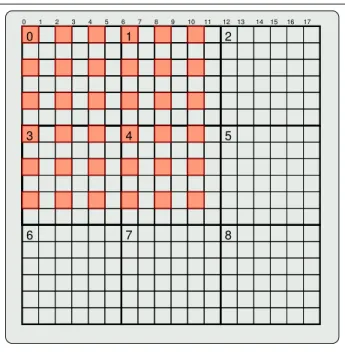
In the following we give an example for a nested FALLS to read a subset of a 2-dimensional matrix (see Fig. 2). For the moment we ignore that the matrix is distributed across 9 nodes and assume that the matrix is completely stored in a local file.
The task in this example is to read the highlighted ele-ments. The easiest way to construct the nested FALLS is to start with the inner FALLS. Therefore we begin by extract-ing every other element from a line of 12 elements. The first selected element starts at offset 0 and spans one byte, the stride between two elements is 2 and we need to read 6 of these elements. This results in pattern(0,0,2,6). On the outer pattern every other line from the 18x18 matrix is read:
(0,17,36,6). The final nested FALLS is created by nesting both patterns:(0,17,36,6,(0,0,2,6)).
0 1 2 3 4 5 6 7 8 9 10 11 12 13 14 15 16 17
0 1 2
3 4 5
6 7 8
Figure 2. Two dimensional matrix distributed across 9 nodes
Note that for nested FALLS there are often several pat-terns which describe the same subset. In this example we could replace the outer FALLS by(0,10,36,6).
3. Format Independent Remote Partial File
Access
The presented method to describe parts of a file is file for-mat independent. It can be applied to any file forfor-mat, but is beneficial only for binary files with parts of structured data. To use the patterns for remote partial file access, the client constructs a pattern description of the sections of interest, sends this description to the remote server (GridFTP in our implementation) and receives the requested data in one con-tiguous block.
In the following we describe some file formats for which the usage of regular patterns is useful. The described meth-ods are applicable to other file formats similarly.
3.1. Accessing Multi-dimensional Image Data
Files storing multi-dimensional uncompressed im-age data are usually well suited for the application of pat-tern reads. A large number of file formats use 2D and/or 3D arrays to store data, like TIFF [13], AVS Field [1], Ami-raMesh binary [15], BMP, PNG [8]. These file formats have an internal structure that allows the usage of pat-terns to subsample or to crop the data.
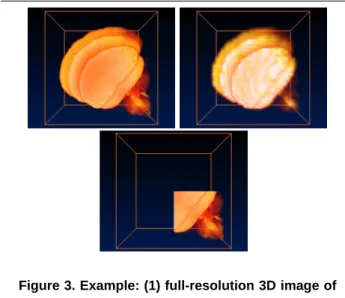
Figure 3. Example: (1) full-resolution 3D image of the brain of a honey bee, (2) same data at 1/4 res-olution, and (3) lower-right corner
Most of these formats follow a common file layout. They start with a header containing meta data like dimensions, layout, format, and storage information, which is followed by, or contains pointer(s) to, data areas that contain the ac-tual image data as a contiguous sequence of bytes.
Sub-sampled or cropped versions of this data can be read using patterns to generate low-resolution images for pro-gressive visualization, or exploratory analysis of large data sets, and images. Similar operations can also be applied to 3D volume data. Figure 3 depicts the result of these opera-tions applied on a 3D volume stored in the AmiraMesh bi-nary format. The original data, a sub-sampled version and a 3D selection of the data were volume-rendered using the vi-sualization software Amira [17]. Both the sub-sampled and the cropped volumes have one fourth of the size of the com-plete volume, the selections can be easily expressed using a
nested FALLS containing three FALLS.
3.2. Accessing Gravitational Wave Data
As an example for complex scientific data, we re-implemented a file reader for the FrameLib file format used by the Geo600 Gravitational Wave Search experi-ment [14]. This format is structured similar to a file system. A table of contents (TOC) refers to other TOCs which re-fer to meta data and parts of binary data (Channels). Our implementation provides a read ahead cache to allow ef-ficient parsing of the file structure of remote files. Using this cache, three remote reads are sufficient to find any par-ticular channel in the TOCs and to read the meta data on that channel. The actual channel data itself can then be effi-ciently accessed using pattern reads.
reads Pattern Binary File (Amira) Network GridFTP Server FALLS Plugin Client System Read Pattern
GridFTP Protocol Extension POSIX−like Client Library
File Format Reader
Figure 4. Our system builds on the GridFTP infras-tructure - the marked elements have been imple-mented.
4. Implementation
Our implementation of the presented remote access method with nested FALLS uses the GridFTP infrastruc-ture [3], and consists of three elements, as depicted in Fig. 4:
• a library providing pattern read capabilities for local files,
• an extension to the GridFTP protocol and a plugin to support nested FALLS on the server side, using the pat-tern read library, and
• a client library providing a POSIX like file access API to perform traditional remote file reads as well as re-mote pattern reads.
4.1. Local Pattern Reads
We implemented a library in C++ for local file access based on nested FALLS. The central function applies a
nested FALLS pattern to a file and returns the read bytes
in a buffer provided by the user.
int falls_pread_buf( const char *file_name, const char *pattern,
char *buffer,
unsigned int buffer_size);
To parse the nested FALLS the parser generator from the boost1libraries is used. After the parsing we perform a
se-mantic check on the pattern, e.g. the covered area is com-pared with the file size.
In the second step the file is memory mapped (mmap(2)) and the nested FALLS can be processed using memory to
memory copies. This is a standard method and our tests proved that it is more efficient than direct buffered disk reads.
In Linux, memory mapped files are accessed in blocks of the page size. The page size for x86 systems, which we used, is 4 kB. In the worst case every byte read by the li-brary invokes a read of one page from the disk. Hence, the local read performance is limited by a combination of disk speed, page size and pattern characteristics (reads per page). For sparse patterns it can happen that for each byte send across the network up to a full page has to be read from the local disk.
4.2. GridFTP Plugin and Protocol Extension
GridFTP [3] is an extension to the standard FTP proto-col, which supports Grid authentication mechanisms using the Grid Security Infrastructure (GSI) [9], remote partial file access, multiple concurrent point-to-point data channels, gathering data from several servers [2], a generic method for protocol extensions, and custom server side data pro-cessing using a plugin mechanism.
We use the latter to extent GridFTP for pattern access on the server side. The GridFTP protocol allows to spec-ify custom server-side processing commands through the ERET (extended retrieve) and ESTO (extended store) com-mands. The general pattern for ERET and ESTO is the fol-lowing:
ESTO <plugin_name>="<plugin_parameters>" <file> ERET <plugin_name>="<plugin_parameters>" <file>
plugin name is a unique string identifying the
plu-gin. The second string (plugin parameters) is plu-gin specific and contains an operation description. The last parameter (filename) specifies the file to be pro-cessed.
We use the ERET mechanism to define an operation that handles remote pattern reads. This operation is imple-mented by a plugin for the GridFTP server that uses the li-brary for local pattern reads. The command for reading a re-mote pattern is:
ERET FALLSPLUGIN="<nested falls>" filename
4.3. POSIX-like Client Library
On the client side, the Globus Toolkit provides a client li-brary for GridFTP, including support for custom ERET or ESTO operations. It is cumbersome to use this library di-rectly on the application level, because complex Globus API calls would have to be mixed with the standard read oper-ations. Another drawback is that local and remote file ac-cesses would be handled separately.
For these reasons we implemented a client library which resembles the standard Unix POSIX interface for file ac-cess comprising open, close, read, write, seek and their file stream equivalents fopen, fclose, fread, fwrite, fseek, fscanf, ..., and extended that inter-face with calls for pattern reads:
int pread (int fd,
const char *pattern,
char **buf,
size_t *nbytes); int pread_buf (int fd,
const char *pattern,
char *buf,
size_t nbytes);
and their file stream equivalents. The two methods differ only in their memory allocation policy. The second method leaves the allocation of a sufficiently large memory area for the user whereas the first method returns the data in a newly allocated buffer. The client library itself can handle mul-tiple I/O plugins. It currently supports local Unix I/O, re-mote data access via pattern reads, and rere-mote access via GridFTP partial file access.
GridFTP Partial File Access (GPFA) is a feature pro-vided by GridFTP as an extension to standard FTP. In fact, GPFA is the first implementation using the more generic ERET command introduced by GridFTP. Our implementa-tion, as explained later, also makes use of the ERET mech-anism, and we compare it to GPFA also for this reason. In short, GPFA allows to retrieve a section of a file at offset
O with length L with a single call, thus providing us with a
mechanism to make non-sequential reads (or writes). Most file formats store meta data in small parts at the be-ginning of the file, whereas the actual data is stored as a huge blob (binary large object). To speed up the latency-dominated meta data reads, with large spatial locality, each read operation actually transfers a chunk of several kB that is buffered in a local cache.
If meta data is distributed across the file (as for the FrameLib format), each cache miss induces one remote op-eration. For the pattern reads, the cache is disabled.
5. Benefits in a Data Management System
Because scientists no longer work isolated in local groups, but they collaborate on an international level, sci-entific computing today relies to a large extent on the ability to quickly access remote files. To avoid access bot-tlenecks for popular files and to improve data reliability in such distributed settings, replicas of the datasets are dis-persed over the Grid.
Using our pattern access, remote reads on a single replica can be speed up significantly. Having a data management
system in mind, that knows about all the replicas and con-trols the access to them, further improvements become pos-sible by gathering the data from several replica locations in parallel.
5.1. Accessing Replicated Files
The replica catalog of a distributed data management system can be used to find several copies of a file. Access-ing these replicas in parallel can improve the access perfor-mance using pattern operations where only a fraction of the data is read from each replica. Pattern reads on local disks induce many disk head movements caused by the alternat-ing read and seek operations. Disk performance in such sce-narios is poor and the available network bandwidth can eas-ily outperform the disks. We will employ several servers to be able to saturate the client network link.
If the user wants to read the pattern F from a fileAand the replica system reports 5 locations A0,A1,A2,A3,A4for
this file, F can be split into 5 disjunct patterns F0,F1,F2,F3
and F4withSFi=F. Fiwill be processed by the host where Aiis stored. Each host sends its part back to the user who
then combines the results of the subqueries.
With a proper splitting of F, we can assign different amounts of work to each node to take differing performance into account. The pattern can be constructed, so that all hosts complete their task in approximately the same amount of time. Thereby the given resources are used in an optimal way. The network topology, local disk speed, etc. have to be considered to minimize the execution time.
As a first approximation we assume that the execution time is proportional to the number of bytes covered by the pattern divided by the network bandwidth between the client and the replica location. The network latency plays only a minor role here.
Splitting a FALLS(l,r,s,n)can be done either by divid-ing the area covered by l and r into several parts or by as-signing complete line segments to different hosts.(l,r,s,n)
can be split to:
1. (l,r−x,s,n)and(r−x,r,s,n)or 2. (l,r,s,x)and(l+x∗s,r,s,n−x)
Combinations of both methods are also possible. For
nested FALLS we can even apply several splitting methods
to the different FALLS on the various levels.
The assignment of complete line segments (2nd method) of the outer FALLS to different hosts is suited for an in-crease in the spatial locality of file accesses. Most I/O sys-tems work more efficient with higher spatial locality, be-cause in this way the number of operating system internal cache hits is increased.
5.2. Supporting Distributed Files
Another possible application is the support of partial replicas in a replica catalog. In distributed parallel numeri-cal simulations, for example, where each host writes lonumeri-cal results in a separate file, the local results often represent a regular subset of the solution. Using patterns, we can reg-ister these subsets (D1, . . . ,Dn) as partial replicas. The
dis-junct partial replicas from several simulation hosts form a complete dataset.
To access such a distributed file with a pattern F, we have to intersect F with each Di. This selects for each node i the
parts of F that are stored at host i. Note that we cannot split
F according to performance considerations, because the
dis-tribution is already given by the partial replicas.
Example. Figure 2 was already used to explain the FALLS concept in Sec 2. Now let us assume that the matrix is gener-ated by a parallel application and distributed across 9 com-pute nodes. The task is again to read the highlighted ele-ments. The necessary pattern is already known from Sec-tion 2 :(0,10,36,6,(0,0,2,6)). We can describe the distri-bution of the data using the following pattern(bi
3c ·108+
(i mod 3)·6,bi
3c ·108+ (i mod 3)·6+5,18,6)where i is
the node index. Given that the data is distributed regularly across the nodes we could have used PITFALLS [16] (an ex-tension to FALLS) to describe the distribution, but we prefer to use FALLS to be open for more irregular patterns.
Each node i executes a different pattern
(0,10,36,6,(0,0,2,6))∩(bi
3c ·108+ (i mod 3)·6,b
i
3c ·
108+ (i mod 3)·6+5,18,6). Each node stores its sub-set of the data in a continuous byte array. Therefore the re-ceived data must be remapped on the client-side to merge the data from the different nodes. Algorithms for the inter-section and the mapping are described in [16].
Integrated into a distributed data management system, a combination of both approaches, pattern access to repli-cated files and pattern distributed files, is most powerful. In such a system, arbitrary portions of files can be stored on in-dividual nodes and registered in the replica catalog, includ-ing the registration of overlappinclud-ing patterns. Then the over-lapping area of two patterns represents two replicas for this area. In a system with distributed files this allows a perfor-mance driven splitting of the access pattern F, but is still more limited than the fully replicated scenario. In such an environment, achieving even load on each node by splitting of patterns is a non trivial task.
6. Tests and Benchmark Results
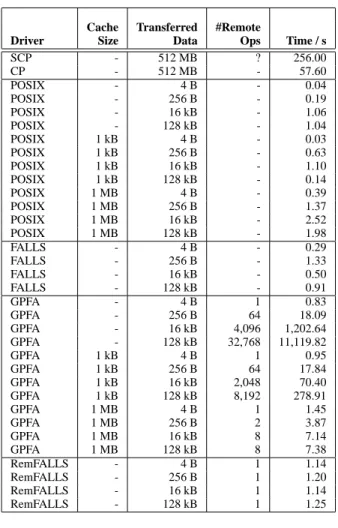
As described earlier, our implementation supports a number of file formats which make use of the pattern based remote access. Table 1 shows the results of measure-ments for the access to a file stored in the AmiraMesh
for-mat. For the tests we used a 5123data set of scalar float val-ues (data size is 512 MB). The plain text header of the data file was cached locally by our library. The pat-terns used for the reads select sub-sampled versions of the data. The queried data is evenly distributed over the com-plete data set. For a 323data selection we have a source line
length ll of 512 floats, the float size f s of 4 bytes, a desti-nation line length dl of 32 floats, and a header length hl of 339 bytes. The pattern is constructed as follows:
(hl, hl+ll2∗f s−1, f s∗ll3/dl, dl, (0, ll∗f s−1, f s∗ll2/dl, dl, (0, f s−1, f s∗ll/dl, dl ))) = (339, 1048914, 16777216, 32, (0, 2047, 32768, 32, (0, 3, 64, 32 )))
The inner-most FALLS selects every 16th float (4 bytes) from a line of 512 floats (2048 bytes). The FALLS in the middle works in the same way. It selects every 16th line (32768 bytes) of a plane of 512 lines. The outer-most FALLS selects every 16th plane of the cube, and has to skip the 339 bytes ASCII header.
We compare the performance of pattern access (FALLS, RemFALLS) with other access techniques, namely, lo-cal file access using POSIX system lo-calls (POSIX), and GridFTP’s remote partial file access (GPFA).
Local measurements were obtained on a Linux system (Pentium III 1.0 GHz, Kernel 2.4.19, 512 MB RAM). For the remote measurements the server was running on a dual Pentium 4 Linux server (Kernel 2.4.19, 1 GB RAM) and the client was the machine mentioned above. For remote file access we used a WAN connection between the Vrije Universiteit Amsterdam, Netherlands, and the Zuse Insti-tute Berlin, Germany. The theoretical link speed between both systems is 100 Mbits and the latency about 15 ms. Results. The performance as listed in Table 1 shows that local I/O is similarly efficient in both cases, POSIX and FALLS. For large cache sizes, POSIX performs even worse than FALLS, but we suspect our implementation of caching for local I/O to interfere with the systems disk cache.
The RemFALLS has similar execution times for all tests. That is not surprising: for the comparatively small amounts of data, the single round trip time dominates the overall ex-ecution time.
The results for GPFA show a significant dependency on both, the number of read items, as expected, and on the lo-cal cache. The transfer time for the largest pattern is much larger than the time needed to transfer the whole file via scp. In fact, due to the caching reads, the complete data set is transferred here, but inefficiently in multiple chunks. The results are promising, so we will apply this scheme for re-mote partial file access to other applications and scenarios in the near future.
Cache Transferred #Remote
Driver Size Data Ops Time / s
SCP - 512 MB ? 256.00 CP - 512 MB - 57.60 POSIX - 4 B - 0.04 POSIX - 256 B - 0.19 POSIX - 16 kB - 1.06 POSIX - 128 kB - 1.04 POSIX 1 kB 4 B - 0.03 POSIX 1 kB 256 B - 0.63 POSIX 1 kB 16 kB - 1.10 POSIX 1 kB 128 kB - 0.14 POSIX 1 MB 4 B - 0.39 POSIX 1 MB 256 B - 1.37 POSIX 1 MB 16 kB - 2.52 POSIX 1 MB 128 kB - 1.98 FALLS - 4 B - 0.29 FALLS - 256 B - 1.33 FALLS - 16 kB - 0.50 FALLS - 128 kB - 0.91 GPFA - 4 B 1 0.83 GPFA - 256 B 64 18.09 GPFA - 16 kB 4,096 1,202.64 GPFA - 128 kB 32,768 11,119.82 GPFA 1 kB 4 B 1 0.95 GPFA 1 kB 256 B 64 17.84 GPFA 1 kB 16 kB 2,048 70.40 GPFA 1 kB 128 kB 8,192 278.91 GPFA 1 MB 4 B 1 1.45 GPFA 1 MB 256 B 2 3.87 GPFA 1 MB 16 kB 8 7.14 GPFA 1 MB 128 kB 8 7.38 RemFALLS - 4 B 1 1.14 RemFALLS - 256 B 1 1.20 RemFALLS - 16 kB 1 1.14 RemFALLS - 128 kB 1 1.25
Table 1. Results of the performance evaluation for local and remote accesses to a large binary data set. The various transfer sizes for partial access correspond to different resolutions of the result-ing data selection (13, 43, 163and 323, ...).
7. Related Work
The DataCutter Framework [6, 7] also provides flexible indexing and filtering of distributed datasets. The indexing service provides access to subsets of the complete dataset. The filtering service can execute multiple filters during ac-cess. Filters can be connected with pipes and make a stream processing possible. For the indexed access additional in-dex files are stored in the system. Filters are C++ objects which are derived from a common filter class. Filters can be placed and executed on any host in the system. DataCut-ter can be used in conjunction with the Storage Resource Broker SRB [5].
FALLS and PITFALLS are already used to design a
can be seen as a very flexible implementation of RAID 0. On RAID level 0 the filesystem is striped over several disks. Traditionally the stripe size is a fixed parameter. For sev-eral applications disk access performance can be enhanced by modifying the stripe size. In clusterfile the stripe pat-tern can be selected per file using a PITFALLS patpat-tern. In Section 5 we described how this idea can be extended to Grid-like environments.
[10] used the concept of plugins to GridFTP servers for implementing file format specific data access capabilities. These are, from an architectural point of view, very similar to the solution presented in this article. They offer substan-tially better performance for unstructured data, and compa-rable performance for structured data. The main penalty for a format specific plugin is the overhead for development and deployment in the target environment. The FALLS based access patterns presented here, span a broader range of po-tential use cases with a single implementation. [10] pre-sented a plugin for the HDF52 file format. This is a very powerful file format, but it has a complex structure. We are currently investigating whether it is feasible to write an HDF5 reader based on the FALLS library. It would be in-teresting to measure the overhead of the generic approach compared to the file format specific plugin.
8. Conclusion
We presented a new approach for remote partial file ac-cess based on a compact pattern description language. The major advantage of this approach is its file format indepen-dence. E.g. a file-format specific plugin for the GridFTP server would have a comparable or better performance, but it would be limited to one file format. Especially in Grid en-vironments it is difficult to install software for every used file format on all servers.
While we showed that FALLS based patterns are very useful for regularly structured binary data formats, their range of use is limited: these patterns are not applicable for ASCII data, and for unstructured binary data, such as JPEG, wavelet or RLE compressed data, or data stored on unstructured grids. The worst case performance to be ex-pected from the presented framework is similar to the per-formance of cached remote Partial File Access via GridFTP. On the other hand, the FALLS patterns are trivially ex-ploitable for simple file formats, as described above. Our POSIX-like IO-Wrapper library further simplifies the im-plementation of file readers based on nested FALLS.
We use the described approach in the GriKSL and the GridLab [4] project. Currently we are trying to improve our model by including predictions of the execution time for patterns, whereas on the implementation side we will
en-2 http://hdf.ncsa.uiuc.edu/HDF5/
hance an existing replica catalog/data management system to support distributed files using patterns.
References
[1] Advanced Visual Systems Inc. AVS/Express Field data type, 2001.
[2] W. Allcock, J. Bester, J. Bresnahan, A. Chervenak, I. Fos-ter, C. Kesselman, S. Meder, V. Nefedova, D. Quesnel, and S. Tuecke. Data management and transfer in high perfor-mance computational grid environments. Parallel Comput-ing Journal, 28(5):749–771, May 2002.
[3] W. Allcock, J. Bester, J. Bresnahan, S. Meder, P. Plaszczak, and S. Tuecke. GridFTP: Protocol extensions to FTP for the Grid. GWD-R (Recommendation), April 2002.
[4] G. Allen et al. Enabling applications on the Grid - a Grid-Lab overview. Intl. Journal on High Performance Comput-ing Applications, 17(4):449–466, 2003.
[5] C. Baru, R. Moore, A. Rajasekar, and M. Wan. The SDSC Storage Resource Broker. Proceedings of CASCON’98, 1998.
[6] M. D. Beynon et al. Distributed processing of very large datasets with DataCutter. Parallel Computing, 27(11):1457– 1478, Oct. 2001.
[7] M. D. Beynon, R. Ferreira, T. Kurc, A. Sussman, and J. Saltz. DataCutter: Middleware for filtering very large scientific datasets on archival storage systems. In Proceedings of the 2000 Mass Storage Systems Conference, pages 119– 133, College Park, MD, Mar. 2000. IEEE Computer Soci-ety Press.
[8] T. Boutell. RFC 2083: PNG (portable network graphics) specification version 1.0, Jan. 1997.
[9] I. Foster, C. Kesselman, G. Tsudik, and S. Tuecke. A se-curity architecture for computational Grids. In ACM Con-ference on Computer and Communications Security, pages 83–92, 1998.
[10] H.-C. Hege, A. Hutanu, R. K¨ahler, A. Merzky, T. Radke, E. Seidel, and B. Ullmer. Progressive retrieval and hierar-chical visualization of large remote data. Proceedings of the Workshop on Adaptive Grid Middleware, September 2003. [11] F. Isaila and W. Tichy. Clusterfile: A flexible physical layout
parallel file system. Proceedings of IEEE Cluster Computing Conference, October 2001.
[12] F. Isaila and W. Tichy. Mapping functions and data redistri-bution for parallel files. Proceedings of IPDPS 2002 Work-shop on Parallel and Distributed Scientific and Engineering Computing with Applications, April 2002.
[13] A. Katz and D. Cohen. RFC 1314: A file format for the ex-change of images in the Internet, Apr. 1992.
[14] LIGO Data Group and VIRGO Data Acquisition Group. Specification of a common data frame format for interfer-ometric gravitational wave detectors (IGWD), August 1997. [15] Amira 3.0 user’s guide and reference manual, 2002.
http://www.amiravis.com/Amira30-manual.pdf.
[16] S. Ramaswamy and P. Banerjee. Automatic generation of ef-ficient array redistribution routines for distributed memory
multicomputers. In The Fifth Symposium on the Frontiers of Massively Parallel Computation, pages 342–349, Febru-ary 1995.
[17] D. Stalling, M. Westerhoff, and H.-C. Hege. Visualization Handbook, chapter Amira - a Highly Interactive System for Visual Data Analysis. Academic Press, 2004.