T
AX
M
ORALE AND
O
PTIMAL
T
AXATION
W
ERNER
G
UETH
R
UPERT
S
AUSGRUBER
CES
IFO
W
ORKING
P
APER
N
O
.
1284
C
ATEGORY1:
P
UBLICF
INANCES
EPTEMBER2004
P
RESENTED ATCES
IFOV
ENICES
UMMERI
NSTITUTE,
W
ORKSHOP ONB
EHAVIORALP
UBLICE
CONOMICS,
J
ULY2004
An electronic version of the paper may be downloaded
• from the SSRN website: www.SSRN.com
CESifo Working Paper No. 1284
T
AX
M
ORALE AND
O
PTIMAL
T
AXATION
Abstract
We study experimentally how taxpayers choose between two tax regimes to fund a public good. The first-best tax regime imposes a general, distortion-free income tax. However, this tax cannot be enforced. The second-best alternative supplements the income tax by a specific commodity tax. This tax cannot be evaded but distorts optimal consumption choices, instead. The result is that a large majority of subjects prefer the general income tax regime. The bulk of votes is consistent with actual payoffs. We isolate tax morale as cause for payoffs above theoretical predictions.
JEL Code: C91, H21, H26.
Keywords: optimal taxation, tax evasion, voting, experiments.
Werner Gueth
Max Planck Institute for Research into Economic Systems Strategic Interaction Group
Kahlaische Str. 10 07745 Jena Germany [email protected] Rupert Sausgruber University of Innsbruck Department of Public Economics
Universitätsstr. 15 6020 Innsbruck
Austria
We thank Wolfram Richter, Gerald Pruckner, and Steven Beckman for helpful comments. We are grateful for financial support by the Austrian National Bank, Jubiläumsfonds, under Project No. 9134.
1
Introduction
The theory of optimal taxation is about the distortions introduced by taxes. The interest of this theory is normative: based on the canonical assumptions of rational and self-interested taxpayers it gives advice on how to design a tax system such that the efficiency cost of taxation is reduced in the best possible way. The theory of optimal taxation has significantly contributed to clarify the objectives of tax policy and to understand the economic properties of tax instruments. Nevertheless, we have to admit that, relative to the theory’s significance in the academic field of public finance, its impact on practical tax policy is meagre (e.g., Slemrod 1990).
What limits the relevance of optimal tax formulas for tax policy? Part of the answer may be that the theory has put too little emphasis on the motives why people pay taxes. Generally, the theory of optimal taxation presumes that taxes can be fully enforced. A large body of the literature on tax compliance illustrates that this assumption is not warranted empirically (for a survey see, Andreoni, Erard, and Feinstein 1998). This literature broadly falls into two groups. The first adheres to the standard assumptions in economics and regards the decision of paying taxes as one that depends on the deterrent effects of legal sanctions (Allingham and Sandmo 1972, Yitzhaki 1987). According to this view, people face a decision under risk when they trade off the cost of paying taxes against the benefits of remaining undetected. For a short time now the theory of optimal taxation pays attention to this literature. For instance, the models by Cremer and Gahvari (1993), Boadway, Marchand, and Pestieau (1994) and Richter and Boadway (2003) acknowledge that there exists an efficiency cost of tax evasion, which ought to be traded off against that of tax distortion.
The second group of the literature on tax compliance has developed from the behavioral branch of economics. Most taxpayers face small expected penalties from tax evasion. Nevertheless, most people abide by the tax law (e.g., Slemrod and Yitzhaki 2002). There is now abundant empirical evidence that people in many instances do not act in their pure self-interest and, leaning against other social sciences, the behavioral literature on tax compliance incorporates social motives to explain a sense of morale or social duty to pay taxes (for references see,
Andreoni, Erard, and Feinstein 1998: 851 ff.). Recently, behavioral economics has gained enormous momentum and is on the verge of becoming mainstream in some fields within economics (for surveys see, e.g., Rabin 2002, Fehr and Falk 2002, Camerer 2003). The theory of optimal taxation accounts for social preferences by the concept of social welfare functions. But this concept is based on ad hoc reasoning rather than on real behavior. So far the theory of optimal taxation has not dealt with the question how new assumptions about individual preferences would modify traditional optimal tax rules.
In this paper, we illustrate that the normative policy implications derived from the existing framework of optimal taxation theory may be misleading un-less it accounts for basic insights from recent research in behavioral economics. Instead of studying normative standards of what tax authorities might do, in an experiment we observe the behavior of taxpayers who are motivated by real in-centives. Our study is particularly centered around a behavioral pattern in public goods experiments, which is highly robust and well documented in the literature (see, Ledyard 1995). In these experiments subjects typically contribute 40 to 60% of their endowment to the public good although selfish individuals would contribute nothing. In our setup a public good is funded by individual taxes and we will refer to tax payments above theoretical predictions as ”tax morale”.1 We
illustrate the welfare implications of tax morale in our design and contrast them against the normative predictions of optimal taxation theory.
We apply experimental methods since, for obvious reasons, data on tax com-pliance is difficult to come by in the field. In contrast, in an experiment we know people’s incomes and we can observe tax payments. In the field the economic effects of taxation typically interact with numerous circumstances that are dif-ficult to control. As a consequence, attempts to evaluate tax instruments with observational data are prone to substantial difficulties (for discussions see, e.g., Creedy 2000, Saez 2001, Fullerton and Metcalf 2002). A virtue of experimental
methods is that we can compare different tax regimes under true ceteris paribus
conditions (see, e.g., Quirmbach, Swenson, and Vines 1996). For instance, in an experiment it is particularly straightforward to measure the relative efficiency of
alternative tax regimes.
Another advantage of experimental methods is that it enables us to shed some light on the role of tax morale for the political feasibility of tax reform
and the endogenous evolution of the tax system.2 For this reason, we allow
taxpayers to vote between two tax regimes to fund the public good. This choice is characterized by a tradeoff between tax distortion and tax evasion. The theory provides a clear-cut prediction of the size of this tradeoff. However, the actual weight of the tradeoff is endogenously determined by tax morale, i.e., the amount of taxes paid in excess of theoretical predictions. Our interest is to see whether tax morale can induce taxpayers/voters to implement a tax regime that is not feasible in the standard framework of optimal taxation theory.
The basic design is as follows: Participants in the experiment gain utility from consuming a set of private goods and a public good. In a referendum they
choose between two tax schemes to fund the public good. TheG-scheme imposes
a[G]eneral income tax on endowments which subjects declare for taxation. The tax is efficient in the sense that it does not distort consumption choices. But the tax cannot be enforced and opportunistic individuals will not declare any taxes. Under the rules of theS-scheme the income tax applies together with a[S]pecific commodity tax. The commodity tax bears an efficiency cost from distorting the
private consumption choice. Nevertheless, assuming rational behavior, the
S-scheme increases overall efficiency by raising receipts for funding the public good without enforcement.
In the experiment we implement conditions such that rational self-interested
agents would prefer the distortionary S-scheme. This prediction is compared
against an alternative prediction based on abundant evidence regarding the vol-untary contribution of public goods. In line with the insights from this literature, we hypothesize that to fund the public good people are inclined to pay income taxes in spite of an individual incentive to free-ride. If tax morale is high, the G-scheme will be overall more efficient. On the other hand, if tax morale is humble, the S-scheme will dominate the G-scheme.
2For discussions on how non-selfish preferences as well as heuristics and biases in judgement
may translate into policy outcomes see, e.g., Quattrone and Tversky (1988), McCaffery (2000), Tyran and Sausgruber (2002), Slemrod and Krishna (2003).
The results show that tax morale is essential in trading off the efficiency cost of the two tax systems: against the predictions of standard theory the income tax (G-scheme), which cannot be formally enforced, results in the same overall efficiency as the specific commodity tax (S-scheme), which sets a limit to free-riding. Moreover, in voting subjects reveal a strong preference for theG-scheme, i.e., a majority of subjects rejects the theoretically favored alternative. We inter-pret these results as strong indication for the necessity to incorporate behavioral aspects of taxation into an encompassing framework of optimal taxation.
The paper is structured as follows: In section 2 we explain the experimental design and discuss our hypotheses. Section 3 presents the results and section 4 concludes.
2
Experimental Design
Each participant in the experiment is a taxpayer. Taxpayers are organized into
groups of size N. Every subject receives an endowment Ei drawn from a known
distribution with support [E, E]. Subjects can declare any share of their
en-dowment for taxation. Call di the endowment subject i declares for taxation at
rate τ ∈ [0,1). Disposable income thus is ei =Ei −τ di. The taxpayer can use
disposable income to purchase individual quantities of two commodities xi and
yi. Goods are priced at px and py. We think of x as a specific commodity that
can be taxed whereas y is some composite numeraire good. Rational taxpayers
maximize payoff subject to the budget constraint ei =xipx(1 +t) +yipy, where t ≥0 is the rate of the specific tax that marks up to the price of commodity x. The subject’s payoff is determined according to:
πi =xiyi+G. (1)
Here, xiyi is the utility from privately consuming (xi, yi) and G = αT the
utility of public good provision financed by tax receiptsT raised fromN subjects. The parameterα, with 0< α <1, is the public good’s marginal per capita return. Endowment points not collected as taxes and not spent on commodity purchases result in zero payoff.
Experimental subjects vote between two tax schemes to fund the public good: the G-scheme imposes a non-enforceable income tax and places emphasis on tax morale as social mechanism to sustain efficiency. More specifically, we implement this by purely appealing to tax morale, i.e., by not monitoring tax compliance at all.3 In the S-scheme commodity x is taxed. Since it is in the self-interest
to purchase this commodity, the S-scheme provides an effective mechanism to
prevent free-riding on taxes raised from other members of the society. We now explain the two tax schemes in full detail.
i) G-scheme: general income tax (τ >0,t = 0): Assume that all tax receipts
are raised efficiently via a general tax τ on endowments. For any disposable
incomeei, and monetary amounts exi and (ei−exi) spent on commodities x and y, respectively, payoff under a general tax is given by:
πG i = ex i px µ ei−exi py ¶ +α N X j=1 τ dj (2)
Regardless of tax declarations di, a subject maximizes payoff when half of
disposable income is spent on commodityx, i.e. ex∗
i =ei/2. Optimal consumption choices are x∗ i = ei 2px and y ∗ i = ei
2py. In the optimum, a subject’s payoff is:
πG∗ i = e2 i 4pxpy +α N X j=1 τ dj. (3) From ∂πiG∗ ∂di = τ h α− ei 2pxpy i
, it follows that a rational taxpayer reduces tax declarations as long as α < ei
2pxpy. If, for instance, α <
E(1−τ)
2pxpy , the optimal decla-ration is d∗
i = 0 always. Declaring taxes would, however, be efficiency enhancing
if the total value generated from funding the public good by an additional unit of tax exceeds the reduction of benefits from private consumption, i.e.,αN > ei
2pxpy.
If, for instance, αN > E
2pxpy efficiency considerations always suggest truthful
3Existing experimental studies on tax compliance implement penalties for underreporting
along with certain probabilities of detection. These features have been criticized to lead astray because designing tax compliance as a decision under risk impedes separating risk preferences from people’s predispositions to comply with a norm. See, Alm, McClelland, and Schulze (1992).
declarations, i.e., d+i = Ei for all Ei ∈ [E, E]. For the experiment we choose
parameters such that a rational taxpayer declares zero income although positive declarations would raise efficiency, e.g., in the sense ofα < E2(1p−τ)
xpy <
E
2pxpy < αN.
ii) S-scheme: specific commodity tax (τ > 0,t >0): Assume that in addition
to an income tax with rate τ < τ there is now a specific tax t > 0 on the
taxpayer’s spending on commodity x. Payoff is:
πS i = ex i px(1 +t) µ ei−exi py ¶ +α N X j=1 µ τ dj + t 1 +t e x j ¶ . (4)
In the optimum it holds: ex∗
i = ei/2 +z, where z = αtpxpy
2 . Payoff in the
optimum with a specific tax is:
πS∗ i = e2 i −4z2 4px(1 +t)py +α N X j=1 · τ dj + t 1 +t ³ej 2 +z ´¸ . (5)
Our parameters assure that α < ei−tpxpx
2px(1+t)py < αN for all possible choices of di
and endowments Ei ∈ [E, E]. Again, under these conditions rational taxpayers
declare zero income (d∗
i = 0) although everyone would be better off under truthful
tax telling (d+i =Ei).
2.1
Details of the Design
There are 4 phases. Each phase consists of 15 periods. In phase 0 in every
period subjects choose the quantities of the goods x and y they wish to buy.
This phase serves to make subjects familiar with the consumption choice task, so yet no taxes apply. In phase 1 the members of each group at the ballot first
choose between the two alternatives, general tax on declared income at rate τ
(G-scheme) or specific tax at ratet plus a general tax at rateτ (S-scheme). The regime supported by simple majority is then implemented for the subsequent 15 periods. Phase 1 ends after 15 periods. Phases 2 and 3 are one to one repetitions of phase 1. Thus, there is a total of 3 votings followed by 15 periods of buying commodities each.
The experiment is parameterized in the following way: Endowments are drawn from a uniform distribution Ei ∼ U(110,190) points. Points are converted into
cash at the exchange rate of points 100 = Cents 25 (Euro 0.25). Points
accu-mulated during the experiment are paid out to participants immediately after
the experiment. For the income tax rate we choose τ = 0.5 in the G-scheme
and τ = 0.05 in the S-scheme. Prices are set at px = 1.1 and py = 50. The
rate for the specific tax is t = 0.27 such that the after tax price of commodity x is px(1 +t) ≈ 1.4. The size of a group is five, i.e., N = 5. The marginal per
capita return of the public good is set at α= 0.5. By this parameter choice, the restrictions discussed in the previous section are satisfied.
2.2
Predictions
In our design tax declarations are voluntary and the experiment is parameterized such that a rational taxpayer abstains from paying taxes on income. Thus, if
people behave rationally, theS-scheme pareto-dominates theG-scheme. In other
words, with zero declarations payoffs for everyone are smaller under the general tax [see eq. (3)] than under the specific tax [see eq. (5)].
To illustrate, Table 1 shows individual payoff as a consequence of own and
others’ tax declarations.4 If nobody declares any taxes, the S-scheme results in
22 % higher payoff than the G-scheme (124 vs. 102). The reason is that the
efficiency cost arising from commodity taxation is small relative to the efficiency cost that prevails if the public good is not provided. Consequently, rational voters would strictly prefer theS-scheme.
The assumption that people maximize their self-interest is a widely correct simplification in economics. However, there are many instances where people adhere to socially desirable behavior even if this is individually costly. Recently, economists have proposed parsimonious specifications of social preferences which can explain such behavior across many situations (e.g., Rabin 1993, Fehr and Schmidt 1999, Charness and Rabin 2002; for a recent survey, see, Camerer 2003,
4Payoffs in Table 1 are calculated under the assumptions that everyone in the group has the
Table 1
Own payoff under optimal consumption choices depending on own (i) and
others’ (−i) tax declarations in percent of ˆE = 150. (G-Scheme/S-Scheme) own (i)
0.00 0.265 1.00
0.00 (102/124) (87/123) (63/120)
others’ (−i) 0.265 (142/128) (127/127) (103/123)
1.00 (252/138) (237/136) (213/133)
Ch. 2). In our design voluntary tax declarations are mutually beneficial be-tween taxpayers. In this setup social preferences give rise to tax morale (for a similar argument, see, Alm, McClelland, and Schulze 1992). A behavioral ap-proach based on social preferences, therefore, hypothesizes that people declare substantial fractions of their endowments for taxation.
Furthermore, if taxpayers’ behavior deviates from what standard economics predicts, what consequences are there for the political feasibility of a particular tax regime? Our guess is that taxpayers may anticipate tax morale and for this
reason vote for the general tax scheme. In Table 1, if everybody declares more
than 26.5 % of endowment, theG-scheme dominates theS-scheme. If everybody
declares taxes honestly, payoff is even 60 % higher in the general than in the
specific tax scheme (213 vs. 133). Moreover, voting for theG-scheme may serve
people as a signal to establish tax morale. Indeed, previous experimental studies have found that voting in favor of socially desirable rules is capable to generate norm compliant behavior even if the norm ex post cannot be formally enforced (see, Alm, McClelland, and Schulze 1999; Tyran and Feld 2001).
3
Results
Experiments were run in May 2003 at the University of Innsbruck. In total we had 75 subjects participating in four sessions. Subjects were undergraduate students
from various majors. The experiment was programmed and conducted using the software z-Tree (Fischbacher 1999). Including Euro 4 for show up on time, the average subject earned Euro 20.7 within approximately 2 hours.
In section 3.1 we evaluate the efficiency of the G-scheme relative to the
S-scheme based on actual behavior. In section 3.2 we discuss voting behavior.
3.1
Efficiency
In our setup we measure efficiency simply in terms of payoffs. Figure 1 depicts
payoffs averaged across subjects and differentiated by tax schemes. In phases
1 and 2, subjects on average earn slightly more in the G-scheme than in the
S-scheme; but as the figure indicates, the differences are small and insignificant
(Phase 1: 121 versus 117 experimental points, p= 0.397, Mann-Whitney test,
one-sided, based on statistically independent group observations; Phase 2: 120 versus 116 points, p= 0.443). Only in phase 3 payoffs are smaller in theG-scheme
than in theS-scheme (115 versus 124, p= 0.056). To test whether overall there is a difference in efficiency between the two schemes we calculate a regression based t-test: we regress individual payoffs on variables for the period, tax declarations relative to endowment, and dummies for phases. To account for statistical depen-dence within groups we calculate robust standard errors adjusted for clustering on groups. According to this test, there is no difference in payoffs between the tax schemes (p= 0.568). We summarize:
Result 1 Payoffs do not differ between tax schemes, i.e., the G-scheme is equally efficient as the S-scheme.
In Figure 1, the grey dotted line at 102 and the black dotted line at 124
in-dicate the equilibrium predictions for the G-scheme and S-scheme, respectively
(compare, Table 1). Apparently, result 1 would not prevail under standard
pre-dictions. We now turn to the question why payoffs deviate from theoretical predictions.
As we have discussed in section 2.2, tax morale provides a reason for payoffs to exceed theoretical predictions. If taxpayers voluntarily declare endowment
points for taxation, this has large effects when the tax rate is high (τ), as in the
G-scheme. In contrast, it has only modest effects when the tax rate is low (τ), as in theS-scheme. In theG-scheme, subjects on average have declared 21% of their
endowment for taxation. In theS-scheme the respective number is 32%. Due to
the difference in the tax rate on declared endowment, nevertheless, average taxes
from declared endowment are much higher in the G-scheme (15.3 points) than
in the S-scheme (2.3 points). Taking as a basis for statistical testing 5 groups that have experienced both tax schemes, a Wilcoxon signed-rank test reveals that this difference is significant (p = 0.043, two-sided). This means that the amount
of taxes that taxpayers pay voluntarily is larger in the G-scheme than in the
S-scheme. In other words:
Result 2 Tax morale is higher in the G-scheme than in the S-scheme.
Tax morale induces efficiency gains from the provision of the public good. In addition, result 2 suggests a stronger demand effect for tax morale in the G-scheme than in theS-scheme.5 This explains why payoffs are above equilibrium
in the G-scheme. On the other hand, we still need to explain why payoffs stay
behind equilibrium in theS-scheme. The straightforward answer to this question is that participants in the experiment not always manage to buy the optimal
consumption bundles. We defineconsumption efficiency as the actual payoff from
consumption over the maximum possible payoff, i.e.,EffG =xiyi/ e2
i
4pxpy in the
G-scheme and EffS = xiyi/ e2
i−4z2
4px(1+t)py in the S-scheme. Our data reveals that there is some inefficiency in consumption in both tax regimes: In phase 1 efficiency
is 90.6% in the G-scheme and 89.5% in the S-scheme. The difference between
schemes is insignificant (p=0.602, Mann-Whitney test). In phase 2 efficiency is 93.2% in both schemes; in phase 3 the respective numbers are 93.3% and 95.4% (p= 0.312).
Non-optimal consumption choices cut down on payoffs regardless of the tax regime. However, tax morale offsets these inefficiencies in theG-scheme, whereas
5Another way to see this is that although switching between theS-scheme and theG-scheme
increases the income tax rate by factor ten (fromτ= 0.05 toτ = 0.5), actual tax declarations relative to endowment differ only by 11 percentage points on average (32% in theS-scheme
this is not the case in theS-scheme. This explains why payoffs stay behind the-oretical predictions in theS-scheme, but are above predictions in the G-scheme. We state this as our next result:
Result 3 Tax morale is the cause for result 1. In our design, tax morale is sufficient to suspend with the theoretical need to supplement an efficient income tax by a specific commodity tax.
Figure 1
Average payoffs in points per period
100 105 110 115 120 125 130 G-scheme S-scheme 124 102 Phase 1 Phase 2 Phase 3
A final observation deserves attention: In the last phase average payoffs have
been smaller in the G-scheme than in the S-scheme (see, Figure 1). The cause
for this observation is that the commodity tax of theS-scheme provides constant funding for the public good, whereas tax morale decreases during the course of
the experiment. In the S-scheme, average per period individual commodity-tax
payments are 15.2, 15.3, and 16.7 in phases 1, 2, and 3, respectively. In contrast,
in the G-scheme average tax declarations start at 25.1 % in phase 1, and go
down to 20.6% and 16.9% in phases 2 and 3, respectively. As a result, individual income-tax payments drop from 18.5 points in phase 1 to 15.2 and 12.3 points in
phases 2 and 3, respectively. Because of this dynamic the S-scheme eventually raises higher total tax receipts to fund the public good and, as a consequence,
payoff-dominates theG-scheme in phase 3. We conclude:
Result 4 Tax morale erodes over time, what eventually suggests to supplement the non-enforceable income tax by a specific commodity tax in our design.
3.2
Voting Behavior
While results 1 to 3 are difficult to reconcile with standard assumptions, result 4 suggest that tax compliance still converges to theoretical predictions. Hence, the conclusion from our study regarding the practical conduct of tax policy are inclusive so far. In any case the implementation of policy measure is often not possible by dictatorial means. For this reason, we not only want to know which tax scheme is efficient. We also wish to know which tax scheme is politically accepted. With respect to voting we report the following result:
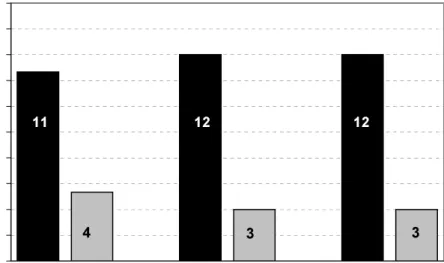
Result 5 Subjects overwhelmingly vote in favor of the general income tax regime (G-scheme). There is no empirical tendency for choices to converge towards the specific commodity tax regime (S-scheme).
Figure 2 provides support for this result. The figure shows the frequency
of groups that have implemented the G-scheme and the S-scheme, respectively.
The vertical axis depicts relative frequencies; absolute frequencies are written on the bars. In the first vote, 11 out of 15 groups (73 percent) approved of the G-scheme (black bar); only 4 groups chose the S-scheme (shaded bar). According
to a binomial test, approval of the G-scheme is significantly higher (p=0.059).
Taking individual behavior, there are 49 out of 75 subjects voting in favor of the G-scheme. Again, this result reveals a bias in subjects’ decisions in favor of the G-scheme (p=0.003).6 These findings reject the hypothesis that taxpayers
support the commodity-income tax mix of the S-scheme.
6We provide this test for illustrative reasons only. Note, however, that individual
Figure 2 furthermore shows that this pattern persists along the sequence of the experiment: in both,the second and third vote, 80 percent (13/15) of groups
vote for theG-scheme. Thus, we do not observe choices to converge towards the
S-scheme. At the level of individuals there is no statistically detectable learning
behavior, neither. Between the first and the second vote, 11 subjects who have
previously voted in favor of the income tax scheme switched their the decision towards the commodity tax scheme. There were, however, 11 other subjects
who switched choices into the reverse direction. Between the second and the
third vote, 9 subjects who have previously voted for the G-scheme switched to the S-scheme, against 9 subjects who switched into the reverse. These numbers illustrate that choices do not converge to any particular tax design.
Figure 2
Frequency of groups approving of theG-scheme [black] and the S-scheme
[shaded]. N=15. 0.733333 0.266667 0.8 0.2 0.8 0.2 0 0.1 0.2 0.3 0.4 0.5 0.6 0.7 0.8 0.9 1 2nd vote 1st vote 3rd vote
In the previous section we have reported that payoffs hardly differ between
schemes. Therefore, it is not clear a priori why so many subjects favor the
G-scheme. To further explore this issue we provide a closer analysis of individual payoffs. In particular, we ask whether it has been individually rational to support the income tax scheme. To answer this question we take actual income tax
dec-larations in the G-scheme and compare payoffs against hypothetical payoffs as
they would result from commodity taxation in theS-scheme. Since for this
com-parison we do not observe consumption choices under the S-scheme, we assume
that subjects buy the optimal commodity bundles in both schemes; i.e., payoffs in theG-scheme are recalculated based on optimal consumption choices and actual tax-declarations according to eq. (3). These payoffs are then compared against payoffs according to eq. (5) assuming the same individual tax declarations.
There are 14 out of 15 groups who voted at least once in favor of theG-scheme. Based on the above calculation, after implementing the scheme for the first time, 9 of these groups by a majority of their subjects do better in theG-scheme than
they hypothetically would have done in the S-scheme. According to a binomial
test this number is different from random (p=0.090). Taking individual data, this corresponds to 40 out of 70 subjects, whose payoffs under the rules of the
G-scheme exceed hypothetical ones of the S-scheme. Again, this number differs from random (p=0.094).
Does this pattern persist? To answer this question we look at the behavior of subjects who voted in favor of the income tax also a second and third time.
12 out of 14 groups that have accepted theG-scheme once implement it also for
a second time. Only 5 out of these 12 groups (p=0.212) by majority of their members manage to sustain profits higher than the hypothetical ones under the rules of theS-scheme. Finally, 9 out of 12 groups that have accepted it twice also
vote in favor of the G-scheme a third time. In phase 3, there remain only 3 out
of these 9 groups (p=0.746) that by majority of their members would still have hypothetically done better in this scheme. We conclude:
Result 6 In the first vote, votes are consistent with actual payoffs, i.e., for a majority of subjects voting in favor of the G-scheme can be ex post rationalized by payoff considerations. In the subsequent two votes many subjects continue voting in favor of the G-scheme even if tax declarations are low and their earning would have been higher under the alternative S-scheme.
Why does the S-scheme receive so little support? One potential reason is
taxpayers. Such a belief would rationalize a vote for theG-scheme. In the light of result 6 it appears odd, however, that many subjects continue to vote in favor
of the G-scheme in phase 3 even after they have experienced that tax morale
went down.
An alternative explanation comes from cognitive psychology. Recent contri-butions by Slemrod and Krishna (2003), and McCaffery (2000) emphasize the relevance of cognitive theory to taxation. In our setup, subjects earn payoffs from two sources: from private consumption and from consuming a public good. In comparing the two tax regimes, subjects know for sure that the payoff from
private consumption will be smaller in theS-scheme than in the G-scheme.7 In
contrast, subjects may find it difficult to predict how a switch between the tax regimes would change their earnings from the public good. Such a difference in the saliency of expected changes in payoffs may contribute to explain why subjects’ choices are biased in favor of the G-scheme.
Our experiment was not aimed to rigorously test for the validity of such arguments. Whatever explanation is valid, result 5 is incompatible with standard theory. Our study, therefore, exemplifies a case where predictions and guidelines derived from standard theory of optimal taxation would fail in an attempt to render tax reform feasible or to explain the endogenous evolution of tax design.
4
Conclusion
Slemrod (1990) in a general assessment argues that the theory of optimal taxation is incomplete as a guide to action unless it accounts for tax evasion. Recent con-tributions that have met this concern challenge long standing insights of optimal taxation theory regarding the optimal tax mix. Particularly, distortionary com-modity taxes may become part of the optimal tax structure when tax evasion is possible. In this experiment we have designed a case for which the theory makes a strong claim to supplement an efficient income tax by a specific commodity
7Subjects are explicitly told that the tax induces an increase in the price of commodityx.
tax. This is the case when the income tax as the first-best solution can be evaded whereas the commodity tax cannot.
The main result is that tax morale plays an essential role in trading off tax evasion against tax distortion. In our experiment, tax morale materializes as disposition to pay taxes to fund a public good against an individual incentive to free-ride. We find that tax morale overall is sufficient to suspend with the need for additional commodity taxation. A second result is that tax morale erodes un-der stationary repetition. Our design in many instances is similar to a voluntary contribution experiments, which typically find a decay in cooperation in repeated interaction (see, Ledyard 1995). Recent experimental research has shown that this patters is highly sensitive to factors like punishment opportunities, social identification, or communication (for a survey, see, e.g., Camerer 2003). In con-text of tax evasion already weak means of economic deterrence can sustain tax morale in multi-round experiments (Alm, McClelland, and Schulze 1992, Tyran and Feld 2001). On the other hand, countries nowadays frequently bemoan a decline in tax morale (see, e.g., Schneider and Enste 2003). Therefore, we may wish to learn more on how to manage a norm of tax compliance in the field (for some discussion, see, Besley, Preston, and Ridge 1997, Kahan 1997, Fehr and Falk 2002).
A final result of our study regards the political acceptance of tax measures. In our experiment taxpayers hardly choose the tax regime which is favored by dard theory. Rather they choose an alternative which is not feasible in the stan-dard approach. This observation exemplifies the power of behavioral economics: modifications of the standard assumptions in the direction of more psychological realism need not be radical to have large-scale effects. We therefore believe that there is a strong need to incorporate behavioral motives of tax compliance into the debate on optimal tax systems.
Our research has highlighted the role of tax morale within the quest for an optimal tax design. Institutional design assuming agents who react optimally to the substitution of a commodity tax by an income tax (or vice versa) may recommend the wrong or at least an inadequate measure when agents systemat-ically deviate from rational choice. In the case at hand opportunistic optimality
would mean to avoid income tax payment and thereby to question the provi-sion of public goods. But this is not what we observe. Thus the behavioral approach to institutional or mechanism design, which puts emphasis on actual decision behavior, may come to different conclusions and recommendations. This stresses the necessity to supplement optimal tax design by one paying tribute to how people actually react to public good provision and their tax financing. Our study is a step into this direction. We hope that our study will motivate further research on behavioral aspects of taxation in an attempt to develop an encompassing framework of optimal taxation.
References
Alm, J., G.H. McClelland, and W.D. Schulze (1992): Why do People Pay
Taxes? Journal of Public Economics 48: 21-38.
Alm, J., G.H. McClelland, and W.D. Schulze (1999): Changing the Social Norm
of Tax Compliance by Voting. Kyklos 52: 141-71.
Allingham, M.G., and A. Sandmo (1972): Income Tax Evasion: A Theoretical
Analysis. Journal of Public Economics 1: 323-38.
Andreoni, J., B. Erard, and J. Feinstein (1998): Tax Compliance. Journal of
Economic Literature 36: 818-60.
Besley, T., I. Preston, and M. Ridge (1997): Fiscal Anarchie in the UK:
Mod-elling Poll Tax Noncompliance. Journal of Public Economics 64: 137-52.
Boadway, R., M. Marchand, and P. Pestieau (1994): Towards a Theory of
Direct-Indirect Tax Mix. Journal of Public Economics 55: 71-88.
Camerer, C. (2003): Behavioral Game Theory. Experiments in Strategic
Inter-action. Princeton Univ Press: Princeton.
Charness, G. and Rabin, M. (2002): Understanding Social Preferences with
Sim-ple Tests. Quarterly Journal of Economics 117(3): 817-69.
Creedy, J. (2000) Measuring Welfare Changes and the Excess Burden of
Cremer, H. and F. Gahvari (1993): Tax Evasion and Optimal Commodity
Tax-ation. Journal of Public Economics 50: 261-275.
Fehr, E. and A. Falk (2002): Psychological Foundations of Incentives. European
Economic Review 46: 687-724.
Fischbacher, U. (1999): z-Tree. Toolbox for Readymade Economic Experiments.
IEW Working paper 21. University of Zurich.
Fullerton, D. and G.E. Metcalf (2002): Tax Incidence. In: A. J. Auerbach und
M. Feldstein (Eds.). Handbook of Public Economics. Elsevier. Amsterdam:
1787-872.
Kahan, D.M. (1997): Social Influence, Social Meaning, and Deterrence.Virginia
Law Review 83: 349-95.
Ledyard, J.O. (1995): Public Goods: A Survey of Experimental Research. In:
J.H. Kagel and A.E. Roth (Eds.).The Handbook of Experimental Economics.
Princeton Univ Press. Princeton: 111-94.
McCaffery, E.J. (2000): Cognitive Theory and Tax. In: C.R. Sunstein (Ed.):
Behavioral Law and Economics. Cambridge Univ. Press. Cambridge: 398-421.
Quattrone, G.A. and A. Tversky (1988): Contrasting Rational and
Psychologi-cal Analyses of PolitiPsychologi-cal Choice. American Political Science Review 82:
719-36.
Quirmbach, H.; C. Swenson, and C. Vines (1996): An Experimental
Examina-tion of Gerneral Equilibrium Tax Incidence. Journal of Public Economics 61:
337-358.
Rabin, M. (1993): Incorporating Fairness into Game Theory and Economics.
American Economic Review 83(5): 1281-302.
Rabin, M. (2002): A Perspective on Psychology and Economics. European
Eco-nomic Review 46: 657-85.
Richter W.F. and R.W. Boadway (2003): Trading off Tax Distortion and Tax
Saez, E. (2001): Using Elasticities to Derive Optimal Income Tax Rates.Review of Economic Studies 68: 205-29.
Schneider F. and D.H. Enste (2003): The Shadow Economy - An International
Survey. Cambridge Univ. Press. Cambridge.
Slemrod, J. (1990): Optimal Taxation and Optimal Tax Systems. Journal of
Economic Perspectives 4: 157-78.
Slemrod, J. and A. Krishna (2003): Behavioral Public Finance: Tax Design as
Price Presentation. International Tax and Public Finance 10: 189-203.
Slemrod, J. und S. Yitzhaki (2002): Tax Avoidance, Evasion, and
Administra-tion. In: Auerbach, A. and Feldstein, M. (eds.): Handbook of Public
Eco-nomics Volume 3. Elsevier. Amsterdam: 1423-1470.
Tyran, J.-R. and L. Feld (2001): Why People Obey the Law. Experimental
Evi-dence from the Provision of Public Goods. Working paper. University of St. Gallen 2001-14.
Tyran, J.-R. and Sausgruber, R. (2002): A Little Fairness may Induce a Lot
or Redistribution in Democracy. Discussion Paper 2002-30. University of St.Gallen.
Yitzhaki, S. (1987): On the Excess Burden of Tax Evasion.Public Finance
Appendix. Sample instructions (originally in German)
General Instructions. Part I: Thank you for participating in the experiment. You receive Euro 4 for having shown up on time. If you read these instructions carefully and follow all the rules, you can earn more. The Euro 4 and all additional amount of money will be paid to you in cash immediately after the experiment. During the experiment we shall not speak of euros but rather of points. Points are converted to euros at the following exchange rate: 100 Points = 25 Cents (Euro 0.25).It is prohibited to communicate with the other participants during the experiment. If you have any questions, please ask us. We will gladly answer your questions individu-ally. It is very important that you follow this rule, otherwise we shall have to exclude you from the experiment and from all payments.
Detailed Instructions: The experiment is divided into periods. In every period you receive an amount of points, which we refer to as your endowment. Your endowment is a randomly generated integer number between 110 and 190 points. Every number between 110 and 190 is equally likely to occur. You will learn your endowment in every period.
In every period you make the following decisions: you have to decide how to use you endowment for the purchase of two commodities X and Y. The quantities you can buy depend on your endowment and in the prices of commodities X and Y:
The price of commodity X is 1.1 points. The price of commodity Y is 50 points.
Example: Your endowment is 150 points. You buy X = 68.18 units of commodity X and Y = 1.5 units of commodity Y. With that purchase you exactly use up your endowment [(68.18×1.1) + (1.5×50) = 150].
How your income is determined: Your income is the product of the units of X and Y you buy:
Your income = X ×Y
In the above example you have bought X= 68.18 units of X andY = 1.5 units of Y. Thus, your income is 102.27 (= 68.18×1.5) points.
You will take your decisions by computer. At the beginning of every period you will see the following input screen (original instructions included a screen-figure here). The number of the period appears in the top left corner of the screen. In the top right corner, you
can see how many seconds remain to take your decision. The first line shows “Your Endowment” in the current period. In the input fields below you must enter the units of commodities wish to buy. Confirm your choice by pressing the OK button.
Please note:
• If time expires before you have made a choice your income is zero.
• Your expenditures on commodity purchases may not exceed your endowment.
• Endowment not spent on the purchase of commodities result in zero income. At the end of a period, a result screen will appear (original instructions included a screen-figure here). Here, your decisions are summarized again. In this example the participant has purchases 68.18 units of commodity X and 1.5 units of commodity Y. The last line shows your income in points (here: 102.27).
Instructions. Part II:
The experiment will now continue for additional 15 periods under the following rules: Participants are randomly assembled into groups of 5 persons; i.e. apart from you there will be 4 additional persons in your group. The composition of your group remains the same in each period. That is, your group members will be the same in every period. The identity of your group members will not be revealed to you at any time.
In this part of the experiment taxes are raised to fund a project. The project generates income for you and the other participants. There are two different kinds of taxes:
1. A tax of τ (”tau”) percent on your endowment. You will shortly be informed about the percentage size ofτ.
2. A tax of 27 percent imputed into the price of commodity X.
In every period you take two decisions:
1. First you decide how much of your endowment you declare for the purpose to be taxed. Of the endowment you declare for taxation τ percent will be deducted as tax. The endowment that remains to you after taxation is called your remaining endowment.
Example: The tax rate tau is 50 percent (τ = 0.5). Your endowment is 170 points. You declare 40 points. From these 40 points there will be 20 (40×0.5) points deducted as tax. Your remaining endowment is then 150 points (170−20).
2. After your remaining endowment is determined you decide again how to use it for the purchase of commodities X and Y. The quantities you can buy now also depend on whether good X is taxed.
– If commodity X is taxed, its price is 1.4 points; i.e. from its previous price of 1.1. points the price of commodity X rises by 27 percent. If commodity X is not taxed, its price remains at 1.1 points.
– The price of commodity Y remains at 50 points.
Example: Your remaining endowment is 150 points. Commodity X is taxed such that its price is 1.4 points. Commodity Y’s price is 50 points. You buy X=56.42 units of commodity X and Y=1.42 units of commodity Y. With that purchase you exactly use up your remaining endowment [(56.42×1.4) + (1.42×50) = 150].
How your income is determined: Your income consists of two parts:
(1) Your income from the project. This income is determined as follows:
Income from the project = 0.5× sum of all individual tax payments The income from the project is determined in the same way for all other partic-ipants; i.e., they receive the same income from the project. For example, if you and the other participants pay in sum 200 points in taxes, you and the other participants will earn 100 (= 0.5×200) points, each. If you and the other par-ticipants pay in sum, e.g., 20 points in taxes, you and the other parpar-ticipants will earn 10 (= 0.5×20) points.
How the your individual tax payments is determined: Your tax pay-ments are, first, τ percent of the endowment you declare for taxation. Second, if commodity X is taxed your expenditure for purchasing commodity X includes a tax of 27 percent. (To calculate the exact amount of commodity tax multiply the purchased units of X with the net price and the tax rate; i.e., X×1.1×0.27.)
(2) Your income from purchasing commodities. As previously, this income is the
product of units of X and Y you buy:
Your income = X ×Y
In the above example you have bought X=56.42 units of X and Y=1.42 units of Y. Thus, your income is 80.12 (= 56.42×1.42) points.
Voting Proposal
Before the experiment will start under the new rules, you and the other 4 par-ticipants in your group vote between two alternatives how to fund the project. The alternative that is wins the majority of votes (i.e., 3 or more) is implemented for the next 15 periods.
Alternative 1:
• The taxτ on your declared endowment isτ =0.05(= 5 percent)
• Commodity X is taxed; its price is1.4 points.
Alternative 2:
• The taxτ on your declared endowment isτ =0.5 (= 50 percent)
• Commodity X is not taxed; its price is1.1 points.
Please note:
Under alternative 1 participants pay taxes if they purchase commodity X. Since com-modity X has become more expensive and you can buy less units from it, you will earn less income from commodity purchase. On the other hand, you will earn income from the project even if you and the other participants do not declare any endowment for the purpose to be taxed.
Under alternative 2 participants pay taxes only if they declare endowment for taxation. The more you declare, the less you can earn form commodity purchase. On the other hand, the more you declare the higher is the income from the project that you and the other participants receive.
CESifo Working Paper Series
(for full list see www.cesifo.de)
___________________________________________________________________________ 1221 Michiel Evers, Ruud A. de Mooij, and Herman R. J. Vollebergh, Tax Competition
under Minimum Rates: The Case of European Diesel Excises, June 2004
1222 S. Brock Blomberg and Gregory D. Hess, How Much Does Violence Tax Trade?, June 2004
1223 Josse Delfgaauw and Robert Dur, Incentives and Workers’ Motivation in the Public Sector, June 2004
1224 Paul De Grauwe and Cláudia Costa Storti, The Effects of Monetary Policy: A Meta-Analysis, June 2004
1225 Volker Grossmann, How to Promote R&D-based Growth? Public Education Expenditure on Scientists and Engineers versus R&D Subsidies, June 2004
1226 Bart Cockx and Jean Ries, The Exhaustion of Unemployment Benefits in Belgium. Does it Enhance the Probability of Employment?, June 2004
1227 Bertil Holmlund, Sickness Absence and Search Unemployment, June 2004
1228 Klaas J. Beniers and Robert Dur, Politicians’ Motivation, Political Culture, and Electoral Competition, June 2004
1229 M. Hashem Pesaran, General Diagnostic Tests for Cross Section Dependence in Panels, July 2004
1230 Wladimir Raymond, Pierre Mohnen, Franz Palm, and Sybrand Schim van der Loeff, An Empirically-Based Taxonomy of Dutch Manufacturing: Innovation Policy Implications, July 2004
1231 Stefan Homburg, A New Approach to Optimal Commodity Taxation, July 2004
1232 Lorenzo Cappellari and Stephen P. Jenkins, Modelling Low Pay Transition Probabilities, Accounting for Panel Attrition, Non-Response, and Initial Conditions, July 2004
1233 Cheng Hsiao and M. Hashem Pesaran, Random Coefficient Panel Data Models, July 2004
1234 Frederick van der Ploeg, The Welfare State, Redistribution and the Economy, Reciprocal Altruism, Consumer Rivalry and Second Best, July 2004
1236 Pascalis Raimondos-Møller and Alan D. Woodland, Measuring Tax Efficiency: A Tax Optimality Index, July 2004
1237 M. Hashem Pesaran, Davide Pettenuzzo, and Allan Timmermann, Forecasting Time Series Subject to Multiple Structural Breaks, July 2004
1238 Panu Poutvaara and Andreas Wagener, The Invisible Hand Plays Dice: Eventualities in Religious Markets, July 2004
1239 Eckhard Janeba, Moral Federalism, July 2004
1240 Robert S. Chirinko, Steven M. Fazzari, and Andrew P. Meyer, That Elusive Elasticity: A Long-Panel Approach to Estimating the Capital-Labor Substitution Elasticity, July 2004
1241 Hans Jarle Kind, Karen Helene Midelfart, Guttorm Schjelderup, Corporate Tax Systems, Multinational Enterprises, and Economic Integration, July 2004
1242 Vankatesh Bala and Ngo Van Long, International Trade and Cultural Diversity: A Model of Preference Selection, July 2004
1243 Wolfgang Eggert and Alfons J. Weichenrieder, On the Economics of Bottle Deposits, July 2004
1244 Sören Blomquist and Vidar Christiansen, Taxation and Heterogeneous Preferences, July 2004
1245 Rafael Lalive and Alois Stutzer, Approval of Equal Rights and Gender Differences in Well-Being, July 2004
1246 Paolo M. Panteghini, Wide vs. Narrow Tax Bases under Optimal Investment Timing, July 2004
1247 Marika Karanassou, Hector Sala, and Dennis J. Snower, Unemployment in the European Union: Institutions, Prices, and Growth, July 2004
1248 Engin Dalgic and Ngo Van Long, Corrupt Local Government as Resource Farmers: The Helping Hand and the Grabbing Hand, July 2004
1249 Francesco Giavazzi and Guido Tabellini, Economic and Political Liberalizations, July 2004
1250 Yin-Wong Cheung and Jude Yuen, An Output Perspective on a Northeast Asia Currency Union, August 2004
1251 Ralf Elsas, Frank Heinemann, and Marcel Tyrell, Multiple but Asymmetric Bank Financing: The Case of Relationship Lending, August 2004
1253 Ngo Van Long and Gerhard Sorger, Insecure Property Rights and Growth: The Roles of Appropriation Costs, Wealth Effects, and Heterogeneity, August 2004
1254 Klaus Wälde and Pia Weiß, International Competition, Slim Firms and Wage Inequality, August 2004
1255 Jeremy S. S. Edwards and Alfons J. Weichenrieder, How Weak is the Weakest-Link Principle? On the Measurement of Firm Owners’ Control Rights, August 2004
1256 Guido Tabellini, The Role of the State in Economic Development, August 2004
1257 François Larmande and Jean-Pierre Ponssard, EVA and the Controllability-congruence Trade-off: An Empirical Investigation, August 2004
1258 Vesa Kanniainen and Jenni Pääkkönen, Anonymous Money, Moral Sentiments and Welfare, August 2004
1259 Panu Poutvaara and Andreas Wagener, Why is the Public Sector More Labor-Intensive? A Distortionary Tax Argument, August 2004
1260 Lars P. Feld and Stefan Voigt, Making Judges Independent – Some Proposals Regarding the Judiciary, August 2004
1261 Joop Hartog, Hans van Ophem, and Simona Maria Bajdechi, How Risky is Investment in Human Capital?, August 2004
1262 Thomas Eichner and Rüdiger Pethig, Efficient Nonanthropocentric Nature Protection, August 2004
1263 David-Jan Jansen and Jakob de Haan, Look Who’s Talking: ECB Communication during the First Years of EMU, August 2004
1264 David F. Bradford, The X Tax in the World Economy, August 2004
1265 Hans-Werner Sinn, Migration, Social Standards and Replacement Incomes. How to Protect Low-income Workers in the Industrialized Countries against the Forces of Globalization and Market Integration, August 2004
1266 Wolfgang Leininger, Fending off one Means Fending off all: Evolutionary Stability in Submodular Games, August 2004
1267 Antoine Bommier and Bertrand Villeneuve, Risk Aversion and the Value of Risk to Life, September 2004
1268 Harrie A. A. Verbon and Lex Meijdam, Too Many Migrants, Too Few Services: A Model of Decision-making on Immigration and Integration with Cultural Distance, September 2004
1269 Thomas Eichner and Rüdiger Pethig, Economic Land Use, Ecosystem Services and Microfounded Species Dynamics, September 2004
1270 Federico Revelli, Performance Rating and Yardstick Competition in Social Service Provision, September 2004
1271 Gerhard O. Orosel and Klaus G. Zauner, Vertical Product Differentiation When Quality is Unobservable to Buyers, September 2004
1272 Christoph Böhringer, Stefan Boeters, and Michael Feil, Taxation and Unemployment: An Applied General Equilibrium Approach, September 2004
1273 Assaf Razin and Efraim Sadka, Welfare Migration: Is the Net Fiscal Burden a Good Measure of its Economics Impact on the Welfare of the Native-Born Population?, September 2004
1274 Tomer Blumkin and Volker Grossmann, Ideological Polarization, Sticky Information, and Policy Reforms, September 2004
1275 Katherine Baicker and Nora Gordon, The Effect of Mandated State Education Spending on Total Local Resources, September 2004
1276 Gabriel J. Felbermayr and Wilhelm Kohler, Exploring the Intensive and Extensive Margins of World Trade, September 2004
1277 John Burbidge, Katherine Cuff and John Leach, Capital Tax Competition with Heterogeneous Firms and Agglomeration Effects, September 2004
1278 Joern-Steffen Pischke, Labor Market Institutions, Wages and Investment, September 2004
1279 Josef Falkinger and Volker Grossmann, Institutions and Development: The Interaction between Trade Regime and Political System, September 2004
1280 Paolo Surico, Inflation Targeting and Nonlinear Policy Rules: The Case of Asymmetric Preferences, September 2004
1281 Ayal Kimhi, Growth, Inequality and Labor Markets in LDCs: A Survey, September 2004
1282 Robert Dur and Amihai Glazer, Optimal Incentive Contracts for a Worker who Envies his Boss, September 2004
1283 Klaus Abberger, Nonparametric Regression and the Detection of Turning Points in the Ifo Business Climate, September 2004
1284 Werner Güth and Rupert Sausgruber, Tax Morale and Optimal Taxation, September 2004