A System for Generating
Static Analyzers for Machine Instructions
⋆Junghee Lim1
and Thomas Reps1,2
1
Comp. Sci. Dept.; Univ. of Wisconsin-Madison, WI; USA 2
GrammaTech, Inc.; Ithaca, NY; USA {junghee,reps}@cs.wisc.edu
Abstract. This paper describes the design and implementation of a language for specifying the semantics of an instruction set, along with a run-time system to support the static analysis of executables written in that instruction set. The work advances the state of the art by creating multiple analysis phases from a specification of the concrete operational semantics of the language to be analyzed.
1
Introduction
The problem of analyzing executables to recover information about their execu-tion properties, especially for finding bugs, security vulnerabilities, or malicious code (e.g., back doors, time bombs, or logic bombs), has been receiving increased attention. However, much of this work has focused on specialized analyses to identify aliasing relationships [13], data dependences [2, 8], targets of indirect calls [12], values of strings [7], bounds on stack height [20], and values of param-eters and return values [24]. In contrast, Balakrishnan and Reps [3, 5] developed ways to address all of these problems by means of an analysis that discovers an overapproximation of the set of states that can be reached at each point in the executable—where a state meansall of the state: values of registers, flags, and the contents of memory. Moreover, their approach can be applied to stripped executables (i.e., neither source code nor symbol-table/debugging information is available).
Although their techniques, in principle, are language-independent, they were instantiated only for the IntelIA32instruction set. Our motivation is to provide a systematic way of retargeting those analyses—and others yet to be created—to instruction sets other thanIA32.
The situation that we face is actually typical of much work on program analysis: although the techniques described in the literature are, in principle, language-independent, implementations are often tied to a specific language or intermediate representation (IR). For high-level languages, the situation has been addressed by developing common intermediate languages, e.g., GCC’sRTL, Mi-crosoft’s MSIL, etc. The situation is more serious for low-level instruction sets,
⋆
Supported by ONR under grant N00014-01-1-0796 and by NSF under grants CCF-0540955 and CCF-0524051.
because of (i) instruction-set evolution over time (and the desire to have back-ward compatibility as word size increased from 8 bits to 64 bits), which has led to instruction sets with several hundred instructions, and (ii) a variety of architecture-specific features that are incompatible with other architectures.
To address these issues, we developed a language for describing the semantics of an instruction set, along with a run-time system to support the static analysis of executables written in that instruction set. Our work advances the state of the art by creating a system for automatically generating analysis components from a specification of the language to be analyzed. The system, calledTSL(for “TransformerSpecificationLanguage”), has two classes of users: (1) instruction-set-specification (ISS) developers and (2) analysis developers. The former are involved in specifying the semantics of different instruction sets; the latter are involved in extending the analysis framework. In designingTSL, we were guided by the following principles:
– There should be a formal language for specifying the semantics of the lan-guage to be analyzed. Moreover,ISSdevelopers should specify only the ab-stract syntax and a concrete operational semantics of the language to be analyzed—each analyzer should be generated automatically from this spec-ification.
– Concrete syntactic issues—including (i) decoding (machine code to abstract syntax), (ii) encoding (abstract syntax to machine code), (iii) parsing assem-bly (assemassem-bly code to abstract syntax), and (iv) assemassem-bly pretty-printing (abstract syntax to assembly code)—should be handled separately from the abstract syntax and concrete semantics.3
– There should be a clean interface for analysis developers to specify the ab-stract semantics for each analysis. An abab-stract semantics consists of an in-terpretation: an abstract domain and a set of abstract operators (i.e., for the operations ofTSL).
– The abstract semantics for each analysis should be separated from the lan-guages to be analyzed so that one does not need to specify multiple versions of an abstract semantics for multiple languages.
Each of these objectives has been achieved in the TSLsystem: TheTSLsystem translates theTSLspecification of each instruction set to a common intermediate representation (CIR) that can be used to create multiple analyzers (§2). Each analyzer is specified at the level of the meta-language (i.e., by reinterpreting the operations of TSL), which—by extension toTSLexpressions and functions— provides the desired reinterpretation of the instructions of an instruction set (§3).
Other notable aspects of our work include
1. Support for Multiple Analysis Types.
– Classical worklist-based value-propagation analyses.
– Transformer-composition analyses [11, 22], which are particularly useful for context-sensitive interprocedural analysis, and for relational analyses.
3
The translation of the concrete syntaxes to and from abstract syntax is handled by a generator tool that is separate fromTSL, and will not be discussed in this paper.
– Unification-based analyses for flow-insensitive interprocedural analysis. In addition, an emulator (for the concrete semantics) is also supported.
2. Implemented Analyses. These mechanisms have been instantiated for a number of specific analyses that are useful for analyzing low-level code, including value-set analysis [3, 5] (§3.1), def-use analysis (for memory, registers, and flags) (§3.2), aggregate structure identification [6] (§3.3), and generation of symbolic expressions for an instruction’s semantics (§3.4).
3. Established Applicability. The capabilities of our approach have been demonstrated by writing specifications forIA32andPowerPC32. These are nearly complete specifications of the languages, and include such features as (1) aliasing among 8-, 16-, and 32-bit registers, e.g.,al,ah,ax, andeax(forIA32), (2) endian-ness, (3) issues arising due to bounded-word-size arithmetic (overflow/underflow, carry/borrow, shifting, rotation, etc.), and (4) setting of condition codes (and their subsequent interpretation at jump instructions).
The abstract transformers for these analyses that are created from theIA32 TSL specifications have been put together to create a system that essentially duplicates CodeSurfer/x86 [4]. A similar system for PowerPC32 is under con-struction. (The TSL-generated components are in place; only a few mundane infrastructure components are lacking.) We have also experimented with suffi-ciently complex features of other low-level languages (e.g., register windows for SunSPARCand conditional execution of instructions forARM) to know that they fit our specification and implementation models.
There are many specification languages for instruction sets and many pur-poses for which they have been used. In our work, we needed a mechanism to create abstract interpreters of instruction-set specifications. There are (at least) four issues that arise: during the abstract interpretation of each transformer, the abstract interpreter must be able to (i) execute over abstract states, (ii) execute both branches of a conditional expression, (iii) compare abstract states and terminate abstract execution when a fixed point is reached, and (iv) apply widening operators, if necessary, to ensure termination. As far as we know,TSL
is the first system with an instruction-set-specification language and support for such mechanisms.
Although this paper only discusses the application of TSL to low-level in-struction sets, we believe that only small extensions would be needed to be able to apply TSLto source-code languages (i.e., to create language-independent an-alyzers for source-level IRs), as well as bytecode. The main obstacle is that the concrete semantics of a source-code language generally uses an execution state based on a stack of variable-to-value (or variable-to-location, location-to-value) maps. For a low-level language, the state incorporates an address-based memory model, for which theTSLlanguage provides appropriate primitives.
The remainder of the paper is organized as follows:§2 introducesTSL and the capabilities of the system. §3 explains how CIRis instantiated to create an analyzer for a specific analysis component.§4 describes quirky features of several instruction sets, and discusses how those features are handled inTSL.§5 discusses related work.
2
Overview of the
TSLSystem
This section provides an overview of the TSL system. We discuss how three
analysis components are created automatically from aTSLspecification, using a fragment of theIA32instruction set to illustrate the process.
2.1 TSL from anISS Developer’s Standpoint
Fig. 1 shows part of a specification of the IA32 instruction set taken from the manual [1]. The specification is only semi-formal: it uses a mixture of English and pseudo-code.
General Purpose Registers: ADD r/m32,r32; Add r32 to r/m32 EAX,EBX,ECX,EDX,ESP,EBP,ESI,EDI,EIP ADD r/m16,r16; Add r16 to r/m16 . . . Each of these registers also has 16- or 8-bit subset names. Operation: DEST←DEST + SRC; Addressing Modes: [sreg:][offset][([base][,index][,scale])] Flags Affected: The OF,SF,ZF,AF,CF, and EFLAGS register: ZF,SF,OF,CF,AF,PF, . . . PF flags are set according to the result.
Fig. 1.A part of the Intel manual’s specification ofIA32’sADDinstruction.
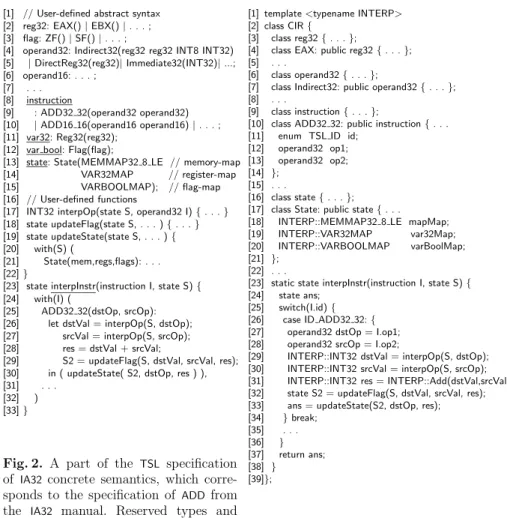
Our work is based on completely formal specifications, which are written in a language that we designed (TSL).TSLis a strongly typed, first-order functional language with a datatype-definition mechanism for defining recursive datatypes, plus deconstruction by means of pattern matching. Fig. 2 shows the part of the
TSL specification that corresponds to Fig. 1. Much of what an ISS developer writes is similar to writing an interpreter for an instruction set in first-order
ML[14]. AnISSdeveloper specifies the abstract syntax grammar by defining the constructors for a language of instructions (lines 2–10), a concrete-state type (lines 13–15), and the concrete semantics of each instruction (lines 23–33).
TSLprovides 5 basetypes: INT8, INT16, INT32, INT64, and BOOL. TSL sup-ports arithmetic/logical operators (+,−,∗,/, !, &&,||, xor), bit-manipulation operators (∼, &,|, ˆ,≪, ≫, right-rotate, left-rotate), relational operators (<,
<=,>,>=, ==, !=), and a conditional-expression operator (? :).
TSL also provides several map-basetypes: MEMMAP32 8 LE,
MEMMAP32 16 LE, VAR32MAP, VAR16MAP, VAR8MAP, VARBOOLMAP, etc.
MEMMAP32 8 LEmaps from 32-bit values (addresses) to 8-bit values,VAR32MAP
fromvar32to 32-bit values,VARBOOLMAPfromvar boolto Boolean values, and so forth. Tab. 1 shows the list of some of theTSLaccess/update functions. Each access function takes a map (e.g.,MEMMAP32 8 LE,VAR32MAP,VARBOOLMAP, etc.) and an appropriate key (e.g.,INT32, var32, var bool, etc.), and returns the value that corresponds to the key. Each update function takes a map, a key,
and a value, and returns the updated map. The access/update functions for
MEMMAP32 8 LEimplement the little-endian storage convention.
Each specification must define several reserved (but user-defined) types: var64, var32, var16, var8, andvar bool, which represent storage components of 64-bit, 32-bit, 16-bit, 8-bit, and Boolean types, respectively;instruction;state; as
[1] // User-defined abstract syntax [2] reg32: EAX()|EBX()|. . . ; [3] flag: ZF()|SF()|. . . ;
[4] operand32: Indirect32(reg32 reg32 INT8 INT32) [5] |DirectReg32(reg32)|Immediate32(INT32)|...; [6] operand16: . . . ;
[7] . . . [8] instruction
[9] : ADD32 32(operand32 operand32) [10] |ADD16 16(operand16 operand16)|. . . ; [11] var32: Reg32(reg32);
[12] var bool: Flag(flag);
[13] state: State(MEMMAP32 8 LE // memory-map [14] VAR32MAP // register-map [15] VARBOOLMAP); // flag-map [16] // User-defined functions
[17] INT32 interpOp(state S, operand32 I){. . .}
[18] state updateFlag(state S, . . . ){. . .}
[19] state updateState(state S, . . . ){
[20] with(S) (
[21] State(mem,regs,flags): . . . [22]}
[23] state interpInstr(instruction I, state S){
[24] with(I) (
[25] ADD32 32(dstOp, srcOp): [26] let dstVal = interpOp(S, dstOp); [27] srcVal = interpOp(S, srcOp); [28] res = dstVal + srcVal;
[29] S2 = updateFlag(S, dstVal, srcVal, res); [30] in ( updateState( S2, dstOp, res ) ), [31] . . .
[32] ) [33]}
Fig. 2. A part of the TSL specification of IA32concrete semantics, which corre-sponds to the specification ofADD from the IA32 manual. Reserved types and function names are underlined.
[1] template<typename INTERP>
[2] class CIR{
[3] class reg32{. . .};
[4] class EAX: public reg32{. . .}; [5] . . .
[6] class operand32{. . .};
[7] class Indirect32: public operand32{. . .}; [8] . . .
[9] class instruction{. . .};
[10] class ADD32 32: public instruction{. . . [11] enum TSL ID id; [12] operand32 op1; [13] operand32 op2; [14] }; [15] . . . [16] class state{. . .}; [17] class State: public state{. . . [18] INTERP::MEMMAP32 8 LE mapMap; [19] INTERP::VAR32MAP var32Map; [20] INTERP::VARBOOLMAP varBoolMap; [21] };
[22] . . .
[23] static state interpInstr(instruction I, state S){
[24] state ans; [25] switch(I.id){
[26] case ID ADD32 32:{
[27] operand32 dstOp = I.op1; [28] operand32 srcOp = I.op2;
[29] INTERP::INT32 dstVal = interpOp(S, dstOp); [30] INTERP::INT32 srcVal = interpOp(S, srcOp); [31] INTERP::INT32 res = INTERP::Add(dstVal,srcVal); [32] state S2 = updateFlag(S, dstVal, srcVal, res); [33] ans = updateState(S2, dstOp, res); [34] }break; [35] . . . [36] } [37] return ans; [38] } [39]};
Fig. 3.A part of theCIRgenerated from Fig. 2.
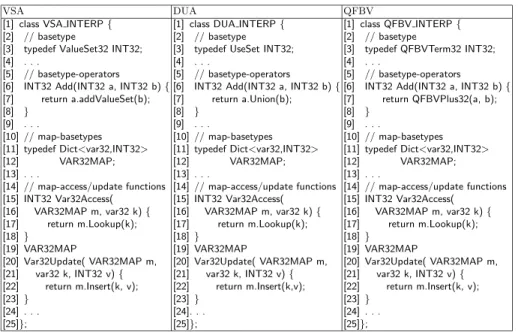
well as the reserved functioninterpInstr. (These are underlined in Fig. 2.) These form part of the API available to analysis engines that use the TSL-generated transformers (see§3). The reserved types are used as an interface between the
CIRand analysis-domain implementations.
The definition of types and constructors on lines 2–10 of Fig. 2 is an abstract-syntax grammar for IA32. The definitions for var32andvar boolwrap the user-defined typesreg32andflag, respectively. Typereg32consists of nullary construc-tors forIA32registers, such asEAX() andEBX();flagconsists of nullary construc-tors for the IA32condition codes, such asZF() andSF(). Lines 4–7 define types and constructors to represent the various kinds of operands that IA32supports, i.e., various sizes of immediate, direct register, and indirect memory operands. The reserved (but user-defined) type instruction consists of user-defined con-structors for each instruction, such asADD32 32 andADD16 16, which represent instructions with different operand sizes.
Table 1.Access/Update functions.
MEMMAP32 8 LE MemUpdate 32 8 LE 32(MEMMAP32 8 LEmemmap,INT32key,INT32v); INT32 MemAccess 32 8 LE 32(VAR32MAPmapmap,INT32key);
VAR32MAP Var32Update(VAR32MAPvar32Map,var32key,INT32v); INT32 Var32Access(VAR32MAPvar32Map,var32key);
VARBOOLMAP VarBoolUpdate(VARBOOLMAPvarBoolMap,var boolkey,BOOLv); BOOL VarBoolAccess(VARBOOLMAPvarBoolMap,var boolkey);
The type state specifies the structure of the execution state. The state for
IA32is defined on lines 13–15 of Fig. 2 to consist of a memory-map, a register-map, and a flag-map. Theconcrete semantics is specified by writing a function named interpInstr (see lines 23–33 of Fig. 2), which maps an instruction and a stateto astate.
2.2 Common Intermediate Representation (CIR)
Fig. 3 shows part of theTSL CIRautomatically generated from Fig. 2. Each gener-atedCIRisspecificto a given instruction-set specification, butcommon (whence the nameCIR) across generated analyses. Each generatedCIRis a template class that takes as inputINTERP, an abstract domain for an analysis (lines 1–2). The user-defined abstract syntax (lines 2–10 of Fig. 2) is translated to a set of C++
abstract-syntax classes (lines 3–15 of Fig. 3). The user-defined types, such as reg32,operand32, andinstruction, are translated to abstractC++classes, and the constructors, such asEAX(),Indirect32( , , , ), andADD32 32( , ), are subclasses of the appropriate parent abstractC++class. Each user-defined function is trans-lated to a staticCIRfunction.
Each TSL basetype and basetype-operator is prepended with the template
parameter name INTERP; INTERP is supplied for each analysis by an analysis designer. Thewithexpression and the pattern matching on lines 24–25 of Fig. 2 are translated toswitchstatements inC++4(lines 25–36 in Fig. 3). The function calls for obtaining the values of the two operands (lines 26–27 in Fig. 2) corre-spond to the C++ code on lines 29–30 in Fig. 3. TheTSLbasetype-operator + on line 28 in Fig. 2 is translated to the CIR member function INTERP::Add, as shown on line 31 in Fig. 3. The function calls for updating thestate(lines 29–30 in Fig. 2) are translated intoC++ code (lines 32–33 in Fig. 3).
2.3 TSL from an Analysis Developer’s Standpoint
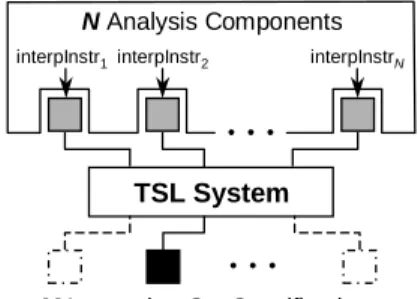
The generatedCIRis instantiated for an analysis by defining (inC++) an inter-pretation: a representation class for eachTSLbasetype, and implementations of eachTSLbasetype-operator and built-in function. Tab. 2 shows the implementa-tions of primitives for three selected analyses: value-set analysis (VSA, see§3.1),
4
TheTSLfront end performswith-normalization, which transforms all multi-levelwith expressions to use only one-level patterns, via the pattern-compilation algorithm from [18, 23].
Table 2. Parts of the declarations of the basetypes, basetype-operators, and map-access/update functions for three analyses.
VSA DUA QFBV
[1] class VSA INTERP{
[2] // basetype
[3] typedef ValueSet32 INT32; [4] . . .
[5] // basetype-operators [6] INT32 Add(INT32 a, INT32 b){
[7] return a.addValueSet(b); [8] }
[9] . . .
[10] // map-basetypes [11] typedef Dict<var32,INT32>
[12] VAR32MAP; [13] . . . [14] // map-access/update functions [15] INT32 Var32Access( [16] VAR32MAP m, var32 k){ [17] return m.Lookup(k); [18] } [19] VAR32MAP [20] Var32Update( VAR32MAP m, [21] var32 k, INT32 v){ [22] return m.Insert(k, v); [23] } [24] . . . [25]};
[1] class DUA INTERP{
[2] // basetype [3] typedef UseSet INT32; [4] . . .
[5] // basetype-operators [6] INT32 Add(INT32 a, INT32 b){
[7] return a.Union(b); [8] }
[9] . . .
[10] // map-basetypes [11] typedef Dict<var32,INT32>
[12] VAR32MAP; [13] . . . [14] // map-access/update functions [15] INT32 Var32Access( [16] VAR32MAP m, var32 k){ [17] return m.Lookup(k); [18]} [19] VAR32MAP [20] Var32Update( VAR32MAP m, [21] var32 k, INT32 v){ [22] return m.Insert(k,v); [23]} [24]. . . [25]}; [1] class QFBV INTERP{ [2] // basetype
[3] typedef QFBVTerm32 INT32; [4] . . .
[5] // basetype-operators
[6] INT32 Add(INT32 a, INT32 b){
[7] return QFBVPlus32(a, b); [8] }
[9] . . .
[10] // map-basetypes [11] typedef Dict<var32,INT32>
[12] VAR32MAP; [13] . . . [14] // map-access/update functions [15] INT32 Var32Access( [16] VAR32MAP m, var32 k){ [17] return m.Lookup(k); [18] } [19] VAR32MAP [20] Var32Update( VAR32MAP m, [21] var32 k, INT32 v){ [22] return m.Insert(k, v); [23] } [24] . . . [25]};
def-use analysis (DUA, see§3.2), and quantifier-free bit-vector semantics (QFBV, see§3.4).
Each interpretation defines an abstract domain. For example, line 3 of each column defines the abstract-domain class forINT32:ValueSet32,UseSet, and QFB-VTerm32. To define an interpretation, one needs to define 42 basetype operators, most of which have four variants, for 8-, 16-, 32-, and 64-bit integers, as well as 12 map access/update operations. Each abstract domain is also required to contain a set of reserved functions, such asjoin,meet, andwiden, which forms an additional part of the API available to analysis engines that useTSL-generated transformers (see§3).
2.4 Generated Transformers
TheTSLsystem provides considerable leverage for implementing static-analysis tools and experimenting with new ones. New static-analyses are easily imple-mented: each static-analysis component is created via abstract interpretation of the TSL code that defines the concrete semantics of the instruction set. In particular, all abstract interpretation is performed at themeta-level: an analysis designer adds a new analysis component to the TSL system by (i) redefining theTSLbasetypes, and (ii) providing a set of alternative interpretations for the primitive operations on basetypes. This implicitly defines an alternative interpre-tation of each expression and function in an instruction-set’s concrete operational
semantics, and thereby yields an abstract semantics for an instruction set from its concrete operational semantics.
Consider the instruction “add ebx,eax”, which causes the sum of the values of the 32-bit registersebxandeaxto be assigned intoebx. When Fig. 3 is instanti-ated with the three interpretations from Tab. 2, lines 23–33 of Fig. 2 implement the three transformers presented (using mathematical notation) in Tab. 3.
Table 3.Transformers generated by theTSLsystem.
Analysis Generated Transformers for “add ebx,eax”
1.VSA λS.S[ebx7→S(ebx)+vsa
S(eax)] [ZF7→(S(ebx)+vsa
S(eax) = 0)][more flag updates]
2.DUA [ebx7→ {eax,ebx},ZF7→ {eax,ebx}, . . . ]
3.QFBV (ebx′=ebx+32 eax)∧(ZF′⇔(ebx+32 eax= 0))∧(SF′⇔(ebx+32 eax<0))∧. . . 2.5 Measures of Success Client Analyzer M Instruction-Set Specifications TSL System N Analysis Components • • •
interpInstr1interpInstr2 interpInstrN
• • •
Fig. 4.The interaction between theTSL
system and a client analyzer. The grey boxes represent TSL-generated analysis components.
The TSL system provides two
di-mensions of parameterizability: dif-ferent instruction sets and difdif-ferent analyses. Each ISS developer speci-fies an instruction-set semantics, and each analysis developer defines an ab-stract domain for a desired analy-sis by giving an interpretation (i.e.,
the implementations of TSL
base-types, basetype-operators, and
ac-cess/update functions). Given the in-puts from these two classes of users, the TSL system automatically gener-ates an analysis component. Note that the work that an analysis developer performs is TSL-specific but indepen-dent of each language to be analyzed; from the interpretation that defines an analysis, the abstract transformers for that analysis can be generated automatically for every instruction set for which one has aTSLspecification. Thus, to createM×N analysis components, the TSLsystem only requires M specifications of the concrete semantics of in-struction sets, andN analysis implementations (Fig. 4), i.e.,M +N inputs to
obtainM×N analysis-component implementations.
One measure of success is demonstrated by our effort to useTSL to recre-ate the analysis components used in CodeSurfer/x86 [4]. We estimrecre-ate that the task of writing transformers (for eight analysis phases used in CodeSurfer/x86) consumed about 20 man-months; in contrast, we have invested a total of about
1 man-month to write theC++ code for the set of TSLinterpretations that are used to generate the replacement components. To this, one should add 10–20 man-days to write the TSL specification for IA32: the current specification for
IA32consists of 2,834 (non-comment, non-blank) lines of TSL.
Because each analysis is defined at the meta-level (i.e., by providing an inter-pretation for the collection of TSLprimitives), abstract transformers for a given analysis can be created automatically foreach instruction set that is specified in
TSL. For instance, from the PowerPC32 specification (1,370 comment, non-blank lines, which took approximately 4 days to write), we were immediately able to generate PowerPC32-specific versions of all of the analysis components that had been developed for theIA32instruction set.
It is natural to ask how theTSL-generated analyses perform compared to their hand-coded counterparts. Due to the nature of the transformers used in one of the analyses that we implemented (affine-relation analysis (ARA) [17]), it was pos-sible to write an algorithm to compare theTSL-generatedARAtransformers with the hand-codedARAtransformers that were incorporated in CodeSurfer/x86. On a corpus of 542 instruction instances that covered various opcodes, addressing modes, and operand sizes, we found that the TSL-generated transformers were equivalent in 324 cases andmore precise than the hand-coded transformers in the remaining 218 cases.5
In addition to leverage and thoroughness, for a system like CodeSurfer/x86— which uses multiple analysis phases—automating the process of creating abstract transformers ensuressemantic consistency; that is, because analysis implemen-tations are generated from asingle specification of the concrete semantics, this guarantees that aconsistent view of the concrete semantics is adopted by all of the analyses used in the system.
It takes approximately 8 seconds (on an Intel Pentium 4 with a 3.00GHz CPU and 2GB of memory, running Centos 4) for the TSL(cross-)compiler to compile theIA32specification to C++, followed by approximately 20 minutes wall-clock time (on an Intel Pentium 4 with a 1.73GHz CPU and 1.5GB of memory, running Windows XP) to compile the generated C++.
5
For 87 cases, this was because in rethinking how the ARA abstraction could be encoded usingTSLmechanisms, we discovered an easy way to extend [17] to retain some information for 8-, 16-, and 64-bit operations. (In principle, these could have been incorporated into the hand-coded version, too.)
The other 131 cases of improvement can be ascribed to “fatigue factor” on the part of the human programmer: the hand-coded versions adopted a pessimistic view and just treated certain instructions as always assigning an unknown value to the regis-ters that they affected, regardless of the values of the arguments. Because theTSL -generated transformers are based on theARAinterpretation’s definitions of theTSL basetype-operators, theTSL-generated transformers were more thorough: a basetype-operator’s definition in an interpretation is used inallplaces that the operator arises in the specification of the instruction set’s concrete semantics.
3
Generation of Static Analyzers
In this section, we explain how various analyses are created using our system, and illustrate this process with some specific analysis examples.
As illustrated in Fig. 4, a version of the interface functioninterpInstris created for each analysis. Each analysis engine callsinterpInstr at appropriate moments to obtain a transformer for an instruction being processed. Analysis engines can be categorized as follows:
– Worklist-Based Value Propagation (or Transformer Application)[TA]. These perform classical worklist-based value propagation in which generated trans-formers are applied, and changes are propagated to successors/predecessors (depending on propagation direction). Context-sensitivity in such analyses is supported by means of the call-string approach [22].VSAuses this kind of analysis engine (§3.1).
– Transformer Composition [TC]. These generally perform flow-sensitive, context-sensitive interprocedural analysis.DUA(§3.2) uses this kind of anal-ysis engine.
– Unification-Based Analyses[UB]. These perform flow-insensitive interproce-dural analysis.ASI(§3.3) uses this kind of analysis engine.
For each analysis, theCIRis instantiated with an interpretation by an analysis developer. This mechanism provides wide flexibility in how one can couple the system to an external package. One approach, used withVSA, is that the analysis engine (written in C++) callsinterpInstr directly. In this case, the instantiated
CIR serves as a transformer evaluator: interpInstr is prepared to receive an in-struction and an abstract state, and return an abstract state. Another approach, used inDUA, is employed when interfacing to an analysis component that has its own input language for specifying abstract transformers. In this case, the instan-tiatedCIRserves as atransformer generator:interpInstris prepared to receive an instruction and a default abstract state6
and return a transformer specification in the analysis component’s input language.
The following subsections discuss how the CIR is instantiated for various analyses.
3.1 Creation of a TA Transformer Evaluator for VSA
VSA is a combined numeric-analysis and pointer-analysis algorithm that deter-mines a safe approximation of the set of numeric values and addresses that each register and memory location holds at each program point [5]. Amemory-region is an abstract quantity that represents all runtime activation records of a pro-cedure. To represent a set of numeric values and addresses,VSAusesvalue-sets, where a value-set is a map from memory regions to strided intervals. A strided interval consists of a lower boundlb, a strides, and an upper boundlb+ks, and represents the set of numbers{lb, lb+s, lb+ 2s, ..., lb+ks}[21].
6
In the case of transformer generation for a TC analyzer, the default state is the identity function.
The Interpretation of Basetypes and Basetype-Operators.The abstract domain for the integer basetypes is a value-set. The abstract domain for BOOL
isBool3({FALSE,MAYBE,TRUE}), whereMAYBEmeans “may beFALSEor may beTRUE”. The operators on these domains are described in detail in [21].
The Interpretation of Map-Basetypes and Access/Update Functions.
The abstract domain for memory maps (MEMMAP32 8 LE, MEMMAP32 16 LE,
etc.) is a dictionary that maps each abstract memory-location (i.e., the abstrac-tion ofINT32) to a value-set. The abstract domain for register maps (VAR32MAP,
VAR16MAP, etc.) is a dictionary that maps each variable (var32, var16, etc.) to a value-set. The abstract domain for flag maps (VARBOOLMAP) is a dictionary that maps avar bool to aBool3. Theaccess/update functions access or update these dictionaries.
VSAuses this transformer evaluator to create an output abstract state, given an instruction and an input abstract state. For example, row 1 of Tab. 3 shows the generatedVSAtransformer for the instruction “add ebx,eax”. TheVSAevaluator returns a new abstract state in whichebxis updated with the sum of the values of ebxandeaxfrom the input abstract state and the flags are updated appropriately. 3.2 Def-Use Analysis (DUA)
Def-Use analysis finds the relationships betweendefinitions (defs) anduses of state components (registers, flags, and memory-locations) for each instruction.
The Interpretation of Basetypes and Basetype-Operators.The abstract domain for the basetypes is a set ofuses (i.e., abstractions of the map-keys in states, such as registers, flags, and abstract memory locations), and the operators on this domain perform a set union of their arguments’ sets.
The Interpretation of Map-Basetypes and Access/Update Functions.
The abstract domains of the maps for DUAare dictionaries that map each def to a set ofuses. Eachaccess function returns the set ofuses associated with the key parameter. Each update functionupdate(D, k, S), whereD is a dictionary,
k is one of the state components, and S is a set of uses, returns an updated dictionaryD[k7→(D(k)∪S)] (orD[k7→S] if a strong update is sound).
TheDUAresults (e.g., row 2 of Tab. 3) are used to create transformers for several additional analyses, such as GMOD analysis [10], which is an analysis to find modified variables for each function f (including variables modified by functions transitively called from f) and live-flag analysis, which is used in our version of VSA to perform trace-splitting/collapsing (see§3.4).
3.3 Creation of a UB Transformer Generator for ASI
ASI is a unification-based, flow-insensitive algorithm to identify the structure of aggregates in a program [6]. For each instruction, the transformer generator generates a set of ASIcommands, each of which is either a command to split a
memory region or a command tounify some portions of memory (and/or some
generator to each of the instructions in the program, and then feeds the resulting set of ASIcommands to anASIsolver to refine the memory regions.
The Interpretation of Basetypes and Basetype-Operators.The abstract domain for the basetypes is a set of datarefs, where adataref is an access on specific bytes of a register or memory. The arithmetic, logical, and bit-vector operations tag datarefs asnon-unifiable datarefs, which means that they will only be used to generatesplits.
The Interpretation of Map-Basetypes and Access/Update Functions.
The abstract domain of the maps for ASIis a set ofsplits andunifications. The access functions generate a set of datarefs associated with a memory location or register. Theupdate functions create a set of unifications or splits according to thedatarefs of the data argument.
For example, for the instruction “mov [ebx],eax”, when ebx holds the ab-stract addressAR foo−12, whereAR foois the memory-region for the activation records of procedurefoo, theASItransformer generator emits oneASIunification command “AR foo[-12:-9] :=:eax[0:3]”.
3.4 Quantifier-Free Bit-Vector (QFBV) Semantics
QFBV semantics provides a way to obtain a symbolic representation—as a for-mula in first-order quantifier-free bit-vector logic—of an instruction’s semantics.
The Interpretation of Basetypes and Basetype-Operators.The abstract domain for the integer basetypes is a term, and each operator on it constructs a term that represents the operation. The abstract domain forBOOLis a formula, and each operator on it constructs a formula that represents the operation.
The Interpretation of Map-Basetypes and Access/Update Functions.
The abstract domain for the state components is a dictionary that maps a
stor-age component to a term (or a formula in the case of VARBOOLMAP). The
access/update functions retrieve from and update the dictionaries, respectively.
QFBVsemantics is useful for a variety of purposes. One use is as auxiliary information in an abstract interpreter, such as theVSAanalysis engine, to provide more precise abstract interpretation of branches in low-level code. The issue is that many instruction sets provide separate instructions for (i) setting flags (based on some condition that is tested) and (ii) branching according to the values held by flags.
• • • (A) cmp eax, 10 (B) js … (C) … (D) … T F (E) jz … • • •
To address this problem, we use atrace-splitting/collapsing scheme [16]. The VSA analysis engine partitions the state at each flag-setting instruction based on live-flag informa-tion (which is obtained from an analysis that uses the DUA
transformers); a semantic reduction [11] is performed on the split VSAstates with respect to a formula obtained from the transformer generated by theQFBVsemantics. The set of VSA
states that result are propagated to appropriate successors at the branch instruction that uses the flags.
Thecmpinstruction shown above (A), which is a flag-setting instruction, has
js (B) and jz (E): js and jz jump according to SF and ZF, respectively. After interpretation of (A), the state S is split into four states, S1, S2, S3, and S4, which are reduced with respect to the formulas ϕ1: (eax− 10< 0) associated
withSF, andϕ2: (eax−10 == 0) associated withZF. S1 :=S[SF7→T] [ZF 7→T] [eax7→reduce(S(eax),ϕ1∧ϕ2)] S2 :=S[SF7→T] [ZF 7→F] [eax7→reduce(S(eax),ϕ1∧ ¬ϕ2)] S3 :=S[SF7→F] [ZF7→T] [eax7→reduce(S(eax),¬ϕ1∧ϕ2)] S4 :=S[SF7→F] [ZF7→F] [eax7→reduce(S(eax),¬ϕ1∧ ¬ϕ2)]
Becauseϕ1∧ϕ2 is not satisfiable,S1 becomes ⊥. State S2 is propagated to
the true branch of js(i.e., just before (C)), and S3 and S4 to the false branch (i.e., just before (D)). Because no flags are live just before (C), the splitting mechanism maintains just a single state, and thus all states propagated to (C)— here there is just one—are collapsed to a single abstract state. BecauseZFis still live until (E), the statesS3andS4are maintained as separate abstract states at (D).
3.5 Paired Semantics
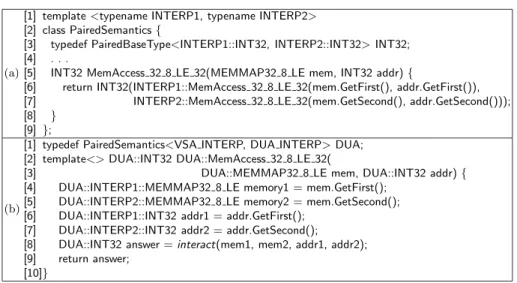
Our system allows easy instantiations ofreduced products [11] by means ofpaired semantics. TheTSLsystem provides a template for paired semantics as shown in Fig. 5(a).
(a)
[1] template<typename INTERP1, typename INTERP2> [2] class PairedSemantics{
[3] typedef PairedBaseType<INTERP1::INT32, INTERP2::INT32>INT32; [4] . . .
[5] INT32 MemAccess 32 8 LE 32(MEMMAP32 8 LE mem, INT32 addr){
[6] return INT32(INTERP1::MemAccess 32 8 LE 32(mem.GetFirst(), addr.GetFirst()), [7] INTERP2::MemAccess 32 8 LE 32(mem.GetSecond(), addr.GetSecond())); [8] }
[9]};
(b)
[1] typedef PairedSemantics<VSA INTERP, DUA INTERP>DUA; [2] template<>DUA::INT32 DUA::MemAccess 32 8 LE 32(
[3] DUA::MEMMAP32 8 LE mem, DUA::INT32 addr){
[4] DUA::INTERP1::MEMMAP32 8 LE memory1 = mem.GetFirst(); [5] DUA::INTERP2::MEMMAP32 8 LE memory2 = mem.GetSecond(); [6] DUA::INTERP1::INT32 addr1 = addr.GetFirst();
[7] DUA::INTERP2::INT32 addr2 = addr.GetSecond(); [8] DUA::INT32 answer =interact(mem1, mem2, addr1, addr2); [9] return answer;
[10]}
Fig. 5.(a) A part of the template class for paired semantics; (b) an example of C++ explicit template specialization to create a reduced product.
TheCIRis instantiated with apaired semantic domain defined with two inter-pretations,INTERP1andINTERP2(each of which may itself be a paired semantic
domain), as shown on line 1 of Fig. 5(b). The communication between interpreta-tions may take place in basetype-operators oraccess/update functions; Fig. 5(b) is an example of the latter. The two components of the paired-semantics values are deconstructed on lines 4–7 of Fig. 5(b), and the individual INTERP1 and
INTERP2 components from both inputs can be used (as illustrated by the call to interact on line 8 of Fig. 5(b)) to create the paired-semantics return value, answer. Such overridings of basetype-operators andaccess/update functions are done byC++ explicit specialization of members of class templates (this is spec-ified inC++by “template<>”; see line 2 of Fig. 5(b)).
We also found this method of CIR instantiation to be useful to perform a form of reduced product when analyses are split into multiple phases, as in a tool like CodeSurfer/x86. CodeSurfer/x86 carries out many analysis phases, and the application of its sequence of basic analysis phases is itself iterated. On each round, CodeSurfer/x86 applies a sequence of analyses: VSA, DUA, and several others.VSAis the primary workhorse, and it is often desirable for the information acquired by VSA to influence the outcomes of other analysis phases by pairing theVSAinterpretation with another interpretation.
4
Instruction Sets
In this section, we discuss the quirky characteristics of some instruction sets, and various ways these can be handled inTSL.
4.1 IA32
To provide compatibility with 16-bit and 8-bit versions of the instruction set,
IA32provides overlapping register names, such asAX(the lower 16-bits of EAX),
AL (the lower 8-bits of AX), and AH (the upper 8-bits of AX). There are two possible ways to specify this feature inTSL. One is to keep three separate maps for 32-bit registers, 16-bit registers, and 8-bit registers, and specify that updates to any one of the maps affect the other two maps. Another is to keep one 32-bit map for registers, and obtain the value of a 16-bit or 8-bit register by masking the value of the 32-bit register. (The former can yield more preciseVSAresults.) Another characteristic to note is thatIA32keeps condition codes in a special register, called EFLAGS.7
One way to specify this feature is to declare “reg32: Eflags();”, and make every flag manipulation fetch the bit value from an appro-priate bit position of the value associated withEflagsin the register-map. Another way is to have symbolic flags, as in our examples, and have every manipulation of EFLAGS affect the individual flags.
4.2 ARM
Almost allARMinstructions contain a condition field that allows an instruction to be executed conditionally, depending on condition-code flags. This feature
7
Many other instruction sets, such as SPARC,PowerPC32, and ARM, also use a special register to store condition codes.
reduces branch overhead and compensates for the lack of a branch predictor. However, it may worsen the precision of an abstract analysis because in most in-structions’ specifications, the abstract values from two arms of aTSLconditional expression would be joined.
[1] MOVEQ(destReg,srcOprnd):
[2] letcond = VarBoolAccess(
[3] flagMap, EQ()); [4] src = interpOperand( [5] curState,srcOprnd); [6] a= Var32Update( [7] regMap,destReg,src); [8] b= regMap; [9] answer =cond?a:b; [10] in (answer )
Fig. 6. An example of the specifica-tion of anARM conditional-move in-struction inTSL.
For example, MOVEQ is one of ARM’s
conditional instructions; if the flag EQ is true when the instruction starts executing, it executes normally; otherwise, the instruc-tion does nothing. Fig. 6 shows the speci-fication of the instruction in TSL. In many abstract semantics, the conditional expres-sion “cond ? a : b” will be interpreted as a join of the original register map b and the updated map a, i.e., join(a,b). Conse-quently, destReg would receive the join of its original value and src, even when cond is known to have a definite value (TRUE
or FALSE) in VSA semantics. The paired-semantics mechanism presented in§3.5 can help with improving the precision of ana-lyzers by avoiding joins. When the CIR is instantiated with a paired seman-tics of VSA INTERPand DUA INTERP, and the VSAvalue ofcond isFALSE, the
DUA INTERP value for answer gets empty def- and use-sets because the true branchais known to be unreachable according to theVSA INTERPvalue ofcond (instead of non-empty sets fordefs anduses that contain all the definitions and uses indestReg andsrcOprnd).
4.3 SPARC
[1] var32 : Reg(INT8)|CWP()|. . .;
[2] reg32 : OutReg(INT8)|InReg(INT8)|. . .; [3] state: State( . . . , VAR32MAP, . . . );
[4] INT32 RegAccess(VAR32MAP regmap, reg32 r){
[5] let cwp = Var32Access(regmap, CWP()); [6] key = with(r) ( [7] OutReg(i): [8] Reg(8+i+(16+cwp*16)%(NWINDOWS*16), [9] InReg(i): Reg(8+i+cwp*16), [10] . . . ); [11] in ( Var32Access(regmap, key) ) [12]}
Fig. 7. A method to handle the SPARC register window inTSL.
SPARC uses register windows to reduce the overhead associated with saving registers to the stack during a conventional function call. Each window has 8 in, 8 out, 8 local, and 8 global regis-ters. Outs becomeins on a text switch, and the new con-text gets a new set of out and local registers. A specific plat-form will have some total num-ber of registers, which are orga-nized as a circular buffer; when the buffer becames full, registers are spilled to the stack to free up a sufficient number for the called procedure. Fig. 7 shows a way to accomodate this feature. The syntactic register
(OutReg(n)or InReg(n), defined on line 2) in an instruction is used to obtain a semantic register (Reg(m), defined on line 1, where m represents the register’s global index), which is the key used for accesses on and updates to the register map. The desired index of the semantic register is computed from the index of the syntactic register, the value of CWP(the current window pointer) from the current state, and the platform-specific valueNWINDOWS(lines 8–9).
5
Related Work
There are many specification languages for instruction sets and many purposes for which they have been used, including emulation (hardware simulation) for cycle simulation, pipeline simulation, and compiler-optimization testing; retar-geting of back-end phases, such as instruction scheduling, register assignment, and functional-unit binding; and concrete syntactic issues, such as instruction encoding and decoding. While some of the existing languages would have been satisfactory for our purposes, their runtime components were not satisfactory, which necessitated creating our own implementation. In particular, as mentioned in§1, we needed the runtime to (i) execute over abstract states, (ii) possibly prop-agate abstract states to more than one successor at a branch node, (iii) be able to compare abstract states and terminate abstract execution when a fixed point is reached, and (iv) apply widening operators, if necessary, to ensure termination. Harcourt et al. [14] usedMLto specify the semantics of instruction sets.LISAS
[9] is a specification language that was developed based on their experience with
ML. Their work particularly influenced the design of theTSLlanguage.
TSLshares some of the same goals asλ-RTL[19] (i.e., the ability to specify the semantics of an instruction set and to support multiple clients that make use of a single specification). The two languages were both influenced by ML, but different choices were made about what aspects of ML to retain:λ-RTL is higher-order, but without datatype constructors and recursion;TSLis first-order, but supports both datatype constructors and recursion.8
The choices made in the design and implementation of TSLwere driven by the goal of being able to define multiple abstract interpretations of an instruction-set’s semantics.
Discussion of additional work related toTSLcan be found in [15].
Acknowledgements. We would like to thank Gogul Balakrishnan, Denis Gopan, and Susan Horwitz for their comments on drafts of this paper, and the anony-mous referees for the helpful suggestions contained in their reviews.
References
1. IA-32 Intel Architecture Software Developer’s Manual,
http://developer.intel.com/design/pentiumii/manuals/243191.htm. 8
Recursion is not often used in specifications, but is needed for handling some loop-iteration instructions, such as theIA32string-manipulation instructions and the Pow-erPC32multiple-word load/store instructions.
2. W. Amme, P. Braun, E. Zehendner, and F. Thomasset. Data dependence analysis of assembly code. IFPP, 2000.
3. G. Balakrishnan. WYSINWYX: What You See Is Not What You eXecute. PhD thesis, Univ. of Wisc., 2007.
4. G. Balakrishnan, R. Gruian, T. Reps, and T. Teitelbaum. CodeSurfer/x86 – A platform for analyzing x86 executables, (tool demonstration paper). InCC, 2005. 5. G. Balakrishnan and T. Reps. Analyzing memory accesses in x86 executables. In
CC, 2004.
6. G. Balakrishnan and T. Reps. DIVINE: DIscovering Variables IN Executables. In VMCAI, 2007.
7. M. Christodorescu, W. Goh, and N. Kidd. String analysis for x86 binaries. In PASTE, 2005.
8. C. Cifuentes and A. Fraboulet. Intraprocedural static slicing of binary executables. InICSM, 1997.
9. T. A. Cook, P. D. Franzon, E. A. Harcourt, and T. K. Miller. System-level speci-fication of instruction sets. InDAC, 1993.
10. K. Cooper and K. Kennedy. Interprocedural side-effect analysis in linear time. In PLDI, 1988.
11. P. Cousot and R. Cousot. Systematic design of program analysis frameworks. In POPL, 1979.
12. B. De Sutter, B. De Bus, K. De Bosschere, P. Keyngnaert, and B. Demoen. On the static analysis of indirect control transfers in binaries. InPDPTA, 2000. 13. S. Debray, R. Muth, and M. Weippert. Alias analysis of executable code. InPOPL,
1998.
14. E. Harcourt, J. Mauney, and T. Cook. Functional specification and simulation of instruction set architectures. InPLC, 1994.
15. J. Lim and T. Reps. A system for generating static analyzers for machine instruc-tions. TR-1622, C.S. Dept., Univ. of Wisconsin, Madison, WI, Oct. 2007. 16. L. Mauborgne and X. Rival. Trace partitioning in abstract interpretation based
static analyzers. InESOP, 2005.
17. M. M¨uller-Olm and H. Seidl. Analysis of modular arithmetic. InESOP, 2005. 18. M. Pettersson. A term pattern-match compiler inspired by finite automata theory.
InCC, 1992.
19. N. Ramsey and J. Davidson. Specifying instructions’ semantics usingλ-RTL. Un-published manuscript, 1999.
20. J. Regehr, A. Reid, and K. Webb. Eliminating stack overflow by abstract inter-pretation. InTECS, 2005.
21. T. Reps, G. Balakrishnan, and J. Lim. Intermediate-representation recovery from low-level code. InPEPM, 2006.
22. M. Sharir and A. Pnueli. Two approaches to interprocedural data flow analysis. InProgram Flow Analysis: Theory and Applications. Prentice-Hall, 1981.
23. P. Wadler. Efficient compilation of pattern-matching. The Impl. of Func. Prog. Lang., 1987.
24. J. Zhang, R. Zhao, and J. Pang. Parameter and return-value analysis of binary executables. InCOMPSAC, 2007.