Environmental Sector
2009 - 2014
A systems approach to skills development to support the Environmental Sector Strategic Plan
Contents
1. Introduction and Background to this document 1
• Policy context 1
• The legislative framework and skills development demands 2
• The Strategic Plan for the Environmental Sector (2009-2014) 3
• The Environmental Sector Skills Plan for South Africa and this HCDS 7
2. Vision, Strategic Objectives and Principles 11
• A systems approach 11
• Vision 11
• Strategic Objectives 12
• Principles 12
3. Strategic Objectives and Strategies for Implementation 14
• Strategic Objective 1: Support skills development for green jobs and a green economy 14 • Strategic Objective 2: Strengthen and retain leadership skills in the environmental sector 19 • Strategic Objective 3: Address scarce and critical skills that currently exist in the environmental sector 23 • Strategic Objective 4: Strengthen the human capital development pipeline within the environmental sector 35
4. Proposed implementation framework 39
5. Proposed means of implementation 41
List of Figures and Tables\
Figure 1: Environmental sector profile 08
Figure 2: A systems approach to Human Capital Development 11
Table 1: Category framework used to differentiate skills levels in the ESSP 13
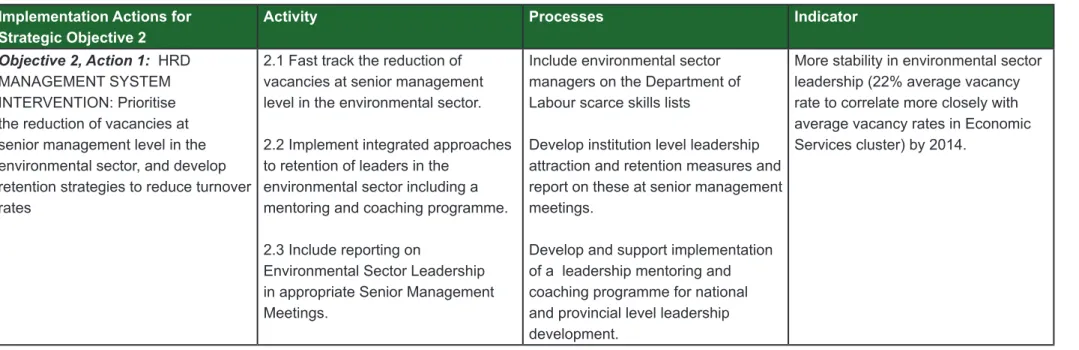
Table 2: Implementation Actions for Strategic Objective 1: Support skills development for green jobs and a green economy 16 Table 3: Implementation Actions for Strategic Objective 2: Strengthen and retain leadership skills in the environmental sector 21
Table 4: Summary of scarce skills identified at sub-focus level 24
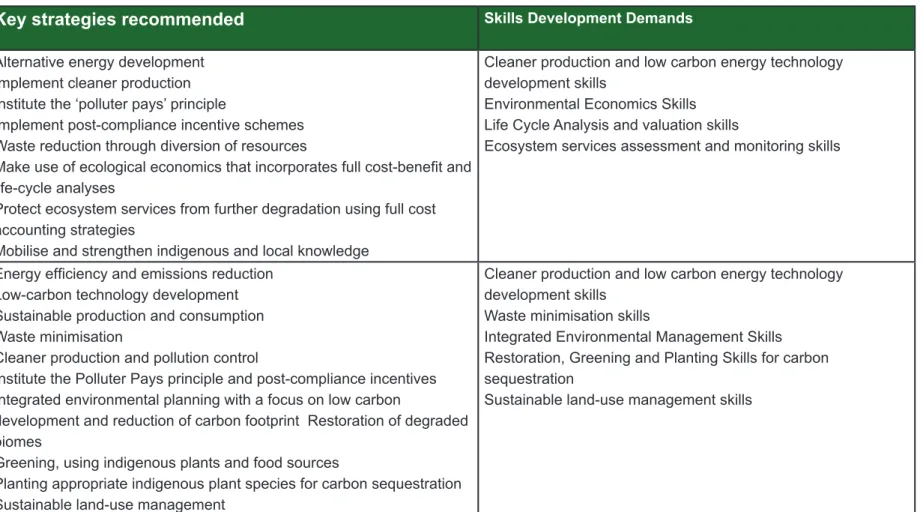
Table 5: Skills development needs for implementing the Strategic Plan for the Environmental Sector 26
Table 6: Critical skills gaps identified across the environmental sector 30
Table 7: New skills development demands for new cross cutting responsibilities 31
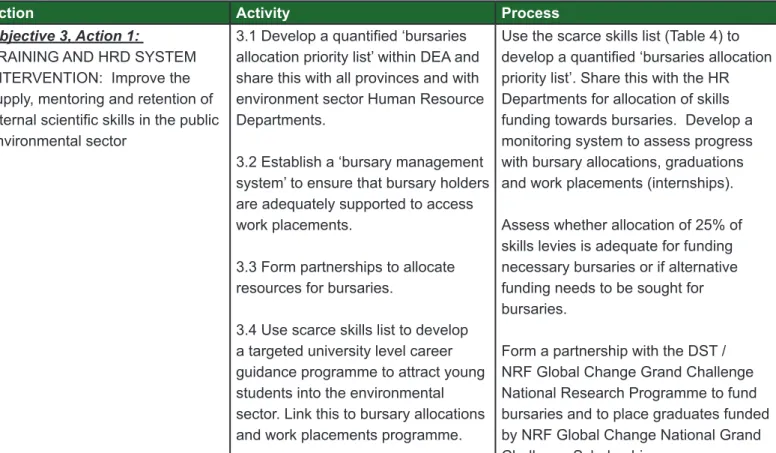
Table 8: Implementation actions for Strategic Objective 3: Address scarce and critical skills in the environmental sector 33 Table 9: Implementation actions for Strategic Objective 4: Strengthen the Human Capital Development pipeline within the environmental sector 37
1.
Introduction and Background to this document
Policy context
This Human Capital Development Strategy (HCDS) arises out of the constitutional imperative for a clean, healthy environment that benefits current and future generations, and the impetus to strengthen opportunities associated with a green economy for South Africa. Its time frame is 2009-2014, which is aligned with the MTSF of 2009-2014. The MTSF prioritises skills development in South Africa, and emphasises the importance of quality in the education, training and skills development process. South Africa has developed a suite of legislation associated with the National Environmental Management Act No. 102 of 1998. The implementation of this legislation remains a work in progress and cannot be done without adequate attention to human capital development. The National Human Resources Development Strategy for South Africa (2009-2014) identifies the importance of implementing skills development initiatives that respond to South Africa’s social and economic needs, and development of skills that improve service delivery.
Significant to this HCDS is the Human Resource demands of achieving the
Delivery Agreement for Outcome 10, which focuses on environmental assets and natural resources that are valued, protected and continually enhanced. Outcome 10. This HCDS particularly addresses human capacity development to ensure a sustainable supply of human resources for achieving Output 2, 3 and 4 of the Delivery Agreement. Throughout the Delivery Agreement, there is mention made of the need for specific skills development initiatives to ensure a sustainable supply of the necessary skills required for implementing the targets of the agreement, indicating a systemic need for giving attention to the issue of skills development. However, as in most other environmental sector plans, specific skills are identified for specific shorter term targets, with inadequate attention given to the systems needed to ensure such skills development – both in the short and longer term. This HCDS therefore provides a more holistic and systemic approach to dealing with the skills
demands that are identified in the Delivery Agreement for Outcome 10, as well as the Strategic Plan for the Environmental Sector (2009-2013). The DEAT Environmental Sector Skills Plan (DEA, 2010) findings are relevant here, as they indicate the need for a systemic approach to addressing human capital development needs for the environmental sector.
The environmental sector is a rapidly emerging sector, and environment is a cross cutting issue, and environmental skills development crosses different sector education and training authorities (SETAs). The environment was not included in the National Skills Development Strategy (NSDS) I or II. In accordance with the Department of Environmental Affairs Environmental Sector Skills Plan (DEA 2010), this Human Capital Development Strategy supports the inclusion of environmental sector and green economy skills development in NSDS III. Prior to 2009 there was no comprehensive skills planning for the environmental sector in South Africa, and in 2009/10 DEA undertook to establish what the major skills development needs were in the environmental sector in South Africa. The Environment Sector Skills Development Plan (DEA, 2010) emphasises the need to address skills development issues within a systems framework. It recommends the
development of Human Capital Development Strategies to implement the Environmental Sector Skills Plan at various levels of the sector, and for various purposes. It specifically recommends the development of a Human Capital Development Strategy (HCDS) for the Environmental Sector that will strengthen implementation of the Strategic Plan for the Environmental Sector (DEA 2010) and that will address sector wide skills development issues. The ESSP provides the background research and information necessary for development of such a Human Capital Development Strategy.
This Human Capital Development Strategy is directly aligned with, and addresses the need for human capacity development based on:
• The Strategic Plan for the Environmental Sector that emphasises the need for capacity building particularly for vertical and horizontal environmental
governance in the public sector; and
• The Environmental Sector Skills Plan for South Africa that proposes a systems approach to skills planning and human capital development, and which provides detailed insight into some of the issues influencing capacity building in the environmental sector, with emphasis on the public sector.
The environmental sector, as defined in this document is based on definition of the sector as provided in the National Environmental Management Act no. 102 of 1998 (NEMA) discussed below.
The legislative framework and skills development demands
Section 24 of the Constitution of South Africa (RSA 1996) enshrines the right of every citizen to an environment that is not harmful to his or her health or well being, and it commits the country to conservation and sustainable management and use of natural resources, as follows:
Everyone has the right:
a) To an environment that is not harmful to their health or well-being; and b) To have the environment protected for the benefits of present and
future generations through reasonable legislative and other measures that:
i) Prevent pollution and ecological degradation ii) Promote conservation
iii) Secure ecologically sustainable development and use of natural
resources while promoting justifiable economic and social development.
The mandate of the Department of Environmental Affairs is to provide the legal and institutional framework necessary for realising this constitutional mandate. Since the promulgation of the National Environmental Management Act No 102
of 1998 South Africa has developed and implemented a comprehensive new environmental policy and legislative framework. The legislative mandate, with its emphasis on a people-centred approach to environmental management and sustainable development of society, has introduced new skills development demands in the environmental sector. These skills are needed for vertical and horizontal integration of the sector mandate, within a framework of co-operative governance.
Environmental sector skills development planning has not ‘kept apace’ of the rapid changes in the environmental sector which are based on the introduction of transformative legislation, and new environmental challenges. This has resulted in a skills development regime that is reactive to legislation, with sometimes serious consequences such as in the case of Environmental Impact Assessment legislation, which suffered from inadequate capacity for implementation. The DEA Environmental Quality and Pollution directorate consequently had to embark on skills development initiatives to strengthen Environmental Impact Management capacity in South Africa. A similar challenge faces many other stakeholders in the environmental sector where for example big industry reports inadequate technical skills to implement new environmental management, cleaner production and low carbon economy strategies (DEA, 2010). There is an urgent need to work towards a more pro-active, integrated approach to skills development in the environmental sector, to address ‘skills development lag’, and/or duplication of effort. This requires co-ordination with the education, training and skills development systems and structures, and reflects the intention for co-ordinated, co-operative governance in the MTSF.
This HCDS is also directly relevant to provincial and local government strategy and planning. Skills development demands outlined in this document were established in consultation with provincial government, and local government, and took account of the specific needs identified at provincial and local government level. Tools for skills development planning are provided in this document that are relevant at all levels of government planning and service
delivery. For example, lists of scarce and critical skills are provided that can be used at all tiers of government to prioritise skills development spending and resource allocations for skills development. Local and provincial government planners, HR Directorates and skills development facilitators are therefore encouraged to use the objectives, tools and action strategies for planning provincial and local level skills development initiatives, and particularly to guide how skills development resources are allocated to ensure effective service delivery and governance. The HCDS therefore provides a system wide perspective of the most significant skills development interventions required, which can be applied at all levels of governance.
The Strategic Plan for the Environmental Sector (2009-2014) and this HCDS
The key goals and priority areas of the Strategic Plan for the Environmental Sector (2009-2104) are to:
1) Provide leadership and coordination of government’s approach to large, complex and cross-sectoral issues affecting the environment, as per the MTSF, and
2) Effectively implement its own sectoral mandates within the context of new and evolving regulatory frameworks with additional
responsibilities, striking a balance between capacity constraints and opportunities.
Three inter-related issues have been highlighted that are of concern to the sector as a whole. These require action across all of its institutions and strong leadership (which will require skills for such leadership) must be provided within government and society as a whole by the sector. These issues are: 1) Implementation of sustainable development,
2) Developing appropriate responses to climate change, and
3) To pursue and explore the concept of green jobs and promote a green economy.
These issues have implications for social and economic development. These issues are ‘cross sectoral’ from a governance perspective, and require skills for integrating these issues into the governance system as a whole, and into society and the economy more widely. The Strategic Plan for the Environmental Sector (2009-2014) identifies the importance of building capacity for environmental governance. It proposes the development of a National Strategy for Capacity Building, of which this HCDS forms an important part. The targets for capacity building within the Environment Sector Strategic Plan are to:
• Achieve increased awareness, understanding and integration of environmental issues within institutions and planning processes.
• Achieve a measurable increase in capacity (of officials, institutions and politicians) – resulting in increased effectiveness in performance of functions across the sector.
• Achieve increased participation in environmental consultation processes as a result of increased capacity of stakeholders.
• Carrying out skills and capacity assessments (audits) for all environmental institutions at national and provincial level.
• Ensuring that environmental skills and capacity are adequately assessed via the Competency Framework established through the National Government Skills Audit for local government (CoGTA).
• Developing and implementing a national strategy for support and capacity building for the environmental sector – to cover all spheres of government and focussing both on environmental officials and other officials and politicians.
• Approving and implementing the Local Government Support Strategy for Environment and Tourism sectors – and ensuring that this is aligned to the Five Year Strategic ‘Turnaround Strategy’ for Local Government (with intention of integrating this into a wider support and capacity building strategy for the sector once it is prepared) (CoGTA, 2009).
• Building on existing programmes and approaches – and incorporating lessons learned into new approaches.
• Reviewing the role of Community Environmental Workers with a view to increasing their effectiveness in capacity building and support.
• Establishing a reporting, monitoring and evaluation system to monitor the effectiveness of the capacity building strategy (and its activities) on an on-going basis.
• Achieving integration / mainstreaming of environmental capacity building into existing support and capacity building programmes for local government – particularly those emanating from: Five Year Strategic Framework for Local Government National Skills Development Programme.
• Ensuring capacity building (e.g. skills transfer, building of institutional capacity) is an integral component of any support projects or other out-sourced projects commissioned by the sector.
It aims to achieve this by:
• Increasing the use of learnerships and bursaries as a means of increasing access to the sector at entry level.
• Developing strategies and approaches for increasing staff retention. • Increasing access to environment related information by all stakeholders. • Developing a national strategy for capacity building of all stakeholders
(concerning topic specific strategies).
This Human Capital Development Strategy provides further definition to the above, and provides strategic direction on how to address the capacity development issues in the environmental sector, from a human capital development perspective. It should be noted here that other important aspects of capacity development e.g. institutional development, resourcing and infrastructure development are equally important within a National Strategy for Capacity Development. These need to be included in a National Strategy for Capacity Development and should complement this HCDS to ensure a sustainable context for skills development.
In particular, the Strategic Plan for the Environmental Sector identifies the following issues associated with capacity building in the environmental sector,
which have implications for human capital development strategic planning, and thus for this HCDS:
• Skills development is needed to support Green Jobs and a Low Carbon / Green Economy.
• There is a need for co-ordinated cross sectoral skills development response to address climate change risk and opportunities from amongst others the energy, agriculture, built environment, information and communication technologies, infrastructure, transport and manufacturing technology sectors, and the institutions and quality assurance bodies (SETAS) that offer education and training to these economic sectors. Such training interventions need to address both climate mitigation and adaptation. • There is a need to develop skills for implementing the National Sustainable
Development Framework five priority areas, and the MTSF strategic priority 9, focussing on sustainable resource management and use. Here particularly sustainable development planning and technology skills are necessary.
• There is a need for skills development initiatives that increase the effectiveness of delivery of sectoral mandates, particularly for core focus areas that have been identified for the sector which include:
o Air Quality- here the shortage of air quality specialists and air pollution control officers needs to be addressed, as well as capacity for air quality licencing and management at provincial and local government
levels
o Waste and Chemicals Management – here there is a need to build capacity across the waste sector in South Africa for a ‘cradle-to-cradle’ approach to waste management in line with new legislation.
o Pollution Incident management o Environmental Impact Management
o Conservation and Sustainable Use of Biodiversity o Marine and Coastal Management
• There is also a need to develop skills for achieving strategic goals, particularly effective institutional frameworks and legislation (i.e. legislative and compliance skills); integrated planning skills (i.e. sustainable development and green economy planning skills); participation, empowerment and awareness (i.e. environmental education, training and community empowerment skills); skills for strengthening information management and international co-operation.
The Strategic Plan for the Environmental Sector (2009-2014) has identified a number of core focus areas aligned to core areas of statutory responsibility, with key priorities for the 5 year framework of implementation, outcomes, activities, targets and responsibilities for delivery, with indicators for monitoring and evaluation. Various capacity building and training initiatives have been identified as priority interventions over the next five years. These are:
1) Waste Management: The need to build capacity across the sector – particularly at local government level - for ‘cradle to cradle’ approaches to waste management, as defined in the NEMA NWA. Most skills in the waste sector are oriented towards end of pipe approaches to waste management, and all skills need to be changed to incorporate waste avoidance approaches. Local government officials in particular need to be supported to adopt new approaches through KPA revisions, but also through training and capacity building. Remediation skills also need to be extended. Public education and participation in local waste avoidance, re-use, recycling and composting programmes is also needed.
2) Air Quality: The training of Air Quality Specialists, and Air Pollution Control Officers, and the training of municipal and provincial officials in atmospheric emission avoidance, licencing, compliance monitoring and enforcement – particularly the 23 District Municipalities that have been identified as having poor or potentially poor air quality. This focus area plans to train 100 officials by 2011 via the APPA registration certificate review process. Public education is also needed to address poor indoor
and ambient air quality in dense, low income settlements (coupled with provisioning of alternative energy resources).
3) Pollution Incident Management: Skills for pollution incident management are needed across spheres. National and provincial government have responsibilities for pollution incident management, and local government requires skills to assist with provision of emergency services if required. Guidelines will be developed that can be used in training, including training for management of coastal zone incident management under ICMA.
4) Environmental Impact Management: There is a need to ensure embedded capacity within mandated agencies (i.e. adequate scientific and decision making skills) for assessing environmental impacts. Skills are needed to ensure greater consistency in quality of authorisations through the EIA process, and skills need to be developed to develop and use a wider range of EIM tools. Skills for compliance monitoring also need to be developed. Skills need to be developed amongst regulators, practitioners and interested and affected parties. Training of administrators in the regulations and the application of administrative systems and processes is a high priority, and provincial courses are being planned. More deliberate efforts to strengthen public understanding and participation are needed. Best practices, guidelines and manuals with standard operating procedures will be developed and these can be used in training. Report writing to ensure accurate reports first time is a critical skill that needs to be provided for. National and provincial government will need to work with local government to strengthen its capacity and understanding of the EIM processes, and to integrate EIM decision making processes into IDPs and other strategic planning frameworks. A provincial level EIM capacity audit and needs analysis is being planned to inform training and capacity building. A new training course on EIA regulations is also being planned, and a training course for Interested and Affected Parties Environmental Impact Management Capacity Building is being planned.
capital development strategy for improving management and research skills in the biodiversity sector is being developed. New skills need to be developed within the biodiversity sector to accommodate Type 1, 2 and 3 conservation activities (within statutory areas, less formal protected areas, and informal landowner conservation activities). New approaches to conservation also need to be introduced into training and capacity building systems, most notably trans-frontier conservation, bio-regional conservation planning, and ecosystem service approaches to conservation, and skills need to be developed in all of these new areas. Skills for understanding and managing climate change impacts on biodiversity also need to be developed. Skills development priorities need to be developed to align with the priorities for implementation identified in the National Biodiversity Framework published in August 2009. Research capacity, particularly in the areas of taxonomy and ecosystem services management needs to be developed. Capacity for spatial biodiversity planning and management needs to be developed in a wider range of provinces as an immediate priority. While the South African National Biodiversity Institute’s (SANBI) support and leadership is highly valued, greater capacity needs to be developed at provincial level for practical implementation of conservation priorities. Skills for compliance monitoring (Environmental Management Inspectors) also need to be developed. Transformation of the biodiversity sector needs to be prioritised in capacity building programmes. At local government level, there is a need to build capacity for integrating biodiversity concerns into Integrated Development Plans (IDPs) and Spatial Development Frameworks (SDFs) for municipalities, and to ensure that systems are put in place for the control and management of priority resources at the local level. Improving knowledge of sustainable extractive use of biodiversity, and establishing and strengthening provincial stewardship programmes are also priorities for capacity building in the biodiversity sector.
6) Marine and Coastal Management: Research capacity is needed to monitor fish stocks and to detect over-exploitation or negative effects on
the integrity of the marine ecosystems, and to understand the influence of climate change on the marine and coastal environment. Modelling skills for determining Total Allowable Catch (TAC) and Total Allowable Effort (TAE) are needed. Skills for implementing an ecosystem approach to MCM are also needed. MCM is experiencing critical capacity and resourcing challenges in the area of compliance monitoring, and more Fisheries Control Officers are needed. Additional technical and enforcement skills are urgently needed in the sector. Community-based monitoring skills also need to be developed in the context of the Expanded Public Works Programmes (EPWP), and this will require training and capacity building. Skills for development of responsible aquaculture activities are also needed. Skills at provincial and local government level need to be developed for coastal management planning, which emphasises sustainable development planning for the coast. Training of Fisheries Control Officers is a priority and an initiative is underway to strengthen and provide the specialist training and development required by FCOs.
7) Training to promote and strengthen enforcement and compliance:
There is a big drive within government to address the problem of insufficient staff to tackle the large scale nature of the task of ensuring adequate enforcement and compliance. Increasing compliance levels will necessitate a much higher level of pro-active compliance monitoring (e.g. routine inspections). There are severe technical skills shortages for carrying out monitoring and enforcement activities (e.g. process engineers, biodiversity specialists, EIM experts etc.). Little capacity is being built for voluntary compliance. Basic training courses have been developed and designed for EMIs (by the EQP branch in DEA) and EMIs have been designated in institutions across the country. There is, however, a great need to extend the training of these officials to provide them with the knowledge of standard operating procedures and the technical skills required to implement compliance and enforcement responsibilities effectively. Capacity for using Joint Enforcement Programmes needs to be further developed. A more sustainable system
of funding EMI training is needed, and a re-examination of funding systems for EMI training is underway. Air, Waste and EIA related monitoring training is also receiving attention across the sector. DEA is carrying the responsibility for developing procedures and systems and for training officials in other institutions within the Directorate Compliance Monitoring. More sustainable, long term systems of capacity development need to be built in the South African Education and Training system for compliance monitoring technical skills. Skills development programmes are also needed for awareness raising of the judiciary.
As can be seen from the above, each ‘focus area’ is effectively busy developing its own human capital development strategies, mainly with a focus on training provisioning for key priority areas. All areas are targeting provincial and local government. There is, however, a need to consider the following common strategy across all of the above focus areas, in order to assess whether the training programmes are co-ordinated (since many target the same end-users, particularly at local government level), and to consider whether a sustainable capacity building system for the environmental sector is being put in place. Questions to help develop such a framework could include:
• Is a sustainable system of training that makes appropriate use of the skills development system instruments and funding mechanisms (e.g. learnerships, qualifications, skills programmes etc.) being established? • Are high quality training materials being produced for use in the training
system, and are there adequately qualified trainers and enough training institutions with capacity to offer high quality training in these areas on a sustainable, ongoing basis?
• Is the training of officials in provincial and local government contexts co-ordinated and is duplication and ‘over-targetting’ of the same people being considered and minimised?
• Is adequate attention being given to public empowerment and education skills to focus on impact reduction and public co-operation in implementing
new environmental mandates, and public participation in sustainability practices and environmental impact management?
• Is adequate attention being given to sustainable workplace support in the form of mentoring and high quality workplace skills planning and other strategies to ensure the successful application of learning and improved efficiency of workplace skills planning instruments and budgets?
These are prioritised within this HCD, along with priority systemic interventions that address the wider skills system ecology, with a view to ensuring longer term catalytic impact.
The Environmental Sector Skills Plan for South Africa and this HCDS A number of critical issues relevant to this HCD have been raised in the
Environmental Sector Skills Plan for South Africa. They are:
• Environmental sector skills development planning has not kept ‘apace’ with the rapid changes in the environmental sector, as reflected in transformative legislation and new environmental challenges. As a result the environmental sector is characterised by a skills development regime that is reactive to legislation. There is an urgent need to work towards a more pro-active, integrated approach to skills development in the sector, to address skills development lag, and/or duplication of effort and systemic inefficiencies.
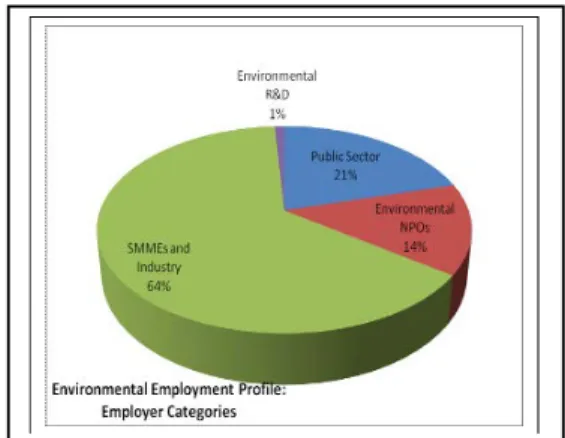
Figure 1: Environmental Sector employment profile (DEA, 2010)
The employment profile of the environmental sector shows that the private sector is the largest employer of environmental skills (SMMEs and big industry – 64%); followed by the Public Sector (national, provincial, local government and parastatals – 21%) and environmental Not for Profit (NPOs) organisations – 14%), with environment related Research and Development making up 1% of employment in the sector. All employers have skills development demands and responsibilities at high skill, intermediary and /or entry occupation level. The emphasis differs depending on the nature and purpose of different environmental institutions. For example, national government have a larger percentage of high skill employees, most environmental parastatals (except for SANBI) and local government have a small percentage of high skills employees, with the bulk of their employment being at entry occupation level. This creates different skills development challenges in vertical and horizontal governance patterns.
• There are five main drivers influencing skills development in the environmental sector namely:
¾ Macro-ecological drivers which manifest in critical environmental issues and risks (critical issues such as climate change, loss of biodiversity, increase in waste etc.). These are linked to environmental
compliance drivers (environmental legislation) that requires skills for implementation and skills to assess and address the issues and risks comprehensively and effectively. This driver is creating the demand for risk assessment and management skills, and various types of environmental science, technology and management skills. As shown in the Strategic Plan for the Environmental Sector, there are very specific skills development demands associated with various environmental management foci / sub-sectors.
¾ Macro-economic drivers and the emergence of a green economy which includes efforts to formalise an Environmental Goods and Services Sector in South Africa (currently the EGS makes up an approximate R20 billion industry or 7% of GDP and is estimated to be growing, with potential to triple in size in five years). There is an emerging emphasis in South Africa on the green economy in industrial sector planning, and on ‘Green Jobs’. Various studies are showing the potential for job creation based on newly emerging environmental foci, and on a new development paradigm based on ‘decoupled growth’, where growth is decoupled from heavy use of resources, but is based on seeking greater efficiency, while extending labour intensity. This driver is creating a demand for new skills, particularly environmental economics skills, new green technology development skills, SMME development skills, and sustainable development planning skills.
¾ Mainstreaming of Environment into Development requires integration of the environmental driver into all government and economic activities, including rural development. This creates skills demands for greening of existing jobs and skills for creating an environmentally literate society and workforce. It also requires skills for sustainable community-based natural resource management into focus in rural areas, where sustainable use of natural resources is key to maintaining and enhancing rural livelihoods. Such skills are therefore critical to rural development.
¾ Research, Science and Technology drivers are emerging as significant in the environmental sector, as three of the South African National Grand Challenges are environment related. The National System of Innovation is therefore intimately linked to environmental priorities – new energy resources, dealing with global (climate) change, and maximising the productivity of biological resources (while managing them sustainably). This national research agenda creates the need for high level scientific skills (social and natural science) development in and for the environmental sector.
¾ The existing skills system and skills base also provides a driver for skills development in the sector. South Africa has a history of unequal education, and poor quality education which affects the entire skills development pipeline. Environment is a ‘new’ focus in the South African education and training system, so many who enter the environmental sector are inadequately prepared for the complex range of environmental challenges and strategies that exist. This creates a need for ongoing in-service skills development, and for effective use of the skills development system. The skills development system in South Africa, is however, also still emerging, and has been characterised by various struggles for efficiency, accessibility and effective use of skills development instruments (e.g. learnerships). The current status of the skills development system, and the ‘newness’ of environment within this system, is creating the need for high quality environmental education and training skills, to service environmental skills development in the entire skills development pipeline.
• The DEA Environmental Sector Skills Plan highlights the urgent need for giving attention to Human Capital Development needs in the public environmental sector – at national, provincial and local government levels to strengthen service delivery. In particular there is a need to address the issues of supply and retention of leadership skills (senior management and skilled technical management leadership); scientific
technical and professional skills, particularly black women scientific and professional skills, and environmental technical skills, as significant shortages of skills are experienced in these categories in the environmental sector. Vacancies in these categories have increased over the past five years, and the state system is increasingly becoming reliant on consultancy services for scientific services. Taking a 22% vacancy (the average vacancy rate of the Economic Cluster) as the ‘norm’, the ESSP reports an approximate vacancy level of over 600 scientific positions
in national and provincial environmental government functions (excludes parastatals), and over 800 environmental technical positions (national and provincial government – excludes parastatals and local government technical environmental positions). There is a need to address these vacancies through pro-active skills development initiatives, in order to reverse this trend to ensure attraction and retention of adequate internal scientific capacity at national and provincial levels. There is also a need to stabilise employment in the human resources system, as high turbulence and turnover in this sector of employment in the public environmental sector affects the efficacy of employment procedures, and especially the filling of environmental occupation vacancies, which are identified in the ESSP as being high (average of 29% for environmental occupations across the public sector – average vacancies in the economic cluster is 22%). The efficacy of workplace skills planning,
and expenditure of training budgets needs to be improved to address the environmental mandate within a service delivery and performance related framework, as large budgets are being spent on mainly generic types of training, often at levels lower than performance criteria demand.
• At local government level, there is a need to build capacity for integrated environmental management (that addresses all legislative requirements at implementation level), to strengthen capacity for sustainable development planning – urban and rural development planning, to strengthen environmental technical capacity, and to strengthen skills at entry occupational level, as this is where the largest percentage of
environmental employees work. The ESSP reports a ‘neglect’ of training of local government employees in environmental practices functions at entry occupation level.
• The Environmental Sector Skills Plan indicates the need for giving urgent attention to the development of skills development planning infrastructure and competence for delivery of training and training capacity for green jobs and a green economy. The Environmental Sector Skills Plan shows that while numerous green economy strategies and strategies for green jobs are emerging, very little attention is given to the
pro-active planning for skills development needed to make these strategies work. Skills development system drivers also show that the environmental sector has, to date, lacked adequate capacity to make effective us of the skills development system instruments (e.g. learnerships), as for example, only 2.4% of learnerships listed are environmental learnerships (DEA, 2010), and many environmental qualifications (which in themselves remain inadequate for the sector) are under- or unutilised. This indicates that there is a need to build the capacity of training institutions, trainers and the SETA system to accommodate and pro-actively plan for and develop capacity for training provision for a green economy and for green jobs. While education and training institutions in South Africa show progress in ‘greening’ of courses and development of new environmental courses, quality is uneven, and delivery appears to be inadequate in terms of matching demand – i.e. there is a demand-supply mismatch. The current range of learnerships for the sector is inadequate and more SETAS need to offer environmental learnerships for the green economy.
• The Environmental Sector Skills Plan also indicates the need to address
internal workplace skills development planning processes to improve the efficacy of workplace skills planning and expenditure on training in the environmental sector. Evidence shows that workplace skills planning is compliance driven, rather than mandate driven, and that while large amounts of money is being spent on training, the training is not clearly aligned with KPAs or performance-based outcomes. Training paid for by workplace skills planning linked budgets tends to be more generic, and most such training is levelled at Levels 1-4 on the NQF, while many employees attending such training are employed with Levels 6-8 NQF
qualifications. While it is conceivable that some courses need to be pitched at introductory level for particularly purposes of learning a new skill, there is also a need for a greater alignment with level of employment and level of skills training being offered, as well as skills training and its relevance to KPAs and performance outcomes. Skills development in workplaces seems to be provider driven (i.e. available accredited courses) and a lack of specific mandate-based information on skills needed.
¾ Aligned with the Strategic Plan for the Environmental Sector, the Environmental Sector Skills Plan also indicates the need for development of skills for mainstreaming climate change, sustainable development and green economy into government and economic systems (i.e. mainstreaming environment into development). This requires development of new skills in the environmental sector such as risk assessment and management (expressed as a need across the environmental sector), sustainable development planning skills (also expressed as a need across the environmental sector); and environmental economics skills (also expressed as a need across the environmental sector). While current employment categories do not always exist for these skills, new positions are beginning to open in these areas, and existing occupations (e.g. urban planners; economists; environmental managers etc.) are having to re-orient or re-skill themselves with these new foci. This creates a demand for re-orientation of existing training and capacity in these areas, as well as development of new training programmes in these areas.
¾ Given the emphasis on quality of education and skills development
outlined in the MTSF, the Environmental Sector Skills Plan also emphasises the need to address and improve quality of environmental education and training at all levels of the system. It recommends interventions to this affect throughout the system, and this includes the quality of career guidance to attract suitable incumbents into the environmental sector. This HCD addresses these issues through a systems approach to skills development, as recommended in the Environmental Sector Skills Plan for South Africa.
2.
Vision, Strategic Objectives and Principles
A systems approach
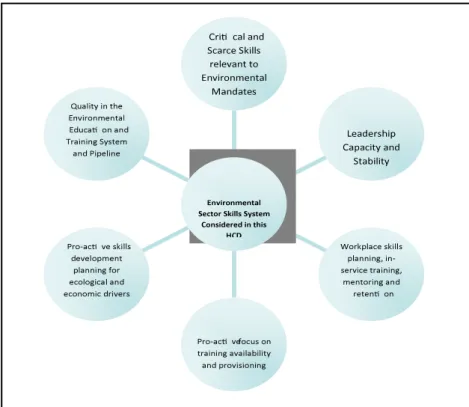
As indicated above the Environmental Sector Skills Plan identifies critical issues affecting the skills system in the environmental sector. Most Human Capital Development planning in South Africa focuses on training provisioning, quantified in numbers of people to be trained over a period of time. While necessary, this represents a short term and fragmented approach to HCD development, and is an inadequate response to addressing the more complex skills development crisis in South Africa, and in the environmental sector in particular. Such approaches to human capital development fail to address the systemic context in which skills are located (i.e. the workplace skills development context), and the need for futures thinking, and pro-active initiatives to provide for futures skills needs (e.g. the Training of Trainers to offer training for an emerging sector’s needs). Based on the extensive research undertaken for the Environmental Sector Skills Plan which was complemented with additional research into the workplace skills environment (e.g. retention, mentoring and workplace skills planning and quality related issues) undertaken specifically for this HCD, this HCD focuses on the system of skills development and proposes various interventions to ensure a more sustainable skills development context for the environment sector. It addresses skills needs at high, intermediate and entry occupation level, and addresses the various priorities identified in the Environmental Sector Skills Plan (DEA, 2010) within a framework of priorities identified for implementation outlined for the Strategic Plan for the Environmental Sector (2009-2014).
Figure 2: Systems approach to Human Capital Development
Based on this systems approach, this human capital development strategy is focussed on both:
1) training programmes to address scarce and critical skills gaps, and
2) various strategic skills systems interventions that are pro-active, and that will have catalytic and longer term impacts in order to ensure that a sustainable system of training will exist for the
environmental sector. Vision
To strengthen human capital within the environmental sector to lead mainstreaming of climate change and sustainable development in government
and the economy, and to effectively implement the national environmental mandate.
Strategic Objectives
1. Support skills development for green jobs and a green economy 2. Strengthen leadership skills for sustainable development planning
and climate change risk and opportunity assessment
3. Address the scarce and critical skills gaps in the public environmental sector for improved vertical governance
4. Strengthen a systems-based approach to human capital development within the environmental sector
Principles
This HCDS is based on the principles for Human Capital Development Strategies recommended in the DEA Environmental Sector Skills Plan. These principles are recommended in the ESSP to ensure synergy and coherence
in Human Capital Development Strategies in the Environmental Sector.
• Principle 1: Systems Approach: This principle requires HCDS to give attention to the skills system in the environment sector. It intends to address the problem of fragmented and narrow approaches to skills development. The purpose of a systems approach to skills development is to address issues at all levels of the skills development ecosystem (e.g. in training organisations, and in workplaces, and at the interface between the two). The systems approach also requires giving attention to the mix of high, intermediate and entry level skills needed in the environmental sector.
• Principle 2: Multi-levelled transformation: This principle requires HDCS to give attention to the ongoing need for transformation in the environmental sector, and to prioritise skills development initiatives in areas where transformation targets are difficult to achieve. It requires a view of transformation that addresses employment equity compliance as
well as transformation of knowledge and practice in the sector.
• Principle 3: Quality and Quantity Balance: This principle requires that HCDS give equal attention to numbers of people trained, particularly in categories of scarce, critical and innovation skills needed for the sector, while at the same time, giving attention to the quality of the training interventions being offered. Quality should become a principle of practice in all interventions supported by the HCDS.
• Principle 4: Pro-active Futures’ Orientation: This principle requires that HCDS consider not only the current and existing needs for skills development, but also interventions that will strengthen a pro-active, futures’ orientation to skills development in the sector (e.g. leadership or sustainable development planning skills).
• Principle 5: Mainstreaming of environmental skills into government, society and the economy: This principle requires that HCDS give attention to the development of new skills needed in the sector, as well as
the greening or re-orientation of existing skills to integrate environmental concepts and practices into all walks of life and into a diversity of occupational categories. For this various skills systems interventions are needed.
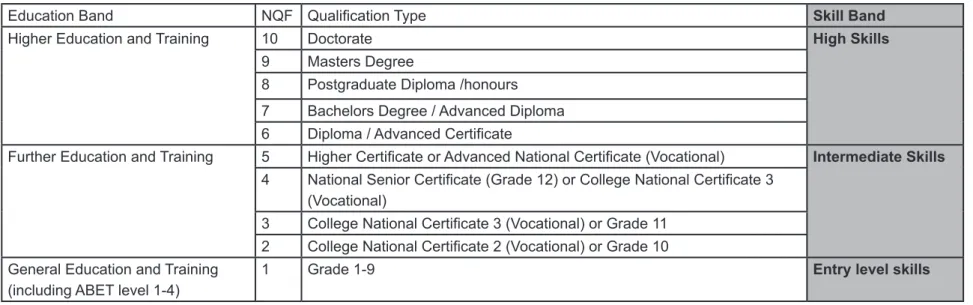
The following framework is used to differentiate skills levels in the ESSP, and also in this HCDS.
Table 1. Category framework used to differentiate skills levels in the ESSP (Kraak, 2008, revised according to new NQF levels); DoL, 2008
Education Band NQF Qualification Type Skill Band
Higher Education and Training 10 Doctorate High Skills
9 Masters Degree
8 Postgraduate Diploma /honours 7 Bachelors Degree / Advanced Diploma 6 Diploma / Advanced Certificate
Further Education and Training 5 Higher Certificate or Advanced National Certificate (Vocational) Intermediate Skills
4 National Senior Certificate (Grade 12) or College National Certificate 3 (Vocational)
3 College National Certificate 3 (Vocational) or Grade 11 2 College National Certificate 2 (Vocational) or Grade 10 General Education and Training
(including ABET level 1-4)
3.
Strategic Objectives and Strategies for
Implementation
Strategic Objective 1: Support skills development for green jobs and a green economy
The Environmental Sector Skills Plan and the Strategy for the Environmental Sector both emphasise the importance of supporting skills development for green jobs and the green economy. This objective does not focus on specific skills for a green economy or specific green jobs (which needs to be done through specific green economy skills strategies and specific SETAs). It rather focuses on wider systemic issues that will facilitate SETAs uptake of green economy skills planning and provisioning, and also pays attention to catalytic / systemic interventions needed to provide for entry level occupation skills development for green jobs and local and provincial government service delivery. It does not focus on the provision of training for these per se, but emphasises that more SETAs need to get involved in learnerships and skills development for the green economy.
A number of key areas for skills development support were identified in the ESSP, and the Strategic Plan for the Environmental Sector:
• Interventions are needed to integrate the environmental driver into the National Skills Development Strategy, into SETA Sector Skills Plans, and into the Occupational Learning System, including curricula of FET Colleges.
• Provincial green economy and other sub-sectoral green economy strategic planning is taking place (e.g. plans for formalising the recycling industry). The ESSP identified that green economy strategies, while pointing to significant potential for job creation in new areas (e.g. solar water heating, renewable energy, urban agriculture etc.) lack integrated skills development strategies to provide for the skills needed to actualise the opportunities outlined in the green economy strategies. Capacity needs to be developed to integrate such skills planning into green
economy strategies. This includes capacity to cost the skills development needs of the green economy strategies, and to mobilise the resources that exist in the current skills development system (e.g. SETA funds) for skills development initiatives that can support green economic strategies. It may also require partnerships with SETAs to invest in ‘training of trainers’ programmes to provide new forms of skills training.
• The ESSP recommends that attention be given to sustainable training pathways that may be linked to existing EPWP training initiatives. It recommends development of Environmental Practice 1, 2, 3 and 4 skills development programmes and/or learnerships to be linked to sustainable job opportunities that could be linked to EPWP programmes, particularly for filling entry level occupational vacancies (e.g. conservation worker vacancies) and for supporting new jobs (e.g. new waste management / recycling industry jobs) at entry level. There is an urgent need to develop new learnerships and skills programmes in the area of environmental practices.
Objective 1, Action 1: Support integration of the environmental driver into the National Sustainable Development Strategy and the Occupational Learning System
This action requires high level systemic intervention to ensure that SETA system funding will be available for green job skills development in the occupational learning system (i.e. in a range of SETAs). Green Economy Strategies show that a number of different SETAS need to be involved in (e.g. AgriSETA for urban agriculture jobs; LGSETA for waste management jobs; and MERSETA for solar heating and new energy technology jobs etc.). For coherence across the SETA system, there is a need to ensure that the environmental driver
is included in the NSDSIII, and integrated into the Sector Skills Plans of the various SETAs. This requires engagement with the National Skills Authority (NSA), and with NSDSIII stakeholders including business and labour. It also requires engagement with the SETAs themselves, to develop knowledge of, and understanding of how the green economy will influence their planning
and work. It also requires engagement with the Ministry of Higher Education and Training and the Qualifications Council for Trade and Occupations and Umalusi, to ensure appropriate content and quality criteria are included in environmental sector training and associated institutions. This is to ensure longer term sustainability of environmental training provision. A priority here would be to ensure that training becomes available for environmental technical skills – particularly intermediate level skills for air quality, coastal, waste, water and biodiversity monitoring, as these were identified as scarce skills that are needed at provincial and local government level in the public sector (the ESSP identified a shortage of over 800 environment technicians in the public sector system).
Objective 1, Action 2: Support the development of a Training of Trainers Programme to expand Provider Capacity for Green Jobs and Green Economy Training and Capacity Development
This action addresses the current inadequate capacity for delivery of green jobs and green economy training in the system. This lack of capacity includes quality issues and capacity for offering sustainable training for EPWP programmes and other green jobs initiatives (e.g. appropriate learnerships). The ESSP shows that there is a lack of capacity in the environmental sector to use the skills system instruments such as learnerships, skills programmes and skills funding that is available in the skills system for providing relevant accredited training programmes. The ETDP SETA has qualifications registered for Environmental Education, Training and Development Practitioners. These qualifications are in use, but require funding to be allocated for their use through the ETDP SETA (the ETDP qualifications are currently funded from other sources, because the environment driver has not been included in the NSDSII, and is not prioritised in the ETDP SETA Sector Skills Plan). The Environmental Education, Training and Development Practices standards need to be revised to have a stronger focus on green jobs training, EPWP training and green economy training (i.e. learners coming off these qualifications should be able to use the NQF system, and should be able to offer high quality accredited training that will strengthen green jobs delivery, and the green economy).
A partnership needs to be established with the ETDP SETA to revise the standards, and to facilitate better and more efficient use of the qualifications and standards through improved curriculum design. Of critical importance, is to include these qualifications in the ETDP Sector Skills Plan, so that funding from the skills system is allocated to them, and that they cease to be outside donor funded, but are internally funded within the ETDP SETA.
Objective 1, Action 3: Develop national materials for use with Environmental Practices Level 1, 2, 3 and 4 Learnership / Skills Development Programme/s to strengthen access to new entry occupation green jobs (e.g. recycling jobs), and green jobs in municipalities
This action addresses a lack of attention given to entry level occupation development in the environment sector. Qualifications for level 1, 2, 3 and 4 exist for Environmental Practices (these qualifications can be contextualised for a variety of environmental practice occupations such as recycling, conservation and parks servicing, alien invasive species eradication, coastal zone monitoring etc. entry occupations) if learning materials and curricula are carefully developed. The ESSP reports that while these and other relevant qualifications are registered and available for use within various SETAS they remain un- or under-utilised. There appear to be difficulties in translating qualifications into appropriate course materials and assessment activities. As indicated above, the sector lacks adequate capacity for this task.
This HCDS action suggests that DEA takes the lead in forming and working within a partnership with the COGTA, relevant SETAs (especially LG SETA; CATHSETA ) and a providers network to facilitate the development of nationally available materials (provided in up to 5 African languages) for learnership and skills programme training development for environmental occupations at levels 1, 2, 3 and 4. The focus should be on Environmental Practices Occupations and Training in different contexts at entry occupation level that focuses on improvement in environmental service provision and new entry green jobs development.
The provision of the materials in African languages is critical as reports on training in provided at entry level shows that training is often inaccessible as much of it is provided in English. This initiative should be carefully designed to support:
• Local government entry occupations involved in environmental practices such as waste management, recycling, sanitation management and greening to improve the quality of current practices and to achieve service delivery gains through improved practice.
• Sustainable learning pathways linked to EPWP programmes and other job creation opportunities to strengthen green jobs development.
These materials should become available to a range of national and local service providers who are supporting green jobs skills development at entry level, to support the use of quality materials for environmental sector training. Efforts should also be made to Train Trainers in how to use the materials (i.e.
link this initiative to Action 2 above).
The ESSP shows that there are potentially over 100 000 people that can benefit from such an initiative to strengthen environmental practices training at entry occupation level immediately (employees in local government and others), and with the expansion of green jobs at entry occupation level, the EPWP programme could potentially provide access links to sustainable learning pathways and jobs for many more learners who could benefit from this initiative. These materials could also be integrated into FET College curricula for longer term sustainability of the training provisioning. This will require engagement with FET Colleges interested in offering the training programmes, and it would be important to involve the FET colleges (and the MHET), along with SETAs at the start of the initiative to design the curricula and materials to be used.
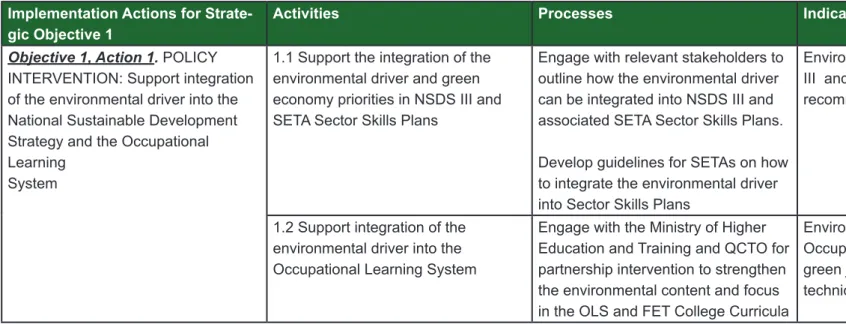
Table 2: Implementation Actions for Strategic Objective 1: Support skills development for green jobs and a green economy
Implementation Actions for
Strate-gic Objective 1 Activities Processes Indicator
Objective 1, Action 1. POLICY INTERVENTION: Support integration of the environmental driver into the National Sustainable Development Strategy and the Occupational Learning
System
1.1 Support the integration of the environmental driver and green economy priorities in NSDS III and SETA Sector Skills Plans
Engage with relevant stakeholders to outline how the environmental driver can be integrated into NSDS III and associated SETA Sector Skills Plans. Develop guidelines for SETAs on how to integrate the environmental driver into Sector Skills Plans
Environment is included into NSDS III and Sector Skills Plans (2011), as recommended in the ESSP.
1.2 Support integration of the environmental driver into the Occupational Learning System
Engage with the Ministry of Higher Education and Training and QCTO for partnership intervention to strengthen the environmental content and focus in the OLS and FET College Curricula
Environment integrated into the Occupational Learning System for key green job sectors and environmental technical skills (by 2014).
1.3 Develop green economy skills planning guidelines for distribution to SETAs and to green economy partners.
for targeted green job sectors and for environmental technician functions at provincial and local government level. Establish a task team to demonstrate (using some case studies) how to cost and integrate skills planning into green economy studies. Develop guidelines for national distribution.
Green Economy Skills Planning guidelines used in green economy strategies by 2012.
Objective 1, Action 2: TRAINING SYSTEM INTERVENTION: Support the development of a Training of Trainers Programme to expand Provider Capacity for Green Jobs and Green Economy Training and Capacity Development
1.4 Develop a Training of Trainers Programme for Providers of Training for Green Jobs
Form a partnership with ETDP SETA and QCTA to revise ETDP standards, and to offer Training of Trainers Programme/s in the Occupational Learning System to extend capacity and improve quality of training for environmental service delivery, green jobs and green economy
Training of Trainer Programme exists as partnership with ETDP SETA 100 Training Providers have attended Training
Quality of 50 environmental training programmes improved
30 new environmental training programmes exist
Objective 1, Action 3: TRAINING SYSTEM INTERVENTION: Develop national materials for use with Environmental Practices Level 1, 2 and 3 Learnership / Skills Development Programme/s to
strengthen access to new entry / entry level occupation green jobs (e.g. recycling jobs), and green jobs in municipalities
1.5 Develop high quality national materials for Environmental Practices Level 1, 2, 3 and 4 Learnership and/ or skills development programmes – Core Materials with applications to various environmental practice occupation contexts (waste, recycling, greening, coastal clean up etc). Align with EPWP focus areas and green jobs development strategies. This training can also be used for CBNRM in rural development contexts.
Form partnership with COGTA, relevant SETAs, and interested FET colleges to develop core materials for learnership and/or skills development programmes for Environmental Practices Level 1, 2, 3 and 4 qualifications to extend EPWP skills programmes, and to strengthen entry occupational environmental training in different environmental practice contexts (waste, biodiversity, coasts, greening, alien clearance etc).
Integrate these qualifications into FET Colleges, and make available the materials to FET
Materials exist for the Level 1, 2 and 3 Learnerships / skills development programmes in up to 5 African languages.
Materials applied to and used in at least 20 different environmental practice training contexts. Materials used by at least 5 FET Colleges wanting to offer
Environmental Practices Level 1, 2, 3 and 4 skills programmes and/or qualifications. 20 providers using the materials in offering skills
Colleges. Translate materials into African languages. Make materials (in modules) available to all training providers with capacity to offer EPWP skills training, learnership and/or FET level training for local government entry occupations, and for green jobs development at entry occupation level (e.g. recycling SMMEs).
ronmental Practices Level 1, 2, 3 and 4 Learnerships at local government level, and in support of entry occupa-tion level Green Jobs Development.
Objective 1, Action 4: WORKPLACE SKILLS PLANNING INTERVENTION: Ensure training funds allocation for training of environmental economists
1.6 Support the training of
environmental economists Identify institutions that offer environmental economics at honours and masters levels, and support targeted bursary allocations for environmental economics honours and masters graduates
More environmental economists trained (40 environmental economists by 2014)
Strategic Objective 2: Strengthen and retain leadership skills in the environmental sector
This strategic objective addresses the finding in the ESSP that there is a need to develop, strengthen and stabilise the supply of leadership and management skills in the environmental sector. High vacancy and turnover rates exist amongst leadership and management categories – particularly amongst senior management and at highly skilled professional and management levels in the public sector. This has a knock on effect across the entire system. The problem is particularly acute at provincial level, but has also been identified at local government level and at national government level. The strength of public sector leadership is critical to the capacity of the sector to provide leadership, as envisaged by NEMA and the Strategic Plan for the Environmental Sector. Using a five year trend analysis, the ESSP showed that vacancies of between 25-30% exist in the following categories of employment:
• Highly skilled production workers (level 6-8) • Highly skilled supervision (level 9-12) • Senior Management (level 13-16)
While this issue was identified specifically within the environmental sector, it should be noted here that leadership capacity has been identified as a wider national problem. The Department of Labour National Critical Scarce Skills list identifies Managers, Senior Managers and Specialist Managers as being scarce in South Africa. Economic Services Cluster HR Oversight data showed that in most categories of employment in the Economic Services Cluster (where most environmental positions are monitored), vacancy rates have decreased over the past five years, with the Senior Management category being an exception, which rose steadily to 34% by the 2007/8 reporting period. Simple regression forecasting predicted a possible rise in vacancies to 38% by 2011. High senior management vacancies, combined with high turnover rates which show a current 25% rate places strain on the public sector to provide a) adequate leadership and b) continuity of leadership. Turnover rates have decreased over the past five year period, but remain high at 25%.
This pattern is visible in DEA national (high vacancies and turnover rates in management categories) and in provinces there are particularly high levels of turnover rates amongst senior managers. This pattern is explained by the drive for transformation, but is also explained by the high demand for senior managers across the national system. The prevalence of this across all levels of government in the public environmental sector indicates that it is a systemic issue that requires attention in a HCDS, particularly given the new demands being placed on the sector with the emergence of a Green Economy, and new socio-ecological challenges and management approaches necessary (e.g. climate change risks).
The ESSP, using a recent five year vacancy period (2003-2008/9) reports that at provincial level in the public environmental sector, the Free State province had high turnover of senior management staff, and KZN had high levels of vacancies (28%) at senior management level, and turnover of senior management which showed an increase of 4% over the five year period. Vacancy rates in the senior management category remained stable at a high 25% in Limpopo province over the five year period, and Mpumalanga province managed to decrease all its vacancies substantially, but remains with high vacancies in the senior management category, and amongst highly skilled professionals. In the Northern Cape province vacancies increased in all employment categories over the five year period, and highly skilled supervision vacancies have rose from 25% to 35% over a five year period, while senior management vacancies increased from 25% to 35% in the five year period, indicating high levels of leadership vacancies in the department. The North West Province similarly showed high levels of vacancies amongst highly skilled professionals (36%). Senior management vacancy rates decreased by 50%, which is encouraging. The Western Cape public environmental sector also showed increases in vacancies over the five year period at highly skilled supervision level (9% increase). Turnover rates at senior management level increased by 13% in the five year period. Gauteng province showed vacancy rates of 63% in highly skilled positions, and 32% vacancies in the supervision category, with a 24% increase in senior management vacancy rates over the