RENTING HOMES (WALES) BILL
Explanatory Memorandum
Incorporating the Regulatory Impact
Assessment and Explanatory Notes
Explanatory Memorandum to the Renting Homes (Wales) Bill
This Explanatory Memorandum has been prepared by the Welsh Government’s Department for Local Government and Communities and is laid before the National Assembly for Wales.
Member’s Declaration
In my view the provisions of the Renting Homes (Wales) Bill, introduced by me on 9 February 2015 would be within the legislative competence of the National Assembly for Wales.
Assembly Member in charge of the Bill Lesley Griffiths AM
Minister for Communities and Tackling Poverty February 2015
CONTENTS
PART 1
1. Description (page 5)
2. Legislative Background (page 6)
3. Purpose and intended effect of the legislation (pages 7 - 38) 4. Consultation (pages 39 - 42)
5. Power to make subordinate legislation (pages 43 - 54) 6. Regulatory Impact Assessment (pages 55)
PART 2 – REGULATORY IMPACT ASSESSMENT 7. Options, costs and benefits (pages 56 - 79) 8. Competition Assessment (pages 80 - 83) 9. Post implementation review (pages 84 - 85)
APPENDIX A: Competition Assessment Filter APPENDIX B: References
1. Description
1. The Renting Homes (Wales) Bill will reform the legal basis for renting a home from a private landlord or community landlord, which includes local authorities and registered social landlords.
2. The Bill will ensure the legal relationship for renting a home is based on two types of contract: a secure contract and a standard contract. Both will set out the rights and responsibilities of both landlord and contract-holder (the term used for “tenant” and “licensee” in the Bill).
2. Legislative background
3. The National Assembly for Wales has the legislative competence to make provision in relation to housing in Wales by virtue of section 108 of, and Part 1 (Subject 11:Housing) of Schedule 7 to, the Government of Wales Act 2006 (“the Act”).
Subject 11 from Part 1 of Schedule 7 to the Act is as follows:
“Housing. Housing finance except schemes supported from central or local funds which provide assistance for social security purposes to or in respect of individuals by way of benefits. Encouragement of home energy efficiency and conservation, otherwise than by prohibition or regulation. Regulation of rent. Homelessness. Residential caravans and mobile homes”
4. The above provides the National Assembly with the competence to make the provisions contained in the Renting Homes (Wales) Bill.
3. Purpose and intended effect of the legislation
Introduction
5. The Welsh Government is committed to doing as much as possible to help people meet their housing needs. The approach, which reflects its core values of fairness, social justice, equality, and sustainable development, recognises the importance of safe, secure and affordable homes as the fabric of people’s lives and that of strong communities. The Government’s role is to consider how the whole system works and to intervene where it is sensible and effective to do so. Tenancy law is a critical element of the housing system and its efficiency.
6. The Renting Homes (Wales) Bill is a significant piece of legislation. As such, it contains considerable detail and some elements of the Bill are technical and complex. This Explanatory Memorandum is designed to convey information on the key elements of the Bill and its provisions.
Overview of the Bill
7. The Bill brings together and modernises the existing complex raft of legislation into one new piece of legislation, and in doing so seeks to improve the arrangements for renting a home in Wales. It proposes: (i) Two main types of occupation contract, which will replace existing
forms of occupation arrangements;;
(ii) These new contracts will comprise fundamental terms set out on the face of the Bill, supplementary terms to be set out in regulations made by the Welsh Ministers, and any additional terms as negotiated and agreed by landlords and contract-holders;
(iii) Contracts will also have to cover key matters such as the address of the property, the level of rent and the rental period; and
(iv) An approach supported by model contracts, which incorporate the relevant fundamental and supplementary terms depending on differing circumstances.
8. This approach aims to achieve:
(i) A clearer, more logical, legal framework, which reflects fairness and equality;
(ii) A simple and effective basis for renting a home from a community landlord or private landlord;
(iii) Greater understanding by landlords and tenants of their respective rights and responsibilities, thus reducing the problems and difficulties that occur with the current system; and
(iv) More flexibility for community landlords, private landlords and support services to meet people’s housing needs, including those of vulnerable groups.
Context
9. The financial downturn in 2008, combined with tighter lending criteria and housing supply pressures, means that the rental sector is playing an increasingly important part in our housing system. There are currently around 440,000 rented homes in Wales, which means around one in three people, over 1 million people in all, live in rented accommodation1.
10. Social rented housing plays a vital part in ensuring that people whose needs cannot be met by the housing market can access a decent, affordable, home. It is a major contribution to tackling poverty. Intermediate rented housing, the provision of which is increasing and which is rented at below full market rates also plays an important role in meeting the needs of people who can’t afford full market rental rates. 11. The private rented sector is also more important as a housing option.2
An effective private rented sector is an essential part of a well-functioning housing market. It plays a critical role in supporting economic mobility, providing flexibility and choice to those who choose not to, or are unable to enter into home ownership. It also provides a home for many of our most vulnerable people. The financial downturn has amplified its importance to the housing market of the future, both in providing homes for younger people, and in contributing towards an increase in the supply of homes. Thus it is important that arrangements for renting a property from a private landlord work well for both parties.
Current position
12. There are currently many different forms of tenancy in both the social housing and private rented sectors. Furthermore, individual tenancy agreements can vary greatly from one landlord to another. These differences and variations can cause people to resist moving between landlords, which can limit their choice of a home and the ability of local authorities to help people to find homes.
13. Disputes between tenants and landlords also arise as a result of the complexity of current law. Joint tenancies can present difficulties in cases of domestic abuse or when parents split up. In some instances, the law actually puts individuals at risk of becoming homeless rather than facilitating a more sensible solution. These issues contribute to renting often being a last resort as a housing option, or the only alternative for those who are unable to buy a home.
Housing Acts currently apply and, over time, they have been subject to substantial amendment which has added to the complexity. This has been exacerbated by the case law that has developed over time. The current position is not conducive to an efficient housing system. In considering the question of whether current law works as well as it could, is clear and fair, the answer has to be “no”.
15. The result of changes over the years is an increasingly complex legal framework, which is difficult to understand for many of those who work in the field of housing, let alone landlords and tenants. It is now considered that only the most experienced housing lawyers fully understand the complexities of housing law. The current position is summed up nicely by the following extract from a quote from a member of the judiciary:
“Housing law has become an impenetrable forest. The once mighty oaks of the common law are in a sorry state. …… There are few paths through the forest, known only to the most skilful lawyers. Some who enter the forest escape with scratches and torn clothes. Many become hopelessly lost3”
16. The lack of understanding, especially amongst tenants, means renting a home is often seen as the last option or, in some cases, the only option. It has become increasingly unclear for tenants, and indeed some landlords, what type of tenancy or licence is in place and what rights and responsibilities apply to them. This uncertainty, or ignorance, can lead to worry, stress and disputes which often lead to court action. The Bill will help to avoid such problems through ensuring the rights and responsibilities of both landlords and contract-holders will be clearly set out, so the parties will know where they stand and disputes can be dealt with more easily.
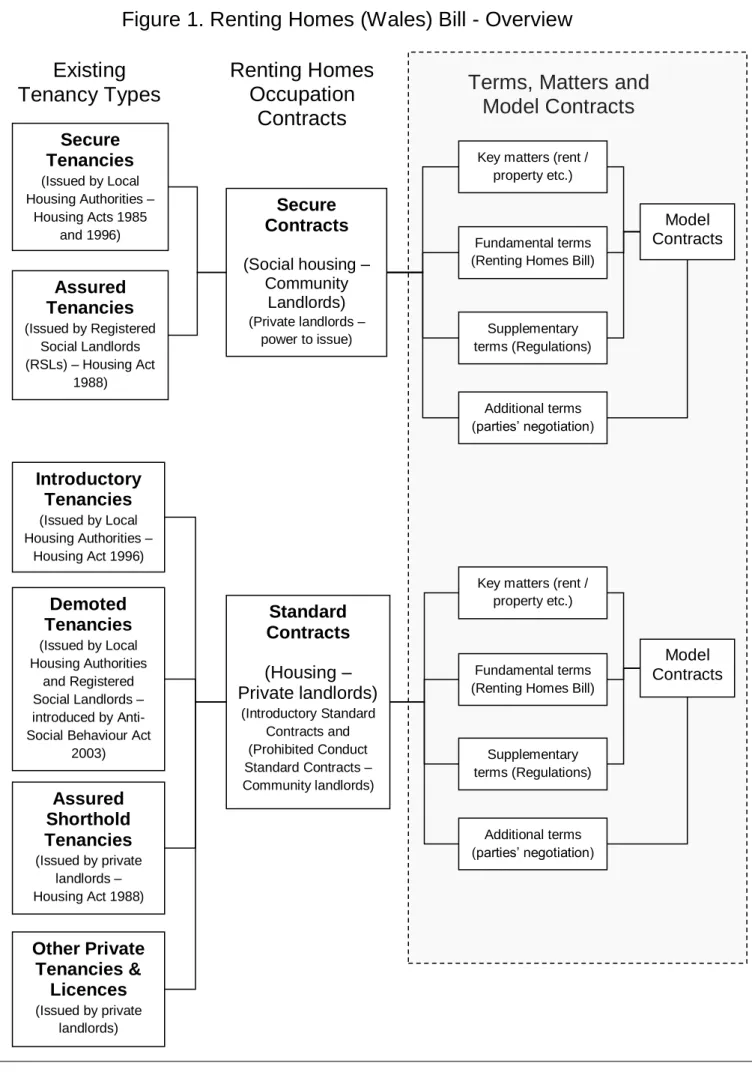
17. Given the increasing reliance on the rented sector, the importance of appropriate and effective legislation that is easy to understand is paramount. Unfortunately, the current law governing the relationship of landlord and tenant has become “an irrationally complicated mess”4. Many disputes between landlords and contract-holders arise from ignorance or difficulties in understanding and applying the requirements of, and obligations on, both parties.
18. Lord Woolf, the former Lord Chief Justice, said within Access to Justice, Final Report which was published in July 1996:
“The time has come for root and branch reform of housing law …… procedural reform can have only a limited impact on [housing law] …… reform of the substantive law on housing could do more than anything to reduce cost and delay … …the main source of difficulty is the complexity of the substantive law itself …… The Law Commission should be invited to carry out a review of housing law with a view to
consolidating the various statutory and other provisions in a clear and straightforward form.5”
19. That report dealt primarily with improving the procedures of the civil courts, with the aim of increasing access to justice by reducing the cost and delay of going to court. Lord Woolf was firmly of the opinion that in the key area of housing, in particular, where there were disputes between landlords and tenants, the law itself was so complex that this too amounted to a considerable barrier to access to justice.
20. This reinforced calls for regulatory change in the rented housing sector, which ultimately led, in 2001, to the UK Government asking the time asked to examine the sector and make recommendations for change. The Commission published its final recommendations in 2006, which received widespread support.
21. The UK Government has not taken forward the Law Commission’s recommendations. Separately, the Welsh Government has developed further the work of the Law Commission leading to this Bill.
Evidence base
22. The Bill and its provisions are grounded in the extensive work of the Law Commission and the evidence behind it. As part of its work, the Commission undertook two separate consultations: one covering status and security6 and the other covering co-occupation, transfer and succession7. There was significant engagement with stakeholders and more than 600 formal written responses to the two papers. Members of the Commission’s team addressed over 100 conferences, seminars, workshops and other meetings on the proposals, including events held in Wales.
23. The Commission’s recommendations were set out in Renting Homes: The Final Report, which was published in 20068. In 2012, the Welsh Government announced it would bring forward legislation to implement the report’s recommendations9
.
24. Following this announcement, and working with the Welsh Government, the Commission reviewed its original report. It published another report, which updated its original proposals and addressed devolution issues arising from implementing the proposals insofar as they applied in Wales10.
25. The Law Commission’s work above provides a solid evidence base for the proposals in this Bill and was the foundation for the additional
Purpose and intended effect
26. There is little doubt amongst housing experts an improved system for renting a home must be underpinned by significant changes to the current legislation. The changes need to be clear, understandable and proportionate.
27. The problems identified can be addressed and overcome by better tenancy arrangements which create a clearer understanding between landlord and tenant at the outset of a tenancy. Following careful consideration of a wide range of evidence, the Government is taking action to improve the arrangements for renting a home in Wales through the provisions set out in this Bill.
28. The new arrangements will mean, wherever possible, consistent terms are used irrespective of whether the landlord is a local authority, housing association or private individual. This will allow important matters to be clearly understood by both landlord and tenant, reduce problems caused by a lack of understanding and make it easier for people to get advice on addressing any problems should they arise. In addition to providing simpler and more flexible arrangements for renting a home, the Bill will do more to:
Create a more flexible framework to help support the victims of domestic abuse from a housing perspective;
Address housing-related anti-social behaviour;
Ensure a more flexible approach to joint tenancies, thus making such arrangements easier for those who need or want them;; Provide a more consistent approach to succession rights;
Establish fairer and more consistent arrangements for eviction for rent arrears from social housing; and
Clarify landlords’ obligations for repair and matters relating to the condition of a property.
29. Over and above doing more to help people to meet their housing needs, the Bill will establish clearer arrangements for landlords and tenants and a better understanding of their rights and responsibilities. This should translate into fewer disputes that end up being addressed through the courts, and a reduction in the worry and costs that this can involve for both parties.
30. The Welsh Government wishes to see the development of a sustainable and high quality private rented sector. At the same time, the commitment to the principles of the secure tenancy remains strong and nothing in the proposals undermines that commitment. The proposals will not fundamentally alter the balance of rights and responsibilities of tenants and landlords that currently exists.
31. The following pages explain the key provisions in the Bill. Where possible, these are cross-referenced to the relevant parts of the Bill itself for clarity and context and to aid understanding. This is not possible in all cases; for example, where a policy intention is achieved by repealing existing legislation.
Occupation contracts
(Key references in the Bill: Part 2, chapters 1, 2 and Schedule 2)
32. A written contract is not currently required as part of a tenancy or licence. Where written contracts are issued, these can vary hugely from property to property and from landlord to landlord. Contracts can be ambiguous, difficult to understand, or contain unlawful terms. A poorly drafted contract is often little better than no contract at all, and sometimes worse. The Renting Homes (Wales) Bill will require all home rentals to be underpinned by a written contract that contains all of the essential information relevant to both parties.
33. Currently, there is also confusion over the legal basis under which someone can rent their home. Sometimes, landlords will purport to issue a “licence” rather than a “tenancy” because they believe this gives them more control, whereas in law a tenancy will have been created, irrespective of what is stated in the agreement. To overcome this problem, the occupation contracts created under the Bill will apply to both tenancies and licences, providing certain requirements are met. This resolves a significant and long-standing area of confusion under current law. This is also why, instead of the terms “tenant” or “licensee”, the Bill refers to “contract-holder”. This allows for the fact that some contract-holders will be tenants while others will be licensees.
34. At the heart of the Bill are the new “occupation contracts”. With a limited number of exceptions, the Bill replaces all current tenancies and licences with just two types of occupation contract. An occupation contract will be provided by a landlord to anyone renting the property as a home and will be one of two main types:
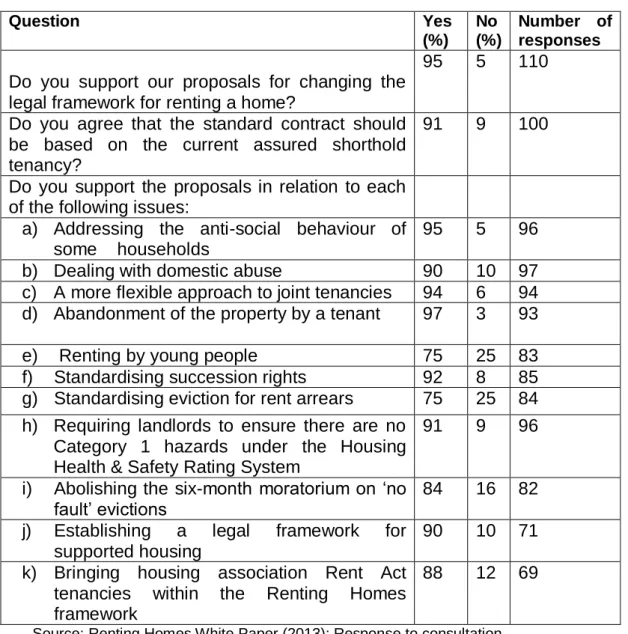
(i) Secure Contract based on the secure tenancy currently issued by local authorities;11
(ii) Standard Contract based on the current assured shorthold tenancy.12
35. Secure tenancies currently used by local authorities are generally seen as providing the greatest degree of protection for tenants. As the basis
also be nothing to stop private landlords issuing a secure contract if they choose to do so.
36. The standard contract will be similar to the current assured shorthold tenancy. It has a lower degree of security of tenure protected under legislation than the secure contract but allows for landlords and contract-holders to agree fixed terms that provide increased security. 37. There are two main versions of the standard contract:
(i) Periodic running typically from week to week or month to month;
(ii) Fixed term running for a pre-agreed set period, usually a number of months or years.
38. On implementation, the vast majority of tenancies or licences made between one or more persons of at least 16 years of age to rent a property as a home will be either a secure or standard occupation contract. Most existing agreements will also convert to the appropriate type of occupation contract. For example, a fixed term assured shorthold tenancy will convert to a fixed term standard contract.
Terms of contracts and variation of terms
(Key references in the Bill: Part 1, Chapters 3, 4 and 5)39. Each occupation contract will comprise three elements. (i) Key Matters;;
(ii) Fundamental Terms; and (iii) Supplementary Terms.
40. There is a fourth element, namely any “Additional Terms” which the landlord and contract-holder may agree.
41. “Key Matters” – these are mandatory and set out the essential facts for the contract, namely:
The property;
The effective date of the contract; The amount of rent; and
The rental period.
42. “Fundamental Terms” - these set out the primary rights and responsibilities under the contract, for example the requirement to provide a written statement of the contract and the process for ending the contract. Some of the fundamental terms can be left out or changed by agreement, but only where this benefits the contract-holder. Other fundamental terms, such as those addressing prohibited conduct,
deception, survivorship and the death of the contract-holder cannot be left out or changed. The fundamental terms are included in the Bill. 43. “Supplementary Terms” - these will be set out in regulations to be
made by the Welsh Ministers. They will be further rights and responsibilities that apply under the contract, such as the obligation to pay council tax and utility bills. The landlord and contract-holder are free to agree to leave out or modify supplementary terms, provided that by doing so they do not undermine the fundamental terms of the contract.
44. “Additional Terms” - these are for those issues not covered by fundamental or supplementary terms. These terms, for example the keeping of pets, should be agreed between the landlord and contract-holder before they are included in the contract.
45. The Bill provides mechanisms for contracts to be varied, according to whether they are secure contracts, periodic standard contracts or fixed term standard contracts. However, certain terms cannot be varied, such as those relating to prohibited conduct, death of the contract-holder and securing a contract by deception.
46. To support landlords in complying with the obligation to issue written contracts that include all relevant key matters, fundamental and supplementary terms, and “model contracts” will be freely available. These will provide for the different renting scenarios that exist in practice, for example an initial fixed term followed by a periodic contract.
Existing tenancies not covered by the Bill
(Key references in the Bill: Schedule 2)47. After careful consideration, it is been decided that a small number of existing tenancies will remain outside the provisions of the Bill. Tenancies, which have been excluded on the basis of, for example, fairness and practicality are:
Tenancies subject to the Rent Act 1977; Agricultural tenancies;
Long tenancies of more than 21 years; and
Nightshelter accommodation (provided for up to 24 hours at a time).
Accommodation in a care home; Accommodation in barracks;
A tenancy or license provided as a temporary expedient in relation to a trespasser; and
Accommodation that is shared with the landlord, including as a lodger.
49. Community landlords, which include local authorities and registered social landlords, will be required to enter into secure contracts except in the following circumstances, where standard contracts may be offered:
Introductory occupation (usually for an initial period of twelve months before becoming a secure contract);
Accommodation provided for asylum seekers or displaced persons;;
Supported accommodation;
Interim accommodation for homeless persons;
Service occupancy, where occupancy is a requirement of employment e.g. police, fire and rescue service;
Student accommodation;
Accommodation let outside the normal allocation rules or let to a key worker;
The property is intended for transfer to a housing association and the occupation is granted under those terms;
Temporary accommodation where:
Land has been acquired for development;
The contract-holder has relocated for the purpose of taking up employment;
The accommodation is leased to the landlord for use as temporary housing accommodation; or
Works are being carried out on the previous property. 50. Community landlords will be required to use standard contracts for
introductory occupation, and as the basis of contracts for medium-term supported housing. Such contracts can also be used where, in response to the holder of a secure contract engaging in prohibited conduct, a community landlord or registered charity obtains a court order imposing a “prohibited conduct standard contract”, usually for a period of twelve months.
51. Tenancies and licences relating to supported accommodation provided for up to six months will not be issued as occupation contracts. However, if the accommodation is provided for more than six months, it would result in the individual having an occupation contract. There are circumstances when this may not apply and these are described in the section on supported housing. The automatic conversion of a supported standard contract to a secure contract after two years, as proposed by the Law Commission, is not being taken forward. This is in response to concerns raised by stakeholders that this risked a
reduction in availability of what is already a scarce form of accommodation for those who require it.
52. Figure [1] below shows how occupation contracts will operate within the current system of licences and tenancies.
Terms, Matters and
Model Contracts
Secure Contracts (Social housing – Community Landlords) (Private landlords – power to issue) Secure Tenancies (Issued by Local Housing Authorities – Housing Acts 1985 and 1996) Assured Tenancies (Issued by Registered Social Landlords (RSLs) – Housing Act 1988) Fundamental terms (Renting Homes Bill)Supplementary terms (Regulations) property etc.) Additional terms (parties’ negotiation) Model Contracts
Key matters (rent / property etc.)
Fundamental terms (Renting Homes Bill)
Supplementary terms (Regulations) property etc.) Additional terms (parties’ negotiation) Model Contracts
Key matters (rent / property etc.) Standard Contracts (Housing – Private landlords) (Introductory Standard Contracts and (Prohibited Conduct Standard Contracts – Community landlords) Assured Shorthold Tenancies (Issued by private landlords – Housing Act 1988) Other Private Tenancies & Licences (Issued by private landlords)
Existing
Tenancy Types
Renting Homes
Occupation
Contracts
Figure 1. Renting Homes (Wales) Bill - Overview
Introductory Tenancies (Issued by Local Housing Authorities – Housing Act 1996) Demoted Tenancies (Issued by Local Housing Authorities and Registered Social Landlords – introduced by Anti-Social Behaviour Act
Duty to provide a written contract
(Key references in the Bill: Section 31)53. A clear, understandable, contract is essential to effective arrangements for renting a home. Both the landlord and contract-holder must have access to a written contract in order to understand their rights and responsibilities. The Bill will require a landlord to provide the contract-holder with a written statement of the contract no later than two weeks from the date of occupation. Most landlords will no doubt continue to issue a written contract for signature before the contract-holder moves in. The two-week period is to allow for situations where accommodation is provided at very short notice. This will ensure that every person renting a home receives a written contract.
54. As stated above, the contracts will contain a range of terms, some of which are mandatory and some optional. However, the majority of terms will be drawn either from the Bill or from regulations made under the Bill, thus leading to far greater consistency across contracts. Having consistent terminology will help improve people’s understanding of the arrangements and their obligations as the contract-holder. At the same time, the landlord will also be clear as to his or her rights and obligations.
55. To assist landlords, model contracts will be readily and freely available for landlords to use as the basis for their agreements. The Welsh Government will ensure arrangements are made for this and it will encourage their use. Using these, both parties could potentially complete a contract simply by inserting the property-specific details, such as the name of the landlord and contract-holder, the address and the amount of rent.
56. If a landlord fails to issue a written contract within two weeks of occupation, it would carry implications for the ability to gain possession of the property where occupied under a periodic standard contract. The landlord would be unable to issue a “no-fault” possession notice to the contract-holder. In addition, and with the intention of emphasising the need for, and importance of, written contracts, a landlord would not be able to issue any such notice for six months from the date the contract was provided to the contract-holder. In addition, should the landlord not provide the written statement within the two-week period, the landlord would be liable to pay compensation to contract-holder amounting to a day’s rent for each day until the contract is provided, up to a maximum of two months’ rent. A contract-holder would be able to offset rent against this compensation.
able to apply to the court for a declaration on the content of the contract. The court may also order compensation to be paid by the landlord.
58. A timely and accurate occupation contract benefits both the contract-holder and the landlord. Responses to the Welsh Government’s consultation13 in 2013 show that in the vast majority of cases, landlords insist on contracts for their tenants and most landlords welcome the clarity the new occupation contracts will bring. However, in the minority of cases where no contract is issued, or it is deficient, the sanctions provided in this Bill will help to ensure compliance.
59. An occupation contract is considered to be effective on either the date the contract is provided to the contract-holder or the date occupation started, in which case the landlord has two weeks to provide the contract in writing.
Ending a contract
(Key references in the Bill: Part 9)
60. The process and circumstances by which current tenancies and licences are ended by a landlord or indeed a tenant are many and varied. The end of a contract, and the way that this happens, is perhaps one of the most confusing parts of current legislation. It is the cause of the majority of court actions and is always likely to be. It can involve time, expense, and worry on the part of both landlord and tenant. The purpose and intended effect of the Bill is to clarify rights and responsibilities and thus reduce the number of disputes and court actions.
61. Many of the claims and disputes can be avoided if the process for ending the contract is clear to all parties at the outset. The arrangements for a landlord or someone renting a home to end a contract, or the circumstances in which a contract comes to an end, must be clear to all concerned.
62. The Bill sets out clear, straightforward and fair processes for ending a contract, which reflect several, fundamental, changes to the current law. The Explanatory Notes (at Annex A) provide detailed information on the provisions and how they will work in practice, but in summary:: a. At any time before occupying the property, the contract-holder may
give notice to the landlord that he or she wishes to end the contract. The contract will then terminated provided no written contract has been issued by the landlord.
b. After the date that a contract-holder occupies the property or after a contract has been issued, both parties must adhere to the terms of the contract before it can be terminated. The purpose behind this is
both parties to the contract. However, the intention of the Bill to provide flexibility where it is needed means that there is an exception to this, which is where the landlord and the contract-holder are in mutual agreement to end the contract.
c. A person who occupies property under a periodic standard contract and who wants to leave the property must give at least four weeks’ notice to the landlord, unless a different notice period is agreed to the advantage of the contract-holder.
d. A contract-holder may withdraw a notice to leave by notifying the landlord and, provided the landlord does not object to the withdrawal of this notice, the contract will continue. If the contract-holder leaves the property before the notice date, the contract will still continue and not end until the notice has expired.
e. At the end of a fixed term standard contract, the landlord and contract-holder may enter into another contract relating to that property. Where the contract-holder remains in occupation, the contract will default to a periodic standard contract under the same terms (save for the fixed term).
f. If any term of the contract is not met in a way that results in the contract-holder being forced to leave the property, the contract would be considered to have ended when possession is given up. This situation is known as a repudiatory breach. For example, a landlord refusing to carry out repairs required under the contract may cause the contract-holder to leave a property.
g. In cases of the death of a contract-holder, and where there are no succession rights to the property, the contract is ended automatically one month after the death or, if earlier, when notice is provided to the landlord by representatives of the deceased. Where there is a successor to the property, such persons can provide notice to the landlord to end the contract of the deceased, rather than succeeding to the contract. Information on joint contracts and succession rights are provided later in this Chapter.
Repossession by the landlord
(Key references in the Bill: Part 9, Chapter 3)63. Figures provided by Her Majesty’s Courts and Tribunal Service show that, in 2012/13, 5,122 possession claims were issued by landlords in Wales; 3,829 by community landlords and 1,293 by private landlords. In response to these claims, the courts made 4,393 possession orders.
seeking possession (which would otherwise only be enforceable through the courts). While actual evictions were almost certainly far higher than suggested by these figures, 838 evictions is still a significant figure. These figures also reflect how community landlords seek suspended possession orders to encourage tenants to address rent arrears.
65. The Bill will make changes to the processes and criteria currently used when a landlord seeks possession of the property. It replaces the long list of grounds for possession under current law with terms in the contract itself. The purpose is to ensure both contract-holder and landlord are clear from the outset of the circumstances under which the property can be repossessed.
66. The Bill will considerably simplify the grounds for possession. There will be only six:
Breach of contract;
Estate management grounds; Contract-holder’s notice; Landlord’s notice;
Landlord’s notice under a fixed term contract; and Serious rent arrears.
67. As under current law, these grounds are either “discretionary” or “mandatory”. This refers to whether the court has discretion as to whether to issue a possession order or it is required to do so. In most cases, the grounds for possession under the Bill are discretionary. 68. Only one mandatory ground for possession applies to both secure and
standard contracts. This is where the contract-holder serves the landlord with a notice to terminate the contract but then fails to leave on the specified date.
69. For standard contracts, there are two other mandatory grounds for possession by a landlord. These are:
Serious rent arrears (for example where the rent is paid weekly or fortnightly and at least eight weeks’ rent is outstanding); and
A landlord’s “no-fault” notice under a standard periodic contract (similar to the notice currently issued under section 21 of the Housing Act 1988).
70. For both secure and standard contracts, there are two types of discretionary grounds where the landlord may seek possession. One is a breach of contract. The other is for estate management reasons. 71. For community landlords, and others providing long-term
management” grounds. These are circumstances which do not relate to any wrong-doing of the contract-holder but are necessary, reasonable or beneficial for the wider community. Examples of estate management grounds include the redevelopment of the property and under-occupation (in specific circumstances). The landlord must provide suitable alternative accommodation if seeking to use an estate management ground.
72. Any possession claim by a landlord must be preceded by a notice which sets out the ground under which the landlord is seeking possession. It must state particulars of the ground and the date after which the landlord can begin a possession claim through the court. 73. There are currently too many varying time frames for proceedings that
only serve to cause confusion. The Bill provides that proceedings relating to breach of contract cannot be started until one month after a possession notice has been given to the contract-holder. The one exception to this is where there has been a breach of the prohibited conduct term, discussed further below.
74. As is currently the case with an assured shorthold tenancy, landlords will retain the ability under standard contracts to give a “no-fault” notice that they want to recover possession. The date specified in the notice, upon which the landlord requires possession, must be not less than two months after the date the notice is given to the contract-holder. In the event of such a notice being given, the landlord will have two months from the date specified in the notice within which to bring the possession claim.
75. If a possession notice for serious rent arrears is not followed up by actual proceedings within six months, the notice lapses. This period is four months where possession is sought on the landlord’s “no-fault” notice ground. The intention of this is fairness. It is unfair, as currently happens frequently, for a contract-holder to be permanently under the threat of a possession notice.
76. The current inability of a landlord to obtain a possession order from the court on the “no-fault” notice ground within the first six months of an assured shorthold tenancy, known as the “six-month moratorium” is not included in the Bill. This is discussed further below.
77. In addition to problems related to the complexity of housing law itself, the consultation process revealed dissatisfaction by stakeholders with the court process, particularly regarding inconsistent decisions and delays. This echoes similar findings from the Law Commission’s work.
“Ground 8” proceedings for possession
78. A housing association is currently able to pursue a mandatory possession ground against an assured tenant whose rent is eight weeks or two months in arrears. This is commonly known as “Ground 8” – this is in reference to Ground 8 of Schedule 2 in the Housing Act 1988. As Ground 8 is mandatory, if a case is taken to court, and is proved, the court is must grant an order for possession to the landlord. 79. Very little use is made of Ground 8. In 2010-11, only 17 of 1,340
possession orders made for rent arrears in respect of housing association assured tenancies were on this ground; just over one in every hundred. The remainder used Ground 1014 (when seeking claims in respect of non-payment of rent), over which the court has discretion.
80. The mandatory nature of Ground 8 means courts are not able to take into consideration factors that may have contributed to any rent arrears. Such factors may have been beyond the tenant’s control, for example the non-payment of housing benefit due to an error or lengthy processing times. However, although Ground 8 is referred to as a mandatory ground, developments in human rights and equality law have changed its nature. This is because tenants are able to raise a defence that granting possession to the landlord would violate their human rights or contravene equality legislation. There are even some suggestions that some District Judges are unwilling generally to accept the mandatory nature of Ground 8 in possession cases.
81. Currently, the ability to obtain a possession order under Ground 8 does not apply to local authority secure tenancies, nor are all housing association tenants subject to this ground. In order to achieve consistency between those who rent from local authorities and those who rent from housing associations (under the single secure contract), the ability to use such a ground for possession would need either to be extended to local authority landlords or removed from housing associations.
82. Given the current use of Ground 8, the general inflexibility provided to courts in considering this ground and the real possibility that such a possession may violate human rights and equality law, abolishing this Ground is the only viable option for establishing a single secure contract. The secure contract will not include an equivalent to Ground 8, and therefore housing provided under the contract will not be subject to any mandatory grounds for possession for rent arrears. This is same position that applies currently to local authority tenants. Overall, three out of every four respondents to the consultation on the White Paper were in favour of standardising the eviction arrangements for rent arrears.
The “six-month moratorium”
83. Under current law for periodic Assured Shorthold Tenancies15, which are the default tenancy in the private rented sector, a court cannot issue a landlord with a possession order on the landlord’s “no-fault” ground within the first six months of a tenancy. This is known as the “six-month moratorium”.
84. The Bill proposes to remove this bar. It will mean that a landlord could seek a possession claim and the court would be able to grant that claim in the first six months of a periodic standard contract. The proposed change is informed by several factors.
85. Individuals who receive accommodation as part of their employment (service occupancy) will fall under the Bill’s provisions and will benefit from the protection of an occupation contract, rather than a simple licence. Similarly, it will also enable fully mutual housing associations (housing co-operatives) to operate without difficulty within the scope of the scheme. Lettings by educational institutions and local authorities to students will also be included, together with other short-term arrangements that currently have only minimal protection.
86. Landlords also cite the six-month moratorium as an inflexible barrier to some types of renting. This is because private landlords are often reluctant to rent to individuals they consider as high risk -- for example someone who is homeless. During the Bill’s development, it became clear that removing the moratorium would encourage more landlords to rent to such individuals and thus assist in providing accommodation for these groups.
87. The purpose of the change is to increase housing options so that landlords may be prepared to rent to those with, for example, poor renting histories, those renting for the first time or those currently in supported accommodation. This would therefore create opportunities that are not currently widely available.
88. In practice, many landlords let for initial fixed term periods of six or twelve months, under which the moratorium is irrelevant because a “no-fault” notice for possession cannot be issued under a fixed term contract. Survey results show that 89 per cent of landlords prefer the length of their initial tenancy to be six months or more and 98 per cent of landlords prefer their tenants to remain for six months or more. 89. There is therefore no reason to believe that removing the moratorium
an area to work or study or to someone between house moves, as well as encourage landlords to consider renting to those they would not do so at present.
90. On a practical note, after issuing the mandatory two months’ notice and then proceeding through the court for the possession order, a landlord would have to issue a possession notice almost immediately after a tenant moves in if they are to regain possession more quickly. This is unlikely when a month’s rent has been paid in advance, as is typical. 91. The intention behind the Bill is to provide greater security through
addressing and clarifying the contractual rights between the parties. It is also questionable what real security is provided solely through imposing an initial six month ‘ban’ on “no-fault” evictions, since evictions on other grounds can still proceed. In short, removing the moratorium will not affect the vast majority of tenancies but will provide for additional flexibility for short term renting where it makes sense, encourage landlords to rent to those they would not do so at present, and provide additional security for those with minimal protection at present. 84 per cent or respondents to the White Paper were in favour of removing the six-month moratorium.
Abandonment
(Key references in the Bill: Part 9, Chapter 13)
92. One long standing issue for landlords is abandonment; that is, where someone who rents a property simply disappears. In addition to no notice being given, a landlord may suffer from rent arrears and, in some cases, find damage to the property. Abandonment may also leave the property unsecured and so vulnerable to vandalism. The issue of abandonment, and particularly the lack of any current specific provision to deal with it, emerged strongly from the White Paper consultation.
93. Abandonment frequently results in the landlord having to seek approval of the court to repossess the property. This takes time and consequently further affects the landlord’s income. Where the landlord is a local authority or housing association, it also creates an unnecessary delay in the availability of social housing for those in need.
94. Where it is clear a property has been abandoned under an occupation contract, the intended effect of the Bill in this regard is to speed up the process for the landlord in order that the property can be re-let to someone else. The Bill allows a landlord to repossess the property without recourse to the court, providing they have carried out the necessary steps to ensure it is abandoned. Where a contract-holder has failed to adhere to the terms of their contract, it is unfair to expect a landlord to expend additional time and expenditure seeking possession
95. The Bill has a number of safeguards for the contract-holder. In order to regain possession in these circumstances, a landlord must give the contract-holder a written warning notice stating the property is believed to be abandoned. The contract-holder will have four weeks to inform the landlord the property has not been abandoned. At the end of the four weeks, if the landlord still believes the premises to be abandoned, the contract can be brought to an end.
96. By way of further safeguards where a lodger occupies the property, or any other person does so under a sub-occupation contract, the landlord must provide a copy of the notice to that person. During the warning period of four weeks, it is the responsibility of the landlord to make such inquiries as are necessary in order to be satisfied the property is abandoned.
97. At the end of the warning period the landlord may bring the contract to an end by providing notice to the contract-holder and take possession of the property immediately. There would be no requirement to seek a court order confirming the possession.
98. The approach to abandonment aims to be fair, balancing the protection of the contract-holder with the ability of the landlord to be able to re-let an abandoned property with minimal delay. This element of the Bill’s provisions attracted very strong support in responses to the White Paper, with 97 per cent of respondents in favour of the proposals.
Joint contracts
(Key references in the Bill: Part 3, chapter 5 and Part 5, Chapter 3)
99. The Bill takes a new approach to the often problematic issue of joint contracts. The current law around what happens to a tenancy when one of the tenants leaves is unhelpfully rigid. At present, one of the joint tenants can, often unintentionally, bring the whole tenancy to an end simply by serving a notice to quit. This can result in unintentional homelessness for the other joint tenants.
100. The broad approach in the Bill on joint contracts is that each of the parties should, wherever possible, be treated as an individual. The Bill therefore allows a joint contract-holder to end their interest in an occupation contract, without ending the whole contract. The intention is to give greater protection and security to the other tenant(s) who wish to remain in the property. Likewise, the Bill enables a joint contract-holder to have their interest removed by the court without it affecting the other contract-holder(s). The purpose behind this is to prevent the
withdrawal date after which they will no longer be bound by the contract.
102. The more flexible approach to joint contracts will also enable a more targeted approach to dealing with anti-social behaviour and domestic abuse. This is discussed below under “Prohibited conduct”
Practicalities of occupation contracts
103. The approach set out in provisions in the Bill aims to balance the control a landlord has over his or her property with the contract-holder’s autonomy in the use of the property as their home. Under the Bill, a contract-holder will not be allowed to do anything, such as creating a sub-contract which allows someone to occupy the property, transferring the contract or mortgaging the property, unless these things are specifically permitted within the contract. To do so would be a breach of the contract and so be a ground for the landlord to serve a notice seeking possession. Making such things clear at the outset can help prevent subsequent disputes.
104. There may, of course, be practical and reasonable circumstances when someone who rents a property may wish to add another person to the occupation contract; for example, as a relationship develops to the point where a couple wish to live together. This can be done as the terms of the occupation contract include the ability for a contract-holder to add additional contract-holders, subject to the agreement of the landlord where this is a requirement of the contract.
105. If someone is added to the contract, that new contract-holder will have the same rights and obligations as the other contract-holder(s). In order to have effect, the agreement must be in writing and be signed by all relevant parties.
106. Where the contract requires the consent of the landlord to add another person to the occupation contract, the Bill sets out the circumstances in which consent may be reasonably withheld or be granted subject to conditions. An example of such a condition would be that the additional contract-holder must forgo a succession right.
Lodgers
(Key references in the Bill: Part 5, Chapter 4)
107. The Bill aims to improve arrangements for renting a home without creating unnecessary barriers or burdens on relatively common arrangements such as lodging. Therefore, the Bill will allow any holder of a secure contract to take in a lodger or lodgers, without requiring consent from the landlord.
or the contract-holder dies, the lodger would have no right to remain in the property.
109. In the case of the holder of a standard contract, which is the default contract for the private rented sector, the regulations to be made under the Bill will allow a supplementary term to be included in the contract allowing the contract-holder to take in a lodger.
Sub-occupancy
(Key references in the Bill: Part 3, Chapter 8, section 59-68)
110. There is no fundamental right in the Bill for a contract-holder to enter into a sub-occupation contract with another person. However, it would be possible to agree for this right to be added to a contract as an additional term and the Bill sets out how such an arrangement would operate. The main contract would be known as the “head contract” and the other contract as the “sub-occupation contract”. The intention of this is again to make the arrangements as clear as possible to all parties, reducing the risk of confusion and, ultimately, disputes.
111. The Bill recognises that different arrangements should apply to sub-contracts made:
With the landlord’s consent and in keeping with any conditions set out by the landlord as part of that consent;
With the landlord’s consent but the contract-holder did not comply with conditions set out by the landlord as part of that consent; or
Without the landlord’s consent or not in accordance with the occupation (head) contract.
112. The Bill will, while allowing the flexibility of sub-contracts, ensure that landlords do not find themselves taking over an agreement to which they have not consented.
Succession rights and transfer
(Key references in the Bill: Part 3, Chapter 8, section 73-86)
113. Who can and cannot succeed to a tenancy on the death of the tenant is another confusing aspect of current housing law. Research conducted through the Wales Omnibus Survey in July 2014 shows that one in three housing association tenants (32 per cent) do not understand this at all. For local authority tenants it was 30 per cent. The figure for those renting from a private landlord as higher at 47 per cent16.
person who would be qualified to succeed the tenant were the tenant to die immediately before the assignment. This allows, for example, an elderly contract-holder to transfer on their secure tenancy to a family member before entering residential care. The Bill makes this arrangement, subject to agreement by the landlord, a fundamental term of all secure contracts.
116. Currently, any succession or transfer can also only be to a single person. The Bill makes provision for joint transfer and succession. However, transfer is only necessary where the contract-holder will be leaving the property since adding a potential successor to the contract as a joint contract-holder is possible.
117. Under section 92 of the 1985 Act, secure tenants of local authorities and assured tenants of registered social landlords are able to exchange their tenancies. The Bill will keep this practice in place for secure contract-holders of community landlords. However, the current process is quite inflexible as when more than two tenancies are involved the last tenant in the chain of exchanges must move into the property vacated by the first. The Bill allows instead for a simple chain of transfers that may result in a vacant property at both ends. No transfer can take place without the agreement of the landlord.
118. In relation to fixed term standard contracts there is no statutory right to transfer a contract. However, to allow for such a transfer to be agreed between the landlord and contract-holder, a fixed term standard contract may include an additional term that, if there are joint contract-holders, one or more of them may require the other to join in a transfer of the contract to another person. In such circumstances the contract-holder(s) seeking the transfer may seek a court order that the other contract-holders join in the transfer.
119. A fixed term standard contract may also include an additional term that a joint contract-holder may transfer their rights and responsibilities to another person. In such circumstances the contract must provide that notice is given to all contract-holders of the proposed transfer. This is to ensure that there is no change in the liabilities of the existing contract-holders. Furthermore, the transferee may only occupy the property with the other joint contract-holders’ permission.
120. When a joint contract-holder ceases to be a party to the contract, the Bill provides that the surviving or remaining contract-holder becomes entitled to all the rights and obligations of the occupation contract. This is a fundamental term of all occupation contracts. Any contract-holder who withdraws from a contract has no further rights or obligations under the contract but retains any right or liability, for example in relation to any arrears, accruing before he or she leaves the contract. 121. Succession rights have become increasingly complex under current
which rights exist or which form of tenancy agreement they are applicable to. The Bill provides a single framework of succession rights that will apply to all occupation contracts.
122. The current system under the Housing Act 1985 prevents succession to a spouse being followed by a member of the family. This is very restrictive and can lead to members of a family being made homeless if, for example, both parents die soon after each other. The Bill will address this restrictive situation that prevents someone who may have lived in the premises all their life from continuing to live in their home. The Bill will also remove the current inequality whereby assured tenancies (issued by housing associations) do not allow at all for succession to family members other than the spouse of the tenant. 123. The Bill will also provide a right of succession to carers under certain
circumstances. This is based on a similar provision implemented in Scotland and recognises the demands placed upon relatives or others who look after those who are elderly, ill or disabled. The level of care is often easier to provide if the carer moves into the home of the vulnerable person. In doing so, the carer may be unable to maintain his or her own home. The Bill recognises this by providing a succession right to unpaid carers who give up their own home to care for another person in that person’s home and occupies that property as his or her only or principal home.
124. In summary, the Bill allows for one ‘priority successor’ (spouse or partner) followed by potential ‘reserve successor’ (resident family member or carer). In the case of a carer or family member other than a spouse, a reserve successor must have lived in the property for at least 12 months. The definition of ‘carer’ is a person who provides or intends to provide a substantial amount of care and is not employed to do so.
Deposit Schemes
(Key references in the Bill: Part 3, Chapter 4 and Schedule 5)
125. Landlords frequently require tenants to pay a deposit as security in case of, for example, any potential damage to the property caused by the tenant. However, the deposit is the tenant’s money and so any deposit paid to a landlord must be properly protected.
126. The Bill adopts the same approach to protecting deposits as current legislation, but extends the application of this approach to all contracts where a deposit is taken (current requirements apply only to assured shorthold tenancies). All deposits must be protected by the landlord through an authorised deposit scheme, as is currently the case. The
may result in the inability of the landlord to regain possession of the property. For example, a landlord failing to protect the contract-holder’s deposit is unable to issue a landlord's possession notice until the deposit is protected correctly. Where a landlord does not comply with the deposit protection requirements the court may, as at present, also order a sum of up to three times the deposit to be paid to the contract-holder.
128. The vast majority of deposits requiring protection will relate to standard contracts in the private rented sector. However, as indicated above, the Bill requires that any deposit taken by a landlord in relation to an occupation contract must be protected. This is an extension to the current legislation, which only requires an assured shorthold tenancy deposit to be protected.
Repairs and maintenance
(Key references in the Bill: Part 3, Chapter 8, section 59-68)
129. The obligations on the repair and maintenance of a rented property can be the source of confusion for landlord and tenant and often, the cause of disputes. The Bill reflects current obligations but, by requiring the landlord’s repairing obligations to be included in the occupation contract, unlike as at present, the Bill will help ensure both parties are aware of these responsibilities. The landlord’s repairing and fitness for human habitation obligations (see below) do not apply to fixed term standard contracts of at least seven years.
130. The landlord is responsible for keeping in repair the structure and exterior of the house, including drains, gutters and external pipes, and supply installations in proper working order. Such installations would typically include:
water; gas; electricity; sanitation; and
heating and hot water.
131. The Bill sits alongside the current Housing Health and Safety Rating System and the enforcement responsibilities of a local authority will remain as defined by current legislation.
Right to occupy
(Key references in the Bill: Part 3, Chapter 6)
132. The Bill provides for the contract-holder to occupy the dwelling without interference by the landlord. This is the equivalent of the common law
right to quiet enjoyment. Importantly, the right to occupy will apply to occupation contracts that are licences as well as tenancies (the right to quiet enjoyment does not apply to licences).
133. Where a landlord exercises a right under the contract, for example to enter the dwelling to carry out repairs, this would not constitute an interference of the right to occupy.
Fitness for human habitation
(Key references in the Bill: Part 4)134. The Bill requires the inclusion of a fundamental term in contracts for the landlord to ensure the property is fit for human habitation. This is a change to the original proposals to require a landlord to ensure there are no Housing Health and Safety Rating System Category 1 hazards in the property.
135. While stakeholder responses to the White Paper consultation supported the approach in principle, a number of concerns were raised as to how this would work in practice. These included a concern that the requirement would place a significant burden on local authorities. 136. As a result of the consultation, the Bill adopts an alternative approach
that removes the reliance on local authority inspections but nevertheless reflects the Welsh Government’s commitment to improving the condition of rented properties and, more importantly, the health and well-being of those who live in them.
137. The approach adopted is similar to the “fitness for human habitation” provisions in the current Landlord and Tenant Act 1985 (but which do not generally apply due to the rent limits in the legislation not having been increased for several decades). Under the Bill, landlords must ensure that the property is fit for human habitation for the duration of the contract.
138. The Bill includes a power to make regulations which will be the basis for establishing whether a property is fit for human habitation. The intention is to base these regulations on the 29 hazard criteria under the Housing Health and Safety Rating System, which are shown for reference purposes below.
Table 1: Criteria for unfitness for human habitation 1. Damp and mould growth
2. Excess cold 3. Excess heat
4. Asbestos; manufactured mineral fibres
5. Biocides (chemicals used to treat timber and/or mould growth)
6. Carbon monoxide and fuel combustion products
7. Lead 8. Radiation
9. Uncombusted fuel gas 10. Volatile organic compounds 11. Crowding and space
12. Entry by intruders
13. Lighting (including natural) 14. Noise
15. Domestic hygiene, pests and refuse
16. Food safety
17. Personal hygiene, sanitation and drainage
18. Water supply
19. Falls associated with baths etc.
20. Falling on level surfaces 21. Falling on stairs etc. 22. Falling between levels 23. Electrical hazards 24. Fire
25. Flames, hot surfaces etc. 26. Collision and entrapment 27. Explosions
28. Position and operability of amenities
29. Structural collapse and falling elements
139. The intention of this element of the Bill is to update and bring back into force, without qualifying rent limits, the requirement for landlords to ensure their properties are fit for human habitation. Should the contract-holder believe the property does not comply with this requirement, he or she will be able to bring a claim against the landlord through the courts, in a similar way to how current claims for disrepair are made.
140. A landlord will be required to provide 24 hours’ notice to enter the premises at any reasonable time to inspect the property or carry out maintenance or repairs. The landlord will not be liable for repairs in any part of the building to which, after making reasonable effort, they cannot get access.
Retaliatory eviction
(Key references in the Bill: Part 9, Chapter 12, section 213)
141. There is little doubt that the majority of landlords are responsible and maintain their properties in line with their obligations. However, a minority are less likely to take their obligations as seriously. A Recent Shelter Cymru report17 highlights these issues and focuses on the practice of ‘retaliatory evictions’ by a landlord. Similar concerns were raised in response to the Renting Homes White Paper.
abused by a minority of landlords. Rather than deal with repairs of which they have been notified, such landlords will tend to evict a tenant through a section 21 “no fault” notice.
143. According to Shelter Cymru, in 2012-13 there were 1,175 reported cases of disrepair. At present, Shelter Cymru advises their clients they may be making themselves vulnerable to eviction18 if they choose to challenge their landlord to address disrepair, either through the local authority or through a civil claim.
144. Retaliatory eviction is not just a problem for tenants; it also damages the image of the private rented sector and tenant confidence more generally. Good landlords wish to see this practice eliminated and would agree no contract-holder should be evicted simply for requesting a repair. However, conversely, no contract-holder should expect permanent security of tenure simply because they claim a relatively minor repair has not been attended to.
145. The provisions in the Bill introduce new, fairer rules around the use of a “no-fault” notice when it follows a request by the contract-holder for repairs or a complaint regarding fitness for human habitation. Where the court is satisfied the landlord has not complied with his or her obligations, and the landlord has issued the possession claim to avoid complying with them, it may treat the possession claim as discretionary, not mandatory and therefore may refuse to make an order for possession.
Prohibited Conduct
(Key references in the Bill: Part 5, Chapter 5 and Schedule 7)
146. Issues such as anti-social behaviour and domestic abuse have a significant impact on the lives of individuals and communities, affecting people’s safety, their health and well-being and their overall quality of life. While some rental agreements include restrictions on behaviour, such as playing loud music, they are varied and inconsistent. The Bill will make a “prohibited conduct term” a mandatory requirement in all occupation contracts.
147. Figures show that, between 2007 and 2012, there were on average 137 evictions due to anti-social behaviour each year19. This is a significant number of people who lose their home for reasons that could often be prevented. They often require the assistance of a number of organisations to help them find alternative accommodation, which stretches those services. Setting out a prohibited conduct term clearly