ID #22-35
EFFECTS OF NITROGEN FERTILIZATION ON THE PRODUCTION OF Panicum
maximum cv. IPR 86 UNDER GRAZING
S.M.B. Lugão1, L.R. de A. Rodrigues2, E. B. Malheiros3, J.J. dos S. Abrahão4, and A. de Morais5 1
Depto de Zootecnia, IAPAR, 87701-970 Paranavaí-PR, [email protected] 2
Depto de Zootecnia, FCAV-UNESP, Jaboticabal, SP, Brasil, 14884-900 3
Depto de Ciências Exatas, FCAV-UNESP, Jaboticabal-SP, Brasil, 14884-900 4
Depto de Zootecnia, IAPAR, Paranavaí, PR, Brasil, 87701-970 5
Depto de Fitotecnia, UFPR, Curitiba, PR, Brasil, 80035-050
Abstract
The experiment was conducted at the Experimental Station of Paranavaí/IAPAR-PR-Brazil, from October 1998 to May 1999, to evaluate the effects of N fertilization on Panicum
maximum cv. IPR 86 pastures. Four doses of N (0; 150; 300; and 450 kg.ha-1.year-1) were applied
to pastures under rotational grazing with grazing cycles (GCs) of 40 days (5 days-grazing and 35 days-rest). It was used a randomized complete block design, with split-plots, and two replications per treatment, being the N-doses studied in the main plots and the GCs in the sub-plots. In all GCs the variables dry matter of available green leaf-blades (GLB) and dry matter of stems + leaf sheaths (GSLS) increased linearly (P<0.01) with the increase in N-doses during a grazing period of 200 days. The average residual GLB and GSLS were 335; 730; 825; and 837, and 104; 1024; 1817; and 2763 kg.ha-1, respectively for the N-treatments of 0; 150; 300; and 400 kg.ha-1.
Introduction
The beef cattle industry is the main activity in the northwest region of the State of Paraná - Brazil representing 40% of the total herd of this State. Actually, 80% of the total area is used with pastures. The productivity of these pastures is decreasing day by day due to inadequate management, which reduces animal performance, and consequently the profitability of the enterprise. Usually the farmers are replacing the forage species used by other species well adapted to the soils under degradation and with a lower requirement in soil fertility. However, this measure does not always give good results due to the lower productivity of the introduced species.
Another alternative is to use intensive systems of production. In this case, information on forage species that can be established in pastures is necessary. Among several introductions of the genus Panicum in the northwest region of Paraná the access BRA-006998, registered by IAPAR as Panicum maximum cv. IPR 86, has presented high production of DM and forage of good quality. Therefore, the objective of this work was to evaluate the effect of the nitrogen fertilization on the availability of DM of green leaf-blades and DM of stems + leaf sheaths, in pastures established with the cv. IPR 86 using a rotational grazing system.
Material e Methods
The experiment was conducted from October 15, 1998 to May 03, 1999 at the Experimental Station of the IAPAR in Paranavaí-PR, Brazil, (23000’05’’ S Lat., 42002’06’’ W Long. and 480m above sea level). Details on the climate, soil, animals, and grazing management are given in this Congress by Lugão et al. (2001).
It was used a randomized complete block design, with split-plots, and two replications per treatment, being the four doses of N studied in the main plots and five grazing cycles (GCs) studied in the sub-plots. The N was applied as calcium nitrate and splited in three applications during the growing season (Nov., Jan., and Mar.).
Samplings to determine the availability and residual DM of green leaf-blades and stems + leaf sheaths were taken at random, before and after grazing, in four alternated paddocks per treatment. Six samples per paddock were harvested at 20 cm above ground using a square of 1 m² and the weight of green mass immediately registered. Sub-samples were taken and separated in leaf-blades and stems + leaf sheaths. Afterwards, the botanical parts were dried in a forced air oven at 65o C during 48-72 hours. The following traits were evaluated: DM of available green blades (GLB), DM of available stems + leaf sheaths (GSLS), DM of residual green leaf-blades (GLB), and DM of residual stems + leaf sheaths (GSLS).
The effects of N-doses were determined by regression analysis using the GLM and REG procedures available in SAS (1990).
Results and Discussion
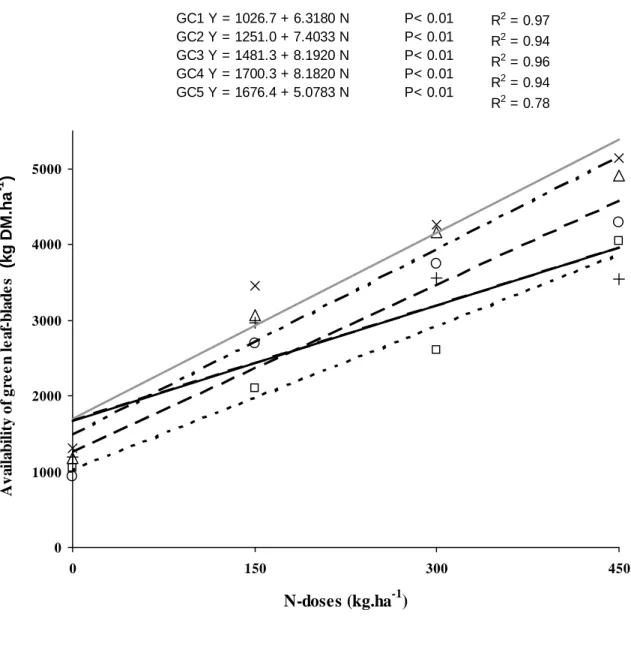
The availability of GLB was affected (P<0.05) by N-doses, GCs, and by the interaction N x GC. The availability of GLB increased linearly as the N-doses increased, in all GCs, as shown in Figure 1. The availability of GLB in response to N-fertilization was higher in GCs 2 and 3. In these cycles the application of the maximum doses of N resulted in increases of 4.56 and 4.18 times in relation to the control in the GCs 2 and 3, respectively. These results showed the high potential of response of cv. IPR 86 to N fertilization. According to Lemaire (1997) the availability of N to promote the priority in the re-distribution of carbon to the formation of aerial part, resulting in a greater photosynthesizing area, increase in the leaf elongation rate, and in a
lower proportion the leaf appearance rate, lower senescence and a higher number of tillers per area. The residual GLB was affected (P<0.05) by N-doses with average values of 335; 730; 825; and 837 kg.ha-1 when the pastures were fertilized with 0; 150; 300; and 450 kg N.ha-1, respectively. The apparent intake of GLB was 71; 74; 77; and 81% with 0; 150; 300; and 450 kg N.ha-1, respectively. The increase in the apparent intake of GLB with the increase of N-doses was also observed by Zimmer (1999).
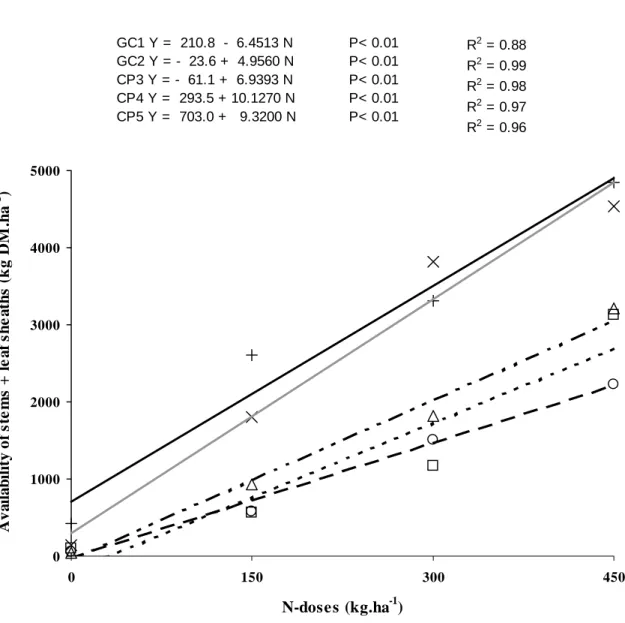
The availability of GSLS was affected (P<0.05) by N-doses, GC, and by the interaction N x GC. In all GCs occurred an increase in the GSLS with the increase of N-doses (Figure 2). The application of the maximum doses of N resulted in increases of 78.46; 39.71; 32.80; 31.27; and 11.30 times in the available GSLS in the 3; 2; 4; 1; and 5, respectively. The average availability of GSLS was 420; 1299; 2323; and 3590 kg DM.ha-1 for the treatments 0; 150; 300; and 450 kg N.ha-1, respectively. The increase in the availability of GSLS with the increase in the N-doses may be due to the higher number and weight of tillers per plant, the differences in the physiological age of the plants, and the higher stem elongation rate (Rodrigues and Reis, 1995).
The average residual GSLS was 104; 1024; 1817; and 2763 kg.ha-1 when the pastures were fertilized with 0; 150; 300; and 450 kg N.ha-1.
The results allow to conclude cv 86 has a high potential for forage production and adaptation to intensive grazing system if N fertilized.
References
Lemaire G. (1997). The physiology of grass growth under grazing: tissue turnover. In: Gomide J.A. (ed) Anais do Simpósio Internacional sobre Produção Animal em Pastejo, 117-144.
Lugão S.M.B., Rodrigues L.R. de A., Abrahão J.J. dos S., Malheiros E.B. and Morais A. de
nitrogen. In: Proceedings of the XIX International Grassland Congress. Piracicaba, São Paulo. Brazil.
Rodrigues L.R. de A. and Reis R.A. (1995). Bases para o estabelecimento do manejo de capins do gênero Panicum. In: Peixoto A.M., Moura J.C., Faria V.P. de (eds) Anais do Simpósio sobre Manejo da Pastagem, 12:197-217.
SAS INSTITUTE INC. SAS/STAT (1990). User's Guide. Version 6.12 ed., Cary, NC: SAS Institute Inc.. 943p.
Zimmer A.H. (1999). Efeito de níveis de nitrogênio e de resíduos pós-pastejo, sobre a produção, a estrutura e a qualidade dos cultivares Aruana e Vencedor de Panicum maximum jacq. Tese (doutorado), Faculdade de Ciências Agrárias e Veterinárias, Universidade Estadual Paulista, Brasil. 208p.
Figure 1 - Effects of four nitrogen-doses on the availability of green leaf-blades (kg DM.ha-1) in five grazing cycles ( GC1: ! ; GC2: O ; GC3: ∆ ; GC4:
×
; GC5: + ) in Panicum maximum Jacq. cv. IPR 86 pastures, from 10/15/1998 to 05/03/1999. 0 1000 2000 3000 4000 5000 0 150 300 450 N-doses (kg.ha-1) A v a ila b ilit y o f g re e n le a f-b la d e s (k g D M .ha -1 ) GC1 Y = 1026.7 + 6.3180 N GC2 Y = 1251.0 + 7.4033 N GC3 Y = 1481.3 + 8.1920 N GC4 Y = 1700.3 + 8.1820 N GC5 Y = 1676.4 + 5.0783 N R2 = 0.97 R2 = 0.94 R2 = 0.96 R2 = 0.94 R2 = 0.78 P< 0.01 P< 0.01 P< 0.01 P< 0.01 P< 0.01
Figure 2 - Effects of four nitrogen-doses on the availability of stems + leaf sheaths (kg DM.ha-1) in five grazing cycles ( GC1: ! ; GC2: O ; GC3: ∆ ; GC4: