Horvat, E. A. and Papamarkou, T. (2018) Gender Differences in Equity
Crowdfunding. In: HCOMP 2017, Quebec City, QC, Canada, 24-26 Oct
2017, pp. 51-60. ISBN 9781577357933
This is the author’s final accepted version.
There may be differences between this version and the published version.
You are advised to consult the publisher’s version if you wish to cite from
it.
http://eprints.gla.ac.uk/143310/
Deposited on: 29 August 2017
Enlighten – Research publications by members of the University of Glasgow
http://eprints.gla.ac.uk
Gender Differences in Equity Crowdfunding
Em˝oke- ´
Agnes Horv´at
School of Communication Northwestern University [email protected]
Theodore Papamarkou
School of Mathematics and Statistics University of Glasgow [email protected]
Abstract
Online peer-to-peer investment platforms are increasingly popular venues for entrepreneurs and investors to engage in financial transactions without the involvement of banks and loan managers. Despite their purported transparency and lack of bias, it is unclear whether social inequalities present in tra-ditional capital markets transfer to these platforms as well, impeding their hoped revolutionary potential. In this paper we analyze nearly four years’ worth of data from one of the lead-ing UK-based equity crowdfundlead-ing platforms. Specifically, we investigate gender-related differences in patterns of en-trepreneurship, investment, and success. In agreement with offline trends, men have more activity on the platform. Yet, women entrepreneurs benefit of higher success rates in fund-raising, a finding that mimics trends seen on some rewards-based crowdfunding platforms. Surprisingly, we also find that female investors tend to choose campaigns that have lower success rates. Our findings contribute to a better understand-ing of gender-related discrepancies in success on the online capital market and point to differences in activity that are key factors in the apparent patterns of gender inequality.
Introduction
Existing finance models in capital markets have been shown to disadvantage female entrepreneurs and investors (Blanch-flower, Levine, and Zimmerman 2003; Alesina, Lotti, and Mistrulli 2013; Dorfleitner et al. 2013). In 2007, 86% of an-gel investors were men and less than 10% of all companies that received venture capital funding were led by women. Research has identified several mechanisms through which this inequality is perpetuated, ranging from statistical and taste-based discrimination (Barasinska and Schaefer 2014) to homophily (Greenberg and Mollick 2016) and womens own beliefs about their aptitudes and value on the labor mar-ket (Gorbatai and Nelson 2015).
Crowdfunding is touted to be a transparent and disinter-mediated internet-based market place that might democra-tize access to capital for minority groups and eventually neutralize gender bias. In crowdfunding, millions of inde-pendent individuals (the crowd) come together to provide funds to people and campaigns that capture their imagina-tion and/or financial interests. This model is a reflecimagina-tion of
Copyright c2017, Association for the Advancement of Artificial Intelligence (www.aaai.org). All rights reserved.
a larger wave of ’commons’ trends: Phenomena like Citizen Science (Cooper et al. 2010), open source software (Weber 2004), online activism and public governance (McCaughey and Ayers 2003), as well as cooperatively-authored online encyclopedia (Bryant, Forte, and Bruckman 2005) are fre-quently discussed for their purported superior outcomes and flexibility as compared to tightly controlled single-source systems. These movements are backed up by evidence sug-gesting that crowds are more agile, use diverse perspectives to act innovatively, and consequently provide broader so-lutions (van Knippenberg, Dreu, and Homan 2004; Page 2007; Jeppesen and Lakhani 2010; Sauermann and Franzoni 2015).
In this paper we ask whether the wisdom of crowds
that emerges in crowdfunding can contribute to equaliz-ing the playequaliz-ing field between the genders. So far, it has been shown empirically that women’s participation rate in crowdfunding is considerably higher than in traditional en-trepreneurship and investing. See, for instance, the study of Marom et al. about the rewards-based crowdfunding platform Kickstarter(Marom, Robb, and Sade 2016). Fur-thermore, women enjoy higher rates of success in fund-ing their campaigns, an outcome that has become appar-ent on platforms such as the rewards-based crowdfunding site Indiegogo (Gorbatai and Nelson 2015), the microfi-nance siteKiva, and the oldest P2P lending platform in the U.S. called Prosper (Ravina 2012; Barasinska and Schae-fer 2014). While these are promising results for small busi-nesses, as of now it is unclear whether gender-related differ-ences are also dampened in the case of equity investments. These involve typically higher amounts of capital and often the desire of funders to intimately know the entrepreneur and her business (Cumming and Dai 2010). Equity crowdfund-ing has appeared later than other forms of crowdfundcrowdfund-ing, but is nevertheless catching up in popularity. As a matter of fact, it is expected that equity crowdfunding platforms will chal-lenge venture capitalists and business angel financiers in the near future (Vulkan, Astebro, and Sierra 2016). Our work contributes to the nascent literature on this promising form of crowdfunding.
We operationalize our analysis using data from the oldest and one of the two leading equity crowdfunding sites in the UK. The data set was kindly shared with us by the company and contains the complete record of their activity from the
inception in 2012 until early 2016. In this time period, the company has promoted requests for more than£117.4 mil-lion and enabled transactions that total to£57.7 million. At the time of writing, the site continues to expand its client base and features.
The paper is organized as follows: First, we review related literature on crowdfunding in general and equity crowdfund-ing in specific. We also survey existcrowdfund-ing research on gen-der divides in raising capital and investing, both offline and online. Next, we provide details about the used data and methodological approaches. We then summarize our find-ings that (i) position the platform on the landscape of other crowdfunding settings in terms of gender differences, (ii) establish the effect of gender on campaign outcome, and (iii) study the flow of capital in the context of the emerg-ing entrepreneur–investor network. We conclude the paper with a discussion about the limitations of our data set and results.
Related Work
Extensive work on crowdfunding focuses on predicting cam-paign success. Inferring outcomes is of interest for en-trepreneurs, investors, crowdfunding platforms, and policy-makers alike. Existing research investigates the predictive power of entrepreneur and campaign characteristics. Predic-tors range from objective indicaPredic-tors like credit score (Iyer et al. 2009; Ceyhan, Shi, and Leskovec 2011), to rather unexpected variables such as social capital (Freedman and Jin 2008; Greenberg et al. 2013; Mollick 2014), appear-ance (Duarte, Siegel, and Young 2012; Ravina 2012), and language of campaign descriptions (Althoff, Danescu-Niculescu-Mizil, and Jurafsky 2014; Gorbatai and Nelson 2015). Whereas these pioneering works have shed light on important factors associated with success, there is neverthe-less a need for a better understanding of gender-related dif-ferences in campaign outcome.
The question is especially relevant since empirical evi-dence shows that women business owners launch their firms with significantly less capital than men (Coleman and Robb 2009). In general, women prefer internal rather than external sources of equity capital (Chaganti, DeCarolis, and Deeds 1995) to the extent that between 1953 and 1998 less than five percent of total venture capital funding went to firms owned by women (Brush et al. 2008).
Yet, in some online fund-raising settings, women tend to be systematically more successful than men. One possible explanation is the language divide that becomes apparent in project pitches and benefits typically female communi-cation styles (Gorbatai and Nelson 2015). A more struc-tural argument is based on notions of homophily. First, there is evidence of gender-based choice homophily that stems from the similarity between individuals. E.g., accord-ing to the findaccord-ings of Marom et al., more than 40% of Kick-startercampaigns that women invest in have female leads. In comparison, only 23% of campaigns that men invest in are led by women (Marom, Robb, and Sade 2016). Sec-ond, perceptions of shared structural barriers that stem from a common social identity might lead to activist choice ho-mophily, which can clarify why women are more likely to
succeed at crowdfunding than men despite being less repre-sented (Greenberg and Mollick 2016).
Research about equity crowdfunding is in its infancy, mostly due to the fact that these platforms faced regulatory hurdles before being able to start operation (Ahlers et al. 2015; Vismara 2016; Vulkan, Astebro, and Sierra 2016). Eq-uity crowdfunding differs from microfinance-, rewards- and loan-based crowdfunding in multiple ways, among which most notably (i) campaign targets approach the size of first round investments for venture capitals, and (ii) fun-ders have a clear goal to obtain significant monetary re-wards for their investments (Vulkan, Astebro, and Sierra 2016). This new setting characterizes thus decision-making under extreme risk relative to the more common forms of crowdfunding that have been at the center of prior research. Moreover, the uncertainty associated with equity invest-ing is compounded by limited investor expertise and avail-able resources in evaluating the moral hazard problems in-herent in equity investments (Gompers and Lerner 2004; Mohammadi and Shafi 2017).
In the little existing research on equity crowdfunding, to the best of our knowledge, there is only one study that looks at gender differences. In the immediate past, Moham-madi and Shafi focused on investment behavior when ana-lyzing a sample of 40 successful equity campaigns from a Swedish equity crowdfunding platform calledFundedByMe
and found that female investors are more risk averse than their male counterparts and tend to invest in campaigns in which the proportion of male investors is higher (Moham-madi and Shafi 2017). Along these lines, our paper investi-gates entrepreneurial and investment behavior using a cross-disciplinary approach and makes connections between gen-der and campaign outcome for the first time in the case of equity crowdfunding.
More broadly, gender inequality is a wide-spread, well-documented phenomenon in the offline labor market, at home, and in cultural production (Blau and Kahn 2000; Bianchi, Robinson, and Milkie 2006; Mandel 2013; Lutter 2015). Literature on the gender gap in Internet skills and usage patterns is growing (Hargittai 2010), yet we know little about how the digital divide transfers to crowdsourc-ing platforms and how this might propagate and potentially amplify offline inequalities. Although there is evidence for lower female contribution rates for instance on peer produc-tion platforms (Robles et al. 2014; Vasilescu et al. 2015; Hargittai and Shaw 2015) and in online freelance communi-ties (Wachs et al. 2017), quantifying the implications of im-balanced gender composition remains challenging. Equity crowdfunding is a setting that enables direct measurements of performance. Our study uses this feature to contribute to the general open question about the effect of gender imbal-ance in participation on success rates in crowdsourcing.
Data and Descriptives
Data The site we study is a UK-based leading eq-uity crowdfunding platform that provides capital to en-trepreneurs to launch new businesses. Through the site, in-vestors from the greater European area provide capital in re-turn for an equity in a new product, business or service. Our
preprocessed sample consists of 727 campaigns launched between May 22, 2012 and January 24, 2016. In this sample, 17,861 unique investors contributed to campaigns of 576 unique entrepreneurs. Out of these, 152 individuals had a dual role meaning that they were both entrepreneurs and in-vestors on someone else’s campaign. Campaigns raise funds from the investor crowd gathered on the platform to infuse private capital in new ventures. During the time frame under consideration, 33.4% of the campaigns with known outcome managed to raise their targets.
Elicitation of gender Since the platform doesn’t record the gender of their users, we extract this information from the investors’ and entrepreneurs’ first names using the U.S. baby name database (soc ). This is an increasingly pop-ular method (Liu and Ruths 2013; Karimi et al. 2016; Wachs et al. 2017). Every name in the U.S. baby name database is accompanied by the number of its occurrences among male and female babies. We deduce the gender of each investor and entrepreneur in the data set by selecting the gender with the highest absolute frequency in the U.S. baby name database. With this automatic method we are able to classify 92.6% of the users as male or female. Our final dataset contains 12,863 male and 3,945 female users. Determination of campaign outcome The platform has an all or nothing policy meaning that only campaigns that manage to raise their target receive capital. The funds re-deemed on the site can be higher than the target amount. When assessing the success of a campaign, we focus on ’accepted’ and ’processed’ investments and consider those campaigns to be successful that have met their investment target. Our binary outcome variable is thus defined as
y=
1,
ifP
iai/A≥1
0, otherwise , (1) whereaidenotes theithinvestment in a campaign with
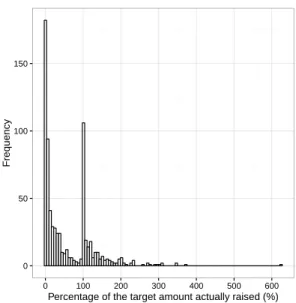
tar-get amountA. The choice of a binary outcome variable is motivated by the shape of the histogram shown in Figure 1. Looking at the percentage of the target amount that was ac-tually raised by individual campaigns, we see that typical campaigns either raise a small fraction of their target amount (hence the first peak in the low-percentage area) or raise their exact target amount or slightly more (hence the second peak at and after 100%). This strong bimodal shape points to the two predominant cases and justifies the simplification we make when using a binary success variable.
Extraction and selection of covariates There are sev-eral observed characteristics of entrepreneurial teams, cam-paigns, and investor groups that we hypothesize to be con-nected to successful campaign outcome:
• Gender of entrepreneuris a binary indicator that refers to the team-leader as the key individual behind the pro-posed equity crowdfunding campaign. This crucial co-variate enables us to connect our findings to mounting
0 50 100 150
0 100 200 300 400 500 600
Percentage of the target amount actually raised (%)
Frequency
Figure 1: Histogram showing the frequency of campaigns that raise given percentages of their target amounts. The two peaks at 0% and 100% indicate two predominant cases that motivated the binary outcome variable we use throughout the study
evidence about female-led ventures that are disadvan-taged in the capital market (Blanchflower, Levine, and Zimmerman 2003; Alesina, Lotti, and Mistrulli 2013; Dorfleitner et al. 2013; Brooks et al. 2014; Kanze et al. 2017).
• Platform familiaritypertains to the activity on the site and is quantified by the total number of successful and failed campaigns launched by the lead entrepreneur. Looking at the history of an entrepreneur on the platform pro-vides a good proxy for the familiarity with platform prac-tices. Moreover, literature on start-ups shows that serial entrepreneurs perform better than novices (Zhang 2011).
• Team sizeis the number of entrepreneurs listed on the site to make up the group of executives behind the campaign. Smaller teams might be riskier since they might be more recent and have had less time to accumulate resources and experience. Aside of team size, the platform doesn’t col-lect further information such as gender composition about the group of entrepreneurs.
• Equity offering (%)of a campaign is a signal of riskiness in traditional investment settings (Leland and Pyle 1977). It has been shown recently in the setting of equity crowd-funding that high equity is perceived as a negative signal most probably due to the suggested overvalued shares and higher risk (Mohammadi and Shafi 2017).
• Target amountis the valuation of the campaign in British pounds (£) and is expected to be negatively associated with fund-raising success (Uzzi 1999). Given the skewed distribution of the requested amounts, this covariate is logged.
who are female to the total count of all investors of a campaign. The share of female investors might relate to the overall attractiveness of a campaign for women due to shared preferences borne out of gender similarity.
• To minimize the barriers to entry, the site does not re-quire that investors acre-quire external certificates. Instead, it offers the possibility to indicate on a voluntary basis wealthy users (i.e.,high net worth individuals) and expe-rienced investors (i.e., sophisticated investors). A truth-ful assignment of these labels can be expected to cor-relate with better investment decisions and potentially a leading role in setting examples for novice or less certain investors. During the time frame of our sample, the site counted 2,288 self-proclaimed high net worth individuals and 1,305 sophisticated investors. Our corresponding co-variates compute the percentage of high net worth individ-uals and sophisticated investors per campaign. Note that this self-reported data might be linked to gender identity and confidence. Indeed, we see that 6.8% women vs. 9% men consider themselves to be sophisticated investors, and 8.3% women vs. 16.6% men are high net worth in-dividuals.
• UK investors (%) Since only about 20% of the invest-ments come from outside the UK and some of the quali-fying UK-based campaigns have certain tax-benefits, an-other feature is the percentage of investors contributing to the campaign who are from the UK.
Table 1 provides the mean, standard deviation and corre-lation between the above covariates. One covariate is binary (entrepreneur gender), two are integer-valued (entrepreneur experience and team size), five represent percentages (eq-uity offering, female-, sophisticated-, high net worth- and UK-based investors), and the target amount is continuous. All covariates are highly dispersed as seen from their means and respective standard deviations. The high variability in the data set is partly explained by the relatively moderate sample size and the associated sparsity of transactions. The correlation matrix among the nine covariates exhibits low pairwise correlations. Thus, there are no obvious associa-tions between potential predictors of campaign success. Creation of the entrepreneur–investor network User activity on the site can be mapped to a network that traces over time the flow of capital between individuals. The network-based approach enables considering structural de-pendencies that arise due to the available resources and mar-ket competition. Structural dependencies are not incorpo-rated in classical regression models despite the fact that they have the potential to give a more accurate account of how different individual and contextual factors contribute to the probability of an investment. The key factor of interest in this case is gender-homophily, which means that connec-tions are more likely to be formed between users of the same gender.
To study homophily, we model the entrepreneur–investor network with the graphG= (V, E,Ω, T)which denotes a directed weighted temporal graph whose nodes v, w ∈ V
represent users and directed edges(v → w)∈Erepresent
investments of a certain amount a ∈ Ωat a specific time
t ∈ T. Individuals on the site have attributes that relate to their gender and activity on the platform. They also have multiple roles r ∈ {I, E, IE}: investor (I), entrepreneur (E), or both (IE), which is inherently coded in the network structure. Accordingly, nodes withr=Ihave only outgoing edges, nodes withr=E have only incoming edges, while nodes withr=IEhave both outgoing and incoming edges, which is a structural detail that gives rise to different degree distributions (see Figure 2). The graph admits (i) self-loops
e= (v, v)that arise whenever an entrepreneur invests in her own campaign, and (ii) multi-edges between the same pair of entrepreneur and investore1=e2= (v, w). Multi-edges
differ in time stamp and/or amount of transaction:t1 6= t2
and/ora16=a2.
Summaries of the entrepreneur–investor network The most complete static snapshot of the entrepreneur–investor network aggregates all successful and unsuccessful transac-tions over the entire time period of our sample. With 18,153 nodes and 59,322 edges, it is very sparse (δ < 0.01). The network has a quasi-bipartite structure: The majority of the users are either investors or entrepreneurs, and the transac-tions occur typically between the two roles. Self-loops are possible, but rather a rarity (n= 533). Multiple edges are far more common (m= 12,372) and given the low reciprocity of connections (ρ <0.01), they indicate that repeated trans-actions cannot be explained based on mutual help. An alter-native reason might be related to trust that arises from pos-itive experience with an entrepreneur as hypothesized on a lending crowdfunding platform (Horv´at, Uparna, and Uzzi 2015).
The right-skewed degree distributions1 displayed in Fig-ure 2 indicate a strong heterogeneity in terms of entrepreneur and investor involvement. Similarly to various online pro-duction systems, the minority of the users are accountable for a large portion of the activity on the platform (Matei and Britt ). This mimics offline inequalities that ultimately give rise to ’elites’.
Findings
We conduct our study along three lines of investigation. First, we evaluate in the context of the studied platform some of the most striking gender-related differences that existing research has identified to be most prominent both off- and online. Second, we build models that expose the effect of entrepreneur and investor gender on campaign outcome net of various controls. Third, we use a network-based approach to explore the role of gender-homophily, which has been as-sumed to contribute to the the gender inequalities we high-light in the following.
Gender patterns in entrepreneurship and investment In terms of participation, 14.8% of the investors and 13.7%
1
The degree of a node is the number of connections it has to other nodes. The degree distribution of a network quantifies the probability of these degrees across the entire network (Kolaczyk 2009).
Mean S.D. (1) (2) (3) (4) (5) (6) (7) (8) (1) Female entrepreneur 1.14 0.34 – (2) Entrepreneur experience 1.33 0.83 0.01 – (3) Team size 3.09 1.93 0.09 0.10 – (4) Equity offering (%) 12.32 8.59 0.01 -0.22 -0.19 – (5) Target amount† 1.62 3.19 -0.01 0.02 0.35 0.15 – (6) Female investors (%) 0.16 0.15 0.18 -0.12 0.10 0.08 0.14 – (7) Sophisticated investors (%) 0.07 0.09 -0.04 0.11 0.12 -0.11 0.06 0.01 –
(8) High net worth investors (%) 0.16 0.15 -0.01 0.03 -0.04 0.07 0.01 -0.19 -0.03 – (9) UK investors (%) 0.84 0.19 0.07 0.01 -0.24 0.20 -0.03 -0.02 -0.13 0.20
†Multiply by105to acquire mean and standard deviation of target amount in GBP (£).
Table 1: Basic statistics and pairwise correlation between entrepreneur- and investor-related covariates aggregated at the campaign-level (N = 680). Covariates of special interest are gender of entrepreneur (1) and percentage of female investors (6)
10−3 10−1 101 103 Degree Distr ib ution
Roles Entrepreneurs Investors Everyone
Figure 2: Degree distributions shown on a log-log scale for entrepreneurs, investors and the entire network (’everyone’). The entrepreneur–investor network tracks the flow of capital and is quasi-bipartite, meaning that most of the edges con-nect entrepreneurs to investors. There are, however, users who at some point during the considered time frame have assumed both roles
of the entrepreneurs are female. These numbers position the equity crowdfunding platform between traditional cap-ital markets and rewards-based crowdfunding and attest to the still far lower inclusion of women than expected based on their base rates in the population.
Given the significant discrepancies in the asking- and giv-ing amounts between the genders in other financial settgiv-ings as documented in the literature, our first exploratory ques-tions are:Do women entrepreneurs ask for less money? Fur-thermore, do they end up obtaining less capital? Figure 3 shows the distribution of target and raised amounts for men and women entrepreneurs. Although there is slightly more heterogeneity in the asking amounts and received funds of men, there is no statistically significant difference between
men and women as indicated by a two-sided Kolmogorov-Smirnoff test (p > .1). As mentioned before, entrepreneurs on the site represent a team of individuals. Team size, however, is also not significantly different on this sam-ple size for male- and female-led entrepreneurs (two-sided Kolmogorov-Smirnoff test:p > .1). 0.0 0.3 0.6 0.9 102 104 106 Amount Distr ib ution
Gender of entrepreneur Female Male
Amount Sought Raised
Figure 3: Comparison between target- and raised amount shown for male and female entrepreneurs, respectively. The plotted data contains information on both successful and un-successful projects. Accordingly, there is no statistically sig-nificant difference between the amounts asked/received by men and women
At a first glance female entrepreneurs and investors have different success rates than their male colleagues. On the en-trepreneurial side, 38.7% of the female-led and 33.4% of the male-led campaigns reach their target. On the invest-ment side, 66.4% of women’s investinvest-ments and 73% of men’s investments are going to funded campaigns indicating that men are more successful investors.
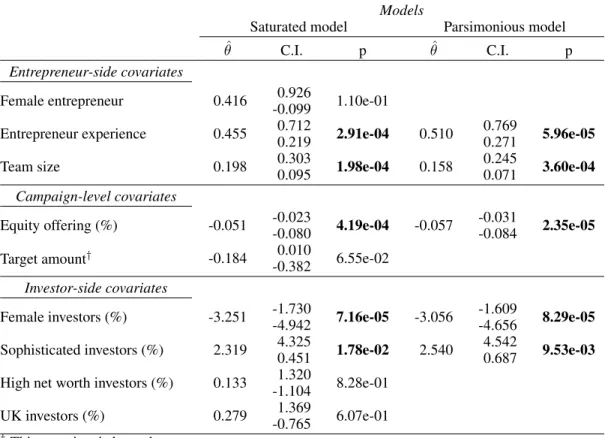
Campaign success and gender Initially, we fit a binomial logistic regression model to the data using the campaign out-come defined in Equation (1) and the nine available covari-ates, namely entrepreneur gender and experience, team size, equity offering, target amount, percentage of female, sophis-ticated, and high net investors, and percentage of investors from the UK.
As seen from Table 2, five covariates are statistically sig-nificant at 0.05 significance level. The sign of the corre-sponding regression coefficient estimates dictate the direc-tionality of significant covariate effects on the campaign out-come. More specifically, on the one hand skilled leading entrepreneurs, bigger entrepreneur teams, and a higher per-centage of sophisticated investors are all beneficial to a cam-paign’s outcome. On the other hand, lower equity offerings indicate less risk and male investors tend to choose projects that will get funded. Although the percentage of successful female entrepreneurs is higher than that of men, the satu-rated logistic regression model does not show that the en-trepreneur’s gender is a significant predictor of a campaign’s outcome.
In a second model, we keep only the five significant pre-dictors of campaign success to build a more parsimonious logistic regression model. Table 2 displays the p-values, re-gression coefficients, and associated95%confidence inter-vals for this simpler model. Statistical significance is pre-served for all five covariates and covariate effects, as de-picted by coefficient estimates, appear amplified. Partly due to the simplicity of the fitted logit model and because of the varying number of missing data among subsets of covari-ates, we didn’t pursue more systematic model selection. Our main interest has been placed on data mining to extrapolate preliminary signals of differentiated activity between male and female investors and entrepreneurs in the data set. We searched for possible interactions between the five signif-icant covariates. For instance, we checked whether bigger teams led by more experienced entrepreneurs have a com-bined positive effect on campaign success, and it turned out that this is not the case.
The performance of the logistic regression models is rather low (McFadden’s pseudoR2is .125 for the saturated
model and .121 for the parsimonious model). This empha-sizes the relative lack of prescriptiveness of this first investi-gation into an unexplored topic and calls for further studies that incorporate more detailed data for validation.
The fact that the percentage of female investors is a sig-nificant negative predictor of campaign success does not im-ply causality. In fact, there are at least two possible con-founders. First, it might be that the underlying project cat-egory or venture sector is the true causal predictor. For ex-ample, technology-oriented campaigns might be by default more prone to success and at the same time more popular in male investor circles. To perform a first test along this lead, we look at the classification of campaigns into categories. The platform provides a predefined set of categories that are used by entrepreneurs to label their campaigns to indicate market sector. This information is available for a subset of the campaigns. Using this data, we rank categories based on the difference in interest that they generate for male and
fe-male investors. As shown in Figure 4, for instance 1.72% of both male and female investors are drawn to the ’Edu-cation’ category. There are a few other categories that are preferred by a comparable percentage of the two investor groups. However, campaigns in ’Food & Drink’, ’Health’ and ’Consumer Products’ are attractive to a higher percent-age of the female than male investors. On the contrary, ’Fi-nance’, ’E-Commerce & Markets’ and ’IT & Telecom’ draw interest from a higher percentage of men.
Education Other Professional Services Arts, Music & Design Environment & Clean Tech Fashion & Apparel Media & Entertainment Games Leisure, Sport & Travel Social & Collaborative Retail High Technology Marketing Consumer Products IT & Telecom E−Commerce & Markets Finance Health Food & Drink
0 5 10 15
Frequency
Gender of investor Female Male
Figure 4: Categories of successful campaigns with frequen-cies showing how often male and female investors choose a campaign with the specific category label. Note that a single campaign can be assigned to multiple categories
Second, homophily between investors and entrepreneurs or gender-specific herding (Mohammadi and Shafi 2017) among investors might also explain away the higher success of campaigns supported mainly by male investors. Since the total number of male investors is higher on the site, the pos-sibility of higher homophily impact among men cannot be precluded in advance. Our final piece of analysis takes a first look at this issue.
Gender-homophily between investors and entrepreneurs Within a network analytic framework, we evaluate gender-homophily given the structure of the entrepreneur–investor graph. Specifically, we askHow likely is it that investments are made between users of the same gendergiventhe num-ber of female and male users as well as the numnum-ber of invest-ments users receive or place? To compute this probability,
Models
Saturated model Parsimonious model
ˆ
θ C.I. p θˆ C.I. p
Entrepreneur-side covariates
Female entrepreneur 0.416 0.926 1.10e-01 -0.099
Entrepreneur experience 0.455 0.712 2.91e-04 0.510 0.769 5.96e-05
0.219 0.271
Team size 0.198 0.303 1.98e-04 0.158 0.245 3.60e-04
0.095 0.071
Campaign-level covariates
Equity offering (%) -0.051 -0.023 4.19e-04 -0.057 -0.031 2.35e-05
-0.080 -0.084
Target amount† -0.184 0.010 6.55e-02 -0.382
Investor-side covariates
Female investors (%) -3.251 -1.730 7.16e-05 -3.056 -1.609 8.29e-05
-4.942 -4.656
Sophisticated investors (%) 2.319 4.325 1.78e-02 2.540 4.542 9.53e-03
0.451 0.687
High net worth investors (%) 0.133 1.320 8.28e-01 -1.104
UK investors (%) 0.279 1.369 6.07e-01 -0.765
†This covariate is logged
Table 2: Results of logistic regression models that predict campaign success based on covariates listed in Table 1. Here we summarize estimated regression coefficients, confidence intervals, and p-values for the two models. Bold typesetting indicates statistical significance at thep < .05level
female to female female to male
male to female male to male
0 100 200 300 400 0 100 200 0 100 200 300 0 100 200 300 400 500 800 900 1000 5350 5400 5450 5500 5550 5600 4300 4400 4500 29400 29600 29800 Number of edges Frequency
Figure 5: Expected number of investments conditional on investor and entrepreneur gender given key features of the network structure (i.e., number of male and female investors and entrepreneurs as well as prevalence of high and low activity en-trepreneurs and investors). Comparing the expectation with patterns in the observed network helps us to understand whether the social process of homophily underlies investment behavior
we generate a set of possible graphs thatcouldrepresent the transactions occurred on the platform. The created graphs
maintain the key structural features of the entrepreneur– investor network, but are oblivious to the gender of the users.
By comparing gender-related patterns in the observed net-work data with expectations that arise from the random-ized graphs, we can assess statistically whether homophily is more predominant than expected by chance under certain structural constraints. We use an edge swap procedure to generate random graphs with fixed degree sequence (Gotelli and Graves 1996; Shen-Orr et al. 2002; Gionis et al. 2007; Newman 2010) as implemented in the igraph R pack-age (Cs´ardi and Nepusz 2006).
Figure 5 shows the number of edges between users of spe-cific genders from 2,500 random graphs obtained with edge swapping. The numbers of edges in the observed data set are not expected based on the distributions generated from the random sample. Regarding the tendency for forming same-gender entrepreneur–investor ties, homophily is much more likely than expected based on the network structure both for women and men. In both cases the unexpectedness is highly significant (p≤.0004). Conversely, investors and en-trepreneurs of opposite gender are significantly less likely to connect (p≤.0004). Note that using a less realistic ran-dom graph model that preserves only the number of en-trepreneurs and investors as well as the density of the net-work, homophily does not appear to be significant. This in-dicates that the gender-specific degree distributions are im-portant on both the entrepreneur and investor side.
Conclusions and Discussion
This paper investigates gender-related patterns of en-trepreneurship and investment on a leading UK-based eq-uity crowdfunding platform. We present evidence of gender differences in participation. Our results suggest that cam-paigns led by female entrepreneurs are slightly more suc-cessful than male-led campaigns. Furthermore, despite the strong gender-homophily on the platform, campaigns with a higher participation rate from female investors tend to fail at raising the target amount. Although our study is unique in its proposition and data usage, the results of our regression models require careful interpretation and further validation.
Previous research has shown that women are more risk averse than men, especially in financial matters (Sund´en and Surette 1998; Eckel and Grossman 2002; Holt and Laury 2002; Croson and Gneezy 2009). Equity crowdfunding en-tails a considerably higher risk than traditional financial settings, and thus not only is risk aversion likely to deter women from investing in high-risk, high-return ventures, but it might also reduce their willingness to engage in crowd-funding altogether. Our models indicate that more skilled entrepreneurs and larger teams have significantly higher chances of fundraising success and so are campaigns with lower equity offering. More transparency about these find-ings related to characteristics of fund-seekers and campaigns can help investors to overcome some of the barriers they face throughout the decision-making process. For instance, a website design or an investor support tool which highlights entrepreneur experience, team size, age of the fund-seeking firm, and previous fund-raising success could assist cautious female investors with more accurate risk-assessment. More-over, tools that focus on team qualifications and venture mer-its instead of entrepreneur genderper sewould also benefit
female entrepreneurs in a crowdsourcing context where it is unclear how salient gender is and how much it matters in obtaining funds.
Our study has several limitations that open up avenues for future research. Most importantly, it is based on a single equity crowdfunding platform. While the results are statisti-cally significant in case of the studied equity crowdfunding platform, generalization is difficult in the lack of further sup-porting evidence from other settings. Next, our work is lim-ited due to the nature of aggregated observed variables and unobservable preferences. For example, we do not have de-tailed information about the entrepreneur teams in terms of gender and skill composition. Additionally, we know very little about the campaigns themselves. In consequence, we cannot exclude the possibility that female investors are in-terested in funding businesses that serve the social good. To clarify these issues, our study would benefit from a combina-tion of the currently deployed data mining approaches with field experiments that could shed light on the signal-to-noise ratio of the observed covariates and might provide essential information that is not being logged by the platform so far. Since these details are not visible to the investor crowd ei-ther, we expect most of our results to hold up in case such scrutiny becomes possible. Finally, it is unclear how the al-gorithmic choices made by the platform in displaying con-tent on their platform impact the visibility, popularity and ul-timate success of campaigns. Appropriate experimental tests and/or activity logs on their platform would help to disentan-gle the effects of platform design.
Despite these limitations, our findings reveal interesting insights related to gender differences, which help tackling the puzzling task of inferring campaign success on crowd-funding platforms. Such indicators of campaign success pro-vide benefits to entrepreneurs, who can retract their applica-tion and avoid the negative impact of a failed project, as well as investors, who can use this as a predictive tool for rein-vesting. Our results thus inform and broaden the building field of crowd-aware system design in equity crowdfunding and beyond.
Acknowledgments
The authors are grateful to the company for sharing their unique data set. The Data Science team has provided indis-pensable information at various stages of this work. We also appreciate the useful input we received from the anonymous reviewers and from Ancsa Hann´ak.
References
Ahlers, G. K.; Cumming, D.; G¨unther, C.; and Schweizer, D. 2015. Signaling in equity crowdfunding. Entrepreneurship Theory and Practice39(4):955–980.
Alesina, A. F.; Lotti, F.; and Mistrulli, P. E. 2013. Do women pay more for credit? Evidence from Italy. Journal of the European Economic Association11:45–66.
Althoff, T.; Danescu-Niculescu-Mizil, C.; and Jurafsky, D. 2014. How to ask for a favor: A case study on the success of altruistic requests. ICWSM 2014.
Barasinska, N., and Schaefer, D. 2014. Is crowdfunding dif-ferent? Evidence on the relation between gender and fund-ing success from a German peer-to-peer lendfund-ing platform.
German Economic Review15(4):436–452.
Bianchi, S. M.; Robinson, J. P.; and Milkie, M. A. 2006.The Changing Rhythms of American Family Life. Russell Sage Foundation.
Blanchflower, D.; Levine, P.; and Zimmerman, D. 2003. Discrimination in the small-business credit market. The Re-view of Economics and Statistics85(4):930–943.
Blau, F., and Kahn, L. 2000. Gender differences in pay. NBER Working Papers 7732, National Bureau of Economic Research, Inc.
Brooks, A. W.; Huang, L.; Kearney, S. W.; and Murray, F. E. 2014. Investors prefer entrepreneurial ventures pitched by attractive men.Proceedings of the National Academy of Sci-ences111(12):4427–4431.
Brush, C.; Carter, N. M.; Gatewood, E. J.; Greene, P. G.; and Hart, M. 2008. The Diana project: Women business owners and equity capital: The myths dispelled. Babson College Center for Entrepreneurship research paper no. 2009-11. Bryant, S. L.; Forte, A.; and Bruckman, A. 2005. Becom-ing wikipedian: Transformation of participation in a collab-orative online encyclopedia. In Proceedings of the 2005 International ACM SIGGROUP Conference on Supporting
Group Work, GROUP ’05, 1–10. New York, NY, USA:
ACM.
Ceyhan, S.; Shi, X.; and Leskovec, J. 2011. Dynamics of bidding in a P2P lending service: Effects of herding and pre-dicting loan success. InProceedings of the 20th Interna-tional Conference on World Wide Web, WWW ’11, 547–556. New York, NY, USA: ACM.
Chaganti, R.; DeCarolis, D.; and Deeds, D. 1995. Predic-tors of capital structure in small ventures.Entrepreneurship: Theory and Practice20(2):7–18.
Coleman, S., and Robb, A. 2009. A comparison of new firm financing by gender: Evidence from the Kauffman Firm Survey data. Small Business Economics33(4):397.
Cooper, S.; Khatib, F.; Treuille, A.; Barbero, J.; Lee, J.; Bee-nen, M.; Leaver-Fay, A.; Baker, D.; Popovic, Z.; and Play-ers, F. 2010. Predicting protein structures with a multiplayer online game. Nature466(7307):756–760.
Croson, R., and Gneezy, U. 2009. Gender differences in preferences.Journal of Economic Literature47(2):448–74. Cs´ardi, G., and Nepusz, T. 2006. The igraph software pack-age for complex network research. InterJournalComplex Systems:1695.
Cumming, D., and Dai, N. 2010. Local bias in venture cap-ital investments. Journal of Empirical Finance17(3):362– 380.
Dorfleitner, G.; Leidl, M.; Priberny, C.; and von Mosch, J. 2013. What determines microcredit interest rates? Applied Financial Economics23(20):1579–1597.
Duarte, J.; Siegel, S.; and Young, L. 2012. Trust and credit: The role of appearance in peer-to-peer lending. Review of Financial Studies25(8):2455–2484.
Eckel, C. C., and Grossman, P. J. 2002. Sex differences and statistical stereotyping in attitudes toward financial risk.
Evolution and Human Behavior23(4):281–295.
Freedman, S., and Jin, G. Z. 2008. Do social networks solve information problems for peer-to-peer lending? Evi-dence from prosper.com. NET Institute working paper no. 08-43.
Gionis, A.; Mannila, H.; Mielik¨ainen, T.; and Tsaparas, P. 2007. Assessing data mining results via swap randomiza-tion. ACM Trans. Knowl. Discov. Data1(3).
Gompers, P., and Lerner, J. 2004.The venture capital cycle. MIT Press.
Gorbatai, A., and Nelson, L. 2015. Gender and the language of crowdfunding. Available at SSRN: https://ssrn.com/abstract=2549354.
Gotelli, N. J., and Graves, G. R. 1996. Null models in ecol-ogy. Smithsonian Institution Press.
Greenberg, J., and Mollick, E. 2016. Activist choice ho-mophily and the crowdfunding of female founders. Admin-istrative Science Quarterly.
Greenberg, M. D.; Pardo, B.; Hariharan, K.; and Gerber, E. 2013. Crowdfunding support tools: Predicting success & failure. InCHI ’13 Extended Abstracts on Human Factors in Computing Systems, CHI EA ’13, 1815–1820. New York, NY, USA: ACM.
Hargittai, E., and Shaw, A. 2015. Mind the skills gap: the role of internet know-how and gender in differentiated con-tributions to Wikipedia. Information Communication and Society18(4):424–442.
Hargittai, E. 2010. Digital na(t)ives? Variation in Internet skills and uses among members of the ”net generation”. So-ciological Inquiry92–113.
Holt, C. A., and Laury, S. K. 2002. Risk aversion and incen-tive effects.American Economic Review92(5):1644–1655. Horv´at, E.-A.; Uparna, J.; and Uzzi, B. 2015. Network vs market relations: The effect of friends in crowdfunding. In
Proceedings of the 2015 IEEE/ACM International Confer-ence on Advances in Social Networks Analysis and Mining 2015, ASONAM ’15, 226–233. New York, NY, USA: ACM. Iyer, R.; Khwaja, A. I.; Luttmer, E. F. P.; and Shue, K. 2009. Screening in new credit markets: Can individual lenders in-fer borrower creditworthiness in peer-to-peer lending? Afa 2011 denver meetings paper.
Jeppesen, L. B., and Lakhani, K. R. 2010. Marginality and problem-solving effectiveness in broadcast search. Organi-zation Science21(5):1016–1033.
Kanze, D.; Huang, L.; Conley, M. A.; and Higgins, E. T. 2017. We ask men to win and women not to lose: Closing the gender gap in startup funding. Academy of Management Journal.
Karimi, F.; Wagner, C.; Lemmerich, F.; Jadidi, M.; and Strohmaier, M. 2016. Inferring gender from names on the web: A comparative evaluation of gender detection methods. In Proceedings of the 25th International Conference Com-panion on World Wide Web, WWW ’16 Companion, 53–54.
Republic and Canton of Geneva, Switzerland: International World Wide Web Conferences Steering Committee. Kolaczyk, E. D. 2009. Statistical Analysis of Network Data: Methods and Models (Springer Series in Statistics). Springer.
Leland, H. E., and Pyle, D. H. 1977. Informational asymme-tries, financial structure, and financial intermediation. The Journal of Finance32(2):371–387.
Liu, W., and Ruths, D. 2013. Whats in a name? Using first names as features for gender inference in twitter. InAAAI Spring Symposium Series.
Lutter, M. 2015. Do women suffer from network closure? the moderating effect of social capital on gender inequality in a project-based labor market, 1929 to 2010. American Sociological Review80(2):329–358.
Mandel, H. 2013. Up the down staircase: Women’s upward mobility and the wage penalty for occupational feminiza-tion, 1970-2007. Social Forces91(4):1183.
Marom, D.; Robb, A.; and Sade, O. 2016. Gender dynamics in crowdfunding (kickstarter): Evidence on entrepreneurs, investors, deals and taste-based discrimination. Available at SSRN: https://ssrn.com/abstract=2442954.
Matei, S. A., and Britt, B. The 1% effect. (forthcoming). McCaughey, M., and Ayers, M. D., eds. 2003. Cyberac-tivism: Online Activism in Theory and Practice. Bristol, PA, USA: Taylor & Francis, Inc.
Mohammadi, A., and Shafi, K. 2017. Gender differences in the contribution patterns of equity-crowdfunding investors.
Small Business Economics1–13.
Mollick, E. 2014. The dynamics of crowdfunding: An ex-ploratory study.Journal of Business Venturing29(1):1 – 16. Newman, M. 2010. Networks: An Introduction. Oxford University Press, 1st edition.
Page, S. E. 2007. Prologue to the difference: How the power of diversity creates better groups, firms, schools, and soci-eties. InThe Difference: How the Power of Diversity Cre-ates Better Groups, Firms, Schools, and Societies. Princeton University Press.
Ravina, E. 2012. Love & loans: The effect of beauty and personal characteristics in credit markets. Working Paper, Columbia Business School Finance and Economics. Robles, G.; Arjona Reina, L.; Serebrenik, A.; Vasilescu, B.; and Gonz´alez-Barahona, J. M. 2014. Floss 2013: A survey dataset about free software contributors: Challenges for cu-rating, sharing, and combining. InProceedings of the 11th Working Conference on Mining Software Repositories, MSR 2014, 396–399.
Sauermann, H., and Franzoni, C. 2015. Crowd science user contribution patterns and their implications. Proceedings of the National Academy of Sciences112(3):679–684.
Shen-Orr, S. S.; Milo, R.; Mangan, S.; and Alon, U. 2002. Network motifs in the transcriptional regulation network of Escherichia coli.Nature Genetics31:1061–4036.
Social Security Administration. Baby names from so-cial security card applications–National level data.
https://catalog.data.gov/dataset/baby-\ \names-from-social-security-card-\
\applications-national-level-data.
Ac-cessed: 2017-08-15.
Sund´en, A. E., and Surette, B. J. 1998. Gender differences in the allocation of assets in retirement savings plans. The American Economic Review88(2):207–211.
Uzzi, B. 1999. Embeddedness in the making of fi-nancial capital: How social relations and networks bene-fit firms seeking financing. American Sociological Review
64(4):481–505.
van Knippenberg, D.; Dreu, C. K. W. D.; and Homan, A. C. 2004. Work group diversity and group performance: An in-tegrative model and research agenda. Journal of Applied Psychology89(6):1008–1022.
Vasilescu, B.; Posnett, D.; Ray, B.; van den Brand, M. G.; Serebrenik, A.; Devanbu, P.; and Filkov, V. 2015. Gender and tenure diversity in github teams. InProceedings of the 33rd Annual ACM Conference on Human Factors in Com-puting Systems, CHI ’15, 3789–3798.
Vismara, S. 2016. Equity retention and social network theory in equity crowdfunding. Small Business Economics
46(4):579–590.
Vulkan, N.; Astebro, T. B.; and Sierra, M. F. 2016. Eq-uity crowdfunding: A new phenomena. Journal of Business Venturing Insights5:37–49.
Wachs, J.; Hann´ak, A.; V¨or¨os, A.; and Dar´oczy, B. 2017. Why do men get more attention? Exploring factors behind success in an online design community. ICWSM 2017. Weber, S. 2004. The Success of Open Source. Cambridge, MA, USA: Harvard University Press.
Zhang, J. 2011. The advantage of experienced start-up founders in venture capital acquisition: evidence from serial entrepreneurs. Small Business Economics36(2):187–208.