Extending Cloud Management Tools at the IaaS
and PaaS Layers for Cloud Interoperability
Student:Oriol Collell Martin
Director:Ana Maria Juan Ferrer
Company:AtoS
Supervisor:Javier Franch Gutiérrez
Department:ESSI
College:Facultat d’Informàtica de Barcelona (FIB)
University: Universitat Politècnica de Catalunya (UPC) BarcelonaTech
Degree:Enginyeria Informàtica
Mode:B
Number of Credits: 37,5
Contents
Acknowledgements xii
Preface xiii
I
Foundations and Project Plan
1
1 Background 2
1.1 Cloud Computing . . . 2
1.1.1 Infrastructure as a Service . . . 4
1.1.2 Platform as a Service . . . 6
1.2 Cloud Computing Interoperability . . . 8
2 Goals 10 3 Project Plan 11 3.1 Initial plan . . . 11
3.1.1 Phases . . . 11
3.1.2 Working hours estimation . . . 13
3.2 Deviation from the initial plan . . . 13
4 Cost analysis 15 4.1 Human Resources . . . 15
4.2 Material Resources . . . 15
II
Exploring interoperability at the PaaS layer
17
5 Introduction 18 6 Cloud4SOA 20 6.1 Matchmaking . . . 20 6.2 Deployment . . . 21 6.3 Migration . . . 21 6.4 Monitoring . . . 217 Interoperability at the PaaS layer 22
7.1 Interoperability problems at the PaaS level . . . 22
7.2 Standards for PaaS Interoperability . . . 23
8 Private PaaS Comparison and Selection 24 8.1 Private PaaS comparative analysis . . . 24
8.1.1 CloudFoundry . . . 25
8.1.2 Aneka . . . 27
8.1.3 Stackato . . . 28
8.1.4 Apprenda . . . 30
8.1.5 CumuLogic . . . 33
8.2 Private PaaS selection . . . 36
9 CloudFoundry Installation 38 9.1 CloudFoundry architecture overview . . . 38
9.2 Installation environment description . . . 41
9.2.1 Installation environment resources . . . 41
9.2.2 Cloud Foundry Deployment options . . . 41
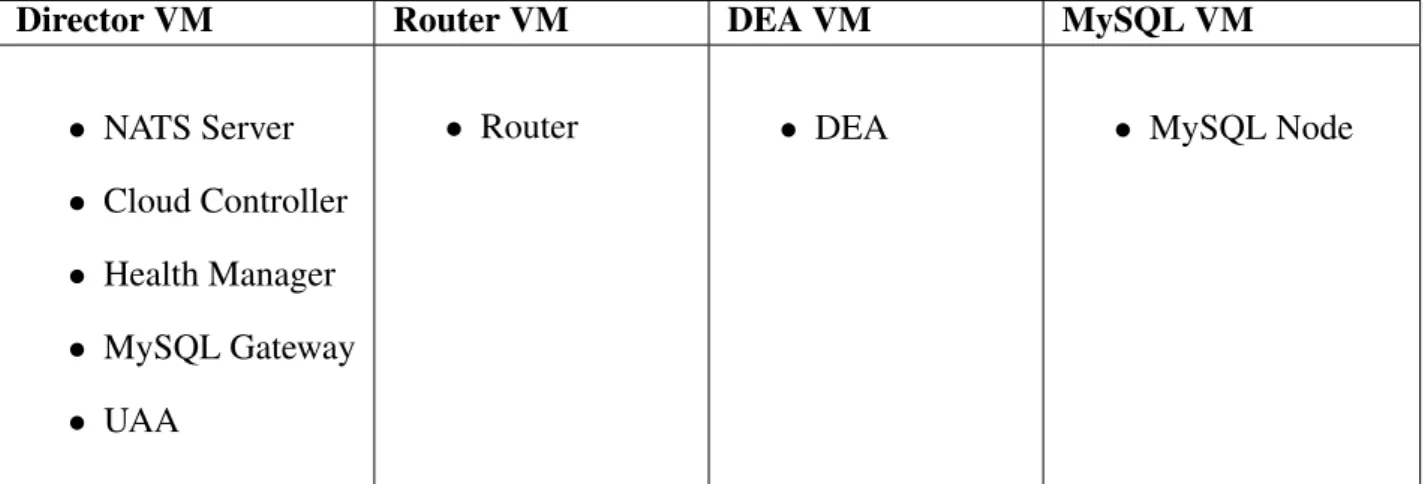
9.2.3 Deployment Design . . . 43
9.2.4 BOSH . . . 44
9.3 Installation and evaluation . . . 45
9.3.1 Installation . . . 45
9.3.2 Installation issues . . . 48
9.3.3 Configuration . . . 48
9.3.4 Validation . . . 49
10 Cloud4SOA Integration Analysis 52 10.1 API Overview and integration Analysis . . . 52
10.1.1 Authentication . . . 52
10.1.2 Monitoring . . . 53
10.1.3 Development Life-cycle supportive methods . . . 53
10.1.4 Monitoring methods . . . 56
10.1.5 Instance Handling Methods . . . 57
10.1.6 Resource Handling Methods . . . 59
10.1.7 Migration Handling Methods . . . 62
10.2 Integration Complexity Summary . . . 64
10.3 CloudFoundry Java library . . . 64
11 Adapter Design and Implementation 66 11.1 Requirements Overview . . . 66
11.1.1 Methodology . . . 66
11.1.2 Functional Requirements . . . 67
11.1.3 Non-functional requirements . . . 71
11.2 Adapter Design . . . 72
11.2.1 Cloud4SOA Reference Architecture Overview . . . 72
11.2.2 Platform Adapters . . . 74
11.2.4 Domain Model . . . 77
11.2.5 Client library conceptual model . . . 78
11.2.6 Behavioral Model . . . 79
11.3 Implementation . . . 99
11.3.1 Technologies involved . . . 100
11.3.2 Local Adapter . . . 101
11.3.3 Remote Adapter . . . 102
11.3.4 Integration with Cloud4SOA . . . 103
11.4 Testing . . . 103
11.4.1 JUnit Overview . . . 103
11.4.2 Local Part Tests . . . 105
11.4.3 Remote Part Tests . . . 107
11.4.4 Discussion on NFRs . . . 108
12 PaaS Hybrid Cloud Scenarios 109 12.1 Hybrid Cloud . . . 109
12.2 Scenarios Description . . . 110
12.2.1 Hybrid Deployment Scenario . . . 110
12.2.2 Bursting on Demand Scenario . . . 110
12.3 Context-Aware Application Description . . . 112
12.3.1 Application deployment map . . . 113
12.4 Cloud4SOA Evaluation . . . 114 12.4.1 Deployment Process . . . 114 12.4.2 Governance Process . . . 121 12.4.3 Monitoring Process . . . 124 12.4.4 Migration Process . . . 125 12.5 Summary . . . 127 13 Conclusions 129
III
Exploring interoperability at the IaaS layer
131
14 Introduction 132 15 OPTIMIS 135 16 Interoperability at the IaaS layer 137 16.1 Interoperability problems at the IaaS level . . . 13716.2 Standards for IaaS interoperability . . . 138
16.2.1 Open Cloud Computing Interface (Open Grid Forum - OGF) . . . 138
17 Requirements Overview 140 17.1 Methodology . . . 140
17.2 Functional Requirements . . . 141
17.2.1 Service Management . . . 143
17.2.3 Monitoring . . . 145 17.2.4 Non-Functional Requirements . . . 146 18 Service Design 148 18.1 Data Model . . . 148 18.1.1 Definitions . . . 150 18.1.2 Classification System . . . 150
18.1.3 Entities Representation System . . . 152
18.2 Behavioral Model . . . 157
18.2.1 Authentication . . . 160
18.2.2 Requests and Responses syntax . . . 160
18.2.3 Create Virtual Machine . . . 160
18.2.4 Delete Virtual Machine . . . 161
18.2.5 Update Virtual Machine . . . 161
18.2.6 Execute Action . . . 162
18.2.7 Get Virtual Machine . . . 162
18.2.8 Get Service Virtual Machines . . . 163
18.2.9 Get all Virtual Machines . . . 164
18.2.10 Terminate Service . . . 164
19 Proxy Design 166 19.1 OPTIMIS reference architecture overview . . . 166
19.1.1 Service Deployment . . . 168
19.1.2 Service Operation . . . 169
19.2 External Providers Integration . . . 170
19.2.1 CloudQoS Integration . . . 170
19.2.2 Data Manager Integration . . . 171
19.2.3 Monitoring Integration . . . 171
19.3 CloudQoS Proxy design . . . 172
19.3.1 Interface Layer Conceptual Model . . . 173
19.3.2 Operations Layer Conceptual Model . . . 175
19.3.3 Interface Layer Behavioral Model . . . 176
19.3.4 Operations Layer Behavioral Model . . . 179
19.4 Implementation . . . 181
19.4.1 Technologies involved . . . 182
19.4.2 Example . . . 182
19.5 Testing . . . 183
19.5.1 Proxy Tests . . . 183
20 Integration with Amazon EC2 185 20.1 Integration Analysis . . . 185
20.1.1 CloudQoS Integration . . . 185
20.1.2 Data Manager Integration . . . 186
20.1.3 Monitoring Infrastructure Integration . . . 188
20.2 Design . . . 192
20.2.2 Amazon S3 Wrapper . . . 198 20.2.3 AWS Collector . . . 205 20.3 Implementation . . . 213 20.3.1 Technologies Involved . . . 213 20.3.2 S3 Wrapper implementation . . . 215 20.3.3 Collector implementation . . . 216 20.4 Testing . . . 216 20.4.1 S3 Wrapper Tests . . . 216 20.4.2 Collector Tests . . . 219 20.5 OPTIMIS Integration . . . 219 21 Conclusions 222 Conclusions & Lessons Learned 224 A JSON OCCI Messages Specification 226 A.1 Resource Instance . . . 226
A.2 Link . . . 227 A.3 Action . . . 228 A.4 Attributes . . . 228 A.5 Example . . . 229 B HTTP Response Codes 231 C Produced Code 233 Bibliography 234
List of Figures
1.1 High-level view of the Cloud stack. . . 4
1.2 High-level view of a virtualization environment. . . 5
3.1 Gantt diagram describing the initial project planification . . . 12
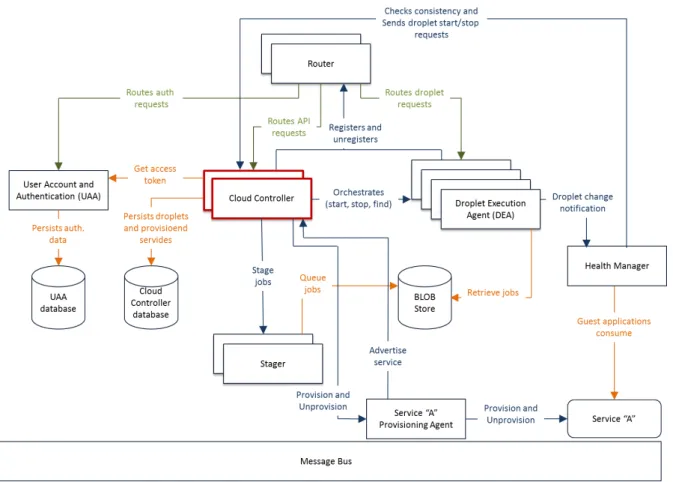
9.1 CloudFoundry architecture . . . 39
9.2 Interaction between users and a CloudFoundry platform. . . 39
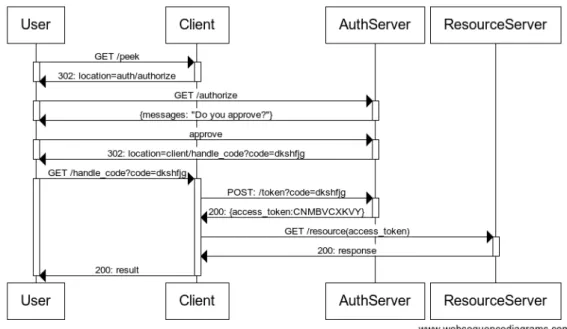
9.3 3 High-level view of the authorization workflow. . . 40
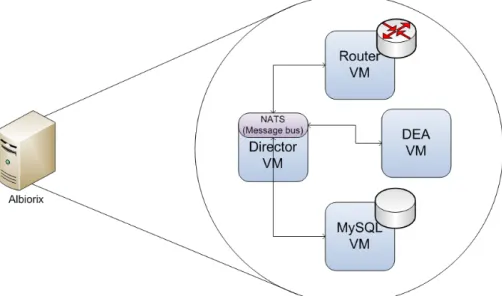
9.4 Deployment view of the VMs that will host CloudFoundry. . . 43
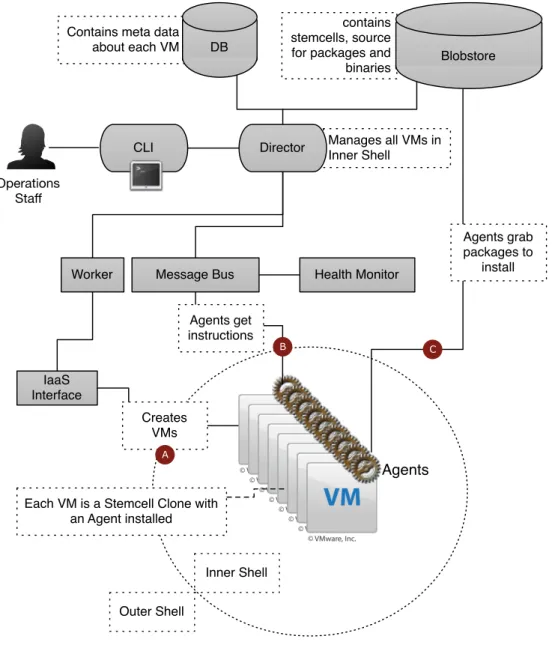
9.5 High-level BOSH architecture. . . 46
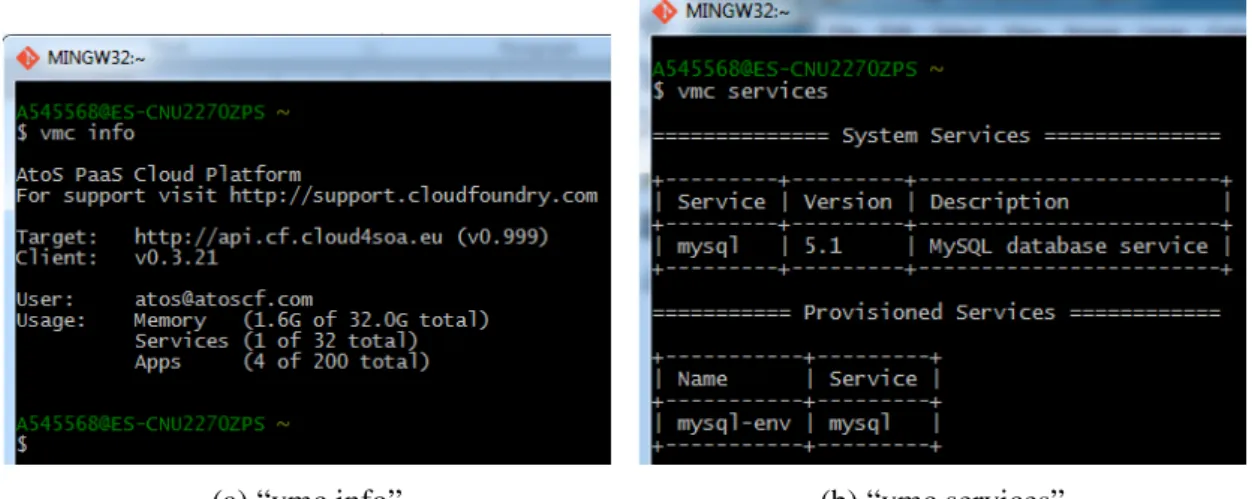
9.6 Results from the “vmc info” and “vmc services” commands . . . 49
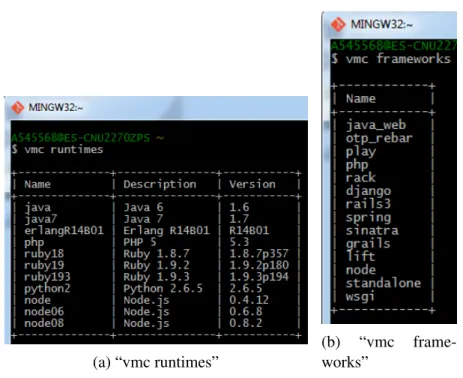
9.7 Results from the “vmc frameworks” and “vmc runtimes” commands . . . 50
9.8 Result of the “vmc push” command. . . 50
9.9 Pushed application shown in a browser. . . 51
11.1 Requirements gathering process . . . 66
11.2 Cloud4SOA 3-layer architecture . . . 73
11.3 Components that form the governance layer . . . 73
11.4 PaaS Offering semantic model . . . 74
11.5 Cloud4SOA communication pattern with the adapters . . . 75
11.6 Invocation patterns between Cloud4SOA, the adapter and CloudFoundry . . . . 76
11.7 Cloud Foundry semantic profile . . . 104
11.8 Result of the local part tests execution . . . 107
11.9 Results of the remote part tests execution . . . 108
12.1 Hybrid Cloud . . . 110
12.2 Hybrid Cloud Scenario . . . 111
12.3 Bursting on Demand Scenario . . . 112
12.4 PTIN Context-aware Multimedia Framework . . . 113
12.5 Application Deployment Map . . . 114
12.6 Context Enabler Application Profile . . . 115
12.7 Matching PaaS Offers for Context Enabler . . . 116
12.8 Deploying Context Enabler . . . 116
12.9 CloudFoundry credentials . . . 117
12.10Deploying Context Enabler web archive . . . 117
12.11Context Enabler running in CloudFoundry . . . 118
12.12Group Manager Enabler Database Credentials . . . 119
12.14Group Manager Enabler running in CloudBees . . . 120
12.15Group Manager Enabler Administration Interface . . . 121
12.16Start/Stop Application . . . 121
12.17Context Enabler stopped . . . 122
12.18Context Enabler not running . . . 122
12.19Undeploy Application . . . 123
12.20Context Enabler undeployed . . . 123
12.21Monitoring Application . . . 124
12.22Group Manager Enabler Response Time . . . 124
12.23Group Manager Enabler Response Code . . . 125
12.24Matching PaaS Offers for migrating Context Enabler . . . 126
12.25CloudBees Credentials for migration . . . 126
12.26Migrating Context Enabler . . . 126
12.27Context Enabler migrated to CloudBees . . . 127
12.28Context Enabler migrated to CloudBees II . . . 127
14.1 OPTIMIS testbed . . . 133
16.1 OCCI placement within an IaaS Cloud provider . . . 139
18.1 Compute type state diagram, where state changes correspond to actions . . . . 154
18.2 Network type state diagram, where state changes correspond to actions . . . 155
18.3 Storage type state diagram, where state changes correspond to actions . . . 156
18.4 Storage Link type state diagram . . . 156
18.5 Example of the URL name-space hierarchy . . . 158
19.1 High-level view of the CQoS proxy architecture . . . 172
19.2 OCCI CQoS unit testing results . . . 184
20.1 High-level view of the interaction between the Data Manager and Amazon S3 . 187 20.2 High-level view of the interaction between the monitoring components and AWS189 20.3 AWS Wrapper Test Interface . . . 217
20.4 AWS Wrapper Test Interface while performing an Upload operation . . . 218
20.5 AWS S3 interface showing the bucket associated to the service after uploading the image . . . 218
20.6 AWS Wrapper Test Interface after the Upload operation . . . 218
20.7 AWS Wrapper Test Interface while performing an Download operation . . . 219
20.8 AWS S3 interface showing the bucket associated to the service after deleting the image . . . 219
List of Tables
1.1 A classification for PaaS platforms . . . 8
3.1 Working hours estimation . . . 13
8.1 Comparative of the features offered by each of the analyzed PaaS providers . . 35
9.1 Description of the different installation options . . . 42
9.2 List of the components that each VM will host . . . 44
10.1 Integration complexity of the methods in the harmonized API . . . 64
11.1 Cloud4SOA Functional requirements . . . 68
11.2 Requirements template . . . 68
11.3 Cloud4SOA Non-Functional requirements . . . 71
11.4 Specialized Cloud4SOA non-functional requirements . . . 72
11.5 Description of the local part unit tests . . . 106
11.6 Description of the remote part unit tests . . . 107
12.1 Cloud4SOA vs CloudFoundry Provider API deployment time (in seconds) . . 118
12.2 Cloud4SOA vs CloudBees creating database (in seconds) . . . 119
12.3 Cloud4SOA vs CloudBees deployment time (in seconds) . . . 120
12.4 Cloud4SOA vs CloudFoundry Provider API stopping application (in seconds) . 122 12.5 Cloud4SOA vs CloudFoundry Provider API undeployment time (in seconds) . 123 17.1 OPTIMIS Functional requirements . . . 142
17.2 OPTIMIS Non-Functional requirements . . . 146
17.3 Specialized OPTIMIS non-functional requirements . . . 147
18.1 Integrity Restrictions of the OCCI Data Model . . . 150
18.2 Changes of state performed by Compute actions . . . 154
18.3 Changes of state performed by Network actions . . . 155
18.4 IPNetworkingMixin attributes . . . 155
18.5 Changes of state performed by Storage actions . . . 156
18.6 Monitoring mixin attributes . . . 157
18.7 Methods exposed by the service . . . 159
19.1 Methods exposed by the CQoS interface . . . 170
19.2 Methods exposed by the Data Manager interface . . . 171
20.1 S3 Wrapper requirements . . . 187
20.2 Metrics measured by OPTIMIS and their support in AWS . . . 190
20.3 Attributes of an OPTIMIS measurement . . . 191
20.4 Description of the process to get each OPTIMIS metric . . . 210
20.5 Description of the AWS S3 Wrapper tests . . . 217
20.6 Description of the AWS Collector tests . . . 220
21.1 Some of the differences between an OCCI-compliant service and AWS . . . 222
A.1 Resource instance structure object members description . . . 227
A.2 Link structure object members description . . . 228
A.3 Action structure object members description . . . 229
List of Diagrams
11.1 CloudFoundry domain model . . . 77
11.2 Components model of the client library and its use by the Adapter. . . 80
11.3 Authentication sequence diagram . . . 81
11.4 Create application sequence diagram . . . 82
11.5 Get space sequence diagram . . . 83
11.6 Delete application sequence diagram . . . 84
11.7 Update application sequence diagram . . . 85
11.8 Deploy sequence diagram . . . 86
11.9 Deploy to environment sequence diagram . . . 87
11.10Upload and deploy to environment sequence diagram . . . 88
11.11Get app status sequence diagram . . . 89
11.12Get running status sequence diagram . . . 89
11.13Get application details sequence diagram . . . 90
11.14Start/stop application sequence diagram . . . 91
11.15Check app availability sequence diagram . . . 92
11.16List applications sequence diagram . . . 93
11.17Create environment sequence diagram . . . 94
11.18Delete environment sequence diagram . . . 94
11.19Update environment sequence diagram . . . 95
11.20Create database sequence diagram . . . 96
11.21Get database list sequence diagram . . . 97
11.22Delete database sequence diagram . . . 98
11.23Export application sequence diagram . . . 98
11.24Download/restore database sequence diagram . . . 99
18.1 OCCI Data Model . . . 149
18.2 OCCI Kind instances example . . . 151
18.3 OCCI Mixin instances example . . . 152
18.4 OCCI Actions defined in the standard . . . 153
19.1 Component-level view of the OPTIMIS architecture . . . 167
19.2 High-level service deployment sequence diagram . . . 169
19.3 Interface layer conceptual model . . . 174
19.4 Operations layer conceptual model . . . 175
19.5 Create Agreement Sequence Diagram . . . 177
19.6 Negotiate Sequence Diagram . . . 178
19.8 Deploy Service Sequence Diagram . . . 180
19.9 Query Service Sequence Diagram . . . 181
19.10Terminate Service Sequence Diagram . . . 181
20.1 AWS CQoS operations layer conceptual model . . . 193
20.2 AWS CQoS Deploy Service Sequence Diagram . . . 195
20.3 AWS CQoS Get Amazon EC2 Client Sequence Diagram . . . 196
20.4 AWS CQoS Query Service Sequence Diagram . . . 197
20.5 AWS CQoS Terminate Service Sequence Diagram . . . 198
20.6 AWS S3 Wrapper conceptual model . . . 199
20.7 AWS S3 Wrapper Constructor Sequence Diagram . . . 200
20.8 AWS S3 Wrapper Upload Sequence Diagram . . . 201
20.9 AWS S3 Wrapper Progress Changed Sequence Diagram . . . 202
20.10AWS S3 Wrapper Download Sequence Diagram . . . 203
20.11AWS S3 Wrapper List Images Sequence Diagram . . . 204
20.12AWS S3 Wrapper Delete Image Sequence Diagram . . . 205
20.13AWS Collector conceptual model . . . 207
20.14AWS Collector Main Method Sequence Diagram . . . 209
20.15AWS Collector Get CloudWatch Measurement Sequence Diagram . . . 211
20.16AWS Collector Get OS Release Sequence Diagram . . . 212
Acknowledgements
I want to dedicate this space to say a big and warm "Thank you!" to all the people that have made this project possible and that have walked by me during the last 5 years and a half. This goes to all of you.
To ARI for embracing me in this project, especially Ana Maria Juan and Francesco D’Andria for having made a bit of room in their busy schedule to attend and help me during the project and having reviewed the project report during the last weeks. This project would not have been possible without your help.
To all my colleges at ARI that have helped me a lot in getting used to the company and the work environment and in solving numerous issues with the projects and the servers, in especial to Sergio García that has helped me multiple times with all sorts of Linux and LATEX hacks.
To David Cunha from PTIN (Portugal Telecom Inovação) for helping me during the imple-mentation of the adapters for Cloud4SOA and the evaluation of the hybrid cloud scenarios.
To Xavier Franch, in the first place for helping me in getting an internship at Atos, and in second place for supervising the project and providing me with helpful advice about the project, the documentation and the presentation. Thanks also to him and all the GESSI staff for embracing me in the GESSI group during the last 3 years and providing me with a LOT of experience that will certainly help me during my career.
To the people that have walked by me during the course of the degree, in especial to Pere Joan García, Oscar Mercè and Marc Rodríguez with whom I have shared numerous classes and successful projects; and with whom I have spent so many good and fun moments.
And last but not least to Cristina Palomares for supporting and encouraging me, always being by my side, and helping me with helpful feedback about the project report during the last weeks of the project.
Preface
The term “Cloud Computing” has recently emerged as one of the buzzwords in the IT industry. A lot of diverse IT companies seem to be using the term as their elevator pitch to attract more users. As it simplest, the “cloud” is the evolution of traditional data centers into virtualized environments which expose resources (computation, storage and applications) that can be used on-demand and that follow a “utility” pricing model where customers are charged based on their utilization of resources. The “cloud” presents itself into numerous forms, depending on the type of services it offers. The most notable forms are: Infrastructure-as-a-Service (IaaS) which offers on-demand computational resources that can be acquired in a self-service way; Platform-as-a-Service (PaaS) which offers a development and hosting platform in which all sorts of applications can be deployed; and Software-as-a-Service (SaaS) which offers complex applications to end-uses, who can use them remotely without the need to install or configure any software [NIS11].
Due to the novelty of this IT paradigm, there are still numerous issues and challenges to address in order to consolidate it. One of these issues is cloud interoperability. The high competitiveness in the cloud market prevents the major cloud providers (Amazon, Google, Microsoft, etc.) from agreeing into a set of standards but, instead, each of them presents its own proprietary interfaces and models. This puts off a lot of SMEs (Small and Medium Enterprises) that feel that will become “locked” into a cloud once they adopt it. The market could greatly benefit from having an interoperable environment in which applications and data could be more easily migrated between providers in the event of peaks of demand or Service-Level Agreement (SLA) violations.
This project will explore the problems of interoperability in the cloud, more concretely at the IaaS and PaaS layers, by contributing to two ongoing European research projects: Cloud4SOA1
and OPTIMIS2at Atos.
Cloud4SOA aims at providing a broker-like multi-cloud platform that connects heteroge-neous PaaS providers into a single location. Developers can use the platform to choose the provider that best matches the requirements of an application and manage its full lifecycle (de-ployment, governance, monitoring and undeployment) through it. Cloud4SOA is also able to monitor the SLA created between a developer and a provider in order to detect violations, in which case it may suggest the developer to migrate the application, action that can be taken through the same Cloud4SOA platform. This project will contribute to the platform by con-necting it to an additional PaaS, which will be selected after analyzing different alternatives and analyzing the effort required to integrate the new provider with each of the Cloud4SOA use cases.
1The project identifier is: CLOUD4SOA FP7-ICT-257953
OPTIMIS aims at optimizing IaaS cloud services by providing a set of inter-related tools for infrastructure providers (IPs), service providers (SPs) and service developers. The optimization covers the full service lifecycle (construction, deployment and operation). The tools for service providers and developers allow them to easily implement, package, deploy and operate services, run legacy applications on the cloud and make informed decisions based on TREC (Trust, Risk, Eco-efficiency and Cost) measurements. The tools for infrastructure providers, on the other hand, allow them to manage the infrastructure (VMs, servers, data storage, etc.) used to operate services. By monitoring the services running on the IP’s infrastructure, OPTIMIS can detect problematic issues and take the necessary actions to overcome them. One of such actions may be to burst a service or some of the resources that it is using to another OPTIMIS-enabled IP from the network of available providers. This project will contribute to this network in two ways: It will provide a new standardized communication channel with any provider that adopts the OCCI3standard and it will add a new provider to the network.
With these contributions we expect to gain a deeper understanding of the current interoper-ability issues at the PaaS and IaaS layers, their impact in the development of multi-cloud tools and how these issues can be solved.
Organization of the document
This document is structured in 3 parts: I Foundations and Project Plan
II Exploring interoperability at the PaaS layer III Exploring interoperability at the IaaS layer
Part 1 – “Foundations and Project Plan” – presents some fundamental concepts of cloud computing, with special attention to the IaaS and PaaS layers, and introduces the current sit-uation of the cloud with respect to interoperability. This part also describes the work plan of the project, commenting on the deviations that it suffered during its course; the goals of the projects and an analysis of its costs.
Part 2 – “Exploring interoperability at the PaaS layer” – gives more detail about the current interoperability issues at the PaaS layer, makes a comparative analysis of some of the currently most important PaaS providers with the intention of selecting one, and describes in detail the contribution that was made to Cloud4SOA by integrating the selected provider with the plat-form.
Part 3 – “Exploring interoperability at the IaaS layer” – gives more detail about the current interoperability issues at the IaaS layer and describes in detail the contributions made to OPTI-MIS, namely, the standardization of a communication channel that can potentially be used to integrate any OCCI-compliant IP with OPTIMIS and the addition of a new IP to the network of OPTIMIS-enabled clouds.
The document finishes by giving some overall conclusions and describing the lessons learned about interoperability during the realization of the project.
3OCCI is one of the standards for IaaS providers that is gaining more relevance. Details about it are given later
Part I
Chapter 1
Background
1.1
Cloud Computing
When we plug an electric appliance to an outlet, we don’t care about how electric power is generated or how it is possible that it gets to that outlet. That is possible because electricity is virtualized, that is, it is readily available from a wall socket that hides the complex details about how this electricity is generated, managed and transported. When extended to information technology, this means delivering computational resources and functions without knowing the internals of how these resources are obtained or managed [BBG11].
Cloud Computing aims at delivering large amounts of computational resources in a fully virtualized manner, by aggregating large pools of physical machines (commonly known as data centers) in a single system view. This huge aggregation of computational resources is used to deliver on-demand portions of computational power, usually in the form of Virtual Machines. An important characteristic of cloud computing is that computing power is delivered as a utility, that is, consumers pay providers based on usage (“pay-as-you-go”) just as we do with traditional public services such as water, electricity and gas.
There have been numerous attempts, both from researchers and practitioners, to describe what exactly “cloud computing” is and what unique characteristics it presents. One such defi-nition is provided by the NIST that says:“Cloud computing is a model for enabling ubiquitous, convenient, on-demand network access to a shared pool of configurable computing resources (e.g., networks, servers, storage, applications, and services) that can be rapidly provisioned
and released with minimal management effort or service provider interaction.” [NIS11]
De-spite all the different definitions of cloud computing, the majority agrees on a set of features that are inherent on the term [BBG11] [NIS11]:
Self-Service Clouds must allow a self-service access to their services so that customers can
request, use, customize and pay for resources without needing any human intervention.
Per-Usage Metering and Billing Clouds must allow consumers to request and use only the
necessary amount of resources without any up-front commitments. Moreover, resources must be charged on short-term basis (usually by the hour) giving consumers the flexibility to use resources only the time they need. This includes providing metering capabilities for different type of resources (computing, storage, memory, bandwidth, etc.) so that usage can be properly reported.
Elasticity One of the key strengths of cloud computing is the ability to quickly and dynami-cally change the amount of resources that are dedicated to a particular service. A cloud gives customers the illusion of infinite computing resources and, thus, they expect it to be able to increase the amount of resources in the event of high workloads and reduce them when the workload decreases.
Customization A cloud must be prepared to deliver resources to multiple customers with
dis-parate requirements; therefore, delivered resources must be customizable. This includes being able to choose the amount of resources to rent (cpu power, memory, storage capac-ity), the OS to use, the application services to install, etc.
Broad network access The services offered by a cloud must be available over the network
and accessible through different mechanisms: through a web interface, through a web service, etc.
Resource pooling Clouds should offer the possibility to specify the location of the rented
resources independently of internal redistributions of resources due to optimization or clean-up tasks. This can be necessary for consumers that need to optimize the latency of their services or that need to deal with data confidentially issues.
Clouds are usually characterized across two independent features: their service model and their deployment model.
The deployment model describes where the computational resources offered by a cloud live and who can access them and can be classified in a public, private or hybrid deployment:
Public deployment denotes a cloud that is available to the general public, usually in a
pay-as-you-go basis. This is the most typical deployment model and the one used by the majority of commercial providers such as Amazon or Rackspace.
Private deployment denotes a cloud that a company or organization internally deploys,
usu-ally in its own data center, and is used exclusively by the company or organization mem-bers. In most cases, creating a private cloud means restructuring the infrastructure of the organization by adding virtualization and cloud-like capabilities.
Hybrid deployment combines both of the above to create a mixed cloud that minimizes their
disadvantages and combines their advantages. Usually such a deployment is created by supplementing a private cloud with capacity from a public cloud, so that the public infrastructure can be used in the event of load spikes or infrastructure failure. The process of temporarily renting capacity from a public cloud is known as cloud bursting.
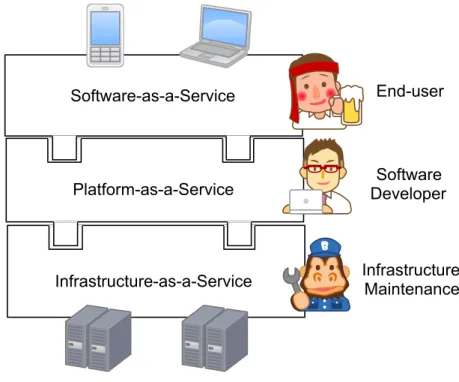
The service model (the “as-a-Service” part) describes the type of services offered. Clouds are classified in mainly three different service models: Infrastructure-as-a-Service (IaaS), Platform-as-a-Service (PaaS) and Software-Platform-as-a-Service (SaaS) (see figure 1.1).
The IaaS and PaaS models are described in detail in the following subsections as they are the models directly related to this project. A major difference between these two and a SaaS is that the formers are addressed to companies or ISV (Independent Software Vendors) while the latter is addressed to end-users. A SaaS is an application that resides on top the cloud stack and can be accessed by end users through web portals, avoiding the need to install any software locally. Traditional desktop applications such as text processing tools or spreadsheets are now
being ported to the cloud (Google Docs is an example of these tools). Also, all sorts of more complex applications are also starting to becloudified, perhaps one of the most famous is the CRM offered by Salesforce.com. Infrastructure-as-a-Service Platform-as-a-Service Software-as-a-Service Infrastructure Maintenance Software Developer End-user
Figure 1.1: High-level view of the Cloud stack and the users directly related to each layer.
1.1.1
Infrastructure as a Service
Infrastructure as a Service (IaaS) was the first layer of Cloud Computing that provided the op-portunity to rent on-demand computational and storage resources in a per-hour basis. The IaaS paradigm popularity burst with the foundation of Amazon Web Services1and its famous EC2 instances, which provided consumers with elastic computational resources that could be very easily managed in a self-service way. Nowadays, we can find lots of IaaS providers in the mar-ket such as Rackspace Cloud2, Windows Azure3 , Terremark4 , Google Compute Engine5and Joyent6. The NIST defines Infrastructure as a Service as:“The capability provided to the
con-sumer to provision processing, storage, networks, and other fundamental computing resources where the consumer is able to deploy and run arbitrary software, which can include operating systems and applications. The consumer does not manage or control the underlying cloud in-frastructure but has control over operating systems, storage, and deployed applications; and
possibly limited control of select networking components (e.g., host firewalls).” [NIS11] In
1http://aws.amazon.com 2http://www.rackspace.com 3http://www.windowsazure.com 4http://www.terremark.com 5https://cloud.google.com/products/compute-engine 6http://www.joyent.com
practice, an IaaS provider makes use of hardware virtualization technologies to offer Virtual Machines to consumers. Consumers acquire complete control over these machines and can customize them, start or stop them, attach virtual disks to them, etc.
The roots of the IaaS paradigm can be found on grid computing and on the advances in hardware virtualization [BBG11]. Grid computing can be defined as the federation of com-puter resources, distributed across a number of locations, to reach a common goal. Commonly, grids are used for a variety of purposes rather than being tied to a single application. Grids, however, have been found to have some limitations such as difficulty in ensuring QoS, lack of performance isolation and lack of availability of resources with diverse software configurations. In this direction, advancements in hardware virtualization technologies have presented an op-portunity to overcome these limitations, by allowing to split a data center or computer cluster into a number of individual and isolated machines that can be used for any purpose. Hard-ware virtualization allows running multiple operating systems and softHard-ware stacks on a single physical platform. As seen in figure 1.2, a software layer called hypervisor mediates access to the physical hardware presenting to each guest operating system a virtual machine (VM), which has access to a limited set of the hardware resources. Researchers and practitioners have identified three main benefits that virtualization provides to workload management [BDF+03]:
Workload isolation is achieved since a program execution is fully confined inside a VM. This
leads to improvements in security, reliability and performance control.
Consolidation of several individual and heterogeneous workloads onto a single physical
plat-form can be achieved, which leads to better resources utilization.
Application mobility can be easily accomplished by encapsulating a guest OS state within its
VM, allowing it to be suspended, serialized, migrated to a different platform and resumed immediately. Hardware Hypervisor Virtual Machine 1 User Software API Server Windows Web Server Database Virtual Machine 2 User Software Facebook App Ruby on Rails Java Virtual Machine N User Software App A Linux Guest OS App X App Y App B
...
Figure 1.2: High-level view of a virtualization environment.
Apart from the common desirable features to all cloud platforms, an IaaS should be based in the following features and capabilities [BBG11]:
Geographic presence IaaS providers typically build several data centers distributed around the world. For some consumers this can improve availability and responsiveness, as well as deal with law issues with regard to data confidentiality.
User interface and access to servers An IaaS provider should offer as many ways as possible
to interact with its cloud. Usually, providers offer a combination of Web interfaces, Command-Line interfaces (CLI) and Web services APIs.
Advance reservation of capacity An IaaS provider should allow the option to reserve
re-sources for a specific time frame in the future, thus ensuring that cloud rere-sources will be available at that time. Consumers use this feature when they expect to have a high peak of demand, for instance, an online shop could reserve an exceptionally large amount of resources during the days before Christmas.
Automatic scaling and load balancing Automatic scaling gains special importance in the IaaS
layer. An IaaS should allow consumers to set conditions for when they want their re-sources to scale up and down, based on a variety of infrastructure and application-specific metrics. Moreover, when the number of virtual machines is increased, incoming traffic must be automatically balanced among the available machines.
Service-Level Agreement Service-Level Agreements (SLAs) are offered by IaaS providers to
express their commitment to deliver a certain Quality of Service (QoS). To customers, this serves as a warranty. Such an SLA usually contains availability and performance guarantees, with availability being clearly the focus point for most IaaS.
1.1.2
Platform as a Service
In the last years, a new paradigm has emerged between the bottom most layer of the cloud (IaaS) and the up most (SaaS) with the name of Platform-as-a-Service (PaaS). The NIST de-fines Platform-as-a-Service as: “The capability provided to the consumer to deploy onto the cloud infrastructure consumer-created or acquired applications created using programming languages, APIs, services, and tools supported by the provider. The consumer does not manage or control the underlying cloud infrastructure including network, servers, operating systems or storage, but has control over the deployed applications and possibly configuration settings for
the application-hosting environment.”[NIS11]
The roots for the emergence of this new middle layer con be found on Application Service Provision (ASP) concepts, where services such asSalesforce.comwere offering a customization layer of some sort for their platforms. Soon, driven by the existence of these services and the eruption of this market with the entrance of Google’s App Engine, the middle layer between IaaS and SaaS became clear.
The main function of a PaaS is to provide a layer of abstraction on top of an IaaS, in which applications can be developed, deployed, tested and governed without worrying about the underlying physical structure. Furthermore, multiple programming models and specialized services (databases, authentication, payment gateways, etc.) are offered as building blocks for applications [App09].
Apart from the common desirable features to all cloud platforms, a PaaS should be able to support the following set of features and capabilities [BBG11]:
Programming models, languages and frameworks A PaaS should support the development and efficient execution of applications that require specialized programming models. In the cloud computing domain, the most common activities that require specialized models are: processing of large data sets in clusters of computers (using the MapReduce model), development of request-based Web services, definition and orchestration of business pro-cesses in the form of workflows (Workflow model), and high-performance distributed execution of diverse computational tasks. Also, a PaaS should support a set of program-ming languages and frameworks. Currently, the most commonly supported languages are Java and .NET, along with the Spring, Java EE and diverse .NET frameworks.
Persistence Options A PaaS should provision applications with access to a persistence layer.
The ability to save and store data in a structured and efficient way has become essential in all domains of software development, with relational databases being the most popular persistence method. In the domain of cloud computing, however, this technology is becoming short as it lacks scalability to handle vast amounts of data. In order to tackle this, distributed storage technologies have emerged which seek to be robust and highly scalable at the expense of relational structure and convenient query languages. In the same direction, innovative technologies such as NoSQL are also seeking to solve the problem of the management of very large amounts of data (of the order of petabytes).
Developer Tools A PaaS is expected to offer a set of tools to both let developers interact with
the cloud (self-service) and to ease the development of complex applications, especially those requiring access to services such as databases. PaaS providers usually offer a CLI (Command Line Interface) to perform all operations (create applications, deploy, mon-itor, etc.) and a graphical application (usually a plug-in for Eclipse or similar IDEs) to perform a subset of these operations in a more intuitive and usable way. Additionally, it is common to offer a web service to allow the execution of these operations programmat-ically.
Automatic Scaling As discussed earlier in this work, one of the beauties of the cloud is its
ability to scale resources up and down according to workload changes. With respect to a PaaS, it is desirable to offer a way to automatically scale applications in terms of assigned memory, CPU power, number of running instances, etc. or at least offer a manual way of doing so.
The literature has elaborated all sorts of PaaS categorizations. Red Hat, for instance, classi-fies PaaS according to their purpose, ranging from a SaaS with extensions to a General-purpose PaaS [Red10] (see table 1.1). While the more specialized PaaS deliver successful results in tackling specific problems, the more general ones are addressed to organizations that need to use a variety of technologies to deploy both new and existing applications.
Another relevant distinction between PaaS is the type of underlying infrastructure, i. e. the IaaS, in which they can be deployed: own infrastructure, tied to a single IaaS or multiple IaaS. Providers such as Google App Engine, Windows Azure or AWS Benstalk are examples of the first category, with the main benefit being that the developer does not need to worry about the infrastructure since it will be provided by the platform. The second category includes Heroku and Aneka, both tied to Amazon EC2 servers. Finally, the “write once and deploy anywhere” [Red10] category is clearly the most flexible and is becoming the market trend as well as the elevator pitch of a lot of companies, such as Cloud Foundry, Stackato and RedHat Open Shift.
Type of PaaS Description
SaaS with extensions Customize and extend the capabilities of a SaaS
application. Salesforce.com (the SaaS), for in-stance, offers a customization layer through force.com (the PaaS).
Purpose-built PaaS A PaaS that simplifies the development of a
spe-cific type of application, with a limited set of capabilities.
PaaS tied to a single application paradigm Provides general capabilities, but supports
only one programming model or develop-ment/deployment environment.
PaaS tied to a single cloud May provide general capabilities and
program-ming models, but is tied to only one type of pri-vate or public infrastructure (IaaS).
Middleware hosted in the cloud Eases distribution of middleware across the
or-ganization, but adds no other value.
General-purpose PaaS Comprehensive, open, and flexible solution that
simplifies the process of developing, deploying, integrating and managing applications in public and private clouds. The majority of well-known providers fit in this category.
Table 1.1: A classification for PaaS platforms
1.2
Cloud Computing Interoperability
Interoperability has been widely identified as one of the highest risks and challenges of Cloud Computing [BBG11, CH09]. Current cloud computing solutions have not been built with in-teroperability as a primary concern; rather, they “lock” customers into their own infrastructure, processes and interfaces, preventing the portability of data and applications. Probably the rea-sons that have caused this situation are both the rapid growth of the cloud market and the increasing competition between the leading vendors (Amazon, Google, Microsoft, etc.), each of them promoting their own, incompatible formats [MHS09].
It is clear that an interoperable cloud environment would benefit customers, as they would be able to migrate their data and applications between heterogeneous cloud providers without compromising the integrity of the data or having to reconfigure the applications. Moreover, they would be able to interact with any cloud provider in the same way and compare different providers across a set of common characteristics such as resources, pricing and Quality of Service (QoS). This would further attract more SMEs (Small and Medium Enterprises) into the cloud since they won’t feel the fear of getting locked-in into one single provider but, rather, would have the option to change provider when it stops fulfilling their requirements.
The solution to this situation is the creation and adoption of standards. In this direction there have been numerous efforts to create open standards for cloud computing. The Cloud
Computing Interoperability Forum (CCIF), for instance, was formed by a set of organizations such as Intel, Sun and Cisco in order to“enable a global cloud computing ecosystem whereby organizations are able to seamlessly work together for the purposes for wider industry adoption
of cloud computing technology”. One of the outcomes of this body has been the Unified Cloud
Interface (UCI) that aims at creating a standard point of access to an entire cloud infrastructure. In a similar direction, but related to virtualization, the Open Virtual Format (OVF) aims at facilitating the packing and distribution of software to be run on VMs so that virtual appliances can be made portable between heterogeneous hypervisors.
Chapter 2
Goals
This project will contribute to two ongoing European research projects (within the FP7 frame-work), namely, Cloud4SOA and OPTIMIS, by providing mechanisms to enhance the interop-erability between their tools and the cloud platforms with which they interact. On one hand, the contribution to Cloud4SOA, which corresponds to the work developed within the “Exploring interoperability at the PaaS layer” part, has the following goals:
• Gain a fairly deep understanding of existing private PaaS offerings by studying and com-paring them.
• Learn and experiment the typical workflow that developers undertake with a PaaS cloud.
• Select the most appropriate private PaaS platform and deploy it into the company’s data center.
• Integrate Cloud4SOA with the deployed instance and test its proper functioning.
• Evaluate if Cloud4SOA is able to properly handle an application deployed into the private cloud and migrate it to a public cloud or vice-versa.
On the other hand, the contribution to OPTIMIS, which corresponds to the work developed within the “Exploring interoperability at the IaaS layer” part, has the following goals:
• Study the current main standards for IaaS management and operation.
• Understand the architecture of the components that have to interact with the non-OPTIMIS OCCI clouds.
• Study the OCCI standard in depth and design the OCCI-compliant interface that the OPTIMIS proxy exposes.
• Design, implement and test the component that will communicate to the non-OPTIMIS cloud proxy, in an OCCI-compliant way.
• Evaluate if OPTIMIS is able to properly handle a bursting scenario with the implemented component.
• Extend the OPTIMIS eco-system by adding support for Amazon EC2. This includes the design and implementation of a proxy able to use Amazon EC2 resources during a cloud bursting operation.
Chapter 3
Project Plan
3.1
Initial plan
The project is expected to last for 5 months and a half approximately working full-time, starting on the 17th of September. The Gantt diagram of the different phases and tasks of the project can be seen in figure 3.1. We are conscious that is very likely that the actual work deviates from the plan at some point due to unexpected circumstances or mistaken predictions. For this reason, we will keep track of how the project actually goes in order to compare it with the plan at the end of the project.
3.1.1
Phases
Learning & Research
The first phase of the project will run up to the 28th of September and consists on getting an overview of Cloud Computing in general and gain a more in-depth insight on concepts closely related to the project, such as standards for the PaaS and IaaS layers and the Cloud4SOA and OPTIMIS projects. This task will also involve comparing several private PaaS vendors and selecting the most appropriate for deployment into the company’s data center. This last task will provide further insight on concepts related to cloud computing and will be an input for the “Exploring interoperability at the PaaS layer” part.
PaaS Part
During the next month and a half approximately (up to the 5th of November) the tasks inside
thePaaS partphase will be performed. These tasks consist on installing and configuring the
private PaaS instance on one of the servers of the company, integrate it with Cloud4SOA and evaluate the result of the integration.
IaaS Part
Finally, during the rest of the duration of the project, the tasks inside theIaaS partphase will be performed. These tasks basically consist on the analysis, design and implementation of the OCCI communication link between OPTIMIS and any OCCI-based provider and on the integration of AWS with OPTIMIS.
3.1.2
Working hours estimation
With the different tasks decided and planned and considering that we will work full-time during the duration of the project, except for the company holydays, we estimate that the project will take 792 hours to complete distributed as shown in table 3.1.
Task Hours
Project Document Writing 90 Project Document Review 20
Learning & Research
PaaS comparative & selection 35 Books and papers reading 25 Cloud4SOA testbed set-up 20
PaaS Part
PaaS installation & testing 35 Cloud4SOA integration 75
Evaluation 60
IaaS Part
Standards study 13
OCCI Integration Analysis 24 Arsys Service Design 30
Proxy Design 65
Proxy Implementation 110 Integration with AWS 190
Total 792
Table 3.1: Working hours estimation
According to the rules established by the Barcelona School of Informatics for the realization of the PFC, which determine that the work load by the student is of about 20 hours per credit, the total number of hours estimated for the realization of the project should be 750, value that closely adjusts to the number of hours estimated for this project in particular.
3.2
Deviation from the initial plan
As initially expected, there were some deviations from the initial planning during the course of the project, mostly due to the lack of knowledge about Cloud Computing which has required researching and learning more about it; and the costly internal processes required to acquire resources inherent on any big company. Despite that, almost all the goals have been fully completed, only the integration with Arsys and the integration with AWS have been partially completed leaving some work out of the project due to a lack of time.
Within the PaaS part, the installation and integration of CloudFoundry took more time than expected due to the fact that CloudFoundry is still a young Open Source project and there is a lack of documentation about the platform. This has required taking extra time diving into the CloudFoundry code and getting involved in the community in order to understand the platform in detail and to clarify all questions. In addition to that, the actual installation of CloudFoundry
was delayed to the second half of November because the necessary resources in the data center were not provided until then. This situation complicated the schedule of the project since during this waitingtime tasks from the IaaS part were intertwined with tasks from the PaaS part. Another consequence of this delay was that the evaluation task had to be also delayed and could not be performed as exhaustively as it was intended.
Something similar happened in the IaaS part with the implementation and testing of the OCCI proxy since it was dependent on the implementation of the service by part of Arsys and they didn’t have it ready until half February. We were able to implement the proxy but were not able to fully test it until the service was ready and running. This, again, complicated the schedule by having to intertwine the “Integration with AWS” tasks with this.
Due to these changes of schedule and the fact that some tasks took more time than initially expected, the goals related to the last tasks, namely the integration of OPTIMIS with OCCI and AWS, were not completely fulfilled. Specifically, the new OCCI proxy could not be used to evaluate the bursting scenario and the integration of AWS was not fully performed, leaving out the work required to connect the implemented components to OPTIMIS.
Chapter 4
Cost analysis
After having prepared the schedule of the project we can make an economic assessment about it. To do so, we have to take into account both human and material resources.
4.1
Human Resources
The higher cost of the project is in human resources. In European Projects, this cost is cal-culated using the “person-month” concept which is an abstraction of the required work effort to complete a task. The tasks performed in part II map almost directly to a task within Work Package 8 (WP8) of Cloud4SOA. This task, as stated by the Description of Work (DoW), has a required effort of 8 Person-Months (PMs). With respect to part III, the tasks performed are not reflected in the OPTIMIS DoW since they have been extra tasks not initially planned. However, comparing the effort required to complete these tasks with the effort required to complete part II, we can assign an effort of 5 PMs to them.
Taking the average monthly rate that Atos calculates for PMs, the total cost of the 13 PMs is about 78.000 e. However, this cost is a simulation considering a team of people from the different partner organizations. Being this a final degree project, there has only been one person working on it with the supervision of the director and some support from one of the partners during the Cloud4SOA evaluation task. Taking into account that the project has lasted for 6 months, the actual cost for the student has been of 6 PMs which equal to 4.000eapproximately.
4.2
Material Resources
In order to develop the project the following material goods have been required:
• A laptop with all the necessary software installed, valued in 1000e.
• A negligible cost of less than 10 efrom Amazon usage fees, both from EC2 and from S3.
• Books and electronic resources valued in 125 e approximately, which includes some paperback books and a subscription to an electronic library.
We have also used the infrastructure in the company data center to host the CloudFoundry installation. However, given that the server in which it has been deployed is shared with other applications, it is difficult to estimate its actual cost.
Part II
Exploring interoperability at the PaaS
layer
Chapter 5
Introduction
This part of the project focuses on interoperability at the Platform-as-a-Service (PaaS) layer. Platform-as-a-Service is a fairly new concept that has emerged from the evolution of the ser-vices offered by some of the major Cloud providers. It comprises a middle layer between the IaaS and the SaaS aimed at providing a scalable development and hosting environment for all sorts of applications. The main goal of a PaaS is to “make the developer’s life easier” by providing a set of tools and resources to help in the development and deployment of scalable applications, be them simple or complex.
Since the emergence of this concept it has gained a fair amount of popularity and, today, we can find lots of PaaS providers in the market: Amazon Elastic Beanstalk, Google App Engine, Heroku, OpenShift, etc. In such a competitive field, where each provider imposes its own “lock” in an effort to become thede factoplatform, interoperability and application portability gets highly damaged. This heterogeneity prevents the establishment of an agreement on a widely accepted, standardized way to input/output Cloud details and specifications [MHS09].
However, cloud developers could highly benefit from an interoperable cloud environment, where applications can be migrated from one vendor to another with minimal hassles and risks. This would let them compare Cloud offerings across a set of characteristics such as resources, pricing, available application services, Quality of Service (QoS), etc. and choose the most cost-effective provider. Furthermore, this would let them easily migrate an application in case that the chosen provider stops delivering the expected results.
The Cloud4SOA European research project pretends to make a step forward in this direction by providing a broker-like multi-cloud platform that connects multiple heterogeneous PaaS providers into a single location. The platform allows developers to search among a variety of PaaS for the one that best fits their requirements and to seamlessly deploy, govern and monitor application on it. Furthermore, Cloud4SOA also allows migrating applications from one PaaS to another when an unexpected condition happens, such as an SLA violation.
Currently, Cloud4SOA only manages public clouds (Amazon Benstalk, CloudBees and Heroku, among others). The goal of this part of the project is to explore the possibility of making hybrid deployments through the platform. To this end, a private PaaS platform will be selected and installed on-premise in the Atos infrastructure, and Cloud4SOA will be extended to support this platform. Once this test-bed is set up, several hybrid deployment scenarios will be used to evaluate the usability and performance of Cloud4SOA when facing such scenarios.
The rest of this part is structured as follows. Chapters 6 and 7 provide some background that will help the reader understand the rest of the document. Next, chapter 8 evaluates and
com-pares a set of private PaaS platforms and explains which one has been selected. Then, chapter 9 provides an overview of the selected platform along with an explanation of the installation environment and process. Following, chapter 10 analyzes how the selected platform can be integrated with Cloud4SOA. Chapter 11 shows the design and implementation of the adapter (the extension to the Cloud4SOA platform). After that, chapter 12 shows the evaluation results of the different hybrid deployment scenarios. Finally, chapter 13 concludes the part.
Chapter 6
Cloud4SOA
Cloud4SOA is a European research project started in 2010 and with 3 years of duration. The goal of the project is to provide a platform to reduce the semantic interoperability barriers between different cloud vendors in order to move a step forward in the realization of a global Cloud market [DBG+12]. Cloud4SOA introduces a broker-based architecture whose main goal
is to address and tackle semantic interoperability challenges at the PaaS layer.
The Cloud4SOA tool aims at facilitating Cloud-based application developers in searching for, deploying and governing their business applications in the PaaS that best fits their needs. Additionally it provides support for migrating an application from one PaaS to another with-out compromising the integrity of the application or the data. This functionality is achieved by semantically interconnecting heterogeneous PaaS offerings through a set of adapters that transform Cloud4SOA-based requests into platform-specific requests for each different PaaS.
In order to handle the interoperability issues, Cloud4SOA introduces a three-dimensional semantic interoperability framework [LKT11] that aims to capture any sort of semantic inter-operability conflict at the PaaS layer, while also mapping it to the appropriate PaaS entity and type of semantics.
Cloud4SOA focus its functionality in four use cases: Matchmaking, Deployment, Migra-tion and Monitoring.
6.1
Matchmaking
This use case allows to search among the existing PaaS offerings for those that best match the user’s requirements. The matchmaking mechanism uses semantic technologies to align the user requirements with the PaaS offering features, even if they are expressed in different forms.
The matchmaking algorithm capitalizes on the PaaS and Application semantic models, and aligns them in order to be able to compare them. The PaaS model captures technical infor-mation and characteristics about the platform such as supported Programming Languages and pricing model. The Application model represent an application created by a cloud-based ap-plication developer that needs to be hosted by a PaaS offering and it captures information such as the programming language, required services, required QoS (Quality of Service), etc. Using these models, “PaaS offering requests” are matched with the available “PaaS offerings” in order to provide the set of offerings that best match the requests.
Moreover, the matchmaking algorithm is able to identify equivalent concepts between di-verse PaaS offerings and “harmonize” them in order to be able to match them with the user’s
requirements. For example, Heroku uses dynosas the basic unit of computation while other PaaS providers use the number of CPUs.
6.2
Deployment
After the developer decides, driven by the recommendations of the matchmaking, on the best PaaS to deploy, she can easily deploy an application to it by providing a set of required details, such as his credentials on the platform. The deployment performs an analysis of the applica-tion’s requirements and builds a specific application deployment descriptor. This descriptor is compliant with the format defined by the selected PaaS offering. The deployment is made through the harmonized Cloud4SOA API, which is implemented by all the platform-specific adpaters.
6.3
Migration
After an application has been running for some time on a PaaS, the developer may realize that the platform is not delivering good enough results and may decide to change to another provider. In this direction, migration offers the functionality to achieve this. First, it retrieves the deployed application archive and translates the application requirements into a platform-specific deployment understandable by the new PaaS provider.
6.4
Monitoring
Once the developer has deployed an application into a PaaS provider, she can get real-time performance statistics such as response time and application health. The Monitoring module “harmonizes” metrics offered by different PaaS providers in a similar way to the matchmaking algorithm.
One of the key aspects of Cloud4SOA with respect to monitoring is the management of Service Level Agreements (SLAs). SLAs describe the service that is delivered, the functional and non-functional properties of the resources, and the duties of the parties involved. Additionally, SLAs define guarantees for the functional and non-functional resources properties. These guarantees define service level objectives that must be met in order to fulfill the agreement along with the compensation action to take in case that the guarantee is not fulfilled.
Cloud4SOA provides a RESTful implementation of the WS-Agreement standard in order to implement the SLA control and enforcement. Additionally it provides a negotiator com-ponent to perform automatic negotiations on behalf of PaaS providers, based on the semantic description of offerings and the QoS requirements specified by an application developer.
Chapter 7
Interoperability at the PaaS layer
This section dives a little deeper into the current interoperability issues at the PaaS layer and briefly describes the most important standardization initiatives that have appeared with the purpose of solving these issues.
7.1
Interoperability problems at the PaaS level
Since the emergence of the PaaS concept a lot of providers have appeared, each one showing their particular characteristics and exposing unique and proprietary ways of interacting with them. The major interoperability problems between different PaaS providers appear in their of-fered development tools which usually use their proprietary runtime frameworks, programming languages and APIs. These differences difficult the uniform interoperation of PaaS providers and the consistent migration of application code between them.
PaaS runtime frameworks often vary significantly. On one hand there are frameworks based on traditional application runtimes and visual programming concepts. On the other hand, there are frameworks with pluggable support for multiple application runtimes [Cha10]. Further-more, PaaS also widely differ in supported programming languages. Google App Engine, for instance, supports Java and Python while Force.com supports a proprietary programming language called Apex. The lack of standards is also present in SDKs which tend to be vendor-specific, locking-in some parts of applications which should be redesigned in case of migration. Data types and storing methods also differ widely. Some of them use existing services such as MySQL while others use proprietary stores and access mechanisms. For instance, Microsoft Azure uses the SQL Azure Database and Google App Engine uses an on-premise DataStore which is accessed using the GQL language, a restricted language similar to SQL.
Conflicts also arise in the back-end functionalities of applications like accounting, billing, metering or advertising since each PaaS provider introduces its own standards.
In summary, the current PaaS scene has the following major interoperability problems:
• Lack of common/standardized Cloud PaaS APIs.
• A great diversity in frameworks, languages, toolsets and SDKs.
• Heterogeneous data types and storing methods.
7.2
Standards for PaaS Interoperability
With the intention of overcoming the aforementioned issues and create a network of cooperat-ing clouds, some standardization bodies have proposed standards that can be adopted by PaaS providers to make a step forward in the achievement of such a network. However, probably due to the novelty of the PaaS, the efforts spent on this direction are far lesser than the ef-forts spent in standardizing the IaaS cloud. In contrast to standards for the IaaS, it is hard to find standard addressed specifically to the PaaS, most of the standards that address this layer, address other layers too. Some of the standards that address the PaaS, as well as other lay-ers, are: some standards from the Distributed Management Task Force (DMTF)1 that address service-level agreements (SLAs), quality of service (QoS), workload portability, automated provisioning, and accounting and billing [DMT09], the Unified Cloud Computing (UCC) from the Cloud Computing Interoperability Forum (CCIF)2 and the some standards released by the Global Inter-Cloud Technology Forum (GICTF)3.
One standard that addresses only interoperability problems at the PaaS layer is the Cloud Application Management for Platforms (CAMP)4 from the Organization for the Advancement of Structured Information Standards (OASIS). The CAMP standard aims at leveraging the in-herent similarities in any PaaS, such as the applications lifecycle management or monitoring processes, to produce a generic application and platform management API that is language, framework and platform neutral.
1http://www.dmtf.org/
2http://www.Cloudforum.org/
3http://www.gictf.jp
Chapter 8
Private PaaS Comparison and Selection
We have evaluated and compared a set of private PaaS offerings in order to select the one that will be used in Cloud4SOA to evaluate the hybrid cloud deployment scenarios. The se-lected PaaS will be deployed on-premise in the Atos data center and will be integrated into Cloud4SOA through the implementation of an adapter.In the next sections a comparative analysis of several PaaS offerings is made, along with a selection of the most appropriate one.
8.1
Private PaaS comparative analysis
We have compared 5 of the currently most important private PaaS platforms:
• CloudFoundry
• Aneka
• Stackato
• Apprenda
• CumuLogic
For each of them we give an overview and evaluate their capabilities with respect to the main features of a PaaS. Specifically we evaluate the following areas:
• Tools and functionalities offered to supportdevelopmentactivities.
• Tools and functionalities offered to support thedeploymentof applications.
• Monitoring and Governancefunctionalities offered.
• Dataservices offered.
• Scaling capabilities offered (elasticity).
Note that this document compares PaaS capabilities from the developer perspective; it does not include an evaluation of the PaaS management capabilities.
8.1.1
CloudFoundry
Site:http://www.cloudfoundry.com, http://www.cloudfoundry.org
Overview
CloudFoundry is a PaaS platform developed by VMWare that can be found in basically two shapes: A public cloud ran by VMWare and the CloudFoundry engine itself released as an Open Source project, allowing anyone to build a private PaaS and to contribute to the engine by extending it.
One of the strengths of CloudFoundry is that it encompasses a wide range of programming languages, frameworks and application services which in the open version of the engine is even wider as anyone can contribute by extending it. Similarly, applications created using CloudFoundry can be deployed to any IaaS.
A weakness with respect to the rest of the offerings is that it does not provide a web Inter-face at the moment, Management of the cloud has to be done through a CLI (Command Line Interface).
Products
Cloud Foundry offers three different forms of a PaaS:
CloudFoundry.com Public instance of the open CloudFoundry PaaS operated by VMWare.
CloudFoundry.com is now in beta and can be used for free.
Micro Cloud Foundry Complete CloudFoundry instance contained within a virtual machine.
This product is intended to be installed directly in a developer’s computer in order to simulate the interaction with arealcloud foundry-based private or public cloud with the same environment, ensuring that applications that run locally will run in the cloud too.
Cloudfoundry.org Open Source project hosting the Cloud Foundry technology. With the tools
within this project aprivate PaaScan be built and deployed on top of any IaaS. Different configurations can be built, achieving different supported languages, frameworks and application services.
Installing and running
In order to install Cloud Foundry the following minimum requirements have to be met:
• VM with an Ubuntu 10.04.4 server image
• At least 1GB of memory in the VM
Development
CloudFoundry does not offer the possibility to run development operations directly into the cloud (such as create the skeleton code of certain types of applications), however, it can be in-tegrated with development tools (such as Eclipse) in order to ease development. Micro Cloud-Foundry can be used as a way to palliate the inconvenience of having to build a whole