G u i d e l i n e s f o r
V i r t ua l t r a n s p o r tat i o n
M a n aG e M e n t C e n t e r
d e V e l o p M e n t
Notice
This document is disseminated under the sponsorship of the Department of Transportation in the interest of information exchange. The United States Government assumes no liability for its contents or use thereof.
The U.S. Government is not endorsing any manufacturers, products, or services cited herein and any trade name that may appear in the work has been included only because it is essential to the contents of the work.
Technical Report Documentation Page
1. Report No.
7. Author(s)
17. Key Words
19. Security Clasif. (of this report)
Form DOT F 1700.7(8-72) Reproduction of completed page authorized
20. Security Clasif. (of this page) 21. No. of Pages 21. Price 4. Title and Subtitle
15. Supplementary Notes
16. Abstract
9. Performing Organization Name and Address
12. Sponsoring Agency Name and Address
5. Report Date
10. Work Unit No. (TRAIS)
13. Type of Report and Period Covered 6. Performing Organization Code
11. Contract or Grant No.
14. Sponsoring Agency Code 8. Performing Organization Report No.
18. Distribution Statement fHWa-Hop-14-016
Guidelines for Virtual Transportation Management Center Development
The purpose of project is to develop guidelines for the creation, implementation and operation of a Virtual traffic Management Center (tMC). This guidebook is intended to serve as a detailed reference that addresses the concepts, methods, processes, tasks, techniques, and other related issues for practitioners to consider associated with planning and development for a virtual tMC. The guidebook describes the business planning process for developing a virtual tMC and provides guidance and procedures for addressing technical, operational and institutional issues such as data needs, communications, responsibilities, and agreements for collaborating remotely will be beneficial.
leidos Corp.
8301 Greensboro drive, Mailstop e-12-3 Mclean, Va 22102-3608
u.s. department of transportation federal Highway administration 1200 new Jersey avenue, se Washington, dC 20590
dan lukasik, Monica Castellanos, adam Chandler, elliot Hubbard, ramanujan Jagan-nathan, teresa Malone
Virtual, intelligent transportation system (its),
transpor-tation Management Center (tMC) no restrictions.
unclassified unclassified XX
december 2014
HotM
2. Government Accession No. 3. Recipient’s Catalog No.
dtfH61-12-12-d-00050
Jimmy Chu, fHWa office of transportation Management, Government task Manager (GtM)
iii
Table of ConTenTs
exeCuTive summaRy ... 1
1. inTRoDuCTion ... 5
1.1. Purpose ... 5 1.2. Intended AudIence ...51.3. virtual TmC Related Definitions ... 6
1.3.1. trAnsportAtIon MAnAgeMent center (tMc) ...6
1.3.2. VIrtuAl tMc defInItIon ...6
1.3.3. trAffIc MAnAgeMent functIons ...6
1.4. Choosing the virtual TmC model ... 10
2. CuRRenT TmC oPeRaTional PRaCTiCes ...13
2.1. TmC Deployment models ... 13
2.1.1. centrAlIzed ...13
2.1.2. dIstrIbuted/decentrAlIzed ... 14
2.1.3. VIrtuAl ...15
2.1.4. HybrId: VIrtuAl ...16
2.2. Geographic area Covered ... 18
2.2.1. sIngle JurIsdIctIon tMc ...18
2.2.2. MultIple JurIsdIctIons tMc ...19
2.2.3. regIonAl or dIstrIct tMc ...20
2.2.4. stAtewIde tMc ...20
2.3. number and Type of agencies involved ... 21
2.3.1. sIngle Agency tMc ...21
2.3.2. MultIple trAnsportAtIon AgencIes ...21
2.3.3. MultIple AgencIes And dIscIplInes ...21
2.4. interview of Current Deployed models ... 22
2.5. Profile of the agencies Reviewed ... 23
2.5.1. AlAbAMA depArtMent of trAnsportAtIon ...23
2.5.2. los Angeles county ...24
2.5.3. Metro regIonAl IntegrAtIon of Its (rIIts) ...25
2.5.4. MIcHIgAn depArtMent of trAnsportAtIon ...28
2.5.5. MInnesotA depArtMent of trAnsportAtIon ...29
2.5.6. new HAMpsHIre depArtMent of trAnsportAtIon ...30
2.5.7. oregon depArtMent of trAnsportAtIon ...30
2.6. Current TmC Deployments ... 33
3. viRTual TmC imPlemenTaTion GuiDelines ... 37
3.1. virtual TmC implementation steps ... 37
3.2. The Planning Process ... 52
3.2.1. obJectIVes ...52
3.2.2. operAtIonAl consIderAtIons ...52
3.2.3. orgAnIzAtIonAl consIderAtIons ...56
3.2.4. busIness Models for A VIrtuAl tMc ...64
3.2.5. plAnnIng for A VIrtuAl tMc Vs. A centrAlIzed tMc ...65
3.2.6. releVAnt fActors to VIrtuAl tMc plAnnIng ...71
3.2.7. estAblIsHIng A core MAnAgeMent teAM...71
3.2.8. IMpleMentIng dAtA storAge And ArcHIVIng ...72
3.2.9. deterMInIng A fInAncIAl Model ... 74
3.3. security ... 76
3.4. Developing a Training Program ... 79
3.4.1. current tMc trAInIng prActIces ...79
3.4.2. How to proVIde trAInIng for VIrtuAl tMcs ...80
4. viRTual TmC benefiTs anD ChallenGes ... 83
4.1. benefits ... 83
4.1.1. cost sAVIngs ...83
4.2. Challenges ... 84
4.2.1. regIonAl stAkeHolder buy-In ...85
4.2.2. legAcy systeMs ...86 4.2.3. serVIcIng AgreeMents ...86 4.2.4. lInes of coMMunIcAtIon ...86 4.2.5. securIty ...87 4.2.6.rIsk ...87
5. Case sTuDies ... 89
5.1. oklahoma Department of Transportation ... 89
5.1.1. bAckground ...89
5.1.2. ArcHItecturAl oVerVIew ...89
5.1.3. deployMent And operAtIons ...90
5.1.4. lessons leArned ...91
5.2. idaho Department of Transportation ... 91
5.2.1. bAckground ...91
5.2.2. VIrtuAl tMc InItIAtIVes ...91 5.2.3. deployMent And operAtIons 92
v
5.3. nebraska Department of Roads ... 93
5.3.1. bAckground ...93
5.3.2. VIrtuAl InItIAtIVes ...93
5.3.3. deployMent And operAtIons ...93
5.3.4. tHe AtMs systeM ...93
5.4. Kansas Department of Transportation ... 95
5.4.1. bAckground ...95
5.4.2. ArcHItecturAl oVerVIew ...95
5.4.3. ... 95
5.4.4. lessons leArned ...96
aPPenDix a: ResouRCes, noTes, anD RefeRenCes ... 99
aPPenDix b: aCRonyms ...103
lisT of Tables
Table 1. Common TMC Functions...7
Table 2. Services that a TMC May Perform ...8
Table 3. Functions Related to Services that a TMC May Perform ...9
Table 4. Pros and Cons of the Virtual TMC Model ... 10
Table 5. LA County Overview...24
Table 6. RIITS User Numbers ...25
Table 7. Current US Deployment Models (based on above Map) ...34
Table 8. Field Communications. ...44
Table 9. Risk Identification and Register ...50
Table 10. Risk Identification Matrix ... 51
Table 11. Attributes of Internal and External Stakeholders ... 53
Table 12. Staffing Models ...56
Table 13. Example of RTCO Focus Areas, Objectives and Measures ...59
Table 14. Sample Approaches for Meeting Operations Objectives ...59
Table 15. Inter-Agency Agreements ...64
Table 16. Organizational and Functional Options for a VTMC ...65
Table 17. Virtual TMC Business Plan Core Components ...66
Table 18. Available Funding Sources ... 74
Table 19. TMC Operations and Management Costs ...84
lisT of fiGuRes
Figure 1. Graph. Centralized Approach ... 14Figure 2. Graph. Distributed Approach ...15
Figure 3. Graph. Model Comparison ... 16
Figure 4. Graph. Hybrid: Virtual-Centralized ... 17
Figure 5. Graph. Hybrid: Virtual-Distributed ... 18
Figure 6. Graph. Illustration of Single-Jurisdiction TMCs ... 19
Figure 7. Graph. Illustration of a Multi-jurisdictional TMC ... 19
Figure 8. Graph. Illustration of a Regional or District TMC ...20
Figure 9. Graph. Illustration of a Statewide TMC ... 21
Figure 10. Graph. Screen Capture from ALDOT Traffic Information and Cameras ...23
Figure 11. Graph. RIITS Network ...26
Figure 12. Graph. RIITS Networks Physical Diagram ...27
Figure 13. Graph. Screen Capture from the IRIS System Showing Interstate Congestion Levels ...29
Figure 14. Graph. Screen Capture from New Hampshire DOT ...30
vii
Figure 16. Graph. ICMS Inputs and Outputs ...32
Figure 17. Graph. Map of Current US TMC Deployment Models ... 33
Figure 18. Graph. Business Plan Steps and Process. Concept of Operations in the System Engineering Development Context ...38
Figure 19. Graph. VTMS Communication Connections ...43
Figure 20. Graph. Hosted Virtual TMC ...45
Figure 21. Graph. Virtual TMC Model ...46
Figure 22. Graph. C2C Communication Hub or Gateway ...47
Figure 23. Graph. Key Organizations in Planning a TMC or Virtual TMC. ...56
Figure 24. Graph. Key TMC Functions in Planning a Virtual TMC ...57
Figure 25. Graph. RTCO Development Phases ...58
Figure 26. Graph. Business Plan Steps and Process ...66
Figure 27. Graph. Relationship of the TMC Business Plan to other Plans and Processes ...67
Figure 28. Graph. Regional ITS Architecture to Suppport Planning and Operations ...68
Figure 29. Graph. National ITS Architecture Interconnect Diagram ...69
Figure 30. Graph. Typical Transportation Data Benefits ...73
Figure 31. Graph. Public-Private-Partnerships Options ... 76
Figure 32. Graph. Project Development Life Cycle ...77
Figure 33. Graph. Distributed Topology of the Oklahoma ITS Network ...90
Figure 34. Graph. Agency Connection Types (to the ATMS) ...92
Figure 35. Graph. NDOR ATMS Deployment Diagram ...95
Figure 36. Graph. Screenshot from KanDrive ...96
1
exeCuTive summaRy
the purpose of this document is to develop guidelines for the creation, implementation, and operation of a Virtual traffic Management Center (VtMC). these guidelines identify the recommended procedures, roles, and responsibilities for planning and establishing a VtMC, as well as case studies highlighting transportation agencies that have gone or are considering going through this process.
it should be emphasized that the VtMC model or a hybrid virtual model is viable given the appropriate conditions, which include the right technical, institutional and political environments. it may not be a viable option for transportation agencies with existing traffic Management Center (tMC) facilities; co-located with other entities; or with policies or procedures in place that prevent operators from working independently. However, this model may be a viable option and should be considered by transportation agencies looking to open a new tMC; merging two or more regional tMCs; monitoring rural areas; or wanting to enhance their back up or emergency operations.
What is a virtual TmC?
taking the definition of a tMC offered by the fHWa and fusing it with the computing world definition of “Virtual”, the following is offered as the basic definition for “Virtual tMC”:
a Virtual tMC is the function of monitoring, controlling, and managing the functional elements of a transportation management system through the use of computers and computer networks without being present at a physical nerve center or without the existence of such a physical nerve center. this includes the functions of monitoring, collecting, processing and fusing transportation system data; disseminating transportation information to outside entities; implementing control strategies that effect changes in the transportation system; and coordinating responses to traffic situations and incidents.
Current Practice
to achieve a better understanding of the current practices related to tMC Virtualization, various transportation agencies, including departments of transportation (dot), were interviewed to determine their approaches to setting up and operating their facilities. all of the transportation agencies interviewed were entities known to have adopted Virtual tMC models, hybrid Virtual tMC models, or at least to have investigated Virtual tMCs as an option. agencies that were contacted include: alabama dot, los angeles (la) County, la Metro, Michigan dot, Minnesota dot, new Hampshire dot, oregon dot, san diego association of Governments (sandaG), oklahoma dot and Kansas dot, among others.
Types of TmCs
from the research conducted, tMC models can fall into four categories:
1. Centralized – in a centralized model, all systems reside in one location or datacenter (typically the tMC facility). this includes domain authentication services, email, applications, shared files and field devices. remote sites can still have access using thin Client devices and bandwidth friendly enablers (e.g. virtual private network (Vpn) technology). thin client refer to a network computer without a hard disk drive. acting as a simple terminal to the server and require constant communication with the server as well.
2. Distributed/Decentralized – in this model, systems and staff reside in multiple locations/tMCs and certain functions or capabilities are distributed or shared between various centers. this arrangement provides agencies with the ability to maximize resources, increase efficiency, improve working relationships, and share costs. in this model, each site is mostly self-sustained, although some connectivity to the primary datacenter is required. However, each site is able to host its own email server, manage applications, control its internet access and host its own shared files. the tMC may have virtual control provided through the shared implementation of a wide-area network.
3. Virtual – Within this approach, the software and system application are available and are accessible from any location, so no physical tMC facility is necessary. there is still the need for physical communications to its field devices and between centers, but this is done in a virtual manner.
4. Hybrid – this is a combination of virtual and another model such as distributed or centralized. this can be a melding of performing certain functions in a centralized manner, as one example, and other functions as virtual. it also represents a model where a single large agency with multiple regions or districts elects to have one or two tMCs operate in some regions, but have other regions operate in a virtual manner without any tMC facility.
the map below provides a snapshot of the different models deployed throughout the united states. the research shows that the most common approached used is the Centralized Model, although there are Virtual tMC systems and several hybrid derivations.
3 selecting the virtual TmC model
implementation of a full Virtual tMC model or a hybrid model thereof requires various considerations to ensure it is the most suitable choice for a transportation agency or region. the table below outlines the advantages and disadvantageous of Virtual tMC operations followed by a series of questions that should be asked prior to deciding upon the Virtual tMC model.
Pros and Cons of the Virtual TMC Model
Advantages of Virtual tMcs Disadvantages of Virtual tMcs
• capital cost savings – Eliminates the need to construct TMC facilities which are large and more expensive to build compared to standard office space.
• Recurring cost Savings – TMC facilities require multiple recurring hardware and software maintenance contracts. • operate from any Location – Virtual TMC operations require
computer and software technologies that enable operations from anywhere.
• Staff Flexibility – Staff can operate from anywhere including their homes during off peak and weekends.
• Staff Security – In certain locations where staff’s physical security is at risk, moving to a Virtual TMC model where staff is dispersed across multiple remote facilities can be an advantage.
• Multiagency operations – Virtual TMC operations is more conducive to regional multiagency operations.
• Requires Broader Staff capabilities – Staff must be able to work independently and be knowledgeable of all SOPS, functions and operations. In a centralized model, tasks could be distributed to different staff more easily.
• expanded/Revised training Programs – Operator training should be more extensive and comprehensive in this model. • it Security – In the Virtual TMC Model, network security
systems and policies will likely need to be extended. • More Difficult Multi-staff coordination – Many agencies
are dependent upon various staff being in the same physical. • existing Agency Agreements – In many cases, there are
existing agency agreements to share and operate facilities and systems together.
• Higher computer Software and Systems integration costs – To enable Virtual TMC operations, more complex and highly integrated software will be needed.
• Need for Physical command control center – Many agencies have the desire for command and control centers.
Here are some key questions to ask if you are considering a Virtual tMC:
• Are you thinking of building a TMC facility, but lack the necessary funding?
• Is there a lack of Operations and Engineering (O&E) resources to maintain ITS systems including TMCs? • Are your existing TMCs facilities too costly to maintain?
• Is there a desire to start performing operations jointly with multiple agencies? • Are your existing TMC applications integrated into a single platform?
• Are your existing TMC hardware and software systems conducive to Virtual TMC operations—e.g., web-based—or do we have a plan to convert them to this?
• Is there a desire to have operations staff dispersed across various physical locations? • Does your agency support the use of web-based, virtual applications?
if the answer to most or all of these questions is yes, then Virtual tMC operations should be investigated as a possibility. this document provides guidelines and recommended action items/steps for agencies looking to entirely or partially virtualize their tMC operations.
5
1. inTRoDuCTion
1.1. Purpose
a transportation Management Center (tMC) acts as the nucleus for collecting, monitoring, verifying, and responding to traffic conditions often disseminating important information to other agencies and the public. traditionally, a tMC encompasses a physical building, which may be part of a single agency or a multi-agency facility and managed by tMC operators and emergency responders (e.g., highway patrol). nevertheless, with the introduction of newer communication, computing, and software technologies a physical tMC may no longer be the only solution. at this time, virtualized tMC operations are a reality and may be a viable alternative. some agencies have adopted the Virtual tMC concept wholesale or have incorporated some portions of it into their operations, while other agencies are still investigating this notion.
the purpose of this document is to develop guidelines for the creation, implementation, and operation of a Virtual tMC. these guidelines identify the recommended processes, procedures, roles, and responsibilities for planning, implementing and operating a Virtual tMC. this report also presents case studies of agencies that have gone or are considering going through this process. it should be emphasized that the Virtual tMC model or a hybrid virtual model is viable solution given the appropriate conditions, including suitable technical, institutional, and political environments. it may not be a viable option for agencies with existing tMC facilities, co-located with other entities, or with established policies that prevent operators from working independently. However, this model may be a viable option and should be considered by agencies looking to open a new tMC, merging two or more regional tMCs, monitoring rural areas, or wanting to enhance their emergency and back up operations. ultimately, it is up to each agency to determine whether this model is right for them. this document provides guidelines and recommended action items for agencies looking to entirely or partially virtualize their tMC operations.
1.2. intended audience
the primary audiences for this document include:
• Agencies planning to implement, operate and maintain a TMC, and those considering partial or full functions of a Virtual tMC.
• Agencies currently operating a TMC and seeking to improve or expand their operations to include Virtual tMC functions.
• Agencies currently operating a TMC and planning to make operational changes in the near future.
1.3.1. Transportation Management Center (TMC)
the federal Highway administration (fHWa) defines a traffic/transportation Management Center as follows:
The Transportation Management Center (TMC) is the hub or nerve center of most freeway management systems. It is where the data about the freeway system is collected and processed, fused with other operational and control data, synthesized to produce “information,” and distributed to stakeholders such as the media, other agencies, and the traveling public. TMC staff uses the information to monitor the operation of the freeway and to initiate control strategies that affect changes in the operation of the freeway network. It is also where agencies can coordinate their responses to traffic situations and incidents. The role of a TMC often goes beyond the freeway network and the particular responsible agency, functioning as the key technical and institutional hub to bring together the various jurisdictions, modal interests, and service providers to focus on the common goal of optimizing the performance of the entire surface transportation system. Because of its critical role in the successful operation of a freeway management system (and perhaps the broader surface transportation network), it is essential that the TMC be planned for, designed, commissioned and maintained to allow operators and other practitioners to control and manage the functional elements of the freeway management system, and possibly beyond.1 this definition suggests that each tMC has its own features and organizational structure and operates in a unique setting appropriate to its geographical area, available technology, and jurisdictional needs. Clearly, this is a freeway-specific definition and there are tMCs that manage toll roads, arterial roadways, and transit systems, among others. Virtual tMC (VtMC) concepts can be applied to all these agencies and facilities.
1.3.2. Virtual TMC Definition
a definition of the word “virtual” is “being such in essence or effect though not formally recognized or admitted.”2
other definitions in the context of the computing world include:
1. “Created, simulated, or carried on by means of a computer or computer network.”
2. “……simulated by a computer systems as a convenient was to manage access to shared resources.” 3. “performing the functions of something that really is not there.”
taking the tMC definition from the previous section and fusing it with these definitions, the following is offered as the basic definition for Virtual tMC:
A Virtual TMC performs the function of monitoring, controlling, and managing the functional elements of a transportation management system through the use of computers and computer networks without having a presence at a physical nerve center or without the existence of such a physical nerve center. This includes monitoring, collecting, processing and fusing transportation system data; disseminating transportation information to outside entities; implementing control strategies that affect changes in the transportation system; and coordinating responses to traffic situations and incidents.
1.3.3. Traffic Management Functions
Whether the tMC has a Virtual or a traditional setting, it will have a unique set of objectives, features, and defined organizational and operational structures based on its jurisdiction and subject to its needs. tMC activities will vary greatly depending on these factors. a VtMC may perform all or some of the “traffic Management functions” characteristic of a traditional tMC. these functions are described below and do not vary in the VtMC environment.
1 FHWA, “Freeway Operations and Management - Transportation Management Centers” website, http://ops.fhwa.dot.gov/freewaymgmt/trans_mgmnt.htm; accessed
7 1.3.3.1. Typical TMC Functions
this section provides a brief overview of the most common functions supported by typical tMC operators as
described the fHWa’s tMC operator requirement and positions descriptions.3
the ability of the Virtual tMC to carry out the listed functions will depend on the scope of work for the center, the participation of partner agencies in the system’s operations, the staffing model chosen for the center, etc.
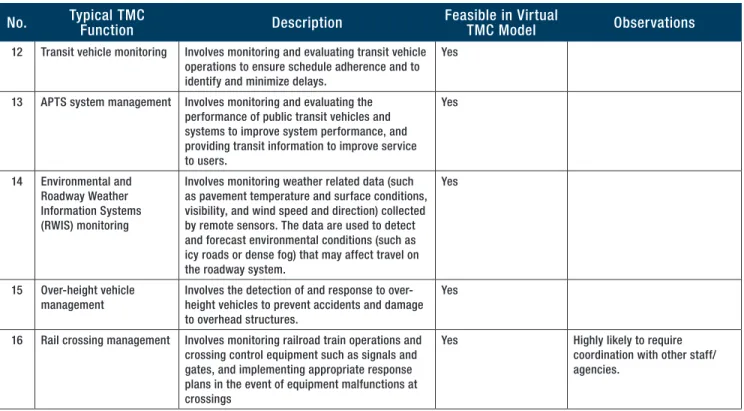
shown in table 1 are the typical functions of a tMC and its relation to a Virtual tMC environment along with any possible constraints.
table 1. common tMc Functions
No. typical tMc Function Description Feasible in Virtual tMc Model observations
1 Provide travel information involves reporting highway conditions, delays, accidents, scheduled construction or other events, and preferred routes. the information may be disseminated through various means, including dynamic message signs, highway advisory radio, the internet, and telephone traveler information systems
Yes
2 Records management involves archiving and retrieving data about the operations and maintenance activities of the tMc. Activities include entering or recording data, generating and storing reports, and facilitating data warehousing.
Yes
3 congestion management involves identifying and responding to recurring congestion resulting from peak travel periods, as well as non-recurring congestion associated with incidents. Responses may include activating ramp meters, posting messages to dynamic message signs, traveler information sites (e.g. 511, wireless apps, etc.), HARs, adjusting signal timing plans among others.
Yes
4 Failure management involves identifying, responding to, and repairing failures of transportation system-related field equipment.
Yes typically repairing failures would be responsibility of the field or maintenance crew.
5 incident management involves detection, verification, response, and clearance of events including multi-car accidents, vehicle breakdowns, and accidents resulting from road debris or weather conditions.
Yes
6 Special event management involves accommodating non-recurring events (such as sporting events, parades, motorcades, and construction) that are expected to have significant impact on the transportation system.
Yes
7 traffic flow monitoring involves viewing traffic data and video images in real time to evaluate traffic conditions for delays and hazards.
Yes
8 emergency management involves coordinating the response of emergency service providers (such as police, fire, eMS, and towing agencies) to emergency conditions (such as incidents, disabled vehicles, and signal malfunctions).
Yes Depending on the systems the VtMc has in place and the operational setting for the VtMc.
9 Provide/coordinate service
patrols involves identifying, verifying, and responding to requests for roadside assistance. Yes Depending on the systems the VtMc has in place. 10 Reversible and HoV lane
management
involves reconfiguring reversible lanes and HoV lanes, by manipulating gates and lane-use signals and visually verifying their status, to manage roadway capacity.
Yes Depending on the systems the VtMc has in place. Highly likely it may require coordination with other staff/parties.
11 traffic signal system
management involves implementing appropriate traffic signal timing plans to optimize arterial street traffic flow, and responding to signal malfunction reports.
Yes Highly likely to require coordination with traffic engineering Dept.
No. typical tMc Function Description Feasible in Virtual tMc Model observations
12 transit vehicle monitoring involves monitoring and evaluating transit vehicle operations to ensure schedule adherence and to identify and minimize delays.
Yes
13 APtS system management involves monitoring and evaluating the performance of public transit vehicles and systems to improve system performance, and providing transit information to improve service to users. Yes 14 environmental and Roadway Weather information Systems (RWiS) monitoring
involves monitoring weather related data (such as pavement temperature and surface conditions, visibility, and wind speed and direction) collected by remote sensors. the data are used to detect and forecast environmental conditions (such as icy roads or dense fog) that may affect travel on the roadway system.
Yes
15 over-height vehicle management
involves the detection of and response to over-height vehicles to prevent accidents and damage to overhead structures.
Yes
16 Rail crossing management involves monitoring railroad train operations and crossing control equipment such as signals and gates, and implementing appropriate response plans in the event of equipment malfunctions at crossings
Yes Highly likely to require coordination with other staff/ agencies.
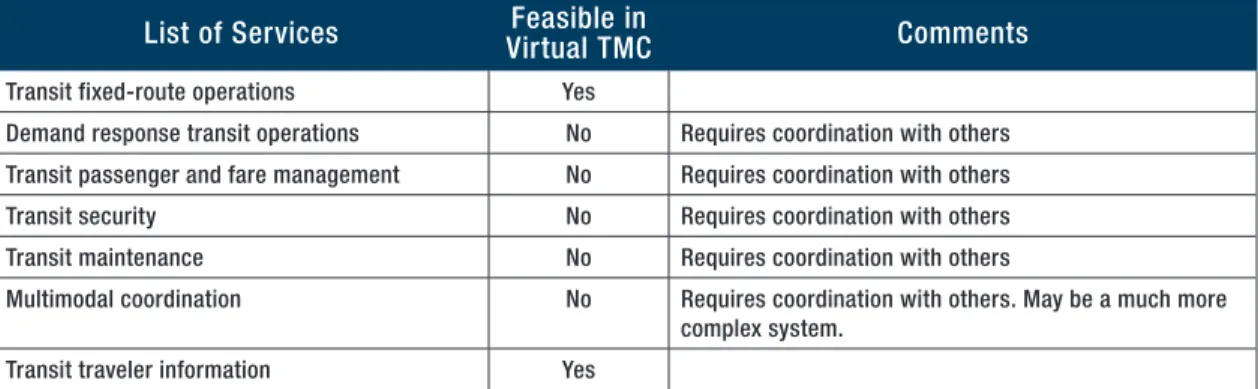
furthermore, the national its architecture provides a more detailed list of activities denoted in table 2. some of these activities may be difficult to perform in a virtual environment as they may require interaction and coordination with other groups within the same agency, external agencies, third-parties, etc.
table 2. Services that a tMc May Perform4
List of Services Virtual tMcFeasible in comments
Network surveillance Yes
Probe surveillance Yes
Surface street control Yes
Freeway control Yes
HoV lane management Yes
traffic information dissemination Yes
Regional traffic control Yes
traffic incident management system Yes
traffic forecast and demand management Yes it needs support from traffic engineers electronic toll collection No Likely only monitoring and reporting emissions monitoring and management Yes
Virtual tMc and smart probe data Yes
Standard railroad grade crossing No too complex of a process Advanced railroad grade crossing No too complex of a process Railroad operations coordination No too complex of a process
Parking facility management No Likely only monitoring and reporting Regional parking management No Likely only monitoring and reporting
Reversible lane management No Requires extensive coordination and sophisticated systems
Speed monitoring Yes
Drawbridge management No too complex of a process Roadway closure management Yes
transit vehicle tracking Yes
4 FHWA, Handbook for Developing a TMC Operations Manual, FHWA-HOP-06-015 (Washington, DC: November 2005). Available at: http://tmcpfs.ops.fhwa.dot.gov/ cfprojects/uploaded_files/Handbook_TMC_Ops_Manual1.pdf
9
List of Services Virtual tMcFeasible in comments
transit fixed-route operations Yes
Demand response transit operations No Requires coordination with others transit passenger and fare management No Requires coordination with others transit security No Requires coordination with others transit maintenance No Requires coordination with others
Multimodal coordination No Requires coordination with others. May be a much more complex system.
transit traveler information Yes
the services mentioned above are accomplished by performing various “functions” described in table 3. table 3. Functions Related to Services that a tMc May Perform
Functions Related to Services Feasible in
Virtual tMc comments
Barrier system management No too complex of a system traffic surveillance data collection Yes
Highway-rail intersection (HRi) traffic management
No too complex of a system Rail operations coordination No Requires additional coordination System management safeguarding Yes
tMc environmental monitoring Yes
tMc evacuation support No Requires additional coordination tMc for Automated Highway Systems (AHS) Yes
tMc freeway management Yes
tMc HoV lane management Yes
tMc incident detection Yes
tMc incident dispatch coordination/ communication
Yes it will require proper systems and tools tMc input to in-vehicle signing No
tMc multimodal coordination No Requires coordination with others. May be a much more complex system.
tMc multimodal crossing management No tMc probe information collection Yes tMc regional traffic control Yes
tMc reversible lane management No too complex of a process tMc signal control No Requires additional coordination
tMc speed monitoring Yes
tMc toll/parking coordination No tMc traffic information dissemination Yes tMc traffic network performance evaluation Yes tMc work zone traffic management Yes
traffic data collection Yes
traffic maintenance No
transit center security No
transit evacuation support No
transit garage operations No
transit environmental monitoring Yes
transit data collection Yes
transit center tracking and dispatch No Requires additional coordination transit center para-transit operations No Requires additional coordination transit center multimodal coordination No
Functions Related to Services Feasible in
Virtual tMc comments
transit garage maintenance No transit center fare and load management No
1.4. Choosing the virtual TmC model
the implementation of a full Virtual tMC model or a hybrid model thereof (which performs certain tMC functions in a virtual manner) requires a series of considerations to ensure it is the most suitable option for an agency or region. this section presents information that can help agencies determine whether a Virtual tMC model is right for them. table 4 outlines the advantages and disadvantageous of Virtual tMC model followed by a series of questions that should be asked prior to deciding upon the implementation of a VtMC.
table 4. Pros and cons of the Virtual tMc Model
Advantages of Virtual tMcs Disadvantages of Virtual tMcs
• Capital cost savings – Eliminates the need to construct TMC facilities which are large and more expensive to build compared to standard office space.
• Recurring Cost Savings – TMC facilities require multiple recurring hardware maintenance contracts to maintain video wall systems, UPS/Generator backup systems, special lighting and fire protection systems, etc. In addition, they require certain hardware systems to be fully replaced after a certain number of years; e.g., video walls.
• Operate from any Location – Virtual TMC operations require computer and software technologies that enable operations from anywhere. This enables operations to still occur during emergency situations when a TMC building may need to be evacuated or when inclement weather makes commuting to physical buildings very difficult.
• Staff Flexibility – With Virtual TMC operations, staff can operate from anywhere including their homes during off peak and weekends. Some agencies that have Virtual TMC capabilities allow such work location flexibility to their staff.
• Staff Security – In certain locations where staff’s physical security is at risk (e.g., at-risk government facilities), moving to a Virtual TMC model where staff are dispersed across multiple remote facilities can be an advantage.
• Multiagency Operations – Virtual TMC operations is more conducive to regional multi-agency operations. Information sharing as well as shared device moni-toring and control are more easily enabled through this model.
• Requires Broader Staff Capabilities – Staff must be able to work independently and be knowledgeable of all SOPS, functions and operations. In a centralized model, tasks could be distributed to different staff more easily.
• Expanded/Revised Training Programs – Operator training should be more extensive and comprehensive in the model so remote operators understand all TMC functions, not just some.
• IT Security – In the Virtual TMC Model, network security systems and policies will likely need to be extended. This will require more expensive hardware and software security systems.
• More Difficult Multi-staff Coordination – Many agencies are dependent upon various staff being in the same physical location to interact; e.g., coordination between DOT and highway patrol staff during incidents.
• Existing Agency Agreements – In many cases, there are existing agency agreements to share and operate facilities and systems together.
• Higher Computer Software and Systems Integration Costs – To enable Virtual TMC operations, more complex and highly integrated software will be needed. • Need for Physical Command Control Center – Many
agencies have the desire for command and control centers where many videos and applications can be displayed and viewed simultaneously on one common display. This will be lost in the Virtual TMC model.
presented below are a number of key questions that agencies should ask themselves in order to help determine whether or not a Virtual tMC is a suitable option for their given environment.
11
• Are you thinking of building a TMC facility, but lack the necessary funding? • Is there a lack of O&E resources to maintain ITS systems including TMCs? • Are your existing TMCs facilities too costly to maintain/operate?
• Is there a desire to start performing operations jointly with multiple agencies? • Are your existing TMC applications integrated into a single platform?
• Are your existing TMC hardware and software systems conducive to Virtual TMC operations, e.g. web-based or do we have a plan to convert them to this?
• Is there a desire to have operations staff dispersed across various physical locations? • Does your agency support the use of web-based, virtual applications?
if the answer to most or all of these questions is yes, then Virtual tMC operations should be investigated as a possibility. if the answer to most of the questions is no, then the next set of questions may further assist an agency not entirely certain that a VtMC implementation is the best solution for them.
• Does your agency have existing TMC facilities in place?
• Is there long-term financial and institutional support to maintain these facilities? • Are there institutional agreements in place to share TMC facilities?
• Is there a lack of multiagency agreements to jointly perform TMC functions?
• Does your agency have multiple separate applications used to perform TMC operations? • Is the IT security policy in place that would prohibit Virtual TMC technology?
• Do you desire you TMC operations staff to physically sit together on one control center or facility? • Are your existing agency TMC software applications thick-client or enterprise based applications?
if the answer to all or most of these questions is yes, then Virtual tMC operations may not be the best solution for that agency. However, if the answer to most of the above questions is “no,” then the agency should continue investigating the VtMC model. as an alternative any agency may also decide to launch a hybrid version of a Virtual tMC.
13
2. CuRRenT TmC oPeRaTional PRaCTiCes
2.1. TmC Deployment models
this section provides a description of the industry’s most common tMC types and models in the united states. there are four (4) typical models:
1. Centralized 2. distributed 3. Virtual 4. Hybrid
it is common for tMCs to use a “hybrid” approach combining characteristics of two or more models. a large number of tMC in the united states have implemented the hybrid model.
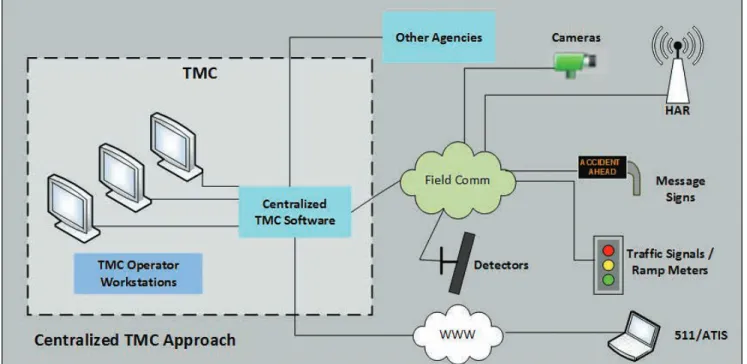
2.1.1. Centralized
this model is usually managed by a single entity and it has straightforward lines of authority as well as established goals and objectives. typically, the operational focus is based on local area issues, although coordination with neighboring agencies may still be necessary depending on existing inter-agency agreements. this approach can be located within the existing agency’s facility and it can be staffed with in-house personnel. However, operations can also be outsourced under the supervision of the agency.
in a centralized model, all systems reside in one location or datacenter (typically the tMC facility). this includes domain authentication services, email, applications, shared files and field devices. remote sites can still have access using thin Client devices and bandwidth-friendly enables (e.g., virtual private network (Vpn) technology). Benefits include lower capital and operational costs, greater data security (all data is stored in a secured datacenter), less backup complexity, co-location of all equipment (e.g., hardware) at one site, and minimized risk areas (e.g., internet access). the disadvantage of this model is that the remote’s sites Wan connection could be a point of failure.
typically, there are two implementation approaches:
• Single Centralized – this application is deployed in an overall region (e.g. Statewide) • Multiple Centralized – this application is deployed in multiple regions, but each
region oversees its own jurisdiction.
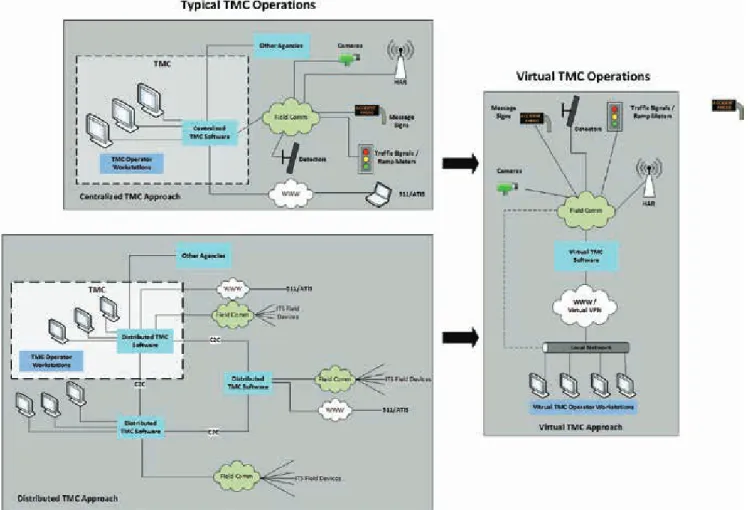
Figure 1. Graph. centralized Approach
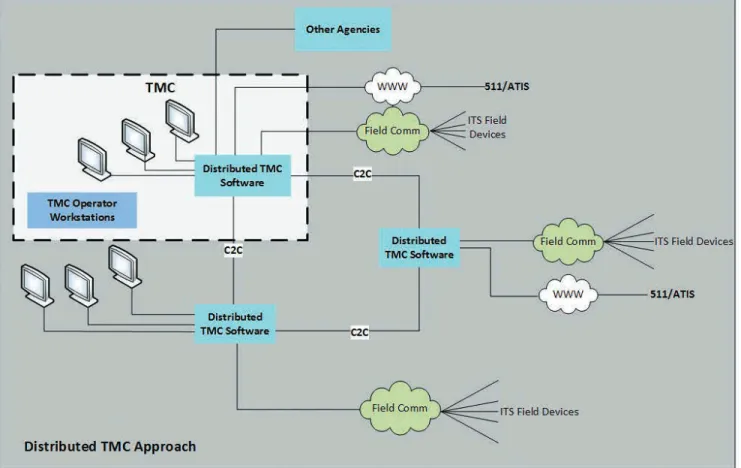
2.1.2. Distributed/Decentralized
this model is a joint program where various agencies reach agreement on policies and practices, structure, funding, staffing, asset sharing, and delineated roles for each agency. Generally, this operational model is applied to larger metropolitan areas that cross several jurisdictional boundaries.
in this model, systems and staff reside in multiple locations/tMCs and certain functions or capabilities are distributed or shared between various centers. this arrangement provides agencies with the ability to maximize resources, increase efficiency, improve working relationships, and share costs.
in this model, each site is mostly self-sustained, although some connectivity to the primary datacenter is required. However, each site is able to hosts its own email server, manage applications, control its internet access, and host its own shared files. the tMC may have virtual control provided through the shared implementation of a wide-area network (Wan). localized management of signals and other traffic control elements ensures that the Wan is used for information and coordination rather than actual operations.
the benefit of this model is that there is no single point of failure as each site can survive on its own. the disadvantage of this model is cost as it requires additional hardware and software as well as support for each site.
15
Figure 2. Graph. Distributed Approach
2.1.3. Virtual
this model may be applied in varying degrees to other operational models, or it may be deployed entirely on its own. Moreover, it needs to be supported with the appropriate its and communication infrastructure, and system security. if deployed on its own, the most common operational approaches include:
• Staffed and operated by a single entity; or
• Managed by a single entity with the operational support of partner agencies.
depending on the jurisdiction, scope, operational approach and geographical area being covered, it may require extensive coordination and cooperation from participating agencies and stakeholders, as well as inter-agency agreements. Virtual access to the system may include both agency and interagency personnel.
under this model, costs may be shared among the participating agencies or may be funded by a single entity.
figure 3 provides a comparison of the Virtual tMC model alongside the two most common traditional models (Centralized and distributed).
Figure 3. Graph. Model comparison
2.1.4. Hybrid: Virtual
this model can be further divided into: Hybrid Centralized and Hybrid distributed. the operational focus may cover an extended geographical area, which may include urban and rural regions.
in the Centralized version, all users are part of the same entity and share the same network. the main difference is that the network can be accessed via intranet or Vpn. for example, district offices may be allowed to enter their own information (e.g. weather information collected from rWis), manage their own events, etc.
in the distributed version, the atMs or any data input system is browser-based and accessible on the internet via Hypertext transfer protocol secure (https) communication protocol. users are able to log into the system from any place with internet connectivity. access to the system will depend on privilege levels assigned to each user.
Currently, the majority of tMCs in north america have virtual capabilities. However, in most instances these have been established for emergency operations or as Backup operations rather than as a stand-alone hybrid model. in addition, typical tMCs are also managed based on their geographic area covered. the range and scope of the geographic service area of a traffic management center is dependent upon institutional, political, and economic considerations as well as the transportation management needs of the area.
17
Figure 4. Graph. Hybrid: Virtual-centralized5
figure 5 depicts the other hybrid model currently deployed in the united states.
Figure 5. Graph. Hybrid: Virtual-Distributed
2.2. Geographic area Covered6
as noted on the tMC Business planning and plans Handbook tMCs may serve single jurisdictions, multiple jurisdictions within a metropolitan area, a large region, or even an entire state. the following terminology is used when describing the various models:
• Jurisdiction – a city, county, or state;
• Agency – a transportation department, public safety department, or emergency management department; and • Discipline – within a transportation agency, you might find a traffic engineering discipline, maintenance
discipline, etc.
2.2.1. Single Jurisdiction TMC
single-jurisdictional tMCs represent the least sophisticated business model arrangement. they serve a single city or county, typically are located in an office area of an existing facility such as a city hall or at the county department of transportation offices. in metropolitan areas with multiple jurisdictions, virtualization may help enable handoffs and coordination of operations with other tMCs through dedicated communications lines and networks.
figure 6 depicts interaction among single jurisdiction, each responsible for their own its equipment (represented as circles in the figure below).
6 FHWA, Transportation Management Center Business Planning and Plans Handbook (Washington, DC: 2005).
19
Figure 6. Graph. illustration of Single-Jurisdiction tMcs7
2.2.2. Multiple Jurisdictions TMC
the multi-jurisdictional tMC controls its field elements in multiple jurisdictions (e.g. cities, counties), irrespective of political boundaries. Consequently, the number of miles of roadway, number of its elements, and the number of stakeholders is significantly larger than would be found in a single jurisdiction tMC arrangement.
figure 7 depicts a tMC that controls its devices (represented as circles in the figure) and operates across political boundaries focusing on an entire metropolitan area.
Figure 7. Graph. illustration of a Multi-jurisdictional tMc8
7 FHWA, Transportation Management Center Business Planning and Plans Handbook (Washington, DC: 2005), p.4-3. Available at: http://tmcpfs.ops.fhwa.dot.gov/cfprojects/uploaded_files/TMC_BPG_Final.pdf
8 FHWA, Transportation Management Center Business Planning and Plans Handbook (Washington, DC: 2005), p.4-4. Available at: http://tmcpfs.ops.fhwa.dot.gov/cfprojects/uploaded_files/TMC_BPG_Final.pdf
Single Jurisdiction
TMC
Single Jurisdiction
TMC
Single Jurisdiction
TMC
Metropolitan Area
Multiple Jurisdiction
TMC
2.2.3. Regional or District TMC
the regional or district tMC business model expands upon the multi-jurisdictional model in that it encompasses additional non-metropolitan areas such as county or state facilities outside of a metropolitan area, in addition to the multiple jurisdictions within the metropolitan area. the mission of a regional or district tMC may include not only urban arterial traffic management, but also the operation and management of suburban, urban freeway, and rural highway and interstate facilities.
figure 8 illustrates that the geographic area of a regional or district area may coincide with dot districts, metropolitan planning areas, or other defined geographic boundaries.
Figure 8. Graph. illustration of a Regional or District tMc9
Virtualization of tMC functions benefits this model in particular by providing a means for mutual access to common systems and for remotely managing other systems (for instance rural systems that may not operate 24-7).
2.2.4. Statewide TMC
a statewide tMC is typically initiated by the state dot, whose geographic service area encompasses the entire state. some of these tMCs are operated by a single agency, while others have received participation from other state agencies such as the state Highway patrol. a statewide tMC can be implemented in a number of ways. the primary differentiator between the various alternatives is the level and scale of central control of the statewide tMC. typically, rural areas are monitored and managed by the statewide tMC while metropolitan areas are under the supervision by regional/district tMCs.
figure 9 is an illustration of a statewide tMC that controls and monitors its devices statewide while a regional tMC still has control over its own area.
9 FHWA, Transportation Management Center Business Planning and Plans Handbook (Washington, DC: 2005), p.4-5.
Available at: http://tmcpfs.ops.fhwa.dot.gov/cfprojects/uploaded_files/TMC_BPG_Final.pdf
Regional or District
Traffic Management
21
Figure 9. Graph. illustration of a Statewide tMc10
2.3. number and Type of agencies involved11
the number and type of agencies (such as a dot, public works, or public safety agency) involved in the tMC significantly affects the functions and activities of the tMC. a number of different business models are available for tMCs relative to the number and types of agencies involved in the tMC planning and operation. furthermore, multiple disciplines from a single agency may be participants in the tMC.
2.3.1. Single Agency TMC
the most common implementation of a tMC serves a single city, one county, or one state. the simplest of these single-jurisdictional tMCs, as described in the previous section, will likely include only a single agency or discipline within that jurisdiction. typically, this would be the traffic engineering agency within a given city or county. Many of the same benefits that apply to a single jurisdiction tMC are applicable to the single-agency tMC model.
2.3.2. Multiple Transportation Agencies
a more sophisticated tMC model arises when transportation agencies from multiple jurisdictions come together to operate a single tMC. an example might be that the dots from two or more cities cooperatively join forces to sustain one tMC to handle both jurisdictions’ transportation management needs. such an arrangement may or may not include the police or emergency management personnel. Many of the benefits of the multiple-jurisdictional tMC are also applicable to the Multiple transportation agencies model.
2.3.3. Multiple Agencies and Disciplines
the Multiple agencies and disciplines tMC model is perhaps the most sophisticated, and as a result the most difficult to implement, but provides the highest potential payoff in terms of improved transportation operations throughout a region. Many of the same benefits of a multi-jurisdictional tMC model are also applicable to the multiple agencies and disciplines model.
10 FHWA, Transportation Management Center Business Planning and Plans Handbook (Washington, DC: 2005), p.4-6.
Available at: http://tmcpfs.ops.fhwa.dot.gov/cfprojects/uploaded_files/TMC_BPG_Final.pdf
11 FHWA, Transportation Management Center Business Planning and Plans Handbook (Washington, DC: 2005).
Available at: http://tmcpfs.ops.fhwa.dot.gov/cfprojects/uploaded_files/TMC_BPG_Final.pdf
Regional or
District TMC
Regional or
District TMC
Statewide Traffic
Management
Center
Regional or
District TMC
GUIDELINES FOR VIRTUAL TMC DEVELOPMENT in this tMC business model, the transportation department, public safety department, emergency management department and transit department, or a combination of these agencies, shares a common facility. the agencies may be from the same jurisdiction, or from multiple jurisdictions. the most typical combination of these agencies includes the collocation of the transportation department and the public safety agency within a single tMC. transportation and public safety are particularly complementary because of the overlap in their missions – to improve the safety of the transportation system, of which incident management is a core component. logistically, the partner agencies are responsible for a common jurisdictional area. as an example, a state dot could co-locate with the state Highway patrol, while the city traffic engineering department co-locates with the local police department.
Historically, emergency management personnel (e.g., fire department) tend to be separate and only in rare instances are they known to co-locate with the transportation and public safety agencies. to help bridge this separation, more and more agencies are providing virtual connections between transportation and emergency management through integrated Cad systems and dedicated communications links so that critical information, including video images, can be shared. Multi-agency tMCs yield significant user, institutional, and system operations benefits.
2.4. interview of Current Deployed models
in order to achieve a better understanding of the current practices related to tMC Virtualization, various transportation agencies including dots were interviewed to determine their approaches to setting up and operating their facilities. ten agencies were interviewed for this guidebook. the questionnaire supplied to them contained 18 questions which were used as input for the information shown in this report. the questions were organized into the following categories:
• General
• Traffic Management System (TMS) / System • Operator Functions
• Virtual Capabilities • Virtual – Cost Benefits • Staffing
• Equipment – Operator Workstation • Shared Operations
• Virtual Operations
• Virtual Implementation Challenges
personnel at the following agencies were interviewed: 1. alabama department of transportation (aldot) 2. los angeles County
3. Metro regional integration of its (riits) 4. Michigan department of transportation (Mdot) 5. Minnesota department of transportation (Mndot) 6. new Hampshire department of transportation (nHdot) 7. oregon department of transportation (odot)
8. san diego iCMs
23 2.5. Profile of the agencies Reviewed
2.5.1. Alabama Department of Transportation
the alabama department of transportation (aldot) is organized into nine geographic regions called divisions, with a Central office located in Montgomery.
Deployment and Operations
there are 140 miles of interstate Highways around the Montgomery region. Currently, the traffic control center oversees 350 traffic signals and red light cameras plus 50-60 CCtVs.
aldot recently procured an atMs system, which is browser-based and can be managed virtually. tMC operations staff and those with user privileges (e.g., supervisors, maintenance staff) will have the ability to perform all atMs activities remotely. However, due to aldot’s network security and rules the atMs won’t be accessible via Vpn. the current Vpn connection has a 22 minute delay and it needs to be upgraded.
figure 10 shows a snapshot of aldot’s traffic conditions in Montgomery County, which is available through the aldot’s website.
Figure 10. Graph. Screen capture from ALDot traffic information and cameras12
Initiatives
aldot is gearing up to open its new statewide regional traffic Management Center (rtMC) in mid-2014. it is planned that the center would cover the road network for the entire state; however, during the initial launch only the Montgomery region and eight adjacent regions in the southeast corner of the state will be covered. the tMC will operate from Monday-friday 6am-6pm with morning and afternoon shifts.
at the opening of the rtMC, operations will not be shared or co-located with any other public agencies, although there is a possibility of doing so in the future with the department of public safety and Highway patrol, the latter operates 24/7. operational sharing with the Highway patrol may provide the rtMC the opportunity to operate around the clock.
the rtMC vision is to have an atMs with virtual functionality in real time at a statewide level. the flexibility of
aldot’s atMs system is that it can be operated remotely. this option may become available once the complete set of performance measures has been identified and coverage expands beyond the original 12 hrs. /day, 5 days/week.
Challenges
the biggest challenge that the rtMC faces is sharing the network with the rest of aldot, which requires authentication through the existing firewall. the ideal situation would be to have two separate networks, with one being for the exclusive use of the rtMC, since it has a set of needs that are distinct from those of the rest of the agency. ideally, the separate network would allow for isp service, and user identification/authorization would be made easier yet still be secure.
2.5.2. Los Angeles County
la County operates signals for a number of cities and unincorporated cities within the county. the tMC is located in alhambra and it operates Monday through thursday from 7am to 5:30pm.
the department is the hub for the traffic Control system in the County. la County also has a center-to-center connection to other cities, where they do not control those cities’ signals, but have viewing capabilities and share data. table 5 provides a snapshot of the number of cities participating in the program.
table 5. LA county overview
traffic control Systems c2c intersections traffic Signals
15 cities 10 cities 670 1800
Deployment and Operations
the system in place is thick client-based with Vpn access. it is in a virtual server platform with a terminal server setup. the system may be accessed remotely, although it is mainly used by maintenance crews and the cities that want access to it.
la County has in place a substantial wireless radio network, which is monitored by their contractors, field maintenance crews, and the department’s it staff.
this is not a traditional tMC, and staff does not have the authority to make decisions regarding timing signals. if changes are needed, they must be approved first by the responsible staff at each agency. if la County staff discovers an issues requiring immediate attention, operators contact the County dispatch. in turn, County dispatch notifies field crews. the agencies are also responsible for the maintenance of their system. However, in unincorporated areas operators can make changes to the signals based on their privileges at the tMC. information is provided to operators by signal timing experts working on synchronization projects.
there are two agreements in place with each of the participating agencies: a Vpn access agreement and a City Cooperative agreement.
Challenges
some of the challenges experienced at the beginning of the program were related to executing agreements with the cities and coordinating implementation with each agency’s it department.
25 2.5.3. Metro Regional Integration of ITS (RIITS)
the los angeles County Metropolitan transportation authority (Metro), sponsors the Metro regional integration of
its (riits) network.13 a number of agencies including Caltrans, City of los angeles department of transportation
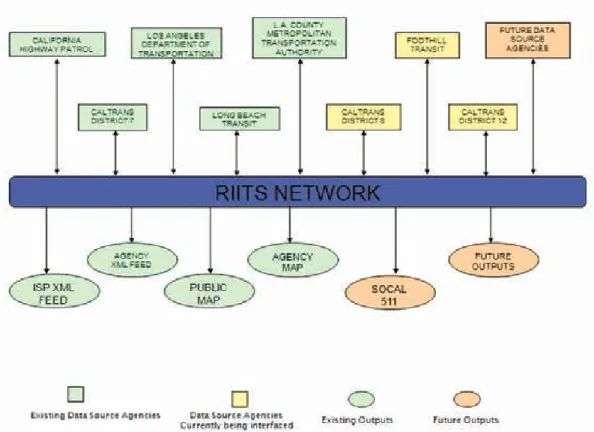
(ladot), California Highway patrol (CHp), long Beach transit (lBt), foothill transit (fHt) and Metro contribute information collected through their own intelligent transportation systems to the network using the los angeles County regional its architecture and national its standards. table 6 shows the number of agencies (125) that participate in the riits program.
table 6. RiitS User Numbers
Users No. of User
LA county 88 agencies
event entry 30 agencies
Active Users (manual) 3 agencies totAL # of agencies - 5 counties: Los Angeles
orange, Ventura, Riverside and San Bernardino.
125 agencies
Deployment and Operations
the riits network supports information exchange in real-time between freeway, traffic, transit and emergency service agencies to improve management of the los angeles County transportation system and better serve the traveling public. riits also provides data to traveler information services of all kinds, which allows them to reach the widest possible audience.
riits is a unique system that combines the data of 125 agencies in the region. it is in essence the largest transportation system in the united states. the program ensures that agencies are able to provide their data to the system by advising each agency of the required hardware and software (e.g. networks, servers, applications (apis)), and by providing training to it staff.
uptime for riits is 88 percent, although the system is currently being updated, and the new goal is to have riits up for 99.5 percent of the time.
riits does not operate as a traditional tMC; there are no riits operators. riits is rather a fully automated system (virtual) running 24/7. each agency is responsible for providing its own data to riits. the system collects events, incidents, scheduled events, freeway performance, real-time transit, arterial traffic signals, and timing plans from all the agencies mentioned above. the information is collected for the counties of los angeles, orange, Ventura, riverside, and san Bernardino. the system belongs to Metro, but the data belongs to each provider.
riits is not a public facing system, the only component that has a Graphical user interface (Gui) is the event entry section. the system is available through the internet but there is ip address security in place. it is configured to receive information from a number of pre-configured ip addresses. event data entry does not reside at the same ip address where data is stored.
agencies can choose to enter their data manually instead of using automation. the system can be accessed through a url on the web or via a mobile application (event entry capability). agencies that have signed up for manual entry have access to the system 24/7.
there are Mous and agency agreements in place, as well as isps/agency agreements. figure 11 depicts the network’s architecture.
13 Los Angeles County Metropolitan Transportation Authority (Metro), “Regional Integration of Intelligent Transportation Systems” website.
Figure 11. Graph. RiitS Network14
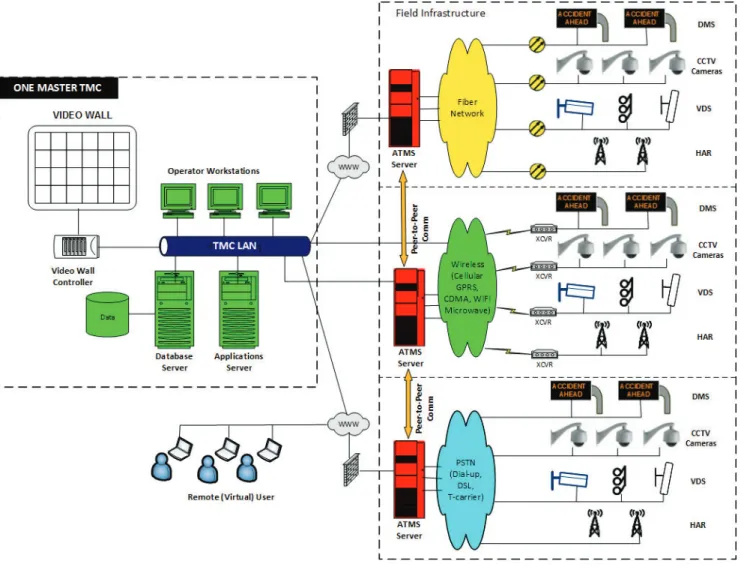
figure 12 depicts the entire diagram of the network including the connection with other agencies.
14 Los Angeles County Metropolitan Transportation Authority (Metro). Regional Integration of Intelligent Transportation Systems (RIITS) website. Available at: www.riits.net
27 Fi gu re 1 2. G ra ph . R iit S N et w or ks P hy si ca l D ia gr am 15 15 Lo s A ng el es C ou nt y M et ro po lit an T ra ns po rt at io n A ut ho rit y ( M et ro ). R IIT S N et w or k O pe ra tio ns a nd M ai nt en an ce M an ua l. A ug us t 2 01 4.
2.5.4. Michigan Department of Transportation Deployment and Operations
the Michigan department of transportation (Mdot) has four tMCs in the state: the south eastern Michigan transportation operations Center (seMtoC) in the detroit Metro region, the statewide transportation operations Center (stoC) in lansing, the West Michigan transportation operations Center (WMtoC) in the greater Grand rapids area, and the Blue Water Bridge (BWB) toC. the seMtoC and statewide toC operate 24/7, while the other two toCs operate only during busy travel times.
the seMtoC manages highway traffic in parts of the Metro region (Wayne, oakland, and Macomb counties). the West Michigan toC manages highway traffic primarily within the region of Grand rapids. the stoC manages traffic across the rest of the state.
Mdot is using a browser based atMs system, which allows devices to be remotely monitored and managed. the atMs is owned by Mdot, but it was developed and it is maintained by a contractor. the atMs provides integrated control of dMs, CCtV and Vds, as well as integrated event Management and response plans (for dMs and notifications).
Michigan’s toCs coordinate response and disseminate information for activities on all Mdot-owned roadways. this includes urban, rural, and interstate facilities. there is coordination with other toCs outside Michigan, and local toCs within Michigan, but there are no formal agreements in place. the Michigan state police dispatch and seMtoC are co-located, and while they work together, there is no formal agreement in place for sharing information. the staff at the toC is contracted and allowed to work alone during overnight shifts. access to the atMs system is provided to toC and Mdot staff. However, there are other users that have access to view information only. Mdot has formal data and video sharing agreements with various agencies and companies, including the national Weather service (nWs), plus many media stations and other traffic information providers.
all centers cover over 1,247 freeway miles, 652 us route miles, and 171 state route miles. operations staff mange 85 CCtVs (with plans to have about 130 more implemented by the end of 2014) and 190 dMss. the network is monitored by toC management.
Challenges
some of the biggest challenges implementing virtual capabilities have been network integration and device communication issues.
29 2.5.5. Minnesota Department of Transportation
Deployment and Operations
the Minnesota department of transportation (Mndot) has in place a regional transportation Management Center (rtMC) comprised of three functional areas all co-located at the center:
• Minnesota State Patrol Dispatch 24/7 • MnDOT Metro Maintenance Dispatch 24/7
• MnDOT Freeway Operations M-F, 4:30am - 10:00pm with limited weekend coverage.
Mndot Metro Maintenance dispatch and freeway operations staff cover the twin Cities Metro area. freeway operations covers urban freeways in the twin Cities Metro area. these roads are interstates, us routes, and state routes. the Minnesota state patrol dispatch covers the northern 2/3 of the state including the twin Cities Metro area. in the twin Cities, cameras and detection cover about 500 miles of freeways. the state patrol has another dispatch center in rochester for the southern 1/3 of the state.
there is an atMs system in place called iris, which is open source software developed in-house by Mndot. the tMC supports onsite and remote control of the Cad system, ramp meters, CCtVs, dMs and lane control devices (see figure 13). iris also allows for streaming video from Mndot’s cameras and camera control. even though the iris system allows for virtual capabilities, in practice Mndot continues to maintain staffing at the rtMC. rtMC operators have remote access to iris, but at this time only supervisors use the system remotely.
local media have iris access to cameras only and use the system to switch camera feeds. the virtual capabilities could be utilized in an emergency should the rtMC be non-functional.
Figure 13. Graph. Screen capture from the iRiS System Showing interstate congestion Levels16
16 Starr, Ray. (2008). Mn/DOT IRIS Software [PP slide 7]. Retrieved from the National Rural ITS Conference:
2.5.6. New Hampshire Department of Transportation Deployment and Operations
the new Hampshire department of transportation (nHdot) has in place a 24/7 statewide tMC. the tMC covers all nH routes throughout the state.
the tMC’s scope includes functions that are atypical of a tMC, such as a statewide dispatch and call center that monitors environmental systems and manages construction work zones. the tMC is also responsible for maintenance dispatch operations and roadside assistance dispatching duties.
nHdot has in place a browser-based atMs system. district offices can access the atMs only through the nHdot Vpn connection. all district offices have been granted access to the atMs with privileges to view other regions’ information. at each district office one operator has access to input information into their Weather Module. district offices are open 24x7 from december to March, and weather data is input on the hourly basis. from april to november, the offices are open only during regular office hours and weather data is input five times per day.
some of the servers are virtualized. network monitoring is performed in house by the dot’s it department.
Figure 14. Graph. Screen capture from New Hampshire Dot17
2.5.7. Oregon Department of Transportation Deployment and Operations
the oregon department of transportation (odot) has in place a 24/7 statewide tMC, which covers the portland Metropolitan and surrounding counties, including part of Wheeler County.
the tMC scope of work includes monitoring and managing freeways, arterial roads and roads owned my odot. the tMC operates CCtVs on freeways and arterial roads, controls VMs, deploys traffic signals, monitors mountain passes and rural areas, and monitors a queue warning system, Vsl, and travel time and curve warning systems (interchange between rural and urban area). in addition, operators also send traffic updates and notifications to various media outlets. tMC operation responsibilities also include dispatching incident response Vehicles to all freeways and some arterials in coordination with 911 to determine appropriate response plans.
odot has in place a browser-based atMs system, which was developed by a private contractor with additional work being done to the system by odot and one of the local universities. the network and the system are monitored by odot’s it department.
the atMs has virtual capabilities including system access and system operations. at this time, only odot personnel have access to the system, including two district offices. these users are connected to odot’s network and do not require Vpn access to manage the atMs. However, designated personnel can view the system remotely. remote connection is possible through Vpn access.
the 911 system is not connected to the atMs, but has shared access to the radio and CCtV feeds through the video switch. odot is working on a Cad interface.