Notice
This document is disseminated under the sponsorship of the U.S. Department of Transportation in the interest of information exchange. The U.S. Government assumes no liability for the use of the information contained in this document. This report does not constitute a standard, specification, or regulation.
The U.S. Government does not endorse products of manufacturers. Trademarks or manufacturers’ names appear in this report only because they are considered essential to the objective of the document.
Quality Assurance Statement
The Federal Highway Administration (FHWA) provides high-quality information to serve Government, industry, and the public in a manner that promotes public understanding. Standards and policies are used to ensure and maximize the quality, objectivity, utility, and integrity of its information. FHWA periodically reviews quality issues and adjusts its programs and processes to ensure continuous quality improvement.Table of Contents
1.0 Introduction ... 1
Freight Transportation Needs ... 2
The Role of the Public Sector in Financing Freight Improvements. 5 2.0 Funding and Financing Tools for Freight Investments... 7
The Federal-Aid Highway System and Federal-Aid Programs... 8
Federal Highway Funding Programs ... 9
Federal Financing Tools ... 26
State Grant and Loan Programs for Freight Improvements ... 33
Other Funding Methods and Financing Tools... 49
3.0 Case Studies of Freight Financing... 59
Arkansas ... 59 California ... 67 Colorado... 72 Delaware ... 74 Florida ... 75 Illinois ... 76 Indiana ... 85 Iowa ... 87 Kansas ... 88 Kentucky ... 89 Louisiana... 90 Maine ... 93 Michigan... 97 Missouri-Kansas... 98 North Carolina ... 100 Nevada... 101 New York... 103 New Jersey ... 108 Ohio ... 110 Oregon ... 113 Pennsylvania... 116 Rhode Island ... 118 South Carolina ... 119 Tennessee ... 122 Texas ... 123 Virginia-West Virginia-Ohio... 126 Washington ... 128 Wisconsin... 133 4.0 References... 137
Federal Funding Programs ... 137
Federal Financing Tools ... 138
State Grant and Loan Programs for Freight Improvements ... 138
Case Studies... 140
Other Resources ... 141
Glossary of Terms... 143
List of Tables
2.1 Federal Funding Programs ... 23
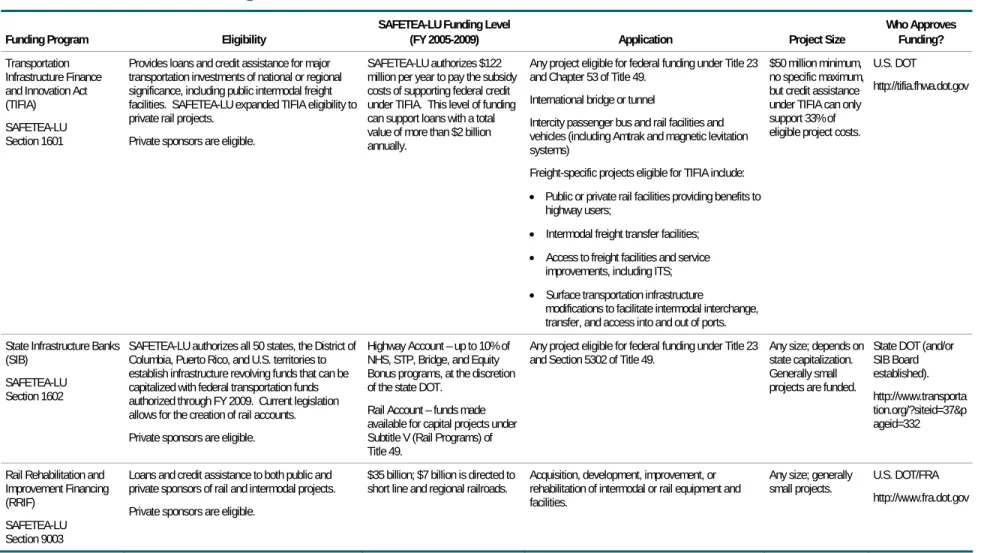
2.2 Federal Financing Tools ... 31
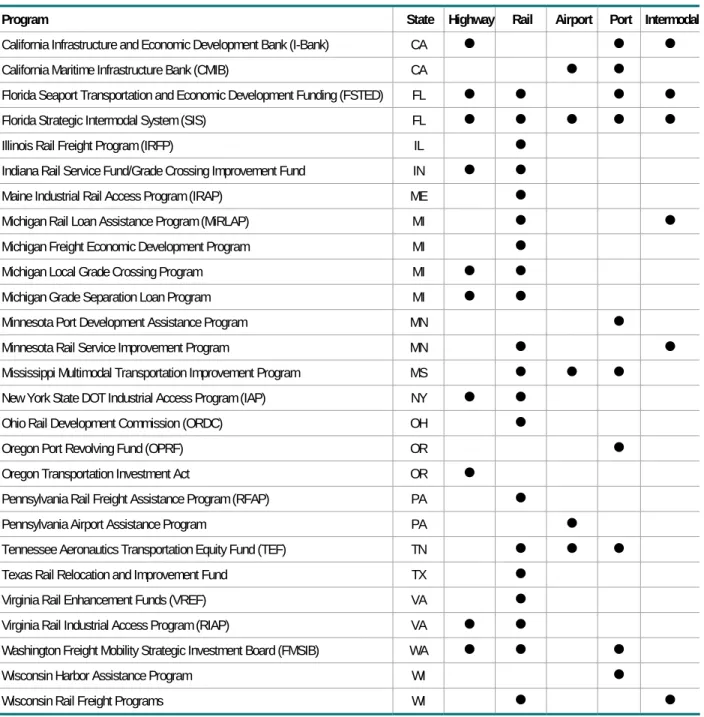
2.3 Illustrative State Grant and Loan Programs ... 34
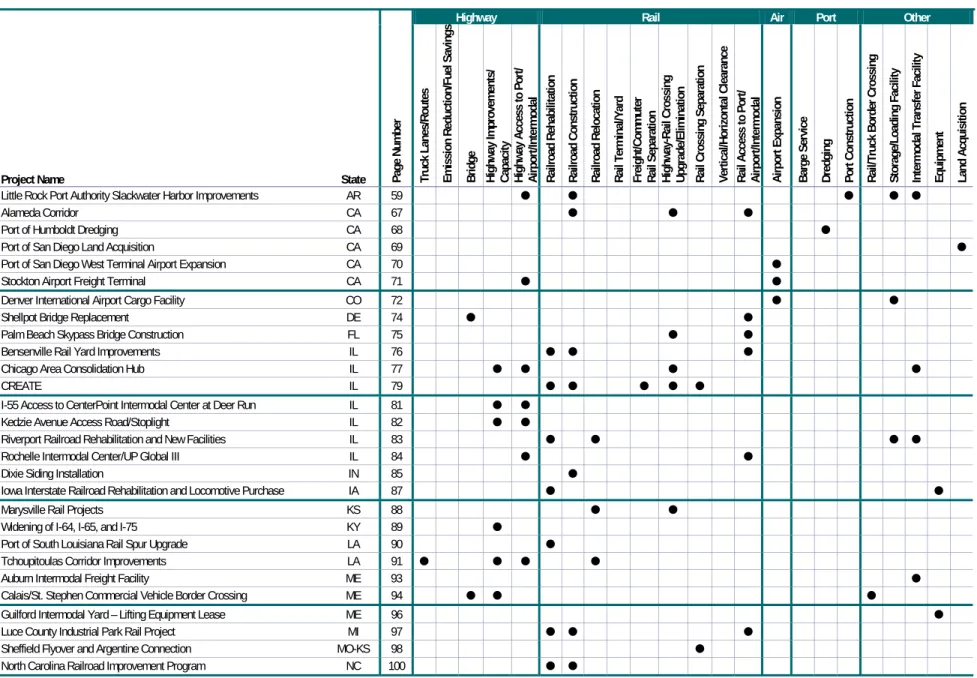
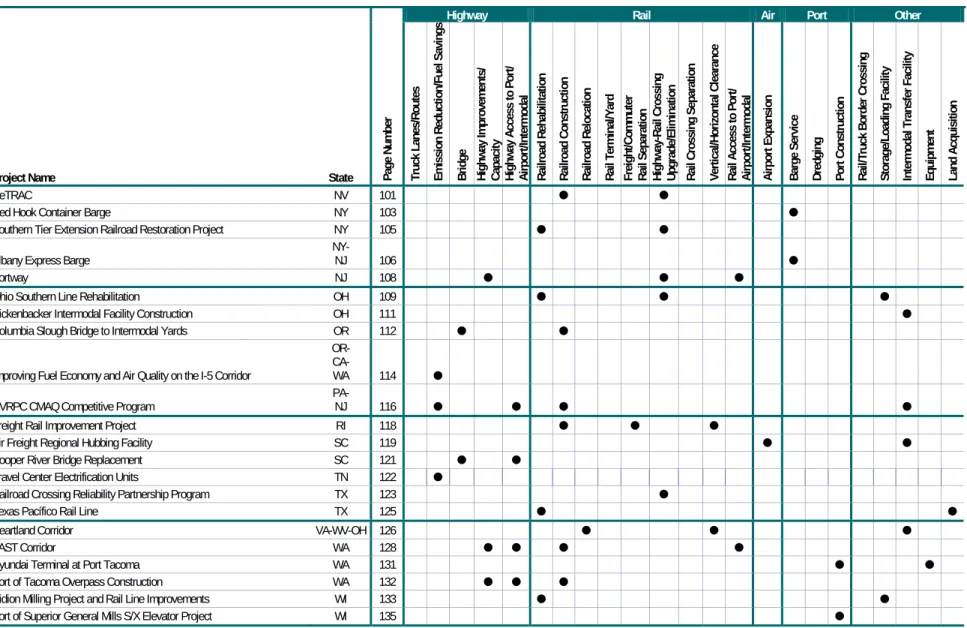
3.1 Case Studies by Project Type ... 61
3.2 Case Studies by Funding Type/Project Size... 63
List of Figures
1.1 2020 Freight Shipments by Mode... 21.0 Introduction
The Federal Highway Administration’s (FHWA) Office of Freight Management and Operations and Office of Planning developed this guidebookas a resource for FHWA, states, metropolitan planning organizations (MPOs), and other parties involved in the identification of freight needs, development of financing plans to fund projects designed to address these needs, and involved in the actual delivery of an eligible project.
This guidebook is composed of four sections:
1. Funding and Financing Tools for Freight Improvements – This section describes existing federal funding programs and
financing tools that could be considered for funding freight improvements. In addition, this section provides an overview of several programs available through the States that have been created to support the increasing need for the public sector to invest in freight-related infrastructure as a way of promoting economic development and addressing multimodal
transportation issues.
2. Case Studies of Freight Financing – Each freight project and the approach to funding various freight projects is unique. Valuable information can be gleaned from investigations into the way that a variety of intermodal freight facility projects have been funded. Obviously, larger, more complex projects require more intricate financial planning and tend to require a wide array of funding instruments in delivery of the project. For this reason, this section provides brief summaries of how various types of freight-related projects were financed.
3. References – Acknowledging that a significant amount of information is readily available to assist in developing funding strategies for freight projects, additional resources beyond the scope of this guidebook can assist in development of a reasonable project financing plan. This section provides links to such freight financing resources, including additional information on federal and state funding and financing programs.
4. Glossary of Terms and List of Acronyms – This section provides descriptions for the various funding categories and terms used in
conjunction with the delivery of intermodal freight facility projects, and a list of acronyms of terms used in the guidebook.
Freight Transportation Needs
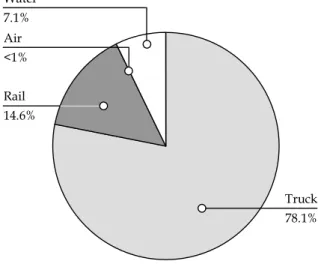
The efficient movement of goods is key to the continued economic health of the nation. Freight shipment tonnage moved by truck, rail, water, and air increased by 20 percent from 1993 to 2002, and is projected to increase by 65-70 percent by 2020. By 2020 (Figure 1.1), trucks are expected to haul about 75 percent of the tonnage, followed by rail (about 15 percent), water (about 7 percent), and air (less than 1 percent).1 The efficient movement of these goods will depend on the availability of a reliable and efficient transportation network, including highways, freight rail lines, airports, ports, intermodal terminals, and intermodal connectors.
Truck 78.1% Rail 14.6% Water 7.1% Air <1%
Figure 1.1 2020 Domestic Freight Shipments by Mode
Trucks carry the largest share of domestic freight movements. In 2002, trucks moved 60 percent of freight by weight. Not surprisingly, truck traffic has doubled over the last 20 years, about the same growth rate as for highway travel as a whole. In 2004, truck traffic accounted for 7.6 percent of the total vehicle-miles traveled (VMT) in the United States, but the impact of truck traffic is noticeable on major routes connecting major population centers, border crossings, and other major hubs of
1 U.S. Department of Transportation, Federal Highway Administration. Freight
activity. According to the 2004 Status of the Nation’s Highways, Bridges, and Transit: Conditions and Performance (2004 C&P Report),2 trucks account for 30 percent of the vehicles on 20 percent of the Interstate System. A study3 on freight bottlenecks on highways found that most bottlenecks are located at Interstate urban interchanges. Overall, highway truck bottlenecks generate 243 million hours of truck delays annually at a cost of $7.8 billion per year.
Congestion is a problem that affects both the movement of people and goods. Between 1980 and 2004, route miles of public roads increased by 4 percent compared with a 94 percent increase in VMT. The 2004 C&P Report estimates the highway capital investment needs, at all levels of government, at $73.8 to $118.9 billion per year (2004 dollars), which is much higer than current funding available. Meeting highway capital investment needs certainly benefits the movement of goods by truck. Other important highway infrastructure investment needs include additional and enhanced rest areas, improvements to intermodal connector facilities, improved operations at gateway and border
crossings, and delivery of safety improvements at rail-highway crossings The physical condition of many existing National Highway System Intermodal Connectors has been identified as a concern along with the adequacy of the mileage designated as intermodal connectors. Many large nationally and regionally significant intermodal freight terminals are connected to higher order roadway networks like the Interstate System by local streets and roads that local governments struggle toward keeping in good physical condition. According to the 2004 C&P Report, about one-third of the intermodal connector system is in need of
additional capacity due to current congestion conditions and over 40 percent of intermodal connector mileage needs some type of pavement or lane width improvement. Improved land access from highway networks to airports and ports is critical for the movement of goods across the nation.
2 U.S. Department of Transportation, Federal Highway Administration, and Federal Transit Administration. 2004 Status of the Nation’s Highway, Bridges, and Transit: Conditions and Performance – Report to Congress. Washington, D.C., February 2006.
3 U.S. Department of Transportation, Federal Highway Administration. An
Initial Assessment of Freight Bottlenecks on Highways. Prepared by Cambridge Systematics and Battelle Memorial Institute. October 2005. Available at http://www.fhwa.dot.gov/policy/otps/bottlenecks/index.htm.
Railroads are currently serving record volumes, despite the fact that rail miles have continued to decline since their peak in the 1920s. Just a two-year comparison of statistics for the seven Class I railroads
operating in the United States shows a decline in rail miles from 97,662 in 2004 to 95,830 in 2005, while tonnage increased from 1.84 billion in 2004 to 1.90 billion in 2005.4 Volumes in 2006 are up 2.8 percent over 2005 through the first 29 weeks of the year.5 Railroads have been reducing track through mergers and branchline rationalization in an effort to reduce costs. Increased volumes are resulting from higher densities on mainlines, which has so far offset traffic lost through the reduction in rail miles. The result is that railroads are currently
operating at capacity in many parts of the country and have little ability to expand their role in freight transportation to more desirable levels. The AASHTO Freight Rail Bottom Line Report6 estimates that shifting all freight rail to trucks would add 92 billion truck VMT, creating the need for an additional $64 billion in highway improvements over the next 20 years. Clearly, it is in the nation’s interest to keep the rail system operating effectively. Assuming rail maintains its current share of freight movements, annual capital for freight system needs were estimated between $5.3 to $11.2 billion.
The interface among major transportation modes (i.e., highway, rail, air and waterborne) is a critical junction point in the freight mobility and goods movement chain. Rail and highway access has been identified as one of the main infrastructure needs at major port and airport locations. In addition, the growth of goods moving through ports and airports has increased considerably in recent years, and is expected to continue growing at an increasing rate. Current and future growth projected in freight demand puts increasing pressure on ports’ and airports’ capacity, especially since demand for port and airport sector has outpaced the growth in capacity.7
4 Association of American Railroads Class I Railroad Statistics. The seven Class I railroads are Burlington Northern Santa Fe, Canadian National, Canadian Pacific, CSX Transportation, Kansas City Southern, Norfolk Southern, and Union Pacific. 5 Association of American Railroads, Freight Traffic Up on U.S. Railroads, July 27,
2006.
6 American Association of State Highway and Transportation Officials.
Freight-Rail Bottom Line Report. Washington, D.C., 2002.
7 Hudson Institute. 2010 and Beyond: A Vision of America’s Transportation Future. Washington, D.C., 2004.
The Role of the Public Sector in Financing
Freight Improvements
The ability of our nation’s transportation system to provide for and maintain the efficient movement of freight is important to the continuing economic health of the United States. Ports, railroads, and intermodal terminals are primarily owned and operated by the private sector. On the other hand, while the trucking industry belongs to the private sector, the infrastructure (i.e., highways) required to move goods by truck is owned and financed, for the most part, by the public sector.
Governments at all levels have a critical interest in the health of the freight transportation network due to its role as an important contributor to local, state, regional and national economic growth and productivity. In addition, there has been increasing discussion over the last several years about government’s role in financing freight-oriented
improvements, including investments in private infrastructure where there is a public benefit and, conversely, private sector investments in public infrastructure where, once again, a public benefit is identified. State and local governments typically have limited experience with financing freight transportation improvement projects. Although most freight projects have been delivered in the form of highway
improvement projects, eligible for the same funds as other highway program projects, they often require a financial plan that includes a variety of funding opportunities derived from multiple sources,
sometimes involving complex public-private partnership arrangements. These projects often require specialized finance skills not typically available within State departments of transportation (DOT),
metropolitan planning organizations (MPOs), or local governmental units (i.e., county, city, town, etc.).
2.0 Funding and Financing
Tools for Freight
Improvement
Improvements
This section provides an overview of existing federal and state funding programs and financing tools that could be used to facilitate freight investments.
Federal programs can be described as one of two types distinguished by the manner in which funding is made available:
1. Funding Programs, that can be targeted to specific projects to address freight transportation needs.
2. Financing Tools, that include loans, credit enhancement, and tax-exempt financing programs. Loans and credit enhancement programs allow states to leverage both public and private resources and stimulate capital investment in transportation infrastructure. Local financing programs can be used to provide property tax relief and other tax benefits for investments made to improve efficiency or increase the capacity of the freight
transportation system by reducing or eliminating tax burdens on interest paid by investors.
Some states have created grant and loan programs to stimulate freight investment. This section also presents information on several of these programs.
Additionally, this section provides an overview of other funding and financing tools – such as dedicated revenue sources, public debt, and institutional arrangements – that have been used by states, local government, and the private sector to finance freight projects.
The Federal-Aid Highway System and
Federal-Aid Programs
The Federal-aid Highway System is defined in law as the National Highway System (NHS). The NHS is comprised of certain roadways identified as being of interest nationally. The NHS includes the Dwight D. Eisenhower National System of Interstate and Defense Highway (the “Interstate System”), the Strategic Highway Network (StraHNet), other Principal Arterial roadways not designated as part of the Interstate or StraHNet systems and connections from the NHS to intermodal or strategic military facilities. Highway program funding is not limited to the Federal-aid System as described above; the Surface Transportation System (STP) funds are viewed as a State administered program and may be used to fund projects on the NHS as well as other roadways not functionally classified as Rural Minor Collectors or Rural and Urban Local System roadways. NHS and STP eligible roadways, thereby, define the roadway systems eligible for federal highway aid. States and MPOs use the funding they receive for a wide variety of highway program-related activities including planning, design,
environmental studies, construction, reconstruction, and improvements on the Federal-aid highway system authorized through legislation enacted by Congress. In general, funding under the Federal-aid
highway program falls into two categories depending on the manner by which they are distributed to the States: apportionments and allocations. A significant difference between apportioned and allocated highway funding programs is that each state is guaranteed to receive funding via apportioned programs each year while there are no guarantees that a particular state will receive highway funding via an allocation in any given year. On a broader level, apportioned programs are guaranteed to be funded each year as long as authorizing legislation is in place while Congress may chose not to fund an authorized allocated program in any given fiscal year.
1. Apportionments are distributed annually to all states via formula provided in law. Apportioned funds are made available to the states through the funding programs authorized by Congress. Once apportionments are distributed to states using these
formulas,8 the use of these funds is subject to statewide and metropolitan planning process requirements provided in law and regulation. Although, the funding is federal, and must be used for projects that fit highway program eligibility criteria and follow all federal environmental and contracting rules (among others), states and MPOs have the discretion to determine which eligible projects will receive funding. The majority of the programs funded through the Highway Trust Fund
(approximately $40 billion annually) are distributed through apportionments, and programmed by state and local
governments and agencies. Thus, freight project sponsors (such as port authorities, local governments, industry members, and others) interested in funding projects with these types of federal-aid funds should work through their state and MPOs, rather than directly through FHWA or U.S. Department of Transportation (U.S. DOT).
2. Allocations. Congress creates and identifies intended funding levels for “discretionary” programs. To select projects under a discretionary program, the U.S. DOT conducts a nationwide selection process among eligible projects, under congressionally mandated criteria. Congress also has chosen to direct federal transportation funding specifically to states, local governments, or projects. This is often referred to as earmarking. In both cases, federal funds are not distributed by formula, but allocated to specific states or projects. Projects seeking discretionary funding under programs created by Congress must participate in the discretionary selection process, as designed by Congress and announced by U.S. DOT, typically in the Federal Register.
Federal Highway Funding Programs
Specific federal funding programs that can be used to fund freight transportation improvements are classified as:
8 Apportionment formulas for Federal-aid Highway Programs are available in Table FA-4A of Highway Statistics, http://www.fhwa.dot.gov/policy/ohim/ hs04/htm/fa4a.htm.
Formula Distributed Highway Funding Programs. These include Interstate National Highway System (NHS), Surface Transportation Program (STP), Interstate Maintenance (IM), and Coordinated Border Infrastructure Program. These programs are typically used to fund highway improvements, although the STP contains provisions for other transportation investments.
1. Special Funding Programs. Programs in this category are identified by their specific program goals and objectives and, consequently, special eligibility criteria. For example, only certain areas, as identified by the U.S. Environmental Protection Agency (USEPA) are eligible to receive Congestion Mitigation and Air Quality Improvement Program (CMAQ) funds and these funds can only be used on projects that can demonstrate a reduction in highway-based vehicle emissions. Also included is Highway Bridge Program, Railway-Highway Crossings, Truck Parking Facilities, Capital Grants for Rail Line Relocation projects, the Fixed Guideway Modernization Program, and other federal funding programs.
3. Discretionary Programs. There are several discretionary
programs that support freight mobility projects, such as Projects of National and Regional Significance (PNRS), National Corridor Infrastructure Improvement Program and the Freight Intermodal Distribution Grant Program. Although most of these programs are fully earmarked in the Safe Accountable, Flexible, Efficient Transportation Equity Act: A Legacy for Users (SAFETEA-LU), they have been included in the guidebook to demonstrate the potential of these discretionary programs to support additional freight investment.
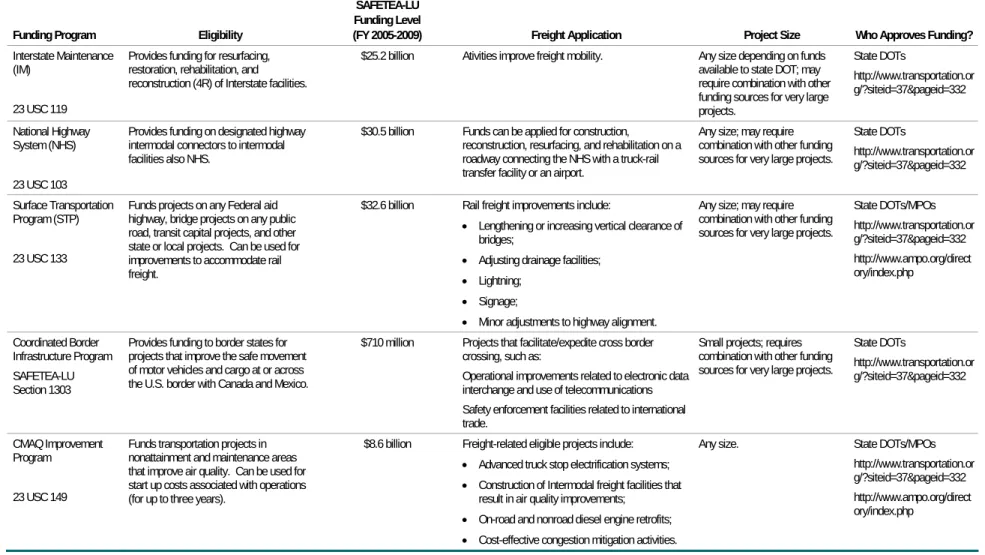
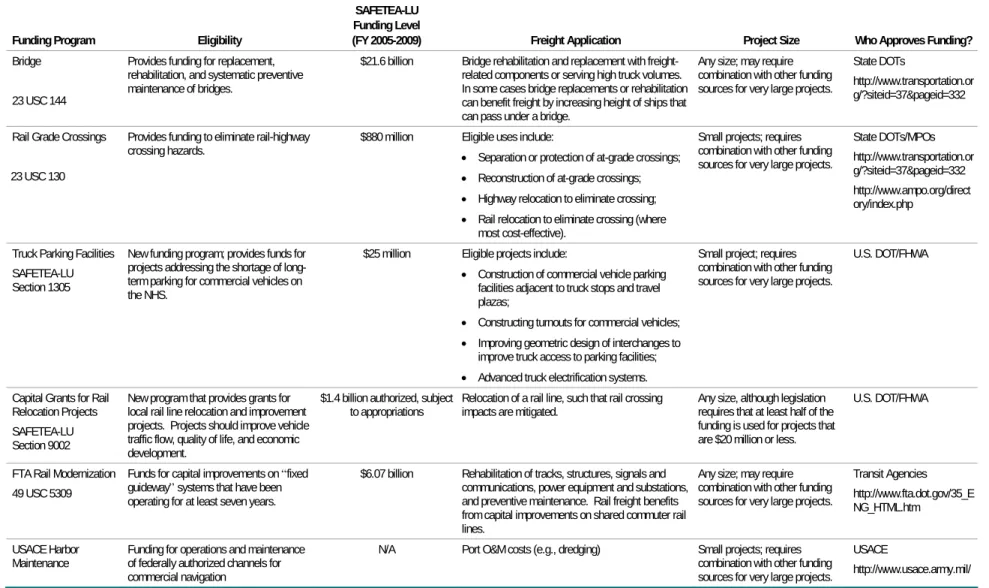
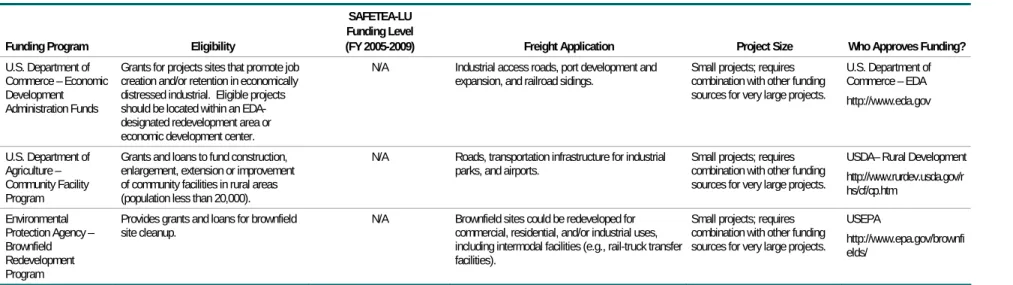
Table 2.1 at the end of the section summarizes the funding programs, including project eligibility and funding levels (where applicable) authorized in SAFETEA-LU for fiscal years (FY) 2005 through 2009.
o Portway (New Jersey) (page 108) o North Carolina Railroad Improvement Program (page 100)
NHS Examples:
H
IGHWAYF
UNDINGC
OREP
ROGRAMSNational Highway System (NHS) – 23 USC 103, 104(b)(1) SAFETEA-LU Funding (FY 2005-2009): $30.5 Billion
The NHS is currently comprised of approximately 160,000 miles (256,000 kilometers) of roadway that have been determined to be important to the
nation’s economy, defense, and mobility. The NHS includes the following five subsystems of roadways: 1) Interstate; 2) Other Principal Arterial; 3) Strategic Highway Network (StraHNet); 4) major strategic highway connectors providing access between major military
installations and StraHNet; and 5) intermodal connectors. The NHS program provides funding for roadways designated as part of the National Highway System, including intermodal connectors between the NHS and intermodal terminals. Eligible activities include construction, reconstruction, resurfacing, and rehabilitation on a roadway connecting the NHS with a truck-rail facility, port, pipeline terminal, or an airport. The federal share of NHS funding is 80 percent. When the funds are used for Interstate projects to add high-occupancy vehicle or auxiliary lanes, but not other lanes, the federal share may be 90 percent. Certain safety improvements listed in 23 USC 120(c) have a federal share of 100 percent.
Surface Transportation Program (STP) – 23 USC 133, 104(b)(3), 140 SAFETEA-LU Funding (FY 2005-2009): $32.6 Billion
The STP program provides flexible funding for projects on any federal-aid highway, bridges on public roads, transit capital investments, and intracity and intercity bus terminals and facilities. Eligible freight projects include:
• Preservation of abandoned rail corridors;
• Bridge clearance increases to accommodate double-stack freight trains;
• Capital costs of advanced truck stop electrification systems; and
• Freight transfer yards.
The federal share of STP funding is generally 80 percent. When the funds are used for Interstate projects to add high-occupancy vehicle or auxiliary lanes, but not other lanes, the federal share may be 90 percent. Certain safety improvements listed in 23 USC 120(c) have a federal share of 100 percent.
STP Examples:
o Railroad Crossing Reliability Program (Dallas-Fort Worth, Texas) (page 123) o Red Hook ContainerBarge (Brooklyn, New York) (page 103) o Port of Tacoma
Overpass (Tacoma, Washington) (page 132)
Interstate Maintenance (IM) – 23 USC 119, 104(b)(4), 118(c) SAFETEA-LU Funding (FY 2005-2009): $25.2 Billion
The IM program provides funding for resurfacing, restoring,
rehabilitating and reconstructing (4R) routes on the Interstate System. These funds cannot be used to provide additional capacity on Interstate routes, and freight-specific projects are not eligible, although some activities may improve freight mobility.
The federal share is 90 percent, subject to the sliding scale adjustment. Certain safety improvements listed in 23 USC 120(c) have a federal share of 100 percent.
Coordinated Border Infrastructure Program – SAFETEA-LU Section 1303
SAFETEA-LU Funding (FY 2005-2009): $833 Million
The Coordinated Border Infrastructure Program provides funding for projects in border states that improve international cross-border
movements of passenger vehicles and cargo. Previously provided as an allocated program, SAFETEA-LU changed the distribution mechanism to formula-based. Funds are distributed by formula to international border states based on factors related to the movement of people and goods through the land border ports of entry within the boundaries of the state as follows:
• 20 percent based on the number of incoming commercial trucks;
• 30 percent based on the number of incoming personal motor vehicles and buses;
• 25 percent based on the weight of incoming cargo by commercial trucks; and
• 25 percent based on the number of land border ports of entry. Eligible projects should be located within 100 miles of the border and may include the construction of transportation and supporting infrastructure, operational improvements, or coordination of planning activities. A border state may use these funds to construct a project in Canada or Mexico, if the project directly and predominantly facilitates cross-border vehicle and cargo movement at an international port of
entry in the border region of the state. Canada/Mexico must assure that the project will be constructed to standards equivalent to those in the United States, and be maintained and used over the useful life of the facility only for the purpose for which the funds were allocated. The federal share is generally 80 percent. When the funds are used for Interstate projects to add high-occupancy vehicle or auxiliary lanes, but not other lanes, the federal share may be 90 percent. Certain safety improvements listed in 23 USC 120(c) receive a federal share of 100 percent.
S
PECIALF
UNDINGP
ROGRAMSCongestion Mitigation and Air Quality Improvement Program (CMAQ) – 23 USC 149, 104(b)(2), 126(c)
SAFETEA-LU Funding (FY 2005-2009): $8.6 Billion
The CMAQ program funds transportation projects and programs that improve air quality (by reducing transportation-related emissions) in nonattainment and maintenance areas for ozone, carbon monoxide (CO), and particulate matter (PM10, PM2.5).
CMAQ funds have been used for freight-related projects that improve air quality by reducing truck, locomotive or other emissions. Examples of CMAQ-funded freight projects include construction of intermodal facilities for moving containers off of highways and onto rail, defraying barge operating costs, rail track rehabilitation, diesel engine retrofits, idle-reduction projects, and new rail sidings. Additionally, though previously eligible, SAFETEA-LU highlighted advanced truck stop electrification system at truck parking facilities, on-road diesel engine retrofits, and other cost-effective mitigation activities as CMAQ eligible projects. In addition, SAFETEA-LU provided new eligibility for nonroad diesel engine retrofit projects.
CMAQ funds may be used to fund construction and other activities that could benefit a private entity, if it can be documented that the project will remove truck traffic on the Federal-aid system or reduce other freight-related emissions, thus improving the region’s air quality. This would be accomplished through a public-private partnership agreement. It is the public-private partnership agreement that allows spending public CMAQ funds on most private freight projects. CMAQ is often the only funding source that many freight projects can access.
CMAQ Examples:
o Dixie Siding Installation(Indianapolis, Indiana) (page 85) o Auburn Intermodal Transfer Facility (Auburn, Maine) (page 93) o DVRPC CMAQ Competitive Program (New Jersey-Pennsylvania) (page 116)
The federal share is generally 80 percent for CMAQ projects. Certain other activities, including carpool/vanpool projects, priority control systems for emergency vehicles and transit vehicles, and traffic control signalization receive a federal share of 100 percent.
Highway Bridge Program – 23 USC 144
SAFETEA-LU Funding (FY 2005-2009): $21.6 Billion
The Bridge Program provides funding for replacement, rehabilitation, and systematic preventive maintenance of bridges. States must use a minimum of 15 percent of the funding for projects on off-system bridges (i.e., on non-federal-aid eligible roadways).
The federal share for all projects, except those on the Interstate System, is 80 percent. For those on the Interstate System, the federal share is 90 percent.
Railway-Highway Crossings – 23 USC 130 SAFETEA-LU Funding (FY 2006-2009): $880 Million
Formerly a set-aside of the STP program, the Railway-Highway
Crossings program provides funding for projects that improve safety at public highway-rail at-grade crossings through the elimination of hazards and/or the installation/upgrade of protective devices at crossings. SAFETEA-LU requires that states set aside at least 50 percent of the funding allocation for the installation of protective devices at rail-highway crossings. If all needs for installation of protective devices have been met, then the funds available can be used for other at-grade
crossing projects eligible under this program. The federal share is 90 percent.
Rail-Highway
Grade Crossing
Examples:
o Ohio Southern Rail Line Rehabilitation (page 109)
o Southern Tier Project (Hornell, New York to Corry, Pennsylvania) (page 105)
Eligible projects include:
• Separation or protection of grades at crossings;
• The reconstruction of existing railroad grade crossing structures; and
• The relocation of highways or rail lines to eliminate grade crossings.
Truck Parking Facilities – SAFETEA-LU Section 1305 SAFETEA-LU Funding (FY 2006-2009): $25 Million
The Truck Parking Facilities is a pilot program that provides grants for projects that address the shortage of long-term parking for commercial vehicles on the NHS. Eligible projects include construction of new or expanded commercial vehicle parking facilities, construction of turnouts for commercial vehicles, improvement to interchanges, electrification systems, and Intelligent Transportation System (ITS) deployments promoting availability of parking.
The federal share for Truck Parking Facilities funding is generally 80 percent. Certain safety improvements listed in 23 USC 120(c) receive a federal share of 100 percent.
Capital Grants for Rail Line Relocation Projects – 49 USC 20154 (SAFETEA-LU Section 9002)
SAFETEA-LU Funding (FY 2006-2009): $1.4 Billion (Subject to annual appropriation)
The Rail Line Relocation Grant program provides grants to states for local rail line relocation and improvement projects that improve rail traffic safety, motor vehicle traffic flow, community quality of life, or economic development, or involve relocation of any portion of the rail line. SAFETEA-LU authorized $350 million per year for FY 2006 through 2009, subject to appropriations. No funds were appropriated for this program in FY 2006. At least 50 percent of the funds shall be awarded for grants of $20 million or less. The federal share shall not be more than 90 percent.
Federal Transit Administration (FTA) Fixed Guideway Modernization Program – 49 USC 5337 (SAFETEA-LU Section 3035)
SAFETEA-LU Funding (FY 2006-2009): $6.1 Billion
FTA’s Fixed Guideway Modernization program provides funding for capital improvements on “fixed guideway” systems, including heavy rail, commuter rail, high-occupancy vehicle (HOV) systems, and light rail. Transit and commuter rail providers are eligible to receive funds from this program for systems that have been in place for at least seven years. The funds are allocated to urbanized areas by statutory formula. Although freight projects are not eligible to use this funding source,
capital improvements on passenger rail lines shared with freight rail could benefit railroads. The federal share for eligible projects is 80 percent.
Federal Aviation Administration (FAA) – Airport Improvement Program (AIP)
AIP Examples:
o Stockton Airport Freight Terminal (California) (page 71) o Air Freight Regional Hubbing Facility (Columbia, South Carolina) (page 119)FAA’s Airport Improvement Program (AIP) provides funding for airport planning and development projects at airports included in the National Plan of Integrated Airports Systems (FAA AIP Handbook). Eligible airports must meet the following criteria:
• Cargo service airports receiving cargo in excess of 100 million pounds annually; and
• Private commercial airports that enplane more than 10,000 passengers annually.
For large and medium primary hub airports, the grant covers 75 percent of eligible costs (or 80 percent for noise program implementation). For small primary, reliever, and general aviation airports, the grant covers 95 percent of eligible costs. Eligible projects include those improvements related to enhancing airport safety, capacity, security, and environmental concerns. In general, sponsors can use AIP funds on most airfield capital improvements or repairs except those for terminals, hangars, and non-aviation development.
O
THERF
EDERALF
UNDINGP
ROGRAMS(N
ON-U.S.
DOT)
U.S. Army Corps of Engineers (USACE) – Harbor Maintenance Trust Fundo
Port of Humboldt Dredging (California) (page 68)Harbor Maintenance
Examples
o Little Rock Port Authority Slackwater Harbor (Arkansas) (page 59)
The Harbor Maintenance Trust Fund (HMTF) provides funding for operations and maintenance (i.e., dredging costs) of federally authorized channels for commercial navigation. Ports located along federal
navigation channels are eligible to receive HMTF funding. The USACE FY 2007 budget includes approximately $2.3 billion for Operations and Maintenance (O&M), of which $707 million (31.3 percent) will be appropriated from the HMTF. The funds are distributed among 21 designated USACE regions. The O&M budget for commercial navigation expenditures is estimated at $1.3 billion (56 percent).
The federal share of O&M expenses funded by HMTF is 100 percent in coastal ports with a harbor less than 45 feet deep, and 50 percent for ports with harbors more than 45 feet deep.
U.S. Department of Commerce – Economic Development Administration (EDA) Funds
EDA provides grants for projects in economically distressed industrial sites that promote job creation and/or retention. Eligible projects must be located within an EDA-designated redevelopment area or economic development center. Eligible freight-related projects include: industrial access roads, port development and expansion, and railroad spurs and sidings. Grantees must provide evidence of economic distress that the project is intended to alleviate. Grant assistance is available up to 50 percent of the project, although the EDA could provide up to 80 percent for projects in severely depressed areas.
During the last quarter of 2005, the EDA announced 117 grants greater than $100,000, totaling almost $103 million. These investments were part of projects that totaled over $240 million. EDA’s Fiscal Year 2004
investments totaled approximately $278 million, with grants ranging from $12,000 to $5.6 million.
U.S. Department of Agriculture (USDA) – Community Facility Program
The USDA Rural Housing Service’s Community Facility Program provides three funding mechanisms to fund construction, enlargement, extension, or improvement of community facilities, providing essential services in rural areas and towns with a population of 20,000 or less. The three programs are 1) Direct Community Facilities loans, 2) Community Facility Loan Guarantees, and 3) Community Facility Grant Program. Grant assistance is available up to 75 percent of the project cost. Eligible transportation-related community facilities include airport hangars, airports, bridges, parking facilities, sidewalks, street improvements, transportation infrastructure for industrial parks, railroads, marinas, municipal docks, and special transportation equipment.
The Community Facility Program provides $297 million in direct loans, $208 million in loan guarantees, and $17 million in grants for FY 2007. The average loan is estimated at $442,000, whereas the average grant is estimated at approximately $32,000. The average loan guarantee is estimated at about $860,000.
EDA Examples:
o Southern TierProject (Hornell, New York to Corry, Pennsylvania) (page 105) o Port of South
Louisiana Rail Spur Upgrade (page 90) o I-55 Access to Center Point Intermodal Center at Deer Run (Joliet, Illinois) (page 81)
Environmental Protection Agency (EPA) – Brownfield Revitalization Program
Through EPA’s Brownfield Revitalization Program, the Federal government provides grants and loans for brownfield site cleanup. Brownfield sites could be redeveloped for commercial, residential, and/or industrial uses, including intermodal facilities (e.g., rail-truck transfer facilities). Site cleanup grants provide up to $200,000 per site to fund cleanup conducted by cities, development agencies, nonprofit groups, and similar entities at sites that they own. A 20 percent match (of funds or in-kind services) is required, although this can be waived in the case of hardship. The Revolving Loan Fund (RLF) grants provide up to $1 million per recipient, available for five years, to establish state or locally administered loan funds. Local governments, states, Indian tribes, and entities such as redevelopment agencies, regional councils, and land clearance agencies are eligible for these capitalization grants. RLF also can make low- or no-interest loans for cleanup. Beginning in FY 2003, recipients may use up to 40 percent of a capitalization award for cleanup subgrants at sites owned by subgrantees. Repayment of
subgrants is not required. A 20 percent non-federal cost share in the form of money, labor, services, or materials is required.
As of May 2006, EPA has awarded 202 RLF grants totaling $186.7 million, and 238 cleanup grants totaling $42.7 million.
D
ISCRETIONARY ANDO
THERP
ROGRAMSThis section presents discretionary and other programs included in SAFETEA-LU that support projects with freight infrastructure elements. Through designation to a specific program, Congress allocates funding to carry out specific projects, or provides a set amount to states for a particular type of transportation investment. Funds from the programs presented below are dedicated to the projects specified in SAFETEA-LU. Discretionary programs are identified for funding at the “discretion” of the Secretary of Transportation or as identified specifically for funding by Congress (also known as “earmarking”). Project sponsors typically submit a request or application and must meet certain eligibility criteria.
High-Priority Projects – 23 USC 117
SAFETEA-LU Funding (FY 2005-2009): $14.8 Billion
The High-Priority Projects Program provides designated funding for specific projects identified in SAFETEA-LU, some of which affect freight mobility. A total of 5,091 projects are identified, each with a specified amount of funding over the five years of SAFETEA-LU. The federal share for projects under this program is generally 80 percent.
Section 1702 of SAFETEA-LU contains the complete list of High-Priority Projects. The full list of projects is available at:
http://frwebgate.access.gpo.gov/cgi-bin/
getdoc.cgi?dbname=109_cong_public_laws&docid=f:publ059.109.pdf. Transportation Improvement Projects – SAFETEA-LU
Section 1934
SAFETEA-LU Funding (FY 2005-2009): $2.6 Billion
The Transportation Improvement provision in SAFETEA-LU provides approximately $2.6 billion for 466 earmarked projects designated under Section 1934. Some of these projects are freight-related and/or may affect freight mobility, including funding allocations for major freight corridor projects such as the Alameda Corridor East (California) and ReTRAC (Nevada). The federal share for Transportation Improvement projects is generally 80 percent and 100 percent for certain safety projects.
Section 1934 of SAFETEA-LU contains a complete list of Transportation Improvement Projects to be funded through 2009. The full list of projects is available at: http://frwebgate.access.gpo.gov/cgi-bin/
getdoc.cgi?dbname=109_cong_public_laws&docid=f:publ059.109.pdf. Projects of National and Regional Significance – SAFETEA-LU Section 1301
SAFETEA-LU Funding (FY 2005-2009): $1.8 Billion
The Projects of National and Regional Significance program provides funding for high-cost projects that are expected to have national and regional benefits, including: 1) improving economic productivity by facilitating international trade; 2) relieving congestion; and 3) improving transportation safety and security by facilitating passenger and freight movement.
Eligible projects include any surface transportation project eligible for federal assistance under 23 USC, including freight railroad projects. The total project cost must be greater or equal to the lesser of $500 million, or 75 percent of the amount of federal highway assistance funds
apportioned to the state where the project is located. The federal share for this program is 80 percent.
SAFETEA-LU authorized $1.8 billion for fiscal years 2005-2009; these funds have been fully earmarked to 25 projects, some of which are freight projects, including the Heartland Corridor (Virginia-West Virginia-Ohio), CREATE (Chicago, Illinois), and the Alameda Corridor East (California). The full list of projects is available on the Office of Operations, Freight Management and Operations Web site,
http://www.ops.fhwa.dot.gov/freight/policy.htm.
National Corridor Infrastructure Improvement Program – SAFETEA-LU Section 130
SAFETEA-LU Funding (FY 2005-2009): $1.9 Billion
The National Corridor Infrastructure Improvement Program is a discretionary program that provides funding for construction of highway projects in corridors of national significance to promote economic growth and international or interregional trade. These corridors of national significance include major freight corridors. SAFETEA-LU authorized $1.9 billion for 33 earmarked projects. The federal share for projects under this program is 80 percent. When the funds are used for Interstate projects to add high-occupancy vehicle or auxiliary lanes, but not other lanes, the federal share may be 90 percent. Certain safety improvements listed in 23 USC 120(c) receive a federal share of 100 percent. The full list of projects is available on the Office of Operations, Freight Management and Operations Web site,
http://www.ops.fhwa.dot.gov/freight/policy.htm.
Freight Intermodal Distribution Grant Program – SAFETEA-LU Section 1306
SAFETEA-LU Funding (FY 2005-2009): $30 Million
The Freight Intermodal Distribution Grant Program is a pilot program that provides funding for intermodal freight transportation and distribution facilities at inland ports and intermodal freight facilities. Projects are intended to relieve congestion, improve safety, facilitate international trade, and encourage public-private partnerships.
SAFETEA-LU authorized $6 million per year through FY 2009. All available funds have been earmarked to six projects. The full list of projects is available on the Office of Operations, Freight Management and Operations Web site,
http://www.ops.fhwa.dot.gov/freight/policy.htm. Ferry Boat Discretionary Program – 23 USC 129(c) SAFETEA-LU Funding (FY 2005-2009): $285 Million The Ferry Boat Discretionary Program provides funds for the
construction of ferry boats and ferry terminal facilities connecting to the NHS. Eligible locations represent logical extensions of the NHS
roadways where construction of a bridge is neither practical or feasible. Ferry boat projects eligible under the program include services designed to carry motor vehicles from one point to another including commercial vehicles. A set-aside of $20 million per year is provided for the
construction or refurbishment of ferry boats and ferry terminals and their approaches that are part of the NHS in the states of Alaska, New Jersey, and Washington.
The remaining funds ($167 million for fiscal years 2006 through 2009) are available for projects on a competitive basis. Because of the large
number of requests, $2 million or less is typically awarded, in order to disburse funding to as many states as possible.
K
EYI
SSUESA
FFECTINGF
EDERALF
UNDINGP
ROGRAMS Although SAFETEA-LU expanded the number and type of funding programs available for freight improvement projects, there remain several key issues affecting the ability of states and MPOs to use these programs or funds from other federal agencies to fund freight-specific projects:• Project Eligibility – The programs described above are limited to specific modes or specific types of projects. CMAQ has been widely used for several freight projects, including public-private partnerships. However, CMAQ funds cannot be used for
highway improvements that increase capacity for single-occupant vehicles, and are limited to projects that improve air quality in nonattainment or maintenance areas. Projects funded by EDA grants must be located in economically distressed areas (as designated by the EDA) and are limited to projects that attract or
retain jobs. While these funding programs are useful for some projects, many freight transportation improvement projects do not meet these specific eligibility requirements.
• Competition from Other Priorities – Traditional programs, such as STP or NHS funds, are more flexible than mode-specific or special programs and can often be used to address a wide range of transportation needs in an area. However, potential freight projects have to compete with other transportation investments for funding under these programs.
• Multijurisdictional Investments – The NHS and STP funding programs may not be eligible for multistate freight investments. Federal-aid funds are allocated by formula and must be matched by state or local funds, making it difficult for states to invest in projects beyond their state boundaries.
• Funding for Complex Projects – Complex projects that include several construction elements could be funded using a
combination of federal programs. For instance, a project that includes improvements on an intermodal connector, bridge rehabilitation, and rail-highway crossing safety improvement would be eligible for NHS, Bridge, and Rail-Highway Grade Crossing funds for respective eligible costs. Examples included in this guidebook in which multiple funding programs have been used to fund freight investments include the North Carolina Railroad Improvement Program (NCRRIP) and the FAST Corridor Program.
Table 2.1
Federal Funding Programs
Funding Program Eligibility
SAFETEA-LU Funding Level
(FY 2005-2009) Freight Application Project Size Who Approves Funding? Interstate Maintenance
(IM) 23 USC 119
Provides funding for resurfacing, restoration, rehabilitation, and
reconstruction (4R) of Interstate facilities.
$25.2 billion Ativities improve freight mobility. Any size depending on funds available to state DOT; may require combination with other funding sources for very large projects. State DOTs http://www.transportation.or g/?siteid=37&pageid=332 National Highway System (NHS) 23 USC 103
Provides funding on designated highway intermodal connectors to intermodal facilities also NHS.
$30.5 billion Funds can be applied for construction,
reconstruction, resurfacing, and rehabilitation on a roadway connecting the NHS with a truck-rail transfer facility or an airport.
Any size; may require combination with other funding sources for very large projects.
State DOTs http://www.transportation.or g/?siteid=37&pageid=332 Surface Transportation Program (STP) 23 USC 133
Funds projects on any Federal aid highway, bridge projects on any public road, transit capital projects, and other state or local projects. Can be used for improvements to accommodate rail freight.
$32.6 billion Rail freight improvements include:
• Lengthening or increasing vertical clearance of bridges;
• Adjusting drainage facilities;
• Lightning;
• Signage;
• Minor adjustments to highway alignment.
Any size; may require combination with other funding sources for very large projects.
State DOTs/MPOs http://www.transportation.or g/?siteid=37&pageid=332 http://www.ampo.org/direct ory/index.php Coordinated Border Infrastructure Program SAFETEA-LU Section 1303
Provides funding to border states for projects that improve the safe movement of motor vehicles and cargo at or across the U.S. border with Canada and Mexico.
$710 million Projects that facilitate/expedite cross border crossing, such as:
Operational improvements related to electronic data interchange and use of telecommunications Safety enforcement facilities related to international trade.
Small projects; requires combination with other funding sources for very large projects.
State DOTs http://www.transportation.or g/?siteid=37&pageid=332 CMAQ Improvement Program 23 USC 149
Funds transportation projects in nonattainment and maintenance areas that improve air quality. Can be used for start up costs associated with operations (for up to three years).
$8.6 billion Freight-related eligible projects include:
• Advanced truck stop electrification systems;
• Construction of Intermodal freight facilities that result in air quality improvements;
• On-road and nonroad diesel engine retrofits;
• Cost-effective congestion mitigation activities.
Any size. State DOTs/MPOs http://www.transportation.or g/?siteid=37&pageid=332 http://www.ampo.org/direct ory/index.php
Table 2.1
Federal Funding Programs (continued)
Funding Program Eligibility
SAFETEA-LU Funding Level
(FY 2005-2009) Freight Application Project Size Who Approves Funding? Bridge
23 USC 144
Provides funding for replacement, rehabilitation, and systematic preventive maintenance of bridges.
$21.6 billion Bridge rehabilitation and replacement with freight-related components or serving high truck volumes. In some cases bridge replacements or rehabilitation can benefit freight by increasing height of ships that can pass under a bridge.
Any size; may require combination with other funding sources for very large projects.
State DOTs
http://www.transportation.or g/?siteid=37&pageid=332 Rail Grade Crossings
23 USC 130
Provides funding to eliminate rail-highway
crossing hazards. $880 million Eligible uses include: • Separation or protection of at-grade crossings;
• Reconstruction of at-grade crossings;
• Highway relocation to eliminate crossing;
• Rail relocation to eliminate crossing (where most cost-effective).
Small projects; requires combination with other funding sources for very large projects.
State DOTs/MPOs http://www.transportation.or g/?siteid=37&pageid=332 http://www.ampo.org/direct ory/index.php
Truck Parking Facilities SAFETEA-LU Section 1305
New funding program; provides funds for projects addressing the shortage of long-term parking for commercial vehicles on the NHS.
$25 million Eligible projects include:
• Construction of commercial vehicle parking facilities adjacent to truck stops and travel plazas;
• Constructing turnouts for commercial vehicles;
• Improving geometric design of interchanges to improve truck access to parking facilities;
• Advanced truck electrification systems.
Small project; requires combination with other funding sources for very large projects.
U.S. DOT/FHWA
Capital Grants for Rail Relocation Projects SAFETEA-LU Section 9002
New program that provides grants for local rail line relocation and improvement projects. Projects should improve vehicle traffic flow, quality of life, and economic development.
$1.4 billion authorized, subject
to appropriations Relocation of a rail line, such that rail crossing impacts are mitigated. Any size, although legislation requires that at least half of the funding is used for projects that are $20 million or less.
U.S. DOT/FHWA
FTA Rail Modernization 49 USC 5309
Funds for capital improvements on “fixed
guideway” systems that have been
operating for at least seven years.
$6.07 billion Rehabilitation of tracks, structures, signals and communications, power equipment and substations, and preventive maintenance. Rail freight benefits from capital improvements on shared commuter rail lines.
Any size; may require combination with other funding sources for very large projects.
Transit Agencies http://www.fta.dot.gov/35_E NG_HTML.htm
USACE Harbor
Maintenance Funding for operations and maintenance of federally authorized channels for commercial navigation
N/A Port O&M costs (e.g., dredging) Small projects; requires combination with other funding
sources for very large projects.
USACE
Table 2.1
Federal Funding Programs (continued)
Funding Program Eligibility
SAFETEA-LU Funding Level
(FY 2005-2009) Freight Application Project Size Who Approves Funding? U.S. Department of
Commerce – Economic Development Administration Funds
Grants for projects sites that promote job creation and/or retention in economically distressed industrial. Eligible projects should be located within an EDA-designated redevelopment area or economic development center.
N/A Industrial access roads, port development and
expansion, and railroad sidings. Small projects; requires combination with other funding sources for very large projects.
U.S. Department of Commerce – EDA http://www.eda.gov U.S. Department of Agriculture – Community Facility Program
Grants and loans to fund construction, enlargement, extension or improvement of community facilities in rural areas (population less than 20,000).
N/A Roads, transportation infrastructure for industrial
parks, and airports. Small projects; requires combination with other funding sources for very large projects.
USDA– Rural Development http://www.rurdev.usda.gov/r hs/cf/cp.htm Environmental Protection Agency – Brownfield Redevelopment Program
Provides grants and loans for brownfield
site cleanup. N/A Brownfield sites could be redeveloped for commercial, residential, and/or industrial uses, including intermodal facilities (e.g., rail-truck transfer facilities).
Small projects; requires combination with other funding sources for very large projects.
USEPA
http://www.epa.gov/brownfi elds/
Federal Financing Tools
Federal financing tools include four mechanisms to finance transportation investments:
1. Loans, where a project sponsor borrows federal highway funds directly from a state DOT or the Federal Government [e.g., State Infrastructure Banks (SIB), and TIFIA loans].
2. Credit Enhancement, where a state DOT or the Federal Government makes federal funds available on a contingent (or standby) basis [e.g., Transportation Infrastructure Finance and Innovation Act (TIFIA) loan guarantees and lines of credit]. Credit enhancement helps reduce risk to investors and thus allows the project sponsor to borrow at lower interest rates.
3. Debt financing through Grant Anticipation Revenue Vehicles (GARVEEs) bonds, where a state DOT can pledge a share of future federal highway funding toward debt service on a long-term bond issue.
4. Special Experimental Project Number 15 (SEP-15), allows the Secretary to waive the requirements of title 23 and the regulations under title 23 on a case-by-case basis. SEP-15 allows FHWA to experiment in four major areas of project delivery – contracting, right-of-way acquisition, project finance, and compliance with the National Environmental Policy Act (NEPA) and other
environmental requirements.
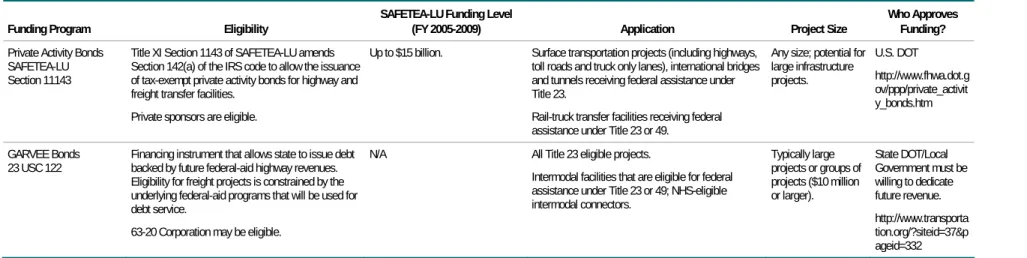
Table 2.2 shows the financing tools that are included in SAFETEA-LU.
T
RANSPORTATIONI
NFRASTRUCTUREF
INANCE ANDI
NNOVATIONA
CT(TIFIA) –
SAFETEA-LU
S
ECTION1601
o ReTRAC (Reno, Nevada) (page 101) o Cooper River Bridge (Charleston, South Carolina) (page 121)
TIFIA Examples:
The TIFIA credit program, originally enacted in the Transportation Equity Act for the 21st Century (TEA-21), was modified by SAFETEA-LU. The strategic goal of this program is to leverage limited federal resources and stimulate private capital investment by providing credit assistance (up to 33 percent of the project cost) for major transportation investments of national or regional significance. Credit assistance is provided
through secured loans, loan guarantees, or lines of credit. Project costs must be at least $50 million or one-third of the state’s annual
apportionment of federal-aid highway funds whichever is less.
SAFETEA-LU expanded TIFIA eligibility to certain private rail projects. Eligibility for freight facilities include:
• Public or private freight rail facilities providing benefits to highway users;
• Intermodal freight transfer facilities;
• Access to freight facilities and service improvements, including capital investments for ITS; and
• Port terminals, only when related to surface transportation infrastructure modifications to facilitate intermodal interchange, transfer, and access into and out of the port.
SAFETEA-LU authorizes $122 million per year to pay the subsidy costs of supporting federal credit under TIFIA. There is no limit on the amount of credit assistance that can be provided to borrowers in a given fiscal year. Repayment of TIFIA loans is required to come from tolls, user fees, or other dedicated revenue sources. As of July 2006, TIFIA assistance amounted to $3.2 billion, leveraging $13.2 billion in
transportation investments for a total of 14 projects. About $994 million in TIFIA debt has been repaid to date. Additional information on this financing program is available at http://tifia.fhwa.dot.gov/.
S
TATEI
NFRASTRUCTUREB
ANKS(SIB) –
SAFETEA-LU
S
ECTION1602
The SIB program, expanded under SAFETEA-LU, allows all states, the District of Columbia, Puerto Rico, and other United States territories to establish infrastructure revolving funds eligible to be capitalized with federal transportation dollars authorized through FY 2009. In addition, the implementation of multistate SIBs is permitted, which may
encourage states to implement and fund projects (including regional freight improvements) that cross jurisdictional boundaries. States also are allowed to create a rail account within the SIB using funds available to capital projects under Subtitle V (Rail Programs) of 49 USC. Through the SIB, states can issue loans and other credit tools to public and private sponsor of transportation infrastructure projects.
The SIB program was created within the Intermodal Surface
Transportation Efficiency Act (ISTEA) legislation, and re-enacted under Transportation Equity Act fro the 21st Century (TEA-21). The first SIB pilot program was open to 10 states, but was expanded to include 38 states plus Puerto Rico. Under TEA-21, only four states (California, Florida, Missouri, and Rhode Island) could transfer additional federal
SIB Examples:
o Ohio Southern Rail Line Rehabilitation (page 109) o Cooper River Bridge (Charleston, South Carolina) (page 121)funding to further capitalize their banks. Other SIBs could continue to operate by using whatever funds had already been deposited in the bank, supplementing the initial capitalization with additional state or local funds.
States participating in the SIB program may capitalize their account(s) in their SIBs with federal surface transportation funds for each of FY 2005-2009 as follows:
• Highway Account – Up to 10 percent of the funds apportioned to the state for the NHS, STP, Bridge, and Equity Bonus.
• Transit Account – Up to 10 percent of funds made available for capital projects under Urbanized Area Formula Grants, Capital Investment Grants, and Formula Grants for Other Than Urbanized Areas.
• Rail Account – Funds made available for capital projects under Subtitle V (Rail Programs) of 49 USC.
• The State must match federal funds used to capitalize the SIB on an 80-20 Federal/non-Federal basis.
Currently 32 states and Puerto Rico participate in the NHS and TEA-21 programs. These states have issued more than $5 billion in loans. No states have entered into cooperative agreement for SAFETEA-LU SIBs to date.
R
AILR
EHABILITATION ANDI
MPROVEMENTF
INANCING(RRIF) –
SAFETEA-LU
S
ECTION9003
o Iowa Interstate Railroad Rehabilitation and Purchase of Locomotives (page 87) o Riverport Railroad Rehabilitation and Yard Expansion (Savanna, Illinois) (page 83)
RRIF Examples
The RRIF program provides loans and credit assistance to both public and private sponsors of rail and intermodal projects. Eligible projects include acquisition, development, improvement, or rehabilitation of intermodal or rail equipment and facilities. Direct loans can fund up to 100 percent of a railroad project with repayment terms of up to 25 years and interest rates equal to the cost of borrowing to the government. Thirteen loans have been issued since 2002 for a total of $517 million. The smallest and largest loans approved were $2.1 million (Mount Hood Railroad) and $233 million (Dakota, Minnesota & Eastern Railroad), respectively.
SAFETEA-LU authorizes $35 billion for this credit program, of which $7 billion is directed to short line and regional railroads. In addition, SAFETEA-LU eliminated two major issues that had made RRIF loans virtually unusable to the railroads. First, it removed the requirement
that collateral be provided. Second, it removed the “lender of last resort” provision, that required applicants to provide evidence that private lending was denied for the project by two lenders.
GARVEE
B
ONDSA Grant Anticipation Revenue Vehicle (GARVEE) bond is a financing instrument that allows states to issue debt backed by future federal-aid highway revenues. Eligibility for freight projects is constrained by the underlying federal-aid highway programs that will be used to repay debt service.
P
RIVATEA
CTIVITYB
ONDSTitle XI Section 11143 of SAFETEA-LU amends Section 142(a) of the IRS Code to allow the issuance of tax-exempt private activity bonds for highway and freight transfer facilities. Therefore, states and local governments are allowed to issue tax-exempt bonds to finance highway and freight transfer facility projects sponsored by the private sector. SAFETEA-LU includes a cap of $15 billion on private activity bonds. Passage of the private activity bond legislation reflects the Federal Government’s desire to increase private sector investment in United States transportation infrastructure. Providing private developers and operators with access to tax-exempt interest rates lowers the cost of capital significantly, enhancing investment prospects. Increasing the involvement of private investors in highway and freight projects generates new sources of money, ideas, and efficiency.
S
PECIALE
XPERIMENTALP
ROJECT15
(SEP-15)
SEP-15 is an experimental process for FHWA to identify, for trial evaluation, new public-private partnership approaches to project delivery. It is anticipated that these new approaches will allow the efficient delivery of transportation projects without impairing FHWA’s ability to carry out its stewardship responsibilities to protect both the environment and American taxpayers.
GARVEE
Examples:
o Rhode Island Freight Rail Improvement Project (page 118) o Widening of I-64,I-65, and I-75 (Kentucky) (page 89)
SEP-15 addresses, but is not limited to, four major components of project delivery:
• Contracting;
• Compliance with environmental requirements;
• Right-of-way acquisition; and
• Project finance.
Elements of the transportation planning process may be also involved. SEP-15 applications may include suggested changes to the FHWA’s traditional project approval procedures and may require some
modifications in the implementation of FHWA policy. Deviations from current title 23 USC, requirements and generally applicable FHWA regulations also may be involved.
K
EYI
SSUESA
FFECTINGF
EDERALF
INANCINGT
OOLS SAFETEA-LU greatly enhanced the loan and credit enhancement programs available to finance freight improvements. Some of these programs are primarily targeted at major transportation improvements, which can limit their applicability in some regions. AlthoughSAFETEA-LU reduced the minimum project size for TIFIA loans, projects must still cost at least $50 million, or one-third of a state’s annual federal-aid apportionments, whichever is less. While some freight projects are large, multimodal projects that fit within this category, many others are small, local roadway, rail, or access projects that do not meet this threshold. SIB loans and GARVEE bonds are more suitable for smaller freight investments.
Table 2.2
Federal Financing Tools
Funding Program Eligibility
SAFETEA-LU Funding Level
(FY 2005-2009) Application Project Size
Who Approves Funding? Transportation
Infrastructure Finance and Innovation Act (TIFIA)
SAFETEA-LU Section 1601
Provides loans and credit assistance for major transportation investments of national or regional significance, including public intermodal freight facilities. SAFETEA-LU expanded TIFIA eligibility to private rail projects.
Private sponsors are eligible.
SAFETEA-LU authorizes $122 million per year to pay the subsidy costs of supporting federal credit under TIFIA. This level of funding can support loans with a total value of more than $2 billion annually.
Any project eligible for federal funding under Title 23 and Chapter 53 of Title 49.
International bridge or tunnel
Intercity passenger bus and rail facilities and vehicles (including Amtrak and magnetic levitation systems)
Freight-specific projects eligible for TIFIA include:
• Public or private rail facilities providing benefits to highway users;
• Intermodal freight transfer facilities;
• Access to freight facilities and service improvements, including ITS;
• Surface transportation infrastructure
modifications to facilitate intermodal interchange, transfer, and access into and out of ports.
$50 million minimum, no specific maximum, but credit assistance under TIFIA can only support 33% of eligible project costs.
U.S. DOT
http://tifia.fhwa.dot.gov
State Infrastructure Banks (SIB)
SAFETEA-LU Section 1602
SAFETEA-LU authorizes all 50 states, the District of Columbia, Puerto Rico, and U.S. territories to establish infrastructure revolving funds that can be capitalized with federal transportation funds authorized through FY 2009. Current legislation allows for the creation of rail accounts. Private sponsors are eligible.
Highway Account – up to 10% of NHS, STP, Bridge, and Equity Bonus programs, at the discretion of the state DOT.
Rail Account – funds made available for capital projects under Subtitle V (Rail Programs) of Title 49.
Any project eligible for federal funding under Title 23
and Section 5302 of Title 49. Any size; depends on state capitalization. Generally small projects are funded.
State DOT (and/or SIB Board established). http://www.transporta tion.org/?siteid=37&p ageid=332
Rail Rehabilitation and Improvement Financing (RRIF)
SAFETEA-LU Section 9003
Loans and credit assistance to both public and private sponsors of rail and intermodal projects. Private sponsors are eligible.
$35 billion; $7 billion is directed to
short line and regional railroads. Acquisition, development, improvement, or rehabilitation of intermodal or rail equipment and facilities.
Any size; generally
small projects. U.S. DOT/FRA http://www.fra.dot.gov