Enterprise Risk Management
Framework
[ Date Approved ] / Version 1.0
Draft v.02
ERM Framework Custodian RBPlat Board
Document Owner Executive: Risk and Assurance
DRAFT Page 2
DOCUMENT HISTORY
REVISION HISTORY
Revision Date Doc Version Summary of Changes Author / Reviewer
04/10/12 0.1 Document Creation Reginald Haman
29/10/12 0.2 Changes from various Executives Reginald Haman
APPROVALS
This policy requires at least signatories from representatives from the following committees:
Name Role Doc Version Approval Signature Date
DISTRIBUTION
This policy has been distributed to:
Name Role Doc Version Consulted / Information Date
DOCUMENT PURPOSE
The purpose of this document is to outline the Enterprise Risk Management (ERM) Framework within RBPlat which contextualizes risk management and describes the components thereof, as a whole, within our business as well as how RBPlat implements these components.
DRAFT Page 3
Table of Contents
1.0 EXECUTIVE SUMMARY ... 5
1.2. ERMOBJECTIVES ... 6
1.3. ERMFRAMEWORK DEVELOPMENT ... 7
2.0 INTRODUCTION ... 8
2.1. THE ENTERPRISE RISK MANAGEMENT ENVIRONMENT ... 9
2.2. THE JOURNEY OF ERM ... 10
3.0 ERM CONTEXT ... 11
3.1. ERMCULTURE -BEHAVIOURS ... 11
3.2. ERMPHILOSOPHY ... 11
3.3. ERMVISION ... 12
3.4. ERMOBJECTIVES ... 13
4.0 ERM FRAMEWORK ... 14
4.1. OVERRIDING PRINCIPLES ... 15
4.2. BUSINESS STRATEGY,ERMSTRATEGY AND RISK APPETITE ... 15
4.3. ERMGOVERNANCE... 19
4.4. ERMPROCESSES ... 34
4.5. RISK CALCULATIONS... 48
4.6. ERMPOLICIES ... 50
4.7. RISK REPORTING ... 53
4.8. ERMCOMMUNICATION,EMBEDDING,MONITORING,REVIEWING AND IMPROVING ... 56
4.9. PEOPLE AND CULTURE ... 58
DRAFT Page 4
Table of Figures
Figure 1: RBPlat ERM maturity model ... 10
Figure 2: RBPlat Risk Philosophy Components... 12
Figure 3: RBPlat ERM Framework ... 14
Figure 4: RBPlat Risk Appetite Approach ... 16
Figure 5: RBPlat Risk Appetite Input Considerations... 16
Figure 6: RBPlat Risk Appetite Decision Filters ... 17
Figure 7: Risk appetite construction ... 18
Figure 8: RBPlat 'Three Lines of Defence' Governance Model... 19
Figure 9: Business Dependency Model ... 39
Figure 10: RBPlat Risk Appetite calculation ... 49
DRAFT Page 5
1.0
EXECUTIVE SUMMARY
The underlying premise of Enterprise Risk Management is that every entity exists to provide value for its stakeholders. All entities face uncertainty and the challenge for management and the Board is to determine how much uncertainty to accept, as it strives to grow stakeholder value. Uncertainty presents both risk and opportunity, with the potential to erode or enhance value. Enterprise Risk Management enables management to effectively deal with uncertainty and associated risk and opportunity, enhancing the capacity to build value.
The aim of the Enterprise Risk Management framework is to provide a structure within which management can operate to enforce the pro-active Enterprise Risk Management process and to inculcate a risk management culture throughout RBPlat and its mining operations and to further ensure that the risk management efforts of RBPlat are optimised.
RBPlat describes risk as the potential that an undertaken action or activity will not result in RBPlat achieving its strategic business objectives but through the use and application of suitable response procedures and/or controls to reduce the impact on strategic business objectives
Some of the key changes affecting the mining industry which are forcing it to dynamically change the way business is conducted includes:
o Introduction of new legislation by regulators and government
o Recent developments in terms of labour relations which will changed the future mining
landscape
o Global economic turmoil and its impact on financial markets
o Challenging operational environment (e.g. costs and grade) in the platinum mining sector
o The impact of climate change and associated catastrophe risks associated therewith
The introduction of these changes to an industry which has been largely relatively stable has led to a focus on risk management.
The development of the ERM framework has been commissioned by the RBPlat Board and Executive Committee who believe it to be good business practice and an integral part of RBPlat’s approach to managing the changes mentioned above. The development of the framework is also a key requirement of King 3 and will enhance compliance to the new Companies Act and other relevant legislation.
1.1.1. ERM Maturity Model
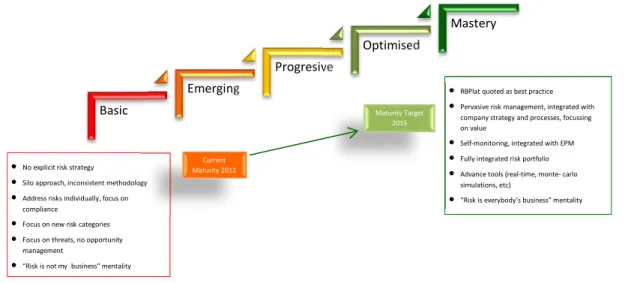
The ERM maturity model (figure 1, pg 10) describes which stages RBPlat (and other organisations) go
through in order to “grow” into mastery in Enterprise Risk Management. While this growth is a long-term process and substantial effort is required to move between each ERM maturity stage, RBPlat is committed to move from its current state (“Emerging”) to a state of “Optimised” by 2015 thereby not only ensuring improved ERM practices but also bringing RBPlat in line with the industry leaders in risk management.
DRAFT Page 6
1.2. ERMOBJECTIVES
The RBPlat ERM Objectives are:
o To support the Board of Directors in its responsibilities with respect to the furtherance of the
safe and sound operation of the business and the protection of all stakeholder interests
o To institute appropriate (with due consideration for the nature, scale, and complexity)
resources, strategies, policies, and procedures for identifying, measuring, monitoring, managing, and reporting of all material risks RBPlat may be exposed to and which is able to be adapted as the business and the external environment change
o Establish an enterprise wide risk awareness culture of identifying, quantifying managing and
reporting of risks within all levels of the organisation i.e. strategic, process, operational level
o Identify and seize business opportunities and meet acquisition targets (where required)
o Enhance the internal control environment in RBPlat
o Ensure Earnings Stability
o Protect against unforeseen losses
o Meet all regulatory requirements where applicable
To support the attainment of these objectives, RBPlat has adopted:
o The implementation of a Risk and Compliance Management Control Function, Internal Audit
Control Function (outsourced) a Sustainable Development Control function, which includes Safety, Health and Environment and Community Development (at the mining operations).
o A Compliance Framework to ensure adherence to all regulatory requirements, including those
pertinent to risks and risk management. In addition, RBPlat will aim to develop and implement:
o An internal Control Framework which will provide management control assurance and will focus
on improving our ability to manage risk effectively, so that we can quickly and confidently act on opportunities to gain competitive advantage, create further value and achieve sustained growth.
o A Governance Framework which will ensure good governance is achieved through the regular
measurement, reporting and communication of risk management performance. This will include measuring the progress of risk management plans and assessing the overall maturity of the risk management programme.
o A Combined Assurance Plan to ensure adequate assurance is provided across the RBPlat
business, especially with financial and operational control systems
RBPlat commits the necessary risk, finance, compliance, internal audit, and governance resources to ensure that the ERM objectives are achieved.
DRAFT Page 7
1.3. ERMFRAMEWORK DEVELOPMENT
The detail contained in the document herein will provide a process for management to guide the pro-active risk and compliance management process and inculcate a risk management culture thereby ensuring that the strategic objectives of the business are optimised. The ERM Framework specifically addresses the structures, processes and standards implemented to manage risks on an enterprise-wide basis in a consistent manner. The framework further addresses the specific responsibilities and accountabilities for the ERM process and the reporting of risks and incidences at various levels within RBPlat ensuring thorough and transparent governance processes
The Framework also aims, to embed the culture and practice of risk management in our day-to-day business activities – aligning strategy, processes, people, technology and knowledge with the purpose of evaluating and managing the uncertainties RBPlat faces in creating stakeholder value. Risk Management must be actively managed and reinforced to ensure that it becomes part of RBPlat’s business culture. Documentation of the ERM framework will provide the initial base for the progression of RBPlat up the ERM maturity scale (described above) to a target state of “Optimised” by 2015. It is prudent to note that concepts documented within this document are in line with existing and anticipated legislation in the mining sector in the forthcoming year. The document owner is very cognisant of the fact that future editions of the ERM framework will take new requirements into account and constant alignment is anticipated.
DRAFT Page 8
2.0
INTRODUCTION
The underlying premise of ERM is that every entity exists to provide value for its stakeholders. All entities face uncertainty and the challenge for management and the Board is to determine how much uncertainty to accept, as it strives to grow shareholder value. Uncertainty presents both risk and opportunity, with the potential to erode or enhance value. Enterprise Risk Management enables management to effectively deal with uncertainty and associated risk and opportunity, enhancing the capacity to build value. Value is maximised when management sets objectives to strike an optimal balance between growth and related risks, and effectively deploys resources in pursuit of the entity’s objectives. It is accordingly accepted by all stakeholders that RBPlat will manage the risks faced in its business in an appropriate manner.
This document outlines the RBPlat Enterprise Risk Management Framework.
The aim of the ERM Framework is to provide a structure within which management can operate to enforce the pro-active ERM process and to inculcate the risk management culture throughout RBPlat and to further ensure that the risk management efforts of RBPlat are optimised. It describes RBPlat’s enterprise risk management processes and sets out the requirements for management in generating risk management action, together with furthering risk management assurance. This document further sets out RBPlat’s approach on the management of risk at all levels of the organisation.
The ERM Framework specifically addresses the structures, processes and standards implemented to manage risks on an enterprise-wide basis in a consistent manner. The standards further address the specific responsibilities and accountabilities for the Enterprise Risk Management process and the reporting of risks and incidences at various levels within RBPlat.
RBPlat describes a risk as the potential that an undertaken action or activity will not result in achieving our strategic business objectives but through the use of suitable response procedures and / or controls, the impact on our strategic business objectives can be reduced. Risk management can thus be defined as activities that are undertaken to reduce exposure to loss. Risk management is of the utmost importance to mining companies because of the inherent high risk environment of the industry. There are a host of activities involved in mining related risk management requiring both specialised skills and centralised oversight to perform successfully. In conjunction, there are also multiple changes currently affecting the mining industry globally and locally and future changes are expected to occur as well and these activities are beginning, appropriately, to fall under tighter executive management scrutiny and control.
Some of the key changes affecting the mining sector which are forcing it to dynamically change the way business is conducted include:
o Introduction of new legislation and codes of good practice by regulators/ legislators
o Changing business environment due to the recent breakdown of employee/ union/ employers
relationships
DRAFT Page 9
o The impact of climate change on mining operations and the potential catastrophe risks
associated therewith
The introduction of these changes to an industry, which has been relatively stable, has led to an increased focus on risk management.
The ERM Framework will focus on the enhancing of governance and control functions as well as appropriate risk management processes to facilitate the financial and business sustainability of mining and related companies. In addition, it will also ensure compliance to existing and forthcoming legislation including but not limited to:
o The Companies Act (Act No. 71 of 2008) (with amendments)
o King Code of Governance Principles (King III)
o ISO 31000:2009 Risk Management Standard
o Mineral and Petroleum Resources Development Act (with amendments)
o Mine Health and Safety Act
o National Environmental Management Act
o National Water Act
o National Energy Act
o Policy and Standards related to Climate risk
o Other relevant legislation
By defining the ERM framework, it lays the platform to ensure effective assurance to internal and external stakeholders that RBPlat is familiar with the risk universe within which it operates, in order to meet its set objectives, and are able to manage it appropriately.
2.1. THE ENTERPRISE RISK MANAGEMENT ENVIRONMENT
2.1.1. RBPlat’s Definition of Enterprise Risk Management
Across RBPlat, value is managed on an enterprise-wide basis, and thus it stands to reason that the risks arising from business activities to create this value should also be managed at the enterprise level. Enterprise Risk Management (ERM) is the process that ensures an integrated approach to the management of risks within a complex and ever changing environment. An integrated ERM framework allows risk-based decision making and provides a streamlined process for evaluating opportunities within the business. An enterprise approach to managing risks involves all functional and/or operational divisions and each employee is encouraged to participate in the ERM process and bears responsibility for conducting at their role in the context of organisational risk management.
The nature of mining is uncertainty, which presents both risk and opportunity, with the potential to erode or enhance value and the challenge for executive management is to determine how much uncertainty to accept in the achievement of our business objectives. Enterprise risk management enables management to effectively deal with uncertainty and the associated risk and opportunity, thus
DRAFT Page 10 Basic Emerging Progresive Optimised Mastery
enhancing the capacity to build value. This implies that risk management is not risk avoidance – it is maximizing the risk/return relationship – it is about taking risks knowingly not unwittingly and is an integral part of good management practice and an essential element of good corporate governance.
2.1.2. Benefits of Enterprise Risk Management
Through the implementation of ERM, the following main benefits can be derived:
o Better alignment between RBPlat’s strategy and the management of risk associated therewith
(which implies an increased likelihood of achieving the strategy)
o Fewer “shocks” and “unwelcome surprises” across the organisation
o Assurance to internal and external stakeholders that RBPlat is aware of its risk and regulatory
universe applicable to its operating environment and is able to manage it adequately
o Ability to better uncover new opportunities and challenges
o Adoption of industry best practice for the management of risk within the mining industry
2.2. THE JOURNEY OF ERM
2.2.1. ERM Maturity Model
The ERM maturity model describes which stages RBPlat (and other organisations) go through in order to “grow” into mastery in Enterprise Risk Management. While this growth is a long-term process and substantial effort is required to move between each ERM maturity stage, RBPlat is committed to move from its current state (“Emerging”) to a state of “Optimised” by 2015 thereby not only ensuring improved ERM practices but also bringing RBPlat in line with best practice for risk management. It will also ensure that other risk categories reach the same level of maturity as the SHE risk management process, but more importantly the full alignment of risk management across the company. ERM is a dynamic concept and the framework will require constant revisiting and updating to meet RBPlat’s strategic objectives and the needs of industry and regulation. The ERM Framework will certainly evolve as RBPlat matures in risk management. The maturity model is displayed below:
Figure 1: RBPlat ERM maturity model
· RBPlat quoted as best practice
· Pervasive risk management, integrated with company strategy and processes, focussing on value
· Self-monitoring, integrated with EPM
· Fully integrated risk portfolio
· Advance tools (real-time, monte- carlo simulations, etc)
· “Risk is everybody’s business” mentality
· No explicit risk strategy
· Silo approach, inconsistent methodology
· Address risks individually, focus on compliance
· Focus on new risk categories
· Focus on threats, no opportunity management
· “Risk is not my business” mentality
Maturity Target 2015
Current Maturity 2012
DRAFT Page 11
3.0
ERM CONTEXT
3.1. ERMCULTURE -BEHAVIOURS
All stakeholders within the RBPlat value chain are responsible for the management of risk in accordance with the RBPlat ERM philosophy. The table below describes the ‘right’ Risk Management behaviours we expect all RBPlat internal stakeholders (e.g. employees, contractors, etc.) and external stakeholders (e.g. associated companies, outsource partners etc.) to have.
What kind of Risk culture do we want? The key Risk Management Behaviours
Behaviour Traits
Stakeholders take ownership for the risks in their environment and understand how they impact on RBPlat.
Good business
understanding o
Stakeholders need to understand, articulate and consistently apply the risk/opportunity 'trade off' in their business decision making
o Stakeholder must be able to identify their risk components and be clear in articulating them
o Stakeholders must be clear on the impact of the risks in their business decision making
o Stakeholders must be able to implement effective controls Stakeholders respond appropriately to
risk information
Timeous and appropriate response to risk situation
o Stakeholders must reacting and respond appropriately to new risk information
o Take correct action where necessary Stakeholders understand the value of
rules and policies, adhere to, and challenge them when necessary
Adherence to
Standards o
Stakeholders understand, comply to and advocate the use of all risk policies, standards and governance frameworks across RBPlat
o Rules are adhered to and where not, they are openly challenged Confidence to highlight and challenge
inappropriate decisions and information
Clear, open communication channels
o Risk issues are openly raised, questioned and highlighted. There is receptiveness to delivering or receiving bad news
o Being prepared to challenge and be challenged The right risk decisions are made by the
right people
Confidence o Stakeholders feel empowered to make risk based decisions within a limits and authority framework
Risk information openly and transparently shared between teams
Collaborative
communication o
Risk information flows openly within and across the organisation
o Risk information is shared and used constructively Table 1: Table of the ‘right’ Risk Management behaviours
3.2. ERMPHILOSOPHY
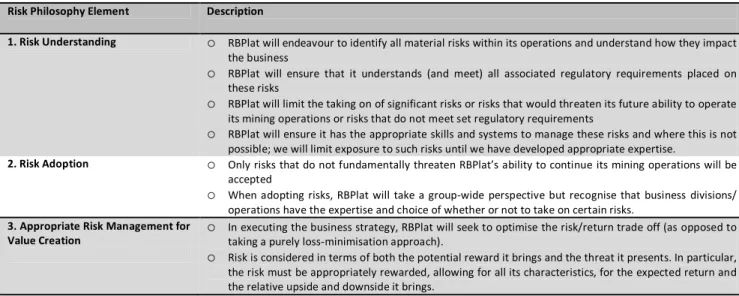
RBPlat views risk not only as a threat or uncertainty, but also as an opportunity to grow and develop the business, within the context of our risk appetite. The underlying premise of the RBPlat Risk Management philosophy is a thorough understanding of the risk exposures of RBPlat in order to ensure that management and the Board are appropriately informed to take strategic decisions in the interests of the shareholder and other stakeholders. The risk management system, policies and procedures should be embedded within the organisational culture and be consistent with our long term strategy.
DRAFT Page 12 Our risk philosophy is the foundation for our risk strategy and is comprised of three elements:
Figure 2: RBPlat Risk Philosophy Components
Risk Philosophy Element Description
1. Risk Understanding o RBPlat will endeavour to identify all material risks within its operations and understand how they impact the business
o RBPlat will ensure that it understands (and meet) all associated regulatory requirements placed on these risks
o RBPlat will limit the taking on of significant risks or risks that would threaten its future ability to operate its mining operations or risks that do not meet set regulatory requirements
o RBPlat will ensure it has the appropriate skills and systems to manage these risks and where this is not possible; we will limit exposure to such risks until we have developed appropriate expertise.
2. Risk Adoption o Only risks that do not fundamentally threaten RBPlat’s ability to continue its mining operations will be accepted
o When adopting risks, RBPlat will take a group-wide perspective but recognise that business divisions/ operations have the expertise and choice of whether or not to take on certain risks.
3. Appropriate Risk Management for
Value Creation o
In executing the business strategy, RBPlat will seek to optimise the risk/return trade off (as opposed to taking a purely loss-minimisation approach).
o Risk is considered in terms of both the potential reward it brings and the threat it presents. In particular, the risk must be appropriately rewarded, allowing for all its characteristics, for the expected return and the relative upside and downside it brings.
Table 2: RBPlat Risk Philosophy Element Descriptions
3.3. ERMVISION
The RBPlat ERM Vision Outcomes:
o Risk Management is driven from the top
o Risk Management meets all internal and external stakeholder requirements
o RBPlat has a comprehensive understanding of the risks it faces as a business
o RBPlat is confident in its selection of which risks to adopt and how to manage them
o Risk management techniques are consistently applied to generate value
o Effective risk management is an inherent part of all our day-to-day roles, thus enhancing the
quality of strategic, capital allocation and day-to-day business decisions
o Staff remuneration and incentives explicitly take into account the extent to which risk
exposures have linked into results delivered, and whether these risk exposures have complied with the agreed risk appetite
DRAFT Page 13
3.4. ERMOBJECTIVES
The RBPlat ERM Objectives are:
o To support the Board of Directors in its responsibilities with respect to the furtherance of the
safe and sound operation of the business and the protection of all stakeholder interests
o To institute appropriate (with due consideration for the nature, scale, and complexity)
resources, strategies, policies, and procedures for identifying, measuring, monitoring, managing, and reporting of all material risks RBPlat may be exposed to and which is able to be adapted as the business and the external environment change
o Establish an enterprise wide risk awareness culture of identifying, quantifying managing and
reporting of risks within all levels of the organisation i.e. strategic, process, operational level
o Identify and seize business opportunities and meet acquisition targets (where required)
o Enhance the internal control environment in RBPlat
o Ensure Earnings Stability
o Protect against unforeseen losses
o Meet all regulatory requirements where applicable
To support the attainment of these objectives, RBPlat has adopted:
o The implementation of a Risk and Compliance Management Control Function, Internal Audit
Control Function (outsourced) a Sustainable Development Control function, which includes Safety, Health and Environment and Community Development (at mining operations).
o A Compliance Framework covering all the approach to adhering to all regulatory requirements,
including those pertinent to risks and risk management. In addition, RBPlat will aim to develop and implement:
o An internal Control Framework which will provide management control assurance and will focus
on improving our ability to manage risk effectively, so that we can quickly and confidently act on opportunities to gain competitive advantage, create further value and achieve sustained growth.
o A Governance Framework which will ensure good governance is achieved through the regular
measurement, reporting and communication of risk management performance. This will include measuring the progress of risk management plans and assessing the overall maturity of the risk management programme.
o A Combined Assurance Plan to ensure adequate assurance is provided across the RBPlat
business, especially with financial and operational control systems
RBPlat commits the necessary risk, finance, compliance, internal audit, and governance resources to ensure that the ERM objectives are achieved.
DRAFT Page 14
4.0
ERM
F
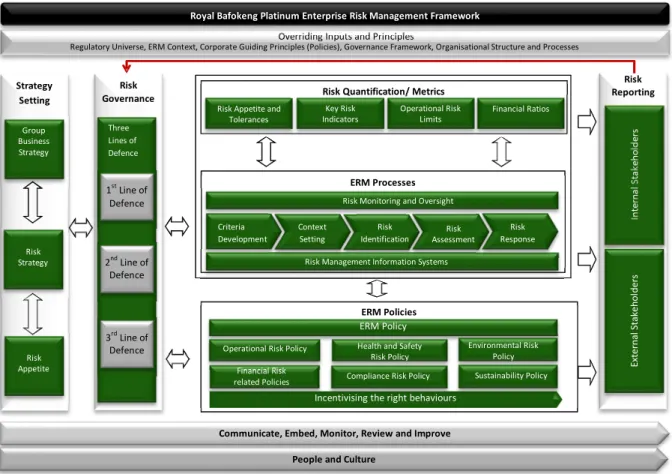
RAMEWORKThe aim of the RBPlat ERM Framework (“the Framework”) is to provide a process for management to guide the pro-active risk and compliance management process and inculcate a risk management culture thereby ensuring that the strategic objectives of the business are optimised. The ERM Framework specifically addresses the structures, processes and standards implemented to manage risks on an enterprise-wide basis in a consistent manner. The framework further addresses the specific responsibilities and accountabilities for the ERM process and the reporting of risks and incidences at various levels within RBPlat ensuring thorough and transparent governance processes
The Framework also aims, to embed the culture and practice of risk management in our day-to-day business activities – aligning strategy, processes, people, technology and knowledge with the purpose of evaluating and managing the uncertainties RBPlat faces in creating stakeholder value. Risk Management must be actively managed and reinforced to ensure that it becomes part of RBPlat’s business culture.
Figure 3: RBPlat ERM Framework
The RBPlat ERM Framework comprise of 9 key components, namely: 1. Overriding Principles
2. Business Strategy, ERM Strategy and Risk Appetite 3. ERM Governance
4. ERM Processes
ERM Policies ERM Processes Risk Quantification/ Metrics Risk Governance Three Lines of Defence Strategy Setting Risk Reporting Risk Strategy Risk Appetite Group Business Strategy
Risk Monitoring and Oversight Criteria
Development
Risk Identification Risk Management Information Systems
ERM Policy
Financial Risk related Policies
Operational Risk Policy Health and Safety
Risk Policy
Overriding Inputs and Principles
Regulatory Universe, ERM Context, Corporate Guiding Principles (Policies), Governance Framework, Organisational Structure and Processes
Internal Stakeholders
External Stakehol
ders
Communicate, Embed, Monitor, Review and Improve
People and Culture
Risk Assessment Risk Response 1st Line of Defence 2nd Line of Defence 3rd Line of
Defence Environmental Risk
Policy Context
Setting
Sustainability Policy Compliance Risk Policy
Incentivising the right behaviours
Risk Appetite and Tolerances Key Risk Indicators Operational Risk Limits Financial Ratios
DRAFT Page 15 5. Risk Quantification
6. ERM Policies 7. Risk Reporting
8. ERM Communication, Embedding, Monitoring, Reviewing and Improving 9. People and Culture
4.1. OVERRIDING PRINCIPLES
The following key inputs and overriding principles are continually kept in consideration throughout the Framework:
o ERM Context (described in section 2 above)
o Any regulatory requirements
o Royal Bafokeng Holdings/ Anglo American Platinum Guiding Principles (Policies),
o Governance Framework,
o Organisation Structure & Processes
4.2. BUSINESS STRATEGY,ERMSTRATEGY AND RISK APPETITE
4.2.1. RBPlat Group Business Strategy
The RBPlat Business Strategy is developed by RBPlat senior management level and approved by the Board as part of a continuous business review process with consideration of the internal and external environment in which RBPlat operates. Business strategy and plans are independently developed for BRPM and Styldrif operations, which forms the foundation of the overall business strategy and strategic plan for RBPlat. It is used as a primary input to the development of the RBPlat Risk Strategy and RBPlat Risk Appetite.
4.2.2. Risk Strategy
Using the RBPlat business strategy as an input, the RBPlat risk strategy will be developed and approved by Board. The risk management strategy includes the risk management objectives, risk management principles and assumptions, risk appetite (in terms of monitoring exposures against tolerances), and assignment of risk management responsibilities across all the activities of RBPlat, consistent with RBPlat’s overall business strategy.
A clearly articulated Risk Strategy for RBPlat thus leads to:
o A guideline for the immediate objectives and focus areas for Risk management within RBPlat
o Transparency and clarity across the business and external stakeholders as to the nature and size
of risks RBPlat wants to take on
o A link between the RBPlat business strategy and the defined risk appetite
DRAFT Page 16
4.2.3. Risk Appetite
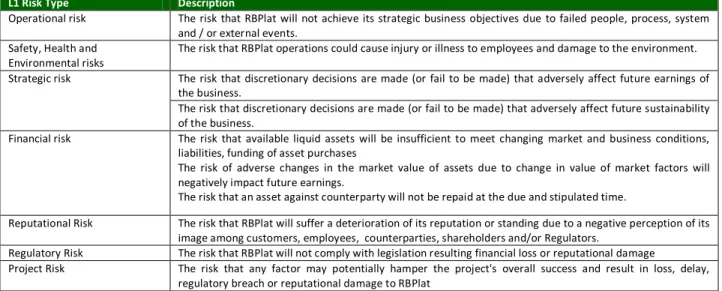
Using the RBPlat Business Strategy and RBPlat Risk Strategy as inputs, the RBPlat Risk Appetite Statement will be developed. The Risk Appetite Statement will be used to inform the Target Risk Profile and Risk Appetite Limits for each Level 1 Risk Category (see Risk Categorisation), reflecting an appropriate balance between risk and return which in turn serve as an input to the risk strategy and business strategy.
4.2.3.1. Risk Appetite Approach
o The approach taken to construct the Risk Appetite is depicted below.
Figure 4: RBPlat Risk Appetite Approach
4.2.3.2. Stakeholder Risk Appetite Expectations
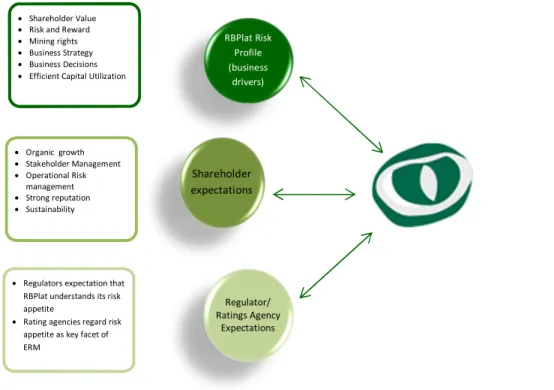
The RBPlat Board has the ultimate responsibility for Risk Management within RBPlat which includes the development of the risk appetite as well as the setting and monitoring of risk tolerances. In line with the above, the following are considered in developing the risk appetite statements and tolerances:
Figure 5: RBPlat Risk Appetite Input Considerations
Risk Appetite Planning
Develop Risk Mandate
• Mandate from Board • Risk Appetite Framework Business Environment • Understand corporate strategy
and risk profile
• Identify stakeholders and their expectations
Develop Risk Appetite Governance
• Accountability and reporting
• Risk Appetite filters Define Appetite, Tolerances and
Limits
Risk Appetite Statement design
Risk Appetite • Propensity to take risk • Develop Company wide risk appetite Risk Tolerances
• Propensity to exercise control • Identify risks to manage • allocate tolerances to set risk appetites • Measurement
Risk Limits
• Define limits and/or targets for each risk • Monitoring
Reconcile Risk Profile and
Appetite
Risk Profile
• Measure current risk profile for each risk • Aggregate individual risks to produce
overall risk profile
Profile vs Appetite • Compare aggregate appetite and profile • Adjust risk profile and/or appetite to
ensure allignment Implement, Monitor &
Report
Risk Appetite Statement • Obtain board approval • Roll-out and implement • Monitor and report
RBPlat Risk Profile (business drivers) Shareholder expectations Regulator/ Ratings Agency Expectations · Shareholder Value
· Risk and Reward
· Mining rights
· Business Strategy
· Business Decisions
· Efficient Capital Utilization
· Organic growth · Stakeholder Management · Operational Risk management · Strong reputation · Sustainability
· Regulators expectation that
RBPlat understands its risk appetite
· Rating agencies regard risk
appetite as key facet of ERM
DRAFT Page 17
4.2.3.3. RBPlat Group Risk Appetite Filters
A “filter” approach (depicted below) will be used to determining whether any proposed significant change in business (e.g. acquisitions, technology or process change, regulatory change, etc.) should be undertaken. The propensity, capacity and appetite for business risks associated with business opportunities that RBPlat Group is prepared, willing and able to accept, mitigate and manage can be represented by this approach. This will in turn confirm whether RBPlat Group is prepared to accept the associated risks and uncertainty associated with the opportunity. Each business operation and functional area will be required to follow a formal process and apply the filters when making business decisions to adopt the change. This process will include the completion of formal templates and/or documents demonstrating how the filters were applied as well as motivation for the new/additional risk.
Figure 6: RBPlat Risk Appetite Decision Filters
4.2.3.4. Risk Appetite Statement Design
The Statement is designed to support the RBPlat’s prevailing business strategy and is intended to facilitate decision-making on an informed basis such that there is a direct correlation between RBPlat’s strategy and its risk appetite.
A comprehensive Risk Appetite Statement therefore ensures that decisions are made on an informed basis and that there is a direct correlation between RBPlat’s strategy and its risk appetite. The Statement provides a clear reference point to monitor risk taking and to trigger appropriate action as the boundaries are approached (or breached).
The statement is designed to force the RBPlat Group to include risk factors in any major strategic or tactical decision and ask the question: ‘Is this course of action compatible with our risk appetite?’ The objective of the Statement is two-fold:
o To detail the risk agenda of the RBPlat externally to the market place; and
o To provide the basis for an internal risk limit structure consistent with Board strategy
The Statement is constructed as follows:
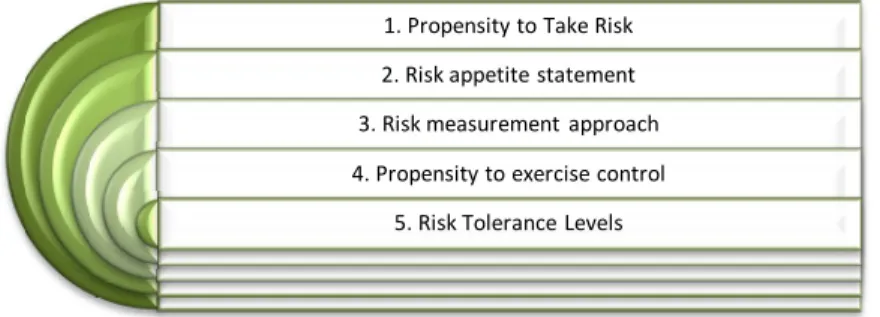
Once RBPlat’s overarching risk profile has been defined, RBPlat’s appetite for each risk type is articulated in terms of the following structure:
DRAFT Page 18 1. Propensity to Take Risk
2. Risk appetite statement 3. Risk measurement approach 4. Propensity to exercise control
5. Risk Tolerance Levels
Figure 7: Risk appetite construction
1. The propensity to take risk for a particular risk type refers to the RBPlat’s tendency to accepting or
rejecting that risk. In line with its enterprise-wide risk profile, the group therefore has a tendency (i.e. propensity) to:
a. Tend to avoid the risk;
b. Tend to be averse towards the risk;
c. Tend to be conservative towards the risk;
d. Tend to be receptive towards accepting the risk, within limits;
e. Tend to be unlimited towards accepting the risk, unconstrained by limits
2. The risk appetite statement for each risk type represents the prevailing view regarding the quantum
of risk that the Group is willing to accept in pursuit of its strategic objectives.
3. The risk measurement approach for each risk type is defined according qualitative and quantitative
risks. In many instances (e.g. Legal and Reputational Risk), certain aspects of risk either prevent accurate measurement or make measurement extremely elusive and difficult. In these cases, a qualitative risk measurement approach will be preferred to articulate risk appetite.
4. Propensity to exercise control refers to the level of management control deemed most appropriate
for the exercise of control measures around the acceptance of that risk.
5. Risk Tolerance Thresholds are measured by risk type. Breaches of these tolerance levels require
specific intervention by the level of management identified at propensity to exercise control level. The thresholds are set according to what level is deemed acceptable, tolerable and unacceptable in defined probability ranges. Exposures that are:
a. Acceptable (green) breaches of the tolerance target are deemed reasonable and likely do
not require specific action other than noting;
b. Tolerable (amber) breaches of the tolerance target may be tolerated but need to be
monitored closely to ensure that the level of exposure does not worsen; and
c. Unacceptable (red) breaches are unacceptable, and will require an immediate response to
ensure that the effects are mitigated or eliminated.
During the initial roll out of the risk appetite, budgets (operational and capital) and the authority limits manual will be used as a basis to determine appetite and tolerance levels. Once the risk appetite and associated reporting has been fully embedded the process will be extended to individual mine and functional area level as part of the journey up the ERM maturity scale.
DRAFT Page 19
4.3. ERMGOVERNANCE
The RBPlat Board has the ultimate accountability for risk management within RBPlat and has mandated the establishment of an ERM Framework, the attainment of the ERM objectives and the implementation of associated processes, roles and responsibilities, policies and reporting. The governance for the ERM framework is aligned to the overall RBPlat Governance Framework.
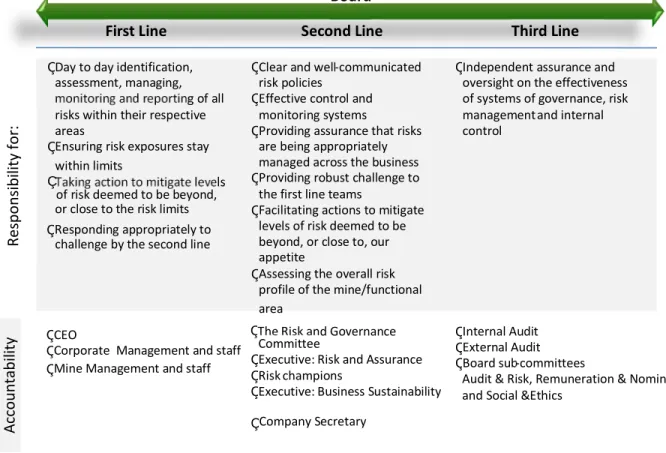
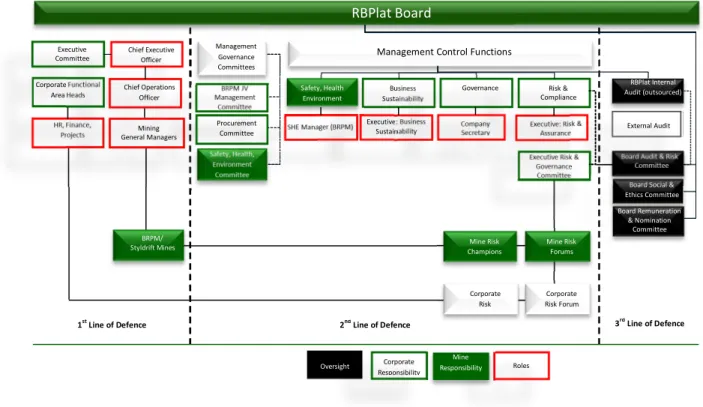
4.3.1. Three Lines of Defence
RBPlat has adopted the ‘three lines of Defence’ model, which is emerging as an industry norm, as an overriding guide for the governance of risk. This model is depicted below.
Figure 8: RBPlat 'Three Lines of Defence' Governance Model
4.3.2. RBPlat Risk Management Governance Framework
The RBPlat Risk Management Governance Framework is described below. It is an extension of the RBPlat
Governance Framework and is subject to all requirements and principles described therein (detailed in
the RBPlat Governance Framework document). The roles and responsibilities below only describe the roles and responsibilities in the ERM context.
monitoring and reporting of all
Taking action to mitigate levels
•Day to day identification, assessment, managing, risks within their respective areas
•Ensuring risk exposures stay within limits
•
of risk deemed to be beyond, or close to the risk limits
•Responding appropriately to challenge by the second line
•Independent assurance and oversight on the effectiveness of systems of governance, risk management and internal control
•CEO
•Corporate Management and staff
•Mine Management and staff
•Clear and well-communicated risk policies
•Effective control and monitoring systems
•Providing assurance that risks are being appropriately managed across the business
•Providing robust challenge to the first line teams
•Facilitating actions to mitigate levels of risk deemed to be beyond, or close to, our appetite
•Assessing the overall risk profile of the mine/functional area
Board
•Internal Audit
•External Audit
•Board sub-committees
Audit & Risk, Remuneration & Nomination and Social &Ethics
•The Risk and Governance Committee
•Executive: Risk and Assurance
•Risk champions
•Executive: Business Sustainability
•Company Secretary
First Line Second Line Third Line
Accountability
DRAFT Page 20 Table 3: RBPlat Risk Governance Structure
4.3.2.1. 1st Line of Defence: Chief Executive Officer
The Chief Executive Officer of RBPlat is accountable to the Board while the Board is accountable to stakeholders for ensuring that the RBPlat has and maintains an effective, efficient and transparent risk management process.
More specifically the CEO’s responsibilities include:
o Recommending to the Board Audit and Risk Committee and/or Board, from time to time, on
matters relating to risk thresholds, risk policies, risk framework, risk strategies and the risk philosophy of RBPlat
o Ensuring the development of the necessary ERM framework, risk policies, risk strategy, risk
processes, risk reporting mechanisms and risk structures
o Ensuring the roll out of the ERM framework, risk policies, risk strategy, risk processes, risk
reporting mechanisms and risk structures into all business areas of RBPlat
o Identifying the risk appetite and risk tolerance levels and obtaining Board approval
o Consider the business’ significant exposure and ensure effective risk assessment criteria is in
place
o Ensuring the following:
· Appropriate leading practice risk management models, standards and techniques are
used in the ERM program and system
· That strategic, process, operational and programme risk assessments are undertaken on
at least an annual basis
BRPM JV Management
Committee
Board Social & Ethics Committee RBPlat Internal Audit (outsourced) Chief Executive Officer Executive Committee
Executive Risk & Governance Committee Executive: Risk &
Assurance Risk & Compliance
Board Audit & Risk Committee BRPM/ Styldrift Mines SHE Manager (BRPM) Business Sustainability HR, Finance, Projects External Audit Safety, Health, Environment Committee Procurement Committee Executive: Business Sustainability Board Remuneration & Nomination Committee Company Secretary
Management Control Functions
Management Governance Committees Corporate Functional
Area Heads Governance
Corporate Responsibility Roles Mine Responsibility Mine Risk Forums Corporate Risk Forum Corporate Risk Mine Risk Champions Safety, Health Environment Oversight Chief Operations Officer Mining General Managers RBPlat Board
DRAFT Page 21
· That there are effective communication, measuring and monitoring systems in place
· Regular reports on the status of significant risks and related risk treatment plans and the
effectiveness thereof are prepared
· That the managing of risks is everyone’s responsibility within RBPlat and everyone is
aware of that
· That there are effective systems, processes, policies and internal control systems in
place within RBPlat and that they are operational in all respects
· Ensure that the ERM system is linked to RBPlat performance management system
· Appropriate ERM Committees are established and are functioning as intended
o Attend the Risk and Governance Committee meeting as well as the Board Audit and Risk
Committee
4.3.2.2. 1st Line of Defence: Executive Committee (‘Exco’)
Exco is accountable to Board for designing, implementing and monitoring the process of risk management and integrating it into the day-to-day activities of RBPlat.
More specifically, the Exco is responsible for:
o Designing an Enterprise Risk Management strategy in conjunction with the Executive: Risk &
Assurance
o Deciding on the manner in which risk mitigation will be embedded into management processes
o Developing a culture of risk management in RBPlat
o Ensuring that adequate and cost effective risk management structures are in place
o Developing and ensuring the implementation of risk management plans including:
· Actions to optimise risk/ reward profile, maximise reward with risk contained within the
Board’s approved risk appetite and tolerance limits
· A cost effective preventative and contingent control framework
· A framework to ensure adherence to legal and regulatory requirements
o Monitoring of the Enterprise Risk Management processes on both a detailed and macro basis by
evaluating changes, or potential changes to risk profiles
o Ensuring the implementation of measures recommended by the internal/ external auditors,
which, in their opinion, would enhance control at a reasonable cost
o Defining roles, responsibilities and accountabilities at the executive and senior management
level
o Assigning a manager to every key risk for appropriate response action including an action date
o Utilising available resources to compile, develop and implement plans, procedures and controls
within the Framework to effectively manage the risks
o Identifying, evaluating and measuring risks and where possible quantifying and linking each
identified risk to key risk indicators
DRAFT Page 22
o Implementation of procedures to ensure adherence to legal and regulatory requirements
o Implementing and maintaining adequate internal controls and monitoring the continued
effectiveness thereof
o Reporting to the Board Audit and Risk Committee on the risk process and resultant risk/ reward
profiles
o Providing policies, frameworks, methodologies and tools to the business units and subsidiaries
for identification, assessment and management of risks.
4.3.2.3. 1st Line of Defence: General Managers
The General Managers are accountable for ensuring that their areas of responsibility have maintained an effective, efficient and transparent risk management process.
More specifically their responsibilities include:
o Ensuring the roll out of the Framework, risk policies, risk strategy, risk processes, risk reporting
mechanisms and risk structures within their areas of responsibility
o Assisting in the development of the risk appetite and risk tolerance levels and obtaining Board
approval
o Ensuring the division operates within the confines of the risk appetite and risk tolerance levels
o Ensuring sufficient resources are committed to ensure the ERM Processes are carried out
effectively
o Have a good understanding of the division’s significant exposures and ensure effective risk
assessment and mitigation criteria is in place
o Ensure regular reports on the status of significant risks and related risk treatment plans and the
effectiveness thereof for risks within the division are prepared
o A risk culture exists on the mine
o That there are effective systems, processes, policies and internal control systems in place within
RBPlat and that they are operational in all respects
o Chair the Mine Risk Forum and attend the Executive Risk and Governance Committee meeting
4.3.2.4. 1st Line of Defence: Mine (BRPM and Styldrift)
Each employee within each mine is tasked with taking responsibility for the management of risk in their
division (see 2nd Line of Defence: Mine Risk Champions). Each employee has the personal responsibility
for day to day management of the risks associated with their tasks and the communication of these risks to the Risk Champions.
DRAFT Page 23
4.3.2.5. 1st Line of Defence: Corporate Functional Area Heads
The Corporate Functional Area Heads of RBPlat are accountable for ensuring that support functions effectively support the rest of the business and that they maintain an effective, efficient and transparent risk management process.
More specifically their responsibilities include:
o Ensuring the roll out of the ERM framework, risk policies, risk strategy, risk processes, risk
reporting mechanisms and risk structures within their areas of responsibility
o Assisting in the development of the risk appetite and risk tolerance levels and obtaining Board
approval
o Ensuring the division operates within the confines of the risk appetite and risk tolerance levels
o Ensuring sufficient resources are committed to ensure the ERM Processes are carried out
effectively
o Have a good understanding of the division’s significant exposures and ensure effective risk
assessment and mitigation criteria is in place
o Ensure regular reports on the status of significant risks and related risk treatment plans and the
effectiveness thereof for risks within the division are prepared
o A risk culture exists within the division
o That there are effective systems, processes, policies and internal control systems in place within
RBPlat and that they are operational in all respects
o Attend the Corporate Risk Forum and Executive Risk and Governance Committee meeting
4.3.2.5. 1st Line of Defence: Corporate Functional Areas (HR, Finance, Projects)
Each employee within each mine is tasked with taking responsibility for the management of risk in their
division (see 2nd Line of Defence: Corporate Functional Area Risk Champions). Each employee has the
personal responsibility for day to day management of the risks associated with their tasks and the communication of these risks to the Risk Champions.
4.3.2.6. 2nd Line of Defence: Compliance Control Function
In terms of the company’s commitment to its adherence to all relevant legislation, it has established a compliance control function, which has been structured in such a way as to facilitate a culture of compliance throughout the company. The compliance control function is managed by the Executive: Risk & Assurance and is responsible for identifying, assessing, advising on, monitoring and reporting on, amongst others, the regulatory compliance risk in the company.
In order for it to be effective, the compliance control function needs to be, and needs to be perceived to be, independent. It also needs to be granted the appropriate authority and status to operate effectively.
DRAFT Page 24 In order for the Board to fulfil its responsibility for managing regulatory risk, there must be routine, formal reporting to the Board by the Executive: Risk & Assurance.
The Compliance function should be able to:
o Provide the RBPlat Board with regular information regarding the level of compliance with
regulatory requirements
o Have adequate resources available to ensure proper compliance monitoring
o Have access to the Chairman of the Audit and Risk Committee and Social and Ethics Committee
o Liaise directly with the Regulators
The primary role of the compliance control function is to assist with, facilitate and monitor the effective management of compliance risks by RBPlat, through, inter alia, the following:
o The development of the compliance function strategy and compliance plan
o Setting policies and standards for compliance
o Providing advice on compliance related matters
o Identifying the regulatory universe
o Measuring and assessing compliance risk
o Compiling and maintaining a compliance manual or operational plan
o Establishing and maintaining a compliance culture
o Monitoring the level of compliance on an ongoing basis:
· Highlighting and key compliance risks and the steps being taken to address them
· Performance against compliance standards and goals
· Compliance issues involving management or persons in positions of major responsibility
· Material compliance violations or concerns involving any other person or business
division
· Material fines or other disciplinary actions taken by any regulator or supervisor in
respect of RBPlat or any employee
o Monitoring the ethics hotline
4.3.2.7. 2nd Line of Defence: Head of Compliance
The responsibility to facilitate compliance throughout the company has been delegated to the Executive: Risk and Assurance, who is responsible for the effective implementation of the Policy.
The Executive: Risk & Assurance is responsible for the following:
o Development of the Compliance Policy and Framework and to ensure that it is fully aligned with
this ERM Policy and Framework
o Development of a Regulatory Universe in conjunction with the various functional areas to
DRAFT Page 25
o Development of specific Compliance Risk Management Plans, where required, to ensure
adherence to the identified legislation
o Identify, assess and reporting on compliance and regulatory aspects to the various risk and
governance structures
o Manage compliance risks by identifying and developing appropriate risk management strategies
and policies
o Identify potential areas of compliance vulnerability and risk and develop corrective action plans
o Advise functional areas and mining units on their regulatory risk profiles and associated
implications
o Creating a compliance driven culture in RBPlat that values responsible conduct and compliance
with internal and external obligations
4.3.2.8. 2nd Line of Defence: Risk Management Control Function
The risk management control function has the authority to communicate with any employee on its own initiative and obtain access to any records required to carry out its responsibilities independent of the influence of other functions and Senior Management.
The RBPlat risk management control functional area responsibilities include:
o Assisting the Board of Directors and Senior Management in the effective operation of the risk
management system, in particular by performing specialist analysis and performing quality reviews;
o Oversight, tracking and measurement of adherence to risk system including the risk register and
associated processes
o Drive the identification, reporting and management of material risk positions and risk exposures
o Assist in classification and rating of risks
o Assessment of the evolving risk profile
o Assessment of pre-defined risk tolerances
o Drive the identification and mitigation of cross functional/ mine risks and in relation to strategic
affairs such as corporate strategy, mergers and acquisitions, and major projects and investments
o Ensure consistency in risk documentation and reporting
o Liaise with external market to identify trends in risk management and present business
o Monitoring the risk management system
o Maintaining an organisation-wide and aggregated view on the risk profile
o Reporting details on risk exposures and advising the Board of Directors with regard to risk
management matters in relation to strategic affairs like corporate strategy, mergers and acquisitions and major projects and investments
o Reporting to Senior Management, key persons in Internal Control Functions, and the Board of
Directors on the company’s risk profile, and detailing all material risk exposures facing RBPlat and related response plans
DRAFT Page 26
4.3.2.9. 2nd Line of Defence: Executive: Risk & Assurance
The Executive: Risk & Assurance should enjoy the freedom within the organisational structure to be objective and independent of the influence of other functions and Senior Management. He / she has the authority and responsibility to regularly report to the Board of Directors all material issues regarding RBPlat evolving risk profile, management of the risk function itself and risk management issues related to strategic affairs as necessary. The main objective of the Executive: Risk & Assurance is to ensure that RBPlat is able to timeously identify measure, manage, monitor, and report on all material risks by ensuring that the ERM Policy and Plan is executed and embedded in the organisation. The Enterprise Risk Management Framework and Policy is in line with international standard (ISO 31000).
The Executive: Risk & Assurance will perform within the following key performance areas:
o Development and implementation of risk management control function strategy
o Development and implementation of the risk management function ‘s operational plan
o Ensure the establishment and implementation of the risk management process throughout
RBPlat
o Oversee, monitor, evaluate and communicate the status of implementation of risk management
at RBPlat
o Ensure the effective functioning of the Corporate and Mine Risk Forums, Executive Risk and
Governance Committee and Board Audit and Risk Committee;
o Analyse and report on risks to management, the Executive Risk and Governance Committee and
Board Audit and Risk Committee
o Ensure that RBPlat has the requisite assurance plan and coordinate outputs to assurance
providers to the organisation
o Monitor and evaluate the effectiveness of RBPlat’s assurance plan
o Manage business risks by identifying and developing appropriate risk management strategies
and policies
o Identify, quantify, monitor and report business risks across all business divisions, and profile
them accordingly
o Ensure that an adequate Risk Financing (Insurance) Programme is in place to protect the RBPlat
assets and to mitigate any potential contingent liability exposures
o Identify potential areas of compliance vulnerability and risk and develop corrective action plans;
o Advise functional areas and mines on their risk profiles and associated implications
o Attend Board Committee meetings to provide the requisite reports
4.3.2.10. 2nd Line of Defence: Executive: Business Sustainability
The Executive: Business Sustainability has the responsibility to ensure that Sustainable Development related risks are identified and appropriate risk response policy and plans are developed and implemented. He / she has the authority and responsibility to regularly report to the Board of Directors all material issues regarding RBPlat evolving sustainable development risk profile and the management of responses in relation to strategic affairs as necessary.
DRAFT Page 27 The Executive: Business Sustainability will perform within the following key performance areas:
o Development and implementation of sustainable development policy and strategy
o Development and implementation of the sustainable development operational plan
o Ensure the establishment and implementation of a sustainable development process
throughout RBPlat
o Oversee, monitor, evaluate and communicate the status of implementation of sustainable
development at RBPlat
o Ensure that RBPlat has the requisite assurance on sustainable development activities and
processes
o Identify potential areas of climate change vulnerability and risk and develop response plans
o Advise functional areas and mines on sustainable development and associated implications
o Attend Board Social and Ethics Committee meetings to provide the requisite reports
4.3.2.11. 2nd Line of Defence: Company Secretary
The company secretary must provide directors with guidance in their duties, responsibilities and powers and make directors aware of all laws and regulations relevant to the company. This should include advice on business ethics and good governance. The company secretary should remain abreast of developments in corporate governance and is pivotal to ensuring that the directors adhere to the highest governance standards as detailed in the King Report (“King III”). The company secretary should also monitor international developments on corporate governance and bring these to the board’s attention where they would add value. He / she are the custodian of Board governance and is responsible to ensure that all governance related legislation and standards (Companies Act, King 3, JSE Listing requirements, memorandum and articles of association etc) is adhered to.
The Company Secretary will perform within the following key performance areas:
o The company secretary is responsible for the schedule of board and committee meetings for
the year. The company secretary prepares the agendas for these meetings in conjunction with the chairperson and key executives.
o The company secretary takes the minutes of these meetings and should ensure that they are
distributed as soon as possible thereafter to aid directors in implementing the decisions.
o The company secretary should ensure that the board’s policies and instructions are
communicated to the relevant persons in the company and that pertinent issues, including risks identified, from management are referred back to the board where appropriate
o The company secretary must ensure that the directors and management operate within an
authority framework approved by the board and reviewed and updated from time to time.
4.3.2.12. 2nd Line of Defence: Safety, Health and Environment
To ensure Safety, Health and Environmental related items are addressed from a risk perspective the risk profile related to these items must be kept up to date in line with the companies review and revision policy for documents. The SHE function must ensure the following:
DRAFT Page 28
o There must be a SHE Baseline risk assessment where the functional areas, sub functions,
physical structures and related activities are listed and defined.
o Critical task inventory lists are done to ensure all employees are trained to identify the hazards
they will be exposed to and how to mitigate such hazards so that they can conduct their duties in a safe, healthy and environmental friendly way.
o Where specific items of concern is identified, the issue based risk assessment process need to be
followed to address that specific risk so that the mitigating factors can be put in place to reduce the risk to an acceptable risk profile.
o For day to day operations, the continuous risk assessment method is used so that persons can
do pre-check and start up inspections before a task is conducted.
4.3.2.13. 2nd Line of Defence: SHE Manager (BRPM)
The SHE Manager (BRPM) has overall responsibility to ensure that adequate SHE Management systems are developed and implemented to manage all SHE related risks. The identification and action plans required for all identified hazards and risks related to Safety, Health and Environment will fall under the responsibility of the SHE Manager BRPM/Styldrift.
The SHE Manager will perform within the following key performance areas:
o Manage a group of specialists either under Shared Services or at the operational shafts to
ensure the requirements of the MHSA and relevant Environmental Acts are being complied with.
o Ensure that any significant risk identified that can pose an issue now or into the future for RBPlat
be reported to the relevant General Manager and then for info to the Executive: Risk and Assurance and if applicable to the Executive: Business Sustainability.
o Development and implementation of the various SHE Management systems operational plans
o Ensure the establishment and implementation of a SHE Risk Assessment process throughout
RBPlat
o Oversee, monitor, evaluate and communicate the status of implementation of SHE Management
at RBPlat
o Ensure that RBPlat has the requisite assurance on SHE activities and processes
o Advise HOD’s at the mines SHE issues and associated implications
o Attend Board Social and Ethics Committee meetings to provide the requisite reports
o Assist the Executive: Risk and Assurance to ensure risk management is imbedded at mine level
with regards to SHE risks and provide assistance to the Executive: Business Sustainability in the managing of sustainable development risks
4.3.2.14. 2nd Line of Defence: Executive Risk and Governance Committee
The Risk and Governance Committee is attended by each Functional Area Exco member, the Executive: Risk & Assurance, Chief Executive Officer, Mine General Managers and Company Secretary. The responsibilities of the Executive Risk and Governance Committee are set out in its terms of reference and briefly include the following:
DRAFT Page 29
o Review the RBPlat risk management framework and structures to be implemented as well as
any significant subsequent changes thereto. This will include the review and approval of risk identification and measurement methodologies
o Review the effectiveness of the risk management process on an on-going basis at strategic and
operational level
o Consider the adequacy of risk management strategies for significant risks facing RBPlat
o Ensuring that the RBPlat strategic, process, operational and programme level risks are assessed
on an on-going and that its control effectiveness are determined and evaluated
o Development and maintenance of a strategic risk register
o Monitor the progress and implementation of action plans and or treatments to address
significant risks
o Provide the Executive Committee with regular reports dealing with the effectiveness of the risk
management process as well as information on significant risks and the status of the control environment
o Review the proposals for any new significant change to the business (new product, acquisition,
channel, policy, opportunity) using the risk appetite filter approach
o Make recommendations from time to time to the Board Audit and Risk Committee on matters
relating to risk thresholds, risk policies, risk strategies and risk philosophy
o Review and ratify RBPlat specific asset and liability insurance programmes and their
implementation
4.3.2.15. 2nd Line of Defence: Functional Area and Mine Risk Champions
Functional Area and Mine Risk Champions will have the responsibility for the coordination of ERM, measurement, evaluation, analysis, treating and reporting of all risk status and strategies for their functional area/ mining unit. The Executive: Risk & Assurance will support management with these functions, while Executive and Senior Management will be responsible for the day-to-day interpretation and management of policy and procedural issues associated with ERM.
The Risk Champions responsibilities include:
o Identification of risks within their functional area/ mine and accordingly, the approvals,
responsibilities and accountabilities applicable to the identification, analysis, treatment and reporting of risks, must be reported to the Executive Risk & Assurance.
o Where current risk controls are deemed ineffective to reduce the risk exposure and therefore
warrant action, prepare appropriate control improvement and action plans. Included in each control plan will be the allocation of accountabilities and action dates for the implementation of the control improvement plan.
o Promote a culture of sound risk management and compliance within their functional area/ mine
o Provide the Board with adequate and timely information to enable the Board to carry out its
duties and functions including the monitoring and review of the performance and risk exposures, and the performance of the Senior Management