Based on SSL
Xiaodong Lin1, Johnny W. Wong1, and Weidong Kou2
1 Department of Computer Science,
University of Waterloo, Waterloo, Ontario, Canada N2L 3G1
{xdlin,jwwong}@bbcr.uwaterloo.ca
2 E-Business Technology Institute,
University of Hong Kong, Pokfulam Road, Hong Kong
Abstract. In recent years, protocols have been developed to ensure
se-cure communications over the Internet, e.g., the sese-cure sockets layer (SSL) and secure electronic transaction (SET). Deployment of these pro-tocols incurs additional resource requirements at the client and server. This may have a negative impact on system performance. In this pa-per, we consider a scenario where users request information pages stored on a web server, and some of the requests require secure communica-tion. An analytic model is developed to study the performance of a web server based on SSL. In our model, the details of the client-server inter-actions found in a typical SSL session are represented explicitly. Input parameters to this model are obtained by measuring an existing SSL im-plementation. Numerical examples on the performance characteristics of SSL are presented.
1 Introduction
In recent years, we have witnessed a general acceptance of the Internet by bu-sinesses and consumers. A key requirement to the success of Internet business is secure communication. It is generally known that messages sent on the Internet are subject to three types of security threats, namely eavesdropping, modifica-tion, and impersonation [1]. Trusted security mechanism and protocols have been developed to ensure secure communications over the Internet. An important se-curity protocol is the secure sockets layer (SSL) [2,3]. It has been implemented in all the major web browsers and in web servers like Apache [4], Lotus Domino server [5] and IBM HTTP server [6]. Another important security protocol is secure electronic transaction (SET) [7].
Deployment of security protocols, such as SSL and SET, incurs additional resource requirements at the client and server. This may have a negative impact on system performance, e.g., increased response time. Performance evaluation of SSL, SET or other security mechanisms, has not received much attention until recently. In [8], the performance improvement of SSL when caching of session keys is used, is evaluated. In another study [9], performance results for a
J. Pieprzyk, E. Okamoto, and J. Seberry (Eds.): ISW 2000, LNCS 1975, pp. 249–261, 2000. c
transport layer security protocol are presented. That study was based on the use of a benchmark tool SPECweb96 [10]. In addition, a performance comparison of SSL and SET is reported in [11].
Our work is different from those in [8,9,11] in the sense that analytic mo-deling is used to study the performance of SSL. More specifically, we consider a scenario where users request information pages stored on a web server, and some of the requests require secure communication. A model is developed to re-present the details of client-server interactions during a typical SSL session. As part of our investigation, we obtain input parameters to our model by measu-ring an existing SSL implementation. Analytic results are then obtained; these results are used to evaluate the performance penalty incurred by SSL. The issue of scalability is also investigated. The advantages of our model include (i) the effects of implementation are represented by the actual measurements and thus the model does not have to consider implementation details, and (ii) the mean response time results are valid for arbitrary distribution patterns of user think time and the various service time parameters.
The rest of this paper is organized as follows. In section 2, the details of a typical SSL session are described with a view to capturing the client-server interactions. Our model is described in section 3. Exact analytic results for the mean response time are derived. System measurement techniques to obtain input parameters are also described. In section 4, numerical examples showing the performance characteristics of a secure web server based on SSL are presented. These examples are designed to show the impact of the number of users, the fraction of user requests that require secure communication, the type of crypto-graphic algorithms used, and the size of the html file retrieved, on response time performance. Finally, section 5 contains a summary of our findings and some concluding remarks.
2 Secure Sockets Layer Protocol Session
Secure Sockets Layer (SSL) protocol is designed to provide secure communi-cation. It performs server authentication, and optionally client authenticommuni-cation. With SSL, private information is protected through encryption, and a user is ensured through server authentication that he/she is communicating with the desired web site and not with some bogus web site. In addition, SSL provides data integrity, i.e., protection against any attempt to modify the data transferred during a communication session.
Our investigation of SSL is based on a publicly available implementation called SSLeay [12]. This would allow us to collect measurement data that can be used to characterize the input parameters. Our measurement experiments are based on SSLeay version 0.6.6b, which is an implementation of SSL v2. This version is selected because it is a stable implementation and is therefore a good candidate to illustrate our modeling approach. Our model can easily be extended to study the behavior of later versions of SSL (v3 and transport layer security [13]).
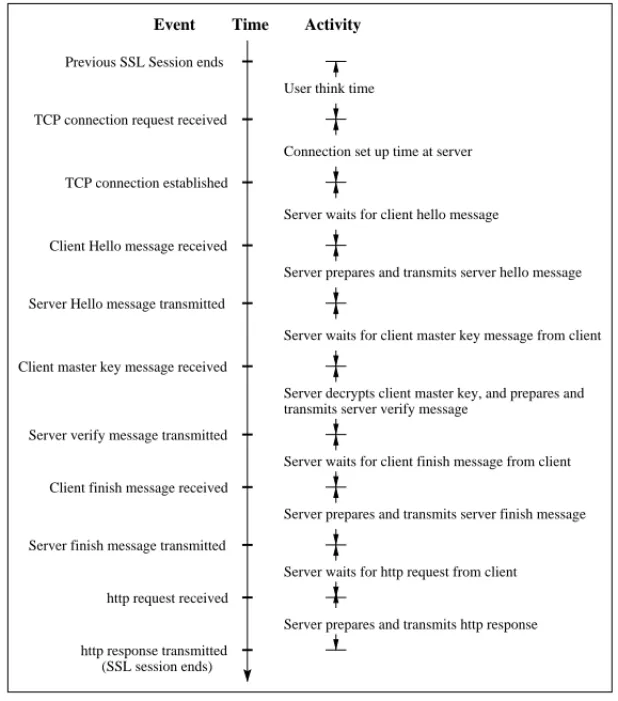
For convenience, we consider the case where an SSL session is set up to request a web page (or https). To facilitate the development of our model, we show in Figure 1 the events and activities as seen by the web server. The SSL session starts at the end of a user think time, which is indicated by the reception of a TCP connection request on port 443 - the default port number assigned to https. The web server then proceeds with setting up the TCP connection, and this activity ends when the TCP connection is established. The web server then waits for a “client hello” message. When such a message is received, the server parses the message, and prepares a “server hello” message for transmission back to the client.
Server waits for client master key message from client Server waits for client hello message
Connection set up time at server
Server waits for http request from client Server prepares and transmits server hello message
Server decrypts client master key, and prepares and transmits server verify message
Server prepares and transmits http response Server prepares and transmits server finish message Server waits for client finish message from client Previous SSL Session ends
TCP connection request received
TCP connection established
Client Hello message received
Server Hello message transmitted
Client master key message received
Server verify message transmitted
Client finish message received
Server finish message transmitted
http request received
http response transmitted (SSL session ends)
Activity Event Time
User think time
Fig. 1.SSL session
After the “server hello” message has been transmitted, the web server waits for a “client master key” message from the client. Upon receiving this message, the web server decrypts the client master key, and prepares a “server verify”
message and transmits it to the client. At end of transmission, the server waits for a “client finish” message. When this message is received, the server prepares a “server finish” message for transmission to the client. The SSL handshake ends when this message is transmitted.
The web server next waits for an http request from the client. Upon receiving this request, the web server prepares an http response. When this response is transmitted, the SSL session ends and the user starts the next think time.
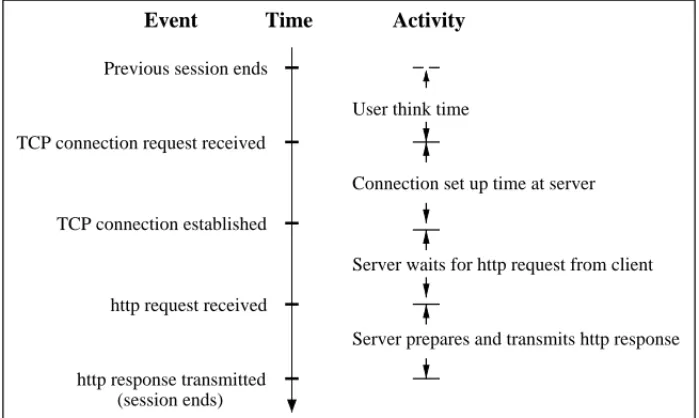
Similarly, we show in Figure 2 the events and activities for the case where secure communication is not required, i.e., a normal http request.
Connection set up time at server User think time
Time
Server waits for http request from client
Server prepares and transmits http response Activity
Event Previous session ends
TCP connection request received
TCP connection established
http request received
http response transmitted (session ends)
Fig. 2.Normal http request
3 Performance Model and System Measurement
3.1 Performance Model
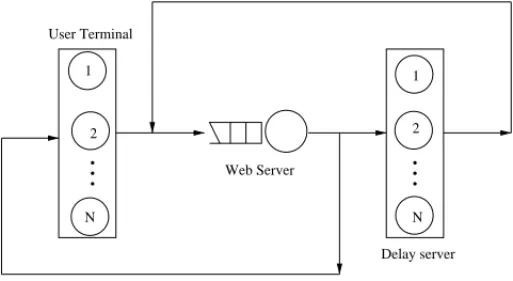
Our performance model is a closed queueing network representing N users re-questing web pages from a web server (see Figure 3). There are two types of requests: type 1 requires secure communication and type 2 is normal http. A request is generated at the end of a user think time. This request is of type 1 with probabilitypand of type 2 with probability 1−p.
There are two service centres: the web server and a “delay” server. The delay server represents all web server activities while waiting for the client, and any network delays. Each type 1 request cycles through the web server and delay server a number of times, following the activities shown in Figure 1. As a result,
. . . .. . 2 N Delay server Web Server User Terminal 1 N 1 2
Fig. 3.Performance model of secure communication sessions
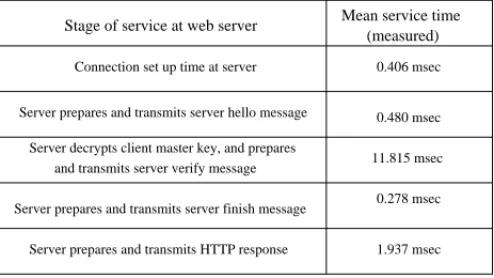
a type 1 request visits the web server several times, as shown by the stages of service in Figure 4. The type 1 request also visits the delay server a number of times, shown by the stages in Figure 5. After visiting the web server for the last time (which corresponds to the activity “server prepares and transmits http response”), a type 1 request is complete, i.e., the http response is returned to the user, and the user starts the next think time. Similarly, for type 2 requests, the stages of service at the web server and delay server are shown in Figures 6 and 7 respectively.
In general, processing of a user request requires usage of resources such as processor, memory and database servers. For convenience, we assume that the required resources are approximated by a number of service time parameters, one for each of the web server or delay server stages. Furthermore, the web server is modeled by a single server queue with processor-sharing discipline [14]. This discipline provides fair sharing of resources among all outstanding user requests. The user terminal is modeled as an “infinite server”, or no queueing. This is a well-accepted model for interactive systems. The delay server is also modeled as an “infinite server”. This assumption can be justified as follows. The time spent by a request at the delay server has two components: processing at the client and network delay. Each client is assumed to be running on a dedicated machine, and hence, there is no queueing at the client. As to the network delay, we assume that the time spent at the server machine to transmit or receive packets is small compared to that required for SSL protocol processing, similarly for time spent in the transport network. The no queueing assumption can therefore be used for the network delay component also.
For our queueing network model, the input parameters are the number of usersN, the mean think timeh, the fraction of user requests that require secure communicationp, and the mean service time of each stage at the web server and delay server for each of the two types of requests (as shown in Figures 4 to 7).
Server prepares and transmits server hello message
Server decrypts client master key, and prepares and transmits server verify message
Server prepares and transmits server finish message
Server prepares and transmits HTTP response
(measured) 0.406 msec 0.480 msec 11.815 msec 0.278 msec 1.937 msec Connection set up time at server
Mean service time Stage of service at web server
Fig. 4.Stages of service at web server for type 1 requests
Server waits for client master key message
Server waits for client finish message
Server waits for http request
Mean service time (measured)
2.536 msec 12.407 msec
0.472 msec
3.921 msec Server waits for client hello message
Stage of service at delay server
Fig. 5.Stages of service at delay server for type 1 requests
Connection set up time at server
Server prepares and transmits http response
Mean service time (measured)
0.322 msec 1.911 msec Stage of service at web server
Fig. 6.Stages of service at web server for type 2 requests
3.2 Analytic Results
Our model belongs to the types of queueing network models analyzed in [14]. Specifically, each web server or delay server stage is represented by a seprate customer class, and the class change feature allows us to model the customer routing between the web server and delay server, as characterized by the orde-ring of activities shown in Figure 1. The results from [14] are therefore directly applicable.
Server waits for http request
Mean service time (measured)
0.094 msec Stage of service at delay server
Fig. 7.Stage of service at delay server for type 2 requests
For our investigation, the state description of interest isS = (n0,(n11, n12),
(n21, n22)) wheren0 is the number of users in the thinking state, and n1r and
n2r are the number of type r requests at the web server and the delay server respectively,r= 1, 2. Using the results in [14], we obtainP(S), the steady state probability that the system is in stateS. FromP(S), one can readily obtain the mean values forn0,n11,n12,n21 andn22 (denoted byn0,n11,n12,n21andn22
respectively).
LetTrbe the mean response time of typerrequests, we use Little’s formula [15] to obtain: T1=(n11n+n21)h 0p (1) and T2=(nn12+n22)h 0(1−p) (2)
Finally, the mean response time over all requests is T = (N−nn0)h
0 (3)
It should be noted that response time is measured from the beginning to end of an SSL session (or a normal http session). It includes the delays while waiting for the client process, and any network delays.
It should also be noted that the formulas for the mean response time (T1, T2andT) are valid for a wide range of distributional assumptions for the think
time, and for the service times at the various web server and delay server stages. The reason is that the steady state probabilityP(S) depends only on the mean think time and the mean service times at these stages [14].
3.3 System Measurement
In this subsection, we discuss our methodology to obtain the mean service time for each of the web server and delay server stages. We built a web server based on SSLeay [12]. The server is written in C and compiled with gcc 2.6 with optimization. Our experimental system consists of a Sun Ultra 10 running SunOS 5.6, which works as the web server. The client machine is a Sun SPARCstation
10 running SunOS 5.5. These two machines are connected to an 100 Mbit/s Ethernet. The required service time parameters can be determined if we know the event times of all the events in Figures 1 and 2. This can be accomplished if we are able to measure the time at which a message is received at the server, and the time at which transmission of a message at the server is finished.
To measure the time at which a message is received at the server, we use the I/O multiplexing model of Unix network I/O [16]. This model allows us to determine exactly when data for a given message are received. We thus modify the available SSLeay source code and place a “select” system call before every server subroutine that attempts to receive data from client. Each time a message is received, the event time is obtained by using the “gettimeofday” system call which returns the current time at a resolution of microseconds.
Measuring the time at which transmission of a message at the server is finis-hed is quite straight-forward. One simply uses the “gettimeofday” system call to get the event time when transmission is complete.
3.4 Measurement Results
We conducted two measurement experiments to obtain values for the service time parameters. In these experiments, we used a scenario of only one user interacting with a web server. The html file size is 1.0 Kbyte. Public-key cryptography is based on 512-bit RSA [17], and secret-key encryption is based on RC4 [17].
Data were collected under the condition of no other applications running on the server and client machines. The first experiment involves SSL sessions (or type 1 requests) only, while the second experiment is concerned only with normal http (or type 2 requests). The measured values of mean service time at the various web server and delay server stages are included in Figures 4 to 7.
4 Numerical Examples
For closed queueing networks, the amount of computation required to obtain numerical results for performance measures such as mean response time may be substantial. Efficient computational algorithms are widely available. For our model, numerical results are obtained by using the algorithm reported in [18].
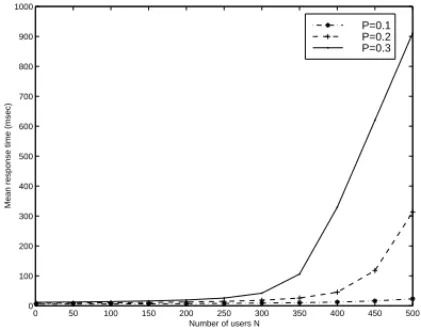
We first investigate the effect of the number of usersN and the parameter pon the mean response time over all requests. The results forp= 0.1, 0.2 and 0.3, are shown in Figure 8. The mean think timehis assumed to be 2 seconds.1
It is observed that with a largerp, there is a performance penalty (i.e., a larger mean response time) even when N is small. The incremental mean response time increases withN and p. The performance penalty incurred by SSL can be explained as follows.
1 This value of h is selected such that the amount of computation is not excessive
for reasonably large values ofN. For a largerh, the performance characteristics are similar, except the system is able to support more users.
0 50 100 150 200 250 300 350 400 450 500 0 100 200 300 400 500 600 700 800 900 1000 Number of users N
Mean response time (msec)
P=0.1 P=0.2 P=0.3
Fig. 8.Mean response time over all requests
Under SSL, significant processing time is required at the web server to decrypt the client master key because public-key cryptography is used. As shown in Figure 4, the mean service time for this activity is 11.815 msec compared to 1.937 msec for preparing an http response. Also, in SSL, secret-key cryptography is used when the web server prepares (i) the “server finish” message and (ii) the http response. This would add to the service times for the SSL session. Further delays are incurred because cryptographic hash functions are computed for all server activities except TCP connection establishment. In addition, an SSL ses-sion has more client-server interactions than the normal http. This is a result of the handshake protocol required to set up the SSL session. These additional interactions will incur delay, not only because of the processing required, but also the need to wait for network round-trip time, and any processing required at the client.
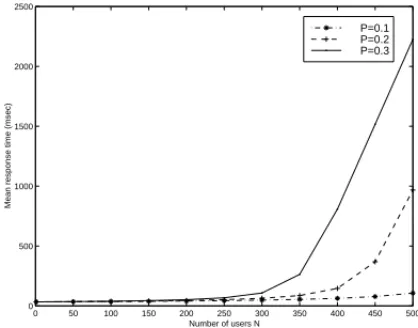
To further illustrate the response time performance of SSL, we plot in Figure 9 and 10 the mean response time of type 1 and type 2 requests respectively. It is observed that an increase inpresults in performance degradation for both types of requests.
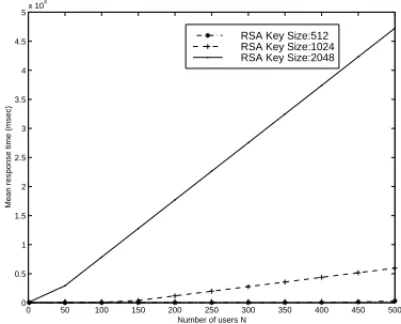
Our second set of results are concerned with the impact of increasing the security strength on SSL performance. Consider first public-key cryptography. The results in Figure 8 are based on measured data for an 512-bit RSA. The longer the RSA key size, the more secure is the SSL protocol. We measured the processing time required on a Sun Ultra 10 for three different RSA private key sizes, and the results are shown in Table 1. Numerical results for mean response time are then obtained for these three key sizes and forp= 0.2. These results are shown in Figure 11. We observe that the response time performance degrades significantly as the RSA key size increases. The reason is that RSA private key cryptographic operation incurs a significant overhead at the web server. The response time can be improved by using an RSA public key cryptography accelerator that is implemented in hardware, e.g., CryptoSwift II [19].
0 50 100 150 200 250 300 350 400 450 500 0 500 1000 1500 2000 2500
Mean response time (msec)
Number of users N
P=0.1 P=0.2 P=0.3
Fig. 9.Mean response time of type 1 requests
0 50 100 150 200 250 300 350 400 450 500 0 50 100 150 200 250 300 350 Number of users N
Mean response time (msec)
P=0.1 P=0.2 P=0.3
Fig. 10.Mean response time of type 2 requests
Table 1.RSA private key cryptographic operation performance
RSA Key Size Performance
512 bits 11 msec
1024 bits 68 msec
2048 bits 481 msec
We next consider the performance impact of secret-key encryption. The re-sults in Figure 8 are based on measured data for RC4. When a higher level of security is required, recommended encryption algorithms include IDEA [17] and Triple DES [17]. We measured the encryption rate on a Sun Ultra 10 for these three algorithms, and the results are shown in Table 2. Numerical results for mean response time are then obtained for these three cases, and for p = 0.2.
These results are shown in Figure 12. We observe that the mean response time increases as stronger secret-key encryption algorithms are used. The increase is mainly due to the overhead incurred by secret-key cryptographic operation when applied to the html file. Compared to the results in Figure 11, we observe that for the parameters under consideration, the performance penalty is small compared to that incurred by public-key cryptography. However, the observation may be different if the html file size is much larger. This is due to the higher overhead incurred by secret-key cryptography, resulting in a significant increase in the mean response time. To illustrate this point, we show in Figure 13 the mean response time performance when the html file sizes are 1 and 2 Mbytes instead of 1 Kbyte. Compared to the results in Figure 11, the performance pen-alty resulting from secret-key encryption is comparable to that from public-key cryptography.
Table 2.Performance of RC4, IDEA and Triple DES
Encryption Algorithm Encryption Speed
RC4 10568.51 Kbyte/sec
IDEA 2794.01 Kbyte/sec
Triple DES 809.23 Kbyte/sec
5 Conclusions
We have presented an analytic model for studying the performance of SSL. Our model is based on a detailed representation of the client-server interactions re-sulting from an SSL session. Numerical results showing the tradeoff between security and response time performance have been obtained. These results pro-vide useful insight into the performance characteristics of a secure web server under a range of operating conditions.
Our analytic model is rather general because the results are valid for arbitrary think time and arbitrary service time distributions at the web server and delay server. In addition, our modeling approach can readily be extended to study other secure communication protocols, e.g., SET.
Acknowledgements. This work was supported by the Natural Sciences and Engineering Research Council of Canada. The authors would also like to thank the anonymous reviewers for their constructive comments.
0 50 100 150 200 250 300 350 400 450 500 0 0.5 1 1.5 2 2.5 3 3.5 4 4.5 5x 10 4
Mean response time (msec)
Number of users N
RSA Key Size:512 RSA Key Size:1024 RSA Key Size:2048
Fig. 11.Mean response time for different RSA private key sizes
0 50 100 150 200 250 300 350 400 450 500 0 50 100 150 200 250 300 350 400 450
Mean response time (msec)
Number of users N
RC4 IDEA Triple DES
Fig. 12.Mean response time for different symmetric key encryption algorithms
0 50 100 150 200 250 300 350 400 450 500 0 0.2 0.4 0.6 0.8 1 1.2 1.4 1.6 1.8 2x 10 4 Number of users N
Mean response time (msec)
HTML FILE SIZE:1MB HTML FILE SIZE:2MB
References
1. Gregory B. White, Eric A. Fisch, Udo W. Pooch. Computer System and Network Security. CRC Press, Inc., New York, 1996.
2. Kipp E.B. Hickman. SSL 2.0 Protocol Specification. February 1995. http://www.netscape.com/eng/security/SSL 2.html
3. Alan O. Freier, Philip Karlton, Paul C. Kocher. SSL 3.0 Protocol Specification. March 1996. http://home.netscape.com/eng/ssl3/index.html
4. Apache Server. http://www.apache.org
5. Lotus Domino Server. http://www.lotus.com/home.nsf/welcome/domino 6. IBM HTTP Server. http://www.as400.ibm.com/products/http/httpindex.htm 7. MasterCard International Incorporated, Visa International. The SET Specification
1.0, Dec. 1997. http://www.setco.org/set specifications.html
8. Arthur Goldberg, Robert Buff, Andrew Schmitt. Secure Web Server Performance Dramatically Improved by Caching SSL Session Keys. Workshop on Internet Server Performance, SIGMETRICS ’98, Madison, Wisconsin, June 1998.
9. George Apostolopoulos, Vinod Peris, Debanjan Saha. Transport Layer Security: How much does it really cost? Proc. INFOCOM ’99, New York, March 1999. 10. The Standard Performance Evaluation Corporation. SPECweb96 Benchmark,
1996. http://www.spec.org/osg/web96/
11. Chris Le Tocq, Steve Young. Set Comparative Performance Analysis: Gartner Group White Paper. http://www.setco.org/download/setco6.pdf
12. T.J. Hudson, E.A. Young. SSLeay Programmer Reference. January 1996. http://www.psy.uq.oz.au/∼ftp/Crypto/ssl.html
13. T. Dierks, C. Allen. RFC2246: The TLS Protocol Version 1.0, January 1999. 14. F. Baskett, K.M. Chandy, R.R. Muntz, F.G. Palacios. Open, Closed and Mixed
Network of Queues with Different Classes of Customers. Journal of the ACM 22(2), April 1975, 248-260.
15. J.D. Little. A Proof of the Queueing FormulaL=λW. Operations Research 9(3), 1961, 383-387.
16. W. Richard Stevens. UNIX Network Programming, Volume 1, Second Edition: Networking APIs: Sockets and XTI. Prentice Hall, Upper Saddle River, New Jersey, 1998.
17. A.J. Menezes, P.C. van Oorschot, S.A. Vanstone. Handbook of Applied Crypto-graphy. CRC Press, New York, 1997.
18. J.W. Wong. Queueing Network Models for Computer Systems. Ph.D. thesis, Uni-versity of California at Los Angeles, 1975.
19. Rainbow Technologies Company. Secure Web Server and VPN (IPSec) Accelera-tion. http://isg.rainbow.com/index.html
20. Special Issue on Web Performance, IEEE Network 14(3), May/June 2000. 21. The Standard Performance Evaluation Corporation. SPECweb99 Benchmark,
1999. http://www.spec.org/osg/web99/
22. R. Hariharan, W. K. Ehrlich, D. Cura, P. K. Reeser. End to End Performance Modeling of Web Server Architectures. Performance Evaluation Review 28(2) Sep-tember 2000, 57-63.