Axel Dreher
HWWA DISCUSSION PAPER
165
Hamburgisches Welt-Wirtschafts-Archiv (HWWA)
Hamburg Institute of International Economics
The HWWA is a member of:
• Wissenschaftsgemeinschaft Gottfried Wilhelm Leibniz (WGL)
•••• Arbeitsgemeinschaft deutscher wirtschaftswissenschaftlicher Forschungsinstitute (ARGE)
Axel Dreher
This paper was prepared within the Research Programme „Trade and Development“ and presented at the HWWA Workshop „Public Choice & Development“ on November 14, 2001.
HWWA DISCUSSION PAPER
Edited by the Department
World Economy
Head: Dr. Carsten Hefeker
Hamburgisches Welt-Wirtschafts-Archiv (HWWA) Hamburg Institute of International Economics Öffentlichkeitsarbeit
Neuer Jungfernstieg 21 - D-20347 Hamburg Telefon: +49/40/428 34 355 Telefax: +49/40/428 34 451 e-mail: [email protected] Internet: http://www.hwwa.de Axel Dreher Fakultät für Volkswirtschaftslehre Universität Mannheim D-68131 Mannheim e-mail: [email protected]
CONTENTS
ABSTRACT 6
ZUSAMMENFASSUNG 6
1 INTRODUCTION 7
2 DEVELOPMENT OF IMF AND WORLD BANK
CONDITIONALITY 8
3 WHY HAS IMF AND WORLD BANK CONDITIONALITY
CHANGED? 19
4 COMPLIANCE WITH CONDITIONALITY 27
5 RECENT REACTIONS TO CRITICISM AND IMPLICATIONS
FOR FURTHER REFORM 39
DEFINITIONS AND DATA SOURCES 43
REFERENCES 46
Abstract
The paper presents a detailed description of IMF and World Bank conditionality and tries to explain changes in this conditionality over time as well as differences between the two institutions. Using panel data it is shown that the number of Fund conditions seem to be influenced by contemporaneous World Bank activity. Moreover, the paper tries to explain compliance with World Bank conditionality as well as interruptions of IMF programs in the recipient countries. Compliance with World Bank conditionality is lower in election years and pre-election years. Breakdowns of IMF programs are less likely in election years. However, no other political factors seem to influence interrup-tions and compliance systematically. The paper describes the instituinterrup-tions’ reaction to re-cent criticism and concludes with implications for reform.
Zusammenfassung
Die mit den Krediten von IWF und Weltbank verknüpften Auflagen haben sich seit der Gründung der beiden internationalen Organisationen stark verändert. Während die Kre-ditvergabe zunächst nur an wenige Bedingungen geknüpft war, müssen heute eine Viel-zahl von zum Teil sehr detaillierten Auflagen erfüllt werden. Diese Auflagen werden zunächst ausführlich beschrieben. Im Anschluss wird aus politisch-ökonomischer Sicht analysiert, welche Faktoren für deren Veränderung sowie Unterschiede in der Aufla-genpolitik von Währungsfonds und Weltbank verantwortlich sind. Es wird außerdem versucht, die Zahl der in IWF-Programmen enthaltenen Auflagen ökonometrisch zu er-klären. Dabei zeigt sich, dass diese Zahl mit dem gleichzeitigen Engagement der Welt-bank in den kreditnehmenden Ländern steigt.
Nachdem dargestellt wurde, inwieweit Weltbank- und IWF-Konditionen in der Vergan-genheit befolgt wurden und welche Faktoren dafür verantwortlich sein könnten, wird eine weitere ökonometrische Analyse präsentiert. Es zeigt sich, dass die Auflagen der Weltbank vor Wahlen signifikant weniger häufig implementiert werden und dass Zu-sammenbrüche von IWF-Abkommen in Wahljahren weniger wahrscheinlich sind.
Abschließend wird die Reaktion der beiden Institutionen auf die in den letzten Jahren zunehmende Kritik an ihrer Auflagenpolitik dargestellt. Außerdem werden Reformvor-schläge unterbreitet.
Keywords: IMF, World Bank, Conditionality, Compliance, Program Interruption JEL classifications: D72, F33, F34
1
Introduction
As IMF and World Bank were founded in Bretton Woods in 1944, there was no consideration of intrusive conditionality now common under the international financial institutions (IFIs) programs. The IMF should provide short term balance of payments credits and stabilise the post war financial system. The Bank was founded to promote long term growth in its member countries. However, over time, with the evolution of the IFIs, conditionality gradually increased and became inseparably associated with their loans. This evolution was never without critics. It was argued that the IMF has put too much emphasis on internal adjustment and neglects development (Payer 1974). Its intrusiveness has been criticised (Williamson 1983) as well as its devaluation policy (Dell 1982). Some have claimed that its programs focus too narrowly on reducing demand, which jeopardises growth (Allen 1984). With respect to the World Bank, Stiglitz (1999) argued that its conditionality has been flawed and may have undermined democracy in recipient countries.
Today, there is a widespread perception that conditionality can not substitute for creditor ownership1 which is most important to successful implementation of World
Bank and IMF policies (World Bank 1988, 1990, 1992, IMF 2001, Stevens and Gnanaselvam 1995). For example, Dollar and Svensson (1998) showed, that governments which are inclined to reform must be identified and can not be created by international organisations. In order to design effective programs, it would therefore be most important for the IFIs to detect factors influencing ownership and thus the willingness to reform.
The widespread criticism is usually based on case studies and what is generally perceived to be the IFIs conditionality. However, data on IMF programs and World Bank Country Assistance Strategy (CAS) papers are publicly available only since April 1998. Policies negotiated in the Banks adjustment programs are usually not published at all. Up to my knowledge, there exists no systematic description of the IFIs conditions included in programs at different times.
The aim of this paper is therefore to provide such an overview and explain changes in conditionality over time and differences between Bank and Fund. Moreover, it is
1 The term ownership simply means that programs include countries ‘own’ strategies for crises resolution and not those of the Fund or Bank.
examined in detail whether there are factors that systematically affect compliance with conditionality.
The paper is organised as follows. Section 2 describes the development of the IFIs conditionality. Section 3 provides possible explanations and tests some of the postulated hypotheses empirically. Section 4 surveys the empirical studies of compliance with IFIs’ conditionality and presents my own panel analysis. Section 5 describes the IFIs reaction to recent criticism and proposes reforms.
2
Development of IMF and World Bank Conditionality
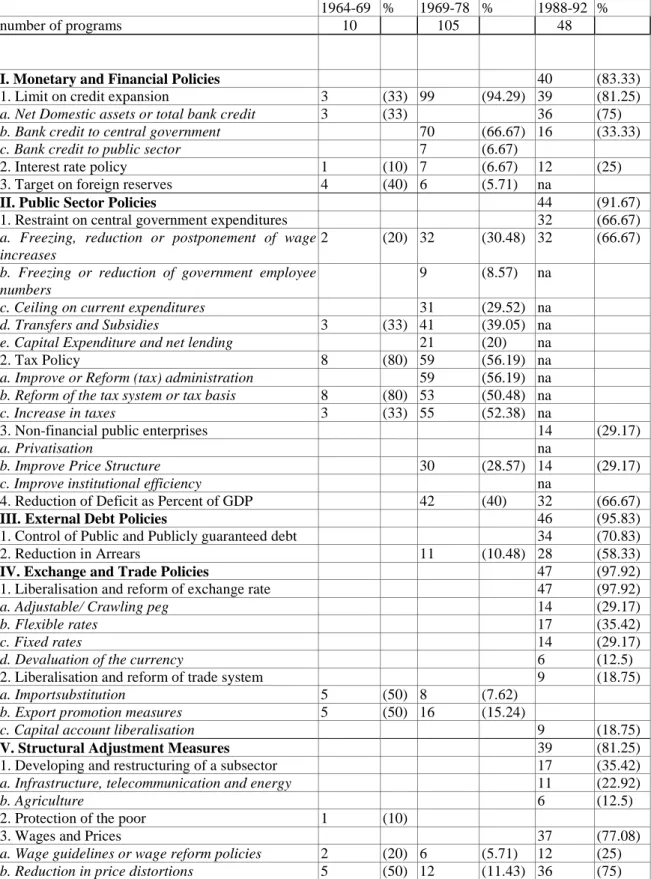
In the beginning of Fund operations, the only nation interested in conditionality at all has been the USA – the only one who was able to provide internationally accepted currency after the war. Even though the USA had no interest to attach detailed conditionality to the IMF’s short term loans designed to stabilise a borrowers‘ balance of payments they wanted to be able to reject drawings if misbehaviour is flagrant (Cornelius 1988: 48).1 This was refused, however, by possible deficit countries like the United Kingdom. Due to this conflict no ultimate decision on conditionality was made at Bretton Woods. Therefore, as the Fund started its operations, its Executive Board2 had to decide on whether to attach conditions to the loans. It was agreed that several goals should be negotiated to secure the revolving character of IMF resources. The borrowing country was, however, free to decide with which instruments to achieve these goals. Popular conditions in the beginning of Fund operations covered monetary and fiscal policy, reductions in relative price distortions, reduced current account deficits through import substitution and export promotion, reductions in deficits and an increase in international reserves (see Table 1).3 Contrary to the Fund, the World Bank depended from the beginning of its operations on private capital markets. Therefore, in order to achieve high credit ratings it lends only to countries where repayment seems likely and
1 Such a misbehaviour would be, e.g., if the Fund’s resources would be used to finance capital flights or rearmament (Dell 1981: 6).
2 The Executive Board is responsible for the Fund’s daily business. It consists of 24 Executive Directors, with the Managing Director as chairman.
3 The first program with binding performance criteria has been with Portugal in 1958 which included a credit ceiling and a maximum commitment level for public work programs and budget expenditure (Dell 1981: 12).
certain macroeconomic conditions were met.1 In spite of the project nature of most of
the Bank’s lending operations prior to the 80s lending was not unconditional. The Bank’s conditions were very similar to that of the Fund and covered public sector budget deficits, credit to the private sector, currency devaluation and reduction in the current account deficit through import substitution and export promotion (Kapur et al. 1997: 455).
Due to the existence of significant overlap in World Bank and IMF advice and conditionality, in 1966 an agreement on the institutions primary responsibilities was made.2 According to this agreement, the Fund should be responsible for exchange rates
and restrictive exchange practices, temporary balance of payments disequilibria and stabilisation programs. The Bank should generate broader development strategies and pursue project evaluations. As areas of overlap, financial institutions, capital markets, domestic savings and the financial position of the borrowing countries were identified.
In the following years, especially after the introduction of the Extended Fund Facility in 1974 IMF conditions became increasingly detailed. Moreover, not only targets were negotiated but detailed conditions concerning specific instruments (Gould 2001: 9). This should give a borrowing country confidence that negotiated tranches will be available in the case of compliance with conditionality. Would only targets be negotiated, external shocks could be responsible for deviations from these targets. However, borrowing country’s governments scope was increasingly reduced. As Table 1 shows, between 1969-78 almost all Standby Arrangements included limits on credit expansion. Contrary to earlier programs, where expenditure restrictions were limited to restrictions on government’s wage bills and subsidies, a broad range of areas was covered. 30 percent of the analysed arrangements included restrictions of the wage bill, 9 percent a reduction in government employees, 30 percent set ceilings on government current and 20 percent on capital expenditures. The percentage of programs covering reductions of transfers and subsidies rose to almost 40 percent. More than 52 percent of the programs included tax increases and, for the first time, creditor interests were covered under the arrangements: 11 programs included reductions in external payments arrears. Import substitution and export promotion measures start to loose weight. It is
1 This also explains why the bank primarily lends to middle income developing countries and really poor countries rarely receive large amounts of money.
2 See „Fund-Bank Collaboration“, memorandum to the Members of the Executive Board from the Secretary to Department Heads from the Managing Director, December 13, 1966.
interesting to note, that later IMF goals like poverty reduction and growth are not covered under its earlier conditionality.
At the same time, World Bank conditionality predominantly aimed at improving management of money and credit, government expenditures and revenues, exchange rates and foreign debt (Kapur et al. 1997: 480). Conditions concerning import substitution were – contrary to earlier loans – no longer included. Instead, export promotion measures were enhanced and restrictions on trade reduced. Often it was contracted to reduce tariffs and subsidies (Kapur et al. 1997: 484). Moreover, whereas World Bank focus until the 70s has chiefly been on (government guaranteed) lending for private enterprises, between 1970-81 credit was granted independently of ownership if professional management was established (Kapur et al. 1997: 481). This was welcomed by borrowing countries‘ governments who then had strong preferences for public investment.
However, policies included in the IFIs programs often were not those preferred by borrowing countries’ governments, who claimed that the increasing intrusiveness of conditionality would not be justified by the relatively small amounts of money provided. Developing countries protested that IMF conditions were not tailored to individual countries circumstances and that industrialised countries received its loans merely without conditionality. Their protests led to a review of IMF conditionality in 1979. It was agreed that individual country’s priorities and characteristics should weigh more heavily in IMF programs. However, at the same time, a new kind of conditionality was introduced. In addition to performance criteria, which must be implemented to secure tranche releases, prior actions should be implemented before a program is presented to the Executive Board. Officially, these prior actions should secure that programs were in line with the targets of the IMF. However, governments frequently had to execute prior actions not critical for success of the programs in order to demonstrate its willingness to comply.
In the years following the IMF conditionality review, supply side aspects gained weight in the programs. This led to greater Fund involvement into social and political belongings of developing countries. Compared to the 70s, the IMF prescribed not only more detailed conditions but also paid out less money at the beginning of programs. Moreover, waivers were more difficult to achieve.
At the same time, Bank staff increasingly became aware that its projects, even if individually successful, could not achieve growth if the macroeconomic environment was deeply flawed. Up to now, conditions did not aim at detailed changes. Instead, they were attached to the Bank’s loans to secure repayments. However, since its project lending did not provide it with the leverage to enforce detailed macroeconomic conditions, structural program lending was initiated in 1980. Under these programs, structural adjustment should be achieved over a 3-5 year period (Kapur et al. 1997: 510). During this time internal and external deficits leading to high inflation and depleting reserves should be eliminated (Ferreira and Keely 2000). In the beginning of adjustment lending, programs negotiated between Bank and borrowing countries included conditions targeted at reducing structural balance of payments deficits. Resources should be shifted to the tradable sector (Ferreira and Keely 2000: 160). Conditions included designing countrywide investment plans, enhance incentives for improved resource allocation, improvements in infrastructure, promotion of exports and reduced protectionism (Kapur et al. 1997: 510). To promote supply detailed microeconomic conditionality was included in those programs. 34 percent of the conditions included were legal actions specified in legal arrangements. 40 percent were additional conditions which are requested by the World Bank president and are included in the staff’s mission report. In addition, 8 percent of conditions were preconditions which must be fulfilled before the Executive Board votes on the agreement. Prior actions (18 percent) are ‘voluntarily‘ taken by borrowing governments since otherwise they would be included under formal conditionality (World Bank 1990: 10). On average, adjustment programs between 1980-82 included 34 conditions. This number rose to 35 in 1983-86 and 56 in 1987-90 (see Table 2). These conditions complemented those of the IMF since conclusion of an IMF arrangement usually is a precondition for the Banks adjustment lending. As can be seen in Table 2, 18 percent of Bank conditions were fiscal and only 3 percent monetary. 17 percent referred to agricultural and 16 percent to trade related goals. In 1991 the average number of conditions was 48 and rising thereafter (Kapur et al. 1997: 522). Between 1980-88 more than 70 percent of all conditions were not quantifiable and could therefore not objectively be evaluated (World Bank 1990: 10). Nevertheless, above 90 percent of structural adjustment loan conditions and 75 percent of conditions included in sectoral adjustment loans were linked to tranche disbursement (McCleary 1991: 208).
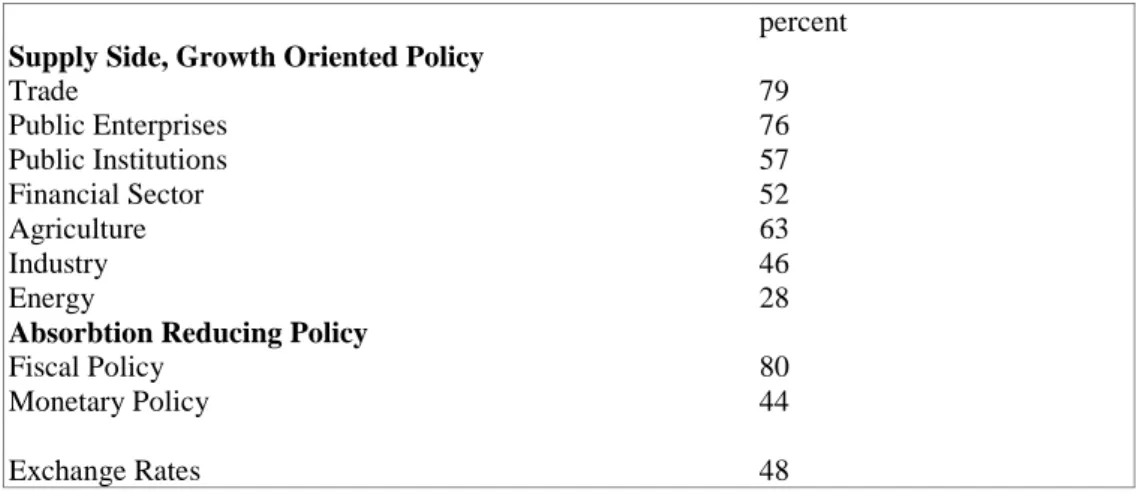
Table 3 plots conditions included in World Bank programs between 1980-88. As can be seen, 80 percent of those programs include conditions concerning fiscal policy. In the
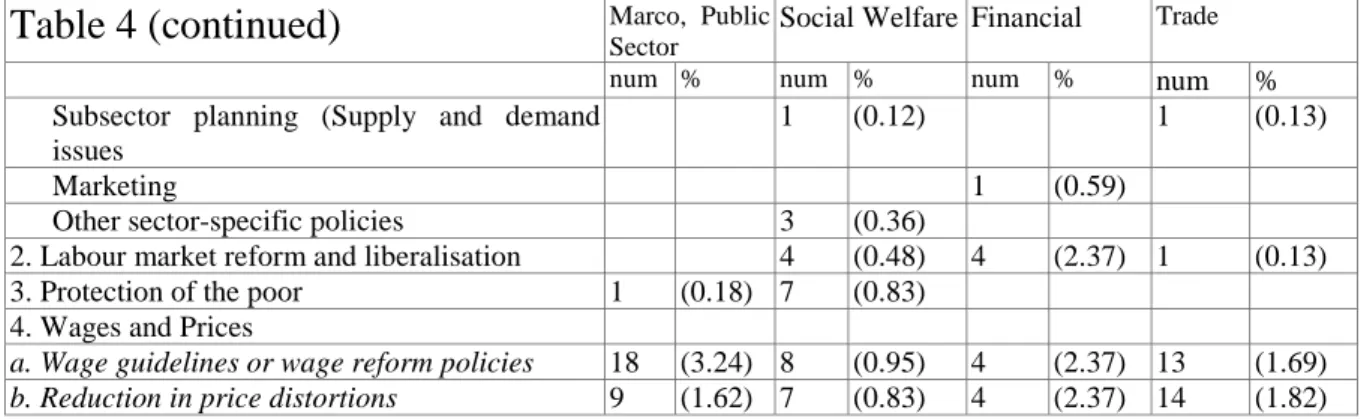
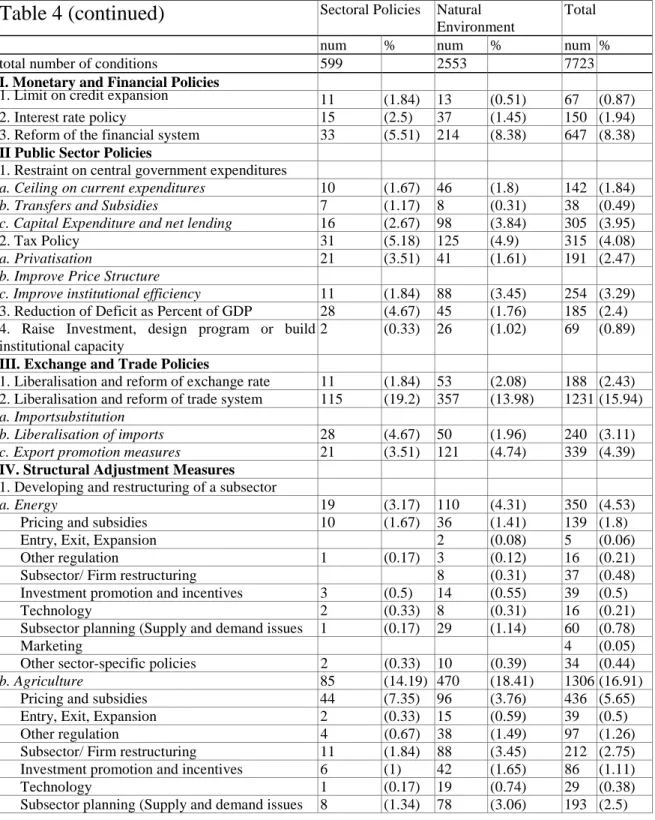
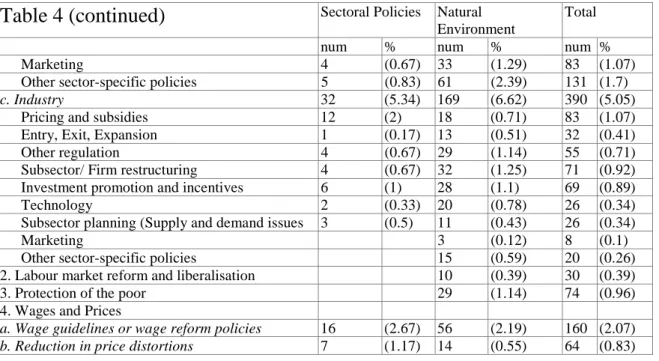
first years of structural adjustment lending reductions of budget deficits account for less than 1 percent of Bank conditionality. However, those reductions were often included in contemporaneous IMF programs. Reductions of budget deficits should at that time primarily be achieved by means of expenditure cuts (Chhibber and Khalilzadeh-Shirazi 1991: 39). Most programs included conditions concerning amount and composition of expenditures, public investment and subsidies. Ultimately, adjustment programs tried to eliminate public subsidies completely (Chhibber and Khalilzadeh-Shirazi 1991: 32). As Table 4 shows, on average, expenditure reductions account for 2 percent and reductions in investment for 4 percent of conditionality between 1980-88. In the 199 programs covered, reductions in transfers and subsidies are programmed 38 times. Quantitative targets for investment were rarely defined. Instead, existing investment plans had to be revised or new plans had to be initiated. Increases in revenues should predominantly be achieved through liberalisation of public enterprise prices (Chhibber and Khalilzadeh-Shirazi 1991: 34). Moreover, processes for planning government budgets should be strengthened. Overall, only 315 conditions refer to taxes (Table 4). Of those, conditions to broaden the tax base, simplify existing tax systems and enhance administrative efficiency were most prominent.
Later programs contained detailed conditions on specific expenditure cuts. Since the focus was now more on poverty reduction, cuts in areas such as education and health were generally avoided. Instead, conditions on curtailing expenditure for government administration, the military and public employees‘ pensions were more frequent (Ferreira and Keely 2001: 169).
Conditions concerning international trade account for almost 16 percent of all conditions and were included in 79 percent of World Bank programs between 1980-88 (Table 2 and Table 3, respectively). In earlier programs conversion of non-tariff trade restrictions to tariffs was demanded, primarily in order to reduce public deficits. Later, overall reductions of export and import restrictions, e.g. reductions in tariffs as well as their dispersion were envisaged (Chhibber and Khalilzadeh-Shirazi 1991: 30). Barriers concerning import substitution were only cautiously approached. At times tariffs protecting domestic products have even been raised (Thomas 1991: 48). Between 1980-93, 27 percent of all conditions aim to reform external trade (Ferreira and Keely 2000: 177). Between 1980-88, 2.5 percent of these conditions try to improve the exchange rate system. Such measures are included in 48 percent of all programs (Table 4).
Reforms covering the financial system are included in more than half of the adjustment programs analysed (Table 3). In this area, the first adjustment loans targeted mainly at liberalising interest rates and credit allocation for political reasons (Gelb and Honohan 1991: 78).1 In addition, programs aimed at institutional changes to reduce interest
subsidies and taxes on financial transactions (Ferreira and Keely 2001: 176). Development of capital and money markets, recapitalisation and mergers of insolvent banks, improved accounting standards and deposit insurance systems were covered under Bank conditionality. Regulatory institutions should get more power and some banks had to change their management (Gelb and Honohan 1991: 81). Moreover, competition in the financial sector was fostered. The total share of financial conditions amounts for 9 percent between 93 (Ferreira and Keely 2001: 177). Between 1980-88 they account for only 4 percent of Bank conditions. Thereafter, they steadily gained relevance. In 1991, 16 percent of all conditions were financial. Those conditions were most prominent in Asia, where 16 percent of Bank conditions between 1980-88 covered this sector (see Table 2).
Conditions relating to public enterprises are included in 76 percent of World Bank programs between 1980-88 (Table 3). More than 3 percent of the included conditions tried to enhance institutional efficiency (Table 4). Earlier programs stressed organisation and management of firms (Ferreira and Keely 2000: 177) and tried to increase supervision and evaluation of its activities. Half of the programs included conditions on specific enterprises (Nellis 1991: 109). Other prominent conditions concerned the number of employees, pricing of goods and services, access to subsidised credit, reduction in arrears and improved education of public employees (Nellis 1991: 111). Enterprises whose losses increased government budget deficits had to be restructured. Losses were reduced by price increases utilising monopoly positions. In the first years of adjustment lending, sales or liquidation of specific public enterprises were, however, less prominent. If privatisation was required, conditions did not refer to specific enterprises. Instead, formulation of investment plans was included under conditionality (Nellis 1991: 114). In later programs, privatisation was more frequent. Overall, between 1980-93 14 percent of all conditions were related to public enterprises (Ferreira and Keely 2000: 176).
1 Conditions on making government’s access to cheap credit more difficult obviously lies in the interest of the staff since these credits might be viewed as substitutes to World Bank loans.
In the agricultural sector, programs tried to improve incentives which were distorted in favour of the industry. Agriculture accounts for about 17 percent of all conditions (Table 4). They were included in nearly 60 percent of structural and almost all sectoral adjustment loans (Knudsen and Nash 1991: 132). Frequently, producer prices as well as prices for inputs like water and fertiliser were raised. Subsidies were reduced. Resistance against government withdrawal from this sector was, however, quite strong. Therefore, such conditions were rare. Instead of privatisation some programs included measures to deregulate markets, especially concerning private access (Knudsen and Nash 1991: 135). Reductions in import barriers referring to agricultural products were frequent conditions. Liberalisation of inputs was, on the other hand, rarely a condition for World Bank credit.
Other structural measures were prominent mostly in the sectors industry (included in 46 percent of the programs) and energy (28 percent). Each of these sectors accounts for about 5 percent of all conditions, the majority of which aims at reducing subsidies and align prices. With respect to the industry sector these conditions were, however, less stringent than in other sectors (Ferreira and Keely 2000: 162).
Overall, between 1980-84 conditions focused primarily on international trade and the fiscal sector. Thereafter, conditions referring to the financial sector as well as privatisation and institutional reforms gained importance.
In 1987 it became obvious to the Bank that the adjustment process would take longer than previously anticipated. At the same time the perception became prominent that the poor should be better protected from adverse effects of the adjustment programs. Since then, Policy Framework Papers include assessments of the programs social consequences.1 Nevertheless in 1988 only 1 adjustment loan covered a poverty
alleviation program, between 1980-87 there were 2 (Knudsen and Nash 1991: 136). Of all conditions between 1980-88 less than 1 percent account for protection of the poor (Table 4). Not until the beginning of the 90s poverty reduction became a central element of adjustment programs (Ferreira and Keely 2000: 188). Since then, gender equality is made a condition as well (Thiele and Wiebelt 2000: 8).
1 Policy Framework Papers were prepared by the IFIs staff with collaboration of the member country. They included economic objectives and macroeconomic as well as structural policies for three-year adjustment periods supported under the IMF’s Enhanced Structural Adjustment Facility (ESAF).
In 1986, the IMF introduced its Structural Adjustment Facility (SAF). With the introduction of this facility, another kind of conditions – structural benchmarks – was established. If those conditions, which were not provided for under the IMF guidelines are not met, access to credit tranches is not automatically terminated. Non-compliance with these benchmarks might lead fund staff, however, to be more stringent if performance criteria are not achieved. Moreover, though the importance of structural benchmarks within the Fund is not clear, non-compliance could lead to program interruptions (IMF 2001: 17). Compared to traditional performance criteria structural benchmarks are much more microeconomic, which reflects, to some extent, the shifted focus of the Fund.1 Whereas its initial focus has been to provide short term balance of
payments support, it increasingly evolved to a development agency with a focus on growth in borrowing countries.
Table 6 shows the distribution of the IMF’s structural conditionality between 1987-99. Overall, the by far most conditions extend to the fiscal sector. Of these, 40 percent refer to tax systems and tax administration, like the introduction of a value added tax or implementation of excise taxes on all cigarettes. Expenditures and public sector management amount for 30 percent of fiscal sector conditions. Other areas covered have been civil service reform and debt management (IMF 2001a: 27). During the Asian crisis, conditions referring to the financial sector gained importance. They amount for almost 24 percent of the Fund’s structural conditions between 1997-99. Of these, 20 percent focused on the monetary policy framework, e.g. on changes in the system of reserve requirements and the introduction or modification of central bank laws to give the central bank more autonomy. 50 percent of the financial conditions referred to banking regulations and supervision. A typical condition in this area would be the liquidation of a certain bank at a certain time. Financial liberalisation amounts to about 10 percent of financial conditionality (IMF 2001a: 27). Another condition that gained importance since 1987 has been privatisation. There, a typical condition could be to privatise, e.g. 80 enterprises at a fixed date. The importance of other areas, on the other hand, declined over time. The trade sector now amounts for only 6 percent of structural conditionality. There, conditions were evenly divided between tariff and non-tariff barriers and focused chiefly on the most restrictive aspects of borrowing countries’ trade regimes (IMF 2001b: 9). Public enterprises and reform of the exchange system also lost importance. Overall, however, structural conditionality has increased substantially after
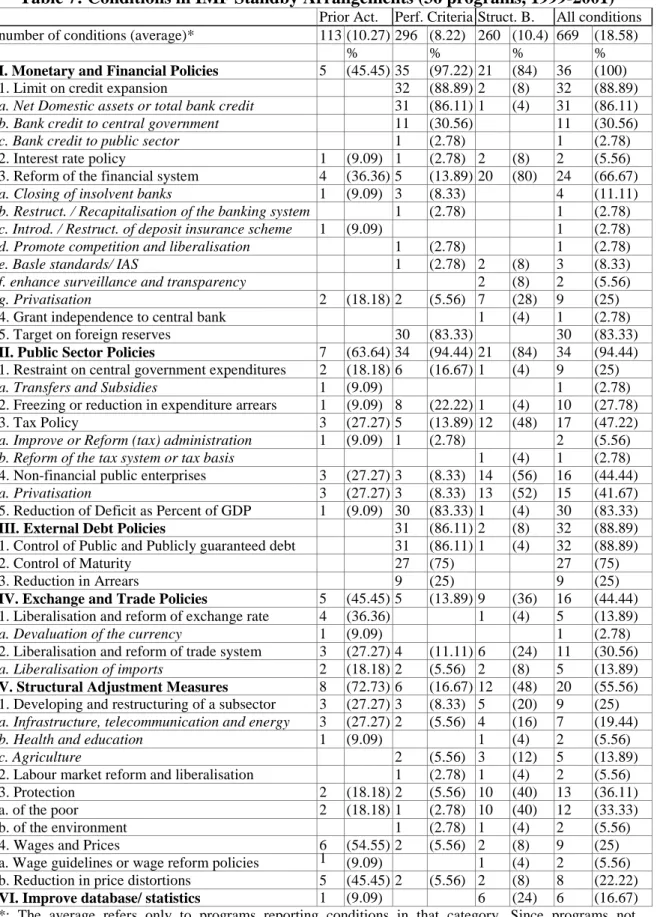
the introduction of the SAF. Between 1985-86 less than 20 percent of upper credit tranche Standby and Extended Arrangements included conditions related to structural measures (IMF 2001a: 8). At the end of the decade, such conditions were covered under almost two thirds of the arrangements whereas by the mid 90s they were included in almost all programs. The average number of structural conditions per program year in 1987 was 2. In 1994 this number has increased to 7 and between 1997-99 on average there were 14 (IMF 2001a: 9). The by far largest share of these structural conditions were benchmarks. However, with the introduction of new facilities, the number of included binding conditions also began to rise. Between 1952-73 on average 4.23 binding conditions were included in IMF programs. This number rose to 7.13 between 1974-82 and 12.07 between 1983-1990. In 1991-95 it rose further to an average of 12.42 (Gould 2001: 6). The average number of performance criteria from 1995-99 was 12.4 of which 5.4 have been structural criteria (Goldstein 2000: Table 4). In Standby Arrangements publicly available, between 1999-2001 the average number of performance criteria is 8.3 whereas total conditions averaged 18.8. Poverty Reduction and Growth Facility arrangements included 23.4 conditions of which 10 were performance criteria. This increase in the number of conditions is partially due to the Fund’s increasing scope. However, the number of conditions covering areas like exchange and trade systems as well as the fiscal and financial sectors also increased. Owing to this large number of conditions, it became increasingly difficult for borrowing countries to identify those conditions which were crucial for further Fund support. In many programs the boundaries between what was demanded by the Fund and a country’s own policies became blurred.
In the beginning of the 90s, Fund critics increasingly claimed that IMF programs were anti poor. Even though the Fund tried to take this into account in more recent programs it generally failed to establish pro poor measures under its conditionality. Poverty reduction is mentioned as major goal in almost all recent programs. However, it is rarely covered by mandatory conditionality. Only structural benchmarks frequently include conditions to prepare action plans, increase allocations to the health sector or improve immunisation of the population. Sectors like health and education are, however, usually spared from budgetary cuts. Moreover, reductions of transfers and subsidies are normally no longer included in IMF programs.
Table 7 and Table 8 plot conditions included in recent Standby and PRGF Arrangements, respectively. As can be seen, compared to earlier periods, conditionality
became much more detailed. Instead of relying on aggregate spending ceilings, the IMF includes detailed conditions on the content of government expenditures. In this area, collaboration with the Bank was common.1 Between 1999-2001 more than 65 percent
of all evaluated Standby Arrangements included conditions concerning borrowing countries’ financial sectors. Of these, 9 percent aim at liquidation of insolvent banks, 30 percent include bank privatisation. Conditions referring to the liberalisation of the capital account, which have been included in almost 20 percent of Standby and Extended Arrangements between 1988-92 (see Table 1) are no longer included. Compared with this period, the development of subsectors was more frequently covered. In PRGF arrangements, those conditions were included in more than 60 percent of the programs. In all periods the most important sectors covered were infrastructure, telecommunication and energy. Compared to 1964-78, restrictions on the government’s wage bills and reductions in external payments arrears are more frequently included since 1988. Today, a major component of structural benchmarks is privatisation of non-financial public enterprises. These conditions cover almost all kinds of public enterprises, independent of their size and importance for the borrowing countries economy. This has been different at the beginning of the Fund’s adjustment lending where only small enterprises were privatised. At this time, conditions on public enterprises were not very comprehensive, reflecting the lack of adequate data. During the 80s, the IMF tried to improve performance through measures like performance contracts, labour force reductions as well as price and market reforms. Later, establishing commercial management and divestment became more frequent. These reforms under IMF programs have mainly been designed by World Bank economists. Fund conditionality often was supportive of measures contained in Bank supported public enterprise reform operations. The selection of public enterprises to be reformed as well as the modalities and time table was developed by the Bank as well. The Fund only assessed the macroeconomic impact of these reforms (Decressin et al. 1999: 181). Instead of quantitative targets general commitments to phase out subsidies were used (Decressin et al. 1999: 170).
Conditions not previously mentioned contain measures to protect the environment, the rights of women and labour market reforms. 15 percent of the programs covered under this study include conditions on issuing better and more timely statistics based on qualitatively improved data. Scope and nature of quantitative performance criteria
1 For example, in Bolivia’s 1994 program a detailed Bank study served as input to the design of fiscal policy (Decressin et al. 1999: 181).
covered under PRGF and Standby Arrangements are similar. However, in addition to similar numbers of quantitative performance criteria PRGF arrangements include a larger amount of structural benchmarks and qualitative performance criteria. Due to the nature of PRGF arrangements its focus lies more on structural reforms. These are included in almost 90 percent of the analysed programs. Compared with contemporaneous Standby Arrangements layoffs in the public sector, payments arrears, tax policy and public enterprises are more frequently covered under PRGF conditionality. In these programs conditions aimed at reducing corruption and strengthening the judiciary are also included.
Overall, conditions concerning reforms of the financial sector as well as privatisation and restructuring of the public sector gained weight relative to exchange rate and trade liberalisation.
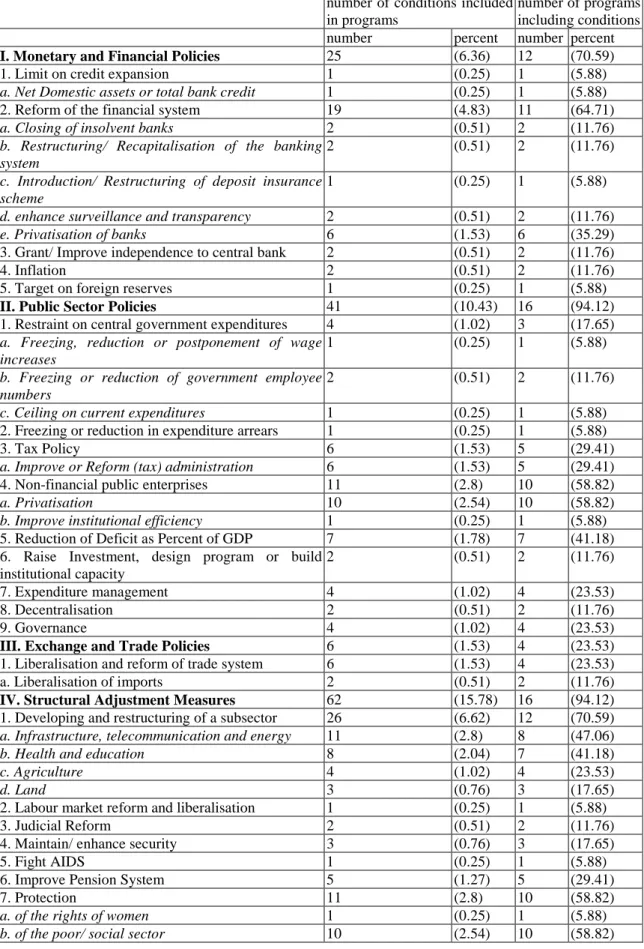
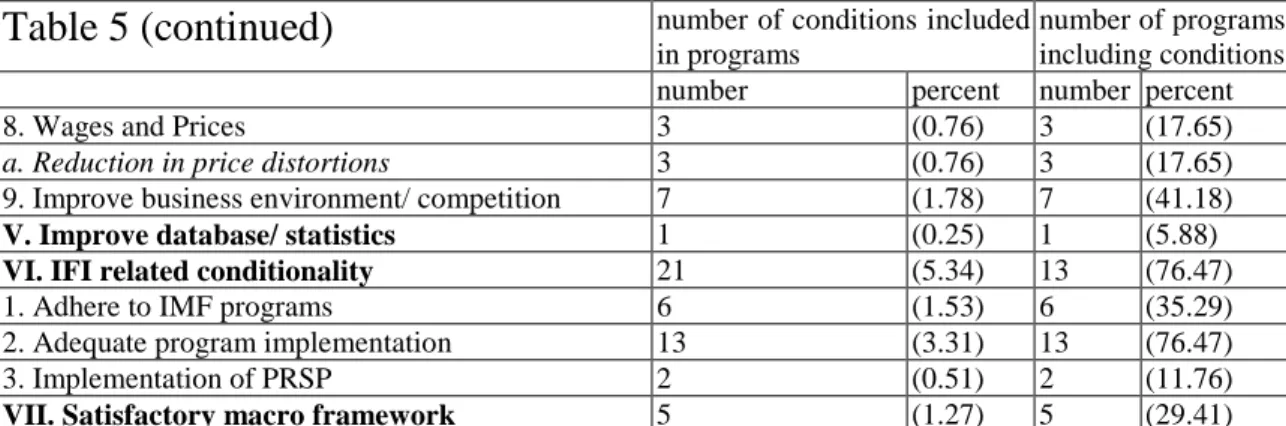
Unfortunately, it is not possible to compare the conditions described directly with the content of current World Bank adjustment programs. However, the Bank usually makes its Country Assistance Strategy Papers publicly available since July 1998. These papers compile possible projects and programs for individual countries over a 2 to 3 year range. Usually implementation of so-called triggers decides on the amount the World Bank is willing to lend to a country. Though CAS are generated with the assistance of country representatives they are not negotiated documents. They represent the Bank’s strategy for that country and disclose information on country authorities’ conflicting views. Table 5 provides an overview of conditions contained in recent CAS. Comparison to Table 4 emphasises the changed focus. Though there have been financial conditions in earlier adjustment programs, the increased importance of these conditions over time is evident. The most frequent condition included in this area is bank privatisation (included in 35 percent of the programs analysed).
Reform of the judiciary is envisioned in 11 percent of the CAS under review. Other conditions which were not included in the 80s refer, for example, to corruption and public safety. Measures designed to protect the social sector as well as conditions improving education and health became more prominent as well. Conditions targeted at reduced government expenditures seem to have gained relevance. They have been included in 20 percent of the CAS. Moreover, these cuts were enhanced by measures included in IMF programs, compliance with which was part of conditionality in 35 percent of the evaluated CAS.
Adequate implementation of current Bank projects was included as trigger in almost 80 percent. 10 percent refer to implementation of strategies covered under the borrowing country’s Poverty Reduction Strategy Paper (PRSP), which is also the basis for credits under the IMF’s Poverty Reduction and Growth Facility (PRGF).
Today, Fund and Bank aim at increased growth and reduced poverty in their member countries. Their conditionality converged. Though both institutions now use many structural conditions, the number included in Bank arrangements – the majority of which are not quantifiable – is still higher.
The next section tries to explain why this is the case. Moreover, public choice reasons for the observed changes in conditionality over time are discussed.
3
Why has IMF and World Bank Conditionality changed?
It is sometimes claimed that the IFIs’ policies are driven by their major members, especially the US government (Goldstein 2000: 67, Frey 1997: 121).1 Others stress the influence of private actors who attach their money to the IMF’s programs (Gould 2001). Conditionality might also be influenced by borrowing countries’ politicians. For example, Dhonte (1997) argued that conditionality can be used as a commitment device. In order to enhance policy credibility governments tie their hands by including preferred policy measures in programs with the IFIs. A similar proposal was recently made by Vreeland (2001) who points out that rejection of government’s preferred policies by opponents becomes more costly when the policies are tied to IMF conditionality. Moreover, the interests of the IFI’s staffs seem to be relevant. As is well known, international bureaucrats derive utility from income, prestige and power (Vaubel 1991: 211). Since staff members prestige rises with the amount of money lent and the stringency of conditionality attached to the loan the number of conditions attached to the IFIs programs should rise the more a country depends on their money (Mosley 1991: 125). In light of these considerations differences in conditionality over time as well as between IMF and World Bank might be explained by changes in relative power and interests of different stakeholders over time.
1 For example, the US and several G7 governments frequently pushed for policies in Fund programs that were not within its core competence.
In 1969 the principle of conditionality was formally included in the Fund’s Articles of Agreement, which was obviously in the interest of its management and staff. As described in the previous paragraph, the IMF’s conditionality was less specific than today and covered a smaller range of policies. At this time, adjustment lending accounted for only a small fraction of the World Bank’s loans.1 The conditions attached
to these programs and overall country strategies have been much less specific and numerous compared to the Fund. This was probably because their project lending did not provide the Bank with the leverage to negotiate agreements with highest government branches. It was therefore impossible for the Bank to prescribe detailed conditions.
With respect to specificity, the different financial background of the IMF and the World Bank might give an explanation. The Bank, which finances its lending with money from the capital markets is under much more pressure to lend available money. It is therefore not in the interest of the Bank to negotiate clear criteria which automatically interrupt programs. Compared to Fund staff, Bank employees probably prefer lending the agreed money, relative to enforcing the agreed-upon conditions (Polak 1994: 15).
This is supported by the fact that the Bank – contrary to the Fund – almost never cancels programs, even if non-compliance is evident (Dollar and Svensson 1998: 4, Ranis 1996: 6, Nash 1993: 24, Mosley et al. 1991: 166). In these cases, tranches are sometimes being withheld for some time but are eventually paid out completely.
Over time, the IMF's conditions became more numerous. However, contrary to what one would have expected after the formal introduction of conditionality, the 70s have been a period of loose conditionality. At this time, partly as a consequence of the oil price shock, private money for developing countries was abundantly available. Most higher and many middle income developing countries found it in their interest to borrow in the private markets, without conditionality attached to the credits. Faced with low demand for their resources, the IFIs were willing to lend at low conditionality. However, as debt problems started to emerge in some Latin American countries, the flow of private money vanished. Now, for many developing countries the only choice to get fresh money was to accept Fund and Bank conditionality. Consequently, faced with rising demand for their money, IFIs started to attach more conditions to their programs.
1 Between 1961-65 4.6 percent of the Bank’s lending was for adjustment purposes. This share rose to 6.5 percent between 1966-70 and 6.6 percent between 1971-75 (Wright 1980: 22).
Since private creditors were willing to lend further only if IMF programs were in effect, the Fund’s leverage was enhanced. This gave him a catalyst function to some extent. Moreover, since for crisis resolution sometimes more money is needed than can be provided by the IFIs, IMF and World Bank depend on these private creditors who should therefore be able to press for conditions which lie in their interest. This hypothesis has recently been tested by Gould (2001) who found evidence that private financial institutions have influenced some of the changes in Fund conditionality.
The oil price shock has also contributed to the World Bank’s decision to engage in adjustment lending. Officially, the Bank wanted to support developing countries which were affected by the recession in most industrial countries and worldwide inflation. However, the deterioration in non-oil developing country’s external environment at the end of the 70s might have induced an unwillingness to service the IFIs debt if the expected net flow would have been negative (Polak 1994: 10) what probably strengthened the Bank’s decision. Moreover, adjustment lending provided the Bank’s staff with more leverage over their members’ policies which increased their power and prestige.
In the following years, the number of conditions – especially those of the Bank – steadily increased. One possible explanation for this rising number in the 80s might be the declining interest of (powerful) industrial countries in the IFIs as provider of credit. Industrial countries received loans from the World Bank only immediately after the Second World War and after 1976 no industrialised country applied for an IMF program. Industrial countries have been, however, potential IMF borrowers until the 80s, even though with declining probability. Since governments probably tend to endorse more stringent conditionality the less the likelihood to be subject to conditions themselves, the changing nature of possible IFI clients might have contributed to more stringent conditionality over time. This might also explain why Bank conditions in the 80s have been much more numerous than that of the Fund.
The immediate impact of the declining interest in the IFIs as providers of credit for industrial countries, however, was an excess amount of money available which could be lent only with less conditionality attached to it. This could partly explain the low conditionality in the 70s. It might also have contributed to the inception of the Extended Fund Facility in 1974 and the enhanced focus on structural adjustment policies (Polak 1994: 8).
With the decline of the Soviet Union, the USA might have lost some of its interest in instrumentalising the IFIs to do its ‘dirty work‘.1 It therefore became more difficult for
allied and neutral countries to get low conditionality loans after 1990.2 Moreover, as
described in the previous paragraph, part of the rising number of conditions is due to the spread to structural conditionality. This spread might have been induced by the increased focus on such reforms in industrial countries (IMF 2001a: 12).
At the same time, many former dictatorships became more and more democratic. Their governments might therefore ask for conditions in their interest to be included in the programs. This might contribute to the high number of structural benchmarks included in programs with transition countries from 1989-97. These amount for an average of 13 in Standby Arrangements, 23 in Extended Arrangements and 26 in programs under the Enhanced Structural Adjustment Facility (Goldstein 2000: Table 9).
Moreover, as a consequence of the Asian crisis, the IFIs faced a rising demand for their money and governments which were desperate enough to agree on virtually all kind of conditions to get the required international reserves. Again they reacted with an increase in the number of conditions. In 1997, there were on average 20 conditions included in programs with Asian countries, compared with an average of 16 conditions for all countries (Goldstein 2000: 35). Prior to the Asian crisis, these countries have been successful without much help from the IFIs. It seems that the IMF seized the chance to imprint their policy on the Asian economies.
As more and more borrowers of the IFIs became more democratic, criticism of the authoritarian nature of conditionality increased. While it seemed to be acceptable to impose conditionality on dictatorships, the institutions were now under pressure to pay due regard to the borrowers own development concepts. Moreover, there was increasing pressure to publish the attached conditions. This public interest made it increasingly difficult to pay out tranches at will when conditions were not achieved. In order to increase their leeway, it was obviously in the interest of the staffs to increase the number of less easily monitorable, less specific conditions.
1 The ‘dirty work‘ hypothesis was first mentioned by Vaubel (1986: 48).
2 There were, however, exceptions to this general trend. The most prominent have been credits granted to Russia in 1992 and 1996. Another example might be Pakistan which is likely to receive low conditionality credits from the IFIs after joining the american-led alliance recently. This might even reduce the IFIs pressure for more democracy (Frankfurter Allgemeine Zeitung, 15.10.2001: 3).
Another important possibility to explain changes in conditionality over time and across countries might be the changing relationship between the IFIs themselves. As described earlier, with the inception of the Fund’s Extended Facility in 1974 and the Banks’ Structural Adjustment Loans in 1980, the demarcation line between Bank and Fund became blurred. In the 80s, Fund and Bank were rivals for adjustment lending. In some cases the Bank supported countries in spite of negative Fund evaluations.1 The Fund
therefore faced the risk of loosing its clients if the Bank marketed its macroeconomic programs with softer conditionality. To avoid this kind of competition and contradictory advice the IMF tried to press for more cooperation (Polak 1994: 39). The IFIs started to send members of their staff to the other organisation‘s mission teams. This improved the range of competences in those teams and therefore the possible scope for conditionality. This range of conditions covered under the IFIs programs might have been expanded further by the rising cooperation between Bank and Fund in other areas as well. For example, Fund programs are a precondition for the Bank’s structural adjustment loans (SAL). This kind of cooperation is explicitly mentioned under the Bank’s Articles of Agreement. Paragraph 8(b) states that
In making decisions on applications for loans or guarantees relating to matters directly within the competence of any international organisation (...) the Bank shall give consideration to the views and recommendations of such organisation.
As can be seen in Table 5, this principle is applied in practice. 35 percent of the Bank’s Country Assistance Strategy Papers between 1998-2000 include obedience to Fund conditionality as trigger. With respect to the IMF, this collaboration is not provided for under its Articles of Agreement. Nevertheless, Fund programs do depend in some ways on the Bank. As one example, disbursements programmed under the Bank’s SALs are usually part of the revenue anticipated by Fund arrangements when performance criteria are settled. Delay in Bank disbursements could therefore imply that Fund performance criteria are missed and the program interrupts (Polak 1994: 15). Moreover, due to the close cooperation between the two institutions, Fund staff takes the Bank’s view of a governments policy into account. This was agreed upon explicitly in the aforementioned 1966 memorandum where Fund and Bank agreed on their respective areas of competence. In this memorandum, Fund and Bank contracted to consult each other’s
staff on matters of their core competence before starting to negotiate with the borrowing country’s government. This interchange is reinforced by the joint country missions.
Another area of collaboration is the preparation of reform programs for member countries. Until January 2000, Bank and Fund staff together drafted Policy Framework Papers. Since then, Policy Framework Papers are being replaced by Poverty Reduction Strategy Papers which are prepared in closer collaboration with government staff.1
Nevertheless, since programs of both the IMF and the Bank base on the jointly prepared PRSP both institutions include conditions in their programs which are not in the area of their core competence. The Fund therefore adopts part of the Bank’s conditionality, though not explicitly, but as part of its own program. The number of IMF conditions is therefore expected to be higher, the higher is contemporaneous Bank involvement in a country. This hypothesis, among others, will be tested in the next section.
Empirical Estimates
To summarise, the testable hypotheses of the previous section state that the number of conditions attached to IMF programs2 are higher
- if the US has no interest in supporting a country, - the more democratic is a country and
- the higher is contemporaneous engagement of the World Bank.
With respect to commercial flows, the influence on the number of conditions is less clear. On the one hand, commercial creditor’s money attached to the IFI’s programs gives them more leverage to negotiate more conditions. On the other hand, commercial flows may be a substitute for those programs. Therefore, in order to lend at all, less conditions might be attached.
In what follows, I will test these four hypotheses empirically using as dependent variable the number of performance criteria and structural benchmarks in IMF programs concluded with 44 countries.1
1 This might also help explain why the PRSP-based Poverty Reduction and Growth Facility loans include more structural conditions compared to Standby Arrangements where Bank-Fund collaboration is less intense.
2 The hypothesis are valid for the World Bank as well. However, I do not have country data on the number of conditions included in Bank programs.
The regression is a pooled time-series cross-section analysis (panel data). The annual data cover the years 1987-99. For about half of the countries in the sample the independent variable is available for only one year. The maximum number of observations for one country is three years. Therefore, the panel is unbalanced. Moreover, the number of observations depends on the choice of explanatory variables.
In addition to variables used for testing the above postulated hypothesis, I use the following groups of variables to predict the number of conditions. The number of conditions is believed to rise with bad domestic policy. The worse is domestic policy at the time of the IMF’s arrival, the more changes are needed and the larger are probably the differences in views about the correct way to manage the economy.
The number of conditions may also depend on the type of program concluded. Countries with a lower per capita income may have less capacity to implement ‚good‘ economic policies on their own. Moreover, since their access to private capital markets is constrained, the IMF’s power to enforce conditions may rise.
Finally, with the increasing number of structural benchmarks in the 90s, the number of conditions is likely to be higher in later programs, even if controlled for some of the factors which might have led to their increase.
In the estimations presented below, I use a poisson model to predict the number of conditions. A hausman test did not reject random effects, so this specification is used.2
Among the independent variables, the most robust were the following: - the level of economic freedom,
- domestic absorption,
- a dummy for countries eligible for the IMF’s Poverty Reduction and Growth Facility and
- a time dummy for years after 1990.
1 Some basic performance criteria are included in almost all programs so that without the inclusion of structural benchmarks variation is small. Moreover, though non-compliance with structural benchmarks does not immediately interrupt IMF programs they constitute an important part of Fund conditionality (IMF 2001a: 5). Prior actions are not included, since these data are available only exceptionally.
2 Since some of the assumptions underlying the poisson model are quite restrictive, a negative binomial model and a simple OLS specification are also estimated. However, as the results are identical, these estimations are not reproduced.
Other covariates were found to be insignificant in most of the specifications. To test for the influence of contemporary World Bank involvement, three variables are used. These are the number of adjustment loans, technical loans and all other loans that were concluded in the same year as the IMF program.
Column 1 of Table 9 shows that most coefficients have the expected sign and are significant at the one per cent level, except for domestic absorption, which is significant at the five per cent level. As the other columns show, the impact of economic freedom, eligibility for PRGF and the time dummy are highly robust with respect to the inclusion of other variables. However, the negative sign of the PRGF-dummy contradicts the a priori hypothesis. This result is driven by three outliers.1 If they are excluded, the
dummy no longer is significant.
Column 2 includes IMF liabilities relative to a country’s quota with the Fund. Since the stringency of IMF conditionality is supposed to rise with larger shares of the quota drawn, its negative coefficient seems surprising. However, this result may arise due to reversed causality. Smaller numbers of conditions included in IMF programs might lead to higher demand for credit. To exclude the possibility of reversed causation, the lagged values of IMF liabilities were used as well. In this specification, an insignificant coefficient was achieved while the other coefficients remained qualitatively the same. Moreover, as can be seen in Table 9, with the inclusion of other variables, the coefficient of IMF liabilities becomes insignificant.
Column 3 adds variables related to the World Bank. Their coefficients are jointly significant at the 1 per cent level (F = 29.68). The hypothesis of equal coefficients among those variables can be rejected (F = 28.76). As can be seen, the number of both adjustment loans and technical loans lead to significantly higher numbers of conditions. Other World Bank loans does not seem to be correlated with IMF conditions.
Columns 4 and 5 test for other creditors’ influence. I include US military and other loans as a proxy for US interest in that country. The number of conditions should therefore be higher, the less money it receives from the US. Like commercial flows this money could also substitute for IMF loans which should also lead to less conditions. However, neither US military or other US loans nor bilateral and commercial debt are
significantly correlated with the number of IMF conditions. The same is true for a dummy which is one for democracies and zero otherwise which is added in column 6.
Finally, column 7 includes all variables in a joint regression. As can be seen, the World Bank variables retain their significance.1
With respect to the above formulated hypotheses, only one found empirical support. IMF programs tend to include more conditions, the more adjustment and technical World Bank loans are concluded in the same year. Other variables which were found to have a robust influence on the number of conditions are the level of economic freedom, a dummy for PRGF eligibility and a time dummy.
4
Compliance with Conditionality
As shown in section 2, conditions included in the IFIs arrangements have changed over time. However, this change in conditionality would only lead to changed policies in developing countries, if conditions were implemented as negotiated. This question has, however, not been analysed empirically so far. Most existing studies of IMF and World Bank conditionality focused on the IFIs effects on economic outcomes.2 As Kahler
(1992: 96) points out, the degree of implementation might itself be a legitimate measure of success. This section therefore tries to examine to what degree conditions have been implemented. Especially, one political factor that influences the will to comply with arrangements negotiated between a government and the IFIs – national elections in program countries – is illuminated.
In the words of the IMF (1997), elections result in government overspending and a general distraction of policy makers. It is sometimes asserted that because of this non-compliance in election years programs are cancelled.3 Contrary to this common view, I
1 In order to check for the robustness of the results, a range of other variables was included to the regression one at the time: aid as a share of GDP, current account balance, government consumption, rate of inflation, monetary growth rate, trade as a share of GDP and net international reserves. None of the additional variables has a significant influence on the number of conditions. With their inclusion, all other variables retain their significance. As an additional test, one country at a time was excluded from the regression. Again, all variables keep their significance.
2 Ul Haque und Khan (1998) provide a survey of studies evaluating the effect of the IMF on economic outcomes. Effects of the World Bank are evaluated by Mosley et al. (1991). An exception to the focus on outcomes is Boockmann and Dreher (2001) who analyse the effects of the IFIs on economic freedom.
shall argue that IMF programs are less likely to break down prior to elections. There are two possibilities. First, even if non-compliance is evident the IMF may not want to damage a government’s reputation in the run up of elections. Since the Fund could be blamed for the defeat of the incumbent, it may grant a waiver and pay out another tranche before interrupting the program after the election. The IMF may also believe that non-compliance is only temporary and will be reversed after the election. Thus, it may decide not to cancel the arrangement. Second, the break-down of an arrangement would be interpreted by the voters as failure of the incumbent. A government that has already borne the sometimes high political costs of negotiating an arrangement is unlikely to cancel a program in the eve of an election. Thus, governments are probably inclined to agree to harsh future conditionality to prevent the arrangement from breaking down.
It was already mentioned that World Bank programs are almost never cancelled. I shall try to test, however, whether compliance is lower in and before election years.
First evidence about the effects of elections on new net credit provided by the IFIs, was provided by Dreher and Vaubel (2001) and Dreher (2001a). We showed that, on average, IMF credits are significantly larger in pre- and post-election years and significantly smaller in election years. IBRD loans are significantly larger in pre-election years. However, the smaller amount of net credit drawn in pre-election years does not necessarily mean that more programs are cancelled in these years. An alternative explanation might be that the higher demand in pre-election years results in exhausted quotas in election years. Governments cannot draw any more money in election years. Alternatively, but less likely, in election years the administrative capacity of a government might be exhausted. Governments may thus be unable to negotiate a new reform program. In addition, since a new program would signal direct support for the incumbent government, the IFIs might be unwilling to negotiate a program in election years.1
The observation of higher post-election year credit leads to a second part of the hypothesis: Since the institutions’ conditionality can be used to justify restrictive macroeconomic policies after the election, fewer programs should be cancelled during
1 Dreher (2001b) provides another explanation. Conclusion of an IMF arrangement may signal rational voters the incumbents incompetence. Since otherwise politicians expect to loose the election they conclude no new arrangements in election years.
those years. If, however, a new government is elected, it may decide not to comply with the conditions negotiated between its predecessor and the IFIs. Moreover, if the incumbent is re-elected, he may decide not to comply with the conditions agreed prior to the election because – after the election – the perceived trade-off between the cheap money and reduced political leeway may have changed. As a consequence, the IMF, having been quite lenient during the election year, may eventually cancel the program. Thus, with respect to the IMF, it is not clear a priori whether interruptions are more or less likely in post-election years.
Apart from factors that influence government ownership, the empirical analysis has to allow for the fact that external or internal shocks could prevent policy makers from complying with the IFIs’ conditionality.1
Compliance with World Bank conditionality
Unlike the IMF, the World Bank itself presents detailed evidence on implementation and success of its adjustment programs.2 A first outline was given in the document
‘Adjustment Lending: an Evaluation of Ten Years Experience’ in December 1988. The main conclusions were that about 60 percent of the agreed policy changes had been implemented. There was, however, huge variation across different policy areas. For example, manipulations of prices have more frequently been implemented than conditions covering areas that are politically sensitive and require building of institutions. Compliance was higher than the average for energy policy (80 percent) and lower for trade, industry and agricultural conditions (55 percent). Similar levels of compliance with adjustment loan conditionality have been reported by Nash (1993) who analyses compliance with World Bank trade related conditionality in Sub-Saharan-African countries between 1980-92. Overall compliance in these countries was relatively high; almost 65 percent of the conditionality was implemented. For non-Sub-Saharan countries he reports a rate of compliance of only 55 percent. In those countries non-compliance was greatest with respect to export institutions and promotion as well
1 Note, that this is different from asking whether the IFIs’ programs were successful. Success depends on many factors. For example, even if a country does not comply with program conditions, a positive shock could improve its situation. On the other hand, programs could fail to succeed, even if all conditions are implemented. This could be due to bad program design or, alternatively, because countries comply only formally and circumvent the program’s spirit with countervailing measures not covered under the programs conditionality.
as conditions referring to the exchange rate. Compliance was highest in the case of export duties and subsidies on import as well as export and quantitative import restrictions.
The first to analyse political reasons for compliance with World Bank conditionality were Mosley et al. (1991). They argue that the type of political regime might influence governments’ ability to comply. This is because authoritarian governments do not have to negotiate with opposition parties about politics. On the other hand, democratic parties may use Bank conditionality as a scapegoat for their preferred reform measures. Another view states that it is most important to commitment whether a new government has come to power. New governments often have popular credits. Moreover, they do not have to fear the immediate loss of power if unpopular measures are taken. A third view stresses the importance of a country’s implementation history. On the one hand it is possible that a history of compliance has contributed to a consensus about the necessity of reforms. Alternatively, countries that did not comply in the past may now be in such a bad economic position that they have no alternative but to reform and thus comply with World Bank conditionality. A fourth type of explanations concentrates on the struggle between interest groups directly. In order to influence commitment, the constellation of power in a country has to be changed. This constellation of power depends heavily on the presence of elections. At those times unpopular reforms are less likely to be implemented.1
A more recent study of the World Bank (1997) analyses compliance with adjustment lending in Sub-Saharan Africa. In this study 10 out of 35 countries are identified as strong compliers, 11 as weak compliers and 14 are poor compliers. In other words, less than 30 percent of the evaluated countries have a good compliance record.
With respect to project lending, the World Bank (2000) reports a higher rate of compliance. According to the Bank, compliance was nearly 80 percent between 1998-99. This compliance measure does not only include compliance with the conditions of
1 There is ample evidence of low compliance prior to elections. For example, in the eve of the November 1983 election in Turkey, money from the World Bank was used to buy electoral support for the governing party, e.g. with mass housing programmes (Mosley et al. 1991: 147). Compliance – which was quite high during the previous period of military rule – was drastically reduced. Public investment growth as well as extra-budgetary funds were expanded. Another example is the Burnham government in Guyana that failed to elicit political commitment in the negotiation of an SAL before elections in December 1980. In Ecuador the removal of maize and wheat import prohibition was only implemented with a delay in July 1988 after presidential elections were held in January.
the loan agreement but also whether qualified personnel and the required financial resources have been assigned to the projects. According to this criteria, compliance with project conditionality has risen over time. Between 1980-89 compliance was only 50 percent, between 1990-93 it rose to 58 and further to 65 in 1994-97 (World Bank, Annual Review of Development Effectiveness, various years). However, the Bank does not evaluate reasons for high or low compliance.
Compliance with IMF conditionality
First evidence on compliance with IMF conditionality was presented by Beveridge and Kelly (1980). They showed that out of 105 countries with upper-credit-tranche programs implemented between 1969–78 only 60 percent achieved the target for the overall fiscal deficit and 54 percent complied with the credit ceiling. However, they did not analyse the reasons for this low compliance.1
In 1985, Zulu and Nsouli report equally low compliance, both for instruments and objectives. Of 35 programs between 1980-81, 61 percent achieved both objectives and instruments. At least one instrument has been achieved in 61 percent of the programs, whereas almost 67 percent achieved at least two objectives. Even lower rates of compliance have been reported by Edwards (1989). Out of 34 programs approved in 1983 only 30 percent complied with conditions on the government’s deficit. In 1984 compliance was reduced further: the ceiling was observed in only 19 percent of the programs. One year later, 57 percent of these countries failed to comply. As for changes in domestic credit, compliance was highest in 1983 (54.8 percent). It reduced to 46.4 percent in 1984 and still further in 1985 (40.9 percent). On average, compliance was
1 There is, of course, case study evidence illuminating possible reasons. One example is the program negotiated with Peru in 1977. This program failed chiefly because targets for the overall budget deficit were not met. Prior to legislative elections in June 1978, monetary expansion surged to more than 60 percent and foreign direct investment declined drastically. In the second quarter of 1978 the country was almost bankrupt. In July, one month after the election, a new IMF arrangement was concluded. The program included conditions on increases in bread and fuel prices, an elimination of most subsidies, an increase in interest rates and restricted government spending (Cline 1983). The targets for the 1978 program were substantially met, the external deficit was down to 10 percent of the exports. Obviously, it would have been difficult to enforce such conditions prior to elections.
Another break-down in which elections might have played a role is that of Tanzania in 1975. The IMF refused to disburse the second tranche of a Standby arrangement initiated in august 1975 because the Tanzanian government did not comply with the imposed conditions (Cline 1983). Specifically, officials were not able to reduce government spending and monetary growth – maybe because of the oil price shock and a worldwide recession. Moreover, legislative and presidential elections held in October could have contributed to the non-compliance. Contrary to the IMF, the World Bank extended their program loans to Tanzania.
higher for changes in net domestic credit to the government with 72 percent in 1983 and about 52 percent in 1984 and 1985. With respect to Extended Arrangements conditionality has even been lower. Of 30 programs between 1978-86, 24 have been renegotiated or had their payments interrupted. 16 were formally cancelled for non-compliance (Haggard 1985).1
Similar results were achieved by Tony Killick (1995) who used a proxy to show that from 305 IMF programs between 1979 and 1993 only 47 percent were completed without interruptions. He showed that the completion rate is declining over time and that Standby Arrangements compared to Extended Fund Facility Arrangements – are more likely to be completed. In addition, Killick gives evidence that highly indebted countries as well as countries with small amounts of IMF credit are less likely to complete a program and that fiscal conditions are especially unlikely to be met. He also stresses that new programs are concluded for political reasons even if non-compliance with the conditionality of previous ones is evident.2
More recently, Mecagni (1999) evaluates 36 countries with an IMF program under the Structural Adjustment Facility or the Enhanced Structural Adjustment Facility approved between 1986-94. His findings show that 28 of the evaluated countries interrupted their programs 51 times in total. 17 countries had more than one interruption. Only 10 programs were in effect for 3 or 4 years without any major interruption and policy slippage. 38 programs made it at least one year, in the second year, 22 programs remained in effect. 33 interruptions were caused by slippage on conditionality, only 8 programs broke down due to disagreements about future actions. In some cases,
1 For example, the 1981 Extended Fund Facility Arrangement with Jamaica was not fully disbursed due to non-compliance in 1983-84 (Stiles 1991). In 1983 – when national elections were held in December – 85 percent of the agreed amount were drawn. One year later, only 15 percent were disbursed. Another example is Mexico, where large deviations from targeted public sector borrowing prior to the July 1985 election occured. In 1984 and 1985 the target was 5.5 and 3.5 percent of GDP, respectively. The actual borrowing amounts to 8.7 percent in 1984 and 9.9 percent in 1985.
2 This was the case in Sudan, for example, where the IMF supported president Nimeiri despite of repeated slippage and a lack of government commitment to reform (Killick 1995: 104). In December 1981, directly after legislator elections, sugar subsidies were abruptly removed instead of letting them phase out, as agreed with the Fund. Moreover, petrol prices were increased by almost 40 percent. (Stiles 1991: 92). The program was therefore cancelled. However, a new arrangement was concluded in February 1982. Another example is the 1996 credit for Russia under the Extended Fund Facility 3 month prior to presidential elections where the US and German governments induced the IMF to support president Yeltsin (Goricki 1999: 223). This was despite the low compliance with conditions under the previous Standby Arrangement where Yeltsin, in the eve of parliamentary and presidential elections promised huge expenditure increases. Moreover, revenues were far behind expectations.