This PDF document was made available from www.rand.org as a public service of the RAND Corporation.
6
Jump down to documentPurchase this document Browse Books & Publications Make a charitable contribution
Visit RAND at www.rand.org
Explore the RAND Institute for Civil Justice
View document details
This document and trademark(s) contained herein are protected by law as indicated in a notice appearing later in this work. This electronic representation of RAND intellectual property is provided for non-commercial use only. Permission is required from RAND to reproduce, or reuse in another form, any of our research documents.
Limited Electronic Distribution Rights
For More Information
Support RAND
The RAND Corporation is a nonprofit research organization providing objective analysis and
effective solutions that address the challenges facing the public and private sectors around the world.
CHILD POLICY CIVIL JUSTICE EDUCATION ENERGY AND ENVIRONMENT HEALTH AND HEALTH CARE INTERNATIONAL AFFAIRS NATIONAL SECURITY POPULATION AND AGING PUBLIC SAFETY SCIENCE AND TECHNOLOGY SUBSTANCE ABUSE TERRORISM AND HOMELAND SECURITY TRANSPORTATION AND INFRASTRUCTURE
This product is part of the RAND Corporation monograph series. RAND monographs present major research findings that address the challenges facing the public and private sectors. All RAND monographs undergo rigorous peer review to ensure high standards for research quality and objectivity.
Capping Non-Economic
Awards in Medical
Malpractice Trials
California Jury Verdicts Under MICRA
Nicholas M. Pace Daniela Golinelli Laura Zakaras
The RAND Corporation is a nonprofit research organization providing objective analysis and effective solutions that address the challenges facing the public and private sectors around the world. RAND’s publications do not necessarily reflect the opinions of its research clients and sponsors.
R®is a registered trademark.
© Copyright 2004 RAND Corporation
All rights reserved. No part of this book may be reproduced in any form by any electronic or mechanical means (including photocopying, recording, or information storage and retrieval) without permission in writing from RAND.
Published 2004 by the RAND Corporation
1700 Main Street, P.O. Box 2138, Santa Monica, CA 90407-2138 1200 South Hayes Street, Arlington, VA 22202-5050 201 North Craig Street, Suite 202, Pittsburgh, PA 15213-1516
RAND URL: http://www.rand.org/
To order RAND documents or to obtain additional information, contact Distribution Services: Telephone: (310) 451-7002;
Fax: (310) 451-6915; Email: [email protected]
ISBN: 0-8330-3665-3
The research described in this report was conducted by RAND Institute for Civil Justice supported by Institute for Civil Justice core funds.
iii
RAND Institute for Civil Justice
The mission of the RAND Institute for Civil Justice (ICJ) is to improve private and public decisionmaking on civil legal issues by supplying policymakers and the public with the results of objective, empirically based, analytic research. The ICJ facilitates change in the civil justice system by analyzing trends and outcomes, identifying and evaluating policy options, and bringing together representatives of different interests to debate alternative solutions to policy problems. The Institute builds on a long tra-dition of RAND Corporation research characterized by an interdisciplinary, empiri-cal approach to public policy issues and rigorous standards of quality, objectivity, and independence.
ICJ research is supported by pooled grants from corporations, trade and profes-sional associations, and individuals; by government grants and contracts; and by pri-vate foundations. The Institute disseminates its work widely to the legal, business, and research communities, and to the general public. In accordance with RAND policy, all Institute research products are subject to peer review before publication. ICJ publications do not necessarily reflect the opinions or policies of the research sponsors or of the ICJ Board of Overseers. For additional information about the In-stitute for Civil Justice, contact:
Robert T. Reville, Director RAND Institute for Civil Justice 1700 Main Street, P.O. Box 2138 Santa Monica, CA 90407-2138
Phone: (310) 393-0411 x6786; Fax: (310) 451-6979 E-mail: [email protected]
v
ICJ Board of Overseers
Raymond I. Skilling Aon Corporation (Chair)
Sheila L. Birnbaum Skadden Arps Slate Meagher & Flom (Co-Chair) Steven Bennett United Services Automobile Association
James L. Brown Center for Consumer Affairs, University of Wisconsin–Milwaukee Kim M. Brunner State Farm Insurance
Alan Charles RAND Corporation
Robert A. Clifford Clifford Law Offices John J. Degnan The Chubb Corporation Kenneth R. Feinberg The Feinberg Group, LLP Paul G. Flynn Los Angeles Superior Court Kenneth C. Frazier Merck & Co., Inc. William B. GouldIV Stanford Law School Jay A. GreerII
Terry J. Hatter, Jr. United States District Court Deborah R. Hensler Stanford Law School
Patrick E. Higginbotham United States Court of Appeals, Fifth Circuit Douglas G. Houser Bullivant Houser Bailey
Roberta R. Katz Katz Family Foundation Jeffrey B. Kindler Pfizer, Inc.
Steven J. Kumble Lincolnshire Management, Inc. Ann Lomeli MassMutual Financial Group
James W. Macdonald ACE, USA
Joseph D. Mandel University of California, Los Angeles Christopher C. Mansfield Liberty Mutual Insurance Company Charles W. Matthews, Jr. Exxon Mobil Corporation
M. Margaret McKeown U.S. Court of Appeals, Ninth Circuit Paul S. Miller Kaye Scholer
Robert S. Peck Center for Constitutional Litigation, Association of Trial Lawyers of America
vi Capping Non-Economic Awards in Medical Malpractice Trials
Paul M. Pohl Jones Day
Thomas E. Rankin California Labor Federation, AFL-CIO Robert T. Reville RAND Corporation
Charles R. Schader American International Group Daniel I. Schlessinger Lord, Bissell & Brook, LLP Larry S. Stewart Stewart, Tilghman, Fox & Bianchi, P.A. Wayne D. Wilson Farmers Insurance Group
vii
Preface
Issues surrounding medical malpractice liability are being vigorously debated at fed-eral and state levels, and MICRA—the Medical Injury Compensation Reform Act passed by California in 1975—has been held out as a possible model for changes in medical liability rules and procedures. MICRA instituted a cap of $250,000 on any award for non-economic damages, such as pain or suffering, and it also imposed lim-its on plaintiffs’ attorney fees.
This monograph presents the results of an empirical study of the effects of MICRA on plaintiffs’ recoveries and on the liabilities of defendants in medical mal-practice cases. It addresses a number of questions: How have MICRA’s caps on non-economic damages affected the final judgments in California jury trials? What types of cases and claims are most likely to have an award cap imposed following trial? What have been the effects of MICRA on plaintiffs’ attorney fees? What have been the effects of MICRA on plaintiffs’ net recoveries (the final judgments minus esti-mated fees)? If the MICRA cap had been adjusted for inflation, what would have been the effect on the final awards in the trials we examined? This monograph should be of particular interest to policymakers considering changes to the existing rules controlling medical malpractice litigation and compensation and to a wider audience outside the policymaking community.
ix
The RAND Corporation Quality Assurance Process
Peer review is an integral part of all RAND research projects. Prior to publication, this document, as with all documents in the RAND monograph series, was subject to a quality assurance process to ensure that the research meets several standards, in-cluding the following: The problem is well formulated; the research approach is well designed and well executed; the data and assumptions are sound; the findings are use-ful and advance knowledge; the implications and recommendations follow logically from the findings and are explained thoroughly; the documentation is accurate, un-derstandable, cogent, and temperate in tone; the research demonstrates under-standing of related previous studies; and the research is relevant, objective, inde-pendent, and balanced. Peer review is conducted by research profes sionals who were not members of the project team.
RAND routinely reviews and refines its quality assurance process and also con-ducts periodic external and internal reviews of the quality of its body of work. For additional details regarding the RAND quality assurance process, visit http:// www.rand.org/standards/.
xi
Contents
Preface...vii Figures...xiii Tables...xv Summary...xvii Acknowledgments...xxix CHAPTER ONE Introduction...1Study Objectives and Approach...3
Issues Not Addressed in This Report...3
Origins and Purpose of MICRA...4
How MICRA Works...6
Types of Damage Awards...6
MICRA’s Damage Caps...8
MICRA’s Sliding Scale for Attorney Fees...8
Organization of This Report...9
CHAPTER TWO Methodology...11
Data Sources...11
Calculating Award Reductions...12
Limitations in Our Approach...13
Gaps in Data...13
Possible Juror Knowledge of Caps...13
Unallocated Compensatory Damage Verdicts...14
Cases and Awards Used in the Analysis...14
Sample Selection...14
Unit of Analysis...15
Wrongful Death Cases...15
xii Capping Non-Economic Awards in Medical Malpractice Trials
CHAPTER THREE
The Effects of MICRA on Final Judgments...19
Effects of the MICRA Cap in All Cases...20
What Types of Cases Are Most Affected? ...23
Analysis of MICRA’s Effects by Type of Injury...26
Effects of Award Caps by Age of Plaintiff...30
Effects of Award Caps by Gender of Plaintiff...32
CHAPTER FOUR Attorney Fees and Plaintiffs’ Net Recoveries Under MICRA...35
MICRA’s Effects on Attorney Fees...35
MICRA’s Effects on Net Recoveries...37
CHAPTER FIVE Effects of Increasing the MICRA Cap for Inflation...43
MICRA and the Consumer Price Index...43
The Impact of Indexing...44
CHAPTER SIX Conclusions...47
Caveats...49
Implications...49
Other Issues of Policy Concern...52
APPENDIX A. Other MICRA Provisions...53
B. Medical Malpractice and Jury Trial Awards in California Civil Litigation...55
C. Methodological Challenges...63
xiii
Figures
S.1. Effects of Fee Scales and Award Caps on Aggregate Attorney Fees...xxiv
S.2. Effects of Fee Scales and Award Caps on Aggregate Net Recoveries to Plaintiffs..xxv
S.3. Change in Aggregate Net Recoveries by Size of Original Non-Economic
Damage Awards...xxvi
3.1. Aggregate Non-Economic Damages as a Percentage of Total Damage Awards....20
3.2. Percentage of Plaintiff Wins for Which Original Non-Economic Damage
Verdict Was Above or Below MICRA Cap...22
3.3. Change in Average Awards Due to MICRA Cap (All Cases with Plaintiff
Wins) ...24
4.1. Effects of Fee Scales and Award Caps on Aggregate Attorney Fees...36
4.2. Effects of Fee Scales and Award Caps on Aggregate Net Recoveries to Plaintiffs..38
4.3. Change in Aggregate Net Recoveries by Size of Original Non-Economic
xv
Tables
S.1. Effects of MICRA by Various Injury Categories...xxii
1.1. Types of Damage Awards...7
1.2. MICRA’s Sliding Scale for Attorney Fees...9
2.1. Example of How MICRA Changes a Jury’s Award...12
3.1. Average Size of Original Verdicts by Type of Claim, All Cases with Plaintiff Wins...20
3.2. Reductions in Non-Economic Awards, Capped Cases Only (1999$) ...22
3.3. Average Size of Final Judgments, All Cases with Plaintiff Wins (1999$) ...23
3.4. Top 10 Percent of Capped Injury Cases in Dollar Size of Reduction of Total Award...25
3.5. Top 10 Percent of Capped Injury Cases in Percentage Reduction of Total Award...27
3.6. Percentage Change in Total Award, Capped Cases Only...27
3.7. Percentage Change in Total Award by Size of Economic Damage Award, Capped Cases Only...28
3.8. Frequency of Capping in Various Types of Injury Cases...28
3.9. Reductions in Capped Awards for Various Injuries...30
3.10. Percentage Change in Total Awards for Various Injury Types, Capped and Uncapped Cases...31
3.11. Effect of Award Caps on Plaintiffs by Age Category ...31
3.12. Effect of Award Caps on Plaintiffs by Gender...33
4.1. Net Recovery to Plaintiff with Average-Sized Non-Economic Damage Award....39
4.3. Net Recovery to Plaintiff with Large Non-Economic Damage Award...40
B.1. Examples of Common Civil Case Types...56
B.2. Frequency of Cases by Case Type, California Jury Trials, 1995–1999 ...57
B.3. Plaintiff Win Rate by Case Type, California Jury Trials, 1995–1999...58
B.4. Compensatory Damage Awards (1999$), California Jury Trials, 1995–1999...59
B.5. Frequency of Punitive Awards by Case Type, Plaintiff Wins, California Jury Trials, 1995–1999...60
xvi Capping Non-Economic Awards in Medical Malpractice Trials
C.1. Percentage Difference Between Aggregate Original Verdicts and Final
Judgments...77
C.2. Percentage of Plaintiff Verdicts in Which Original Non-Economic Damage
Award Exceeded the Cap...77
C.3. Average Size of Final Judgment...77
C.4. Average Size of Non-Economic Damage Award Reduction, Capped Cases
Only...77
C.5. Difference in Aggregate Attorney Fees Under MICRA Compared with Fees
in a System Without Caps or Fee Scales...78
C.6. Difference in Aggregate Net Recoveries (Judgment less Fees) Under MICRA
xvii
Summary
Concerns over the price and availability of medical malpractice insurance have sparked a vigorous national debate over proposed medical malpractice liability legisla-tion. Proponents of changes in the existing rules and procedures governing medical malpractice liability argue that skyrocketing medical liability insurance premiums and withdrawals of insurers from the market are forcing some health care providers out of practice and deterring others from performing risky procedures or taking up certain medical specialties. Many such proponents claim that the root cause of these problems is the growing cost of resolving malpractice claims. This assumption forms the basis of proposals to change the laws that govern the medical malpractice dispute process, including proposals that call for placing limits on trial awards and attorney fees in malpractice cases.
A model for such limits has been the Medical Injury Compensation Reform Act (MICRA), a law enacted in California in 1975 to control soaring medical malpractice insurance premiums in the state and to ensure the continuing availability of malprac-tice insurance coverage. This complex legislation has two main provisions. First, it limits (or caps) to $250,000 the amount of non-economic damages a plaintiff can recover at a medical malpractice trial. Trial awards granted to compensate plaintiffs for their physical and financial injuries consist of economic damage awards for specific expenses that are incurred or likely to be incurred, such as medical treatment ex-penses and wage loss, and non-economic damage awards that address losses that are more difficult to quantify, such as pain or suffering, loss of consortium1 and
com-panionship, emotional distress, and mental anguish. MICRA’s caps apply only to non-economic damages. Typically unaware of the MICRA limit, a jury can award whatever amount it believes is appropriate for non-economic losses,2 but following
the verdict, the judge will reduce the award to $250,000 if necessary prior to entering the final judgment in the case. Second, MICRA limits the contingency fees of the ____________
1Loss of consortium claims allege that the injuries incurred by one member of a marital relationship have adversely
affected the other spouse’s expectations of care, comfort, companionship, emotional support, or sexual intimacy.
2 The terms “damages” and “losses” are for the most part interchangeable. In this report, the word “damages”
xviii Capping Non-Economic Awards in Medical Malpractice Trials
plaintiffs’ attorneys according a sliding scale that allows attorneys to charge no more than 40 percent of the first $50,000 of any recovery, one-third of the next $50,000, 25 percent of the next $500,000, and 15 percent of the amount over $600,000. To-gether, the limits on trial awards and on contingency fees were intended to reduce the costs of resolving individual claims and to reduce the overall number of claims brought against health care providers in the first place. In turn, it was hoped that any savings resulting from these rule changes would be reflected in lower premium levels and a healthier insurance industry.
Critics of proposals that contain limits on awards and fees similar to those con-tained in MICRA claim that they result in inadequate compensation for the most severely injured individuals; that they shift the costs of liability from malpractice in-surance companies to other types of insurers, benefit providers, or government agen-cies; that they are increasingly unfair over time as the cap’s size remains fixed at $250,000 in nominal terms despite inflation; and that they prevent many victims with legitimate claims from obtaining skilled legal representation. These critics of the proposals have suggested that the current problems in the malpractice insurance in-dustry are due more to the cyclical nature of the insurance market and poor under-writing conditions and also question claims that the insurance industry is so weak that it needs this kind of specialized relief and that MICRA-like rule changes would translate into reduced premiums and greater availability of coverage.
As this debate heats up in Congress and in some state legislatures, it underscores that there is a clear need for empirical analysis of the issues that are involved. The most contentious issues revolve around MICRA’s imposition of a ceiling of $250,000 on non-economic damages in malpractice awards and its maximum limits on attor-ney fees, two features of the legislation that are the subjects of this research.
Study Objectives
This report presents the results of an empirical study of the effects of MICRA on plaintiffs’ recoveries, the fees plaintiffs’ attorneys receive, and the liabilities of defen-dants following trial. After examining data from 257 plaintiff verdicts in malpractice trials from 1995 to 1999, we sought to answer the following questions:
• How have MICRA’s caps on non-economic damages affected the final judg-ments in California jury trials?
• What types of cases and claims are most likely to have an award cap imposed following trial?
• What have been the effects of MICRA on plaintiffs’ attorney fees?
• What have been the effects of MICRA on plaintiffs’ net recoveries (the final judgments minus estimated fees)?
Summary xix
• If the MICRA cap had been adjusted for inflation, what would have been the effect on the final awards in the trials we examined?
Research Approach
Our analysis is based on the outcomes of 257 medical malpractice trials (195 with non-fatal injury claims and 62 death claims) with jury verdicts granted in favor of the plaintiffs over a five-year period (1995 to 1999) in California state courts. The source for these data was the California Jury Verdicts Weekly (CJVW), a private publication used primarily by lawyers, insurance adjusters, and others who follow what juries are awarding for specific types of claims in the state. We abstracted extensive information from the case reports in the publication, including information on type of claim, liti-gant characteristics, and award amounts for economic damages, non-economic dam-ages, and punitive damages.
Because the MICRA award cap is applied by the trial judge only after the jury’s decision has been delivered, we were able to use the jury verdict data to calculate the difference between what the jurors believed to be the proper amount of damages (as evidenced by their original awards) and what the plaintiffs were likely to have re-ceived as a result of MICRA.
Limitations and Caveats
The answers to our study questions should help to provide a clearer picture of MICRA’s effects on litigants in actual trials. But this study addresses only the impact of MICRA on jury awards, attorney fees, and plaintiffs’ recoveries arising from such trials. We are aware that MICRA influences the entire claiming and litigation process and that focusing on jury verdicts ignores MICRA’s effects on the much larger num-ber of cases that were resolved before trial and on disputes and losses arising from health-care-related injuries that may never have been filed as formal actions. MICRA’s most important ramifications for both patients and health care profession-als (and their insurers) may not be on trial awards but instead on the far greater number of matters that never went before a jury. But such cases and claims are out-side the scope of this analysis. MICRA is likely to have changed the number and character of cases that reached the trial stage; however, our analysis focused solely on actual trials concluded during our study period.
We did not attempt to calculate the effects of MICRA on malpractice insurance premiums or on coverage availability. As a result, no conclusion can be drawn from the study as to whether MICRA achieved the California Legislature’s ultimate goal of maximizing the availability of health care services by holding down insurance
pre-xx Capping Non-Economic Awards in Medical Malpractice Trials
mium levels. Nor does this study address other important issues such as MICRA’s effects on (1) the costs and quality of health care services; (2) specific medical prac-tices, such as the extent of “defensive” medicine; (3) transaction costs of the malprac-tice liability system; (4) the frequency of what some observers have characterized as “frivolous” lawsuits; (5) shifts in costs to other types of insurance and benefit provid-ers; (6) the size of pre-trial settlements; and (7) the ability of injured individuals to receive fair compensation through settlement or trial.
As described more fully in Appendix C, privately published jury verdict report-ers such as CJVW do not capture all trials. We have no way of determining the ex-tent of the gap in our data, but limited evidence suggests that it could be substantial. As a result, our results should be viewed as reflecting the experience of just a sample of all trials during the five-year period of the study (which would in turn impact our findings for aggregate verdict awards and for aggregate attorney fees calculated on the basis of those awards). Additionally, there is evidence that smaller-value awards are more likely to be underreported in these publications, which would also impact our findings on average award size.
How Has MICRA Affected Jury Awards?
About 22 percent of California medical malpractice trials during our study period resulted in a verdict in favor of one or more plaintiffs in each case (compared with 53 percent for all other types of trials). In those plaintiff verdicts, MICRA-triggered changes by judges to jury awards are a common occurrence. The cap on non-economic awards was imposed in 45 percent of the cases won by plaintiffs in our sample. Verdicts in death cases were capped more often (58 percent) than those in non-fatal injury trials (41 percent).
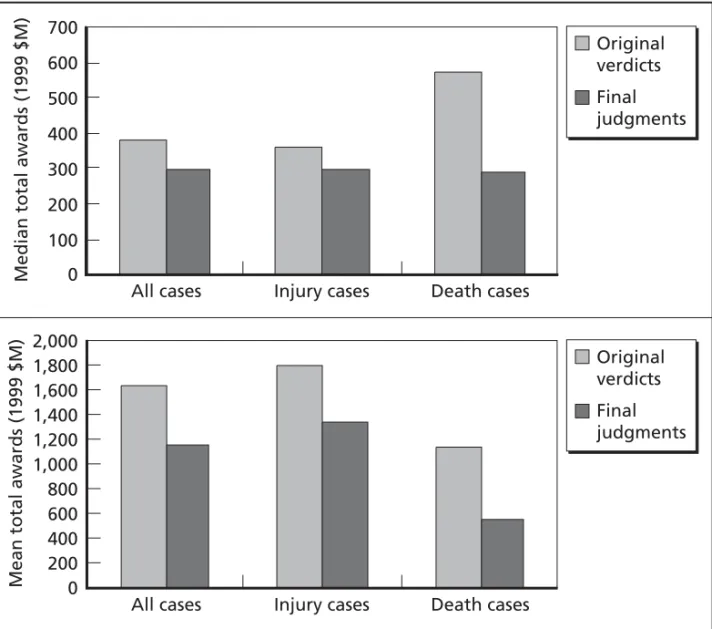
Awards in the original verdicts in our sample totaled $421 million, but with MICRA, the final judgments in those cases dropped to $295 million. In other words, MICRA reduced the overall liabilities of the defendants by 30 percent. In death cases, defendants’ liabilities were reduced by 51 percent, compared with a 25 percent reduction in non-fatal injury claims. When their awards are capped, plaintiffs
typi-cally lose many hundreds of thousands of dollars. The median3 reduction in
non-economic awards was $366,000. Although some awards were reduced by only a few thousand dollars, the largest cut found in our sample during the five-year period (1995 to 1999) was nearly $9 million, a reduction representing 97 percent of the jury’s original non-economic damage award. Similar cases with multi-million-dollar ____________
3 The “median” award is that value for which half of all values are above it (and half are below it). The “mean”
Summary xxi
reductions are often cited as evidence that some plaintiffs are shouldering a dispro-portionate share of MICRA’s impact.
What Types of Cases Are Most Affected by MICRA?
To identify the types of cases that realized the greatest changes in award size, we looked at the data in a number of different ways. First, although we give aggregate results for all cases, we also examined the difference in results for non-fatal injury cases (which we refer to from here on as “injury cases”) and cases that resulted in death, and we found some stark differences. Second, we estimated the effect of MICRA on awards in terms of absolute size of reduction (in dollars) and also in terms of the percentage reduction in the total award, by which we mean the eco-nomic and non-ecoeco-nomic damages combined. Injury cases with absolute reductions of $2.5 million or more usually involved newborns and young children with very critical injuries (such as permanent coma, quadriplegia, or severe retardation). But such large dollar losses did not always translate into large percentage reductions in total awards because these very young plaintiffs needed extensive medical care over the rest of their lives and were often awarded economic damages of equal or greater value than their non-economic awards. Even after MICRA reductions, the total awards in most of these cases were still more than a million dollars. Arguably, the injury cases most affected by MICRA were the ones in which the plaintiffs lost the greatest percentage of the total award as a result of the cap on non-economic damages.
Cases with the greatest percentage losses in total awards are those with small economic losses but great damage to the plaintiff’s quality of life. These cases, with economic awards of $100,000 or less (and sometimes as little as $1,200), had non-economic awards of about a million dollars or more (suggesting that the jury believed the plaintiff’s injuries resulted in extreme levels of pain, suffering, anguish, distress, and the like), resulting in a drop of 67 percent or more in total award size. In one instance, the final total award was reduced by 94 percent.
Cases involving claims of death have larger reductions than non-fatal injury cases—in both absolute and relative terms. The median reduction in capped-death cases was $459,000, compared with $286,000 for injury cases, and the median per-centage reduction in total awards when the cap was imposed was 49 percent, com-pared with 28 percent in injury cases. The reason for these deep percentage cuts in total award size for death cases is that, on average, death cases receive relatively low awards for economic damages compared with the awards originally granted by juries for non-economic damages.
xxii Capping Non-Economic Awards in Medical Malpractice Trials
What Types of Injuries Experienced the Greatest Reductions in Awards?
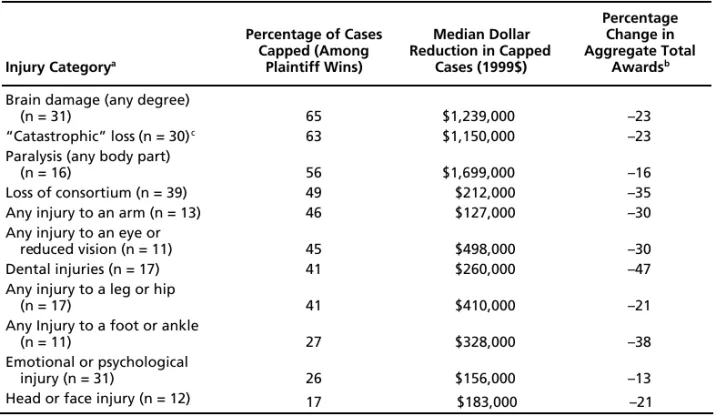
Table S.1 describes the effects of MICRA by injury type along several dimensions: the percentage of capped cases, the median award reduction when the case is capped, and the percentage reduction in aggregate total awards (including cases above and below the cap). The table shows that plaintiffs with the most serious injuries, such as brain damage, a variety of catastrophic injuries, and paralysis, have their awards capped most frequently, and when they do, they incur median reductions of more than a million dollars. Dental cases, however, experience the highest percentage re-duction in aggregate awards in all plaintiffs’ verdicts, even though they resembled many other injury cases in their frequency of being capped and median dollar reduc-tion. Jury awards for these injuries are reduced by nearly half because of the cap. A few other types of non-catastrophic injuries, such as injury to a foot or ankle or claims of a loss of consortium, also experienced deep cuts in total awards aggregated across all cases.
Table S.1
Effects of MICRA by Various Injury Categories
Injury Categorya Percentage of Cases Capped (Among Plaintiff Wins) Median Dollar Reduction in Capped Cases (1999$) Percentage Change in Aggregate Total Awardsb
Brain damage (any degree)
(n = 31) 65 $1,239,000 –23
“Catastrophic” loss(n = 30)c
63 $1,150,000 –23
Paralysis (any body part)
(n = 16) 56 $1,699,000 –16
Loss of consortium (n = 39) 49 $212,000 –35
Any injury to an arm (n = 13) 46 $127,000 –30
Any injury to an eye or
reduced vision (n = 11) 45 $498,000 –30
Dental injuries (n = 17) 41 $260,000 –47
Any injury to a leg or hip
(n = 17) 41 $410,000 –21
Any Injury to a foot or ankle
(n = 11) 27 $328,000 –38
Emotional or psychological
injury (n = 31) 26 $156,000 –13
Head or face injury (n = 12) 17 $183,000 –21
NOTE: Dollar amounts are rounded to the nearest thousand.
a These categories overlap (a plaintiff may be counted in more than one category) and reflect only those claimed injury types found in 5 percent or more of the injury cases in which plaintiffs won. Counts for each category correspond to the number of cases with plaintiff wins, whether or not they are capped. b
Includes cases both above and below the cap.
c “Catastrophic losses” as we have defined them include claims of burns over more than 50 percent of the body, quadriplegia, paraplegia, becoming infected with HIV or allowing AIDS to develop, severe brain damage, or blindness.
Summary xxiii
Among the injuries least affected by the cap are those that involve emotional or psychological injuries. Verdicts for the plaintiffs in such cases trigger the MICRA cap 26 percent of the time (compared with 41 percent for all injury cases), have one of the smallest median dollar reductions of any commonly claimed injury when the cap is triggered, and result in one of the smallest reductions in aggregate total awards for all cases with such claims (13 percent).
Which Age Groups and Gender Are Most Affected by MICRA?
Injured plaintiffs under one year of age4 had MICRA reductions imposed in 71
per-cent of their cases. The median reduction for this age group in capped cases was also very high: 1.5 million dollars, far more than the median for individual plaintiffs with injury claims ($268,000). But because their economic awards are also relatively large, cases involving infants have the smallest median percentage reductions in the total award when the cap is imposed: losses of 22 percent compared with losses of 32 per-cent for all individual plaintiffs with injury claims.
Plaintiffs 65 years of age and older also have a very high percentage of awards reduced by the cap (67 percent), but they have the smallest median dollar reduction of any age group because their awards for non-economic damages often fall relatively close to the $250,000 limit. Undoubtedly, the fact that different age groups are likely to experience different sorts of injuries may play a role in these distinctions.
Female plaintiffs typically have larger cuts to their total verdicts, with a median change of –34 percent compared with –25 percent for males. As with the differences between age groups, some of the differences between men and women in the fre-quency and impact of the cap’s imposition may be due to differences in the types of medical conditions for which they originally sought treatment.
What Are MICRA’s Effects on Attorney Fees?
In the absence of MICRA, the cases we examined would have generated an estimated $140 million in fees for the plaintiffs’ attorneys, assuming a contingency fee rate of one-third of the recovery and using the jury’s original verdict for calculating that fee. But with the effects of the award caps and sliding scale, attorney fees were reduced by 60 percent overall (59 percent for injury cases and 65 percent for death cases). Figure S.1 shows the impact of various assumptions on estimated fees. From top to bottom, the figure shows estimated total fees ($140 million) with no limits on the fees or awards), the effect of award caps without any limits on fees (a 30 percent decrease), ____________
xxiv Capping Non-Economic Awards in Medical Malpractice Trials
effects of fee limits without any caps on awards (a 46 percent decrease), and the effect of MICRA on fees with limits on both awards and fees, which yields aggregate fees of $56 million (a 60 percent decrease). These results suggest that MICRA has had a major impact on plaintiffs’ attorney fees in medical malpractice cases and that the sliding scale has a greater effect on those fees than has the damage cap.
What Are MICRA’s Effects on Plaintiffs’ Net Recoveries?
One justification for imposing limits on attorney fees was to help offset the impact of award reductions on plaintiffs. To gauge the size of this offset, we estimated plain-tiffs’ net recoveries—i.e., the final judgments minus estimated fees—for all cases in our data. In the absence of MICRA, the plaintiffs in the cases we examined would have received estimated net recoveries of about $280 million, using the jury’s original verdict and assuming a contingency fee of one-third of the recovery. We found that net recoveries were reduced by 15 percent overall (9 percent in injury cases and 44 percent in death cases) as a result of MICRA’s limits of awards and fees.
Figure S.2 shows the impact of various assumptions on estimated net recoveries. Moving from top to bottom, the figure shows estimated net recovery in the aggregate without MICRA ($280 million), the effect of award caps but no fee limits on that
Limits on fees and awards Fee limits, no caps on awards No limits on fees, awards capped No limits on fees or awards 0 50 100 150
Aggregate attorney fees 1995–1999 (1999 $M) –30%
–46%
–60%
RAND MG234-S.1
Summary xxv
amount (a 30 percent decrease), the effect of fee limits without award caps (a 23 per-cent increase), and the effect of both fee and award limits on the original amount ($240 million, a 15 percent decrease).
Such aggregate numbers, however, hide significant differences in the effects of MICRA on net recoveries in cases that were awarded different amounts for non-economic damages. Figure S.3 illustrates those differences. It shows that when com-bined with the award cap, the attorney fee limits work to the greatest advantage of those plaintiffs with relatively modest non-economic awards, but does not provide complete offset for those with the largest awards. Net recoveries for all cases with original jury awards for $250,000 or less in non-economic damages were increased by 19 percent, while those with non-economic damage awards over $1 million were
re-duced by 28 percent. The change in net recovery was greatest in high-value death
cases, with a 64 percent drop in aggregate size despite the limits on fees.
Adjusting the Cap for Inflation
With the cap remaining fixed in nominal terms at its 1975 levels, the real value of the maximum award for non-economic damages has been declining over the years. To explore this issue, we calculated how final judgments in our five-year sample of
RAND MG234-S.2 Limits on fees and awards Fee limits, no caps on awards No limits on fees, awards capped No limits on fees or awards 0 50 100 150 200 250 300 350 400
Aggregate net recoveries 1995–1999 (1999 $M) –30%
+23%
–15%
xxvi Capping Non-Economic Awards in Medical Malpractice Trials RAND MG234-S.3 Over $1M $250K to $1M $250K or less –80 –60 –40 –20 0 20 Deaths only Injuries only All cases Non-economic damage awards
Percentage change from a system without limits on fees or awards
Figure S.3—Change in Aggregate Net Recoveries by Size of Original Non-Economic Damage Awards
trials would have changed if the MICRA caps had been allowed to increase at the rate of inflation (or “indexed”) as part of the original legislative package. Based on the Consumer Price Index for urban consumers as the benchmark for annual increases, the cap would have been $708,000 in 1995, $729,000 in 1996, $746,000 in 1997, $757,000 in 1998, and $774,000 in 1999.
If the MICRA cap had been indexed for inflation since 1975, the savings to de-fendants in the five years’ worth of cases we examined would have been 21 percent of the amount originally awarded (compared with 30 percent under the fixed cap), as-suming that the same number and types of trials would occur under these modified conditions. The tripling of the cap’s size for the study period would have resulted in a 13 percent increase in defendant liabilities for the trials found in our data. The proportion of verdicts over the cap in the five-year period of the study would de-crease by more than half, from 45 percent to 19 percent. However, it is possible that additional cases would have been filed and more trials would have taken place with the higher limits, increasing defendant expenditures.
Summary xxvii
Conclusions and Implications
MICRA does appear to have had the California Legislature’s intended initial result of limiting defendants’ expenditures. Whether such savings have translated into reduced premiums and greater availability of coverage—which were the California Legisla-ture’s ultimate goals—is beyond the scope of this analysis.
Although the study did not assess the adequacy of compensation for plaintiffs, it did identify the types of cases and plaintiffs that lose the most as a result of MICRA:
• Plaintiffs with the severest injuries (brain damage, paralysis, or a variety of cata-strophic losses) had their non-economic damage awards capped far more often than all plaintiffs with injury claims and had median reductions of more than one million dollars (compared with a median reduction of $286,000 for all in-jury cases).
• Plaintiffs who lost the highest percentage of their total awards were often those with injuries that led to relatively modest economic damage awards (about $100,000 or less) but that caused a great loss to their quality of life (as suggested by juries’ million-dollar-plus awards for pain, suffering, anguish, distress, and the like). These plaintiffs sometimes received final judgments that were cut by two-thirds or more from the jury’s original decision.
• Death cases are capped more frequently than injury cases (58 percent versus 41 percent), and when they are capped, death cases have much higher percent-age reductions in total awards than injury cases, with a median drop of 49 per-cent versus a 28 perper-cent drop for injury cases.
The study results also suggest that MICRA has resulted in a sea change in the economics of the malpractice plaintiffs’ bar. Because of the law’s combination of award caps and limits on maximum contingency percentages, attorneys lost 60 per-cent of the fees they would have made from these plaintiff victories without MICRA. The analysis suggests that the savings to defendants and their insurers are funded by both plaintiffs and their attorneys. Because the fee limits help offset award reductions (aggregate net recoveries for plaintiffs are 15 percent less than they would have been without MICRA even though defendants are realizing a 30 percent drop in aggregate liabilities), the legislation’s provisions regarding awards and fees could be character-ized as shifting some of the costs for compensating medical malpractice from defen-dants to not only plaintiffs but also to plaintiffs’ counsel.5
____________
5 To put it another way, defendants would have paid out $420.6 million without MICRA but with the award
cap, aggregate liabilities were $295.5 million, a $125.1 million savings. Without MICRA, we estimate that plain-tiffs would have received $280.4 million in net recoveries after fees were deducted but with the award cap and the fee limits, aggregate net recoveries were $239.5 million, a $40.9 million drop. The difference between the
defen-xxviii Capping Non-Economic Awards in Medical Malpractice Trials
The effect of this financial shift on attorney practices is unclear. Has MICRA discouraged attorneys from practicing in this field? Has MICRA changed the way claims are litigated and settlements are negotiated? Has MICRA made it more diffi-cult for plaintiffs in malpractice cases to find attorneys who will represent them? These are all important questions raised by this analysis. Steeply reduced fees, com-bined with the relatively low rate of plaintiff victories in California medical malprac-tice cases and the high costs of expert medical witnesses—which are almost always borne by the attorney if there is no recovery—suggest that attorneys in California are likely to be much more selective in evaluating new malpractice clients than they would be in the absence of MICRA.
The study suggests that the research that is required to fully inform the policy discussion would include an analysis of the following:
• the effects of MICRA on a patient’s access to attorney representation
• the comparative effects of MICRA on different demographic groups and be-tween patients with various types of losses arising from malpractice incidents (e.g., those with low out-of-pocket expenses versus those with more substantial economic losses)
• the effects of MICRA’s trial award limits on the size of settlement offers
• the effects of MICRA’s impact on award and settlement size on other types of benefit providers, such as government programs or disability insurers
• the effects of current and proposed liability rules on medical errors and the quality of care
• the effects of current and proposed liability rules on access to medical care • the effects of various liability regimes on health care costs
• the impact of any savings to defendants occasioned by MICRA upon medical malpractice insurance premium levels and the availability of coverage.
__________________________________________________________________
dants’ savings and the reduction in plaintiffs’ net recoveries, approximately $84 million, would come in the form of reduced attorneys fees.
xxix
Acknowledgments
We would like to acknowledge the excellent long-term relationship that ICJ has en-joyed with some of the most respected private jury-verdict reporting services across the country: California Jury Verdicts Weekly (San Diego), Cook County Jury Verdict Reporter (Chicago), Jury Verdict Reporting Service (St. Louis), Jury Verdicts Northwest (Seattle), New York Jury Verdict Reporter (East Islip), and Texas Blue Sheet (Houston). Without their generous permission to use the information that they gather and pub-lish, this work would not have been possible.
For nearly two decades, the Institute for Civil Justice has had the benefit of the enthusiasm and skills of both upper-level law students from Southern California law schools and recent bar admittees to help us develop our jury verdicts database. The most recent effort to read and code 17,000 reports of jury verdicts reached in 1995 through 1999 in California, New York, and a number of other jurisdictions in the country was led by Janine Chu and Sharona Ghodsian. Other coders included Mi-chael Rousseau, Ted Gipstein, Mary Masi, Lisa Anderson, MiMi-chael Levine, Erin Haggerty, Susan Jensen, William Colitre, Padraic McCoy, and Yaron Tilles. Donald Solosan of the RAND Survey Research Group coordinated the considerable adminis-trative aspects of the coding effort.
Steven Garber and David Studdert provided helpful criticisms and contribu-tions in their formal review of this report. We value their suggescontribu-tions and hope that we have responded appropriately.
Joanna Nelsen of ICJ and Christopher Dirks of RAND are to be thanked for their tireless and valuable administrative work on this document. Nancy DelFavero did her usual outstanding job of editing.
We are also grateful for the input of various members of the ICJ Board of Over-seers who took the time to review early drafts of this report. Their comments gave the authors an invaluable education and grounded the end result in reality. Any er-rors in methodology, data collection, or conclusions are, of course, solely the respon-sibility of the report’s authors.
1 CHAPTER ONE
Introduction
Over the past few years, growing concerns about the availability and costs of medical malpractice insurance have sparked a vigorous national debate over how personal in-jury claims arising from health care treatment are litigated and resolved. Proponents of changes to existing rules and procedures have argued that doctors, hospitals, and other health care providers are facing skyrocketing medical liability insurance premi-ums in many states and in some instances are unable to obtain malpractice coverage at all.1 They also claim that doctors are retiring from practice out of frustration with
the high costs of insurance or moving their practices to states that have revamped their medical liability rules or where insurance is more affordable.
Asserting that an increase in both the frequency of medical malpractice claims and the size of the average payout has been at the root of the current situation, some observers have called for sweeping changes in the laws controlling how disputes over health-care-related injuries are resolved.2 In response, the U.S. Congress in recent
years has deliberated over various proposals that would impose new rules on all states that have not already adopted restrictions on malpractice litigation.3
____________
1 Bush, 2003.
2 Physician Insurers Association of America, 2003.
3 One example of a reform package that Congress has considered is House Bill 5 (H.R. 5), passed by the U.S.
House of Representatives on March 13, 2003, although not under consideration by the U.S. Senate as of this writing. While H.R. 5 is clearly modeled on the Medical Injury Compensation Reform Act of 1975 (MICRA), the subject of this study, there are a number of significant differences between the two. For example, the proposed legislation would limit punitive damages to instances in which the defendant acted with malicious intent to injure or deliberately failed to avoid unnecessary injury and would cap such damages to the greater of $250,000 or twice the economic damage award (MICRA is silent as to punitive damages). Another departure from MICRA is that H.R. 5 clearly applies its restrictions to actions against health care organizations and medical product manufactur-ers. H.R. 5 also appears to place a single cap for all plaintiffs on non-economic damages arising out of a single event, whereas MICRA (as interpreted by the California courts) places separate caps on the claims of the person directly injured and the claims of his or her spouse. H.R. 5 would eliminate joint liability for both economic and non-economic losses, whereas MICRA is silent on this issue (California Civil Code §1431.2, which does elimi-nate joint liability for non-economic damages only, became effective on June 4, 1986). Finally, H.R. 5 contains a clear prohibition on informing the jury of the potential imposition of the award cap, whereas no such restriction is found in the MICRA statutes.
2 Capping Non-Economic Awards in Medical Malpractice Trials
A model for these efforts has been a California law known as MICRA, the
Medical Injury Compensation Reform Act of 1975.4 This complex legislation has
two key features: It limits to $250,000 the amount a plaintiff can recover for non-economic damages5(such as pain or suffering, emotional distress, mental anguish, and
loss of consortium)6 and it limits plaintiffs’ attorney fees in malpractice cases
ac-cording to a sliding scale based on the size of the recovery, with the contingency fee percentage decreasing as the plaintiff’s recovery increases.
The framers of MICRA hoped that the law’s provisions would result in lower premium levels and a healthier insurance industry. Proponents of similar changes to liability rules today claim that MICRA has done just that: They believe that MICRA is the primary reason that medical malpractice insurance is relatively affordable and available in California.7
Critics of proposed changes to liability rules with features similar to those found in MICRA claim that such changes would result in inadequate compensation for the most severely injured; that they would shift the costs of liability from malpractice in-surance companies to other types of insurers, benefit providers, or government agen-cies; that they would become increasingly unfair over time because the size of any award caps would remain fixed in nominal terms despite inflation; and that they would prevent many victims with legitimate claims from obtaining skilled legal rep-resentation.8 Suggesting that the current problems in the malpractice insurance
in-dustry are due more to the cyclical nature of the insurance market and poor under-writing conditions, critics of the proposed changes also question claims that the insurance industry is so weak that it needs this kind of specialized relief and asserts that MICRA-like rule changes would translate into reduced premiums and greater availability of coverage.9
As this debate heats up in Congress and in some state legislatures, it underscores that there is a clear need for empirical analysis of the issues that are involved. The ____________
4 Stats. 1975, Second Ex. Sess. 1975–1976, Chs. 1, 2, pp. 3949–4008, quoted in Fein v. Permanente Medical
Group, 175 Cal. Rptr. 177 at 184 (Cal. App. 3rd Dist., 1981).
5 The terms “damages” and “losses” are for the most part interchangeable. In this report, the word “damages”
refers specifically to claimed losses.
6 Loss of consortium refers to the loss of a spouse’s care, comfort, companionship, emotional support, and sexual
intimacy.
7 See, e.g., Office of the Assistant Secretary for Planning and Evaluation, 2002. President George Bush, for
ex-ample, asserted that MICRA has worked to lower insurance premiums: “Anybody who goes into court and wins their case ought to get full economic damages. At the same time, we must prevent excessive awards that drive up costs, encourage frivolous lawsuits, and promote drawn-out legal proceedings. And that is why we need a reason-able federal limit on non-economic damages awarded in medical liability lawsuits, and the reasonreason-able limit in my judgment ought to be $250,000. . . . In California, when they had a problem with their medical malpractice insur-ance premiums, they put a law in place, and it worked. . . .” [emphasis added](Bush, 2002).
8 See, e.g., Mehlman, 2003.
Introduction 3
most contentious issues revolve around MICRA’s imposition of a ceiling of $250,000 on non-economic damages in malpractice awards and its maximum limits on attor-ney fees, two features of the legislation that are the subjects of this research.
Study Objectives and Approach
This study examined how MICRA’s caps on damage awards and its limits on contin-gency percentages have affected the plaintiffs’ recoveries, the fees plaintiffs’ attorneys receive, and the liabilities of defendants following a verdict at trial. Specifically, it ad-dresses the following questions:
• How have MICRA’s caps on non-economic damages affected the final judg-ments in California jury trials?
• What types of cases and claims are most likely to have an award cap imposed following trial?
• What have been the effects of MICRA on plaintiffs’ attorney fees?
• What have been the effects of MICRA on plaintiffs’ net recoveries (the final judgments minus estimated fees)?
• If the MICRA cap had been adjusted for inflation, what would have been the ef-fect on the final awards in the trials we examined?
We analyzed the outcomes of 257 medical malpractice trials (195 plaintiffs with non-fatal injury claims and 62 with death claims) with jury verdicts granted in favor of the plaintiffs over a five-year period (1995 to 1999) in California state courts. The source for these data was the California Jury Verdicts Weekly (CJVW), a private publi-cation that provides extensive information about recent jury decisions across the state.
Because the MICRA award cap is applied by the trial judge only after the jury’s decision has been delivered, we were able to use the jury verdict data to calculate the difference between what the jurors believed was the proper amount of damages (as evidenced by their original awards) and what the plaintiffs were likely to have re-ceived as a result of MICRA. A more detailed description of our methodology and data is provided in Chapter Two and Appendix C.
Issues Not Addressed in This Report
While this analysis provides important information about how MICRA operates in actual trials, it is important to clarify what the study does not do. Focusing on jury verdicts ignores MICRA’s effects on the much larger number of cases that were
re-4 Capping Non-Economic Awards in Medical Malpractice Trials
solved prior to trial and on disputes and losses from health-care-related injuries that never reached the filing stage. MICRA’s most important ramifications for both pa-tients and health care professionals (and their insurers) may not be on trial awards but instead on the far greater number of matters that never went before a jury. But such cases and claims are outside the scope of this analysis. MICRA is likely to have changed the number and character of cases that reached the trial stage; however, our analysis focused solely on actual trials concluded during our study period.
There is also a good deal of interest in the relationship between award caps and malpractice insurance premium levels and the availability of coverage, but we were not able to include an analysis of that relationship in this study. Such an analysis would have required analyzing insurance cycles, assessing the impact of other changes in the liability and insurance system since MICRA was implemented, comparing California with other states that have not radically changed their medical liability laws, determining the underlying frequency and severity of medical errors and the injuries that result from them, investigating the rates of informal claiming and filing cases, and exploring other issues.10 As a result, no conclusion can be drawn from the
study as to whether MICRA achieved the California Legislature’s ultimate goal of maximizing the availability of health care services by holding down insurance pre-mium levels.
Nor does this study address other important questions, such as MICRA’s effects on (1) the costs and quality of health care services; (2) specific medical practices, such as the extent of “defensive” medicine; (3) transaction costs of the malpractice liability system; (4) the frequency of what some observers have characterized as “frivolous” lawsuits; (5) shifts in costs to other types of insurance and benefits providers; (6) the size of pre-trial settlements; and (7) the ability of injured individuals to receive fair compensation through settlement or trial.
Nevertheless, we believe an analysis that focuses on jury awards can shed light on how important—albeit selected—aspects of MICRA’s features operate in practice and contribute to the ongoing policy debate over medical malpractice litigation.
Origins and Purpose of MICRA
What many states are experiencing now mirrors what California faced in the mid-1970s, when a major medical malpractice insurer announced that it would no longer write group insurance in the state while other insurers implemented dramatic rate ____________
10 For an example of the type of complex analysis needed for exploring the linkage between liability laws and
Introduction 5
increases.11 And like physicians in states such as New Jersey,12 West Virginia,13 and
Nevada14 in 2002 and 2003, California doctors in 1975 went on strike to protest
what they felt was an unfair and unjust situation that was squeezing them out of their practices.15
California legislators at the time voiced their concerns that if the crisis were al-lowed to continue, a collapse of the medical liability insurance system would limit the availability of health care and also result in a situation in which those who were injured by medical negligence would be unable to recover adequate compensation from uninsured doctors. As the preamble to MICRA states:
The Legislature finds and declares that there is a major health care crisis in the State of California attributable to skyrocketing malpractice premium costs and re-sulting in a potential breakdown of the health delivery system, severe hardships for the medically indigent, a denial of access for the economically marginal, and depletion of physicians such as to substantially worsen the quality of health care available to citizens of this state.16
The legislature reacted to the situation by passing MICRA. The ultimate legisla-tive goal of MICRA, repeatedly reiterated by the California Supreme Court, was to maximize the availability of health care services by holding down premium levels and thereby reducing the cost of malpractice insurance.17 As the Court stated in a 1984
decision:
As we have frequently recounted, the Legislature enacted MICRA in response to a medical malpractice insurance “crisis,” which it perceived threatened the quality of the state’s health care. . . . The continuing availability of adequate medical care depends directly on the availability of adequate insurance coverage, which in turn operates as a function of costs associated with medical malpractice litigation. . . . ____________
11 Although per-doctor malpractice insurance premiums in California had already been rising 14 percent per year
between 1960 and 1974, they took a sharp upward turn in the mid-1970s. Rate hikes of 300 percent and more were put into effect in 1975 by Argonaut Insurance and Travelers Insurance, two of the state’s largest insurers (Lipson, 1976, p. 1). Argonaut also announced in January 1975 that it would no longer extend group coverage to Northern California doctors, although it would offer more expensive individual policies that were sometimes as much as four times the group rate. Fosburgh, 1975a, p. A1.
12 Goldman, 2003, p. A10. 13 Miller, 2003, p. A1.
14 “Shuttered Las Vegas Trauma Center . . . ,” 2002, p. A20.
15 Triggered by Argonaut Insurance’s cessation of group coverage to Northern California doctors, nearly half of
the doctors in that part of the state failed to show up for work beginning May 1. By the end of the month, the work stoppage had spread to Southern California hospitals as well. Fosburgh, 1975a, p. A1; Fosburgh, 1975b, p. A56.
16 Stats. 1975, Second Ex. Sess. 1975–1976, Ch. 2, §12.5, p. 4007, quoted in Fein v. Permanente Medical Group,
175 Cal. Rptr. 177 at 184 (Cal. App. 3rd Dist., 1981).
6 Capping Non-Economic Awards in Medical Malpractice Trials
Accordingly, MICRA includes a variety of provisions all of which are calculated to reduce the cost of insurance by limiting the amount and timing of recovery in cases of professional negligence. . . . MICRA thus reflects a strong public policy to contain the costs of malpractice insurance by controlling or redistributing li-ability for damages, thereby maximizing the availli-ability of medical services to meet the state’s health care needs.18
MICRA left unchanged both the core elements for establishing liability and the burden of proof that is placed on a plaintiff. In theory, identical plaintiffs bringing a case to trial before and after MICRA would have the same chance of winning. MICRA also did not attempt to directly influence the size of medical malpractice in-surance premiums or mandate the availability of coverage. Instead, its primary strat-egy was to reduce the exposure of defendants (directly) by limiting trial awards and (indirectly) by influencing the size of settlements and by reducing the number of new cases filed against health care providers.
How MICRA Works
This section provides information on the types of damage awards, as well as recovery caps and limits on attorney fees under MICRA. For a summary of MICRA provi-sions other than those related to the cap on awards and the limits on fees, see Appen-dix A. For a description of how malpractice litigation in California compares with other civil litigation in terms of frequency, plaintiff win rates, and award amounts, see Appendix B.
Types of Damage Awards
When juries find for plaintiffs on the question of liability and grant them some amount of money—what we will call a plaintiff “win”—the monetary verdicts take the form of compensatory damageawards and, on occasion, punitive damageawards. Compensatory damage awards are designed to help the plaintiff recover any losses suffered as a consequence of the defendant’s actions. The purpose of compensatory awards is often characterized as an attempt to return plaintiffs to the condition they occupied before they were injured. The awards represent, to the maximum degree possible, the financial equivalent of the losses and the harms incurred in the past or reasonably certain to be incurred in the future by the plaintiff. This compensation is typically divided into separate awards for economic damages and non-economic damages.
Table 1.1 breaks out the types of damage compensation. Economic damages awards (sometimes called special damage awards or pecuniary loss awards) are for spe-____________
Introduction 7
cific costs already incurred or likely to be incurred by the plaintiffs, such as medical care expenses or past wage loss or estimated impairment to one’s future earning ca-pacity. An award for economic damages usually has some quantifiable basis. Non-economic damage awards (sometimes called general damage awards,non-pecuniary loss awards, discretionary damage awards, or indeterminate damage awards) encompass losses that are harder to quantify in dollar terms, such as pain, suffering, humiliation, and the like. Translating these losses into their monetary equivalent is a subjective process that is left up to the jury after considering the evidence and the arguments of
counsel for both sides.19 However, the trial judge—and ultimately the appellate
courts—can reduce or void the non-economic damage award if they believe it to be
excessive.20 Non-economic awards are the sole focus of MICRA’s limits on trial
awards.
The second broad type of monetary awards, granted under only limited circum-stances, are punitive damages. Unlike compensatory damages, punitive damages are not intended to cure the plaintiff’s harm but rather to punish the defendant and send a signal that similar behavior by others is unacceptable.
Table 1.1
Types of Damage Awards
Economic damages
Compensate for past or future economic losses such as wage loss, costs of medical care and vocational rehabilitation, property damage, loss of profits, replacement services, attendant care, and other such losses
Compensatory damages
Non-economic damages
Compensate for past or future non-economic losses such as pain, suffering, emotional distress, mental anguish, disfigurement, physical impairment, loss of consortium, loss of companionship, loss of parental guidance, loss of enjoyment of life, loss of society, humiliation, embarrassment, inconvenience, injury to reputation, and other such losses Punitive damages Punish and/or deter similar behavior by the defendant or others
____________
19 The jury instruction used in California for non-economic damages typically contains language similar to the
following: “No definite standard or method of calculation is prescribed by law by which to fix reasonable com-pensation for pain and suffering. Nor is the opinion of any witness required as to the amount of such reasonable compensation. Furthermore, the argument of counsel as to the amount of damages is not evidence of reasonable compensation. In making an award for pain and suffering you shall exercise your authority with calm and reason-able judgment, and the damages you fix shall be just and reasonreason-able in light of the evidence.” See, e.g., California Jury Instructions—Civil (BAJI [Book of Approved Jury Instructions]), 1994. Nevertheless, so called “per diem” arguments in which an attorney suggests that a certain amount of money per unit of time be awarded for non-economic damages (for example, one dollar per hour for the rest of the plaintiff’s life) are allowed as are total dollar-figure requests. Beagle v. Vasold, 53 Cal. Rptr. 129 (Cal. Sup. Ct., 1966).
20 The power to override the jury’s decision also exists in the context of economic damage awards. Also, trial
judges, if they believe any award component is inadequate, have the ability to order a new trial unless the defen-dant agrees to an increase in the size of a judgment.
8 Capping Non-Economic Awards in Medical Malpractice Trials
MICRA’s Damage Caps
MICRA limits to $250,000 the amount a plaintiff can recover at trial for non-economic losses due to medical negligence. The cap has remained fixed in nominal terms at $250,000 since 1975. Like other aspects of MICRA, the award cap applies to virtually any claim against licensed health care providers for negligent acts or omis-sions in the rendering of their services. This includes claims against doctors and nurses, of course, but also claims against hospitals, chiropractors, psychotherapists, blood banks, sperm banks, emergency medical technicians, dentists, and just about any other licensed health care professional in a dispute.21 The limit is applied no
matter how serious the injuries claimed by the plaintiff, including those that result in the death of a patient.
Any reduction of the award for non-economic damages that is needed to con-form to the MICRA caps comes after the jury has rendered its decision. The jurors can award whatever amount they believe is appropriate for non-economic losses, but upon a post-verdict motion by the defendant, the judge will reduce the award to comply with MICRA’s limits before entering the final judgment in the case.
MICRA’s Sliding Scale for Attorney Fees
Placing limits on attorney fees may not seem to fit into MICRA’s strategy of lower-ing costs to defendants and their insurers as a means of reduclower-ing malpractice insur-ance premiums and improving availability of health care services. After all, such fees are paid not by the defendant but by the plaintiff in a transaction that conceivably is of no concern to the defense.
In reality, reduced contingency fees decrease the likelihood that a potential plaintiff will be able to obtain legal representation and, as such, decrease the overall exposure of potential defendants. As with any type of civil litigation in which contin-gency-fee agreements are extensively used, plaintiffs’ attorneys in medical malpractice litigation must perceive that the expected revenues from representing a client exceed the costs the attorney is likely to incur in litigation, given the risk that there may not be any recovery whatsoever. Legislatively imposed restrictions on contingency fees loom large in this calculus. As potential fees decrease, at some point it is no longer economically viable to represent some previously acceptable clients when the ex-pected costs outweigh the exex-pected payoff. Conceivably, those patients who are un-able to retain counsel could proceed on their own. But the likelihood of a pro se claimant (one without attorney representation) obtaining full compensation in a seri-ous medical malpractice case with complex issues of liability and damages is quite small. If maximum contingency fees are reduced enough, the number of successful ____________
21 In contrast, health maintenance organizations do not receive MICRA’s protections. Under California Civil
Code §3428, “Health care service plans and managed care entities are not health care providers under any provi-sion of law” and, as such, would not be within MICRA’s scope.
Introduction 9
cases—and indeed the number of formally filed cases—will drop off from the num-bers that might be seen without such limits.
Reducing the number of claims has been suggested as one of the intents behind MICRA’s limits on medical malpractice contingency fees.22 In attempting to
under-stand why the California Legislature chose to regulate fees as part of a medical liabil-ity reform package that was designed to reduce insurer expenditures, the California Supreme Court suggested that such restrictions might result in plaintiffs agreeing to accept smaller settlement offers, reducing the incentives to pursue “marginal claims” and providing greater net recoveries to plaintiffs to take some of the sting out of award caps.23
MICRA’s sliding scale for attorney fees, as amended in 1987, is shown in Table 1.2. This fee scale applies to any medical malpractice recovery, whether it is achieved through a trial, a settlement, or arbitration. Moreover, in the case of trials, it is the final judgment, after any MICRA-triggered reduction to the original jury award, which forms the basis for the fee.
The maximum contingency fee allowable under MICRA depends on the size of the recovery, and different percentages are used for different portions of the recovery. For example, attorney fees for a final judgment of $220,000 would be calculated as 40 percent of the first $50,000, one-third of the next $50,000, and 25 percent of the remaining $120,000, for a total of $66,666.67.
Table 1.2
MICRA’s Sliding Scale for Attorney Fees
Recovery Maximum Fee Allowed
First $50,000 40%
Next $50,000 1/3
Next $500,000 25%
Amounts over $600,000 15%
Organization of This Report
Chapter Two describes how we conducted the analysis. Chapter Three provides the results of our analysis of the effects of MICRA on awards. Chapter Four places the award limits within the context of another important feature of MICRA: its restric-tions on what an attorney may charge for representing plaintiffs at trial. Chapter Five ____________
22 See, e.g., Jenkins and Schweinfurth, 1979, p. 944, fn. 696; Dissent of Chief Justice Bird, Roa v. Lodi Medical
Group, Inc., 37 Cal.3d 920 at 934–940 (Cal. Sup. Ct., 1985).
10 Capping Non-Economic Awards in Medical Malpractice Trials
explores the effects of MICRA on defendants and plaintiffs if the award limit had been adjusted for inflation in the original legislation. Chapter Six summarizes our key findings and describes their implications.