The dark side of Interval Temporal Logic: sharpening the undecidability border
Davide Bresolin∗, Dario Della Monica†‡, Valentin Goranko§, Angelo Montanari‡, and Guido Sciavicco¶k ∗Dept. of Computer Science, University of Verona, Italy
Email: [email protected]
†Dept. of Computer Science, University of Salerno, Italy Email: [email protected]
‡Dept. of Mathematics and Computer Science, University of Udine, Italy Email: [email protected]
§Dept. of Informatics and Mathematical Modelling, Technical University of Denmark Email: [email protected]
¶Dept. of Information and Communication Engineering, University of Murcia, Spain Email: [email protected]
kUIST Ohrid, Macedonia
Abstract—Unlike the Moon, the dark side of interval tempo-ral logics is the one we usually see: their ubiquitous undecid-ability. Identifyingminimalundecidable interval logics is thus a natural and important issue in the research agenda in the area. The decidability status of a logic often depends on the class of models (in our case, the class of interval structures) in which it is interpreted. In this paper, we have identified several new minimal undecidable logics amongst the fragments of Halpern-Shoham logicHS, including the logic of theoverlaps relation, over the classes of all and finite linear orders, as well as the logic of themeetandsubintervalrelations, over the class of dense linear orders. Together with previous undecidability results, this work contributes to delineate the border of the dark side of interval temporal logics quite sharply.
Keywords-temporal logic; interval logic; undecidability. I. INTRODUCTION
Temporal reasoning plays a major role in computer sci-ence. In the most standard approach, the basic temporal entities are time points and temporal domains are represented as ordered structures of time points. The interval reasoning approach adopts another, arguably more natural, perspective on time, according to which the primitive ontological entities are time intervals instead of time points.
The tasks of representing and reasoning about time in-tervals arises naturally in various fields of computer sci-ence, artificial intelligsci-ence, and temporal databases, such as theories of action and change, natural language processing, and constraint satisfaction problems. Temporal logics with interval-based semantics have also been proposed as a useful formalism for the specification and verification of hardware [1] and of real-time systems [2].
Interval temporal logics feature modal operators that correspond to (binary) relations between intervals usually known as Allen’s relations [3]. In [4], Halpern and Shoham introduce a modal logic for reasoning about interval struc-tures (HS), with a modal operator for each Allen’s relation. HS is undecidable under very weak assumptions on the
class of interval structures [4]. In particular, undecidability holds for any class of interval structures over linear orders that contains at least one linear order with an infinite ascending (or descending) sequence of points, thus including the natural time flowsN,Z,Q, andR. For a long time, such a sweeping undecidability result have discouraged attempts for practical applications and further research on interval logics. A renewed interest in the area has been recently stimulated by the discovery of some interesting decidable fragments of HS[5], [6], [7], [8]. Gradually, the quest for expressive decidable fragments of HS has become one of the main points of the current research agenda for interval temporal logic. In this context, many fragments ofHShave already been shown to be undecidable [9], [10], [11], [12]. In this paper, we contribute to delineate the boundary between decidable and undecidableHSfragments by estab-lishing new undecidability results. In particular, we exhibit the first known case of a single-modalityHSfragment which is undecidable in the class of all linear orders, as well as in the class of allfinitelinear orders, strengthening previous results [10], [11]. Moreover, most undecidability proofs for interval logics hinge on the existence of a linear ordering with an infinite sequence of points; here we show how to relax such an assumption. For space reasons, the details of proofs are mostly omitted; they can be found in [13], together with a complete picture of the state-of-the-art on the classification ofHS fragments w.r.t. decidability of satisfia-bility. The web page http://itl.dimi.uniud.it/content/logic-hs also provides a collection of online tools that enable one to verify the status (decidable/undecidable/unknown) of any fragment ofHSw.r.t. the satisfiability problem, over various classes of linear orders (all, dense, discrete, and finite).
II. PRELIMINARIES
Let D = hD, <i be a linearly ordered set. An interval overDis an ordered pair[a, b], wherea, b∈D anda≤b.
Intervals of the form [a, a] are called point intervals; if these are excluded, the resulting semantics is called strict interval semantics(non-strictotherwise). Our results hold in either semantics. There are 12 different non-trivial relations (excluding the equality) between two intervals in a linear order, often called Allen’s relations [3]: the six relations depicted in Table I and their inverses. One can naturally associate a modal operator hXiwith each Allen’s relation RX. For each operatorhXi, we denote byhXiitstranspose,
corresponding to the inverse relation.
Halpern and Shoham’s logic HS is a multi-modal logic with formulae built over a set AP of propositional letters, the propositional connectives∨ and¬, and a set of modal unary operators associated with all Allen’s relations. For each subset {RX1, . . . , RXk} of these relations, we define
the HS fragment X1X2. . .Xk, whose formulae are defined by the grammar:
ϕ::=p|π| ¬ϕ|ϕ∨ϕ| hX1iϕ|. . .| hXkiϕ,
whereπis a modal constant, true precisely at point intervals. We omit π when it is definable in the language or when the strict semantics is adopted. The other propositional connectives, like ∧ and →, and the dual modal operators
[X]are defined as usual, e.g., [X]ϕ≡ ¬hXi¬ϕ.
LetI(D)be the set of all intervals overD. The semantics
of an interval-based temporal logic is given in terms of interval models M = hD, Vi, where V : AP 7→ 2I(D) is
the valuation function that assigns to every p ∈ AP the set of intervals V(p) over which it holds. The truth of a formula over a given interval[a, b]in a modelM is defined by structural induction on formulae:
• M,[a, b]πiffa=b;
• M,[a, b]piff[a, b]∈V(p), for allp∈ AP; • M,[a, b]¬ψ iff it is not the case thatM,[a, b]ψ; • M,[a, b]ϕ∨ψiffM,[a, b]ϕor M,[a, b]ψ; • M,[a, b]hXiiψiff there exists an interval[c, d]such
that [a, b]RXi [c, d], andM,[c, d]ψ,
Satisfiabilityis defined as usual.
The notion of sub-interval (contains) can be declined into two variants, namely,proper sub-interval ([a, b] is a proper sub-interval of [c, d] if c ≤ a, b ≤ d, and [a, b] 6= [c, d]), andstrict sub-interval (when both c < a andb < d). Both variants will play a central role in our technical results; notice that by sub-interval we usually mean the proper one. III. ASHORT SUMMARY OF UNDECIDABILITY RESULTS
In this section, we first summarize the main undecidability results for fragments ofHS. Then, we state the main results of this paper (Theorem III.1), which extend the previous ones under two different aspects:(i)we prove a number of new undecidability results for proper sub-fragments of logics that were already known to be undecidable, and (ii) we show how to adapt various existing undecidability proofs to a more general class of linear orders. The first undecidability
hAi hLi hBi hEi hDi hOi [a, b]RA[c, d]⇔b=c [a, b]RL[c, d]⇔b < c [a, b]RB[c, d]⇔a=c, d < b [a, b]RE[c, d]⇔b=d, a < c [a, b]RD[c, d]⇔a < c, d < b [a, b]RO[c, d]⇔a < c < b < d a b c d c d c d c d c d c d Table I
ALLEN’S INTERVAL RELATIONS AND THE CORRESPONDINGHS MODALITIES.
result, for fullHS, was obtained by Halpern and Shoham [4]. Since then, several other results have been published, starting from Lodaya [14], that proved the undecidability of the fragment BE, when interpreted over dense linear orders, or, alternatively, over hω, <i, where infinite intervals are allowed. In [9], Bresolin at al. proved the undecidability of a number of interesting fragments, such as AD∗E∗, AD∗O, AD∗B∗, AD∗O, BE, BE, and BE, where, for each X ∈ {A,L,B,E,D,O}, X∗ denotes eitherX or X. In [10], the undecidability of all (HS-)extensions of the fragmentO (and thus ofO), except for those with the modalitieshLiand
hLi, has been proved when interpreted in any class of linear orders with at least one infinite ascending (or descending) se-quence. In [11], the one-modality fragmentOalone has been proved undecidable, but assuming discreteness. Recently, Marcinkowski et al. have first shown the undecidability of B∗D∗ on finite and discrete linear orders [15], and, then, strengthened that result to the one-modality fragmentsDand D[12].
Here, we first extend and complete the results from [10], [11] by providing an undecidability proof that assumes neither discreteness nor the presence of an infinite sequence. Second, we strengthen the undecidability results given in [9] by (i) proving that the logicsB∗E∗ are undecidable over the class of finite linear orders, and (ii) by showing that the weak fragmentsA∗D∗are undecidable with respect to all relevant classes of linear orders. As a consequence, we obtain a very sharp characterization of the decidability/undecidability border for the family ofHS-fragments, as the undecidability for the mentioned logics holds over the class of all finite linear orders as well as over the classical orders based on
N,Z,Q, andR.
Theorem III.1. The satisfiability problem for theHS frag-ments O, O, A∗D∗, B∗E∗ is undecidable in any class of linear orders that contains, for each n > 0, at least one linear order with length greater thann.
Due to space constraints, we only detail the case of O. First, we show how to relax the discreteness hypothesis;
then, we provide the changes needed to relax the hypothesis about the existence of at least one infinite sequence in the model. We refer the reader to [13] for full details.
IV. UNDECIDABILITY OFO A. Intuition
As in [10], [11], our undecidability proof is based on a reduction from the so-called Octant Tiling Problem (OTP). This is the problem of establishing whether a given finite set of tile typesT ={t1, . . . , tk}can tile the second octant
of the integer plane O ={(i, j) : i, j ∈N∧0 ≤ i ≤j}.
For every tile type ti ∈ T, let right(ti), lef t(ti), up(ti),
and down(ti) be the colors of the corresponding sides
of ti. To solve the problem, one must find a function f :O → T such thatright(f(n, m)) =lef t(f(n+ 1, m))
and up(f(n, m)) = down(f(n, m+ 1)). By exploiting an argument similar to the one used in [16] to prove the undecidability of the Quadrant Tiling Problem, it can be shown that the Octant Tiling Problem is undecidable too. Given an instance OTP(T), whereT is a finite set of tiles types, we build anO-formulaΦT in such a way that ΦT is satisfiable if and only if T tiles O. The proof is similar to that of other undecidability results for HS fragments, but not readily derivable from those. It is based on the undecidability proof of O in the class of discrete linear orders [11]. The essential difference here concerns dropping the discreteness assumption, which turns out to be rather non-trivial, and it leads to a very general and elegant proof of the undecidability ofO, structured as follows. First, we focus on the (sub)setG[a,b] of all and only those intervals that are
reachable in the language ofOfrom a given starting interval
[a, b], by defining a suitable global operator [G]. Then, we set the tiling framework by forcing the existence of a unique infinite chain ofu-intervals (i.e., intervals satisfying a designated propositionu) on the underlying linear ordering; the elements of suchu-chainwill be used as cells to arrange the tiling, and we will define in the language a derived modality to capture exactly the next u-interval from the current one. Third, we encode the octant by means of a unique infinite sequence ofId-intervals (Id-chain), each one of them representing a row of the octant. An Id-interval is composed by a sequence of u-intervals; each u-interval is used either to represent a part of the plane or to separate two consecutive rows; in the former case it is labelled with tile, in the latter case it is labelled with ∗. Fourth, by setting suitable propositions, we encode the above-and right-neighborrelations, which connect each tile in a row of the octant with, respectively, the one immediately above it and the one immediately at its right, if any. The encoding of such relations must be done in respect of thecommutativity property(Def. IV.1 below). Throughout, if two tilest1andt2
are connected by the above-neighbor (resp., right-neighbor) relation, we say that t1 is above-connected (resp.,
right-connected) tot2, and similarly fortile-intervals (when they
encode tiles of the octant that are above- or right-connected, respectively).
Definition IV.1 (commutativity property). Given two tile-intervals[c, d]and[e, f], if there exists atile-interval[d1, e1],
such that[c, d] is right-connected to [d1, e1] and[d1, e1] is
above-connected to[e, f], then there exists also atile-interval
[d2, e2] such that [c, d] is above-connected to [d2, e2] and [d2, e2] is right-connected to[e, f].
B. Technical details in the infinite case
Let [a, b] be any interval of length at least 2 (i.e., such that there exists at least one pointc witha < c < b). We defineG[a,b] as the set of all and only those intervals [c, d]
of length at least 2 such thatc > a,d > b. Accordingly, the modality[G], defined as[G]p≡p∧[O]p∧[O][O]p, refers to all and only intervals inG[a,b]. Because all formulae that we
will use in the encoding will be prefixed withhOi,[O], or
[G], hereafter we only refer to intervals inG[a,b]; all others
will be irrelevant.
Definition of the u-chain.The definition of theu-chain is the most difficult step in our construction, due to the extreme weakness of the language. This part represents the main difference with [11]: while there the definition of theu-chain hinges on the discreteness assumption, here we need to force its existence by means of a completely new approach. It in-volves three, related, aspects:(i)the existence of an infinite sequence ofu-intervals[b0, b00],[b1, b01], . . . ,[bi, b0i], . . ., with b≤b0andb0i=bi+1for eachi∈N;(ii)the existence of an
interleaved auxiliary chain [c0, c00],[c1, c01], . . . ,[ci, c0i], . . .,
where bi < ci < b0i, bi+1 < c0i < b0i+1, and c0i = ci+1
for eachi∈N, composed byk-intervals (each one of them overlapping exactly oneu-chain), used to make it possible for us to reach the ‘next’u-interval from the current one (see Fig. 1);(iii)guaranteeing that both chains are unique. This third aspect is the most difficult one. To obtain uniqueness, we show that under certain conditions the language of O can express properties of proper sub-intervals, which is quite surprising for a fragment so (apparently) weak. In particular, we show that whenever p is disjointly-bounded (see Def. IV.3 below), it is possible to express properties such as “for each interval[a, b], if [a, b] satisfies pthen no proper sub-interval of[a, b]satisfies p”.
u u u u u u u
b0 b1 b2 b3 b4 b5 b6 b7
k k k k k k k
c0 c1 c2 c3 c4 c5 c6 c7
Figure 1. Encoding of theu-chain.
LetM be a model over the setAPof propositional letters, and let [a, b] be our starting interval (which automatically defines the universe G[a,b]).
Definition IV.2. The propositions p, q∈ AP are said to be disjointif, for every pair of intervalsh[c, d],[e, f]isuch that
[c, d]satisfies pand[e, f] satisfies q, eitherd≤eor f ≤c (i.e.,[c, d]∩[e, f] =∅). The propositionq is calleddisjoint consequent of p if p and q are disjoint and any p-interval is followed by aq-interval, that is, for each interval[c, d]∈ G[a,b] that satisfies p, there exists an interval[e, f]∈ G[a,b],
withe≥d, that satisfies q.
Definition IV.3. The proposition pis said to be disjointly-bounded in G[a,b] (w.r.t. a disjoint consequent q) if: (i) [a, b] neither satisfies p nor overlaps a p-interval, that is, p(possibly) holds only over intervals[c, d], withc≥b;(ii)
p-intervals do not overlap each other, that is, there do not exist two intervals[c, d]and[e, f]satisfyingpand such that c < e < d < f;(iii)phas a disjoint consequent q. Now, whenever we can prove that a certain propositionpis is disjointly-bounded inG[a,b] w.r.t. a disjoint consequentq,
we may set an auxiliary propositioninsidep in such a way
that it is true over all proper sub-intervals (in G[a,b]) of p
-intervals; after that, by simply asserting thatinsidep-intervals
and p-intervals cannot overlap each other, we will be able to guarantee that p-intervals are never proper sub-intervals of other p-intervals. To define insidep for the (disjointly
bounded) letter p, we exploit the existence of its disjoint consequence q, plus an auxiliary proposition −→p, which we make true over intervals starting inside a p-interval and ending outside it and inside aq-interval.
[G](p→[O](hOiq→ −→p)) (1)
[G](¬p∧[O](hOiq→ −→p)→insidep) (2) [G]((insidep→ ¬hOip)∧(p→ ¬hOiinsidep)) (3) Lemma IV.4. LetM be a model,[a, b]be an interval over M, andp, q∈ APtwo propositions such thatpis disjointly-bounded inG[a,b] w.r.t.q. IfM,[a, b](1)∧(2)∧(3), then,
inG[a,b], there are nop-intervals properly contained in other
p-intervals.
Proof: Suppose, by contradiction, that there exist two intervals [c, d] and [e, f] (belonging to G[a,b]) satisfying p
and such that[e, f]is sub-interval of[c, d]. By definition of sub-interval, we have that c < e or f < d. Without loss of generality, let us suppose that c < e (the other case is analogous). Since[e, f]∈ G[a,b], then there exists a point in
betweeneandf, say ite0. The interval[c, e0]is a sub-interval of [c, d]. Moreover, it cannot satisfyp, since it overlaps the p-interval [e, f] (and p is a propositional letter disjointly-bounded in hM,[a, b]i). By (1) and by the fact that q is a disjoint consequent of p, each interval starting in between c and d, and ending inside a q-interval, satisfies −→p. Thus,
[c, e0]satisfies¬pand[O](hOiq→ −→p). By (2), it must also satisfyinsidep. But this contradicts (3), hence the thesis.
From now on, given a proposition p disjointly-bounded w.r.t. to a disjoint consequent q, we use non-sub(p, q) to
denote the formula(1)∧(2)∧(3), and expressing the global property that no p-interval is sub-interval of another p -interval. By means of the following formulae, we force the letteru1,u2,k1, andk2 to be disjointly-bounded.
¬u∧ ¬k∧[O](¬u∧ ¬k) (4) [G]((u↔u1∨u2)∧(k↔k1∨k2) ∧(u1→ ¬u2)∧(k1→ ¬k2)) (5) [G]((u1→[O](¬u∧ ¬k2))∧(u2→[O](¬u∧ ¬k1))) (6) [G]((k1→[O](¬k∧ ¬u1))∧(k2→[O](¬k∧ ¬u2))) (7) [G]((hOiu1→ ¬hOiu2)∧(hOik1→ ¬hOik2)) (8) [G]((u1→ hOik1)∧(k1→ hOiu2) ∧(u2→ hOik2)∧(k2→ hOiu1)) (9) (4)∧. . .∧(9) (10)
Lemma IV.5. Let M be a model, and [a, b] and interval over M such thatM,[a, b](10). Thenu1,u2,k1, andk2 are disjointly-bounded.
Finally, to build the u-chain, we state the following formulae, where first is used to identify the first interval of the chain.
hOihOi(u1∧first) (11)
[G](u∨k→[O]¬first∧[O][O]¬first) (12)
[G]((first→u1)∧(first→[O][O]¬first)) (13) non-sub(u1,k1)∧non-sub(u2,k2)
∧non-sub(k1,u2)∧non-sub(k2,u1)
(14)
[G](u∨k→[O]hOi(u∨k)) (15)
(11)∧. . .∧(15) (16)
Lemma IV.6. LetM be a model and[a, b]an interval over M such thatM,[a, b](10)∧(16). Then:
(a) there exists an infinite sequence of u-intervals
[b0, b00],[b1, b01], . . . ,[bi, b0i], . . ., withb≤b0,b0i =bi+1
for eachi∈N, and such that M,[b0, b00]first,
(b) there exists an infinite sequence of k-intervals
[c0, c00],[c1, c01], . . . ,[ci, c0i], . . . such that bi < ci < b0i, bi+1< c0i< b0i+1, andc0i=ci+1 for eachi∈N, and
(c) every other interval [c, d]∈ G[a,b] satisfies neither of u,
k, orfirst, unless c > bi for everyi∈N.
Within this framework, the operator hXui, used either to reach the first u-interval of theu-chain or to step from any givenu-interval to the next one in the sequence, is definable:
hXuiϕ≡(¬u∧hOihOi(first∧ϕ))∨(u∧hOi(k∧hOi(u∧ϕ)))
we make use of the following set of formulae:
¬Id∧ ¬hOiId∧[G](Id→ ¬hOiId) (17)
hXui(∗ ∧ hXui(tile∧Id∧ hXui∗ ∧[G](∗ → hXui(tile∧ hXuitile)))) (18) [G]((u↔ ∗ ∨tile)∧(∗ → ¬tile)) (19) [G](∗ → hOi(k∧ hOiId)) (20) [G](Id→ hOi(k∧ hOi∗)) (21) [G]((u→ ¬hOiId)∧(Id→ ¬hOiu)) (22) [G](hOi∗ → ¬hOiId) (23) non-sub(Id,k) (24) (17)∧. . .∧(24) (25)
Lemma IV.7. Let M,[a, b] (10)∧(16)∧(25) and let b ≤b01 < c01 < b11 < . . . < bk1−1 1 < c k1−1 1 < b k1 1 =b 0 2 < c02 =c k1 1 < b 1 2 < . . . < b k2 2 =b 0 3 < . . . be the sequence of
points, defined by Lemma IV.6, such that [bij, bij+1]satisfies uand[ci
j, c i+1
j ]satisfieskfor eachj≥1,0≤i < kj. Then,
for eachj≥1, we have: (a) M,[b0
j, b1j]∗;
(b) M,[bi j, b
i+1
j ]tile for each0< i < kj;
(c) M,[b1
j, b0j+1]Id;
(d) k1= 2,kl>2 for eachl >1;
and no other interval [c, d] ∈ G[a,b] satisfies ∗ (resp., tile,
Id), unlessc > bi
j for eachi, j >0.
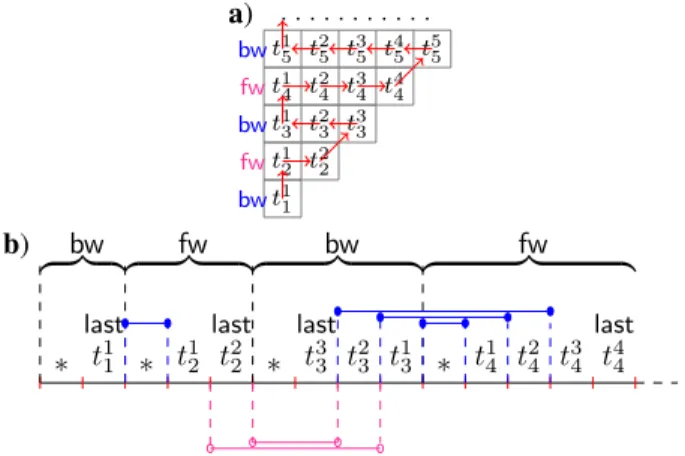
Above-neighbor relation. We proceed now with the en-coding of the above-neighbor relation (Fig. 2), by means of which we connect eachtile-interval with its vertical neighbor in the octant (e.g.,t22witht23in Fig. 2). For technical reasons, we need to distinguish betweenbackwardandforwardrows of O using the propositions bw and fw: we label each u-interval with bw (resp., fw) if it belongs to a backward (resp., forward) row (formulae (26)-(27)). Intuitively, the tiles belonging to forward rows of O are encoded in as-cending order, while those belonging to backward rows are encoded in descending order (the tiling is encoded in a zig-zag manner). In particular, this means that the left-most tile-interval of a backward level encodes the last tile of that row (and not the first one) in O. Let α, β ∈ {bw,fw}, with α6=β:
hXuibw∧[G]((u↔bw∨fw)∧(bw→ ¬fw)) (26)
[G]((α∧¬hXui∗ → hXuiα)∧(α∧hXui∗ → hXuiβ)) (27)
(26)∧(27) (28)
Lemma IV.8. If M,[a, b] (10)∧(16)∧(25)∧(28), then the sequence of points defined in Lemma IV.7 is such that M,[bij, bij+1] bwif and only if j is an odd number, and M,[bi
j, b i+1
j ] fw if and only j is an even number.
Furthermore, we have that no other interval [c, d]∈ G[a,b]
satisfies bworfw, unless c > bi j for eachi, j >0. a) t1 1 t1 2 t22 t13 t23 t33 t1 4 t24 t34 t44 t1 5 t25 t35 t45 t55 bw fw bw fw bw b)
last last last last
∗ t11 ∗ t 1 2 t 2 2 ∗ t 3 3 t 2 3 t 1 3 ∗ t 1 4 t 2 4 t 3 4 t 4 4 z }| {z }| {z }| {z }| { bw fw bw fw
Figure 2. Encoding of the above-neighbor relation.
We make use of such an alternation between backward and forward rows to correctly encode the above-neighbor relation. We constrain each up rel-interval starting from a backward (resp., forward) row not to overlap any other up rel-interval starting from a backward (resp., forward) row. The structure of the encoding is shown in Fig. 2, where up rel-intervals starting inside forward (resp., backward) rows are placed one inside the other. Consider, for instance, how the 3rd and 4th level of the octant are encoded in Fig. 2b. The1sttile-interval of the3rd level (t3
3) is connected
to the second from lasttile-interval of the4th level (t3 4), the 2ndtile-interval of the3rd level (t2
3) is connected to the third
from lasttile-interval of the4th level (t2
4), and so on. Notice
that, in forward (resp., backward) level, the last (resp., first) tile-interval has no tile-intervals above-connected to it, in order to constrain each level to have exactly onetile-interval more than the previous one (thesetile-intervals are labeled withlast).
Formally, we define the above-neighbor relation as fol-lows. If [bi
j, b i+1
j ] is a tile-interval belonging to a
for-ward (resp., backfor-ward) row, then we say that it is above-connected to the tile-interval [bjj+2+1−i, bjj+2+1−i+1] (resp.,
[bjj+2+1−i−1, bjj+2+1−i]). To do so, we label with up rel the interval [ci j, c j+2−i j+1 ] (resp., [cij, c j+2−i−1 j+1 ]). Moreover, we
distinguish between up rel-intervals starting from forward and backward rows and, within each case, between those starting from odd and even tile-intervals. To this end, we use a new proposition, namely, up relbwo (resp., up rel
bw e , up relfwo , up rel
fw
e ) to label up rel-intervals starting from an odd tile-interval of a backward row (resp., even tile-interval/backward row, odd/forward, even/forward). To ease the reading of the formulae, we groupup relbwo andup relbwe inup relbw(up relbw↔up relbwo ⊕up relbwe ), and similarly forup relfw. Finally, up relis exactly one among up relbw andup relfw(up rel↔up relbw⊕up relfw). In such a way, we encode the correspondence between tiles of consecutive rows of the plane induced by the above-neighbor relation.
Let α, β ∈ {bw,fw} and γ, δ ∈ {o,e}, with α 6= β and γ6=δ:
¬up rel∧ ¬hOiup rel (29)
[G]((up rel↔up relbw∨up relfw)
∧(up relα↔up relαo∨up relαe)) (30) [G]((k∨ ∗ → ¬hOiup rel)∧(up rel→ ¬hOik)) (31)
[G](u∧ hOiup relαγ → ¬hOiup relαδ ∧ ¬hOiup relβ) (32)
[G](up relα→ ¬hOiup relα) (33)
[G](up rel→ hOiId) (34)
[G](hOiup rel→ ¬hOifirst) (35)
[G](up relαγ → hOi(tile∧ hOiup rel β
γ)) (36)
(29)∧. . .∧(36) (37)
Lemma IV.9. IfM,[a, b](10)∧(16)∧(25)∧(28)∧(37), then the sequence of points defined in Lemma IV.7 is such that, for eachi≥0,j >0, the following properties hold: a) if [c, d] satisfies up rel, then c = ci
j and d = ci 0 j0 for
some i, i0, j, j0 > 0; that is, each up rel-interval starts and ends inside a tile-interval. More precisely, it starts (resp., ends) at the same point in which ak-interval starts (resp., ends);
b) [ci j, ci
0
j0] satisfies up rel if and only if it satisfies exactly
one betweenup relbw andup relfw and [ci j, ci
0
j0]satisfies
up relbw (resp., up relfw) if and only if it satisfies ex-actly one betweenup relbwo andup relbwe (resp., between up relfwo and up relfwe );
c) for each α, β ∈ {bw,fw} and γ, δ ∈ {o,e}, if [ci j, ci
0 j0]
satisfiesup relαγ, then there is no other interval starting atci
j satisfyingup rel β
δ such thatup rel α
γ 6=up rel β δ;
d) eachup relbw-interval (resp.,up relfw-interval) does not overlap any other up relbw-interval (resp., up relfw -interval); e) if [ci j, ci 0 j0] satisfies up rel bw o (resp., up rel bw e , up rel fw o , up relfwe ), then there exists an up relfwo -interval (resp., up relfwe -interval, up relbwo -interval, up relbwe -interval) starting at ci0
j0.
We constrain eachtile-interval, apart from the last one of some level, to have atile-interval above-connected to it. To this end, we label the lasttile-interval of every row with the new proposition last (formulae (43)-(45)). Then we force alltile-intervals not labelled withlastto have atile-interval above-connected to them (formulae (46)-(49)):
[G](tile→ hOiup rel) (38)
[G](α→[O](up rel→up relα)) (39)
[G](up relα→ hOiβ) (40)
[G](hOi∗ → ¬(hOiup relbw∧ hOiup relfw)) (41)
[G](tile∧ hOiup relαγ∧ hXuitile
→ hXui(tile∧ hOiup relαδ))
(42)
[G](last→tile) (43)
[G]((∗ ∧bw→ hXuilast)∧(fw∧ hXui∗ →last)) (44)
[G]((last∧fw→ hXui∗)∧(bw∧ hXuilast→ ∗)) (45)
[G](∗ ∧fw→ hXui(tile
∧ hOi(up rel∧ hOi(tile∧ hXui∗))))
(46)
[G](last∧bw→ hOi(up rel
∧ hOi(tile∧ hXui(tile∧ hXui∗)))) (47) [G](k∧ hOi(tile∧ hOiup relαγ)
→[O](hOiup relγα∧ hOi(k∧ hOi(tile
∧ hOiup relβδ ∧ ¬last))→ hOiup relαδ))
(48)
[G](up rel→ ¬hOilast) (49)
(38)∧. . .∧(49) (50)
Lemma IV.10. If M,[a, b] (10)∧(16)∧(25)∧(28)∧ (37)∧(50), then the sequence of points defined in Lemma IV.7 is such that the following properties hold:
a) for each up rel-interval [cij, cij00], connecting the
tile-interval[bi j, b i+1 j ]to thetile-interval[bi 0 j0, bi 0+1 j0 ], if[cij, ci 0 j0]
satisfiesup relbw(resp.,up relfw), then[bi j, b i+1 j ]satisfies bw(resp.,fw) and[bij00, bi 0+1 j0 ] satisfiesfw(resp.,bw);
b) (strict alternation property) for each tile-interval [bi j, bij+1], with i < kj − 1, such that there exists an
up relbwo -interval (resp., up rel bw
e -interval, up rel fw o -in-terval, up relfwe -interval) starting at cij, there exists
an up relbwe -interval (resp., up relbwo -interval, up relfwe -interval, up relfwo -interval) starting atcij+1;
c) for everytile-interval[bi j, b
i+1
j ]satisfyinglast, there is no
up rel-interval ending atci j;
d) for each up rel-interval [ci j, ci
0
j0], with 0 < i < kj, we
have thatj0 =j+ 1.
Lemma IV.11. Each tile-interval [bi j, b
i+1
j ] is
above-connected to exactly one tile-interval and, if it does not satisfy last, then there exists exactly one tile-interval which is above-connected to it.
Right-neighbor relation. The right-neighbor relation con-nects each tile with its horizontal neighbor in the octant, if any (e.g., t23 witht33 in Fig. 2). Again, in order to encode the right-neighbor relation, we must distinguish between forward and backward levels: a tile-interval belonging to a forward (resp., backward) level is right-connected to the tile-interval immediately to the right (resp., left), if any. For example, in Fig. 2b, the 2nd tile-interval of the 4th level (t2
4) is right-connected to thetile-interval immediately to the
right (t3
4), since the4th level is a forward one, while the2nd
tile-interval of the 3rd level (t2
3) is right-connected to the
tile-interval immediately to the left (t3
3), since the3rd level
is a backward one. Therefore, we define the right-neighbor relation as follows: if [bi
j, b i+1
j ] is a tile-interval belonging
(resp., i6= 1), then we say that it is right-connected to the tile-interval [bij+1, bij+2] (resp.,[bij−1, bi
j]).
Lemma IV.12 (Commutativity property). If M,[a, b] (10)∧(16)∧(25)∧(28)∧(37)∧(50), then the commutativity property holds over the sequence defined in Lemma IV.7. Tiling the plane. The following formulae constrain each tile-interval (and no other interval) to be tiled by exactly one tile (formula (51)) and constrain the tiles that are right-or above-connected to respect the colright-or constraints (from (52) to (54)): [G](( k _ i=1 ti↔tile)∧( k ^ i,j=1,i6=j ¬(ti∧tj)) (51) [G](tile→ _ up(ti)=down(tj) (ti∧ hOi(up rel∧ hOitj))) (52) [G](tile∧fw∧ hXuitile→ _ right(ti)=lef t(tj) (ti∧ hXuitj)) (53) [G](tile∧bw∧ hXuitile→ _ lef t(ti)=right(tj) (ti∧ hXuitj)) (54) (51)∧. . .∧(54) (55)
Given the set of tile types T ={t1, t2, . . . , tk}, let ΦT be the formula(10)∧(16)∧(25)∧(28)∧(37)∧(50)∧(55). Lemma IV.13. The formulaΦT is satisfiable if and only if
T can tile the second octantO.
C. Extending undecidability to finite linear orders
In this section, we show how to adapt the construction of the previous section in order to encode the Finite Tiling Problem. This provides us with an undecidability proof for the fragment Othat works in any class ofstrongly discrete linear orders – that is, linear orders satisfying the property that every interval contains only finitely many points – that contains arbitrarily (finitely) long orders. In particular, this allow us to conclude thatOis undecidable when interpreted in the class of all finite linear orders.
The Finite Tiling Problem is formally defined as the problem of establishing if there exists two natural number k and l such that a finite set of of tile types T, con-taining two distinguished tile types t0 and tf, can tile the {0, . . . , k}×{0, . . . , l}finite plane, under the restriction that f(0,0) =t0 andf(k, l) =tf. This problem has been first
introduced and shown to be undecidable in [17].
Definition of the u-chain. The main difference from the reduction of the octant tiling problem described in the previous section is the finiteness of the rectangular area. This requires the existence of an arbitrarily long, but not infinite, u-chain. Hence, we introduce an auxiliary propositionslastu to denote the last u-interval of the (finite) u-chain. The
properties oflastu are defined as follows.
hOihOilastu (56)
[G](lastu→ ∗ ∧[O](¬u∧ ¬k)∧[O][O](¬u∧ ¬k)) (57) Now, we analyze the formulae used in the previous section, showing only those that need to be changed for the finite case. Formula (9) is replaced by (58) in order to guarantee the existence of theu- andk-chains.
[G]((u1∧ ¬lastu→ hOik1)∧(k1→ hOiu2)
∧(u2∧ ¬lastu→ hOik2)∧(k2→ hOiu1))
(58) Since u1- and u2-intervals (resp., k1- and k2-intervals) do not infinitely alternate with each other in the finite case, we introduce the new proposition cons, and we force it to be a disjoint consequent of uandk. In this way, we can force u1,u2,k1, andk2 to be disjointly-bounded.
¬cons∧[O]¬cons∧[G](u∧k→ hOihOicons) (59)
[G](hOiu∨ hOik→ ¬hOicons) (60)
[G]((u∨k→ ¬hOicons)∧(cons→[O](¬u∧ ¬k))) (61) Finally, we replace (14) and (15) with (62) and (63).
non-sub(u1,cons)∧non-sub(u2,cons)
∧non-sub(k1,cons)∧non-sub(k2,cons)
(62)
[G](u∨k→[O](hOihOilastu→ hOi(u∨k))) (63) Notice that formulae (56), . . . , (63) guarantees the ex-istence of the u-chain also when interpreted over arbitrary linear orders, but that the strong discreteness assumption is crucial to guarantee the finiteness of the chain. As a coun-terexample, consider the model overQdepicted in Figure 3,
whereu1holds over every interval[2−21n,2−
1
2n+1]such that n is even, u2 holds over every interval [2− 21n,2−
1 2n+1]
such that n is odd, the sequence of k1- and k2-intervals are defined consistently, and lastu holds over the interval
[2,2 +1
2]. Such a model satisfy formulae (56), . . . , (63), but
contains an infiniteu-chain.
u1 u2 u1 k1 k2 k1
u1,lastu
1 12 34 78 2 2 +12
Figure 3. Infiniteu-chain counterexample.
Definition of the Id-chain. To guarantee that Id is a disjointly-bounded proposition, we exploit the fact that, by definition,consis also a disjoint consequent ofId. Moreover, as for the u-chain, we have to make sure that the chain is finite: to this end, we introduce the propositionlastId to denoting the lastId-interval of the (finite) Id-chain.
Finally, we redefine formulae (18) and (20) as follows.
hXui ∗ ∧[G](∗ → hXuitile) (65)
[G](∗ ∧ ¬lastu→ hOi(k∧ hOiId)) (66) Above-neighbor relation.In the finite case, every row has exactly the same number of tiles; therefore, the formulae (43), (44), (45), (47), and (49) can be dismissed. Formulae (36), (38), and (48) are replaced by the following ones.
[G](up relαγ →(hOitile∧(hOihOi(∗ ∧ ¬lastu)
→ hOi(tile∧ hOiup relβγ))))
(67)
[G](tile∧ hOihOi(∗ ∧ ¬lastu)→ hOiup rel) (68)
[G](k∧ hOi(tile∧ hOiup relαγ)
→[O](hOiup relγα∧ hOi(k∧ hOi(tile
∧ hOiup relβδ))→ hOiup relαδ))
(69)
To complete the construction is sufficient to add the constraints on the first and last tile of the plane. Therefore, undecidability ofO is proven also for finite linear orders.
V. CONCLUSIONS
In this paper, we filled in many gaps in the char-acterization of HS fragments with respect to decidabil-ity/undecidability. More precisely, we proved that O, O, B∗E∗, and A∗D∗ are undecidable when interpreted in any significant class of linear orders. However, this is not the end of the story, because the status of some meaningful frag-ments is still unknown. As an example, the (un)decidability of D and D over the class of all linear orders cannot be trivially derived from known results about finite, discrete, and dense ones [12], [18].
ACKNOWLEDGEMENTS
This research has been partially supported by the EU project FP7-ICT-223844 CON4COORD, the HYLOCORE project, funded by the Danish Research Council, the Italian PRIN project Innovative and multi-disciplinary approaches for constraint and preference reasoning, and the Spanish MEC projectTIN2009-14372-C03-01.
REFERENCES
[1] B. Moszkowski, “Reasoning about digital circuits,” Tech. Rep. STAN-CS-83-970, Dept. of Computer Science, Stanford University, Stanford, CA, 1983.
[2] Z. Chaochen, C. A. R. Hoare, and A. P. Ravn, “A calculus of durations,” Inf. Processing Letters, vol. 40, no. 5, pp. 269– 276, 1991.
[3] J. F. Allen, “Maintaining knowledge about temporal inter-vals,”Communications of the ACM, vol. 26, no. 11, pp. 832– 843, 1983.
[4] J. Halpern and Y. Shoham, “A propositional modal logic of time intervals,”Journal of the ACM, vol. 38, no. 4, pp. 935– 962, 1991.
[5] D. Bresolin, V. Goranko, A. Montanari, and P. Sala, “Tableaux for logics of subinterval structures over dense orderings,” J. of Logic and Computation, vol. 20, pp. 133–166, 2010. [6] D. Bresolin, V. Goranko, A. Montanari, and G. Sciavicco,
“Propositional interval neighborhood logics: Expressiveness, decidability, and undecidable extensions,”Annals of Pure and Applied Logic, vol. 161, no. 3, pp. 289–304, 2009.
[7] D. Bresolin, A. Montanari, P. Sala, and G. Sciavicco, “Op-timal Tableaux for Right Propositional Neighborhood Logic over Linear Orders,” in Proc. of JELIA’08, ser. LNAI, vol. 5293. Springer, 2008, pp. 62–75.
[8] D. Bresolin, A. Montanari, and G. Sciavicco, “An optimal decision procedure for Right Propositional Neighborhood Logic,”J. of Automated Reasoning, vol. 38, no. 1-3, pp. 173– 199, 2007.
[9] D. Bresolin, D. Della Monica, V. Goranko, A. Montanari, and G. Sciavicco, “Decidable and Undecidable Fragments of Halpern and Shoham’s Interval Temporal Logic: Towards a Complete Classification,” in Proc. of LPAR’08, ser. LNCS, vol. 5330. Springer, 2008, pp. 590–604.
[10] ——, “Undecidability of Interval Temporal Logics with the
Overlap Modality,” inProc. of TIME’09. IEEE Computer Society Press, 2009, pp. 88–95.
[11] ——, “Undecidability of the logic ofOverlap relation over discrete linear orderings,”ENTCS, vol. 262, pp. 65 – 81, 2010, Proc. of M4M-6, 2009.
[12] J. Marcinkowski and J. Michaliszyn, “The ultimate undecid-ability result for the Halpern-Shoham logic,” 2011, Proc. of LICS’11.
[13] D. Della Monica, “Expressiveness, decidability, and undecidability of interval temporal logic,” Ph.D. dissertation, University of Udine, 2011. [Online]. Available: http: //www.dia.unisa.it/dottorandi/dario.dellamonica/phdthesis.pdf [14] K. Lodaya, “Sharpening the undecidability of interval tem-poral logic,” in Proc. of ASIAN’00, ser. LNCS, vol. 1961. Springer, 2000, pp. 290–298.
[15] J. Marcinkowski, J. Michaliszyn, and E. Kieronski, “B and D are enough to make the Halpern-Shoham logic undecidable,” in Proc. of ICALP’10 - Part II, ser. LNCS, vol. 6199, July 2010, pp. 357–368.
[16] E. B¨orger, E. Gr¨adel, and Y. Gurevich,The Classical Decision Problem. Springer, 1997.
[17] K. Lodaya, R. Parikh, R. Ramanujam, and P. S. Thiagarajan, “A logical study of distributed transition systems,” Informa-tion and ComputaInforma-tion, vol. 119, no. 1, pp. 91 – 118, 1995. [18] A. Montanari, G. Puppis, and P. Sala, “A decidable
spa-tial logic with cone-shaped cardinal directions,” in Proc. of CSL’09, ser. LNCS, vol. 5771, 2009, pp. 394–408.