1
Effect of Financial Risk Management Practices on Efficiency of Microfinance Institutions in Kenya
By Fiona Nyambura Nderitu1 Abstract
Purpose- This paper sought to find the effect of financial risk management practices on efficiency of microfinance institutions in Kenya. The chosen financial risk management practices for this research were Credit Risk Management systems, Behavioral Detection and Predictive Analysis Systems, Structured Finance Systems and Risk Management Systems.
Methodology - A survey approach was employed of all the licensed MFIs that are registered with the Association of Microfinance Institutions in Kenya (AMFI). Drop and pick later method was used for distribution and collection of questionnaires to the relevant employees of the MFIs. The research targeted 47 MFIs. Statistical Package for Social Sciences (SPSS) and a Likert scale were utilized for analyzing quantitative data. Regression model was employed to show how financial risk management practices affect efficiency of MFIs.
Findings - Regression analysis presented R-square of 0.977 which implies that 97.7% of variations in the dependent variable is caused by variations in the independent variables which included Credit Risk Management systems, Behavioral Detection and Predictive Analysis Systems, Structured Finance Systems and Risk Management Systems. Risk management systems was found to be utilized in the MFIs to the most extent,followed by structured finance systems,credit risk management systems and behavioral detection and predictive analysis systems respectively. The results obtained from the study indicated that there existed an absolute association between financial risk management practices and efficiency of MFIs.
Implications – Microfinance Institutions (MFIs) need to create a better environment through improved control techniques in which every employee has a stake in refining the internal control system for risk management. There is need for MFIs to improve their financial risk management practices, and provide regular training to all their employees on the financial risk management practices so as to enhance efficiency since the study positions that there is a positive relationship between Financial Risk Management practices and efficiency.
Value - The general public benefitted from the research through improved management of perils and enhanced services by microfinance institutions. The study was also helpful to government institutions like The Central Bank of Kenya in setting regulations in the financial sector and safeguarding the resources of the country. Lastly, academicians were furnished with more knowledge and facilitate more research on management of risk in financial sector. The foregoing study added to the existing literature on the relationship between handling of financial risks and efficiency of MFIs in Kenya and provides a foundation for more analysis.
Key words: Financial risk management practices, efficiency of Microfinance Institutions in Kenya
1MSC, Finance MuchSprings Investments Limited,
2
2Lecturer University of Nairobi, School of Business, Department of Finance and Accounting and a Certified
Investment and Financial Analyst (CIFA) ([email protected])
Introduction
Risk idea is a fundamental part of an organization since the financial distress and inequity that can result from ignoring it can be dire. Risk terminology varies from organization to organization, and different people may use different terms to refer to the same risk, or use the same terms for completely different risks. One of the definitions of risk isthe possibility of an actual yield on an investment being lower than the expected return (ActEd, 2013). Risks that microfinance institutions face, must be managed efficiently and effectuallyso as ensure these institutions are successful to meet financial and social objectives.The management of these risks is vital and is crucial for the efficient functioningof the financial institutions, their profitability, and eventually their survival in the market. There’s therefore need for MFIs to put in place effective risk management tools or systems to help keep the risk exposure within acceptable boundaries.
Some of the risks faced by financial institutions include: Liquidity risks; the marketability of investments that cannot be sold quickly enough to meet the organization’s objectives. Credit risks; financial institutions are at timesunable to pay due obligations on its liabilities. Strategic risks; characterized by business decisions that are unfavorable, erroneous execution of those decisions, governance and oversightthat is incompetent or deficient leadership, as well as apparent risks, for example modifications in the competitive or business environment. Fraud risks; presented in intentional deception by an employee or client which leads to loss of earnings or capital. Operational risk; unexpected losses due totechnology that is incompetentand systems of particulars, operational difficulties, inadequate human resources, or infringementof integrity, for example fraud (SampleRisk Rating Model, 2000).
This MFI sector has experienced the effects of poor risk managementin the past years, in various forms for example depreciation of local currency and foreign exchange losses that are unwarranted.The consequences of poor management of theseMFIs are financial losses and loss ofconfidence of savers in the organization. It is therefore vital for microfinance institutions to base supervision and internal audits on risk management and become risk focused(Alibés, 2006).
3
Making educated decisions abouthow to direct the real risks that are part of the business,how much risk to tolerate and how to mitigate the risks are the essence of riskmanagement (Kinuthia, 2013).
Given the foregoing financial services sector business environment, only the most resilient institutionsremain in business (Njeri, 2010). In this regard, questions have persisted on the efficiency of MFIs, especially given that MFIs target small and medium enterprises. There is therefore need to research on the effect that risk management practices have on day to day activities of MFIs. This study will focus on how financial risk management practices influence efficiency of MFIs, and will be mostly confined to variables related to performance of MFIs and risk management practices in place.
Financial Risk Management Practices
Financial Risk Management is defined in the Economic Times (2017 as the process of spotting possible risks in advance, examining them and implementing preventive measures to curb or lower the hazard.Various authors including Stulz (1984) and Smith et al (1990) have given justifications whyactive management of risksshould be of focus tomanagers in their organizations. Maximization of anticipated profits taking into account its variability/volatility (financial risk) is the prime goal of risk management in MFIs.
Financial peril is caused by external and internal vulnerabilities and as much as it has adverse negative effects, it can be managed through certain practices referred to as risk management practices. In these practices, a course of establishing priorities has to be pursued in which the hazard with the highestloss and highest possibility of happening is managed first and risks with smaller loss are managed later (Stulz, 2003) and (Kiochos, 1997). These are the practices that ensure organizations have early internal warnings and management responses that prevent the small risks from exploding to unmanageable risks. In case the risks are poorly managed in organizations, financial losses occur and loss of sureness by those who save in the organization.There is however, no particular model to control the balance between risks with greatest possibility of occurrence and loss and those with smaller loss, hence causes management
4
of risk to be problematic. A proper management of a possibility of suffering loss therefore makes it possible for a firm to minimize its exposure to hazards and be ready to hold up after any unforeseen crisis (Omasete, 2014).
Efficiency
Drucker (1966) describes efficiency as the means of doing things properly. This indicates minimal devotion of the available inadequateresourceto facilitate achievement of a goal. Carl (1969) also presents efficiency as the extent of how well in the use of its financial resources, an organization has handled certain trading’s (liquidity, risk and return and profitability).
Efficiency estimatesproduction of gross revenues by theproper utilization of the assets of a business. Effectiveness of production, pricing and marketing resolutionsshows efficiency. Monitoring the firm’s performance can also be utilized to measure efficiency(Virambhai, 2010).Most micro finance institutions seek financial efficiencyand reconstitution has been done in many of the MFIs so as to attain financial efficiency and fund their development.
Financial Risk Management Practices and Efficiency
Institutions encounter risks that they must take charge of efficiently and effectively to be successful. Various financial risks that institutions face affect institutional efficiency. Risk management therefore plays an important role in enhancing institutional efficiency. Management of perils entails repetitive process that constitutes steps that when taken will facilitate betterperformance and improved decision-making. The system should involve: identifying, examining, evaluating, treating, monitoring and communication of risks. Organizations are therefore able tomaximize the profits and minimize the losses(COSO Enterprise Risk Management Framework, 2004).
According toBikker (2015), the ultimate objective of risk management implementation in commercial organizations is to maintain proper financial performance and efficiency. Companies also manage financial risks so as to minimize the instability of earnings or cashflows as a result of financial risk exposure. This enables the companies to keep away from financial distress and
5
the costs associated with it(Dhanini, 2007). In addition,Bobakovia (2013) argues that the competence of a firm relies on its capability to predict and mitigate risks, and possibility of provisions to cover losses brought about by risks that arise. The actual financial situation of a company should therefore determine the attention of the risk management. After the occurrence of the associated risks, firms that have effectual risk management structures exceed their peers as they are more ready for these moments.
Micro Finance institutions in Kenya
In global debates on poverty reduction, microfinance has become one of the major subjects of discussion. It stands as one of the most promising and cost-effective tools of intervention against poverty globally.Christen (1997) describes microfinance as the use of market-driven and commercial approachesto offer various financial services to the poor. Provision of other financial services like savings, transfer of money, payments, remittances, and insurance, among others are encompassed in this description.Concerted efforts have been made to encourage access of these services to the poor using micro finance institutions (MFIs) all over the world.
In Kenya, the low income target market is generally ignored and has for a long time not had access to appropriate microfinance products(Mbogo, 2010). While over 90% are exposed to many risks in Kenya, with the poor being the most exposed; only 13% of the total population is served by MFIs.MFIs of Kenya are registered under the MFI Act, 2006. Microfinance Act of 2006 regulates theprovision of microfinance services in Kenya. Downscaling commercial banks, non-bank financial institutions,saving and credit cooperatives that are licensed and NGOs are some of the kindsof microfinance service providers in Kenya. Currently, there are 53 registered MFIs in Kenya(Association of Microfinance Institutions of Kenya, 2011).
Structural weaknesses, fraud by both employees and clients, fall down of some firmscaused bydeficiency of liquidity, slow economic increase, and inefficientgovernance, slow entrance of microfinance services andpermeation of the industryare some of the numerous queries facing the microfinance industry. Increased incorporation into countries’ financial systems means increased awareness by regulatory authorities and a higher exposure to liquidity risk and interest rates.
6
Effective financial risk management is therefore critical for the efficient functioning, growth and sustainability of a microfinance institution and hence the need to develop a way of mitigating the risk (Abhay, 2010).
Research Problem
Each and every financial institution seeks towork productivelyto ensure its enhancement and expansion and to sustain its stability and function efficiently. Microfinance institutions provide financial products and services like savings, insurance, transfers and credit services to entrepreneurs and small business people who lack access to banking services(Holt, 1994).
The Kenyan vision 2030 blue print identifies financial sector stability as one of the key factors in the attainment of the objectives of the strategy and point out that the sector should grow by 8% over the next 20 years to help the country achieve its objective. This can only be achieved if there is growth in and stability in the financial sector and cases of the institutions insolvency or financial crisis happening should be prevented at all cost. This is done by ensuring financial institutions are not only profitable but also function efficiently (Muteti, 2014).
The Kenya Financial Sector Stability report (2016) indicates that MFIs avail 34% and 12% of urban and rural employment opportunities in Kenya. However, there has been a decline in the number of MFIs over the years. There is therefore need to identify the reasons for this decline and advice on ways to revive these MFI businesses to sustainable levels.KPMG (2015) report indicates that poor management of financial risks led to collapse of many companies in Kenya in the last 20 years. These collapsed companies also include microfinance institutions.
Stulz (1984) opine that a firm can get comparative advantagethrough opportunities exhibited by some risks, therefore warranting it to upgradeefficiency in operation and financial performance. Ernst (2012) present that institutions with more developed risk management practices tend to bring on the greatest improvement in revenue, outshine their equals financially and function more efficiently. Kinuthia (2013) shows that financial risk management system (FRMS) aid in the utilization of collateral management systems, behavioral detection and predictive analysis
7
systems, structured finance systems and risk management systems. Winfred (2013) shows that FRMS to most extent increases profitability and efficiency in companies.
In the Kenyan banking sector, Muteti (2014)studiedhow financial risk management affects financial performance of commercial banks, and revealed thatfinancial performance of commercial banks is negatively affected by credit risk, interest rate risk, foreign exchange risk and liquidity risk.For the MFIs, Kipkemboi (2013) concluded that credit risk management practices positively affectedfinancial performance.The foregoing studies however, did not seek to establish the influence of specific risk management practices on efficiency of the microfinance institutions.This research sought to answer the research question; do financial risk management practices influence efficiency of microfinance institutions in Kenya?
Research Objectives
The general objective of this study was toinvestigate the relationship between financial risk management practices and efficiency of Micro finance institutions in Kenya.
Specific objectives were to:
i. Identify financial risk management practices of MFIs in Kenya ii. Establish levels of efficiency in Microfinance institutions in Kenya
iii. Analyze how financial risk management practices influence efficiency of MFIs in Kenya
Empirical Review
Kombo, Wesong, &Murumba (2011) conducted a study to assess the influence that risk management strategies have on micro-finance institutions’ financial sustainability. Some of the conclusions were that the most preferred sources of funding by the sampled MFIs were; donor funding, revolving fund and government subsidies. The most frequent risks were strategic risk, liquidity risk and credit risk whereas subsidy reliance and reputation occur at a very low incidence.
Njeri (2010) sought to determine the strategic risk management practices adopted by large commercial banks and the challenges faced by these banks in their strategic risk management
8
practices. The study found out that banks have adopted strategic risk management practices and though there was a slight variance in approach between the banks, the most commonly adopted practice centered on strategic risk assessment, evaluation, monitoring, reporting and control.
Singh, Goyal &Kumar (2012) studied the determinants of technical efficiency and efficiency in microfinance institutions. DEA was used in the paper for evaluating efficiency of 41 MFIs in India by the use of input oriented and output oriented methods. The results suggest that output of MFIs can be raised by 59.4% without raising the quantum of inputs. This means that similar level of gross loan portfolio can be obtained by reducing the inputs. The study differed significantly from the present study in that it covered technical efficiency and its determinants as opposed to how financial risk control practices affect efficiency of MFIs.
From the foregoing, it is inferred that studies have been conducted on the influence of risk management strategies on financial sustainability of micro-finance institutions (Kombo, Wesonga & Murumba, 2011); Strategic risk management practices by large commercial banks (Njeri ,2010); The impact of financial risk management strategies on financial performance of micro finance institutions(Kinuthia, 2013).From the studies above, it is inferred that there is still need to investigate the effects of financial risk management practices on efficiency of microfinance institutions.
Research Methodology Research Design
Brink and Wood (1998) states that the aim of a research design is to lay out a plan for giving reasonable answers to the research question and is a blue print for any move.Descriptive research design was employed in the study. Kothari (2004) posits that the main reason for descriptive research is description of matters as they prevail presently; adding that it entails survey and enquiries of facts finding. Research design that is descriptive employs methods that are both quantitative and qualitative.
9
The study population was allthe MFIs registered by theAssociation of Micro finance Institutions of Kenya (AMFI) which are 47 in number. The study reviewed information obtained from journals and other relevant secondary sources on the Micro Finance Institutions.Due to the small size of the Population, no sampling was conducted.
Data Collection
This researchutilized both primary and secondary data. Primary data wasgathered by the utilization of questionnaires. Drop and picklatertechnique was employed todistributequestionnaires which consistedof structured questions.A questionnaire is anoverallphrase that entails all data gatheringmethods in whichthere are similar set of questions in a predetermined manner in which each person is asked to answer (Saunders & Thornhill, 2009). Secondary data was collected from various documents as was voluntarily provided by the respondents and others obtained from other sources. The documents obtained for the purposes of obtaining secondary data included company policy documents, brochures, newsletters, and annual financialstatements.
Data Analysis
Statistics that was descriptive included the utilization of total and relative (percentages) frequencies, standard deviation and estimations of reliability mean. Independent and dependent variables were analyzed by the use of Statistical Package for Social Sciences (SPSS). Tables and other graphs were also employed to present the findings.
Analytic Model
The following regression equation was established: Y= μ+β1X1+ β2X2+ β3X3+ β4X4+ ҽ
Where:
Y – Efficiency of MFIs µ - Constant
β -Beta co-efficient
X1 –Credit Risk Management systems
10 X3- Structured Finance Systems
X4- Risk Management Systems Ҽ –Error term
The study utilized secondary data so as to determine efficiency of the MFI’s. Efficiency was computed using Data Envelopment Analysis (DEA) as:
Inputs that were used in this study included total assets and total expenses while the factors that were treated as outputs included financial revenue and gross loan portfolio.
Descriptive Statistics Efficiency
Table 1: Descriptive statistics for efficiency
Year N MAX(Efficiency) MIN(Efficiency) MEAN
2013 34 1.0000 0.0222 0.3000
2014 34 1.0000 0.0245 0.5314
2015 34 1.0000 0.0398 0.4367
Table 1 above presents a summary efficiency of MFIs over three years. Lowest minimum value for efficiency was 0.0222 in year 2013 and the highest minimum value was 0.0398 in 2012. The constant increase in the minimum efficiency shows efficiency of MFIs in Kenya has been improving over the years. The mean efficiency ratio of 0.5314 in year 2014 shows that the efficiency of most of the MFIs in that year was above average.
Financial Risk Management Practices
Questions onidentification techniques were Likert scale type where mean responses implied as: 4.5 to 5.4 -Strongly Agree; 3.5 to 4.4 -Agree; 2.5 to 3.4 -Not Sure; 1.5 to 2.4-Disagree, and 0.5 to 1.4-Strongly Disagree.
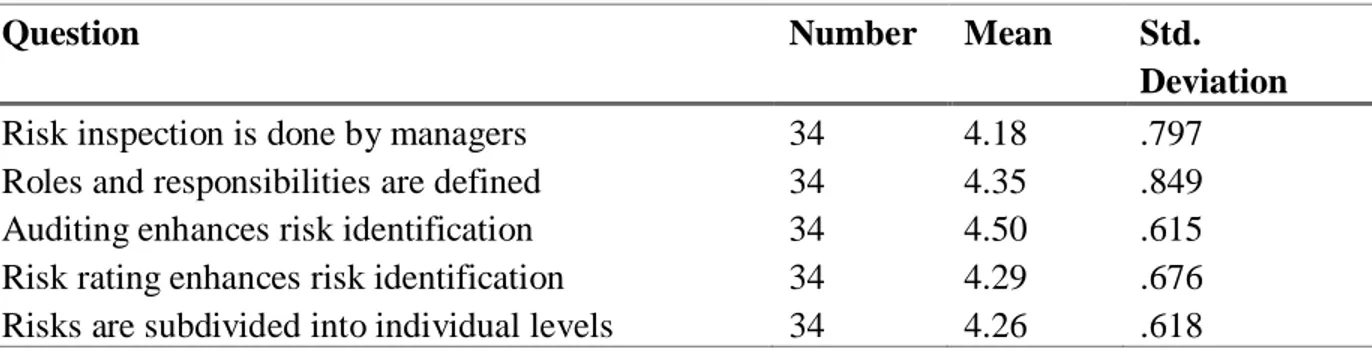
11 Table 2: Risk identification techniques
Question Number Mean Std.
Deviation
Risk inspection is done by managers 34 4.18 .797
Roles and responsibilities are defined 34 4.35 .849
Auditing enhances risk identification 34 4.50 .615
Risk rating enhances risk identification 34 4.29 .676 Risks are subdivided into individual levels 34 4.26 .618
Probed on the agreement level with statements, most of the respondents strongly agree that auditing enhances risk identification in the various MFIs (Mean = 4.5, SD = 0.615). The respondents agree that roles and responsibilities are defined (Mean = 4.35, SD = 0.849), Risk rating enhances risk identification (Mean = 4.29, SD = 0.676), risks are subdivided into individual levels (Mean = 4.26, SD = 0.618) and Risk inspection is done by managers (Mean = 4.18, SD = 0.797).
The study further enquired to what extent various risk management practices were being utilized and the effectiveness of the various risk management practices.The feedback was rated by a 5-point Likert scale where: 4.5 to 5.4 –Great Extent; 3.5 to 4.4 –Good Extent; 2.5 to 3.4 –Average Extent; 1.5 to 2.4-Minimal Extent, and 0.5 to 1.4-No Extent.
Table 3: Utilization of financial risk management practices
Financial risk management practice Number Mean Std.
Deviation
Credit Risk Management Systems 34 3.971 .7972
Behavioral Detection and Predictive Analysis 34 3.853 .7439
Structured Finance Systems 34 4.417 .7429
Risk Management Systems 34 4.500 .5075
From table 3 above,risk management systems are utilized to a great extent (Mean = 4.5, SD = 0.50) .Structured finance systems (Mean = 4.4, SD = 0.74), Credit risk management systems
12
(Mean = 0.39, SD = 0.79) and Behavioral detection and Predictive analysis (Mean = 3.85, SD = 0.74) are utilized to a good extent. It is thusinferred that credit risk management systems, behavioral detection and predictive analysis systems and risk management systems are all utilized by MFIs.
Correlation Analysis
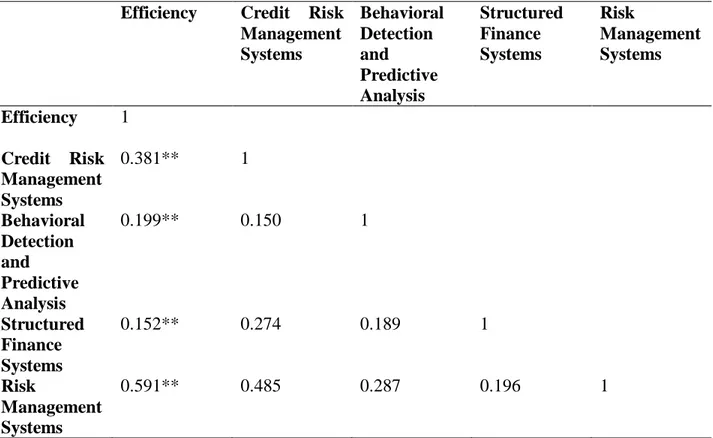
As shown in table 4, there are statistically significant positive associations between efficiency and structured finance systems (r=0.152), behavioral detection and predictive analysis (r = 0.199), credit risk management systems (r = 0.381) and risk management systems (r=0.591). The research establishes a statistically significant positive relation between Credit risk management systems and risk management systems (r=0.485) which shows that credit risk management systems is positively supported by risk management systems put in place.
Table 4: Correlation Matrix
Efficiency Credit Risk Management Systems Behavioral Detection and Predictive Analysis Structured Finance Systems Risk Management Systems Efficiency 1 Credit Risk Management Systems 0.381** 1 Behavioral Detection and Predictive Analysis 0.199** 0.150 1 Structured Finance Systems 0.152** 0.274 0.189 1 Risk Management Systems 0.591** 0.485 0.287 0.196 1
13 Regression Analysis
The research used regression analysis to model the research framework. The study also used the following to analyze and estimate the effects of each and every variable in the respective models on efficiency of MFIs:
Ordinary least square (OLS) method of estimation of coefficients: The OLS model treats each observation the same and does not take into account individual and time effects.
F-Value: It is a probability value employed in statistical significance testing to aidin determination of significance including a specific changein the model.
Model Summary
R-Gui and SPSS where used to conduct the analysis of the regression model, to show the relation betwixtfinancial risk management practices and efficiency of MFIs in Kenya.
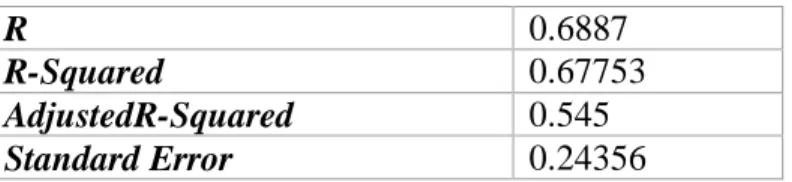
Table 5: Illustrating Model Summary
R 0.6887
R-Squared 0.67753
AdjustedR-Squared 0.545
Standard Error 0.24356
R-square, which is the coefficient of determination, indicates the variation in dependent variable as a result of changes in the independent variables. From the results of the research, the R-square was 0.677 which is the same as 67.7%,showing that there was 67.7% variation in dependent variable because of alterations in the independent variables which included Credit Risk Management systems,Behavioral Detection and Predictive Analysis Systems, Structured Finance Systemsand Risk Management Systems. The model was therefore considered dependable for examining the relation between risk management practices and efficiency.
14
R is correlation coefficient.It shows the strength of how financial risk management practices influence efficiency of MFI's. From table 5 above, the R value was 0.6887 therefore indicating a positive correlation between the financial risk management practices and efficiency in the MFI's. ANOVA Results
Table 4.8Illustrating ANOVA of the regression
d.f. SS MS f-value sig
Regression 4 0.5450 0.180 3.45 0.0034
Residual 30 0.054 0.057
Total 34 0.61574
The significance value of 0.0034 is smaller than 0.05; therefore the model is notablystatistically significant in forecasting how financial risk management practices affect efficiency of MFIs in Kenya. The F value at 5% significance level was found to be 3.45. This showed that F calculated was greater than the F value and hence therefore means that the overall model was significant. The model is therefore good for prediction.The significance level being lower thanthe threshold of 0.05 proves the significance of financial risk management practices on efficiency of MFI's in Kenya is great and this is validated by the F test.
Results Interpretation
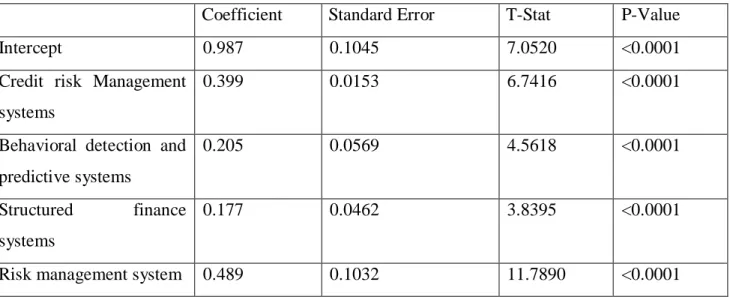
Table 6: Regression coefficients
Coefficient Standard Error T-Stat P-Value
Intercept 0.987 0.1045 7.0520 <0.0001
Credit risk Management systems
0.399 0.0153 6.7416 <0.0001
Behavioral detection and predictive systems
0.205 0.0569 4.5618 <0.0001
Structured finance systems
0.177 0.0462 3.8395 <0.0001
Risk management system 0.489 0.1032 11.7890 <0.0001
An independent variable is significant to a regression model if the p-value tends to zero. In this study; Credit risk Management systems, Structured finance systems, Behavioral detection and
15
predictive systems and Risk management system are all significant to the study. Thus the equation of best fit can be summarized as follows:
Risk management system.
Therefore (Y = β0 + β1X1 + β2X2 + β3X3 + β4X4 + ε) translates to: (Y= 0.987+ 0.399X1+ 0.205X2+ 0.177X3+ 0.489X4 + ε)
From the regression equation, if all variables (Credit risk management systems, behavioral detection and predictive analysis systems, structured finance systems and risk management systems) are sustained at zero, efficiency of MFIs will be 0.987. In addition, the findings of this research indicated that holding the rest of independent factors at zero, 1 unit improvement ofcredit risk management systems would induce 0.399 improvement of efficiency of MFIs.; 1 unit enhancement of behavioral detection and predictive analysis systems will cause 0.205 enhancement inefficiency of MFIs in Kenya; while 1 unit advancement in structured finance systems will cause 0.177 advancement inefficiency of MFIs in Kenya;and 1 unit growthofrisk management systems would cause 0.489 growth in efficiency of MFIs in Kenya.
Summary of Findings
The study sought to determine how financial risk management practices influence efficiency in MFIs in Kenya. Survey method was employed to obtain primary data and secondary data was obtained from Central bank reports and AMFI reports. SPSStogether with regression analysis were thenemployed for data analysis.Conclusions and findings of the research indicated thatrisk management systems were utilized to a great extent with a mean of 4.5 and internal auditors were involved in risk management to a great extent with a mean of 4.47.The research also sought to know what actions are taken in case a customer defaults the loan. The findings indicate thatit is mostly through taking collateral as securityand the most vital component of financial risk management strategies is risk mitigation.According to the analysis of the findings, it was also concluded that financial risk management practices brings effectiveness to organization’s efficiency.
16
The study sought to know whether financial risk management was a key factor in the business policy formulation. According to the analysis of the findings, it was concluded that most respondents indicated that indeed risk management was a key factor in business policy formulation and auditing enhances risk identification. The researcher explored whether the MFIs had a financial risk management department which handles collection of credit in default. The research results concluded that most respondents confirmed the position and the MFIs had standardized procedures for handling financial risk management systems.The study also established that utilization of financial risk management systems increases profitability of the business to a great extent.
From the analysis of the results, regression analysis showed that the R-square was 0.677 which is the same as 67.7%, showing that there was 67.7% variation in dependent variable because of alterations in the independent variables which included Credit Risk Management systems, Behavioral Detection and Predictive Analysis Systems, Structured Finance Systems and Risk Management Systems. The model was therefore considered dependable for examininghow financial risk management practices have an influence on efficiency. The F value at 5% significance level was found to be 3.45. This indicated that F calculated was greater than the F value and hence therefore means that the overall model was significant. The model is therefore good for prediction
The results obtained from the study indicated statistically significant positive associations between efficiency and structured finance systems (r=0.152), behavioral detection and predictive analysis (r = 0.199), credit risk management systems (r = 0.381) and risk management systems (r=0.591). This observation implies that where the MFI's utilize financial risk management systems, efficiency is enhanced. In addition, from the regression equation, if all variables (Credit risk management systems, behavioral detection and predictive analysis systems, structured finance systems and risk management systems) are sustained at zero, efficiency of MFIs will be 0.987.This implies that the more enhanced the financial risk management practices the more
17
improved the efficiency. The study also found that MFIs have adopted utilization of financial risk management systems so as to mitigate against losses resulting from financial risk.
Conclusions
From the results of the study the general objective which sought to ascertain the relation between financial risk management practices and efficiency in MFIs in Kenya was met. The research concluded that there was a positive relation between FRM practices and efficiency of MFIs in Kenya. With regard to the first specific objective which was to identify financial risk management practices of MFIs in Kenya, the findings of the researchshowed that risk management systems is the most utilized FRM practice with a mean of 4.5.Otherpractices adopted by MFIs include improvement of credit risk management systems and structured finance systems. The second specific objective which was to establish levels of efficiency in MFIs in Kenya was also met. The findings of the study indicated that the lowest minimum value for efficiency was 0.0222 in year 2013 and the highest minimum value was 0.0398 in 2012. The constant increase in the minimum efficiency indicated that efficiency of MFIs in Kenya has been improving over the years.
The analysis of the results revealed that most of the respondents showed they utilized risk management systems to a great extent.The study also established that utilization of financial risk management systems increases profitability of the business to a great extent. It was concluded that most vital component of approaches of financial risk management was risk mitigation.The paper determinedlevel of effectiveness of financial risk management practices and their effectiveness on organization performance. From the results of the findings, it was concluded that most respondents indicated that indeed financial risk management practices causes effectiveness to organization accomplishment.
Theresearch established that there existed constant improvement in minimum efficiency which indicated that efficiency of MFIs in Kenya had been improving over the yearsThe significance value was found to be 0.0034 which was smaller than 0.05; thus the study concluded that the model used was statistically significant in forecasting how financial risk management practices
18
affect efficiency of MFIs in Kenya. There was also a statistically significant positive relation betweenpractices of financial risk management and efficiency of MFIs in Kenya.The research therefore concluded that enhancement of financial risk management practices will lead to improved efficiency in MFIs in Kenya.
Recommendations
With regard toconclusions of this research, MFIs need to create a better environment through improved control techniques in which every employee has a stake in refining the internal control system for risk management. This research focused howfinancial risk management practices influence the efficiency of MFIs. It is therefore recommended that similar studies should be replicated in other institutions and the findings be compared to determine ifthere is overall consistencyonthe effects of financial risk management practices on firm efficiency.
The paper recommends that there is need for MFIs to improve their financial risk management practices, and provide regular training to all their employees on the same so as to enhance efficiency; as the study established that there is present a positive relationship between FRM practices and efficiency. Microfinance Institutions also need to do proper background check on customers so as to avert higher rates of default. The study also recommends that it is important that MFIs work on their client appraisal techniques so as to enhance their financial performance.
Microfinance Institutions should readily discuss risk rating criteria so as to enhance risk management. The study further recommended that MFIs in Kenya should take on a multifarious approach to risk management in order to attain better benefits from their risk management efforts.
REFERENCES
Abhay, N. (2010, May 10). India Microfinance. Retrieved from indiamicrofinance.com/types-of-risks-faced-microfinance-institutions.html
ActEd. (2013). CT6. BPP.
19
Alibés, M. B. (2006). Factors Influencing Risk Taking Behavior in Real World Decisions. 26. Arnold, G. A. (2005). Corporate Financial Management. 354-356.
Association of Microfinance Institutions of Kenya. (2011). Retrieved July 14, 2017, from Overview of AMFI: http://www.amfikenya.com/pages.php?p=1
Bank for international Settlements. (2000, September). Retrieved July 18, 2017, from www.bis.org/publ/bcbs75.htm
Bank Negara Malaysia. (2014, April 18). Introduction to Market Risk. Kuala Lumpur, Malaysia. Bikker, J. &. (2015). Bank Provisioning Behaviour & Procyclicality. Journal of International
Financial Markets ,Institutions & Money, 141-157.
Bobakovia, I. (2013). Retrieved July 14, 2017, from http://www.nbs.SK/BIATEC/. Carl, L. M. (1969). Managerial Accounting. London: E.Anold Publishers.
Cairn.info. (2013). Retrieved July 8 2017, from https://www.cairn.info/revue-journal-of-innovation-economics-2013-page-15.htm
Chavez, R. (1996). The design of Successful Financial Intermediaries :evidence from Indonesia. 65-78.
Christen, R. (1997). Managing for financial success : Financial Success for the Poor. Washington DC.
COSO Enterprise Risk Management Framework. (2004). New York: AICPA.
Dhanini, F. (2007). Fear is the Key : A Behavioural Guide to Underwriting Cycles, 10 Conn. Ins.L.J 255.
Economic Times. (2017). Retrieved July 14, 2017, from m.economictimes.com/definition/risk-management
Ernst, &. Y. (2012). How Leading Companies Use Risk Management to Fuel Better Performance. Turning Risk into Result.
Farma, E. F., & French, K. R. (2004). The Capital Asset Pricing Model ; Theory & Evidence. Journal of Economic Perspectives, 25-46.
French, C. W. (2003). The Treynor Capital Asset Pricing Model. Journal of Investment
Managemtnt, 60-72.
Holt, S. (1994). The New World of Microenterprise Finance :Building Healthy Institutions for the Poor. In M. a. Otero, The Village Bank Methodology :Performance and Prospects (pp. 156-184). Kumarian Press.
20
Husni, B. (2011). House Prices & Mortgage Credit Availability: Is the Relationship Reinforcing? Job Market Paper.
Investopidia (2017) Retrieved on July 18 2017, from Investopedia: www.investopedia.com/terms/m/marketrisk.asp
Kenya, C. B. (2015). The Bank Supervision Annual Report. Nairobi.
Kinuthia, N. (2013, October). Unpublished project on the Relationship between Financial Risk Management Systems and Financial Performance of Micro Finance Institutions in Kenya. Kiochos, P. (1997). Principles of Risk Management and Insurance. New York: Pearson
Education.
Kipkemboi, J. (2013, October). Unpublished project on , relationship between credit risk management practices and financial performance of micro finance institutions in Kenya. Koduk, C. (2015, October). AN unpublished project on The Effect of Electronic Banking on
Financial Performance of Savings and Credit Cooperative Societies in Nairobi County. Kombo, A., Wesong, J., & Murumba, N. (2011). An Evaluation of the Impact of Risk
Management Strategies on Micro Finance Institutions Financial Sustainability; A case of Selected MFIs in KIsii Municipality .
Latifee, H. (2006). The Future of Microfinance ;Visioning the who, what, when, where, why & how of Microfinance: Expansion over the next ten years. Grameen Trust Publication. Marek, K. K. (2007, January). Risk Management Teory : A Comprehensive Empirical
Assessment. Warsaw, Poland.
Mbogo. (2010). Insurance Companies Seek New Strategies to Attract Customers. Business Daily.
MicroFinance Network. (2000, July). A Risk Management Framework for Microfinance Institutions. A Risk Management Framework for Microfinance Institutions. Deutsche Gesellschaft Technische Zusammenarbeit (GTZ).
Muteti, S. (2014, October). Unpublished project on The relationship between financial risk management and financial performance of commercial banks in Kenya.
Njeri, V. (2010). A survey on strategic risk management practices by large commercial banks in Kenya. Unpublished MBA Project. University of Nairobi.
Ochola, P. (2016). International Journal of Economics, Commerce an Management. Evaluation of efficiency of MFIs in Kenya : An application of Data Envelopment Analysis, 218-230. Omasete, C. (2014, October). Unpublished project on The Effect of Risk Management on
21
SampleRisk Rating Model. (2000). A Risk Management Framework for Micro Finance Institutions, 15-25.
Saunders, M., & Thornhill, A. (2009). Research Methods for Business Students ;5th Edition. FT/Prentice Hall.
Stulz, R. (1984). Optimal Hedging Policies;Journal of Financial and Quantitative Analysis, 127-140.
Stulz, R. (2003). Risk Management and Derivative. Ohio.
Tarantino, A. (2009). Risk Management in Finance: Six Sigma and other Next Generation Techniques. John Wiley and Sons.
Ugirase, J. (2013, November). AUnpublished Project on The Effect of Credit Risk Management on the Financial Performance of Commercial Banks in Rwanda.
Virambhai, S. Z. (2010). A study of productivity and financial efficiency of textile industry of India .
Wanjiku, N. (2016, October). Unpublished project on the effect of financial risks on institutional efficiency among companies listed in the Nairobi securities exchange. Nairobi.