Implementation of Wind Turbine Controller Design for
Smart Campus
Aye Sandar Myint
*, Hla Myo Tun
*, Zaw Min Naing
***
Department of Electronic Engineering, Mandalay Technological University
**
Technological University (Maubin)
Abstract- This paper presents the design and construction of charge controller for wind energy source. The charge controller is a small prototype that is suitable to charge small battery. The maximum charging current of the charge controller is about 7 A. The c harge controller is designed using PIC 16F877A microcontroller, liquid-crystal display (LCD), silicon-controlled rectifier (SCR), rectifier diodes and other electronic components. The SCR and rectifier diodes in conjunction with other components are used to charge the battery. The battery charging is controlled by the microcontroller circuit. The LCD module displays the status of the battery while it is charging. At the same time the voltage level of the battery is also displayed. The microcontroller controls the charging circuit and diverted the charging current to the diverted load if the battery is fully charged. The microcontroller also produces signal to the audible alarm circuit in the case of full charge battery. The simulation results are based on the ISIS software environments before implementing the hardware description. The experimental results for charge controller are also mentioned.
Index Terms- wind turbine, controller, smart campus, renewable energy, PIC.
I. INTRODUCTION
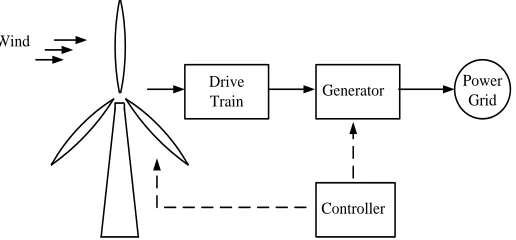
S the importance of environmental protection and sustainable growth increases, wind energy, a clean and renewable energy, attracts increasing attention. Wind energy is one of the most economical forms of alternative energy available today. It can save the environment and make it cleaner for generations to come. This thesis is intended to emerge the charge controller for wind energy source. A charge controller is an essential part for nearly all power systems that charge battery, whether the power source is solar, wind, hydro, fuel, or utility grid. The charge controller can control the voltage and regulates the charging of the batteries. Its purpose is to keep the batteries properly fed and safe for the long term. The basic functions of a controller are quite simple. Charge controllers block the reverse current and prevent battery overcharge. Some charge controllers also prevent battery over discharge and protect from electrical overload. The controllers also display the status of the battery. The main components of the wind energy system are the wind turbine, the mechanical drive train, the generator, the power grid, and the controller. The wind turbine converts the kinetic energy of the wind into mechanical energy. The generator converts the mechanical energy into electrical energy. The controller is the “brain” of the system. It ensures that the whole system works as expected. The controller consists of two parts. The first part is the master controller. The second part is the generator controller. During the power optimization stage, the master controller adjusts the system rotation speed to keep the optimal tip speed ratio. The speed regulation works by controlling the power of the generator. During the wind power limitation range, the master controller regulates the pitch angle to limit the wind power utilization. The generator controller is in charge of accurately controlling the active power of the system. The generator controller adopts the stator flux oriented vector control strategy. This thesis intends to propose and construct the charge controller portion of wind power system. The block diagram of the wind power system is shown in Figure 1.1.
Wind
Drive
Train Generator
Power Grid
[image:1.612.181.439.584.704.2]The charge controller for wind energy source is operated as: blocking reverse current, preventing overcharge, control set points vs. temperature and control set points vs. battery type. In wind generator, the reverse current is controlled by using one kind of semiconductor diode. The diode used for blocking reverse current is called a “blocking diode”. The overcharging of the battery can be prevented by using pulse width modulation (PWM) controller. The ideal set points for charge controllers depend on the types of the batteries. Some controllers have a means to select the type of battery.
II. PROPOSEDCHARGECONTROLLER
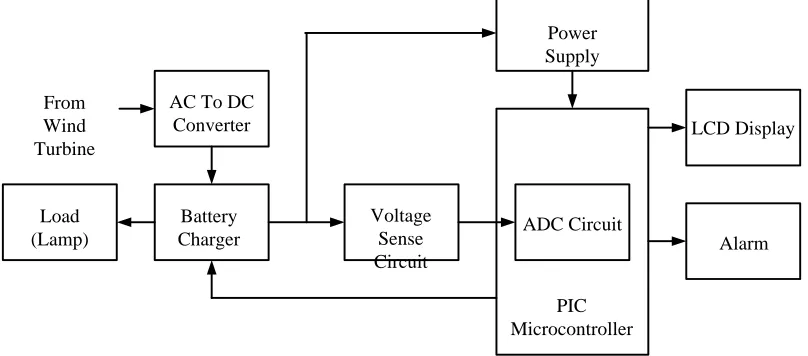
The charge controller intended to design and implement in this research work is a small power charge controller. Figure 2.6 shows the block diagram of the charge controller. The charge controller is built around semiconductor switches (silicon controlled rectifier-SCR) rather the electromechanical switches (relays). The microcontroller is used to control the overcharging of the battery, to display the battery voltage continuously and to make audible alarm when the battery is fully charged. Firstly the battery is charged using high current through the SCR. When the battery almost reaches its full terminal voltage (full charge) high current charging is cut off and slow charging (trickle charging) is still done. At full charge condition the charging is totally cut out by the control of the microcontroller. The current coming from the wind turbine through the converter circuit is diverting to another load (e.g. lamp). By this means the overcharging of the battery is prevented. The constructed charge controller can charge the 12 V battery with up to 6 A of current. The amount of charging current can be increased by changing some components in the charge controller without any difficulty.
Load (Lamp)
Battery Charger AC To DC
Converter
Voltage Sense Circuit
ADC Circuit
PIC Microcontroller
Power Supply
LCD Display
Alarm From
[image:2.612.105.509.262.440.2]Wind Turbine
Figure 2. The Block Diagram of the Charge Controller
III. IMPLEMENTATION
The operation of the charge controller circuit is explained in this section. The charge controller circuit will charge the 12 V battery until the battery gets its full terminal voltage. The charge controller changes from normal charging mode into the tickle charging mode when the full terminal voltage (full charge) of the battery is reached. In the tickle charging mode the battery is slowly charged. The charging of the battery is totally cut off by the control of microcontroller at the end. The battery full charge audible alarm is also activated when the battery is fully charged. Therefore the damage of the battery from the overcharging can be avoided. The components used in the circuit can withstand up to 6 A of charging current. This means that the power of the charge controller circuit used in this research work is 6A x 12V = 72 W. By changing some components used in the circuit, the charge controller circuit can be modified to charge the battery up to 300 A of charging current. Now it is the time to articulate the research work with ideas gathered in above steps by adopting any of below suitable approaches.
C3
R4
ZD1
SCR2
R3
D5
R1
PR1
SCR1
D7
R5
R6
PR2
12V
BATTERY
C106D
C106D
1N40
02
47uF
11V/1W
47Ω
2W
47Ω
2W
470Ω
5W
220Ω
47Ω
1KΩ
1KΩ
[image:3.612.152.455.60.273.2]From
Rectifier
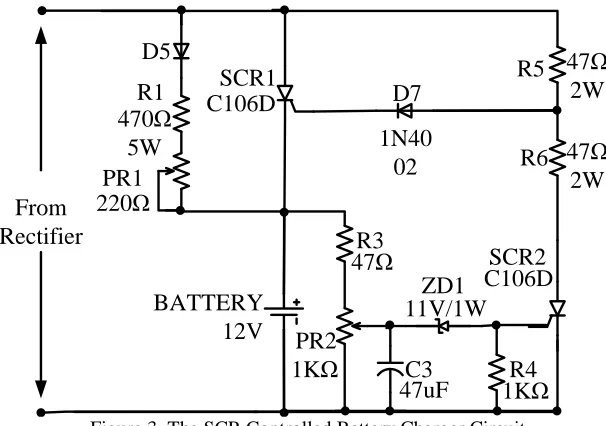
Figure 3. The SCR Controlled Battery Charger Circuit
When the battery voltage is low the current flows into the gate terminal of SCR1 through resistor R5 and diode D7. Therefore the SCR1 will conduct heavily for every half wave cycles and charges the battery with large currents. The voltage of the battery is sensed (or detected) by the serially connected resistor R3 and the preset resistor PR2. The R3 and PR2 form voltage divider circuit. The PR2, in this circuit, can be considered as two resistors: PR2 (u) and PR2 (l).
Therefore PR2 = PR2 (u) + PR2 (l)
The total resistance RT above the center tap of PR2 is
RT = R3 + PR2 (u)
The voltage develops at the center tap of the preset PR2 (VPR2(l) ) can be calculated using the voltage divider equation:
VPR2(l) = ( PR2 (l) / RT + PR2 (l) ) VBattery VPR2(l) = ( PR2 (l) / R3+ PR2 ) VBattery
The center tap of the preset resistor PR2 is connected to the cathode of the zener diode ZD1. The zener voltage of ZD1 is 11 V/1W.
The anode of the ZD1 is connected to the gate of SCR2. The SCR2 does not conduct if the voltage Vc develops at the center tap of the
PR2 is less than the zener voltage.
If the battery voltage becomes high due to the charging current the voltage Vc will also high. If Vc becomes higher than the zener
voltage, the SCR2 will conduct for every half wave cycles. The conduction of SCR2 will start at 90 degree of the positive half cycle. In the other word, it is the position for the largest charging current for the battery by the SCR1. Therefore large charging current is shunt to the power resistors R5, R6 and SCR2.
In this condition SCR2 is conduct early than the SCR1. The voltage drop across the anode and cathode terminal of SCR2 will reduce when the SCR2 is conducts heavily. Therefore the voltage between R5 and R6 becomes low and it makes the diode D7 reverse biased. This causes the gate current of SCR1 stop. And therefore the conduction of SCR1 is stop. Therefore the charging of the battery through SCR1 is stop.
The voltage between the anode and cathode of the SCR2 is approximately zero voltage when the SCR2 is heavily conducted. In this condition the voltage at the junction of resistors R5 and R6 can be calculated by assuming the peak voltage of the rectifier output to be
about 16 V (VP = 16 V) as follows:
The voltage at the junction = ( R6 / R5 + R6) VP
= ( 47 / 47 + 47) 16 V = 8 V
The voltage is fed to the gate of the SCR1 via diode D7. The voltage is much lower than the cathode voltage of SCR1. Therefore SCR1 is not conduct in this condition. The power ratings of the resistors R5 and R6 are 2 W respectively. They are chosen to withstand the current passing through the heavily conducted SCR2.
Although there is no charging current to the battery through the SCR1 there is another charging current path to the battery. This is the
path formed by the diode D5, the resistor R1 and the preset resistor PR1. This is actuallythe slow charging current path (or trickle
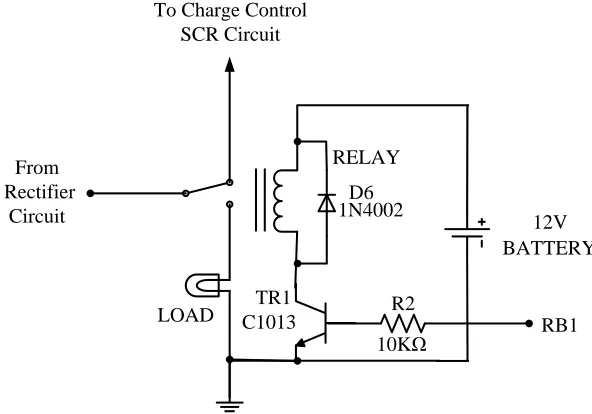
pin is at logic ’0’ state. This is the charging state of the battery. In this state there is no current passing through the relay coil. So that the relay switch is in the normally closed condition. As can be seen in circuit diagram, Figure 4, the normally closed switch of the relay is connected between the diode rectifier output and charge control SCR circuit. In this condition the relay coil do not activate. The relay will stay in this state until the full terminal voltage of the battery is arrived. At full terminal voltage the RB1 pin of the microcontroller will produce logic ’1’ state. The voltage between the base-emitter junction of the transistor in forward bias condition
is about VBE = 0.7V.
LOAD TR1 R2 D6
12V BATTERY RELAY
C1013
1N4002
10KΩ From
Rectifier Circuit
To Charge Control SCR Circuit
[image:4.612.157.453.142.349.2]RB1
Figure 4. The Relay Circuit for Charging and Load Diversion
The relay coil needs several mA of current to activate. And the current gain of the transistor is about 100. It is assumed that the relay coil requires 40 mA to activate, the value of the base current limiting resistor can be calculated as follows:
Relay coil current = Collector current = IC = 40 mA
The base current IB of the transistor TR1 can be calculated using the equation:
IC = hFE IB IB = IC / hFE
IB = 40 mA/ 100 = 0.4 mA
The voltage drop across R2 can be calculated as follows:
V(R2) = 5 V - VBE
V(R2) = 5 V – 0.7 V = 4.3 V
The resistance of R2 can be calculated as follows:
R2 = V(R2) / IB = 4.3 V / 4 mA ≈ 10kΩ
The current IC is enough to drive the relay coil. Therefore the transistor is ON and the current is passing to the collector-emitter
R9 D8
TR2 BUZZER
5V
C1013
1N4002
10KΩ
[image:5.612.224.385.408.708.2]RB1
Figure.5. The Audible Alarm Circuit
The buzzer requires about 40 mA of current to activate. The current gain of the transistor is about 100. The value of the base current limiting resistor can be calculated as follows:
Collector current = IC = 40 mA
The base current IB of the transistor TR2 can be calculated using the equation:
IC = hFE IB IB = IC / hFE
IB = 40 mA/ 100 = 0.4 mA
The voltage drop across R9 can be calculated as follows:
V(R9) = 5 V - VBE
V(R9) = 5 V – 0.7 V = 4.3 V
The resistance of R9 can be calculated as follows:
R9 = V(R9) / IB = 4.3 V / 4 mA ≈ 10kΩ
The current IC is enough to drive the buzzer. Therefore the current is passing from the + 5 V supply to the ground through the buzzer
and collector and emitter junction of the transistor TR2. Thus the audible alarm is activated when the battery is fully charged.
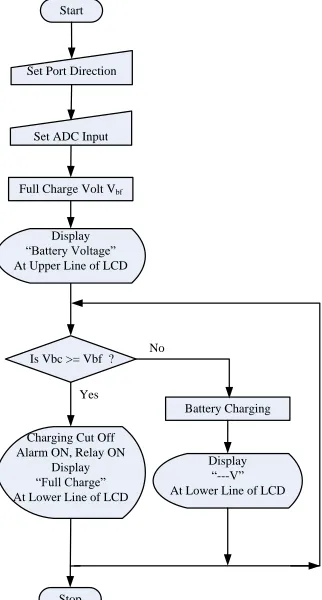
The flow chart of the charge controller is shown in Fig. 4.9. At the start of the program, the I/O port directions of the microcontroller
are set. The full charge voltage of the battery is assigned and stored in the memory of the microcontroller as Vbf.
Start
Full Charge Volt Vbf
Battery Charging Is Vbc >= Vbf ? No
Yes Set Port Direction
Set ADC Input
Display “---V” At Lower Line of LCD Charging Cut Off
Alarm ON, Relay ON Display “Full Charge” At Lower Line of LCD
The ADC section of the microcontroller is enabled and RA0 pin is assigned as the ADC input pin. The resolution of the ADC is set at 10 bits and the reference voltage for the ADC is assigned as +5V. Then the PIC microcontroller pins, used to send control and data signals to the LCD module, are defined according to the PIC BASIC PRO compiler specifications.
In this paper, 4-bit mode is used to display data and message on the LCD module. The upper line of the 16×2 lines LCD module
displays the message "Battery Voltage". The charging battery voltage, Vbc at RA0 is checked by the program. The battery voltage is
displayed on the lower line as "- - - V". And then the battery voltage is compared with the battery full charge voltage. If the battery voltage is less than the full charge voltage the battery charging is going on. On the other hand, if the battery voltage is equal to or greater than the full charge voltage, the charging of the battery is completely stopped. Then the lower line of the LCD will display “Full Charge”. The program waits about 1s and then loop back to the start of the voltage comparison statement.
The program source code for the PIC microcontroller is developed in Micro Code Studio (IDE). The software is configured to wo rk together with PIC BASIC PRO complier software and EPICWIN programmer software. Therefore all steps of software routines, editing the source code, compiling the source code into Hex file and programming the Hex file into microcontroller's flash memory can be done in Micro Code Studio software. The programmer hardware used for this paper is EPIC Plus programmer board from micro Engineering Labs Inc. EPIC Plus is a low-cost programmer with an 18-pin socket on the device. The programmer is connected to the parallel part (the printer port) of a PC using a 25-way DB 25 type cable
IV. SIMULATIONRESULTS
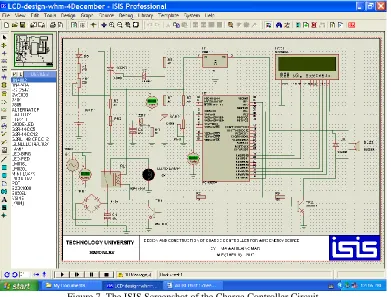
At first, the charge controller circuit is simulated using Proteus software. The schematic diagram of the main components of
[image:6.612.113.504.299.596.2]the charge controller circuit including the microcontroller circuit is drawn in the ISIS software and then run the simulator program. A screenshot of the ISIS schematic capture and interactive simulation environment is shown in Figure 7.
Figure 7. The ISIS Screenshot of the Charge Controller Circuit
BY MA WAI HLAING MAR
DESIGN AND CONSTRUCTION OF CHARGE CONTROLLER FOR WIND ENERGY SOURCE
TECHNOLOGY UNIVERSITY
MANDALAY M.E (THESIS) 2010
RA0/AN0 2 RA1/AN1 3 RA2/AN2/VREF-4 RA4/T0CKI 6 RA5/AN4/SS 7 RE0/AN5/RD 8 RE1/AN6/WR 9 RE2/AN7/CS 10 OSC1/CLKIN 13 OSC2/CLKOUT 14 RC1/T1OSI/CCP2 16 RC2/CCP1 17 RC3/SCK/SCL 18 RD0/PSP0 19 RD1/PSP1 20 RB7/PGD 40 RB6/PGC 39 RB5 38 RB4 37
RB3/PGMRB2 36 35 RB1 34 RB0/INT 33 RD7/PSP7 30 RD6/PSP6 29 RD5/PSP5 28 RD4/PSP4 27 RD3/PSP3 22 RD2/PSP2 21 RC7/RX/DT 26 RC6/TX/CK 25 RC5/SDO 24 RC4/SDI/SDA 23 RA3/AN3/VREF+ 5 RC0/T1OSO/T1CKI 15 MCLR/Vpp/THV 1 U2 PIC16F877A R7 47k BAT1 PR3 D 7 1 4 D 6 1 3 D 5 1 2 D 4 1 1 D 3 1 0 D 2 9 D 1 8 D 0 7 E 6 R W 5 R S 4 V S S 1 V D D 2 V E E 3 LCD1 GDM1602A BUZ1 BUZZER VI
1 VO 3
[image:7.612.106.514.59.668.2]G N D 2 U1 7805 D8 1N4002 LOAD LAMP 12V BR1 D1-D4 R3 47 PR2 SCR1 C106D SCR2 C106D D7 1N4002 R5 47 R6 47 R4 1K ZD1 1N4741A C3 47u D5 R1 470 PR1 220 Volts +3.58 Volts +12.0 TR2 2SC1013 R9 10K TR1 2SC1013 R2 47k V1 VSINE AC Volts +14.1 C1 47u RL1 G2R-14-DC5
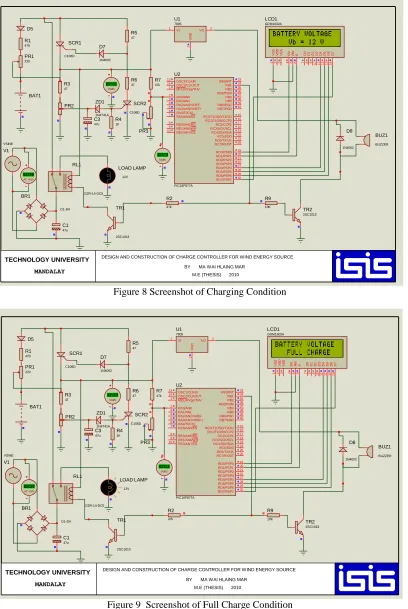
Figure 8 Screenshot of Charging Condition
BY MA WAI HLAING MAR
DESIGN AND CONSTRUCTION OF CHARGE CONTROLLER FOR WIND ENERGY SOURCE
TECHNOLOGY UNIVERSITY
MANDALAY M.E (THESIS) 2010
RA0/AN0 2 RA1/AN1 3 RA2/AN2/VREF-4 RA4/T0CKI 6 RA5/AN4/SS 7 RE0/AN5/RD 8 RE1/AN6/WR 9 RE2/AN7/CS 10 OSC1/CLKIN 13 OSC2/CLKOUT 14 RC1/T1OSI/CCP2 16 RC2/CCP1 17 RC3/SCK/SCL 18 RD0/PSP0 19 RD1/PSP1 20 RB7/PGD 40 RB6/PGC 39 RB5 38 RB4 37 RB3/PGM 36 RB2 35 RB1 34 RB0/INT 33 RD7/PSP7 30 RD6/PSP6 29 RD5/PSP5 28 RD4/PSP4 27 RD3/PSP3 22 RD2/PSP2 21 RC7/RX/DT 26
RC6/TX/CKRC5/SDO 25 24 RC4/SDI/SDA 23 RA3/AN3/VREF+ 5 RC0/T1OSO/T1CKI 15 MCLR/Vpp/THV 1 U2 PIC16F877A R7 47k BAT1 PR3 D 7 1 4 D 6 1 3 D 5 1 2 D 4 1 1 D 3 1 0 D 2 9 D 1 8 D 0 7 E 6 R W 5 R S 4 V S S 1 V D D 2 V E E 3 LCD1 GDM1602A BUZ1 BUZZER VI
1 VO 3
G N D 2 U1 7805 D8 1N4002 LOAD LAMP 12V BR1 D1-D4 R3 47 PR2 SCR1 C106D SCR2 C106D D7 1N4002 R5 47 R6 47 R4 1K ZD1 1N4741A C3 47u D5 R1 470 PR1 220 Volts +4.47 Volts +15.0 TR2 2SC1013 R9 10K TR1 2SC1013 R2 47k V1 VSINE AC Volts +14.1 C1 47u RL1 G2R-14-DC5
with time and whether conditions. Sometimes it is calm and there is no power output from the wind power generator. Therefore it is not convenient to test the charge controller with the electrical power produced by the wind power generator for every time.
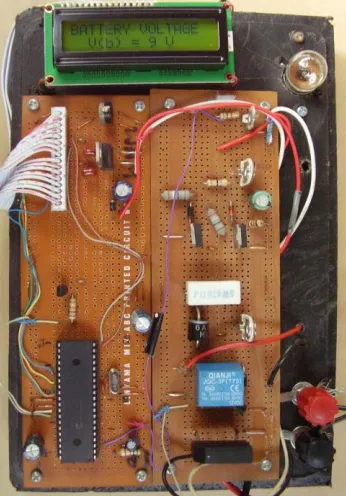
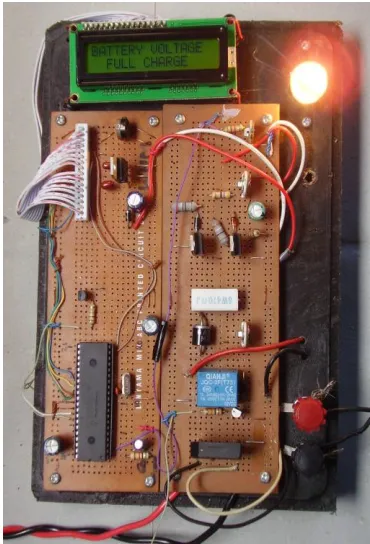
[image:8.612.220.393.152.400.2]The charge controller is tested with the step-down AC transformer with the same power rating as the wind power generator in the place of the AC generator of the wind electric power generator. The battery can be charged according to the charge controller. The charging current of the battery is limited to the maximum of 6A. The presets used in the circuit are adjusted to fulfill the requirements stated in the previous chapters. The LCD module displays the messages about the voltage of the battery for every second while it is charging. Figures 10, 11 and 12 show the photos of the complete circuit of the charge controller for charging stage. The first line of the LCD module displays the message “BATTERY VOLTAGE” and the second line displays the battery voltage.
Figure 10. Photo of the Charge Controller in the Charging Stage (9V)
Figure 12. Photo of the Charge Controller in the Charging Stage (12V)
The charging time for the 100AH battery using this charge controller will be about 20 hours for fully charged if enough electrical power is obtained from the source (wind energy). The advantage of using the charge controller is to protect the battery from over charging. The constructed charge controller can perform the battery charging and protection from the over charging. The charge controller will also make audible alarm if the battery is fully charged. As a future research, the charge controller can be designed to
withstand higher charging current by using appropriate electronic components.
VI. CONCLUSION
The charge controller in the present circuit can control maximum charging current of about 7 A. It is not large enough to charge battery with large ampere hour rating (e.g. 120 AH, 150 AH). The charging time for large battery will take more than ten hours. It takes a long time to charge the battery. So it is not practical to use this type of charge controller for large battery. Therefore, the current rating of the charge controller must be increased to be suitable for real world applications. The charge controller operation is based on the semiconductor device (SCR). The current rating of the SCR used in the circuit is about 8 A. Therefore, the charging current cannot exceed the limiting current value of the SCR. The electronic components used in the charge controller are chosen to reduce costs and to experiment easily. The constructed charge controller is intended to demonstrate the charging and over charge control circuits with the help of microcontroller. Therefore, some modifications must be made to be useful practically.
ACKNOWLEDGMENT
I would wish to acknowledge the many colleagues at Mandalay Technological University who have contributed to the development of this paper.
REFERENCES
[1] Ferreira P., et al.: Interfaces for Renewable Energy Sources with Electric Power Systems, Environment 2010: Situation and Perspectives for the European Union 6-10 May 2003. Porto, Portugal
[2] Anonymous: Wind Turbines for Home Power, June 2010, http://www.absak.com/library/wind-turbine-home-power [3] Anonymous: Xantrex Charge Controllers, June 2010, http://www.enviroharvest.co.za
[4] Anonymous: WTCC Specification – Wind Turbine Charge Controller (WTCC), May 2010, http://www.environmentsaveenergy.co.za/WTCC%20specifications [5] Anonymous: Kestrel Charge Controller Type 0801 User Manual, May 2010, http://www.kestrelwind.co.za
[6] Anonymous: GDM 1602A Liquid Crystal Display (LCD) Data Sheet, XIAMEN OCULAR,http://www.xmocular.com/MODULE/GDC1602A.htm
[7] Nelson V.: WIND ENERGY: Renewable Energy and the Environment, CRC Press, (2009). [8] Hugh P.: Home-Build Windpower, January 2007, http://www.scoraigwind.com/books/ [9] Ibrahim D.: PIC BASIC Projects, Elsevier, (2006).