Introduction
As Malaysia is moving towards globalization, the economy of the country is moving from the industrial-based economy towards the knowledge-based economy (Ghosh, L, Yew Wah dan Suresh Narayan, 997). In the effort to pursue the globalization and to compete in the world market, the country makes and revises various strategies in order to do so. In context of global world today, the quality of human capital is no longer a specialty but a necessity. The aspect of human development, however, should not be neglected. This is to make sure that Malaysia will have a constant supply of the brilliant human resources and they will be sufficient for the country’s development and advancement.
According to Melvyn Dodridge (1999) and Fallows, F and Steven, C. (2000) state that in the worldwide situation today, versatile and compliant manpower is required to be considered as fit to explore the job world. Now, knowledge is no longer the only asset that will ensure an individual a place in jobs’ arena, instead, an individual must possess adequate soft skill complete with academic knowledge to have more advantages when applying for a job. By possessing other disciplines, an individual is viewed as a dynamic individual and therefore will add merit to the person’s personality outlook.
According to the writer of the module the development of soft skill for Higher Education Institution, soft skill covers all aspect of generic skills involving cognitive element related with non-academic skills such as positive values, leadership, teamwork, communication, and lifelong learning. Higher Education Institution needs to generate graduates who are
balanced in terms of intellectual quality as well as humanity approach that includes attitude, moral values and others.
The need to possess soft skill is highly discussed nowadays. Among the issues discussed is regarding the issue of unemployed graduates. It is peculiar when it is hard for a graduate to get a job. The issue was widely discussed until there is an idea stated that the reason why there are a lot of graduates unemployed is because they do not posses soft-skill or in short, they do not possess a complete set of standard criteria to be acceptable in the job industry. These include graduates who are lack of good personality, for example, not critical and lack of communication skill, such as English language mastery and socializing skill. This will in turn, create individuals who are not motivated with their work.
The importance of possessing soft skill is no longer an odd subject. Each graduate will need to face the reality in job’s life. Therefore, it is really important to equip them with soft skill that will enable them to promote themselves to their employer. A graduate should also realize that the real world is far more different than the reality in classroom. And the experiences are not something that you can get directly from a lecture. Soft skill can be interpreted in various conditions. Formal education is one of the mediums to ensure the students have master soft skill. However, some students acquire this skill in their daily life. Their surroundings, and the social groups they mingle with, will determine the level of their soft skill. The scenario in Malaysian education system nowadays starts to pay particular attention towards the development of soft skill among the students. Hence, the country has carried out a few methods that are believed to be helpful for the students.
Elixir Social Studies 39 (2011) 4895-4904
Developing soft skill in Advanced Technology Training Centre (ADTEC): an
analysis of comparison
Ahmad Esa1, Jailani Md Yunus1 and Aina Aishikin Mohamad Ali2
1
Faculty of Technical Education, University of Tun Hussein Onn Malaysia (UTHM), 86400 Parit Raja, Batu Pahat 2
Politeknik Tanjung Malim, Malaysia.
A B S T R A C T
The mastery of soft skill is very important among students nowadays, however, the issue on the most effective ways to inculcate this skill has yet been identified. Thus, the purpose of the study is to identify the most dominant channel that is effective to inculcate the skill to help students to embrace it. The objective of the study is to identify settings that are convenient for inculcation of soft skill. There are three different settings identified and researched; the skill could be inculcated through co-curriculum, workshops or in the classroom. The experiment is design to be a descriptive study. Data for the experiment was collected through instruments such as survey forms and interviews. The respondents of the survey were 196 students semester 5 and 6 from ADTEC Malaysia. The outcome of the experiment showed that levels of soft skill development are varied through co-curricular activity, workshops and classroom. From a Paired Sample t-Test that has been carried out, it showed that there is a significant different in level of soft skill development between co-curricular activities and workshops, and between co-co-curricular and classroom. On the other hand, the outcome of the Paired Sample t-Test does not show any significant difference of soft skill between workshop and class. The findings conclude that the most relevant difference is through workshop and class.
© 2011 Elixir All rights reserved.
Social Studies
A R T I C L E I N F O
A r t i c l e h i s t or y :
Received: 25 July 2011; Received in revised form: 22 September 2011;
Accepted: 29 September 2011;
K e y w or d s Soft skill, Co-curriculum, Workshop, Classroom.
Available online at www.elixirjournal.org
Tele:
Background of the Problem
Soft skill is frequently discussed as an important element for graduates to survive in the real life situation. Presently, Malaysian government carries out three key strategies to produce a group of first class human capital. This is because; a group of first class human capital would ensure quality through their ability to face changes in technology. Thus, the government performs three key strategies, beginning with increment in the capacity of acquiring knowledge and the ability to master the knowledge. Secondly, is by reinforcing the scientific facility, research and development as well as innovation and thirdly, inculcate social cultures by possessing strong moral values. From the proposal, we can see that the balance between knowledge and some fields of study must be parallel. This will ensure the development of soft skill that can assist the graduates to survive in the competitive working environment.
According to Melvyn Dodrige (1999), most of engineering graduates who have worked, have little soft skill. This weakness makes them unable to apply engineering knowledge that they have learnt, to solve problems that is similar to what they have studied. According to Mohd Yahya (2003) the quality of trainees from training centre are determined through their employability and marketability; that is based on how far the trainees will be absorbed to the job market. The rational is based on National Economic Action Council research on 115 employers from different sectors in the year 2000 found that the employability criterion for a worker is 39.3% on a good attitude and 29.7% on experiences and 12.0% on communication skill. While for academic achievements and analytical skills scored low percentages of 3.5% and 1.2% each.
As according to Mohd. Safarin Nordin, Mohd Zolkifli Abd Hamid and Mohd Khata Jabor (2005), to guarantee an employability from an employer in the future, trainees must be given enough exposure to a real life situation where they can practice their generic skill such as leadership skill, creative and critical thinking, problem solving skill and communication skill. All the skills are necessary to complete the package as a graduate who is charismatic and prepared to be committed in working.
Commonly, it is believed that students trained under a higher institution get job easier because they are trained under an extensive training. Thus, the institution specially trained them to master the required skill for the particular industry (Mohd Safarin Nordin dan Kamaruddin Mohd Tahir (2004). However, the situation changes as to adhere to the current demand in the job industry where getting jobs are competitive as there are more selections to be made. This is because, nowadays, there are many higher education institutions that have adopted a hands-on approach. Due to the situation, trainees from training institution will face the challenge where they will need to compete with the graduates who possess soft skill as well as good academic result. Therefore, education institutions and technical training centre should get prepared to face the incoming challenge. This is in order to produce a skillful workforce for the country. According to Mohd Yusof and Mohd Fadhil (1997), graduates from technical field should have at least four soft skills that are relevant with the demand of their field of work. The first and the most important element is the ability to self-learn. Graduates should possess the ability to self-taught themselves so that they will be able to acquire new skill and new knowledge although they are caught up in a busy working environment. Secondly, another skill that they should possess is the ability to manage
manpower and human resources. Besides managing and handling tools and equipments, they have to be aware that they will need to guide their lower level colleagues. As for the third element, the graduates should have adequate ability to communicate whether orally or alternative ways. And the fourth element is the leadership skill. This is because, they will probably need to be a leader or supervisor at their workplace later on.
Advanced Technology Training Centre (ADTEC) Batu Pahat, is one of the recognized technical training institutions in Malaysia. This institution is among the institutions which has contribute in producing graduates who has met most of the future employers’ standards and thus, capable to compete in the real world. Therefore, ADTEC’s management agrees that soft skill is one of the criteria needed to produce a student who is competent and competitive. If we look at the scenario of the learning environment in ADTEC, it emphasizes 60% of the assessment on practical and another 40% on the theory classes. This shows that there are two types of learning environment, which is in the workshop and in the class. Due to this condition, it is hard to determine which settings are more dominant in inculcating soft skills to the students. Co-curricular activities also act as another environment that is highly debated among the researchers as an influencing way to inculcate soft skills. However, in ADTEC, this statement has not been proven to be right. Thus, based on the justification, there should be a need to conduct a research to assist students and management to identify the right settings that will contribute to the development of soft skills.
Statement of Problem
Many researches done to discover ways to inculcate soft skill effectively, among them is a research done by Zainudin et. al(2006) observing methods of developing soft skill in teaching engineering. Another research done by Fahar G. Hayati and Mustahsan Mir (2004) researched on the development of soft skill in labs, while Ahmad Esa (2007) researched on how co-curricular activity encouraged the learning of soft skill. From the researches, it can be concluded that there are suitable settings available to inculcate soft skill. Nevertheless, there is no research that has been carried out; looking at the issue of the how do these different settings, such as co-curriculum activities, workshops and technical theory classes like we have in ADTEC, affect the level of soft skill development. This research is carried out to identify the level of soft skill development in ADTEC by looking at the three different settings and simultaneously will determine of which setting is the most useful in inculcating soft skill in ADTEC.
Research Objectives
The objectives of this research are as follows,
a. To determine the level of soft skills acquired among students in ADTEC during co-curricular activities
b. To determine the level of soft skills acquired among students in ADTEC during workshops
c. To determine the level of soft skills acquired among students in ADTEC during classes
d.To determine the differences in the level of soft skills acquired during co-curricular activities, workshops and classes among students in ADTEC
Hypotheses
Ho1: There are no significant differences in the level of the acquired soft skills among students in ADTEC during co-curricular activities and workshops.
Ho2: There are no significant differences in the level of the acquired soft skills among students in ADTEC during co-curricular activities and workshops.
Ho3: There are no significant differences in the level of the acquired soft skills among students in ADTEC during workshops and classes.
Literature Review
Soft skills, also known as generic skills, are essential, not only to post graduates, but also to employees in all sectors. These skills will help employees to be more confident and competent in doing their tasks. This chapter will explain the definition of soft skills from different views, research location backgrounds, social skill elements and previous related researches on software skills.
Soft skills has now become one of the most important element, apart from academic achievements, required in creating essential characteristics of IPT graduates nowadays. The existences of soft skills are motivated by current and global needs, especially from the industry side that requires its workers to possess towering personality. Soft skills is known to be a critical element in a global world of occupation, especially with the drastic changes in technology, thus, each IPT graduate must value soft skills that fulfils the needs of the market and the ever challenging daily life.
According to Glenn P. Costin (2002), soft skills is the skill of an individual to interact, research, build and lead, and it is also a skill which is a method to build one’s personality. Examples of soft skills are planning, communicating and creativity.. According to him, there are hard skills which means the skills of and individual to interact directly physically using current technology using physical products.
Soft skills is also known as generic skills (Sharin Mohammad, Hasanan Md Nor, Wahid Omar and Danial Mohamed, 2004). They believe that soft skills are non-technical skills that is essential in the today’s world of occupation that aims to add value to the graduates with skills such as working skills and communicating skills. According to Marginson (1993) and Mohd Zaki Kamsah (2004), soft skills are general skills that can be used in many occupations or industries and is not specialized on certain posts only. Soft skills can be used and applied from low level to top level of workers.
According to Kearns (2001), soft skill in individuals can be classify into four groups which is readiness to work, working attitude, knowledge and enterprising, creative and innovative, possessing good interpersonal skill and good thinking skill as well as wanting to learn. Moreover, he stated that generic skill is one of the skills needed in every job sector. NCVER’s (2003) defined soft skill as a skill that is not specialized for a particular working sector or industry; however, it is important for job, education and living in general. Examples of the skills are communication skills, mathematic skills, organization skills, computer literate, interpersonal competence and analytical skills.
Soft skill is vital for every employee. This is in order to make Malaysia as an industrial country that able to go hand in hand with other advance countries. By ensuring the standard of workers, Malaysia can claim itself ready to compete with the world market since we are able to generate our own economy with the existence of excellent human capital. The current global situation emphasize more on industrial knowledge, thus, it
demands other countries to focus on working effectively and productively to produce a high standard industrial production. In order to make sure industrial production hits the target, workers should possess soft skill to develop the career and country’s economy.
Most of the jobs area requires workers with a complete package of technical skill and soft skill to ensure company’s productivity simultaneously allows the company to compete at the same level as with the advance company. Workers who possess excellent soft skill can adapt with any types of working environment and this will makes them versatile and compelling. The intensity of soft skill requirement depends mostly on types of industry.
According to Hasliza (2002), one of the reasons why Higher Education Institution fails to provide space in the job market is because most of the graduates do not possess adequate soft skill. Future employers have less confident lack of communication skill, unable to make controlled decision and unable to work in group. While Tengku Mahaleel (2002) thinks that in order to place students and compete in the global job market today, local graduates must possess elements of generic skills besides excellent academic result. According to him, soft skill enables an employee to use all the knowledge and skills that is in the working arena accordingly.
Soft skill can be gained from education. Skills such as problem solving skill, critical and creative thinking skill, effective communication, teamwork and mannerism are examples of soft skill. This skill cannot replace the specific skill discipline, instead adds to students’ technical skill and professional knowledge. For example, it is easier to learn in groups and cooperate with a group to solve a problem than working individually. With this method, a student will be able to acquire the knowledge he has learnt in an easier and practical way (Melvyn Dodrigh, 1999).
According to M. Z. Kamsah (2004), teaching is the easiest part in the process of teaching and learning, but the most challenging part is to equip students with soft skill. The process to expose them to cooperative learning and active learning will let them acquire the good communication skill, good teamwork skill and the most of all is an excellent problem solving skill. This situation obtained when students are excited and comfortable to participate in learning when they are given a chance to do a presentation such as public speaking. This will encourage the students to improve on the skills involved.
In addition, Norziha binti Megat Mohd. Zainuddin, Norihan bt Abu Hassan, and Syed Ardi Syed Yahya Kamal (2006), stated that cooperative learning enable students to improved on their generic skill. According to these researchers, generic skill will assist the students to use technical skill as an advantage when working in a group. This is because, the students will be able to understand conflict as a space for discussion and respect differences for creativity booster. With the advantage of communication skill, it will enable them to negotiate and tolerate in their discussion.
making analysis and organize thorough plan. These will at the same time trained the students on managing their time.
According to the research done by Yahya Buntat (2004), soft skill can also be developed by participating in co-curriculum activities such as taking part in campaigns. This is because, the campaigns usually are organized and handled by students. Campaigns such as anti-drug campaign, fire extinguish campaign, counteractive campaign and courtesy campaign. These types of programs will require students to prepare proposals, making plan, and budget. From these activities, students will gain the skill in management, working in groups and decision making.
In a research done by Fahar G. Hayati and Mustahsan Mir (2004), find that working in labs and workshops can develop soft skill. The findings from their research concluded that through working on a project based projects that they have throughout their courses both for senior level and junior level able to replace the old labs method. There are many advantages in improving technical skill and soft skill among engineering students. Teaching and learning in labs inculcate teamwork skill and communication skill.
Research Methodology
This research is based on an observation involving 196 students from ADTEC. They are in their fourth and fifth semester doing a fulltime diploma course. The instrument of the research is surveys and interviews. Items used in the surveys are closed items. For a closed item, Likert Scale (1 until 5) is used to measure responses from the respondents for each item presented. Details of the scale are shown in the Table 1 below. As for the interview, the semi structure format is used where through this method, written questions are prepared before hand.
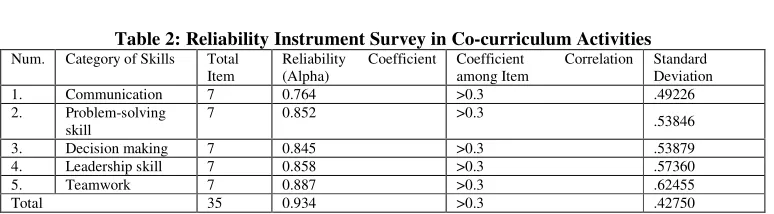
The outcomes of this research then were assessed in Reliability Analysis – Scale Alpa uses SPPS program (version 12) for every item and the alpha is more than 0.6. Therefore the items built are really convincing as it has high level of reliability. Table 2, 3 and 4 show the alfa value for each section in the survey.
Descriptive analysis is used to obtain mean and standard deviation to fulfill the objective determined. The mean statistic interpretation used is modified from Landell (1997) suggests that the value of mean of 1.0 until 2.33 = low, 2.34 until 3.67 = medium and 3.68 until 5 = high.
Finding
Table 5 summarizes mean score and standard deviation for soft skill development in co-curriculum activity to support objective for research number one. Mean score for soft skill development in teamwork is the highest that is 3.8746, while decision making skill only score 3.6662 which is the lowest mean score.
Table 6 shows mean score and standard deviation for soft skill development in workshops. The highest mean score of soft skill’s development found for the ability to work in groups is 3.9840 while the lowest is communication skill that is 3.7449.
Table 7 interprets mean score and standard deviation for soft skill development in the classroom. The data shows that mean score for the ability to work in a team, the highest is 3.9293 while the ability to make decision is only 3.7259.
Below is the result obtained from two tailed test that has been carried out. It is plotted in Table 8 showed that there is significant difference in the level of soft skill development between two types of settings the students went through that is
through co-curriculum activities and through workshop, therefore Ho is not acceptable.
Data obtained from two tailed test as shown in Table 9, conclude that there is a significant difference in the level of development of soft skill when the students gone through co-curriculum activities and in the classroom and therefore Ho is unacceptable.
The outcome of the two tailed test that is carried out shown in Table 10, shows that there is no significant difference in the level of soft skill development in the workshops or the classroom and thus making Ho acceptable
Table 11 shows mean score through each setting to determine the level of soft skill development in ADTEC. The table shows the level of soft skill development in ADTEC is at a high level.
Discussion and Conclusion
Nowadays, it is necessary for the students to possess soft skill. Many efforts have been carried out by the responsible bodies to make sure graduates are equipped with skills needed to pursue the working field. The students themselves, on another hand, have to be alert and realize the important of acquiring soft skill. This realization has to be instilled when they were students because it is the best time for them to acquire the most skill for themselves. The need to possess soft skill is not only an issue in Malaysia, however, it is widely discussed in other countries. Other countries also believe that soft skill is important and the ways and methods to acquire it should be identified.
Soft skill scope is very wide and the usage is unlimited in the working sectors. In any field of work, there is a need to have soft skill. The skill is to be used by anyone at anytime and anywhere, for example, communication skill. This skill is needed by anyone to communicate and if a person possess this skill, it will be a lot easier for them to use it to communicate, and to explain information and facts to others. The topic discussed in the development of soft skill in ADTEC is the settings available to achieve the objectives in producing graduates who are not only have technical skills but also equipped with relevant amount of soft skill.
To answer these questions in the first research, a discussion was made based on the level of soft skill development in co-curriculum activities among ADTEC students. To answer second inferences, discussion is based on the inculcation of soft skill in workshops and the discussion for the third inference is based on the activities in the classroom. For discussion 4, 5 and 6 is based on hypotheses fixed.
Based on apprentice test that is carried out. The results showed that the most voted settings to promote soft skill development are through workshops, and followed by participating in co-curriculum activities. From the research findings, it shows that soft skill development progress rapidly through workshops followed by classroom and co-curriculum activities. The difference in the findings is due to the total respondents who took part in each setting.
the highest level. Types of skills inculcated through co-curriculum activities among ADTEC’s students are according to the hierarchy starting with teamwork, leadership skills, problem solving skill, communication skill, and finally decision making skill.
The finding of this research is almost similar to Ahmad Esa (2007) who states that soft skill development through co-curriculum activities from students’ perspectives is according to the hierarchy of teamwork, leadership, problem solving skills, decision making skill, and communication skill. The different in this finding is the position of soft skill development for fourth and the fifth place. This clearly shows that soft skill does developed through co-curriculum activities. The research findings show that working in groups is the highest skills inculcated in co-curriculum activities. The findings are similar to the research done by Ahmad Esa, Noraini Kaprawi, Jailani Md. Yunos (2005) and Mayocchi and Hanrahan (2000) who stated that the highest skill learnt among the skills gained by individuals through co-curriculum is teamwork.
Among elements of working in groups that can be develop soft skill is when one of the group members are willing to help another person in the group and work together to solve problem as well as making decision. These elements explained the requirement to form a good team. In order to work as one functional team, a student must be helpful and ready to contribute ideas to work on the most suitable decision for the groups. Accepting and giving ideas are also among elements that are inculcated in this skill. This is clear that students have to be open-minded with any decision that has been made as a group to make sure the group mission’s is accomplished. Students must also be prepared to accept criticism for improvement and to accept the group working strategy that has been decided. The outcome of each element in soft skill shows that the cooperation to decide group work strategy and to aid other group members in teamwork gets higher scores. This proofs that students are able to work together and help group members to form group’s strategy. On the other hand, giving ideas for discussion and ability to accept criticism scored the lowest score.
Skill that is ranked as the second highest is leadership. The finding of this research is similar to Rohanida Abd. Manap and Mohd Sofian Omar Fauzee (2002) who believes that soft skill can be develop through co-curriculum activities. The element in leadership skill that scored the highest score is commitment in work. This shows that the student is able to become a leader for an organization because he/she is committed to hold the responsibility of the work. Through co-curriculum, students are given the responsibility to control the organization that they follow. Each group members should take up roles to carry the task to accomplish the mission of the organization. In this condition, soft skill for leadership skills element can be cultivate at the maximum level through co-curriculum activity because they are involved both directly or indirectly in each of the activities that is carried out. The students themselves have to know their responsibility and cooperate with their leader by assisting the leader to lead the organization to ensure the objective and the aims of the organization are accomplished.
As for the problem solving skill, it has scored the third highest score. Through co-curriculum activities, this skill is cultivated and this statement is parallel with the findings form Upward (1989) that stated problem solving skill can be inculcated through co-curriculum activities. Employer nowadays needs workers who are able to think critically and are alert to the
problem that arises and know how to handle it. The importance to possess the problem solving skill is practiced in all co-curriculum activities. For example, in a situation where a team is going to participate in a competition, there will be a problem arises such as discipline problem of one of the group members or the team’s performance. This situation will require the leader and other team mates to think of the best way to solve the problems. If we were to study about this phenomenon, it is clearly seen that co-curriculum can help in assisting soft skill among students.
The skill that is ranked at the fourth place in the list is soft skill development through co-curriculum is the communication skill. Through co-curriculum activity, this skill can be cultivated perfectly. Again this finding is similar to Upward (1989) research which stated that communication skill can be cultivated through co-curriculum activity. A students who has a good communication skill will enable them to blend easily both into the life as a student or in working environment. Having good communication skill will give them more advantage as through communication skill, they are able to express themselves correctly or in other words, they will be able to deliver the information precisely, simultaneously, this will increase their self-esteem. Through co-curriculum, communication skill is cultivated through activities that require students to find for sponsorships where students are requested to go and meet the individuals involved face to face. Hence, it will indirectly help them to learn of techniques to communicate with the higher authority. Communication between group members also formed through this activity. As a leader, ones should possess the ability to give clear directions and as a follower, others have to understand the situation to ensure coordination in the organization.
Boldness to finalize a decision is an element needed that make decision making skill ranked as number five in the list of soft skill development . Even though it is at the fifth place, it is among the highest score for the skills involved in soft skill. A student cannot be called as excellent until he knows how to make a good decision. In making decision, there are criteria to be looked at for example, the confidence in making decision, the act of identifying the need to make a decision, able to make a decision at a necessary time, able to live out precise judgments by listing and choosing available alternatives for the decision. Nevertheless, making the best decision is making a decision that is not influenced by emotions. These criteria are required anywhere in any kind of situations in performing the curriculum activities. This skill can be developed through co-curriculum because the content of the co-co-curriculum usually require the students to get involved actively and shrewdly.
Through the research done by Yahya Buntat (2004) conclude that the development of soft skill can be gained both directly or indirectly through co-curriculum activities. The indirect cultivation or the informal ones happens when students are encouraged to get connected with outsiders and practicing healthy living culture that would be acceptable to the society’s view for example, by adhering to the norms and disciples that has already determined.
In conclusion, through co-curriculum activities it can assist the students to inculcate soft skill and at the same time, can mould the students to become a charismatic, competence and ethical parallel to the demand of the industry nowadays.
the highest level compared to when they are in classrooms or during co-curriculum activities. In the setting, there are five aspects of soft skill that can be developed; they are according the hierarchy of teamwork, leadership skill, decision making skill, problem solving skill and communication skill.
The setting that gets the highest score which makes it as the top setting that is most influential in cultivating soft skill in ADTEC is in workshops. The learning environment in workshops focuses more on learning skills through practical or hands on. In a research by Fahar G. Hayati and Mustahsan Mir (2004), finds that through working in workshops and labs, it develops students’ soft skill. The research finding shows that the project based courses both on level for junior and senior that changed the old methods have a lot of advantages. Not only that it helps them to improve in technical skill for engineering students, the teaching and learning process in the lab also manage to build the teamwork as well as communication skill among the students. According to Kearns (2001) soft skills in thinking concept and learning skill, is when ones are able to use their thinking skill to solve problems critically and analyze information in order to self-taught and develop themselves.
In a research done by Yorke (1999) finds that employer from a small an medium scale industry need workers who are skillful in oral communication, able to handle workload, able to solve problems, critical, able to generate conclusion and able to work as a team. These show that soft skill which are developed in the workshops produce students who are prepared to compete in job market industry especially industrial sector.
Result from the data analysis find the level of soft skill development that scored the highest is teamwork. The findings is supported by the learning methods used in the workshops where the students are required to work as a team in order to fulfill the aims of the projects given. The learning methods used are mostly effective in producing the final product if to be compared to the individual work.
According to Shymal Majumdar (2002), quality students need them to work in a team in order to solve a complex problem, create complex tools, services and materials. Through collaborative and synchronize teamwork, it will give them a key to success in producing a quality final product. Moreover, Watson (2003) states that individuals who are able to work as a group will possess more skill such as management skill, communication skill, decision making skill and others.
Subsequently, leadership skill is at the second highest skill in the list. If to look at the hierarchy, there is a connection between leadership skill and teamwork. This is based on the perspectives to ensure the group achieved the target, where a good leader is needed to ensure the flow in teamwork. Each agenda done in a group has to reach the consensus and a leader should be able to inspire the other group members. Ricketts (2005) states that a good leader must have the ability to discuss, the empathy towards others’ needs, the ability to be a good listener, the ability to reach the target determined, and finally able to give and accept advise.
The skill that is ranked at the third place and at the medium level is the ability to make decision. The ability to make decision is intertwined with leadership. Many respondents believe that this skill is acquired when they work in the workshop. All the decision must be thought thoroughly of its effects in the future. However, in the process of making a decision, most students do not take the initiative to list down the strengths and weaknesses or other alternatives available for the
problems when they are making the decisions. In this case, researches think that student need to work cooperatively with their tutor so that their knowledge will expand and indirectly the process of making decision is easier and adaptable to daily activities such as in the workshops.
The problem solving skill is ranked at the fourth place for soft skill development in workshop. If we were to look at the hierarchy in this setting, it shows the relation of this skill among the other skills involved. When the verdict is made, usually there will be a problem arises that requires students to solve it on their own. The skill in this context, in workshop, is seen from the aspect of completing works that is given. Students will be facing with the problem of how to complete their work, no matter whether the work is individual or in groups, when they have a dateline to be met. In this situation, students will be stressful and they will face with time management anxiety and inadequate skill to complete the work. In order to find for the alternatives from the problem, they need to think quickly of a way to solve their problem to ensure their work at the best view and on time.
Skill that scored the lowest score is communication skill through workshops. In the learning environment in workshops, students are not actively communicate because most of the learning is practical learning and most of it require strong diligent and focus. Therefore, communication skill is less look into. In the research done by Briggs and Hodgson (2000) identified that communication skill is among the weaknesses of engineering students. And the research also stated that engineering students are afraid to communicate and hence fail to communicate effectively.
The conclusion is soft skill are mostly developed in workshops. This is of course influence by the fact that the learning system in ADTEC is 60% in practical and 40% in theory classroom, however clearly showed that workshops are the most dominant among others. Students mostly have a lot of activity in the workshop compared to in classroom or through co-curriculum activities. These showed that students have used every skill they have acquired when they are learning in workshop.
The outcome of the research analysis done showed that level of soft skill development in classroom among ADTEC is at the second highest after workshop. In this setting, students may get to generate all the five aspects of soft skill. They are according to the organization of hierarchy beginning from teamwork, leadership skill, communication skill, problem solving skill and decision making skill. This setting gets good scores which made it as the second best in soft skill development. This has showed that soft skill can be developed and applied in ADTEC’s classroom.
Soft skill development such as problem solving skill can be found in education. Critical thinking skill, effective communication, teamwork and mannerism are the examples of soft skill elements. These elements do not modify other specific disciplinary skill. But will let the students acquire both technical knowledge and soft skill to equip them to become a professional. It is easier to accept learning in groups rather than to solve problems on their own. With this skill, it is easier for students to acquire the knowledge imparted (Melvyn Dodrigh, 1999).
the most. It can happen with the assistant of the facilitator in handling classroom’s tasks and following instructions. This statement is evidenced with the finding of the research proven that soft skill is highly developed in the classroom.
The skill that is at the highest rank is the ability to work in a group. This shows that soft skill is based on cooperation in groups during teaching and learning. Cooperation and collaboration are molded under the guidance of their facilitator where they will need to facilitate learning in classrooms. As the curriculum in ADTEC is focusing more on engineering, therefore the subjects offered are difficult to acquire by the students. Therefore, most of the students need to have a group where they can study and work on a project together to master the subject quicker through discussion handled.
Whereas for leadership skill in classroom gets the second higher place because, as usual, it is understood that this skill in needed during teaching and learning. Commonly, in any class, a student will be appointed as a leader, the same situation applies in ADTEC. Other students will play the role as follower under the leadership of a leader. Thus, all students will possess the leadership skill as working in groups under a leader, it requires them to work with one another and thus, indirectly, each individual will have the ability to guide and organize their life accordingly.
On another hand, communication skill falls to the third place. The classroom environment clearly shows that the communication process is happening between students. Communication is important in teaching and learning to ensure that they will reach the objective of teaching and learning that is carried out. During teaching and learning, there will be a question and answer session where it will allow students to communicate both ways. For the students, high communication skill is needed when they are in the class as they have to learn how to be a listener to understand instructions. This will help them to get better results yet only if they are attentive in the class.
Problem solving skill is raked at the fourth place. This is because, usually, in classrooms, there are not so much of critical situation. Most situations are controlled situation due to time constraint. Therefore, it makes this criterion as number four in the list. The learning environment in classroom is more controlled than in workshops because all the students are under supervision and therefore they are bound to listen to the instructions given by the instructor. In problem solving skill, many respondents said that they are not patient enough to list down alternatives to solve the problems, consensus are often easily gained. This is because they never face with a critical problem similar to the real life problem in the classroom.
Similarly, making decision in the classroom is the lowest. This is because this skill is interrelated with problem solving skill. This situation is seen as hard under the learning environment where facilitator is there to facilitate learning. Many respondents thought that making decision in classroom could not be influenced by emotion. This is because, everything is happening is under control.
All in all, soft skill develops through classroom is the highest because students undergo teaching and learning session everyday. The finding of this research is supported by a similar research done by Zainudin et. al. (2004) showed that soft skill development occurred at the highest in the classroom setting during teaching and learning.
Research findings also show that there are significant differences between extra-curricular activities and classes and between co-curricular activities and workshops even though both settings obtain high scores. There are no significant differences in the level of soft skills development in workshops and classes. This is due to the approach or environment of both settings which are equal during the execution of teaching and learning process. Therefore it is concluded that the most dominant settings for soft skills development are through workshops and classes channel.
Shahrin Mohammad et.al (2004) defines soft skills as non-technical skills that is very needed in today’s occupation world, in order to give added values to graduates in skills such as working skills and communicating skills. According to Marginson (1993) and Mohd Zaki Kamsah (2004), soft skills are a general skill that can be used in various occupations or industries and is not specific to certain posts only. Soft skills can be used and applied from the lowest level of workers to the highest positions.
It is hoped that the result of this research will help students to master soft skills at an optimum level as they already knew the most correct and exact channel for soft skills application process. As for the management, especially the instructors, it is hoped that they obtain sufficient information in order to help the students to be competent, flexible and competitive.
This research has shown that the level of soft skills application in ADTEC is very high based on the findings that show that all three channels scored high marks, with the highest being from workshops, followed by classes and extra-curricular activities. This research also managed to prove that the most dominant channel in soft skills application is through workshops and classes. Therefore it is hoped that students will know the easiest channel to help them obtain and master soft skills. This will help them to become a competent and skillful graduates and workers, ensuring them to be the nation’s aspirations in order to make Malaysia an advanced and respected country in the eyes of the world.
Reference
Ahmad Esa, Noraini Kaprawi, Jailani Md. Yunos (2005). “Persepsi Pensyarah Terhadap Penerapan Kemahiran Komunikasi Menerusi Kokurikulum Di Politeknik”. Jurnal Penyelidikan. Jilid 7. 1-14.
Ahmad Esa, Noraini Kaprawi, Jailani Md.Yunos (2006). “Membangun Kemahiran Generik Menerusi Persatuan Dan Kelab Di Politeknik Malaysia”. Jurnal Personalia. No.9. 59-76. Ahmad Esa (2007). “Penerapan Kemahiran Generik Menerusi Kokurikulum di Politeknik Bagi Memenuhi Keperluan Industri di Malaysia”. University Tun Hussein Onn Malaysia: Thesis Philosophy Doctorate.
Briggs, H. dan Hodgson, P.(2000). “Generic Skills Development in Undergraduate Engineering Education in Australia”. http://www.csus.edu/acaf/univmanual/cocurcres.htm. Retrieved on 22 March 2003.
Fahar G.Hayati dan Mustahsan Mir (2004). “Enhancement of Technical-cum-Generic skills Through Design Experience in Laboratories”. Ajman University of Science and Technology. Fallows.F dan Steven.C (2000). “Integrating Key Skill in Higher Education”. London: Kogan Page Limited.
Glenn P. Costin (2002). “ Legitimate Subjective Observation (LSO) and The Evaluation of Soft skill In The Workplace”. Albury Convention Center And Performing Arts Centre. Hasliza Hassan, (2002). “Ciri-ciri Kualiti Pelajar Untuk Keperluan Pekerjaan Pada Masa Kini”. Seminar Antara Industri dan Institusi Pendidikan Awam, Universiti Teknologi Malaysia: Bangi.
Kearns, P (2001). “Generic Skills For The New Economy” – review of research, NCVER, Adelaide.
Landell K. (1997). “Management by Menu.” London:Wiley dan Sons Inc.
Marginson, S. (1993) “Education and Public Policy in Australia”. Cambridge and Melbourne: Cambridge University Press.
Mayocchi, L dan Hanrahan, S.J. (2000). “Transferable Skills for Career Change.” Dalam Lavalle, D dan Wylleman (2000). “Career Transitions in Sport: International Perspectives. “USA: Fitness Information Technology, Inc. 95-110.
Melvyn Dodrige (1999). “Generic Skill Requirement for Engineer in the 21st Century United Kingdom”. School of Engineering: University of Derby.
Mohd Safarin Nordin, Mohd Zolkifli Abd Hamid, Mohd Khata Jabor (2005). “Tahap Keyakinan Kemahiran Generik Di Kalangan Pelajar Kolej Komuniti”.Universiti Teknologi Malaysia.
Mohd Safarin Nordin dan Kamaruddin Mohd Tahir.(2004) “ Kemahiran Generik – Kepentingan Dalam Memenuhi Keperluan Majikan Masa Kini”. Universiti Teknologi Malaysia.
Mohd. Yahya Nordin (2003). “Isu Dan Cabaran Dalam Penyediaan Tenaga Kerja Dalam Era Perubahan Teknologi Dan Globalisasi”. Kertas Utama Dalam Persidangan Kebangsaan Pendidikan Dan Latihan Teknik Dan Vokasional.
Mohd. Yusof Mohamad dan Mohd Fadhil Nuruddin (1997). “Cabaran Perindustrian Masa Hadapan Dan Kualiti Graduan Teknikal Yang Diperlukan”. Persidangan Kebangsaan Pendidikan Dan Kejuruteraan: Universiti Teknologi Malaysia, Skudai.
Mohd Zaki Kamsah (2004). “Developing Generic Skills In Classroom Environment:Engineering Students’ Perspective”. Center For Teaching And Learning: Universiti Teknologi Malaysia.
NCVER’s Glossary of Australian VET Training Terms (2003). “Generic Skills.” http://www.ncver.edu.au.htm. Retrieved on 18 July 2007.
Norziha Binti Megat Mohd. Zainuddin, Norihan bt Abu Hassan dan Syed Ardi Syed Yahya Kamal (2006). “ Kajian Kes Penggunaan Pembelajaran Koperatif dan Kemahiran Generik Terhadap Pencapaian Mata Pelajaran Logik Digital” . Universiti Teknologi Malaysia.
Ricketts, J.C. (2005). “The Relationship Between Development and Critical Thinking Skills”. Journal of Leadership. 4.27-41. Rohanida Ab. Manaf Dan Mohd Sofian Omar Fauzee(2002). “Kepentingan Kokurikulum Dalam Sistem Pendidikan ”. Dalam Mohd Sofian Omar Fauzee, Aminudin Yusof Dan Borhan Yusof (2002). “Kokurikulum Peranan Dan Implikasi.” Kuala Lumpur: Utusan Publications And Distributors Sdn Bhd 1-7.
Shahrin Mohammad, Hasanan Md. Nor, Wahid Omar, and Danial Mohamed (2004). “Enhancing Teaching and Learning through the Incorporation of Generic Skills for Civil Engineering Undergraduates”. Universiti Teknologi Malaysia. Shyamal Majumdar (2002).“Emerging Generic Skills & Challenges of Learning Systems:Training K-workers”. Philippines : Metro Manila.
Tengku Mahaleel Tengku Ariff, (2002). “Ciri-ciri Kualiti Pelajar Untuk Keperluan Pekerjaan Pada Masa Kini.” Seminar Antara Industri dan Institusi Pendidikan Awam.
Upward, H. (1989). “ Enterprise in Action”. Dalam Warwick, D. (1989). ”Linking School and Industry.”Oxford: Basil Blackwell. Ltd. 152-163.
Watson, P. (2003). “Innovative Teaching, Teamwork and Generic Skills in the University Environment.” Seminar Paper: Macquarie University.
Yahya bin Buntat (2004). “Kemahiran Employability (Soft skill) Dan Kepentingan Penerapannya Di Kolej-Kolej Kediaman”. Universiti Teknologi Malaysia.
Yorke M. (1999) “Leaving Early: Undergraduate Non-completion in the United Kingdom”. Falmer Press: London. Zainudin B. Hassan, Mohd Anuar B. Abdul Rahman, Mohd. Najib B. Abdul Ghafar Kamariah Zakaria (2006). “Penerapan Kemahiran Generik Dalam Pengajaran Kejuruteraan Di Sekolah Menengah Teknik Di Terengganu”. Universiti Teknologi Malaysia, Skudai.
Table 1: Instrument Scale
Scale 1 2 3 4 5
[image:8.612.114.501.549.656.2]Assessment Level Very Low Low Medium High Very High
Table 2: Reliability Instrument Survey in Co-curriculum Activities
Num. Category of Skills Total Item
Reliability Coefficient (Alpha)
Coefficient Correlation among Item
Standard Deviation
1. Communication 7 0.764 >0.3 .49226
2. Problem-solving skill
7 0.852 >0.3
.53846
3. Decision making 7 0.845 >0.3 .53879
4. Leadership skill 7 0.858 >0.3 .57360
5. Teamwork 7 0.887 >0.3 .62455
Table 3: Reliability Instrument Survey in a Workshop
Num Category of Skills
Total Item
Reliability Coefficient (Alpha)
Coefficient Corelation among Item
Standard Deviation
1. Communication 7 0.816 >0.3 .54413
2. Problem Solving 7 0.887 >0.3 .58117
3. Decision Making 7 0.880 >0.3 .57950
4. Leadership 7 0.845 >0.3 .54348
5. Teamwork 7 0.890 >0.3 .61394
Total 35 0.949 >0.3 .46650
Table 4: Reliability of Survey Instruments in a Classroom
Num Category of Skills Total Item Reliability Coefficient (Alpha) Coefficient Corelation among Item Standard Deviation
1. Communication 7 0.814 >0.3 .51481
2. Problem Solving 7 0.855 >0.3 .53322
3. Decision making 7 0.832 >0.3 .52868
4. Leadership 7 0.816 >0.3 .51762
5. Teamwork 7 0.863 >0.3 .57826
Total 35 0.943 >0.3 .43798
Table 5: Score Mean and Standard Deviation for Soft Skill Development in Co-curriculum Activities.
Item Mean Standard Deviation Interpretation of Statistic (Level of Development) Communication Skill 3.6924 .49226 High
Problem Solving Skill 3.7063 .53846 High Decision Making Skill 3.6662 .53879 Medium Leadership Skill 3.7515 .57360 High
Teamwork 3.8746 .62455 High
Total 3.7382 .42750 High
Table 6: Mean Score and Standard Deviation for Soft Skill Development in Workshops
Item Mean Standard Deviation Interpretation of Statistic (Level of Development) Communication Skill 3.7449 .54413 High
Problem Solving Skill 3.7573 .58117 High Decision Making Skill 3.7704 .57950 High Leadership Skill 3.8739 .54348 High Teamwork 3.9840 .61394 High
[image:9.612.110.513.55.248.2]Total 3.8261 .46650 High
Table 7: Mean Score and Standard Deviation for Soft Skill Development in Classroom
Item Mean Standard Deviation Interpretation of Statistic (Level of Development) Communication Skill 3.7937 .51481 High
Problem Solving Skill 3.7471 .53322 High Decision Making Skill 3.7259 .52868 High Leadership Skill 3.8251 .51762 High Teamwork 3.9293 .57826 High Total 3.8042 .43798 High
Table 8: Result of the Paired Sample t-Test – Difference between Co-curriculum and Workshop
Statistics Pair Difference
Settings Mean
Standard Deviation
t df Sig.
(2-tailed)
Result
Co-curriculum and workshop -0.8790 0.23639 -5.206 195 0.000 Significant difference
Table 9: Result of the Paired Sample t-Test – Difference between Co-curriculum and Classroom
Statistics
Pair Difference Settings
Mean
Standard
Deviation t df
Sig. (2-tailed)
Result
Co-curriculum and Classroom
-0.6603 0.23203
-3.984
[image:9.612.132.476.368.436.2]Table 10: Result of the Two Tailed Test – Difference between Workshop and Classroom
Statistics Pair Difference
Settings
Mean Standard Deviation
T df Sig. (2-tailed)
Result
Workshop and Classroom 0.2187 0.17829 1.717 195 0.088 No significant difference
Table 11: Mean Score for each setting to determine level of Soft Skill Development in ADTEC
Settings Total Mean Score (n =196) Result
Co-curriculum 3.7382 High
Workshop 3.9840 High