Journal of Chemical and Pharmaceutical Research
__________________________________________________
ISSN No: 0975-7384 CODEN(USA): JCPRC5
J. Chem. Pharm. Res., 2011, 3(2):379-387
379
Analysis of adsorption compression for CH
4/CO
2mixture in supercritical systems
P Sumanatrakul1, C Sangwichien1, G Aranovich2 and M D Donohue2
1
Department of Chemical Engineering, Faculty of Engineering, Prince of Songkla University, Songkhla, Thailand
2
Department of Chemical and Biomolecular Engineering, Johns Hopkins University, Baltimore, Maryland, USA
_____________________________________________________________________________ _____________________________________________________________________________ _____________________________________________________________________________ _____________________________________________________________________________
ABSTRACT
The Ono-Kondo model is used to correlate with experimental data from references for the adsorption of methane and carbon dioxide binary mixture on activated carbon Filtrasorb 400 at 318 K and on Norit R1 Extra at 298 K. CH4-CH4 interaction in adsorbed layer can be analyzed
by using coordinates of equation (4) while CO2-CO2 interaction can be evaluated by using
coordinates of equation (5). The energy of adsorbate-adsorbate interactions (between a central molecule and surrounding molecules in the adsorbed phase) varies from positive at low pressures to negative at high pressure ends. This result indicates phenomenon of adsorption compression with repulsive interactions in adsorbed phase. The shape of isotherms in Ono-Kondo coordinates can be interpreted in terms of adsorbate-adsorbate interactions: the slope versus density represents potential function where the distance between nearest neighbors is a function of adsorbate density. This transition indicates the competitive nature of the individual component adsorption from the mixtures. CO2 is most adsorbed component. Even if
the concentration of CO2 in the bulk is lowered, the adsorption competitive stays in favor of CO2.
Keyword: Supercritical binary mixtures, Adsorbate-adsorbate interactions, Adsorption
Compression, Ono-Kondo model.
___________________________________ ___________________________________ ___________________________________
___________________________________________________________________________________________________________________________________________________________________________________________________________
INTRODUCTION
380
enhanced by injecting carbon dioxide at supercritical conditions into coal-bed methane reservoirs [1-4]. The carbon dioxide displaces methane from the coal seam and is itself permanently stored. Finally, recovery methane can be useful and carbon dioxide can be converted to fossil fuel in suitable sources.
In order to predict the competitive adsorption behavior of carbon dioxide and methane mixture under supercritical conditions, we must understand in their interaction properties. Because an adsorption of carbon dioxide and desorption of methane have shown the effects for the quantity and quality of the carbon dioxide sequestering and the methane recovering in the enhance coal-bed methane process [5]. Therefore, the knowledge of the adsorption behavior of the mixture of carbon dioxide and methane requires for investigating.
Previously, a lattice DFT model based on the Ono-Kondo equation can be successfully applied to the adsorption of binary systems [6]. This model is able to predict a wide variety of behavior including multilayer adsorption [7], hysteresis in micropores [8], and adsorption in supercritical systems [9]. It also has been discussed for a phenomenon of compression in adsorbed phases at subcritical conditions [10]. The compression phenomenon has various demonstrations, including compression of molecules sitting on neighboring active sites of a solid surface, compression of adsorbed surface layers, and compression in nanopores [11-14]. In other words, The Ono and Kondo lattice model has been used to predict adsorption isotherms over wide temperature and pressure ranges [15].
In this paper, we consider a new aspect of model to analyze an important fluid-fluid interaction property for methane and carbon dioxide binary mixture in supercritical systems by using Ono-Kondo lattice model. The shape of isotherms in Ono-Kondo coordinates can help to understand adsorbate-adsorbate energies; the slope of the line in Ono-Kondo coordinates gives the value of coefficient and the sign of coefficient gives information about the character of adsorbate-adsorbate interactions for both components of binary mixtures.
MODELING
Consider a binary lattice with boundaries. Each site of the lattice can contain either an A molecule or a B molecule or it can be vacant. There are interactions between nearest neighbors with
ε
AA,ε
BB,ε
ABbeing the energy of adsorbate-adsorbate interactions, andε
AS,ε
BSbeing theenergy of adsorbate-adsorbent interactions. It can be assumed that the lattice fluid is in contact with a flat surface at the plane of i=0 and that the first layer of adsorbed molecules is in the plane of i=1. Figure 1 illustrates the lattice model for both the adsorbate-adsorbate and adsorbate-adsorbent interactions in the monolayer adsorption.
Figure 1 Schematic representation of the lattice model in the first layer for binary system.
In the model exhibited in Figure 1, i=0 represents the surface plane, i=1 defines the first layer of adsorbate molecules, i=2 defines the second layer, and so on. The last layer, i=N+1, defines the bulk fluid. According to the Ono-Kondo lattice model [16] can be represented as nonlinear finite difference equations of second order which relate the composition in each layer to the density in
381
the bulk for A molecule as:
0 ] [ 2 ) ( 2 ) ( 2 ) ( ) 1 ( ) 1 ( ln 3 3 2 3 2 3 2 2 2 3 = + − − + − + + + − + − − − − ∞ ∞ ∞ ∞ ∞ ∞ ∞ AB B AA A AB B AA A AB B AA A As A B A B A A x z x z x z z x z z x z x z z z x x x x x x kT ε ε ε ε ε ε ε (1)
Where kB is Boltzmann’s constant, T is absolute temperature, z1 is the coordination number
between the surface and molecules in the first layer, z2 is the coordination number in the
monolayer, and z3 is the coordination number for tree-dimensional lattice. Here, x∞ denotes the
bulk concentration (or density), xi is the concentration (or density) in the i-th adsorbed layer,
ε
represents the nearest-neighbor energy of the adsorbate-adsorbate interactions, and
ε
s is theinteraction energy between the adsorbate molecules on the adsorbent surface. Both
ε
andε
s arenegative for the attractive forces. Notice that the equations for i=1 and i=N define the boundary conditions on the lattice model.
Rearrangement equation (1) becomes to:
0 ) ( 2 ) ( 2 ) ( ) 1 ( ) 1 ( ln 2 3 2 2 3 = + + − + + − + − − − − ∞ ∞ ∞ ∞ ∞ AB B AA A AB B AA A As A B A B A A x x z z x x z z z x x x x x x kT
ε
ε
ε
ε
ε
(2)Similarly, for B molecule:
0 ) ( 2 ) ( 2 ) ( ) 1 ( ) 1 ( ln 2 3 2 2 3 = + + − + + − + − − − − ∞ ∞ ∞ ∞ ∞ BB B AB A BB B AB A Bs B B A B A B x x z z x x z z z x x x x x x kT
ε
ε
ε
ε
ε
(3)For the mean field approximation, we can write equation (2) as:
kT z x x kT z H x x x x x AB B A AA A A B A A B
ε
ε
2 2 ) 1 ( ln 1 − − = −− ∞ (4)
And equation (3) becomes to:
kT z x x kT z H x x x x x AB A B BB B B B A B A
ε
ε
2 2 ) 1 ( ln1 =− −
−
− ∞ (5)
Where HA =(exp(z2 −z3)/2)
ε
AS /kT, HB =(exp(z2 −z3)/2)ε
BS /kT, and the values of xA∞and xB∞ can be approximated by xA∞ = (
π
/6)nσ
3A, here n is the total number of particles pervolume of the container, and
σ
is the distance between molecules. Note that n is calculated from the classical ideal gas law as n=nmNA /V =P/kT, where P is pressure of the fluid [Pa], V is total volume of the container containing the fluid [m3], nm is the number of moles [mole], NA is382
temperature [K].
Plotting [ 1/xB ln xA /(1−xA −xB)xA∞HA ] versus [ x /A xB ] and [1/xA ln xB /(1−xA −xB)xB∞HB] versus [x /B xA] give
ε
AA(CH4-CH4 interaction) andε
BB(CO2-CO2 interaction) from slope of line and CH4-CO2 (
ε
AB) interaction gets from intercept.RESULTS AND DISCUSSION
Plotting Adsorption Isotherms for CH4/CO2 Binary Mixture in Ono-Kondo Coordinates
[image:4.595.209.406.267.355.2]with Estimated Henry’s Constants
Table 1 Dimensionless Henry’s constants for adsorption of methane and carbon dioxide on activated carbon [17-19]
Adsorbate H
T = 318 K
Methane 60
Carbon Dioxide 100 T = 298 K
Methane 45
Carbon Dioxide 74
Plotting Y (the first term in equations 4 and 5) as a function of xA/xB, we can get the value of
ε
AAand
ε
BB from the slope of the graph. The sign ofz2εAA/kT and z2εBB /kT give information about the sign of adsorbate-adsorbate interactions. These coordinates also gives the intercept,kT
z2εAB/ which can be used to that verify this simplistic model is reasonable for gas-solid systems.
We used the equilibrium adsorption data for CH4/CO2 binary mixture on activated carbon
Filtrasorb 400 at 318 K and pressures up to 13.6 MPa (calculated from ref. [20]) and on activated carbon Norit R1 Extra at 298 K (calculated from ref. [21]) to analyze adsorption isotherms.
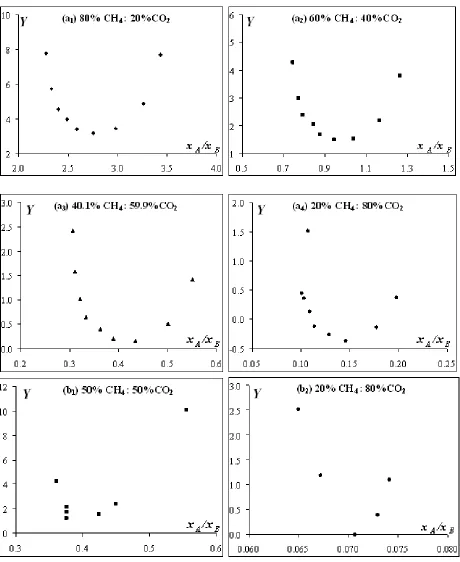
Figures 2 and 3 illustrate adsorption isotherms for CH4/CO2 binary systems in coordinates of
equations (4) and (5), respectively with the estimated H values in Table 1 [17-19]. The results for different systems (various concentration and different adsorbents) have similar shapes: the change of adsorbate-adsorbate interactions for CH4/CO2 mixture is similarly going down to a
certain minimum and then going up. From Figures 2 and 3, compressed molecules can be occurred on both adsorbents at high concentrations with negative slope of line and the most of the scale of xB/xA over than xA/xB. This transition indicates the competitive nature of the
individual component adsorption from the mixtures. CO2 is most adsorbed component. Even if
the concentration of CO2 in the bulk is lowered, the adsorption competitive stays in favor of CO2.
383
[image:5.595.77.537.70.632.2]
Figure 2 Adsorption isotherms in Ono-Kondo coordinate of equation (4): (a1)-(a4) for CH4/CO2 binary systems
adsorbed on activated carbon Filtrasorb 400 at T = 318.2 K [calculated from ref. 20], and (b1)-(b2) for
CH4/CO2 binary systems adsorbed on activated carbon Norit R1 Extra at 298 K [calculated from ref. 21].
Specified CH4 is A component and CO2 is B component.
384
Figure 3 Adsorption isotherms in Ono-Kondo coordinate of equation (5): (a1)-(a4) for CH4/CO2 binary systems
adsorbed on activated carbon Filtrasorb 400 at T = 318.2 K [calculated from ref. 20], and (b1)-(b2) for
CH4/CO2 binary systems adsorbed on activated carbon Norit R1 Extra at 298 K [calculated from ref. 21].
385
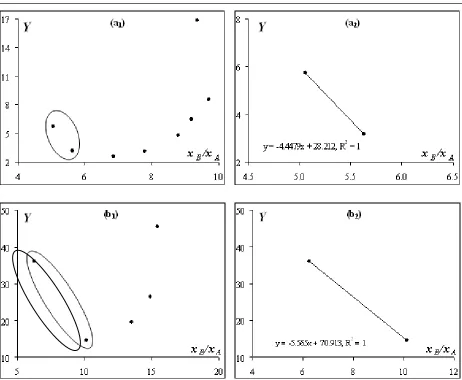
Figure 4 Adsorption isotherms in Ono-Kondo coordinate of equation (4): (a) for 20%CH4 : 80%CO2 binary
mixture adsorbed on activated carbon Filtrasorb 400 at T = 318.2 K [calculated from ref. 20], and (b) for 20%CH4 : 80%CO2 binary mixture adsorbed on activated carbon Norit R1 Extra at 298 K [calculated from
ref. 21]. Circles indicate high composition ends, and right frames show high composition ends in larger scale.
386
[image:8.595.76.538.65.445.2]
Figure 5 Adsorption isotherms in Ono-Kondo coordinate of equation (5): (a) for 20%CH4 : 80%CO2 binary
mixture adsorbed on activated carbon Filtrasorb 400 at T = 318.2 K [calculated from ref. 20], and (b) for 20%CH4 : 80%CO2 binary mixture adsorbed on activated carbon Norit R1 Extra at 298 K [calculated from
ref. 21]. Circles indicate high composition ends, and right frames show high composition ends in larger scale.
CONCLUSION
With estimated values of H, adsorption isotherms in Ono-Kondo coordinates show deviations from behavior of compression phenomenon at high pressure end. The slopes of these linear sections represent values and signs of these energies: negative slopes indicate repulsive interactions in adsorbed phase due to adsorption compression.
Compressed molecules can be expected on any adsorbent at high concentrations where the adsorbed layer is nearly full. At high enough density, interactions in adsorbed layer become repulsive and
ε
AA, orε
BB (adsorbate-adsorbate interaction) becomes positive, but the totalchange in energy still can be negative because of large negative
ε
s (adsorbate-adsorbentinteraction). However, the repulsion of molecules in the full monolayer seems to be general behavior for high enough affinity to the adsorbent.
387
Acknowledgement
The authors acknowledge support by the Graduate School and faculty of Engineering, Prince of Songkla University for providing a scholarship to study and pursue this paper. Appreciation is extended to the Johns Hopkins University for their assistance during my time in the United States.
REFERENCES
[1] X. Wei, P. Massarotto, G. Wang, V. Rudolph, S. D. Golding, Fuel, (2010), 89, 1110-1118. [2] M. Mazzotti, R. Pini, G. Storti, J. of Supercritical Fluids, (2009), 47, 619-627.
[3] S. Durucan, J. Shi, International Journal of Coal Geology, (2009), 77, 214-221. [4] B. K. Prusty, Journal of Natural Gas Chemistry, (2008), 17, 29–38.
[5] B. B. Gathitu, W. Y. Chen, M. McClure, Ind. Eng. Chem. Res., (2009), 48, 5024–5034.
[6] G. L. Aranovich, M. D. Donohue, J. Colloid. Interface. Sci., (1998), 200, 273-290. [7] G. L. Aranovich, M. D. Donohue, J. Colloid. Interface. Sci., (1997), 189, 101-108. [8] G. L. Aranovich, M. D. Donohue, J. Colloid. Interface. Sci., (1998), 205, 121-130. [9] G. L. Aranovich, M. D. Donohue, J. Colloid. Interface. Sci., (1996), 180, 537-541. [10] G. L. Aranovich, M. D. Donohue, Langmuir, (2003), 19, 2722-2735.
[11] G. L. Aranovich, T. E. Wetzel, M. D. Donohue, J. Phys. Chem. B, (2005), 109, 10189-10193. [12] G. L. Aranovich, C. Sangwichien, M. D. Donohue, J. Colloid. Interface. Sci., (2000), 227, 553-560.
[13] G. L. Aranovich, M. D. Donohue, Colloid and Surfaces A: Physicochemical and
Engineering Aspects, (2001), 187-188, 95-108.
[14] G. L. Aranovich, M. D. Donohue, J. Colloid. Interface. Sci., (2005), 292, 202-209. [15] P. Bénard, R. Chahine, Langmuir, (2001), 17, 1950-1955.
[16] S. Ono, S. Kondo, Molecular theory of surface tension in liquids, Encyclopedia of Physics, (1960), Springer-Verlag, Berlin.
[17] H. M. McNair, E. J. Bonelli, Basic Gas Chromatography, (1968), Varian Aerograph, USA. [18] C. J. Cowper, A. J. DeRose, The Analysis of Gases by Chromatography, (1983), Pergamon Press, Oxford.
[19] A.V. Kiselev, Intermolecular Interactions in Adsorption and Chromatography, (1986), Vysshaya Shkola, Moscow.
[20] M. Sudibandriyo, Z. Pan, J. E. Fitzgerald, R. L. Robinson, K. A. M. Gasem, Langmuir, (2003), 19, 5323-5331.
![Table 1 Dimensionless Henry’s constants for adsorption of methane and carbon dioxide on activated carbon [17-19]](https://thumb-us.123doks.com/thumbv2/123dok_us/8784006.905793/4.595.209.406.267.355/table-dimensionless-henry-constants-adsorption-methane-dioxide-activated.webp)