DETECTION OF HEAD POSITION USING CHAIN
CODE ALGORITHM
NORFAIZA BINTI FUAD
MASTER OF SCIENCE
UNIVERSITI PUTRA MALAYSIA
DETECTION OF HEAD POSITION USING CHAIN CODE A L G O R I T H M
By
NORFAIZA BINTI FUAD
Thesis Submitted to the School of Graduate Studies, Universiti Putra Malaysia, in Fulfilment of the Requirements for the Degree of Master of Science
DEDICATION
To my mother, my father, my brothers, my sister, my father and mother-in-law, my lecturers, my friends and my husband you are the rhythm in my tune, you are the sun and my moon, you are the beach and my wave, you are the glove and I am the hand, you are the station and I am the train, you are the teacher and I am the pupil, you are the suture to my wound, you are the magnet to my pole, you are the sum to my equations and you are the answer to my question. J dedicate this thesis to you.
Abstract of thesis presented to the Senate of Universiti Putra Malaysia in fulfilment of the requirement for the degree of Master of Science
DETECTION OF HEAD POSITION USING CHAIN CODE A L G O R I T H M By
NORFAIZA BINTI FUAD February 2007
Chairman : Associate Professor Adznan bin Jantan, PhD Faculty : Engineering
Nowadays, autonomous vision-based system has been applied to handle human job that reliability and efficiency of any intelligent system gain improvement and enhancement. Human head detection is the first step of an autonomous human recognition system. This thesis focuses on a method to recognize and detect a human at the surveillance or highlighted area boundary based their head beside; a simulation system of head detection was developed using image processing. The main contribution of this thesis is it contributes an algorithm of head recognition and detecting which based on image segmentation, Prewitt edge detection and Chain Code algorithm. Static or still images are used as input data for simulation process. The use of Median Filter (MF) method for preprocessing stage is studied and implemented to make low noise for good signification in an image. Prewitt edge detecting (PED) has been applied to present boundary of features in the images in
been applied to demonstrate the performance of the system, a person or more was detected for texture background and untextured background. The anahsis. design and development of simulation system are done in Visual C ^ . All the methods have been tested on image data and the experimental results have demonstrated a robust system.
Abstrak tesis yang dikemukakan kepada Senat Universiti Putra Malaysia sebagai memenuhi keperluan untuk Ijazah Master Sains
PENGESANAN K E D U D U K A N KEPALA M E N G G U N A K A N A L G O R I T M A 'CHAIN CODE'
Oleh
NORFAIZA BINTI FUAD February 2007
Pengerusi : Profesor Madya Adznan bin Jantan, PhD Fakulti : Kejuruteraan
algoritma Chain Code (CCA) untuk mengenal pasti lengkok kepala manusia dan melakukan proses pengesanan. Tahap kesukaran persamaan matematik yang mudah telah menjadi faktor pemilihan teknik ini berbanding teknik-teknik lain. Dua situasi atau keadaan telah dipilih untuk mendemostrasi pencapaian sistem, seorang manusia atau lebih telah di kesan pada latar belakang bercorak dan latar belakang tidak bercorak. Penganalisasian, rekabentuk dan pembangunan sistem simulasi telah menggunakan perisian Visual C++. Semua kaedah telah diuji pada data imej dan keputusan eksperiment membuktikan sistem ini adalah tegap.
A C K N O W L E D G E M E N T S
First of all, Syukur Alhamdulillah. Thanks to Allah for blessing me with healthiness, strength and guidance in completing this thesis. I would like to sincerely thank my supervisor Associate Professor Dr. Adznan Bin Jantan, for having pointed me to the right direction, for his enthusiastic and energetic guidance throughout my study and his support, without which, this thesis would not be possible. His endless enthusiasm settings and patience is something to be admired and sought after in both academic settings as well as in life.
To my committee member. Dr. Khairi Bin Yusof; I thank him enormously for giving me additional knowledge about image processing during the class, for being such a nice and helpful person and for looking after my work and making valid suggestions. His suggestions have helped making this work more focused.
To my beloved husband, Mohd Erwandi bin Marwan who gave his full support to me and helped developing portion of the system.
1 certify that an Examination Committee has met on 9 February 2007 to conduct the final examination of Norfaiza binti Fuad on her Master of Science thesis entitled "Detection of Head Position Using Chain Code Algorithm" in accordance with Universiti Pertanian Malaysia (Higher Degree) Act 1980 and Universiti Pertanian Malaysia (Higher Degree) Regulations 1981. The Committee recommends that the candidate be awarded the relevant degree. Members of the Examination Committee are as follows:
Abd Rahman bin Ramli, PhD Associate Professor
Faculty of Engineering Universiti Putra Malaysia (Chairman)
Mohd Fadlee bin A. Rasid,, PhD Lecturer
Faculty of Engineering Universiti Putra Malaysia (Internal Examiner) Sabira Khatun, PhD Associate Professor Faculty of Engineering Universiti Putra Malaysia (Internal Examiner)
Khairuddin bin Omar, PhD Associate Professor
Faculty of Technology and Information System Universiti Kebangsaan Malaysia
(External Examiner)
HASAN D. GHAZALI, PhD Professo: _ , Dean
School of Graduate Studies Universiti Putra Malaysia Date: 17 M A Y 2007
This thesis submitted to the Senate of University Putra Malaysia and has been accepted as fulfilment of the requirement for the degree of Master of Science. The members of the Supervisory Committee are as follows:
Adznan bin Jantan, PhD Associate Professor Faculty of Engineering Universiti Putra Malaysia (Chairman)
Khairi bin Yusuf, PhD Lecturer
Faculty of Engineering Universiti Putra Malaysia (Member)
A I N I I D E R I S , PhD Professor/Dean
DECLARATION
I hereby declare that the thesis is based on my original work except for quotations and citations which have been duly acknowledged. I also declare that it has not been previously or concurrently submitted for any other degree at UPM or other institutions.
Date: 10 M A R C H 2007
TABLE OF CONTENTS
Page
DEDICATION ii A B S T A R C T iii A B S T R A K v A C K N O W L E D G E M E N T S vii
A P P R O V A L viii DECLARATION x LIST OF TABLES xiv LIST OF FIGURES xv LIST OF ABBREVIATIONS xviii
CHAPTER
1 INTRODUCTION
1.1 Introduction 1 1.2 Problem Statement 2
1.3 Goal 4 1.4 Objectives 4 1.5 Research Scopes 5 1.6 Thesis Layout 5 1.7 Summary 7
2 L I T E R A T U R E REVIEW
2.1 Input Detection for Vision-based System 8
2.2.1 Grayscale Images 9 2.2.2 True Colour or RGB Images 10
2.2.3 Binary Images 10 2.2 Input Requirement for Related Research 10
2.3 Human Head Model 12 2.4 Head Crux Detection Using Image Processing and Analysis
Process 15 2.5 PreProcessing 17 2.6 Feature Extraction 20
2.6.1 Region based Shape Representation 22 2.6.2 Contour based Shape Representation 23
2.7 Estimation and Detection 25
2.8 Recognition 28 2.9 Related Research Review 30
2.10 Comparison of Head Detection 33
2.11 Discussion 36 2.12 Summary 37
3 M A T E R I A L S AND M E T H O D S
3.2 System Design of Human Head Detection S\slem 3S
3.3 Image Acquisition and Uploading 42 3.3.1 Image Pixels Declaration 43 3.3.2 Imagery Buffer Declaration 45 3.3.3 Arrangement of Pixel Value in the Imagery Buffer 45
3.4 Pre-processing Module 46 3.4.1 Conversion of a RGB Image into Grayscale Image 47
3.4.2 Noise Removal 51 3.5 Feature Extraction Module 53
3.5.1 Edge Detection and Boundary Features 55 3.5 2 Conversion of a gray scale image into BW image 58
3.6 Detection Module 59 3.6.1 Head Crux Approximation 61
3.6.2 Foreground Estimation 65
3.7 Recognition Module 66 3.7.1 Bound Human Head Position 67
3.8 System Development of Human Head Detection System 68
3.8.1 Development Tools 68 3.8.2 Supporting Tools 69 3.8.3 Project's Graphical User Interface 71
4 R E S U L T S AND DISCUSSION
4.1 Introduction 73 4.2 Pre Processing Analysis 74
4.2.1 Result for Conversion of a RGB Image into Grayscale
Image 75 4.2.2 Result for Noise Removal 76
4.2.3 Discussion for Pre Processing Analysis 77
4.3 Feature Extraction Analysis 78 4.3.1 Result for Edge Detection and Boundary Features 78
4.3.2 Result for Conversion of a Gray Scale Image into BW
Image 80 4.3.3 Discussion for Feature Extraction Analysis 83
4.4 Detection and Recognition Analysis 85 4.4.1 Result for Head Crux Approximation 85
4.4.2 Result for Foreground Estimation 86 4.4.3 Result for Bound Human Head Position 89 4.4.4 Discussion for Detection and Recognition Analysis 90
4.5 System Performance Analysis 91 4.6 The Graphical User Interface (GUI) 92 4.7 Test of Head Detection System 94
4.7.1 Result for Different Position of Head in an Image 95 4.7.2 Result for Different Number of Heads in an Image 100 4.7.3 Result for Different Number of Heads with Different
Environment in an Image 102 4.7.4 Evaluation of Result for Different Position of Head in
an Image 104 4.7.5 Evaluation of Result for Different Number of Heads in
4.7.6 Evaluation of Result for Different Number of 1 leads
with Different Environment in an Image 107 4.8 Example of true detected result and misdetection 109
4.9 Discussion for overall system analysis 111
5 C O N C L U S I O N A N D F U T U R E W O R K
5.1 Conclusion 113 5.2 Future work 115
LIST OF TABLES
Table Page 1.1 Computer vision system application in real time environment. 2
2.1 The example above shows type of image format 8
2.2 Comparison of Human Head Detection 34
4.1 Result Test 1 103 4.2 Result Test 3 106
LIST OF FIGURES
Figure Page 2.1 Orientation of the head is described in terms of yaw, pitch, and 13
roll as shown.
2.2 Graph for a sequence containing a yaw movement and horizontal 14 translation, with all other parameters remaining basically
unchanged except for a slight roll. The top row shows ground truth.
2.3 Examples of the nested ring structure of human head regions 14
2.4 Example Heads in different position (degree) 15
2.5 Basic steps for filtering an image 18 2.6 Examples of difference filter output (a) RGB image before 20
filtering (b) Median Filter (c) Wiever Filter (d) High pass filter
2.7 Hierarchy of shape based representation and description 21 technique
2.8 Examples of difference feature extraction output (a) RGB image 24 before feature extraction, (b) Robert Cross edge detector (c)
Sobel edge detector (d) Prewitt edge detector.
2.9 Estimation graph for yaw and roll position 26 2.10 Region (shaded) as it is transformed from (a) continuous to (b) 27
discrete form and then considered as a (c) contour or (d) run lengths illustrated in alternating colors.
3.1 Block diagram of system. 39 3.2 Overall flowchart of human head detection system 41
3.3 The directions throughout to be from the point of view of the
subject rather than the observer 42 3.4 Upload input imagery flowchart 43 3.5 The Digital Image (I) and the window kernel (h) respectively 44
3.7 Median filter technique 52 3.8 Feature extraction module flowchart 54
3.9 Edge detection operation 55 3.10 Detection module flowchart 60 3.11 Chain code window kernels and its direction respectively,
P I , P8 are name of pixels in an image 62 3.12 The example results of using chain code algorithms 64
3.13 Recognition module flowchart 66 3.14 Microsoft Visual C + + 6 . 0 IDE 69 3.15 Adobe Photoshop 6.0 interface and its window kernel 70
3.16 Matlab IDE interface 70 3.17 The Project Program Graphic User Interfaces (GUI) 71
4.1 Image Conversion Result (a) Original image (b) Gray scale 74 image
4.2 Filtering image noise (a) Gray scale image (b) Image after
implemented Median filter 75 4.3 Boundary edge image (a) Median filter image (b) Image after
implemented Prewitt edge detector 78 4.5 Sample detection result for image sequence, (a) Input Image, (b)
Image after edge detection using Prewitt Edge (c-f) Foreground
detected for threshold value 25, 50, 75, 100 and 125 respectively. 79-80
4-6 Sample of detected curve head using T^ =125 for several of outdoor image sequences.
4.7 Comparison Binary and Chain Code output (a) Binary image,
T=125 (b) After Chain Code algorithm 85 4.8 Image the estimation location mark as red rectangular 86
4.9 The output of edges comparison between regions interested
pointed after chain code processing and estimation marking 86-87 4.10 The output of estimation head curve using red rectangular. 88
4.11 The output of estimation human head using green rectangular. 88 4.12 Graphical User Interface of System 91 4.13 Graphical User Interface of System after detection process 92 4.14 Examples for Rotation are taken in the "untextured" room 94 4.15 Examples for Scaling are taken in the "untextured" room 95 4.16 Examples for Tilting are taken in the "untextured" room 96 4.17 Examples for Rotation are taken in the "textured" room 97 4.18 Examples for Scaling are taken in the "textured" room 98 4.19 Examples of difference number human head. Head detection in
R G B image (a,c,e,g.i) and Head detection in binary image (b,d,f,h,j).
99-100 4.20
4.21
Examples of different environment in human head detection The analysis graft of Table 4.1
101-102 104 4.22 The graph of Test 2 105 4.23 The graph for analysis result figure 4.22 105 4.24 The analysis graph of table 4.2 107 4.25 (a, c, e) Sample input image, (b, d, f) Sample of true detected
object
108 4.26 (a, c, e, g) Sample input image, (b, d, f, h) Sample of
misclassification of detected object 109 4.27 Comparison performance using Chain Code and without Chain
Code.
LIST OF ABBREVIATIONS
2D 2 Dimensional 3D 3 Dimensional
API Application Programming Interfaces CCA Chain Code Algorithm
DIB Device Independent Bitmap DIP Digital Image Processing GUI Graphical User Interface HPF High Pass Filter
IDE Integrated Development Environment JPEG Joint Picture Expert Group
LPF Low Pass Filter
MATLAB Matrix Laboratory MF Median Filter
MSDN Microsoft ® Developer Network OS Operating System
PED Prewitt Edge Detection RGB Red, Green, Blue
ROI Region of Interest TC Threshold Code TIFF Tag Image File Format
M C M C Markov chain Monte Carlo framework Window® ME Window Millennium
CHAPTER 1
INTRODUCTION
1.1 Introduction
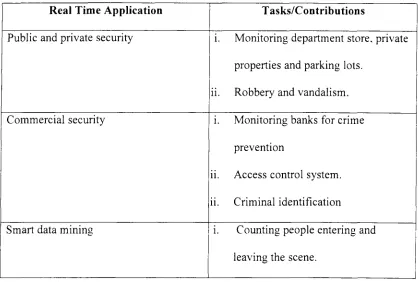
The output of recognition and detection algorithms can be used to provide the human operator with high level data. Besides, in order to yield accurate decision within a fast time and a proficient routine to search for stored image or video data. Advancement in the development of these algorithms would lead to breakthroughs on applications that use computer vision system. Table 1.1 shows some applications of computer vision.
Table 1.1: Applications of computer vision system in real time environment. Real Time Application Tasks/Contributions
Public and private security i. Monitoring department store, private properties and parking lots.
ii. Robbery and vandalism.
Commercial security i. Monitoring banks for crime prevention
ii. Access control system, ii. Criminal identification
Smart data mining i. Counting people entering and leaving the scene.
1.2 Problems Statement
There are two main problems in head detection and estimation with static images that needed to be understood, analyzed and solved:
1. High Dimension State Space.
Human upper body pose and pose estimation i n v o k e searching in a high dimensional space with complex distribution. With static images, there is no preceding pose for initializing the search, unlike a video tracking problem. This calls for an efficient mechanism for exploring the solution space. In particular, the search is preferably data-driven, so that good solution candidates can be found easily [1],
2. Pose Ambiguity.
From a single view, the inherent non-observability of some of the degrees of freedom in the body model leads to forwards/backwards flipping ambiguities [1] of the depth positions of body joints. Ambiguity is also caused by noisy and false observations. This problem can be partly alleviated by using multiple image cues to achieve robustness.