Journal of Chemical and Pharmaceutical Research
__________________________________________________
ISSN No: 0975-7384 CODEN(USA): JCPRC5
J. Chem. Pharm. Res., 2011, 3(6):521-526
Formulation and development of fast-disintegrating naproxen
tablets using simplex lattice design
Deepali Avinash Meher*
Department of Pharmceutics, K.E.S. Rajarambapu College of Pharmacy, Kasegaon Tal. Walwa, Dist. Sangli, Maharashtra, India
______________________________________________________________________________
ABSTRACT
The poor aqueous solubility of the drug results in variable dissolution profile and hence poor bioavailability. The aim of present work was to show the effect of various super disintegrants on the disintegration time and in vitro drug release rate. In this study, an attempt had been made to prepare fast disintegrating tablets of the drug using different super disintegrants following wet granulation method. The sodium starch glycolate, cross carmellose sodium and crospovidone were used in different concentrations according to the simplex lattice design as the super disintegrants. The tablets were evaluated for diameter, thickness, hardness, friability, weight variation, wetting time, percentage of water absorption, disintegration time and in vitro dissolution studies. The disintegration time of all formulation showed less than 88 seconds. Formulation containing equal amount of Cross carmellose sodium and crospovidone showed fastest disintegration than other formulations containing crospovidone, cross carmellose sodium and sodium starch glycolate.
Keywords: Naproxen; Fast-disintegrating; Simple lattice design; Super disintegrants.
______________________________________________________________________________
INTRODUCTION
Deepali Avinash Meher J. Chem. Pharm. Res., 2011, 3(6):521-526 ______________________________________________________________________________
dosage forms for existing drugs with improved safety and efficacy together with reduced dosing frequency, and the production of more cost effective dosage forms. For most therapeutic agents used to produce systemic effects, the oral route still represents the preferred way of administration, owing to its several advantages and high patient compliance compared to many other routes [2]. Tablets and hard gelatin capsules constitute a major portion of drug delivery systems that are currently available. However, many patient groups such as the elderly, children, and patients who are mentally retarded, uncooperative, nauseated, or on reduced liquid-intake/diets have difficulties swallowing these dosage forms. Those who are traveling or have little access to water are similarly affected[3-5].To fulfill these medical needs, pharmaceutical technologists have developed a novel oral dosage form known as Orally Disintegrating Tablets (ODTs) which disintegrate rapidly in saliva, usually in a matter of seconds, without the need to take it water. The bioavailability of some drugs may be increased due to absorption of drug in oral cavity and also due to pregastric absorption of saliva containing dispersed drugs that pass down into the stomach. More ever, the amount of drug that is subjected to first pass metabolism is reduced as compared to standard tablet. [6]The various super disintegrants like sodium starch glycolate, cross carmellose sodium and crospovidone were used for preparation of fast disintegrating tablets [7-9]. Naproxen, a non-steroidal anti-inflammatory drug, was selected as model drug because it is widely used in treatment of pain and inflammation. A common problem in pharmaceutics occurs when the components of formulations are varied in an attempt to optimize its performance with respect to variables. Simplex lattice can be used to determine the relative proportion of ingredients that optimizes a formulation with respect to specified variables. Hence simplex lattice is used to obtain the optimum concentration of superdisintegrants to formulate the fast disintegrating tablets of Naproxen.
EXPERIMENTAL SECTION
Materials:
Naproxen was a gift sample from Glaxo Pharma Pvt Ltd.( Goa). Sodium starch glycolate (SSG), cross carmellose sodium (CCS) and crospovidone were the gift from Colorcon Asia Pvt Ltd, Goa, Magnesium sterate,Talc,Asparteme,Lactose All other ingredients used were of pharmaceutical grade.
Methods:
Weight variation test:
20 tablets were selected randomly from the lot and weighted individually to check for weight variation. Weight variation specification as per I.P. is shown in Table no.1
Table no.1: Weight variation specification as per I.P.
Average weight of tablet % deviation
80mg or less ± 10
more than 80mg but less than 250mg ± 7.5
250mg ormore ± 5
Friability test:
To achieve % friability within limits for an FDT is a challenge to the formulator since all methods of manufacturing of FDT are responsible for increasing the % friability values. Thus, it is necessary that this parameter should be evaluated and the results are within bound limits (0.1-0.9%).Friability was determined by Roche friabilator by evaluating 20 tablets of each formulation (Lab Hosp, India).
Friability (%) =initial weight - final weight / initial weight x100
Wetting time:
It was determined by placing a piece of tissue paper folded twice in a small petridish containing 6 mL water. A tablet was placed on the tissue paper and small amount of amaranth powder was placed on upper surface of tablet. The time required for development of a red color on the upper surface of the tablet was recorded as wetting time[4].A piece of tissue paper folded twice was placed in a small petri dish containing 10 mL of water. A tablet was kept on paper and time required for complete wetting was measured.
Water absorption ratio:
Then wetted tablet was weighed and percentage of water absorption was determined using the following equation[10-12]:
R = Wb-Wa/Wa
x
100Where, Wa is weight of tablet before water absorption Wb is weight of tablet after water absorption
R is water absorption ratio.
Drug content:
Twenty tablets were weighed and powdered. An amount of the powder equivalent to 100 mg of naproxen sodium was dissolved in 100 mL of pH 7.4 phosphate buffer, filtered, diluted suitably and analyzed for drug content at 230 nm using UV-Visible spectrophotometer.
In vitro disintegration time:
Deepali Avinash Meher J. Chem. Pharm. Res., 2011, 3(6):521-526 ______________________________________________________________________________
Dissolution study:
In vitro release of naproxen sodium from tablets was monitored by using 900 ml of SIF (USP phosphate buffer solution, pH 7.4) at 37±0.5° and 75 rpm using programmable dissolution tester [Lab India (model: Disso-2000), India]. 5 m aliquots were withdrawn at 1 min time intervals and were replenished immediately with the same volume of fresh buffer medium. Aliquots, following suitable dilutions, were assayed spectrophotometrically at 230 nm.
RESULTS AND DISCUSSION
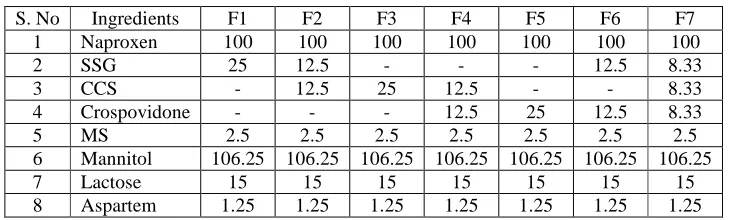
[image:4.595.116.492.434.544.2]The average weight of the prepared tablets was in between 258.22 and 260.34 mg. The average thickness and diameter of tablets were found to be 3.45 mm and 8.00 mm, respectively. The hardness of prepared tablets was between 2.5 to 3.5 kg/cm2. The friability of all the formulations was less than 1% indicating the ability of tablet to withstand abrasion in handling packaging and shipment. The weight variation of prepared tablets was within limits. The wetting time of formulation F4 was 36 seconds containing crospovidone and cross carmellose sodium in equal proportion, which was lower than other formulations. The percentage of water absorption was between 67.35 to 99.73. The disintegration time of the tablets varied from 19 to 88 seconds. The tablet containing equal proportion of crospovidone and cross carmellose sodium disintegrates faster than tablets prepared with other formulations as shown in Table 2. The in vitro drug release from tablets containing crospovidone and cross carmellose sodium was 99.45% and drug release of tablets containing only sodium starch glycolate was 87.12% while tablets formulated using Table 2
Table 2 Composition of formulation
S. No Ingredients F1 F2 F3 F4 F5 F6 F7
1 Naproxen 100 100 100 100 100 100 100
2 SSG 25 12.5 - - - 12.5 8.33
3 CCS - 12.5 25 12.5 - - 8.33
4 Crospovidone - - - 12.5 25 12.5 8.33
5 MS 2.5 2.5 2.5 2.5 2.5 2.5 2.5
6 Mannitol 106.25 106.25 106.25 106.25 106.25 106.25 106.25
7 Lactose 15 15 15 15 15 15 15
8 Aspartem 1.25 1.25 1.25 1.25 1.25 1.25 1.25
SSG = Sodium starch glycolate; CCS = Cross carmellose sodium; MS = Magnesium stearate, F= Formulation
Table 3
S. No Properties F1
1 Thickness(mm) 3.45 0.02
2 Diameter (mm) 8.01 ± 0.09
3 Hardness (kg/cm2) 2.80 ± 0.04
4 Friability (%) 0.580 ± 0.002
5 weight variation% 1.63 ± 0.12
6 Wetting time sec. 214.00 ± 0.95
7 water absorption 94.73 ± 0.99
8 disintegrating time(sec.)
88.00 ± 1.03
9 drug release% 10 min.
87.12 ± 0.86
*All readings were taken in triplicate ± Standard Deviation.
The result of simplex lattice design revealed that the
affect the wetting time, disintegration time, drug release. The formulation containing crospovidone and crosscarmellose sodium in equal proportion showed the fast disintegration as compared to the other formulatio
combination of disintegrants in tablets formulation, tablet with fast disintegration can be produced.
Table 3 Evaluation Of Tablet Formulations (F1-F7)
F1 F2 F3 F4 F5
3.45 ± 0.02 3.46 ± 0.05 3.45 ± 0.03 3.44 ± 0.02 3.46 ± 0.06 8.01 ± 0.09 7.98 ± 0.12 8.00 ± 0.03 8.00 ± 0.09 8.01 ± 0.03 2.80 ± 0.04 3.20 ± 0.03 3.00 ± 0.09 2.70 ± 0.04 2.70 ± 0.11 0.580 ± 0.002 0.410 ± 0.012 0.400 ± 0.031 0.670 ± 0.004 0.620 ± 0.011 1.63 ± 0.12 2.03 ± 0.43 1.86 ± 0.08 1.95 ± 0.05 3.09 ± 0.09 214.00 ± 0.95 97.00 ± 1.04 175.00 ± 0.84 36.00 ± 1.48 46.00 ± 0.65 94.73 ± 0.99 67.35 ± 1.16 84.77 ± 0.35 99.72 ± 0.92 84.35 ± 0.43 .00 ± 1.03 52.00 ± 0.39 75.00 ± 0.34 19.00 ± 0.89 23.00 ± 1.15 .12 ± 0.86 90.73 ± 0.76 89.99 ± 1.52 99.45 ± 0.91 93.60± 0.58
*All readings were taken in triplicate ± Standard Deviation.
Release profile of Naproxen
Fig.1: Drug release profile
CONCLUSION
The result of simplex lattice design revealed that the combination of disintegrants significantly affect the wetting time, disintegration time, drug release. The formulation containing crospovidone and crosscarmellose sodium in equal proportion showed the fast disintegration as compared to the other formulations. It is thus concluded that by selecting proper amount and combination of disintegrants in tablets formulation, tablet with fast disintegration can be
F6 F7
± 3.45 ± 0.05
3.46 ± 0.06 ± 8.02 ±
0.01
8.00 ± 0.07 2.70 ± 2.80 ±
0.10
2.90 ± 0.09 0.620 ± 0.600 ±
0.002
0.580 ± 0.015 3.09 ± 2.58 ±
0.05
2.97 ± 0.08 46.00 ± 124.00 ±
1.17
87.00 ± 0.53 84.35 ± 77.32 ±
0.84
88.27 ± 0.12 .00 ± 73.00 ±
1.02
33.00 ± 0.93 0± 88.80 ±
0.42
88.75 ± 0.35
Deepali Avinash Meher J. Chem. Pharm. Res., 2011, 3(6):521-526 ______________________________________________________________________________
REFERENCES
[1] Shyamala B, Narmada GY. The Indian Pharmacist, 2002; 13(8): 09-12.
[2] Valleri M, Mura P, Maestrelli F, Cirri M, Ballerini R. Drug Dev Ind Pharm, 2004; 30(5):525-34.
[3]Hanawa T, Watanabe A, Tsuchiya T, Ikoma R, HidakaM, Sugihara M. Chem Pharm Bull,
1995; 43(2): 284- 288.
[4]Mallet L. J. Am. Pharm. Assoc, 1996; 36(11): 628-635.5. [5]Porter SC. Am Pharm Rev, 2001; 85: 28-35.
[6]D Bhowmik et al, Journal of Chemical and Pharmaceutical Research, 2009, 1(1): 163-177
[7]N. Do, and T. Farrell, Control of dissolution rate of immediate release tablets containing Starch 1500 with a combination of different types and grades of Methocel. AAPS Annual Meeting and Exposition, San Antonio, TX October 31, 2006.
[8]M. Adel, M. Semreen, and K. Mazen. Pharm. Technol. January, 68-78 (2005).
[9]A. Singh, and R. Jain. Fast dissolving composition with prolonged sweet taste, US Patent US 7122198, 2006.
[10]Y. Yonnobu, S. Hisakazu, D. Kazumi, and O. Akinobu. Chem. Pharm. Bull. 44: 2121-2127 (1996).
[11] Gupta S.C., Gurjar R., Khambete H., C K Sudhakar., Jain S. J. Chem. Pharm. Res., 2011, 3(4):55-6155
[12] K. S. G. Arul Kumaran, J. Sreekanth and S. Palanisamy, J. Chem. Pharm. Res., 2011,
3(3):169-175