A STUDY OF TOTAL PRODUCTIVE MANTENANCE IMPLEMENTATION IN
MANUFACTURING INDUSTRY
Yunos bin Ngadiman Universiti Tun Hussein Onn Malaysia
Burairah bin Hussin (PhD) Universiti Teknikal Malaysia Melaka
Izaidin bin Abdul Majid (PhD) Universiti Teknikal Malaysia Melaka
ABSTRACT
Total Productive Maintenance or TPM is an advanced manufacturing technique that focuses on maximizing the Overall Equipment Effectiveness or OEE of any asset or capital equipment utilized in the production of goods and services. While the basic components of TPM have been existence for decades, few companies are able to assemble the components into an overall strategy. Many companies will partially implement some of the components but never realize the full benefits that can be achieved through TPM. In addition, staffs at production area need to make sure that they manage to strike the demand on time. Since the production area conquered by the machine, there will be risk that the machine not work properly, damaged and corrupted. That’s the reason why TPM has been design to assist the manufacturing in production area to increase the performance of the equipments. This case study, we do in order to find out about the difference of the result that affects OEE before and after the TPM being implemented in manufacturing industries. Improvement will be made after the abnormal elements have been detected, so that it can be directly corrected. Analyzing and identify the elements will give impact on the OEE result. The approach methods in this study is experimental study through instruments used to collect data are observation and calculation. To calculate the OEE, Microsoft Excel is commonly be used. Hence, TPM is a tool in helping firm to achieve an optimal manufacturing process. By being able to achieve this level of maintenance, an organization will be able to make such a competitive advantages brought by TPM philosophy, thus producing such high quality of manufacturing product that manage to satisfy customers and subsequently generating greater profits.
Field of Research: Total Productive Maintenance, Overall Equipment Effectiveness, Capital Equipment, abnormal element, observation, quality of product, customer satisfaction.
1. INTRODUCTION
TPM or being known as Total Productive Maintenance has been originated in Japan in 1971 (Joel Levitt, 2010). It is being design as a method to improve the availability of machines through the utilization of maintenance. Some people might think that TPM is “deterioration prevention”, which means is what happens naturally to anything that is not “taken care of”. For this reason many people refer to TPM as "total productive manufacturing" or "total process management" (Peter Wilmott et. al., 2001). TPM is a proactive approach that essentially aims to identify issues as soon as possible and plan to prevent any issues before occurrence. One motto is "zero error, zero work-related accident and zero loss" (Wireman, T., 2004).
In the other hand, TPM also need to make sure that the setting and maintenance of the machine are being frequently done by the machine operator that has be well-trained to handle that machines (S. Nakajima, 1988). In this setting the operators are enabled to understand the machinery and identify potential problems, righting them before they can impact production and by so doing, decrease downtime and reduce costs of production. TPM is a critical adjunct to lean manufacturing. If machine uptime is not predictable and if process capability is not sustained, the process must keep extra stocks to buffer against this uncertainty and flow through the process will be interrupted (Joel Levitt, 2010). Unreliable uptime is caused by breakdowns or badly performed maintenance. Correct maintenance will allow uptime to improve and speed production through a given area allowing a machine to run at its designed capacity of production.
Working with little inventory and stopping production when there is a problem causes instability and a sense of urgency among workers. In mass production, when a machine goes down, there is no sense of urgency; excess inventory will keep the operation running while maintenance fixes the problem. In lean production, when an operator shuts down production to fix a problem, the line will soon stop producing, creating a crisis and a sense of urgency. A properly implemented and maintained Total Productive Maintenance System (TPM) will provide the needed stability for lean production. For example, we have choose Toyota organization as the sample for our case study, because Toyota is one of the famous automotive manufacturers (Joel Levitt, 2010). A little more than 30 years ago, an automotive supplier company in Japan (Nippondenso) realized that until to the delivered address and systematically eliminate the causes of poor equipment performance unfortunately cannot deliver to the customers “just in time,” improve quality levels, lower operating costs or improve profits.
2. STUDY FINDING
2.1 Knowledge of Total Productive Maintenance (TPM)
TPM or being known as Total Productive Maintenance has been originated in Japan in 1971. It is being design as a method to improve the availability of machines through the utilization of maintenance. Some people might think that TPM is “deterioration prevention”, which means is what happens naturally to anything that is not “taken care of”. For this reason many people refer to TPM as "total productive manufacturing" or "total process management" (Joel Levitt, 2010). TPM is a proactive approach that essentially aims to identify issues as soon as possible and plan to prevent any issues before occurrence. One motto is "zero error, zero work-related accident, and zero loss" (Wireman, T.,2004).
In the other hand, TPM also need to make sure that the setting and maintenance of the machine are being frequently done by the machine operator that has be well-trained to handle that machines (Peter Wilmott et. al., 2001). In this setting the operators are enabled to understand the machinery and identify potential problems, righting them before they can impact production and by so doing, decrease downtime and reduce costs of production. TPM is a critical adjunct to lean manufacturing. If machine uptime is not predictable and if process capability is not sustained (Ralph Bernstein, 2005), the process must keep extra stocks to buffer against this uncertainty and flow through the process will be interrupted. Unreliable uptime is caused by breakdowns or badly performed maintenance. Correct maintenance will allow uptime to improve and speed production through a given area allowing a machine to run at its designed capacity of production.
Working with little inventory and stopping production when there is a problem causes instability and a sense of urgency among workers. In mass production, when a machine goes down, there is no sense of urgency; excess inventory will keep the operation running while maintenance fixes the problem. In lean production, when an operator shuts down production to fix a problem, the line will soon stop producing, creating a crisis and a sense of urgency. A properly implemented and maintained Total Productive Maintenance System (TPM) will provide the needed stability for lean production. For example, we have choose Toyota organization as the sample for our case study, because Toyota is one of the famous automotive manufacturers (Joel Levitt, 2010). A little more than 30 years ago, an automotive supplier company in Japan (Nippondenso) realized that until to the delivered address and systematically eliminate the causes of poor equipment performance unfortunately cannot deliver to the customers “just in time,” improve quality levels, lower operating costs or improve profits.
communication between operators and engineering (Joel Levitt, 2010). Production personnel are trained to perform routine maintenance.
2.2 TPM Concepts
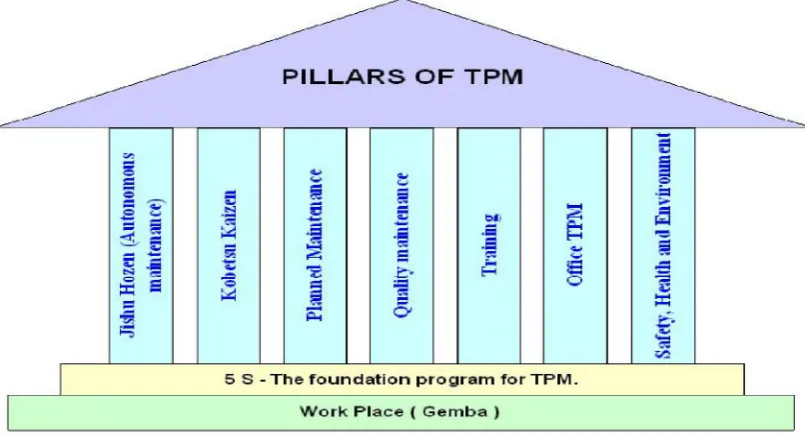
[image:4.595.99.502.257.476.2]TPM can be illustrated as being supported by seven TPM Activities “Pillars”, all of which are supported by 5S (Matthew P. Stephens, 2004).
Figure 1: TPM Activity Pillars
Pillar 1 – 5S
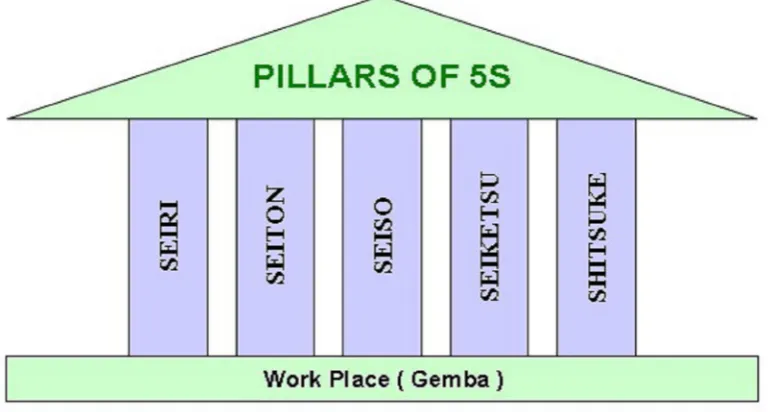
Figure 2: 5S Activity Pillars
The foundation program for TPM, the 5s’ are translated from Japanese terms which stands for, Seiri, Seiton, Seiso, Seiketsu, and Shitsuke. The meaning of each terms are as the Table 1:
Table 1: 5S Translated Terms
Japanese Term English Translation Equivalent “S” Terms
Seiri Organization Sort
Seiton Tidiness Systematize
Seiso Cleaning Sweep
Seiketsu Standardization Standardize
Shitsuke Discipline Self-Discipline
SEIRI - Sort out:
This means sorting and organizing the items as critical, important, frequently used items, useless, or items that are not need as of now. Unwanted items can be salvaged. Critical items should be kept for use nearby and items that are not be used in near future, should be stored in some place.
SEITON - Organize:
[image:5.595.89.510.482.559.2]SEISO - Shine the workplace:
This involves cleaning the work place free of burrs, grease, oil, waste, scrap etc. No loosely hanging wires or oil leakage from machines.
SEIKETSU - Standardization:
Employees have to discuss together and decide on standards for keeping the work place / Machines / pathways neat and clean. These standards are implemented for whole organization and are tested / inspected randomly.
SHITSUKE - Self discipline:
Considering 5S as a way of life and bring about self-discipline among the employees of the organization. This includes wearing badges, following work procedures, punctuality, dedication to the organization etc.
This 5S implementation has to be carried out in phased manner. First the current situation of the workplace has to be studied by conducting a 5S audit. This audit uses check sheets to evaluate the current situation. This check sheet consists of various parameters to be rated say on a 5-point basis for each 'S'. The ratings give the current situation. The each of the above-mentioned 5S is implemented and audit is conducted at regular intervals to monitor the progress and evaluate the success of implementation. After the completion of implementation of 5S random audits could be conducted using these check sheets to ensure that it is observed in true spirits by everyone in the work place. A sample check sheet is shown below. The check sheet shown below takes a general industry into consideration. It may vary from even from one plant to another, and more exhaustive (Joel Levitt, 2010).
PILLAR 2 - JISHU HOZEN (Autonomous maintenance)
This pillar is geared towards developing operators to be able to take care of small maintenance tasks, thus freeing up the skilled maintenance people to spend time on more value added activity and technical repairs. The operators are responsible for upkeep of their equipment to prevent it from deteriorating. By use of this pillar, the aim is to maintain the machine in new condition. The activities involved are very simple nature. This includes cleaning, lubricating, visual inspection, tightening of loosened bolts etc.
There are 7 steps of Jishu Hozen which consist of: 1) Preparation of employees, 2) Initial cleanup of machines, 3) Take counter measures, 4) Fix tentative JH standards, 5) General inspection, 6) Autonomous inspection, and 7) Standardization.
The first step which is the preparation of employees is to train the employees. Educate the employees about TPM, Its advantages, JH advantages and Steps in JH. Educate the employees about the equipment they use, the frequency of oiling, day-to-day maintenance activities required and the abnormalities that could occur in the machine and way to find out the abnormalities.
The second step is to have initial cleanup of machines. All items needed for cleaning would be arranged and equipment should be cleaned by the employees completely with the help of maintenance department. All dust, stains, oils, greases and any sign of dirt should be removed. Things that has to be taken care while cleaning is for example, oil leakage, loose wires, unfastened nuts and bolts and worn out parts. After the equipments are cleaned up, they are well categorized and suitably tagged. It is then transferred to a register and makes a note of areas which were inaccessible. Finally the opened parts of machine are closed and the machine is run.
The third step is counter measures. At this instant, Inaccessible regions had to be reached easily. For example, if there are many screw to open a flywheel door, hinge door can be used. Instead of opening a door for inspecting the machine, acrylic sheets can be used to prevent work out of machine parts necessary action must be taken. Therefore, Machine parts should be modified to prevent accumulation of dirt and dust.
The fourth step is to fix tentative standard. In order to achieve better improvement, JH schedule has to be made and followed strictly. For that purpose, schedule should be made regarding cleaning, inspection and lubrication and it also should include details like when, what and how in details and standardized.
The fifth step is the general inspection. The employees are trained in disciplines like Pneumatics, electrical, hydraulics, lubricant and coolant, drives, bolts, nuts and safety. This is necessary to improve the technical skills of employees and to use inspection manuals correctly. In this case, inspect the conditions of each part of equipment using the human senses of sight, hearing, smell, and touch to detect signs of equipment failure. By identifying potential problems with inspections, we can plan and implement repair or replacement before a breakdown or defect occurs. Inspection can be aided through the use of stickers affixed to the equipment to show which sense is to be used at which location. By acquiring this new technical knowledge, the operators are now well aware of machine parts.
The sixth step is the autonomous inspection, where new methods of cleaning and lubricating are used. Each employee prepares his own autonomous chart / schedule in consultation with supervisor. Parts, which have never given any problem, or part, which don’t need any inspection, are removed from list permanently based on experience which Including good quality machine parts. This avoids defects due to poor JH. Inspection that is made in preventive maintenance is included in JH while the frequency of cleanup and inspection is reduced based on experience.
modified such that there is no difficulty in getting any item. Everybody should follow the work instructions strictly. Necessary spares for equipments is planned and procured.
PILLAR 3 – KOBETSU KAIZEN
"Kai" means change, and "Zen" means good (for the better). Basically kaizen is for small improvements, but carried out on a continual basis and involve all people in the organization. Kaizen is opposite to big spectacular innovations. Kaizen requires no or little investment. The principle behind is that "a very large number of small improvements are more effective in an organizational environment than a few improvements of large value. This pillar is aimed at reducing losses in the workplace that affect our efficiencies. By using a detailed and thorough procedure we eliminate losses in a systematic method using various Kaizen tools. These activities are not limited to production areas and can be implemented in administrative areas as well.
Kaizen aims to practise concepts of zero losses in every sphere of activity and relentless pursuit to achieve cost reduction targets in all resources as well as improve over all plant equipment effectiveness. Kaizen policy performs extensive use of PM analysis as a tool for eliminating losses while focus of easy handling of operators. Kaizen target to achieve and sustain zero loses with respect to minor stops, measurement and adjustments, defects and unavoidable downtimes.
The objective of TPM is maximization of equipment effectiveness. TPM aims at maximization of machine utilization and not merely machine availability maximization. As one of the pillars of TPM activities, Kaizen pursues efficient equipment, operator and material and energy utilization that is extremes of productivity and aims at achieving substantial effects. The major 6 big losses will then be discussed (Joel Levitt, 2010).
PILLAR 4 – PLANNED MAINTENANCE
It is aimed to have trouble free machines and equipments producing defect free products for total customer satisfaction. This breaks maintenance down into four "families" or groups, which was defined earlier.
1. Preventive Maintenance
2. Breakdown Maintenance
3. Corrective Maintenance
4. Maintenance Prevention
With Planned Maintenance we evolve our efforts from a reactive to a proactive method and use trained maintenance staff to help train the operators to better maintain their equipment.
machines. It targets zero equipment failure and breakdown throughout the manufacturing process and ensure availability of spares all the time.
There are majorly six steps in this planned maintenance which first is the equipment evaluation and recording present status. Then it restores deterioration and improves weaknesses, follow by building up information management system. Later is to prepare time based information system, select equipment, parts and members and map out plan. Fifth step is to prepare predictive maintenance system by introducing equipment diagnostic techniques and finally evaluate the planned maintenance.
PILLAR 5 - QUALITY MAINTENANCE
It is aimed towards customer delight through highest quality through defect free manufacturing. Focus is on eliminating non-conformances in a systematic manner, much like Focused Improvement. We gain understanding of what parts of the equipment affect product quality and begin to eliminate current quality concerns, and then move to potential quality concerns. Transition is from reactive to proactive (Quality Control to Quality Assurance). QM activities are to set equipment conditions that preclude quality defects, based on the basic concept of maintaining perfect equipment to maintain perfect quality of products. The condition is checked and measure in time series to very that measure values are within standard values to prevent defects. The transition of measured values is watched to predict possibilities of defects occurring and to take counter measures before hand.
The policies of the quality maintenance includes detect free conditions and control of equipments and support quality assurance. It is the focus of prevention of defects at source and focuses on poke-yoke, which also known as fool proof system. Other than those are in-line detection and segregation of defects and effective implementation of operator quality assurance. Additionally, it target to achieve and sustain customer complaints at zero, reduces in-process defects by half and cost of quality by half as well.
The data requirement is defined as quality defects are classified as customer end defects and in house defects. For customer-end data, we have to get data on customer end line rejection and field complaints. In-house, data include data related to products and data related to process. Data related to products are Product wise defects, Severity of the defect and its contribution, Location of the defect with reference to the layout, Magnitude and frequency of its occurrence at each stage of measurement, Occurrence trend in beginning and the end of each production/process/changes, and Occurrence trend with respect to restoration of breakdown/modifications/periodical replacement of quality components. Meanwhile, data related to process are the operating condition for individual sub-process related to men, method, material and machine, the standard settings/conditions of the sub-process and the actual record of the settings/conditions during the defect occurrence.
PILLAR 6 – TRAINING
"Know-why". By experience they gain, "Know-How" to overcome a problem what to be done. This they do without knowing the root cause of the problem and why they are doing so. Hence it becomes necessary to train them on knowing "Know-why". The employees should be trained to achieve the four phases of skill. The goal is to create a factory full of experts. The different phase of skills is
Phase 1: Do not know.
Phase 2: Know the theory but cannot do.
Phase 3: Can do but cannot teach
Phase 4: Can do and also teach.
The policy of training focus on improvement of knowledge, skills and techniques and creating a training environment for self-learning based on felt needs. Other policies are training curriculum / tools /assessment etc conductive to employee revitalization and training to remove employee fatigue and make, work enjoyable. It targets to achieve and sustain downtime due to want men at zero on critical machines as well as achieve and sustain zero losses due to lack of knowledge / skills / techniques while at the same time, aims for 100 % participation in suggestion scheme (Joel Levitt, 2010).
There are basically six steps in educating and training activities. First of all is setting policies and priorities and checking present status of education and training. Secondly establish of training system for operation and maintenance skill up gradation. Thirdly, train the employees for upgrading the operation and maintenance skills follow by the preparation of training calendar and the kick-off of the system for training. Final step is the evaluation of activities and study of future approach.
PILLAR 7 – OFFICE TPM
Office TPM should be started after activating four other pillars of TPM. Office TPM must be followed to improve productivity, efficiency in the administrative functions and identify and eliminate losses. This includes analyzing processes and procedures towards increased office automation. Office TPM addresses twelve major losses. There are,
1. Processing loss
2. Cost loss including in areas such as procurement, accounts, marketing, sales leading to high inventories
3. Communication loss
4. Idle loss
5. Set-up loss
6. Accuracy loss
8. Communication channel breakdown, telephone and fax lines
9. Time spent on retrieval of information
10. Non availability of correct on line stock status
11. Customer complaints due to logistics
12. Expenses on emergency dispatches or purchases.
An office TPM usually starts with a senior person from one of the support functions e.g. Head of Finance, MIS, Purchase etc should be heading the sub-committee. Members representing all support functions and people from Production & Quality should be included in subcommittee (Society of Manufacturing Enineers, 2008). TPM co-ordinate plans and guides the subcommittee. The office TPM starts with the first providing awareness about office TPM to all support departments and then helping them to identify P, Q, C, D, S, M in each function in relation to plant performance. They would later identify the scope for improvement in each function and collect relevant data to help them to solve problems in their circles. Then, they make up an activity board where progress is monitored on both sides - results and actions along with Kaizen and fan out to cover all employees and circles in all functions (Wireman, T., 2004).
There are some topics discussed related to the office TPM which includes Inventory reduction, Lead time reduction of critical processes, Motion & space losses, Retrieval time reduction, Equalizing the work load and Improving the office efficiency by eliminating the time loss on retrieval of information, by achieving zero breakdown of office equipment like telephone and fax lines.
The office TPM benefit an organization creating involvement of all people in support functions for focusing on better plant performance. It also enhances better utilized work area. Some most important benefit are nevertheless reduce administrative cost, inventory carrying cost, manpower breakdown of office equipment, and expenses due to emergency dispatches or purchases. It also at the same time reduces repetitive work, customers’ complaints due to logistics. Lastly, it provide clean and pleasant work environment (Ralph Bernstein, 2005).
The extension of office TPM to supplier and distributors is essential, but only after we have done as much as possible internally. With suppliers it will lead to on-time delivery, improved 'in-coming' quality and cost reduction. With distributors it will lead to accurate demand generation, improved secondary distribution and reduction in damages during storage and handling. In any case we will have to teach them based on our experience and practice and highlight gaps in the system, which affect both sides. In case of some of the larger companies, they have started to support clusters of suppliers.
PILLAR 8 - SAFETY, HEALTH AND ENVIRONMENT:
heads the committee. Utmost importance to Safety is given in the plant. Manager (Safety) is looking after functions related to safety. To create awareness among employees various competitions like safety slogans, Quiz, Drama, Posters, etc. related to safety can be organized at regular intervals.
2.3 TPM Implementation
TPM focuses on optimizing planning and scheduling. Availability, performance and yield are other factors that affect productivity. Availability losses arise from breakdowns and change-over, for example, the situation in which the line is not running when it should be. Performance losses arise from speed losses and small stops or idling or empty positions. In this case, the line may be running, but it is not producing the quantity it should. Yield losses consist of losses due to rejects and poor start-up behavior in the line producing the products (Ralph Bernstein, 2005). These losses lead to low values of the overall equipment effectiveness (OEE), which provides an indication of how effective the production process is. TPM helps to raise the value of the OEE by supplying a structure to facilitate the assessment of these losses (Robert C. Hansen, 2002). Application of TPM leads to both short and long-term improvements.
The implementation of TPM are usually refers to the 12 basics steps TPM development program which is also divided into 3 main stages, which are the Preparation, Implementation and Stabilization stage. The preparation stage consist of the first 5 basic steps follow by the implementation stage which consist of 6 basic steps and finally the stabilization stage has only 1 basic step. In the preparation stage a suitable environment is created by establishing a plan for the introduction of TPM. This preparation stage is analogous to the product design stage, when the details of a product are mapped out and prepared for. It is like the kickoff at the beginning of a ball game which begins the production (Wireman, T.,2004).
The implementation stage is comparable to the production stage for a product in which materials are processed; parts are made and assembled after inspection. Finally an inspection is done to complete the manufacturing process which is known as the stabilization stage.
2.3 Overall Equipment Efficiency (OEE)
Total Productive Maintenance (TPM) focuses on maximizing the Overall Equipment Efficiency (OEE) with involvement of each and everyone in the organization (Wireman, T., 2004). OEE can be describe as a concept in maintenance and is a way of measuring the effectiveness of machine and become a backbone in management programs. OEE also is a method to find out effectiveness of equipment and it is obtained by multiplication of three ratios (Robert C. Hansen, 2002) which is:-
a) Available Ratio
b) Quality Ratio
Is a percent of parts produced compare to standard or quality of “A” grade/prime grade material produced divided by total production (off grade + prime grade) or measures how many of product is in good quality.
c) Performance Ratio
Which is the rate of production divided by capacity of machine to produced or percent of sellable parts produced compared to parts started or measures how fast the machine runs and how close it is to the ideal speed (Matthew P. Stephens, 2004). Normally Overall Equipment Efficiency (OEE) is presented in term of percentage as below:
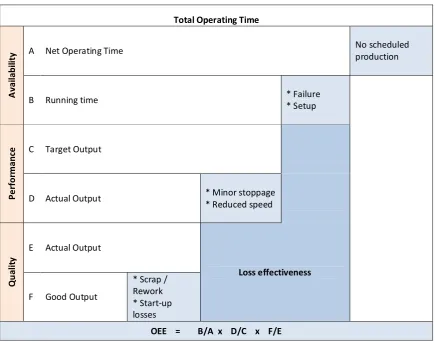
[image:13.595.81.517.345.688.2]OEE = B/A (Availability rate) x D/C (Performance rate) x F/E (Quality rate)
Table 2: Diagram of Overall Equipment Efficiency (OEE)
Total Operating Time
A
vai
labil
ity A Net Operating Time
No scheduled production
B Running time * Failure * Setup
Pe
rfor
mance
C Target Output
D Actual Output * Minor stoppage * Reduced speed
Qu
alit
y
E Actual Output
Loss effectiveness
F Good Output
* Scrap / Rework * Start-up
losses
OEE = B/A x D/C x F/E
identify potential problems as a way to improve or eliminate them (Wireman, T., 2004). This measurement tools basically connect with three elements together and yield an overall percentage. To get the overall equipment effectiveness value, we need multiply the available the machine operating, quality of product the machine produce and the quality output of total production (Society of Manufacturing Enineers, 2008).
2.3 Efficiency, Effectiveness and Productivity
Overall Equipment Effectiveness (OEE) in term of Efficiency, Effectiveness and productivity (Worthington, A. C., 2008) is terms that are often used in different ways (Robert C. Hansen, 2002). Therefore it is necessary start with explain their definition. Installation is a certain level of cooperate assets where transformation process takes place and this installation produces outputs by transforming inputs. For examples, in the welding line of car factory, steel as a input is transformed into car doors (output). However steel is not only the input. Labor and energy is another example of input. Productivity is the actual output over the actual input for example number of cars per employee. The Effectiveness of the installation is the actual output over the reference output. Productivity can be influenced not only by changing the effectiveness but also by altering the efficiency (Peter Wilmott et. al., 2001), this is the actual input over the reference input. Installation effectiveness is one of the important factors that influence the production cost-prize. Other contributing factors are raw materials, utilities, people and work methods. Raw materials as input can be actual raw materials as well as semi-manufactures (altering the raw material to create a portion of, but not the final product), from a previous installation but they have to be exterior to the own installation. It should be clear that the maximization of installation effectiveness can‟t be the one and only goal.
2.4 The Important Using OEE
Overall Equipment Effectiveness (OEE) truly reduces complex production problems into simple, intuitive presentation of information (Wireman, T., 2004), Ralph Bernstein (2005).
• Also help in systematically improve your process with easy-to-obtain measurement
• Save companies from making inappropriate purchases and help them focus on improving the performance of machinery and plant equipment already own.
• OEE also used to find the greatest areas of improvement, so you can start with the area that will provide the greatest return on assets.
• The important of machine, departments, production lines, and plant can be easily measured by using Overall Equipment Efficiency (OEE)
• By using OEE all the losses become visible where priorities will become clear and you will able to make well founded choice for specific improvement and at the same time it is simple way and easy to understand for all involved.
• Accurately calculating OEE can reducing the overall time require to operate a demand thus reducing cost, decreasing inventory levels to lower working capital and increasing incremental profit.
2.5 Common mistake by using OEE
• using the wrong speeds basis
• improper roll up
• reclassifying unplanned downtime as planned
(Matthew P. Stephens, 2004)
2.6 The Added Value of OEE calculation
Generally Overall Equipment Efficiency (OEE) measures how well the equipment is running and it can specifically show how much of the time machine is actually doing well and what percentage or portion of the output is of good quality not just the amount of products or output the machine is turning out. OEE (Robert C. Hansen ,2002) also not just for maintenance anymore since the approach can help predict problems in the future and may allow some monitoring of the equipment health as well. And it also involved step by step computation which is part of the general framework (Joel Levitt, 2010).
Calculation for OEE Metric is multiplication of:
Availability % = Uptime / Schedule Product Time %
Performance % = Theoretical Production Time for Throughput / Available Time %
Quality % = Good Units Produces / Throughput % Thus, practically use OEE in manufacturing industry is
3. CONCLUSION
After review all the 8 pillars of TPM, it have high chance to achieve the main objective if all the pillar being implement in organization. We can divide the 8 pillar based on the objective of 3Z‟s.
Main Objective Implemented pillar to achieve the objective Zero Breakdown Autonomous Maintenance (Jishu Hozen)
Focused Improvement (Kobetsu Kaizen) Planned Maintenance (Keikaku Hozen) Training and Education
Early Management (5S)
Zero Defects Autonomous Maintenance (Jishu Hozen) Focused Improvement (Kobetsu Kaizen) Planned Maintenance (Keikaku Hozen) Training and Education
Early Management (5S)
Quality Maintenance (Hinshitsu Hozen) Office TPM
Zero Accidents Autonomous Maintenance (Jishu Hozen) Training and Education
Office TPM
Safety, Health & Environment (SHE)
program (Peter Wilmott et. al., 2001), an unusually high rate of return compared to resources invested may be expected.
4. RECOMMENDATION
After study about Total Productive Maintenance (TPM) we have a few suggestions to improve it whereby to reduce technical failures (breakdowns), increasing of the Preventive Maintenance (PM) is the most effective way to reach good results. Also the development of the machine tools and its component of NC such as control, motors, valves, and electrical components are very important to get more reliable equipment. Here it is very important, that the customer contact with the machine tool manufacturers is close, the man is fully aware of, which kind of equipment the customer needs. The method likes QFD (Quality Function Deployment) and Taguchi whereby method are very useful for the tool manufacturers in this study. To eliminate organizational losses apply better planning methods, increase the co-operation with the product planning and product planning by using methods like concurrent/simultaneous engineering. Apply new ordering/ delivering routines with the raw material suppliers to get the materials just in time. See, that you have good tooling system for the NC whereby machine tools. Use CAD/CAM simulation to reduce or eliminate the NC whereby program testing time/set-up time. Give education to operators, and inform them about, how important it is to minimize the set-up times.
REFERENCES
Joel Levitt (2010), TPM Reloaded – Total Productive Maintenance, Industrial Press. Inc., New York.
Matthew P. Stephens (2004), Productivity and Reliability – Based Maintenance Management, Pearson Prentice Hall, New Jersey.
Peter Wilmott et. al. (2001), TPM – A Route to World Class Performance, Butterworth Heinemann, Biddles Ltd, Guildford and King’s Lynn, Great Britain.
Ralph Bernstein (2005), TPM – Collected Practicess and Cases, Productivity Press, New York.
Robert C. Hansen (2002), Overall Equipment Effectiveness, Industrial Press. Inc., New York.
S. Nakajima (1988), Introduction to Total Productive Maintenance, Japan In-Plant Maintenance, Productivity Press, USA.
Society of Manufacturing Enineers (2008), Total Productive Maintenance in America, William F. Masterson Producer USA.