Journal of Chemical and Pharmaceutical Research, 2012, 4(6): 3287-3296
Research Article
CODEN(USA) : JCPRC5
ISSN : 0975-7384
3287
Vibrational, Structural and Electronic properties of 6-methyl nicotinic acid by
Density Functional Theory
Rajesh Kumar Srivastava, Vijay Narayan, Onkar Prasad and Leena Sinha
*Physics Department, University of Lucknow, Lucknow, India
_____________________________________________________________________________________________
ABSTRACT
The equilibrium geometry and harmonic frequencies of the 6-methylnicotinic acid, were determined and analyzed at DFT level employing the basis set 6-311+G(d,p). The skeleton of the optimized molecule is non-planar. In general, a good agreement between experimental and calculated normal modes of vibrations has been observed. The molecular electrostatic potential surface has been used along with frontier orbital energy gap, electric moments, first static hyperpolarizability, to understand the activity of the molecule.
Keywords: Frontier orbitals, First static hyperpolarizability, Normal mode analysis, Thermodynamic properties.
_____________________________________________________________________________________________
INTRODUCTION
Nicotinic acid or vitamin B-3 is a vitamin in the B complex group and is essential for the normal and healthy functioning of intestinal tract, stomach, nervous system, and for a healthy skin. It is used widely in the treatment of hyperlipoproteinemias and decreases both the cholesterol and the triglyceride concentrations in the plasma. However, with very high doses its side effects are common and are particularly known to hinder the compliance of patients. Nicotinic acid derivatives have been developed to overcome this problem. As a result of chemical and galenic retardation, these derivatives lessen the side effects and the necessary doses are considerably reduced in comparison with pure nicotinic acid. The title compound 6-methyl nicotinic acid is an intermediate of the drug etoricoxib (a non- steroidal anti-inflammatory drug for the treatment of arthritis and osteoarthritis) [1]. The crystal belongs to monoclinic systems with the following lattice parameters: a=3.8788 Å, b=13.634 Å, c=6.1094 Å,
β=90.51o, its unit cell volume being 323.07 Å3.The crystal structure is stabilized by intermolecular O-H--N and C-H--O hydrogen bonds [2].
The present communication deals with the investigation of the structural, electronic and vibrational properties of 6-methylnicotinic acid due to its medicinal importance. The structure and harmonic wave numbers were determined and analyzed at the density functional theory (DFT) level employing the basis set 6-311+G(d,p). The optimized geometry of 6-methylnicotinic acid and its molecular properties such as equilibrium energy, frontier orbital energy gap, molecular electrostatic potential (MESP) energy map, dipole moment, polarizability and first static hyperpolarizability were calculated and discussed. A complete vibrational analysis of the molecule was performed by combining the experimental IR spectroscopic data and the quantum chemical calculations. DFT based calculations provide not only the qualitative but also the quantitative understanding of energy distribution of each vibrational mode on the basis of potential energy distribution (PED) and lead to an additional interpretation of the vibrational spectroscopic data as demonstrated in studies conducted by various groups [3-9]. The thermodynamic properties of the studied compound at different temperatures were also calculated.
2 Quantum chemical calculations
3288
functionals [10] with Lee-Yang-Parr correlation functionals (B3LYP) [11,12] of the density functional theory [13] and 6-311+G(d,p) basis set was chosen. All the calculations were performed using the Gaussian 09 program [14]. The model molecular structure of 6-methylnicotinic acid is given in Figure 1. Positive values of all the calculated vibrational wave numbers confirmed the geometry to be located at the true local minima on the potential energy surface. As the DFT hybrid B3LYP functional tends to overestimate the fundamental normal modes of vibrations, a uniform scaling factor of 0.9679 [15, 16] was applied, and, in general, a good agreement of calculated modes with experimental ones was obtained. The theoretical IR spectrum [Figure 2] has been compared with the experimental spectra reported at NIST web data [17]. The vibrational wave number assignments were carried out by combining the results of the Gauss view 3.07 program [18], symmetry considerations and the VEDA 4 program [19].
The DFT is also used to calculate the dipole moment, mean polarizability ‹α› and the total first static hyperpolarizability βTOTAL [20,21] and are given in terms of x, y, z components by the following equations:
µ = (µ2x + µ2y + µ2z )1/2
‹α› = 1/3[ αxx + αyy + αzz ]
βTOTAL= [β2x + β2y + β2z ]1/2
= [(βxxx + βxyy + βxzz)2 + (βyyy+ βyzz + βyxx)2 + [(βzzz + βzxx + βzyy)2]1/2
The β components of Gaussian output are reported in atomic units (1 a.u.= 8.3693 x 10⁻³³ e.s.u.).
Heat capacity Cp and entropy S were calculated using DFT and were obtained from the output of Gaussian programs. The equations used for calculating the absolute entropy of a molecule are as follows [22,23]
vib rot trans
S
S
S
S
=
+
+
where Strans, Srot and Svib are translational, rotational and vibrational entropy, respectively, which can be calculated
by the following equations-
[
3
/
2
ln(
2
/
2)
+
ln(
/
)
+
5
/
2
]
=
R
mkT
h
kT
P
S
transπ
+
+
=
R
ln(
1/2/
)
(
1
/
2
)
ln(
T
3/(
h
2/
8
2I
k
)(
h
2/
8
2I
k
)(
h
2/
8
2I
k
))
3
/
2
S
rotπ
σ
rπ
xπ
yπ
z[
]
∑
− =−
−
−
−
=
3 61
)}
/
exp(
1
ln{
)}
1
)
/
/(exp(
)
/
{(
N ivib
R
h
i
kT
h
i
kT
hvi
kT
S
ν
ν
where N is the number of atoms in a molecule, R is the gas constant, m is the molecular mass, k is the Boltzmann constant, h is Planck’s constant, T is the temperature, P is the pressure, σr is the symmetry number for rotation, I is
the moment of inertia, and υ is the vibrational frequency.
The heat capacity at constant pressure was calculated using the equation-
∑
− =
−
−
+
+
=
+
+
=
3 61 2
}
)
1
)
/
exp(
)
/
(
)
/
exp(
)
2
/
3
(
)
2
/
5
(
{
/(
N i vib rot transp
C
C
C
R
R
R
h
i
kT
h
i
kT
h
i
kT
C
ν
ν
ν
where Ctrans, Crot and Cvib are contribution to heat capacity due to translation, rotational motion, and vibrational
motion respectively.
RESULT AND DISCUSSION
3.1 Molecular Geometry Optimization and Energies
3289
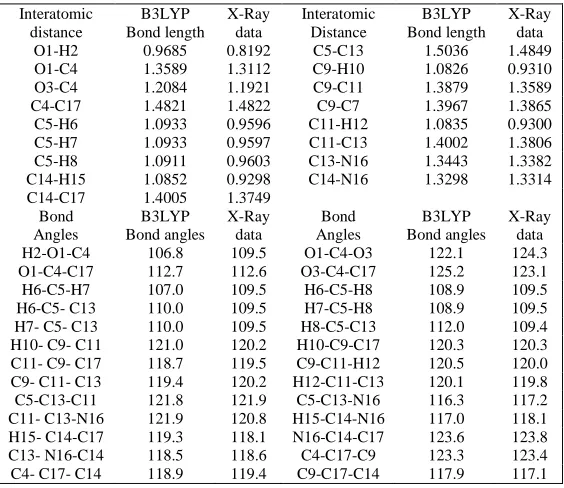
[image:3.595.212.405.265.371.2]of heterocyclic ring lie in the range 1.388Å-1.401 Å and 1.083 Å-1.085 Å respectively which are close to standard value 1.40 Å and 1.10 Å [24] but the C-H bond lengths in methyl group have values 1.093 Å and 1.091 Å. The C(14)-N(16)/ C(13)-N(16) bond lengths are found to be1.330/1.344 Å which are smaller than the C-C bond of benzene ring. The replacement of carbon atom of benzene ring by electronegative nitrogen atom decreases the bond length of C-C bond. The C(5)-C(13) bond length is 1.504 Å but due to conjugation effect C(4)-C(17) bond shows some double character and its bond length is calculated to be 1.482 Å. The C=O/C-O bond lengths at 1.208 Å/1.359 Å are close to standard value 1.20 Å/1.34 Å and O-H bond of carboxylic group has value 0.969 Å (standard value 0.96 Å). The decrease in exohedral angles C5-C13-N16/H15-C14-N16 to116.3o/117o and increase in endohedral angles C11-C13-N16/N16-C14-C17 to 121.9o/123.6o from the usual 120.0o is attributed to the repulsion between N16 and O3 atoms. Moreover, reduction in angle O1-C4-C17 to 112.7o and enhancement in angles O1-C4-O3/O3-C4-C17 to 122.1o/125.2o from 120.0o were also observed in the quantum chemical calculations and is due to the repulsion between O1 and O3 atoms. The skeleton of 6-methylnicotinic acid is not strictly planar: the methyl group deviates from the plane of heterocyclic ring, the deviation is represented by the dihedral angles H6-C5-C13-C11(-121.2o)/H6-C5-C13-N16(58.8o)/H7-C5-C13-C11(121.2o)/H7-C5-C13-N16(-58.5o). In general, optimized parameters agree very well with the XRD data (refer to table 1).
Fig. 1 Optimized structure along with numbering scheme of 6-methyl nicotinic acid At B3LYP/6-311+G(d,p)
Table 1. The optimized geometric parameters of 6-methylnicotinic acid and comparison with available experimental* results, bond
lengths in angstrom (Å), bond angles and selected dihedral angles in degrees (º)
* http://webbook.nist.gov/chemistry/form-ser.html.
3.2 Electronic Properties
The most important orbitals in a molecule are the frontier molecular orbitals, called highest occupied molecular orbital (HOMO) and lowest unoccupied molecular orbital (LUMO). These orbitals determine the way the molecule interacts with other species. The frontier orbital gap helps characterize the chemical reactivity and kinetic stability of the molecule. A molecule with a small frontier orbital gap is more polarizable and is generally associated with a
Interatomic distance
B3LYP Bond length
X-Ray data
Interatomic Distance
B3LYP Bond length
X-Ray data O1-H2 0.9685 0.8192 C5-C13 1.5036 1.4849 O1-C4 1.3589 1.3112 C9-H10 1.0826 0.9310 O3-C4 1.2084 1.1921 C9-C11 1.3879 1.3589 C4-C17 1.4821 1.4822 C9-C7 1.3967 1.3865 C5-H6 1.0933 0.9596 C11-H12 1.0835 0.9300 C5-H7 1.0933 0.9597 C11-C13 1.4002 1.3806 C5-H8 1.0911 0.9603 C13-N16 1.3443 1.3382 C14-H15 1.0852 0.9298 C14-N16 1.3298 1.3314 C14-C17 1.4005 1.3749
Bond Angles
B3LYP Bond angles
X-Ray data
Bond Angles
B3LYP Bond angles
[image:3.595.166.448.446.690.2]3290
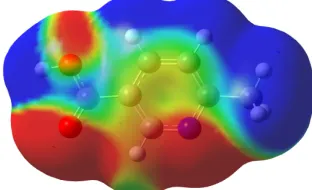
high chemical reactivity, low kinetic stability and is also termed as soft molecule [25]. The HOMO is the orbital that primarily acts as an electron donor and the LUMO is the orbital that largely acts as the electron acceptor. The 3D plots of the frontier orbitals HOMO and LUMO and electrostatic potential mapped on iso-density surface known as molecular electrostatic potential (MEP) surface, for 6-methylnicotinic acid are shown in Figure 3 and Figure 4 respectively. It is seen from the figure that although both HOMO and LUMO are spread over the entire molecule but the HOMO shows considerable antibonding character. The calculated value of frontier orbital energy gap of 0.19974 a.u. or 5.4352 eV (Table 2) in case of 6-methylnicotinic acid makes it a soft and more polarizable molecule as compared to water and dimethyl furan (DMF), taking water and DMF as reference molecules for comparison, as both are eminently polar solvents, on account of their high dielectric constant, electron donor property and ability to form complexes having 9.3088 and 6.8054 eV for their frontier orbital energy gap calculated at the same level of theory as well as the same basis sets.
[image:4.595.191.405.476.670.2]The electrostatic potential (ESP) is a physical property of a molecule related to how a molecule is first “seen” or “felt” by another approaching species. A portion of a molecule that has a negative electrostatic potential is susceptible to electrophilic attack-the more negative the better. The MESP simultaneously displays molecular shape, size and electrostatic potential values and has been plotted for the title molecule. MESP mapping is very useful in the investigation of the molecular structure with its physiochemical property relationships [25-31]. The MESP of 6-methylnicotinic acid shows clearly the three major electron rich regions characterized by red color - around the two oxygen atoms and nitrogen atom of the heterocyclic ring, whereas all the hydrogen atoms bear the brunt of positive charge (blue regions).The green region in the MESP surfaces corresponds to a potential halfway between the two extreme red and dark blue color.
Table 2. Parameters corresponding to optimized geometry of 6-methyl nicotinic acid at DFT/B3LYP level of theory
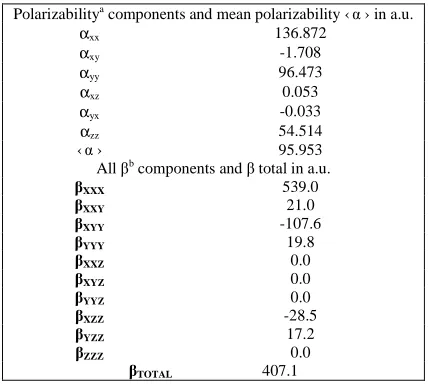
Table 3. Polarizability and hyperpolarizability data for 6-methylnicotinic acid at B3LYP/6-311+G(d,p)
a In atomic units. Conversion factor to the SI units, 1e2 a
o2 E h-1 = 1.648778 x 10-41 C2 m2 J-1 b In atomic units. Conversion factor to the SI units-
1e3a
03Eh-2= 3.206 361 × 10-53C3 m3 J-2
Basis set
Ground State Energy (Hartree)
Frontier Orbital Energy Gap
(Hartree)
Dipole Moment (Debye)
6-311G (d) -476.29329 0.20213 3.1182
6-311+G(d) -476.30359 0.20021 3.3495
6-311+G(d,p) -476.31856 0.19974 3.3610
Polarizabilitya components and mean polarizability ‹α › in a.u.
αxx 136.872
αxy -1.708
αyy 96.473
αxz 0.053
αyx -0.033
αzz 54.514 ‹α › 95.953 All βb components and β total in a.u. βXXX 539.0
βXXY 21.0
βXYY -107.6
βYYY 19.8
βXXZ 0.0
βXYZ 0.0
βYYZ 0.0
βXZZ -28.5
βYZZ 17.2
βZZZ 0.0
3291
Fig. 2 Theoretical IR spectrum of 6-methyl nicotinic acid
[image:5.595.147.467.353.704.2]3292
Fig. 4 MEP surface of 6-methyl nicotinic acid
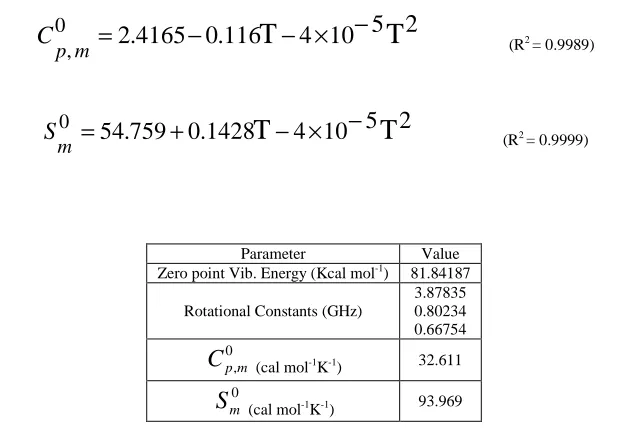
Fig. 5 Variation of Heat Capacity and Entropy with temperature
3.3 Electric Moments
The dipole moment in a molecule is another important electronic property that results from non-uniform distribution of charges on the various atoms in a molecule. It is mainly used to study the intermolecular interactions involving the van der Waal type dipole-dipole forces, etc., because higher the dipole moment, stronger will be the intermolecular interactions. The calculated value of dipole moment in the case of 6-methylnicotinic acid has value 3.3610 Debye. If dipole moment of 6-methylnicotinic acid is compared with that of water and DMF, it is seen that its calculated dipole moment value is slightly higher than the water but relatively smaller than that of DMF (Dipole moment value of DMF and water are 4.24 and 2.16 Debye respectively at the same level of calculation i.e. B3LYP/6-311G+(d,p)). The polarizability and first static hyperpolarizability β value are calculated to be 95.953 a.u. and 407.1 a.u. respectively [Table 3].
3.4 Vibrational Spectral Analysis
The optimized molecular structure of 6-methylnicotinic acid belongs to the C1 point group as it does not display any
[image:6.595.90.539.256.440.2]3293
program and the animation option of Gaussview 3.0. The comparison of the scaled wavenumber with experimental values reveals that the B3LYP method shows very good agreement with the experimentally observed spectra. The vibrational analysis of the title molecule has been carried out under following heads -
3.4.1 CH3 modes:
[image:7.595.88.524.198.636.2]A single methyl group present in the 6-methylnicotinic acid is attached to the carbon atom C13 of the ring. Methyl group shows several characteristic fundamental vibrations corresponding to asymmetric, symmetric stretches, bending, rocking and torsion modes.
Table 4: Theoretical and experimental wave numbers (in cm-1) of 6-methyl nicotinic acid
S.No. Calc. (scaled wave no.
in cm-1)
Expa IR wave no. in cm-1
Calc. IR Inten.
Assignment of dominant modes in order of decreasing potential energy distribution (PED)
1 3649 3567 104.29 ν(O1-H2)(100) 2 3103 - 2.14 νs(C-H)R(99) 3 3079 - 6.79 νas(C-H)R(99) 4 3074 - 3.61 νas(C-H)R(97) 5 3017 3000 15.45 νas(C-H) methyl(99) 6 2993 2983 7.67 νas(C-H)methyl(100) 7 2939 2950 11.17 νs(C-H)methyl(100) 8 1732 1750 413.71 ν(O3-C4)(83)
9 1584 1583 168.05 ν(C-C)R(48)+ ν(N16-C13)R(26) 10 1547 - 15.68 ν(C-C)R(54)+ ν(N16-C13)R(30)
11 1466 - 19.40 Ф(H15-C14-N16)R(21) )+Ф(H12-C11-C9)R(18) +ν(N16-C13)R(16)+ν(C-C)(11) 12 1440 1467 19.14 methyl deformation(88)
13 1428 - 7.95 methyl deformation(92)
14 1370 - 16.55 methyl umbrella bending (45)+ ν(N16-C14)R(19)+Ф(H10-C9-C17)R(18) 15 1364 1367 3.84 methyl umbrella bending (82)
16 1317 1317 112.46 Ф(H2-O1-C4)(32) )+ν(C4-C17)(15)+ ν(O1-C4)(13)+Ф(H10-C9-C17)R(12) 17 1277 - 29.53 Ф(H15-C14-N16)R(47)+ ν(N16-C14)R(17)+Ф(H1-C-C)R(15)
18 1254 1283 1.73 Ring deformation(72)+ methyl rocking (15)
19 1213 - 7.73 ν(C5-C13)(27)+Ф(H12-C11-C9)R(22)ν(C-C)R(12)+ ν(C-N)R(11) 20 1166 1183 215.28 Ф(H2-O1-C4)(41) + ν(C4-C17)(17)
21 1124 - 29.82 Ф(H-C-C)R(68)+ ν(C-C)R(14) 22 1071 1083 178.27 ν(O1-C4)(50)+ Ф(H-C-C)R(26) 23 1026 1017 7.15 methyl rocking (82)
24 1006 - 39.98 Ring trigonal bending 25 975 - 7.18 methyl rocking (75) 26 970 - 0.20 ω (C-H)R(88) 27 949 - 0.63 ω (C14-H15)R(73) 28 829 - 4.30 ω (C-H)R(75)
29 818 - 1.69 Ф(C-C-C)R(33)+ Ф(C-N-C)R(23) 30 748 750 62.44 ω (C-H)R(65)+ r methyl(14)
31 711 717 3.64 Ring torsion mode(65)+ Ψ(O1-C4-O3)(14)+Ψ(H2-O1-C4)(12) 32 705 - 29.62 Ф(O3-C4-O1)(29)+ ν(C5-C13)(17)+ν(C4-C17)(15)
33 633 675 0.64 Ф(C-C1-C1)R(51)+ Ф(C14- N16-C13)R(21)+ Ф(C17-C14-N16)R(18) 34 585 600 28.03 Ф(O3-C4-O1)(44)+ Ф(C11-C13-N16)R(17)+ ν(C5-C13)(15) 35 560 575 80.75 ω (O1-H2)(87)
36 491 - 10.80 Ф(O1-C4-C17)(48)+Ф(C4-C17-C14)(17)+ Ф(C5-C13- C16)(15) 37 459 - 21.72 Ring torsion mode(61)+methyl rocking(16)
38 401 - 1.55 Ring torsion mode(66)+ τ(H15-C14-N16-C13)R(14)
a Experimental data has been obtained from NIST website-http://webbook.nist.gov/chemistry/form-ser.html. Note : Abbreviations used here have following meaning.
ν: stretching; νs: symmetric stretching; νas: asymmetric stretching; Ф: in plane bending;
Ψ : out of plane bending; ω: wagging; R: Pyridine ring.
The CH3 antisymmetric stretching vibrations are generally observed in the region 2940-2980 cm-1 while the
symmetric stretching vibrations are generally observed in the range 2850-2890 cm-1. In 6-methylnicotinic acid the two antisymmetric stretching vibrations of CH3 group are calculated at 3017 and 2993 cm-1 and are assigned to a
3294
methyl rocking modes are at 1026 cm-1 and 975 cm-1 contributing 82% and 75% to the total PED respectively and are assigned at 1017 cm-1 in the IR spectra.
3.4.2 C=O, C-O and C-N vibrations:
The appearance of a strong band in IR spectra around 1650-1800 cm-1 in aromatic compound shows the presence of carbonyl group and is due to the C=O stretching motion. The wavenumber of the stretch due to carbonyl group mainly depends on the bond strength which in turn depends upon inductive, conjugative, field and steric effects. The one strong band in the IR spectra at 1750 cm-1 is due to C=O stretching vibration corresponding to C=O group (at C4) of carboxylic group. This band is calculated at 1732 cm-1. The other strong band observed at 1083 cm-1 is due to C-O stretching vibration of the same carboxylic group whose general position is 1000-1200 cm-1.This band is calculated at 1071 cm-1. Identification of C-N stretching is not an easy task, due to the possible mixing of other vibrations. As expected the C-N stretching in case of 6-methylnicotinic acid are calculated as mixed mode at 1370 cm-1 and 1277 cm-1 and are assigned at 1283 cm-1 in IR spectra.
3.4.3 OH vibrations:
The OH stretching vibrations are generally observed in the region around 3200-3650 cm-1. The appearance of strong band at 3567 cm-1 in IR spectra shows the presence of OH group. The band is calculated at 3649 cm-1 and contributes 100% to the total PED. The small discrepancy between the calculated and the observed wavenumber may be due to the intermolecular hydrogen bond [2]. Two bands observed at 1183 cm-1 and 1317 cm-1 in IR spectra are due to H2-O1-C4 in-plane bending and are calculated at 1317 cm-1 and 1166 cm-1 respectively as mixed modes.
3.4.4 Ring modes:
The heterocyclic ring spectral region predominantly involves the C-H, C-C and C-N stretching, and C-C-C, H-C-C and C-N-C bending vibrations. The bands due to the ring C-H stretching vibrations are generally observed in the region 3000-3100 cm-1. The calculated CH stretching modes are at 3103, 3079 and 3074 cm-1 wave numbers. Vibrations involving C-H in-plane bending are found throughout the region 1100-1500 cm-1. The C-H wagging mode starts appearing at 970 cm-1 and has contributions up to 748 cm-1 and is assigned well in the spectra. The C-C stretching vibrations are calculated at 1584, 1547, 1213 and 1124 cm-1. The torsional modes appear in general in the low wavenumber regions. In the present case, the calculated ring torsional modes with more than 60% contribution are 711, 459 and 401 cm-1.
3.5 Thermodynamic Properties
The values of some thermodynamic parameters (such as zero-point vibrational energy, specific heat capacity, rotational constants, entropy and dipole moment) of title molecule by DFT/B3LYP/6-311+G(d,p) method at 298.15 K in ground state are listed in the Table 5. The global minimum energy obtained for structure optimization of B3LYP with 6-311+G(d,p) basis set is -476.31856 a.u.(Table 2).
3295
Table 5. The calculated thermodynamic parameters at 298.15 K temperature and 1.0 Atm pressure in ground state
2
5
10
4
116
.
0
4165
.
2
T
T
0 ,
−
×
−
−
=
m pC
(R2 = 0.9989)2
5
10
4
1428
.
0
759
.
54
T
T
0
=
+
−
×
−
m
S
(R2= 0.9999)
All the thermodynamic data supply helpful information for the further study on the 6-methylnicotinic acid. They can be used to compute the other thermodynamic energies according to relationships of thermodynamic functions and estimate directions of chemical reactions according to the second law of thermodynamics. It should be noted that all thermodynamic calculations were done in gas phase and they could not be used in solution.
CONCLUSION
The equilibrium geometry and harmonic wavenumbers of 6-methylnicotinic acid molecule under investigation were analyzed at DFT/6-311+G(d,p) level. The skeleton of the optimized molecule is non planar. In general, a good agreement between experimental and calculated normal modes of vibrations was observed. The frontier orbital energy gap, dipole moment, MESP surface and first static hyperpolarizability of 6-methylnicotinic acid were also calculated. According to the frontier orbital energy gap 6-methylnicotinic acid is quite reactive molecule and thus has a low kinetic stability as compared to water and DMF. The MESP has also been used to understand the activity of the molecule. The correlations between the statistical thermodynamics and temperature are also obtained. It is seen that the heat capacities and entropies increase with the increasing temperature owing to the fact that the intensities of the molecular vibrations increase with increasing temperature.
Acknowledgement
The authors (O.P. and L.S.) are grateful to University Grants Commission for financial support and Prof. M.H. Jamroz for providing his VEDA 4 software.
REFERENCES
[1] J P Jasinski, RJ Butcher, M S Siddegowda, HS Yathirajan, AR Ramesha, Acta Crystallogr Sect E, 2011, 67, o107-o108.
[2] ML Pan, YH Luo, SL Mao, Acta Crystallographica Section E, 2011, 67, o2345. [3] A Barth and C Zscherp, Q. Rev. Biophys, 2002, 35(4) 369-430.
[4] G Dinorah, O Lucia, M Vieites, M Boiani, M Gonzalez, EJ Baran, H Cerecetto, Spectrochim. Acta Part A: Mol.
Biomol. Spectros. 2007, 68, 341-348.
[5] HRH Ali, HGM. Edwards, J Kendrick, IJ Scowen, Spectrochim. Acta A Mol. Biomol. Spectrosc. 2009, 72 715-719.
[6] S. Muthu and EI Paulraj, J. Chem. Pharm. Res., 2011, 3(5), 323-339.
[7] P Udhayakala , TV Rajendiran, S Seshadri, S Gunasekaran, J. Chem. Pharm. Res., 2011, 3(3), 610-625. [8] M Sheikhshoaie, T Shamspur, SZ Mohammadi, J. Chem. Pharm. Res., 2012, 4(1), 27-32.
[9] S Qaneinasaba, Z. Bayatb, J. Chem. Pharm. Res., 2011, 3(4), 579-582. [10] AD Becke, J. Chem. Phys. 1993, 98(7), 5648.
[11] C Lee, W Yang, RG Parr, Phys. Rev. B, 1988, 37, 785-789.
[12] B Miehlich, A Savin, H Stoll, H Preuss, Chem. Phys. Lett., 1988, 157(3) 200-206.
Parameter Value Zero point Vib. Energy (Kcal mol-1) 81.84187
Rotational Constants (GHz)
3.87835 0.80234 0.66754 0 ,m p
C
(cal mol-1K-1) 32.6110 m
3296
[13] W Kohn, LJ Sham, Phys. Rev. 1965, 140, A1133- A1138.[14] M J Frisch et. al. Gaussian 09, Revision A.1, Gaussian, Inc., Wallingford CT, 2009 [15] AP Scott and L Random, J. Phys. Chem. 1996, 100, 16502-16513
[16] P Pulay, G Fogarasi, G Pongor, JE Boggs, and A Vargha, J. Am. Chem.Soc., 1983, [17] http://webbook.nist.gov/chemistry/form-ser.html.
[18] Æ Frisch, HP Hratchian, RD Dennington II, TA Keith, J Millam with AB Nielsen, AJ Holder, J Hiscocks. Gaussian, Inc. Gauss View version 5.0., June, 2009.
[19] MH Jamroz, Vibrational Energy Distribution Analysis: VEDA 4 Program Warsaw, Poland, 2004. [20] DA Kleinman, Phys, Rev. 1962, 126, 1977.
[21] J Pipek and PZ Mezey, J. Chem. Phys. 1989, 90, 4916-4926.
[22] DA McQuarrie and JD Simon ,Molecular Thermodynamics, University Science Books, Sausalito, CA, 1999. [23] W. J. Hehre, L. Radom, P. v. R. Schleyer and J. A. Pople, AB initio Molecular orbital Theory, New York: Wiley, 1986.
[24] P Sykes, A Guidebook To Mechanism In Organic Chemistry. Sixth Edition 15. 1986.
[25] I Fleming, Frontier Orbitals and Organic Chemical Reactions,John Wiley and Sons, New York, 1976.
[26] JS Murray and K Sen, Molecular Electrostatic Potentials, Concepts and Applications, Elsevier, Amsterdam,
1996.
[27] SR Gadre, RN Shirsat, Electrostatics of Atoms and Molecules Universities Press, 2001 [28] I Alkorta, JJ Perez, Int. J. Quant. Chem. 1996, 57, 123-135.
[29] E Scrocco, J Tomasi, Advances in Quantum Chemistry, (Ed. P. Lowdin), Academic Press, NewYork, 1978. [30] FJ Luque, M Orozco, PK Bhadane, SR Gadre, J. Phys. Chem., 1993, 97, 9380-9384.