Klein, RA and et al,
10.31234/osf.io/9654g
Title Many Labs 2 : Investigating Variation in Replicability Across Sample and
Setting
Authors Klein, RA and et al,
Type Article
URL This version is available at: http://usir.salford.ac.uk/id/eprint/48989/
Published Date 2018
USIR is a digital collection of the research output of the University of Salford. Where copyright permits, full text material held in the repository is made freely available online and can be read, downloaded and copied for noncommercial private study or research purposes. Please check the manuscript for any further copyright restrictions.
Many Labs 2: Investigating Variation in Replicability Across Sample and Setting
Richard A. Klein Université Grenoble Alpes [email protected]
Michelangelo Vianello University of Padua [email protected] Fred Hasselman Radboud University Nijmegen [email protected]
Byron G. Adams Tilburg University & University of Johannesburg [email protected] Reginald B. Adams The Pennsylvania State University [email protected]
Sinan Alper Baskent University [email protected]
Mark Aveyard American University of Sharjah [email protected]
Jordan R. Axt University of Virginia [email protected]
Štěpán Bahník University of Economics, Prague [email protected]
Rishtee Batra Indian School of Business [email protected]
Mihály Berkics Eötvös Loránd University, Budapest [email protected] Michael J. Bernstein Penn State University Abington [email protected]
Daniel Berry California State University, San Marcos [email protected] Olga Bialobrzeska SWPS University of Social Sciences and Humanities, Warsaw [email protected] Evans Binan University of Jos, Jos Nigeria [email protected]
Konrad Bocian SWPS University of Social Sciences and Humanities, Faculty in Sopot [email protected] Mark J. Brandt Tilburg University [email protected]
Robert Busching University of Potsdam [email protected]
Anna Cabak Rédei Lund University [email protected]
Huajian Cai Chinese Academy of Science [email protected],
Fanny Cambier Université catholique de Louvain [email protected] Katarzyna Cantarero SWPS University of Social Sciences and Humanities, Faculty in Sopot [email protected] Cheryl L. Carmichael Brooklyn College & Graduate Center, CUNY [email protected] Francisco Ceric Universidad del Desarrollo (Santiago, Chile) [email protected]
David C. Cicero University of Hawaii at Manoa [email protected] Jesse Chandler University of Michigan; PRIME Research [email protected]
Armand Chatard Poitiers University and CNRS [email protected] Eva E. Chen The Hong Kong University of Science and Technology [email protected]
Jen-Ho Chang Academia Sinica [email protected] Winnee Cheong HELP University, Malaysia [email protected]
Sharon Coen University of Salford [email protected]
Jennifer A. Coleman Virginia Commonwealth University [email protected] Brian Collisson Azusa Pacific University [email protected]
Morgan A. Conway University of Florida [email protected]
Katherine S. Corker Grand Valley State University [email protected] Paul G. Curran Grand Valley State University [email protected]
Fiery Cushman Harvard University [email protected]
Zubairu K. Dagona University of Jos, Jos Nigeria [email protected] Ilker Dalgar Middle East Technical University [email protected]
Anna Dalla Rosa University of Padua [email protected]
William E. Davis Mount Holyoke College [email protected]
Maaike de Bruijn Tilburg University [email protected] Leander De Schutter WHU - Otto Beisheim School of Management [email protected]
Thierry Devos San Diego State University [email protected]
Canay Doğulu Baskent University [email protected]
Nerisa Dozo The University of Queensland [email protected]
Kristin Nicole Dukes Simmons College [email protected]
Yarrow Dunham Yale University [email protected]
Carolyn Finck Universidad de los Andes, Colombia [email protected] Natalia Frankowska SWPS University of Social Sciences and Humanities, Warsaw [email protected] Miguel-Ángel Freyre National Autonomous University of Mexico [email protected] Mike Friedman Université catholique de Louvain [email protected] Elisa Maria Galliani University of Padua [email protected] Joshua C. Gandi University of Jos, Jos Nigeria [email protected] Tanuka Ghoshal Indian School of Business [email protected] Steffen R. Giessner Rotterdam School of Management, Erasmus University [email protected]
Tripat Gill Wilfrid Laurier University [email protected]
Timo Gnambs Leibniz Institute for Educational Trajectories [email protected] Ángel Gómez Universidad Nacional de Educación a Distancia [email protected] Roberto González Pontificia Universidad Católica de Chile [email protected]
Jesse Graham Eccles School of Business, University of Utah [email protected]
Jon E. Grahe Pacific Lutheran University [email protected]
Ivan Grahek Ghent University [email protected]
Eva G. T. Green University of Lausanne [email protected]
Kakul Hai Manipal University Jaipur [email protected]
Matthew Haigh Northumbria University [email protected] Elizabeth L. Haines William Paterson University [email protected]
Michael P. Hall University of Michigan [email protected]
Marie E. Heffernan University of Illinois at Urbana-Champaign [email protected] Joshua A. Hicks Texas A&M University [email protected] Petr Houdek Jan Evangelista Purkyne University [email protected] Jeffrey R. Huntsinger Loyola University Chicago [email protected] Ho Phi Huynh Texas A&M University - San Antonio [email protected] Hans IJzerman Université Grenoble Alpes [email protected] Yoel Inbar University of Toronto Scarborough [email protected]
Åse H. Innes-Ker Lund University [email protected]
William Jiménez-Leal Universidad de los Andes, Colombia [email protected] Melissa-Sue John Worcester Polytechnic Institute [email protected]
Jennifer A. Joy-Gaba Virginia Commonwealth University [email protected] Anna Kende Eötvös Loránd University, Budapest [email protected]
Roza G. Kamiloğlu University of Amsterdam [email protected] Heather Barry Kappes London School of Economics and Political Science [email protected] Serdar Karabati Bilgi University, Istanbul [email protected] Haruna Karick SWPS Warsaw Poland/University of Jos, Jos Nigeria [email protected] Victor N. Keller University of Brasilia [email protected]
Nicolas Kervyn Université catholique de Louvain [email protected] Goran Knežević Department of psychology, University of Belgrade [email protected]
Carrie Kovacs Johannes Kepler University Linz [email protected] Lacy E. Krueger Texas A&M University-Commerce [email protected]
German Kurapov Tilburg University [email protected]
Jamie Kurtz James Madison University [email protected]
Daniël Lakens Eindhoven University of Technology [email protected]
Ljiljana B. Lazarević Institute of psychology, University of Belgrade [email protected]
Carmel A. Levitan Occidental College [email protected]
Neil A. Lewis, Jr. Cornell University [email protected]
Samuel Lins University of Porto [email protected]
Nikolette P. Lipsey University of Florida [email protected]
Joy Losee University of Florida [email protected]
Esther Maassen Tilburg University [email protected]
Angela T. Maitner American University of Sharjah [email protected] Winfrida Malingumu Open University of Tanzania [email protected] Robyn K. Mallett Loyola University Chicago [email protected]
Satia A. Marotta Tufts University [email protected]
and Faculty of Media and Communications, Singidunum University
[email protected] Fernando Mena Pacheco Universidad Latina de Costa Rica [email protected] Taciano L. Milfont Victoria University of Wellington [email protected]
Wendy L. Morris McDaniel College [email protected]
Sean Murphy The University of Melbourne [email protected]
Andriy Myachykov Northumbria University [email protected]
Nick Neave Northumbria University [email protected]
Koen Neijenhuijs VU Amsterdam (previously Radboud University Nijmegen) [email protected] Anthony J. Nelson The Pennsylvania State University [email protected]
Félix Neto Universidade do Porto [email protected]
Austin Lee Nichols University of Navarra [email protected]
Aaron Ocampo Universidad Latina de Costa Rica [email protected] Susan L. O’Donnell George Fox University [email protected]
Elsie Ong The Open University of Hong Kong [email protected]
Malgorzata Osowiecka SWPS University of Social Sciences and Humanities, Warsaw [email protected] Gábor Orosz Eötvös Loránd University, Budapest [email protected]
Grant Packard Wilfrid Laurier University [email protected]
Rolando Pérez-Sánchez University of Costa Rica [email protected]
Boban Petrović Institute of Criminological and Sociological Research, Belgrade [email protected]
Ronaldo Pilati University of Brasilia [email protected]
Brad Pinter The Pennsylvania State University [email protected] Lysandra Podesta Radboud University Nijmegen [email protected]
Gabrielle Pogge University of Florida [email protected]
Monique M.H. Pollmann Tilburg University [email protected] Abraham M. Rutchick California State University Northridge [email protected]
Alexander Saeri The University of Queensland [email protected] Patricio Saavedra Pontificia Universidad Catolica de Chile [email protected] Erika Salomon University of Illinois at Urbana-Champaign [email protected] Kathleen Schmidt Southern Illinois University Carbondale [email protected] Felix D. Schönbrodt Ludwig-Maximilians-Universität München [email protected] Maciej B. Sekerdej Jagiellonian University [email protected] David Sirlopú Universidad del Desarrollo (Concepción, Chile) [email protected]
Jeanine L. M. Skorinko Worcester Polytechnic Institute [email protected]
Michael A. Smith Northumbria University [email protected] Vanessa Smith-Castro University of Costa Rica [email protected]
Karin Smolders Eindhoven University of Technology [email protected] Agata Sobkow SWPS University of Social Sciences and Humanities, Wroclaw Faculty of
Psychology [email protected]
Walter Sowden Center for Military Psychiatry & Neuroscience, Walter Reed Army Institute of Research, [email protected]
Manini Srivastava University of Lucknow [email protected]
Oskar K. Sundfelt Lund University [email protected]
Philipp Spachtholz University of Regensburg [email protected] Troy G. Steiner The Pennsylvania State University [email protected]
Jeroen Stouten KULeuven [email protected]
Chris N. H. Street University of Huddersfield [email protected]
Stephanie Szeto The Open University of Hong Kong [email protected] Ewa Szumowska Jagiellonian University in Krakow [email protected] Andrew Tang The Open University of Hong Kong [email protected]
Norbert Tanzer University of Graz [email protected]
Morgan Tear The University of Queensland [email protected]
Manuela Thomae University of Winchester [email protected] Jakub Traczyk SWPS University of Social Sciences and Humanities, Wroclaw Faculty of
Psychology [email protected]
Jordan Theriault Boston College [email protected]
Joshua M. Tybur VU Amsterdam [email protected]
Adrienn Ujhelyi Eötvös Loránd University, Budapest [email protected] Robbie C.M. van Aert Tilburg University, Netherlands [email protected] Marcel A.L.M. van Assen Tilburg University, Netherlands [email protected]
Paul A. M. van Lange VU Amsterdam [email protected]
Marije van der Hulst Erasmus MC Rotterdam (previously Radboud University Nijmegen) [email protected] Anna Elisabeth van ‘t Veer Leiden University, Netherlands [email protected] Alejandro Vásquez Echeverría Universidad de la República, Uruguay [email protected]
Leigh Ann Vaughn Ithaca College [email protected]
Alexandra Vázquez Universidad Nacional de Educación a Distancia [email protected] Luis Diego Vega Universidad Latina de Costa Rica [email protected]
Catherine Verniers Paris Descartes University - Sorbonne Paris Cité [email protected]
Mark Verschoor Tilburg University [email protected]
Ingrid Voermans Radboud University [email protected]
Marek A. Vranka Charles University [email protected]
Marieke de Vries Radboud University [email protected]
Cheryl Welch James Madison University [email protected]
Aaron L. Wichman Western Kentucky University [email protected] Lisa A. Williams University of New South Wales [email protected]
Michael Wood University of Winchester [email protected] Julie A. Woodzicka Washington and Lee University [email protected]
Marta K. Wronska SWPS University of Social Sciences and Humanities, Faculty in Sopot [email protected]
Liane Young Boston College [email protected]
John M. Zelenski Carleton University [email protected]
Zeng Zhijia Guangdong Literature & Art Vocational College [email protected] Brian A. Nosek University of Virginia; Center for Open Science [email protected]
Abstract
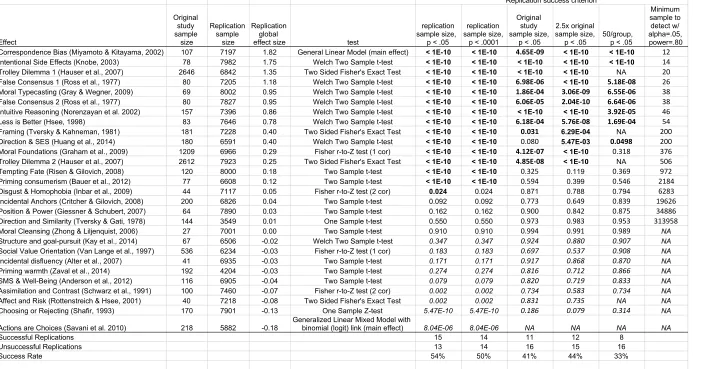
We conducted preregistered replications of 28 classic and contemporary published findings with
protocols that were peer reviewed in advance to examine variation in effect magnitudes across
sample and setting. Each protocol was administered to approximately half of 125 samples and
15,305 total participants from 36 countries and territories. Using conventional statistical
significance (p < .05), fifteen (54%) of the replications provided evidence in the same direction
and statistically significant as the original finding. With a strict significance criterion (p < .0001),
fourteen (50%) provide such evidence reflecting the extremely high powered design. Seven
(25%) of the replications had effect sizes larger than the original finding and 21 (75%) had effect
sizes smaller than the original finding. The median comparable Cohen’s d effect sizes for
original findings was 0.60 and for replications was 0.15. Sixteen replications (57%) had small
effect sizes (< .20) and 9 (32%) were in the opposite direction from the original finding. Across
settings, 11 (39%) showed significant heterogeneity using the Q statistic and most of those were
among the findings eliciting the largest overall effect sizes; only one effect that was near zero in
the aggregate showed significant heterogeneity. Only one effect showed a Tau > 0.20 indicating
moderate heterogeneity. Nine others had a Tau near or slightly above 0.10 indicating slight
heterogeneity. In moderation tests, very little heterogeneity was attributable to task order,
administration in lab versus online, and exploratory WEIRD versus less WEIRD culture
comparisons. Cumulatively, variability in observed effect sizes was more attributable to the
effect being studied than the sample or setting in which it was studied.
Word count = 265
Keywords = social psychology; cognitive psychology; replication; culture; individual differences; sampling effects; situational effects; meta-analysis
Suppose a researcher, Josh, conducts an experiment finding that experiencing threat
reduces academic performance compared to a control condition. Another researcher, Nina,
conducts the same study at her institution and finds no effect. Person and situation explanations
may come to mind immediately: (1) Nina used a sample that might differ in important ways from
Josh’s sample, and (2) the situational context in Nina’s lab might differ in theoretically important
but non-obvious ways from Josh’s lab. Both could be true simultaneously. A less interesting, but
real, possibility is that one of them made an error in design or procedure that the other did not.
Finally, it is possible that the different effects are a function of sampling error: Nina’s result
could be a false negative, or Josh’s result could be a false positive. The present research
contributes evidence toward understanding the contribution of variation in sample and setting for
observing psychological effects.
Variation in effects: Person, situation, or sampling error?
There is a history of research evidence for effects of variation by particular person
characteristics, in particular situations, and for particular experimental effects (Lewin, 1936;
Ross & Nisbett, 1991). For example, people tend to attribute behavior to characteristics of the
person rather than characteristics of the situation (e.g., Gilbert & Malone, 1995; Jones & Harris,
1967), but some evidence suggests that this effect is stronger in western than eastern cultures
(Miyamoto & Kitayama, 2002). A common model of investigating psychological processes is to
identify an effect, and then investigate moderating influences that make the effect stronger or
weaker. As such, when one confronts different outcomes from similar experiments, the readily
available conclusion is that a moderating influence accounts for the difference. However, if
assumptions of moderation may be overapplied and the role of sampling error underestimated.
If effects are highly variable across sample and setting, then variation in effect sizes will
routinely exceed what would be expected from sampling error. In this circumstance, the lack of
consistency between Josh and Nina's results is unlikely to influence beliefs about the original
effect. Moreover, if there are many influential factors, then it is difficult to isolate moderators
and identify the necessary conditions to obtain the effect. In this case, the lack of consistency
between Josh and Nina’s results might produce collective indifference -- there are just too many
variables to know why there was a difference, so their different results produce no change in
perceived understanding of the phenomenon.
Alternatively, variations in effect sizes may not exceed expectations due to sampling
error. In this case, the observed differences in effects are not indicating moderating influences of
sample or setting. This would indicate imprecision in effect estimation is the sole source of
variation and require no causal explanation. For Josh and Nina, the possibility that the variation
is sampling error rather than evidence for moderation is not necessarily easy to assess, especially
if their studies had small samples (Morey & Lakens, 2016). With small samples, Josh’s positive
result and Nina’s null result will likely have confidence intervals that overlap each other leaving
little to conclude other than “more data are needed”.
The difference between these interpretations is substantial, but there is little direct
evidence regarding the extent to which persons and situations--or samples and settings--influence
the size of psychological effects in general (but see Coppock, in press; Krupnikov & Levine,
2014; Mullinix, Leeper, Druckman, & Freese, 2015). The default assumption is that
psychological effects are awash in interactions among many variables. The present report
The first Many Labs project replicated 13 classic and contemporary psychological effects with
36 different samples/settings (N = 6,344). The results of that study showed that: (a) variation in
sample and setting had little impact on observed effect magnitudes, (b) when there was variation
in effect magnitude across samples, it occurred in studies with large effects, not in studies with
small effects, (c) overall, effect size estimates were more related to the effect of study rather than
the sample or setting in which it was studied, and (d) this held even for lab-based versus
web-based data collections, and across nations.
A limitation of the first “Many Labs” is that there was a small number of effects and
there was no reason to presume them to vary substantially across sample and setting. It is
possible that those effects are more robust and homogenous than the typical behavioral
phenomena, or that the populations were more homogenous than initially expected. The present
research represents a major expansion of the “Many Labs” study design with (1) more effects,
(2) inclusion of some effects that are presumed to vary across sample or setting, (3) more labs,
and (4) diverse samples. The selected effects are not random nor are they representative, but they
do cover a wide range of topics. This study provides preliminary evidence for the extent to
which variation in effect magnitudes is attributable to sample and setting, versus sampling error.
Other Influences on Observed Effects
Across systematic replication efforts in the social-behavioral sciences, there is
accumulating evidence that fewer published effects replicate than might be expected, and that
replication effect sizes are typically smaller than original effect sizes (Camerer et al., 2016, 2018;
Ebersole et al., 2016; Klein et al., 2014; Open Science Collaboration, 2015). For example,
Camerer et al. (2018) successfully replicated 13 of 21 social science studies published in Science
among successful replications, the average replication effect size was about 75% of what was
observed in the original experiments. Failures to replicate could be due to errors in the
replication, or because of unanticipated moderation by changes to sample and setting as is
investigated here. They can also occur because of pervasive low-powered research plus
publication bias that is more likely to select positive than negative results for publication (Button
et al., 2013; Cohen, 1962; Greenwald, 1975; Rosenthal, 1979), and because of questionable
research practices, or p-hacking, that can inflate the likelihood of obtaining false positives (John
et al., 2012; Simmons et al., 2011). These are not investigated directly in this research, but they
could contribute to observing failures to replicate and to weaker effect sizes than observed in the
original research.
Origins of Study Design
To obtain a candidate list of effects, we held a round of open nomination and invited
submissions for any effect that fit the defined criteria (see the Coordinating Proposal available on
the OSF: https://osf.io/uazdm/). Those nominations were supplemented by ideas from the project team, and from direct queries for suggestions to independent experts in psychological science.
The nominated studies were evaluated individually on the following criteria: (1)
feasibility of implementation through a web browser, (2) brevity of study procedures (shorter
procedures desired), (3) citation impact of the effect (higher impact desired), (4) identifiability of
a meaningful two-condition experimental design or simple correlation as the target of replication
(with an emphasis on experiments), (5) general interest value of the effect, and (6) applicability
to samples of adults. The nominated studies were evaluated collectively to assure diversity on the
for which reliability of the effect is unknown1, (2) effects known to be sensitive to sample or
setting and others for which variation is unknown or assumed to be minimal, (3) classic and
contemporary effects, (4) breadth of topical areas in social and cognitive psychology, (5) the
research groups who conducted the study, and (6) publication outlet.
More than 100 effects were nominated as potentially fitting these criteria. A subset of the
project team reviewed these effects to maximize the number of included effects and diversity of
the total slate on these criteria. No specific researcher was selected for replication because of
beliefs or concerns about their research or the effects they have reported, but some areas and
authors were included more than once because of producing short, simple, interesting effects that
met the selection criteria.
Once selected for inclusion, a member of the research team contacted the corresponding
author (if alive) to obtain original study materials and get advice about adapting the procedure
for this use. In particular, original authors were asked if there were moderators or other
limitations to obtaining the result that would be useful for the team to understand in advance and,
perhaps, anticipate in data collection.
In some cases, correspondence with original authors identified limitations of the selected
effect that reduced its applicability for the present design. In those cases, we worked with the
original authors to identify alternative studies or decided to remove the effect entirely from the
selected set, and replaced it with one of the available alternatives.
We split the studies into two slates that would require about 30 minutes each. We
included 32 effects in total before peer review and pilot testing. In only one instance did original
authors express strong concerns about inclusion in the study. Because we make no claim about
1 Because the project goal was to examine variability in effect magnitudes across samples and
the sample of studies being randomly selected or representative, we removed the effect from the
project. With the remaining 31 effects, we pilot tested both slates with participation across the
authors and members of their labs to ensure that each slate could be completed within 30
minutes. We observed that we underestimated the time required for a few effects. As a
consequence, we had to remove three effects (Ashton-James, Maddux, Galinsky, & Chartrand,
2009; Srull & Wyer, 1979; Todd, Hanko, Galinsky, & Mussweiler, 2011), shorten or remove a
few individual difference measures, and slightly reorganize the slates to achieve the final 28
included effects. We divided the studies across slate to be balanced on the criteria above and to
avoid substantial overlap in topics.
Following the Registered Report model (Nosek & Lakens, 2014), prior to data collection
the materials and protocols were formally peer reviewed in a process conducted by the journal
editor.
Disclosures
Preregistration. The accepted design was preregistered at https://osf.io/ejcfw/. Data, materials, and online resources. Comprehensive materials, data, and
supplementary information about the project are available at https://osf.io/8cd4r/. Any deviations from the preregistered design in study description or implementation are recorded in
supplementary materials (https://osf.io/7mqba/). Any changes to analysis plans are noted with justification and comparisons between original and revised analytic approaches, also available in
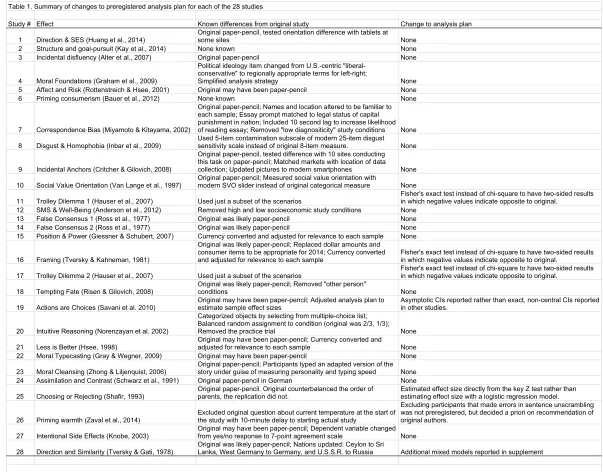
supplementary materials (https://osf.io/4rbh9/), see Table 1 for a summary. A guide to the data analysis code is available at: https://manylabsopenscience.github.io/.
Measures. We report how we determined our sample size, all data exclusions, all
Subjects. The research was conducted in accordance with the Declaration of Helsinki
and following local requirements for Institutional Review Board approvals for each of the data
collection sites.
Conflicts of Interest. Brian Nosek is Executive Director of the non-profit Center for
Open Science which has a mission to increase openness, integrity, and reproducibility of
research.
Author Contributions. Coordinated project: Fred Hasselman, Richard Klein, Brian
Nosek, Michelangelo Vianello.
Designed the study: Štěpán Bahník, Jesse Chandler, Katherine Corker, Fred Hasselman,
Hans IJzerman, Richard Klein, Brian Nosek, Kathleen Schmidt, Marcel van Assen, Leigh Ann
Vaughn, Michelangelo Vianello, Aaron Wichman.
Developed materials: Jordan Axt, Štěpán Bahník, John Conway, Paul Curran, Richard
Klein, Kathleen Schmidt
Wrote proposal: Jordan Axt, Štěpán Bahník, Mihály Berkics, Jesse Chandler, Eva E.
Chen, Sharon Coen, John Conway, Katherine Corker, William E. Davis, Timo Gnambs, Fred
Hasselman, Hans IJzerman, Richard Klein, Carmel Levitan, Wendy Morris, Brian Nosek,
Kathleen Schmidt, Vanessa Smith-Castro, Jeroen Stouten, Marcel van Assen, Leigh Ann
Vaughn, Michelangelo Vianello, Aaron Wichman
Collected data: Byron G. Adams, Reginald B. Adams, Sinan Alper, Mark Aveyard,
Štepán Bahník, Rishtee Batra, Mihály Berkics, Michael J. Bernstein, Daniel Berry, Olga
Bialobrzeska, Evans Binan, Konrad Bocian, Mark J. Brandt, Robert Busching, Anna Cabak
Rédei, Huajian Cai, Fanny Cambier, Katarzyna Cantarero, Cheryl L. Carmichael, Francisco
Cheong, Sharon Coen, Jennifer A. Coleman, Brian Collisson, Katherine S. Corker, Paul G.
Curran, Fiery Cushman, Zubairu K. Dagona, Ilker Dalgar, Anna Dalla Rosa, William E. Davis,
Maaike de Bruijn, Leander De Schutter, Thierry Devos, Canay Dogulu, Nerisa Dozo, Kristin
Nicole Dukes, Yarrow Dunham, Kevin Durrheim, Charles R. Ebersole, John E. Edlund,
Alexander Scott English, Anja Eller, Carolyn Finck, Natalia Frankowska, Miguel-Ángel Freyre,
Mike Friedman, Jennifer A. Joy-Gaba, Elisa Maria Galliani, Joshua C. Gandi, Tanuka Ghoshal,
Steffen R. Giessner, Tripat Gill, Timo Gnambs, Ángel Gómez , Roberto González, Jesse
Graham, Jon E. Grahe, Ivan Grahek, Kakul Hai, Eva G. T. Green, Matthew Haigh, Elizabeth L.
Haines , Michael P. Hall, Fred Hasselman, Marie E. Heffernan, Joshua A. Hicks, Petr Houdek,
Jeffrey R. Huntsinger, Ho Phi Huynh, Melissa-Sue John, Hans IJzerman, Yoel Inbar, Anna
Kende, Åse H. Innes-Ker, William Jiménez-Leal, Roza G. Kamiloglu, Heather Barry Kappes,
Serdar Karabati, Haruna Karick, Victor N. Keller, Nicolas Kervyn, Richard A. Klein, Goran
Kneževic, Carrie Kovacs, Lacy E. Krueger, German Kurapov, Jamie Kurtz, Daniël Lakens,
Ljiljana B. Lazarevic, Carmel A. Levitan, Samuel Lins, Melissa-Sue John, Esther Maassen,
Angela T. Maitner, Winfrida Malingumu, Robyn K. Mallett, Satia A. Marotta, Janko Mededovic,
Fernando Mena Pacheco, Taciano L. Milfont, Wendy L. Morris, Sean Murphy, Andriy
Myachykov, Nick Neave, Koen Neijenhuijs, Anthony J. Nelson, Félix Neto , Austin Lee
Nichols, Aaron Ocampo, Susan L. O’Donnell, Elsie Ong, Malgorzata Osowiecka, Gábor Orosz,
Grant Packard, Rolando Pérez-Sánchez, Boban Petrovic, Ronaldo Pilati, Brad Pinter, Lysandra
Podesta, Monique M.H. Pollmann, Abraham M. Rutchick, Alexander Saeri, Patricio Saavedra,
Erika Salomon, Felix D. Schönbrodt, Maciej B. Sekerdej, David Sirlopú, Jeanine L. M.
Skorinko, Michael A. Smith, Vanessa Smith-Castro, Karin Smolders, Agata Sobkow, Walter
Stouten, Chris N. H. Street, Stephanie Szeto, Ewa Szumowska, Andrew Tang, Norbert Tanzer,
Morgan Tear, Manuela Thomae, Jakub Traczyk, David Torres, Jordan Theriault, Joshua M.
Tybur, Adrienn Ujhelyi, Robbie C.M. van Aert, Marcel A.L.M. van Assen, Paul A. M. van
Lange, Marije van der Hulst, Anna Elisabeth van ‘t Veer, Alejandro Vásquez Echeverría, Leigh
Ann Vaughn, Alexandra Vázquez, Luis Diego Vega, Catherine Verniers, Mark Verschoor, Ingrid
Voermans, Marek A. Vranka, Marieke de Vries, Cheryl Welch, Aaron L. Wichman, Lisa A.
Williams, Michael Wood, Julie A. Woodzicka, Marta K. Wronska, Liane Young, John M.
Zelenski, Zeng Zhijia
Analyzed data: Fred Hasselman, Michelangelo Vianello, Richard Klein, with support
from Katie Corker, Brian Nosek, Robbie C.M. van Aert, Marcel A.L.M. van Assen
Designed figures: Fred Hasselman, Brian Nosek
Wrote report: Richard Klein, Brian Nosek, Michelangelo Vianello
Commented, edited, and approved report: All authors
Acknowledgements. We thank Cameron Anderson, Adam Baimel, Galen Bodenhausen,
Emma Buchtel, Zeynep Cemalcilar, Clayton Critcher, Fiery Cushman, Itamar Gati, Steffen
Giessner, Jesse Graham, Kurt Gray, Christopher Hsee, Yanli Huang, Yoel Inbar, Daniel
Kahneman, Aaron Kay, Shinobu Kitayama, Joshua Knobe, Michael Kubovy, Yuri Miyamoto,
Ara Norenzayan, Jane Risen, Lee Ross, Yuval Rottenstreich, Krishna Savani, Norbert Schwarz,
Eldar Shafir, Chi-Shing Tse, Paul van Lange, Liane Young, Lisa Zaval, and Chenbo Zhong for
helping develop and review materials, and for providing additional details from original studies
when needed.
Prior versions: None.
Participants
An open invitation to participate as a data collection site in Many Labs 2 was issued in
early 2014. To be eligible for inclusion, participating labs agreed to administer their assigned
study procedure to at least 80 participants and to collect as many as was feasible. Lab decisions
to stop data collection were based on their access to participants and time constraints. None had
opportunity to observe the outcomes prior to conclusion of data collection. All contributors who
met the design and data collection requirements received authorship on the final report. Upon
completion of data collection there were 125 total samples (64 for Slate 1 and 61 for Slate 2,
which includes 15 sites that collected data for both slates) with a cumulative sample size of
15,305 (mean = 122.44, median = 99, SD = 92.71, Range = 16 to 841).
Samples included 79 in-person (typically lab-based) and 46 web-based data collections.
39 samples were from the United States, and the 86 others were from Australia (2), Austria (2),
Belgium (2), Brazil (1), Canada (4), Chile (3), China (5), Colombia (1), Costa Rica (2), Czech
Republic (3), France (2), Germany (4), Hong Kong, China (3), Hungary (1), India (5), Italy (1),
Japan (1), Malaysia (1), Mexico (1), The Netherlands (9), New Zealand (2), Nigeria (1), Poland
(6), Portugal (1), Serbia (3), South Africa (3), Spain (2), Sweden (1), Switzerland (1), Taiwan
(1), Tanzania (2), Turkey (3), The United Arab Emirates (2), The United Kingdom (4), and
Uruguay (1). Details about each site of data collection are available here: https://osf.io/uv4qx/. Of those that responded to demographics questions, in Slate 1 34.5% were men, 64.4%
were women, 0.3% selected “Other”, and 0.8% selected “Prefer not to answer”. The average age
for Slate 1 was 22.37 (SD = 7.09)2. For Slate 2, 35.9% were men, 62.9% were women, 0.4%
selected “Other”, and 0.8% selected “Prefer not to answer”. The average age for Slate 2 was
23.34 (SD = 8.28)3. Variation in demographic characteristics across samples is documented at
https://osf.io/g3bza/. Procedure
The study was administered over the Internet for standardization across locations. At
some locations, participants completed the survey in a lab or room on computers or tablets,
whereas in other locations the participants completed the survey entirely online at their own
convenience. Surveys were created in Qualtrics software (qualtrics.com) and unique links to run
the studies were sent to each data collection team to track the origin of data. Each site was
assigned an identifier. These identifiers can be found under the “source” variable in the public
dataset.
Data were deposited to a central database and analyzed together. Each team created a
video simulation of study administration to illustrate the features of the data collection setting.
For languages other than English, labs completed a translation and back translation of the study
materials to check against original meaning (cf. Brislin, 1970). Labs decided themselves the
appropriate language for their sample and adapted materials for content appropriateness for the
national sample (e.g., editing monetary units).
Assignment of labs to slates maximized national diversity for both slates. If there was
one lab for a country, it was randomly assigned to a slate using random.org. If there was more
than one lab for a country, then labs were randomly assigned to slate using random.org with the
exception that they were evenly distributed across slates as closely as possible (e.g., 2 in each
slate if there were 4 countries). Nearing data collection, we recruited some additional Asian sites
specifically for Slate 1 to increase sample diversity. The slates were administered by a single
experiment script that began with informed consent, then presented the effects in that slate in a
fully randomized order at the level of participants, followed by the individual difference
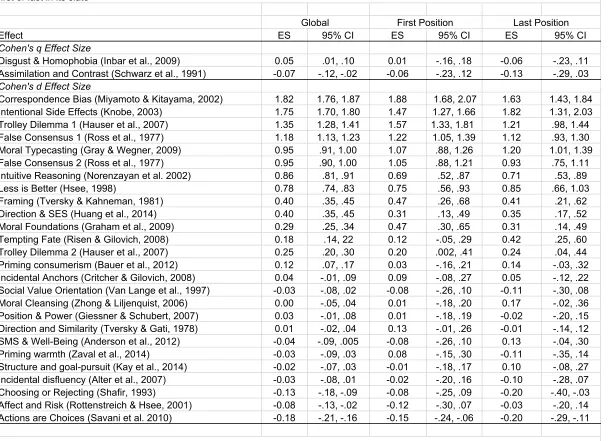
measures in randomized order, and then closing with demographics measures and debriefing.
Demographics
The demographics below were included to characterize each sample and for possible
moderator investigations. Participants were free to decline to answer any question.
Age. Participants noted their age in years in an open-response box.
Sex. Participants selected “male”, “female”, “other”, or “prefer not to answer” to indicate
their biological sex.
Race/ethnicity. Participants indicated race/ethnicity by selecting from a drop-down menu
populated with options determined by the replication lead for each site. Participants could also
select “other” and write an open-response. Note that response items were not standardized as
some countries have very different conceptualizations of race/ethnicity.
Cultural origins. Three items assessing cultural origins used a drop-down menu
populated by a list of countries or territories, and an “other” option with an open-response box.
The three items were: (1) In which country/region were you born?, (2) In which country/region
was your primary caregiver (e.g., parent, grandparent) born?, and (3) If you had a second
primary caregiver, in which country/region was he or she born?
Hometown. A single item “What is the name of your home town/city?” with an open
response blank was included as a potential moderator for the Huang et al. (2014) effect.
Wealth in hometown. A single item “Where do wealthier people live in your home
town/city?” with North, South, and Neither as response options was included as a potential
moderator of the Huang et al. (2014) effect. This item appeared in Slate 1 only.
options of: strongly left-wing, moderately left-wing, slightly left-wing, moderate, slightly
right-wing, moderately right-right-wing, strongly right-wing. Instructions were adapted for each country of
administration to ensure relevance of the ideology dimension to the local context. For example,
the U.S. instructions read: “Please rate your political ideology on the following scale. In the
United States, ‘liberal’ is usually used to refer to left-wing and ‘conservative’ is usually used to
refer to right-wing.”
Education. Participants reported their educational attainment on a single item “What is
the highest educational level that you have attained?” using a 6-point response scale: 1 = no
formal education, 2 = completed primary/elementary school, 3 = completed secondary
school/high school, 4 = some university/college, 5 = completed university/college degree, 6 =
completed advanced degree.
Socio-economic status. Socio-economic status was measured with the ladder technique
(Adler et al., 1994). Participants indicated their standing in their community relative to other
people in the community with which they most identify on a ladder with ten steps where 1
indicates people at the bottom having the lowest standing in the community and 10 referring to
people at the top having the highest standing. Previous research demonstrated good convergent
validities of this item with objective criteria of individual social status and also construct validity
with regard to several psychological and physiological health indicators (e.g., Adler, Epel,
Castellazzo, & Ickovics, 2000; Cohen, Alper, Doyle, Adler, Treanor, & Taylor, 2008). This
ladder was also used in Effect 12 in Slate 1 (Anderson, Kraus, Galinsky, & Keltner, 2012, Study
3). Participants in that slate answered the ladder item as part of the Effect 12 materials and did
not receive the item a second time.
moved toward refining implementation of established scales embedded in data collection to
check for aberrant response patterns (Huang et al., 2014; Meade & Craig, 2012). We included
two items at the end of the study, just prior to demographic items. The first item asked
participants “In your honest opinion, should we use your data in our analyses in this study?” with
yes and no as response options (Meade & Craig, 2012). The second item was an Instructional
Manipulation Check (IMC; Oppenheimer, Meyvis, & Davidenko, 2009), in which an ostensibly
simple demographic question (“Where are you completing this study?”) is preceded by a long
block of text that contains, in part, alternative instructions for the participant to complete to
demonstrate they are paying attention (“Instead, simply check all four boxes and then press
“continue” to proceed to the next screen”).
Individual Difference Measures
The following individual difference measures were included to allow future tests of effect
size moderation.
Cognitive reflection (Finucane & Gullion, 2010). The cognitive reflection task (CRT;
Frederick, 2005) assesses individuals’ ability to suppress an intuitive (wrong) response in favor
of a deliberative (correct) answer. The items on the original CRT are widely known, and the
measure is vulnerable to practice effects (Chandler, Mueller, & Paolacci, 2014). As such, we
used an updated version that is logically equivalent and correlates highly with the items on the
original CRT (Finucane & Gullion, 2010). The three items are: (1) “If it takes 2 nurses 2 minutes
to measure the blood pressure of 2 patients, how long would it take 200 nurses to measure the
blood pressure of 200 patients?”; (2) “Soup and salad cost $5.50 in total. The soup costs a dollar
more than the salad. How much does the salad cost?”; and, (3) “Sally is making tea. Every hour,
take for the tea to reach half of the final concentration?” Also, we constrained the total time
available to answer the three questions to 75 seconds. This likely lowered overall performance
on average as it was somewhat less time than some participants took in pretesting.
Subjective well-being (Veenhoven, 2009). Subjective well-being was measured with a
single item “All things considered, how satisfied are you with your life as a whole these days?”
on a response scale from 1 “dissatisfied” to 10 “satisfied”. Similar items are included into
numerous large-scale social surveys (cf. Veenhoven, 2009) and have shown satisfactory
reliabilities (e.g., Lucas & Donnellan, 2012) and validities (Cheung & Lucas, 2014; Oswald &
Wu, 2010; Sandvik, Diener, & Seidlitz, 1993).
Global self-esteem (Robins, Hendin, & Trzesniewski, 2001). Global self-esteem was
measured using a Single-Item Self-Esteem Scale (SISE) designed as an alternative to using the
Rosenberg Self-Esteem Scale (1965). The SISE consists of a single item: “I have high
self-esteem”. Participants respond on a 5-point Likert scale, ranging from 1 = not very true of me to 5
= very true of me. Robins, Hendings, and Trzesniewski (2001) reported strong convergent
validity with the Rosenberg Self-Esteem Scale (with rs ranging from 0.70 to 0.80) among adults.
Also, the scale had similar predictive validity as the Rosenberg Self-Esteem Scale.
TIPI for Big-Five personality (Gosling, Rentfrow, & Swann, 2003). The five basic
traits of human personality (Goldberg, 1981) -- conscientiousness, agreeableness, neuroticism /
emotional stability, openness / intellect, and extraversion -- were measured with the Ten Item
Personality Inventory (Gosling et al., 2003). Each trait was assessed with two items on seven
point response scales from 1 = disagree strongly to 7 = agree strongly. The five scales show
satisfactory retest reliabilities (cf. Gnambs, 2014) and substantial convergent validities with
2014).
Mood (Cohen, Sherman, Bastardi, Hsu, McGoey, & Ross, 2007). There exist many
assessments of mood. We selected the single-item from Cohen and colleagues (2007).
Respondents answer “How would you describe your mood right now?” on a 5-point response
scale: 1 = extremely bad, 2 = bad, 3 = neutral, 4 = good, 5 = extremely good.
Disgust Sensitivity Scale--Contamination Subscale (DS-R; Olatunji et al., 2007). The
DS-R is a 25-item revision of the original Disgust Sensitivity Scale (Haidt, McCauley, & Rozin,
1994). Subscales of the DS-R were determined by factor analysis. The contamination subscale
includes the 5 items related to concerns about bodily contamination. For length considerations,
only the contamination subscale was included for Effect 8 in Slate 1. No part of this scale
appeared in Slate 2.
The 28 Effects
Before describing the main results examining heterogeneity across samples and settings,
we describe each of the 28 selected effects. We provide a summary of the main idea of the
original research and the sample size, inferential test, and effect size that is the key result for
replication. Then, we summarize the confirmatory aggregate result of the replication. The
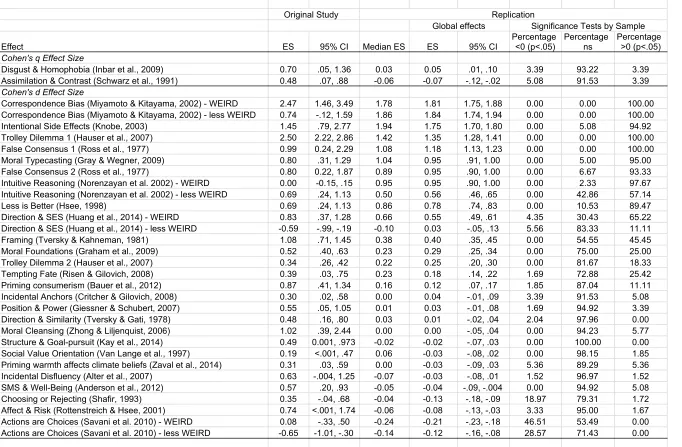
aggregate result is tested by pooling the data of all available samples, ignoring sample origin.
An aggregate result was labelled consistent with the original finding if they were in the same
direction and statistically significant as the original study conducted in a western, educated,
industrialized, rich, democratic society (Henrich et al., 2010). In four cases, the original study
focused on cultural differences in the key effect. Our main replication result is the aggregate
effect size regardless of cultural context. Whether effects vary by setting (or cultural context
opportunity to test the original cultural difference with similar samples, they are reported as
additional results in reports of the individual effects. For some of the effects, moderating
influences were anticipated in advance by the original authors that could affect comparison of the
original and replication effect sizes. If any were planned, we report the a priori identified
additional, moderator, or subset analyses.
For readers interested in the global results of this replication project this long section
detailing each individual replication can be skipped. Systematic tests of variation by sample
using meta-analysis follow the section of describing results of individual findings. Heterogeneity
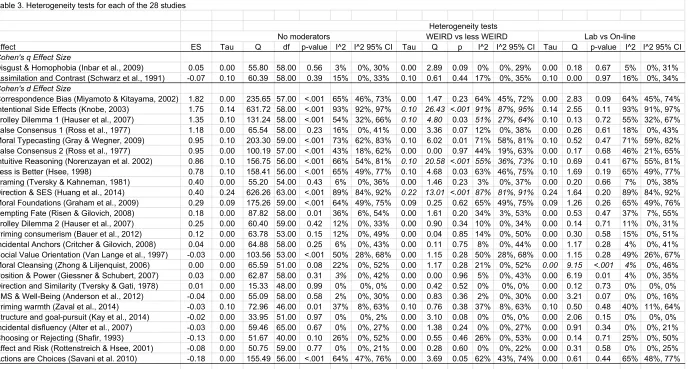
was assessed using the Q, Tau, and I2 measures (Borenstein et al., 2009).
SLATE 1
1. Direction and Socioeconomic status: LIVING IN THE NORTH IS NOT
NECESSARILY FAVORABLE: DIFFERENT METAPHORIC ASSOCIATIONS
BETWEEN CARDINAL DIRECTION AND VALENCE IN HONG KONG AND IN THE
UNITED STATES (Huang, Tse & Cho, 2014, Study 1a)
People in the United States and Hong Kong have different demographic knowledge that
may shape their metaphoric association between valence and cardinal direction (North/South).
180 participants from the United States and Hong Kong participated. Participants were presented
with a blank map of a fictional city and were randomly assigned to indicate on the map where
either a high-SES or low-SES person might live. There was an interaction between SES (high vs.
low) and population (US vs. HK), F(1,176) = 20.39, MSE = 5.63, p < .001, ηp2 = 0.10, d = .68,
95% CI [.38, .98] . US participants expected the high-SES person to live further north (M =
+0.98, SD = 1.85) than the low-SES person (M = -0.69, SD = 2.19), t(78) = 3.69, p < .001, d =
further north (M = +0.63, SD = 2.75) than the high-SES person (M = -0.92, SD = 2.47), t(98) =
-2.95, p = .004, d = -.59, 95% CI [-.99, -.19]. The authors explained that wealth in Hong Kong is
concentrated in the south of the city, and wealth in cities in the United States is more commonly
concentrated in the north of the city. As a consequence, cultures differ in their assumptions of
wealth concentration in fictional cities.
Replication. The coordinates of participants’ click on the fictional map were recorded
(X, Y) from the top-left of the image, and then recentered in the analysis such that clicks in the
north half of the map were positive and clicks in the southern half of the map were negative.
Across all samples (N = 6,591), participants in the high-SES condition (M = 11.70, SD = 84.31)
selected a further north location than participants in the low-SES condition (M = -22.70, SD =
88.78; t(6,554.05) = 16.12, p = 2.15e-57, d = 0.40, 95% CI [0.35, 0.45].
The original authors suggested we may only replicate the pattern for "Western"
participants for whom up and North are aligned with the predicted “good” and high-SES
evaluation. As suggested by the original authors, the focal test for replicating the effect for
"Western" participants was completed by selecting only participants across all samples who
indicated wealth tended to be in the north in their hometown. These participants expected the
high-SES person to live further north (M = 43.22, SD = 84.43) than the low-SES person (M =
-40.63, SD = 84.99; t(1,692) = 20.36, p = 1.24e-82, d = 0.99; 95% CI [0.89, 1.09]). This result is
consistent with the hypothesis that people reporting that wealthier people tend to live in the
North in their hometown also guess that wealthier people will tend to live in the North in a
fictional city, and is a substantially larger effect compared to examining the sample as a whole.
Follow-up analyses. The original study compared Hong Kong and U.S. participants. In
-37.44, SD = 84.29) than the low-SES person (M = 12.43, SD = 95.03; t(140) = -3.30, p = 0.001,
d = -0.55; 95% CI [-0.89, -0.22]). U.S. participants expected the high-SES person to live further
north (M = 41.55, SD = 80.73) than the low-SES person (M = -42.63, SD = 82.41; t(2,199) =
24.20, p = 6.53e-115, d = 1.03; 95% CI [0.94, 1.12]). This result is consistent with the finding
from the original study demonstrating cultural differences in perceived location of wealth in a
fictional city correlating with location of wealth in one’s hometown.
For most participants, the study was completed on a vertically oriented monitor display as
opposed to completing a paper survey on a desk as in the original study. The original authors
suggested a priori this may be important because associations between “up” and “good” or
“down” and “bad” may interfere with any North/South associations. At ten data collection sites
(N = 582), we assigned some participants to complete the slate on Microsoft Surface tablets
resting on the table for horizontal administration. This addressed the original authors’ hypothesis
that the vertical orientation of the monitor would interfere with observing the relationship
between cardinal direction on the map and perceived location of wealth. With just the
participants using the horizontal tablets, those that said wealth tended to be in the north in their
hometown (n = 156) expected the high-SES person to live further north (M = 38.66, SD = 80.43)
than the low-SES person (M = -43.92, SD = 80.32; t(154) = 6.38, p = 1.95e-09, d = 1.03; 95% CI
[.69, 1.36]). By comparison, within this horizontal tablet group, those that said wealth tended to
be in the south in their hometown (n = 87) expected the high-SES person to live further south (M
= -33.58, SD = 72.89) than the low-SES person (M = -4.11, SD = 88.33; t(85) =-1.63, p = .11, d
= -.36; 95% CI [-.79, .08]). The effect sizes with just these subsamples are very similar to the
effect sizes with the whole sample, suggesting that display orientation did not moderate this
2. Structure and goal pursuit: A FUNCTIONAL BASIS FOR STRUCTURE-SEEKING:
EXPOSURE TO STRUCTURE PROMOTES WILLINGNESS TO ENGAGE IN
MOTIVATED ACTION (Kay, Laurin, Fitzsimons, & Landau, 2014, Study 2)
In Kay, Laurin, Fitzsimons, and Landau (2014), 67 participants generated what they felt
was their most important goal. Participants then read one of two scenarios where a natural event
(leaves growing on trees) was described as being a structured or random event. For example, in
the structured condition, a sentence read “The way trees produce leaves is one of the many
examples of the orderly patterns created by nature…”, but in the random condition it read “The
way trees produce leaves is one of the many examples of the natural randomness that surrounds
us…”. Next, participants answered three questions about their most important goal on a scale
from “1 = not very” to “7 = extremely”. The first measured subjective value of the goal and the
other two measured willingness to engage in goal pursuit. Those exposed to a structured event
(M = 5.26, SD = 0.88) were more willing to pursue their goal compared to those exposed to a
random event (M = 4.72, SD = 1.32; t(65) = 2.00, p = 0.05, d = 0.49, 95% CI [0.001, 0.980]).
In the overall replication sample (N = 6,506), those exposed to a structured event (M =
5.48, SD = 1.45) were not significantly more willing to pursue their goal compared to those
exposed to a random event (M = 5.51, SD = 1.39; t(6,498.63) = -0.94, p = 0.35, d = -.02, 95% CI
[-0.07, 0.03]. This result does not support the hypothesis that willingness to pursue goals is
higher after exposure to structured versus random events.
3. Disfluency engages analytical processing: OVERCOMING INTUITION:
METACOGNITIVE DIFFICULTY ACTIVATES ANALYTIC REASONING (Alter,
Alter and colleagues (2007) investigated whether a deliberate, analytic processing style
can be activated by incidental disfluency cues that suggest task difficulty. Forty-one participants
attempted to solve syllogisms presented in either a hard- or easy-to-read font. The hard-to-read
font served as an incidental induction of disfluency. Participants in the hard-to-read condition
answered more moderately difficult syllogisms correctly (64%) than participants in the
easy-to-read condition (42%; t(39) = 2.01, p = 0.051, d = 0.64, 95% CI [-0.004, 1.27]).
The original study focused on the two moderately difficult items from the six
administered. Our confirmatory analysis strategy was sensitive to potential differences across
samples in ability on syllogisms. We first determined which syllogisms were moderately
difficult to participants by excluding any of the six items, within each sample, that were
answered correctly by fewer than 25% of participants or more than 75% of participants across
conditions. The remaining syllogisms were the basis of computing mean syllogism performance
for each participant.
Following Alter et al. (2007), the easy-to-read font was black Myriad Web 12-point and
the hard-to-read font was 10% grey italicized Myriad Web 10-point. For a direct comparison
with the original effect size, the original authors suggested that only English in-lab samples be
used for two reasons: (1) we could not adequately control for online participants “zooming in”
on the page or otherwise making the font more readable, and (2) we anticipated having to
substitute the font in some translated versions because the original font (Myriad Web) may not
support all languages4. In this subsample (N = 2,580), participants in the hard-to-read condition
answered a similar number of syllogisms correct (M = 1.10, SD = 0.88) as participants in the
easy-to-read condition (M = 1.13, SD = 0.91; t(2,578) = -0.79, p = 0.43, d = -0.03, 95% CI
[-0.11, 0.05]). As a secondary analysis that mirrored the original, we used the same two
syllogisms from Alter et al (2007). Participants in the hard-to-read condition answered a similar
number of syllogisms correctly (M = 0.80, SD = 0.79) as participants in the easy-to-read
condition (M = 0.84, SD = 0.81; t(2,578) = -1.19, p = 0.23, d = -0.05, 95% CI [-0.12, 0.03]).5
These results do not support the hypothesis that syllogism performance would be higher when
the font is harder to read versus easier to read; the difference was slightly in the opposite
direction and not distinguishable from zero (d = -0.03, 95% CI [-0.11, 0.05] versus original
d=0.64).
Follow-up analyses. In the aggregate replication sample (N = 6,935), participants in the
hard-to-read condition answered a similar number of syllogisms correctly (M = 1.03, SD = 0.86)
as participants in the easy-to-read condition (M = 1.06, SD = 0.87; t(6,933) = -1.37, p = 0.17, d =
-0.03, 95% CI [-0.08, 0.01]). Finally, in the whole sample, using the same two syllogisms from
Alter et al. (2007), participants in the hard-to-read condition answered a similar number of
syllogisms correctly (M = 0.75, SD = 0.76) as participants in the easy-to-read condition (M =
0.79, SD = 0.77; t(6,933) = -2.07, p = 0.039, d = -0.05, 95% CI [-0.097, -0.003]). These
follow-up analyses do not qualify the conclusion from the focal tests.
4. Moral Foundations: LIBERALS AND CONSERVATIVES RELY ON DIFFERENT
SETS OF MORAL FOUNDATIONS (Graham, Haidt, & Nosek, 2009, Study 1)
People on the political left (liberal) and political right (conservative) have distinct policy
5The original authors also hypothesized that this effect is sensitive to task order. If people are
preferences and may also have different moral intuitions and principles. 1,548 participants
across the ideological spectrum rated whether different concepts such as purity or fairness were
relevant for deciding whether something was right or wrong. Items that emphasized concerns of
harm or fairness (individualizing foundations) were deemed more relevant for moral judgment
by the political left than right (r = -0.21, d = -0.43, 95% CI [-0.55, -0.32]), whereas items that
emphasized concerns for the ingroup, authority, or purity (binding foundations) were deemed
more relevant for moral judgment by the political right than left (r = 0.25, d = 0.52, 95% CI
[0.40, 0.63])6. Participants rated the relevance to moral judgment of 15 items (3 for each
foundation) in a randomized order on a 6-point scale from “not at all relevant” to “extremely
relevant”.
The primary target of replication was the relationship of political ideology with the
“binding” foundations. In the aggregate sample (N = 6,966), items that emphasized concerns for
the ingroup, authority, or purity were deemed more relevant for moral judgment by the political
right than political left (r = 0.14, p = 6.05e-34, d = 0.29, 95% CI [0.25, 0.34], q = 0.15, 95% CI
[0.12, 0.17]). This result is consistent with the hypothesis that “binding” foundations are
perceived as more morally relevant by members of the political right than the political left. The
overall effect size was smaller than the original result (d = 0.29, 95% CI [0.25, 0.34] versus
original d=0.52).
Follow-up analyses. The relationship of political ideology with the “individualizing”
foundations was a secondary replication. In the aggregate sample (N = 6,970), items that
emphasized concerns of harm or fairness were deemed more relevant for moral judgment by the
6Zero-order Pearson correlations are not provided in the original article. They have been
computed on the raw public data and are based on N = 1,209 participants with pairwise complete values:
political left than political right (r = -0.13, p = 2.54e-29, d = -0.27, 95% CI [-0.32, -0.22], q =
-0.13, 95% CI [-0.16, -0.11]). This result is consistent with the hypothesis that “individualizing”
foundations are perceived as more morally relevant by members of the political left than the
political right. The overall effect size was smaller than the original result (d = -0.27, 95% CI
[-0.32, -0.22] versus original d = -0.43).
5. Affect and Risk: MONEY, KISSES, AND ELECTRIC SHOCKS: ON THE
AFFECTIVE PSYCHOLOGY OF RISK (Rottenstreich & Hsee, 2001, Study 1)
Forty participants chose whether they would prefer an affectively attractive option (a kiss
from a favorite movie star) or a financially attractive option ($50). In one condition, participants
made the choice imagining a low probability (1%) of getting the outcome. In the other
condition, participants imagined that the outcome was certain, they just needed to choose which
one. When the outcome was unlikely 70% preferred the affectively attractive option, when the
outcome was certain 35% preferred the affectively attractive option (χ2(1, N=40) = 4.91), p =
0.0267, Kramers φ = 0.35, d = 0.74, 95% CI [<0.001, 1.74]). This result supported the
hypothesis that positive affect has greater influence on judgments about uncertain outcomes than
judgments about definite outcomes.
In the aggregate replication sample (N = 7,218), when the outcome was unlikely, 47%
preferred the affectively attractive choice, and when the outcome was certain, 51% preferred the
affectively attractive choice (p = 0.002, OR = 0.87, d = -0.08, 95% CI [-0.13, -0.03]). This result
is opposite of the hypothesis that affectively attractive choices are more preferred when they are
uncertain versus definite. The overall effect size was much smaller and in the opposite direction
of the original study (d = -0.08, 95% CI [-0.13, -0.03] versus original d = 0.74).
UNDERMINES PERSONAL AND SOCIAL WELL-BEING (Bauer, Wilkie, Kim, &
Bodenhausen, 2012, Study 4)
Bauer and colleagues (2012) examined whether being in a consumer mindset would lead
to less trust towards others. In Study 4, 77 participants read about a hypothetical water
conservation dilemma in which they were involved. Participants were randomly assigned to
either a condition that referred to the participant and others in the scenario as “consumers” or as
“individuals.” Participants in the consumer condition reported less trust toward others (1= not at
all, 7 = very much) to conserve water (M = 4.08, SD = 1.56) compared to the control condition
(M = 5.33, SD = 1.30), t(76) = 3.86, p = 0.001, d = 0.87, 95% CI [0.41, 1.34]).
In the aggregate replication sample (N = 6,608), participants in the consumer condition
reported slightly less trust toward others to conserve water (M = 3.92, SD = 1.44) compared to
the control condition (M = 4.10, SD = 1.45), t(6,606) = 4.93, p = 8.62e-7, d = 0.12, 95% CI
[0.07, 0.17]). This result is consistent with the hypothesis that trust is lower when thinking of
others as consumers versus thinking of others as individuals. The overall effect size was much
smaller than the original result (d = 0.12, 95% CI [0.07, 0.17] versus original d = 0.87).
Follow-up analyses. The original experiment included four additional dependent
variables. Comparing with the original study, the replication showed weaker effects in the same
direction for (1) responsibility for the crisis (original d = 0.47; replication d = 0.10, 95% CI
[0.05, 0.15]), (2) obligation to cut water usage (original d = 0.29; replication d = 0.08, 95% CI
[0.03, 0.13]), (3) how much they viewed others as partners (original d = 0.53; replication d =
0.12, 95% CI [0.07, 0.16]), and (4) how much others should use less water (original d = 0.25;
replication d = 0.01, 95% CI [-0.04, 0.06]).
CRITICAL ROLE OF ATTITUDE DIAGNOSTICITY OF SOCIALLY CONSTRAINED
BEHAVIOR (Miyamoto & Kitayama, 2002, Study 1)
Miyamoto and Kitayama (2002) examined whether Americans would be more likely than
Japanese to show a bias toward ascribing to an actor an attitude corresponding to the actor’s
behavior, referred to as correspondence bias (Jones & Harris, 1967). In their Study 1, 49
Japanese and 58 American undergraduates learned they would read a university student’s essay
about the death penalty and infer the student’s true attitude toward the issue. The essay was
either in favor or against the death penalty, and it was designed to be diagnostic or not very
diagnostic of a strong attitude. After reading the essay, participants learned that the student was
assigned to argue the pro- or anti-position. Then, participants estimated the essay writer’s actual
attitude toward capital punishment and the extent to which they thought the student’s behavior
was constrained by the assignment.
Controlling for perceived constraint, analyses compared perceived attitudes of pro-
versus anti-capital punishment essay writers. American participants perceived a large difference
in actual attitudes when the essay writer had been assigned to write a pro-capital punishment
essay (M = 10.82, SD = 3.47) versus anti-capital punishment essay (M = 3.30, SD = 2.62; t(56) =
6.66, p < 0.001, d = 1.75, 95% CI [1.14, 2.35]). Japanese participants perceived less of a
difference in actual attitudes when the essay writer had been assigned to write a pro-capital
punishment essay (M = 9.27, SD = 2.88) versus an anti-capital punishment essay (M = 7.02, SD
= 3.06); t(47) = 1.84, p = 0.069, d = 0.53.
In the aggregate replication sample (N = 7,197), controlling for perceived constraint,
participants perceived a difference in actual attitudes when the essay writer had been assigned to
essay (M = 4.45, SD = 3.51; F(2, 7194) = 3042.00, p < 2.2e-16, d = 1.82, 95% CI [1.76, 1.87]).
This finding is consistent with the correspondence bias hypothesis--participants inferred the
essay writer’s attitude based, in part, on the observed behavior. Whether the magnitude of this
effect varies cross-culturally is examined in the aggregate analysis section.
Follow-up analyses. For the primary replication, participants estimated the writer’s true
attitude toward capital punishment to be similar to the position that they were assigned to defend.
Participants also expected writers would freely express attitudes consistent with the position to
which they were assigned (pro-capital punishment M = 10.17, SD = 3.84; anti-capital
punishment M = 4.96, SD = 3.61; t(7,187) = 59.44, p = 2.2e-16, d = 1.40, 95% CI [1.35, 1.45].
Two possible moderators were included in the design: perceived attitude of the average
student in the writer’s country (tailored to be the same country as the participant) and perceived
persuasiveness of the essay. In the aggregate replication sample (N = 7,211), controlling for
perceived constraint, we did not observe an interaction between condition and perceived attitude
of the average student in the writer’s country on estimations of the writer’s true attitude toward
capital punishment (t(7,178) = 0.55, p = 0.58, d = 0.013, 95% CI [-0.03, 0.06]). Also, in the
aggregate replication sample (N = 7,211), controlling for perceived constraint, we did observe an
interaction between condition and perceived persuasiveness of the essay on estimations of the
writer’s true attitude toward capital punishment (t(7,170) = 16.25, p = 2.3e-58, d = 0.38, 95% CI
[0.34, 0.43]). The effect of condition on estimations of the writer’s true attitude toward capital
punishment was stronger for higher levels of perceived persuasiveness of the essay.
8. Disgust predicts homophobia: DISGUST SENSITIVITY PREDICTS
INTUITIVE DISAPPROVAL OF GAYS (Inbar, Pizarro, Knobe, & Bloom, 2009, Study 1)