International Journal of Emerging Technology and Advanced Engineering
Website: www.ijetae.com (ISSN 2250-2459,ISO 9001:2008 Certified Journal, Volume 4, Issue 6, June 2014)
219
A Survey on TDMA-based MAC Protocols for Wireless
Sensor Network
Pijus Kumar Pal
1, Punyasha Chatterjee
2School of Mobile Computing and Communication, Jadavpur University, Kolkata, India
Abstract— Recent advancement in micro-electro-mechanical systems (mems) have enabled the development of Wireless sensor Network (WSN) which is gaining popularity day by day and is used in wide range of applications. The sensor nodes that constitute WSN have several constraints like limited battery power, memory constraint, limited bandwidth etc. Therefore designing an efficient MAC layer protocol is a challenging task. TDMA-based MAC protocols can avoid collisions, overhearing and idle listening and therefore energy efficient. In this paper, we firstly describe a brief account of the factors influencing WSN MAC design. Then, we describe several TDMA-based MAC protocols both centralized and distributed which are proposed so far for wireless sensor network.
Keywords— MAC Layer, Scheduling, Time Division Multiple Access (TDMA),Wireless Sensor Network (WSN).
I. INTRODUCTION
Recent technological advances have enabled the development of low cost, low power & multifunctional sensor devices. These autonomous devices with integrated sensing, processing, and communication capabilities are called sensor nodes. A sensor node is an electronic device that is capable of detecting environmental conditions such as temperature, sound, or the presence of certain objects.
Wireless Sensor Network (WSN) typically consists of a large number of spatially distributed autonomous sensors to monitor certain environmental and physical phenomenon and cooperate with each other to perform the designated task and send the information to the Base Station (BS) or the Access Point (AP).
Medium access control (MAC) is one of the critical issues in the design of wireless sensor networks. As in most wireless networks, collision, which is caused by two nodes sending data at the same time over the same transmission medium, is a great concern in WSNs. To address this problem, a sensor network must employ a MAC protocol to arbitrate access to the shared medium in order to avoid data collision from different nodes and at the same time to fairly and efficiently share the bandwidth resources among multiple sensor nodes.
Therefore, a MAC protocol plays an important role in enabling efficient network operation and achieving good network performance.
There are many types of MAC protocols, designed for WSN so far. In TDMA based MAC protocols, time are divided into time-frames and each time-frame is further divided into a fixed number of time-slots as shown in Figure 1. Each node is allocated a time-slot in a time-frame and is allowed to transmit only in the allocated time-slot. Furthermore, a node depending on the schedules of its neighboring nodes may remain in the sleep mode when it is neither to transmit, nor to receive, i.e. can switch off their transceiver conserving appreciable amount of energy [23]. In this paper we are giving the overview of several TDMA based MAC protocols developed for WSN.
Rest of the paper is organized as follows: Section II describes the different categories of WSN MAC protocols; Section III describes the factors that influence sensor network MAC design. Section IV presents various TDMA based MAC protocols both centralized and distributed and finally Section V concludes the paper.
Figure 1. TDMA Frame Structure
II. CATEGORIES OF WSNMACPROTOCOLS
MAC protocols for wireless sensor network can be broadly classified into two categories: Contention-based MAC protocols and Schedule-based MAC protocols.
A. Contention-based MAC Protocols
International Journal of Emerging Technology and Advanced Engineering
Website: www.ijetae.com (ISSN 2250-2459,ISO 9001:2008 Certified Journal, Volume 4, Issue 6, June 2014)
220
The sender listens to the shared medium before transmission, waits a random period of time if the medium is busy and then tries again. It is better for networks, where the contention is low and burst traffic is expected.
Both ALOHA (Additive Link On-line Hawaii System) and CSMA (Carrier Sense Multiple Access) are the most typical examples of contention-based MAC protocols [2].
B. Schedule-based MAC Protocols
In schedule-based MAC protocol, nodes' access to the shared medium is divided in respect to either time (Time Division Multiple Access) or frequency (Frequency Division Multiple Access) or orthogonal pseudo - noise codes (Code Division Multiple Access) [2]. This allows different nodes to access the shared medium without interfering with each other and thus effectively avoids collisions.
Contention-based MAC protocols consume more energy as compared to Schedule-based MAC protocols specially TDMA-based protocols, because they waste energy in collisions [20] and idle listening in the network. They also can’t provide delay guarantees [19]. A good schedule not only avoids collisions by silencing the interferers of every receiver node in each time slot but also minimizes the frame-size hence the end-to-end communication latency.
Apart from all the positive parts of TDMA, it has some negative impacts too. Firstly, TDMA uses topology information for scheduling purpose which comes in the form of neighboring and interference relationships among nodes. But it is very difficult to precisely capture these interference relationships because of interference range irregularity [21]. Secondly, it has limited scalability and adaptability to network changes. Thirdly, TDMA requires strict time synchronization for the time-slots [18]. However, a guaranteed packet delivery and bounded latency are highly desirable in real-time applications, which can be ensured in TDMA.
III. FACTORS INFLUENCING WSNMACDESIGN
According to [22], to design an efficient MAC protocol for WSN, attributes such as Energy-efficiency, Scalability and Adaptivity, Latency, Channel utilization, Throughput, Fairness etc. are to be considered. In this section, brief description of each of the attributes will be given.
A. Energy-efficiency
As the sensor nodes are battery powered, it is almost impossible to change or recharge the batteries of the nodes. The radio is the major consumer of energy in many hardware platforms.
So, the MAC layer needs to consider this issue as it directly controls radio activities in order to prolonging the network lifetime.
B. Scalability and Adaptivity
The number of sensor nodes deployed in studying a phenomenon may vary. Depending on the application, it can be in the order of hundreds, thousands or the number may reach an extreme value of millions. Some nodes in the network may die, some new nodes may join or due to mobility some nodes may move to new location. A good MAC protocol should accommodate such changes gracefully.
C. Latency
Latency refers to the time-delay between the time when a packet is sent by the sender and the time when that packet is successfully received by the receiver. In case of sensor network application with stringent latency requirements (e. g., real - time monitoring of bush fires), the detected event must be reported to the sink node in real time so that the appropriate action could be taken.
D. Channel Utilization
This reflects how well the entire bandwidth of the channel is utilized in communication. Bandwidth is a valuable resource in wireless communication. So, the MAC protocols designed for WSN should maximize the utilization of this scared resource.
E. Throughput
Throughput refers to the amount of data successfully transferred from a sender to a receiver in a given time. This is usually measured in bits or bytes per second. Similar to latency, the importance of throughput depends on different applications.
F. Fairness
Fairness refers to the ability of different sensor nodes in the network to equally share a common transmission channel among them. As the nodes in WSN cooperate with each other to accomplish a single common task, it is important not to achieve per-node fairness, but to ensure the quality of service for the whole task.
IV. TDMA-BASED MACPROTOCOLS
International Journal of Emerging Technology and Advanced Engineering
Website: www.ijetae.com (ISSN 2250-2459,ISO 9001:2008 Certified Journal, Volume 4, Issue 6, June 2014)
221
Each node in the sensor network is allocated a fixed number of time-slots and is allowed to transmit only in the allocated time-slots in each frame. In this section, a number of TDMA-based MAC protocols developed for wireless sensor network are described in brief. Based on the nature of the algorithms, we have classified the protocols in two groups: Centralized protocols and Distributed protocols.
A. Centralized TDMA Protocols
In Centralized TDMA protocols, the Base Station (BS) or the Cluster-Head (CH) (in case of Hierarchical WSN) centrally schedules different slots to different nodes in the network. Every node uses these time-slots for data communication. In this sub-section, a number of centralized TDMA protocols are described.
1) Bit-map-assisted MAC Protocol: Bit-map-assisted (BMA) MAC Protocol [3] is an intra-cluster communication MAC protocol for large-scale cluster-based WSNs. BMA is intended for event-driven applications where sensor nodes transmit data only when significant events are observed.
[image:3.612.49.286.594.704.2]BMA operation is divided into rounds. An example of a complete round is depicted in Figure 2. Each round is divided into cluster set-up phase and steady-state phase. During cluster set-up phase, cluster-head is determined based on nodes energy levels. This is done using non-persistent CSMA and elected node broadcasts an advertisement message claiming to be the new cluster-head. The steady-state phase is divided into k-sessions with fixed duration. Each session consists of a contention-period, a data-transmission period and an idle period. During each contention period, all nodes keep their radios on. The contention period follows a TDMA-like schedule: each node is assigned a specific slot and the nodes transmit a 1-bit control message to the cluster-head during its scheduled slot if it has data to transmit; otherwise, its scheduled slot remains empty. After the contention period is over, the cluster head has complete knowledge about the nodes in the network.
Figure 2. Illustration of a Single Round in BMA [3]
The cluster head sets up and broadcasts a transmission schedule for the source nodes, the nodes that wish to send its data. Then the system enters into the data transmission period. During the data transmission period, each source node turns on its radio and sends its data to the cluster-head over its allocated slot-time, and keeps its radio off at all other times. All the other nodes (non-source nodes) keep their radios off during the data transmission period. When a session finishes, the next session begins with a contention period and the same procedure is repeated. The cluster head collects the data from all the source nodes and forwards the aggregated and compressed data to the base station
.
Advantages- Significant energy savings is possible in BMA. The nodes have average packet latency and utilize the bandwidth efficiently.
Disadvantages- The disadvantage of this protocol is that it is superior for only the cases of low and medium traffic loads.
2) Self- organized TDMA Protocol for WSN: Self-Organized TDMA protocol (SOTP) [4] is a cross layer protocol to serve the application-specific and data-centric nature of WSN. SOTP applies across-layer design to achieve superior energy efficiency and lower transmission delay via a TDMA MAC scheme. In SOTP the transmission range of base station is much larger than that of the other sensors in the network. It is assumed that the base station can broadcast data to all sensor nodes while a sensor node can reach their immediate neighbors via one hop. Here, time is divided into frames and each frame is divided into slots. It is assumed that the number of slots in one frame is larger than the number of sensor nodes in whole sensor network.
International Journal of Emerging Technology and Advanced Engineering
Website: www.ijetae.com (ISSN 2250-2459,ISO 9001:2008 Certified Journal, Volume 4, Issue 6, June 2014)
222
A node when receives this, it moves to the registered state. A node in the registered state can have one father node and several child nodes. Every node sets the TX slots of its child nodes as its own RX slots.
Advantages- SOTP is energy efficient due to its pure TDMA and non-clustering architecture. It reduces transmission delay efficiently.
Disadvantages- This protocol assumes the transmission range of the base station is such that it can cover all the other sensor nodes in the network. Data aggregation and compression is left to the upper layers and it is assumed that such aggregation and compression will not add to the delay of multi-hop transmission.
3) Event Driven TDMA Protocol: Event Driven TDMA Protocol (ED-TDMA) [5] is an energy efficient TDMA protocol for event driven application in wireless sensor network. ED-TDMA improves channel utilization by changing the length of TDMA frame according to the number of source nodes and saves energy with a bitmap-assisted TDMA schedule. ED-TDMA also employs intra-cluster coverage to prolong network lifetime and to improve system scalability.
The operation of ED-TDMA protocol is divided into rounds. Each round begins with a set-up phase followed by a steady phase. The Set-up phase includes clustering and time synchronization. An example of TDMA frame structure of ED-TDMA is shown in Figure 3. It begins with a reservation phase, followed by a TDMA schedule and data transmission.
[image:4.612.329.550.183.231.2]The reservation phase consists of m mini-slot where m is the number of members in the cluster. The members occupy the mini-slot according to their ID. Node with maximum ID occupies the first mini-slot while node with minimum ID occupies the last mini-slot, and so on. If a node has data to send in the current frame it sends a 1-bit RSV (Reservation) message to the cluster head. The length of the reservation phase is m bit.
Figure 3. Frame structure of ED-TDMA [5]
In TDMA schedule phase, the cluster head broadcasts a schedule packet according to the RSV packet received in the reservation phase. The schedule packet format is shown in Figure 4. This frame consists of two parts.
[image:4.612.50.290.577.639.2]The first k bit parts represent piggybacking reservation of the previous frame. The second m-bit part represents the reservation in the current frame.
Figure 4. TDMA schedule packet of ED-TDMA [5]
In the transmission phase a node sends data to the cluster head during its data slot. If it has more data to send in next frame, it can book a data slot in the next frame by piggybacking a flag in the data packet.
Advantages- The energy consumption is reduced in each node thereby network lifetime is prolonged. This protocol performs better for event-driven application with high-density deployment and under low traffic in wireless sensor network.
Disadvantages- Energy consumption of ED-TDMA depends on the monitoring area. As this is cluster-based protocol, there would be larger overheads such as cluster management, time synchronization under large monitoring area. So, energy utility efficiency of ED-TDMA decreases drastically with the enlargement of monitoring area.
4) Mobility Tolerant TDMA-based MAC Protocol:
Mobility tolerant TDMA-based MAC Protocol [6] is a new TDMA based MAC protocol which can be used in mobile wireless sensor network. In this protocol it is assumed that the network is static during its set-up phase, cluster-head has less mobility with more battery power and the synchronization is done automatically. The other nodes in the cluster have same capability.
According to this protocol, whole network is divided into clusters. Each cluster is owned by a cluster-head. The time is divided into frames (N) and in turn into time slots as shown in Figure 5.
International Journal of Emerging Technology and Advanced Engineering
Website: www.ijetae.com (ISSN 2250-2459,ISO 9001:2008 Certified Journal, Volume 4, Issue 6, June 2014)
223
[image:5.612.54.289.283.423.2]In order to improve channel utilization, each time slot is further divided into 3 sections: Communication Request (CR), Channel Allocation (CA) and Data Section (DS). In communication request (CR) section, owner node collects the information about the surrounding nodes. All those nodes that have data to transmit will put requests to the owner node for the grant of slot for data transmission. If the owner node doesn’t have any data to transmit then it will calculate the Priority Index (PI) of each node that has put a request for grant of a time slot. Among the slot requested nodes, the node with less PI is given more priority.
Figure 5. Schematic of Mobility tolerant TDMA Based MAC Protocol [6]
In Channel Allocation (CA) section, the node decides whether to send the data and keep the channel to it or allots the channel to a cluster node which has requested for a slot and has the highest priority. Packets are transmitted or received in this Data Section. After the communication process is over the node goes into sleep as often as possible in order to save the battery power.
Advantages- It is very good energy conserving MAC protocol and another important observation is that it has relatively very less delay as compared to other traditional TDMA-based MAC protocol
Disadvantages- This protocol assumes the network to be static during its setup phase and can tolerate less mobility of the cluster heads.
B. Distributed TDMA Protocols
In Distributed TDMA protocols, scheduling is done by the nodes themselves based on the local information that they have. There is no need of any centralized entity (BS or CH). So, here the message communication is very less compared to the centralized algorithms and hence it is more energy efficient. In this sub-section, a number of distributed TDMA protocols for WSN are discussed.
1) Self- Organizing Medium Access Control: Self-organizing medium access control for sensor networks (SMACS) [7] is a distributed MAC protocol which enables a collection of nodes to discover their neighbors and establish schedules for communicating with them without the need for any local or global master nodes. In SMACS, each sensor node is able to turn its radio on and off, and tune the carrier frequency to different bands as per requirements.
The number of available bands is relatively large. In order to form a flat topology, the neighbor discovery and channel assignment phases are combined. A channel is assigned to a link immediately once the existence of the link is discovered. Therefore, by the time all nodes hear from all their neighbors, they will have formed a connected network, where there is at least one multi-hop path between any two distinct nodes. In SMACS, only partial information about radio connectivity in the vicinity of a node is used to assign timeslots to each links. Each node maintains a TDMA-like frame called super-frame, in which it schedules different timeslots to communicate with its known neighbors. In each timeslot, a node only communicates with one neighbor. Each link operates on a different frequency, which is chosen randomly from a large pool of frequencies when the links are established. This reduces the probability of collision during channel assignment. After a link is established, a node knows when to turn on its transceiver to communicate with another node and will turn off when there is no communication.
Advantages: In SMACS, link assignment is done without a need for collecting global connectivity information or even connectivity information that reaches farther than one hop away. Hence, significant energy savings can be achieved.
Disadvantages: The drawback of SMACS is its low bandwidth utilization. For example, if a node only has packets to be sent to one neighbor, it cannot reuse the timeslots scheduled for other neighbors.
2) Power Aware Clustered TDMA: Power Aware Clustered TDMA (PACT) [8] is an energy-efficient TDMA-based MAC protocol for a large population of sensors interconnected by a wireless multi-hop network. The key features of PACT are listed below:
International Journal of Emerging Technology and Advanced Engineering
Website: www.ijetae.com (ISSN 2250-2459,ISO 9001:2008 Certified Journal, Volume 4, Issue 6, June 2014)
224 PACT adapts duty cycles of the nodes to user traffic.
In other words, the radios are turned off if the network is inactive.
A simple selection scheme is used to limit the number of active gateways between neighboring cluster heads.
PACT provides a clustered structure which can be utilized by high level protocols to reduce global communication overhead. This helps PACT to be an efficient protocol for large sensor networks.
[image:6.612.53.290.357.510.2]In PACT, there are two common slot assignment schemes usually referred to as node activation and link activation. For node activation schemes, each node is assigned a single time slot in each TDMA frame and the node can use this slot to transmit to any neighbor. On the other hand, a link allocation scheme assigns time slots based on each directed links. A node can transmit a packet to its neighbor only during the time slot that is assigned to the directed link for that neighbor.
Figure 6. PACT TDMA Structure [8]
Figure 6 shows the general TDMA structure of PACT. Each frame consists of control mini slots and data slots. All nodes turn their radio on during the control mini slots. Every node broadcasts the allocation of the data slots assignments to its neighbors using its assigned mini slot. Each node learns the data slot assignment status from these control packets and choose non-conflicting transmission allocations. Each node shuts its radio off during those time slots in which it does not send or receive any packet.
Advantages- It is the first TDMA protocol that uses clustering to take advantages of the dense topology to preserve energy and prolong the network lifetime. It adapts energy consumption to user traffic.
Disadvantages- As clustering is unavoidable in PACT, an amount of overhead, it may be very less, is still there due to clustering.
3) Distributed Energy-Aware MAC Protocol: The distributed energy -aware MAC (DE - MAC) [9] protocol is a TDMA based MAC protocol for addressing the energy management problem in WSNs. The DE-MAC protocol exploits the inherent features of TDMA to avoid energy waste caused by collision and control overhead, and employs a periodical listening and sleeping mechanism to avoid idle listening and overhearing. Unlike some existing MAC protocols that treat all nodes equally with respect to energy conservation, DE-MAC treats those critical nodes (i.e., with lower energy) differently by using them less frequently to achieve load balancing among all nodes. A group of neighbor nodes periodically perform a local election process based on their energy levels to elect the worst-off node(s) as the winner(s) and let the winner(s) sleep more than its (or their) neighbor nodes. The protocol initially assigns the same number of transmission slots to each node in a TDMA frame. A node can independently decide to initiate an election if its current energy level is below a threshold value. Once an election is initiated, each node sends its energy level to all of its neighbors, which is included to its regularly scheduled transmission packet during its scheduled timeslot. To receive the energy level information from other nodes, all nodes listen to all transmitted packets. There are no sleeping nodes when other nodes are transmitting. This is to enable the integration of leader-election with regular TDMA transmission and thus save bandwidth. At the end of the election process, the node with the minimum energy level is elected as a winner. Once one or more winners are elected, all the losers reduce the number of their timeslots by a constant factor (e.g., two) and the winners have timeslots twice the number of the losers.
Advantages: In DE-MAC, the idling listening time of those critical nodes are reduced, leading to more energy savings in the critical nodes thereby increases network lifetime.
Disadvantages:As the low energy nodes sleep for more time (they perform only sensing activity), this introduces end-to-end delay to be more as compared to other TDMA based MAC protocols.
International Journal of Emerging Technology and Advanced Engineering
Website: www.ijetae.com (ISSN 2250-2459,ISO 9001:2008 Certified Journal, Volume 4, Issue 6, June 2014)
225
Time is divided into a series of random-access periods and scheduled-access periods (Figure 7), which alternate with each other. A random-access period, also referred to as a signaling slot, is further divided into smaller signaling slots and a scheduled-access period, also referred to as a transmission slot, into smaller transmission slots. The TRAMA protocol starts with a random access period where each node randomly selects a timeslot and then transmits. A node can only join the network during a random access period.
[image:7.612.59.291.353.485.2]The TRAMA protocol consists of three components: the neighbor protocol (NP), the schedule exchange protocol (SEP), and the adaptive election algorithm (AEA). Both the NP and the SEP allow nodes to exchange 2 - hop neighborhood information and their schedules. The AEA uses the neighbor and schedule information to select transmitters and receivers for the current timeslot, allowing all other nodes to switch to a low - power mode.
Figure 7. Time Slot Structure in TRAMA [10]
Advantages- In this algorithm, less collision probability is achieved. Higher percentage of sleep time helps in significant energy savings and throughput is higher as compared to Contention -based protocols.
Disadvantages- TRAMA has a higher delay than contention - based protocols due to a higher percentage of sleep time and thus is suitable for applications that are not delay sensitive, but require high delivery throughput and energy efficiency.
5) On- demand TDMA Scheduling for Energy Conservation in Sensor Network: On-demand TDMA scheduling (ODS) [11] represents two variants of TDMA-based MAC protocol, specifically designed for sensor networks. They attempt to reduce energy consumption while providing efficient delivery of sensor data to the sinks. The two variants are Busy Tone On-Demand Scheduling (BTODS) and On-Demand Scheduling (ODS).
The goal is to schedule sensor-to-sink flows by scheduling a slot for transmission and reception at each hop along the path that does not interfere with the existing flows.
In BTDOS, the channel is divided into two sub channels, one for data and one control channels for busy tones. Busy tones do not need to be demodulated, but neighbors must be able to detect the presence of the busy tone signal on the control channel. It is assumed that the transmission ranges of control channel and data channel are chosen as such that the interference becomes sufficiently low. Thus, busy tones are used to avoid the hidden terminal because receivers can emit a busy tone while they are receiving data. This allows the neighbors to know that a transmission would interfere with the receiver’s packet reception.
In BTODS, a node will transmit a busy tone under the following conditions:
It is receiving on the data channel.
It overhears another node sending on the data channel.
Figure 8 shows the timing diagrams for BTODS slots with unicast data. In this figure (Figure 8), Trand_1 is chosen
uniformly at random from (Tmin , Trand ) and Trand_1 + Trand_2
= Trand to keep the slots aligned. Tmin is chosen to be long
enough to allow a node’s busy tone to be propagated to its two-hop neighbors. Every slot begins with an idle listening period of Δ to account for synchronization errors. Data that has been previously scheduled in a slot will receive priority over data which is attempting to be scheduled in the slot.
ODS is similar to BTODS, but does not use busy tones. The slot structure of ODS is shown in Figure 9. Here nodes use extra periods to indicate they will be busy sending or receiving in the current slot. These slots are TTX_busy and
TRX_busy. When a node is scheduled to send data in the
current slot, it will transmit on the data channel during the TTX_busy period. A node will transmit on the data channel
during the TRX_busy period if either it is scheduled to receive
data in the current slot or it heard another node transmit during the TTX_busy period. The latter case indicates another
node is already scheduled to transmit in the current slot. Thus, a node which detects the data channel busy during the TTX_busy period must indicate that it will not be able to
receive in the current slot to all potential senders, which it does during the TRX_busy period.
International Journal of Emerging Technology and Advanced Engineering
Website: www.ijetae.com (ISSN 2250-2459,ISO 9001:2008 Certified Journal, Volume 4, Issue 6, June 2014)
226
[image:8.612.57.280.110.377.2]b) Attempting to schedule data
Figure 8. Timing diagram for slots in BTODS [11]
a) Previously scheduled data
b) Attempting to schedule data Figure 9. Timing diagram for slots in ODS [11]
Advantages- Both protocols are designed to schedule sensor to sink flows while reducing energy consumption due to collision, overhearing, idle listening and control overhead. Both allow nodes to find slots which do not interfere with existing flows in their vicinity.
Disadvantages- BTODS requires the hardware capability to provide two non-interfering channels, either by splitting a channel or using two separate radios. If the channel is split, then the bit rate of the data channel may be slightly reduced and the busy tone may be more susceptible to the effects of fading [12]. For the latter case, twice as much bandwidth is needed and energy will be consumed by both radios. ODS requires longer time-slot and less time is devoted to data transmission. This also has more control overhead in terms of time and transmission.
6) Lightweight Medium Access Control Protocol:
Lightweight Medium Access Protocol (LMAC) [13] is an energy-efficient TDMA-based MAC protocol designed for wireless sensor network. It takes into account the physical layer properties. The intention of the LMAC protocol is to minimize the number of transceiver to make the sleep interval of sensor nodes adaptive to the amount of data traffic in the network.
In LMAC, time is divided into time slots, which nodes can use to transfer data without having to content for the medium. Thus it reduces energy wastage due to collisions.
Each node is assigned one time slot and the node has the control over this time slot. A frame consists of several time slots. After a frame length, a node again has a period of time reserved for it. Time slots can be reused at a non-interfering distance. This time slots are assigned using a distributed algorithm. During its assigned time slot, a node can only transmit a message which consists of two parts: control message and a data unit. As a time slot is controlled by a single node, this node can communicate in a collision free manner. The control message carries the ID of the time slot controller, it indicates the distance of the node to the gateway in hops for simple routing, it addresses the intended receiver and reports the length of the data unit. The control data will also be used to maintain synchronization between the nodes. The nodes also transmit the sequence number of their time slot in the frame. All the neighboring nodes will put effort in receiving the control messages of their neighboring nodes. When a node is not addressed in that message the node will switch off its power consuming transceivers only to wake at the next time slot. If a node is addressed, it will listen to the data unit which might not fill the entire remainder of the time slot. Both transmitter and receiver(s) turn off their transceivers after the message transfer has completed. In this protocol, a node can only transmit a single message per frame.
Advantages-Significant energy savings prolongs the network lifetime. Nodes in the network can communicate with each other in a collision free manner.
Disadvantages- The main drawback of LMAC scheme is that it increases idle-listening overhead since nodes must always listen to the control sections of all slots in a frame, to allow nodes to receive data and to allow new nodes to join the network anytime. As the slots are computed only once in LMAC, this protocol is not suitable for mobile sensor networks, where nodes can enter and leave other nodes’ radio neighborhood at any time.
International Journal of Emerging Technology and Advanced Engineering
Website: www.ijetae.com (ISSN 2250-2459,ISO 9001:2008 Certified Journal, Volume 4, Issue 6, June 2014)
227
In this protocol, a sensor utilizes its assigned slot only when it is sending or receiving information from other nodes in the network, otherwise its receiver and transmitter are turned off to avoid unnecessary neighbor listening which consumes extra power. In order to avoid overhearing, only destination nodes need to listen to the transmitter. Other neighbors can turn-off their RF circuits to save energy. To activate a node, the source node sends a wakeup packet to the destination node in the w-slot associated with the destination node. After receiving the wakeup packet from source node, the destination node identifies the source node and starts listening during the s-slot associated with the source node.
Advantages- The power consumption of TDMA-W protocol is only 1.5%-15% as much as SMAC. In other words, the lifetime of TDMA-W networks is 6-67 times longer than 10% S-MAC.
Disadvantages- The problem with this protocol is that the slot assignment scheme sometimes can’t detect one hop collisions. Another problem that needs to be taken care of is deadlock.
8) Flexible TDMA based MAC Protocol: Flexible TDMA-based MAC Protocol (FlexiMAC) [15] is a novel TDMA-based protocol for efficient data gathering in wireless sensor networks that provides end-to-end guarantees on data delivery. This protocol also takes into account the severe energy and memory constraints of wireless sensor networks and this is designed for periodic data gathering application. In FlexiMAC, nodes only transmit and receive packets during their own time slot(s) then sleep until their slots turn up again. Initially, FlexiMAC builds a data gathering tree and nodes' schedules. This initial network setup is a one-off phase. Once the schedule is built, nodes then maintain their schedules throughout their lifetime in the network. During the initial network setup, Flexi-MAC uses CSMA/CA for packet transmission and so nodes' receivers are always on (i.e., in the listen mode), and also uses a token passing scheme. Nodes avoid collisions by allowing a node to execute a specific procedure only when it holds a token. After the initial network setup finishes, nodes perform regular data gathering tasks using their TDMA schedules. They also can modify their schedules when the network topology changes means addition of new nodes or failure of some nodes.
[image:9.612.328.566.137.240.2]An example of look up table of nodes in Flexi-MAC is shown in Figure 10. The schedule only represents a list of slots when a node should be active and so the slots are not contiguous in time (discrete).
Figure 10. FlexiMAC nodes' schedule (lookup table) [15]
In FlexiMAC, the Fault Tolerant-Listening Slot (FTS) is simply a short CSMA period where all nodes in the network are in the listen mode. The Base Station generates a Time Slot Assignment token (TSA_token) and sends the token to the nodes using DFS technique. This allows nodes to claim a slot and allows them to adjust themselves according to their local neighborhood state. Nodes switch to the receive mode for their scheduled Receive Slot List (RSL), transmit mode for scheduled Transmit Slot List (TSL), or else they switch to the sleep mode. A Multi-Function Slot (MFS) is used for local time synchronization and local repair. This helps the network to be fault tolerant. The Conflict Slot List (CSL) which records slots that are used by a node's first-level and second-level neighbors, allows the slot to be reused in other nodes.
Advantages- As the nodes are active in only their TDMA slots or else they sleep, resulting in high energy savings. Nodes also can continue to perform properly irrespective of the failure of individual nodes by performing a local repair in FTS. So, this is fault tolerant, energy efficient and guarantees end-to-end data delivery while achieving energy and memory efficiency for different network configuration.
Disadvantages- FlexiMAC considers only energy & memory constraints with end-to-end delivery guarantee. But the end-to-end delay is one of the most important parameters for wsn, is not considered for assessment. This is the main problem with FlexiMAC.
International Journal of Emerging Technology and Advanced Engineering
Website: www.ijetae.com (ISSN 2250-2459,ISO 9001:2008 Certified Journal, Volume 4, Issue 6, June 2014)
228
A conventional TDMA scheme will assign one time slot to each sensor node. However, the sensors outside of each others’ range can transmit simultaneously. There by slot reuse is possible, that reduces the schedule length.
For WSN, the scheduling problem has two additional constraints: (1) No child is to be scheduled after its parent due to the use of data aggregation; and (2) Because of possible collision at the receiver, nodes sending to a common parent must be scheduled in different time slots, although they might be outside each other’s range (hidden nodes).
In the TDMA schedule each node is assigned a time slot to transmit. In the case of a high traffic load each node will transmit its data in its assigned slot, and hence, this guarantees the minimum end-to-end delay. In case of light traffic load, a technique called, slot stealing, is used on top of the TDMA schedule. Every node is assigned a slot. The node is called the owner of the slot. If the slot owner has no data to send in its assigned slot, some other node can take over this slot in a controlled way and send its data.
Advantages- TDMA-ASAP allows the network to adapt to the changing conditions and to balance end-to-end transmission time and energy consumption. It allows for quick response time from sensor queries during bursts of activity and conserves energy during periods of light load.
Disadvantages- The disadvantage of TDMA-ASAP is that this assumes the sensor network to be lightly loaded.
10) Distributed TDMA Scheduling Protocol based on Coloring Algorithm: Distributed TDMA Scheduling Protocol based on Coloring Algorithm (TDMA-CA) [17] is a distributed TDMA scheduling protocol which uses spatial reuse of transmission channel.
[image:10.612.327.568.138.273.2]Here the whole sensor network is defined to be a spanning tree rooted at Access Point (AP). The tree is represented by a graph G(V,E) where V is the set of nodes in the network and E is the set of edges, namely the communication link between nodes. The ID of the AP is 0. A sample example of this protocol with eight nodes is shown in Figure 11. Here, G represents the spanning tree of the sensor network, G’ shows the collision among nodes with a dashed line, GC represents the conflict graph, any two nodes associated with the solid line are conflict.
Figure 11. Conflict graph [17]
Every data packet is forwarded by a node to its parent and until it reaches the AP. TDMA-CA uses a distributed coloring algorithm to allocate different colors to the conflicting nodes (nodes within the 2-hop distance of a node) and arranges distinct slots for data transmission for each color by TDMA scheduling. Distributed Coloring algorithm is divided into two stages. In first stage, each node of graph G picks one slot for transmission in the order of the traversal of the depth first search (DFS). In the second stage, the DFS is repeated and now each node picks as many of the remaining colors as it can for transmission. At both stages, the nodes send this information to their one-hop and two-hop neighbors in G' so that all their interferers in GC learn about the
assignment. The result of both stages is shown in Figure 12.
Figure 12. The result of both stages [17]
Advantages- This is conflict-free TDMA algorithm which is energy efficient and has low latency.
[image:10.612.327.565.473.581.2]International Journal of Emerging Technology and Advanced Engineering
Website: www.ijetae.com (ISSN 2250-2459,ISO 9001:2008 Certified Journal, Volume 4, Issue 6, June 2014)
[image:11.612.42.297.160.629.2]229
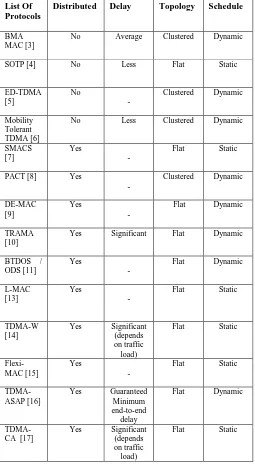
TABLE I
COMPARISON OF TDMA PROTOCOLS
List Of Protocols
Distributed Delay Topology Schedule
BMA MAC [3]
No Average Clustered Dynamic
SOTP [4] No Less Flat Static
ED-TDMA [5]
No
-
Clustered Dynamic
Mobility Tolerant TDMA [6]
No Less Clustered Dynamic
SMACS [7]
Yes
-
Flat Static
PACT [8] Yes
-
Clustered Dynamic
DE-MAC [9]
Yes
-
Flat Dynamic
TRAMA [10]
Yes Significant Flat Dynamic
BTDOS / ODS [11]
Yes
-
Flat Dynamic
L-MAC [13]
Yes
-
Flat Static
TDMA-W [14]
Yes Significant (depends on traffic load)
Flat Static
Flexi-MAC [15]
Yes
-
Flat Static
TDMA-ASAP [16]
Yes Guaranteed Minimum end-to-end
delay
Flat Dynamic
TDMA-CA [17]
Yes Significant (depends on traffic load)
Flat Static
V. CONCLUSION
Wireless sensor networks are energy constraint and to enhance the lifetime of the network an energy efficient MAC protocol is required. TDMA-based MAC protocols can be a solution which divides the time span into time-slots and allocate the time-slots to different nodes in a WSN.
The nodes can use the allocated time-slots for data transfer whenever required. TDMA has the natural advantage of eliminating collision and bounding the delay, thereby more energy-efficient. Nodes in the network can conserve more energy by entering into inactive states when they are not transmitting or receiving. This paper gives a description of several TDMA-based MAC protocols both centralized and distributed for the wireless sensor network. Advantages and disadvantages of each protocol is mentioned. A comparison study of different protocols which are investigated in this paper is also given. Apart from all the positive sides of TDMA, it has some drawbacks too like limited scalability and adaptability to network changes, strict time synchronization etc. With all these positive and negative sides keeping in mind, future research areas are trying to find a distributed energy efficient standard MAC protocol suitable for wireless sensor network.
REFERENCES
[1] Akyildiz, I.F., Su, W., Sankarasubramaniam, Y. and Cayirci, E. 2002. Wireless sensor networks:A survey, Computer Networks , vol. 38 , no. 4 , 393 – 422 .
[2] Tanenbaum, S. 1996. Computer Networks (3rd ed.), Prentice - Hall,
Inc. , Upper SaddleRiver, NJ.
[3] Li, J., Lazarou, G.Y. 2004. A bit-map-assisted energy-efficient MAC scheme for wireless sensor networks, Proceedings of the 3rd International Symposium on Information Processing in Sensor
Networks, 55-60.
[4] Wang, Y., Henning, I., Li, X. and Hunter, D. 2006. SOTP: A SELF-ORGANIZED TDMA PROTOCOL FOR WIRELESS SENSOR NETWORKS, IEEE conference on Electrical and Computer Engineering, 1108-1111.
[5] Gong, H., Liu, M., Yu, L., and Wang, X. 2009. An Event Driven TDMA protocol for Wireless Sensor Networks, International Conference on Communications and Mobile Computing, 132-136. [6] Thaskani, S., Vinod Kumar, K., and Rama Murthy, G. 2011.
Mobility Tolerant TDMA Based MAC Protocol for WSN, IEEE Symposium on Computers & Informatics. 515-519.
[7] Sohrabi, K., Gao, J. Ailawadhi, V., and Pottie, G. J. 2000. Protocols for self - organization of a wireless sensor network, IEEE Personal Communications, 16 – 27.
[8] Pei, G.and Chien, C. 2001. Low power TDMA in large wireless sensor networks, Military Communications Conference 2001 (MILCOM ’01). IEEE Communications for Network-Centric Operations: Creating the Information Force. 347-351.
[9] Kalidindi, R, Ray , L., Kannan, R. and Iyengar, S.2003. Distributed energy aware MAC layer protocol for wireless sensor networks , in Proceedings of 2003 International Conference on Wireless Networks (ICWN ’ 03) , Las Vegas, Nevada.
[10] Rajendran, V., Obraczka, K. and Garcia - Luna - Aceves, J. J. 2003. Energy-efficient, collision-free medium access control for wireless sensor networks, in Proceedings of 1st ACM Conference on
International Journal of Emerging Technology and Advanced Engineering
Website: www.ijetae.com (ISSN 2250-2459,ISO 9001:2008 Certified Journal, Volume 4, Issue 6, June 2014)
230
[11] Miller, M. J. and Vaidya, N. H. 2004. On-Demand TDMA Scheduling for Energy Conservation in Sensor Networks, Technical Report.
[12] Stark, W. 2000. Coding, Modulation, and Multiple-Access, in WTEC Study on Wireless Technologies and Information Networks, 5–14.
[13] Hoesel, L.F.W van and Havinga, P.J.M. 2004. A Lightweight Medium Access Protocol (LMAC) for Wireless Sensor Networks, in Proc. INSS Conf, June 2004.
[14] Chen, Z. and Khokhar, A. 2004. Self organization and energy efficient TDMA MAC protocol by wake up for wireless sensor networks, 1st Annual IEEE Communications Society Conference
on Sensor and Ad Hoc Communications and Networks (IEEE SECON ’04), 335-341.
[15] Lee, W. L., Datta,A. and Cardell-Oliver, R. 2006. FlexiMAC: A flexible TDMA-based MAC protocol for fault-tolerant and energy-efficient wireless sensor networks, IEEE International Conference on Networks, (ICON ’06),.1-6.
[16] Gobriel, S., Mosse, D. and Cleric, R. 2009. TDMA-ASAP: Sensor Network TDMA Scheduling with Adaptive Slot-stealing And Parallelism, 29th IEEE International Conference on Distributed
Computing Systems, 458-465.
[17] Wu, D., Wang, G. and Li, X. 2010. Distributed TDMA Scheduling Protocol Based on conflict-free For Wireless Sensor Networks, International Conference on Intelligent Computing and Integrated Systems (ICICS), 876-879.
[18] Zheng, J. and Jamalipour,A. 2009. WIRELESS SENSOR NETWORKS: A Networking Perspective, A JOHN WILEY & SONS, INC., PUBLICATION, ISBN: 978-0-470-16763-2. [19] Ergen, S. C and Varaiya,P. 2009. TDMA Scheduling Algorithms for
Wireless Sensor Networks, 985.
[20] Ye, W., Heidemann, J. and Estrin, D. 2002. An energy-efficient MAC protocol for wireless sensor networks, IEEE Infocom 2002, 1567–1576.
[21] Zhou, G. He, T., Krishnamurthy, S. and Stankovic. J. A. 2004. Impact of radio irregularity on wireless sensor networks. In MobiSys ’04: Proceedings of the 2nd international conference on Mobile systems, applications, and services, New York, NY, USA, 2004. ACM Press, 125–138.
[22] Ye, W., and Heidemann, J. 2003. Medium access control in wireless sensor networks ,Technical Report ISI - TR - 580, USC/Information Sciences Institute, 1 – 8 .
![Figure 2. Illustration of a Single Round in BMA [3]](https://thumb-us.123doks.com/thumbv2/123dok_us/8713025.882411/3.612.49.286.594.704/figure-illustration-single-round-bma.webp)
![Figure 4. TDMA schedule packet of ED-TDMA [5]](https://thumb-us.123doks.com/thumbv2/123dok_us/8713025.882411/4.612.50.290.577.639/figure-tdma-schedule-packet-ed-tdma.webp)
![Figure 5. Schematic of Mobility tolerant TDMA Based MAC Protocol [6]](https://thumb-us.123doks.com/thumbv2/123dok_us/8713025.882411/5.612.54.289.283.423/figure-schematic-mobility-tolerant-tdma-based-mac-protocol.webp)
![Figure 6. PACT TDMA Structure [8]](https://thumb-us.123doks.com/thumbv2/123dok_us/8713025.882411/6.612.53.290.357.510/figure-pact-tdma-structure.webp)
![Figure 7. Time Slot Structure in TRAMA [10]](https://thumb-us.123doks.com/thumbv2/123dok_us/8713025.882411/7.612.59.291.353.485/figure-time-slot-structure-in-trama.webp)
![Figure 8. Timing diagram for slots in BTODS [11]](https://thumb-us.123doks.com/thumbv2/123dok_us/8713025.882411/8.612.57.280.110.377/figure-timing-diagram-slots-btods.webp)
![Figure 10. FlexiMAC nodes' schedule (lookup table) [15]](https://thumb-us.123doks.com/thumbv2/123dok_us/8713025.882411/9.612.328.566.137.240/figure-fleximac-nodes-schedule-lookup-table.webp)
![Figure 11. Conflict graph [17]](https://thumb-us.123doks.com/thumbv2/123dok_us/8713025.882411/10.612.327.565.473.581/figure-conflict-graph.webp)