International Journal of Emerging Technology and Advanced Engineering
Website: www.ijetae.com (ISSN 2250-2459,ISO 9001:2008 Certified Journal, Volume 4, Issue 2, February 2014)
368
E-Brainstorm: Using PaaS Model of Cloud for Elearning
Devipriya.C
1, Lavanya.K
2, Sangeetha Priya.M
3, Shalini Merine George
41,2,3PG Student, 4Assistant Professor, Department of CSE., Sri Eshwar College of Engineering, Coimbatore, India
Abstract – The cloud computing is one of the emerging technology which is currently being used everywhere in the world. But still the potentiality of other services of cloud like platform and infrastructure as a service remains unexplored. An evaluation of the specific type of cloud most suitable and beneficial for the learners precisely depending on the technical knowledge behind the usage has not been reached. To address this part, a study to answer whether cloud technologies could be used to aid the students doing higher studies, predominantly belonging to computer science by focusing on the actual tasks in mind was undertaken. This study concludes that the platform clouds are most valued by students and technical teachers to achieve the course objectives and that cloud has provided a considerable improvement in the labs where in the previous scenarios a lot of work needs to be done prior to undertaking the experiments like setting up the necessary software for the course activities. Here we developed a system to use the PaaS cloud in providing a different way of e-learning by bridging the gap between the students and the resource person. This work could also be applied to other disciplines of science where it involves virtual experimentation.
Keywords- cloud, education, performance, virtual.
I. INTRODUCTION
There exists a tension in the higher education which is between the offered qualities and the motive to provide education to more and more people in this busy world [2]. The role of information technologies is ever increasing in supports to improve the quality and the resources that can be shared and accessed globally. Several information technologies have been proposed for supporting a variety of educational courses, such as distributed computing and parallel systems. But there are still difficulties in using those services like much effort is needed in priory setting up of the experimental scenario for undergoing the experiments [3]. This demands high technical knowledge from the professors as well as the students. This also makes the students to divert from their actual course mostly in relevance to administration tasks.
The term Cloud computing is general for anything that involves delivering hosted services over the internet. These services are classified broadly into three categories as: Infrastructure-as-a-service (IaaS), Platform-as-a-service (PaaS) and Software-as-a-service (SaaS).
The name cloud computing was inspired by the cloud symbol that is often used to represent the internet in flowcharts and diagrams.
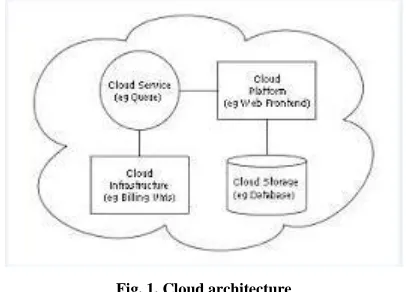
[image:1.612.342.545.388.534.2]A cloud service has three distinct characteristics that differentiate it from the traditional way of hosting [9]. It is being sold on demand, more typically by the count of a minute or the hour; it is elastic in the sense that a user can have as much or as little of the services as they want at any given time; and the service is fully managed by the service provider [7]. All that a customer needs is a personal computer and with the internet access. Considerable innovations in the concept of virtualization and distributed way of computing, and alsoincreased and improved access to high-speed internet and a weakness in economy, have increased the interest in using the cloud computing technology.
Fig. 1. Cloud architecture
International Journal of Emerging Technology and Advanced Engineering
Website: www.ijetae.com (ISSN 2250-2459,ISO 9001:2008 Certified Journal, Volume 4, Issue 2, February 2014)
369
Infrastructure-as-a-Service like Amazon Web Services provides virtual server instance application programming interface which can allow us to start, access, configure and finally stop their virtual servers and also the storage provided [14]. In most of the organizations, cloud technologies allow a company to pay as much as for the capacity being in need, and bring more online as soon as required. Since this pay-for-use model resembles the way electricity, fuel and water are consumed; it is something referred to as utility computing.
Platform-as-a-Service in the cloud is defined as a set of software and product development tools hosted on the infrastructure of the service provider. Developers are allowed to create applications on the platform of the service provider over the internet. PaaS providers may use interfaces, website portals or gateway software installed on the customer’s computer. GoogleApps is an example of PaaS [4]. Developers need to know that at the current period, there are no strong standards for interoperability or data portability to be enforced in the cloud. Some of the providers will not be interested in allowing the software created by the customers to be moved off the provider’s platform.
In the Software-as-a-Service cloud model, the vendor supplies the infrastructure like hardware, the software product and also interacts with the user through a front-end application.Services can be anything from Web-based email to inventory control and data processing [6]. Because the service provider hosts both the application and the data, the user can avail the service from anywhere.
II.RELATED WORK
In order to have a clean idea about the role of technologies other than cloud in education, let us analyze the need for those technologies. Education is a lifelong process therefore anytime anywhere access to it is the need. The increase in information needs is always increasing and therefore there is a great need to get access to this information [11]. It is the responsibility of education to meet the demands of variety of learners and therefore information technology is important in meeting this need. We need to increase access and bring down the cost of education to meet the challenges illiteracy [5].
Information and communication technologies in
education refer to teaching and learning the subject matter that enables understanding the functions and effective use of information and communication technologies. To satisfy the needs of advanced education, the idea of virtual labs for experimental learning through experiments emerged.
Labs for advanced computer science like advanced networking and distributed systems become more online. Often, cyber competitions require students to use advanced software like Adobe Photoshop and Jquery [8].
Teacher education programs can facilitate improvements not only in students’ technology skills but also in their beliefs and intentions regarding integrating technology into instruction [13]. Technology training directly affects pre service teachers’ self-efficacy and beliefs on some value, which in turn have an influence on student-centered use of technology.
Service Oriented Architecture (SOA) is an approach to building technology applications that aligns business and IT goals. This is accompanied by defining and building services that are business and education focused and can be reused and deployed across multiple software applications. In the technology domain, SOA has been around for a number of years and has been successfully used in many corporations [10]. In the recent years, several organizations have shown interest in standardizing their application developmental procedures around the Service Orientation. There are several reasons for this increase in interest, but one of the primary drivers is the proliferation of cloud-based vendors and the need to integrate disparate platforms. All believe that higher education in particular will benefit immensely from the SOA way of thinking, since Technology, Departmental, Administrative staff must work together to clearly articulate services and how they may be offered to constituents or end users [12]. This can offer new, create, and innovative ways for an entire community to get together and work. This beats the current method of IT engagement where IT writes requirements based on a meeting or their present knowledge, and then the software
is delivered in the future. In this type of model,Information
technology is nothing but an organization that takes orders and one that produces needed software depending on the available model at that scenario. Leveraging of the Service Oriented Architecture allows all the communities to think in a broad way and should have a good stay in the ongoing process where the result should be an improvement over the current status.
III. COURSE BACKGROUND
A. course description
The courses under consideration are those that were related to system architecture, their organizations,
algorithms and their complexity, data structures
International Journal of Emerging Technology and Advanced Engineering
Website: www.ijetae.com (ISSN 2250-2459,ISO 9001:2008 Certified Journal, Volume 4, Issue 2, February 2014)
370
These courses essentially need a lot of work to be done besides the actual setting up of the experimentation. This will often diffract the mentality of the students in learning the actual concepts. The main aspects of the course will get distracted. These constraints need to be concentrated in order to improve the educational curriculum of the students to get them more centered on the course rather than activities related to peripheral tasks.
Some of the related topics under the course include, the complexity theory and its introduction, networks which may be structured or unstructured, the working principle behind the peer-to-peer systems, the differences between the current overlay networks from their precedents, for the distributed hash tables to be used for the peer-to-peer systems which are more probably structured in nature, design considerations of the overlay networks and the architecture for internetworking and resource management, monitoring, routing algorithms, hierarchy and evaluation of performance of the content delivery networks, issues related to performance criteria and its evaluation, monitoring those performance criteria, the tricks related to networking, legal issues, and also the issues related to privacy, and finally algorithms for node discovery.
The syllabus for these experiments can be accomplished by the realization of several assignments related to the lab experiments. The final session includes the main idea to connect all the concepts that the students have gained during the previous lab sessions. So when this is the
scenario imagine the pre-experimentation work,
administrative tasks to be accomplished in order to complete the lab course. This is the reason behind the distraction of students from the actual course works. The motive of the course could not be fully accomplished if so.
B. Evaluation Setup
The evaluation in this system considers the use of the cloud service to use if for the pre-experimental setup. Here we propose to use the platform and infrastructure services of the cloud for this purpose. We implemented this considering the basic services like HTML and SQL using the platform services of the cloud.
The already available systems caused long time transmission but this is menu based and can be used for smooth working. The experimentation setup includes the registration of new user as a part where the new user can be a student or the staff. Then follows the pre-examination module where the student before entering the actual system is evaluated to know the knowledge level of them.
The queries are displayed on a random order and they are evaluated to current academic performance of the student. The marks related to each student were stored in the database. This helped to plan for the level of the tutorial to be given to the student and to do accordingly which isa positive side. Then the next is the evaluation of the results of the students by the administrative people. The results need to be kept persistent. This can be done using the databases and the query language to extract the information from it.
The user can attend the exams and view their results immediately. The user can choose the materials for their study according to their wish. Both the administrator and the author can upload materials and contents. The user can choose which one to refer. They can also choose the materials of particular author by selecting their names. The administrator is the only person who can view the results. The reports can be used by the admin to analyze the usage of the system and also to know the number of users and their status. This helps to maintain the system up to date.
IV. RESULTS ANALYSIS
A. Evaluation process
There are different stages in the evaluation process of the experimentation.
1)Concept categorization.
The concepts are based on the usefulness and the ease of use. Some of the uses are better quality of work, better control over the work, time saving, criticalness in achieving the objectives, focus and similar others. The ease of use factors are reduced error proneness, little dependence on online documentation, flexibility, ease of remembering, ease of learning and the ease of usefulness.
2)Data collection
This case includes wide data sources to be collected where the students need to face a variety of questions to make them classified as either in the advanced or the elementary level.
International Journal of Emerging Technology and Advanced Engineering
Website: www.ijetae.com (ISSN 2250-2459,ISO 9001:2008 Certified Journal, Volume 4, Issue 2, February 2014)
371
3)Data analysisUsing both the qualitative and the quantitative approaches, the gathered data were analyzed combining the results gathered in various ways. There are several categories in this analysis. The first category is related to the students with previous experience in the relevant tasks. This is the major fact to consider in this scenario. The two cases include one is advanced which is more experienced and the other is elementary which is less experienced. The more experienced case is related to previous knowledge in management functions of the system and is based on the answering level of the students. Data analysis is performed after the data collection process where the data collected using the predefined set of questions.
B. Evaluation results
The system is found to be useful for the students as they can learn in an easier way. Also it helps them to access the resources from a remote location. Both the students and the author are benefitted by this system as it avails portability. Also the students can be able to focus on the actual learning activities rather than the peripheral activities. This facilitates the authors where they have the choice of sharing their knowledge over a greater community of students. This also eliminates the need for a personal tutor to teach technologies. The students can learn at their convenience. This proves a better way of e-learning. The total number of students registered and the total number of staffs registered were counted. Also the number of students took test, the number of students passed and the count of students satisfied along with the authors satisfied were all accounted. Based on the result analysis it is proven that cloud is the only technology which provides more advanced level of improvement in the case of eLearning.
The contributions of cloud in these kind of activities is clear when several recent software were observed. Anyhow a detailed examination of the benefits of cloud in educational scenario has been undone. This evaluation shows that the cloud technologies produced a considerable improvement in the educational aspects of both the students and the teachers. Most preferably PaaS type of cloud produces notable improvement. This technology can be most suitable inn case of advanced eLearning cases where a considerable amount of field work needs to be done before going into the actual course works. These types of works include pre-setting of the experimental scenario, installing the necessary software, performing some of the administrative works related to account creation, managing those accounts in case of online requirements.
All these activities were apart from the course needs, which will distract the students from the actual aim of the experimentation works.
The notable observations from the above analysis follow.
The students and the staffs stated that the cloud
platforms help the students to focus on the actual course work rather than distracting by doing pre-setup activities.
The usage of cloud technology may sometimes hide
the heterogeneous nature of the operating systems used and also the software tools. Hence cloud tools should not be used when it separates the students from these technologies that are supposed by the students to learn.
Of the available service models of cloud, PaaS was
valued the most by the users of the system. This improves the time usage and also the end quality of
the result.
The cloud technology helps in reducing the work
burden of the staffs in preparing for the technologies
before they can go for teaching the students.
Another positive impact that was identified in the
analysis was the ability of the students to learn the tasks more easily and quickly than the previous
scenarios.
The observations show that the cloud technologies can be fruitfully used for the educational scenario and that this will provide significant improvement in the focus level of the students. Even though there are little practical difficulties in early stages of the cloud usage, the result quality and the accuracy were greatly improved.
V.CONCLUSION
International Journal of Emerging Technology and Advanced Engineering
Website: www.ijetae.com (ISSN 2250-2459,ISO 9001:2008 Certified Journal, Volume 4, Issue 2, February 2014)
372
This work can be extended to a variety of advanced eLearning courses that needs a lot of pre setting works. Also this can be combined with the other models of cloud services like infrastructure and software. We are currently working on using the Infrastructure as a Service model of cloud in advanced courses on computer science
background. This includes distributed computing,
networking, routing protocols implementation and usage and hence forth.
REFERENCES
[1] Luis M. Vaquero,“EduCloud: PaaS versus IaaS Cloud Usage for an Advanced Computer Science Course”, IEEE transactions on Education, 2010
[2] D. Dagger, A. O’Connor, S. Lawless, E. Walsh, and V. P. Wade, “Service-oriented e-learning platforms: From monolithic systems to flexible services,” IEEE Internet Comput., vol. 11, no. 3, pp. 28–35, May/Jun. 2007.
[3] C. Fang and L. C. Sing, “Collaborative learning using service-orientedarchitecture: A framework design,” Knowledge-Based Syst., vol. 22,no. 4, pp. 271–274, 2009.
[4] L. M. Vaquero-González, D. Hernández-Leo, F. Simmross-Wattenberg,M. L. Bote-Lorenzo, J. I. Asensio-Pérez, Y. A. Dimitriadis, E. Gómez-Sánchez, and G. Vega- Gorgojo, “The opportunity of gridservices for CSCL-application development,” in Proc. Euromicro Conf. Parallel, Distrib., Network-Based Process., Los Alamitos, CA,2005, pp. 4–11.
[5] P. J. Beers, P. A. Kirschner, H. P. A. Boshuizen, and W. H. Gijselaers, “Coercing knowledge construction in collaborative learning environments,”in Proc. CSCL, 2005, pp. 8–17.
[6] M. L. Bote-Lorenzo, E. Gómez-Sánchez, G.Vega-Gorgojo, Y. A. Dimitriadis,J. I. Asensio-Pérez, and I. M. Jorrín-Abellán, “Gridcole: A tailorable grid service based system that supports scripted collaborative learning,” Comput. Educ., vol. 51, no. 1, pp. 155–172, 2008.
[7] L. M. Vaquero, L. Rodero-Merino, J. Caceres, and M. Lindner, “Abreak in the clouds: Towards a cloud definition,” Comput. Commun.Rev., vol. 39, no. 1, pp. 50– 55, 2009.
[8] Z. Xu, Z. Yin, and A. Saddik, “AWeb services oriented framework fordynamic e-learning systems,” in Proc. IEEE CCECE, May 2003, vol.2, pp. 943–946, vol. 2. K. Friesen and N. Mazloumi, “Integration of learning management systemsand Web applications using Web services,” Int. J. Adv. Technol.Learn., vol. 1, no. 1, pp. 16– 24, 2004.
[9] G. Vossen and P. Westerkamp, “E-learning as a web service”, in Proc.Int. Database Eng. Appl. Symp., 2003, p. 242.
[10] S. Wesner, K. Wulf, and M. Müller, “How grid could improvee-learning in the environmental science domain,” in Proc. 1st
LeGE-WG Int. Workshop Educ. Models Grid Based Services, 2002, pp. 3–4.
[11] A. Bagnasco, A. Poggi, and A. Scapolla, “Computational grids and online laboratories,” in Proc. 1st Int. Conf. Adv. Technol. Enhanced Learn., 2005, pp. 14– 19.
[12] C. Alario-Hoyos, J. I. Asensio-Pérez, M. L. Bote-Lorenzo, E. Gómez-Sánchez, G. Vega-Gorgojo, and A. Ruiz-Calleja, “Integration of external tools in virtual learning environments: Main design issues andalternatives,” in Proc. 10th IEEE Int. Conf. Adv. Learn. Technol.,Washington,DC, 2010, pp. 384–388.