https://doi.org/10.5194/hess-23-4783-2019 © Author(s) 2019. This work is distributed under the Creative Commons Attribution 4.0 License.
A virtual hydrological framework for evaluation of
stochastic rainfall models
Bree Bennett1, Mark Thyer1, Michael Leonard1, Martin Lambert1, and Bryson Bates2 1School of Civil, Environmental and Mining Engineering, University of Adelaide,
North Terrace Campus, 5005, South Australia, Australia
2School of Agriculture and Environment, The University of Western Australia, Crawley, 6009, Western Australia, Australia Correspondence:Bree Bennett ([email protected])
Received: 13 September 2018 – Discussion started: 25 September 2018
Revised: 21 September 2019 – Accepted: 1 October 2019 – Published: 25 November 2019
Abstract.Stochastic rainfall modelling is a commonly used technique for evaluating the impact of flooding, drought, or climate change in a catchment. While considerable atten-tion has been given to the development of stochastic rainfall models (SRMs), significantly less attention has been paid to developing methods to evaluate their performance. Typical evaluation methods employ a wide range of rainfall statis-tics. However, they give limited understanding about which rainfall statistical characteristics are most important for re-liable streamflow prediction. To address this issue a formal evaluation framework is introduced, with three key features: (i) streamflow-based, to give a direct evaluation of mod-elled streamflow performance, (ii) virtual, to avoid the issue of confounding errors in hydrological models or data, and (iii) targeted, to isolate the source of errors according to spe-cific sites and seasons. The virtual hydrological evaluation framework uses two types of tests, integrated tests and unit tests, to attribute deficiencies that impact on streamflow to their original source in the SRM according to site and season. The framework is applied to a case study of 22 sites in South Australia with a strong seasonal cycle. In this case study, the framework demonstrated the surprising result that apparently “good” modelled rainfall can produce “poor” streamflow pre-dictions, whilst “poor” modelled rainfall may lead to “good” streamflow predictions. This is due to the representation of highly seasonal catchment processes within the hydrological model that can dampen or amplify rainfall errors when con-verted to streamflow. The framework identified the impor-tance of rainfall in the “wetting-up” months (months where the rainfall is high but streamflow low) of the annual hydro-logic cycle (May and June in this case study) for providing
reliable predictions of streamflow over the entire year despite their low monthly flow volume. This insight would not have been found using existing methods and highlights the impor-tance of the virtual hydrological evaluation framework for SRM evaluation.
1 Introduction
Stochastic rainfall model (SRM) simulations are used pri-marily as inputs to a hydrological model, for simulating real-isations of streamflow. Streamflow simulations are then used to assess hydrological risks, such as floods (e.g. Camici et al., 2011; Li et al., 2016) or droughts (e.g. Henley et al., 2013; Mortazavi-Naeini et al., 2015; Paton et al., 2013). When eval-uating the efficacy of SRMs, current approaches that make comparisons to observed rainfall or streamflow have limited diagnostic ability. They are unable to make a targeted eval-uation of the SRM’s ability to reproduce streamflow charac-teristics of practical interest. This paper introduces a new vir-tual framework that enables targeted hydrological evaluation of SRMs.
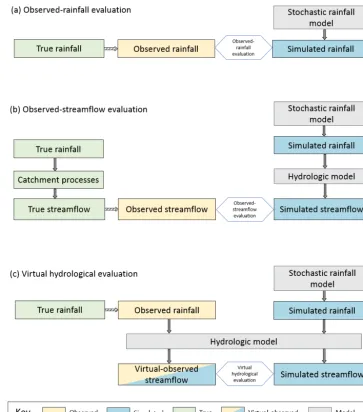
Figure 1.Schematic of(a)observed-rainfall evaluation where simulated rainfall is compared against observed rainfall and(b) observed-streamflow evaluation where simulated observed-streamflow is compared against observed observed-streamflow.(c)Virtual hydrological evaluation framework where simulated streamflow is compared against virtual-observed streamflow.
ascertain whether the SRM’s performance is sufficient in terms of predictions of practical interest, which are typically streamflow-based. This means it is unclear whether it is nec-essary to invest time and effort to address instances of poor performance, when the majority of statistics are well repro-duced (Bennett et al., 2018; Evin et al., 2018).
To overcome limitations in observed-rainfall evaluation methods, the conventional alternative is to evaluate the rainfall model’s performance in terms of streamflow (e.g. Blazkova and Beven, 2002, 2009; Camici et al., 2011; McMillan and Brasington, 2008) and is referred to as “streamflow evaluation”. From Fig. 1b, observed-streamflow evaluation typically involves (1) a SRM that pro-duces simulations of rainfall that are (2) input to a hydrologi-cal model to produce simulated streamflow, which is (3)
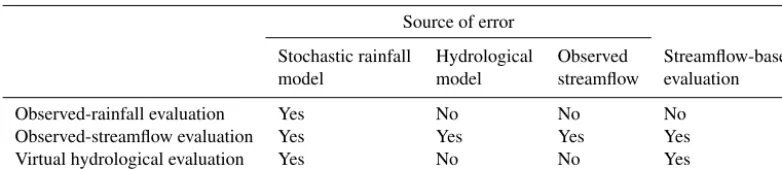
Table 1.Comparison of the sources of error for observed-rainfall, observed-streamflow and virtual hydrological evaluation frameworks as well as whether the evaluation is streamflow-based.
Source of error
Stochastic rainfall Hydrological Observed Streamflow-based
model model streamflow evaluation
Observed-rainfall evaluation Yes No No No
Observed-streamflow evaluation Yes Yes Yes Yes
Virtual hydrological evaluation Yes No No Yes
The focus of this paper is the development and appli-cation of a virtual hydrological evaluation framework for streamflow-based evaluation of SRMs. As shown in Fig. 1c, a virtual hydrological evaluation involves the comparison of simulated streamflow statistics (produced by the hydro-logical model by inputting simulated rainfall from a SRM) against virtual-observed streamflow statistics (produced by the hydrological model by inputting observed rainfall). This framework is designed to focus on streamflow predictions of interest, similar to observed-streamflow evaluation, but to re-duce the sources of error to only those introre-duced by the SRM. To illustrate this, Table 1 gives an overview of the sources of error for the three evaluation frameworks and in-dicates whether the evaluations are streamflow-based. The observed-rainfall evaluation framework is used to identify errors in the SRM, but is not able to determine their impli-cations for streamflow. The observed-streamflow framework provides an absolute measure of performance, since ulti-mately the goal is to match streamflow observations or statis-tics. However, with this approach it is not possible to readily identify whether discrepancies in the simulated streamflow are attributed to the SRM, the streamflow observations, or poor process representation within the hydrological model. In contrast, the virtual hydrological evaluation framework is a relative measure of performance, where the hydrological model is a common factor in the production of simulated streamflow and virtual-observed streamflow that is used as a baseline for comparison. By using a virtual baseline, ob-served streamflow is not directly required in the evaluation as both simulated and observed rainfall undergo transforma-tion by the same process representatransforma-tion (i.e. the hydrological model). This enables discrepancies in the streamflow to be identified in terms of features of the SRM.
To date, “virtual experiments”, that is, experiments that focus on comparisons between streamflow simulated under different conditions or inputs (i.e. virtual streamflow) with-out relying on comparisons to observed streamflow, have been used in a variety of contexts. Examples include (i) the evaluation of hydrological model sensitivity (e.g. Ball, 1994; Nicótina et al., 2008; Paschalis et al., 2013; Shah et al., 1996; Wilson et al., 1979), including the identification of rainfall features of interest in terms of hydrological behaviour (e.g. Sikorska et al., 2018), (ii) the development of new techniques
for flood frequency analysis (e.g. Li et al., 2014, 2016), and (iii) the calibration, validation, and selection of SRMs (e.g. Kim and Olivera, 2011; Müller and Haberlandt, 2018).
The framework presented in this paper is a significant ad-vance from previously reported virtual experiments because it presents a formal framework to identify key deficiencies in the SRM by (1) extending the comprehensive and systematic evaluation (CASE) framework (developed by Bennett et al., 2018, for observed-rainfall evaluation and used by Evin et al., 2018, and Khedhaouiria et al., 2018) that systematically cat-egorises performance at multiple spatial and temporal scales using quantitative criteria for each statistic for use in virtual hydrological evaluations and (2) utilising two types of virtual experiments that are able to identify the source of key defi-ciencies in the SRM at specific locations and time periods.
The key objectives of this paper are the following. 1. Introduce a formalised framework for the virtual
hy-drological evaluation of SRMs: the new framework is a stepwise procedure that enables the identification of poor performing sites, then poor performing time peri-ods, and then the key deficiencies in the SRM for those sites and time periods by drawing on the systematic ap-plication of quantitative performance criteria.
2. Present two different tests which are part of the frame-work: the integrated test and a new type of test, the unit test. Combined use of these tests allows streamflow dis-crepancies to be attributed to their original source in the SRM according to site and season.
3. Demonstrate the framework on a daily SRM at multiple sites to evaluate performance at daily, monthly, and an-nual timescales and to contrast the outcomes with con-ventional evaluation methods.
2 Virtual hydrological evaluation framework 2.1 Overview
A virtual hydrological evaluation involves the comparison of simulated streamflow statistics to virtual-observed stream-flow statistics (Fig. 1c), defined as the following.
– Simulated streamflow is streamflow produced by the hydrological model by inputting simulated rainfall at a given site.
– Virtual-observed streamflow is streamflow produced by the hydrological model by inputting observed rainfall at the same given site.
The virtual framework undertakes a relative assessment of the simulated and observed rainfall after its transformation by the same hydrological model to provide insight into the performance of the SRM. Because the hydrological evalua-tion is a relative comparison of the observed and simulated rainfall, it is important that all other model parameters and extraneous variables (e.g. potential evapotranspiration) relat-ing to the hydrological model are kept the same for the sim-ulation of both virtual-observed and simulated streamflow. It is also important that the selected hydrological model is fit for purpose so that it can simulate the streamflow characteris-tics of interest. This selection process should also ensure that the hydrological model is compatible with the tested rainfall model and the objectives of the test (i.e. a distributed hydro-logical model would not be selected to evaluate a single-site rainfall model for deficiencies).
The virtual hydrological evaluation framework is best used to augment and complement existing evaluation methods, rather than act as a replacement. The three evaluation frame-works could work together as follows, where (i) observed-rainfall evaluation identifies any deficiencies in the SRM prior to any hydrological considerations; (ii) the virtual hy-drological framework identifies which of these rainfall de-ficiencies impact on the key predictions of interest, that is, simulated streamflow; and (iii) observed-streamflow evalua-tion provides a final validaevalua-tion. Therefore, together they en-able a more focused approach to identify opportunities for improvement of a SRM. This is because the ultimate goal of the SRM modelling process remains the same: to match observed streamflow for a catchment of interest.
The formal implementation of the virtual hydrological evaluation framework is summarised in Fig. 2. It uses a series of steps to identify poor performing sites (i.e. specific loca-tions in space, for example, the location of a rainfall gauge), then poor performing time periods, and then key deficiencies in the SRM for those sites and time periods. It combines both observed rainfall-evaluation and virtual hydrological evalua-tion. The virtual hydrological evaluation includes two differ-ent types of tests, an “integrated test” that isolates issues for a given site and “unit tests” that isolate issues for specific time
periods. This enables the diagnosis of the key deficiencies in the simulated rainfall. The following sections explain the three steps in turn.
2.2 Step 1 – identify poor performing sites
The first step focuses on using integrated tests to identify poor performing sites for further evaluation. Following the selection of a primary streamflow characteristic of interest and a suitable hydrological model, integrated tests are con-ducted for each rainfall site (described below in Sect. 2.2.2). The results of the integrated tests are then used to iden-tify sites that are poor performing, according to the sys-tematic application of quantitative performance criteria (see Sect. 2.2.3), for the primary streamflow characteristic. 2.2.1 Selection of the primary streamflow
characteristic and relevant hydrological model In order to undertake an integrated test, an appropriate hy-drological model is required to simulate the streamflow. The hydrological model should be selected on the basis that it is capable of simulating streamflow for the timescales, magni-tudes, and physical processes of interest to the intended ap-plication. For example, a capability for simulating flow vol-umes is important for yield. A streamflow characteristic of interest, herein termed the “primary streamflow characteris-tic”, is then selected to enable a method for filtering sites and concentrating the investigation of the SRM on sites that per-form poorly in terms of its intended application. For exam-ple, the distribution of annual total flow would be a suitable characteristic when investigating yield. Following the iden-tification of the hydrological model and primary streamflow characteristic, an integrated test is conducted for each rain-fall site, which serves as an overall test of the SRM’s perfor-mance.
2.2.2 Integrated test procedure
The integrated test proceeds for a single site by transform-ing the time series of observed and simulated rainfall, via the hydrological model (Fig. 1c). Consider the time series of ob-served daily rainfall,Robs, for each year at a given site. This rainfall time series is transformed according to a hydrolog-ical modelg[ ] to produce the virtual-observed streamflow, denoted asQvo, and “. . .” are additional inputs (e.g. poten-tial evapotranspiration).
Qvo=ghRobs, . . .i (1)
Likewise, all replicates of the simulated daily rainfall,Rsim, for each year at a given site are transformed according to the hydrological modelg[ ] to produce simulated streamflow replicates,Qsim.
Figure 2.Virtual hydrological evaluation procedure.
If there is a discrepancy between the simulated streamflow, Qsim, and virtual-observed streamflow, Qvo, distributions, this indicates that there is a deficiency in the simulated rain-fall for that site.
The integrated test procedure is explained in terms of daily rainfall and daily streamflow at a single site, as it is herein applied to evaluate a daily rainfall model (see Sect. 3). This test procedure can be extended to other timescales and spa-tial scales (e.g. spaspa-tial rainfall, subdaily rainfall). These ex-tensions are discussed in Sect. 5.4.
2.2.3 Identify poor performing sites using the CASE framework
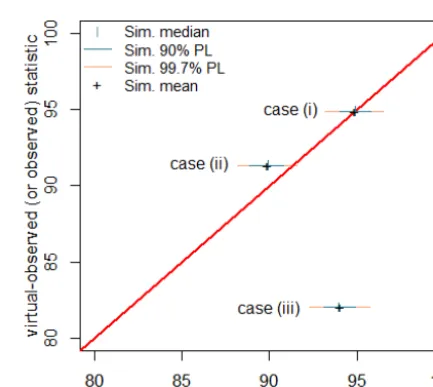
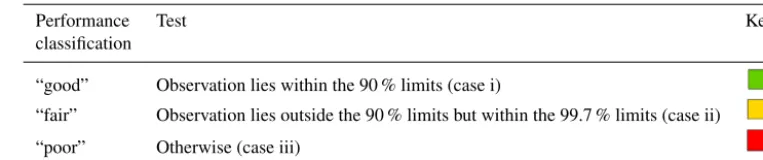
The integrated test results aim to identify the sites that are poor performing for the primary streamflow characteristic. Model performance is categorised using a CASE framework approach as “good”, “fair”, or “poor” following Bennett et al. (2018). The quantitative tests for each performance cat-egory are provided in Table 2 alongside an illustration of each in Fig. 3. The quantitative tests proceed by comparing the statistics of the virtual-observed streamflow against those calculated from replicates of the simulated streamflow. Per-formance was categorised as “good” if the selected statistic for the virtual-observed streamflow fell within the 90 % lim-its of the statistic calculated from the simulated streamflow replicates (Fig. 3, case i), as “fair” if the virtual-observed statistic fell outside the 90 % limits of the simulated stream-flow replicates but within the 99.7 % limits (Fig. 3, case ii), and as “poor” if otherwise (Fig. 3, case iii).
2.3 Step 2 – identify poor performing time periods The second framework step is to identify poor performing time periods by conducting a detailed analysis of the in-tegrated test results and comparing these results with an observed-rainfall evaluation at the monthly scale.
Evaluating monthly total flows is a valuable test of SRM performance as the production of monthly total flow volumes relies on the integration of many daily rainfall characteris-tics (amount, duration, persistence). For each of the poor performing sites, each of these statistics for each month are categorised as “good”, “fair”, and “poor” using the CASE
Figure 3.Illustration of performance classification: case (i) shows “good” performance, case (ii) shows “fair” performance, and case (iii) shows “poor” performance. Adapted from Bennett et al. (2018).
framework. See Sect. 2.2.3 for further explanation of the cat-egorisation procedure. This enables the identification of poor performing time periods from the perspective of the virtual hydrological evaluation.
[image:5.612.319.536.212.406.2]Table 2.CASE performance classification criteria. Adapted from Bennett et al. (2018).
Performance Test Key
classification
“good” Observation lies within the 90 % limits (case i)
“fair” Observation lies outside the 90 % limits but within the 99.7 % limits (case ii) “poor” Otherwise (case iii)
2.4 Step 3 – identify sources of poor performance The third step of the framework is to identify sources of poor performance in streamflow according to deficiencies in the simulated rainfall. Step 2 identifies the poor performing time periods from a streamflow perspective. However, due to catchment “memory”, the poor performance in streamflow could be due to deficiencies in the simulated rainfall from a range of potential influencing months during or prior to the poor performing time period. For example, poor streamflow performance in an evaluated month may be due to the in-fluence of (i) rainfall deficiencies mostly in the same month (i.e. concurrent influencing months), (ii) rainfall deficiencies over a contiguous block of months including and preceding the evaluated month (i.e. prior and concurrent influencing months), or (iii) rainfall deficiencies in a preceding month more so than in the evaluated month (i.e. prior influencing months). The integrated test cannot isolate which influencing months produce these deficiencies. Therefore, the unit test is designed to enable the identification of sources of poor per-formance in streamflow. The sources of poor perper-formance are described in terms of which influencing months exhibit key deficiencies in simulated rainfall and therefore which SRM components should be improved.
2.4.1 Unit test procedure
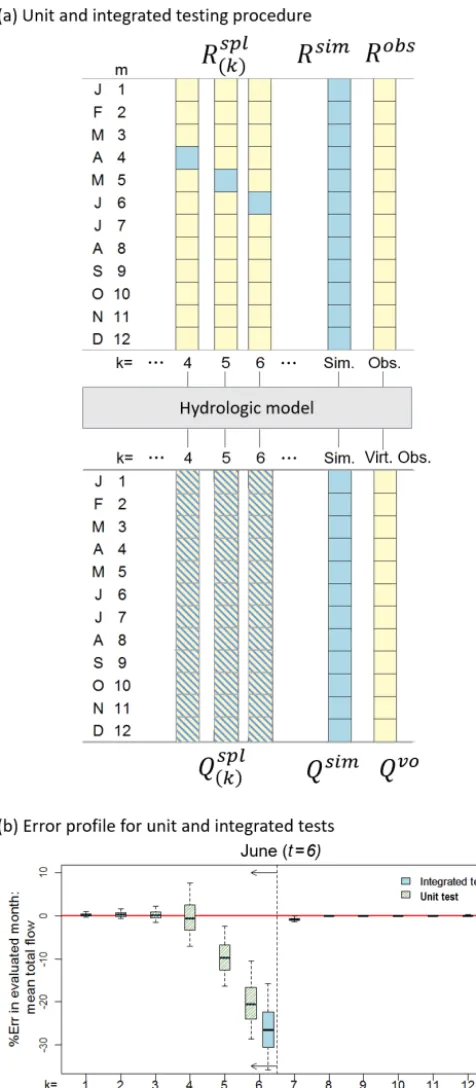
The unit test investigates the impact of simulated rainfall in a given influencing month on the production of streamflow in an evaluated month of interest. This is achieved by splic-ing observed and simulated rainfall into a ssplic-ingle time series which is used to produce simulated streamflow.
Following Fig. 4a, consider the time series of observed, Robs, and simulated,Rsim, daily rainfall for each year (and replicate) at a given site. Figure 4a illustrates the embed-ding of simulated rainfall Rksim in an influencing month, k, within observed rainfall Rmobs for all other months m∈ {1, . . .,12|m6=k}. The resulting spliced rainfall time series R(k)splis denoted with respect to the influencing month,k, and has the same length as the corresponding observed,Robs, and simulated,Rsim, time series.
R(k)spl=
12 [
m=1
Rmsim; m=k
Rmobs; m6=k (3)
For example, if June (k=6) is selected as the influencing month, each year of the spliced time series,R(spl6), would be composed as follows:
R(spl6)=nR1obs, . . ., R5obs, Rsim6 , R7obs, . . ., R12obso. (4) The ensemble of k=1, . . .,12 spliced rainfall time series R(k)splfor all influencing months and additional inputs (e.g. po-tential evapotranspiration) indicated by “. . .” is transformed according to a hydrological modelg[ ] to produce an ensem-ble of simulated streamflow,Qspl(k). This procedure is repeated for all simulated rainfall replicates.
Qspl(k)=ghR(k)spl, . . .i (5)
By construction, the spliced rainfall is identical to the ob-served rainfall for all months other than the influencing month, so any errors in streamflow statistics can be attributed to the influencing month free from other factors.
The full set of spliced rainfall (e.g. spliced rainfall for each month designated as the influencing monthRspl(k);k=
1, . . .,12) is input to the hydrological model. This step is re-peated for all available replicates of the spliced time series. The results of the unit test and the integrated test (Steps 1–2) are then investigated and compared by selecting each month as the evaluated time period in turn as well as other key time periods (e.g. annual).
2.4.2 Compare unit tests and integrated tests
Side-by-side comparison of the results of the integrated test and unit tests are given in terms of the errors for selected monthly and annual statistics (see the illustration in Fig. 4b). The comparison of errors from the unit test forms the basis of interpretation for hydrological insights and their relationship with the SRM.
Figure 4.Schematic of(a)the method of constructing a unit test by embedding simulated months in an observed time series and(b)the error profile produced when using the integrated and unit tests for the evaluated time period of June (t=6) (boxplot whiskers indicate the 90 % limits of the simulated streamflow replicates). For the unit test the errors in the evaluated period (t) are calculated as the differ-ence betweenQspl(k)andQvo(t ). For the integrated test the errors are calculated as the difference betweenQsimandQvo(t ).
Using the functionh[ ] to denote a calculated statistic of interest (e.g. mean or standard deviation), the relative error in an evaluated time periodt (e.g. annual or particular month) is given by
%Err(t )=
hhQeval(t ) i−hhQvo(t )i hhQvo(t )i
×100, (6)
whereQvo(t ) is the virtual-observed streamflow and Qeval(t ) is the simulated streamflow from the selected virtual hydrologi-cal test (i.e.Qsimif integrated test orQspl(k)if unit test selected) in the evaluated time periodt. This procedure is repeated for all replicates of the simulated streamflow such that a range of errors is reported for each test for the target time period.
Following the calculation of this error metric for all repli-cates of the integrated test and ensemble of unit tests (k=
1, . . .,12), it is possible to investigate deficiencies in the sim-ulated streamflow in terms of which influencing month(s) contribute more to the deficiencies in streamflow for the tar-get time period based on that statistic of interest. Thus, for each site, statistic, and evaluated time period there are 13 sets of errors to compare.
A typical error profile from integrated and unit tests is shown in Fig. 4b where mean monthly flow is selected as the statistic of interest for the evaluated time period of June (t=6). In this figure the sets of errors from the integrated and unit tests are summarised as boxplots with the boxplot whiskers indicating the 90 % limits of the errors from the evaluated streamflow replicates. Figure 4b shows the inte-grated test produced a median error of 27 % (blue shaded boxplot) from all simulated rainfall replicates indicating a deficiency in the simulated streamflow for June. Examina-tion of the unit tests (yellow and blue striped boxplots) for the target time period (June) shows that the median error is 20 % when the influencing month is June (k=6), the median error is 10 % when the influencing month is May (k=5)and when the influencing month is April (k=4) the median error is negligible. Therefore, the bias in mean June streamflow is primarily due to SRM deficiencies in June and May respec-tively.
2.4.3 Identify types of key deficiencies
unit tests for key influencing months is also recommended. Examples of each case are presented in Sect. 4.
3 Case study
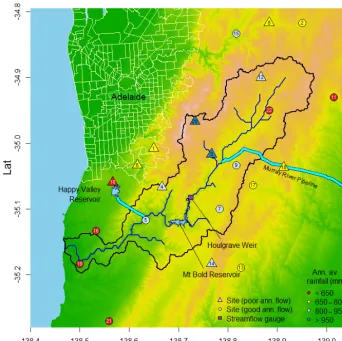
The Onkaparinga catchment in South Australia is used as a case study (Fig. 5). The 323 km2catchment lies 25 km south of the Adelaide metropolitan area and contains the largest reservoir in the Adelaide Hills supplying the region (Mount Bold Reservoir). The catchment has a strong seasonal cycle (shown in Fig. 6) where the driest months (December, Jan-uary and FebrJan-uary) exhibit low rainfall and low streamflow, the wettest months (July, August and September) have high rainfall and high streamflow, and the “wetting-up” period (April, May and June) has high rainfall and lower stream-flow. There is a strong rainfall gradient (Fig. 5), with average annual rainfall ranging from approximately 500 mm on the coast (Site No. 19) to over 1000 mm in the region of highest elevations (Site No. 20). A breakdown of the rainfall char-acteristics (annual total, number of wet days, daily average amounts, wet-spell and dry-spell durations) at each site on a monthly basis is provided in the Supplement.
The evaluated daily rainfall was simulated using the la-tent variable autoregressive daily rainfall model of Bennett et al. (2018) using at-site calibrated parameters to simulate daily rainfall independently at each of the 22 sites. This rainfall model uses a latent variable concept, which relies on sampling from a normally distributed “hidden” variable. The latent variable can then be transformed to a rainfall amount by truncating values below zero and by rescaling val-ues above zero to match the observed rainfall’s distribution. Here, the rainfall is rescaled using a power transformation.
To calibrate the model the rainfall data at a given site is partitioned on a monthly basis and separate parameters are fit for each month. The mean and standard deviation of rainfall amounts, as well as the proportion of dry days is calculated. These statistics are matched to the corresponding properties of the truncated power transformed normal distribution. The at-site lag-1 temporal correlation is then calculated based on the observed wet-day periods for a given month. This statistic is transformed to the equivalent correlation of the underlying latent variable by accounting for the effects of truncation to determine the autocorrelation parameter. Full details of the calibration procedure are provided in Bennett et al. (2018). In this study the daily rainfall model was calibrated and simu-lated at 22 locations independently throughout the catchment that have long, high-quality records (Fig. 5). 10 000 repli-cates of simulated rainfall covering a 73 year period (1914– 1986) were used.
The hydrological model GR4J (Perrin et al., 2003) was used to simulate streamflow (both virtual-observed and sim-ulated) at a daily time step. GR4J is a daily lumped hy-drological model that simulates daily streamflow in a par-simonious manner using four parameters. The GR4J model
was calibrated according to the procedure set out in Wes-tra et al. (2014b) for the stationary version of the GR4J hydrological model. The details are provided in Westra et al. (2014a) and a short summary is provided here. The ob-served data from the multiple rainfall gauges in the Onka-paringa catchment were Thiessen weighted to calculate the catchment average rainfall, which was used purely for the purposes of calibrating the hydrological model. The hydro-logical model was calibrated to the daily streamflow data at Houlgrave Weir (see Fig. 5) using a model calibration pe-riod of 15 years (1985–1999). The model parameters were estimated using a maximum likelihood estimation procedure with a weighted least squares likelihood function. The set of hydrological model parameters that maximised the likeli-hood function were found using a multi-start quasi-Newton optimisation procedure with 100 random starts. Overall, the GR4J model was able to simulate streamflow with a good fit to the observed daily streamflow, with a Nash-Sutcliffe effi-ciency of 0.8. A similar type of hydrological model and cal-ibration approach has been used for other virtual evaluation studies (Li et al., 2014, 2016). The same set of hydrological model parameters are used for both the unit and integrated tests so that the same transformation of rainfall to flow is used.
4 Results
4.1 Step 1 – identify poor performing sites
To undertake Step 1, annual total flow volumes were des-ignated as the primary streamflow characteristic to narrow the number of sites investigated. Following the selection of the primary streamflow characteristic and selection of the hy-drological model, GR4J, integrated tests were undertaken to evaluate the simulated rainfall at the 22 sites. The annual total flow distribution was used to give a broad indication of per-formance. This step categorised 10 of the 22 sites as “poor” and 12 as “good”, which is in strong contrast to earlier eval-uation efforts using observed-rainfall evaleval-uation (Bennett et al., 2018) that categorised the majority of sites and statistics as “good” (see Sect. 2.2.3 for category definitions).
The 10 sites categorised as “poor” are the focus of subse-quent virtual hydrological evaluation framework steps. These “poor” performing sites are indicated by the triangles in Fig. 5.
Figure 5.Onkaparinga catchment, South Australia. Sites indicated by triangles are explored in greater detail in this paper due to the relatively poorer ability of simulated rainfall to reproduce virtual-observed annual streamflow totals at these sites.
Figure 6. Seasonal variation of catchment average rainfall and flow at Houlgrave Weir. Boxplots show the variation across years. “Wettest” indicates months with higher rainfall and higher flow. “Driest” indicates months with lower rainfall and lower flow. “Wet-ting up” indicates months with higher rainfall and lower flow.
– simulated daily rainfall statistics (mean (m) daily amounts, standard deviation (SD) of daily amounts, mean number of wet days (nwet) and the standard devi-ation of the number of wet days);
– aggregate rainfall statistics (mean and standard devia-tion of total rainfall); and
– aggregate streamflow statistics (mean and standard de-viation of total flow).
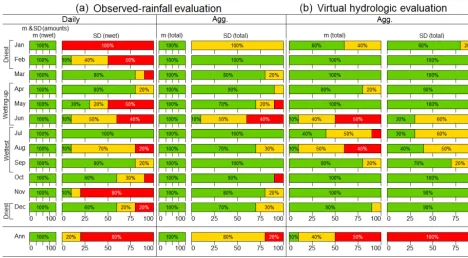
[image:9.612.45.290.463.561.2]Figure 7.Integrated test, comparing observed-rainfall evaluation(a)with the virtual hydrologic evaluation(b). Comparison of daily and aggregate (“Agg.”) rainfall statistics against aggregate flow statistics for individual months and years, where means are denoted as “m” and standard deviations as “SD”.
Whereas the virtual hydrological evaluation (fifth and sixth) columns show mostly “good” performance in all months other than those in the “wettest” or “wetting-up” periods.
A clear trend from Fig. 7 is the contrast in performance be-tween the observed-rainfall evaluation and the virtual hydro-logical evaluation. One contrast is that in the driest months (December, January, February) “poor” performance in sim-ulating rainfall (based on observed-rainfall evaluation) did not necessarily translate to “poor” performance in simulat-ing streamflow (based on virtual hydrological evaluation). For example, examining the first row of Fig. 7, the observed-rainfall evaluation shows that in January the SRM’s ability to simulate variability in the number of wet days, SD(nwet), was “poor” for all sites. However, in contrast the virtual hy-drological evaluation shows that most sites had “good” per-formance in simulating the January distribution of monthly total flow (i.e. m(total) and SD(total)).
A second contrast is that “good” performance in the observed-rainfall evaluation does not necessarily translate to “good” performance for the virtual hydrological evaluation, particularly for months in the “wettest” and “wetting-up” pe-riods. For example, in Fig. 7 the rows summarising June and August show large percentages of “poor” sites in the vir-tual hydrological evaluation of monthly total flow. This defi-ciency would have been difficult to infer using the observed-rainfall evaluation due to the 100 % “good” performance of
m(total) rainfall and “good/fair” performance of SD(total) rainfall in these months.
Likewise, by examining the bottom row of Fig. 7 that summarises annual performance, it can be seen that the observed-rainfall evaluation shows unbiased mean annual to-tal, m(total), rainfall (100 % “good”) and yet the mean annual total flows showed only 10 % of sites as “good”. Discussion of the unit tests in the following section will investigate rea-sons why apparently “good” rainfall can yield “poor” flow. 4.3 Step 3 – identify sources of poor performance To undertake Step 3, unit tests were run to evaluate the source of deficiencies in poor performing time periods. The results of these test were compared against integrated tests in terms of their relative errors. From this comparison the source and type of key deficiencies in the simulated rainfall that lead to poor performance in simulated streamflow were identified. A comparison of the virtual-observed flow duration curve for the poor performing time periods and the flow duration curves resulting from unit tests for key influencing months was also undertaken to illustrate the impact of these key de-ficiencies on the daily flow duration curve.
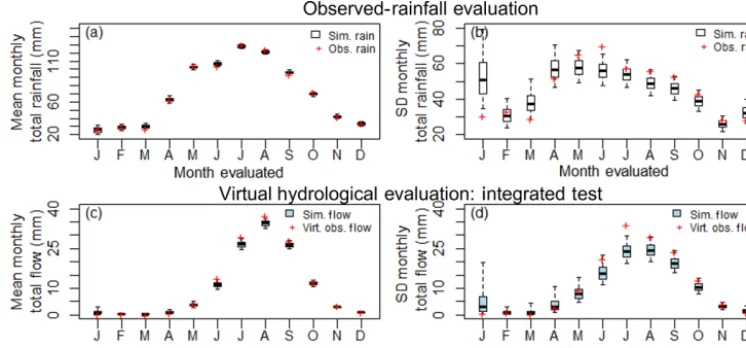
Figure 8.Lobethal, Site 12(a)observed-rainfall evaluation mean monthly total rainfall,(b)observed-rainfall evaluation standard deviation of monthly total rainfall,(c)virtual hydrological evaluation (integrated test) mean monthly total streamflow,(d)virtual hydrological evaluation (integrated test) standard deviation of monthly total streamflow. Boxplot whiskers indicate the 90 % limits of the simulated streamflow or rainfall replicates.
4.3.1 Streamflow errors mostly originate from rainfall model deficiencies in the evaluated month
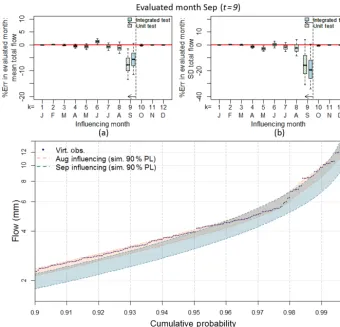
A common case for streamflow errors is that they originate from rainfall in the same month. This case can be illustrated using Site 12 in Fig. 8 where left-side panels show results for the mean and right-side panels show the standard deviation and where panels (a) and (b) summarise the observed-rainfall evaluation, panels (c) and (d) summarise the integrated test. From panels (a) and (b), the simulated monthly rainfall is generally unbiased, but from panels (c) and (d) the mean and standard deviation of the simulated streamflow is lower than the virtual-observed flow from June to September. Here, September is selected as an illustrative case for an application of the unit test in Fig. 9 since it shows biased flow.
Taking September as the evaluated month (t=9), Fig. 9a and b compare the unit tests for all 12 influencing months (yellow and blue striped boxplots) with the integrated test (blue shaded boxplot) in terms of the error in the simu-lated flow. When the influencing month is September (i.e. the September rainfall is “spliced” into the observed record, k=9) the resultant error is greatest and closest to the er-ror for the integrated test for both the mean monthly total flow (Fig. 9a) and standard deviation of monthly total flow (Fig. 9c). For the example of the standard deviation, when the influencing month is July (i.e. July rainfall is spliced into the observed record) the median error is less than 2 %, whereas when September is taken as the influencing month the median error is approximately 16 % (Fig. 9b). Therefore, to improve September flows, September rainfall should be improved in preference to all other months.
This need to improve September in preference to preced-ing months is also illustrated via Fig. 9c where the September daily flow duration curves are shown for the cases where
Au-gust (orange shading) and September (blue shading) are the influencing months compared against the virtual-observed September flow duration curve (purple dots). Where August is selected as the influencing month, the virtual-observed flow duration curve largely sits inside the 90 % limits of the flow duration curves resulting from the unit testing proce-dure. Whereas, the virtual-observed flow duration curve is located outside the 90 % limits of the unit test flow dura-tion curve when September is taken as the influencing month. Thereby providing further evidence that, to improve Septem-ber flows, SeptemSeptem-ber rainfall should be improved in prefer-ence to other months.
Analysing other sites and months suggests that over 50 % of the evaluations correspond to this case, and they typically occur in spring and summer months when the catchment is drying out.
Figure 9.Lobethal, Site 12(a)unit test error in mean monthly flow (September),(b)unit test error in standard deviation of monthly flow (September),(c)unit test September flow duration curve when August and September are selected as influencing months (top 10 % of flow days shown). Boxplot whiskers indicate the 90 % limits of the simulated streamflow replicates.
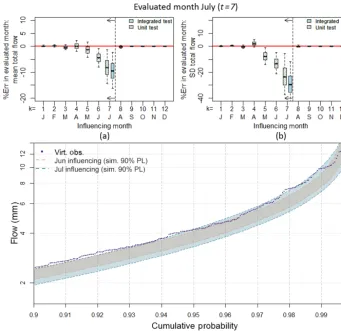
May are the influencing month. Therefore, to improve July flows, it is not just the July rainfall that should be improved, but also the preceding 2 months.
This need to improve July and preceding months is also illustrated via Fig. 10c where the July daily flow duration curves are shown for the cases where June (orange shading) and July (blue shading) are the influencing months compared against the virtual-observed July flow duration curve (purple dots). For both cases the virtual-observed flow duration curve is located outside the 90 % limits of the flow duration curves resulting from the unit testing procedure.
Typically, “wetting-up” and “wettest” months fall in this case where streamflow errors originate from rainfall model deficiencies over a contiguous block of months, approxi-mately 40 % of the site/month combinations.
4.3.3 Streamflow errors originate from rainfall model deficiencies in a preceding month more so than evaluated month
An example of the case where the largest contribution to streamflow errors arises from rainfall deficiencies in a
pre-ceding month is provided by Site 10, where July is selected as the evaluated month. July is selected as an illustrative case for application of the unit test since it shows biased flow (see Fig. 11c and d), but did not show any bias in the simulated rainfall (see Fig. 11a and b).
The largest contributor to error in July flow is not July rain-fall but June rainrain-fall (Fig. 12a and b). That is, the largest er-rors occur when there is observed rainfall for July spliced with simulated rainfall for June. In contrast, simulated July rainfall spliced with observed rainfall in other months yields a smaller median error. This deficiency in June rainfall can also be seen in an examination of the July flow duration curves (Fig. 12c) where the virtual-observed flow duration curve sits within the 90 % limits of the simulated flow dura-tion curve where July is designated as the influencing month, whereas when June is designated as the influencing month the virtual-observed flow duration curve sits outside the 90 % limits for a number of the higher flow days.
Figure 10.Lobethal, Site 12(a)unit test error in mean monthly total flow (July), and(b)unit test error in standard deviation of monthly total flow (July),(c)July flow duration curve when June and July are selected as influencing months in unit test (top 10 % of flow days shown). Boxplot whiskers indicate the 90 % limits of the simulated streamflow replicates.
[image:13.612.113.484.482.658.2]Figure 12.Happy Valley, Site 10(a)unit test error in mean monthly flow (July),(b)unit test error in standard deviation of monthly flow (July), and(c)July flow duration curve when June and July are selected as influencing months in the unit test (top 10 % of flow days shown). Boxplot whiskers indicate the 90 % limits of the simulated streamflow replicates.
deficiencies in a preceding month represents about 10 % of the evaluated site/month combinations (i.e. those identified in Step 2).
4.3.4 Influence of monthly rainfall on annual flow volumes
While annual simulated rainfall was unbiased, annual simu-lated streamflow was biased. An illustration of how errors in annual total streamflow arise from deficiencies in simulated rainfall is shown for Site 10. Figure 13a and b show that when the months of May to August are assessed as the influenc-ing month they produce the largest errors in distribution of annual total flow for Site 10. Splices of other months do not significantly degrade the simulation of total annual flow. This deficiency can also be seen via an examination of the flow ration curve (Fig. 13c) in which the virtual-observed flow du-ration curve is located outside portions of the simulated flow duration curves where May or June are designated as the in-fluencing month. Improvements to the simulation of annual total flow will therefore come from improving the SRM in the “wetting-up” and wettest months of the seasonal cycle
(May to August). This insight from the use of unit testing would be difficult to obtain using other evaluation strategies (further discussed in Sect. 5.2).
5 Discussion
5.1 The importance of streamflow-based evaluation Streamflow arises from the integration of rainfall processes (e.g. rainfall amounts, occurrences and wet-dry patterns) over a catchment. Features of the catchment, such as catch-ment storage, thresholds and nonlinearities in the rainfall– streamflow response function, can either act to amplify or dampen the rainfall errors at different times of the year. These behaviours were clearly identified and demonstrated in Step 2 of the virtual hydrological evaluation framework that compares observed-rainfall evaluation and virtual hydrolog-ical evaluation (see Sect. 4.2).
Figure 13.Happy Valley, Site 10(a)unit test error in mean annual total flow, and(b)unit test error in standard deviation of annual total flow, and(c)annual flow duration curve when May and June are selected as influencing months in unit test (top 10 % of flow days shown). Boxplot whiskers indicate the 90 % limits of the simulated streamflow replicates.
Given that the rainfall elasticity of streamflow to rainfall is a factor of 2 to 3.5 (Chiew, 2006), using the principles of error propagation (Ang and Tang, 2007), assuming linear-ity it follows that a 10 % error in mean/standard deviation of rainfall could potentially be amplified to 20 %–35 % error in the mean/standard of streamflow. This estimate represents a lower-bound of the potential amplification, since the non-linear nature of the rainfall-runoff transformation will likely produce a larger potential amplification of errors. This in-dicates that streamflow-based evaluation of rainfall models provides a stronger test than observed-rainfall evaluation in terms of the sensitivity of the statistics. For example, Fig. 7 shows that July rainfall statistics were classified as “good”, yet despite this, the streamflow response was “poor” (see Sect. 4.2 for further discussion). It could be argued that the rainfall results presented in Fig. 7 were classified as “good” because the observed-rainfall evaluation was limited, but the evaluation was methodical and used a comprehensive range of daily and monthly statistics (Bennett et al., 2018). While many rainfall statistics were preserved (means, standard de-viation, extremes, marginal distributions of daily rainfall) the rainfall–streamflow response of the catchment exposes that
there are deficiencies in the rainfall model not clearly identi-fied by the observed-rainfall evaluation (Bennett et al., 2018). In terms of dampened influence, catchment storages and high evapotranspiration can also act to suppress errors in the rainfall simulations. For example, Fig. 7 showed that the vari-ability in the number of wet days, SD(nwet), was “poor” for all sites in January, yet this did not result in “poor” stream-flow. The high potential evapotranspiration in January indi-cates that the majority of rainfall in January is converted into actual evapotranspiration yielding little streamflow. Hence, any errors in rainfall do not noticeably impact on January streamflow.
con-trast, observed-streamflow evaluation is typically hampered by difficulties in separating the impact of data errors, hydro-logical model predictive performance from the errors in the SRM. A further benefit is the ability to undertake streamflow-based evaluation at any site where rainfall is observed and simulated. This enables insights into the SRM performance for simulating streamflow on a site-by-site basis.
The use of a virtual hydrological framework for evalua-tion provides the unique opportunity to develop innovative tests that can target specific aspects of the SRM. This paper introduces an innovative unit test that was used as a method for isolating the influence of rainfall in a month (i.e. the in-fluencing month) on streamflow in an evaluated month while excluding the possibility of deficiencies from other rainfall months. The test enables a procedure for targeting months that are influential in terms of streamflow production rather than interpreting model performance based on blunt evalua-tion of rainfall or streamflow.
This unit test provides added value over and above the integrated test because it identifies which are the influenc-ing months that have deficiencies in the modelled rain-fall that produce poor streamflow predictions. For example, Sect. 4.3.2 illustrated that while the integrated test identi-fied that there was poor streamflow in July for Site 12, the unit test was able to identify that the simulated rainfall in the prior influencing months of both May and June (Fig. 10) made significant contributions (10 %–15 % errors) to July’s poor streamflow. A second example is shown in the influence of monthly rainfall on the errors in annual flow volumes in Sect. 4.3.4. If the modeller had focussed on improving the SRM by focusing on months with the highest contribution to annual total flow, July to September would have been identi-fied as important, whereas the unit test identifies a different focus (May–August). The unit tests in Sect. 4.3.4 show that May and June combined make up 13 % of the total annual flow volume (Fig. 11c). However, they contribute to 11 % of the error in the mean annual total flow (Fig. 13a) and 24 % er-ror in the standard deviation (Fig. 13b). By contrast, Septem-ber is a high-flow month contributing 21 % of the annual total flow, but only 2 % error in the mean and 6 % error in the stan-dard deviation. Without the unit test, it would have been less clear that the “wetting-up” months such as May and June were a more important focus for SRM improvement than a high-flow month such as September.
5.3 Identifying key deficiencies in the rainfall properties of the SRM
The previous section highlighted that simulated rainfall in the “wetting-up” period May–June was a key cause of errors in the streamflow. Returning to the observed-rainfall evaluation of the SRM (see Fig. 7) enables identification of the rainfall properties that are likely to be the cause of these errors in the streamflow. In the May–June months, the mean and standard deviation of rainfall amounts on wet days and the mean
num-ber of wet days show 100 % “good” performance, while the standard deviation of the number of wet days shows a high proportion of sites with “poor” performance (50 % of sites in May and 40 % of sites in June). This identifies that rain-fall amounts on wet days are reproduced well, but there is not enough variability in the rainfall occurrences in the key months of May–June. The observed-rainfall evaluation iden-tifies that this is a common problem for this SRM, with 8 months having some proportion of “poor” sites for the stan-dard deviation of the number of wet days – similar results were found in Bennett et al. (2018). However, the virtual hy-drological evaluation identified that it is the rainfall occur-rences in 2 key months (May and June) that will provide the most benefit in terms of virtual hydrological evaluation. This provides clear guidance on the rainfall properties that need to be improved for this SRM.
5.4 Limitations and future research
The virtual hydrological framework for SRM evaluation pro-vides an opportunity for further improvements in the future to substantially augment the framework’s diagnostic capabil-ities, including the following.
i. Using multiple, well-tested hydrological models – a po-tential limitation of the virtual hydrologic evaluation framework is that it is reliant on the use of a single hydrological model. Hydrological model structural er-rors may potentially skew interpretation of the SRM evaluation if the hydrological model poorly represents the catchment processes. To reduce these impacts the steps taken in this study included (a) using a well-tested hydrological model that has demonstrated good perfor-mance on a wide range of catchments (e.g. the GR4J model has been widely tested – see Perrin et al., 2003 and Coron et al., 2012); and (b) calibrating and evalu-ating the hydrological model on a catchment close to the observed rainfall sites to ensure it provided suffi-ciently good performance (e.g. GR4J was calibrated to the Onkaparinga catchment – see Westra et al., 2014b, a). Future research will use multiple, well-tested hydro-logical models with sufficiently good performance to re-duce the reliance on a single hydrological model and to ensure the identification of SRM deficiencies is not de-pendent on a single hydrological model.
have monthly/seasonal autocorrelation (these were not significant for the rainfall in the Onkaparinga catch-ment), the unit testing approach would need to be ex-tended by conditionally sampling the simulated rainfall in a manner that preserves monthly correlations. iii. Evaluation of temporal non-stationarity – this
frame-work can be extended to evaluate the impact of non-stationarity on SRM model performance by applying it on a selected non-stationary period. Care would be needed in the selection of statistics to identify model performance (since the performance in different sub-periods could be masked when evaluating an overall period). A related issue is that the hydrological model should provide adequate performance across the range of non-stationary climate forcings to which it is sub-jected.
iv. Evaluation of spatial performance – there are multi-ple opportunities to develop tests for spatial perfor-mance, including (a) repeating the integrated test for all sites, and for catchment average rainfall means it would be possible to diagnose whether specific loca-tions or the spatial dependence cause poor reproduc-tion of streamflow statistics; (b) developing a spatial unit test (which is analogous to the temporal unit test but extended to space) where different combinations of sites are “spliced” in the construction of catchment av-erage rainfall – to evaluate the impact of “mixed” per-formance in the SRMs between sites on the catchment average rainfall; and (c) these spatial unit tests could be used to evaluate stochastic weather generators more generally as well as spatially distributed rainfall genera-tors – though these would require a spatially distributed hydrological model.
v. Evaluation of SRMs at subdaily timescales – this ex-tension to evaluate SRMs at other timescales provides opportunities for the development of further unit test variants that focus on a range of different aspects of subdaily rainfall (intensity, duration, persistence) and its impact on streamflow characteristics of interest (e.g. subdaily flow peaks). This extension would require the use of a well-tested continuous subdaily hydrological model capable of simulating the relevant streamflow characteristics.
6 Conclusions
This paper has introduced a virtual hydrologic evaluation framework that enables targeted hydrological evaluation of SRMs. The framework formalises virtual streamflow investi-gations by (1) using a comprehensive and systematic evalu-ation approach to evaluate performance and (2) introducing two key innovations, an integrated test and a unit test. The
integrated test compares simulated streamflow and virtual-observed streamflow to detect overall deficiencies in the ability of at-site simulated rainfall to reproduce streamflow statistics. The unit test enables the attribution of detected streamflow errors to specific months of simulated rainfall. The integrated and unit tests enabled different conclusions to be reached in terms of priorities for improving the SRM. These conclusions would not otherwise have been possible with conventional evaluation methods that focus either on rainfall statistics or on high-streamflow months. The inte-grated test demonstrated that while large discrepancies were identified in low rainfall months, these did not translate to deficiencies in streamflow due to the dry state of the catch-ment. The test also indicated instances where simulated rain-fall categorised as “good” translated to “poor” flow due to the influence of catchment “memory” and rainfall from prior months. The unit test identified the importance of the simu-lated rainfall in the transition months of May and June (late autumn/early winter) during the “wetting-up” phase of the catchment cycle for producing low errors in subsequent high-streamflow months (July/August/September) and the annual streamflow distribution. The virtual hydrological evaluation framework provides valuable additional diagnostic ability for the development and application of SRMs not available by using rainfall-based evaluation techniques alone.
Data availability. All the data used in this study can be re-quested by contacting the corresponding author Bree Bennett at [email protected].
Supplement. The supplement related to this article is available on-line at: https://doi.org/10.5194/hess-23-4783-2019-supplement.
Author contributions. BBe conceived and executed the analysis, with input from MT, MLe, MLa, and BBa. MT, MLe, MLa, and BBa contributed to assisting with method development, interpreta-tion, and analysis. BBe, MT, and MLe mostly wrote, reviewed, and revised the paper.
Competing interests. The authors declare that they have no conflict of interest.
Financial support. This research has been supported by the Aus-tralian Research Council (grant no. DP1094796).
Review statement. This paper was edited by Nadav Peleg and re-viewed by Hannes Müller-Thomy and two anonymous referees.
References
Andreassian, V., Perrin, C., Michel, C., Usart-Sanchez, I., and Lavabre, J.: Impact of imperfect rainfall knowledge on the effi-ciency and the parameters of watershed models, J. Hydrol., 250, 206–223, 2001.
Ang, A. and Tang, W.: Probability Concepts in Engineering: Em-phasis on Applications to Civil and Environmental Engineering (2nd Edition), John Wiley & Sons Inc, Hoboken, New Jersey, USA, ISBN 10 0-471-72064-X, 2007.
Ball, J. E.: The influence of storm temporal patterns on catchment response, J. Hydrol., 158, 285–303, 1994.
Baxevani, A. and Lennartsson, J.: A spatiotemporal precipitation generator based on a censored latent Gaussian field, Water Resour. Res., 51, 4338–4358, https://doi.org/10.1002/2014WR016455, 2015.
Bennett, B., Thyer, M., Leonard, M., Lambert, M., and Bates, B.: A comprehensive and systematic evaluation framework for a parsi-monious daily rainfall field model, J. Hydrol., 556, 1123–1138, 2018.
Blazkova, S. and Beven, K.: Flood frequency estimation by contin-uous simulation for a catchment treated as ungauged (with un-certainty), Water Resour. Res., 38, 14-11–14-14, 2002.
Blazkova, S. and Beven, K.: A limits of acceptability approach to model evaluation and uncertainty estimation in flood fre-quency estimation by continuous simulation: Skalka catch-ment, Czech Republic, Water Resour. Res., 45, W00B16, https://doi.org/10.1029/2007WR006726, 2009.
Camici, S., Tarpanelli, A., Brocca, L., Melone, F., and Moramarco, T.: Design soil moisture estimation by comparing continuous and storm-based rainfall-runoff modeling, Water Resour. Res., 47, W05527, https://doi.org/10.1029/2010WR009298, 2011. Chiew, F. H.: Estimation of rainfall elasticity of streamflow in
Aus-tralia, Hydrolog. Sci. J., 51, 613–625, 2006.
Coron, L., Andreassian, V., Perrin, C., Lerat, J., Vaze, J., Bourqui, M., and Hendrickx, F.: Crash testing hydrological models in contrasted climate conditions: An experiment on 216 Australian catchments, Water Resour. Res., 48, W05552, https://doi.org/10.1029/2011WR011721, 2012.
Coxon, G., Freer, J., Westerberg, I., Wagener, T., Woods, R., and Smith, P.: A novel framework for discharge uncertainty quantifi-cation applied to 500 UK gauging stations, Water Resour. Res., 51, 5531–5546, 2015.
Evin, G., Thyer, M., Kavetski, D., McInerney, D., and Kuczera, G.: Comparison of joint versus postprocessor approaches for hydro-logical uncertainty estimation accounting for error autocorrela-tion and heteroscedasticity, Water Resour. Res., 50, 2350–2375, 2014.
Evin, G., Favre, A.-C., and Hingray, B.: Stochastic generation of multi-site daily precipitation focusing on extreme events,
Hy-drol. Earth Syst. Sci., 22, 655–672, https://doi.org/10.5194/hess-22-655-2018, 2018.
Henley, B. J., Thyer, M. A., and Kuczera, G.: Climate driver in-formed short-term drought risk evaluation, Water Resour. Res., 49, 2317–2326, 2013.
Khedhaouiria, D., Mailhot, A., and Favre, A.-C.: Daily Precipita-tion Fields Modeling across the Great Lakes Region (Canada) by Using the CFSR Reanalysis, J. Appl. Meteorol. Clim., 57, 2419– 2438, 2018.
Kim, D. and Olivera, F.: Relative importance of the different rain-fall statistics in the calibration of stochastic rainrain-fall generation models, J. Hydrol. Eng., 17, 368–376, 2011.
Kuczera, G. and Williams, B. J.: Effect of rainfall errors on accuracy of design flood estimates, Water Resour. Res., 28, 1145–1154, 1992.
Li, J., Thyer, M., Lambert, M., Kuczera, G., and Metcalfe, A.: An efficient causative event-based approach for deriving the annual flood frequency distribution, J. Hydrol., 510, 412–423, 2014. Li, J., Thyer, M., Lambert, M., Kuzera, G., and Metcalfe, A.:
In-corporating seasonality into event-based joint probability meth-ods for predicting flood frequency: A hybrid causative event ap-proach, J. Hydrol., 533, 40–52, 2016.
McInerney, D., Thyer, M., Kavetski, D., Lerat, J., and Kuczera, G.: Improving probabilistic prediction of daily streamflow by iden-tifying Pareto optimal approaches for modeling heteroscedastic residual errors, Water Resour. Res., 53, 2199–2239, 2017. McMillan, H. K. and Brasington, J.: End-to-end flood
risk assessment: A coupled model cascade with un-certainty estimation, Water Resour. Res., 44, W03419, https://doi.org/10.1029/2007WR005995, 2008.
Mortazavi-Naeini, M., Kuczera, G., Kiem, A. S., Cui, L., Henley, B., Berghout, B., and Turner, E.: Robust optimization to secure urban bulk water supply against extreme drought and uncertain climate change, Environ. Modell. Softw., 69, 437–451, 2015. Müller, H. and Haberlandt, U.: Temporal rainfall disaggregation
us-ing a multiplicative cascade model for spatial application in ur-ban hydrology, J. Hydrol., 556, 847–864, 2018.
Nicótina, L., Alessi Celegon, E., Rinaldo, A., and Marani, M.: On the impact of rainfall patterns on the hy-drologic response, Water Resour. Res., 44, W12401, https://doi.org/10.1029/2007WR006654, 2008.
Paschalis, A., Molnar, P., Fatichi, S., and Burlando, P.: A stochastic model for high-resolution space-time precipitation simulation, Water Resour. Res., 49, 8400–8417, 2013.
Paton, F. L., Maier, H. R., and Dandy, G. C.: Relative magnitudes of sources of uncertainty in assessing climate change impacts on water supply security for the southern Adelaide water supply sys-tem, Water Resour. Res., 49, 1643–1667, 2013.
Perrin, C., Michel, C., and Andréassian, V.: Improvement of a parsi-monious model for streamflow simulation, J. Hydrol., 279, 275– 289, 2003.
Rasmussen, P.: Multisite precipitation generation using a latent au-toregressive model, Water Resour. Res., 49, 1845–1857, 2013. Renard, B., Kavetski, D., Leblois, E., Thyer, M., Kuczera, G., and
Shah, S. M. S., O’Connell, P. E., and Hosking, J. R. M.: Modelling the effects of spatial variability in rainfall on catchment response. 2. Experiments with distributed and lumped models, J. Hydrol., 175, 89–111, 1996.
Sikorska, A. E., Viviroli, D., and Seibert, J.: Effective precipitation duration for runoff peaks based on catchment modelling, J. Hy-drol., 556, 510–522, 2018.
Srikanthan, R. and Pegram, G. G. S.: A nested multisite daily rain-fall stochastic generation model, J. Hydrol., 371, 142–153, 2009. Westra, S., Thyer, M., Leonard, M., Kavetski, D., and Lambert, M.: Impacts of climate change on surface water in the Onka-paringa catchment – volume 1: hydrological model development and sources of uncertainty, Goyder Institute for Water Research Technical Report Series No. 14/22, Adelaide, South Australia, 1839–2725, 2014a.
Westra, S., Thyer, M., Leonard, M., Kavetski, D., and Lambert, M.: A strategy for diagnosing and interpreting hydrological model nonstationarity, Water Resour. Res., 50, 5090–5113, 2014b. Wilks, D. S.: High-resolution spatial interpolation of weather
gen-erator parameters using local weighted regressions, Agr. Forest Meteorol., 148, 111–120, 2008.