S T U D Y P R O T O C O L
Open Access
Efficacy of acupuncture for chronic knee pain:
protocol for a randomised controlled trial using a
Zelen design
Rana S Hinman
1*, Paul McCrory
1, Marie Pirotta
2, Ian Relf
2, Kay M Crossley
3, Prasuna Reddy
4, Andrew Forbes
5,
Anthony Harris
6, Ben R Metcalf
1, Mary Kyriakides
1, Kitty Novy
2and Kim L Bennell
1Abstract
Background:Chronic knee pain is a common and disabling condition in people over 50 years of age, with knee joint osteoarthritis being a major cause. Acupuncture is a popular form of complementary and alternative medicine for treating pain and dysfunction associated with musculoskeletal conditions. This pragmatic Zelen-design
randomised controlled trial is investigating the efficacy and cost-effectiveness of needle and laser acupuncture, administered by medical practitioners, in people with chronic knee pain.
Methods/Design:Two hundred and eighty two people aged over 50 years with chronic knee pain have been recruited from metropolitan Melbourne and regional Victoria, Australia. Participants originally consented to participate in a longitudinal natural history study but were then covertly randomised into one of four treatment groups. One group continued as originally consented (ie natural history group) and received no acupuncture treatment. The other three were treatment groups: i) laser acupuncture, ii) sham laser or, iii) needle acupuncture. Acupuncture treatments used a combined Western and Traditional Chinese Medicine style, were delivered by general practitioners and comprised 8–12 visits over 12 weeks. Follow-up is currently ongoing. The primary outcomes are pain measured by an 11-point numeric rating scale (NRS) and self-reported physical function measured by the Western Ontario and McMaster (WOMAC) Universities Osteoarthritis Index subscale at the completion of treatment at 12 weeks. Secondary outcomes include quality of life, global rating of change scores and additional measures of pain (other NRS and WOMAC subscale) and physical function (NRS). Additional
parameters include a range of psychosocial measures in order to evaluate potential relationships with acupuncture treatment outcomes. Relative cost-effectiveness will be determined from health service usage and outcome data. Follow-up assessments will also occur at 12 months.
Discussion:The findings from this study will help determine whether laser and/or needle acupuncture is efficacious, and cost-effective, in the management of chronic knee pain in older people.
Trial registration:Australian New Zealand Clinical Trials Registry reference: ACTRN12609001001280
Background
Chronic knee pain is a common and disabling condition, particularly in people over 50 years of age [1,2]. Knee joint osteoarthritis (OA) is a major cause of knee pain and results in loss of functional independence, psycho-logical impairment and a reduction in the overall
quality-of-life of affected individuals. In addition to the personal burden of knee OA, there are substantial direct and indirect health care costs particularly in terms of employment status, productivity and joint replacement surgery, making knee OA a substantial public health problem.
Management of knee OA is primarily focused on treat-ing the pain and disability associated with the condition, with non-pharmacological therapies considered the cornerstone of treatment [3]. Acupuncture is a popular treatment for pain and dysfunction associated with * Correspondence:[email protected]
1Centre for Health, Exercise and Sports Medicine, Department of
Physiotherapy, School of Health Sciences, Faculty of Medicine Dentistry & Health Sciences, The University of Melbourne, Melbourne, VIC, AUSTRALIA Full list of author information is available at the end of the article
musculoskeletal conditions. A study of 350 rheumatol-ogy patients in the United Kingdom revealed that 61% of those with OA had used acupuncture [4]. In clinical practice, a range of health professionals administer or refer patients for acupuncture. In Australia, acupuncture by medical practitioners has been established for 40 years and has gained widespread patient acceptance in the community. We have found that over 80% of surveyed general medical practitioners referred patients for acu-puncture [5] and that they generally consider acupunc-ture to be highly effective and safe [6]. Amongst all complementary and alternative medicine modalities, acupuncture is associated with the highest average annualised expenditure [7]. Thus research to determine its efficacy and cost-effectiveness is warranted.
Acupuncture traditionally involves the insertion of fine needles into specific points of the body. According to the ancient philosophy of traditional Chinese acupunc-ture, energy circulates in 12’meridians’located through-out the body. Pain or ill health will result if the meridian energy circulation is blocked. Stimulating the appropri-ate combination of meridian acupuncture points in the body can restore energy circulation, health, and balance [8]. From a Western medicine perspective, acupuncture is a technique of peripheral sensory stimulation (through activation of peripheral A-delta and C fibres) applied at acupuncture points and/or trigger points that can acti-vate central nervous system pain pathways, release spe-cific pain relieving substances as well as reduce muscle and sympathetic nervous system tonicity [9,10].
In recent years there has been a substantial increase in the number of randomised controlled trials (RCTs) in-vestigating the efficacy of needle acupuncture for chronic knee pain. A recent meta-analysis concluded that while placebo-controlled trials show statistically sig-nificant benefits for pain, the benefits are small and un-likely to be clinically relevant [8]. Waiting list-controlled trials however suggest statistically significant and clinic-ally relevant benefits, which may be due to expectation or placebo effects. Accordingly, well-designed rigorous RCTs are needed that control for both placebo and ex-pectation effects in order to evaluate the efficacy of acu-puncture for chronic knee pain.
Although acupuncture has been traditionally adminis-tered with needles, the use of laser acupuncture has increased because of its pain-free nature and minimal adverse effects [11]. Laser acupuncture involves the ap-plication of low-level laser, which is a form of electro-magnetic radiation in the visible or infrared region of the light spectrum. These laser devices are manufactured with such low energy densities that photo-chemical changes are elicited without photo-thermal effects. Within these ranges, various energy levels and wave-lengths can be used depending on the tissue penetration
required. In laser acupuncture, the beam of light gener-ated is applied to the skin at acupuncture points and/or trigger points, similar to the application of needles.
Laser acupuncture effects are thought to alter periph-eral afferent nerve stimulation, modulating spinal cord afferent input on second order neurons and enhancing peripheral endogenous opioid analgesia [12] as well as acting via centrally mediated mechanisms. Laser also has effects at the local cellular and tissue level [13] with evi-dence of modulation of inflammatory processes [14] varying according to laser dosage [15].
In contrast to needle acupuncture, the efficacy of laser acupuncture has been less well studied in the manage-ment of chronic knee pain. In general, RCTs have used small sample sizes and variable laser dosages in terms of wavelength, total energy, application sites and number of treatments. In a meta-analysis of eight trials published up until 2006 investigating the short-term efficacy (within 4 weeks) of laser therapy for knee OA, statisti-cally and potentially clinistatisti-cally significant pain-relieving benefits over placebo were found [11]. The effect was greater when only trials evaluating an optimal dosage and administration were included. Since this meta-analysis, two other small studies have been published providing further support for the use of laser acu-puncture in chronic knee pain [16,17].
It is not clear whether differences in efficacy exist be-tween laser and needle acupuncture given that there are no direct head-to-head comparisons of needle and laser acupuncture for chronic knee pain., However, in a sys-tematic review, laser but not needle acupuncture offered statistically and clinically significant short-term pain re-lief over placebo [11]. Similarly, a meta-analysis found that treatment with laser acupuncture had better pain outcomes in the medium-term, although not short-term, than treatment with needle acupuncture in people with non-specific neck pain [18]. These studies suggest that laser acupuncture may be at least as effective, if not more effective, than needle acupuncture.
In designing appropriate clinical trials, a methodo-logical concern in acupuncture trials has been the difficulty in having a true placebo control group given pre-existing participant expectations, particularly where the treatment itself is multidimensional involving therapist-patient interaction as well as an intervention [21]. A meta-analysis has confirmed a significant placebo effect for the treatment of pain in knee OA that varies in size depending on the intervention [22]. For acupunc-ture, the placebo effect size (mean 0.71 (95% confidence interval 0.53, 0.90)) was higher than the overall effect size for all placebo treatments (0.51 (0.46, 0.55)). As with many treatments, higher patient expectation has been shown to be associated with greater improvements fol-lowing acupuncture treatment. A pooled analysis of four clinical trials of acupuncture found that after completion of treatment, the odds ratio for response between patients considering acupuncture an effective or highly effective therapy and patients who were more sceptical was 1.67 (95% confidence interval 1.20-2.32) [23]. The use of “sham needle” acupuncture as a placebo control, whereby needling is performed superficially or at non-acupuncture sites, is controversial given that such a pro-cedure may still produce biological responses and hence may not be truly placebo. Blinding of clinicians adminis-tering needle acupuncture is also problematic. Such methodological difficulties can be overcome in trials of laser acupuncture as it is possible to successfully blind both participants and clinicians by using specially designed laser machines [24].
First described by Zelen in the New England Journal of Medicine in 1979 [25], Zelen design trials are a means of reducing bias by minimizing participant expectations in a treatment trial where the knowledge of the interven-tion itself may influence the study outcome (Hawthorne effect) in the control group. This is done by enrolling participants into an observational study but covertly ran-domising participants following their recruitment into a treatment trial (post-randomised consent). The control group remains unaware of the treatment being evaluated [26]. Such a design has been used successfully in a study comparing a physiotherapy treatment of exercise and knee taping to standard non-physiotherapy treatment in people with predominant patellofemoral OA [27]. A po-tential disadvantage of the Zelen design can be a higher crossover rate than a usual RCT which may dilute treat-ment effects in an intention-to-treat analysis. However, a review of 58 RCTs using the Zelen design found that while most trials (n = 41) experienced some crossover from one group to the other (median crossover = 8.9%, interquartile range 2.6% to 15%) the rate was usually within acceptable limits [26].
Thus, we are currently conducting a Zelen design RCT to investigate the efficacy of needle and laser
acupuncture administered by experienced medical acu-puncturists in people with chronic knee pain and to evaluate maintenance of effects over the longer term. We will also evaluate the cost-effectiveness of needle and laser acupuncture, as well as explore whether psy-chosocial measures are associated with changes in pain, physical function and health-related quality of life fol-lowing acupuncture treatment. This paper describes the protocol for this ongoing trial.
The primary hypotheses are that:
H1: Laser acupuncture will result in significantly greater improvements in pain (as measured overall via numerical rating scale (NRS)) and physical function (as measured via Western Ontario and McMaster (WOMAC) Universities Osteoarthritis Index) than sham laser acupuncture at 12 weeks. H2: Laser and needle acupuncture will result in
significantly greater improvements in pain (as measured overall via NRS and physical function (as measured via WOMAC) than no treatment at 12 weeks.
H3: Laser acupuncture will result in significantly greater improvements in pain (as measured overall via NRS) and physical function (as measured via WOMAC) than needle acupuncture at 12 weeks.
The secondary hypotheses are that:
H4: Sham laser acupuncture will result in significantly greater improvements in pain (as measured overall via NRS) and physical function (as measured via WOMAC) than no treatment at 12 weeks. H5: Laser, sham laser and needle acupuncture will
result in significantly greater improvements in pain (as measured overall via NRS) and physical function (as measured via WOMAC) than no treatment at 12 months, while laser acupuncture will result in significantly greater improvements than needle acupuncture.
H6: Laser, sham laser and needle acupuncture will result in significantly greater improvements in pain (as measured on standing and walking via NRS and by WOMAC), physical function (as measured via NRS) and health-related quality of life than no treatment at 12 weeks and 12 months.
H7: Laser acupuncture will result in significantly greater improvements in pain (as measured on standing and walking via NRS and by WOMAC), physical function (as measured via NRS) and health-related quality of life than needle acupuncture at 12 weeks and 12 months. H8: A greater proportion of people receiving laser,
global overall improvements compared to no treatment at 12 weeks and 12 months. H9: A greater proportion of people receiving laser
acupuncture will report global overall
improvements compared to needle acupuncture at 12 weeks and 12 months.
Methods/Design
Trial design
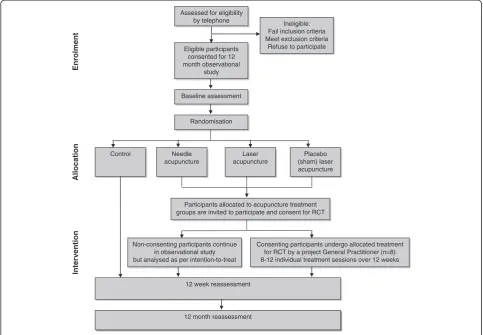
A two-stage Zelen design RCT [25,28] which conforms to CONSORT [29] and STRICTA guidelines [30] for acupuncture studies (Figure 1).
Participants
A total of 282 men and women with chronic knee pain have been recruited from the community in metropol-itan Melbourne and regional Victoria, Australia. A num-ber of recruitment strategies were used including (i) advertisements in local clubs, community centres, news-papers, Arthritis Australia and University websites, Uni-versity staff newsletters, radio, television, and a social networking site; (ii) placement of brochures and study posters in medical and physiotherapy clinics; and (iii)
presentations about knee OA in the local community by the researchers.
People were eligible to participate if they (i) were aged >50 years; (ii) had a history of knee pain of >3 months duration; (iii) reported knee pain on most days of the past month; (iv) reported an average knee pain severity over the past month of≥4 out of 10 on an 11-point NRS and; (v) reported morning knee stiffness of <30 minutes duration.
Exclusion criteria included: (i) history of any systemic arthritic condition; (ii) history of knee arthroplasty on the most painful knee; (iii) wait-listed for any knee surgery for either knee; (iv) history of any knee surgery in previous 6 months; (v) any other condition affecting lower limb function (eg trauma, malignancy, neurological condition); (vi) history of any knee injection in past 6 months (eg cor-tisone, hyaluronic acid); (vii) current use of oral or inject-able anticoagulant medication; (viii) use of acupuncture in past 12 months; (ix) any bleeding disorder; (x) allergy to light; (xi) referral to pain clinic or use of morphine or pethadine within past 6 months; (xii) any other medical condition precluding participation in the trial (eg kidney or liver disease, deep vein thrombosis); (xiii) knee pain
Allocation
Enrolment
Intervention
Non-consenting participants continue in observational study but analysed as per intention-to-treat
12 week reassessment
12 month reassessment
Control Needle
acupuncture
Placebo (sham) laser acupuncture Laser
acupuncture Randomisation
Assessed for eligibility
by telephone Ineligible:
Fail inclusion criteria Meet exclusion criteria
Refuse to participate
Baseline assessment Eligible participants consented for 12 month observational
study
Participants allocated to acupuncture treatment groups are invited to participate and consent for RCT
[image:4.595.56.540.383.718.2]Consenting participants undergo allocated treatment for RCT by a project General Practitioner (n=8) 8-12 individual treatment sessions over 12 weeks
subject to compensation claim or; (xiv) unable to give written informed consent.
Although both knees could undergo treatment as part of the project, only the most symptomatic knee as nomi-nated by the participant at enrolment was evaluated.
Procedure
Figure 1 depicts the trial protocol. Eligibility of prospective participants was determined over the telephone by an in-vestigator (MK) not involved in assessment or treatment of participants. Ethical approval was obtained from the University of Melbourne Human Research Ethics Com-mittee (HREC No. 0931840). All participants provided written informed consent. Initially, all participants con-sented to participate in a longitudinal observational nat-ural history study of chronic knee pain, involving assessments at baseline, 12 weeks and 12 months. All assessments, comprised solely of questionnaires, are com-pleted by participants at home and mailed back to the University of Melbourne, where data is entered by a blinded assessor (MK).
Upon receipt of completed baseline questionnaires, an investigator (KN) accessed the computerised covert ran-domisation schedule to reveal whether the participant was allocated either (i) laser acupuncture (could be ei-ther real laser or sham laser but the investigator and participant are blinded to this information); (ii) needle acupuncture or; (iii) no treatment (control group). Parti-cipants randomised into the no treatment arm continue as consented in the natural history observational cohort for the 12 month duration of the study and did not undergo (or are made aware of ) any intervention as part of the trial. Participants randomised to receive either laser or needle acupuncture were telephoned by an in-vestigator (KN) and offered the opportunity to undergo the allocated intervention and contribute their data to the trial. Participants allocated to the laser groups were informed they may receive either real laser or sham laser and that this has been randomly pre-determined and would not be revealed to them until the completion of the 12 month assessments. Participants willing to par-ticipate in the intervention provided informed consent to do so at this point. Participants who choose not to participate in the intervention continued as initially con-sented in the natural history observational cohort for 12 months, however their data will be analysed as per intention-to-treat.
Participants who were randomised to receive acupunc-ture had treatment visits arranged with a project general practitioner (GP) for treatment over 12 weeks. All study participants, including those allocated to the no treat-ment group and those who were randomised to receive treatment but declined to do so, undergo re-assessment at 12 weeks and again at 12 months.
Randomisation and allocation concealment
The randomisation schedule was prepared by the study biostatistician (AF). All eligible participants were consecu-tively randomised into either the (i) real laser acupuncture; (ii) sham laser acupuncture; (iii) needle acupuncture or; (iv) no treatment group. Allocation was randomised within random permuted blocks of six to twelve generated a priori and stratified according to treating GP so that all GPs delivered approximately equal numbers in each acu-puncture group to control for therapist variation. An elec-tronic password-protected spreadsheet that contained concealed acupuncture group allocation was prepared by a researcher (BM) with no other involvement in the study, and held by an investigator (MP) not involved in recruit-ment, assessment or treatment. The patient code numbers for the randomised laser treatment arms were entered into the study laser machines by an independent biomedical engineer, in order to permit blinding of both the treating GPs and the participants.
Blinding
Laser and sham laser participants were blinded to treat-ment allocation, as were the GPs administering laser and sham laser acupuncture, as the same machine provided both interventions and the participant code (entered by the GP) determined whether the machine actually out-putted laser or not [24]. Participants in the no treatment group are unaware that the treatment groups exist and that their data will be used for comparison (despite hav-ing consented to their longitudinal data behav-ing used for other unspecified research questions as determined by the researchers). Only the participants undergoing nee-dle acupuncture and the GP provider were unblinded to their treatment group allocation.
Interventions
acupuncture experience. None had less than 10 years acu-puncture experience.
The GPs attended a four-hour training session run by an investigator (IR) who is an experienced medical acu-puncturist, to standardise all aspects of the treatment protocol. This same investigator maintained regular con-tact with the GPs throughout the trial to answer any treatment-related questions and ensure compliance. Each GP was provided with a detailed treatment manual de-scribing administration of the acupuncture interventions as well as the trial protocol. GPs were supplied with a pre-coded laser machine (custom-designed to deliver both real and sham laser) and standardized needles required for administering the acupuncture interventions.
Acupuncture treatments (approximately 20 minutes in duration) were administered once or twice weekly (at the GP’s discretion) in the GP’s rooms for 12 weeks, with a minimum of 8 and a maximum of 12 treatments deliv-ered. Participants did not pay for treatment and the treating GPs were reimbursed for their time on a per pa-tient basis.
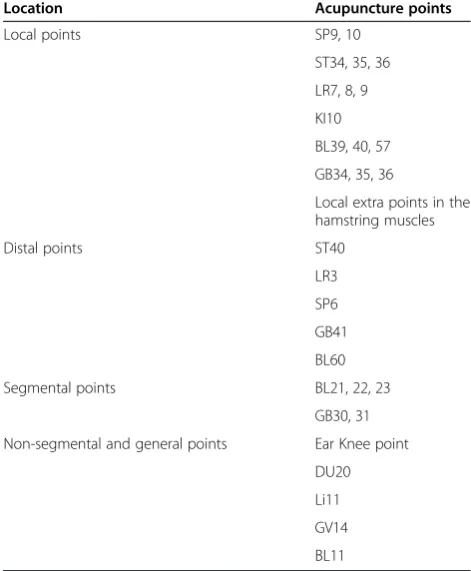
The treatment protocol permitted the GPs to treat participants as they would treat patients in their normal practice. They were allowed to select from a standar-dized set of acupuncture points around the knee, as well as distal points on the intervention side (Table 2). Other points could be used at the GP’s discretion depending on the cause(s) and site of the pain evident at clinical examination. These included points indicated by Trad-itional Chinese Medicine diagnoses in relation to Zang-Fu organ dysfunction, associated meridian and deep channel connections and ear points. Because of varying participant sensitivity, the initial treatment session per-mitted a maximum of six points in total, including four points on the study limb and two other points chosen as per protocol. In subsequent treatment sessions, further
points were added as clinically indicated by participant response to treatment, as well as local tenderness, muscle tightness and/or swelling. Over subsequent treat-ments, acupuncture points were varied according to changes in participant symptoms and point reactivity. The 12-week treatment period allowed for patient at-tendance flexibility (a break of up to four weeks between visits was deemed acceptable for participants going away on holidays etc.), as well as for strong acupuncture responders to have several days settling time as neces-sary. Visits were scheduled twice per week if necessary, but weekly visits were generally recommended. Treat-ment was considered complete when pain and function had returned to normal, however a minimum of 8 treat-ments was required. Laser acupuncture interventions were administered with the patient positioned either su-pine or sitting over the edge of the treatment couch. Treating GPs completed standardized treatment notes after each acupuncture session. Information recorded included the acupuncture points treated and any adverse events reported by the patient from the previous session.
Needle acupuncture
[image:6.595.56.290.113.286.2]Patients randomised to the needle acupuncture treat-ment underwent treattreat-ment lying down with needles
Table 1 Descriptive characteristics of the general practitioners who provided acupuncture treatment
General practitioner
Gender Location(s) Years of
medical practice
Years of acupuncture experience
1 Male Bacchus
Marsh
23 14
East Melbourne
2 Male Anglesea 30 24
3 Male Wendouree 48 30
4 Female Glen Waverley 25 18
5 Male Mildura 20 10
6 Male Traralgon 25 12
7 Male Malvern 50 19
[image:6.595.303.539.125.411.2]8 Male Bendigo 45 30
Table 2 Framework of acupuncture points that could be selected by general practitioners when administering acupuncture treatments (laser and needles)
Location Acupuncture points
Local points SP9, 10
ST34, 35, 36
LR7, 8, 9
KI10
BL39, 40, 57
GB34, 35, 36
Local extra points in the hamstring muscles
Distal points ST40
LR3
SP6
GB41
BL60
Segmental points BL21, 22, 23
GB30, 31
Non-segmental and general points Ear Knee point
DU20
Li11
GV14
inserted at the selected acupuncture points. Single-use Sierin needles (0.25x40mm) were used. The needles were inserted and left in place with the participant to rest. Needles were disposed of into a bedside sharps container at the completion of treatment.
Laser and placebo laser acupuncture
Laser acupuncture was administered at the selected acupuncture points using a Acupak P/L (Melbourne) laser machine that was specially manufactured for use in this trial [24]. The laser machines were standard Class 3B laser devices that are licensed by the Austra-lian Therapeutic Goods Association with an output of 10 mW. Energy output was 0.2 J per acupuncture point. Laser strength was checked by the manufacturer (a bio-medical engineer) at study commencement, halfway through the study and will be repeated at study com-pletion. Laser strength testing is a routine procedure in laser manufacture and maintenance and is done with a standard laser testing device. The trial laser machine had a small red non-laser light source arising from in-side the probe tip that lit up when the probe was in both treatment mode and sham mode (no output). This acted as a decoy to the treatment beam, which is invis-ible. Therefore, neither the treating GP nor the partici-pant could detect any difference between the real or
sham laser treatment being applied. The trial laser machines were programmed by the manufacturer. At each treatment session, the GP typed the participant’s study code into the keypad of the machine, and the ma-chine automatically delivered either laser acupuncture (ie laser output) or sham laser acupuncture (ie no laser output) according to the programmed randomisation schedule.
Outcome measures
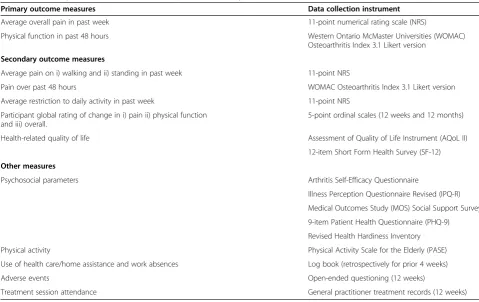
Table 3 summarises the range of measures that are being collected as part of this study. The majority of outcomes are measured at baseline, 12 weeks and 12 months in all participants (irrespective of group allocation). All out-comes are collected via self-report questionnaire and mailed back to the investigators.
Age, gender, height, weight, duration and nature (uni-lateral/bilateral) of knee symptoms and previous treat-ment for knee joint problems were obtained by questionnaire at baseline for descriptive purposes.
Self-reported pain and physical function
[image:7.595.56.536.425.727.2]The primary pain outcome is average overall knee pain over the past week. This is assessed using an 11-point NRS with terminal descriptors of “no pain” and “worst pain possible”. Similar scales are also being used to
Table 3 Summary of measures collected as part of the study
Primary outcome measures Data collection instrument
Average overall pain in past week 11-point numerical rating scale (NRS)
Physical function in past 48 hours Western Ontario McMaster Universities (WOMAC)
Osteoarthritis Index 3.1 Likert version
Secondary outcome measures
Average pain on i) walking and ii) standing in past week 11-point NRS
Pain over past 48 hours WOMAC Osteoarthritis Index 3.1 Likert version
Average restriction to daily activity in past week 11-point NRS
Participant global rating of change in i) pain ii) physical function and iii) overall.
5-point ordinal scales (12 weeks and 12 months)
Health-related quality of life Assessment of Quality of Life Instrument (AQoL II)
12-item Short Form Health Survey (SF-12)
Other measures
Psychosocial parameters Arthritis Self-Efficacy Questionnaire
Illness Perception Questionnaire Revised (IPQ-R)
Medical Outcomes Study (MOS) Social Support Survey
9-item Patient Health Questionnaire (PHQ-9)
Revised Health Hardiness Inventory
Physical activity Physical Activity Scale for the Elderly (PASE)
Use of health care/home assistance and work absences Log book (retrospectively for prior 4 weeks)
Adverse events Open-ended questioning (12 weeks)
Treatment session attendance General practitioner treatment records (12 weeks)
assess average pain on standing and on walking over the past week as secondary outcomes. Pain is also assessed, along with physical function, using the disease-specific WOMAC Osteoarthritis Index [31]. The physical func-tion subscale, which comprises 17 quesfunc-tions, is the pri-mary outcome measure for self-reported physical function. A secondary measure of physical function is a NRS assessing average restriction to daily activities over the past week with terminal descriptors of “no restric-tion”and“maximum restriction possible”.
At the 12 week and 12 month assessments, partici-pants rate their perceived change in a) pain; b) physical function and; c) overall, compared to baseline on a five-point ordinal scale (1-much worse to 5-much better). Scales of this kind are frequently used as an external cri-terion for comparison with changes in scores of other outcomes [32]. Measuring participant-perceived change using a rating of change scale has been shown to be a clinically relevant and stable concept for interpreting truly meaningful improvements from the individual per-spective [33].
Health-related quality of life
Health-related quality of life is measured using the As-sessment of Quality of Life instrument version two (AQoL II). The AQoL II has 20 questions that cover six dimensions of health-related quality of life including in-dependent living, social relationships, physical senses, coping, pain and psychological wellbeing. The AQoL has strong psychometric properties and is more responsive than other more widely used scales [34,35]. It produces a single utility index that ranges from−0.04 (worst pos-sible related quality of life) to 1.00 (full health-related quality of life).
The 12-item Short Form Health Survey (SF-12) is also being used to measure health-related quality of life [36]. The SF-12 is a self-administered questionnaire that was designed to measure patient outcomes in medical prac-tice and clinical research and to evaluate the effective-ness of health interventions. The 12 questions in the SF-12 measure an individual’s perceived health across eight domains: physical functioning; role limitations be-cause of physical health problems; bodily pain; general health perceptions; energy/fatigue; social functioning; role limitations because of emotional problems; and gen-eral mental health. The SF-12 is scored so that a high score indicates better functioning. Scoring algorithms are applied to individual item responses to produce the composite Physical Component Summary (PCS) and Mental Component Summary (MCS) scores. The PCS and MCS scores have a range of 0 to 100 and were designed to have a mean score of 50 and a standard de-viation of 10; scores greater than 50 represent above average health status.
Psychosocial measures
A range of psychosocial measures are being collected in order to evaluate whether psychosocial parameters are associated with changes in pain, physical function and health-related quality of life observed with acupuncture.
i) Arthritis Self-Efficacy Scale is used to measure self-efficacy. It has three subscales that assess self-efficacy for control of pain management (5 questions), physical function (9 questions) and other arthritis symptoms (6 questions). Each question is rated on a 10-point NRS from 1 (“very uncertain”) to 10 (“very certain”). Prior studies have supported both the reliability and validity of this scale [37].
ii) Illness Perception Questionnaire Revised (IPQ-R) is used to measure participant’s perceptions of their arthritis [38]. It comprises 38 items, each rated on a 5-point Likert scale, ranging from“strongly disagree” to“strongly agree”. The IPQ-R assesses numerous dimensions including identity, timeline acute/ chronic, timeline cyclical, consequences, personal control, treatment control, illness coherence, emotional representations. It has demonstrated reliability and validity [38].
iii)Medical Outcomes Study (MOS) Social Support Survey is used to measure the perceived social support available to an individual. It comprises six questions that ask respondents to indicate how often each of six different types of support is available to them. Responses are scored on a five-point scale ranging from“all of the time”to“none of the time”. This measure of social support has been shown to have adequate validity and reliability [39].
iv)Patient Health Questionnaire (PHQ) is a self-administered version of the PRIME-MD diagnostic instrument for common mental disorders [40] . This trial is utilizing the PHQ-9 [41], which is the
depression module that scores each of the 9 DSM-IV criteria [42] as“0”(not at all) to“3”(nearly every day).
v) Revised Health Hardiness Inventory comprises 24 items and is used to measure health hardiness (control, commitment, and challenge) in individuals with actual health problems. Respondents indicate on a 5-point scale the degree to which they agree with the statement, ranging from“strongly disagree” to“strongly agree”. This questionnaire has adequate psychometric properties, and is a reliable and useful instrument to assess perspectives towards one’s own health [43].
Physical activity levels
questionnaire that has been shown to be reliable, valid and sensitive to change in people with knee OA [44,45]. It records both the level and type of recreational and oc-cupational physical activity undertaken by participants over the previous week. The PASE was developed and validated in samples of older adults (age 55+ years) [46].
Use of health care, home assistance and work absences
Information on health care use (e.g. visits to hospitals, medical practitioners, other health professionals, use of investigative procedures, prescription and non-prescription drugs) and the need for paid and/or unpaid home assistance over the previous four weeks will be collected via a log-book at baseline, 12 weeks and 12 months. Participants are also asked to record any absences from paid employment (if applicable) and/or unpaid work (eg household duties, caring for family/ friends) because of their health. The log-book utilises a checklist format to minimize respondent burden and to ensure high quality data is obtained with minimal data loss.
Adverse events
Adverse events were monitored via open-ended ques-tioning by the acupuncturist at each treatment session and recorded in the treatment notes. In addition, partici-pants receiving acupuncture treatment were asked at 12 weeks whether they experienced any adverse effects of treatment via open-ended questioning.
Treatment session attendance
Participant adherence was measured by recording the number of treatment sessions attended (out of a max-imum number of 12) in the GP treatment notes.
Sample size calculations
Our primary endpoints are average overall knee pain measured on a NRS and physical function measured via WOMAC at 12 weeks. The minimum clinically import-ant difference to be detected in OA trials is a change in pain of 1.8 units (on NRS) [47] and a change of 6 phys-ical function units on the WOMAC (out of 68) [48]. Calculations are based on an analysis of covariance (ANCOVA) adjusting for baseline of the outcome vari-able, and assume a between-patient standard deviation of 3.0 units for pain and 12.0 units for WOMAC [49]. Sample size calculations for our particular study design need to take into account four aspects: clustering effects resulting from treatment of patients by the same therap-ist for comparisons with the control arm (hypothesis H2); dilution of the treatment effect resulting from the Zelen design [50]; precision gain from baseline adjust-ment; and loss to followup. Initially assuming no cluster-ing effects and a regular two-arm parallel RCT design
with complete followup, 33 patients per arm would be required to detect the above differences in pain and function with 80% power at a two-sided 5% significance level, using ANCOVA with assumed baseline to 12 week correlations of 0.50 for pain and 0.70 for function [49]. Adopting a conservative intra-therapist correlation of 0.10 inflates the sample size to 40 patients per arm across a total of 10 therapists. Assuming a conservative 15% non-consent rate for patients randomised to any of the three treatment arms increases the sample size by 1/ (1–0.15)2= 38%, and finally, allowing for 15% loss to fol-lowup, inflates the total sample size to 66 patients per arm, which we round up to 70 per arm, or 280 patients in total. Assessment of hypotheses H1 and H3 involve within-therapist comparisons only and therefore the pre-cision loss from clustering by therapist does not apply, yielding greater power (90%) for these comparisons.
Statistical analyses
The primary analysis of the data will be undertaken using the principle of intention-to-treat with all rando-mised patients included in the analyses. Demographic and clinical characteristics, as well as baseline data, will be presented to assess the baseline comparability of the intervention groups. Descriptive statistics will be pre-sented for each group as the mean change (standard de-viation, 95% confidence intervals) in the outcomes from baseline to each time point. Differences in mean change from baseline to each time point will be compared be-tween groups using random effects linear regression modelling adjusting for baseline levels of the outcome measure and using the treating therapists as random effects to account for clustering of outcomes by thera-pists. Model assumptions will be checked by standard diagnostic plots. Improvement between acupuncture groups (based on the perceived ratings of change) will be compared using logistic regression with random effects as above and presented as odds ratios with 95% confidence intervals. Multiple imputation methodology will be employed to account for missing data [51]. No statistical adjustment will be made for multiple testing. All tests will be two sided and carried out at the 5% level of significance.
As part of the secondary analyses of the primary out-comes at 12 weeks and 12 months, we plan to conduct a separate analysis to estimate the effect of treatment in the hypothetical scenario of full adherence to the rando-mised treatment intervention. Analytical methods for this will utilise instrumental variables methodology in-volving two stage least squares estimation [52].
Economic evaluation
individual patient. Standard methods of economic evalu-ation alongside a clinical trial will be used to evaluate the differences in resource use and health outcomes at the end of treatment and at 12 months. The primary economic evaluation will take the form of a cost effect-iveness study with a range of outcome measures includ-ing the incremental cost per extra person with a clinically significant improvement in pain and function and per extra quality adjusted life years (QALYs) for laser acupuncture compared to either sham or needle acupuncture. The difference in QALYs will be calculated in the primary analysis as the difference in the area under the curve for AQoL scores over the duration of 12 months. Differences in mean change from baseline for the AQoL to each time point will be weighted by the time from baseline using generalised linear regression modelling adjusting for baseline levels of the AQoL to construct QALYs, and then compared between groups. Differences in the mean cost between groups will be cal-culated using generalised linear regression modelling. In-cremental cost per QALY will be calculated as the ratio of the difference in mean cost to the difference in mean QALYs with 95% confidence intervals calculated using Fieller's theorem.
Timelines
The application for project funding was successful in December 2008 and funding commenced in August 2009. Ethics approval was obtained from the Human Re-search Ethics Committee of the University of Melbourne in July 2009. Recruitment commenced in February 2010 and was completed in December 2011. The trial is due for completion in December 2012 when all participants will have completed 12-month follow-up.
Discussion
This paper has presented the theoretical rationale, as well as the protocol, for an ongoing Zelen design RCT that is testing the efficacy of a combined Western and Traditional Chinese Medicine style of acupuncture for managing chronic knee pain and disability symptoms in older people. The findings of this study will help deter-mine whether laser and/or needle acupuncture are effi-cacious in relieving knee pain and/or improving physical function. This study will also determine whether effects of acupuncture can be maintained over the longer term, and whether psychosocial factors influence treatment outcomes. Importantly, the use of the Zelen design will minimize the bias typically encountered in traditionally designed RCTs where participant expectations may in-fluence study outcomes.
Competing interests
The authors declare that they have no competing interests.
Authors’contributions
RSH, PM, KMC and KLB conceived the project and PM is leading the co-ordination of the trial. RSH, PM, KMC, MP, IR, PR, AF, AH and KLB developed the protocol and procured the project funding. IR and MP designed the acupuncture program and IR trained the GPs. AF performed the sample size calculations and designed the statistical analyses. AH is leading the collection and analysis of the cost-effectiveness data. MK recruits and screens the participants and performs data entry, while KN randomises participants to groups and is the liaison for the treating GP’s and participants. RSH and KLB wrote the first draft of the manuscript. RSH wrote the final draft of this manuscript. All authors participated in the trial design, provided feedback on drafts of this paper and read and approved the final manuscript.
Acknowledgements
This trial is being funded by the National Health and Medical Research Council (Project #566783). None of the funders have any role in the study other than to provide funding. KLB is funded in part by an Australian Research Council Future Fellowship. MP was funded by a Primary Health Care Research Evaluation Development fellowship. PM is funded in part by an NHMRC Practitioner Fellowship. The Study GPs providing the acupuncture treatments are Dr Ian Relf, Dr Paul Ghaie, Dr Sandra Martin, Dr Danny Traum, Dr Paul Coughlan, Dr Robert Meyer, Dr Malcolm Macdonald and Dr Tim Denton. We wish to acknowledge Dr Roberta Chow for her valuable advice regarding the treatment protocols.
Author details
1Centre for Health, Exercise and Sports Medicine, Department of
Physiotherapy, School of Health Sciences, Faculty of Medicine Dentistry & Health Sciences, The University of Melbourne, Melbourne, VIC, AUSTRALIA.
2Department of General Practice, School of Medicine, Faculty of Medicine
Dentistry & Health Sciences, The University of Melbourne, Melbourne, VIC, AUSTRALIA.3Physiotherapy, School of Health & Rehabilitation Sciences, The
University of Queensland, Brisbane, QLD, AUSTRALIA.4School of Medicine
and Public Health, Faculty of Health, University of Newcastle, Callaghan, Newcastle, NSW, AUSTRALIA.5Epidemiology & Preventative Medicine, Faculty
of Medicine, Nursing & Health Sciences, Monash University, Melbourne, VIC, AUSTRALIA.6Centre for Health Economics, Faculty of Business & Economics,
Monash University, Melbourne, VIC, AUSTRALIA.
Received: 13 August 2012 Accepted: 11 September 2012 Published: 19 September 2012
References
1. Felson DT, Naimark A, Anderson J, Kazis L, Castelli W, Meenan RF:The prevalence of knee osteoarthritis in the elderly. The Framingham Osteoarthritis Study.Arthritis Rheum1987,30:914–918.
2. Jinks C, Jordan K, Croft P, Ong BN:A brief screening tool for knee pain in primary care (KNEST). 2. Results from a survey in the general population aged 50 and over.Rheumatol2004,43:55–61.
3. Zhang W, Moskowitz RW, Nuki G, Abramson S, Altman RD, Arden N, Bierma-Zeinstra S:OARSI recommendations for the management of hip and knee osteoarthritis, Part II: OARSI evidence-based, expert consensus guidelines.Osteoarthritis Cartilage2008,16:137–162.
4. Breuer G, Orbach H, Elkayam O, Berkum Y, Paran D, Mates M, Nesher G: Perceived efficacy among patients of various methods of complementary alternative medicine for rheumatologic diseases.
Clin Exper Rheumatol2005,23:693–696.
5. Pirotta M, Cohen M, Kotsirilos V, Farish S:Complementary therapies: have they become accepted in general practice?Med J Aust2000,172:105–109. 6. Cohen M, Penman S, Pirotta M, Da Costa C:The integration of
complementary therapies in Australian general practice: results of a national survey.J Altern Complement Med2005,11:995–1004. 7. Ramsey S, Spencer A, Topolski T, Belza B, Patrick D:Use of alternative
therapies by older adults with osteoarthritis.Arthritis Rheum2001, 45:222–227.
8. Manheimer E, Cheng K, Linde K, Lao L, Yoo J, Wieland S, van der Windt DA, Berman BM, Bouter LM:Acupuncture for peripheral joint osteoarthritis.
Cochrane Database Syst Rev2010,1:CD001977.
10. Huang W, Pach D, Napadow V, Park K, Long X, Neumann J, Maeda Y, Nierhaus T, Liang F, Witt CM:Characterizing acupuncture stimuli using brain imaging with FMRI - a systematic review and meta-analysis of the literature.PLoS One2012,7:e32960.
11. Bjordal JM, Johnson MI, Lopes-Martins RA, Bogen B, Chow R, Ljunggren AE: Short-term efficacy of physical interventions in osteoarthritic knee pain. A systematic review and meta-analysis of randomised placebo-controlled trials.BMC Musculoskelet Disord2007,8:51.
12. Hagiwara S, Iwasaka H, Okuda K, Noguchi T:GaAlAs (830 nm) low-level laser enhances peripheral endogenous opioid analgesia in rats.Lasers Surg Med2007,39:797–802.
13. Chung H, Dai T, Sharma SK, Huang YY, Carroll JD, Hamblin MR:The nuts and bolts of low-level laser (light) therapy.Ann Biomed Eng2012, 40:516–533.
14. de Morais NC, Barbosa AM, Vale ML, Villaverde AB, de Lima CJ, Cogo JC, Zamuner SR:Anti-inflammatory effect of low-level laser and light-emitting diode in zymosan-induced arthritis.Photomed Laser Surg2010, 28:227–232.
15. Moriyama Y, Nguyen J, Akens M, Moriyama EH, Lilge L:In vivo effects of low level laser therapy on inducible nitric oxide synthase.Lasers Surg Med2009,41:227–231.
16. Alfredo PP, Bjordal JM, Dreyer SH, Meneses SR, Zaguetti G, Ovanessian V, Fukuda TY, Junior WS, Martins RA, Casarotto RA, Marques AP:Efficacy of low level laser therapy associated with exercises in knee osteoarthritis: a randomized double-blind study.Clin Rehabil2011,26:523–533. 17. Shen X, Zhao L, Ding G, Tan M, Gao J, Wang L, Lao L:Effect of combined
laser acupuncture on knee osteoarthritis: a pilot study.Lasers Med Sci 2009,24:129–136.
18. Leaver AM, Refshauge KM, Maher CG, McAuley JH:Conservative interventions provide short-term relief for non-specific neck pain: a systematic review.J Physiother2010,56:73–85.
19. Conaghan PG, Dickson J, Grant RL:Care and management of osteoarthritis in adults: summary of NICE guidance.BMJ2008,336:502–503.
20. Hochberg MC, Altman RD, Toupin April K, Benkhalti M, Guyatt G, McGowan J, Towheed T, Welch V, Wells G, Tugwell P:American College of Rheumatology 2012 recommendations for the use of nonpharmacologic and pharmacologic therapies in osteoarthritis of the hand, hip, and knee.Arthritis Care Res2012,64:465–474.
21. Paterson C, Dieppe P:Characteristic and incidental effects in complex interventions such as acupuncture.BMJ2005,330:1202–1205. 22. Zhang W, Robertson J, Jones AC, Dieppe PA, Doherty M:The placebo
effect and its determinants in osteoarthritis: meta-analysis of randomised controlled trials.Ann Rheum Dis2008,67:1716–1723. 23. Linde K, Witt CM, Streng A, Weidenhammer W, Wagenpfeil S, Brinkhaus B,
Willich SN, Melchart D:The impact of patient expectations on outcomes in four randomized controlled trials of acupuncture in patients with chronic pain.Pain2007,128:264–271.
24. Relf I, Chow R, Pirotta M:Blinding techniques in randomized controlled trials of laser therapy: an overview and possible solution.Evid Based Complement Altern Med2007,5:383–389.
25. Zelen M:A new design for randomized clinical trials.N Engl J Med1979, 300:1242–1245.
26. Adamson J, Cockayne S, Puffer S, Torgerson DJ:Review of randomised trials using the post-randomised consent (Zelen's) design.Contemp Clin Trials2006,27:305–319.
27. Quilty B, Tucker M, Campbell R, Dieppe P:Physiotherapy, including quadriceps exercises and patellar taping, for knee osteoarthritis with predominant patello-femoral joint involvement: randomized controlled trial.J Rheumatol2003,30:1311–1317.
28. Torgerson DJ, Roland M:What is Zelen's design?BMJ1998,316:606. 29. Schulz KF, Altman DG, Moher D:CONSORT 2010 statement: updated
guidelines for reporting parallel group randomised trials.BMJ2010,340:c332. 30. MacPherson H, Altman DG, Hammerschlag R, Li Y, Wu T, White A, Moher D:
Revised STandards for Reporting Interventions in Clinical Trials of Acupuncture (STRICTA): extending the CONSORT statement.Acupunct Med2010,28:83–93.
31. Bellamy N, Buchanan WW, Goldsmith CH, Campbell J, Stitt LW:Validation study of WOMAC: a health status instrument for measuring clinically important patient relevant outcomes to antirheumatic drug therapy in patients with osteoarthritis of the hip or knee.J Rheumatol1988, 15:1833–1840.
32. Jaeschke R, Singer J, Guyatt GH:Measurement of health status.
Ascertaining the minimal clinically important difference.Control Clin Trials 1989,10:407–415.
33. ten Klooster PM, Drossaers-Bakker KW, Taal E, van de Laar MA: Patient-perceived satisfactory improvement (PPSI): interpreting meaningful change in pain from the patient's perspective.Pain2006,121:151–157. 34. Osborne RH, Hawthorne G, Lew EA, Gray LC:Quality of life assessment in
the community-dwelling elderly: validation of the Assessment of Quality of Life (AQoL) Instrument and comparison with the SF-36.J Clin Epidemiol2003,56:138–147.
35. Whitfield K, Buchbinder R, Segal L, Osborne RH:Parsimonious and efficient assessment of health-related quality of life in osteoarthritis research: validation of the Assessment of Quality of Life (AQoL) instrument.Health Qual Life Outcomes2006,4:19.
36. Jenkinson C, Chandola T, Coulter A, Bruster S:An assessment of the construct validity of the SF-12 summary scores across ethnic groups.J Public Health Med2001,23:187–194.
37. Lorig K, Chastain RL, Ung E, Shoor S, Holman HR:Development and evaluation of a scale to measure perceived self-efficacy in people with arthritis.Arthritis Rheum1989,32:37–44.
38. Moss-Morris R, Weinman J, Petrie K, Horne R, Cameron L, Buick D:The Revised Illness Perception Questionnaire (IPQ-R).Psychol Health2002,17:1–16. 39. Sherbourne CD, Stewart AL:The MOS social support survey.Soc Sci Med
1991,32:705–714.
40. Spitzer RL, Williams JB, Kroenke K, Linzer M, deGruy FV 3rd, Hahn SR, Brody D, Johnson JG:Utility of a new procedure for diagnosing mental disorders in primary care. The PRIME-MD 1000 study.JAMA1994, 272:1749–1756.
41. Kroenke K, Spitzer RL, Williams JB:The PHQ-9: validity of a brief depression severity measure.J Gen Intern Med2001,16:606–613. 42. Association AP:Diagnostic and Statistical Manual of Mental Disorders
DSM-IV-TR Fourth Edition. Washington, DC: American Psychiatric Association; 2000. 43. Gebhardt WA, van der Doef MP, Paul LB:The Revised Health Hardiness
Inventory (RRHI-24): psychometric properties and relationship with self-reported health and health behavior in two Dutch samples.Health Educ Res2001,16:579–592.
44. Martin K, Rejeski W, Miller M, James M, Ettinger W Jr, Messier S:Validation of the PASE in older adults with knee pain and physical disability.Med Sci Sports Exerc1999,31:627–633.
45. Washburn RA, Ficker JL:Physical Activity Scale for the Elderly (PASE): the relationship with activity measured by a portable accelerometer.J Sports Med Phys Fitness1999,39:336–340.
46. Washburn R, Smith K, Jette A, Janney CA:The Physical Activity Scale for the Elderly (PASE): development and evaluation.J Clin Epidemiol1993, 46:153–162.
47. Bellamy N, Carette S, Ford P, Kean W, le Riche N, Lussier A, Wells G, Campbell J:Osteoarthritis antirheumatic drug trials. III. Setting the delta for clinical trials- results of a consensus development (Delphi) exercise.J Rheumatol1992,19:451–457.
48. Tubach F, Ravaud P, Baron G, Falissard B, Logeart I, Bellamy N, Bombardier C, Felson D, Hochberg M, van der Heijde D, Dougados M:Evaluation of clinically relevant changes in patient reported outcomes in knee and hip osteoarthritis: the minimal clinically important improvement.Ann Rheum Dis2005,64:29–33.
49. Lim BW, Hinman RS, Wrigley TV, Sharma L, Bennell KL:Does knee malalignment mediate the effects of quadriceps strengthening on knee adduction moment, pain, and function in medial knee osteoarthritis? A randomized controlled trial.Arthritis Care Res2008,59:943–951. 50. Altman DG, Whitehead J, Parmar MK, Stenning SP, Fayers PM, Machin D:
Randomised consent designs in cancer clinical trials.Eur J Cancer1995, 31A:1934–1944.
51. Molenberghs G, Kenward M:Missing Data in Clinical Studies. Chichester, UK: John Wiley and Sons Ltd; 2007.
52. Stuart EA, Perry DF, Le HN, Ialongo NS:Estimating intervention effects of prevention programs: Accounting for noncompliance.Prev Sci2008, 9:288–298.
doi:10.1186/1472-6882-12-161