ScholarWorks @ Georgia State University
ScholarWorks @ Georgia State University
Religious Studies Theses Department of Religious Studies
Fall 12-2-2011
Sacrilege in the Sanctuary: Thucydidean Perspectives on the
Sacrilege in the Sanctuary: Thucydidean Perspectives on the
Violation of Sacred Space during the Peloponnesian War
Violation of Sacred Space during the Peloponnesian War
Suzanne Y. Tryon
Follow this and additional works at: https://scholarworks.gsu.edu/rs_theses
Part of the Religion Commons
Recommended Citation Recommended Citation
Tryon, Suzanne Y., "Sacrilege in the Sanctuary: Thucydidean Perspectives on the Violation of Sacred Space during the Peloponnesian War." Thesis, Georgia State University, 2011.
https://scholarworks.gsu.edu/rs_theses/36
This Thesis is brought to you for free and open access by the Department of Religious Studies at ScholarWorks @ Georgia State University. It has been accepted for inclusion in Religious Studies Theses by an authorized
administrator of ScholarWorks @ Georgia State University. For more information, please contact
VIOLATION OF SACRED SPACE DURING THE PELOPONNESIAN WAR
by
SUZANNE Y. TRYON
Under the Direction of Louis A. Ruprecht Jr.
ABSTRACT
Few have paid attention to the role that pan-Hellenic religious norms play in
Thucy-dides‟s The Peloponnesian War. This thesis investigates the trope of religious sacrilege in the
form of violated sacred space. By examining how this trope functions within his chosen
rhetori-cal presentation, I will argue that a secular interpretation of Thucydides does not accord with
what he tries to accomplish within his narrative, and that scenes describing such sacrilege
actual-ly function in crucial ways to support a major premise of his work. Two specific instances of
sacrilege will be examined: the civil war on Corcyra in 427 BCE; and the Battle of Delion in
424/3 BCE. I will demonstrate that Thucydides incorporates sacrilege to serve as evidence for
vious, are inherently fragile and unstable.
VIOLATION OF SACRED SPACE DURING THE PELOPONNESIAN WAR
by
SUZANNE Y. TRYON
A Thesis Submitted in Partial Fulfillment of the Requirements for the Degree of
Master of Arts
in the College of Arts and Sciences
Georgia State University
Copyright by Suzanne Yvonne Tryon
VIOLATION OF SACRED SPACE DURING THE PELOPONNESIAN WAR
by
SUZANNE Y. TRYON
Committee Chair: Louis A. Ruprecht Jr.
Committee: Molly Bassett
Gerard Pendrick
Electronic Version Approved:
Office of Graduate Studies
College of Arts and Sciences
Georgia State University
DEDICATION
This thesis is dedicated to my parents, both for instilling in me the love of learning and
ACKNOWLEDGEMENTS
I am deeply indebted to all the members of my committee. I thank Dr. Ruprecht for the
care with which he reviewed multiple drafts of this thesis, for suggesting that I read Thucydides
in the first place, and for helping me to find the big picture when I constantly found myself lost
in the details. I thank Dr. Pendrick for making Greek fun (not an easy task) and for puzzling
through passages of Thucydides with me. Finally, but not least, I thank Dr. Bassett for the best
methods class (Icons) that I have taken during my university career, and I can only hope that
what I learned is reflected in this thesis. Anything useful to be gleaned from this thesis emerged
through their patience and guidance, and any mistakes or misinterpretations I claim solely as my
TABLE OF CONTENTS
ACKNOWLEDGEMENTS ... v
LIST OF FIGURES ... vii 1 INTRODUCTION ... 1
2 RELIGION IN THUCYDIDES... 11
3 CIVIL WAR IN CORCYRA ... 18
4 BATTLE AT DELION ... 30
5 CONCLUSION ... 44
6 REFERENCES ... 46
LIST OF FIGURES
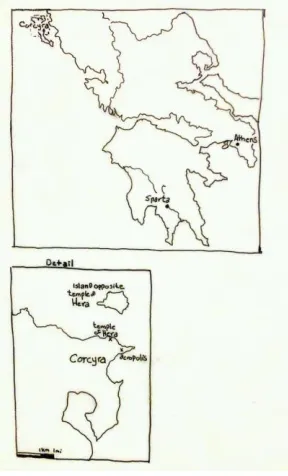
Figure 1.1 The Greek-speaking world during the Peloponnesian War 6
Figure 3.1 Corcyra 18
1 INTRODUCTION
Again, I merely record the current story, without guaranteeing the truth of it. It may, however, be true enough….
-Herodotus1
And with reference to the narrative of events, far from permitting myself to derive it from the first source that came to hand, I did not even trust my own impressions, but it rests partly on what I saw myself, partly on what others saw for me, the accuracy of the report being always tried by the most severe and detailed tests possible.
-Thucydides2
Reading The Peloponnesian War in the summer of 2010 was my first exposure to
Thucy-dides. I devoured the text greedily, both because I enjoyed the tale he had to tell about what he
considered the greatest war in the Greek-speaking world, and also because I had finally stumbled
upon the topic I wished to explore in my master‟s thesis. Depictions of sacrilege in sacred
spac-es occur repeatedly throughout Thucydidspac-es‟s text, and I made it my goal to invspac-estigate how this
trope was functioning in his narrative. I was surprised to learn that the traditional,
post-Enlightenment conception of Thucydides as an historian was one that took him to be an
histo-rian of Realpolitik, disinterested in or dismissive of traditional Greek religious norms. This has
led to him being viewed as a secular historian with “scientific” standards of objectivity similar to
those of modern academic historians. There is much to support this interpretation, but it requires
ignoring precisely those passages I found most interesting. These labels – secular, scientific,
ra-tionalist - are clearly anachronistic, and can possess only marginal value when applied to
pre-Enlightenment historical figures like Thucydides.
1
The Histories, trans. Selincourt, 335. 2
If we approach Thucydides while trying conscientiously to suspend these modern
as-sumptions, a new picture emerges. It becomes much easier to see how the repeated trope of what
I am calling “sacrilege in the sanctuary” functions within his narrative, and it is harder to dismiss
these scenes merely as examples of Thucydides‟s denigration of pan-Hellenic religion. In fact, I
will argue that he includes such scenes for precisely the opposite reason: the scenes of sacrilege
possess searing violence, functioning as symbols meant to make his audience realize exactly how
desperate things became during the Peloponnesian War. Sacrilege only works as a symbol when
there is an understood consensus that certain boundaries should not be crossed, and textual
evi-dence suggests that Thucydides felt that violating sanctuaries was one such transgression. Many
important passages in Thucydides deal with the violation of pan-Hellenic values and customs
(nomoi) as they relate to pan-Hellenic conceptions of sacred space. Therefore, I intend to
ex-plore the role played by the recurring trope of the violation of sacred space as a part of
Thucy-dides‟ rhetorical strategy serving the larger purpose of his history. He intentionally develops
these episodes to support a central claim of his work: that the Peloponnesian War was the largest,
the longest, and the most destructive war that had occurred up to that point in the Greek-speaking
world. Thucydides was not moved to write his history only by the sheer mass of mobilized
sol-diers or resulting casualties. It was also the collapse of pan-Hellenic mores that suggested to
Thucydides that the tragic moral and social consequences of the war were greater than any the
Greeks had previously experienced. Ultimately, the very things that were supposed to provide
unity to the Greek-speaking world proved to be inherently fragile and unequal to the task of
re-straining the types of violence they were meant to hold in check.
Interpreting Thucydides is a daunting task for several reasons. First, scholars know little
source of information available to present-day scholars concerning the brutal, twenty-seven year
war between two Greek city-states, Athens and Sparta, and their respective allies, in the final
third of the 5th century BCE. Though Thucydides records in scrupulous detail the first
twenty-one years of military and political activities among the warring Greek city-states, he rarely
men-tions himself, except for a brief introduction in the first sentence of his history: “Thucydides, an
Athenian, wrote the history of the war between the Peloponnesians and the Athenians…”3 He
makes an appearance only twice more during the narrative, even though he was a participant in
the war. One appearance is in reference to suffering from the plague that devastated the
Athe-nian population during the early years of the war,4 and he mentions himself again when he is
blamed and exiled by the Athenians for losing a valuable colony to Spartan aggression.5
Histo-rians surmise from his father‟s name, Olorus, that Thucydides possessed an aristocratic Thracian
pedigree, though he was an Athenian citizen, and they suspect that he derived most of his wealth
from gold mines located on family property in the Thracian mountains. 6 The war broke out in
431 BCE, when Thucydides would have been approximately thirty years old.7 In 424 BCE, he
was elected to the position of strategos (general), one of ten powerful men in charge of the
Athe-nian military. He was exiled in that same year when forces under his control lost Amphipolis, a
colony in the northeast of Greece that belonged to Athens, because of the campaigns of the
Spar-tan general Brasidas. It was during his exile that Thucydides began to write The Peloponnesian
3 1.1.1.
4While describing the outbreak of the plague, he writes, “All speculation as to its origins and causes, if causes can be found adequate to produce so great a disturbance, I leave to other writers, whether lay or professional; for myself, I shall simply set down its nature, and explain the symptoms by which perhaps it may be recognized by the student, if it should ever break out again. This I can the better do, as I had the disease myself, and watched its operation in the case of others.” 2.48.3, italics mine.
5“It was also my fate to be an exile from my country for twenty years after my command at Amphipolis.” 5.26.5. 6
V. D. Hanson, “Introduction” in The Landmark Thucydides, edited by Strassler, ix.
War, a fact that presumably gave him access to valuable sources from all sides of the conflict.8
Once the war ended in 404 BCE with the complete surrender of Athens to its rival Sparta, many
scholars assume that he returned to Athens to finish his book and died in his native city. The
ex-act date or cause of death is unknown.9
In addition to our having only a basic outline of Thucydides‟s personal life, the history he
left us is one of the most difficult and complex of Greek texts for scholars to translate.
Thucy-dides appears to be a methodical and careful historian; but his obscure, often ambiguous prose
has provided readers with centuries of consternation and confusion. To get his story across, he
“juggled tenses in a sophisticated way, piled up subordinate clauses and resorted to other devices
that are often the despair of modern readers.”10
Compared with contemporary writers from the
5th century BCE in Athens, he is seen to have a penchant for abstract nouns, to demonstrate a
preference for archaic and even poetic expressions, and routinely to invert the normal word order
of Greek prose. Added to this rhetorical complexity is the fact that the text as extant is
incom-plete. It ends abruptly in Book Eight, in mid-sentence, during the twenty-first year of the
twen-ty-seven year conflict, which suggests that Thucydides may have died before he could finish his
history. Many scholars suspect that portions of The Peloponnesian War are unfinished, due to
the fact that they possess less polish than the majority of the text. This makes it difficult to know
where Thucydides was ultimately going with his narrative, given that he probably lacked the
time to complete it. 11
Essentially, his history is a chronological record of the conflict known as the
Peloponne-sian War (431-404 BCE), a war involving two powerful competing Greek city-states, Athens and
8“[A]nd being present with both parties, and more especially with the Peloponnesians by reason of my exile, I had leisure to observe affairs more closely.” 5.26.5.
9
M. I. Finley, “Introduction” in The Peloponnesian War, trans. Rex Warner (1954) 9-13. 10
Ibid., 10. 11
Sparta and their respective allies. The war is sometimes framed as an inevitable and unavoidable
clash between the Hellenic superpowers with both seeking economic and political dominance
and representing rival political ideologies. Though most of the Greek city-states (poleis) were
autonomous (a fact reflected in the various systems of government they developed), the two most
common systems were democracy and oligarchy.12 Athens claimed its status as the preeminent
democracy and possessed a naval empire portrayed in Thucydides‟s account as adventurous,
in-novative, and swift to capitalize on good fortune. It was also the leader of the Delian League,
founded in 477 BCE in the wake of the Persian Wars (490-479 BCE). At its height, one hundred
and fifty allies contributed money or ships to a nominally collective enterprise, though it soon
became apparent that the Athenians treated their allies more like subjects. The immense tribute
and prestige Athens acquired through its naval empire inspired fear and distrust among other
powerful city-states. The most powerful of these, Sparta, was an oligarchy, a regime whose
strength was founded on its formidable hoplite army. They were characterized as more
conserv-ative than the Athenians, slow to act and reluctant to commit. They led the Peloponnesian
League, a collective of allied city-states whose members included Corinth, Aegina, and Thebes,
all traditional enemies of the Athenians.13 However, Thucydides rejects the notion that Athens,
Sparta, and their respective allies were destined to fight by ideological differences. Rather, he
lays the blame for the war upon naked ambition and jealousy:
[Calamities] came upon them with the late war, which was begun by the Athenians and Pelopon-nesians with the dissolution of the Thirty Years Peace made after the conquest of Euboea. To the question why they broke the treaty, I answer by placing first an account of their grounds of com-plaint and points of difference, that no one may ever have to ask the immediate cause which plunged the Hellenes into a war of such magnitude. The real cause, however, I consider to be one
12I reference Aristotle for a discussion on the differences between democratic and oligarchic constitutions: “[I]t is a democracy when those who are free are in the majority and have sovereignty over the government, and an oligarchy when the rich and more well born are few and sovereign.” Politics IV.III.8-11, trans. by H. Rackham (1932). 13
which was formally most kept out of sight. The growth of the power of Athens, and the alarm which this inspired in Sparta, made war inevitable.14
In other words, it was ultimately Spartan nervousness and its envy of growing Athenian power
[image:16.612.74.380.180.406.2]that unleashed a war of epic proportions.
Figure 1.1 The Greek-speaking world during the Peloponnesian War
Thucydides tells us that it is his goal to record the events of this war without having to
resort to the more quixotic embellishments of poets and other historians. He is candid when it
comes to explaining how he plans to accomplish this:
On the whole, however, the conclusions I have drawn from the proofs quoted may, I believe, safe-ly be relied upon. Assuredsafe-ly, they will not be disturbed either by the verse of a poet displaying the exaggeration of his craft, or by the compositions of chroniclers that are attractive at truth‟s ex-pense; the subjects they treat being out of reach of evidence, and time having robbed most of them of historical value by enthroning them in the region of legend.15
He wanted to provide a history that used only verifiable evidence, largely consisting of
eye-witness accounts, reports which did not explain human actions for the most part with reference to
the gods. Because of his assiduous attention to natural phenomena and his thorough descriptions
14
1.23.3-6.
of troop movements and political developments, scholars have often accepted Thucydides‟s
claim to objectivity in reporting the events of the war, despite his candid confession to the
artful-ness of his presentation. Later, he reveals:
With references to the speeches in this history, some were delivered before the war began, others while it was going on; some I heard myself, others I got from various quarters; it was in all cases difficult to carry them word for word in one‟s memory, so my habit has been to make the speakers say what was in my opinion demanded of them by the various occasions, of course adhering as closely as possible to the general sense of what they really said.16
I shall argue that the introduction of the subject of religious norms is a regular feature of what
Thucydides deemed was demanded “by the various occasions.”
It was common for Early Modern European and North American scholars to project their
own scientific values onto the ancient Athenian. He was conceived as the first modern historian,
the first writer to transcend his local circumstances and to achieve logical, rational objectivity in
his writing. Thomas Hobbes – the author of Leviathon (1651), but also one of the first to
trans-late Thucydides into English (1628) – remarks that Thucydides “is yet accounted the most politic
historiographer that ever writ.”17
In Twilight of the Idols (1889), Nietzsche vastly prefers
Thu-cydides‟s style to that of the more idealistic philosophy of the Socratic schools: “My recreation,
my predilection, my cure for all Platonism has always been Thucydides. Thucydides and,
may-be, Machiavelli‟s prince are most closely related to me by their unconditional will to fabricate
nothing and to see reason in reality – not in „reason,‟ and still less in „morality‟.”18 Donald
Ka-gan, a leading contemporary authority on Thucydides and the Peloponnesian War, writes in his
most recently published book, Thucydides: The Reinvention of History (2009), that “Thucydides
seems to have taken a spectacular leap into modernity.”19
16
1.22.1, my italics. 17
Kagan, Thucydides: The Reinvention of History, 229. 18
Twilight of the Idols. 87. 19
These characterizations, warranted up to a point, can be misleading. They are in large
part inspired by Thucydides himself. He invites this interpretation through his own ironic
juxta-position of his methods with those of Herodotus, an earlier Greek historian. Herodotus was born
in Halicarnassus on the coast of Asia Minor sometime between 490 and 480 BCE and traveled
widely, describing the events that led to the Persian invasion of the Greek mainland, and
at-tempted to explain how it was that a relatively small group of independent Greek cities had come
to repel the largest empire known to him. His account came to be called simply The Histories,
and it earned him the title “Father of History,” a title first used by Cicero.20 It was after
Herodo-tus and through his influence that historia gained new meaning: “Before Herodotus, it had meant
no more than „inquiry‟ or „research‟…. After him, it designated a new branch of human
intellec-tual endeavor: the quest to compile a record of events that would uncover root causes and
recur-ring patterns.”21
Herodotus was simultaneously condemned by other ancient figures as the “Father of
Lies” for his willingness to include every story told to him with no apparent concern for
accura-cy; he often left it to the reader to judge the validity of his reports.22 As a result, Herodotus‟s
ac-count is filled with references to fantastical beings and gods interacting in human history and
af-fecting events. In contrast, Thucydides wants to report on events he lived through and witnessed
himself, relying on eyewitness and first-hand accounts when he could not be present. He
delibe-rately contrasts his work to that of Herodotus when he claims, “The absence of romance in my
history will, I fear, detract somewhat from its interest….I have written my work, not as an essay
which is to win the applause of the moment, but as a possession for all time.”23 Lucian of
20
Evans, “Father of History or the Father of Lies: The Reputation of Herodotus,” 11. 21
Hale, Lords of the Sea, 134-5. 22
Evans, “Father of History or the Father of Lies: The Reputation of Herodotus,” 11. 23
sota (c. 125-c.180 CE) reported a specific instance in which Herodotus supposedly read his
His-tories aloud at an Olympic contest: “He seized the moment when the gathering was at its fullest,
and every city had sent the flower of its citizens; then he appeared in the temple hall… he recited
his Histories, and bewitched his hearers.”24His rambling narrative certainly seemed opportune
for an oral setting. This is not to imply that Thucydides‟ account was never read aloud, but
ra-ther that “he want[ed] it to be thought of as a possession for ever rather than a prize recitation.”25
He believed that he was doing something fundamentally different than Herodotus. In the
centu-ries after the golden age of Classical Greek writers, Greek, Roman, and European historians
con-sciously molded their histories after Thucydides, rather than Herodotus‟ more fantastical mode
of reporting.
Nevertheless, we should be careful about accepting uncritically Thucydides‟s own claims
and the ways in which they have been interpreted. After spending months reading and working
closely with his text, I am convinced that Thucydides developed a brilliant and novel approach to
historical reporting in The Peloponnesian War. However, he is more than just a reporter of the
Peloponnesian War; he is involved in crafting events to portray his own interpretation of the war.
His work fell prey to the same problems with memory that Herodotus encountered, even though
he attended to current events and Herodotus looked to the days of a previous generation. For that
reason, it is important to remember that academic „history‟ as practiced in the modern university
was a discipline that did not yet exist and would not for thousands of years. During Thucydides‟
time, historia did not yet signify the technical genre „history‟ of modern academic history, and
24“Herodotus and Aetion,” translated by H. W. Fowler, (91).
25
the „historian‟ only became a professional occupation in the late 19th
century. It would be wrong
to treat him as though scientific objectivity as it is understood now was his goal.26
Thucydides advances a clear argument or agenda in his history, revealing why he chose
to record his account of the Peloponnesian War for future generations. He believes his subject to
be more massive in scope and duration than any war the Greek-speaking world had previously
experienced. Such an astounding claim brings the Trojan or Persian Wars to mind, two
legen-dary wars in Greek history remembered with much pride and patriotism by the ancient Greeks.
This comparison explains why the first book of Thucydides‟s history - traditionally called “the
Archaeology,” for its extensive description of the early settlement and rise of the Greek-speaking
world - is dedicated to proving the comparative weakness of earlier Greek military endeavors.
He asserts that the Greek expedition to Troy was the largest of its time, but that it could not
com-pete with the armies or navies of his own day. The Homeric Greeks lacked the funds to support
a large invading force: “[W]ant of money proved the weakness of earlier expeditions.”27 The
second Persian war he acknowledges as the greatest action preceding his own, but dismisses it as
inferior, because it “found a speedy decision in two actions by sea and two by land.”28 In
con-trast to the smaller forces involved in the Trojan War, and the shorter duration of the Persian
wars, the Peloponnesian War lasted for twenty-seven years, and by the end of it, very little of the
Greek-speaking world had been left unaffected. The extent of the conflict, the savagery of the
engagements, and the raw destructive power of those events left a mark on Thucydides;
sacrile-gious violence in relisacrile-gious sanctuaries provides the symbol that captures the catastrophic
vi-olence most eloquently.
26
Kagan, Thucydides: The Reinvention of History, 1-21. 27
1.11.2. 28
2 RELIGION IN THUCYDIDES
According to Donald Kagan, Thucydides “wrote for an anonymous audience in the
fu-ture, intending his history to teach valuable general truths.”29
He did not try to limit himself to a
mere recording of facts and numbers like many assume; he was interested in examining the
so-cial consequences of the war. Rather than being uninterested in Greek religion, as many believe,
there appear to be times when he harnesses common knowledge of sacred nomoi (laws/customs)
and uses their violation as evidence for the savagery and unnaturalness of the war.30 He is able
to use the violation of religious norms such as sacred asylum (asylia) and resulting ritual
pollu-tion (miasma)to illustrate for his readers the unraveling of the social and religious fabric during
intense periods of violence. Let us turn to the so-called Peace of Nicias to examine how
skillful-ly Thucydides wrestles with these issues.
The Peace of Nicias in 421 BCE [see Appendix] created a momentary respite in what
would eventually prove to be nearly two decades of intense internecine warfare. It established a
cease-fire between Athens and Sparta after almost ten years of episodic fighting. Both parties
had reasons for desiring peace. Cleon and Brasidas, who in Thucydides‟ estimation were “the
two principle opponents of peace on either side,” were killed in a battle outside of Amphipolis in
422 BCE.31 Athens, embarrassed after a rout at the battle of Delion, desired to reacquire her
re-cently lost colony at Amphipolis, and Sparta was desperate to regain the one hundred and twenty
hoplites taken captive on the isle of Sphacteria in 425 BCE. The peace was designed to last for
fifty years, and each side would return any conquered cities and prisoners as restitution to their
29
Kagan, Thucydides: The Reinvention of History, 227. 30
See Nano Marinatos‟ Thucydides and Religion for a thorough overview of secular scholarly interpretations of Thucydides.
mother polis.32 The Peace of Nicias represented a high point in the war for the Athenians: their
empire was still intact, and Sparta appeared neutralized.
As a means for ending hostilities, the Peace of Nicias was a miserable failure. It was
of-ficially terminated after six years in the spring of 415 - hardly the fifty years its authors had
envi-sioned – though in reality, the spirit of the treaty was never upheld. Thucydides argues that the
treaty was “treacherous,” and that when “looked at in the light of the facts it cannot, it will be
found, be rationally considered a state of peace.”33 Most of Sparta‟s allies, chief among them the
Boeotians, refused to entertain the idea of peace with Athens, whose empire had simply grown
too large and powerful for their comfort. As a result, they were constantly seeking ways to
en-courage Sparta to renew the war and destroy the Athenian empire once and for all. As for the
Athenians, their primary motive for making peace with Sparta was to regain their colony at
Am-phipolis. It was a source of timber for their navy, and acted as a buffer to Spartan passage
through Thrace. Hostilities were renewed at the Battle of Mantineia in 418 BCE after both sides
failed to uphold the provisions of the treaty.34
One of the few treaties that Thucydides quotes in his history, the Peace of Nicias treaty
between Sparta and Athens remains an invaluable piece of evidence, revealing to us one way in
which Greek identity was understood in the ancient world. As a means for investigating who
exactly is included in the Greek–speaking world (Hellenikon), the treaty highlights for readers
certain religious customs which were supposed to be protected from violation by both sides.35
According to Thucydides, the peace treaty contained eleven articles, the first two of which read
as follows:
32
Kagan, ThePeace of Nicias and the Sicilian Expedition, 1-12. 33
5.26.2-3. 34
Kagan, The Peace of Nicias and the Sicilian Expedition, 15. 35
1.1.7, Greek-English Lexicon, compiled by Liddell and Scott, 9th edition. Lidell offers “the Greeks collectively”
Regarding the national temples (ηα ιερα κοινα), there shall be a free passage by land and by sea to all who wish it, to sacrifice, travel, consult, and attend the oracle or games, according to the customs of their country.
The temple and shrine of Apollo at Delphi and the Delphinians shall be governed by their own laws, taxed by their own state, and judged by their own judges, the land and the people, according to the cus-toms of their country (ηα παηρια).36
In the above passage, Crawley translates koina (κοινα) as national. However, this is problematic,
because this is a time that predates the concept of the nation-state. Hobbes translated koina as
“public,” which reflects more accurately the sense in which the Greeks used the term. Liddell
and Scott recommend “common,” “general,” and “mutual” as other possible renderings for
koi-na.37 The treaty refers to temples that the Greek-speaking world held in common, major
sanctu-aries that functioned in a pan-Hellenic capacity.For most of its early history, the Greek-speaking
world was a politically fragmented territory, with allegiance owed to native city-states, the
cha-racteristic form of political organization among the Greeks. These city-states were called poleis
(polis: singular; poleis: plural). George Forrest defines the polis as “a community of citizens
(adult males), citizens without political rights (women and children), and non-citizens (resident
foreigners and slaves), a defined body, occupying a defined area, living under a defined or
defin-able constitution, independent of outside authority to an extent that allowed enough of its
mem-bers to feel they were independent.”38 Clearly, it is anachronistic to speak of “Greece” or
“na-tional” temples in the fifth century BCE if one understands “nation” as it is used in contemporary
politics, though this does not mean that the ancient Greek-speaking peoples were wholly distinct
from one another. The kind of solidarity they did possess, however tenuous, was a common
sense of what constituted sacred space and its violation.
36
5.18.3-9. 37
LSJ, sv. 38
Thucydides expresses difficulties with defining who qualifies as a “Greek,” though he
manages to locate some general features. He begins his history by examining the settlement of
Hellas and writes:
Before the Trojan war there is no indication of any common action in Hellas, nor indeed of the universal presence of the name…. The best proof of this is furnished by Homer. Born long after the Trojan war, he nowhere calls all of them by that name, nor indeed any of them except the followers of Achilles from Pthiotis, who were the original Hellenes; in his poems they are called Danaans, Argives, and Achaeans. He does not even use the term barbarian, probably because the Hellenes had not yet been marked off from the rest of the world by one distinctive name.39
He ends by concluding that „Hellenes‟ refers to “both those who took on the name city by city, as
the result of a common language, and those who later were all called by the common name.”40
One of the primary bonds Thucydides discerns in such a loose confederation of city-states is
guage. Political disunity did not prevent a Hellenic identity from forming in the spheres of
lan-guage as well as religion. Pan-Hellenism is the broad label used by scholars to refer to this
reli-gious ethos connecting “a group of cities and tribes united by bonds of language and culture in
Greece, on the Aegean Islands and along the coast of Asia Minor, together with their colonies
from the Black Sea to Sicily, southern Italy, Marseilles, and Spain.”41 With this scale of
geo-graphical diversity, it would be misleading to view Greek culture as homogeneous, and
Thucy-dides repeatedly acknowledges how diverse and fractured the ancient Greek-speaking world was.
Citing squabbling city-states and covetous, small-minded tyrants as evidence, he argues that “for
a long time everywhere in Hellas do we find causes which make the states alike incapable of
combination for great and national ends.”42 Thucydides constantly encourages his readers to see
that any notion of a politically unified Greek world is inherently fragile.
39
1.3.2-4. 40
The Peloponnesian War, translated by Warner, 1.3.4. 41
Burkert, Greek Religion, 8. 42
Nevertheless, Charles Freeman argues that “while individual city-states were creating
their own political and social structures in the archaic age, Greek culture was developing an
un-derlying cohesion through its shared religious beliefs.”43 The focal point of pan-Hellenism was
not any sort of doctrinal creed or sacred text but rather the emergence of the pan-Hellenic
sanct-uary, often along with its accompanying structure, the temple or shrine. The primary function of
a sanctuary -- set aside and apart from the polis -- was to provide space for ritual activities.
These rituals were often repetitive, performed with the seasons, or meant to mark certain
miles-tones in life such as the transition from childhood to adulthood. A sacrifice usually accompanied
ritual ceremonies, and it was through this sacrifice that communication with the gods was
possi-ble.44 The borders of a sanctuary were always clearly marked: “These boundaries marked out the
core sacred space, which being sacred was inviolable….[I]t was a place where nothing might be
damaged and no one might be harmed with impunity.”45 Either visible lines like a wall or
invisi-ble lines often provided by natural features such as distinguishing trees or landmarks indicated
the boundary of sacred space. One Greek word for a sanctuary was temenos, “a place set aside,”
related to the verb temno, “to cut off.” This suggests a clearly understood separation between the
ordinary world and the sanctuary - sacred space dedicated to the gods.46 It was divorced from all
aspects of daily life, including the endemic violence which characterized so much of the activity
between Greek city-states.
Many sanctuaries served only those residents in nearby cities or towns, but some
sanctu-aries became pivotal for establishing formal relations between communities and reinforcing
“ideas and values central to polis organization (such as the adoption of law codes or hoplite
43
Freeman, The Greek Achievement, 126. 44
Ibid., 131. 45
Pedley, Sanctuaries and the Sacred in the Ancient Greek World, 57. 46
fare).”47 Olympia and Delphi, two of the most famous sanctuaries in the ancient Greek world,
developed a pan-Hellenic identity as early as the eighth century BCE in response to regional
po-litical and social needs. In a landscape carved into local territorial divisions, it was advantageous
to have a neutral meeting place, since the sanctuaries were intended, at least in theory, to be
au-tonomous from local political interference; though they were normally run and controlled by
lo-cal cities, they were not cities themselves.
Even though the violation of sanctuaries was prohibited by pan-Hellenic nomoi – laws
and customs purported to be respected by all Greeks - Thucydides describes such violations as
occurring repeatedly throughout the course of the war. In an essay concerning Thucydides and
religion, Borimir Jordan compiles a list of all passages referring to religious matters, finding a
substantial number: sacred funds are contested; temple grounds are occupied by armies; and
“sanctuaries and festivals are used and abused as military bases, pretexts, and occasions for
launching aggression and perpetuating brutality.”48 Two incidents in particular are useful for
elucidating the theme of the violation of sacred space. First, the revolt at Corcyra (Corfu) is
sin-gled out by Thucydides for its brutality and for the complete breakdown of social norms in
evi-dence there. Refugee laws were broken, people were slain on temple altars, and the very
lan-guage of moral norms was perverted. Second, at the Battle of Delion, the Athenians actually
oc-cupied and fortified the temple of Apollo in Boeotian territory, and it is because of their method
of justifying this sacrilege that Thucydides ultimately condemns them.
I will argue that an examination of these two incidents reveals that Thucydides was not
dismissive or inconsiderate of pan-Hellenic religious customs, as was commonly held by
pre-vious generations of secularist Thucydidean scholars. Rather, he used the violation of sacred
47
Morgan, “The Origins of pan-Hellenism,” 18. 48
space and sacred norms as a central image to express the horror of the events he witnessed: “The
Peloponnesian War went on for a very long time and there occurred during it disasters of a kind
and number that no other similar period of time could match.”49 The war fomented profound
changes in Greek society. Thucydides attempts to highlight these changes for his readers as well
as to communicate something about the fragile nature of Greek identity. If being Greek meant
that there existed a loose set of religious norms which all held in common, then what should one
conclude after these customs are transgressed repeatedly? The violation of the temenos of a
sanctuary serves as a metaphor for an ethical and moral system repeatedly violated during the
course of the war. By recounting violations of pan-Hellenic customs, Thucydides tries to show
his readers just how cataclysmic were the times through which he lived and exposes just how
fragile Greek norms proved to be.
3 CIVIL WAR IN CORCYRA
Brute godlessness is all the rage: Virtue tossed on the refuse heap. Lawlessness now governs law. Mankind no longer is concerned
With not provoking heaven. -Euripides (Iphigenia at Aulis)50
The island of Corcyra (Corfu) is the second largest island in the Ionian Sea and lies off
the northwestern coast of Greece and Albania. It is separated from the Greek mainland by a
nar-row channel, and throughout Greek and Roman history, it served as an important base for trade
networks, linking the Greek mainland to Italy in the west. It was colonized in approximately 730
BCE by Corinth, a city-state located on the Isthmus of Corinth, a thin piece of land connecting
the Peloponnesus to the northern mainland. By the late fifth century BCE, the capital city of
[image:28.612.75.219.404.642.2]Corcyra was a wealthy city-state, and its wealth translated into a formidable fleet.
Figure 3.1 Corcyra
50
Struggle for control of this fleet would bring the Corcyreans into the thick of the Peloponnesian
War, and the consequences of the conflict demonstrate the fragility of pan-Hellenic unity and
values during wartime.
Thucydides mentions Corcyra in a significant way no fewer than three times before the
end of Book 3. In his “Archaeology,” the history of Hellas leading up to the outbreak of the
Pe-loponnesian War, he describes the rise of powerful city-states in Hellas and attributes much of
their power to the sea:
But as the power of Hellas grew, and the acquisition of wealth became more an objective, the rev-enues of the states increasing, tyrannies were established almost everywhere – the old form of government being hereditary monarchy with definitive prerogatives – and Hellas began to fit out fleets and apply herself more closely to the sea.51
Navies, which were composed of triremes, became crucial for maintaining and increasing
power.52 The ability to put down piracy and secure trade routes across the Mediterranean
al-lowed the city-states with powerful navies to accumulate vast amounts of revenue, and
success-ful conquest was rare without the aid of navies. According to Thucydides, the Homeric king
Agamemnon gained wealth and status through domination of nearby land territories, and yet “he
could not have been master of any…if he had not possessed a fleet.”53
Thucydides attributes the
earliest naval battle in Greek history to Corinth, the developer of the trireme, when they first
clashed with their colony, Corcyra. It is an eerie foreshadowing of conflicts to come and reveals
how important naval strength would be in future wars for the Greeks.
Near the end of Book 1, Thucydides conveys how renewed conflict two hundred and
six-ty years later between Corinth and Corcyra developed into one of the chief proximate causes for
51 1.13.1. 52
Triremes were light, wooden battle ships about 120 ft in length often with crews of approximately 200 men. Vic-tor Davis Hanson remarked, “There has probably never been as bizarre yet successful a galley as the Greek trireme” (A War Like No Other, 236). Hanson has positioned himself to be darling of the neoconservatives, drawing parallels between his interpretation of Greek warfare and the American situation in Iraq and Afghanistan. However, A War Like No Other can and should stand independent of his politics on the strength of its academic merit.
the Peloponnesian War.54 For the two Hellenic powers, Sparta and Athens, Corcyra was a
fara-way island, and quarrels between it and its mother polis should not have disturbed their tense
balance of power. Donald Kagan explains, “[t]he original crisis, a small cloud in the blue sky,
confined to the far northwest, just another in a long series of quarrels between Corcyrean
colon-ists and their Corinthian metropolis, now threatened to reach a more dangerous level, involving
at least one of the great powers of the Greek World.”55 The Athenians intervened on behalf of
the Corcyreans, whose navy was smaller only than that of the Athenians and the Corinthians.
The Corcyreans convinced the Athenians during a speech given in their assembly that “your first
endeavor should be to prevent, if possible, the existence of any naval power except your own;
failing this, to secure the friendship of the strongest that does exist.”56 Ultimately, the Athenians
intervened because they could not allow the Corinthians to increase their navy and thus shift
ma-ritime control away from the Athenians. Athenian interference gave the Corinthians a reason to
submit a grievance to the Spartans, and they hardly needed another reason, given their long
his-tory of enmity for the Athenians. Corinth was one of the more powerful city-states in the
Pelo-ponnesian League, and the Spartans were motivated to retain their good will. Thucydides asserts
that the expansion of Athenian naval power created a power imbalance that Sparta could not long
tolerate and that it was a significant contributor to the outbreak of the war.57
However, for Thucydides, Corcyra comes to stand for much more than just one of the
earli-est colonies to have a navy that rivaled that of its host city, or one of the more immediate causes
for the Peloponnesian War. In Book 3, he describes a civil war that broke out on the island of
54 1.13.4. 55
Kagan, The Peloponnesian War, 29. 56
1.35.5. 57
Corcyra in the 420s BCE, a violent affair in which he discerns a complete breakdown of society.
The Corcyrean revolt began when the Corinthians released approximately two hundred and fifty
Corcyrean prisoners captured in sea battles, granting them safe passage home to Corcyra.
Un-beknownst to the Corcyreans, the prisoners had been paid and instructed “to intrigue with the
aim of detaching the city from Athens.”58 They urged the Corcyreans to abandon their current
alliance with the Athenians and to return to a position of neutrality, in the hopes that the
Corcy-reans would then become more susceptible to overtures from the Spartans and their allies. A
conference was held, with the Corcyreans resolving to “remain allies of the Athenians according
to their agreement, but to be friends to the Peloponnesians as they had been formerly.”59 This
was welcome news in Athens, where leaders feared the loss of one hundred and twenty triremes
friendly to Athens upon the sea.60
The Corinthian agents did not give up and next attempted to bring a democratic,
pro-Athenian councilman to trial on charges of enslaving the city to Athens. The councilman,
Pei-thias, was acquitted and responded by bringing countercharges of sacrilege against his
accus-ers.61 The accusers, “rendered desperate by the law…banded together, armed with daggers, and
suddenly bursting into the Council, killed Peithias and sixty others.”62 What followed was
noth-ing short of a guerrilla war inside the city waged between the democratic and oligarchic factions,
and Hanson succinctly captures the chaos that ensued:
The poor hoped that their greater numbers and the liberation of hundreds of slaves would prevail over the capital of the oligarchs, who in response forthwith hired 800 foreign mercenaries….The democrats descended from the heights of the city to rout their adversaries, who were terrified in turn by the arrival of an Athenian fleet. Slaves cut down their masters. The women of the city
58 3.69.1. 59
3.69.2. 60
Kagan, The Peloponnesian War, 25-30. 61
The Corinthian agents were accused of cutting stakes found on ground sacred to Zeus and Alcinous. As Robert Strassler explains, “It was of course criminal sacrilege to touch land dedicated to a god,” The Landmark Thucyi-dides, 3.70.4a.
joined the democrats and pelted the rich with roof tiles. In desperation, the oligarchs tried to torch the city, vainly attempting to ward off the popular uprising even as their hired soldiers deserted in droves.63
This civil strife (stasis) was only the beginning.64 A Spartan fleet of fifty triremes arrived in the
waters off Corcyra, where they surprised and easily defeated a Corcyrean force assisted by only
twelve Athenian triremes. However the Spartans failed to press their advantage, retreating at the
threat of a rumored Athenian fleet coming to the aid of the islanders. Sixty ships under the
command of Eurymedon did arrive from Athens, bolstering the democratic cause inside the city.
Thucydides reports that the pro-Athenian Corcyreans began to slaughter their fellow-citizens,
anyone who could be deemed an oligarchic sympathizer, though often those murdered turned out
to be victims of personal agendas.65
Thucydides tells us that this revolution was unique only in one sense:
So bloody was the march of revolution, and the impression which it made was the greater as it was one of the first to occur. Later on, one may say, the whole Hellenic world was convulsed; strug-gles being everywhere made by the popular leaders to bring in the Athenians, and by the oligarchs to introduce the Spartans.66
Corcyra was just one of the many theaters in which the evils of civil strife appeared, though it
was to be the one that received the most detailed description by Thucydides since it was the first.
Hanson estimates that well over one thousand oligarchic sympathizers and their opponents
pe-rished at Corcyra alone.67 Usually, these bloody revolutions affected the overall war little, if at
all, and rarely succeeded in creating any lasting changes in cities‟ affiliations.
The civil strife in Corcyra possessed an ethical interest for Thucydides which transcended
its relative unimportance in the overall course of the war. Thucydides was a general during the
war until the loss of Amphipolis. The Athenians blamed him for its loss and exiled him.
63
Hanson, A War Like No Other: How the Athenians and Spartans Fought the Peloponnesian War, 106-7. 64
The Peloponnesian War, translated by Smith, 3.82.1. 65
Hanson, A War Like No Other, 106-8. 66
3.82.1. 67
fore, one can assume that he was familiar with the horrors of combat: the sights, the sounds, the
smell. What appears to have horrified Thucydides was not violence itself, but the manner in
which this particular violence manifested itself inside the city.
Hanson supports Thucydides‟ claim that the Peloponnesian War marked a new trend in
Greek warfare and proposes that the ancient Greeks themselves viewed the war differently from
previous wars. This is reflected in his unique approach to the narrative of the war; he offers a
thematic rather than the usual chronological structure in his book, A War Like No Other, all of it
told from the perspective of the combatants on the ground. He places the revolt at Corcyra in a
chapter on terror, where he argues that the Peloponnesian War was fought in a new and different
manner from previous Greek wars. Previous wars supposedly “had been decided honestly by
picked contingents who fought at prearranged times and places to avoid larger bloodshed…. In
the popular myth, armies were to seek out prearranged flat plains, where each side in similar
heavy armor could more easily charge into the other.”68 Greek-speaking societies in the
Classic-al period glorified this heavily-armored soldier, the hoplite, and they viewed as inferior other
styles of soldiery, such as cavalry or missile-throwers. However, the Peloponnesian War
en-couraged the evolution of military tactics away from cumbersome, expensive hoplite battles.
Hanson estimates that there were only four true hoplite engagements during the total course of
the twenty-seven year war. 69 Every other hostile engagement was a naval battle, a siege, an
am-bush, a revolt, something unconventional and something that did not reflect the Greek popular
preference for a simple, formal clash of arms. Thucydides‟s narrative reveals that he understood
“that the conflict was no conventional fight, but, rather, a new sort of civil war in which there
was no divide between war and politics, external policy and internal intrigue, killing on the
68
Ibid., 133.
tlefield and murder off it.”70 Corcyra was his illustrative example of this new type of
unconven-tional warfare.
Why? What happened at Corcyra that was so horrible in Thucydides‟ eyes? It consists
of more than a matter of simply unconventional battle tactics. It has more to do with a category
previously marked: sacrilege. Thucydides records for posterity the savagery of his fellow
Hel-lenes in the wake of the original revolt: “Death thus raged in every shape; and as usually happens
at such times, there was no length to which violence did not go; sons were killed by their fathers,
and suppliants dragged from the altars or slain upon it; while some were even walled up in the
temple of Dionysus and died there.”71 Speaking more broadly about the revolutionary struggles
as a whole, Thucydides tells us:
Thus every form of iniquity took root in the Hellenic countries by reason of the troubles.….In the confusion into which life was now thrown in the cities, human nature (η ανθρωπίνα ϕσζις), always rebelling against the law and now its master, gladly showed itself ungoverned in passion (οργης), above respect for justice, and the enemy of all superiority; since revenge would not have been above religion (οζιοσ), and gain above justice, had it not been for the fatal power of envy.72
Once more, envy is in the foreground, so that the things meant to provide social stability such as
laws, justice, and religion no longer provided a bulwark against the worst elements of human
na-ture.
In her dissertation, Thucydides and Religion (later published in 1981), Nanno Marinatos
argues that it is in the course of his description of the tragic consequences of the Corcyrean
re-volt that Thucydides reveals himself to be a moralist, acutely sensitive to the link between the
collapse of religion and the collapse of morality. She concludes that it is “quite clear that he
as-sociates religion with morality, and that he sees religion as a restraint, a check on man‟s primal
70
Ibid., 121. 71
3.81.5. 72
impulses.”73 The Corcyrean affair represents a transformation of morality in society, with
Thu-cydides clearly regretting the loss of pre-Peloponnesian War principles. The turbulent times
caused people to turn against the laws (nomoi), by which Thucydides could have and probably
meant legal laws adopted by humans in cities, but nomos has another meaning besides law; it can
mean custom or habit, unwritten laws. Marinatos suggests that Thucydides is also referring to
these unwritten laws, pan-Hellenic customs commonly observed throughout the Greek-speaking
world and repeatedly violated during the war.74 They form one of the most common tropes in
Thucydides‟s narrative.
One type of violation during the revolt that Thucydides focuses on concerns the
pan-Hellenic concept of asylia (αζσλια)¸ root for the English word „asylum.‟ Asylia literally means
“prohibition against stealing,”75
and it operated on two levels. On the one hand, sanctuaries
themselves were protected by asylia. All were considered to be inviolable precincts (asylon
hie-ron): “One of the basic tenets of Greek religion was that everything inside sacred territory was
owned by the god – and the possessions of divinities were of course taboo for human beings.”76
Having an inviolable status allowed sanctuaries to function as secure spaces for money storage,
safe destination sites for pilgrims, and neutral gathering locations during religious festivals.
On the other hand, asylia could be extended from the sacred ground to those who
ap-proached the sanctuary as suppliants (male: hiketes; female: hiketis). If a Greek was in a
despe-rate situation, he could seek the protection guaranteed at sanctuaries by performing a specific
ritual. He had to enter the sacred space openly, being honest about his reasons for requiring
asy-lia. Next, the person needed to approach either the altar or an image of a deity and sit before it,
73
Marinatos, Thucydides and Religion, 33. 74
Marinatos, Thucydides and Religion, 31-46. 75
Ulrich Sinn, “Greek Sanctuaries as Places of Refuge,” 90. 76
holding one of two objects: a strand of wool or a freshly gathered twig. After this rite which the
Greeks called hiketeia, the person achieved a new status, that of suppliant, and “the sanctuary
was in turn obliged to work towards a solution of the problem, as a rule by undertaking the role
of a go-between.”77 The priests operated as legal advisors, and the suppliant was permitted to
remain on sacred ground until his reason for seeking asylia was resolved.
Asylia was a pan-Hellenic custom supposed to be respected by all Greeks, who believed
dire consequences followed those who violated it. Euripides, a tragic playwright from Athens
and a contemporary of Thucydides, suggests in The Trojan Women that Agamemnon and the
Greeks returning home from the Trojan War suffered so much because Ajax violated asylia in
Athena‟s own temple:
Athena: I want to make the Trojans whom I hated happy, and the homecoming of the Achaeans a disaster.
Poseidon: How you shift from mood to mood, plunging from hatred to excess of love!
Athena: So you haven‟t heard how my temples and I have been dishonored?
Poseidon: I have. How Ajax hauled Cassandra from your sanctuary.78
Until Ajax raped Cassandra inside the sanctuary itself and removed her against her will from the
temple, Athena supported the Greek cause, but after this violation, she visited divine retribution
upon them. Denying or killing a suppliant was considered a form of sacrilege, and yet the
an-cient records abound with instances when this protection was ignored or revoked, and not just in
plays. As Marinatos writes, “[o]ne of the most important functions of sanctuaries was to provide
shelter to political refugees.”79
There was no formal, written law code applicable to all Greeks,
since city-states operated as independent political entities, but there was a widespread
under-standing of certain unwritten norms. One of them was asylia, a necessary feature of the
Greek-speaking world due to frequent warfare and political turmoil.
77
Ibid., 91. 78
Euripides, The Trojan Women. Trans. Paul Roche (1998) ll. 78-85. 79
Thucydides repeatedly describes political refugees seeking asylia during the Corcyrean
revolt. Before any of the fighting even began, the Corinthian agents indicted Peithias, an
in-fluential council member, charging him with enslaving Corcyra to Athens. Once Peithias was
acquitted, he brought his own lawsuit against the schemers, “accusing five of the richest of their
number of cutting stakes in the ground sacred to Zeus and Alcinous.”80
Claims of sacrilege had
become a political tool used for revenge. The violation of nomoi became a new weapon, and its
deployment caused events in the city to deteriorate rapidly.
After a successful conviction, the agents were responsible for paying a large fine, one
they could not afford. They sought refuge in the city‟s temples: “they seated themselves as
sup-pliants in the temples, to be allowed to pay it by installments.”81
However, Peithias persuaded
those in charge of the temples to give up the suppliants. It was the failure of asylia to operate
that caused the agents to feel as though one of the only options left to them was violence. There
was no longer any refuge in religion. Armed with daggers, they attacked the Council, killing at
least sixty people. This allowed the conspirators to gain temporary control of the city.
In the initial aftermath of the attack, the losing oligarchic faction had to once again seek
asylia to protect themselves from vengeful democratic elements. Though the pro-Athenian
vic-tors had agreed in a treaty that they would only bring ten of the chief instigavic-tors to trial and
would allow everything else to return to normal, at the first opportunity, “they began to enroll
their enemies for the ships; and these fearing that they might be sent off to Athens seated
them-selves as suppliants in the temple of the Dioscuri.”82
Citing their unwillingness to sail as proof
of their false intentions, the citizens prepared to oust the oligarchs through violence. Only the
restraining hand of the Athenian general, Nicostratus, prevented the Corcyreans from molesting
80 3.70.4. 81
3.70.5. 82
the suppliants. The oligarchs, however, were transferred to an island off the northern coast of the
city-state of Corcyra to prevent them from being able to conspire.
When the pro-Athenian Corcyreans were later defeated in the initial Spartan naval attack,
they feared that the Spartan fleet would attempt a rescue of the men basically imprisoned on the
island. They returned the oligarchs to the city and placed them inside of Hera‟s temple. When
the Spartans landed and began to lay waste to the countryside, the democratic faction prevailed
upon the suppliants to leave and negotiate with the Spartans in an effort to save the city.
How-ever, the Spartans quickly retreated at the approach of Eurymedon and his Athenian fleet before
the suppliants could act. The departure of the Spartans and the arrival of a strong Athenian
pres-ence allowed the democratic faction the freedom to dispense punishment to the Spartan
sympa-thizers. They persuaded fifty of the men seeking sanctuary to attend trial. All of them were
con-victed and condemned to death. When this news reached the others still in the temple, they
“slew each other there in the consecrated ground; while some hanged themselves upon the trees,
and others destroyed themselves as they were severally able.”83
This type of mass violence
con-tinued for seven days, and Thucydides records that a frequent occurrence was for suppliants to be
“dragged from the altar or slain upon it.”84
There was no asylia anymore at the end of the
Corcy-rean affair.
Religion was not the only pan-Hellenic bond to dissolve during the war according to
Thucydides. Envy and the desire for power also contributed to profound changes in the language
of morality, the other factor supposedly held in common among the warring city-states. He
re-ports,
Words had to change their ordinary meaning and to take that which was now given them. Reck-less audacity came to be considered the courage of a loyal supporter; prudent hesitation, specious
83 3.81.3. 84
cowardice; moderation was held to be a cloak for unmanliness; ability to see all sides of a question incapacity to act on any. Frantic violence became the attribute of manliness; cautious plotting a justifiable means of self-defense….Thus religion (εσζεβεια) was in honor with neither party; but the use of fair phrases to arrive at guilty ends was in high reputation.85
This shift in language represented the replacement of traditional values by new ones, and given
Thucydides‟s concern for social stability, it is not surprising that he presents this turn of events
as tragic indeed.
The revolt at Corcyra demonstrated the breakdown of social and religious norms. For
Thucydides, it was an example of the social disintegration which often followed violent
factio-nalism. Pan-Hellenic nomoi like asylia ceased to function and were repeatedly transgressed,
much like the sacred boundaries meant to protect spaces dedicated to the gods. Even traditional
Greek moral vocabulary had metamorphosed into something almost unrecognizable. The
viola-tions described by Thucydides were intended as illustraviola-tions of the depths to which this war
en-couraged people to sink. Ultimately, Thucydides concludes that human envy, when combined
with the brutality of war, sometimes proves stronger than laws or religion. He clearly expresses
disapproval over the collapse of traditional pan-Hellenic values, and he uses the Corcyrean revolt
to foreshadow for his reader the tragic later developments during the Peloponnesian War.
85
4 BATTLE AT DELION
But of this be mindful, when ye lay waste the land, - that ye show reverence towards the gods.
-Sophocles (Philotectes)86
While the revolt at Corcyra came to symbolize for Thucydides the new, unconventional
nature of Greek warfare and its effect on traditional values, the Battle of Delion (Delium) served
to illustrate in different ways his perception of an evolving religious and moral landscape during
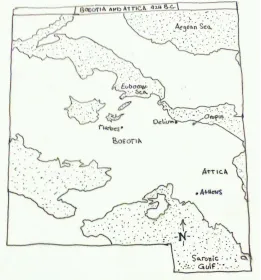
the Peloponnesian War. Delion was a small temple located on the coast in Boeotian territory,
just north of a shared frontier with Athens, 2 km from Oropus and 8 km from Tanagra.87 It
earned its name, which means „little Delos,‟ from a temple of Apollo that looked out over the
sea; it reminded those who saw it of the more famous sanctuary of Apollo located on the island
of Delos.88 In the fall of 424 BCE, the Athenians experienced an infantry disaster near the small
border sanctuary of Delion. They were routed in a surprise attack by the Boeotians and forced to
fall back, occupy, and defend the temple. Not surprisingly, the Boeotians described Athenian
behavior as the most grievous type of sacrilege, and Thucydides seems to agree, using the
viola-tion of pan-Hellenic values to cast an unfavorable light on his fellow countrymen.
The Battle of Delion resulted from the Athenian desire to escape a two-front war. By the
seventh year of the Peloponnesian war, the Athenians had endured Spartan invasions of the Attic
countryside from the south every spring, and their traditional enemy, the rival city of Thebes
which dominated politics in Boeotia to the north, consistently attempted to lure democratic allies
in Boeotia over to the oligarchic cause, often using tactics similar to those employed at Corcyra.
Though Hanson considers the battle of Delion to be one of the few traditional hoplite battles of
86
The Tragedies of Sophocles, translated by Sir Richard C. Jebb, ll. 1440. 87
Sources vary as to where the temple of Apollo at Delion was located. For a discussion of possible theories, see Kendrick Pritchett‟s Studies in Ancient Greek Topography: Part II (Battlefields) (1969) 27-30.
88
the Peloponnesian war, it began with the Athenians planning to defeat their Boeotian foes
through subterfuge. To eliminate Theban influence and interference, the Athenians leaders
con-cocted a daring, preemptive plan which they hoped would remove Thebes as a serious threat for
[image:41.612.111.372.182.462.2]the rest of the war, allowing them to focus their attention on the Peloponnesians.
Figure 4.1 Delion
Two Athenian generals (strategoi), Demosthenes and Hippocrates, were aware of
demo-crats in at least three city-states in Boeotia who were willing to betray their poleis to the
Athe-nians.89 If they could help these revolutions along, “it was hoped that the capture of these three
sites simultaneously might weaken Theban resolve and produce democratic, anti-Theban
rebel-lions all over Boeotia. At the very least, Athens would have three fortresses on the borders of
89
Boeotia for plundering expeditions and as refuges where exiles could escape.”90
Demosthenes
was to take his forces, as many troops as forty triremes could carry, and attack the port cities
where pro-democratic forces had indicated their willingness to cooperate. Hippocrates would
create a diversion, crossing the Athenian border into Boeotian territory, and build a fortified site,
an easily defensible place for retreating hoplites.91 Then, as Demosthenes marched from the
north and Hippocrates came up from the south, they would destroy their rivals in a classic pincer
attack.
Unfortunately their plan, which necessitated perfect timing and absolute secrecy, hardly
played out as its architects imagined. Thucydides reveals that their plot was foiled almost from
the beginning: “[T]he plot had been betrayed by Nicomachus, a Phocian from Phanotis, who
in-formed the Spartans and they the Boeotians.”92 Demosthenes‟s naval raid lost the element of
surprise, and, in addition, the two generals mixed up between them the date for the invasion.
When Demosthenes sailed into ports which he expected to be sympathetic to his cause, he found
hostile garrisons and no place to land his ships. He retreated, failing to achieve any of his
objec-tives, and those in the cities who had promised support were silent as troops from all over
Boeo-tia arrived to reinforce the endangered cities.
Meanwhile, Hippocrates, as yet unaware that Demosthenes‟s attack had already been
re-pulsed quite handily, moved his forces across the Athenian border into Delion as a diversionary
tactic. He set about preparing the site for fortification. Over the next five days,
his army began to fortify the sanctuary of Apollo at Delium, in the following manner. A trench was dug all round the temple and the consecrated ground, and the earth thrown up from the exca-vation was made to do duty as a wall, in which stakes were also planted, the vines round the sanctuary being cut down and thrown in, together with stones and bricks pulled down from the houses nearby, using, in short, every means to build the rampart. Wooden towers were also
90
Kagan, The Peloponnesian War, 165. 91
Ibid., 165-6. 92