V- Blast Detection in MIMO-OFDM System Using
Efficient Iterative Technique
G.Kanimozhi1, S.Devika2, P. Anto Felix Shaji3, K.Vadivel4
1, 2, 3, 4
Assistant Professor, Department of ECE, Jerusalem College of Engineering
Abstract: V-BLAST is a detection algorithm used for the reception of multi – antenna MIMO system. It applied to receiver using ordered successive cancellation method. At each stage of the algorithm the stream with the highest SNR is decoded. The V- BLAST technique which is proposed achieves high data rate. The proposed scheme adjusts the number of candidate symbol and iterative scheme based on the channel state information. V- BLAST detection technique has better BER performance than conventional schemes. Similarly BER performance of the QRD-M with iterative scheme has better performance. The proposed scheme has less complexity and better BER performance. Therefore the proposed scheme is used in wireless communication efficiently.
Keywords: V-BLAST, QRD-M, MIMO, BER, SNR, Iterative Scheme.
I. INTRODUCTION
Recently, Wireless Communication system has received extensive attention because of increasing demand for high data communication. Therefore various wireless digital communication techniques have been proposed. To satisfy these demands for wireless multimedia services, high-speed wireless communication and higher network capacity are required.
The MIMO-OFDM system which is a combination of advantages of MIMO and OFDM is currently being considered as a strong candidate for the physical layer transmission scheme of next generation wireless communication systems [1]. The Vertical Bell Laboratories layered space-time (V-BLAST) which is an important branch of BLAST has been very attractive in recent years for its simple implementation structure and high frequency efficiency [2].
The V-BLAST causes performance degradation when the data rate is high. Therefore many detection techniques for V-BLAST have been suggested to develop the traditional transmit technique [3]-[6].During the detection procedure, later detected symbol is detected through decision feedbacks from prior detected symbols. If no error exists in the prior detected symbol, the diversity degree of the next detected symbol is supposed to increase by one after each cancellation. Therefore addition of receive antennas attains more spatial diversity and improves diversity degree.
However if error exists in the prior detected symbol, the decision feedbacks result in a great negative effect on the detection of the later detected symbols. In order to overcome the above problems, iterative detection algorithm can be used in detection process. Iterative algorithms are those that repeatedly refine a current solution to a computational problem until an optimal or suitable solution is yielded. Iterative algorithms are widely used.
However complexity of iterative detection algorithm is increased by iteration time and as the number of transmit antennas increases. The proposed scheme has better BER performance than conventional, Similarly BER performance of the QRD-M with iterative scheme is better. Moreover the complexity of the proposed scheme has less complexity than QRD-M detection with iterative method.
II. MIMO-OFDM SYSTEM MODEL
Unfortunately, conventional OFDM signals are vulnerable to malicious eavesdropping due to their distinct time and frequency characteristics. As the physical-layer transmission parameters of OFDM signals can be blindly estimated by adversaries, traditional upper-layer security mechanisms cannot completely address security threats in wireless OFDM systems. Physical layer security, which targets communications security at the physical layer, is emerging as an effective complement to traditional security strategies in securing wireless OFDM transmission.
The phsical layer security of OFDM systems over wireless channels was investigated from an information-theoretic perspective. Based on the theoretical secrecy capacity study, several OFDM security techniques have been proposed. Power and subcarrier allocation schemes in OFDM systems subject to the power and security constraints were reported. Moreover, transmit beam forming, artificial noise and cooperation transmission can also be adopted to improve the security of OFDM-based transmission. However, these secrecy capacities based security techniques usually require the knowledge of the eavesdropping channel, which is conditioned on a successful detection of eavesdroppers. Also, additional resource may be needed like cooperative terminals and multiple antennas. The concept of coordinate interleaving was originally introduced into communications systems to improve the reliability of data transmission, and later extended to space-time code designs for multiple-input multiple-output transmission. Interleaving method was utilized to decrease the error rate in cooperative relay networks. However, none of these works take into account security issues.
III. V-BLAST DETECTION TECHNIQUE.
V-BLAST detection uses linear combinatorial nulling techniques (such as ZF or MMSE) or non-linear methods like symbol cancellation. Turn by turn each sub stream is considered to be the desired signal and all the others are interferers. Nulling is obtained by linearly weighting (W) the received signals. The MIMO system requires multiple antennas at both ends of radio link. It increases data rate by transmitting independent information streams on different antennas. For V-BLAST, No channel knowledge required at transmitter.
A. Main Steps for V-BLAST detection 1) Ordering: choosing the best channel.
2) Nulling: using ZF, MMSE, ML.
3) Slicing: making a symbol decision
4) Canceling: subtracting the detected symbol .5. Iteration: going to the first step to detect the next symbol.
The detection process consists of two main operations: 1. Interference suppression (nulling): The suppression operation nulls out interference by projecting the received vector onto the null subspace (perpendicular subspace) of the subspace spanned by the
interfering signals. After which, normal detection of the first symbol is performed. 2. Interference cancellation (subtraction): The contribution of the detected symbol is subtracted from the received vector.
IV. DETECTION TECHNIQUES
A. DFE Detection Scheme
In order to reduce the computational complexity of the OSIC (Ordered Successive Interference Cancellation) detection, the DFE(Decision Feedback Equalization) detection is proposed. The DFE detection is based on QR-decomposition. Therefore channel matrix Hk* can be expressed as
Hk* = Qk*Rk*, where,
Rk* is an upper triangular matrix. Qk* is an ortho-normal matrix. ZK* =(QK*)H YK*=RK*XK*+NK*
⎣ ⎢ ⎢ ⎢ ⎡ ∗ ∗ ⋮ ∗ ⎦ ⎥ ⎥ ⎥ ⎤ = ⎣ ⎢ ⎢ ⎢ ⎡ , ∗ , ∗ ⋯ , ∗
0 ∗ ⋯ ∗
⋮ ⋮ ⋱ ⋮
0 0 ⋯ ,
∗ ⎦ ⎥ ⎥ ⎥ ⎤ ⎣ ⎢ ⎢ ⎢ ⎡ ∗ ∗ ⋮ ∗ ⎦ ⎥ ⎥ ⎥ ⎤ + ⎣ ⎢ ⎢ ⎢ ⎡ ̇ ∗ ̇ ∗ ⋮ ̇ ∗ ⎦ ⎥ ⎥ ⎥ ⎤
where, Nk* is a noise matrix
The first detection order of DFE detection can be expressed as
∗ = ∗ , ∗ = , ∗ ∗ + ∗/ , ∗
After the first detection process, the remaining signal can be detected as follows
∗
= ∗− ,
∗
. ∗/ ,
∗
The signal is consecutively detected from ∗to ∗.
B. QRD-M Detection Scheme
In order to increase the BER performance of DFE detection, the QRD-M detection is proposed. The QRD-M detection increases the candidate symbol in DFE detection and is based on QR-decomposition. In the first step of QRD-M detection, the system considers all L symbols, c = [c(1),. ,c(L)] of L -QAM. C is candidates of transmit symbol. The system uses the squared Euclidian distance betweenZ1k* and c in order to determine the transmit symbol and can be expressed as
∗
( ) = ∗− ,
∗
( )
∗
= ∗(1),⋯, ∗( ),⋯, ∗( )
The L candidate symbols (c) are calculated by the squared Euclidian distance vector ( ∗), the ( ≤ ) symbols are selected from smallest to M1value for Euclidian distance and each symbol is the minimum branch metric.The selected symbols
∗
=
∗
Therefore, the path metric for hth survived symbol candidates ∗(ℎ), ∗(ℎ),⋯ ∗ (ℎ) and lth candidate of symbol (c(l)) are calculated as follows
∗
(ℎ, ) = ∗− ,
∗
( ) + ,
∗ ∗
(ℎ) + ∗ (ℎ)
where ∗ (ℎ)is the path metric of the hth
survived candidate symbols of the (m-1)th stage. In the ( ≤ )symbols are selected from smallest to M1value for Euclidian distance. This step is repeated up to the Txth stage. At the Txthstage, the candidate symbol
which has the smallest path metric is selected among MTx survived candidate symbols and the selected candidate symbol is decided
to final detected symbols.
V. PROPOSED DETECTION TECHNIQUE
The proposed scheme uses iterative detection algorithm, the number of candidate symbol and channel state. Detailed analysis of the proposed scheme is as follows.
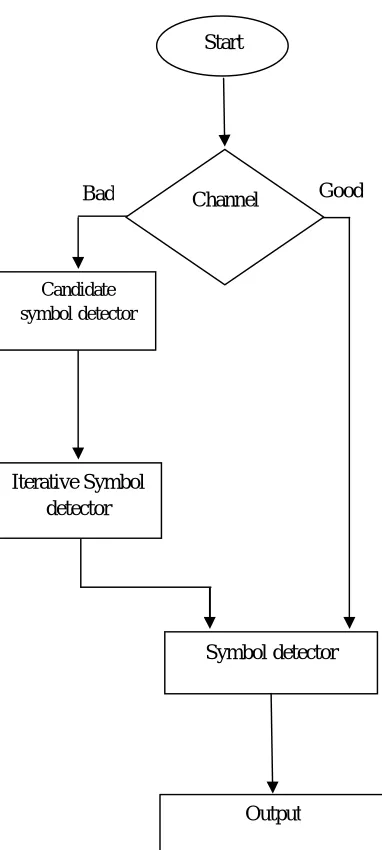
[image:5.612.190.412.307.513.2]The iterative scheme is the way to get the diversity gain and improves the BER performance. Iterative scheme uses the final detection symbol and the final detection symbol is used again to refine the remaining decision.
Fig 2: Algorithm of the proposed detection scheme
The proposed scheme adjusts the number of candidate symbol and iterative scheme based on channel state. When channel state is good, the DFE detection which allocates only one candidate symbol for detection. However, when channel state is bad, the number of candidate symbol is increased and the iterative scheme is used for detection.
The channel state ( ( ) i C H ) is calculated by 1-norm condition number and threshold value is calculated as follows
( ) =1 ( )
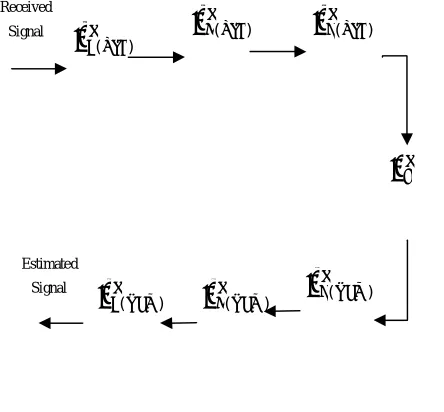
Received Signal
Estimated Signal
( )
∗ ( )
∗
( )
∗
( )
∗
∗
( )
∗
( )
Fig 3: Procedure of the proposed detection scheme
VI. SIMULATION RESULTS
The proposed system demonstrates the BER performance of proposed detection scheme and compares with conventional detection schemes via simulation. Next, it demonstrates the complexity of proposed detection scheme and compares with conventional detection schemes. The simulation considers MIMO-OFDM system and 16-QAM modulation is used. The number of subcarrier is 256 and the channel is Rayleigh fading channel and the number of channel path is 7. It is supposed that the channel is frequency flat fading during one MIMO-OFDM symbol period.
The BER performance of the proposed detection with 8×8MIMO-OFDM system and M is set to 2. In order to compare the BER performance of proposed scheme, ZF (Zero Forcing) detection, MMSE (Minimum Mean Square Error) detection, DFE detection, QRD-M detection and QRD-M detection with iterative scheme are shown.
Simulation result shows that the proposed detection scheme has better BER performance when compared to the conventional ZF, MMSE and DFE detection. The proposed detection scheme has similar BER performance as the M(M =4) and iterative QRD-M( M =2). In high SNR environment, the proposed scheme has better performance than QRD-M (M=4) scheme.
Good Bad
Start
Channel
Candidate symbol detector
Symbol detector Iterative Symbol
detector
Fig.4:BER performance of proposed detection with 8×8 MIMO-OFDM system using 16-AM(M =2)
The BER performance of the proposed detection with 8×8MIMO-OFDM system and M=3. In order to compare the BER performance of proposed scheme, ZF(Zero Forcing) detection, MMSE(Minimum Mean Square Error) detection, DFE detection, QRD-M detection and QRD-M detection with iterative scheme are shown. Simulation result shows that the proposed detection scheme has better BER performance than conventional ZF, MMSE and DFE detection. The proposed detection scheme has similar BER performance as the QRD-M(M =6) and iterative QRD-M( M =3). In the proposed scheme has better performance than QRD-M (M=6) scheme in the high SNR environment.
Fig 5: BER performance of proposed detection with 8×8 MIMO-OFDM system using 16-QAM( M =2)
VII. CONCLUSION
The efficient V-BLAST detection technique which is iterative in nature is proposed. Depending on the channel state, the proposed scheme adjusts the number of candidate symbol and iterative scheme. In DFE detection, one candidate symbol is used for detection when the channel state is good else the number of candidate symbol will be increased and iterative scheme is used for detection.
15 20 25 30 35 40 45
1e-006 1e-005 0.0004 0.0001 0.001 0.01 0.1 1 SNR(dB) B it E rr o r R a te (B E R ) ZF MMSE DFE QRD-M(M=4) Proposed scheme(M=2) Iter QRD-M(M=2)
15 20 25 30 35 40 45
Thus the proposed detection scheme can be efficiently used in wireless communication because it reduces complexity and has better BER performance.
REFERENCES
[1] M. -S. Baek, Y. -H. You and H. -K. Song,“Combined QRD-M and DFE detection technique for simple and efficient signal detection in MIMO-OFDM systems”,IEEE Trans. Wireless Communication, vol. 8, no.4, pp1632–1638, 2009
[2] J. -K. Ahn, S. -J. Yu and H. -K. Song, “Channel Condition Number Based Switching Detection Scheme in MIMO-OFDM System,” IEICE Trans.Fundamentals, vol. E96-A, no.1, pp387–390, 201
[3] G. J. Foschini, “Layered space-time architecture for wireless communication in a fading environment using multi-element antennas,” Bell Labs Tech J., vol. 1, no.2, pp 41–59, 1996
[4] Benjebbour, H. Murata, and S. Yoshida, “Performance of iterative successive detection algorithm with space-time transmission,”IEEEVehicular Technology Conference VTC 2001 Spring, vol. 2,pp1287–1291,2001