2019 International Conference on Computation and Information Sciences (ICCIS 2019) ISBN: 978-1-60595-644-2
Design and Implementation of Teaching
Quality Evaluation System Based on
SpringBoot
Kan Ji, Xiaojun Chen, Aoming Qin, Jia Liu and Jinmei Wu
ABSTRACT
In order to enhance the integration, standardization and network of teaching quality evaluation, SWPU (Southwest Petroleum University) proposes teaching quality evaluation system based on SpringBoot as a part of smart campus construction. This system adopts the B/S structure to design the system function module and system database.In addition, it utilizes the IDEA tool management project, which enables a normative and consistent way to integrate the information resources, such as personnel system and educational administration system. As such, the system realizes sharing data and ensures practicability and scalability.
1. INTRODUCTION
Outline of the National Medium-and Long-Term Education Reform and Development Plan (2010-2020) pointed out "It is necessary to improve the evaluation of education and teaching, establish scientific and diverse evaluation according to the training objectives and talent concepts, carry out educational quality evaluation activities involving the government, schools, parents and society, do a good record of students' growth, and improve the comprehensive quality evaluation,
Kan Ji, Network and Information Center, Southwest Petroleum University, Chengdu, 610500, China
XiaoJun Chen, Network and Information Center, Southwest Petroleum University, Chengdu, 610500, China
Aoming Qin, School of Computer Science, Southwest Petroleum University, Chengdu, 610500, China
Jia Liu, School of Computer Science, Southwest Petroleum University, Chengdu, 610500, China
and then explore various evaluation methods to promote student' development[1]. "
The evaluation in teaching quality in universities allows better understanding students' learning situation and examining teachers' classroom and teaching process. Teaching quality evaluation is a systematic and complex project, coupled with the main research direction in the field of education. However, at present, teaching quality evaluation system is unscientific and evaluation methods single, combined with Information Island and serious information sharing problem. Thus, it is imperative to design and implement integrated teaching quality system for smart campus construction.
Based on the unified data standard and the research results of the teaching quality evaluation system of our university, this paper puts forward to teaching quality evaluation system based on SpringBoot, which makes teaching quality evaluation system adopted to new requirements and new standards of smart campus construction.
2. SYSTEM ANALYSIS
On the basis of research results of the teaching quality evaluation system of SWPU, the purpose of this system is to provide scientific and objective evaluation, obtain real and comprehensive feedback information, and identify problems. As such, teachers can fully understand their teaching level, coupled with providing decision-making reference to leaders. Moreover, it provides the basis of classroom teaching quality excellence award and teacher title evaluation and so on.
The system based on SpringBoot is implemented by MySQL, Java and B/S. The foreground technology renders the page through JSP, JQuery, html5, and css3. This paper makes full use of information resources of SWPU, which not only solves teaching quality evaluation and evaluation analysis by manual model, but also achieves sharing authority data.
2.1 Demand Analysis
The traditional teaching quality evaluation method is time-consuming and labor-intensive, and the feedback information is not timely and comprehensive, which plays a slight role in promoting teachers' personal development and improving teaching quality. As a consequence, the design and implementation of teaching quality evaluation system is necessary for smart campus. On the basis of analyzing the actual process of teaching quality evaluation and the standard requirement of smart campus information construction, the system should have the following requirements.
(2) Completing teaching evaluation according to corresponding evaluation methods.
Publishing the results of teaching quality evaluation to teachers through multiple channels.
(3) Setting different operation rights for different users and providing diverse operation interfaces.
(4) Combining information construction norms and unified data standards, standardized database design and public shared data ensure the organic integration with the personnel system and the educational administration system.
(5) Considering the security, database backup and restore so as to timely deal with the database failures.
2.2 Architecture Design
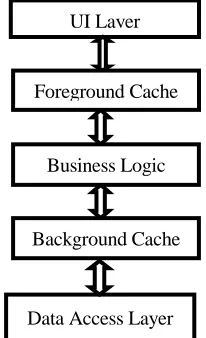
[image:3.612.240.343.435.604.2]The system is based on three-tier architecture. In addition, we add two more layers, which lead to five parts: UI Layer, Foreground Cache Layer, Business Logic Layer, Background Cache Layer, Data Access Layer. UI Layer renders the page through JSP, JQuery, html5, and css3. Foreground Cache Layer is between UI Layer and Business Logic Layer, which is mainly used to cache the portal and static resources of the system. Business Logic Layer mainly includes the implementation of the algorithm, image processing, and other data business logic processing. Background Cache Layer is between Business Logic Layer and Data Access Layer, which caches the results of the execution. Data Access Layer directly adds, deletes and updates the database. The architecture diagram of this system is shown in Figure 1.
Figure 1. The architecture diagram. Data Access Layer
UI Layer
Foreground Cache Layer
Business Logic Layer
3. FUNCTION MODULE DESIGN
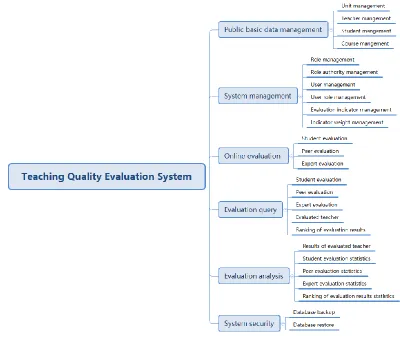
[image:4.612.116.516.197.534.2]The system functions include six modules: public basic data management, system management, online evaluation, evaluation analysis, query, and system security. The function diagram of the system is shown in Figure 2.
Figure 2. Function structure diagram.
(1) Public basic data management, including department management, teacher management, student management, and course management.
(3) Online evaluation, including student evaluation, peer evaluation, and expert evaluation. Different user permissions obtain corresponding module rights. For example, users who log in as an expert can only enter the expert module to evaluate teaching quality evaluation. The system automatically gives the course number and course name that the expert needs to evaluate according to the expert group to which the expert belongs, and the log-in expert has the records of the teacher.
(4) Evaluation query, including student evaluation, peer evaluation, expert evaluation, evaluated teacher and Ranking of evaluation results.
(5) Evaluation analysis, including results of evaluated teacher, student evaluation statistics, peer evaluation statistics, and expert evaluation statistics.
[image:5.612.99.505.257.486.2](6) System security, including database backup and database restore. Expert evaluation in Figure 3.
Figure 3. Expert evaluation.
4. DATABASE DESIGN
The system uses MYSQL relational database to organize, store and manage data in accordance with data structure. Teaching quality evaluation database is constructed based on the unified data standard of SWPU, which ensures the standardization data of information system. Then the system has expansibility and adaptability. The specific design of the database is shown below.
systems such as personnel systems and educational system. The data covers information including department information(department number, department name and department level), teacher information(teacher number, teacher name, department number, job title, coupled with position), student information(student number, student name, sex, department number, class number, class name, grade, professional number, professional name, enrollment year, student type number, combined with student type name), course information(course order number, course number, course name, teacher number, class hours, professional number, professional name, course type number, course type name and department number).
(2) System managements used to store the required system data information, including role information(role number, role name and role identity), role function information(role function number, role function name, function number, coupled with role function type), user information(user number, teacher/student number, password, combined with state), user role information(user role number, user number, combined with role number), evaluation indicator information(evaluation indicator number, evaluation indicator name, indicator value, indicator maximum value, indicator minimum value, course type number, coupled with indicator detailed description).
(3) Evaluation information managements used to store the evaluation content of student evaluation, peer evaluation, and expert evaluation. The fields involve evaluator number, teacher number, evaluation time, class number, evaluation indicator number, individual score, and total scores, combined with evaluation comment.
5. KEY TECHNOLOGY
5.1 SpringBoot
Based on Spring4.0 design, SpringBoot not only inherits the original excellent features of the Spring framework, but also simplifies the whole construction and the development process of Spring applications by simplifying configuration. In addition, SpringBoot can solve the problem of version conflicts of dependent packages and unstable references [2].
SpringBoot’s features are:
(1) Create stand-alone Spring applications.
(2) Embed Tomcat, Jetty or Undertow directly (no need to deploy WAR files). (3) Provide opinionated 'starter' dependencies to simplify your build configuration.
(4) Automatically configure Spring and 3rd party libraries whenever possible. (5) Provide production-ready features such as metrics, health checks, and externalized configuration.
The basic architecture design of SpringBoot application development template is described from front-end to background. The front-end often uses the template engine, including Free Marker and Thyme leaf, which are written in JAVA, render the template and output the corresponding text. As a result, the interface design and the logic of application are separated. The front-end development also uses Bootstrap, Angular JS, coupled with JQUERY. Json, Non-XML, and RESTful API are provided in the data transmission format of the browser. Spring MVC is used to process requests after the data arrives at the server. To Data Access Layer, there are mainly persistence layer frameworks such as Hibernate, My Batisand JPA. The database is commonly used by MYSQL. The development tool recommends the IDEA [2].
5.2 Public data acquisition
In order to solve the shortcomings of data inconsistency caused by the current basic data redundancy, and open the data channel between business systems, the data cleaning platform of SWPU realizes the authoritative data transmission, cleaning and integration between application systems. It concentrates authoritative data to standard database in real time, and then distributes basic data onto this system from standard database. The public basic data onto the system includes departments, teachers, students and courses, which is obtained from the data center of the university.
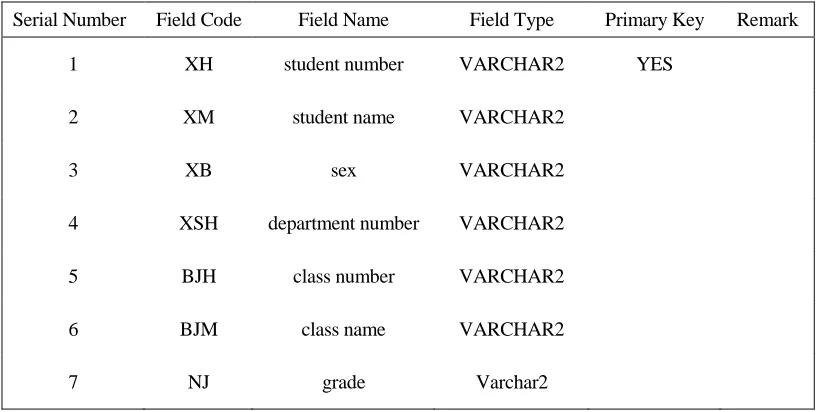
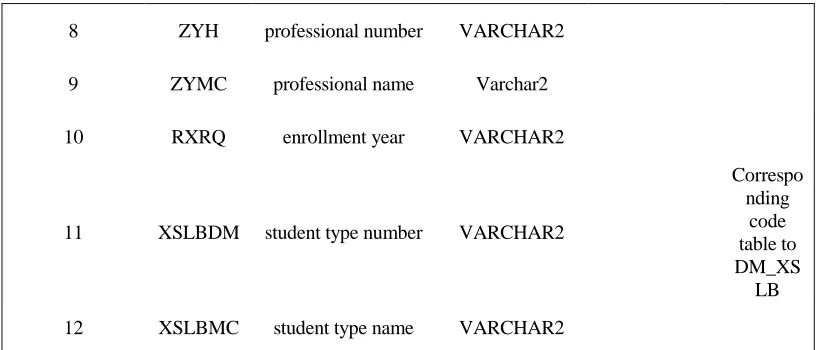
[image:7.612.93.502.475.681.2]The paper takes the student object as an example to introduce the specific design of the student's public data table. The design of the student data table is shown in Table I.
TABLE I. STUDENT DATA TABLE.
Serial Number Field Code Field Name Field Type Primary Key Remark
1 XH student number VARCHAR2 YES
2 XM student name VARCHAR2
3 XB sex VARCHAR2
4 XSH department number VARCHAR2
5 BJH class number VARCHAR2
6 BJM class name VARCHAR2
8 ZYH professional number VARCHAR2
9 ZYMC professional name Varchar2
10 RXRQ enrollment year VARCHAR2
11 XSLBDM student type number VARCHAR2
Correspo nding
[image:8.612.93.501.84.259.2]code table to DM_XS
LB
12 XSLBMC student type name VARCHAR2
6. CONCLUSIONS
In terms of information construction standard of SWPU and unified data standard, the paper designs and implements teaching quality evaluation system based on SpringBoot. In the light of teaching quality evaluation system of SWPU, the system is simple and easy to use, so as to meet the requirements of SWPU's teaching quality evaluation business, concurrent users and response spend requirements. Through rational and comprehensive analysis of requirements, the system architecture, function modules and database are designed according to requirements analysis. The system functions are developed based on SpringBoot and Data Center standard library. At present, the weight of evaluation indicator is artificially set by experience, so that the next step will be to establish multi-level, whole-process, scientific, reasonable and fair teaching evaluation through Big Data technology, so as to realize teaching reform brought by Big Data.
ACKNOWLEDGEMENTS
REFERENCES
1. Outline of the National Medium-and Long-Term Education Reform and Development Plan (2010-2020).http://www.moe.gov.cn/srcsite/A01/s7048/201007/t20100729_171904.html. 2. Xiao Deng. 2004. “A Thesis Submitted in Partial Fulfillment of the Requirements for the Degree
for the Master of Engineering. Hubei: Huazhong University of Science and Technology. 3. SprinBoot. Spring Website. 2016.
4. Fang Xie. 2016. “The design and implementation of teaching quality evaluation system,” Jilin:
Jilin University. 2016.
5. Chaosheng Yan, Chengjiang Zhang, Dan Li. 2012. “Design and implementation of teaching quality evaluation system based on web,” Computer Engineering and Design. 2012, 31(4). 6. Wenhui Peng, Zongkai Yang, Chengling Cheng, etc. 2006. “Scheme of data sharing of higher
educational management information system in campus,” Computer Engineering and Design., 27(11)