R E S E A R C H A R T I C L E
Open Access
Lower hamstring extensibility in men compared
to women is explained by differences in stretch
tolerance
Paul WM Marshall
*and Jason C Siegler
Abstract
Background:This study examined whether passive hamstring tissue stiffness and/or stretch tolerance explain the relationship between sex and hamstring extensibility.
Methods:Ninety healthy participants, 45 men and 45 women (mean ± SD; age 24.6 ± 5.9 years, height 1.72 ± 0.09 m, weight 74.6 ± 14.1 kg) volunteered for this study. The instrumented straight leg raise was used to determine hamstring extensibility and allow measurement of stiffness and stretch tolerance (visual analog pain score, VAS). Results:Hamstring extensibility was 9.9° greater in women compared to men (p = 0.003). VAS scores were 16 mm lower in women (p = 0.001). Maximal stiffness (maximal applied torque) was not different between men and women (p = 0.42). Passive stiffness (slope from 20-50° hip flexion) was 0.09 Nm.°-1lower in women (p = 0.025). For women, linear and stepwise regression showed that no predictor variables were associated with hamstring extensibility (adjusted r2= -0.03, p = 0.61). For men, 44% of the variance in hamstring extensibility was explained by VAS and maximal applied torque (adjusted r2= 0.44, p < 0.001), with 41% of the model accounted for by the relationship between higher VAS scores and lower extensibility (standardizedβcoefficient = -0.64, p < 0.001). Conclusions:The results of this study suggest that stretch tolerance and not passive stiffness explains hamstring extensibility, but this relationship is only manifest in men.
Keywords:Hamstring extensibility, Passive stiffness, Stretch tolerance
Background
Extensibility is defined as the ability of muscle tissue to lengthen or stretch beyond resting length. Lower ham-string extensibility is a functional characteristic of signifi-cant interest for the prevention and rehabilitation of locomotion related strain injuries [1,2], as well as the treatment of patients with chronic low back pain [3-5]. Passive stretching is a typical component of injury preven-tion and rehabilitapreven-tion programs to address hamstring ex-tensibility [6]. However, there is dispute as to the efficacy of passive stretching for improving hamstring extensibility. The equivocal evidence may, in part, be attributed to the use of different volumes of stretching prescribed between studies [7-9], small sample sizes, confusion about the mechanism of action for explaining changes in hamstring
extensibility, and the confounding effect of small mixed sex groups [10-12]. Two factors typically measured for explaining changes in hamstring extensibility are passive stiffness and stretch tolerance. There is debate regarding the relative contribution of passive stiffness and stretch tolerance to hamstring extensibility. Moreover there is limited information examining similarities or differences between-sex in passive stiffness and stretch tolerance. The limited evidence examining between-sex differences con-tributes to the confusing evidence from training studies that use small mixed sex groups to examine changes in hamstring extensibility.
Muscle stiffness is the ratio of the change in torque to the change in muscle length, which may be examined dur-ing active or passive contractions [13]. Often measured during an instrumented passive straight leg raise (iSLR) test to allow observation of torque applied during stretch [11,14,15], some research that has concluded passive
* Correspondence:[email protected]
School of Science and Health, University of Western Sydney, Locked Bag 1797, Penrith South, NSW 2751, Australia
stiffness does not explain extensibility, either acutely or following training [8,10,11,16]. However, these studies typ-ically define passive stiffness from the maximal torque measured at the end of the hamstrings range of motion [8,10,11,16]. Maximal applied torque is probably not a valid estimation of passive muscle stiffness as the meas-urement does not take into account the ratio of the change in torque to change in muscle length during stretch. In contrast increased passive hamstring stiffness, quantified as the slope of the torque-angular position curve during passive hip flexion, was observed to signifi-cantly predict decreased extensibility in both healthy indi-viduals and patients with chronic LBP [5]. Moreover, reductions in the slope of the torque-angular position curve were associated with improved hamstring extensi-bility following 4-weeks of passive stretching in healthy young men and women [12]. The reliance on measure-ment of maximal torque rather than examining changes in torque during the range of motion has contributed to the conclusion that hamstring extensibility is probably best explained by stretch tolerance.
Stretch tolerance is described as the willingness to tol-erate the discomfort associated with stretch [11,17]. Typically, this has been self-reported as the angle during the range of motion where discomfort is reported [8,17]. One study suggested stretch tolerance does not explain extensibility, but no direct measure of stretch tolerance was performed during testing [5]. Other evidence that suggests stretch tolerance may contribute to hamstring extensibility has examined maximal perceived pain dur-ing an extensibility test before and after traindur-ing inter-ventions [11,12]. While increased hamstring extensibility was reported following passive stretch training programs [11,12], maximal pain reported at the new end range of extensibility was not changed. This was interpreted in one study to mean that participants willingness to toler-ate pain during stretch had improved [11], and was not discussed in the other [12]. Stretch tolerance does likely predict extensibility, but the contribution to extensibility as compared to changes in passive stiffness is unknown. Moreover, it is unclear whether there are between-sex differences in the contribution of stretch tolerance and passive stiffness to total hamstring extensibility.
One study using the iSLR reported no between-sex dif-ference for extensibility, but lower passive stiffness for women [5]. This finding [5] is confounded by a small, mixed sample of healthy controls and LBP patients, and absence of a direct stretch tolerance measure. Other evi-dence using a prone knee flexion/extension perturbation model reported lower active and passive hamstring stiff-ness in women [18,19]. Thus it is reasonable to believe that passive stiffness will be lower in women, although it is not clear whether this will explain differences in extensi-bility during the iSLR. Moreover, it is unclear whether or
not stretch tolerance will be lower in women concomitant to lower passive stiffness. Differences between men and women for pain sensitivity and tolerance have been re-ported [20]. Typically, these findings suggest that women have greater pain sensitivity and lower tolerance than men, which is often attributed to different hormonal pro-files [20-22]. Whether women will self-report greater pain during stretch, when it is expected that passive stiffness will be lower and extensibility higher than men is unclear.
There is a need to understand whether the relationship between sex and hamstring extensibility is explained by hamstring passive tissue stiffness and stretch tolerance. Providing information about the factors that contribute to hamstring extensibility within each sex will help the design of targeted interventions. The purposes of this study were: 1) to compare measures of hamstring exten-sibility, passive stiffness, and stretch tolerance between men and women, 2) to examine the relationship between passive stiffness and stretch tolerance with hamstring ex-tensibility within each sex.
Methods
Participants
sport training session, yoga or pilates class). Written in-formed consent was received from all participants. Ethical approval was received for this study from the University Human Research Ethics Committee.
Instrumented straight leg raise (iSLR)
The KinCom isokinetic dynamometer (Chattanooga, Kin-Com 125 Version 5.32) was used for iSLR testing. Partici-pants were placed in a supine position on the examination table. They were fixed to the table by the use of straps across the trunk, pelvis, and opposite thigh. Adjustable support was provided to prevent the lumbar spine flatten-ing onto the test surface durflatten-ing testflatten-ing. The leg was fully extended in the apparatus and attached to the lever arm on the distal aspect of the thigh and mid-shank, and the ankle was fixed at 90° of dorsiflexion. The center of rota-tion of the dynamometer lever arm was aligned with the hip joint center of rotation through the greater trochanter of the test limb. Following familiarization with the experi-mental set-up and preliminary movement through a par-tial range of motion (passive flexion of the hip performed by the investigator), the stop angle to be used during test-ing was established by passively flextest-ing the participant’s hip until they could no longer tolerate the stretch. This was performed between 3 to 5 times with 30 s rest be-tween movements until a consistent maximum hip flexion angle (within 1° hip flexion as observed from digital real-time output of the dynamometer software) was estab-lished. The maximum angle of these trials was set as the terminal limit of the dynamometer for the recorded trial. This procedure was used to ensure that a true maximum hip flexion angle was set, reducing the influence of partici-pant choice on termination of range of motion. The hip was then passively flexed through the established range of motion by the dynamometer at a movement velocity of 5°. sec-1, which is similar to previous studies [5,15,17].
Hamstring extensibility
Angular position of the lever arm and torque were con-tinuously collected at 100Hz. Maximum hip flexion angle (leg°max) in the sagittal plane was measured from output
of the angular position of the lever arm relative to the initial starting position (leg fully extended in line with the trunk was calibrated to starting angle of 0°). Therefore leg°max was the dependent variable we measured and
defined as representing hamstring extensibility. Inter-trial reliability within this study for leg°maxduring the iSLR was
high (ICC r = 0.98). Intra-tester reliability for the iSLR has been reported (ICC r = 0.94, [23]), in addition to between-session reliability (ICC r = 0.95, [12]).
Hamstring stiffness
The active torque required to lift the leg was continu-ously recorded (Figure 1) and adjusted for limb weight,
leg length, and the angular position of the lever arm. Stiffness was defined as the torque calculated at the dif-ferent joint angles (Me). The maximal value from the torque-time curve was recorded and defined as the max-imal stiffness (Memax). The relative stiffness (Megrad)
through the common range of motion (20 to 50° based on hip flexion angle) was calculated from the slope of a linear trend line fitted to torque values recorded from 20 to 50° hip flexion. For processing Megrad, recorded
torque values in 5° increments (20°, 25°…..45°, 50°) were calculated from the average 1-s torque recorded at each point in the range of motion (e.g. average torque re-corded from 19.5 to 20.5° was calculated for stiffness at 20° hip flexion). Subsequently, the slope (Δtorque/Δ an-gular position; Nm.°-1) and coefficient of determination (r2) to examine the goodness of fit were calculated from a linear line fit to the torque-angular position relation-ship for each participant. The common range of motion is achievable in healthy and clinical populations [5,24]. The average coefficient of determination for the linear line for participants was r2= 0.94 ± 0.01 (not different between men and women). Analysis through the com-mon range of motion allows comparison of passive tis-sue stiffness across a standard absolute range of motion between participants, independent of total extensibility or maximal applied torque, and is a measure that allows direct comparison across population cohorts with lower absolute extensibility (e.g. low back pain patients, ath-letes pre-season with low extensibility).
Stretch tolerance
The visual analog pain scale (VAS) was used to represent participant stretch tolerance. The VAS is a 100 mm hori-zontal line with “no pain” and“worst pain” anchored to the respective left (0 mm) and right (100 mm) ends. Par-ticipants were asked to draw a vertical line through the horizontal line at the point which best represented their maximal pain intensity experienced during the iSLR. The VAS score (mm) was calculated by measuring the distance from “no pain” to their mark. The VAS score was collected immediately (<5 s) following iSLR testing. Between-trial reliability for VAS scores reported during the manual SLR tests to establish maximum range of motion (performed prior to the recorded iSLR) had an ICC r-value > 0.95. Test-retest reliability of the VAS to measure self-rated pain has been demonstrated to be high with ICC scores between 0.70 and 0.83 [25]. The VAS has been estimated to be more sensitive to change than a verbal rating scale, and similar to an 11-point nu-meric rating scale [26].
Statistical analysis
from inspection of the skewness and kurtosis of the data and Kolmogorov-Smirnov normality tests. Dependent var-iables were compared between men and women using in-dependent samples t-tests. Mean differences and 95% confidence intervals were calculated for between-sex differences. Pearson’s correlation coefficients were calcu-lated for within-sex relationships between the predictor variables Memax, Megrad, and VAS. Multiple linear and
step-wise regression analyses were used to examine the re-lationship between Memax, Megrad, and VAS scores with
leg°max.Regression analyses were performed for the entire
sample, and separately for each sex. The significance level for this study was p < 0.05.
Results
Men and women results for iSLR variables are presented in Table 1. Leg°maxwas 9.9° greater in women compared
to men (95% CI for mean difference, 3.5 to 16.3°, p = 0.003). VAS scores were 16 mm lower in women (95% CI for mean difference, -7 to -26 mm, p = 0.001). Megrad was 0.09 Nm.°-1 lower in women (95% CI for
mean difference, -0.01 to -0.16 Nm.°-1, p = 0.025). No between-sex difference was observed for Memax.
For women, correlation analysis identified no associ-ation between VAS and Memax (r = 0.19, p = 0.21) or
Megrad(r = 0.12, p = 0.41), and a significant positive
associ-ation between the respective passive stiffness measures (r = 0.47, p = 0.001). For men, there was a significant posi-tive association between VAS and Memax (r = 0.66,
p < 0.001), but no association between VAS and Megrad
(r = 0.11, p = 0.47), or between the respective passive stiff-ness measures (r = 0.26, p = 0.10).
For all participants, the predictor variables significantly explained 23% of the variance in Leg°max (adjusted r2=
0.23, p < 0.001). Stepwise regression identified VAS as the primary predictor of Leg°max (adjusted r2= 0.22,
p < 0.001), with higher VAS scores associated with lower Leg°max(standardizedβcoefficient = -0.48, p < 0.001). For
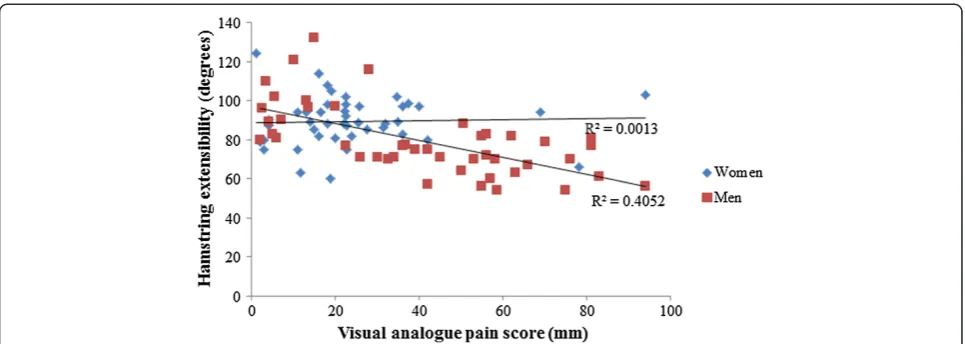
women, linear and stepwise regression showed that no predictor variables were associated with Leg°max(Figure 2;
[image:4.595.59.540.89.273.2]adjusted r2= -0.03, p = 0.61). For men, 44% of the variance in Leg°max was explained by the predictor variables
Figure 1Representative results from a man and woman tested in this study for the torque measured during the instrumented straight leg raise test (iSLR).Passive tissue stiffness was measured as the slope (Δy/Δx) through the common range of motion (Megrad, 20-50°), and peak
torque applied during the iSLR (Memax). Maximum leg excursion angle (leg°max) was used to represent hamstring extensibility in this study (male,
67°; female, 87°). Observe the lower Megrad, and greater leg°maxfor the female participant, but similar Memax. Note that VAS pain scores were 66
and 4 mm respectively for the male and female participant results presented here.
Table 1 Between sex results (mean ± SD, lower and upper limits for 95% confidence interval, CI) for iSLR measures of hamstring extensibility (leg°max), passive stiffness (Memax, Megrad), and stretch tolerance (hamstring VAS;mm)
Variable Men (n = 45) Women (n = 45)
p-value
Mean ± SD 95% CI Mean ± SD 95% CI
leg°max(°) 79.4 ± 17.8 73.5 to 85.4 89.4 ± 12.4 85.2 to 93.5 0.003
Memax(Nm) 43.6 ± 23.6 35.7 to 51.5 40.3 ± 14.6 35.4 to 45.1 0.42
Megrad(Nm.° -1
) 0.47 ± 0.15 0.42 to 0.53 0.38 ± 0.21 0.32 to 0.46 0.025
Hamstring VAS (mm) 41 ± 26 32 to 49 24 ± 19 18 to 30 0.001
[image:4.595.58.541.646.724.2](adjusted r2= 0.44, p < 0.001). Stepwise regression revealed that VAS explained 41% of variance, with higher VAS scores associated with lower Leg°max(Figure 2; standardized
β coefficient = -0.64, p < 0.001), and Memax contributed
a further 3% to the model with higher scores associated higher Leg°max (standardized β coefficient = -0.32, p =
0.041).
Discussion
Main findings
The main findings of this study were 1) women had lower passive stiffness through a common range of mo-tion, better stretch tolerance (lower VAS scores), and greater hamstring extensibility compared to men, and 2) stretch tolerance, but not passive stiffness, was a signifi-cant predictor of total hamstring extensibility for men only.
Between sex differences in extensibility
The results of this study support previous findings for between-sex differences in the mechanical properties of hamstring stiffness and extensibility [18,19]. Previous re-search has provided insight into mechanistic factors that may contribute to the between-sex differences reported here. One study reported that increased electromechan-ical delay (EMD) of the medial hamstrings during the iSLR test was associated with greater hamstring exten-siblity in women, suggesting that the neuromuscular control of the hamstrings during stretch is altered in women [5]. Another study [18] reported that greater hamstring stiffness in men, as measured by an oscillating knee flexion/extension protocol, was positively associ-ated with hamstring cross-sectional area (CSA). Mea-sures of both stiffness and CSA were greater in male participants [18]. During the iSLR procedure in the
current study, the applied torque to passively flex the hip was corrected for the limb weight, angular position, and lever arm of the participant. This calculation does not account for hamstring muscle CSA. Future research should examine whether passive stiffness, as measured by the iSLR method used in this study, may be explained by hamstring CSA and thus explain between-sex differ-ences observed.
The association between stretch tolerance and extensiblity
[image:5.595.57.540.88.260.2]the pain scores reported in this study, particularly those reported by men, are mediated by increased group III af-ferent discharge rates. Moreover, there is no evidence examining group III afferent discharge properties during a stretching task where mechanical tension within the muscle is gradually increasing, or comparing group III discharge properties between sexes. Concomitant to nociception potentially explaining between sex differ-ences in stretch tolerance is consideration for whether pain is causing a reflex response that impairs hamstring extensibility in men.
Johansson and Sojka proposed that muscle pain pro-duces disturbances in proprioception, stiffness regula-tion, and motor control by altering stretch sensitivity and the discharge of spindle afferents via gamma fusi-motor neurons [30]. Thus, it is reasonable to believe that increased pain during stretch may alter the neuromuscu-lar control of the hamstrings, increase the eccentric con-traction during stretch, and limit extensibility. Existing evidence would suggest that muscle activity does not contribute to termination of the straight leg raise. It was recently reported that surface EMG signals obtained from the hamstring muscles during the passive straight leg raise were not related to measures of stiffness or ex-tensibility [5]. Indeed, healthy controls exhibited higher hamstring EMG signals as well as greater extensibility compared to patients with chronic low back pain, thus negating suggestions that increased muscle activity is detrimental during a passive straight leg raise. The physiological link between pain and increased spindle output has also been questioned. Recent evidence using experimentally induced muscle pain reported that muscle spindle output was not increased, suggesting that stimulation of group III and IV afferents fails to excite fusimotor neurons and increase muscle spindle dis-charge [31]. Therefore the causation for termination of the test and thus the relationship between pain and ex-tensibility, evident only in men, is probably mediated by behavioural interpretation of the pain elicited during stretch.
Application and limitations
Recommendations for training interventions to improve hamstring extensibility in each sex cannot be made in this study. While current evidence would suggest that higher volumes of stretching (e.g. multiple hamstring stretches performed up to 5 times per week) are most effective for increasing extensibility and thus should be prescribed to both sexes [7,12], it is not clear whether men also need additional intervention to improve their ability to tolerate stretch. The results of this study do suggest that findings and conclusions from previous literature exploring mech-anisms of action for changing hamstring extensibility using small mixed sex samples are strongly confounded
because of the differences between each sex for the rela-tionship between stretch tolerance and extensibility.
There are several limitations to this study. First, while we recorded current physical activity levels, we did not record historical physical activity levels. Since the between-sex dif-ference in extensibility was likely explained by pain and the behavioural response to pain, it is a noteworthy limitation that historical activity was not recorded. It is reasonable to believe that historical exposure to stretching, and types of activity where hamstring range of motion is trained (e.g. dance), could influence the familiarity with the type of stretch used in this study and thus the between-sex differ-ence. Other muscles in the posterior kinetic chain (e.g. glu-teals) likely contribute to the extensibility and stiffness measures in this study. Therefore, while the primary muscle stretch is applied to, these results are not specific to only the hamstrings. While not measured, we do not believe that hamstring extensibility was significantly affected by changes in the displacement or strain of the lumbosacral nerve roots during iSLR testing. By stabilizing the lumbar spine and using a fixed ankle position we have controlled these poten-tially confounding variables that have been observed to in-crease spinal nerve root tension [32]. Finally, the two measures of passive stiffness were based on the slope through the common range of motion (20 to 50° hip flexion) and the maximal applied torque. Other researchers have applied a 4th order polynomial to hamstring torque data during stretch, and have calculated the average first differential from a number of common points during the range of motion as the measure of stiffness (e.g. every 5° during the final 15° during the test [33]). Polynomial model-ling may adequately fit the entire torque-angular position curve, but absolute application of a 4th order polynomial for all participants assumes this is the best fit for the data. The passive stiffness measure in this study is based on the assumption of linearity between torque and angular pos-ition (r2= 0.94 ± 0.01) in a range of motion (20 to 50°) that is achievable for healthy and chronic back pain populations. In future, methods should be applied that are individualized to each participant for curve-fit modelling and quantifying stiffness.
Conclusions
Greater hamstring extensibility in women was not asso-ciated with the lower passive stiffness and stretch toler-ance scores. In contrast, lower extensibility in men was associated with higher pain scores. The results of this study suggest that stretch tolerance does explain ham-string extensibility, but this relationship is only manifest in men.
Competing interests
Author contributions
PM designed the study and coordinated data collection and analysis. PM and JS were both involved in the data analysis, preparation and editing of the final manuscript. Both authors read and approved the final manuscript.
Acknowledgements
Funding for this project and the publication was provided by internal funding sources in the School of Science and Health, University of Western Sydney.
Received: 10 March 2014 Accepted: 3 July 2014 Published: 7 July 2014
References
1. Witvrouw E, Danneels L, Asselman P, D’Have T, Cambier D:Muscle flexibility as a risk factor for developing muscle injuries in male professional soccer players. A prospective study.Am J Sports Med2003, 31(1):41–46.
2. Bradley P, Portas M:The relationship between preseason range of motion and muscle strain injury in elite soccer players.J Strength Cond Res2007, 21:1155–1159.
3. Esola MA, McClure PW, Fitzgerald GK, Siegler S:Analysis of lumbar spine and hip motion during forward bending in subjects with and without a history of low back pain.Spine1996,21(1):71–78.
4. McHugh MP, Kremenic IJ, Fox MB, Gleim GW:The role of mechanical and neural restraints to joint range of motion during passive stretch.Med Sci Sports Exerc1998,30(6):928–932.
5. Marshall PWM, Mannion J, Murphy BA:Extensibility of the Hamstrings is best explained by mechanical components of muscle contraction, not behavioral measures in individuals with chronic low back pain.
PM&R2009,1:709–718.
6. Brooks JHM, Fuller CW, Kemp SPT, Reddin DB:Incidence, risk, and prevention of hamstring muscle injuries in professional rugby union.
Am J Sports Med2006,34(8):1297–1306.
7. Ylinen J, Kautiainen H, Hakkinen A:Comparison of active, manual, and instrumental straight leg raise in measuring hamstring extensibility.
J Strength Cond Res2010,24(4):972–977.
8. Folpp H, Deall S, Harvey LA, Gwinn T:Can apparent increases in muscle extensibility with regular stretch be explained by changes in tolerance to stretch?Aus J Physiol2006,52(1):45–50.
9. Roberts JM, Wilson K:Effect of stretching duration on active and passive range of motion in the lower extremity.Br J Sports Med1999,33:259–263. 10. Halbertsma JPK, Göeken LNH:Stretching exercises: effect on passive
extensibility and stiffness in short hamstrings of healthy subjects.
Arch Phys Med Rehabil1994,75(9):976–981.
11. Law RYW, Harvey LA, Nicholas MK, Tonkin L, De Sousa M, Finniss DG: Stretch exercises increase tolerance to stretch in patients with chronic musculoskeletal pain: a randomized controlled trial.Phys Ther2009, 89(10):1016–1026.
12. Marshall PWM, Cashman A, Cheema BS:A randomized controlled trial for the effect of passive stretching on measures of hamstring extensibility, passive stiffness, strength, and stretch tolerance.J Sci Med Sport2011, 14(6):535–540.
13. McNair PJ, Wood GA, Marshall RN:Stiffness of the hamstring muscles and its relationship to function in anterior cruciate ligament deficient individuals.Clin Biomech1992,7:131–137.
14. Lee R, Munn J:Passive moment about the hip in straight leg raising.
Clin Biomech2000,15(5):330–334.
15. Tafazzoli F, Lamontagne M:Mechanical behaviour of hamstring muscles in low-back pain patients and control subjects.Clin Biomech1996, 11(1):16–24.
16. Magnusson SP, Simonsen EB, Aagaard P, Soørensen H, Kjær M:A mechanism for altered flexibility in human skeletal muscle.J Physiol1996, 497(1):291–298.
17. Halbertsma JPK, Göeken LNH, Hof AL, Groothoff JW, Eisma WH:Extensibility and stiffness of the hamstrings in patients with nonspecific low back pain.Arch Phys Med Rehabil2001,82(2):232–238.
18. Blackburn T, Bell D, Norcross M, Hudson J, Kimsey M:Sex comparison of hamstring structural and material properties.Clin Biomech2009,24:65–70.
19. Blackburn T, Padua D, Riemann B, Guskiewicz K:The relationship between active extensibility, and passive and active stiffness of the knee flexors.
J Electromyogr Kinesiol2004,14:683–691.
20. Wiesenfeld-Hallin Z:Sex differences in pain perception.Gend Med2005, 2(3):137–145.
21. Wise EA, Price DD, Myers CD, Heft MW, Robinson ME:Gender role expectations of pain: relationship to experimental pain perception.
Pain2002,96(3):335–342.
22. Robinson ME, Riley JL, Myers CD, Papas RK, Waxenberg LB, Fillingim RB: Gender role expectations of pain: relationship to sex differences in pain.
J Pain2001,2(5):251–257.
23. Ylinen J, Kankainen T, Kautiainen H, Rezasoltani A, Kuukkanen T, Häkkinen A:Effect of stretching on hamstring muscle compliance.J Rehabil Med
2009,41(1):80–84.
24. McHugh MP, Connolly DAJ, Eston RG, Kremenic IJ, Nicholas SJ, Gleim GW: The role of passive muscle stiffness in symptoms of exercise-induced muscle damage.Am J Sports Med1999,27(5):594–599.
25. Li L, Liu X, Herr K:Postoperative pain intensity assessment: a comparison of four scales in Chinese adults.Pain Med2007,8(3):223–234.
26. Breivik EK, Björnsson GA, Skovlund E:A comparison of pain rating scales by sampling from clinical trial data.Clin J Pain2000,16(1):22–28. 27. von During M, Andres KH:Topography and usltrastructure of group III
and IV nerve terminals of cat’s gastrocnemius-soleus muscle.InThe primary afferent neuron: a survey of recent morpho-functional aspects.Edited by Zenker W, Neuhuber WL. New York: Plenum; 1990:35–41.
28. Hayes SG, Kaufman MP:Gadolinium attenuates exercise pressor reflex in cats.Am J Physiol Heart Circ Physiol2001,280:H2153–2161.
29. Kaufman M, Hayes SG, Adreani CM, Pickar JG:Discharge properties of group III and IV muscle afferents.InSensorimotor contrl of movement and posture.Edited by Gandevia SC, Proske U, Stuart DG. New York: Springer US; 2002.
30. Johansson H, Sojka P:Pathophysiological mechanisms involved in genesis and spread of muscular tension in occupational muscle pain and in chronic musculoskeletal pain syndromes: a hypothesis.Med Hypotheses
1991,35(3):196–203.
31. Fazalbhoy A, Macefield VG, Birznieks I:Tonic muscle pain does not increase fusimotor drive to the human leg muscles: implications for chronic muscle pain.Exp Physiol2013,98(6):1125–1132.
32. Gilbert KK, Brismee JM, Collins DL, James CR, Shah RV, Sawyer SF, Sizer PS: 2006 Young investigator award winner: Lumbosacral nerve root displacement and strain: Part 2. A comparison of 2 straight leg raise conditions in unembalmed cadavers.Spine2007,32(14):1521–1525. 33. Palmer TB, Jenkins NDM, Cramer JT:Reliability of manual versus
automated techniques for assessing passive stiffness of the posterior muscles of the hip and thigh.J Sports Sci2013,31(8):867–877.
doi:10.1186/1471-2474-15-223
Cite this article as:Marshall and Siegler:Lower hamstring extensibility in men compared to women is explained by differences in stretch tolerance.BMC Musculoskeletal Disorders201415:223.
Submit your next manuscript to BioMed Central and take full advantage of:
• Convenient online submission
• Thorough peer review
• No space constraints or color figure charges
• Immediate publication on acceptance
• Inclusion in PubMed, CAS, Scopus and Google Scholar
• Research which is freely available for redistribution