2019 International Conference on Applied Mathematics, Modeling, Simulation and Optimization (AMMSO 2019) ISBN: 978-1-60595-631-2
Study on the Problems of Container Loading on Railroad Flatcar
Chao CHEN
*and Wei-lun LI
School of Traffic and Transportation, Beijing Jiaotong University, Beijing, China
*Corresponding author
Keywords: Loading, Container, Best fit algorithm.
Abstract. The components of container loading problems on railroad flatcar were analyzed in this paper. The constraint conditions that needed to be considered when studying this problem were determined. A loading model was established which include objective function of flatcar length utilization. The Best Fit Algorithm was used for solving the model. The number of containers that cannot be loading with each container should be confirmed first according to railroad car loading technical constraints first, and then sort them by quantity. Finally, an example is used to implement the algorithm and the results indicated that the model and algorithm is feasible in practical application.
Introduction
Under the situation of rapid development of container transportation, it is an important problem must be considered that how to make rational use of railroad vehicles to transport containers in order to improve railway transportation efficiency and economic benefits. Containers loading on railroad flatcars is an important part of the container transportation process, which is the key to cost saving and efficiency improvement.Container loading problems can be divided into the following situations: different sizes of containers loading on flatcars, different weights of containers loading on flatcars and loading containers on different type of flatcars. The purpose of containers loading is to achieve maximum flatcars length and load utilization under transportation safety requirements.
Problem Description
The problem of containers loading on flatcars can be described as[1,2]: there are a certain number of containers need to be transported to destination in a railroad freight station. The containers need railroad flatcars and must be loaded according to Railroad Goods Loading and Securing Rules[3]. The containers loading order and position on the flatcars should be arranged reasonably. Under constraint conditions, the capacity utilization of flatcars should be maximized, and containers should be transported quickly and safely.
Problem Composition
The containers loading problem mainly includes container, railroad flatcar, loading technical rules, objective function and so on.
(1) Container
Containers are the object of loading. In general, consignor hand over containers to carrier for loading operations. The length of railroad containers in China are mainly 20ft and 40ft[4].
The size and weight of containers are the loading decision basis. Both of them need to meet the railroad flatcars technical rules. The total gravity center of the containers after loading should be within the reasonable range according loading rules.
(2) Flatcars
Flatcars are the containers transportation tools. The main technical parameters are flatcar weight, loading capacity, bogie center distance and length, etc. The main flatcars that can be loaded with containers are common flatcars and special flatcars. Common flatcars are NX17AK, NX17AT, NX17K,
flatcars are X6B, X6C, etc. The containers loading length is 40ft. The technical parameters of some
flatcars are shown in Table 1.
Table 1. Flatcars technical parameters.
Type Weight[t] Loading Capacity[t]
Bogie Center Distance[mm]
Flatcar Floor Length×width[mm]
NX17AK 22.5 60 9000 13000×2980
NX17AT 22.5 60 9000 13000×2980
NX17K 22.4 60 9000 13000×2980
NX17T 22.5 60 9000 13000×2980
NX70H 23.8 70 10920 15400×2960
NX70 23.8 70 10920 13000×2980
X6B 22.4 60 10920 15400×2970
X6C 20.2 60 10920 15400×3030
(3) Constraint Conditions
The constraint conditions that should be met during containers loading on flatcars includes: 1) Containers’ type, size, quantity;
2) Containers loading directions on flatcars (For example, two containers on the same flatcar must be loaded door-to-door.);
3) Single deck loading;
4) The total containers weight on a flatcar must be within the loading capacity, the size of containers must meet the flatcar’s requirements.
5) Each flatcar has two bogies. The loading on each bogie must not exceed half of the flatcars loading capacity, and the loading difference between two bogies must not exceed 10t[5].
(4) Objective Function
The expected target of the containers loading plan is to make the highest flatcar length utilization, which means using the minimum number of flatcars for loading containers.
Loading Model
There are m containers in a railroad freight station need to be transported, the number of containers are 1,2,3…n,n+1…m, numbers 1 to n are 20ft containers, numbers n+1 to m are 40ft containers. Containers’ weight are W1,W2,W3…Wm. The distance from the gravity center of each container to its
door is di. The number of flatcar type is F, the number of flatcars per type are N1,N2,…,NF. The
flatcars’ allowed loading length are L1,L2,…,LF. Bogie Center Distance of each type of flatcar are
S1,S2,…,SF, loading capacity are Z1,Z2,…,ZF. num is the flatcars quantity. xij is the quantity of
container i on flatcar j, it is 0-1 variable. Longitudinal allowable deviation of combined containers’ gravity center after loading on flatcar j is aj. The total weight of containers on flatcar j is Qj.
(1) Loading length constraint
1 1
( 1)
m m
ij j ij j
i i
x l x D L
(1)D is the minimum spacing between adjacent containers, (m). (2) Flatcar loading capacity constraint
j m
i i ijW Z x
1
(2)
(3) Longitudinal deviation of combined containers’ gravity center constraint
j j j j S Q Z
a
0.5
2 — (3)
When ZjQj10
j j
j S
Q
a 5 (4)
Longitudinal deviation of combined containers’ gravity center is:
() 1 ) ( 1 * 2 / / j n t j n t j jt jt jtj YW W L
a (5)
Wjt is the No.t container’s weight on flatcar j, [t]. Yjt is the distance between gravity center of
No.t container and the front end of the flatcar j.
1 1 ) 1 ( t r j jt jrjt l t D d e
Y (6)
ljr is the length of No.r container on flatcar j, [t]. djt is the distance between gravity center of No.t
container and the container door on flatcar j, [m]. ej is the distance between the front end of No.1
container and the front end of the flatcar j, (m).
2 / ) 1 ) ( (
1
m i i ij jj L xl n j D
e (7)
The objective function of flatcar length utilization,
% 100 ) ( max 1 1
num j j m i i L l xf (8)
Best Fit Algorithm
Best Fit Algorithm is a method to find out the smallest size of free place from all the free areas, which can meet the requirements of operation. This method can make useless space as small as possible[6].
Best Fit Algorithm can be applied to the problem of container loading for the purpose of saving flatcars. For this problem, the following improvements can be made.
Step1: List the unmatched container number of container i according to container loading table, regarded as set Di. Ri is the number of elements in set Di, regarded as repulsion degree. For example,
D1= (4, 6) means No.1 container cannot be fitted on the same flatcar with containers No.4 and No.6,
R1= 2.
Step2: Array Ri in descending order.
Step3: Loading the container which has the biggest Ri in the unloaded containers.
Step4: Judging the flatcar is loading full or not, if not, looking for the container which has the biggest Ri in the containers can be matched to it, then, loading them on the same flatcar.
Step 5: Repeat Step3 and Step4 until all containers are loaded.
Example
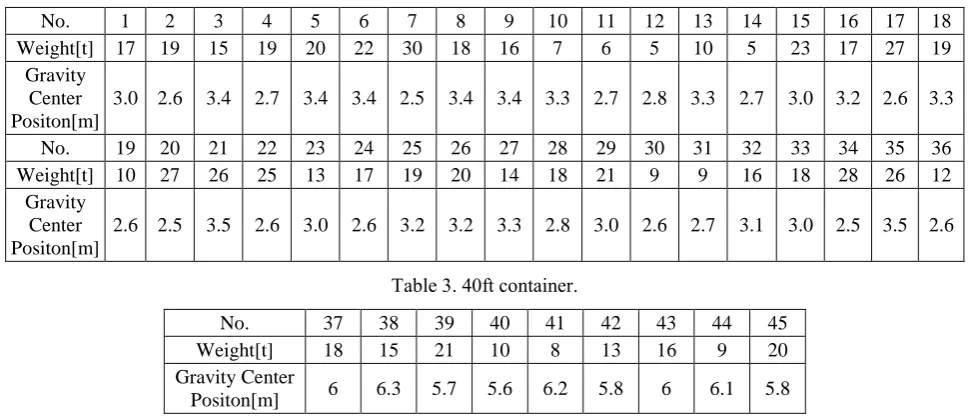
There are 45 containers need to be transported to the same destination, including 9 40ft containers and 36 20ft containers. NX17K flatcar will be used. Table 2 & 3 includes the container weight,
Table 2. 20ft containers.
No. 1 2 3 4 5 6 7 8 9 10 11 12 13 14 15 16 17 18 Weight[t] 17 19 15 19 20 22 30 18 16 7 6 5 10 5 23 17 27 19
Gravity Center Positon[m]
3.0 2.6 3.4 2.7 3.4 3.4 2.5 3.4 3.4 3.3 2.7 2.8 3.3 2.7 3.0 3.2 2.6 3.3
No. 19 20 21 22 23 24 25 26 27 28 29 30 31 32 33 34 35 36 Weight[t] 10 27 26 25 13 17 19 20 14 18 21 9 9 16 18 28 26 12
Gravity Center Positon[m]
[image:4.595.55.541.85.295.2]2.6 2.5 3.5 2.6 3.0 2.6 3.2 3.2 3.3 2.8 3.0 2.6 2.7 3.1 3.0 2.5 3.5 2.6
Table 3. 40ft container.
No. 37 38 39 40 41 42 43 44 45 Weight[t] 18 15 21 10 8 13 16 9 20 Gravity Center
Positon[m] 6 6.3 5.7 5.6 6.2 5.8 6 6.1 5.8
According to Best Fit Algorithm, list the unmatched sets Di of 20ft container i,
D1=0, D2=0, D3=0, D4=0
D5=(11,12,14) R5=3
D6=(10,11,12,14,19,30,31) R6=7
D7=(10,11,12,14,19,30,31) R7=7
D8=(12, 14) R8=2
D9=0
D10=(6,7,15,17,21,34,35) R10=7
D11=(5,6,7,15,17,18,20,21,22,26,29,34,35) R11=13
D12=(5,6,7,8,15,17,18,20,21,22,25,26,29,34,35) R12=15
D13=(21, 35) R13=2
D14=(5,6,7,8,15,17,18,20,21,22,25,26,29,34,35) R14=15
D15=(10,11,12,14,30) R15=5
D16=0
D17=(10,11,12,14,30,31) R17=6
D18=(11,12, 14) R18=3
D19=(6,7,35,21) R19=4
D20=(11,12, 14) R20=3
D21=(10,11,12,13,14, 19,23,24,30,31,36) R21=11
D22=(11,12, 14) R22=3
D23=(21,35) R23=2
D24=(21,35) R24=2
D25=(12,14) R25=2
D26=(11,12, 14) R26=3
D27=0
D28=0
D29=(11,12,14) R29=3
D30=(6,7,15,17,21,34,35) R30=7
D31=(6,7,17,21, 34,35) R31=6
D32=0
D33=0
D34=(10,11,12,14,30, 31) R34=6
D35=(10,11,12,13,14,19,23,24,30,21,36) R35=11
21, 35, 6, 7, 10, 30, 17, 31, 34, 15, 19, 5, 18, 20, 22, 26, 29, 8, 13, 23, 24, 25, 36, 1, 2, 3, 4, 9, 16, 27, 28, 32, 33.
First loading the container which has the biggest Ri, the loading result is(12, 14) (11, 10) (21, 35)
(6, 7) (30, 31) (17, 34) (15, 19) (5, 18) (20, 22) (26, 29) (8, 13) (23, 24) (25, 36) (1, 2) (3, 4) (9, 16) (27, 28) (32, 33) .
The loading plan needs 18 NX17K flatcars for loading 20ft containers, 9 NX17K flatcars for loading
40ft containers.
Conclusion
Based on the actual situation in China, containers loading on flatcar is the analyzed problem, the constraint conditions were confirmed and loading model was established. The validity and practicability of the model and algorithm were validated by an example. For railroad flatcars which can be loaded with two 20ft containers, the best loading plan can be obtained by Best Fit Algorithm.
Acknowledgement
This research was financially supported by the National Key Research and Development Program of China (Project No. 2018YFB1201402).
References
[1] Loh K. H, Bruce G, Edward W. Solving the one-dimensional bin packing problem with a weight annealing heuristic, J. Computers Operations Research. 2006. 10(11) 1-9.
[2] Eunice L. C, Hugo T. M, Peter R. A hyper-heuristic for solving one and two-dimensional bin packing problems, J. Genetic and Evolutionary Computation Conference. 2011: 257-258.
[3] China Railway. Railroad Goods Loading and Securing Rules. China Railway Publishing House. 2015.
[4] Wu Qiang. Railway Container Transportation. China Railway Publishing House. 2011.
[5] Han Mei. Technology of Railroad Freight Transportation. China Railway Publishing House. 2018.