2019 International Conference on Artificial Intelligence and Computing Science (ICAICS 2019) ISBN: 978-1-60595-615-2
Collaborative Clustering Selection Algorithm Based on T-LEACH
Hui WANG, Ming-liang DENG
*and Ping-yuan LIANG
Loudi Institute of Vocational and Technical, Loudi, Hunan, China
*Corresponding author
Keywords: LEACH algorithm, Energy balance, WSN, CMIM.
Abstract. In order to solve the problem of WSN data collection in smart greenhouse under step terrain, factors such as energy consumption, distance and node density are considered in the clustering process, and the LEACH algorithm is improved to achieve energy saving and energy balance. The terrace model of multi-layer stochastic distributed WSN system is established, and the terraced CMIMO hierarchical clustering algorithm, namely T-LEACH algorithm, is proposed. The rationality and effectiveness of the algorithm are verified by simulation.
Introduction
In WSN, energy can be saved through CMIMO technology. With MIMO technology, capacity and transmission speed can be increased under multi-antenna transmission, and at the same speed, energy consumption can be saved compared to SISO[1]. In CMIMO transmission mode, this paper analyzes the energy consumption, distance and density between each node, and selects the cooperative node CN (CN, Cooperative node) to improve the coverage of WSN and extend the life cycle of the network.
The literature[2] proposed a distributed clustering routing algorithm, which proposed a CH competition algorithm, which depends on the residual energy of the candidate CH and the residual energy of its GN in the life cycle. This document also considers the problem that the geometrical dimensions formed by candidate CHs close to the BS are also small. In [3], a new dynamic clustering DCREDT selection algorithm is proposed. The algorithm uses residual energy and distance threshold to cluster. Under the premise of saving energy, the node with larger residual energy is preferentially CH, and CH is realized. Energy balance with other nodes, but does not consider the transmission distance in complex environments and the variation of transmission signal attenuation.
After analyzing the WSN data acquisition in the topography of the terraced fields, the terraced hierarchical clustering algorithm is proposed, namely T-LEACH. The basic idea of the algorithm is to manually distribute the nodes according to the area of the trapezoids in each layer of the network, so that the nodes with high density, close distance and high energy become the working nodes of the current round, and the other nodes enter the sleep state. Thereby better balancing the energy consumption of the entire network and extending the life cycle of the entire network. This provides an important reference value for the later stepped terrain.
System Model
Terraced Area Is Divided
A Model in Which a Hill Node Is Distributed
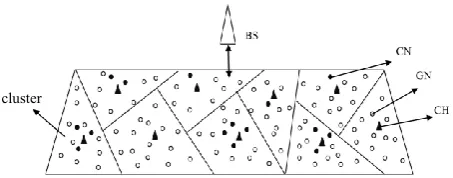
After each layer of nodes is deployed, the density values around each layer of nodes are calculated, that is, the number of nodes in a certain distance around the node is divided by the total number of nodes in each layer. The model of a hilly node distribution is shown in Figure 1. The BS is placed at the topmost center of the terrace. Each layer will be divided into multiple clusters. Each cluster has only one cluster head (CH). There may be one or more cooperative nodes CN around the CH. The common nodes are represented by GN. The MN is a monitoring node (MN) that detects the occurrence of an event, and either CH or CN can simultaneously become the MN. After a period of data acquisition, if an emergency occurs, data is collected by multiple MNs and transmitted via CMIMO, and the data is transmitted to the CH for data fusion. Finally, the data is transmitted to the BS in a CMIMO manner and in a single-hop or multi-hop manner.
For the sake of analysis, the WSN is first assumed as follows[5]:
1)All nodes are randomly distributed evenly in the trapezoidal area, and the ID indicates that each node has a unique address identifier.
2)The BS position is fixed and unique, with unlimited energy. Moreover, it has multiple physical antennas that can handle and access complex routing algorithms.
3)Taking an approximate distance to the transmission distance in the case where the channel state and the bit error rate are known.
4)Single-hop and multi-hop are used for data fusion and reduce the amount of data transmission. 5)The current residual energy of each node can be obtained by calculation.
6)The distance from each node to the BS can be calculated.
Proposed T(i) Formula
The cluster of the LEACH algorithm is established, each node generates a (0-1) random number, and if the number is less than the thresholdT(i), the node is selected as the CH node of the round.T(i)
in this paper considers the residual energy of the node, the distance from the node to the BS, and the density of the node distribution. CH is in the middle of the cluster, which is more conducive to the selection of CN. In the T-LEACH algorithm, the threshold ofT(i)is represented by equation (1):
i r
0 CH-BS total E pN
,
(1-p*(r mod 1/p))E d N
T(i)=
0 ,
. i ch
if i g if i g
s t E E
In equation (1), E0is the initial energy value, Eiis the i residual energy value of the node, Echis
the energy threshold of the campaign CH,
r
Nis the number of surrounding nodes, and Ntotalis the total
number of nodes in each hilly field. gis the set of nodes that have not been selected as CH in the past 1/pround, and mod is the modulo operator. dCH BS− is the distance from CH to BS.
CH Is Selection
Step 1 Each node transmits test information to the surrounding area at a certain distance, and the node receiving the test information will reply the information to the sending node, and the
[image:2.595.168.395.235.324.2](1)
Figure 1. A model of the distribution of a ridge terraces.
transmitting node will determine the number of surrounding nodes according to the number of received reply information nodes. It is then divided by the total number of nodes in each layer (determined by manual settings when deploying nodes) to obtain the distribution density of the nodes[6].
Step 2 By detecting the node itself, the node can obtain its own residual energy value. First, the node residual energy value is compared with the thresholdEch, and the node larger thanEchmay be
selected as CH. In order for the value ofT(i)to be between 0 and 1, the residual energy value must be
divided by the initial energy value to be the node specific residual energy level[7].
Step 3 The distance between the area where the node is located and the BS is determined by the distance between the CH and the BS. This distance can be obtained by node positioning, or the distance can be measured by multi-hop or single-hop transmission.
Step 4 According to formula (1), the threshold of the node in each layer of A,B,C, andDcan be respectively, and the node randomly becomes CH according to the threshold. In order to control the ratio of CH, the value of T(i) can be adjusted.
According to the literature [4], it is reasonable to control the CH in the range of 5%. Since the
CMIMO transmission is performed, the CN must also be selected, so that when selecting the CH, it is not necessary to consider the distance between the CHs.
Step 5 After the CH is selected, the CH will send a broadcast message, and other GNs receiving the broadcast information sent by the CH will choose to join the appropriate cluster.
CN Is Selection
After the T-TEACH clustering process is completed, after the CH passes the data transmitted by the GN into a fusion process, the CN needs to be selected again for cooperative transmission[8]. The
choice of CN is related to the remaining energyEcnof the node, the distance of the node from the CH,
and the state information of the channel. The remaining energy is large, and the node with a small distance from the CH and a node with a good channel state are more likely to become the CN. The selection algorithm for CN is as follows:
Step 1 The CH sends a CN selection command, and after receiving the command, the surrounding nodes return their remaining energy values to the CH.
Step 2 The CH calculates the CN to CH transmission distance according to the received GN response information, and evaluates the channel state information.
Step 3 The CH compares all the obtained GN to CH distances, and selects the most suitable GN to become the CN according to the returned GN residual energy value and the channel state condition.
Simulation and Analysis
Simulation Environment
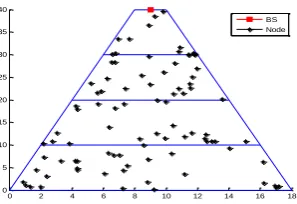
The improved T-LEACH algorithm is simulated and verified by Matlab7.0 and the parameters of each index are analyzed. The running time period is used as the counting unit. 90 nodes are designed to be randomly deployed in the four-layer area of the trapezoid, and the BS position is set in the most terraced area. The top of the center.
Simulation Parameter Settings
In order to prove the validity and rationality of the T-LEACH algorithm, the algorithm was verified by Matlab7.0. The parameter settings are as follows[9]:
Rationality of T-LEACH Algorithm
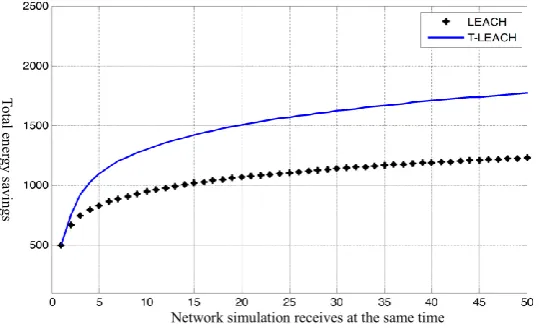
The simulation mainly compares LEACH and T-LEACH from the energy saving comparison chart of one-hop reception at the same time. The simulation parameters use Table 1.
[image:4.595.208.357.59.161.2]It can be seen from Fig.3 that in the same life cycle, the improved T-LEACH algorithm saves a lot of total energy consumption at the same time compared with the traditional LEACH, so that the entire network can extend the life cycle because of the improved T. The T-LEACH algorithm considers the energy consumption, distance and density values of CH, thus avoiding the possibility of traditional LEACH randomly selecting CH, better saving energy consumption, greatly reducing the premature aging of nodes, and making the entire network energy consumption Equalization.
Table 1. Parameter settings.
[image:4.595.151.458.298.416.2]
Parameter value Parameter value Parameter value
Figure 2. Randomly distributes the nodes of the trapezoidal field.
0 2 4 6 8 10 12 14 16 18
0 5 10 15 20 25 30 35 40
The result shown in Figure 4 is that the improved T-LEACH algorithm is much more efficient than the traditional LEACH algorithm in one-hop reception at the same time, because the energy consumption of each layer is considered in the T-LEACH algorithm. Consumption and energy consumption of the IST. Because the attenuation factor is considered in the whole energy analysis, it can save energy and perform the CMIMO one-hop transmission mode. So let the entire network improve the network life.
Summary
This paper studies the terrace structure of Xiang Zhong area, which is the most typical step terrain, and constructs a terrace model. A terraced CMIMO clustering algorithm T-LEACH is proposed. The algorithm selects nodes with large energy, close distance and high node density to be selected as CH, and combines single-hop and multi-hop CMIMO, and selects CN for transmission, which can balance the energy consumption of each node and make the whole The network life cycle is extended. The above simulation results show that T-TEACH is significantly better than LEACH protocol in network life cycle, which is very suitable for hierarchical clustering design under step terrain. Further improvements will be made in the location of the BS in further work.
Acknowledgment
[image:5.595.147.419.82.254.2]The project was supported by the National Natural Science Foundation of P. R. China (61173018). P. Liang is the corresponding author.
Figure 3. Save energy savings during the same time.
To
tal
e
ner
gy
sa
vin
gs
The network sends at the same time
Figure 4. Comparison of the same time to receive energy savings.
To
tal
e
ner
gy
sa
vin
gs
[image:5.595.167.437.387.551.2]References
[1] Wei Zhang, Zhongxun Wang, Yang Yu, Baojun Liu. Research on LEACH Clustering Routing Protocol in Wireless Sensor Networks [J]. Communication Technology. 2016(08).
[2] Chang-Jiang Jung, Wei-Ren Shi, Xian-Lun Tang, et, al. Energy-Balanced unequal clustering routing protocol for wireless sensor networks [J]. Journal of Software, 2012, 23(x): 1222-1232.
[3] A.F. Liu; X. Jin, U.H. Cui, Z.G. Chen. Deployment guidelines for achieving maximum lifetime and avoiding energy holes in sensor network [J]. Information Sciences, 2013, 230(1)197-226.
[4] Pingyuan Liang, Xingcheng Liu, Chun Shi, Xiwei Luo. Research on dynamic clustering selection algorithm for multi-hop WSN based on CMIMO [J]. 2010, 36(10): 1401-1408.
[5] Cheng-long Hu, Yong-zhen Li. Research on Multi-Hop Routing Protocol of Wireless Sensor Networks Based on Gradients. 2018 International Conference on Computer Science, Electronics and Communication Engineering(CSECE2018).
[6] Siran Wang, Yan-xia Wang, Yun-jian Tang. An Improved Uneven Multilayer Cluster Routing Algorithm for Homogeneous WSNs Based on Cooperative Relaying. 2016 3rd International
Conference on Materials Engineering, Manufacturing Technology and Control (ICMEMTC 2016.
[7] Jie Huang. A Double Cluster Head Based Wireless Sensor Network Routing Algorithm 2017 IEEE 8th International Conference on Software Engineering and Service Science.
[8] Imran Rashid, M. Adnan Nasim, Adeel Akram. Relay Based Clustering with Least Distance Cluster Head Selection for Wireless Sensor Networks. 2013 15th IEEE International Conference on Communication Technology.